







Abstract
The caste system in India traditionally confers immense prestige to upper caste Brahmins and severely curtails the backward castes. In spite of institutional efforts to diminish caste-based discrimination, several contemporary studies underscore the invisible ways in which caste operates. The central question that this article asks is, ‘How do Brahmins maintain and assert their privilege today?’. Focusing on the Brahmin residents of Deulpota (village in West Bengal) and rural Brahmin migrants in Kolkata (city), I trace their social networks to learn about how Brahmins subtly maintain their status and privilege in day-to-day life. I argue that Brahmins form and maintain social networks in ways which innocuously preserve their privileges through social capital accessed from diverse asymmetrical relations. These privileges and advantages are sustained through Brahmins’ networks of the instrumental kind. Wealthy Brahmins forge these relations to preserve their social position, their family lineage and to control the subordinates while the struggling resource-poor Brahmins use their caste position to cope with impediments of their class status. As such, this study shows how being Brahmin allows for easier access to important instrumental relations (which are not merely caste-based) and resources embedded in them.
Introduction
The caste system in India, one that traditionally confers great prestige to the upper caste Brahmins and severely curtails lower caste groups, is a marker of privilege by birth. This ascribed unearned privilege is an inherent part of caste structure that which ranks individuals into relationally superior and inferior caste categories. Occupying the highest rank in the hierarchy, Brahmins have held positions of power and religious authority, with a disproportionate share of privileges such as wealth and land ownership, social status and dominance over lower caste groups. Such forms of authority, legitimized through religion, which Weber (1947) terms as ‘traditional authority’, granted them advantages in economic and political spheres of life through transmissibility of capital (Bourdieu, 1986). Prestige and respectability, as Bourdieu calls ‘symbolic capital’, along with economic and political power, are also gained under these circumstances and transmitted across generations.
Intrinsic to caste-based privileges is the inter-relatability between different caste groups or varnas. 1 Through ownership and control, privilege is as much about Brahmin personal asset as much as it is about their relationship with other social groups. Similar to McIntosh’s (1988) assessment of White privilege in the United States, in which the use of privilege to dominate/oppress can be hidden, Brahmin privilege too is not just about unearned advantages but how it is used as a means to dominate the lower castes. Post-colonial sociological and anthropological studies underscore the importance of caste in regulating inter-caste and intra-caste relations. Ethnographic works on caste relations, such as Pocock’s (1972) study of the Patidar community or Srinivas’ (1976) observations in Rampura, provide rich details on socially sanctioned norms and rules that drive caste-based behaviour and interpersonal relations. This study revisits inter-caste relations in the present-day Indian context to examine Brahmin privilege today. However, since Brahmins are internally stratified into several jatis, it deviates from treating Brahmin as a homogeneous category in the varna system, although there are common features that operate at both levels. Brahmins do not exist in isolation and the manifestation of their privileged status is contextual and constrained by structural and cultural factors (Bairy, 2010). The key driving forces that influence caste relations and Brahmin privileges are the following:
Changing forms of pollution and purity, a crucial component in the hierarchical order of caste-based inequality in which high caste is deemed ‘pure’ as against the lower ‘impure’ castes (Dumont, 1970). Scriptural notions of pollution, centred on different aspects of Hindu public and private life, are an exclusionary force, constraining inter-caste relationships. Traditionally local temples managed ritual systems within villages, in which boundaries were set internally, regulating relations among caste groups and thus perpetuating ranking among castes and sub-castes in the name of religion (Dirks, 2014). However, with the rise of Western education, purity/pollution practises among the urban upper caste members started to change, followed by their rural counterparts (Shah, 2007). Moreover, the Indian state redefined social expectations of caste by abolishing untouchability (Revankar, 1971). More recently, Fuller and Narasimhan (2014) explicated how Tamil Brahmans modified their traditional rules of purity to fit into urban life and modern professions. A process of de-ritualisation is apparent. Nevertheless, Bayly (1999) cautions against a linear transition from ritualisation to de-ritualisation. As such, rules of purity/pollution are more dynamic and vary contextually.
The decay of traditional caste 2 -based occupations. The economic liberalization – the transformative phase in the end of 20th century – led to a sea change in traditional caste-based occupations, in which government rules and regulations loosened up to promote foreign trade for better growth, efficiency and resource allocation in response to market forces (Gupta, 1993). For instance, the traditional patron–client jajmani relations 3 were sanctioned and practised by both rulers and the village community, based on land ownership, and controlled by the upper castes (Dirks, 2014). However, jajmani relations have modified, changed and diluted over time, so has its moral claims (Kumar, 2016). With urbanization and rural to urban migration, Brahmins have dispersed into several modern professional fields. The Tamil Brahmins, for instance, a traditional small elite group, is disproportionately represented in the urban IT sector of India (Fuller and Narasimhan, 2008).
Constitutional reforms like reservations for scheduled castes, scheduled tribes and other backward castes (a form of affirmative action) as well as increase in democratic participation among lower caste members (Jaffrelot, 2003), have helped weaken the moral claims that caste groups impose on its members. In this regard, it is to be noted that the analytical shift from the dominant construction of caste as hierarchy (Dumont, 1970) to caste as difference (Gupta, 2004) draws attention. Caste as hierarchy presents a single varna system that ranks caste groups into ‘superior’ and ‘inferior’ positions. But social stratification is not just about classifying people into different strata. Overstating hierarchy ignores the cultural distinctiveness, regional variations and historical significance that a particular caste (or sub-caste) participates in. Understanding caste as difference incorporates multiple hierarchies because it allows castes and sub-castes to maintain their discrete character and identity (Gupta, 2004). By questioning hierarchy, his alternative theorisation underscores that the inherent power dynamics with which caste members relate to each other needs to be questioned.
However, contemporary empirical studies have demonstrated that caste not only matters, but is still relevant for the Indian social sciences and the society at large (Fuller, 1996; Harriss, 2006; Jodhka, 2012). In liberalized India, caste takes on a more complex nature. For instance, within the system of arranged marriages, while technology has changed old methods of forming alliances with new, the arrangement itself has remained unchanged (Majumdar, 2009). A recent report demonstrates how caste endogamy is still the dominant form of arrangement, more so among the richer and urban middle class than among the poor. 4 In the realm of higher education, what seems like a meritocratic setup in which achievement is an outcome of one’s ability and hard work, upper caste overwhelmingly dominates (Subramanian, 2019).
This paper builds on the above scholarship that exemplifies how caste, still persistent, operates in insidious ways and reveals what lies below the surface. The central theme is Brahmin privilege, a crucial intervention in academic scholarship that is rarely examined in light of our present context. The Dalit 5 perspective on caste inequality is rich in details on varying aspects of Dalit life that visibilizes modern forms of discrimination and social exclusion. But similar research on Brahmins, who are at the privileged end of the caste spectrum, has not received due attention. As Deshpande (2013) rightfully notes, there is a hypervisibility for the lower castes but invisibility for the upper castes, in real life as well as in academic research. The study aims to shed light on this invisibility of the Brahmins in academic scholarship.
This research seeks to understand how Brahmin privilege operates today, putting the Brahmin individual at the centre of analysis. How do they access these privileges? It employs social networks as a lens to understand their personal worlds and examine who they are connected to, who do they interact and spend time with and who do they seek help from, emphasizing on acquaintances and other instrumental relationships with individuals from other socio-economic backgrounds. Narratives of Brahmin interactions highlight the expansiveness and durability of Brahmin networks, and how they maintain them. I argue that Brahmin social capital, 6 accrued through diverse instrumental relations, is a form of privilege that they maintain through their everyday association with others. Brahmins’ everyday networking has allowed them to innocuously preserve their privileges by forging new kinds of relations 7 amid changing contexts, and in situations where ascribed privileges may not be easy to access.
The case of West Bengal, the field site for this study, is stereotyped as a liberal state where even as far as 19th- and early-20th-century, a number of comments by noted public intellectuals hinted at the absence of caste discrimination (Sen, 2018). Up until the recent past decades, with the Communist party ruling Bengal, the rhetoric of caste absenteeism has remained persistent. In reality, the upper caste Hindus in Bengal have monopolized the topmost positions in all fields, without any significant resistance from the lower caste (Samaddar, 2013). Although numerically a minority, they are dominant (Broomfield, 1982; Srinivas, 1959), economically, politically and through Western education, both in village and city contexts.
In the urban context of Bengal, the Bhadralok is a commonly used ethnic terminology representing the upwardly mobile, English-speaking upper and forward castes. As elite members of the society, their position in local self-governments and education boards gave them institutional strength which enabled them to forge relations with resourceful positions such as teachers and lawyers (Broomfield, 1982), as opposed to the Chotolok, a term colloquially used for the disadvantaged low caste/class members (Sinha and Bhattacharya, 1969). The Kulin Brahmins, also a regional variation of the varna system, are the traditional Brahmin elites of West Bengal, who held much of Bengal’s land, wealth as well as the press (Broomfield, 1982). Historically, the term ‘Kula’ in Bengal indicated this elite status and ‘Kulins’ used to refer to persons belonging to this status group (Chatterjee, 2005). Individual social status and perceptions of the other are largely shaped by sense of superiority and inferiority built around such categorizations.
With due consideration of the macro Indian reality as well as the specific case of Bengal, the subsequent sections deal with the conceptual framework on which Brahmin privilege is built and an empirical investigation of the same in rural and urban contexts of Bengal.
Identifying Brahmin social capital
A crucial part of everyday life, social networks are important for the support, care and well-being they facilitate. They are also an important tool to analyse social engagement among different social groups and cultures (Melamed et al., 2020; Putnam, 2000). The advantages from networks lie in the resources that individuals and communities benefit from. These resources, one accrues from his networks, are widely termed as social capital. But the flipside of support is social closure (Coleman, 1988) and exclusion of out-group members. In this sense, social capital is created out of ‘durable networks of more or less institutionalized relationships of mutual acquaintance and recognition’ (Bourdieu, 1986: 51) and thus facilitates an understanding of the deep structural fault lines that segregate societies.
In societies marked by high levels of inequality, resources are unequally distributed among different social groups. Bourdieu (1986) emphasizes that by reinforcing social relations through unequal flow of resources, social capital constantly reproduces inequality. Thus, the abundant value of social capital notwithstanding, its distribution is often non-egalitarian. In this regard, an analysis of social capital accumulation links macro and the micro processes and holds the potential to unpack how social structures affect personal networks and constrain (or facilitate) access to social capital.
For this study, I take a micro qualitative approach to social capital, that views social relations as innumerable ties that connect individuals to each other, albeit set against a macro-structural canvas. It provides a useful framework for analysing network advantages that individuals gain from their social position. In particular, examining social capital draws attention on the social location that the individual occupies in the structural hierarchy, as well as the cultural the meanings associated with it (Erickson, 1996) and the resources circulating within relations. In studying social networks of Brahmins, I focus on how their relationships garner them certain advantages or access to social capital. Two important gateways to recognize this is by looking into (1) Brahmin connectivity with diverse heterogeneous relations, particularly, (2) asymmetrical relations:
Heterophily is about diversifying networks, a quality that connects people from varying structural and cultural attributes. By connecting people from different socio-cultural backgrounds, heterophily is an integrative force and explores social cohesion among different social groups. By contrast, homophily indicates that people with similar structural attributes tend to socialize more (McPherson et al., 2001). This is re-inforced through closeties. But at the same time, it excludes others who are not from similar social worlds (Baron et al., 2000). In this way, those in power exclude their subordinates from resources they themselves have access to (Tilly, 1998). In literature, while social capital is attained through close relationships, mainly family, friends and relatives, instrumental ties such as acquaintances also play an important role because they help individuals gain social leverage (De Souza Briggs, 1998). It is well demonstrated that networks outside one’s social group are positively related to social mobility (Lin, 2001) such as in the labour market (Chua, 2011; Granovetter, 1973), or for better health (Cornwell, 2009). Building on these conceptual and substantive dimensions, I look at relations outside the Brahmin individual’s immediate close circle of relatives and friends.
The persistence of caste through marriage alliance and family ties is well documented. Patriarchy and kinship are deeply interwoven with caste. Several studies focus on the role of kin relationships (Patel, 2005), which highlight the prevalence of caste homogeneity through families and extended kin. The importance of close relations notwithstanding, in this study I emphasize on Brahmin heterophilous relations to understand motives, strategies and meanings of their relations with others outside their immediate circles. I examine acquaintances, people who play an instrumental-functional role in their day-to-day lives, yet not closely paid attention to. In a south Indian village society, Srinivas and Béteille (1964) had observed that networks are potentially useful mechanisms for social mobility since a diverse set of networks helps an individual forge ties outside his caste and village and helps loosen strong in-group ties. However, it is not to be mistaken that this led to an overhaul of social barriers. Through caste heterophilia, Natrajan (2011) found a new form of casteism, shifting away from traditional Dumontian (1970) lens of monopolistic caste-based exclusionary behaviour and practises. Differentialist casteism, as he terms it, maintains that caste ‘. . . could as easily operate without a dread of or fear of difference but rather with a desire for and yearning to see and maintain cultural difference along lines of caste’ (Natrajan, 2011: XVII). In other words, the underlying processes of discrimination might be overlooked by what appears to be cultural differences between caste groups, and hence natural. This is particularly important for Brahmin privilege which is not just about occupying the highest caste position but also about maintaining a cultural distinctiveness:
2. For a relational account of Brahmin privilege, I specifically examine their asymmetrical relations, as I earlier indicate that Brahmin privilege is closely tied to their relationship with other caste/class members. Individuals related to each other asymmetrically hold unequal power and status. In other words, it has a clear focus on those who are in positions of control and those who are dependent. In contemporary social capital literature, asymmetrical ties need urgent attention, that was earlier featured in the influential works of social theorists like Simmel (1896) who studied superiors and subordinate relationships, Homans (1950) who studied master and servant relationships and more recently the one by Stanton-Salazar (1997) who studied the relationship between youth and institutional agents such as teachers and counsellors.
I rely on Brahmin networks to examine asymmetrical inter-caste relations. These relations, characterized by unequal power and resources, are those in which the Brahmin are in a superior position or subordinate position (in terms of class position) compared to their network members. In one of his later works, Béteille explained how caste, class and power are closely tied to each other in determining social relationships among villagers and their connections beyond the village boundaries (Béteille, 1965). Here, Srinivas and Béteille’s hope of inter-caste connections was based on the assumption that mutual need and reciprocity could be a conduit for building more egalitarian relations between Brahmins with others. Several decades later, I examine whether such has been the case.
The jajmani system is a classic example of a common practise between individuals in asymmetrical relations. In rural India, this system was a dominant type of patron–client relationship. Coined by Wiser (1936), in this system the lower caste landless peasants work for the rich upper caste landowners. This bonds them within a long-lasting relationship of trust and obligation. However, for the purpose of this study, I broaden the focus to include any instrumental relation outside close-knit families that are asymmetrical in nature. Given the strong hierarchies in India, for example, along class and caste lines, a study of asymmetrical ties would be most appropriate, for the context at hand (Srinivas, 1976).
The above network characteristics aim to uncover how Brahmins connect with others, what makes them form these contacts and why do these networks matter.
Methodology
The data used in this article are part of my dissertation 8 data collected on social networks of village residents and rural work migrants in India. I conducted interviews in two field sites from October 2014 to August 2015, in Deulpota (village field site) and in Kolkata (city field site), capital of West Bengal and about 100 km away from the village. A qualitative enquiry through observations and in-depth interviews of 26 Brahmins: 15 village residents residing in Deulpota at the time of interview and 11 Brahmin migrant workers in the city revealed their everday lives and social interactions. These Brahmins are primarily adult male members, between 22-69years old, and engaged in diverse occupations. After spending about six months collecting data from the village, I followed family members and friends of those who have migrated to Kolkata, and spent the next four months tracking, talking and observing Brahmin migrants in Kolkata.
Brahmins in Deulpota and those who migrated to Kolkata are numerically a minority. Other castes in Deulpota include the Mahisyas – agricultural middle castes (numerically the largest) – and the Dalits (or, the Scheduled caste). All the Brahmin interviewees are Kulin Brahmins, part of the larger group of Bhadraloks, with ‘Chakraborty’ or ‘Mukherjee’ as their surnames. In the findings, I use ‘Brahmins’ and mention their class background. For the sake of clarity, I use ‘lower castes’ when I’m comparing Brahmins with all others. However, I mention the the caste category (for instance, Dalit) when I emphasize on a particular caste other than Brahmin.
I met officials from the Panchayat administrative office who took me around Deulpota and introduced the village head. I attended several informal group gatherings in public spaces and events in Deulpota that stretched across the entire fieldwork time and established relationships with the village Brahmins. Through them, I contacted the city migrants. I examined them in their everyday natural settings and their associations with other people. I took detailed notes on their work life, friendships, neighbourhood co-operation and encounters. However, observations of Brahmin social lives in the city were restricted since most of the respondents have long working hours. Details of Brahmin profile in the two settings are as follows:
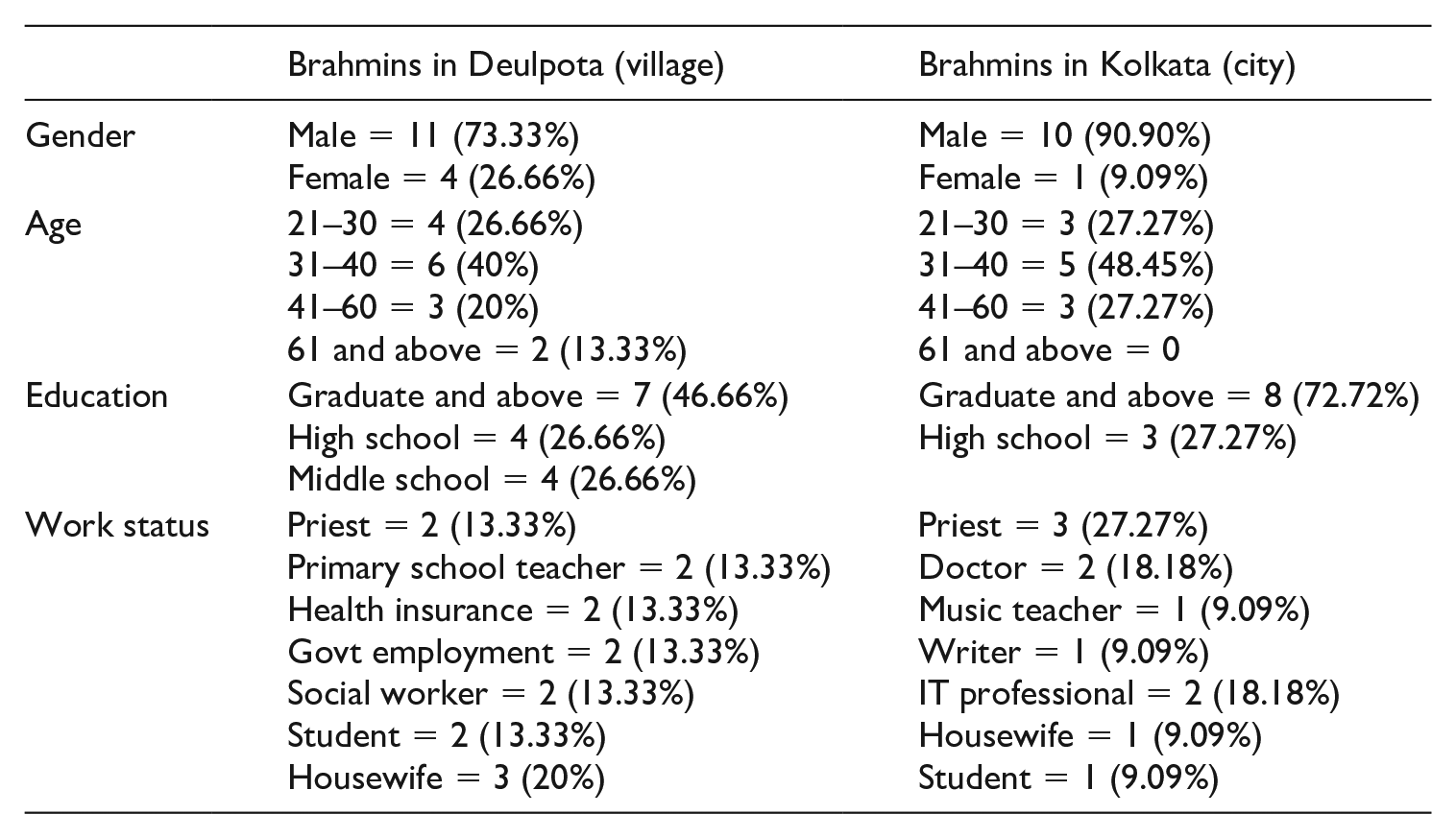
I have taken individual Brahmins as the unit of analysis. I capture variations within overarching commonsense understanding of Brahmin identity. A few specific standard network questions were asked so as to get comprehensive details about their relationships, specifically who they associate several daily life situations with. These include ‘who do you go to discuss important matters’, ‘if needed who do you borrow money from’, ‘who do you approach for emergency help in the city’, ‘who do you spend leisurely time with’ and ‘who do you approach when in sudden trouble’. The rest of the interview followed deeper into their motives and behaviours, and the often hiddendynamics of one’s networks was brought to the surface.. Studies on heterophily, social capital and their relationship to social inequality are mostly quantitative. Using a qualitative approach is also intended to look beyond common categorization of relationships used in sociological scholarship, such as close kin, friends or neighbours and focus rather on the underlying networking processes, its purpose and function.
Invisibilizing Brahmin privilege
Deulpota residences are segregated caste-wise, a common characteristic of Indian villages. The Brahmin neighbourhood comprises wealthy and humble Brahmin families. The village headman is a Brahmin octogenarian, landowner and well known among villagers as someone who takes care of village needs. When I spoke to him, he reiterated how his ancestors dedicated their lives for the welfare of the village. The primary school, village temple and doctor’s clinic were set up by this family and in the past several decades they actively managed them. Two of the teachers from the primary school also live here. Similar to the larger Indian context, education, religious rituals and modern professions in Deulpota and Kolkata have been dominated by the Bengali Brahmins. Hence, relationships are often formed and regulated by them. However, with increased levels of education, diverse work prospects and material prosperity among non-Brahmin residents, Brahmins in Deulpota or Kolkata do not see themselves as privileged. Minati, a 50-year-old Brahmin housewife stated, ‘dudh jol shob mishe gache’ Milk (Brahmins) and water (Dalits) have mixed now
What Minati meant was that there is no caste discrimination in the village and that the Brahmins and Dalits have intermingled. However, her furtive glance to the ground that had accompanied these words also indicate a tinge of sorrow, as if a position they once held is taken away. Her reference to caste as a matter of the past also implicitly leads one to believe that a change in the social environment is imminent, in which Brahmin outward, conspicuous and socially acceptable forms of domination are no longer the norm.
Conversations with respondents indicated co-existence among villagers based on mutual respect, trust and concern for each other. They explained their relations with others as community-like, for instance, ‘we know each other for decades and maintain good relations with one another’, ‘we run to help each other’, and ‘here, we have no fear of burglary, theft, or violence’. Such perception about mutual co-operation and equality points at the absence of visible caste discrimination. The question, therefore, is whether Brahmin self-perceived absence points at a shift in conventional ways of maintaining their privileged positions or the rise of a new language of power, influence and control.
Prolonged interactions started to uncover Brahmin connections with influential people and institutions. For instance, Samiran, an older Kulin Brahmin from Deulpota, reminisced, The last crime in this area was around four years back, of one of our fellow villagers who came home drunk and beat up his wife. The whole village came together, discussed and decided to hand over the matter to the police. I am in good terms with our local police officer and contacted him immediately.
Beyond the act of helping out, what is also to be noted is Samiran’s ‘good terms’ with the local police. This influence comes from his position of economic and political power that his past and present generations have accumulated. Villagers come together and hold meetings to discuss matters concerning crime, family disputes, village development initiatives or religious and social events. Although Brahmins, Mahisyas and Dalit representatives are present in these occasions, giving all social groups an equal right to participate, the decision makers are older Kulin Brahmin men, who are well connected with individuals in positions of power and authority.
By contrast, Brahmin migrant interviewees in the city experience a different world around them. Unlike the geographical arrangement in the village, neighbourhood, work and personal connections are not constrained by caste. City neighbourhoods are segregated by class and Brahmin migrants in Kolkata live in a range of housing from slum dwelling, dormitories to apartments in housing complex based on their occupational status. Kartik, a young unmarried Brahmin IT professional who lives in a shared apartment with three other professionals, said, My colleagues and roommates are my friends. When I face any problem, and need urgent help, they are there to help me. After working for six days a week, I prefer to simply stay back at home, spend time with them, cook a meal together and maybe watch movies
Kartik’s roommates 9 are not Brahmins, but they belong to forward castes. 10 Leading middle-class lives in the city, caste has no apparent significance in their day-to-day life. Their frequently shared activities show that they co-operate and help each other out to get by struggles of everyday life such as work pressure or financial constraints. They do not possess the degree of influence or control that Brahmins in Deulpota have. This group, who think of themselves as ‘caste-less’ (Deshpande, 2013), is higher educated, modern city professionals who dismiss the role of any caste influence in their lives.
The politics of caste invisibility is reflected in Brahmin narratives of their daily life. This is done through the presentation of village as community and its adherence to mutual co-operation, a change of dominant Brahmin identity and ways in which they relate to others or the influence of city life on migrants. Implicit in this denial is also an assertion that caste no longer matters. Accounts of interactions in Deulpota and Kolkata suggest that caste privilege is denied, overlooked, a thing of the past or a medium for social good. To understand the manifestation of Brahmin privileges in all its complexities, this article examines a crucial feature of social life, who they are connected to and what meanings lie underneath.
The following section focuses on Brahmin asymmetrical relations with individuals occupying social positions and resources different from them, to recognize networking mechanisms and strategies that Brahmins use to hold on to their positions of power.
Formal relations and privileging mechanisms
Interviews and observations uncovered the diverse range of Brahmin networks besides close family, friends and neighbourhood relations. I particularly find those networks illuminating in which the power difference between the Brahmin individual and his contact person is the defining characteristic of their relationship. I term them ‘formal relations’. Formal relations comprise relationships that Brahmins form, maintain and primarily interact for functional purpose, either in the context of receiving or providing service or help. Most often, situations that initiate the active use of these relations are tied to their economic lives, relating to jobs, education, finance or housing. In doing so, these are networks sought for day-to-day needs as well as bigger life transitioning events. Kanai, a lower class Brahmin Deulpota resident, was the first interviewee to highlight these relations when he talked about an ongoing land dispute between him and his uncle:
who is helping you out regarding the land issue?
I went and spoke with our local politician. Later, one of his workers came to visit our land. With the help of the politician I have been trying to get a fair trial on the ownership of this land. I am a poor Brahmin and don’t have any other assets.
. . . I am poor, I cannot pay bribe. But we Brahmins are always in the service of helping others. Hence, we are respected and people look at us differently.
Kanai explained helping others not as a human quality but as a moral responsibility of the Brahmins in which reciprocity not only arises from familiarity with one another, but by simply being Brahmin. In a village setting, where people know each other, there is an indication that Brahmins stand out because of values and beliefs attached to their positions.
In the city, Babul, a young Brahmin student, spoke of his landlord while narrating his recent bike accident: Last year I had a bike accident. With a fracture, I could not move my leg for three months. Although my mother came and stayed with me, Raja da (landlord) was the one to reach the hospital when it first happened. Not only did he stay with me until my family arrived, he also paid the necessary bills which we later repayed. He is my local guardian.
Babul’s relative arranged for his stay in Kolkata near the college he got enrolled in. Although he knows the landlord for about a year, his landlord has become his guardian. The helpful nature of the landlord being evident, Babul’s tone was also signalling something else about the landlord’s behaviour towards him. He added, I do not have any bad habits; I don’t hang around till late night like my friends do. Mr Raju trusts me.
Similar to Kanai’s case, mutual trust is not just based on relationships between families in Deulpota and Kolkata, but is also a moral character presented of the Brahmin self, 11 a character that grows out of Brahmin identity, is accepted by others, and helps establish trust between an otherwise unequal landlord–tenant relationship. Their examples illustrate the privileges of general trust that people have on them, especially when they migrate to an unfamiliar space. Underneath the mundane act of approaching acquaintances for instrumental purpose lie others’ biases that are normalized. And this is how the Brahmin positions his own self to garner those advantages.
In the course of the interviews, Brahmin respondents mentioned doctor, factory owner, office senior, teacher, shop owner, health insurance agent, employer, retired government officer, and so on. These relations range from acquaintances to those they are closer to. But they are all asymmetrical in nature and characterized by difference in resources, power or wealth. While in the village it is generally the influential persons such as political party workers or police that Brahmins name, professional relations such as bank official, lawyer, and landlord comprise majority of formal relations in the city. It is the position and the resources these networks hold, that Brahmins seek out for. Formal relations include not only asymmetrical relationships within formal institutions but also informal ties between doctor and patient. These relationships are defined more by their relative socio-economic positions (like the good landlord and the helpful banker), less so by the nature of the relationship itself (like friend and neighbour).
To explicate this further, I divide the Brahmin interviewees into two economic categories to examine Brahmin privilege in greater detail: (1) the hoarders of information, wealth and power, and (2) the strugglers, economically at a disadvantaged position without adequate resources of their own. This distinction is made for three main reasons: First, to address Brahmin heterogeneity within the limited capacity of this study. For instance, the landlord of the village is contextually in a different position from the educated professional in Kolkata, but in both cases, they are hoarders of important resources such as ancestral property and advanced education degrees. Second, this captures the struggle of a Brahmin migrating and familiarizing himself in a new setting (city), without the benefits of his village identity. Third, it places the Brahmins in two spectrums – as seekers of resources and as providers.
The hoarders
Bijon Chakraborty, a middle-aged Brahmin resident of Deulpota, explained why he reached out to help this young man called Jeet, a meritorious Dalit student from his village. Jeet’s grandfather was a landless farmer who worked for Bijon’s father. His mother is a domestic help at Bijon’s house and father works as a driver in Kolkata since farming could not support the education of Jeet and his sister. Similar to Kanai’s use of words, Bijon reiterates, I try to reach out to the underprivileged as much as I can. As Brahmins, it is our duty to look after the welfare of our village. Now Jeet is a meritorious student, who is very poor. So I spoke to the school principal and got him admitted there. On top of that, unlike other students he did not have to pay fees.
He further adds, My father was a reputed doctor of Deulpota. Everyone respected him and he gave his life to the service of mankind. It is his reputation and goodwill that has passed on to us. That is how I know the principal of the school.
Just like Kanai, Bijon’s narrative also points at a moral stance justifying his actions. He is helping out a poor Dalit family, not only by providing them their daily sustenance but also by showing them a light of hope for future. It is also about maintaining a social position inherited from ancestors. Helping garners symbolic capital, through status and prestige, for Bijon’s family.
In the city, where the Brahmin migrant comes out of his familiar social space, privilege enables soft coercion. Mrs. Kalpana, 65-year-old Brahmin housewife, often spends her evenings with her social club friends and she is also part of an informal writers’ club where she discusses her writings with others. Kalpana mentioned her trustworthy domestic help who she brought from her native village Deulpota twenty years back. Mrs. Kalpana introduced her with a show of pride: Rina is from my native village. I have brought her here. After her husband’s untimely death, she needed work. She came here with me leaving her 4-year-old son behind. Eventually the son followed her and is now working for us as our driver. He is like our son.
Rina is a 41-year-old, Dalit migrant from Deulpota. Back in Deulpota, her husband was a landless farmer. While on one hand Kalpana is the one to bring Rina and her son and provide them with means of survival, the Dalit family is tied to this family ever since. When I asked Kalpana how close is Rina to her, Kalpana immediately replies ‘she is like family’.
The unequal relation between employers and servants in Indian households is demonstrated as a class phenomenon in which the ‘culture of servitude’, relations of dependence and obligations by which a servant is tied to the employer, talk about an ever-evolving modern elite and the nature of relationship with their subservient helpers (Qayum and Ray, 2003). Kalpana is a Bengali upper class Brahmin bhadralok. She is not just Rina’s employer, but also the one who helped her in times of distress by bringing her to the city and providing a sense of security in a land of strangers. Rina cooks, cleans and takes care of Kalpana’s ailing mother-in-law. Kalpana’s years of relationship with Rina is not ‘intimate’ or ‘mutually confiding’ (Marsden and Campbell, 1984). Neither is it totally instrumental. Norms attached to roles, as Parsons and Shils (1951) note, lead the individual to reciprocate to mutual expectations. The jajmani relationship that Rina’s ancestors had with Kalpana’s has changed dramatically over time, but the power dynamics remain, and manifests in subtle ways, more so in the city today where people like Rina and Kalpana live under the same roof and eat the same food. Their unequal class relations are accompanied by mutual expectations that bear the mark of their family histories; the village they come from, their respective caste positions and underlying obligations that both their ancestors have had towards each other. Thus, while the difference between domestic servant and owner is primarily defined by class, caste is deeply entrenched and is the force that implicitly sustains the relationship. . It is this history that ties the families beyond the economic, into a more complex relationship of caste, class and their village roots even though the traditional de-personalized, feudal character of of the Jajmani system has changed. In this sense, the connections that Brahmin hoarders living in the city have with their village, is not just holding on to their village roots, but also their positions of power. Brahmins have long been regarded to be upholding their status and role as providers of resources and support to the landless peasants and underprivileged groups. But migration to the city space where class is dominant is a conduit through which upper class Brahmins re-assert their caste privileges as well.
The strugglers
In Kolkata, I met Shankar and Ganesh, Brahmin priests from Deulpota. Both of them left the village a decade back in search of work in the city. They found a living in the slums of Kolkata. Slums in Indian cities are overcrowded, informal housing for the poor. Adjusting to the ways of new neighbours who were all lower class and caste members, other ethnic backgrounds with habits and routine different from theirs, was hard. With what they called a ‘safe’ environment back in the village amid others from similar caste background, the Brahmin priests lamented about the changed social environment in the city: ‘Young boys and girls smoke in front of their elders and come home drunk,’ Shankar grinned, and ‘people fight over petty issues’.
After two years of adjusting to that environment and talking to clients about their struggles, who are mostly middle and upper caste bhadraloks who visit the temples they work in, Shankar and Ganesh made connections with the local influential political party worker and managed to leave the slum and get a living space in local temple premises. Having sole monopoly over priesthood, both of them strategically utilized their position to get access to a neighbourhood conducive to their way of life. When lower caste, especially poor Dalit workers migrate to the city for work, they mostly live in slum dwelling, and is a stark reality of how migration to the city not only excludes them from other social groups but also relegates them to the urban poor. 12
Shankar and Ganesh reached out to the right people, using the kind of instrumental networks which, as De Souza Briggs (1998) points out, help the poor in both ‘getting by’ and ‘getting ahead’. The direct role of caste in the mobility stories of Shankar and Ganesh is less obvious, so are the privileges. The reason why upper castes have traditionally maintained their high status is because of their political power backed by land ownership (Gupta, 2004; Singh, 2008). But in the absence of such material privileges, lower class Brahmins like Shankar and Ganesh come to Kolkata in search for work. Although their journey is different from that of the hoarders, caste status plays a crucial role in allowing them access to important resources . How they reached out to individuals who could help them is a combination of their status as priests, circumstances (living in poor conditions) as well as conscious decision-making (building rapport with clients and owners of localtemples). Channelling their networks resulted in privileges: money, better housing and higher respect. When they migrated to the city for work, they became part of the urban poor. Their caste provided them with their last resort to survival and sustenance in big cities where life of the poor is a daily struggle. In other words, their stories uncovered how access to social capital led them to survive and manage the hurdles of navigating urban life.
Conclusion
This study adds to contemporary caste literature that reiterates the persistence of upper caste dominance. It examines Brahmin day-to-day lives and points out advantages they accrue from their networks, namely social capital. It pays attention to their functional relations, especially the role of formal relations in accessing privileges. Being Brahmin is clearly advantageous. But access and use of diverse and asymmetrical relations to their benefit help maintain their privileged position in subtle, invisibleways. Social relations is a necessary feature of individual social life. By demonstrating how Brahmins utilize networks using their caste status, this paper highlights caste inequality through Brahmin networking behaviour, motives and functions. The objective is to underscore the deepening effects of caste.
This also hints on the disintegration of old ways and systems through which caste functioned (Jodhka, 2016), that was more exploitative and exclusionary. The image of Brahmins within patriarchy or as exploitative landowners is well known. But the interpersonal dynamics of Brahmin formal relations as a way of garnering advantages, hints at a change in which they relate to other social groups to maintain such valuable networks.Implicitly, it also shows how Brahmins construct their selfhood in relation to others. In denying caste privilege, Brahmin self-perception of the erosion of previously held advantages is shown. But in contrast, their networks demonstrate otherwise. While there is no visible discrimination under the guard of norms, their everyday networking is a mechanism that shows how privileges are maintained and taken advantage of.
This study also demonstrates the caste–class intersection under conditions of migration and articulates the complexities within it. Although previous studies have looked at the effects of class among upper caste communities (Subramanian, 2019), this study takes the concept of social capital as a form of caste privilege for the Brahmins in contemporary India, besides the more obvious education and wealth. The hoarders’ (resourceful Brahmins) networks help them in maintaining their caste position, cultural distinctiveness, morality and family lineage. Implicit in it is also a soft coercion towards those dependent on them, similar to the jajmani system, but with a subtle face. For the strugglers (ordinary poor Brahmins), in the absence of class-based material privileges, caste position helps them access the right people to get by difficult situations and thus cope with the impediments of their class status.
A limitation of the article is the absence of gender. Given the focus of the article and the nature of the sample, gender could not be fitted into the study. A majority of the respondents, both residents and migrants, are male. Village Brahmin women are still largely limited to household activities. Moreover, family and kin relations, in which gender features strongly, are not the focus of this article.
Footnotes
Acknowledgements
I would like to thank the organizers of the conference on Invisible Privilege in Asia, Dr. Laavanya Kathiravelu and Dr. Saroja Dorairajoo and for providing their valuable feedback. I am also grateful to the anonymous reviewers for their important comments on this research and the editors of Current Sociology who guided me through the process of publication.
Funding
The author received no financial support for the research, authorship and/or publication of this article.
