







Abstract
For the recent 3 years, there has been a growing research interest in adaptation to the new normality and crisis digitalization during pandemic. However, there are a little empirical researches in cultural organizations. This study is in line with some sorts of approaches of network society and autonomy. The aim of the research is to study how cultural institutions integrate into the network society through one of the critical elements in creating a network society – digitalization during COVID-19 pandemic. The study was conducted using a mixed methodology in 2021 in St. Petersburg. Three blocks of empirical data were collected and analyzed based on theaters, museums, libraries, and creative spaces: 67 questionnaires; 12 expert interviews; webometrics of social networks of 108 organizations. The key difficulties were the weakness of the technical base and the lack of competencies and specialists to produce content and attract an audience online. The key findings are three strategies of adaptation to the conditions of the new normality: deepening digitalization; hybrid and strategy of autonomy from digitalization. The strategy of deepening digitalization is typical mainly for libraries that are active online even before the pandemic. They found themselves in the most advantageous position by building and expanding the previously developed digital activity. The hybrid strategy was mainly characteristic of museums, which intensified the digitization of collections and introduced new formats, including broadcasts from previously closed repositories. The strategy of autonomy from digitalization is more inherent in theaters, for which the transition to online turned out to be the most difficult and in many cases impossible. Crisis digitalization has exposed the structural difficulties associated with (non-)willingness to transform the former autonomy into the new requirements of the network society.
Introduction
For several decades, digitalization has played a central role in many aspects of life, communication, and interaction, while the process itself has been widely discussed in various communities and media. In studies of digitalization, researchers focus on the changes and transformation of previous social, economic and cultural relations and (or) the emergence of new interactions and relationships between people as a result of digitalization. Nowadays, digital technologies have not only become an integral part of our daily lives, but they have also become integrated into social relationships. Consequently, the digital environment, like any other offline social environment, now has specific contexts, roles, statuses and strategies (Castells, 2011; Schwab, 2019; Srnicek, 2019).
In the scientific literature, there is still no well-established definition of the concept of ‘digitalization’. In this research, we will understand digitalization as the current stage of technology development in society, in which not information in general, but primarily its digital format and methods of digital presentation of information are of paramount importance (Castells, 2001).
A key role in digitalization is assigned to the Internet environment, the development of which serves as a source of many social changes.
Until recently, despite the rapid development of digital technologies and their widespread use in daily life, digitalization has been a linear process. However, the COVID-19 pandemic has triggered an unprecedented surge in digitalization, which in its turn has spurred researchers’ interest to study how this process contributes to the creation of the ‘new normal’ and affects various institutions, from family to school to professional life. Undoubtedly, the need to adapt to the ‘new normal’ has also had an impact on culture. During the pandemic, cultural institutions have been forced to change their usual schedules and formats, transform their practices of interacting with audiences and experience an acute demand for specific skills among employees. Culture plays a special role in any society and certainly with the outbreak of COVID-19 and the emergence of new contexts for cultural institutions, there have been discussions about the impact of digitalization and digital society on the former unique character and familiar formats in the ‘new normal’ (Koksal et al., 2020; Lagman et al., 2021). An important offshoot of the discussion has been the question of how prepared are cultural institutions and their employees to work in the digital environment and the new working conditions. The discussion focuses on the prospects of active use of new formats and the abilities of cultural institutions to preserve their unique character in digital interaction with guests and customers (Pavlova, 2020).
During lockdowns/quarantines/‘stay-at-home days’, all institutions used different approaches to change and adapt to the new conditions. Essentially, without exception, all of them faced the need to work in new conditions: small offline audience or no audience at all, the need to develop hybrid and online formats, and so on. The new conditions led to forced dependence on digitalization in its broadest sense. And although according to UNESCO, most cultural institutions have fully or partially resumed their work, the experience of online work during the pandemic requires analytical interpretation due to its global nature and imminent impact. Empirical studies of the impact of the pandemic on work, especially in the case of museums, and the intensive digitalization of all formats have been conducted for the United Kingdom and the United States (Samaroudi et al., 2020).
At the same time, with the outbreak of COVID-19 pandemic, the ‘new normal’ forced cultural institutions to switch to remote work. These conditions have not only necessitated intensive digitalization but have also significantly altered practices of interaction with audiences and demanded specific skills. These changes raise questions about the impact of the observed forced digitalization on the cultural sphere, leading in some cases to a so-called ‘uberization of culture’. In our research, we understand uberization as a transition to a direct-to-consumer model that bypasses all actors through digitalization. In this article, we focus on the adaptation strategies that cultural institutions have developed and deployed during the pandemic. In our work, we draw attention to the changes in the autonomy of cultural institutions during the intensive digitalization in the pandemic. The research question is how cultural institutions integrate into the network society through one of the critical elements in creating a network society – digitalization? What strategies of adaptation are developed in response to this situation? The object of this research is cultural organizations that, due to the COVID-19 pandemic, were forced to digitalize their work in one way or another. We consider the context of the pandemic as a trigger that triggers the need for more intensive digitalization and, meanwhile, creates new features in digitalization, changing reality itself. Thus, the main one is the research of the integration of cultural institutions during the period of emergency measures or emergency digitalization associated with the pandemic and explaining the need to use new measures and new approaches to work.
The research of such organizations is of research interest, since it is these institutions that often faced the difficulties of lack of resources during the COVID-19 pandemic and the need to digitize as much as possible what previously worked mainly ‘live’. As is usually the case with epochal shifts, the social factor is at the center of dynamic changes. The digital-networked society demands a new type of worker, endowed with high professional qualities, able to quickly adapt to changing conditions, actively participate in the process of continuous education throughout life with a focus on creative work and innovation.
Theoretical context
One of the essential features of modern society is the social and cultural transformation of the previous relationships and interactions that existed in society. The economic and social features of the development of the new normal are structured around ‘reflexive modernization’, which Beck notes is associated with greater individual freedom as people make their own choices and become less involved in interactions and operations with collective institutions in society (Beck, 1992). Collective identity, as well as the importance of maintaining it (e.g. collective meetings or events where people can communicate with each other), therefore becomes less important. Alongside this, the diversity of options and the potential saving of time become the hallmarks of reflexive modernization. Previous institutions as well as institutional practices and the focus on collectivity change or disappear (Beck, 1992; Beck et al., 1994).
The changes in society are manifested in the development of information technologies and digitalization. One of the features of the development of modern society is a flexible social structure developed and promoted by new information technologies, which include the Internet and online communication, online interactions (Castells, 2000, 2011) According to Castells (2001), the main priority of a network society is individuality, the focus on individual interactions and the development of individual projects, communication and interaction between users.
Numerous studies of the impact of Internet technologies on social changes in society, however, do not answer the question: in what direction should the structures of power and management be modernized so that their daily practices correspond to changes in society, and the management system itself to the realities of the information stage of civilization development? The fact that the new information age gives rise to a crisis of hierarchical social systems (which includes the state management system with a rigid power-administrative hierarchy and a system of bureaucratic procedures) and requires new methods for establishing social ties and ways of forming a social order was pointed out in works by M. Castells (2000).
According to the concept of ‘network society’ widely used in sociology, the main form of organization of modern society is a flexible network structure supported by new communication technologies, primarily the Internet (Castells, 2000; Castells, 2004). Communication mediated by digital networks (both interpersonal and mass) is gradually approaching in its importance face-to-face communication. Such communication affects all major spheres of public life. At the same time, network interdependence and the tendency to individualization, as J. van Dijk notes, are not antagonistic processes, but two sides of the same coin (Van Dijk, 2012; Van Deursen et. al, 2011). ‘Individuals’, writes M. Castells (2001), ‘build their networks, online and offline, based on their interests, values, inclinations, and projects’ (p. 158). The activities of cultural institutions are also influenced by the above processes of individualization and digitalization; personal interests and individual choice come to the fore, which forces institutions to look for new ways to interest potential visitors, including actively using online technologies, the relevance of which is increasing with the onset of a pandemic. In the research, we use the concepts of M. Castells and his ideas of the network society.
According to them, one of the features of modern forms of digital practices is their origin in the virtual world and further development in the real one. Castells calls this feature the new space of autonomy. In this space, individuals are independent of social and political institutions, construct connections at their own discretion, disseminate ideas, and implement projects. Here, a society of network individualism is born, which is characterized by multimodality, viral spread of ideas, horizontal hierarchy, self-reflection, glocality, deliberative nature of management. At the same time, new digital technologies are considered as mobilization tools for involving the population in a policy of even greater segregation and differentiation through digital divides and unequal access for different layers and groups. This model in the field of work of cultural institutions involves the weakening of state regulation and the transition and creation of their own ideas and spaces by cultural institutions. Thus, both employees of cultural institutions and visitors themselves are moving toward sharing practices, namely when visitors and employees complement, rather than replace, each other. Sharing practices have become possible through the use of digital technologies and, as a result, the involvement of the general population in the work on content. Visitors and population in this case become ‘distant others’ for each other in the distribution of tasks, knowledge, and content creation. The situation of the pandemic in this case acts as a trigger that launched the opportunities for sharing practices and created a network of relationships between employees of cultural institutions and the visitors themselves. At the same time, integration into a network society, which, in connection with the crisis of digitalization as a whole, sets new perspectives, new features in work and demands for work among employees of cultural institutions, which is also one of the focuses of this research.
Digitalization is crucial for the network society, which is becoming a society of ‘digital individualism’. It is characterized by the weakened influence of traditional collective organizations as new forms of collaboration, interaction, and communication emerge in the digital environment.
If we analyze the literature on digitalization in culture, we can define at least two important research trends. The first one deals with the increasing scope of digitalization and its rapid development in the field of culture. This point is explored in works on how digitalization is restructuring cultural institutions and what new formats are emerging (Macrì and Cristofaro, 2021). Another line of research on digitalization in culture can be called ‘emergency digitalization’. Emergency digitalization has taken place in cultural institutions in recent years, and in this context it is considered as a forced transition to the ‘digital’, the creation and search for new forms of interaction with consumers of cultural products (Giannini and Bowen, 2021; Varriale et al., 2021). These studies focus on the processes that reshape and change the usual operations in cultural institutions, as well as on the processes that create new work environments and bring a new notion of professional autonomy. Moreover, emergency digitalization sets specific contexts in the work environment, namely the loss of work–life balance and the transition to work without fixed hours and the need to work from home (Hung, 2017). In this context, the loss of autonomy of cultural institutions is associated with the loss of their unique character: theater performances, book presentations in libraries, art exhibitions in museums. While traditional activities in cultural institutions suggested that the personnel of these institutions create a unique product or a ‘masterpiece’ using flights of eloquence and every possible trick of the trade, the outbreak of the pandemic and the intensive digitization in cultural institutions have limited the work of a librarian, a museum curator, or an actor to the creation and delivery of digital content. Under these conditions, cinematographers, video editors, and SMM (Social Media Marketing) specialists are taking on key roles. In this process, on one hand, we observe the loss of autonomy and the former uniqueness of cultural institutions as soon as their work is multiply used or standardized. On the other hand, emergency digitalization in culture, as happened in education, raises issues of production quality and content presentation, and risks the loss of the former identity of a work, exhibition, or performance. In our study, we consider emergency digitalization as an inevitable event that changes the previous practices of cultural institutions and the familiar characteristics of cultural products. Emergency digitalization also forces institutions to find ways to adapt to everyday life in a network society.
Empirical basis and research methods
In our study, we used different methods and conducted it from August to November 2021 in Saint Petersburg. We collected and analyzed three empirical data sets. The institutions represented in all three data sets can be divided into four groups: museums, libraries, theaters and concert halls, and creative spaces. The sample was formed in such a way as to cover the most common types of cultural organizations. In addition, within each type, we tried to choose different organizations – from state-owned to small non-profit ones, so that the picture was more complete. This made it possible to identify and understand the specific difficulties and peculiarities of the work of different organizations of different sizes and forms of ownership. Separately, it should be noted that our study does not include the largest state organizations (museums and theaters) due to access difficulties. This is largely due to difficulties in access to such organizations. The first data set includes 12 semi-structured (formalized) interviews with experts and directors of cultural institutions. The institutions are represented as follows: 4 libraries, 4 theaters, 2 museums, 1 creative space and 1 contemporary art center. All interviews were transcribed and analyzed through thematic coding. The second data set consists of 67 questionnaires from 65 different institutions. 1 The respondents represented 26 libraries, 24 museums, 9 theaters, and 6 institutions of other types (community center, concert hall, creative space). Finally, the third data set contains the webometrics results from 108 cultural institutions (34 museums, 22 theaters and concert halls, 25 libraries, 12 creative spaces/parks, and 15 regional cultural institutions of different types). We selected cultural institutions for webometrics based on the principles of having an account in social networks and activities in the account. Webometric analysis was performed on social media accounts with those organizations with which there were interviews. The webometric methods were applied to the social network Vkontakte, as all selected institutions have a regularly updated page there.
We tried to keep their ratio in the empirical data. The total number of libraries in St. Petersburg: 211, museums – 205, theaters – 94, creative spaces – 14. 2 All organizations in which interviews were given are also among the respondents in the survey. This made it possible to provide a kind of data triangulation. Only a part of these organizations were present in the webometric analysis, since in this case the priority was the analysis of organizations inaccessible for survey/interviews. The choice of a mixed methodology is due, first, to the desire to comprehensively study the strategies of organizations in a pandemic, and second, to ensure data triangulation. The interviews made it possible to reconstruct different adaptation strategies. The survey helped to better understand the differences in strategies between different types of organizations and identify the main difficulties of work during a pandemic, as well as the features of digitalization, both in terms of organizing the work of employees and interacting with the audience. In addition, survey participants provided rich material for analysis, referring to specific projects that they implemented during the pandemic and talking about their associations. The webometric method made it possible to evaluate the dynamics of the activity of the organizations in social networks (increasing in the number of subscribers, the number of posts, likes). In addition, new and actively developing formats of interaction with the audience, which were discussed in the interview, were presented on pages in social networks and we got the opportunity to get to know them in more detail.
The role of informants in the interviews and respondents in the questionnaires were the heads of different levels of the organizations studied. Some of the respondents in the survey were employees in leadership positions and had access to detailed information about the work of the organization during the pandemic. The obvious limitations and disadvantages of the survey are the small number of respondents and the low proportion of theaters in comparison with other organizations (libraries and museums). This is due to the fact that the active phase of the survey fell on August, when most theaters are closed and key employees are on vacation.
Results of the study
The biggest challenges: Decline in the audience and forced transition to online
During the pandemic, there was a considerable audience decline, especially for traditional offline events. In the initial phase (‘stay-at-home days’), this was the result of the complete closure of all organizations. In the subsequent stages, up to the present day, the audience decline results from the capacity limitations enforced by the Russian Federal State Agency for Health and Consumer Rights and the absence of foreign tourists. In addition, according to some respondents, visitors themselves are particularly cautious and avoid crowded places.
The most common answer to the question about the biggest challenges in working during the pandemic was the absence of visitors offline (this option was chosen by two-thirds of the respondents). The second most common response (58.2% of respondents) was ‘lack of or insufficient materials and resources’. This point was further elaborated in the interviews when the respondents talked about the lack of equipment, software, skills to organize live streaming/video recording, and so on needed to transition to online operations.
The third most common response to the challenges of the pandemic was ‘Impossible/difficult to get an audience for online events’. We can assume that this option was chosen mainly by those institutions that have little experience of hosting online events, or, as many theater representatives said, that their work requires face-to-face contact with audiences, which cannot be replaced by streaming a performance online.
The next most common responses, given by a fifth of the respondents, were ‘organizing remote work’ and, in particular, ‘the need to switch to online formats’.
When asked about the most significant changes in audiences, nearly half of the respondents (47.8%) indicated that attendance at their events had declined. However, almost a quarter of the respondents (23.9%) said that audiences had grown (due to the online format), while a fifth highlighted difficulties in engaging with audiences and changing age and gender composition. Only 6% of the respondents indicated that there had been no change.
Responses about the number of participants in online events vary widely, from ‘10-15’ to ‘over 350,000’. This wide range is due to the specialization and size of the institutions, as well as the specifics of the counting method and statistics. We must also keep in mind that these numbers are only estimates of participants based on feedback provided after the events. Some respondents indicated that they did not count and could not answer this question. An illustrative response from one of the respondents: ‘We did not count. On the other hand, who do we consider to be participants? The videos continue to get views. I cannot answer that’ (Interview 9, Associate Director for Science Popularization, museum).
Therefore, it is difficult to make a clear/medium quantitative assessment of the audience based on the respondents’ responses. Looking at the results of the webometric analysis, we can identify three preliminary periods where audience participation varied. The first period coincided with the first wave of the pandemic. Institutions moved to remote working, so this period is characterized by the creation of new forms of audience engagement and entry into the digital environment. The surge in activity took place in March–April 2020, especially on the main online platforms, which provide additional opportunities for audience engagement. The number of views is directly dependent on an institution’s resources, so by no means all were able to engage audiences in their activities. Audiences consisted mainly of loyal subscribers and users who had known these institutions for more than a year. Theaters faced the greatest challenges during this period, as online forms of audience interaction were poorly developed or non-existent. Under these circumstances, they had to quickly look for new forms of audience interaction, while some independent theaters were forced to close or temporarily disband their companies. According to one director of such a theater, during the ‘stay-at-home days’ actors had to ‘work as delivery men’ (Interview 2, Artistic Director, independent theater).
The second period coincided with the first lifting of restrictions, when offline events were allowed on a small scale. Institutions (especially creative spaces) that could hold events outdoors were at an advantage. Events posted on an institution’s main page received the most views.
The third period coincided with the general reintroduction of offline events and the gradual lifting of restrictions. At this point, all institutions returned to the spotlight. There were now more opportunities to hold indoor events and new formats emerged. In addition, views peaked in the summer of 2021, the time of traditional summer holidays, school vacations, and the rise of tourism.
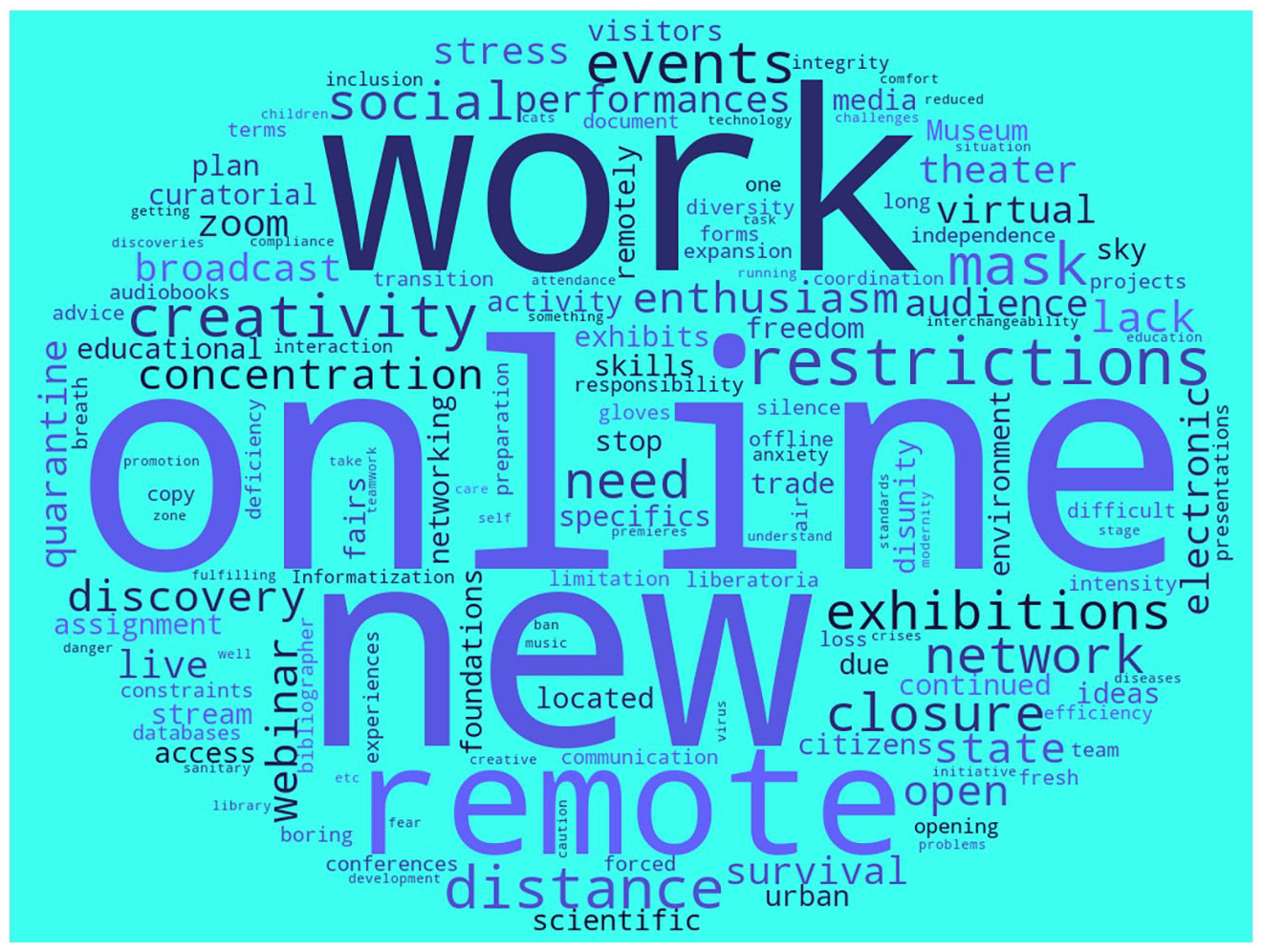
When asked what associations they had with working during the pandemic, the respondents could only name three to five words. We summarized their answers in a word cloud and obtained the following visual representation (Figure 1):
Visual presentation of associations.
As we can see from the word cloud, most of the associations, including the most common ones, are related to online format, digitalization, and various restrictions.
In summary, we can identify obvious trends characteristic of the vast majority of cultural institutions during the pandemic. These are the forced shift to the online format, with severe limitations, and the development of adaptation strategies and new forms of interaction with audiences and ways to engage them. The main challenges were insufficient materials and resources, and a lack of skills and expertise to produce content and engage audiences online. But there are also excellent trends, so libraries that were previously focused on the online format of work were easier to integrate into working with visitors during the COVID-19 period, unlike museums and theaters and this is due to the fact that many of the libraries take into account the individual choice of their visitors and therefore create convenient online accounts for their visitors.
‘Extrapolation’ of digitalization
In the questionnaires and interviews, the respondents note that the pandemic has triggered the further development of many existing digital formats. At the same time, new forms of interaction with audiences are emerging, encompassing a wide range of different practices alongside more familiar forms, ranging from a night at the museum tours, virtual ‘scientist’s study’, and online reading of fairy tales to podcasts, lectures, and broadcasts from close museum repositories.
Among the positive impacts of digitalization, the vast majority of the respondents (71.6% and 70.1%, respectively) cited ‘an increase in the popularity of events online’ and ‘the development of new event formats’. Nearly 40% noted an increase in audience size (although respondents noted in their interviews that this trend was short-lived and not sustainable).
Digitalization has had an impact not only on interaction with audiences, but also on the inner workings of institutions. Some had problems with remote communication, others, on the contrary, considered it more efficient, as is evident in one of the interviews: Everybody was out of the office and we found we did not have to have that many meetings. It’s just that before everyone hated phone calls and face-to-face meetings and now we realized we could avoid unnecessary meetings and do matters remotely. (Interview 4, Public Relations director, creative space)
Adaptation strategies of cultural institutions during COVID-19 pandemic
The empirical data set allowed us to identify some patterns. We found that organizations of different types have organized their work in different ways during the pandemic. Their actions differed both in the organization of the work of employees and in interaction with the audience. The study showed that different practices depended on the difference in the use of digital technologies. As a result, we identified three adaptation strategies, which we will discuss in more detail below.
The first strategy, the strategy of increased digitalization, is characterized by the high degree of adaptation of institutions to the changes and emergency digitalization during COVID -19. Adopters of this strategy have held on to the autonomy and uniqueness of their institutions to a lesser extent and have mostly enriched their previous experiences by further developing formats of interaction with audiences that existed before the pandemic. The second strategy, the hybrid strategy, is characterized by the combination of different formats and the transition of activities to online mode, while maintaining the primary focus on the events that are essential to the unique character of the institutions offline.
The third strategy is the strategy of autonomy from digitalization. This strategy is characterized by a high degree of autonomy in activities, the struggle to preserve the unique character, and the reluctance to adapt to the conditions of ‘emergency digitalization’.
Strategy of increased digitalization
Analysis showed that the transition to remote working has been more or less painless for library staff and patrons. Modern technologies, including digitalization, have been widely adopted by libraries. Restrictions on library patrons were relaxed, while subscribers had additional opportunities to work with electronic catalogs. One of the most popular ways libraries developed during the pandemic was through the use of the LitRes service, which allowed users to download and read the books they needed. For example, the LitRes service gave chief librarians the opportunity to inform readers about books and introduce them to the latest publications and additions.
It was fortunate that we had the LitRes mobile library, and I think the service peaked when our readers used it while we approved the charge of the books our readers wanted 24/7. We started using social media, hosting various trivia games and workshops. Perhaps the biggest problem was that we did not have our collections at hand as we all stayed at home, our employees wrote articles and reviews, and we hosted a variety of events. We managed communication between all employees by having one person who collected all the information, structured it and passed it on to the technical department that then published it. (Interview 1, Chief Librarian)
Many libraries were already using social networks before the pandemic, so they were better prepared compared with other cultural institution In some cases, the use of remote formats has helped to grow audiences. Therefore, the transition to online work has caused fewer problems for libraries than for theaters and museums. At the same time, the use of library digital services by older people who do not have the skills has decreased.
Therefore, for the libraries that followed the strategy of increased digitalization, it was crucial to develop the existing formats that were convenient and friendly for online visitors, such as online quests and workshops or book reviews. The institutions that have used the strategy of increased digitalization are characterized by the uberization of their activities during the pandemic. Libraries were more adaptive to the individual choice of visitors and, consequently, this circumstance allowed these institutions to integrate in the best way into the work during the pandemic.
Hybrid strategy
The hybrid strategy was mainly used by museums. The role of museums has changed during the pandemic as many of their functions have changed. Digitalization has become their priority. For example, during the pandemic, museums strongly promoted the digitization of their collections. Social media pages gained importance as they allowed museum staff to share necessary information, report on their activities, and post their publications and infographics. Unlike libraries, museums had not been as active in online communication and therefore faced greater challenges.
Museum staff point out the importance of staying in touch with audiences so that they can resume interacting with visitors once the restrictions are lifted and the pandemic is over. In the meantime, online communication with visitors took the form of narratives about this or that exhibit and online exhibitions. Another necessary measure was the development of new audio guides specifically for the online format. Under these circumstances, according to the respondents, the main requirements for museum staff included the creative approach to the organization of museum events and the transition of museum exhibitions and activities to the online mode, the creation of new formats: ‘Working remotely, we did not do what we normally do; we did not work face-to-face with visitors, but we introduced completely new formats. Online tours, educational outreach through social media and websites – so everything changed’ (Interview 9, Associate Director, museum).
During the pandemic, the audience also changed. Due to the closed borders, museums no longer received foreign visitors, who on one hand brought in the funds necessary for the museums’ development, and on the other hand provided opportunities for sharing experiences in working with museum visitors. Moreover, international exhibitions became impossible or very difficult to organize, while direct contacts with colleagues from other countries withered away.
However, the transition to the online format was brought about by the impossibility of generating revenue from visitors during the pandemic. At the same time, the online events held by museums were mostly non-profit and thereby low budget.
Small museums were the least adapted to the pandemic because they did not have the technologies needed to transition to digital formats during the pandemic. In the worst-case scenarios, such museums had to close altogether or curtail their activities.
As visitors’ consumption habits changed during the pandemic, museums adopted different working formats, but the focus remained on maintaining audience interaction with the audience and participation in museums’ online events. Museums lost some of their audience and due to the closed borders and restrictions in place, the flow of visitors has not yet returned. The development of online formats makes it easier to attract new visitors, but whether they will turn into live audiences in the future is questionable.
Strategy of autonomy from digitalization
The strategy of autonomy from digitalization was mainly used by small chamber theaters, which did not have specialists to help them switch to online mode and could not work in a digital environment, as all their previous activities were offline.
The main feature of this strategy is the search for alternative ways and often the inability to switch to online mode or to combine online and offline. Theaters are highly collectivized and form their own community, which often falls apart during the pandemic. Under these circumstances, theaters were faced with the challenge of engaging with online event formats and looking for possible new formats.
After analyzing the material, we found that theaters underwent the greatest changes during the pandemic. The biggest challenge for theaters during this period was the loss of place, the ‘loss of the scene’, after all repertoire became obsolete. Very few performances could be transferred to the online format. Literary and artistic directors faced the problem of producing adapted versions of their performances. They tried to adapt plays and create new formats that could appeal to audiences.
Overall, the pandemic hit the theaters hard, but for us the experience was also beneficial. Because during the first wave, when everyone was quarantined, we had to look for ways to communicate with audiences through the Internet, and the theaters experienced that for the first time. The theater is an actor coming on stage and interacting directly with the audience, so no one was prepared for that. Of course, everyone rushed to make recordings, stream video poetry, and perform monologs. It dawned on us pretty quickly that these formats do not work, that they are not engaging, and that they are not theater.
It is worth noting that there were two approaches, which differed according to the size of a theater. The first approach was to look for new formats that would appeal to audiences.
My colleagues (. . .) are also working on an independent theater, and they have developed this format of an online play: a spectacle for one spectator, it’s is not even a play and it’s not a spectator, maybe a performance, I do not know what to call it really. They took the Stalker film by Tarkovsky and wrote a story as if a person calls, someone who wants to follow the path of a stalker. That person calls and on the other side, an actor and a director navigate this person through some internal struggles and, the concept is, that person is taken on a journey. Basically, they contact that person throughout the day by phone, texts or messages. The person participating does not see anything, but goes on with their life while they receive messages and calls and think about some thoughts. It was a fascinating project, but only for one person. (Interview 2, artistic director, independent theater)
The second approach involved a more traditional format, working with existing performances but developing their alternative versions (e.g. producing adapted versions that could be easily streamed).
Overall, both approaches are about the ‘struggle’ of artistic directors and literary producers to attract audiences to watch plays online. Theaters also experience the effect of the ‘indifferent onlooker’ whose emotions are difficult to assess and analyze, which was mentioned by theater directors in their interviews. Thus, an ‘indifferent onlooker’ is an anonymous spectator, and it is unclear what they will choose: a TV show or a play. Artistic directors noted in their interviews that in this case it is important to understand all the specifics of the ‘indifferent onlookers’ audience, while in practice most chamber state and independent theaters do not have the skills and tools to study this type of audience. This creates difficulties with the presence on social media, which many chamber theaters do not have, and with the digitalization of new formats.
The biggest challenge was the video content uploaded to YouTube. Artistic directors noted that they often struggled with promoting their channels, organizing online performances, and presenting content appropriately to engage audiences and analyze their needs.
Only large theaters had the facilities for SMM analysis. They implemented online projects relatively successfully and were able to stream performances because they had the necessary equipment and technology.
So, we see that the functions of a theater as well as the suggested practices have changed completely. The degree of change depends on the status of the theater and its audience (children or adults). At the same time, theaters have actively developed new services, such as SMM service, intensified PR services, and introduced marketing in social networks by promoting their pages in social networks. Both large theaters and chamber theaters have changed the way they work with, present, and promote material. Theaters developed in various formats: video editing, designer work, and sound production. Often all of these functions were handled by the theaters’ PR service or by dedicated specialists hired to produce high-quality content.
At the same time, it was important to preserve the previous autonomy of the institution and create unique formats and content. This situation was exacerbated by the need to compete with other platforms that had greater experience in the online environment. Thus, on one hand, the strategy of autonomy from digitalization is linked to the preservation of the previous working format and the unique character of the institution. On the other hand, it has emerged from the ‘emergency digitalization’, which has forced institutions to look for new formats and ways of interacting with audiences online.
Discussion
The concept of the network society has shown its applicability as an analytical tool for the features of digitalization and the transition to digitalization of cultural institutions during the pandemic. The theoretical model demonstrated the degree of deepening and expansion of digitalization processes. At the same time, it also showed the fragmentation of the network society that is being formed in Russia today, and also revealed the risks of those cultural organizations that will not be able to adapt to the ongoing changes. The practical significance of the research lies in the possibility of using the identified patterns in the development of strategies and activities affecting the digitalization of the economy and public life and the integration of cultural institutions into the digital society. To deepen the understanding of the network society, future research should pay attention to the broader context of the digitalization caused by the pandemic in various cultural institutions and analyze the features in how different institutions, for example, in the city and in the countryside, create their own strategies and their own characteristics for integration into cultural institutions. Also, the use of the concept of the network society and specific examples that were demonstrated in the article allow us to consider the features of how the network society is formed in Russia and affects the transformation of the employment structure in Russia, while the key influence on the transformation of the employment structure in the case of Russia is due to the fact that the very employment of employees of cultural institutions becomes more flexible, while new formats arise to which employees working in cultural institutions have to adapt in a new way.
Issues related to the effective involvement of the visitors of cultural institutions themselves in the network society and digitalization practices remain unexplored. The risks generated by ‘forced’ digitalization, both for the cultural institutions themselves and their employees, and for their visitors, also require a deeper research. They may relate to the regulatory landscape, cybersecurity, and content, features of unhindered access to content, as well as training employees for new opportunities and risks that the network society itself sets and training employees of cultural institutions to interact directly with visitors and individualize work with visitors to find flexible and reflective models. All this is carried out, among other things, in the framework of working with visitors of cultural institutions.
The pandemic has ‘tested’ cultural institutions for their ability to adapt to new conditions. Flexibility, quick adaptation and learning ability, and network structure played into the hands of cultural institutions; however, not all cultural institutions in the considered case of St. Petersburg were ready and had the necessary resources for rapid adaptation to new conditions, as well as full integration into the network society and individualization, creating a direct dialogue between visitors and employees of institutions. It is too early to draw conclusions about how cultural organizations will work after the pandemic, but it is obvious that digital practices cannot completely replace all areas of their work, including performances and the work of theaters, which are experiencing the greatest difficulties in digitalization and gradual integration into the digital society. Of course, this research is limited by the Russian context and its work in the framework of the integration of cultural institutions into a network society, as well as the development of such a society. However, some discussion points and ideas can be quite extrapolated to the features of the digitalization of cultural institutions in the period pandemics are ubiquitous and are becoming emerging focus areas for further work and further research.
Conclusion
The results of the research show the presence of two differently directed and divorced in time trends associated with the perception of cultural institutions of the ongoing changes. The first is due to the spontaneous growth of local professional autonomy at the beginning of the pandemic, when institutions such as libraries and some museums de facto provided greater freedom in choosing how to organize interaction with visitors. Under these conditions, the virtualized platforms of institutions have become experimental laboratories for the invention of a ‘craft’ ‘new order’ from the chaos of the first days of the pandemic. Some cultural institutions and their employees perceived the ongoing changes as an organizational, creative and even existential challenge, the response to which requires the utmost individual and collective mobilization. It turned out that in a force majeure situation, at first it became possible to conduct professional activities with a greater degree of freedom than in normal times; this weakened the administrative control on the part of the management of institutions and also allowed, mainly employees of libraries and museums, to be more integrated into the network society. The degree of freedom for museum and library staff was that they often had direct contact with visitors during the pandemic.
The second trend is ‘catch-up’ quality control, adapted to the remote format. This trend was typical mainly for museums and theaters, when it was necessary to quickly mobilize all the forces and develop in the context of a network society; however, in this case, there was usually no practice of individualization and transition to a reflexive format of working with visitors, and there was no period of adaptation as well as attempts to use the resources of the network society and introduce such resources for the work of institutions, as a rule for theaters and museums, turned out to be fruitless.
Forced digitalization triggered the creation of new formats and the evolution of existing ones, both within institutions and in their interactions with audiences. Different types of institutions showed different strategies to ‘negotiate’ the new normal and addressed the needs of the network society to varying degrees.
We have defined three different adaptation strategies used by cultural institutions during the pandemic. The first strategy, the strategy of increased digitalization, involves the utmost emergency digitalization during the pandemic. Some institutions and their staff perceived the ‘emergency digitalization’ and the transition to online as a new existential reality. Under these circumstances, it was important to adapt to the pandemic, develop the skills needed to create online content, quickly search for the content they needed, and adapt to the new conditions. Cultural institutions, especially libraries, become the ‘testing ground’ for new working standards and formats, as well as for different online formats.
The second strategy is hybrid. This strategy involves switching some events to online format and supplementing them with active presence on social media, while retaining the unique character of some offline formats.
The third strategy, the strategy of autonomy from digitalization, implies that cultural institutions do everything possible to maintain autonomy in their work. Such institutions are actively using new digital formats. This adaptation brings many challenges and complaints among staff, especially related to the choice of formats and the implementation of certain ideas using technologies that cultural institutions often do not have. In the meantime, digitalization in the context of this strategy should be defined as catch-up, or emergency, force majeure need to integrate institutions into the digital environment. The preservation of autonomy, often combined with the inability to compete with other institutions and formats, as well as the preservation of a specific identity, become an integral part of this strategy. It becomes difficult, and often impossible, to change format, uberize the activities by switching to online completely, and to integrate into the more individualized digital society.
Footnotes
Funding
The author received no financial support for the research, authorship, and/or publication of this article.
