







Abstract
This article addresses scholars concerned about public sociology’s position within the field and academia. It offers new reflections on public sociology to enrich our understanding of its nature and highlight gaps that need further attention. The article also presents propositions regarding the theoretical and practical issues that currently shape how public sociology is perceived, and it outlines some of the visible challenges in practicing it today. In this article, I review the existing discussion on public sociology and comment on it based on qualitative research conducted with scholars in Kraków, as well as my observations as an early-career researcher. These reflections are intended to hopefully strengthen the position of public sociology within the sociological community and to foster further discussion on public sociology 20 years after Burawoy first introduced it.
(. . . ) the success of public sociology will not come from above but from below. It will come when public sociology captures the imagination of sociologists, when sociologists recognize public sociology as important in its own right with its rewards, and when sociologists then carry it forward as a social movement beyond the academy.
Introduction
This article aims to rediscuss the idea of public sociology, as introduced to a broad sociological public by Michael Burawoy two decades ago, within the context of the current Polish academic landscape and commented on from the perspective of an aspiring scholar, a doctoral student. Even though public sociology has gained widespread popularity throughout the last two decades, it has also become a matter of controversy within academia and may now bring various associations, from being the most desirable version of sociology 1 to being a contradiction toward ‘rigorous science’ – a hardly accepted one.
I conducted a qualitative study in which I interviewed Polish scholars who teach sociology and conduct sociological research. The goal was not only to see what drives them toward social engagement but also to understand the role of the academic framework in which they operate. The findings have inspired a further investigation into the literature on public sociology and other traditions at the intersection of sociology and public engagement, followed by reflections on the role of academic capitalism. This article summarizes my research findings and gathers reflections on public sociology.
Having in mind the constant, rapid, and even accelerating technological progress that is transforming societies around the world, I believe that a further conversation about public sociology and its future is invaluable within the field. Proactive engagement within partnership dialogues between sociologists and the publics may serve as an opportunity-creation platform of civic engagement in civilizational changes – like climate change and its social consequences, advancements in medicine, computing, or artificial intelligence, and so on. Describing and analyzing social reality is important and is a foundational work of sociologists, but – as some of my interlocutors said – if something worrying is being noted, taking action is a duty. As 20 years have passed since Burawoy gave his memorable speech (Burawoy, 2005), it seems that what he was advocating is still relevant and equally, if not more, important.
Public sociology: the original idea
What is public sociology? The main feature of public sociology that distinguishes it from other variants is its public mission, embodied in an engagement in dialogues with various non-academic publics.
Public sociology (. . .) strikes up a dialogic relation between sociologist and public in which the agenda of each is brought to the table, in which each adjusts to the other. In public sociology, the discussion often involves values or goals that are not automatically shared by both sides, so reciprocity, or as Habermas (1984) calls it ‘communicative action’, is often hard to sustain. Still, it is the goal of public sociology to develop such a conversation. (Burawoy, 2005: 9)
Public sociology may be seen as aiming to produce sociological knowledge that is relevant to the publics, constructed in cooperation with them, possibly for their benefit. A benefit may be understood as an outcome perceived by a public as valuable, one that remains in line with the shared understandings of collective good within civil society.
From Burawoy’s standpoint, sociology studies the world from the perspective of civil society and is dependent on it, and for this reason, it should care about ‘the expansion of the social’ (Burawoy, 2005: 24). In compliance with the long tradition of studies on civil societies, and concerning many authors who try to define civil society, here comes a shortened picture: But what is civil society? For my argument, here we can define it as a product of the late 19th century Western capitalism that produced associations, movements, and publics that were outside both state and economy, political parties, trade unions, schooling, communities of faith, print media, and a variety of voluntary organizations. (Burawoy, 2005: 24)
In public sociology, knowledge is a product of negotiations with non-academic actors and communities. It is produced for communication purposes, which makes it relationship-centered. It is validated through public debate and based on its relevance to the perspectives of the designated publics. Significant effort is put into making communication clear to the non-academic publics, including translating professional language to easily accessible vocabulary and means (for instance, popular science books instead of scientific articles). Above all, in public sociology, ‘the researcher must prioritize the defense of society and its actors against states and markets; he or she must ‘join forces with other publics’, as Wieviorka (2008: 385) puts it.
What for, with, and for whom may sociology co-produce knowledge? An attempt to answer these questions was made by Michael Burawoy, among others, when he gave his memorable speech for the American Sociological Association as the organization’s President in 2004. Borrowing from Bourdieu the framing of the social world being structured as competing fields, he distinguished four types of sociology within the field and characterized them as competing with each other, but because of that, enhancing the quality of each one. The author considered two kinds of knowledge and two kinds of publics to construct an interesting conceptualization of what he called sociological labor. See Table 1 for a summary.
Division of sociological labor.
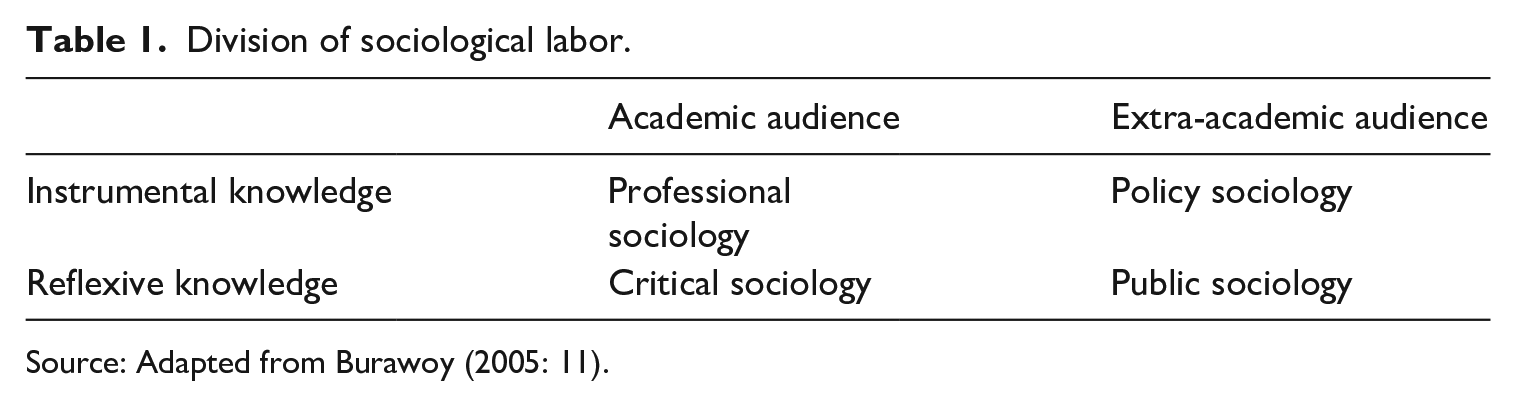
Source: Adapted from Burawoy (2005: 11).
Burawoy distinguished two types of knowledge, based on purpose and characteristics, employing the terms reflexive and instrumental knowledge. Reflexive knowledge aims at opening discussions and existing perceptions of social phenomena. The goal is to invite new questions, rather than to deliver clear answers and solutions. Reflexive knowledge supports self-awareness and brings a critical overview of phenomena and related contexts. Within the division of sociological labor, reflexive knowledge is associated with critical sociology and public sociology. In critical sociology, it is employed to examine power dynamics and to reveal the ideological underpinnings of social structures (including the ones within the sociological field itself). In public sociology, reflexive knowledge is co-created within a dialogue between sociologists and various social groups called publics. It may concern examining the social structures in which a group functions, including existing inequalities or injustice, as well as investigating possible alternatives.
On the other hand, instrumental knowledge is produced to give answers and inspire directed action. It is goal-oriented and practical. As opposed to reflexive knowledge, instrumental knowledge seeks actionable solutions within a given framework. It is associated with professional sociology and policy sociology. The former aims at developing theories and methodologies that may serve further analyses of social phenomena. It may be seen as technical because it constitutes the theoretical and methodological foundation of sociological research. In policy sociology, instrumental knowledge ought to be effectively applied by practically addressing social issues in collaboration with various stakeholders. It is inclusive of, but not limited to, collaborations between sociologists and private companies, for example, through work on user-friendly website interface designs, or support for governments in conducting evidence-based decision-making, as it is popularly referred to. The division of knowledge into reflexive and instrumental has been a subject of criticism (see Morrow, 2009). Moreover, its application to empirical study, as outlined in the following sections, is somewhat problematic due to the difficulty in accurately categorizing the real-world sociological work as exclusively producing reflexive or instrumental knowledge.
Burawoy writes about academic publics and non-academic publics. In the case of the former, the knowledge produced within sociology is addressed to other scholars or students to advance theoretical understandings, share methodological advancements, and contribute to the academic discourse. Interactions with the academic publics involve presentations at conferences, publications in academic journals, participation in scholarly debates, and academic teaching. When academic publics utilize instrumental knowledge, it contributes to professional sociology. When they engage with reflexive knowledge, it constitutes critical sociology.
Non-academic publics involve various groups and individuals from outside academia who engage in sociological dialogues. Non-academic publics may include non-governmental organizations, policymakers, local communities, minorities, journalists, or the so-called general public. They may engage with instrumental sociological knowledge, as in policy sociology, or with reflexive sociological knowledge, as in public sociology. According to Burawoy, within public sociology, the publics can emerge traditionally or organically. Traditional public sociology tends to address broad, inactive, unorganized, and mainstream publics, while organic public sociology is recognized through a commitment to visible, active, local, and often counter-mainstream publics.
It is important to acknowledge that these types were originally introduced as ideal types (Weber, 2011). Consequently, it is rare for one’s sociological practice to be categorically classified within a one single type. Instead, it is more common for sociologists to engage with various types of sociology throughout their professional careers. Moreover, it is conceivable that a research project may encompass activities representing multiple sociological domains, for example, professional sociology – by producing new theoretical concepts; and policy sociology – by formulating recommendations to policymakers. Similarly, Burawoy (2005: 11) asserts that ‘sociology can simultaneously serve a client and generate public debate’. Finally, the four types and the interrelationships between them vary locally and temporally.
Within this fruitful and inspiring framework, Burawoy presented his central argument about the lack of sufficient presence and visibility of public sociology within academia. He advocated for enhanced peer and institutional recognition. Concurrently, the well-known sociologist engaged in critical reflection on the contemporary academic environment, often termed academic capitalism, acknowledging its limitations.
Public sociology: reception and development
Burawoy wished ‘to avoid a head-on confrontation with “professional” sociology and even render[ed] homage to it’ (Wieviorka, 2008: 382); however, some sociologists expressed marked skepticism. For example, in the early 2010s, Sztompka was critical of the approach suggested by Burawoy. He warned the global sociological community against a ‘left-wing activism bringing ideologization and politicization to sociology, calling for revolutionary action rather than thought, appealing to emotion rather than reason, leading sociologists to the barricades rather than to libraries’, 2 to which he had classified public sociology, promoted by Burawoy at that time (Sztompka, 2012: 7–8). Public sociology may indeed follow social trends or glorify already popular views. Because public sociology is oriented toward working with publics, it may require coalition building around ideas that may intersect with broader trends in thinking (for propositions of good practices, see Glenn, 2009 or Mayrl and Westbrook, 2009). However, from a constructivist’s perspective, the divisions between action versus thought, emotion versus reason, and activism versus theoretical work may not be clear or helpful. Theoretical work can be revolutionary, competing reasonings can be imagined for the same case depending on one’s values and emotions, and scientific research involves a nexus of thoughts and actions. Furthermore, the question of whether any scientific method could be entirely free from ideology – a system of ideas that shapes and maintains social order (Scott, 2014) – remains vital. Nevertheless, the objection to public sociology points to existing tensions between different visions of the field’s agenda, of sociological and societal futures.
On the other hand, Wieviorka asks, ‘should researchers participate in public life and, if so, how?’ Although he generally sympathizes with Burawoy’s proposition and seems to care about the success of this approach, he also proposes some new perspectives. First, he has a different view on the desired relationship between public and professional sociology. While Burawoy encourages dialogue between the two, Wieviorka suggests ‘a distinct break’. Second, Wieviorka believes that the internal differences within public sociology are much more significant than was outlined by Burawoy. Despite seeing some value in the division into organic and traditional public sociology, he presents a different typology, consisting of three types of public sociology – elitism, restitution, and deliberative democracy (Wieviorka 2008: 384–386).
Third, he relates the idea of public sociology to other traditions. One of them is action research, where interactions with publics involved in research contribute to producing knowledge through recurring transformations and reinterpretation. The other one is sociological intervention (Touraine, 1980), where the role of the sociologist is to deliver arguments that a public is willing to accept as their own, which constitutes an immediate test for knowledge accuracy. The judge, however, is not the sociological community, but a relevant non-academic public. Furthermore, Wieviorka emphasizes the interconnection between knowledge validation and social engagement, thereby making a case for the interconnectedness of the methods employed by sociologists to validate knowledge and how they choose to establish their relationship with society.
Let me say it very generally: scientific problems and problems of involvement should therefore not be separated. Our conceptions of the demonstration of the validity of the knowledge we produce are not independent of our conceptions of our relationship to what is known as the public sphere. (Wieviorka, 2008: 388)
Later, Michel Wieviorka wrote on public sociology, describing his work, including sociological interventions. He focused on two dimensions – knowledge production and diffusion (Wieviorka, 2014). Like Burawoy, Wieviorka perceives academic sociology as communicating mostly, if not only, within academia – through professional journals, congresses, and other means dedicated to sociological societies. Nonetheless, he argues, not only should sociologists communicate within professional circles, but they should also reach out beyond the academy.
In my opinion, diffusion should go much further and be based on a different conception from that of the academic who discusses with his or her peers and teaches his or her students. [. . .] Indeed, my constant concern is to diffuse sociological knowledge in such a way as to make it useful to a maximum number of people, starting with the social actors concerned. (Wieviorka 2014: 244)
While recognizing the value of this kind of venture and pursuing it in his career, Wieviorka dedicates considerable effort to analyzing some associated risks. ‘Ultimately, the question and the challenge of public sociology boil down to how one can intervene in social life and, at the same time, remain a social scientist’ (Wieviorka, 2014: 243) is the closing sentence within the abstract. The author elaborates on how sociologists can actively participate in debates over and actions around social issues by engaging with current political events and media while maintaining their scientific integrity. He concludes that the delicate balance may be sustained by demonstrating rigorous scientific standards. Although the exact understanding of the rigorous scientific standards remains slightly unclear, it could perhaps be defined as transparency concerning data and methodology. He believes that this dual engagement allows sociologists to meaningfully contribute to social life while remaining committed to the principles of their scientific training.
Gans (2016), who served as president of the American Sociological Association in 1988, published an article that focused on the notion of publics. He collected various reflections and observations, asserting that further empirical research would provide a more robust foundation for understanding the publics. In his opinion, the majority of existing literature on public sociology overlooked the role of the publics, creating a problematic gap.
True, we have to start the ball rolling but ultimately, we have limited control over what becomes public sociology. The public has the last word. (Gans, 2016: 5)
Other reflections from Wieviorka resonate with the aforementioned points and serve to emphasize the agency of, and the importance of, the future extended focus on publics.
Frequently, the sociologist who wishes to act as a ‘public sociologist’ is disappointed; there is little or no reaction from actors whom the sociologist hopes will be interested in his or her research. [. . .] The sociology I practice often leaves a bitter taste and is sometimes even painful. ( Wieviorka, 2014: 251)
Nevertheless, Gans appears to have come to terms with uncertainty as a feature of public sociology. For Gans, the analysis of the mechanisms that facilitate public support and the eagerness toward engagement is of crucial importance. Limiting the analysis to traditional public sociology, embodied within written texts that gain popularity outside academia, the author identifies a multitude of characteristics.
First, the written text should comprise an uncomplicated language, understandable to the lay public. Second, the content should be somehow relevant or useful for the public; however, no singular strategy is thought to guarantee success. Third, it needs to be taken into consideration that publics vary in multiple ways. Gans classifies publics accordingly: sociology students; other students, who are assigned sociological readings; and non-student publics categorized by class, age, gender, race, education, and so on. The final category may be referred to as the mass audience. It is the most challenging to reach for several reasons, chief among them the lack of training that sociologists receive in communicating with this group, which I consider particularly important.
Fourth, ‘The safest hypothesis holds that most people in both publics will be primarily interested in sociology that tells them something that affects them directly or is personally relevant or useful to their well-being and their everyday lives’, including explaining significant current events (Gans, 2016: 6). Fifth, sociology may become public through the efforts of ‘presenters’: teachers, journalists, editors, publishers, radio and television presenters, social media opinion leaders, and so on. Therefore, it is important to understand how they operate to be able to cooperate with them successfully. Sixth, it should be acknowledged that presenters summarize, simplify, and sometimes dramatize their messages to capture the attention of their publics. The associated risk is that of misinterpretation and misrepresentation, whether intentional or otherwise. Seventh, journalists are accustomed to operating within the logic of their field, including reacting in a fast manner. This may be surprising to sociologists, who are used to different environments. Nevertheless, mutual adjustments may be expected for constructive collaborations.
Finally, Gans presents arguments that underscore the value of public sociology. First, there are many social problems in the United States, but I believe that this it applies to many countries, which could be addressed by public sociology. Second, the discipline needs public support to obtain research funding. Third, it needs to effectively compete with other social sciences, some of which offer alternative approaches and gain popularity, for example, behavioral and institutional economics (see also Gans, 2009). Fourth and finally, it can enrich the vitality of the discipline by addressing contemporary events and policy-related research questions. Consequently, it serves to counterbalance the tendency within academic circles to prioritize contributions within the context of disciplinary agendas, as opposed to societal needs (Gans, 2016: 9–11). Finally, Gans agrees with Burawoy that public sociology primarily needs institutional recognition and validation, accompanied by incentives and rewards for scholars who support contributions to public sociology.
Public sociology: conclusions
‘One of the subjects that needs further discussion is the nature of public sociology itself since it can come in several varieties’ (Gans, 2016: 4).
The following overview gives rise to numerous questions and delineates further discussion and research. From a theoretical standpoint, the demarcation of public sociology remains ambiguous. What constitutes public sociology, and what does not, is one of the central questions. Gans (2016: 5) wondered whether a journalist’s report is classified as public sociology or not, how long the note or paper should be, and how significant the public reach should be. What means and genres of communication count? To provide perceptive answers, it is vital to consider temporal and local contexts.
From a pragmatic perspective, undertaking public sociology entails specific characteristics and challenges. Currently, there are several handbooks on that matter (Germov and Poole, 2023; Jeffries, 2009; Rocha and Davidson, 2023) that address key questions of public sociology. Some also include the problem of the originally US-centric approach, aiming to recognize the usefulness of the concept within other geographical contexts and to move beyond the United States (Hossfeld et al., 2021). Seeing most renowned sociologists deciding to share very practical, everyday implications of their work – such as what complications one may face when deciding to talk to the press, or that it is important to respond to phone calls from journalists quickly if one wants to keep their attention – it seems that it has still not become accessible, common knowledge among scholars.
Study in Poland: local context and methodology
The local intellectual background
Polish sociology has a long tradition of sociological practice and reflexive thought at the intersection of societal interventions and academic knowledge. Applied sociology cuts across a variety of research topics and renewed authors (PWN Encyclopedia, n.d.), such as Adam Podgórecki. According to Afeltowicz and Pietrowicz (2012), Podgórecki’s approach was one of the most extensive and detailed propositions of applied sociology presented globally. In Podgórecki’s view, the social sciences and humanities constitute an important site of conscious and goal-oriented understanding and influencing of social processes. Sociotechnics and social engineering were supposed to be sites for pragmatic knowledge production, leading to practical recommendations and directed interventions on the social body. In 1969, Podgórecki established a Division for Sociotechnics in the Polish Sociological Association (PSA), and in 1972, the Research Committee on Sociotechnics at the International Sociological Association (Wicenty, 2018: 61). He also participated in the creation of the Institute of Social Prevention and Resocialization at the University of Warsaw.
Currently, applied sociology is often offered as a separate educational path from traditional sociology. For example, at the University of Warsaw, sociology is offered by the Department of Sociology, and applied sociology (with social anthropology) is offered by the Faculty of Applied Social Sciences and Resocialization – the latter institution also specializes in the field of social work. Adam Mickiewicz University of Poznań proposes applied sociology as a specialization on the sociological path at the MA level. These examples demonstrate a strong position of applied sociology within the Polish academic landscape.
Another tradition is clinical sociology (i.e. Rebach and Bruhn, 1991; Wirth, 1931), which aims to diagnose social problems and treat group members and communities (Glassner and Freedman, 1979). According to Freedman (1989: 54), a ‘clinical sociologist is essentially a change agent rather than a researcher or evaluator’; moreover, their work is practice-oriented, focused on case studies, diagnostic, seeking for frameworks of clients’ issues across broader societal conditions, embedded in values and leading to societal change. In Poland, clinical sociology has been described by scholars such as Woźniak (2014) and Kaszyński (2021).
Furthermore, the relationship between social work and sociology has been and remains close (Frysztacki, 2006). At the Adam Mickiewicz University of Poznań, social work and sociology both operate within the Department of Sociology. A similar situation is observed at the Jagiellonian University, Kraków, at the Institute of Sociology, Department of Philosophy. Moreover, the Section of Social Work has been operating within the PSA since 1995. It was established by sociologists from the Jagiellonian University, Władysław Kwaśniewicz, and Krzysztof Frysztacki, as a response to the growing need to strengthen connections between social practice and academic sociology. The latter has already been serving as an important educational platform for future social workers. Therefore, the institutionalization of the subfield in PSA at the intersection of sociology and social work aimed at creating a platform for interdisciplinary and intersectoral discussions and exchange of experience (PSA website, n.d.). Today, sociologists play an important role in the academic development of social work (i.e. Brenk et al., 2018; Frysztacki, 2019; Kaszyński, 2013; Miś et al., 2011; Ornacka, 2013).
All these contexts represent the deep entrenchment and high importance of social engagement across the history of Polish sociology. Several points relevant to public sociology (e.g. those concerning insufficient institutional incentives or emotional support) may be true not only for public sociology but also for other traditions at the intersection of academic sociology and social interventions or sociological practice. It is also important to be aware of the local traditions of sociological engagement, as it may provide a better understanding of local knowledge, heritage, and networks of engagement.
Methodology
To explore the understanding of the nature of public sociology, I conducted a qualitative study in Kraków, Poland, between February and June 2023. Qualitative in-depth interviews were employed, a method that has been proven to elicit complex and intricate pictures of individual experience and perspective. I interviewed 12 scholars whose collaboration with non-academic publics could be named public sociology. Each interview lasted between 60 and 120 minutes (about 16 hours in total). Audio recordings were transcribed, and the content was analyzed with MaxQDA. One interview was excluded, as an interlocutor firmly distanced themselves from associations with public sociology, and their perspective was distinctly incongruent with the remaining ones. Therefore, the results were concluded based on 11 interviews.
Knowing that public sociology is not a popular identity in Poland, I did not follow self-identification as a selection criterion. I did not exclude it but rather enriched it by formulating other criteria. I was looking for sociologists who (1.1) were members of the PSA or (1.2) were recommended by the members (snowball method), and simultaneously (2) were known among colleagues to be engaged in dialogical collaboration with non-academic publics. It turned out that they were interested in one or more from the list: social movements, minorities, criminalization, urban sociology, communality, sociology of media, political sociology, civic engagement, labor market, participatory action research, sociology of knowledge, and social work. Three interlocutors self-identified as public sociologists before interviews. Others were open to discussing similarities between the concept and their work.
The interlocutors represented three universities: Jagiellonian University (6), AGH University of Science and Technology (3), and Pedagogical University (2). The numbers roughly align with the unequal sizes of the three institutions. Gender division was fair: female (6) and male (5). The age structure turned out as follows: born in the 1960s (3), 1970s (3), 1980s (5).
The study aimed to better understand the characteristics of public sociology; the means with which it may proceed; the value it brings to sociologists, sociology, or society; and the central issues connected with public sociology.
The interviews were semi-structured. Following a general scenario, the conversation was led in alliance with an individual resonance of the interlocutors across the main themes. Six topics were addressed: (1) activities and means used (2) motivations behind engagement with publics; (3) views on the relationship between sociology and society, the purpose of sociological knowledge production, the role of the sociologist; (4) hypothetical objections toward public engagement of scholars and responses to them; (5) ‘being political’ and making science; (6) practical challenges.
Study in Poland: results
As is often the case in individual in-depth interviews, the number of issues discussed with the interlocutors is such that it is impossible to entirely reflect them here in a meaningful way (Kvale, 2010). Consequently, the following section will synthesize the most important findings.
Values of public sociology
It appeared that in some cases, sociologists decided to engage with the publics, motivated by personal care toward what is perceived as a collective good. I asked directly about the values underlying their work or derived them from complex descriptions. Then, working with a list of 40 values, I categorized them into five broader categories. I can say they are characteristic of the interlocutors, and I can expand the claim that they may be characteristic of some people within public sociology. Of course, they are not exclusive to it, but I present them as potentially uniting or inspiring benchmarks for public sociology. Here they are: (1) humanitarianism, (2) civil society, (3) social responsibility and the normative function of academia, (4) accessibility of scientific knowledge, and (5) reciprocity in the relationships between researchers/academia and the people they study.
Practices of public sociology
Through what practices may these values be realized? Given broad descriptions of endeavors perused by the interviewed scholars, I fitted their efforts into seven clusters: (1) research projects that include formulating recommendations, (2) communication through mass media, (3) collaboration with non-governmental organizations, (4) organizing intersectoral conferences, (5) utilizing tools from the field of art, (6) moderation and facilitation of group communication, (7) micro-scale actions.
The aim of creating this list was to highlight the diversity of forms in which the ‘public moments’, namely the spirit of public sociology, may appear. By shedding light on various – sometimes not immediately intuitive – examples, I hope to extend the concept of public sociology onto endeavors that may sometimes be less spectacular in results but carry the mission and dialogical approach that originally inspired Burawoy and numerous others.
From public sociology to public moments of sociology
I argue that it should be widely acknowledged that the concept of public sociology was introduced as an ideal type. Accordingly, ‘ideal’ exemplifications – easy to separate from the other three types and highly significant – rarely, if ever, appear in real life. Perhaps the frequent focus on the scale of impact is not the most helpful in attempts to recognize, understand, and appreciate public sociology. A broad positive impact is desired, and there are strong reasons to develop nuanced understandings of its mechanisms and equip sociologists with the necessary competencies. However, broad-scale and significant social impacts are rare and challenging to capture (through either qualitative or quantitative means). Consequently, it may be beneficial to recognize public sociology primarily through its characteristics other than scale and to enhance its understanding from this standpoint.
Perhaps a fruitful avenue for public sociology would be to focus on tracing the so-called ‘public moments’ within a vast array of examples that may typically not be immediately classified as public sociology. I argue that a shift of attention from the well-established category of public sociology to ‘public moments’, also offered by Burawoy but less often referred to, could prove beneficial twofold. First, a more inclusive understanding of public sociology, offered by the notion of ‘public moments’ within sociological practice, could foster gaining recognition and scholarly support, opening the possibility of self-identification for a broader spectrum of practitioners. During my field research, I have observed that for some people to call their sociological work public sociology, a documented, broad societal impact (like a change in law or significant social mobilization) is needed. This approach has the potential to move beyond the question of scale and impact (‘success’), which can elicit a range of reactions and normative (self-)judgments. The openness of the category could allow more sociologists to recognize its relevance to their work and to perceive interest in contributing to associated conversations and actions. Second, it could be an effective way to deepen our understanding of the mechanisms within public sociology, as Gans originally set out to achieve. To do so, an examination of a broad range of actions driven by the ‘spirit’ of public sociology and characterized by their public moments could be conducted, and then the results obtained through different means and within various contexts could be compared.
Public sociology within academic capitalism and parametrization
Academic capitalism combines scientific principles of the search for truth with the economic rationale of profit maximization (Münch, 2020). The concept arose in the 1990s (Leslie and Slaughter, 1997) and gained increased recognition after the publication of the Academic Rankings of World Universities in 2003 (i.e. Jessop, 2017; Kauppinen, 2012; Münch, 2014; Rhoades and Slaughter, 2004; Welsh et al., 2008). It deals with market-like behaviors such as institutional competition for monies, such as grants, often at the expense of the universities’ public mission (Baltodano, 2012). In the realms of academic capitalism, students become clients, and faculty are turned into managers selling living arrangements through degrees (Slaughter and Leslie, 2001). The corporatization of higher education has been reported to promote various symptoms such as high faculty pressure undermining a sustainable work–life balance, commitment, motivation, and even professional identity (Spinrad et al., 2022). Furthermore, it promotes large, English-language research universities and strengthens the already existing hegemonies of wealth, culture, and institutional power (Marginson and Ordorika, 2011).
In Poland, the realms of academic capitalism fostered a ministerial reform in higher education governance (Polish Parliament, 2018). Aiming to increase the international competitiveness of Polish science, the new regulations introduced a system of evaluation known as parametrization. It stands for an attempt to employ mathematical ‘objective’ measures to assess the value of scientific institutions through, for example, number of publications and citations, effective obtaining of grants, and international collaborations. The initial assessment is later translated into increased or decreased public funding, as a way of adjusting to the global market of science and higher education (Bielska, 2018). The reform evoked mixed opinions and still faces visible criticism (i.e. Cybal-Michalska, 2018; Giedrewicz-Niewińska and Niewiński, 2024; Ostrowicka and Spychalska-Stasiak, 2020).
This context provides an informative framework for a subsequent section of study results focused on some practical challenges faced by sociologists engaging with non-academic publics. Certainly, one of the most significant problems pertains to the absence of adequate systemic incentives that would support the public engagement of sociologists.
R07: We fit into other things as researchers today.
Researcher: What kind of things?
R07: Parameterization, which is widely criticized, but we don’t do anything about it.
(Respondent 07)
Ultimately, the thing is that these points and citations are, in a sense, currency. Or a resource that we acquire to obtain other resources: grants, positions, degrees, status, power, and so on.
(Respondent 08)
Public activity, civic activity that I’ve been talking about here, educational activity, popular science – basically, nobody rewards that. [. . .] Generally, it doesn’t really pay off, in the sense that -well, you don’t actually get any greater benefits from it, right? And it’s engaging, though.
(Respondent 10)
Burawoy had already elaborated on that directly in connection with public sociology in his presidential address.
The recognition of public sociology must extend to the organic kind which often remains invisible, private, and is often considered to be apart from our professional lives. The project of such public sociologies is to make visible the invisible, to make the private public, to validate these organic connections as part of our sociological life. (Burawoy, 2005: 8)
It is, however, disappointing that after two decades sociologists report the same issue that had already been thoughtfully recognized and publicly addressed. Nonetheless, it happened to be the case for some of my interlocutors that their noble and big-scale public engagement conducted alongside their scientific research was not recognized at all by their employers (public universities) during the cyclic scholarly evaluation, which determines their position within the academy (or even the institutional belonging). It is somehow striking that individuals who may be highly respected by their peers, students, and non-academic publics for their public engagement may be at risk of being evaluated as ‘poor’ sociologists in the light of institutional evaluation criteria if they do not publish enough papers, preferably in renowned international journals. It is highly important to communicate with peers, for which journals are suited. Accordingly, it seems rational to validate other kinds of outputs as well, if they are valuable examples of scholars contributing to society.
Psychological burdens
Another challenge reported was the psychological burden that accompanies some type of research and interactions with the publics. Sometimes sociologists face human suffering, and especially in qualitative research, it might be mentally and emotionally overwhelming for an individual. Despite existing literature that presents propositions to approach this challenge (i.e. Rocha and Davidson, 2023), sociology has not yet broadly introduced systemic answers to these health risks. Good practice and inspiration may be found within communities of mental health therapists. It is generally a norm among therapists to regularly consult with supervisors whose role is to help reflect on the relationship with a patient and the therapeutic process. Moreover, therapists receive training on how to approach patients, reflect on the relationship, and personally deal with the psychological burden that facing the suffering of other people may bring. Although it is not the primary goal of sociologists to help people overcome their problems, in practice, it is sometimes the case that they may form connections with other people and get engaged emotionally. Nonetheless, it would be ethically questionable not to show empathy to an interviewee who cries during an interview as a reaction to a recollection of some painful memories (sexual violence, war, etc.). Yet, sociologists are at risk of being left alone with it and are formally unprepared to professionally manage these kinds of situations. Introducing institutional mechanisms that could provide support and advice on such cases if needed would potentially be beneficial for many professionals, providing them with a safe framework of support and collective management of challenging but impactful aspects like that.
Skill gaps and the need for adopted training
Finally, the interviews revealed gaps in sociological education in terms of skills supporting public sociology. It has also already been noted that for public science to flourish, educational programs need to address the skills needed for that. Based on this study, skills that need to be trained are: (1) translating professional language to a common language, responsibly and attractively in written text and oral presentation (for radio, television, in-person meetings, etc.); (2) relations with publics: forming, pursuing, managing, including potential risks and uncertainties; (3) skill to manage risks, including disappointment, resentment and drops in motivation; (4) ethics of public sociology.
It may be useful to note that the Association for Applied and Clinical Sociologists offers certification to experienced professional sociological practitioners of applied, clinical, and engaged public sociology. Moreover, the Commission for the Accreditation of Programs in Applied and Clinical Sociology certifies high standards of educational programs that integrate sociological knowledge, methodologies, and skills with ethics and practical engagement.
Conclusion
Why am I bringing these considerations on public sociology now? If anyone believed that public sociology was what the field needed to flourish 20 years ago, there is no reason to believe differently now. It is nothing less needed in 2025 when the global and local social problems still call for constant, dynamic addressing. Various unjust inequalities, diverse forms of violence from domestic, through symbolic, to war, global warming and its social impacts including migrations, recurring crises like the pandemic, as well as current and foreseen challenges born with the faster-than-ever development of new technologies including AI – to name just a few issues that could be a subject matter for public sociology. Despite those facts, some people are worried that there is little space in sociology to sufficiently address real-world problems: I think most of us do what we do despite, not because of, being at university. I even filled in my questionnaire recently, and it turned out that what I do doesn’t translate into any points. And let’s be honest, I can afford it, and I certainly won’t change, and I wouldn’t want to change very much. But I deeply regret that this way of doing sociology by my seminarians, MA students, well, it doesn’t translate into the modern world. And they will certainly not stay at university - a huge pity. Because they are dramatically disillusioned by it. It’s a shame. (Respondent 03)
This observation was a recurring topic in the interviews and a very important one for some. There was ambiguity toward the current processing expressed, often followed by expressing a need for change. I also question if there is enough space within the academy for actions directed at social change. Scientific communities declare that they aim to make the world a better place in some sense. Better for whom, how is ‘good’ defined, who decides, and based on what criteria, as would be rightly asked from the perspective of Science and Technology Studies (Jasanoff, 2005) – are other questions that need further investigation and eventually practical answers concerning public sociology as well. Nonetheless, for example, the international network ‘Scholars at Risk’ claims that among the core values in science is ‘to respond to contemporary problems and needs of all members of society’ (Scholars at Risk, 2020: 5). However, scholars report gaps in systemic infrastructure that would sufficiently enable realizing this goal.
This article aimed to highlight this problem more and suggested the following directions for change: (1) higher institutional and formal recognition of public sociology in academia, (2) more visible discussion about the need and value of public sociology, (3) more inclusive characterization by ‘public moments’, (4) changes into sociological educational programs aiming at training skills useful for doing public science, and (5) introducing systemic support for those who work with communities.
In this anniversary time, public sociology needs to be rediscussed, both to pay tribute to the memorable debate that significantly gained recognition two decades ago, thanks to Burawoy, and to keep the idea alive and to retain its inspirational and transformative potential. As Gallie (1956) once identified some concepts to be essentially contested, their vividness is kept through a constant debate. And if the boundaries of scientific fields are socially determined (Gieryn, 1995), it is up to us to set them in a way that achieves the goals once widely accepted by the sociological community.
Footnotes
Acknowledgements
DeepL was used to translate interlocutors’ statements from Polish to English. All translations were subsequently reviewed and corrected by the author. The author declares no conflict of interest.
Funding
The author received no financial support for the research, authorship, and/or publication of this article.
Ethical approval and informed consent
Consent is audio recorded. Participants were verbally informed about the aim of the study, their right to choose not to participate, and to withdraw their consent at any given moment.
