







Abstract
This study investigated the relation between building human capital of former dropouts and their occupational standing and the interaction effects with individual characteristics. By applying the growth curve model, this study highlighted the factors that lead high school dropouts to enhance their occupational standing. An increment in the work experience limitedly improved the occupational standing of dropout workers. The acquisition of a vocational certificate pushed dropout workers further toward higher occupational standing but engendered more benefits to female workers than to male workers. The benefit of a vocational certificate accrued to Whites, thereby increasing the racial disparities with Hispanics. The association between work experience and occupational standing did not depend on the demographic characteristics, indicating the presence of social constraints. Parental education level did not affect dropout workers in their acquisition of a higher occupational standing. Work experience was also not a mechanism for dropout workers to obtain better occupation and therefore, other policy interventions should be considered. Dropout workers need to be redirected toward a hidden credential, such as a vocational certificate instead of the General Educational Development test.
High school dropouts have become a widespread phenomenon in the United States. Each year, more than a million students leave high school without a diploma, making the rate of high school dropouts a continuous source of social concern (Alliance for Excellent Education, 2011; Lerman, 2004). Several pieces of legislation, such as the Improving America’s School Act of 1994, the Workforce Investment Act of 1998 and the No Child Left Behind Act of 2001, have been introduced to retain potential dropouts at schools or to increase dropout employability in the labor market (Bridgeland & Mason-Elder, 2012). Despite these efforts, dropout rates have not improved. Likewise, one half of all dropouts are employed in “dead-end” jobs, in which advancement is not attainable; as a result, they often become welfare recipients (Danziger et al., 1999; Schwartz, 1995). Policy makers have initiated and funded workfare programs, such as Job Corps, Youth Activities, and Youth Build, to enhance dropout resiliency and self-supporting capacity through building human capital (Bridgeland & Mason-Elder, 2012; Fernandes-Alcantara, 2012). Workfare programs urge former dropouts to accumulate work experience through mandatory work requirements and to obtain a General Educational Development (GED) diploma or vocational credentials (LaLonde, 2003).
Studies have assessed the effects of these initiatives on wage rates (Bloom, Thompson, & Ivry, 2010; W. R. Johnson, 1978; Schochet, Burghardt, & Glazerman, 2001). However, wage rates may be a loose indicator, which cannot properly show the career development or occupational standing of dropouts because of their unique characteristics in the labor market (Jencks, Perman, & Rainwater, 1988). First, higher pay does not always equate with a higher job on the job ladder because dropouts tend to be employed in menial jobs where wage rates depend on physical strength rather than on skills and knowledge (Green, 2009). Second, during young adulthood, which is a period indicated by frequent job search and turnover, wage rates may not reflect the real value of dropouts in the labor market as young workers leave employers before the employers can recognize their productivity (Simpson, 2000). Third, wage rates may take on a downward rigidity because the sheer number of dropouts looking for work means that employers can easily find replacements (Lerman, 2004). To overcome these limitations in using wage rates, we explore the changes in occupational standing over time.
Literature has portrayed the typical aspects of jobs held by school dropouts as dead-end jobs or secondary jobs (Cluck, Beaulieu, & Barfield, 1998; Waldinger & Lichter, 2003). In circumstances where young dropout workers are not attached to their jobs, would increasing human capital through a GED diploma or vocational credentials provide a real opportunity for their occupational prospects? Given that there is a socioeconomic nature of job findings and employment, the labor market outcome will vary within gender, family background, and race. Such social constraints are expected to create different opportunity structures for dropout workers. Does the human capital building process in dropout workers compensate for the influence of social constraints on occupational standing? The purpose of this study is to examine the effects of human capital accumulation of dropouts on occupational standing and the interaction effects with individual characteristics by drawing on the National Longitudinal Study of Youth 1997 (NLSY 97; U.S. Department of Labor, 2009).
Work Experience in the Achievement of Occupational Standing
Work experience is considered an important mechanism for accumulating human capital via learning-by-doing (Mincer, 1981). However, occupations in the secondary market characterize entry-level jobs as standardized and repetitive work, and mundane or demeaning activities (Ghilarducci & Lee, 2005; Waldinger & Lichter, 2003). Waldinger and Lichter (2003) demonstrated such classification because of the minimal skill requirements of secondary jobs, where employers value prospective employees’ attitude more than their work experience. Scherer (2004), in a study of European countries, demonstrated that once hired in the secondary market, workers are trapped in this market, regardless of their length of work experience.
Whether work experience in secondary jobs provides rewards has significant implications for welfare programs. Placing the priority between skill building via education or training, and labor market attachment via job placement has been controversial in welfare discussions (Guerson & Hamilton, 2002). According to job-placement-first views, work experience will lead to better economic outcomes regardless of job decency (Cohen, 1998; Holcomb, Pavetti, Ratcliffe, & Riedinger, 1998). With frequent turnover and less attachment to the labor market, workers in the secondary market may achieve labor market benefits by accumulating work experience (Bloom, Hendra, Martinson, & Scrivener, 2005). This view favors being employed as a prerequisite for receiving welfare. However, skill-formation-first views consider that skill improvement leads to a long-term stable and secure employment rather than an instant job placement (Autor, Houseman, & Kerr, 2012; Carnevale & Desrochers, 1999).
Educational or Vocational Credentials in the Achievement of Occupational Standing
There has been considerable disagreement as to the effect of human capital building for disadvantaged workers. Several suggestions have been made regarding ways to account for the relation between GED and the economic outcomes. According to Heckman and LaFontaine (2006), a GED only signals that GED holders have more ability than other dropouts. However, Murnane, Willett, and Boudett (1995) suggested that a GED enhances the holder’s productivity by increasing knowledge, skills, or behavior. As suggested by the segmented labor market theory, research that examined the structure of the labor market has found few rewards linked to education in the secondary market (Dekker, de Grip, & Heijke, 2002; Rumberger & Carnoy, 1980). Recent studies have been conducted to determine whether the economic outcomes of dropouts with GED are equivalent to those of workers with a high school diploma or greater than those of dropouts without a GED (Boesel, Alsalam, & Smith, 1998). Some studies have asserted a positive effect of GED acquisition on economic outcomes, particularly for women (Boudett, 2000). Other studies have demonstrated that positive economic benefits are due to self-selection toward GED certification by ability, indicative of only the signal effect of GED acquisition (Heckman & LaFontaine, 2006). A focal point underlying this discrepancy between studies is whether the preparation for GED tests leads to sufficient educational activities to enhance work performance and thereby provide economic benefits.
Nonacademic credentials, such as a vocational certificate, have not been of much interest in the United States (Autor et al., 2012; Kerckhoff & Bell, 1998). A vocational certificate is given to a person who has passed a test followed by a course work, signifying a trained capacity for certain skills or knowledge, and also signals the holder’s capability (Bills & Wacker, 2003). However, limited extant studies have focused on the effects of vocational certificates for high school graduates. Furthermore, there is no conclusion as to whether a vocational certificate complements a lack of high school certificate for dropout workers and serves as a signal for them to move into a higher occupational status.
Social Constraints in the Achievement of Occupational Standing
Women’s relative disadvantage in occupational standing to that of men is due to diverse factors: frequent interruption of women’s careers (F. D. Blau & Kahn, 2004), lower aspiration for occupations (Aisenbrey & Brückner, 2008), occupational segregation and concentration on limited occupations (Anker, 2001; Sewell, Hauser, & Wolf, 1980), lower occupational mobility (Mandel, 2012; Topel & Ward, 1992), and discrimination (Maume, 1999). Furthermore, studies have implied an influence of gender difference on the effects of academic and vocational credentials on the labor market outcome. For women, significant and higher returns to credentials have been reported (Bailey, Kienzl, & Marcotte. 2004). Boudett (2000) demonstrated that a GED increases women’s wage rates substantially. Kerckhoff and Bell (1998) reported a gender difference in having vocational certificates among high school graduates on wage rates. Similar to gender segregation across occupations, it is reported that women’s acquisition of a vocational certificate is also concentrated on limited fields, such as health care, office work, and cosmetology (Carnevale, Rose, & Hanson, 2012). Carnevale, Rose, and Hanson (2012) suggested that a vocational certificate, allowing women to work at a flexible job and even at home, provides more labor market advantages to women than to men.
The background of parents’ education is transmitted directly or indirectly through educational outcomes to children’s occupational outcomes (P. Blau & Duncan, 1967). Coleman (1988) has offered the indirect effects of parental background on children’s occupational outcomes through social capital. Studies have paid special attention to the fact that labor market information is unequally distributed or transmitted. Information on job openings in secondary jobs transmits mainly through human networks, such as incumbents’ informal referrals (Henly, 2000). Parents of dropouts who lost their institutional network through schools may have a larger impact on the career development of the dropouts.
Minority disadvantages in the achievement of occupational standing have been well-documented. Studies pointed out diverse reasons for disadvantages across different races, such as racial discrimination (Grusky, 2008), ability difference (Herrnstein & Murray, 1994), difference in informal interaction (Baldi & McBrier, 1997), and residential segregation (Wilson, 1996). Murphy and Welch (1994) suggested that excessive economic competition and increasing skill requirements of occupation would lead employers to reward their employees based on individual capacity rather than on racial distinction; thus, this phenomenon would narrow the racial gap. As such, occupational inequality due to racial discrimination could be lessened by the manifestation of minorities’ hidden human capital by holding a vocational credential (Grodsky & Pager, 2001). However, few studies have conducted research as to whether minority disadvantages can be lessened with an increase in certificate attainment among the dropouts.
Research Questions of This Study
Previous studies have not explored dropouts’ occupational standing, which is the main concern of this study. However, their findings present the domain that may influence such standing, for which, the literature provides plausible expectations. This study investigates dropouts’ occupational standing over time by applying a growth model.
First, this study investigates the effects of building human capital, such as work experience and educational or vocational credentials, on occupational standing. If these variables prove to be effective, they will have important implications on the types and directions of policy that should be introduced for dropout workers.
Second, this study examines the moderation effects of human capital building on the relation between individual characteristics, such as gender, family background, race, and occupational standing. Answers to this question may show the direction for whom the policy should be designed.
Data and Method
Data and sample construction
The data examined in this study were derived from the NLSY 97 from the years 1997 to 2008. The NLSY 97 is a longitudinal survey of 8,984 respondents from 6,819 households aged 12 to 16 as of December 31, 1996 (U.S. Department of Labor, 2009). This survey was designed to aggregate information each year about the school-to-work transition of youths and their transition to adulthood, and incorporated expansive sets of variables for schooling and participation in the labor market. This survey drew two kinds of samples: a cross-sectional sample designed to represent the U.S. population born in 1980 through 1984, and a supplemental sample of the Black and Hispanic population born in the same years. To adjust for differences in the probability of selection due to oversampling for Blacks and Hispanics, we applied sample weights produced by the NLSY 97 Custom Weighting Program.
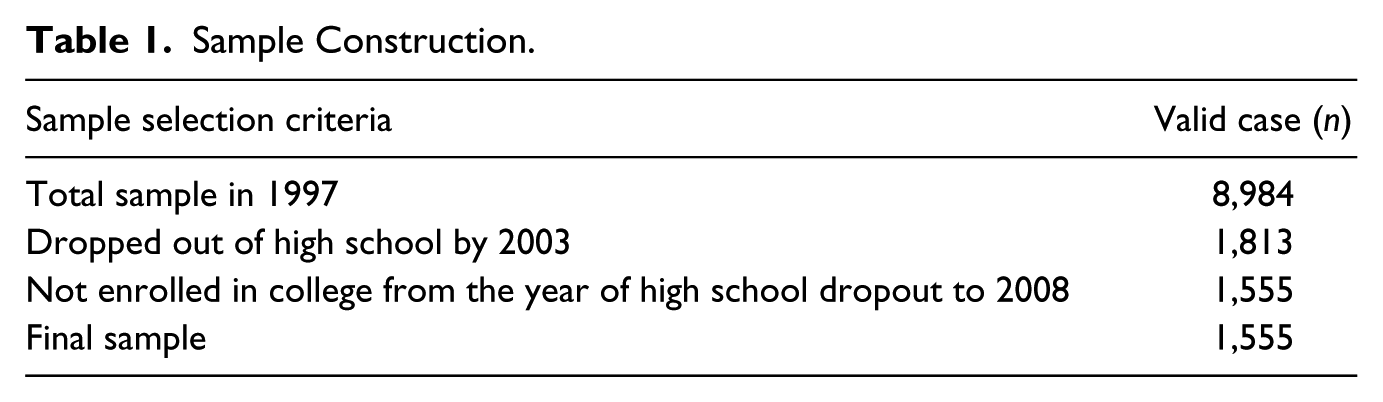
The filtering process that was used to construct a sample is described in Table 1. To investigate the factors affecting the occupational standing of school dropouts, this study restricted the sample to workers who dropped out of high school by 2003, which is the expected graduation year, if respondents aged 12 (as of December 31, 1996) finished high school in 4 years. It decreased the number of samples from 8,984 to 1,813. In addition, 438 respondents who enrolled in college after acquiring a GED by 2008, the year of the latest release of NLSY 97, were excluded. This criterion decreased the sample size to 1,555. We imputed missing data on individual characteristics using the mi command in Stata.
Sample Construction.
Dependent variable
This study used occupational standing as the dependent variable. Occupational standing carries information on “a degree of prestige or social standing” (Miech, Eaton, & Liang, 2003, p. 441). Ever since Duncan developed the Socioeconomic Index (SEI), many scholars have updated it. This study used a measure that Nakao and Treas (1994) upgraded. We used the occupations that respondents hold in the beginning of each year. Detailed process and the plausible problem in calculating occupational standing are provided in the appendix.
Independent variables
The independent variables were divided into two categories by time reference: time-variant and time-invariant variables. Three time-variant variables were considered: years since high school dropout (work experience) and acquisition of GED or vocational credential. For the time scale structuring the baseline of growth in occupational standing, this study considered years since high school dropout, which were a proxy for work experience. GED acquisition was coded to capture the average effect of GED acquisition on occupational standing: “1,” if workers achieved a GED credential for the year examined and “0” otherwise. Once a GED was acquired in a certain year, the subsequent year was coded as “1.” This coding scheme was supposed to capture any change in the occupational standing before and after GED acquisition. Vocational credential was coded the same way as GED acquisition. The dummy coding was supposed to capture the average effect of vocational credential on occupational standing.
Three time-invariant variables were considered: parental education, gender, and race. Parental education was dummy coded as follows: less than high school, high school, 2nd year college, and 4th year college or above. High school was a reference for parental education. Male was a reference for gender. Race was dummy coded as follows: White, Black, Hispanics, and Others. White was the reference for race.
Control variables
Control variables were years of schooling and years of birth. Years of schooling literally meant total years in school before dropping out. It was centered on a grand mean. Years of birth were supposed to catch the difference at the age of dropout workers.
Data analyses
This study used a growth curve model—that is, the trajectories of occupational standing depend on the repeated measurements nested within individual characteristics. Time or an alternative to time was specified at Level 1 in the growth curve model, and predictors were included at Level 2 to specify the time effect. Formulating a Level 2 model for a slope of the time variable in a Level 1 model allows a specification of the interaction of the time variable with time-invariant variables in Level 2, thereby allowing the estimation of the growth rate for individuals over occasions. Other strengths of the growth model stem from the use of missing measurements on time-variant variables (Raudenbush & Bryk, 2002).
At the repeated measure level (Level 1), time-variant variables were included in the model. The time variable—years after high school dropout—constructed the baseline of the growth model. The result of the tests, examining which variables need to be incorporated at Level 1, indicated that the coefficients for the linear and quadratic forms of years after high school dropout were significant. For the Level 2 model, time-invariant variables were specified. Chi-square test for the random intercept and random slope models showed that the variance components for the random intercept and linear and quadratic slope for years after high school were significant. Therefore, three coefficients were random in the Level 2 model (upi ≠ 0, 0 ≤ p ≤ 2). Then, we examined which variables at Level 2 interact with the Level 1 variable. The models were specified as follows:
Level 1:
(Occupational standing)ti = π0i + π1i (Years since school dropout) + π2i (Years squared) + π3i (GED) + π4i (Vocational) + εti.
Level 2:
π0i = β00 + β01 (Year of birth) + β02 (Schooling) + β03 (Gender) + β04~06 (Parental education) + β07~09 (Race) + µ0i.
π1i = β10 + β11 (Gender) + β12~14 (Parental education) + β15~17 (Race) + µ1i.
π2i = β20 + µ2i.
π3i = β30 + β31 (Gender) + β32~34 (Parental education) + β35~37 (Race).
π4i = β40 + β41 (Gender) + β42~44 (Parental education) + β45~47 (Race).
Results
Descriptive statistics
Table 2 presents the descriptive statistics. Analyses showed that in 2008, approximately 5.67 years had passed since the respondents dropped out of school. In 2008, 44% and 16% of the respondents achieved GED and vocational certificates, respectively. Respondents who obtained GED diplomas were more than those who had vocational certificates. Samples were composed of 55% Whites, 24% Blacks, 8% Hispanics, and 13% others. Respondents included more male subjects (59%) than female subjects (41%); 35%, 57%, 11%, and 5% of the respondents had parents whose education levels were less than high school, high school, 2nd year college, and 4th year college, respectively.
Descriptive Statistics (Weighted).
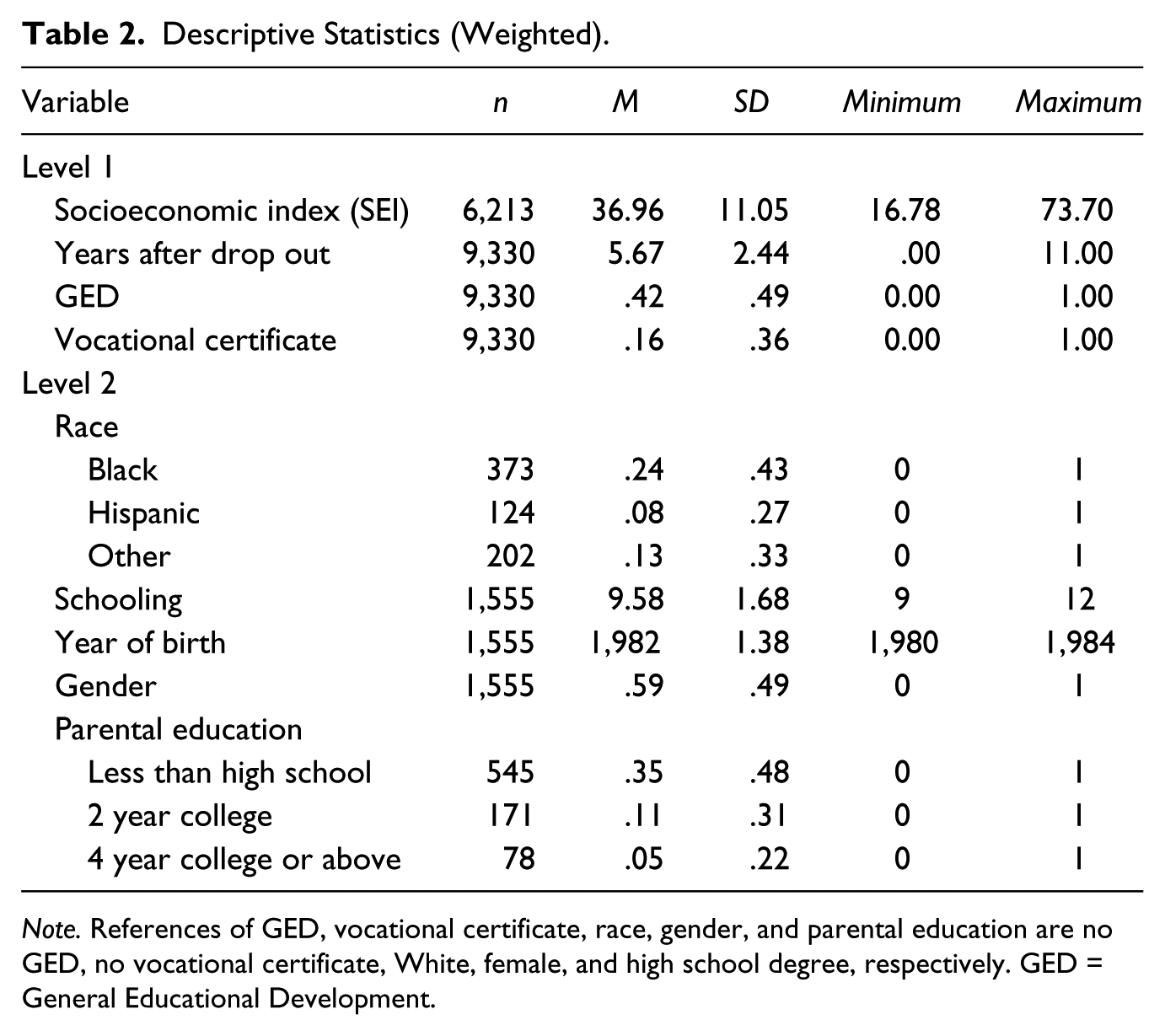
Note. References of GED, vocational certificate, race, gender, and parental education are no GED, no vocational certificate, White, female, and high school degree, respectively. GED = General Educational Development.
The effects of Level 1 variables on occupational standing
Table 3 presents the results of the growth curve models of occupational standing. Provided here are the marginal effects for continuous variables and the discrete changes from 0 to 1 for discontinuous variables. Models 1 and 2 in Table 3 focused on the effects of time-variant variables on within-individual changes in occupational standing. Model 1 demonstrated that the rate of occupational standing (β10 = .85, p < .001) increased as years accumulated after dropping out; yet, the increments between years (β20 = −.05, p < .05) decreased gradually, which is indicative of a curvilinear pattern of occupational trajectories. Figure 1 displays the fitted growth trajectory of occupational standing on the work experience of respondents. The overall pattern in Figure 1 suggests that the size of the growth rate is trivial, and even the growth rate in occupational standing is stagnant after 5 years of dropping out.
Relation Between Human Capital Building and Occupational Standing.
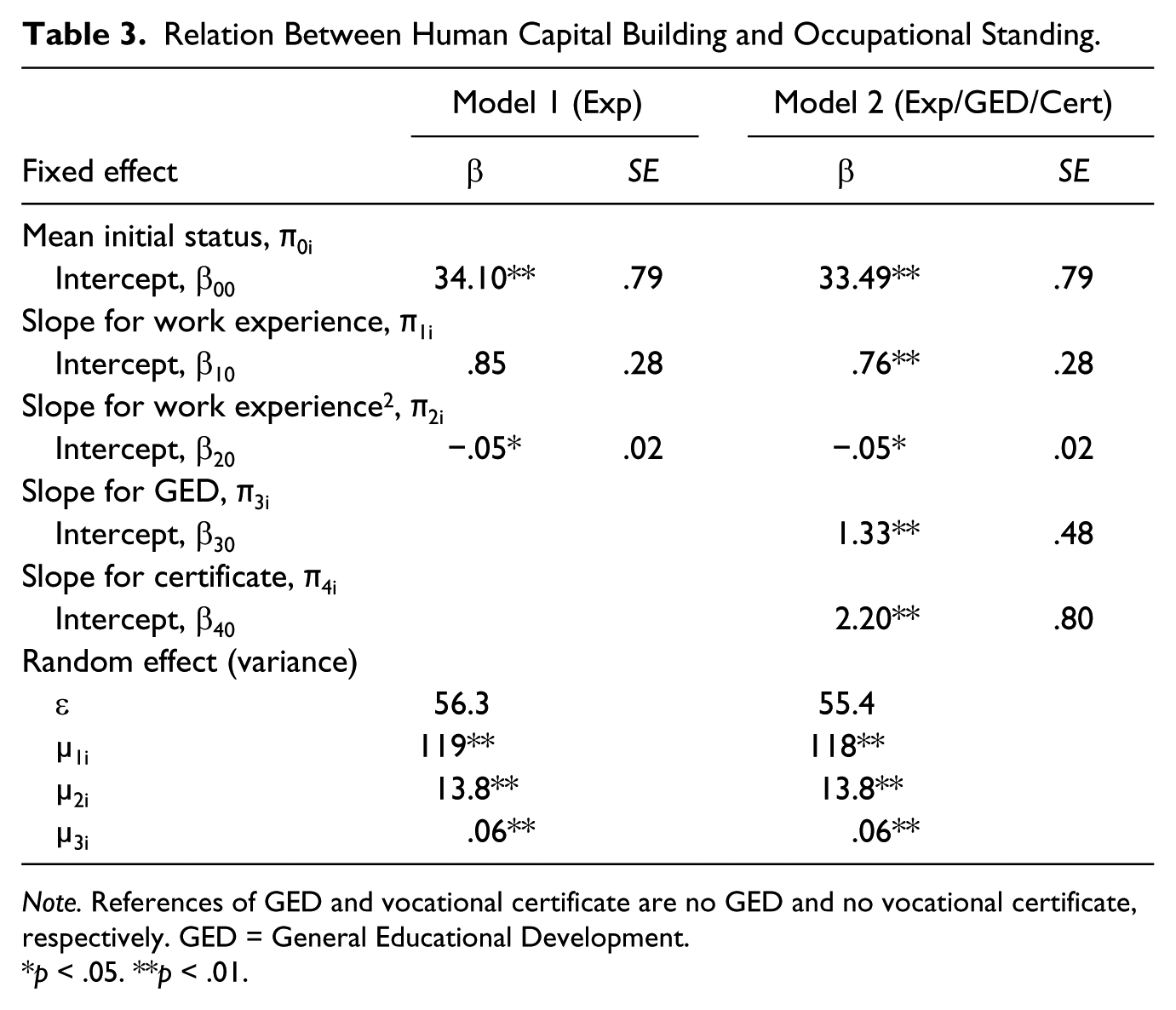
Note. References of GED and vocational certificate are no GED and no vocational certificate, respectively. GED = General Educational Development.
p < .05. **p < .01.
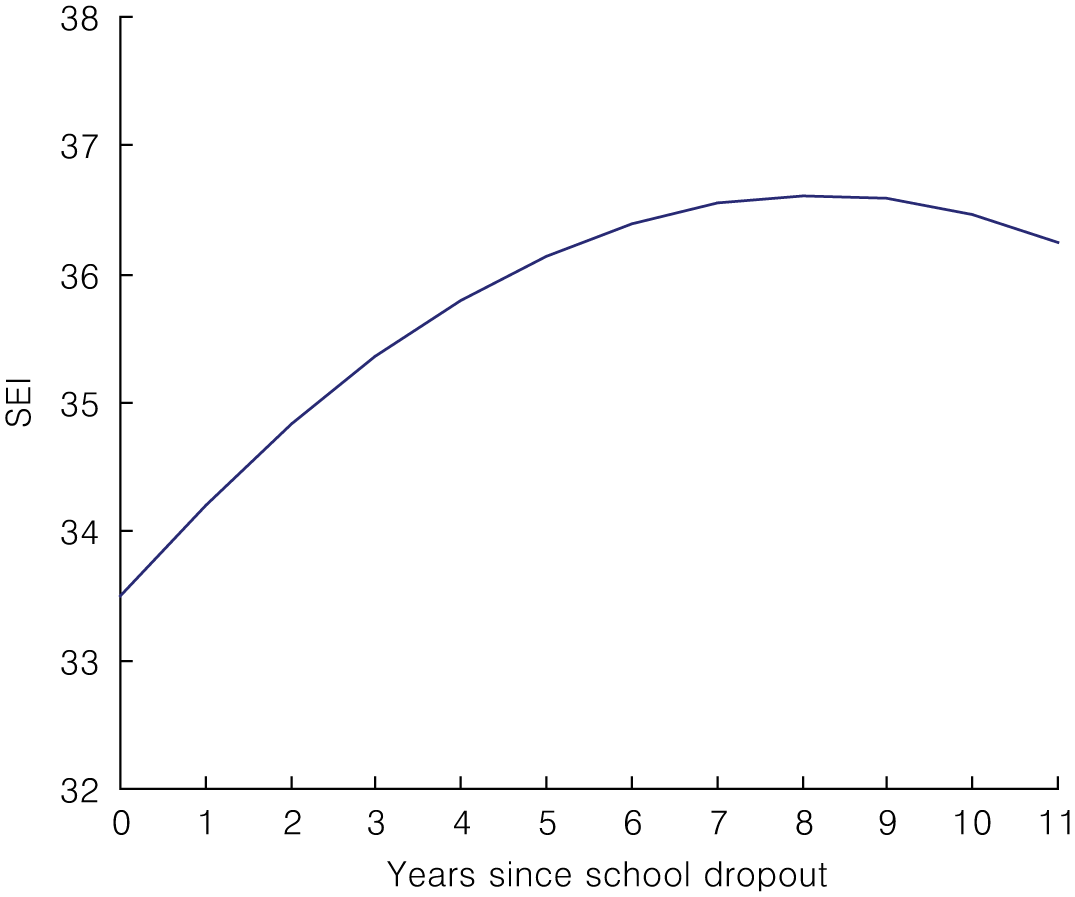
Plot of the predicted trajectory of occupational standing.
Model 2 presents the slope estimates for GED (β30) and vocational certificates (β40). The acquisition of vocational certificates enhanced the SEI by 2.20, whereas GED acquisition increased the SEI by 1.33.
The effects of Level 2 variables on occupational standing
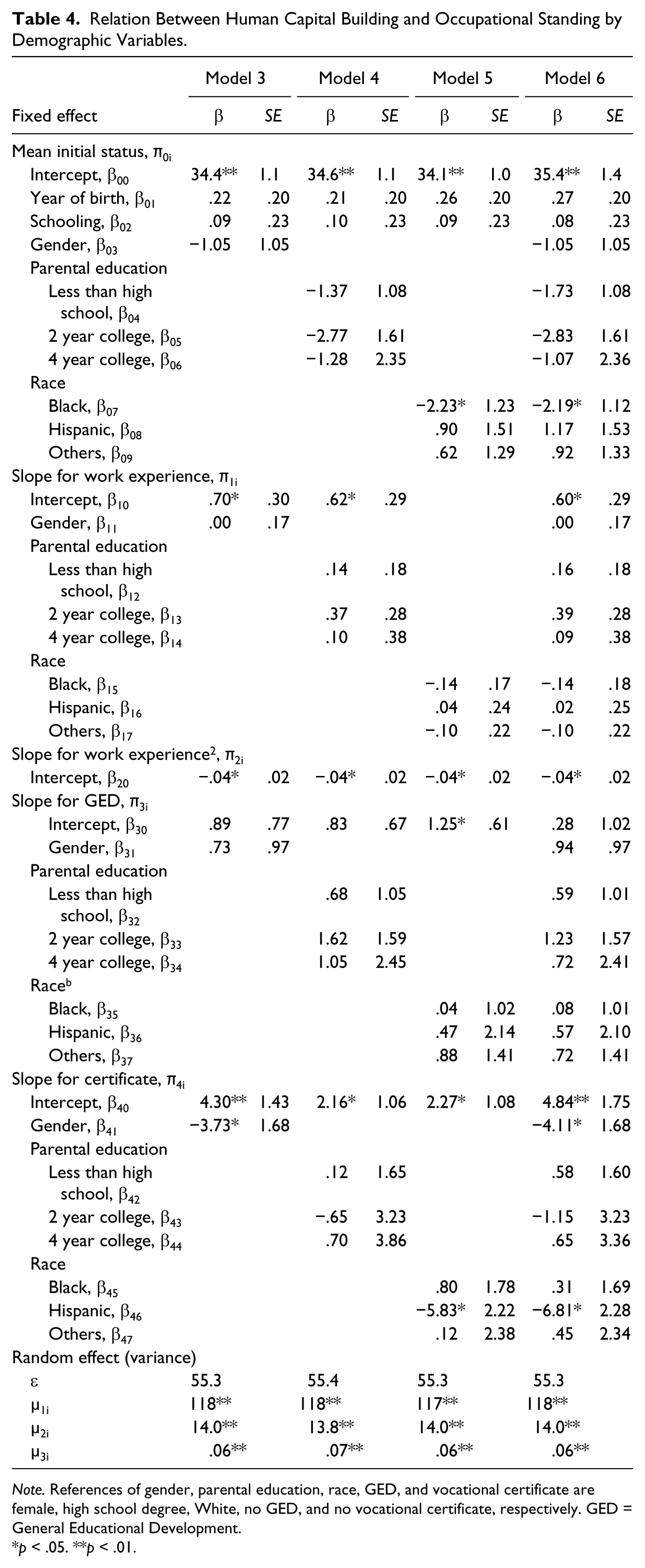
Models 3 through 6 in Table 4 present the way the relation between Level 2 individual characteristics and the trajectories of occupational standing interacts with human capital building after school dropout. Estimates were conducted after controlling for the years of schooling and ages. Years of schooling and ages at job entry did not significantly affect the initial status. Model 3 shows how the slopes for the human capital building process differ within gender. The initial status (π0i) and growth rate (π1i) were not different by gender; yet, gender interacts with the slopes for vocational certification (β41). Increases in occupational standing by vocational certification differ within gender categories. The estimates for vocational certification are 3.73 lower for male workers than for their female counterparts. After the GED slope is specified with the interaction with gender, GED lost statistical significance (β30). However, the overall intercept (π0i) and the slope for work experience (π1i) do not differ for male and female workers.
Relation Between Human Capital Building and Occupational Standing by Demographic Variables.
Note. References of gender, parental education, race, GED, and vocational certificate are female, high school degree, White, no GED, and no vocational certificate, respectively. GED = General Educational Development.
p < .05. **p < .01.
We investigate how the associations between occupational standing and work experience, acquisitions of GED, or vocational certificate interact with parental education. Model 4 demonstrates that the associations are significantly influenced by parental education. Compared with workers whose parents had only a high school diploma, any worker with educationally advantaged parents did not benefit more from the acquisition of human capital than those with less-educated parents. This suggests that dropout workers follow similar occupational trajectories irrespective of the parental background.
Model 5 presents whether the racial differential in occupational standing is moderated by human capital building. Black workers compared with White workers have suffered an initial disadvantage in occupational standing. However, other insignificant slopes (β15, β35, and β45) present that the disadvantage of Black workers is not moderated by human capital building, such as work experience, acquisition of GED, or vocational certification. Hispanic workers, in comparison with White workers, show disparities in occupational standing for the acquisition of vocational certification. The intercept for vocational certification (β46) represents an increase in the occupational standing of White workers holding certification. Hispanic workers holding certification have a lower occupational standing compared with White workers.
Discussion
This study highlighted the factors that lead high school dropouts to enhance their occupational standing by applying the growth curve model. To a minimum extent, an increment in years after school dropout improves the occupational standing of dropout workers. Acquisition of vocational certificate pushes dropout workers further toward higher occupational standing but brought more benefits to female workers than to male workers. The benefit of vocational certificate accrues to Whites, which increases racial disparities with Hispanics. Thus, the acquisition of vocational certificate attenuated disparities by gender but tightened racial difference. The association between work experience and occupational standing did not depend on demographic characteristics, indicating social constraints. Parental education level did not matter to dropout workers in acquiring a higher occupational standing.
This study showed the demographic similarity or difference in occupational standing among dropout workers. There was no disadvantage in the occupational standing of female workers at the lower levels of jobs, implicating no gender discrimination at the lower levels of occupations. Although the stigma of having a lower parental education permeates across schooling, there are no considerable variations in the effects of parental education on dropouts’ children’s occupational standing. The benefit of parents’ higher educational attainment may not lie in the dropouts’ children’s occupational standing. Different parents have different knowledge, skills, and know-how’s to cope with their situations within the current status (Farkas, 2003). Rewards for familial resource could be oriented toward types of jobs familiar or linked to their backgrounds. Workers from low socioeconomic status (SES) may have higher vocational maturity on menial jobs than those from high SES. The social closure occurring in low-level jobs, in which vacancies are mainly filled via informal hiring methods, such as incumbent referrals, may not serve as a barrier to occupational access for those from low SES (Waldinger & Lichter, 2003). Racial difference exists in lower occupations. Black workers initially hold lower occupational standing compared with White workers, even after controlling for background variables. Disadvantages in Black workers are not compensated by work experience or credentials. Initial difference at entry-level work has persistent effects on the racial occupational gap. This implies that individual effort cannot solve a structural hole in the minority treatment of the labor market, and policy intervention is needed to narrow the racial disparities.
This study also presented how human capital acquired after school dropout is related to occupational standing. First, work experience, measured with years after school dropout, contributed a little to escape dropout workers from lower occupational standing. This finding corresponds to the result of the study by Connolly and Gottschalk (2002), showing that dropout workers achieved less than 1% wage growth. This implies that most dropout workers were stuck in dead-end work for a considerable time. With a low annual growth rate of occupational standing and its decrement over time, it would not be plausible for the average dropout worker to escape from low occupations. It implies that work experience cannot be a mechanism for dropout workers to move into a better occupation. The trivial capacity accumulation by work experience indicates that welfare policy, focusing only on work experience, was destined for failure because work experience itself does not guarantee enhancing the occupational standing. Second, GED is not conducive to occupational standing, even though most dropouts pursued GED compared with a vocational certificate. Carnevale and Desrochers (1999) insisted that dropouts were only qualified for 12% of the jobs. Meanwhile, dropouts may be able to substantially expand their employability by receiving a vocational certificate. Vocational certification may provide the momentum needed to avoid the most unprivileged jobs by allowing greater access to a higher status job. Policy needs to reorient them toward a “hidden credential” (Kerckhoff & Bell, 1998, p. 152). In the circumstance that the comparative earnings of high school graduates to college graduates have decreased since the 1980s (Hotchkiss & Shiferaw, 2011), insofar as dropouts are not seeking college education, their labor market benefits lie in obtaining occupational skills, not educational credentials. For a career development of dropout workers, this study suggests that such policy intervention, as accumulation of human capital through vocational certificate, could be a better option for dropouts than the promotion to obtain a GED.
Some modes of human capital building benefit for specific demographic groups in the labor market. First, this study shows the significant moderating effects of gender on the relation between vocational certificate and occupational standing, even after controlling for schooling, academic, and nonacademic credentials and work experience. As for the moderating effect of gender, female workers obtained more benefits from a vocational certificate. Grubb’s study (2002) offered the first possible interpretation. Acquisition of vocational certificate may help female workers to get out of gender-stereotyped service jobs, such as cashier, waitress, and janitors. The studies of Melamed (1995) and Cannings and Montmarquette (1991) offered another plausible interpretation that criteria for access to occupations may be applied differently by gender (Melamed, 1995). Female workers’ suitability for jobs may be evaluated more strictly by the observable criteria than men’s suitability. Furthermore, male workers may be less dependent on credentials to gain higher status in occupations than female workers (Cannings & Montmarquette, 1991). Likewise, employers may not be as strict with male workers as with female workers in applying the criteria to a job. Thus, job-related credentials, such as vocational certificate, may provide female workers with more advantages than their male counterparts. Second, for Hispanic workers, the acquisition of a vocational certificate does not give as much advantage as it does for White workers. One possible interpretation is that Hispanic workers may obtain certificates in less-rewarding fields than their White counterparts. This interpretation is supported by the research that Hispanic workers are overrepresentative in menial jobs, such as in the construction industry (R. W. Johnson & Soto, 2009). Another possible interpretation is that even though holding a certificate can send a positive message to employers about workers’ productivity, the disadvantage of Hispanic workers could be due to a barrier to job entry for which an obtained certificate is targeted for. Less advantage to Hispanic workers on a vocational certificate may be its less relatedness to the job. However, further research is needed for this racial differential.
Limitations and Suggestions
This study has some limitations and suggestions as to the future study. First, some respondents defined as high school dropouts may attend college after achieving a GED in the future, although this study used all the available waves from NLSY 97. Second, this study focused on factors that made dropout workers to obtain a higher occupational standing but did not delve into the hidden mechanism that lies behind the differentiated effects of gender or race on occupational standing. Future studies should consider this mechanism. Third, this study focused on the changes in the status of jobs that dropout workers hold; however, it did not examine the effects of the changes in occupational standing on wage rates. Given the mediating role of occupational status, future research should consider the relation between changes in occupational standing and wage rates, and whether such occupational standing will push the wage rates above the poverty line. Despite these limitations, this study demonstrated how individual characteristics and human capital accumulation help dropout youth workers to move up the occupational ladders. Because high dropout workers are the major concerns of welfare policy, the findings of this study may contribute to the enhancement of policy effectiveness by providing some evidence.
Footnotes
Appendix
Declaration of Conflicting Interests
The author(s) declared no potential conflicts of interest with respect to the research, authorship, and/or publication of this article.
Funding
The author(s) received no financial support for the research, authorship, and/or publication of this article.