







Abstract
Chicago Public Schools and school districts throughout the country are seeking new ways to foster racial, ethnic, and socioeconomic equity as desegregation consent decrees are being lifted. One of Chicago’s selective enrollment high schools drafted parents, educators, administrators, and community representatives to address its own diversity concerns and to examine the barriers to high-quality educational opportunities district-wide. As a result, this school began a pilot program that explored opportunities for bolstering the recruitment and nurturing the success of low income and minority students, and these efforts eventually contributed to policy changes in the overall district. The authors describe the program’s development and implementation and suggest it as one model for closing the “opportunity gap.”
Jones College Prep High School, in one of Chicago’s gentrifying neighborhoods, is 1 of 10 “selective enrollment” high schools (SEHSs) in the Chicago Public School (CPS) system. Being admitted into a SEHS is a three-step process: achieving a minimum number of points (that reflect grades, attendance, and standardized test scores in the seventh grade year), taking the selective enrollment test in the eighth grade year, and then making the cut among the hundreds of applicants vying to enroll at the school of choice. Jones College Prep has been ranked as one of the 30 best high schools in the state of Illinois (Rossi & Golab, 2004), was in 2006 the first Chicago public school to win the U.S. Department of Education’s Blue Ribbon Schools award, was chosen as one of U.S. News and World Report’s 100 Best High Schools for 2007-2008 and 2008-2009, and has one of the best records in Chicago for placing graduates in competitive colleges. As a SEHS, Jones is one of the most sought after placements in Chicago for incoming freshmen. Although the school is not content to coast on its reputation alone, there is no need to worry about marketing to ensure the recruitment of capable students—Jones could continue to have its slots filled with little effort in the foreseeable future.
On the other side of the equation, however, the concern about being in a position to qualify for recruitment seems to loom larger every year for talented eighth graders across the city. In particular, low-income and racial/ethnic minority students, especially males, are finding it more difficult to get into the SEHSs of Chicago. An internal study conducted for CPS (based on an analysis of freshmen enrollment data from 2004-2005) found that students living in “nonperforming” attendance areas 1 have very limited access to “performing” schools and concluded that even after controlling for seventh-grade Iowa Test of Basic Skills (ITBS) scores, access still depended on where students lived—a significant “opportunity gap.” On this point, the admissions cycle for the 2010-2011 school year led to an unprecedented set-aside of 100 seats in the top SEHSs (see lengthier discussion later in this paper) after students with competitive scores from the lowest-performing elementary schools were virtually shut out (Karp, 2010). Nonetheless, it would seem that SEHSs in Chicago are at great risk of becoming very segregated places, both racially and socioeconomically.
There are, as well, strong disincentives to nurturing a diverse school culture in a city like Chicago. Many educators, policymakers, politicians, and even some civil rights officials have come to feel that it may be more fruitful to focus on high standards and adequate resources in all schools than on integration per se (Berkowitz, 2006; Rumberger & Palardy, 2005; Saunders, 2007). This resignation may become even more pronounced in light of Chicago’s limited options and reactive planning for a post-desegregation era. A recent local report (Karp, 2009) cites budget shortfalls as the reason offered by CPS officials for the lack of a solid plan for integration once Chicago’s decades-old consent decree (a 1980 U.S. Department of Justice order that had required the district to implement a voluntary desegregation plan for its segregated schools) was lifted, as had been anticipated. School choice opportunities, both nationally and in Chicago, spark concerns that children of parents who are less savvy about options (often those with less education and resources; see Horvat, Weininger, & Lareau, 2003; Wells & Crain, 1999) will be “left behind” in poorer performing, hyper-segregated neighborhood public schools.
For these and other reasons (e.g., residential segregation), school districts all over the country that have relied on admissions or assignment plans to address legal demands for diversity are now facing increasing educational segregation in terms of both applications and enrollment, and are struggling to determine how best to address these changes (Orfield & Lee, 2006). Some districts are experiencing turmoil, such as in Wake County, North Carolina, where a school assignment plan that seemed to be working satisfactorily was rejected by a newly elected board in 2010, sending those interested in maintaining integration back to the drawing board (Winerip, 2011). Other districts that have offered selective enrollment schools as one desegregation option, like Chicago, are seeing both an increase in segregation in applications and enrollment. New York City (Otterman, 2011) and Fairfax County, Virginia (Sieff, 2010), are examples of two urban districts that have seen the same slide in minority admissions within their selective high schools as Chicago. New York’s prestigious Hunter College High School experienced the resignation of its highly regarded principal in 2010 partly due to tensions regarding the lack of diversity at the school and the admissions process (Otterman, 2010).
A recent study showed that among all CPS high schools, only a few besides the selective enrollment schools send a large proportion of their graduates to college in general and to 4-year and selective colleges in particular (Roderick, Nagaoka, & Allensworth, 2006). Consistent with national trends, CPS continues to struggle with dropouts and loses nearly half of its African American males by 18 years of age (Allensworth, 2005). Consequently, the trend toward lower numbers of minority and low income students in selective enrollment schools results in even fewer opportunities for college attendance for the city’s most underserved populations, a true reversal in the fight to combat an ongoing opportunity gap. Urban districts attempting to improve college matriculation rates can ill afford to dismiss the selective enrollment avenue to higher education, even as they struggle simultaneously to address obstacles to college attendance at neighborhood schools.
In this article, the authors focus primarily on 2006-2007, the initial year—the planning and development stages—of Jones’ Targeted Recruitment and Support (TRSP) program, concluding with our analysis of the program’s impact on the entire district’s selective enrollment policy that eventually emerged in response to both the recent Supreme Court rulings, virtually eliminating race as the sole criterion for school admissions decisions, and the lifting of the district’s consent decree. All of us were involved with the TRSP program from its inception in various capacities; as principal of the school (Fraynd), and as members of the TRSP steering committee (Miretzky and Chennault). We believe that the story behind this initiative offers a window into the issues facing Chicago public schools in terms of who gets into and who is excluded from the city’s selective enrollment high schools, and may well have relevance for other urban districts across the country struggling with diversity concerns. Who gets in matters because the students who attend these schools are much more likely than the average CPS student to go on to college (Roderick et al., 2006). However, more and more, the students attending these schools are middle class, White, and female—limiting the enrollment of other student populations who arguably have fewer options, now and in the future, lacking the boost a selective enrollment school can provide 2 (see Figure 1).
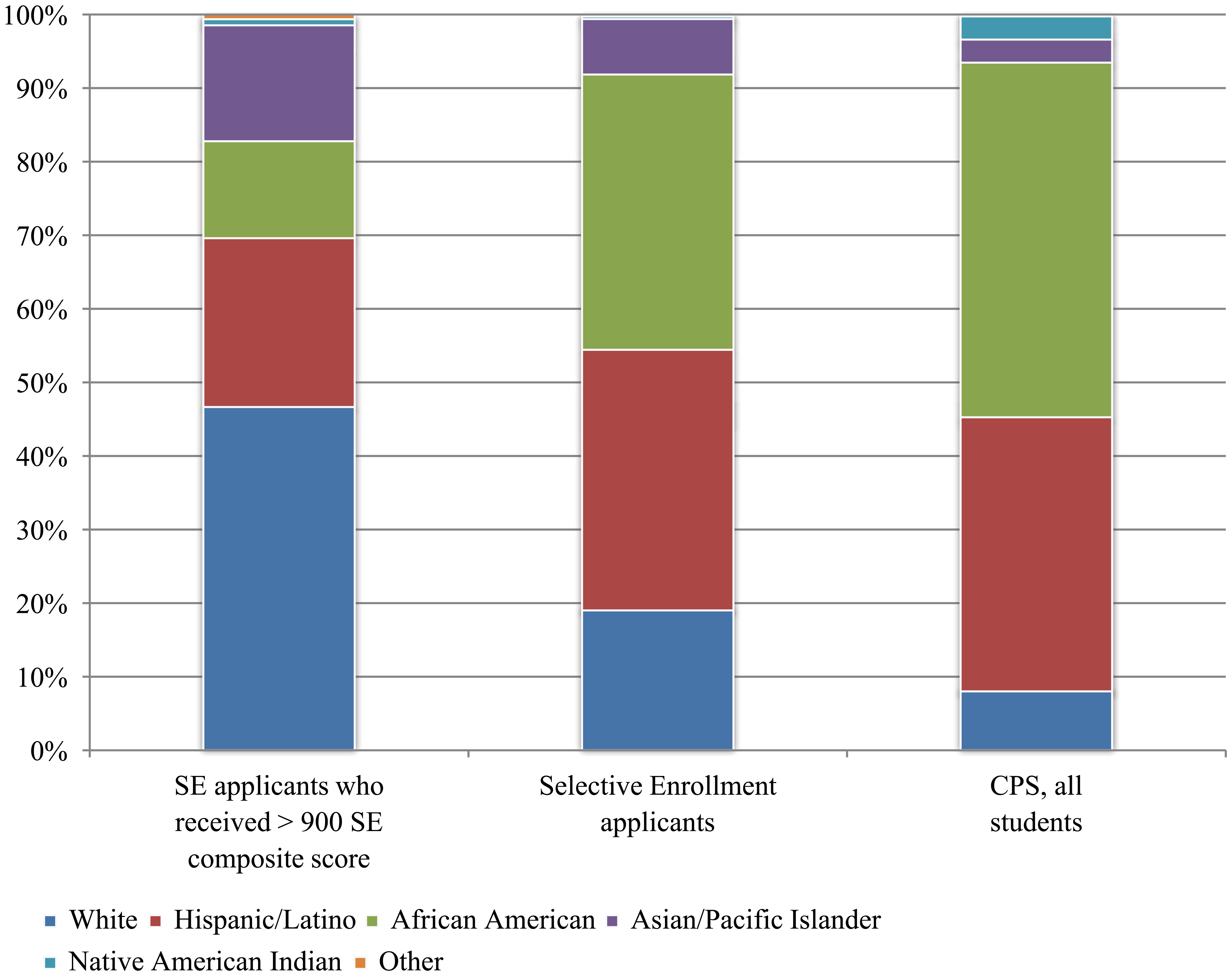
CPS racial breakdown, 2005-2006.
Why Avoiding Segregated Schools Is Critical: What the Literature Says
There is a wide range of benefits attributed to integrated schooling and well documented in the literature on desegregation. Some of these benefits fall under the category of academic achievement and attainment, whereas others are more social/societal in nature. Importantly, minority students are not the only ones who stand to benefit from greater integration; students of higher socioeconomic status and White students can derive benefit as well.
Academic Benefits
Having a racially, ethnically, and socioeconomically diverse student body can contribute to academic achievement for students of varied backgrounds (though in different ways), especially for low-income students (Kahlenberg, 2001; Rumberger & Palardy, 2005; Tam & Bassett, 2004), although the matter of school diversity is admittedly a complex one (see, for example, Morris, 2008; Owens, 2010). Racial minority and low-income students attending integrated schools tend to have more access to better educational resources and opportunities than they have at more segregated schools (Carter, 1996; Dawkins & Braddock, 1994; Orfield, Kucsera, & Siegel-Hawley, 2012; see also Linn & Wellner, 2007). Desegregated settings are associated with heightened academic achievement for minority students (Borman & Dowling, 2010; Braddock, 2009; Schofield, 1995). And as expert testimony in the Parents Involved case argued, integrated schools also enhance critical thinking skills (defined as “the ability to understand and challenge views which are different from [one’s] own”) for all students (Parents Involved in Community Schools v. Seattle School District, 2005, p. 1174). Similarly, an amicus curiae brief to the Parents Involved case, signed by 553 social scientists (Brief of 553 Social Scientists, 2007), highlights the body of research regarding the benefits of interaction opportunities between students of different ethnic and racial backgrounds: “Both experimental and field studies in higher education, for example, have concluded that interactions with a diverse group of students can lead to higher and deeper levels of thinking” (p. 7).
While there is no clear consensus that White students benefit from integration in terms of general academic achievement (Siegel, 2006) or attainment, there does seem to be a consensus that there are no deleterious effects (Hoschild & Scrovronick, 2003; Johnson, 2011; Linn & Wellner, 2007). Garda (2011) goes further to make the forceful argument that White students are actively harmed by segregated schools that fail to prepare them for what he calls a “multicultural marketplace” by providing opportunities to learn “cross-cultural competence” in integrated environments.
Social and Societal Benefits
A more racially diverse school environment is associated, for all students, with the improvement of outlooks and viewpoints concerning race relations (Kurlaender & Yun, 2001; Pettigrew & Tropp, 2006; Wells, Holme, Revilla, & Atanda, 2004). Diverse schools are associated with a reduction in students’ acceptance of stereotypes (Pettigrew & Tropp, 2006) and more willingness to interact and become friends across racial lines (Killen, Crystal, & Ruck, 2007). Broader objectives (i.e., preparation for functioning in a diverse adult world, democratic citizenship skills) are enhanced when students interact in an integrated educational setting (The Civil Rights Project, 2002; Gurin, Nagda, & Lopez, 2004; Ma & Kurlaender, 2005). Moreover, students who have attended integrated schools have a greater likelihood of residing in integrated neighborhoods and of maintaining regular interracial contacts (Kurlaender & Yun, 2001; Orfield & Eaton, 1996; Wells & Crain, 1999), and an increased likelihood of working in an integrated environment and having positive experiences in the integrated workplace (Braddock, Crain, & McPartland, 1994; Kurlaender & Yun, 2001; Schofield, 1995; Trent, 1997).
Newer research highlights the long-term effects of desegregation as well. In a comprehensive and well-designed study, Johnson (2011) reports that the cohort of Black students who spent 5 years in desegregated schools during the 1960s to 1980s are earning about 25% more as adults than those who did not have the same schooling opportunity. In addition, this cohort was less likely to have been incarcerated by age 30 and was also healthier than the comparison group—a difference the researcher equates to a 7-year delay in health deterioration. There were no significant effects on Whites from desegregation across any of these outcomes. Johnson attributes the attainment outcomes for Black adults to improved access to school resources as reflected in reductions in class size and increases in per-pupil spending. A recent Civil Rights Project report underscores the same point: It is not that the mere act of sitting next to a White student guarantees that students of color will have better educational outcomes. “Instead, the resources—both material and human—that are consistently linked to predominately White and/or wealthy schools help foster serious advantages over minority segregated settings” (Orfield et al., 2012, p. 36).
Achieving and maintaining diversity by targeting socioeconomic integration is a more recent policy innovation in the desegregation arena, and therefore has been the subject of less scrutiny. However, given the dwindling options when it comes to race-based integration plans, there is increasing usage of socioeconomic plans as proxies. And there are promising signs of the benefits that can result—with some caveats. Basile (2012) performed a cost–benefit analysis of socioeconomic status-based integration programs and found that an initial investment of about $6,500 per student led to, in later years, increased income, less time on welfare, and fewer crimes among the integrated students. “The total gain, which includes both the public gain as well as increased private earning, is estimated at around $33,000 per student,” he concludes (p. 128). In a different study, Reardon and Rhodes (2011) analyzed the effects of socioeconomic-based plans on segregation patterns in 23 school districts in the United States. They conclude that such plans have the potential to yield socioeconomic integration and to reduce racial segregation even when race-based plans are absent, but their conclusions are necessarily tentative because the plans they studied are few in number and use “weak” mechanisms (i.e., use a narrow range of socioeconomic factors in the assignment of students). They cautiously recommend that interested districts should incorporate stronger mechanisms into socioeconomic plans for the best chance at reducing racial and socioeconomic segregation levels.
Of course, how students are integrated is of paramount importance. Providing enhanced opportunities to underserved students and the achievement of a desired level of demographic diversity are necessary but insufficient conditions for moving beyond the liabilities of segregated schooling. To enhance the prospects of success for all students in an integrated environment, sincere commitments and careful planning are required to ensure that something meaningful happens amid such diversity. These understandings were foundational to the creation of our program for recruitment and support.
The Impetus for TRSP
Since Jones “reopened” in 1998 as a college prep SEHS (it had operated until 1998, serving primarily African American students, as a “commercial” high school with an emphasis on business training), its diverse student body has enjoyed a record of academic success. A student survey in 2005 reported that diversity, the school’s central location, and its quality academics were the three most important reasons why students choose Jones as their high school. This diversity is threatened as the school’s success attracts a much larger and somewhat less heterogeneous group of applicants each year. This broader pool, coupled with the fragmented processes and admissions criteria of selective enrollment (Boston Consulting Group, 2006; Myers, 2008), contributes to Jones’ diminishing reflection of the CPS student population overall. In 2002-2003, less than 20% of all students at Jones were White and more than 65% were low income. In contrast, the incoming freshman class in 2006 was 30% White and the overall percentage of low-income students decreased to 57% (although it is important to note that the percentage of White students would have risen to 47% if the school had not been able to enact the flexibilities of a long-standing consent decree [discussed below]). There was also a corresponding decrease in the number of Chicago neighborhoods represented at Jones. While Jones is far above the norm in terms of enrolling the highest percentage of low and moderate-income students of any of the “top 100” schools in the state of Illinois, 3 the administration and staff remained concerned about the apparent trend toward a less diverse student body (see Figure 2).
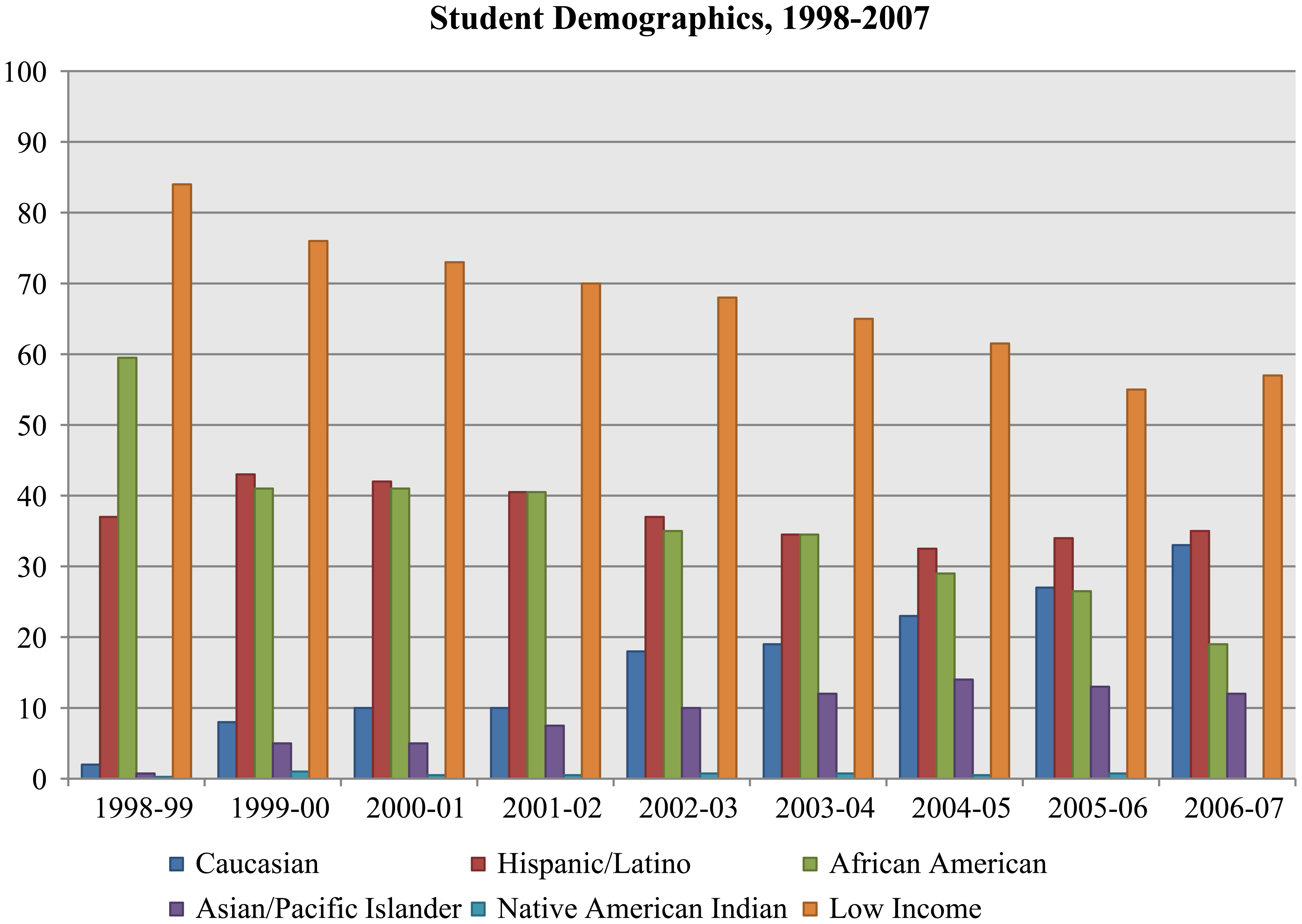
Jones College Prep demographics, 1998-2007.
CPS and school districts across the nation have been struggling to find new ways to foster racial, ethnic, and socioeconomic equity as court-supervised desegregation consent decrees, imposed during the 1970s and 1980s as remedies for past discrimination, expire. Under the decrees, many school districts opened magnet and selective enrollment schools that offered specialized curriculum and instructional approaches to voluntarily attract ethnically and racially diverse students from beyond their immediate neighborhoods. CPS opened and expanded its magnet and selective enrollment programs in 1980, when the consent degree was imposed, in the hope that geographically open admissions would mitigate racial segregation in its schools. However, it seemed likely that the termination of CPS’s decree (which happened in 2009), along with the decisions of the Roberts Supreme Court regarding Parents Involved v. Seattle School District and Meredith v. Jefferson City Board of Education, would have a significant impact in coming years on options for promoting school diversity and equity—and for narrowing the opportunity gap—in the city.
It is possible that recent guidelines from the Departments of Justice and Education (U.S. Department of Justice, 2011) promoting the voluntary use of race by schools to promote diversity and limit racial isolation in the face of increasing segregation might have a encouraging effect on desegregation efforts. These guidelines suggest options, such as nonracial admission criteria, school feeder patterns, zoning shifts, and open enrollment to name a few, for districts to consider. However, it remains clear that decrees provide the only legal imperative left to maintain racial integration, and the Supreme Court’s 2007 decisions to limit the use of race in admissions criteria have severely restricted the means by which to facilitate such integration. These factors may well result in school districts feeling forced, as Justice Anthony Kennedy suggested, to ignore the resegregation of schooling. In fact, these changes may contribute to more resegregation (see Orfield, Frankenberg, & Lee, 2002/2003).
Like the miner’s canary, the situation at Jones served as a warning to the entire Chicago district that it needed to rethink its overall policies on enrollment and diversity in a complicated political and social landscape. Its selective enrollment schools—elementary and secondary—used the flexibility provided by the district’s consent decree to promote integration and foster some measure of equity. The release from the decree, accompanied by the growing interest of White families (some from private and parochial schools) in Jones and other selective enrollment options, will pose enormous challenges to maintaining the diversity that has been the centerpiece of the district’s voluntary integration initiative. TRSP has provided, we believe, an avenue for addressing this inevitable dilemma around the opportunity gap, in that its use of income and geography as primary criteria for recruitment to these selective enrollment options—which by and large have been adopted by the district, along with a formalization of a “set aside” option for principals—should withstand challenges in a post-desegregation environment.
The Targeted Recruitment and Support Program
In the spring of 2006, a group of parents, educators, administrators, and community, foundation, and business representatives were drafted by Jones’ administration to consider the issue of dwindling diversity in Chicago’s SEHSs and to develop ways to address the issue in a forward-thinking manner. As a result, Jones served as the site of a pilot program, begun during the 2006-2007 school year, which was intended to be a means of exploring ways to bolster the recruitment and to foster the success of low income and minority students: the TRSP.
TRSP’s mission was to identify students from low-performing and distressed schools and communities and recruit them to selective enrollment schools, beginning initially with Jones in the 2006-2007 school year, with the hope of expanding to other SEHSs in subsequent years. As a critical component of this mission, TRSP sought to offer support throughout these students’ high school careers, drawing upon the resources already in place for students who needed additional help and supplementing these resources with interventions tailored to the specific needs of recruits. In doing this the program sought to strengthen supports for all students—targeted or not—by learning more about the kinds of interventions that made a real difference for any struggling student.
The Targeted Recruiter, which was a new position created for the program, was the key contact in working with selected neighborhoods in collaboration with parents, community leaders, clergy, educators, social service providers, and others to identify students capable of succeeding at Jones. Because early experiences at recruitment events revealed that many of these young people and their families might not be familiar with either Jones, or the selective enrollment option, TSRP made a commitment to work closely with families to support them in this process as well as to continue to foster efforts to disseminate information about selective enrollment in general in communities less likely to be visited by selective enrollment recruiters. It seemed clear, however, that recruitment was only the beginning. It was not enough to get students into the school. The ultimate success of the program was going to be measured by how many of these students “found a place” at Jones, stayed on to graduate, and then made their way to college. To achieve these ends, students would need help to address logistical, community, academic, and social issues promptly and effectively—help that needed to be provided by teaching staff, administrators, and even fellow students.
Creating and sustaining relationships—between communities, educators, and students—was, from the beginning, an additional and very important goal of TRSP. Mutual learning and enrichment must be in the forefront of the outreach to underrepresented neighborhoods. To keep from alienating local high schools, it was important that TRSP not be perceived as “creaming” the best students from challenged neighborhoods and then moving on. Given these deeply-felt concerns, long-term goals for the program included (a) coordination and collaboration among selective enrollment schools and other programs, such as gifted centers, magnets, International Baccalaureate programs, and open enrollment schools, to improve and enhance the delivery of information about options to all neighborhoods in Chicago, and (b) the support of counseling and other personnel in neighborhood schools in encouraging educational opportunities for all eligible elementary school students (see Figure 3).
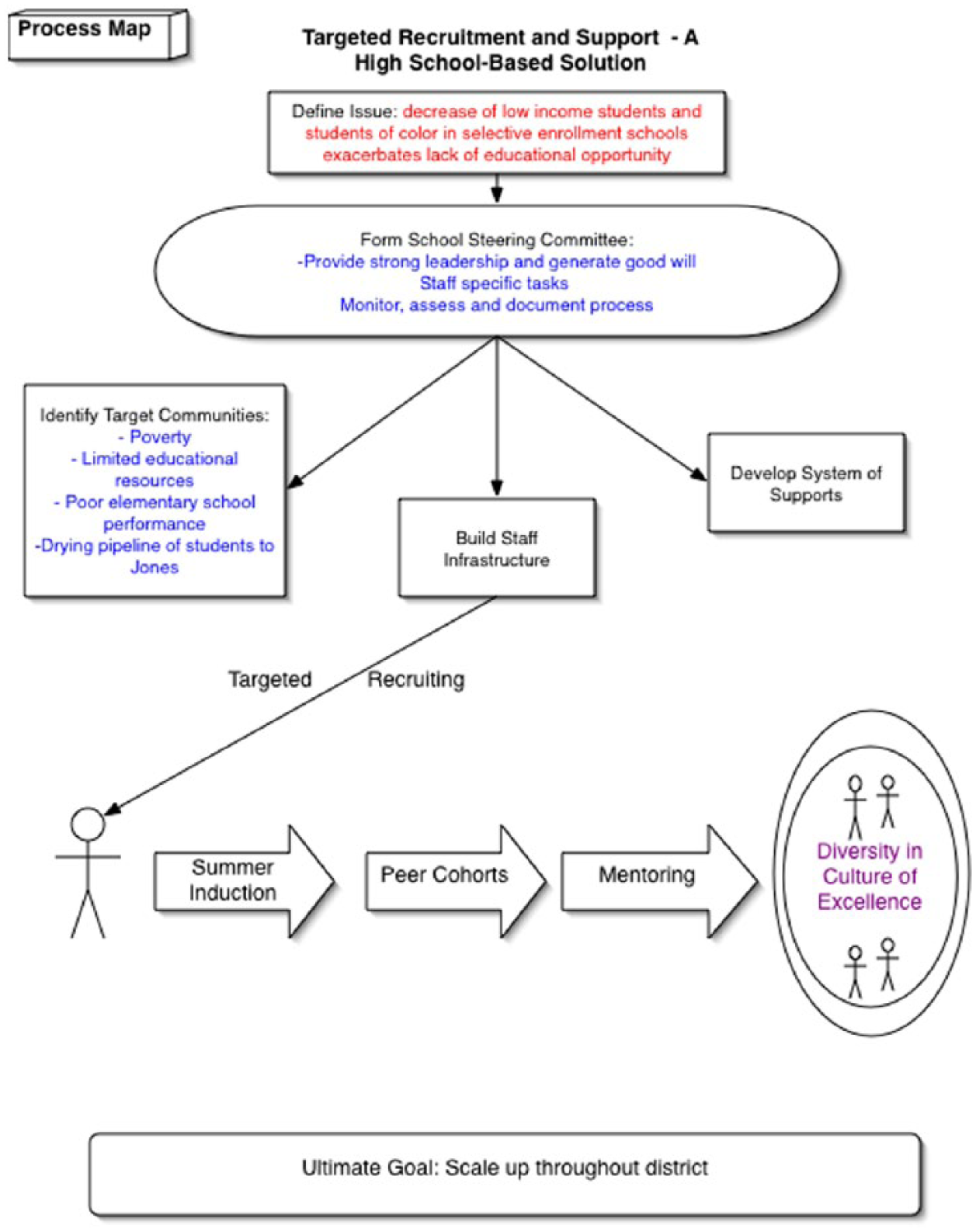
TRSP process map.
As noted earlier, a steering committee made up of a number of committed individuals representing a wide range of backgrounds and organizations was constituted at Jones in spring 2006. This committee was tasked with responsibilities such as the final selection of neighborhoods, community outreach, and fundraising. The group included school administrators and teachers from Jones; parents, community members, and current students from a variety of neighborhoods, including some of the neighborhoods being considered for selection; district administrators; Chicago-area college and university professors and researchers; business leaders from the school’s immediate neighborhood; consultants; representatives from other selective enrollment schools; and other “friends” with an interest in the success of TRSP. The steering committee met regularly, beginning in May 2006, to provide guidance and to oversee the progress of its subcommittees (recruiter hiring, research and evaluation, fundraising, community outreach, and student support) and the overall implementation of the effort. Plans were made to continue to deepen connections through outreach efforts with the four targeted communities that were ultimately identified, to develop a student support system, to evaluate and analyze the program, and to prepare for the expansion of the program in subsequent years.
The Targeted Recruiter Position
Under the supervision of the Hiring/Recruiter Mentoring subcommittee and the school principal, a targeted recruiter was hired in the spring of 2006. The responsibilities of this position included designing and implementing strategies to identify students, who would likely be overlooked by traditional high school admissions processes. The position required collaboration and partnership with external stakeholders, such as schools, community groups, and religious organizations in underserved areas of the city. The mission was focused on both recruiting students from targeted communities and increasing awareness of the selective enrollment process in general (and in doing so, increasing the number of overall applicants to SEHSs). Funds were secured from the district to underwrite part of the costs of supporting the position; to underscore their belief in the program, steering committee members and friends also contributed personally. The targeted recruiter was mentored initially by Jones’ full-time admissions counselor (who retired in June 2007), and assumed full admissions duties for the 2007-2008 school year, while continuing to develop TRSP.
The targeted recruiter worked closely with the TRSP steering committee to develop evaluation criteria to identify and recruit students; cultivate relationships with community leaders, local elected officials, community-based organizations, religious institutions, and individual community residents, with an aim to creating a pipeline for qualified prospective students; develop relationships with schools in the targeted neighborhoods; and work with the Student Support subcommittee to design a mentoring and support network program for selected students.
Choosing the Neighborhoods
The Research/Analysis/Evaluation and Community Outreach subcommittees were assigned the task of choosing the four targeted neighborhoods so that the targeted recruiter could begin recruitment efforts prior to designated eighth-grade testing dates. The committee sifted through data that represented a variety of measures and ultimately narrowed the criteria so that targeted neighborhoods
were among the city’s most impoverished neighborhoods (as determined by the MacArthur Foundation and the Local Initiatives Support Corporation; LISC/Chicago) 4 ;
were the neighborhoods of the district’s most low-performing elementary schools, as reflected by Illinois Standards Achievement Test (ISAT) reading and math test scores;
were the neighborhoods with district schools serving student populations of 90% or more eligible for free or reduced lunch;
had no plans for new schools (public, charter, private) in the near future;
had schools with high-scoring (ISAT) students, who had not taken advantage of opportunities to apply to selective enrollment schools; and
represented a “drying pipeline” to Jones (e.g., Neighborhood X sent nine students to Jones in 2003, but none in 2006).
The two committees weighed these criteria and selected four neighborhoods to target for the first (and as was later decided, the second) year of the initiative. These neighborhoods have the highest or near the highest concentrations of poverty, low-performing schools, and limited educational alternatives, and had very few or no students in the Jones class of 2010. It is worth noting that the new guidelines from the Departments of Justice and Education specifically suggest, under their “Admission to Competitive Schools and Programs” option that schools “could give special consideration to students from neighborhoods selected specifically because of their racial composition and other factors” and could also
give greater weight to the applications of students based on their socioeconomic status whether they attend underperforming feeder schools, their parents’ level of education, or the average income level of the neighborhood from which the student comes, if the use of one or more of these additional factors would help to achieve racial diversity or avoid racial isolation. (U.S. Department of Justice, 2011, p. 12)
Recruiting and Choosing Students
With assistance from the district’s central offices, in the fall of 2006, Jones’ admissions counselor, principal, and targeted recruiter were able to examine data—the numbers of students in a given school who had achieved minimum percentiles on the seventh-grade ISAT—that helped determine where students, who were eligible to take the selective enrollment test, were enrolled. With a limited amount of time and a high number of eligible students, the targeted recruiter and the steering committee had to move quickly to determine how to inform these students, their families, and relevant neighborhood elementary school staff about the selective enrollment process.
Over 1,000 letters describing the process and alerting students to the selective enrollment test were sent from Jones to potential test-takers via their schools in the targeted communities, and another 200 or so letters went directly to the homes of students who had ISAT stanines of 7 or higher (the approximate level at which students are expected to be successful academically at a college prep high school; this confidential information was available only to Jones’ admissions counselor, principal, and targeted recruiter.).
Flyers were sent to each elementary school in each community to invite the students and parents of the sixth, seventh, and eighth graders in these schools, as well as school counselors and administrators, to selective enrollment information seminars in their community. During the seminars, which were arranged with the help of community leaders and held in accessible settings, families were given information about Jones in particular and the selective enrollment process in general. The targeted recruiter also set up appointments with a range of schools in each community to provide additional information and to begin a long-term effort to forge stronger links with the elementary schools in general.
Selection process
Jones’ recruiter looked for eighth-grade students in schools located in the four targeted communities who had achieved a selective enrollment point total of 700 to 850 points (out of a possible 1,000, with up to 300 points each, awarded for seventh-grade grades, standardized test scores, and selective enrollment test scores, and up to 100 points for seventh-grade attendance). Students with higher totals would be unlikely to be shut out of the “accepted” pool, especially if they were willing to be flexible about their first choice of SEHS, by virtue of their superior scores. In addition, the recruiter sought to bypass students who had selected as a top choice one of the newer, less established selective enrollment high schools, and tried instead to stay with students who were limiting their selections to the high schools that experienced a surfeit of applications year after year. 5
Because Jones’ criteria had broadened the selective admission point scale beyond the traditional higher range to ensure geographic diversity, the steering committee felt the need for an additional process to determine identified students’ ability to succeed at Jones. It was agreed that students would take part in an interview process with three components: discussion with a panel of current Jones students in a comfortable setting (facilitated by a school staff member/fellow); an interview with the recruiter and a teacher at the school; and an interview with the potential student’s parent or guardian, if available, as a means of exploring the level of support for their student’s success. Staff would debrief with the student panel and meet to sift through their impressions about who should be selected for the program. The results of the interview process would then be used to guide the principal in using his principal discretion set-aside afforded to all SEHS schools.
This interview process was designed to learn more about students’ social skills and motivation, their interests and extracurricular activities, and other responsibilities, and, if relevant, the reasons for 10 or more absences in eighth grade (which ordinarily would be an obstacle for student acceptance at a SEHS). The TRSP committee did not want to overlook, for example, a student who would benefit from Jones and also contribute to it, but who might have been shouldering family responsibilities while finishing elementary school. Second tier considerations also included adult recommendations and references and attendance at a Jones-sponsored mixer, which featured presentations by Jones staff and current students and provided an opportunity for the prospective students to learn more about the school and the admissions staff to learn more about the students. Ultimately, nine students were selected to make up the first TRSP cohort for the 2007-2008 school year.
Involvement of School Staff
Many of the Jones teaching and counseling staff expressed strong support for TRSP. They were aware that the demographics of the school were shifting. As one teacher put it, “I think this makes perfect sense . . . we used to get students from these communities. . . . So we want to reach out and reestablish the pipeline. I don’t see why we wouldn’t be doing this.” Others, while not opposed to TRSP, expressed concerns about whether the caliber of the academic program would be maintained, and encouraged TRSP committee members to actively seek recruits with a history of self-motivation (personal communication, anonymous, May 13, 2008).
As a means of underscoring the commitment to TRSP, it was decided to use a district professional development day, during the last week of school in June 2007, for a staff visit to the TRSP-targeted neighborhoods. Teachers self-selected into four groups (one group per neighborhood). The day offered a series of activities, arranged by TRSP’s Community Outreach subcommittee, that were meant to help school staff and community hosts become better acquainted and for staff to become familiar (or refamiliarized) with the neighborhoods. Teachers began their day at a community center and took part in “get to know you” activities with local students and their family members. Community representatives then took the time to describe local programs and youth services in their areas. The visit also included lunch with Jones students from the neighborhood who used the opportunity to inform their teachers about where they lived.
After lunch, Jones staff headed back to the school and regrouped to discuss the visits. This debriefing prompted generally positive feedback from the teaching staff as well as the desire to learn more, with comments reflecting interest in “how we can build stronger, ongoing connections to the communities where our students live,” suggestions to invite “students and their families to come to Jones for ‘get-to-know-you’ activities,” and appreciation for the opportunity to “get out and walk around the communities, in order to learn about the neighborhoods” (personal communication with author, May 16, 2008). These visits were just the beginning of an ongoing effort to partner with community residents to enhance future targeted recruitment efforts and to raise awareness in general of the variety of options for high-school-age students.
University Interest
Bolstering the work of the TRSP steering committee and the buy-in of teachers, a professor from a local university’s college of education asked permission to conduct research that would follow the targeted students through at least their first year at Jones. This request, which was enthusiastically granted, led to the design of a study that sought to (a) map the development of relationships between participants in the TRSP (students, parents, teachers, school staff [especially staff serving as mentors to TRSP students], and local community representatives) and (b) assess how school support systems affected the development of student identity and the ability of students to navigate the schooling experience. The university research team intended to use observations, formal and informal interviews, and the examination of school structures (e.g., extracurricular activities, programs, curriculum, activities) to understand the complex and dynamic aspects of TRSP, communicate the points of view of those involved in the program, assist in reflection about the data, and provide feedback for modifying the evolving program.
One important reason why this research seemed to be such a good fit for TRSP was the emphasis of its design on capturing the voices, experiences, and input of the targeted students as a means of helping to shape the program and potentially foster its success for similar students in the future. The students were the best resources to provide useful information about the processes involved in identity development and the individual, network, and institutional factors contributing to these processes. As a result of this emphasis, it became apparent that the university’s graduate students should and would play an important, hands-on role in supporting both students and the school “on the ground” in the efforts to develop strong and beneficial connections.
The Summer Program
Recruited students were required to attend a summer program, prior to the start of school, designed by the Student Support/Mentoring subcommittee. The summer program enjoyed significant support from the university graduate students, who frequently accompanied students to activities and took responsibility for informal mentorship of the TRSP students.
The summer program consisted of structured activities that included a tour of Chicago, featuring historic, cultural, and ethnic neighborhoods and landmarks, but focusing in particular on Jones’ neighborhood, an evening at a hip-hop cafe, distribution and discussion of a book called The Pact (Davis, Jenkins, & Hunt, 2002), a formal dinner in downtown Chicago, a Chicago White Sox game, and enrollment in the Jones summer theatre camps. Students were asked to write essays related to some of these activities, including the city tour, cafe visit, and book assignment, as well as make regular contributions to a personal journal. Throughout these weeks there were ongoing, back-and-forth discussions of the expectations for and from the students regarding TRSP and Jones.
By the start of the school year in late August, 2007, TRSP students had spent a significant amount of time with each other and with supportive school-based adults in this summer transition stage of TRSP, and the steering committee had a framework for the summer component of the program.
Making a Difference: Assessing the Impact of TRSP
In its planning year, TRSP was able to accomplish several things despite a very tight schedule and limited resources. The steering committee and its subcommittees, with the help of teachers and staff, created a job description and advertised for and hired a targeted recruiter, organized neighborhood visits for its teachers and counselors, launched its information and recruitment efforts in four targeted communities, recruited its initial cohort of nine African American, low-income students, assisted approximately 30 more nonrecruited students with broader selective enrollment information and support, developed a summer program for recruited students, held regular meetings with partners and stakeholders and regularly communicated progress to a broader range of interested parties, began work with the local university as a research partner, and outlined plans for additional assessment and evaluation processes.
One aspect of the program that we deliberately sought to examine was the nature of the relationship between Jones and its targeted neighborhoods, including the possibilities and problems inherent in the selective enrollment process. The outreach done in the process of the first fall recruitment effort reinforced the steering committee’s early sense that there was indeed insufficient information about and a poor understanding of the district’s selective enrollment process among school counselors, parents, and students in the targeted neighborhoods—this has continued to be the case (Myers, 2008). To take one example, many parents and students were unaware of the importance of seventh-grade performance (grades, attendance, test scores) in terms of the selective enrollment process until eighth grade, when it was too late. Many of them were also unaware of how to maximize their likelihood of being accepted to a selective enrollment school (i.e., they did not understand which schools had relevant acceptance criteria ranges or how choice “rankings” affected the likelihood of acceptance). Third, there were a significantly large number of students who would not qualify for any selective enrollment school but who were still being allowed to take the selective enrollment exam, and there were other students who were qualified but had no idea they had options. These contradictions underscored the variability in counselor efficacy among elementary schools in the targeted neighborhoods, which was also identified as a significant problem in a 2006 report commissioned by the district that examined the high school enrollment process (Boston Consulting Group, 2006). Some counselors actively encouraged parents and students by supplying current information, arranging information sessions about high school options, and staying abreast of Chicago Public Schools memos and reminders. Other counselors remained under the impression that Jones was still a “commercial” high school, with an emphasis on business training, despite its change to a selective enrollment college prep format in 1998.
Other hopes for building meaningful partnerships between Jones and the four neighborhoods, at least in the first year, remained mostly unrealized due to financial, personnel, and other constraints. The TRSP steering committee had raised intriguing questions early in the process as it designed the program, questions that reflected thoughtful debate over the program’s philosophical underpinnings, and the political and social ramifications of these issues. For example, members discussed whether it was enough to simply try to make a community more aware of the high school options that are “out there” for its children, or if there was an accompanying obligation to try to do more to help sustain schools in these challenged areas. If the latter, how could TRSP begin to create bridges between students, between teachers, between parents, and between administrators of the Jones community and our target communities? What would “building meaningful partnerships” with these communities mean? These are concerns that are important and compelling, but they proved difficult to address in a pilot year.
The hope of chipping away at the opportunity gap through collaboration in a robust and coordinated fashion with other selective enrollment high schools was another long-term goal. After TRSP was undertaken, another SEHS in the city began its own partnerships with the low-income elementary schools surrounding it. That school’s students have begun mentoring sixth graders and will follow them as they maneuver the selective enrollment system, with the goal of enrolling some of these students and informing others of their options.
Although it is beyond the scope of this paper to examine the specific outcomes of the students in TRSP, it may be beneficial to briefly mention a few highlights of the participants’ experiences in the program. 6 Of the nine students in the first cohort (2007-2008), two were accepted by and decided to attend private colleges (one a historically Black college), one decided to attend vocational school with the intention of becoming an occupational therapist, three indicated that they planned to attend community colleges, and one was completely undecided about his plans after high school. As for the two remaining students, one moved after the first year and left the school, and the parent of the other refused consent to participate in the research (Quiroz, under review).
The researcher, reflecting on the participants’ overall experiences with the program (identified as “DI” below), writes,
Members responded to their experiences in a number of ways. These included behaviors of resistance that were both self-destructive and positive. They also included attempts to fit in, improve their grades, make friends, and seek help from teachers. For example, a small group of DI students became involved in an extracurricular activity that promoted community service and provided opportunities to celebrate being Black. Other DI students developed cross-racial friendships and participated in school activities that helped them to experience the school differently. Some DI members developed close relationships with a single teacher who served as mentor. One student came to school early and left late just to “hang out” in the building because it made him “feel good.” Most of the members’ grades improved dramatically by the end of the second year and every member graduated from [Jones College Prep] and though most of the participants stated intentions to go to college or university, only four of them had applied and been accepted to a college or university at the time of their last interview (June 2011). (Quiroz, under review)
Impacting Admissions Policy Going Forward?
Perhaps most significantly, though, district policy, compelled by the shifting legal environment and faced with allegations about the use of clout in magnet and selective enrollment admissions (Ahmed & Banchero, 2010), was revamped. We believe some of the changes—specifically the changes announced after the initial admissions process was completed—reflect the influence of TRSP in terms of both application guidelines and the district’s unprecedented attempts to reach out to students traditionally left out of the selective enrollment process.
After taking into account the few years that have passed since the pilot year of TRSP, there is reason to believe that the program had more of an impact on district thinking than anticipated. A project that received little public support from the district—it was reported that “district administrators have been standoffish about taking a more active role” and one CPS spokesman characterized TRSP as “something Jones is doing on their own” (Karp, 2007, p. 22)—appears to have ultimately played a role in informing district policy for SEHSs. We conclude by examining some of the components of the selective enrollment process created for the 2010-2011 school year (a process that will be subject to revision in subsequent years).
In the wake of the CPS consent decree being vacated and the Supreme Court rulings on the use of race in school admissions, the district created a new and complex selective enrollment process for both elementary and secondary schools for the 2010-2011 school year. This process involved using five variables (median family income, adult educational attainment, and numbers of single-parent, owner-occupied, and non-English speaking households) to create clusters of areas that reflected particular socioeconomic statuses (see Office of Access and Enrollment [formerly the Office of Academic Enhancement], Chicago Public Schools, n.d., for additional details and relevant documents). Families fell into particular “tiers” and students in given tiers competed against each other for spaces in selective enrollment (SE) schools. This competition, however, took place after siblings were given spaces in the SE schools attended by an older brother or sister, and after up to 40% of the remaining spaces were filled with neighborhood students.
Incorporating the NCLB transfer option
With the changes mentioned above, or perhaps because of them, it appears as though the new admissions policy in and of itself did not result in an increase in or even a maintenance of existing levels of diversity among the applicants, who were awarded spaces at sought-after SEHSs. As a matter of fact, by all appearances the students who were accepted, especially at the four most competitive SEHSs, became less diverse. This apparent effect on racial diversity came as no surprise to many local observers. When the new admissions process was approved and announced at the end of 2009, publicly expressed fear that racial diversity would be undermined was widespread. A November 2009 debate on public radio between the Century Foundation’s Richard Kahlenberg, who consulted with CPS and helped construct the new admissions process, and the legal director of the ACLU of Illinois (Steele, 2009) was indicative of the high profile of the competing perspectives on the implications for racial diversity. In response to the skepticism, the CEO of Chicago schools pledged to make adjustments to the process if disparities did in fact result (Karp, 2010).
At this writing, CPS has said it will not release detailed racial or socioeconomic information on the students who received invitations to fill slots at the nine selective enrollment schools (Karp, 2010); however, the district moved in March of 2010 to announce the No Child Left Behind High School Choice Program:
For the first time, CPS will transfer students into selective enrollment high schools, using the student choice provisions contained in the federal NCLB law. The program also will help ensure continued racially diverse student bodies at the District’s selective enrollment high schools, officials said. (Chicago Public Schools News Release, 2010)
CPS’s eleventh-hour adjustment to the admissions process by relying on the NCLB transfer provision implies that there were some racial imbalances (at least at four of the SEHSs) that needed to be addressed.
The district identified 336 students from 87 low-performing schools, combining data about high-poverty neighborhoods and low-performing schools to find students in much the same way that TRSP had—but only after the district’s new selection process resulted in racial and ethnic disparities that could have been avoided if the TRSP model, instead, had been used initially. As Karp (2010) noted, “Because the worst schools have virtually no White or Asian students, reserving seats would be a back-door way of maintaining some racial diversity in elite schools, which have become less diverse in recent years.” These students were invited to apply for 100 spots (25 in each of the four SEHSs) that were made available. In addition, CPS promised additional funding in the form of block grants to create support systems for these students, and principals were “authorized to design a program that meets the needs of the individual students and the receiving school” (“Chicago Public Schools Announces Additional Seats,” 2010), similar to the support programs created by TRSP to help successfully integrate students into Jones. And according to Karp (2010),
“[This] move is a one-time deal. But in the future, NCLB transfers will be incorporated into the entire magnet and selective enrollment admissions process managed by the Office of Academic Enhancement,” said Patrick Rocks, general counsel for CPS.
Thus, the very model established by TRSP of opening up more opportunities to students in underrepresented neighborhoods—which served as a proxy for maintaining and promoting racial diversity—will be incorporated into district-wide admissions policy.
Institutionalizing the “principal’s pick”
The fact that principals of CPS magnets and selective enrollment schools have had the power to pick up to 5% of incoming students each year, with little accountability and virtually no guidelines for selection, has been an open secret in Chicago for years. This option resulted in significant jockeying, generally by parents who were more savvy about trying to use connections or “work the system” to enhance their chances (Banchero, 2008). 7 In 2008, this option was formally approved with the caveat that students being considered under the principal’s discretion option for SEHSs must still have taken the selective enrollment exam and applied to the selective enrollment schools. In March 2010, prompted by concerns raised in the media about misuse of the policy to favor connected students (Ahmed & Banchero, 2010), the discretion option was revised to be more explicit about criteria for the SEHSs.
Now, principals must consider the following characteristics as factors in the decision process regarding admittance of these “picks”: unique skills or abilities; activities demonstrating social responsibility; extenuating circumstances; and demonstrated ability to overcome hardship. The guidelines describe extenuating circumstances as requiring “evidence that the applicant’s grades or standardized test scores are not a true representation of academic ability (such as documented recent personal family crisis; death in family during period when grade point average dropped).” The determination of ability to overcome hardship requires evidence that a potential student can achieve at the SEHS “based on the applicant’s demonstrated drive and ambition to overcome hardship (such as coming from single-parent family dependent on documented public assistance)” (“New Guidelines Announced for Principal Discretionary Picks at Selective Enrollment Schools,” 2010). While all these criteria were in the mix in our TRSP selection process, the last two in particular were critical in choosing cohorts. And the characteristics used in the principal’s discretion process became formalized only after TRSP used similar characteristics in selecting its first cohort of students. Again, it seems clear that the TRSP model contributed to the shift by CPS in at least publicly framing principal’s discretion as an avenue for closing the opportunity gap for worthy candidates.
Final Thoughts
As a nation we are facing continued segregation in our public schools, driven in part by continuing residential segregation in many areas but particularly in urban environments (Iceland, Weinberg, & Steinmetz, 2002). Schools in highly segregated metropolitan areas, in particular, face significant quandaries in closing the opportunity gap. We do not yet know how much can be scaled up from one school’s efforts to maintain diversity, though we are heartened by the choices CPS has made in its initial year of adjusting to a new paradigm of policymaking in the desegregation arena. We cannot foresee what the legal ramifications of any new assignment policies might be, given that there are likely to be challenges to any plan; one has only to look at the struggles of the Wake County Schools to see how complex such predictions can be. We do believe, as stated earlier, that TRSP’s income and geography criteria provides a framework for moving forward and considering novel ideas for closing the opportunity gap.
Every adult who was involved closely with TRSP was committed to the goals of maintaining and fostering a diverse student population at Jones and opening doors for talented eighth graders across the CPS system. We were under no illusions that this would be easy. However, we believe that schools are one of the only institutions (if not the only) in the United States where children can have the opportunity to experience diversity in meaningful and positive ways, under the guidance of adults who are committed to supporting the development of their understanding and critical examination of difference in our society. And we believe that thriving schools that are blessed with the advantages that selective enrollment high schools seem to have—involved parents, strong faculty and administration, challenging curriculum, focused environment—have a special responsibility to try to lead the way because of their privileged status in school systems.
We look forward to the insights about the kinds of efforts and environments that foster strong identity development and connections within the school setting for students that will be shared as a result of the university research stretching across 3 years of TRSP. And we realize that, while TRSP attempted to address some difficult questions regarding the opportunity gap, it raised others—like whether the program was complicit in perpetuating a two-tiered school system, for instance. Nevertheless, TRSP represents one very important response to addressing one of the most daunting challenges in public education, and we hope its existence encourages other districts to experiment as a means of finding their own responses.
Footnotes
Declaration of Conflicting Interests
The author(s) declared no potential conflicts of interest with respect to the research, authorship, and/or publication of this article.
Funding
The author(s) received no financial support for the research, authorship, and/or publication of this article.