







Abstract
This study explores the impetus for and impact of four urban teachers’ extracurricular investments. Framing teacher investment as work voluntarily undertaken with an eye toward bringing about a highly desired, yet highly uncertain, end, we argue that the outcome of these often-hidden investments have identity and career implications for teachers. Through a comparison of two case studies in the southeast and northeast United States, we investigate why and how teachers come to invest themselves in particular extracurricular projects, the identity implications of the investments, and how the ultimate outcome of the investments may influence their decision to stay in or leave the profession. Findings reveal that teachers’ extracurricular investments—either in individual students or whole-school projects—are intimately tied to their identities and career trajectories. Implications are offered for research, teacher education, and policy.
“Darrell taught me as much as I ever taught him about learning . . . He is also one of reasons that I did not quit when the going got tough.” “This isn’t sustainable. This isn’t who I am or the type of place that I want to work. So, if I have a chance to change it, don’t I owe that to my kids . . . and myself?”
Mr. Preston and Ms. Nolan taught in high schools that were thousands of miles apart, yet, as teachers in urban schools, shared similar struggles in the face of what many would call untenable odds. Both knew all too well what it meant for the “going to get tough.” We, as former teachers in urban public high schools, also know well the plethora of competing and sometimes conflicting goals toward which teachers work both in and out of their classrooms and schools. Although our efforts in support of our classroom practice took up a great deal of our attention and time, the rationale for other extracurricular undertakings could not be so easily linked to our classroom teaching. Our research with urban teachers reminds us of this point, that many of the teachers invested a great deal of time and effort in undertakings that at first blush appeared unrelated to their classroom teaching. We became curious about teachers’ extracurricular efforts, about why they undertook them, and what they meant to them as teachers. We do not define extracurricular in the way that many schools do, as only referring to teachers’ commitments of leading clubs or coaching sports teams. Rather, we consider teachers’ extracurricular activities more broadly, as those related to improving the profession, in their commitments to individual students, or large-scale improvement efforts.
In this article, we explore several teachers’ extracurricular undertakings to make a case for understanding these projects as investments that are closely linked to teachers’ identities. We will further show that, like any investment, these endeavors carry a certain amount of risk for teachers and that the lack of return on these investments may have implications for teachers’ careers. Finally, by establishing a potential link between teachers’ extracurricular investment, identity, and attrition, we hope to offer an alternative means for understanding how urban teachers work, outside of the classroom setting, toward identities that sustain them (Clandinin, Schaefer, & Downey, 2013).
We investigated three research questions:
We draw from two independent case studies in two urban districts in the United States. Although we found many teachers in both sites investing themselves in particular projects, for the purposes of this article, we will focus on four teachers’ investments to illustrate the rewards and challenges of their practices. Before turning to our participants’ narratives, we first review the relevant literature on teacher attrition and identity.
Literature Review
Two important bodies of literature informed our inquiry: teacher attrition and teacher identity. The scholarship in these fields continues to grow. This study, importantly, connects these two bodies of literature as we explore the ways that particular extracurricular investment affects teachers’ identities and their decisions to stay in or leave the classroom.
In recent years, there has been increasing concern about the exodus of teachers from schools, particularly urban ones. From new literature on teacher attrition across the globe (i.e., Lindqvist, Nordanger, & Carlsson, 2014) to well-publicized letters of resignation in major U.S. newspapers (Dunn, 2018; Dunn, Deroo, & VanDerHeide, 2017), stories of teachers leaving the classroom are becoming increasingly common in both research and public spaces. These studies and personal perspectives contribute to an important narrative about teaching in today’s schools by illustrating the complex challenges that teachers face in their everyday practice, including an increase in accountability measures, scripted curricula, and high-stakes testing at the same time as they see dwindling resources, paychecks, and respect (i.e., Kumashiro, 2011; Ravitch, 2010).
Countering popular rhetoric that there is a teacher shortage, empirical evidence demonstrates that the larger problem is teacher turnover (Ingersoll, 2003; Ingersoll & May, 2011a; Dunn, 2011). Particularly impacting new teachers, teachers of color, and those working in urban and high-needs environments, attrition can cost up to US$2.2 billion dollars per year (Alliance for Excellent Education, 2014). In high-needs schools, such as those examined in this study, the teacher turnover rate is “about 20 percent per calendar year—roughly 50 percent higher than the rate in more affluent schools” (Alliance for Excellent Education, 2014, p. 3). Teachers continue to cite working conditions as pivotal to their decision to leave, arguing that these environmental and systemic factors make it more difficult for them to do their jobs, feel competent and confident as professionals, and have a voice in policies at all levels (e.g., Byrd-Blake et al., 2010; Santoro, 2011). Similar struggles with teacher turnover occur in countries from England, to Canada, Australia, Hong Kong, and South Africa (Allen, Burgess, & Mayo, 2012; Goddard & Goddard, 2006; Plunkett & Dyson, 2011; Xaba, 2003).
Studies on teacher attrition can be broadly categorized into two camps, one focused on the qualities of a particular teaching context, such as support and autonomy, and the other focused on the qualities of individual teachers, such as their preparation, education, resilience, and commitment (Schaefer, Long, & Clandinin, 2012). Although contextual and personal factors certainly play an important part in why teachers choose to stay in or leave the profession, we understand the most fertile ground to be between the two categories, where the contextual and the personal comingle in the making of teachers’ identities.
Educational researchers have only recently begun exploring the relationship between teacher identity and teacher attrition (Flores, 2006; Flores & Day, 2006; D et al., 2009; Clandinin et al., 2013; Downey et al., 2014). Research shows that, in addition to a love for children and subject matter, people become teachers to live out particular stories and with particular intentions (Olsen, 2008; Olsen & Anderson, 2007; Smethem, 2007). Conceptualizing teaching as a means for people to live out a particular story or intention (Schaefer, 2013; Schaefer & Clandinin, 2011; Smethem, 2007; Clandinin, 2015) opens up new territory for understanding how teachers working toward ends that have identity, and career, implications for them as teachers. Framing teachers’ identities as stories to live by (Connelly & Clandinin, 1999), we take a narrative conception of identity that “speaks to the nexus of teachers’ personal practical knowledge and the landscapes, [in and out of schools], past and present, on which teachers live and work” (Author 2, 2009, p. 141). We further see teachers as working toward, and investing in, their stories to live by, and their failure to do so as potentially giving birth to a story to leave by (Schaefer, 2014).
In light of this existing literature, we explored individual teachers’ stories within their unique urban educational contexts where teacher attrition was common and relatively uncontested. To help us better conceptualize how teachers made particular choices and how these choices were connected to their identities, we utilized a theoretical framework of investment, explored in the following section.
Conceptual Framework: Teacher (Identity) Investment
Many educational researchers affirm what practicing teachers learn quickly: teaching is rife with uncertainty in large part because teachers depend on students for their results (Cohen, 1989; Cohn & Kottkamp, 1993; Hargreaves, 1999; Lortie, 1975). As John Dewey (1933) pointed out almost a century ago,
Teaching can be compared to selling commodities. No one can sell unless someone else buys. We should ridicule a merchant who said he had sold a great many goods although no one had bought any. But perhaps there are teachers who believe they have done a good day’s worth of teaching irrespective of what their students have learned. (p. 35)
Although Dewey is focused more on learning than identity, it is not difficult to see the identity implications of assessing teachers based on student learning. Taking Dewey’s evidence-based approach to teacher quality a step further, we understand teachers as working toward goals that realize, or enhance, a desired teaching identity. Although certainly much of this work takes place in classrooms, we found that teachers also took up work outside of the classroom that engaged their time, effort, and emotions. We view this work as a form of investment in bringing about a particular outcome that has implications for their identities as teachers.
Extending Dewey’s metaphor, we understand teachers to not only be selling commodities but also investing in them. Alongside teachers’ “selling” of knowledge, skills, and concepts to students in the classroom, we noticed that many teachers in our studies were also making larger and sustained investments outside the classroom. Much like any other form of investment, teachers cannot be sure that their work will bring about the desired result. This fact introduces a certain and often unforeseen amount of risk into the work.
In his influential work, Life in Classrooms, Phillip Jackson (1968) points to the risky nature of teachers’ work: “The possibility of failure, of time running out, and of wasted efforts introduce the element of risk to the teacher’s task that is absent in many of the more causal forms of social service” (p. 134). In describing the investments teachers make to elicit “great leaps of motivational awakenings” (p. 138) in their most challenging students—what we now colloquially refer to as “making a difference”—Jackson likens it to gambling: “In a sense these youngsters are academic long shots: there is a small chance of them ending in the money, but the assurance of an enormous emotional payoff to the teacher if they do” (p. 139). We would further add that, along with the emotional payoff, there exists an identity payoff that comes with achieving such astounding results.
Lortie (1975) referred to these “emotional payoffs” as the psychic rewards of teaching that teachers pursued with such vigor that Lortie likened the teachers to entrepreneurs who “tend to concentrate their efforts at points where effort may make a difference” (p. 101). Framing teaching as an emotional practice (Grumet, 1988; Hargreaves, 2001), we understand the emotional payoffs or psychic rewards of teaching to make a difference in teachers’ identities. In this sense, teachers’ emotional investments are also identity investments, and the potential payoffs from these investments fund a desired teacher identity. In what follows, we show how teachers work toward, invest in, and bet on outcomes that support desired teaching identities. One notable aspect of our teachers’ investment practices is that they take place outside of the classroom context. Another is how these teachers’ frustration with their current situation fuels their extracurricular investments.
The final piece to our puzzle is how the outcome of these investments may influence teachers’ decision to stay or leave teaching. Building on the idea that teachers might leave teaching because they cannot be the kind of teacher they hoped to be (Dunn, 2015; Dunn, Deroo, & Vanderheide, 2017; Dunn & Durrance, 2014; Downey, 2014; D et al., 2015); we argue that the outcomes of these investments can have identity implications that influence their decision to stay in or leave teaching.
Method
This study is a qualitative comparative case study. Two separate cases were situated at two different schools, and we each examined a group of teachers at our field site. Case study methodology was used because we wanted to better understand how our participants made sense of their contexts and experiences (Denizin & Lincoln, 2011; Stake, 1995). Furthermore, we wanted our data collection and analysis to “retain the holistic and meaningful characteristics of real-life events” (Yin, 2009, p. 4). In crafting this particular comparative analysis, we selected focal participants from our separate case studies to compare to each other. We chose this approach because the small number allows us to demonstrate both the commonalities and unique features of each case. That is, we feel our two settings and four participants are both similar and different enough to merit inclusion in one study.
Context and Participants
Our two field sites are located in different regions of the United States. First, City High is located in a large city in the northeastern United States, and Aiden spent 3 years engaging in ethnographic fieldwork with teachers in the school’s vocational program. Beyond that, he spent an additional 3 years working with the teachers on various projects. Widely considered to be a “failing” high school, City High’s student population was almost all African American, with three quarters qualifying for free or reduced lunch. Although this case originally included 14 teachers from the vocational program, for the purposes of this article, we focus on Mr. Preston, an automotive teacher, who at the beginning of this study, was in his first year at City High.
A second site, Wilson High, is located in a similar-sized city in the southeastern United States. A traditional urban high school with administrative oversight through a large central office, Wilson serves a majority of students of color who are bused in from surrounding neighborhoods, though a small but vocal (and powerful in terms of social, cultural, and economic capital) percentage is White students from the wealthier neighborhood in which the school is located. Alyssa spent 2 years studying Wilson’s teachers in all content areas after having researched at other schools and at the district level for the four previous years (Dunn, 2013). Our focal participants selected from a larger study of 10 Wilson teachers are Ms. Bradshaw, Ms. Griffin, and Ms. Nolan.
It is important to note that all our focal participants are not in core content areas. This is a deliberate selection because much recent research on the pressures in urban schools has focused on teachers of math and English language arts, the most commonly tested subjects and the ones most susceptible to top-down reform and curricular changes. We argue that teacher pressures are not confined, however, to these core areas; the teachers selected here demonstrate the ways that teachers in all fields make continuous investments in their students and their own teaching identities.
Data Collection and Analysis
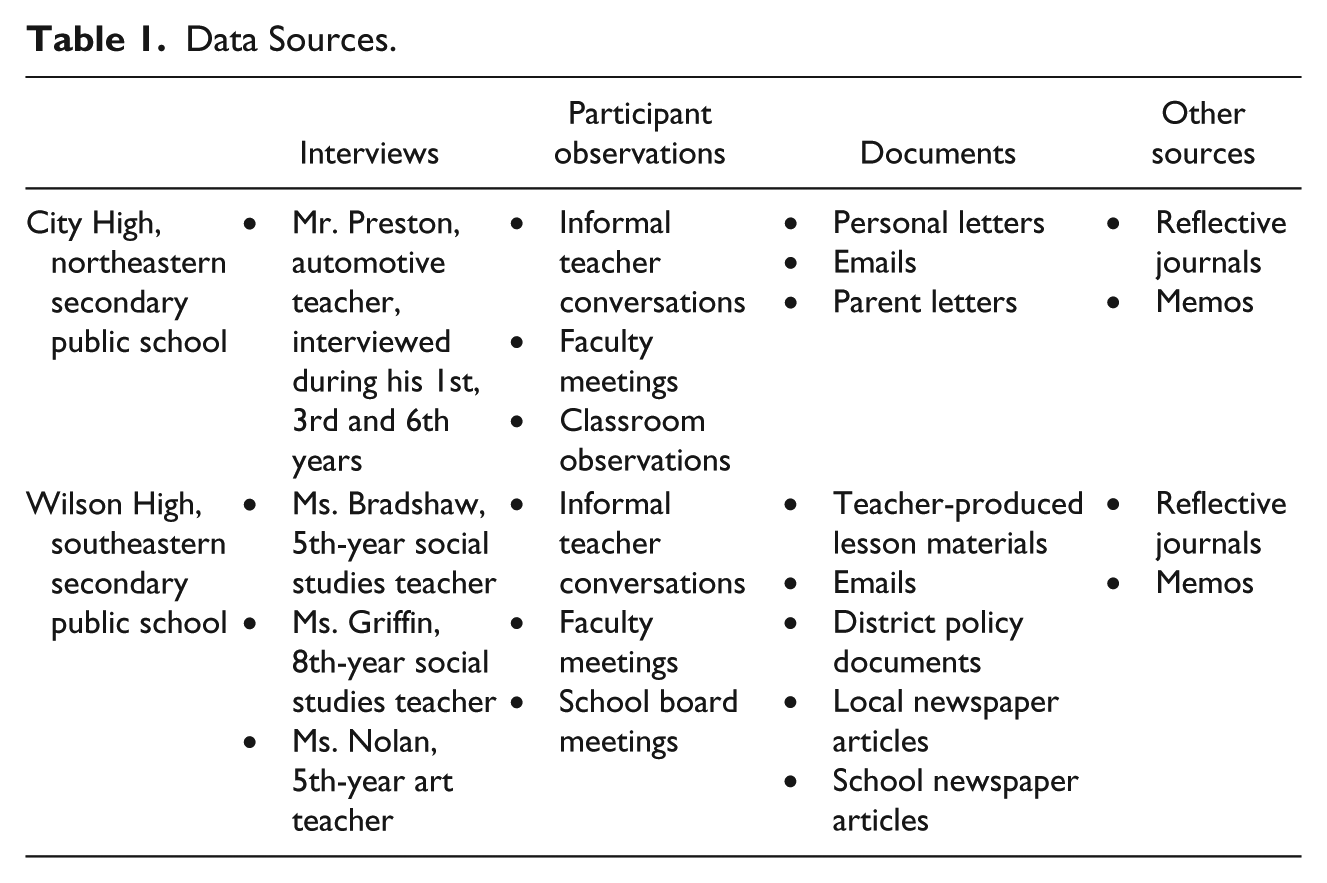
Both studies utilized common case study methods, including multiple open-ended interviews, participant observation, document analysis, and reflective memoing. Table 1 illustrates particular components of each type of data source. To effectively compare our cases, data were first triangulated within and across the multiple sources for each school individually. Later, the data were compared across cases for City High and Wilson High. Multiple levels of coding were conducted to uncover underlying themes (Rubin & Rubin, 2005; Strauss & Corbin, 1998).
Data Sources.
An important consideration for qualitative research and, in particular, for the type of in-depth case studies in which we are engaged, is an understanding of researchers’ perspectives. Comparing two independently conducted case studies allowed us to challenge our own interpretations of the data with each other, as well as push our understandings of the variety of investments that teachers might make and how outcomes of the investments were related to their commitment to the profession. In addition, we kept reflective journals and memos to track our own places in the research and check our biases, and these were used to inform our final analysis. Finally, we find it important to mention that we neither endorse nor condemn these teachers’ investments. Although we, too, as teachers, and now as professors, have invested in our profession and professional identities in a variety of ways, we are not making any evaluative claims about the quality or importance of our participants’ particular investments, but rather exploring how and why they were made and what happened as a result.
Findings
In this section, we present the results of our inquiry into teachers’ investments. We have chosen to explain the results in narrative form. Embedded within each section are answers to our research questions of why and how teachers invested, the implications of these investments on their identities, and the influence of these investments on their decisions to stay or leave the profession. The participants’ narratives also highlight the variety of extracurricular investments that teachers can (and do) make, from investing heavily in one individual student’s success to betting on a whole-school project.
Mr. Preston’s Investment
Mr. Preston left a lucrative career in the automotive industry to become a teacher in his early thirties. White and working class, he is a proud product of the city’s vocational high schools. Mr. Preston viewed becoming a teacher as both a moral and national imperative, as he believed that his country’s future, what he viewed as its return to glory, hinged on schools, and in particular urban schools, enabling students to succeed in the world and workplace.
Mr. Preston believed that having a certain attitude was the most important factor in determining success and, in his classroom, had even posted Charles Swindoll’s 1 famous quotation on the central role of attitude in success. Mr. Preston saw it as his job to teach his students how to work hard and stay positive. He believed a positive attitude to be at the heart of the American Dream and blamed schools’ failure to instill these values in young people, as contributing to the demise of the United States. As he explained in an email:
So you teach hope and hard work as much as brakes and suspension?
I thought that is what a teacher in the inner city is supposed to do, right? We live in what used to be the greatest country in the world, and yes, if you work hard and smart, you can succeed if you stick to your guns.
During his first year of teaching, Mr. Preston struggled to understand why so many of his students seemed disenchanted with and disengaged from school. He became frustrated with the kids who “did not want to be there” and had what he deemed bad attitudes. He also met a student who broke his heart.
Mr. Preston talked a lot about Darrell, a highly motivated African American ninth grader who worked hard in class and excelled under the hood of a car, but barely scored any points on his first written exam. Mr. Preston soon figured out that Darrell could barely read. What pained Mr. Preston was having such a hard-working student with such a good attitude make it to high school struggling to read and write. Darrell had been labeled as needing special education services, but City High teachers quickly figured out, as one teacher put it, “there are no services” for students. Beyond this, Mr. Preston blamed Darrell’s teachers for giving up on him:
Darrell was told by one of his other teachers that he will never amount to be any type of auto mechanic and that he really isn’t smart enough to do that, whereas I had him in my class and I knew for a fact that he was smart enough. But someone along the road before he got to me dropped the ball and no one ever picked it up.
Over the next 3 years, Mr. Preston metaphorically picked up the ball and ran with it, working intensively with Darrell to help him learn to read and write during lunch, free periods, and after school. Beyond putting in long hours with Darrell, Mr. Preston badgered the school system to provide a reading specialist to work intensively with Darrell.
We consider Mr. Preston to have made a huge personal investment in Darrell learning to read. We also see Mr. Preston, by investing his time and energy, as making the kind of difference that he believes good teachers need to be working toward in U.S. schools. His deep affection for Darrell and disdain for the teachers who, according to him, wrote Darrell off, demonstrate Mr. Preston’s deep emotional investment in Darrell’s success.
Later, in his third year of teaching, Mr. Preston received what could be considered the first return on his investment, which he explained when asked about a moment that makes teaching in a struggling urban school worth it:
Well I can think of one exact moment: when I got the letter from one of my student’s [Darrell] mothers and how she told me that she was so happy that I was her son’s teacher because I took the time to get the kid the special help that he needed. As soon as I started working with the kid, he immediately started to blossom.
Mr. Preston produced the letter that Darrell’s mother had written to the school district, and a portion of the letter read,
Other teachers told me my son couldn’t make it because he couldn’t comprehend the written work. Whereas, Mr. Preston, along with Mr. Jameson, told me my son was a hard worker, very attentive and maturing nicely. Now I know my son will/can make it as long as he has teachers willing to go “that extra mile” for children who have special needs. Thank you for employing Mr. Preston as a teacher at City High School. There should be more dedicated teachers like him. He [is] indeed the true meaning of the word TEACHER!!
Mr. Preston cherished the letter, and it only made him work harder to help Darrell achieve his dream of becoming a mechanic. But Darrell was not the only one striving, as Mr. Preston became a teacher to inspire students to work hard and achieve their dreams. In a very real sense, Darrell realizing his dream of becoming a mechanic helped Mr. Preston to realize his dream of being a teacher who, through hard work and a positive attitude, made a difference in the lives of his students. As Mr. Preston stated at the time, “If I get that kid to really be something someday, I think that I would be real happy with myself. Hopefully I will have 100 more just like him.” The letter from Darrell’s mother served as a sort of early return on his investment, and would become more significant and even sacred to Mr. Preston in a few years.
Mr. Preston continued to work with Darrell until he graduated, even enlisting Aiden to conduct mock job interviews with Darrell. Mr. Preston also helped Darrell land a good job with the city repairing vehicles in its fleet maintenance division. Darrell kept in touch with Mr. Preston, who updated Aiden on his progress 2 years after Darrell’s graduation:
Darrell, I still get a Christmas card from him and his mom every year. Now there was a mission that was worth the trip. Get this. He is now a shop foreman for city transit system and is doing great. What a great kid.
The mission, or the large investment of Mr. Preston’s time, energy, and emotions in Darrell’s future, had paid off handsomely. He had bet big on a “long shot” and hit the jackpot:
Speaking to one of my best friends, Hal, he told me that many teachers never get the chance to make that big a difference in a child’s life. I thought about it for a long time and I think he was right. I consider myself lucky to feel that feeling that Darrell gave me.
Darrell’s success gave Mr. Preston not only a good feeling that we might consider a psychic reward of teaching but also concrete evidence to support his larger mission of helping his country return to its economic preeminence. Darrell’s success provides Mr. Preston with proof that his mission to become the kind of teacher that makes a difference in the life of his students, a mission that he had left another career to take up, is worth the trip. To this day, Mr. Preston keeps the letter Darrell’s mother wrote taped inside the back door of his house: “Now that makes all the bullshit worth it to me. I look at that letter every day and give it a tap on the way out the door and that seems to keep me going all day.”
Mr. Preston’s massive investment of time and energy in Darrell, almost all of which occurred outside traditional classroom learning time, paid massive dividends in terms of his own identity as a teacher. Darrell’s success, and its subsequent identity implications for Mr. Preston, appears to have been influential in Mr. Preston’s choosing to stay in the profession. Reflecting on Darrell 5 years after he graduated, Mr. Preston said, “Darrell taught me as much as I ever taught him about learning . . . he is also one of reasons that I did not quit when the going got tough.”
Seeing Darrell’s story as sustaining Mr. Preston, as one of his stories to live by (Connelly & Clandinin, 1999), we wonder whether Mr. Preston would be able to sustain his identity as a teacher who makes a difference if Darrell had not “succeeded.” Would he still be teaching? Interestingly, although researchers such as Lortie (1975) and Jackson (1968) considered the potential payoffs of teachers’ investments, far less work has been done on what happens when teachers do not get substantial “returns” on their investments. We now turn to exploring this very thing.
Betting on a Charter School
Wilson High School is part of the Glendale School District, a large metropolitan district in the southeastern United States that has, in recent years, been the scene of administrative scandals, accountability measures, increased high-stakes testing, mandated curriculum, budget cuts, and layoffs. It is also the “work home” of Ms. Bradshaw, Ms. Griffin, and Ms. Nolan, three White, veteran teachers who made their particular investment as a way to “stay connected” and “have a voice” despite these oppressive conditions.
Ms. Bradshaw had been teaching at Wilson for 5 years. She taught social studies, primarily at the AP (Advanced Placement) and IB (International Baccalaureate) levels. Ms. Griffin, also in the social studies department, was an 8-year veteran at Wilson and primarily taught general-level U.S. History and Yearbook. Ms. Nolan was in her fifth year as an art teacher for both general-level and AP/IB Fine Arts. These teachers became active participants in a large, parent-driven movement to establish a “charter cluster” that would allow Wilson and several of its feeder elementary and middle schools to become independent of the larger school district. Their massive investment of time, effort, and emotion in the process can be viewed as a big chance that they took, in part, to make staying at Wilson, as Ms. Griffin said, “worth it.”
The movement toward developing this cluster of charter schools began in the spring of 2012, when a group of parents began exploring ways to exert more local control over the school’s decisions and give teachers more autonomy over the curriculum and their classrooms. The parents organized a coalition of peers, teachers, and community and business leaders to investigate the process and began forming working groups to write a petition that would be voted upon and then approved by the Glendale School Board. In addition to providing curricular options, such as pathways for AP, IB, and STEAM (Science-Technology-Engineering-Art-Mathematics), of most importance to those involved was relative independence from the Glendale District Office, which was viewed as “overburdened,” “top down,” and “mismanaged.” Instead, the group advocated for “community-based oversight and schoolhouse-level management” where “school principals will oversee and manage curriculum, operations, personnel, and finances” and where “decisions are timely, relevant, made by stakeholders of the Cluster.” They sought flexibility and autonomy for curriculum and instructional matters, financial issues, and operational and management structures.
Ms. Bradshaw, Ms. Griffin, and Ms. Nolan were all involved in this undertaking from the outset. Outside of school, they each served in one of the “working groups.” For Ms. Bradshaw, the effort served in part as an “outlet for my activism,” which she viewed is a central part of both her personal and her professional identities. For Ms. Nolan, her imagined future as a parent fueled her investment: “I think all the people with young children see it as their children’s future . . . I don’t even have kids yet and I’m excited about that idea. That keeps me going.” All three participants noted that the charter cluster was the first thing in a long time, as Ms. Griffin put it, “to give us hope.” Similarly, it represented an opportunity to “have a voice” and “be listened to” as teachers. Commenting on her participation in the working group on fiscal feasibility, Ms. Bradshaw recalled,
It’s amazing because when we get to something about instruction, they [parents and administrators in the working group] stop and look at us [teachers] and they wait to hear what we have to say. They trust that we know what we’re talking about because it’s something we do every single day. Crazy that somebody would actually believe what we have to say!
Ms. Bradshaw believed that becoming a charter cluster was the only option for success: “According to Audre Lorde, you can’t dismantle the master’s house with the master’s tools . . . It could be that it’s not the solution and the answer to everything, but at least it’s something different.” Finding their current situation increasingly untenable in terms of living out their imagined stories as teachers who were trusted and valued as competent professionals, the teachers opted to invest heavily in bringing about a change might solve some of these problems.
Yet despite this opportunity and potential positive outcomes of their investment, there were also many risks. First, they faced pushback from district administrators and some other teachers. Like Mr. Preston, the three teachers worried that their colleagues might be part of the problem if they were not working toward a solution. As Ms. Nolan said,
I just like the idea that we as a community get to write it [the petition]. We get to decide what we want and I feel as a teacher if I’m not a part of this process, then I will have to kick myself in the butt later when this charter does go through. I don’t understand why more teachers aren’t wanting to be a part of that for that very reason.
Later, she mused that perhaps it was because the charter petition required all teachers and administrators to apply for their jobs again, and some may have feared not being rehired or being demoted. Ms. Griffin expressed a similar sentiment; the teachers who were not involved, she guessed, were “afraid” and “used to not caring.”
Second, the teachers expended a great deal of time and energy on these efforts, primarily after school and on weekends. As explained above, they saw the charter as a potential solution for their constantly being overwhelmed, disempowered, tired, and frustrated with the district’s policies and practices. Ms. Nolan said that the idea of a charter cluster “felt like a game changer. A lot of people would’ve just left if no solution had been presented, I’m certain.” Later, on the day of the community vote (which was required to end in a positive outcome to move on to the next stage of approval), she wrote, “Colleagues like [those supporting the petition] lift my morale and make sticking around these hallways much easier. Finger/toes crossed, prayers said . . .”
Well aware that the charter petition could fail and further demoralize them, these teachers saw it as their only chance to create a more sustainable situation for themselves and put all their hopes into the petition’s success. Ms. Nolan remarked that she would only stay at Wilson if the charter petition was successful: “If after this next year, I feel like nothing’s changed and [Glendale] is still going downhill, I’m going to try and get out.”
Finally, a major challenge to the teachers’ investments in this process was that it forced them to confront the ways that the proposed cluster contradicted their core beliefs about public education and equity, or how they had created their teaching identity stories. This cognitive dissonance (Festinger, 1957) came as a result of participants’ fears that their support of a charter school initiative contradicted their prior beliefs about how charter schools threatened public education. They realized that the charter model proposed for Wilson might further marginalize students of color and students living in poverty because many of Wilson’s current students were bused in from segregated, poorer neighboring areas where the local high schools had failed to meet Adequate Yearly Progress (AYP). In the charter plan, a lottery would be instituted that would make it harder for these students to attend the new cluster. Ms. Bradshaw said,
It makes my stomach turn to think about shutting out a group of students that could possibly never have an opportunity to go to a decent school . . . But at the same time, it’s like I can’t do it all, and the school can’t do it all . . . And it sounds really shitty.
This “shutting out” was in direct opposition to why Ms. Bradshaw said she liked teaching at Wilson, because she got to work with a diverse group of youth and she thought that the diversity of the student body made for a better learning experience for all of the Wilson’s students. Similarly, Ms. Griffin explained,
If I’m being honest, I feel like a lot of parents want that [a lottery for out-of-zone children] because they want to weed out a lot of trouble coming from the lower socioeconomic group. On one hand, I’m okay with it because it means the kids who are here now are not going to be damaged at all by it [because current students would be “grandfathered” in and would not have to participate in the lottery]. Then, on the other hand, it’s my hopes that I don’t end up teaching at a charter school that’s pretentious and affluent and there’s no diversity. I like the diversity.
Having previously been a teacher in New York City, Ms. Griffin prided herself at being successful at working with all types of students, using culturally relevant instruction and critical pedagogy in her art classroom. Thus, her investment in the charter cluster seemed at odds with her teacher identity.
The parents that Ms. Griffin mentioned were the same ones who Ms. Bradshaw described as “all living in a dream world where everybody makes $125,000 a year or more, and you’re in your late 40s, early 50s, and you’ve already fucking retired . . . all White.” She said the parents leading the petition were concerned with getting autonomy from Glendale, but that the charter had little to do with “equal access to education.” After she described these parents, a particularly powerful exchange occurred that illustrates this cognitive dissonance and how her investment threatened her story to live by:
So does it bother you to be involved with this group? How do you reconcile that?
I don’t know if I have fully. I really don’t know if I have. One of the ways that I reconcile it is that I really believe if some of the changes that I want to see happen actually happen, it’s going to give me an opportunity to be a better teacher. And then it trickles down and it gives me the opportunity to be a better parent and then it gives me the opportunity to be a better person . . . But now that I’m saying it out loud, it seems really disjointed and disconnected. Really, how could—seriously, a charter is going to make me a better human being? [scoffs]
I don’t know. What do you think?
But it’s true—and not. What I believe in my core, and I think that’s one of the reasons I got into teaching, is I really truly believe that the personal is political . . . So maybe that’s how I make sense out of it . . . I can do what I need to do with a group of students to send them out and hopefully get them to, you know, continue the process . . . I don’t know. We’ll see. My heart wants to be [sighs]—my heart is with the students that struggle.
What is important to note is that all three teachers have strong commitments to social justice, which they also cited as motivating them to become teachers and teach in a diverse school. They feel trapped between a rock and hard place on this issue, as the current situation does not allow them to be good teachers and affects their lives negatively, but the alterative will most likely mean they will not be able to teach the students they want to serve most.
Finally, after nearly a year of planning, a community vote was taken in September 2013. Because the overwhelming majority of those who voted were in favor of the petition, the organizers were allowed to bring their petition to the Glendale district school board. In November, the group presented their case at a regularly scheduled school board meeting. However, after a lengthy discussion of the budget ramifications, by a vote of 5-4, the charter cluster petition was rejected. Those involved were devastated. Even though she had already left Wilson the previous summer (in part because she “saw the writing on the wall” and suspected the charter was not going to pass, thus jeopardizing her morale to the point where she left the classroom and took a job in business), Ms. Griffin was “heartbroken, but not surprised.” Participants were especially discouraged, saying that the district had again “turned their back” on teachers, students, parents, and the community. In a social media post, Ms. Nolan wrote,
To all my friends and colleagues who were apart [sic] of the petition, I thank you for all your efforts and passion towards this fight. You all are a huge part of why I continue to stick around [Glendale] . . . We fought a good fight.
As they had indicated the previous school year, immediately after the negative vote, Ms. Griffin and Ms. Nolan began making plans to leave their teaching positions. Their extracurricular investment, unfortunately, had not paid off in the way they hoped it would.
Discussion
The cases of Mr. Preston and the Wilson teachers illustrate two very different ways that teachers can make large extracurricular investments in their careers and their identities: (a) investing in individual students’ success and (b) investing in systemic change at the school level. Although we studied more teachers and found similar types of investments in each of our larger projects, we see these two examples as particularly salient because of their potential long-term effects on teachers’ identities—Mr. Preston’s outcome sustained his teaching identity, whereas the Wilson teachers’ outcome further constrained their identities, their stories to live by, until they became stories to leave by (Clandinin, 2015).
Mr. Preston became very emotionally invested in this because he believed that teachers needed to work for motivated students like Darrell. Returning to Mr. Preston’s ideas about the importance of attitude for teachers and students, we can also see his investment as simultaneously a wager on his identity as a teacher who makes a difference. His massive venture to “save” a student whom other teachers had given up on ends with a huge payout that funds his identity as a good teacher. It also serves to protect his identity from the threats imposed on it by students who, unlike Darrell, Mr. Preston considers to “not want to be there.”
Mr. Preston’s investment in Darrell paid off, in the end. While we cannot conclusively say what would have happened if his mission with Darrell had ended differently, it appears that Mr. Preston has lived off his winnings, viewing himself as able to make a difference and thus continuing to teach. Indeed, over the last 13 years that Mr. Preston has been teaching, he has come close to leaving more than once. But he has remained, perhaps in part because he has the letter from Darrell’s mother that he taps on the way out the door each morning that reminds him of who he is and why he teaches.
Conversely, the teachers at Wilson made a large investment into planning for a new school structure that did not come to fruition. They wagered on the potential for a school structure that, they argued, would give them more autonomy, creativity, and voice in the classroom, curriculum, and leadership. The hope that participants had when discussing the charter school cluster versus when they were discussing their current classroom practice was palpable; in interviews, they visually relaxed, their eyes lit up, and they became more animated in their vocal patterns and gestures. It was a startling transformation to witness. They were “all in,” as they acknowledged, before they knew the results of the charter vote, and they were “completely depending” on the vote passing to, as one put it, “feel good about myself and my career.” This is despite the fact that they were somewhat conflicted about the true goals and outcomes of a charter conversion. Thus, the proposed charter fueled their identities; a new charter would, they believed, make staying true to their teacher selves more possible than within the current context of Wilson. When the vote failed, the teachers felt as if they went bankrupt on their investment and, importantly, as if this loss was a direct result of a lack of foresight, care, and strong leadership from the district. They were depending on the school district to “repair years of damage” from financial and institutional mismanagement that had taken its toll on them as teachers, but instead, they found themselves further disconnected from their hopes for teaching and their teaching identities.
Looking across the two cases, we see the extracurricular projects in which teachers invest themselves—their time, emotions, and identities—as fertile ground for better understanding the work and lives of urban teachers. In both cases, the teachers invested heavily in particular outcomes that were about more than just losing or winning a gamble on Darrell or the charter school. Their ventures were about taking a risk on an extracurricular project that held the promise of reinforcing and sustaining their teaching identities in challenging times and contexts. As in all qualitative research, we cannot posit a direct link between their investments (and winning or losing them) and attrition, but our data do indicate that there is a strong relationship between how our four participants chose to invest, the outcomes of these investments, and their decisions to stay in or leave the profession.
Naturally, the story does not begin here, as the circumstances that brought Mr. Preston and the Wilson teachers to make these investments deserve special attention. All four teachers struggled against institutional forces that imperiled their efforts to become the kind of teachers they had imagined. Sensing the gap between their imagined story of themselves as teachers and the constraints placed on them by urban schools, the teachers wondered how much longer they could continue in their current situations. The teachers’ investments appear to be fueled by an underlying desperation. Thus, this project holds implications for future research into the contexts that fueled such investments.
Finally, our research supports taking a more longitudinal and latitudinal approach to studying teacher identity. We have been reminded that people become teachers for many reasons, and that these reasons continue to shape their work both in and out of schools. Viewing teaching as also a means to an end, as a way to bring about some larger and often-personal goal, such as helping America return to glory or bring about a more equitable world, allows us to see teachers’ identity work as starting long before they step in their first classroom. Along with this more longitudinal approach, we also find that taking a more latitudinal approach to their work as teachers allows for a more nuanced and complete picture of how they work toward particular teaching identities.
Implications and Conclusion
Our study has implications for research, practice, and policy. Focusing on teachers’ investments may provide teacher educators, researchers, and policy makers with an additional framework for understanding how and why large numbers of novice and veteran teachers leave urban classrooms. Furthermore, these investments point to the significance of the extracurricular work teachers do outside of the classroom on their identities and careers. Although much research remains to be done in this area, from our work, it would be a safe bet to say that teachers invest time, emotions, and energy in extracurricular spaces to bring about particular outcomes that have serious implications for their teaching identities and careers. Future research on the relationship between teacher attrition and teacher identity is recommended. In particular, it would be helpful to examine this relationship in a variety of school settings, geographic contexts, and with teachers representing a wider representation of racial and ethnic backgrounds.
This research also raises implications for teaching and teacher education. For example, administrators at the school level would do well to support teachers in their strategizing about the types of investments they make and in supporting their investments. Support structures that have been shown to improve teachers’ professional development and job satisfaction, including professional learning communities and critical friends groups, could also include a focus on the benefits and challenges of making extracurricular investments in individual students or whole-school endeavors. Teacher educators, in turn, can become involved in university–school partnerships that support giving teachers a voice in school and district decision making. They may also devise new strategies for supporting preservice teachers in discussions about the realities of teaching in urban schools and the types of dispositions and skills needed to sustain a career in urban schools. This is of particular interest to us, as teacher educators, as we seek to help current and future teachers become better aware of the peripheral or somewhat hidden investments they are making and the implications that these have for their identities and even their careers. There is a great deal of uncertainty in our work as educators, and when we invest a great deal of ourselves in particular outcomes, whether that investments come to fruition or not has consequences that we are not always aware of going in.
We see the importance of applying findings from this research to policy making at school, district, state, and national levels. Policy makers must ask the following questions: What factors compel teachers to make such big investments that they risk going bankrupt? Why do teachers have to bet on one student or on a whole-school reorganization to sustain themselves and their teacher identities? Phrased more proactively, what can policy makers do to ensure that teachers are continuously supported and sustained? We would argue that the first step in this process is to give teachers a voice in policy making decisions at all levels and to use research that highlights teachers’ lived experiences.
Finally, our metaphor of investment raises much-needed awareness about the limits of teachers. We believe that, all too often, teachers are portrayed as selfless giving trees that have a bottomless pit of time, effort, and commitment for their schools and students. We hope that in showing the more human side of these teachers, as people with lives, dreams, and limits, we can begin to develop schools and school change models that do not rely on teachers being superheroes, saints, or robots. We hope that seeing their struggles to not only survive in their schools but also to sustain their identities as teachers will help bring about more honest, sobering, and ultimately productive conversation around teachers’ role in urban schools and reform.
Footnotes
Declaration of Conflicting Interests
The author(s) declared no potential conflicts of interest with respect to the research, authorship, and/or publication of this article.
Funding
The author(s) received no financial support for the research, authorship, and/or publication of this article.