







Abstract
High academic expectation—how far a student expects to get in school—is usually predictive of positive outcomes for a student. Yet less is known about mechanisms behind collective expectation: the proportion of students in a school who expect to pursue further studies. Using urban schools’ data from the Education Longitudinal Study 2002, this research examines how collective expectations affect short-term and long-term outcomes, and the predictors of these expectations. Through hierarchical linear models, I find that collective expectations are positively associated with academic outcomes, and that individual expectations remain significant even after controlling for socioeconomic status. I argue that the results illustrate how school structural and economic forces interact with collective expectations in protecting or preventing personal academic attainment.
Keywords
One’s personal expectations—an approximation of motivation—can critically influence one’s eventual life outcomes. This is evident for students who have high levels of aspirations as these contribute to high academic grades (Hodis et al., 2015; Meyer, McClure, Walkey, Weir, & McKenzie, 2009). It may also be at work in high parental expectations influencing high school math achievement through math course-taking (Froiland & Davison, 2016) or in high teacher expectations affecting student literacy engagement (Pantaleo, 2016). Often, this is coded through one’s educational expectations: how far one expects to get in school (e.g., college, PhD). Given the influence of individual expectations of students, parents, and teachers, research has focused on predictors of high expectations or aspirations, and these often point to socioeconomic factors and parental investment affecting personal student expectations (Chesters & Smith, 2015; Hao & Yeung, 2015; Hartas, 2016).
As researchers show educational expectations influencing academic achievement, these have tended to focus on how one’s personal expectations can lead to these outcomes. Less is known about how the collective educational expectations in a school can contribute to students’ outcomes. By collective expectation, I refer to the most common education expectation of students in the same school. In this light, it may be possible that there are structural opportunities in the school that facilitate higher expectations not just for one student but for the majority of students (Rowan-Kenyon, Perna, & Swan, 2011). In the same manner, certain peer influences may explain higher expectations among friends in a given school (Dupriez, Monseur, Van Campenhoudt, & Lafontaine, 2012; Mora & Oreopoulos, 2011). In addition, these “peer effects” may be more prevalent in urban schools because these students come from similar backgrounds in similar neighborhoods (Gottfried, 2014; Lefgren, 2004). Given this gap on research regarding collective expectations in a school, I ask how collective expectations predict short-term and long-term educational outcomes, and what factors affect these collective student expectations.
Using data on urban school students from the Education Longitudinal Study (ELS) 2002, a nationally representative sample of high school students, I analyze how individual- and school-level educational expectations predict math test scores and likelihood of being accepted to college, and consequently, factors predicting these expectations. I argue that structural and economic factors play a role in the creation of collective expectations, and that these factors interact with these group expectations to influence academic achievement. I present this argument in four parts. The first section discusses relevant literature on the interaction between social and personal forces in expectations and academic achievement. The second provides information on the data and methods used for this study, while the third presents the results from hierarchical analyses and robust regressions. The fourth section discusses the study in terms of its conclusions, implications, and limitations.
Society, Expectations, and Achievement
Expectations and Achievement
A student’s belief, motivation, and attitude toward the future have important effects on future outcomes (Ariani, 2016; Hrbackova & Suchankova, 2016; Ryan & Deci, 2000), and this can be seen prominently with students’ educational expectations. Academic or educational expectation is usually measured by how far a student thinks he or she will go in school, from quitting before high school to pursuing graduate degrees (Cunningham, Corprew, & Becker, 2009). Given the positive impact of motivation and how expectations are approximations of motivation, researchers have focused on how expectations positively affect academic outcomes (Nasser & McInerney, 2016; Sanders, Field, & Diego, 2001). Using a longitudinal study in England, Khattab (2015) finds that high expectations and aspirations are strong predictors of academic achievement, measured through the 11th-grade examinations for British students. An additional element to this is the importance of stable expectations rather than expectations that are constantly shifting (Bozick, Alexander, Entwisle, Dauber, & Kerr, 2010).
Although academic expectations have a considerable effect on students’ personal achievement, it may also be the case that achievements help students expect more for themselves. Khanh Bui (2007) provides evidence for reciprocal effects between expectations and achievement, where expectations reinforce academic outcomes, and outcomes confirm one’s expectations. However, the presence of long-term outcomes predicted by student expectations offer strong support for the initial hypothesis, highlighted by the higher achievement and growth rates of students who had higher academic expectations from the beginning (Liu, Cheng, Chen, & Wu, 2009). In the study, they emphasize that one’s expectations in coordination with measures of self-efficacy had affected not only the initial achievement of the student but also the latter achievement in test scores and the growth rate from it.
In addition to one’s individual expectations, other people’s expectations also have important effects to one’s behavior and actions. It is something akin to self-fulfilling prophecies, which is defined as situations in which one person’s inaccurate perceptions of a second one leads the second one behaving and acting in ways similar to those false perceptions (Merton, 1948). Its application to schools was established in Pygmalion in the Classroom (Rosenthal & Jacobson, 2003), which has shown how the child’s education can be affected by the expectations of teachers. Subsequent research in this field has shown the long-term effects of these expectations, such that differential expectations from first grade have effects on high-school performance (Sorhagen, 2013), or that these expectations may be selectively applied to stigmatized social groups (Jussim & Harber, 2005). In such cases, the role of critical awareness of such biases may help mitigate the effect of these expectations (López, 2017), although the influence of others’ expectations is still significant.
In addition to the student and the teachers’ expectations, the expectations of parents may also contribute to short-term and long-term academic outcomes, such that these expectations contribute to parental involvement on the child’s learning (Jung & Zhang, 2016) or parental investment on the child’s future opportunities (Hao & Yeung, 2015). Aside from these issues, parental expectations may actually help in learning outcomes through students’ intrinsic motivation (Fan & Williams, 2010; Jeynes, 2012). In this sense, the parent’s expectations may emphasize the value of education and, thus, make students aspire to reach those expectations. Such interaction between expectations and intrinsic motivation together can predict the development in mathematics, particularly through the taking of more challenging courses (Froiland & Davison, 2016). The expectations of parents, students, and teachers also reinforce each other, such that the whole interaction has a greater effect than the addition of the singular parts.
Society and Expectations
Although expectations have positive effects on individual growth, these expectations may be predicted or prevented by structural factors such as poverty and race. On one hand, there is the status attainment model of the Wisconsin school that emphasize how academic aspirations influence and predict achievement (Sewell, Haller, & Ohlendorf, 1970; Sewell, Haller, & Portes, 1969). On the other hand, there is the blocked-opportunities theory that highlight how social structural and economic barriers prevent educational and occupational success, thus leading to the differential effects for different populations (Kao & Tienda, 1998). With such differences, social factors can have both protective and preventive effects in terms of one’s educational aspirations, expectations, and achievement.
First, social structural forces can initially influence student’s educational expectations and, thus, affect achievement. After all, students with high academic expectations are also likely to have parents who are invested in their growth (Porumbu & Necşoi, 2013) and parents who themselves have high expectations for their children (Phillipson & Phillipson, 2012). These protective structures can be furthered by the social relationships that children have with their parents and peers: strong ties and support systems strongly influencing academic motivation (Hill & Wang, 2015; King & Ganotice, 2014). In a study on the influence of parent education and income on child outcomes, Davis-Kean (2005) found that these predictors actually worked through parental expectations. This means that the protective effects were not so much the financial or cultural capital but the way this capital has been channeled to influence the motivation of parents and students. This extends Sewell and Shah’s (1968a) argument about the role of parent education in child attainment, given how educational expectation and motivation are highly predicted by one’s social background: socioeconomic status (SES), race, and parental investment. Thus, students are able to achieve more through the investment put forth by the parents and community, not so much simply from having more resources.
Inasmuch as parents and social background positively influence achievement through the motivation and expectations of students, negative structural factors and circumstances may at the same time prevent the creation of positive academic expectations. Although expectations can positively predict outcomes, structural factors can either prevent a person from even having those expectations or inhibit a person from realizing high expectations. In a study of this phenomenon, Hanson (1994) found that economic class had a strong effect in preventing students from having higher expectations or in realizing these expectations (for those who initially had them). It is as if the everyday school, home, and community experiences of poverty and race are leveling students’ educational aspirations (MacLeod, 1987).
Similarly, the absence of models in one’s community may heighten this sense of leveled or blocked opportunities, thus signaling that it is harder for a person to advance from one’s current status. It has echoes but is distinct from Fordham and Ogbu’s (1986) concept of the burden of acting White, where minority students diminish academic effort given the fear of being perceived to “act White.” The main critique of this explanation is that peer pressure against academic achievement is not prevalent and for the instances that these happen, it can be attributed more to school structures than Black culture (Tyson, Darity, & Castellino, 2005). In understanding, however, the dynamics of blocked opportunities, the main consideration is how social realities in one’s family, school, and community may prevent the assumption of higher expectations, thus influencing motivation and consequent academic success. In the convergence of status attainment and blocked opportunities theories, there is the important consideration of how social realities are affecting expectations—either in protecting them or preventing them.
Schools’ Expectations and Achievement
In this context, individual expectations may either predict achievement through personal motivation and social investment on the student’s education, or prevent achievement through lowered expectations or blocked realities. Less, however, is known about how collective factors may be affecting both expectations and achievement. This concern for the collective is particularly meaningful for urban schools, where much of the variance in test scores and academic achievement is between schools rather than within schools (Munk, McMillian, & Lewis, 2014). Given the considerable effect of which school one is placed in, what collective factors in a school could be contributing to both expectations and achievement?
Research has identified factors that are either compositional or contextual that contribute to these outcomes. Compositional factors are about the effects of the school’s racial and demographic realities on expectations and achievement, while contextual ones are about school-specific practices and climate that contribute to those outcomes.
In terms of composition, different school-level socioeconomic experiences contribute to different school outcomes. One such factor prevalent in urban schools is the segregation based on race, or more recently with the rise of charter and selective enrolment schools, segregation based on talent (Sirer, Maroulis, Guimerà, Wilensky, & Amaral, 2015). From previous studies, the school’s racial and achievement composition has effects not only on school achievement (Billings, Deming, & Rockoff, 2014; Darby & Saatcioglu, 2015; White et al., 2016) but also on school disciplinary practices (Sartain, Allensworth, & Porter, 2015; Skiba, Michael, Nardo, & Peterson, 2002) and school safety (Thibodeaux, 2013). Aside from the segregation that happens between schools, within-school segregation also have important consequences for students as Walsemann and Bell (2010) provide preliminary evidence that as within-school discrimination increases, the odds of students having higher educational aspirations actually decrease. They quantified within-school segregation by using a dissimilarity index that measured the unevenness in distribution of Black and White students across levels of English curriculum (Walsemann & Bell, 2010, p. 1691). Aside from racial factors, school economic composition also affects aspirations but is mediated by the perceived support from teachers and peers (Berzin, 2010).
In addition to the school’s demographic composition, the everyday practices in the school can have either remediating or worsening effects on expectations and achievement. Schools may remediate the effects of demographics through social capital and trust that both affect aspirations for higher education (Fuller, 2014). In her study, Fuller suggests, as with Bourdieu (1997), how schools can endow individuals with social capital through students’ engagement with each other. An authoritative school climate has positive effects in terms of both school expectations and achievement, especially as systems of student support and fair disciplinary structures contribute to higher engagement, grades, and educational aspirations (Cornell, Shukla, & Konold, 2016; Thapa, Cohen, Guffey, & Higgins-D’Alessandro, 2013). Aside from social capital and school climate, the resources in a school can also provide the remediating effects necessary for higher student expectations. In the research of Rowan-Kenyon and colleagues (2011), they found that the presence of career counseling and college preparatory programming in schools had a positive impact on the likelihood of students going to college.
Although there are school practices that can lead to the reduced effect of race or poverty on a person’s expectations, there may also be institutional contexts that can prevent growth in academic expectations. One such context is the practice of tracking, where students who are in less prestigious tracks are doubly affected: having decreased aspirations for higher levels of education and being less prepared for university-level schooling (Dupriez et al., 2012; Hanushek & Wößmann, 2006). In this sense, tracking leads to greater inequalities, and these inequalities may present themselves in both educational expectations and consequent achievement. In addition, high suspension practices in schools may negatively affect student expectations (Mizel et al., 2016). Thus, although family and school demographics may affect students’ expectations, there are practices that are attributable to schools that can help facilitate higher expectations. In the same manner, however, there are similar structures such as tracking and punitive discipline that can even further the effects of school demographics.
With this literature on how social forces could influence academic outcomes, this present research investigates two related questions. First, how do group expectations influence academic achievement? Second, how do structural and economic factors influence group expectations? This literature review has shown that expectations influence achievement but that more has to be known in terms of what is here referred to as “collective expectation.” It has also shown that both structural and economic constraints affect outcomes, and this present study investigates whether these constraints affect collective expectations. Thus, the hypotheses that come from this review are as follows: (a) Collective expectations predict academic achievement in urban schools, and (b) these collective expectations are influenced by structural and economic factors.
Data and Method
Data for this research came from the 2002 and 2006 waves of ELS, a representative sample of high school students who were in 10th grade during the 2002 base year. Data are from the National Center for Education Statistics (NCES), and I limited the 2002 sample to 4,639 students from 249 urban schools. The 2006 sample has the same number of schools but is limited to 3,562 urban students—a reduction stemming from sample attrition and exclusion of those with missing data on the dependent variable (application or acceptance into college).
Dependent Variables
There are two dependent variables examined separately in this study. From the 2002 base year, the student’s standardized math test score in 10th grade is used as a short-term outcome variable for academic achievement. This test was administered by item response theory (IRT) International and NCES, and had questions on algebra, geometry, probability, and problem solving. This has been standardized from the raw math test results, and the standardized scores have a mean of 50 and minimum and maximum values of 10 and 90, respectively.
Another dependent variable is from the 2006 follow-up survey on students’ acceptance to college, either in a 2-year or 4-year program. This measure is coded one for those who both applied and got accepted to college, and zero for those who did not get accepted or did not apply to college. Students who had missing data were excluded because of problems posed by imputing dependent variables (Allison, 2002).
Independent Variables
The independent variables are categorized into either school-level or individual-level variables. For school-level variables, there are three I include: the percentage of students in a school who expect to pursue further studies (henceforth called collective student expectation), the percentage of parents in a school who aspire for their children to pursue further studies (collective parent aspiration), and the school mean SES index. The first two school-aggregated predictors were scaled such that a one unit increase was equivalent to a 10 percentage point increase (e.g., a school with 32% of students who expect to pursue graduate education is coded as 3.2). Percentage pursuing further studies is used because this is a more discriminating variable than simply going to college (more than 80% desire to pursue at least college).
In addition, the school mean SES index was computed by taking the average of the individual-level SES scores of students in a school and was the proxy for the level of poverty in a school. This was used instead of free and reduced price lunch because it has several missing data and was a categorical variable in the original data. By using the average of the individual’s SES scores (a composite variable computed with parents’ education and occupation, and family income), the level of SES in the school is computed. Also included as controls in the robust regressions are school category (public, Catholic, private) and the neighborhood’s level of crime (high, medium, low, mixed). Although race is a variable that may affect student outcomes, school-level variable on race was not used for two reasons: This variable was unavailable in the original data, and its inclusion may affect statistical parsimony.
For individual-level variables, the student educational expectations were collapsed to four categorical variables: The student (a) does not expect to finish high school, (b) expects to finish high school but not a 4-year college degree, (c) expects to finish a 4-year college degree, or (d) expects to pursue further studies. The same four categorical variables were used for parents’ aspiration. These data were used instead of parent expectations because this has no missing data compared with expectations that had more than a thousand missing data. These categories were formed by collapsing some categories from the original data, like putting together students who expect to graduate only high school with those who expect a 2-year degree, or students who expect to pursue masters with those who expect to pursue a PhD. This question was asked in the 2002 sample and is, thus, maintained for the 2006 sample.
When the hierarchical analyses are performed, the second category (expects to finish high school) is used as reference group, because the first one has only a small number of observations and is an unstable reference group. Since the level of poverty may have an effect on short-term and long-term outcomes, family SES is used as a control variable to account for socioeconomic differences. It is a composite variable from the 2002 wave that combines parents’ education, occupation, and combined income.
These independent variables have been measured in the 2002 base year data. Even for the long-term outcome of likelihood of being accepted to college (measured in 2006), the same individual-level measures were used. However, to address student mobility and attrition, the school-level collective expectations and mean SES were recomputed for the second regression by taking the average of those who have valid observations per school.
Analytic Strategy
To answer the question of how school educational expectation affects short-term and long-term academic outcomes, I perform hierarchical linear modeling because this accounts for the nesting of individuals in schools and avoids the possibility of aggregation bias (Fantuzzo, LeBoeuf, & Rouse, 2014; Raudenbush & Bryk, 2002). In this study, I estimated five models for each of the two outcomes: math test scores and acceptance to college. The mathematical model can be seen in Appendix A, and I use Level 1 to refer to student-level variables, and Level 2 for the school-level variables.
Model 1 had no predictors in the equation, to determine the residuals for Level 1 (σ2) and Level 2 (τ00), and, thus, be able to compare these with the residuals in the subsequent models that had predictors. Model 2 adds the Level 2 predictor of collective student expectation, while Model 3 adds the Level 1 predictor of students’ individual expectations (categorical variables). In this way, I first ascertain the impact of school educational expectation on the outcomes, and then after this, I control for the individual-level expectations. Model 4 adds individual- and school-level variables on parental aspirations, while Model 5 adds school mean SES and individual SES. All school-level predictors were grand mean centered, while the individual-level education expectations were binary variables that were not centered.
To answer the second question on factors affecting collective expectations, I perform four models using robust regressions because the presence of outliers may influence the ordinary least squares regression (see Appendix B). Limiting this to 249 urban schools, the first model regresses collective student expectation on collective parent aspirations, a proxy for structural factors in a school. The second model adds school mean SES as a control, while the third adds dummy variables for the effect of Catholic schools and other private schools. The fourth model adds the school neighborhood’s level of crime, although the results for this regression is multiply imputed because of the 45 missing variables (either not responded by the school or not given in the abbreviated school survey).
Results
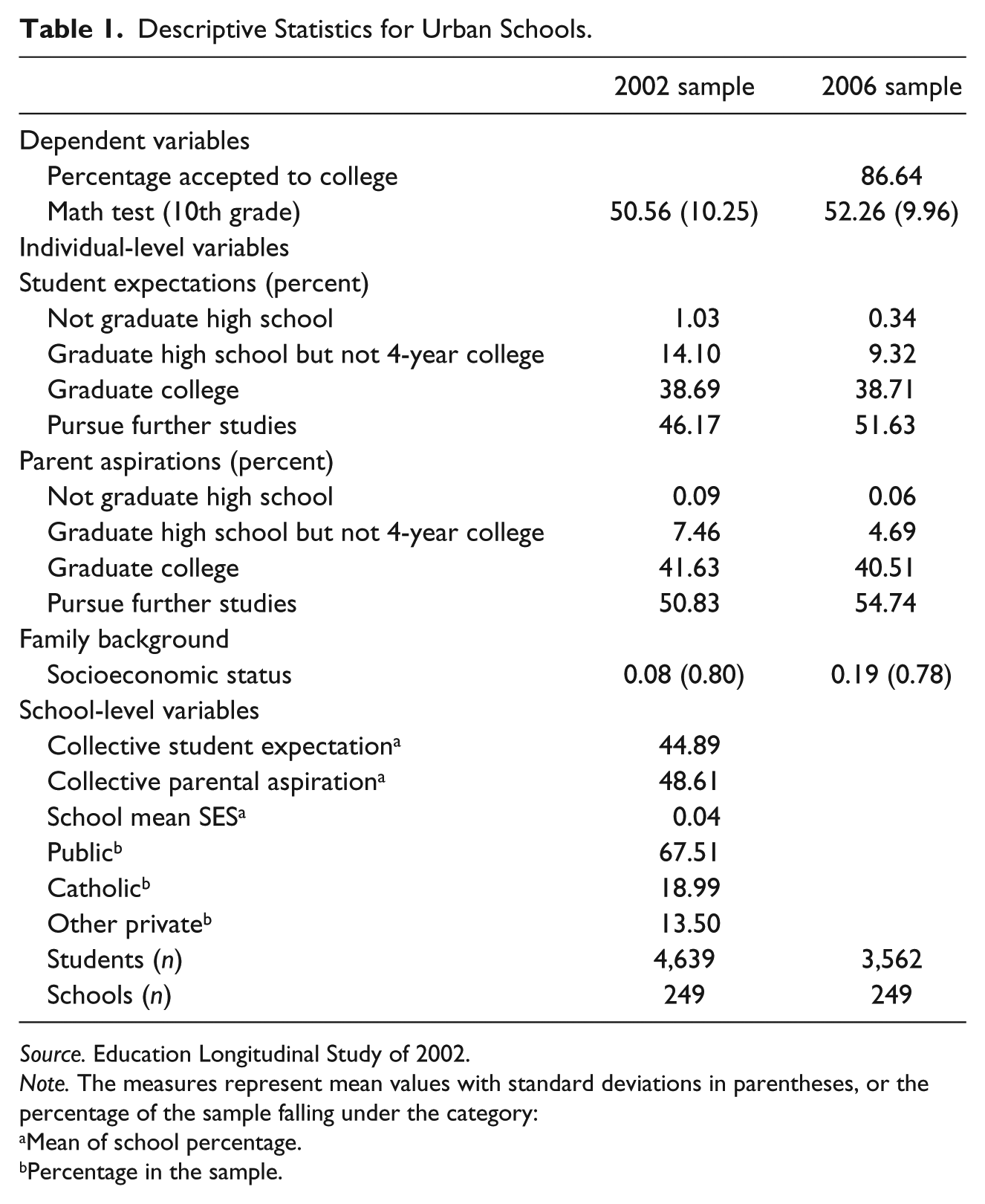
Given that there were people present in the 2002 wave but no longer present in the 2006 wave, I provide descriptive statistics for both 2002 and 2006 samples. Table 1 presents descriptive statistics for the sample of urban high schools in the United States for both waves. The dependent variables on the top part show that the percentage of students accepted to college is 86.64%, and the average math test score is 50.56 points, with a standard deviation of 10.25.
Descriptive Statistics for Urban Schools.
Source. Education Longitudinal Study of 2002.
Note. The measures represent mean values with standard deviations in parentheses, or the percentage of the sample falling under the category:
Mean of school percentage.
Percentage in the sample.
For the independent variables, I mark both individual-level and school-level predictors. The percentages for student expectations and parent aspirations are results from the base year survey; the question was not administered in 2006 and, thus, uses the original to compare the samples. It is noteworthy that there was an increase in the sample’s percentage of students who expect to pursue further studies (from 46.17 to 51.63), although those who expect to graduate college remained similar from 2002 to 2006. The same could be said for parent’s aspirations. I also provide the mean of family SES, used as control for the regressions. In 2002, the mean for family SES in urban schools is 0.08, and this takes on both positive and negative numbers.
School-level predictors are only available for the 2002 data. The average school percentage of students who expect to pursue further studies (collective student expectation) is 44.89%, while the average collective parental aspiration for further studies is 48.61%. From the sample of schools, 67.51% were public, 18.99 Catholic, and 13.50 other private.
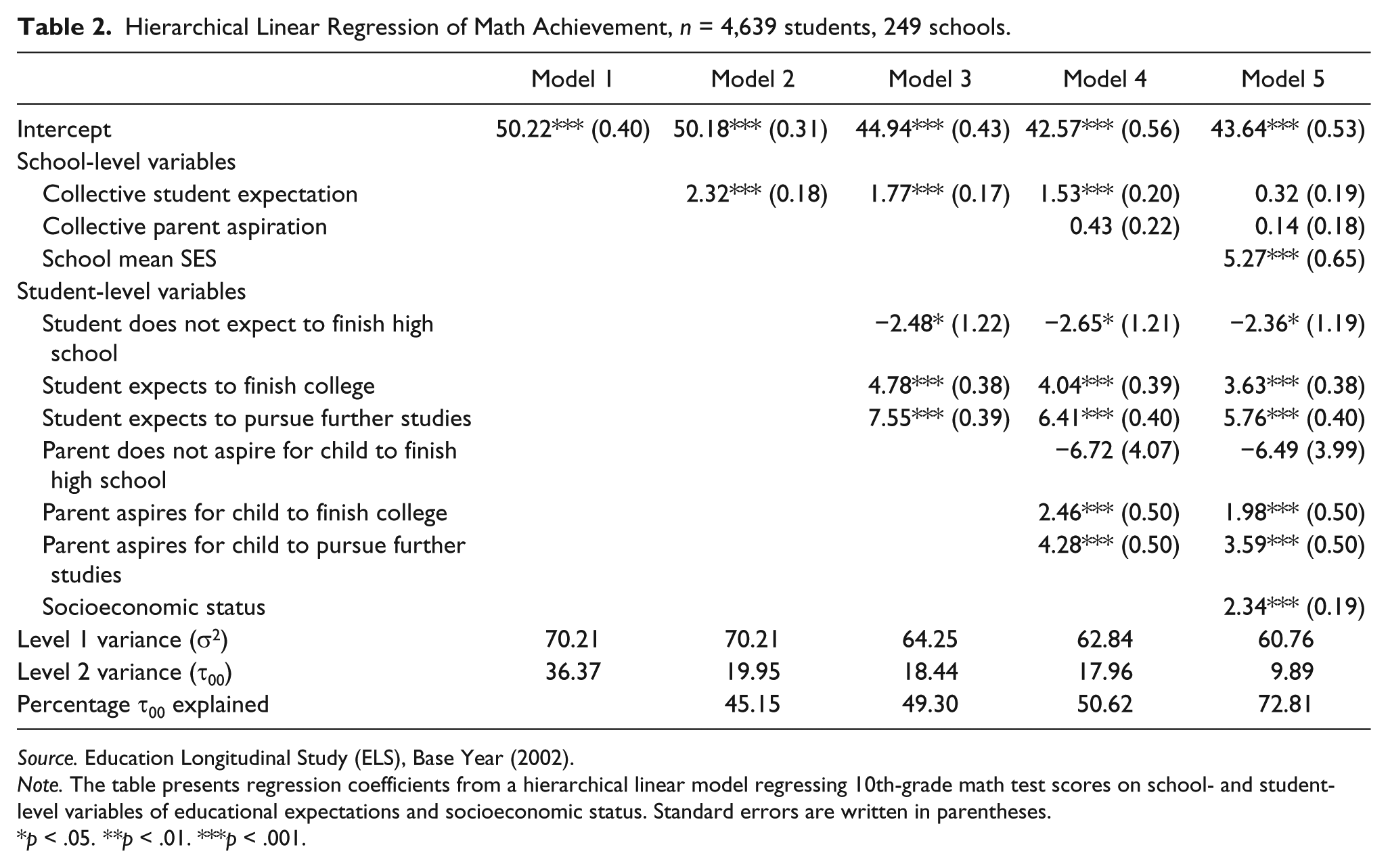
Table 2 presents results of hierarchical models with 10th-grade math test score as the outcome variable. In the first model, the variance between schools (τ00) is 36.37, which means that 51.8% (36.37/70.21) of the variability in math achievement was between schools in this unconditional model. In the second model adding the school-level predictor of collective student expectation, the variation in school math achievement explained by this variable is 45.15%, (36.37 − 19.95) / 36.37. Thus, a 10% increase of students who expect to pursue graduate studies is associated with an average 2.32-point increase in math test scores for those in that school. When student-level expectations are added in the third model, the effect of collective student expectation is reduced but not eliminated. It shows that a 10% addition in a school’s collective expectation is still significant (1.77-point increase), even after controlling for individual student expectations.
Hierarchical Linear Regression of Math Achievement, n = 4,639 students, 249 schools.
Source. Education Longitudinal Study (ELS), Base Year (2002).
Note. The table presents regression coefficients from a hierarchical linear model regressing 10th-grade math test scores on school- and student-level variables of educational expectations and socioeconomic status. Standard errors are written in parentheses.
p < .05. **p < .01. ***p < .001.
The fourth model adds school- and individual-level parent expectations, and there are two concepts to note: Individual parent aspiration is predictive of math test score outcomes even as its school-level predictor is not, and the student collective expectation is still statistically significant at a 1.53-point addition associated with a 10% increase. However, in the fifth model that adds school and individual-level SES factors, the effects of collective educational expectation are diminished, and a 1-point increase in school mean SES is related to a 5.27-point increase in math test scores. In this sense, the school mean SES captures more of the effects on math achievement. This fifth model that includes all covariates also explains 72.81% of the variation in school math achievement.
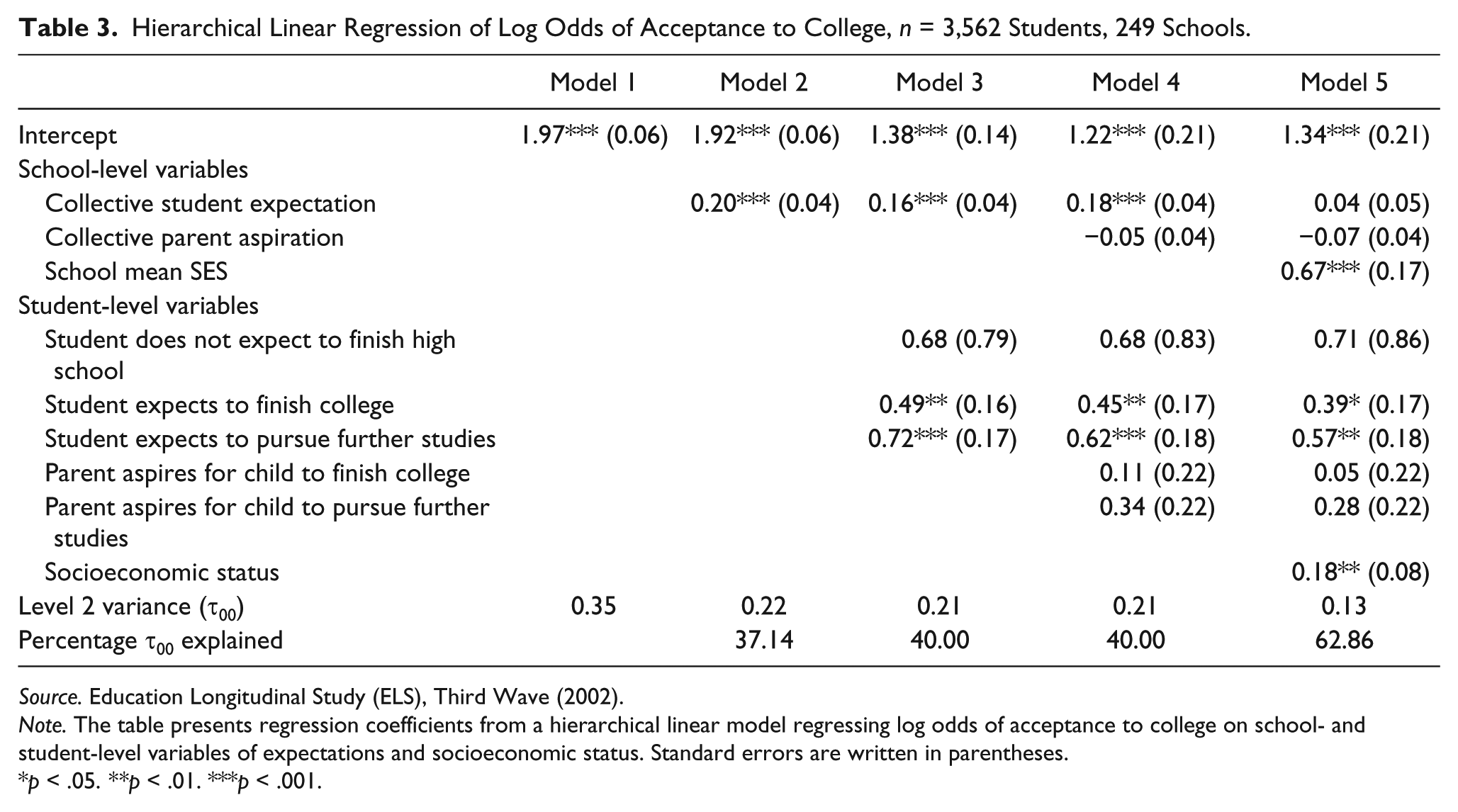
Collective or individual educational expectations may indeed influence a person’s math test scores, but it may also be the case that a person’s educational capacities or abilities may influence one’s educational expectations. Given this, I also use a long-term outcome to see if such expectations have effects further down one’s life. Table 3 presents hierarchical analyses on the log odds of being accepted to college, using unit-specific coefficients. In the first model, the average log odds for a student in an urban school with the average random effect is 1.97 (87.76% likelihood of being accepted to college). When collective student expectation is added as an explanatory variable, a 10% increase is associated with a 0.20 log odds increase. Thus, a student in a school with 10% more students who expect to go on graduate school has an 89.28% chance of being accepted to college.
Hierarchical Linear Regression of Log Odds of Acceptance to College, n = 3,562 Students, 249 Schools.
Source. Education Longitudinal Study (ELS), Third Wave (2002).
Note. The table presents regression coefficients from a hierarchical linear model regressing log odds of acceptance to college on school- and student-level variables of expectations and socioeconomic status. Standard errors are written in parentheses.
p < .05. **p < .01. ***p < .001.
When student-level educational expectations are added, the school-level effect is reduced, and there is a greater effect for individual expectations, such that a student who expects to pursue further studies in a school with 10% more students with this expectation has a 91% probability of being accepted to college. The fourth model adds school and individual parental aspirations that do not strongly influence the likelihood of being accepted. However, the addition of school and family SES in the fifth model had significant effects on the likelihood of being accepted to college, such that a one-unit increase in school mean SES is associated with a 0.67 log odds increase in acceptance to college. It is also noteworthy that the fifth model explains 62.86% of the between-school variance in the odds of being accepted to college.
Given the considerable effect of collective student expectation even after controlling for covariates, I perform robust regressions with the school’s collective expectation as outcome. This regression is preferred because of the presence of some outliers that may affect precision when using ordinary least squares regression, although I discovered only minimal differences between the two regressions after performing both. In the first model in Table 4, a 10% increase in collective parent aspiration is associated with a 5.6% increase in the percentage of students in a school who expect to pursue further studies. In the second model, this is reduced to 3.1%, although a one-unit increase in school mean SES is associated with an 18.8% increase in the school’s collective student expectation. To determine whether there were differential effects by school type, we added these categorical predictors, and there were no significant differences between public, Catholic, and other private schools. The same null effect is suggested by the nonsignificant coefficients for neighborhood crime level, with medium level of crime as the reference category.
Robust Regression of Collective Student Expectation, n = 249 Schools.
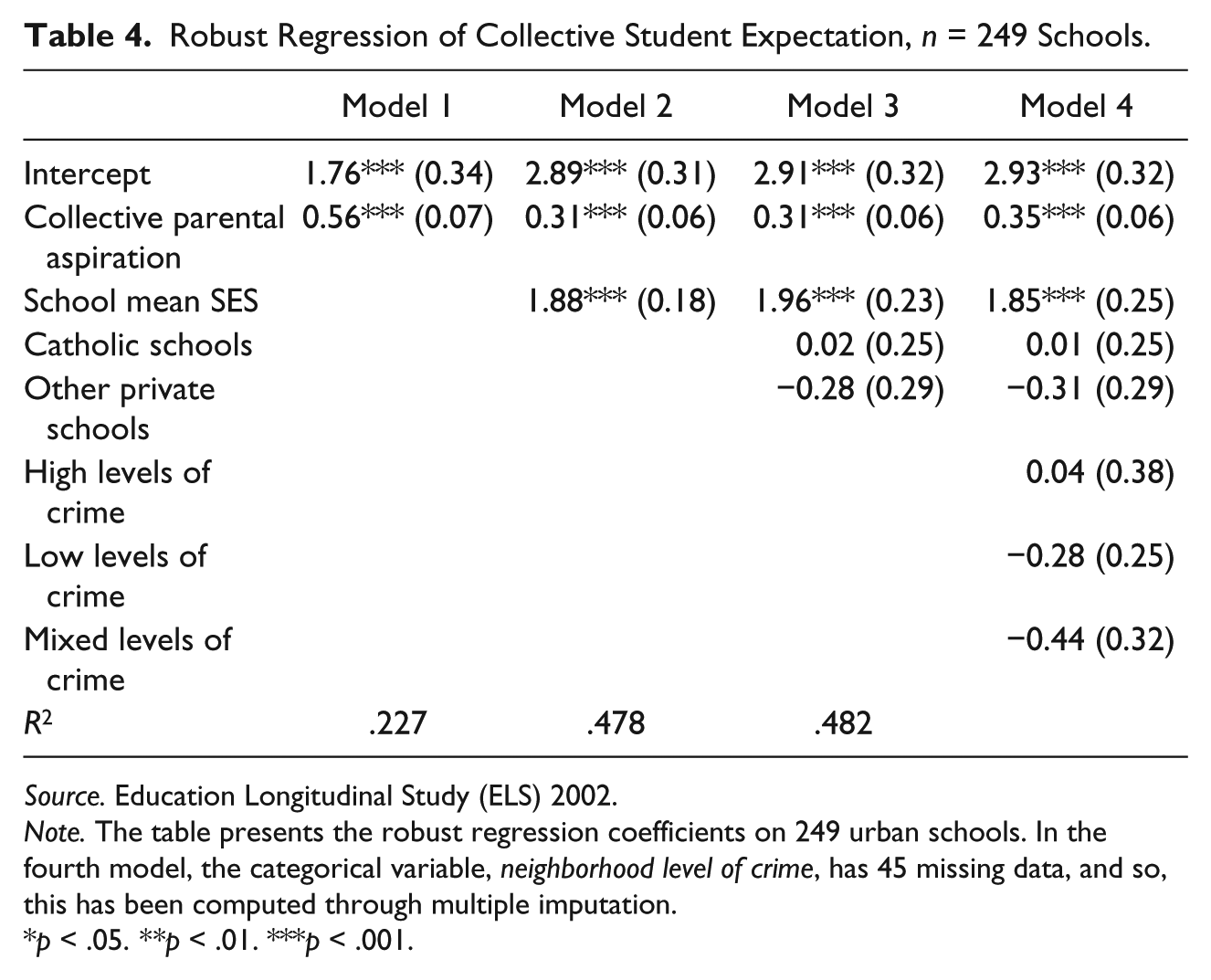
Note. The table presents the robust regression coefficients on 249 urban schools. In the fourth model, the categorical variable, neighborhood level of crime, has 45 missing data, and so, this has been computed through multiple imputation.
p < .05. **p < .01. ***p < .001.
Discussion and Conclusion
Many factors affect academic outcomes, and among them are the individual’s motivation, often codified in educational expectations (Hudley, 2016; Khattab, 2015). Although there is a considerable reciprocal relationship between individual academic expectations and achievement (Sanders et al., 2001), less is known about how collective expectations may affect achievement and what factors can influence the collective expectation of students aspiring further studies. In this section, I argue that structural and socioeconomic factors affect not only individual expectations and outcomes but also the school’s collective student expectation and consequent outcomes. In addition, I suggest that these structural factors in urban schools influence collective expectations that may either protect or prevent academic achievement.
First, collective expectations have important impacts on both long-term and short-term expectations, even after controlling for students’ individual expectations. However, this effect is diminished when school mean SES is considered. On one hand, this result shows that although individual expectations are still predictive of various educational outcomes (Sommerfeld, 2016), the expectations of those in a school also influence aggregate student achievement. This idea links closely with how economic research identifies high expectation as an important predictor for “effective schools,” although this originally referred to administrators’ expectations (Dobbie & Fryer, 2013; Kraft, Marinell, & Yee, 2016). Nonetheless, this idea emphasizes the importance of structural and cultural facets in a school: that schools with high expectations may have protective effects for the achievement of students. On other hand, the fact that this school-level effect is diminished with the addition of SES means that SES may strongly influence expectation and achievement within the school. It suggests that low economic status notably hinders both aspirations and outcomes, akin to the block opportunities framework where economic structures prevent higher personal attainment (Kao & Tienda, 1998; Vowell & May, 2000). In this discussion, I explain more how both the protective and restrictive factors operate in collective expectations.
Given the substantial influence of collective expectations on academic outcomes (prior to controlling for SES), a second consideration is how school structural factors affect collective expectation. From the robust regressions, schools that have high concentrations of parents who aspire for their children to pursue further studies also have high collective student expectation. Thus, structures of parental involvement, investment, and support have important consequences for expectations. Not only do individual parents’ support affect expectations and outcomes (Phillipson & Phillipson, 2012; Porumbu & Necşoi, 2013), there is also the possibility that aspirations of parents reinforce each other in schools with high social capital (Morgan & Todd, 2009). This means that the protective effect of parental involvement and expectation is not solely for the individual child, because parents in a school can influence each other in their expectations.
A structural factor that was not examined but may likely affect students’ collective expectation are the expectations of teachers, particularly how explicit expectations and implicit prejudice both affect students’ expectations for themselves (Peterson, Rubie-Davies, Osborne, & Sibley, 2016; Sebastian Cherng, 2017). Other school factors like sector and level of crime did not do much to influence collective expectation, which posits that other contextual factors may be driving high expectations. In this second consideration, I highlight how school-level structures and support influence collective expectation and achievement. However, structural considerations and constraints (such as economic factors) may also hinder the level of collective expectation.
Thus, a third argument is on how the school and individual’s socioeconomic position can have important repercussions on both school expectation and achievement. Research as early as Sewell and Shah (1968b) emphasized these social class differences, which can be intervened by parental encouragement. After all, it is not encouragement that explains the difference between classes, given how some lower SES parents can be very encouraging, and this could lead to better student outcomes. In a sense, socioeconomic issues contribute to how far one can realistically expect to go in school, particularly as resources are necessary for such expectations (Hanson, 1994). As can be gleaned from the analysis of data, the school’s mean SES significantly affects school expectations, and this validates previous findings on negative economic factors blocking both aspirations and opportunities (Dupriez et al., 2012; Rowan-Kenyon et al., 2011). In addition, I suggest that the effect of school economic factors work through collective expectations since students project blocked opportunities and, in this manner, prevent the attainment of higher academic goals. Thus, students in low SES schools may understand these blocked pathways as “limiting” their collective goal and accomplishment.
This discussion has focused on how the school’s structural and socioeconomic factors protect and prevent high collective expectations, and how these influence educational outcomes. Nevertheless, there are some limitations posed by this research. First, I have been cautious not to frame this as a causal argument that higher expectations lead to better outcomes, because the reciprocal relationship has been documented as well (Bui, 2007; Eccles & Wigfield, 2002). This research, however, focuses on the substantial effect that a school’s collective expectation may provide in addition to one’s personal expectation. Thus, the focus is not on the causal pathway but the school-level effect. Second, the robust regressions on collective expectations could have benefited from other predictors that approximate teacher expectations, school culture, and structures that positively or negatively affect collective expectation. The identification of these structures can also provide opportunities for further systems changes in schools. Third, this research has focused on urban schools although I have done similar analyses on rural schools, and found that the school-level effects were not substantial. Thus, a possible direction for future research is to compare the differential effects of collective expectations in rural, suburban, and urban schools.
Research on academic expectations and achievement often focuses on how individual factors affect individual outcomes. Through hierarchical analyses in this study, I have discussed how collective expectations help predict academic results, and how these expectations are affected by structural and socioeconomic factors. On one hand, structural factors of parental aspiration and school culture can have protective effects on expectations and outcomes, while on the other hand, socioeconomic factors can have preventive effects through the projection of blocked opportunities. In addition, these factors are at work not only on individual people but also on the schools themselves: that collective structural expectations and opportunities can have important effects on education and later life outcomes. This implies the need to not only promote individual expectations but also cultivate a culture of high expectations in a school.
Footnotes
Appendix A
Below is the model specification for the hierarchical linear analyses:
where
For the school-level coefficients,
Model 1 is unconditional and only has γ00, uoj, and eij. Model 2 has school-level collective expectation (γ01) while Model 3 adds individual-level expectations (γ10, γ20, γ30). Model 4 adds school- and individual-level parental expectations. Model 5 adds school and individual-level socioeconomic status.
Appendix B
Below is the model specification for robust regression:
where Y col exp is the outcome of school collective expectation for school j.
Acknowledgements
The author extends his thanks to the editors and anonymous reviewers of this journal article. He also thanks Xi Song, Stephen Raudenbush, James Murphy, Anna Mueller, Randy Gao, Akshaya Suresh, Kailey White, James Liggett, and Bronwyn Nichols for helpful comments and suggestions.
Declaration of Conflicting Interests
The author declared no potential conflicts of interest with respect to the research, authorship, and/or publication of this article.
Funding
The author received no financial support for the research, authorship, and/or publication of this article.
