







Abstract
This study explores the impact of residential environment (urban vs. kibbutz community) and use of information and communication technology (ICT) on loneliness among the elderly in Israel. The quantitative study surveys four sub-populations of people above the age of 65: (a) kibbutz residents who use ICT, (b) kibbutz residents who do not use ICT, (c) urban residents who use ICT, and (d) urban residents who do not. Findings confirm the hypotheses that urban residents will report greater loneliness than kibbutz residents, and ICT users will report lower feelings of loneliness than non-users. A significant effect of residential environment is found. A significant impact of ICT use is also found, but the effect size is small. Furthermore, there is interaction between the variables: Kibbutz residents using ICT report greater loneliness than those who do not, while among urban residents, ICT users report a lower level of loneliness.
Urbanization and Aging of World Population
Since the second half of the 20th century, urbanization increased dramatically throughout the world (Hall & Pfeiffer, 2000; United Nations, 2014). Between 1930 and 2014, the percentage of people living in urban areas increased from 30% to 54%. In Europe and throughout the Western hemisphere, the percentage of urban residents is more than 70%, and in some countries, it is more than 90%. All major regions are urbanizing and this trend is expected to continue (United Nations, 2014). The term “urban areas” refers to a wide variety of settlement types ranging from mega-cities to smaller urban settlements. Specific criteria for defining urban areas such as minimum population or population density vary across countries and cultures (Deuskar, 2015; United Nations, 2005).
During the same time period, there has been a gradual increase in the percentage of the population considered “elderly.” In 1950, the percentage of people above the age of 65 was 5%; by 2015, this rose to 8.5% (He et al., 2016). This may be attributed to improvements in social conditions and health care which lengthen life expectancy, alongside a decline in the birthrate. The percentage of elderly varies regionally, from 3.5% in Africa to 17.4% in Europe (He et al., 2016).
Living in an urban versus rural area has been found to have a strong impact on the lifestyle of the elderly such as care by family versus state services (Li et al., 2013), health and nutrition (Raina et al., 2014), and depression (Sengupta & Benjamin, 2015).
In all social environments, urban and rural alike, one of the main challenges faced by the elderly is a sense of loneliness, as will be discussed in detail below (Even-Zohar & Brashaur, 2012). One area that may affect feelings of loneliness among the elderly is use of information and communication technologies (ICTs). Some recent studies have found that use of ICT reduces loneliness among older adults (Cotten et al., 2013; Hur, 2016; Shelton & Uz, 2015). On the contrary, there is concern that use of ICT among the elderly may lead to depression and other negative outcomes, which have been found among students (Akin & Iskender, 2011; Dalbudak et al., 2013; Huang, 2010; Spraggins, 2009).
The current study compares the effects of ICT use on the sense of loneliness among people above the age of 65 who live in an urban area or a rural collective community (kibbutz) in Israel.
Aging
It is difficult to define when “old age” begins as the term is controversial, and not self-evident. There is extensive discussion and debate regarding this term in the research literature. One common approach is to use the retirement age of 65 and above (Orimo et al., 2006; World Health Organization, 2002). Three primary categories of characteristics of the elderly are physiological, social, and psychological.
Physiological characteristics
These relate to the body’s systems and are based on external signs of age and functional abilities. In general, as people age, they suffer an irreversible decline in sharpness of the senses, a slowdown in central nervous system function, decreased memory function, sleep difficulties, and an increase in the incidence of chronic incurable diseases. Physiological characteristics of aging may limit a person’s ability to respond to environmental challenges and stimuli. These changes may make assistance necessary, sometimes requiring transition to a nursing institution.
Social characteristics
The aging process is affected by and affects sociological and social contexts. Social contacts and networks of the elderly are often disrupted by retirement, deaths, or changing residence (Cotten et al., 2013). Relatives may live far away and have limited time to visit. Furthermore, in some societies, there is a loss of respect for the elderly among younger generations (Billig, 2003). Tension in familial relations may result from the stress and anxieties of caring for elderly relatives (Lebenstein & Rahman, 1995).
Psychological characteristics
These pertain to the subjective experience of the external world, emotions, and feelings. There are numerous psychological disorders that characterize old age (Livnat et al., 2013). One prevalent psychological characteristic of old age is a sense of loneliness (Cotten et al., 2013). A meta-study conducted in 26 Eastern and Western European countries (Yur’yev et al., 2010) finds that suicide rates among the elderly are lower in societies where they are more likely to live with their families, and where the culture has positive, friendly, and respectful attitudes toward the elderly.
Loneliness
Loneliness is a social-emotional state that stems from a gap between the number or quality of desired social connections and those which are available in reality. The literature differentiates between the concepts of loneliness and social isolation. Loneliness is a subjective experience entailing negative feelings about one’s level of social connections. Social isolation, in contrast, is an objectively observable lack of significant social connections with family, friends, or community that provide for social support. A socially isolated person will not necessarily report a sense of loneliness, while a person surrounded by others may feel lonely.
Loneliness Among the Elderly
Loneliness is seen as being a prevalent problem among the elderly (Dury, 2014; Runcan, 2014; Shayovitz-Ezra, 2011) due to life changes which affect social relations and the social support network, such as retirement; loss of spouse, friends, and relatives; as well as physical and mental disabilities or limitations (Dykstra, 2009; Van Tilburg, & De Jong Gierveld, 2007). A study conducted in Israel found that marital status, gender, and health are predictors of loneliness (Shayovitz-Ezra, 2011).
When elderly people relocate to a nursing home or assisted living center, they undergo a complete transition of the residential situation, which is often emotionally and socially difficult (Drageset et al., 2011; Lee, 2010, among many others). On the contrary, changing place of residence has the potential to expand one’s social circles (Evangelista et al., 2014; Riedl et al., 2013).
However, some studies find that reported levels of loneliness among the elderly have decreased somewhat (Dykstra, 2009). In addition, contrary to expectations, elderly living with their families do not always report lower levels of loneliness, as may be expected (Yur’yev et al., 2010). These findings may be explained due to the cultural context of the subjective experience of loneliness and social expectations.
ICT Use Among the Elderly
In recent years, efforts have been made to understand how ICT affects loneliness among the elderly. ICT refers to computer-based applications that provide access to information, including those that promote communication between two or more people. More specifically, it refers to web pages, e-mail, real-time chat rooms and discussion groups, internet-based support groups, and voice-based web-based cameras (Blaschke et al., 2009). Although technological innovations offer a wide range of benefits for those who use them, there are factors that make it difficult for the elderly to adopt them and to stay abreast of the ever-accelerating rate of technological change. A key one is education. Lack of guidance and instruction makes it difficult for the elderly to understand how to use new technological devices. Limitations in vision, motorization, and memory also make it difficult for some elderly people to use information technologies (Livnat et al., 2013). In addition, there are segments of the older population that perceive ICT as “the realm of the young” (McMurtrey et al., 2011). However, use of ICT affects one’s ability to function in contemporary society (Isaac, 2005). A range of efforts to make these technologies accessible to the elderly population have been launched, for example, in schools and community centers (Brown, 2006; Woodward et al., 2013).
Impact of ICT on loneliness among the elderly
For the elderly, ICT has a potential to positively influence the quality of life by improving social support and psychosocial well-being (Carpenter & Bunday, 2007; Eastman & Iyer, 2004; Pfeil et al., 2009; Selwyn et al., 2003; Selwyn, 2004). ICT enables the elderly to communicate frequently, easily, and inexpensively with friends and family, regardless of distance (Adler et al., 2006; Czaja & Lee, 2003; White et al., 2002; Woodward et al., 2013). For the elderly who are largely home-bound, internet access allows them to interact with the outside world (Blit-Cohen & Litwin, 2004; Bradley & Poppen, 2003), improves their relationships, and helps lessen the sense of social isolation (Blit-Cohen & Litwin, 2004; Czaja et al., 2006). Elderly people may receive support and encouragement by participating in online groups (Shapira et al., 2008). Using ICT may lead to feelings of personal independence and growth (Cotten et al., 2013). On the contrary, findings from studies conducted among the general population find that ICT use can also have negative effects such as depression, anxiety, stress, loneliness, and poor social availability (Antoci et al., 2012; Spraggins, 2009).
There has been little previous research on ICT use among the elderly and how it affects this population. In particular, there is a need to compare how ICT affects social well-being of the elderly in different environments. A study conducted among elderly participants in a computer and internet training course in Spain found that those living in rural areas were less socially active and had higher expectations that communication technologies would improve their daily lives, as compared with participants from urban areas (González et al., 2012). Longitudinal research among rural elderly in Thailand revealed that the proliferation of mobile phones has mitigated the negative social impacts of their children’s migration to urban areas (Knodel & Saengtienchai, 2007).
Israeli Society: Urban Areas and Kibbutz
The current study compares the experiences of elderly people who live in urban areas or on a kibbutz.
Urbanization in Israel
Israel is characterized by high population density. In Israel, a city or urban area is defined as a locality with 20,000 or more residents (Ruder & Milgraom, 2010). The percentage of the population in Israel living in urban areas in Israel rose from 89.6% in 1983 to 91.7% in 2005, and it remains more than 90% (United Nations, 2014). This increase in urbanization reflects the growth of the population in existing urban localities, as well as by the fact that some localities surpassed the population threshold and thus additional localities were redefined as urban areas (Cohen-Castro, 2007).
The kibbutz is a distinctively Israeli type of cooperative settlement based on socialist-egalitarian values. They are generally in a rural and agricultural setting. Traditional kibbutz society is a closed and intimate social framework. Members live and work together with a sense of shared responsibility and mutual obligations regarding the individual’s contribution to the community and the community’s support of its members (Leviatan et al., 1998; Shapira, 1996). In recent decades, the structure of the kibbutz has undergone changes, and many kibbutzim have undergone a process of privatization (Davidovich et al., 2009; Moskovich & Ashush, 2013; Moskovich & Palgi, 2015). Nevertheless, the idea of cooperation and emphasis on the community and mutual guarantee of resources remains at the core of kibbutz life.
Many kibbutz settlements were founded by core groups of young adults, and had small numbers of elderly in the early years. As their membership has aged and many of their children and grandchildren leave the kibbutz for urban areas, the percentage of the people living on a kibbutz who are above 65 has grown dramatically (Leviatan et al., 1998).
Aging in Israel
According to data from Israel’s Central Bureau of Statistics (2015) at the end of 2015, the population of Israeli citizens 65 years or older was approximately 939,000 individuals, constituting about 11.1% of the population. Within this population, about 56% are between the ages of 65 and 74 (n = 525,840) and 44% (n = 413,160) were above the age of 75. The percentage of the total population that is 65 and older is lower in Israel than it is in the countries of Europe, North America, and the Ukraine, which have lower fertility rates than Israel. However, Israel’s proportion of elderly is higher than that in Asia, Latin America, and Africa, areas which have relatively higher fertility rates and lower life expectancies.
The population of Israeli citizens in general and its elderly population in particular are heterogeneous in terms of origin and culture. An important distinguishing trait pertains to their type of residence. Of the population of Israelis aged 65 and older, the vast majority (81% or 764,000 individuals) live in cities, while less than 2% (16,300) live on a particular type of collective rural community known as a kibbutz. There are differences between age sub-groups of the elderly. Among those between 65 and 74 years old, 90% (473,200) live in urban areas, while about 2.5% (12,700) live on a kibbutz. Among those above the age of 75, about 93% (383,700) live in cities and less than 3% (10,100) live in a kibbutz (Israel Central Bureau of Statistics, 2015).
Another factor related to place of residence is whether the elderly live at home or in institutions. Of those aged 65 to 85, virtually all (97%) live in private households and a small minority lives in institutions and assisted living centers. However, of those 85 and older, the percentage of those in institutions rises to 11% (Israel Central Bureau of Statistics, 2015).
To compare the experience of aging in these types of residential environments, we consider three primary aspects that affect lifestyle and quality of life among the elderly: community, employment, and health care.
Community
The community aspect focuses on the traits of the society in which elderly people live and the degree of their involvement in community life. It has been found that more frequent social connections raise the level of satisfaction and improve quality of life among the elderly (Even-Zohar & Brashaur, 2012).
Urban areas
Israeli urban communities are relatively heterogeneous, often with significant differences between areas of the same city. One issue the elderly face concerns whether to stay in their familiar community, move closer to family, or relocate into an assisted living center.
Most Israeli municipalities provide social activities for the elderly through senior centers and other community centers. However, transportation is not provided and may limit participation for some elderly people. The Israeli Ministry of Labor, Social Affairs, and Social Services organizes and funds a “Supportive Community” program in some urban areas which assists elderly citizens who wish to remain in the community and environment they are familiar with (Billig, 2003; Even-Zohar & Brashaur, 2012).
Kibbutz
A supportive community life is integral to kibbutz values. Most elderly people living on a kibbutz have at least one family member who continues to live as a member of the kibbutz. Furthermore, it has been found that friends and peers make as significant a contribution to life satisfaction of elderly kibbutz members as do family members (Leviatan et al., 1998). In particular, widows and widowers living on a kibbutz receive compensatory support from the community. There is a widespread perception that the necessary changes should be made to meet the health care and other needs of the aging population, to integrate them into the community, and to provide them with a comfortable and safe living environment in the kibbutz community (Yitzchaki & HaYisraeli, 1995). Elderly members take part in meetings and cultural events at the kibbutz. Even simple daily activities such as eating in the community dining room or shopping in the community store offer social encounters for the elderly.
On the contrary, the social circles of the elderly on kibbutz are limited in that there is little change in the kibbutz membership, particularly among the older segments of the community, and therefore they meet few new people as their peer group declines in number due to death or moving off the kibbutz. Furthermore, in comparison with cities, the kibbutz community tends to be relatively homogeneous.
Employment
Employment refers to how the elderly use their time, whether it is paid work or other daily occupations such as caring for grandchildren, volunteering, and hobbies. It has been found that increased level of activity among the elderly increases their general satisfaction with life (Even-Zohar & Brashaur, 2012; Yitzchaki & HaYisraeli, 1995). In Israel, the employment situation differs for elderly people living on a kibbutz or in an urban area.
Urban areas
According to Israel’s 2004 Retirement Age Act, the mandatory age of retirement is 67 for men and 62 for women (Axelrad et al., 2013). Mandatory retirement was upheld by the Supreme Court, following a challenge that it discriminates based on age, although a court decision ruled that women may opt to retire up to the age set for men (Doron, 2003). Vocational retraining is not part of the adjustment process. Therefore, there is little room for integration of the elderly in the urban labor market.
Kibbutz
The Retirement Age Act does not apply to kibbutz members (Carmel, 2017). Their retirement from employment is gradual and according to their own wishes, physical health, and mental state. The study by Yur’yev et al. (2010) found suicide rates among the elderly to be lower in societies which allow and encourage continued participation in the labor market. Many kibbutz residents older than the standard retirement age continue to work in their place of employment (Moskovich & Palgi, 2015). Some kibbutzim offer elderly members and residents the option of being retrained for new fields of work, adapting their employment to their changing abilities. Thus, the elderly continue to be integrated into the work life of the kibbutz as members who contribute to their community.
Moreover, the elderly living on a kibbutz do not need to set up private pension funds, because the kibbutz management takes care of this and members are insured for life. This alleviates the economic burden from family members. A negative consequence of the predominance of the kibbutz in the care of its elderly members is that family members may not feel obligated to take part in their care (Lebenstein & Rahman, 1995).
Health Care
This aspect refers to the care and assistance given to an elderly person by an outside party, in the medical field or in any other field in which the elderly person needs assistance. It has been found that medical health strongly affects the emotional well-being of an elderly person (Even-Zohar & Brashaur, 2012). A person’s economic situation may affect the quality of health care services received.
Urban areas
Under the National Health Insurance Law, all Israeli citizens are entitled to state-funded health care, and there are a variety of health clinics and nursing services available to the elderly living in urban areas. However, the elderly often face problems of accessibility to these formal support systems (Billig, 2003). Furthermore, the economic situation of the elderly and their families has a significant impact on available treatments, medications, and the quality of certain services. For example, seniors who have sufficient savings and private insurance policies can afford to live in high-quality nursing and retirement homes, as opposed to state-run facilities which may be crowded and of lower quality. Other legislation such as the Equal Rights for Persons With Disabilities Law offers additional support and protection to the elderly, but implementation of services is not uniform in all cities.
Kibbutz
On a kibbutz, elderly members are given the choice of whether to stay in their home or move to a nursing home located on the kibbutz. Those requiring intensive treatment may need to be placed in an institution outside the kibbutz (Lebenstein & Rahman, 1995). Given that the elderly and members of their family were partners in the establishment of the kibbutz nursing home, transition to these institutions seems to be less emotionally difficult, especially when institution continues to be managed by the community. Each kibbutz provides a health care system responsible for the physical and mental health of all members including a clinic that provides medication (Yitzchaki & HaYisraeli, 1995).
Research Hypotheses
The current study compares reported feelings of loneliness among older people living in Israeli cities and kibbutz communities and the impact of ICT use on loneliness. We propose three hypotheses:
Method
Research Process
This quantitative study examines differences in reported feelings of loneliness among elderly people living on a kibbutz or in an urban environment. Self-report questionnaires were distributed to residents of kibbutz communities and cities in northern Israel. When necessary, they were distributed online. The questionnaires took about 7 to 10 min to complete. Due to the medical condition of some of the participants, the questionnaire was read to them and the responses were marked on their request. The research was conducted in compliance with ethical standards. Prior to the start of the study, participants received an explanation about the research and instructions on how to fill out the questionnaires. Their anonymity was ensured. Participation was voluntary, and individuals were told they could end their participation at any time.
Study Population
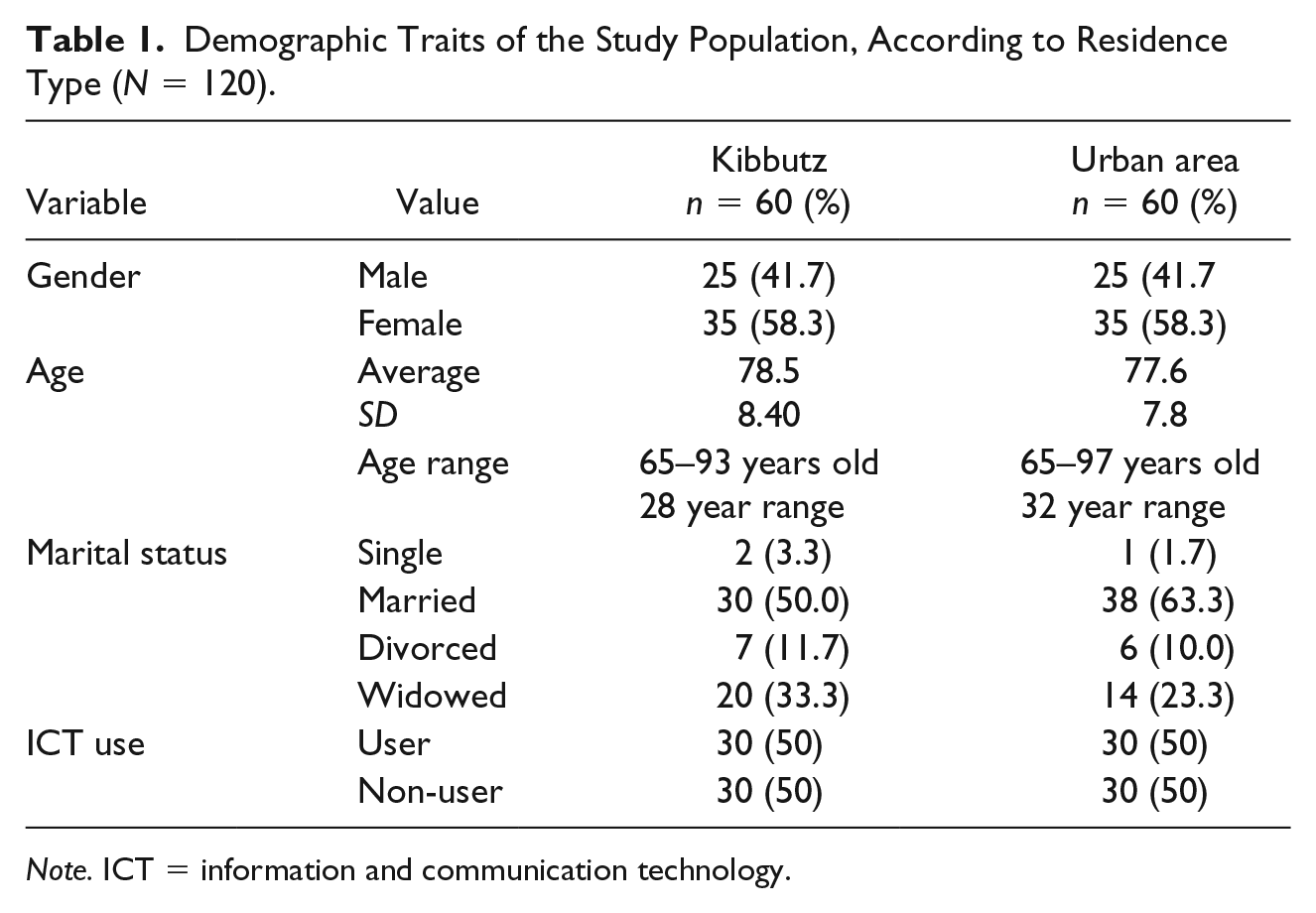
The study population consists of 120 individuals, all age 65 or older. The study population was selected such that half (60) live on a kibbutz and the other half live in urban areas in Israel. Some general demographic characteristics of the study population are presented in Table 1. The gender breakdown is the same for the kibbutz and urban sub-populations, with a somewhat higher representation of females (58%). In both groups, the largest number is married, followed by those who are widowed. A minority is divorced and only a few individuals remained single. The average ages and average age range in the two settings are similar, with a slightly higher average age among those on kibbutz but a slightly larger age range in urban areas, as shown in Table 1.
Demographic Traits of the Study Population, According to Residence Type (N = 120).
Note. ICT = information and communication technology.
Research Tools
Three questionnaires were distributed to the study participants.
Demographic questionnaire
This questionnaire includes basic personal information such as age, place of residence, and marital status.
ICT use questionnaire
In the first section of this questionnaire, participants rate the frequency of ICT use on a 5-point scale from 1 (never) to 5 (several times a week). In the second section, participants who report any use of ICT indicate their reasons for using ICT according to the following categories: (a) news, (b) communication with others, (c) information/learning, (d) watching movies/television programs, or (e) other.
Loneliness scale
We used the revised UCLA (University of California, Los Angeles) Loneliness Scale, a 20-item self-report instrument (Peplau & Cutrona, 1980; Russell et al., 1978). The items in the Loneliness Scale are linked to other negative psychological experiences such as depression and anxiety, but it measures the distinct psychological experience of separateness from others (Russell et al., 1978). Respondents rate each of the statements on a scale of 1 (I never feel this way) and 4 (I often feel this way). Ten of the statements are phrased in a positive way (i.e., “I feel isolated from others”) and 10 are negatively phrased (i.e., “I do not feel alone”) to prevent a response bias. The Hebrew version is taken from Raz (2003). The questionnaire has high repeatability reliability (α = .73; Russell et al., 1978). In the Hebrew version, a significant correlation is found between loneliness scores and social behaviors reflecting loneliness, such as the amount of time the individual spends alone during the day (Raz, 2003). In the current study, internal reliability is high (α = .824).
Results
Preliminary Analyses
Frequency of ICT use
In both the urban areas and kibbutz communities, half of the participants report they do not use ICT at all and the other half uses it with varying degrees of frequency. Frequent ICT use (several times a week) is reported by 43% of the surveyed kibbutz residents and 35% of those in urban areas. The remaining participants selected intermediate categories: once a month, twice a month, or once a week. For the final analysis, the different categories for varying frequency of ICT usage are merged, so that only two categories are compared: ICT users and non-users.
Motivations for ICT use
Only those who indicate some ICT use responded to the second section of this questionnaire, as explained above. Among the ICT users on a kibbutz, the most common reasons are information/learning (41.25%) and communication with others (41.2%). A few use ICT to keep up with the news or other uses. Among the ICT users in urban areas, the most common use by far is communication with others (62.1%), with a smaller number using ICT for information/learning (20.7%), or other use (17.2%). No one is this group says they use ICT to keep up with the news. The data indicate that more elderly people in urban areas use ICT to communicate with others.
Loneliness Among Elderly Kibbutz and Urban Residents
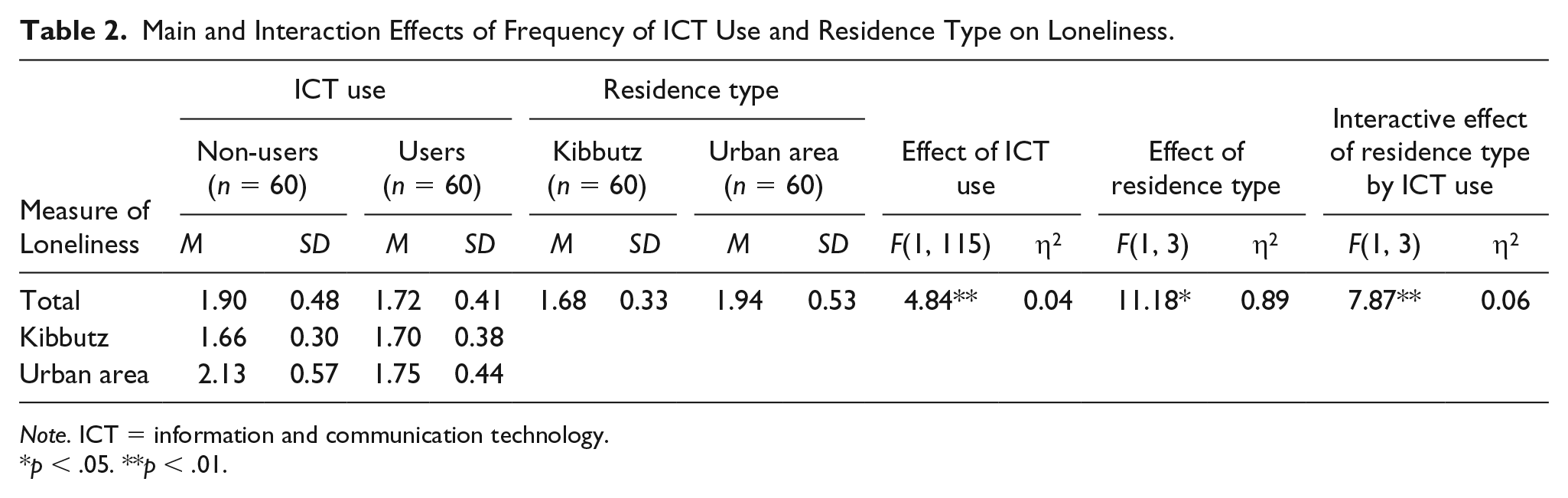
To examine the first hypothesis, that elderly people in urban areas will report greater feelings of loneliness as compared with their peers living on a kibbutz (beyond the contribution of ICT use), a two-way ANOVA is carried out. The independent variables are type of residence (kibbutz/urban area) and ICT use (users/not users). The dependent variable is the sense of loneliness.
As shown in Table 2, residence type has a significant effect on loneliness, F(1, 3) = 11.18, p < .05; η2 = 0.89. The mean for measures of loneliness among elderly living in urban areas (M = 1.94) is significantly higher than those residing in a kibbutz (M = 1.68). The hypothesis regarding the main effect of the residence type is confirmed.
Main and Interaction Effects of Frequency of ICT Use and Residence Type on Loneliness.
Note. ICT = information and communication technology.
p < .05. **p < .01.
Loneliness and ICT Use
To test the second hypothesis, that elderly people using ICT will report lower levels of loneliness than those who do not use ICT (beyond the contribution of residence type), a two-way ANOVA is conducted. A significant effect of ICT use is found. The mean for measures of loneliness among those who use ICT, F(1, 3) = 4.84, p < .01 (M = 1.72), is significantly lower than that of participants who do not use ICT at all (M = 1.90). However, the effect size is small. The hypothesis of the main effect of the use of ICT is confirmed.
Interaction Between Residence and ICT Use on Loneliness
A third two-way ANOVA is conducted to test the third hypothesis regarding the interaction between residence type and ICT use on loneliness, such that elderly people living on a kibbutz will report feeling greater loneliness if they use ICT, while those living in a city who use ICT will report less loneliness.
There is indeed a significant interaction effect between the independent variables, F(1, 115) = 7.86, p < .01; η2 = 0.06. The elderly residing in a kibbutz who use ICT users report a higher level of loneliness (M = 1.70) than kibbutz residents who do not use ICT (M = 1.66), although the difference between the averages is small. In contrast, the elderly living in urban areas who use ICT report a lower level of loneliness (M = 1.75) than urban residents those who do not use ICT (M = 2.13). These are the loneliest sub-population of the study. The interaction hypothesis has been confirmed and is illustrated in Figure 1.
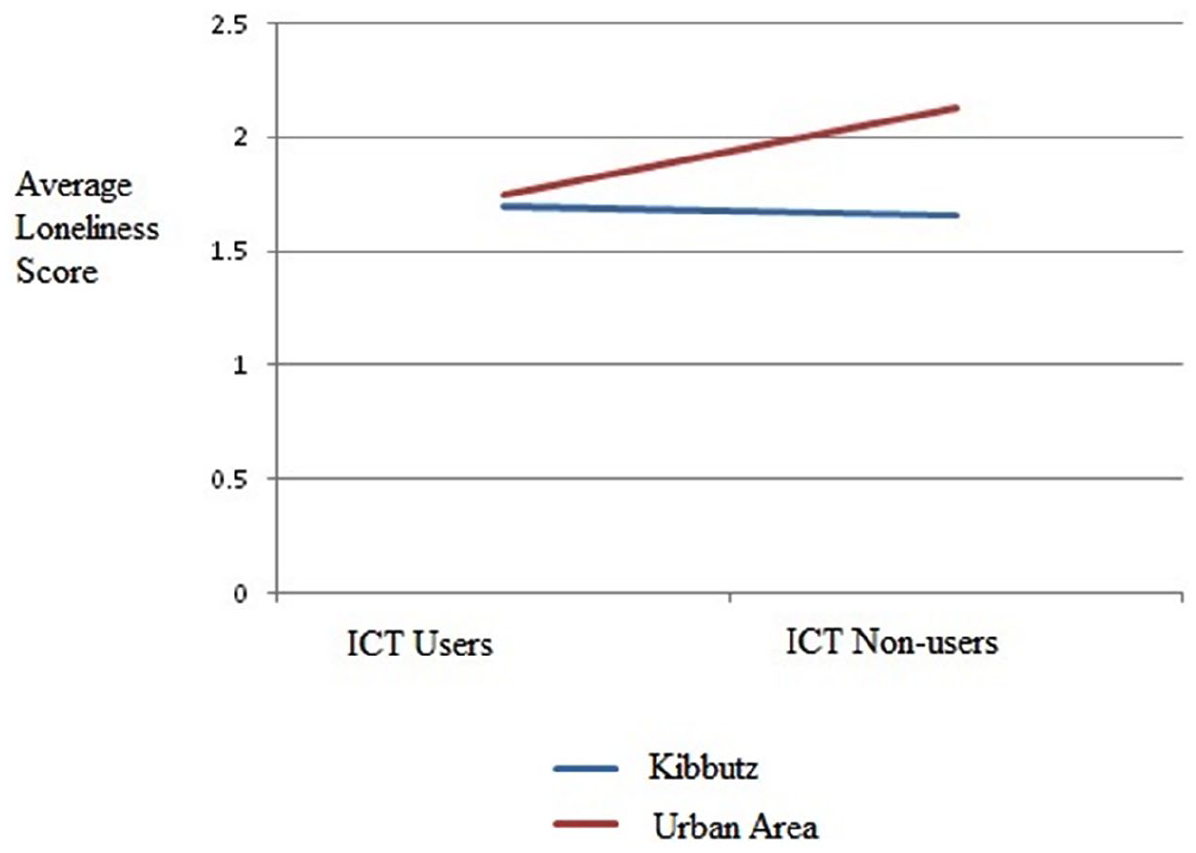
Interaction effect between residence type and ICT use on loneliness.
Discussion and Conclusion
The simultaneous aging and urbanization of the population in many areas necessitates giving additional attention to the specific needs of the elderly living in various types of residential settings. The current study contributes to the discussion regarding quality of life and well-being among the elderly by examining the impacts of residence type and ICT use on loneliness among elderly residents of urban areas and kibbutz communities in Israel.
As predicted, elderly people living in urban areas report more loneliness than their peers living on a kibbutz. It appears that one result of the social and organizational arrangements of the kibbutz is the less loneliness among elderly residents. The kibbutz, built on a socialist ideology, not only guarantees the existential needs of its members, it also enables them to continue working and being an active part of community life (Leviatan et al., 1983). In contrast, in urban areas, the elderly may lose social ties without finding an opportunity to create new connections and thus feel more solitude (Even-Zohar & Brashaur, 2012). The programs provided by governmental social services do not seem to adequately mediate this sense of loneliness. This is particularly important given the increasing percentage of people who live in urban areas.
The current study also verifies the findings of previous findings that elderly people who use ICT report a lower loneliness than those who do not by providing an easily accessible means of social interaction (Pfeil et al., 2009; Selwyn et al., 2003). Many elderly people do not use technologies due to lack of accessibility and instruction or supplementary modes for those who are visually or hearing impaired (Li et al., 2013). Expanding current efforts to create ICT education programs for the elderly (Cotten et al., 2013; Woodward et al., 2013) may be beneficial for reducing loneliness among this growing population.
The most significant contribution of this study is the interaction between residence type and ICT use. The distinctive forms of living in Israel (kibbutz and urban) allow for a new perspective on the topic. While elderly urban residents who use ICT report less loneliness, the opposite is found among kibbutz residents; ICT users report a slightly higher sense of loneliness than those who do not use these technologies. Previous studies have shown that people often turn to ICT to alleviate their sense of loneliness (Antoci et al., 2012). It is possible that elderly people living on a kibbutz who feel lonely are more likely to turn to ICT, whereas those who are more involved in community life do not. Furthermore, it is possible using ICT increases or even creates their sense of loneliness because they are not taking part in other social gatherings and activities in the community.
Research Limitations
The study includes a limited sample (120 participants), primarily from the northern region of Israel. Kibbutz communities and urban areas in other parts of Israel, especially the population center, are not represented.
Some participants found it difficult to fill out the questionnaires and received assistance in the fillings. Furthermore, some participants may have been embarrassed to express how lonely they are. Therefore, there is some concern that the answers recorded did not fully and accurately represent their feelings.
Recommendations for Further Research
A broader sampling of participants from kibbutz communities and urban areas from all parts of the country is recommended. A comparison is recommended between kibbutz communities that have been completely privatized and those that have not been privatized, to examine the interaction between ICT use and loneliness in kibbutz communities where the social support system underwent a change.
It is recommended to deepen the parallel investigation comparing the different reasons for use of ICT and the characteristics of the elderly in terms of their lifestyle. For example, how close relatives live, and whether the elderly make extensive use of ICT to overcome this distance. It would be enlightening to compare the results among Israeli elderly with parallel rural/urban populations in other countries. Expanding the investigation will enable a deeper understanding of the interactions uncovered.
Footnotes
Declaration of Conflicting Interests
The author(s) declared no potential conflicts of interest with respect to the research, authorship, and/or publication of this article.
Ethics Approval
The research was conducted in accordance with ethical standards.
Funding
The author(s) received no financial support for the research, authorship, and/or publication of this article.