







Abstract
Culturally Responsive Teaching (CRT) has gained significant attention across diverse school environments in justice by supporting students from culturally underrepresented groups. However, how teachers develop their agency toward inclusive practices and what influences the agency developed have been undertheorized and underexplored. This study aims to identify factors that support teachers’ initial enactment of CRT and what strengthens or weakens the positive agency developed. This study is guided by a grounded theory approach. Sixteen in-service teachers’ semi-structured interview transcripts were analyzed using the constant comparative method. Four themes emerged from each of the research questions. Theoretical and practical implications are discussed to better support in- and pre-service teachers’ growth toward becoming social justice-oriented change agents with CRT practices.
U.S. public schools are becoming increasingly diverse. Although student demographics vary greatly by state and even within districts, the number of non-White students exceeded the number of White students in 2014 and is expected to grow further in the coming years (Bonner et al., 2018). The National Center for Education Statistics (2019) projected that between fall 2015 and fall 2017, the percentage of White students enrolled in public schools would decrease from 49% to 45%, while the percentage of students of color would increase from 50% to 55%. Despite these shifting demographics, current educational practices in U.S. public schools remain unchanged. Wide gaps in academic achievement and educational opportunity between White students and students of color remain (Valentino, 2018), and the teaching force is primarily dominated by middle-class White teachers (Barker, 2019). Further, most textbooks present only the society’s dominant ideologies, which reflect the values and norms of middle-class European Americans (Gay, 2018).
To reduce these discrepancies and advocate for a more just, democratic, and equitable education for all students, some scholars have encouraged teachers to implement Culturally Responsive Teaching (CRT) practices (Bonner et al., 2018; Matias, 2013). Although there are varied approaches to defining terms such as culturally relevant and culturally sustaining teaching and pedagogy, there is no disagreement that CRT is a pedagogy that uses “the cultural characteristics, experiences, and perspectives of ethnically diverse students as conduits for teaching them more effectively” (Gay, 2002, p. 106). By supporting the students to learn through their own cultural lenses instead of the ones constructed by dominant ideologies, CRT addresses and improves the institutional and systemic inequality issues that exist in current education settings. Many scholars have studied the benefits of CRT and shared evidence-based strategies that teachers can use to implement CRT effectively in their classrooms (Griner & Stewart, 2013; Hollie, 2018).
However, little is known about what empowers teachers to implement CRT in their classes. Specifically, researchers rarely discuss how teachers are initially motivated to learn and practice CRT and what factors promote or challenge teachers to sustain their efforts. As reported by a number of educational studies that examined the successes or failures of various educational innovations, the teacher is the most critical agent in making positive changes brought by CRT. To better understand how to support teachers in enacting CRT, it is imperative to examine what influences on the orientation of teacher agency, the power of teacher(s) to determine his or her (their) actions, toward the CRT enactment. With regard to educational changes, teacher agency has been described in both a positive and negative manner in existing studies. While some teachers actively seek and try out new practices, others resist or are indifferent to changes (Lasky, 2005; Priestley et al., 2012).
This study aims to explore what contributes to the initial construction of positive teacher agency toward CRT and what strengthens or weakens the positive agency developed. The following three research questions guide the study:
What influences the initial construction of positive teacher agency toward CRT?
What strengthens teachers’ positive agency toward CRT development?
What weakens teachers’ positive agency toward CRT development?
Literature Review
Culturally Responsive Teaching (CRT)
CRT acknowledges students’ cultural experiences and backgrounds while emphasizing educational practices that create an environment in which students feel empowered and welcomed (Taylor & Sobel, 2011). Hollie (2019) points out that CRT gained prominence in 1994 with the publication of Gloria Ladson-Billings’s seminal text The Dreamkeepers: Successful Teaching of African American Students. Ladson-Billing (1994) described CRT as “a pedagogy that empowers students intellectually, socially, emotionally, and politically by using cultural and historical referents to convey knowledge, to impart skills, and to change attitudes” (p. 13).
When educators not only acknowledge different cultures in the classroom, but also show their willingness to learn about them, they create a more effective learning environment (Chenowith, 2014). Creating a culturally aware classroom environment allows students from different cultures to feel validated, thereby creating a greater sense of classroom community (Thomas & Berry, 2019). CRT practices also help teachers understand cultural differences as strengths rather than deficits, relate the curriculum to students’ cultural experiences, establish connections with families and local communities, and increase student engagement, ultimately improving academic outcomes of students from underrepresented populations (Bassey, 2016; Bonner et al., 2018; Hammond, 2015).
Some studies have suggested effective ways teachers can successfully implement CRT. Thomas and Berry (2019) argue that educators must establish a rapport with their students, be knowledgeable about their subject matter, and have a high cultural competency. Chenowith (2014) and Hammond (2015) claim that self-reflection and self-contextualization are imperative for successful integration of CRT practices into the classroom. Given that CRT cannot be put into practice without understanding “the social-emotional dimensions of the students, the teacher, and the classroom community” (Donahue-Keegan et al., 2019, p. 158), engaging in self-reflection builds a teacher’s social-emotional stamina. Moreover, Chen and Yang (2017) underscore the importance of professional development opportunities for teachers in order to enact more comprehensive and healthy CRT practices.
Theoretical Underpinnings on Teacher Agency
As a “superordinate concept” of teacher agency, human agency has been extensively theorized and explored across academic disciplines (Wilcox & Lawson, 2018, p. 185). Giddens’s (1984) theory of structuration describes human agency as one’s intentionality influenced by competence and reflexivity and argued that people mobilize themselves within social structures. Criticizing Giddens’s view as over-socialization of agents, Archer (1985) claims that individuals are independent from external structures and can construct their own personal identity through internal reflections. Reflecting on both Giddens’s and Archer’s perspectives on agency, Burns and Dietz (1992) suggest sociocultural evolution theory and underscore the significant roles of internalized culture and varied individual characteristics in terms of achieving agency (p. 273).
Teacher agency is critical in supporting student learning, teachers’ professional development, school improvements, and the success of educational innovations and reform policies (Toom et al., 2015). Despite educational studies’ recognition of its importance, some scholars acknowledge that teacher agency as a concept has been underexplored and undertheorized compared to human agency (Min, 2019; Biesta et al., 2015). One approach that has received attention for theorizing the concept is Priestley et al.’s (2015) ecological model. These authors propose that teacher agency has iterational (teachers’ life and professional histories), projective (short- and long-term orientations of action), and practical-evaluative (cultural, structural, and material aspects) dimensions: The achievement of agency is always informed by past experience – and in the particular case of teacher agency this concerns both professional and personal experience. . .is always orientated towards the future in some combination of short[er] term and long[er] term objectives and values. And it illustrates that agency is always enacted in a concrete situation, therefore both being constrained and supported by cultural, structural and material resources available to actors. (p. 138)
Echoing and expanding Priestley et al.’s ecological perspective, Wilcox and Lawson (2018) explain that teacher agency is achieved by “the interplay of individual and group/collective perceptions and intentions and the conditions provided by the school, district context, and surrounding community” (p. 186). They claimed that teacher agency needs to be examined in relation to “cultures, structures, and relationships that shape the particular ‘ecologies’ within which teachers work, including district and school organizational climates, routines, and rituals” (p. 186).
Many studies exploring the topic of teacher agency have described teachers as change agents in the context of innovations or reforms and identified factors influencing the construction of teacher agency toward these changes (Toom et al., 2015). Park and Jeong (2013) found administrator’s leadership to be a factor that reduces teachers’ resistance toward school reform. Some other scholars have echoed this finding (Brezicha et al., 2015; Ganon-Shilon & Chen, 2019). Teacher beliefs also gathered scholars’ attention as a factor that influences the construction of teacher agency for change (Biesta et al., 2015; Datnow & Hubbard, 2016; Ham & Dekkers, 2019). Moreover, human or physical resources that include professional development opportunities (Allen & Penuel, 2015; Sánchez-Mena & Martí-Parreño, 2017), time (Brenner & Brill, 2016; Francom, 2020), and collaborative school culture (Min, 2019; Datnow, 2018) have also been recognized as influential factors on teacher agency for change.
Teachers as Change Agents for Social Justice
Educational inequality is one of the major challenges that many countries across the globe have experienced. To address this problem and create more equitable societies for all, a large body of research in both U.S. and international settings has highlighted the important role of teachers as change agents who can fight on the frontline against social injustice (Bourn, 2016; Kohli et al., 2015; Pantić & Florian, 2015). Given that teachers are the most critical in-school factors in students’ academic, social, and emotional development, what and how they teach in their classrooms is directly associated with students’ growth as critical citizens who engage in activities to improve inequality and achieve social justice (Pantić & Florian, 2015). These studies especially call for teachers’ efforts to enact pedagogical approaches in which can dismantle the structural inequality that exists in the current educational environment and improve the academic performance of underrepresented groups.
For example, the critical pedagogy introduced by Paulo Freire 40 years ago in his seminal book Pedagogy of the Oppressed has been widely explored in various subject areas and school levels as an effective teaching approach for developing students’ critical thinking skills to support their understanding of the oppression of marginalized groups and encourage their actions to interrupt the status quo (Behizadeh et al., 2019; Zion et al., 2015). In addition, Caldera (2018) argued that both pre- and in-service teachers should develop competence to enact woke pedagogy that allows teachers to acknowledge the effects of racial differences, use students’ lived experiences as sources for creating knowledge, and help them examine multiple forms of oppression resulting from the complex interplays among factors ranging from race to gender. She claimed that woke teachers can “link students’ home lives, political developments, and academic content to increase engagement, create agency, and produce knowledge than can lead to civic engagement and social activism” by contributing to improving the inequality that exists in the current school system (Caldera, 2018, p. 8). CRT is another example. Esposito and Swain (2009) describe CRT as “a vehicle for examining social injustices on both a micro and macro level, thereby opening the door for the implementation of social justice pedagogy” (p. 38).
However, despite the general agreement among education scholars that teachers need to be social justice-oriented change agents, by enacting pedagogy that promotes social justice in their classrooms, discussions regarding what empowers them to adopt this role are scant (Pantić & Florian, 2015). Pantić (2015) is one of a few scholars who attempted to theorize the constituent attributes of teacher agency for social justice, identifying four key elements: (1) sense of purpose (teachers’ beliefs about their roles as social justice agents), (2) competence (teachers’ practices for promoting social justice), (3) autonomy (teachers’ perceived power for decision making), and (4) reflexivity (teachers’ capacity to reflect and evaluate their practices). However, it is unknown whether this model can empirically explain teacher agency toward pedagogical approaches that promote social justice, especially CRT in this paper. To address this gap, this study explores what empowers teachers to be change agents for social justice by taking and sustaining a CRT approach in their teaching practices. It also explores what discourages teachers’ efforts to enact a CRT approach, thereby limiting their agency to promote social justice.
Methodology
To understand the factors that influence on the orientation of teacher agency toward CRT, the researchers employed Glaser and Strauss’ (2017) grounded theory approach. This approach allows researchers to generate substantive theories rooted in data collected in natural settings (Chong & Yeo, 2015). Hutchinson (1986) explains, Grounded theory offers a systematic method by which to study the richness and diversity of human experience and to generate relevant, plausible theory which can be used to understand the contextual reality of social behavior (pp.125-126).
Using this approach, the researchers asked in-service teachers who have employed CRT to share their perceptions on what initially motivated, promotes, or challenges them to continue CRT in their practices.
Participants and Contexts
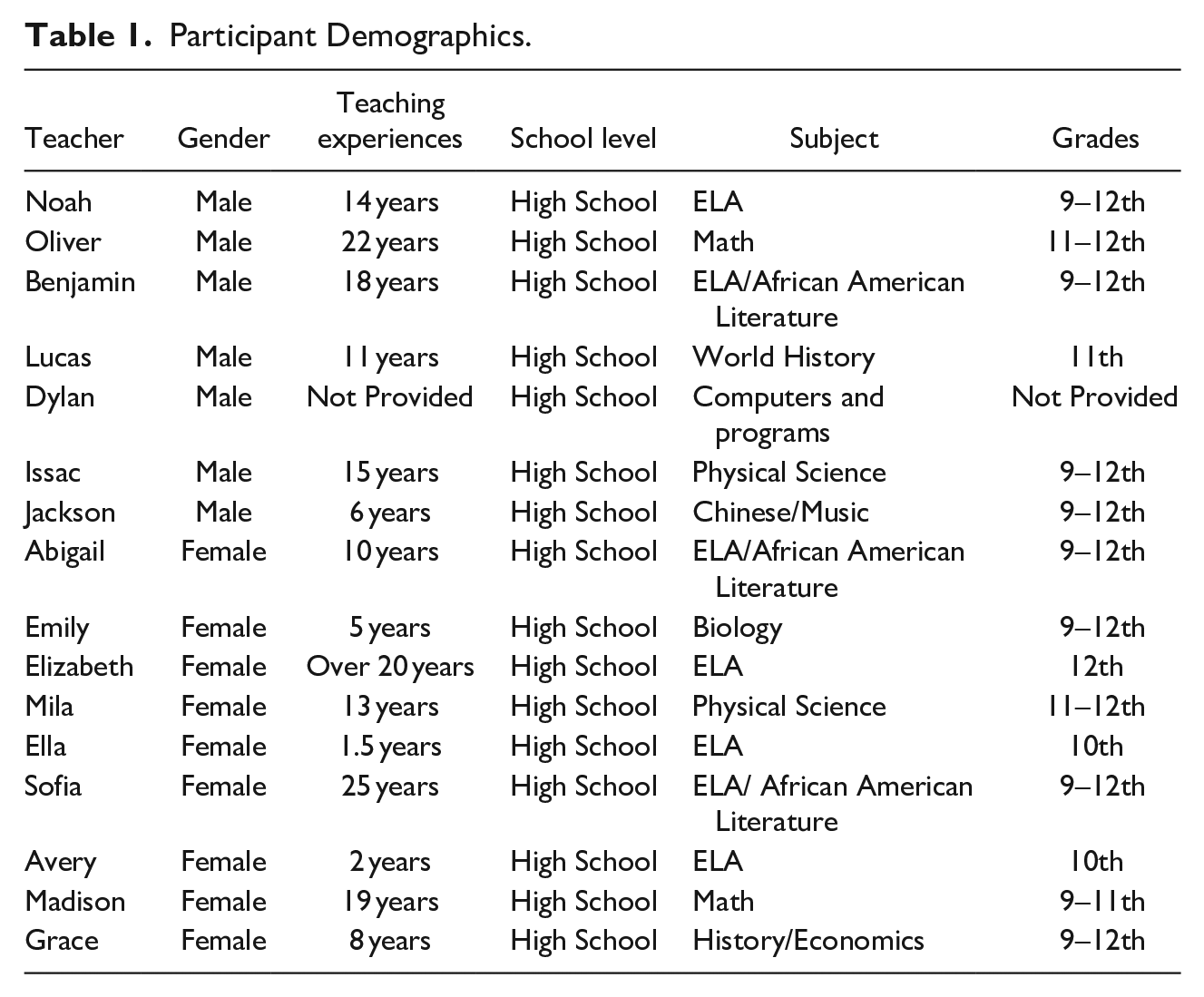
Sixteen in-service high school teachers at STAR (pseudonym) public school district in the Southeastern U.S. voluntarily participated in this study. Teaching experience with CRT was a prerequisite for participation in this study. Therefore, the teachers interviewed have experiences of enacting CRT in their classes. Of these, 43.8% (n = 7) were male and 56.2% (n = 9) were female. With respect to years of teaching experience, 13.3% (n = 2) had less than 5 years, 20.0% (n = 3) had 5 to 9 years, 26.7% (n = 4) had 10 to 14 years, 20.0% (n = 3) had 15 to 19 years, and 20.0% (n = 3) had 20+ years. One teacher did not provide his teaching experience. Grade levels ranged from 9th to 12th grade and subject areas varied from ELA to physical science. One teacher, Dylan (pseudonym), described his current position as Curriculum and Instruction Coordinator for Career and Technical Education (CTE), though had recently taught computer programming and shared his CRT experiences from a CTE teacher’s perspective. Table 1 summarizes the demographic information of participants described above.
Participant Demographics.
The STAR public school district, located within one of the most populous urban counties in the state, was intentionally selected for this study because of its unique racial and ethnic profile. Compared to previous CRT studies that focused only on Black students (Coffey & Farinde-Wu, 2016; Kumi-Yeboah et al., 2020), the mixed student body composition of White and non-White students in STAR public school district enabled the researchers to gain insights on why and how CRT is practiced in schools with students from diverse backgrounds. In 2020, non-White students constitute 54.7% of STAR public school district’s student body across all school levels. Among the non-White students, 0.2% are American Indian, 9.8% are Asian, 22.3% are Black, 18.4% are Hispanic, 0.1% are Pacific Islander, and 3.8% are two or more races (STAR County Public School System, 2020).
Further, the STAR school district’s history of segregation and desegregation has given rise to persistent controversy. Since the 1970s, the district has pursued school desegregation using an income-based plan—all district schools should have no more than 40% of students who qualify for free or reduced-price lunches. This school integration effort received pushback from the Republican-majority school board and some county residents (Khadaroo, 2010; McCrummen, 2011). Despite growing pressure to weakened school desegregation, the district has run several equity initiatives, including cultural proficiency training to enhance cultural responsiveness for teachers, administrators, and staff (STAR County Public School System, 2020), that are closely related to the principles of CRT. With this contextual uniqueness, the researchers speculated that teachers working in this district might have greater awareness and more opportunities to implement CRT than teachers in other school districts.
Data Collection
Semi-structured interviews were conducted as they allowed researchers to obtain rich data rooted in certain contexts from a small number of samples with a fairly flexible, open framework (Pathak & Intratat, 2012). This format can encourage interviewees to share their lived experiences and perceptions about the phenomenon of interest with significant latitude. A recruitment email outlining the purpose of the study, research questions, and interview procedures was sent to all teachers at the 31 high schools in the STAR public school district during Fall 2019. Of these, 16 teachers elected to participate. Interviews were conducted by three researchers via Zoom (https://zoom.us/), an online video conferencing tool and spanned approximately 20 to 40 minutes. The first author trained the researchers to conduct the interviews using the following questions, which directly relate to the study’s research questions:
What initially motivated you to implement CRT methods in your teaching?
Are you still implementing CRT in your teaching practices? If not, why did you stop implementing the CRT?
What helps (helped) you continue to implement CRT in your teaching?
What challenges do (did) you have in implementing CRT in your teaching?
Data Analysis
This study employed Corbin and Strauss’s (2015) constant comparative method to analyze 16 video files transcribed verbatim. Two researchers imported the transcribed files into Nvivo 12, a qualitative data analysis software. Hilal and Alabri (2013) described the advantages of using computer program for data analysis as it “reduces a great number of manual tasks and gives the researcher more time to discover tendencies, recognize themes and derive conclusions” (p. 182).
Independently, each researcher read all 16 interview files multiple times to increase familiarity with the participants’ comments and conducted open coding, “the initial stage of forming emergent theory or conceptualization” (Chong & Yeo, 2015, p. 259). During open coding, they created “nodes” that represented categories or themes in Nvivo. Then, the two researchers met, reviewed and compared the open coding results, and proceeded with axial and selective coding, the second and third steps of constant comparative methods. Using axial coding the researchers built relationships between the categories identified through open coding by creating parent and child nodes in Nvivo that represented main and subcategories, respectively. Then, selective coding was used to interpret the relationships identified and to answer the research questions of this study with theory development (Creswell, 2012). To ensure validity, an outside researcher reviewed the data and shared opinions on how to code the data whenever discrepancies arose. Based on her input, they discussed the conflicting points until reaching full consensus.
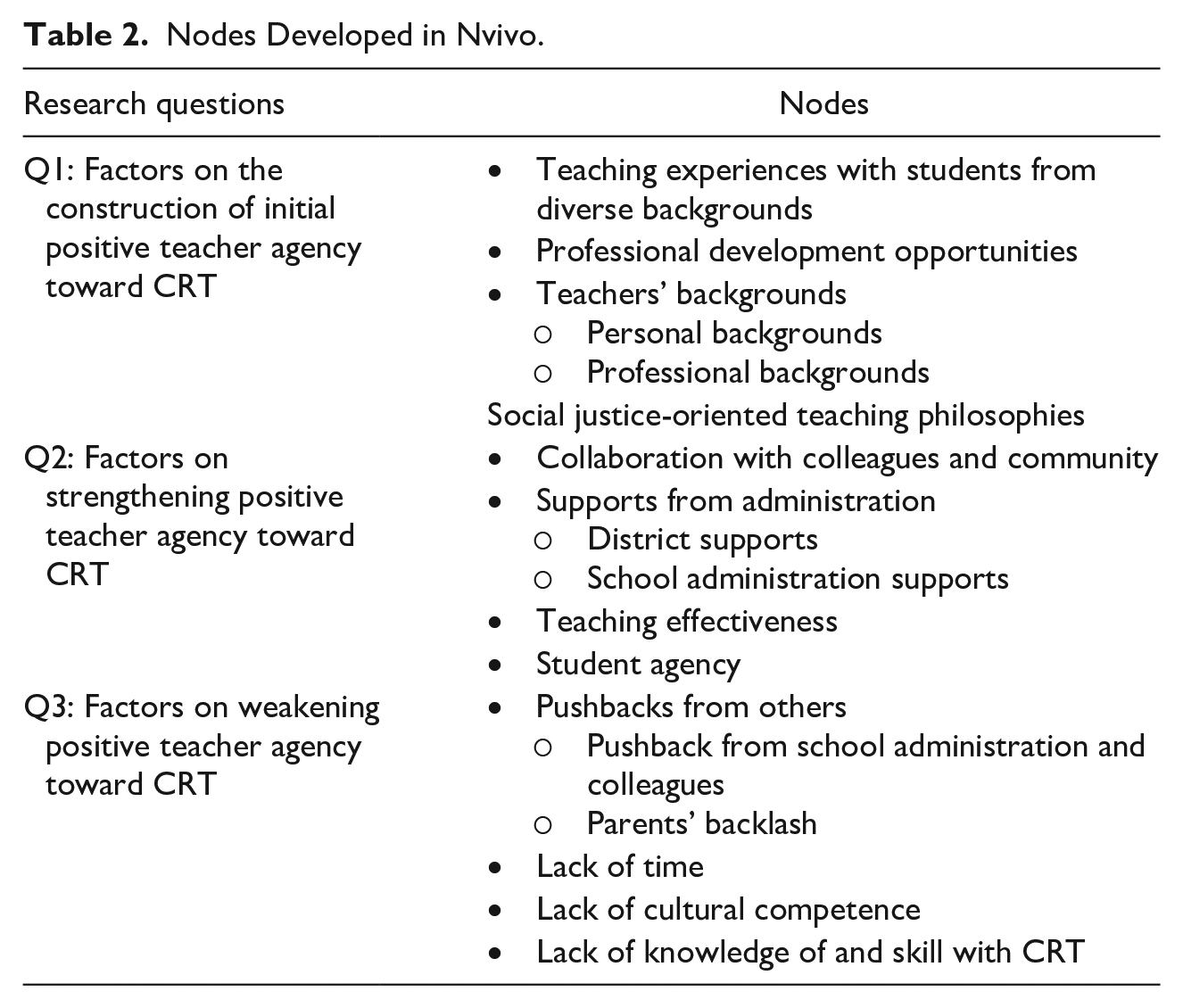
Twelve parent nodes were created in relation to the first, second, and third research questions of this study. Three of them had child’s nodes, representing sub-themes. Nodes created in Nvivo are summarized in Table 2 below. To illustrate how the data were analyzed and coded, the following two examples are provided. First, the statement “We are about 50% international, so I want to say we are about 70 different countries at our school, and there are 40 some different languages. . .” was coded as “Teaching experiences with students from diverse backgrounds.” Second, the statement “I think a lot of teachers, even though they want to. . .be culturally responsive teachers. . .they don’t have time to do it just because they have to push through so much of their material. . .” was coded as “Lack of time.”
Nodes Developed in Nvivo.
Results
Based on the analysis results represented by nodes in Nvivo, this section describes in detail each of the themes that emerged across the data along with the participating teachers’ accounts for this study’s three research questions.
Factors on the Construction of Initial Positive Teacher Agency toward CRT
Four themes emerged in response to the first research question “What influences the initial construction of positive teacher agency toward CRT?” (1) Teaching experiences with students from diverse backgrounds, (2) professional development opportunities, (3) Teacher’s backgrounds, and (4) Social justice-oriented teaching philosophies.
Teaching experiences with students from diverse backgrounds
The participating teachers indicated that their experience teaching classes with many students from diverse cultural backgrounds empowered them to initiate CRT practices. The following accounts from interviews with Emily and Dylan demonstrate that CRT implementation was an essential practice for them to accommodate the needs of diverse students.
My first job teaching, I taught at a school that was like 85% Hispanic students, so you kind of just did it without thinking. It was part of the job and you weren’t going to be a good teacher in that school if you didn’t do it.
[T]he first class I taught here 5 years ago, 25 students from 13 different countries. We are about 50% international, so I want to say we are about 70 different countries at our school, and there are 40 some different languages. . . we kind of have to be.
Professional development opportunities
The second theme that emerged was that of professional development opportunities. The following comment from Abigail illustrates opportunities provided by her school district to learn how to meet the needs of students from diverse backgrounds:
STAR County gives good opportunity, great opportunity for furthering our development. I went to a teaching tolerance workshop seminar this past year. We had the Color of Education that came to STAR city (Pseudonym) back in October a month or so ago. So, there’s tons of different opportunities for us to grow and understand better how to reach our students here.
The participating teachers also explained how their past university experiences, at the undergraduate or graduate level, influenced their initial CRT implementation. The following comments from Benjamin and Avery represent this point:
[G]oing back to when I was doing my masters, I did a lot of that based on critical pedagogy and the work of Paulo Freire. So, I think that was kind of the root of it.
[I]n my method courses . . . So even before I began to be a teacher, I was thinking and brainstorming how to be inclusive and how my students can start to understand other cultures within their own as well . . . But also, once I started my internships, really seeing how diverse a school can be . . . you know, even with the ethnicity makeup, I mean there are still different religions and different socioeconomic status, so making sure that students . . . feel like they belong as well. . .I think you have to implement culturally responsive teaching in order to do that.
Teacher’s backgrounds
The participating teachers described that their personal and professional backgrounds were influential in initiating CRT. Personal backgrounds were mentioned primarily by teachers from racially, ethnically, and culturally underrepresented groups. The following comments from Jackson demonstrate this:
Honestly, it’s probably just growing up, you know, a minority in my area. . .when I realized that 1 day I was like, “Man, I should really embrace my history and culture some more.” It just really got me thinking, wow you know to really love your culture is a great feeling. And not only do I want to create that with my students, I want them to enjoy their culture as well, regardless of what some Americans say. You know, regardless of ethnicity, culture to culture. You know, it might be family culture, it might be just traditions that different households do. And I just want kids . . . because I, I know the feeling of just, embracing it. So, I want my students to have that feeling as well.
The teachers also mentioned their professional backgrounds as a motivational factor in initiating CRT practices. Lucas’s comment illustrates this point:
[L]iving and working in Mongolia for 2 years gives you like, well living and working anywhere overseas for 2 years in a country where people don’t speak your language, where they have a much, much, much different culture than the one you have, being completely isolated culturally and socially in, in every way gives you an appreciation for students that have different cultures in your own classroom. . .I’ve been there so I understand what it’s, what it’s like. . .how important it is to make sure that, that these, that different cultures are addressed and celebrated and talked about and not meant to be isolated.
Social justice-oriented teaching philosophies
The final theme was that of teachers’ social justice-oriented teaching philosophies. The STAR district teachers believed that education should help students critically engage and act upon inequity issues existing in their community, thus making them change agents. The following comments illustrate this theme:
I’m a deep believer in the idea that if you’re not a part of the solution then you’re a part of the problem, so um that that’s just kind of always been my personal philosophy so it just seems natural to integrate that in what we do in class every day. To you know, make kids aware of kind of the systematic underpinnings of what defines the world they live in today, but also to give them the means and the opportunity to do something about it. . .So, you know, I want the kids to learn to critically engage with their own communities using, you know, what we learn in class.
I was researching a lot of equity issues and I guess a friend of mine, he and I were working together, we’ve led some equity trainings, and we were looking for more resources and we came across the whole concept of culturally responsive teaching and thought it kind of embodied everything that we were doing . . . like it explained why what we were doing was working.
Factors on Strengthening Positive Teacher Agency toward CRT
Four themes emerged in response to the second research question “What strengthens teachers’ positive agency toward CRT development?” (1) Collaboration with colleagues and community, (2) support from administration, (3) teaching effectiveness, and (4) student agency.
Collaboration with colleagues and community
As Emily and Benjamin illustrated below, the participating teachers mentioned that collaboration with colleagues and community partners supported their continued implementation of CRT:
We have an equity team here at the school that I am on. . .I work a lot with other teachers in the building and kind of pick their brains for ideas. That kind of stuff and that helps, maybe something else worked in somebody else’s classroom and I’ll try it in mine.
[I]t’s the network of people that you start to find the like-minded people in your community and you know, I see there all the people, myself included, start to act as a bridge builder. And people connecting people together and saying “Hey, I know this guy over here and I know this woman over here and they’re working in the same sphere. Let me bring them together.” So, kind of the thing that’s helped me continue to do this work is just it’s my colleagues and it’s my community partners.
Support from administration
District and school administration support was an important factor that strengthened CRT practices as illustrated by the following comments:
We just did a huge curriculum vetting where. . .we evaluated them for text complexity, both quantitative and qualitative as well as how culturally responsive they are and so the, having this come down from all high rather than it be a grassroots sort of thing, I think has made it a lot easier.
I want to take a bunch of kids to Montgomery to visit the EJI’s offices and go to all these museums, it just began with that first “Yes,” because they very easily could say “How exactly does this support your curriculum in African American Literature?” And I mean, I can explain how it does, but if they were so inclined, they could’ve created a barrier to that. . .so that “Yes” from my principal and from my leadership team that they ultimately OK any kind of a field trip is actually kind of big.
Teaching effectiveness
The participating teachers also mentioned that observing the effectiveness of CRT at improving student dispositions and academic performance strengthened their willingness to continue implementation:
…I think just seeing these success rates. . .just being like “this is actually working for my students” and even the students that were supposedly hard to reach, or other teachers had told me weren’t going to do well at first in the class or something like that. Watching them succeed. That’s the motivating factor.
I feel like it is successful, I feel like students respond to me in a positive manner and they try which is really all I can get them to do. When they think I have their best interest at heart and really try to understand them as a person.
Student agency
The last theme that emerged was student agency. Klememčič (2015) defines student agency as the student’s “perceived power to achieve intended outcomes in a particular context of action and interaction, but also to self-engagement of a critical reflexive kind” (p. 16). According to the participating teachers, students who actively sought to learn about others’ lives and engaged in critical discourse regarding societal inequality motivated them to continue implementing CRT in their teaching. Abigail’s and Benjamin’s comments illustrate this theme:
[I]n my African American Lit class it’s not all black students, I have some white students in there as well and they’ll say the reason why I took this class was because I want to learn more about other people besides myself and when they come in there with an open mind, that makes everything else easy, and the students can make it their own.
So, students just naturally on an emotional level, they attach to that topic and they’re willing to do whatever research or presentations or discussions or, I mean, any work I put in front of them having to do with that, they would just plow through that work because they were so passionate about it. . . the level of engagement I see doing this work with kids is off the charts compared to anything else that I do.
Factors on Weakening Positive Teacher Agency toward CRT
Four themes emerged in response to the third research question “What weakens teachers’ positive agency toward CRT development?” (1) Pushback from others, (2) lack of time, (3) cultural misunderstandings and misinterpretations, and (4) lack of knowledge and skills.
Pushback from others
The first theme that emerged was of pushback from school administration, colleagues, and parents regarding CRT practices. Ella’s comment demonstrates how lack of support from school administrators can discourage teachers from continuing CRT practices by preventing them from collecting information about students’ cultural assets:
[W]hat ultimately came up in conversation was like the legality of me asking students personal information or private information. So like the fact that they were asked voluntarily to share information about their religion, socioeconomic status, um and ability status is like surveying and collecting student information any of that kind was deemed as illegal and invasive
Teachers also described that working with colleagues who do not value diversity barred them from implementing CRT:
Probably the biggest challenges I have are from my coworkers. You know you have, at large schools, you’re part of professional learning teams. . .but I have several coworkers who definitely do not value anything besides for a Caucasian, European perspective on things. And since curriculum has to be aligned across departments, it is, you know, like there are lots of hard conversations. . .whenever there’s like actual arguments it’s usually about stuff like that.
Finally, teachers mentioned the backlash from parents about CRT practices as a barrier that weakens their positive CRT agency as Ella describes below:
The other fold of things is like parent response. Because, ultimately, I think culturally responsive teaching. . .oftentimes is discussed in relation to systemic inequalities. That, like, culturally responsive teaching is a reaction to sort of compensate for those disparities in the school system. And so even bringing up things like racial inequality, like I said, is viewed as either political or something that’s too mature for high school students to be talking about in the eyes of the parents.
Noah echoes Ella’s point as follows:
It'1s from parents. . . they view it as an agenda being pushed as opposed to opening up the cannon to all of the students and having many students see themselves reflected from the canon, they look at it as “No, you’re like, trying to push this agenda that is liberal or these identities are ones that should be promoted”. . . a parent said to me earlier this year something to the effect of like “You should just be teaching them grammar. Like, that’s your job.”
Lack of time
Limited time to study and prepare for CRT due to other job duties was another factor that made it challenging for teachers to enact this approach. Emily’s and Elizabeth’s comments illustrate this theme:
I think culturally responsive teaching, the biggest part of it is knowing your students well enough. . .which is a big thing to do when you are also forced to teach to content because there is an end of course exam. That is given by the state and counts against your school if your kids fail . . . It’s hard, I have 94 kids right now and when you have 94 kids, it is hard to get to know 94 people and you only have 5 months with them, you have nothing with these kids. So, it is hard to get to know each one individually and how to address each one of their different needs and wants.
I think it has to do with time, time. We don’t have time sometimes to really think about that. . . I think a lot of teachers, even though they want to implement the, the culturally responsive . . . or they want to be culturally responsive teachers, I think that they can’t do it or they don’t have time to do it just because they have to push through so much of their materials.
Lack of cultural competence
The third theme that emerged was lack of cultural competence resulting in teachers’ and students’ misunderstanding and misinterpreting each other. Some teachers mentioned that when students’ racial, ethnic, and cultural identities differed from their own, it became more difficult to understand the students’ experiences and perspectives, which thereby challenged CRT implementation:
Sometimes there are cultural misunderstandings in the sense of like I don’t understand something that they find to be offensive or interesting based on my cultural experience. Sometimes there is a mismatch in the information allowing me to figure that out is not always easily attainable.
I think one of the biggest ones is not being able to share some of the same perspective as my students. . .as a white woman teacher, I don’t always share the same experiences as my students, so being open to those perspectives, I think.
Lack of knowledge of and skill with CRT
The teachers also mentioned that their lack of knowledge and skills relating to CRT weakened their positive agency toward it. Teachers perceived that certain subjects were less amenable to CRT implementation than others because of their nature. Benjamin’s observation of math teachers represents this theme:
[O]ur math and science teachers have a hard time seeing how they can do things that are culturally and critically responsive to our kids’ needs. Because [to] our math teachers . . . numbers are numbers.
Another example comes from Grace:
I have a history degree and for the first 5 years that I taught, and the last two, I had at least one history course, it has just been in the past year that I have switched to just teaching economics. But I think in history I did it a lot more often because of course you could look at different perspectives and try to pick different subgroups. Not in the economics.
Discussion
The findings of this study gave rise to several theoretical and practical implications. First, they provide empirical evidence supporting either Priestley et al.’s (2015) ecological perspective of teacher agency or/and Pantić’s (2015) model of teacher agency for social justice. The emergent themes demonstrated that the orientation of teacher agency toward CRT is influenced by Priestley et al.’s (2015) three elements of ecological perspective of teacher agency: iterational, projective, and practical-evaluative. The iterational dimension is evident in how teachers’ personal backgrounds, represented as racial, ethnic, and cultural minorities, both enabled their personal recognition of CRT values as well as their desire to share the benefits with their students. In addition, teachers’ past experiences in which they were exposed to different cultural environments as well as teaching students from diverse backgrounds motivated them to initiate CRT practices.
The findings indicate the need to diversify teaching staff, which is currently dominated by White teachers. As illustrated by Jackson, racial, ethnic, and cultural backgrounds of teachers of color will intrinsically motivate them to implement CRT by creating culturally aware classrooms (Thomas & Berry, 2019). Based on this finding, we suggest that school administrators endeavor to recruit and retain teachers of color. Further, since turnover rates for teachers of color are higher than those of White teachers, school administrators should consider strategies to develop and nurture a school culture that respects and promotes diversity (Carver-Thomas, 2018; Kohli, 2018).
The findings also implicated the importance of improving teachers’ cultural competencies as highlighted by Thomas and Berry (2019). Lucas’s comment indicates that teachers with higher cultural competencies through experiences of living abroad better understand the value of integrating students’ diverse cultural backgrounds into their teaching practice. This is supported by another finding in which teachers’ lack of cultural competence challenged their ability to sustain CRT practices, as shown by Issac’s and Avery’s comments. To this end, administrators should consider providing opportunities in which teachers can observe culturally competent teachers working with students from diverse backgrounds, so as to develop their own cultural competence. Establishing collaborative systems with teachers working in high diversity areas or abroad can constitute such opportunities.
Teachers in this study also highlighted the critical role of teacher education programs in supporting teachers to become social justice-oriented change agents. As represented by Benjamin’s and Avery’s comments, teachers’ educational experiences in their undergraduate and graduate school programs, that allow them to experience diverse school environments and learn foundational CRT ideas, empowered them to initiate CRT in their own teaching practice. This finding is corroborated with the finding that lack of knowledge and CRT skills discouraged teachers from continuing implementation. Based on these findings, we suggest teacher educators endeavor to equip preservice teachers with necessary knowledge and skills for effective CRT implementation, systematically and holistically. Practicum experiences that allow preservice teachers to observe and teach students from diverse backgrounds should be emphasized as they cultivate an understanding of social justice theory, liberating pedagogies, and culturally relevant content knowledge (Dyches and Boyd, 2017).
The findings of this study also indicated that teachers’ shorter- and longer-term goals influenced their agency orientation toward CRT as indicated in Priestley et al.’s (2015) ecological perspective of teacher agency. Specifically, teachers’ goals to facilitate student growth in terms of academic performance and social and emotional development not only encouraged them to initiate the new practice but promoted sustained efforts. Additionally, some teachers such as Benjamin and Mila, viewed themselves as agents of change for social justice and described that their long-term goals of reducing inequalities within the education system drove them to initiate CRT practices in their classrooms. This finding also corroborates Pantić (2015)’s conceptual model of teacher agency for social justice that addresses “sense of purpose,” by stressing the need to support teachers in developing dispositions and beliefs that their educational practices can contribute to the resolution of inequity problems and achieve social justice.
Teachers in this study also indicated that their CRT agency achievements were influenced by the contexts in which they worked, thus confirming the practical-evaluative third dimension of Priestely et al.’s ecological viewpoint. With unique historical backgrounds represented in its student body, the STAR district has strongly promoted school integration and actively worked toward educational equity. As Abigail, Sophia, and Noah mentioned, the STAR school district’s offer of ample professional development opportunities to meet diverse student needs enabled teachers in the district to initially construct and maintain positive agency toward CRT. The district also encouraged individual teachers to improve their competence with CRT practices, another facet of Pantić’s (2015) model.
In addition, school administration and colleagues played significant roles in forming individual teachers’ agency toward CRT, similar to worldwide efforts for educational reform (Min, 2019; Brezicha et al., 2015; Datnow, 2018; Ganon-Shilon & Chen, 2019; Park & Jeong, 2013). As Benjamin’s and Ella’s comments demonstrated, principals can either promote or limit professional autonomy, which ultimately motivates or discourages teachers in their CRT efforts. This point is consistent with Pantić’s (2015) observation in his model that teacher autonomy is an important facet of teacher agency for social justice. The participating teachers also perceived colleagues who respected diversity and promoted CRT practices to be helpful resources for developing CRT knowledge and skills. On the other hand, teachers who worked with colleagues who did not promote diversity found difficulty in implementing CRT themselves.
These findings call for school principals to develop and nurture supportive and collaborative school cultures that respect individual teachers’ values and beliefs, grant instructional autonomy, and promote practices that meet the needs of students from diverse cultural backgrounds. Given that lack of time for planning CRT was indicated as a barrier to sustaining this practice, school administrators should help teachers obtain enough time to develop culturally relevant instruction to better serve those students. Teachers should also be provided with physical and human resources to effectively implement, evaluate, and reflect upon their practice. This study further found that parental pushback was influential in stopping teachers from continuing efforts in implementing CRT. This finding indicates that schools need to collaborate with their communities by communicating with parents about the value of CRT and involving them in opportunities to promote diversity.
This study also expands Priestley et al.’s (2015) and Pantić’s (2015) models by adding student agency as another element. The concepts of teacher and student agency have been discussed separately in educational studies, but little is known about how they interrelate (Vaughn, 2014). However, this study demonstrates that student agency, characterized by strong enthusiasm and engagement with educational CRT experiences, positively influences teacher agency toward CRT practices, as demonstrated through Abigail’s and Benjamin’s accounts. This point underscores the need for educators to provide students with opportunities to exercise their agency for social justice. This may present as student dialogue surrounding existing classroom or school inequities and them finding their own solutions.
Conclusion
In this study, factors that influenced the initial construction of positive teacher agency toward CRT and factors that strengthened or weakened agency were explored. The findings of this study contribute to the field of teacher education in several ways. First, empirical evidence collected from teachers’ personal experiences with CRT provide ideas for educational scholars to advance theoretical discourses about the concept of teacher agency for social justice. Second, findings suggest the importance of teacher educators designing their programs to strongly support preservice teachers’ growth into social justice-oriented change agents. Third, they provide insight into how administrators can better assist and promote in-service teachers’ CRT practices.
Despite these noteworthy findings, this research has several limitations. Although this study aims not to generalize findings, but rather explore factors that influence teacher agency toward CRT, interviewing more teachers in the STAR district could have provided a clearer picture of what influences teachers’ CRT implementation. Additionally, factors influencing teacher agency toward CRT practice may vary depending on the level of diversity in a school’s region or grade level. Therefore, it is suggested that future studies explore teacher agency toward CRT in rural areas with little diversity or among elementary and/or middle schools.
Footnotes
Declaration of Conflicting Interests
The author(s) declared no potential conflicts of interest with respect to the research, authorship, and/or publication of this article.
Funding
The author(s) disclosed receipt of the following financial support for the research, authorship, and/or publication of this article: This research was supported from the Office of Research and the University Research Council at the Appalachian State University.
