







Abstract
English is a compulsory course for students in China from primary education to postgraduate education. Recently more and more policymakers at Chinese universities have been forcing English education to be performed using a one-way English immersion approach. In their views, the more English practices in English classes, the better the learners’ learning performance will be. This study adopts a hermeneutics research method, a questionnaire survey and some interviews to investigate the question whether a one-way English immersion teaching approach is equitable to those from rural areas. It finds that this teaching approach is inequitable to those from rural areas in at least three aspects, including increasing their economic burdens, decreasing their English acquisition confidences, and mismatching with their career requirements. The study calls for Chinese policymakers to alter their urban-centered viewpoints toward English education, and English teachers to enrich the English teaching approaches in the future and pay more attention to the future career requirements of those from rural areas.
Keywords
Introduction
In efforts to make English language teaching congruent with global and regional trend, Chinese education governments pay much attention to English education. They suggest that English education should be offered to all learners in China, regardless of any social backgrounds. English, therefore, has become a compulsory course for all Chinese students and learning English a national task to teachers and students (Ma, 2012). Almost all students from grade three (even grade one in cosmopolitan cities) of primary school to postgraduate education in China have to learn English as their foreign language in order to meet some national English education standards or requirements. The Ministry of Education of the People’s Republic of China (2017a, 2017b) and its affiliated agency The Foreign Language Teaching Steering Committee of Colleges and Universities (2016) believe that English education can develop students’ communicative skills, promote their intercultural knowledge and foster students’ English learning strategies.
In recent years plenty of scholars focus their studies on issues about how to improve English education in China from a variety of aspects, such as family environments (Butler, 2014), language attitudes (Wang, 2015), language policy (Pan, 2011), and learning strategies (Wang et al., 2015). Although scholars contribute a lot to English teaching and acquisition, English education in China is still faced with many challenges. According to a report, only 28.17% non-English major students can reach the national English requirements (Surprised! Less than 30% students cannot pass the College English Test Band Four, n.d.). Bing (2008) has pointed out that among all the challenges, the inequity of English teaching policies and the policies’ implementation are the most prominent ones. Current studies have revealed several reasons for inequality in education, such as geographical areas, ethnic origins, and gender differencies (Burt & Namgi, 2008; Collins, 2008; Holsigner, 2005; Ram, 1990; Rew, 2008). According to the report by McKay (2010), in mainland China, the policies that support English language teaching in elite schools exacerbate educational inequality.
Scholars believe that English language environment is an essential factor affected English acquisition (Yao, 2013). A one-way English immersion teaching approach, therefore, has appeared in China. Under this teaching approach students and their teachers speak in English solely in their English class and speaking their first language is forbidden. As most of the college students’ first language is Mandarin Chinese, the teaching approach is the same as a one-way immersion teaching approach (Fortune & Tedick, 2008). That is, all students have a linguistically homogeneous background and they are moving together in one direction toward proficiency in English. Chinese governments encourages the one-way English immersion teaching approach in universities (The Foreign Language Teaching Steering Committee of Colleges and Universities, 2016; The Ministry of Education of the People’s Republic of China, 2017a, 2017b), as it is believed that the more English practices in English classes, the better the learning performance will be. It is a doubt whether this teaching approach is an equitable teaching approach to all learners from different social environments. The paper will conduct some investigation and try to answer the aforementioned question.
Methodology
Data Collection Methods
This study is approved by the Committee of Ethnics and Integrity in Research with Humans in North China University of Science and Technology. It uses a hermeneutic method, a questionnaire survey, and some interviews to investigate Chinese non-English major students’ opinions toward a one-way English teaching approach. The research method of hermeneutics is used to analyze the connections of a one-way English immersion teaching approach with the inequity to Chinese non-English majors from rural areas theoretically; the questionnaire survey is adapted to verify the conducted findings; while the research method of interview is used in both designing the questionnaire and verifying the conducted findings.
Hermeneutics is a method aimed at analyzing previous literature through interpretation (Harrington, 2001), which is based on the conditions of human understanding of texts (Harrington, 2001; Heidegger, 1976; Leyh, 1988). This research method is widely used in both social sciences and natural sciences (Lozano et al., 2014). Hermeneutical explorations have the possibility of developing universally valid interpretations by analyzing the understanding of literatures (Lozano et al., 2014). However, this method is always limited by the inner experience of the interpreter (Dilthey & Jameson, 1972). Generally speaking, the most important characteristic of hermeneutics is the paradox of the hermeneutic circle, wherein the whole has to be understood from its individual elements and their connection with each other, yet it presupposes that to understand the individual elements the whole has to be understood (Cooper, 1981; Leyh, 1988; Lozano et al., 2014, 2017).
The analyses performed in this paper are based on the constant comparative analysis via an iterative process, reflecting on the authors’ understandings and interpretations of a one-way English immersion teaching approach and the characteristics of English acquisition of non-English major students from rural areas in China. It follows a similar approach as the constant comparative analysis used in Grounded Theory (Bryman, 2004), where the initial framework for analysis is done in the context of (1) the requirements of a one-way English immersion teaching approach and (2) the characteristic of non-English major students’ English acquisition of those from rural areas. The former is developed by reviewing the previous literatures; while the latter is discussed by the author and his colleagues. The link between a one-way English immersion teaching approach and the inequity of non-English majors’ English acquisition in China is developed in an iterative process, in which a first draft is proposed and then discussed in four rounds to ensure that there is agreement on the levels and on the entire framework. The development of the framework is equivalent of combining the “integrating categories” and “recognizing relations” stages of a Grounded Theory (Bryman, 2004).
The interview method is used in both designing the questionnaire and verifying the conducted findings. At the same time of analyzing data with the hermeneutic research method, the study interviews 10 students about their perspectives to a one-way English immersion teaching approach. The interview is an open interview, without any topic limitations. The randomly selected 10 students can express any opinions toward the one-way English immersion teaching approach. Based on the findings with the research methods of hermeneutics and interview, the study designs a questionnaire, aimed to verify the deducted findings.
Instrument
A questionnaire and an interview are used to survey learners’ viewpoints on the inequity of a one-way English immersion teaching approach to those non-English major students from rural areas.
Following the design and validation process for questionnaires reported by Jorge et al. (2015), Pérez-Foguet et al. (2018) and Yao (2019a), the questionnaire of data collection in this study is designed and validated through a number of steps. Firstly, an extensive literature review, specifically related to one-way English immersion teaching approach (Cammarata & Tedick, 2012; Fortune & Tedick, 2008; Lindholm-Leary & Genesee, 2014), two-way English immersion teaching approach (Cervantes-Soon et al., 2017), and English acquisition in China (Yao, 2013, 2017, 2019a; Pan, 2011; Wang, 2015), have been performed. These studies report that a one-way English immersion teaching approach is inequitable to those from rural areas in acquiring English in three dimensions: increasing their economic burdens, decreasing their English acquisition confidences, and mismatching with their career requirements. Then the study designs a questionnaire to examine Chinese non-English major students’ viewpoints to the aforementioned three dimensions. The survey is validated by a pre-test in North China University of Science and Technology, Tangshan, China. The pre-test results show that the reliability and the validity of the questionnaire are 0.87 and 0.89, respectively, which is valuable enough as a tool to investigate the learners’ authentic opinions on the inequity of a one-way immersion English teaching approach to learners from rural areas. Besides an introduction and some questions of the participants’ basic information, the questionnaire is comprised of 12 closed questions, with 4 questions focusing on each dimension. The questionnaire employs a five point Likert scale from “strongly agree” to “strongly disagree.” In detail, Question No. 8 to 11 in the questionnaire focus on the first dimension; No. 4, 5, 6, and 12 on the second dimension; and No. 1, 2, 3, and 7 on the third dimension (see Supplemental Appendix).
In this study, the research method of interview is used to enrich the research data. After the questionnaire survey, the study interviews 30 students about their opinions toward a one-way English immersion teaching approach. The interview outline includes three questions:
Do you like or dislike a one-way English immersion teaching approach and why or why not?
Do you think a one-way English immersion teaching approach is a better teaching approach than other teaching method, and why or why not?
In which way, do you think a one-way English immersion teaching approach can be improved?
In the interview process the researcher has a face-to-face communication with the research subjects. In order to relax the interviewees, the researcher records the interview covertly by a recorder and transcribes it after the interview with the interviewees’ permission rather than writes down what the subjects said on the spot.
Participants and Procedures
A second validation of the survey was conducted in North China University of Science and Technology in January 2019. According to the data released by the Ministry of Education of the People’s Republic of China (n.d.), there are 2,688 universities in China. The North China University of Science and Technology is one of the universities in China. It ranks at a middle level academically and its students come from more than 20 provinces in China. The students at North China University of Science and Technology have no special characters in learning English. They are similar to students at other Chinese universities. Three hundred and twelve learners take part in the survey. Initially, the researcher and some English teachers tell all the participants the aims and the requirements of the survey. Then the participants complete the survey. They have the rights to withdraw from the survey at any time without giving any reasons. After 30 minutes the participants hand in the questionnaires. Then the research team checks the collected questionnaires and picks out the invalid ones. Finally, the study gets the valid questionnaires. The subjects in the study and the survey results are as follows: there are 290 valid questionnaires totally, 147 of which come from female learners while 143 from male learners, and 156 of which are finished by learners in rural areas while 134 in cities. 1 In October 2019 the study interviewed 30 learners from rural areas about their opinions on a one-way English immersion teaching approach.
After the data collection process the study evaluates the options. The options A to E are equal to 1 to 5, respectively. After the evaluation process the data are put into a computer and analyzed with the help of the software of SPSS 22.0. The results are as follows.
Results
Loading Economic Burdens to Their Families
In China there are huge gaps of social development and educational development between cities and rural areas (Yao, 2019a). In this circumstance, schools in rural areas cannot get enough qualified English teachers and English teaching equipment. English teaching in primary schools and secondary schools in rural areas is conducted with the help of Chinese language, and students are unable to practice their oral English skills in their class as well as after class. When students from rural areas enter into universities, however, they have to learn English in an English immersion environment. In order to follow their teachers in English class and catch up with other students, they have to practice English listening and speaking skills after class with the help of some tutors. Usually the service is costly.
The survey results in this study have verified that Chinese non-English major students have similar viewpoints to the deductive results. The statistical results reveal that the numbers of students from rural areas who choose the option of “strongly agree” and “agree” in question 8 ([29% + 19%] vs. [14% + 30%]), question 9 ([25% + 22%] vs. [12% + 7%]), or question 11 ([25% + 22%] vs. [19% + 18%]) are higher than those from cities; while lower in question 10 ([14% + 13%] vs. [22% + 24%]). The Mann-Whitney U test results show that the p values in question 8, question 9, question 10, and question 11 are .005, .000, .000, and .011, respectively. All of them are less than .05, which means the aforementioned differences are significant. The interview results have verified the deducted results, either. Most students from rural areas in the interview tell the researcher that learning English in a one-way English immersion approach cost them a lot of money, which is economic burdens to them or their families. Table 1 reveals the different opinions to the aforementioned four questions between students from rural areas and from cities.
On Family Economic Burden.
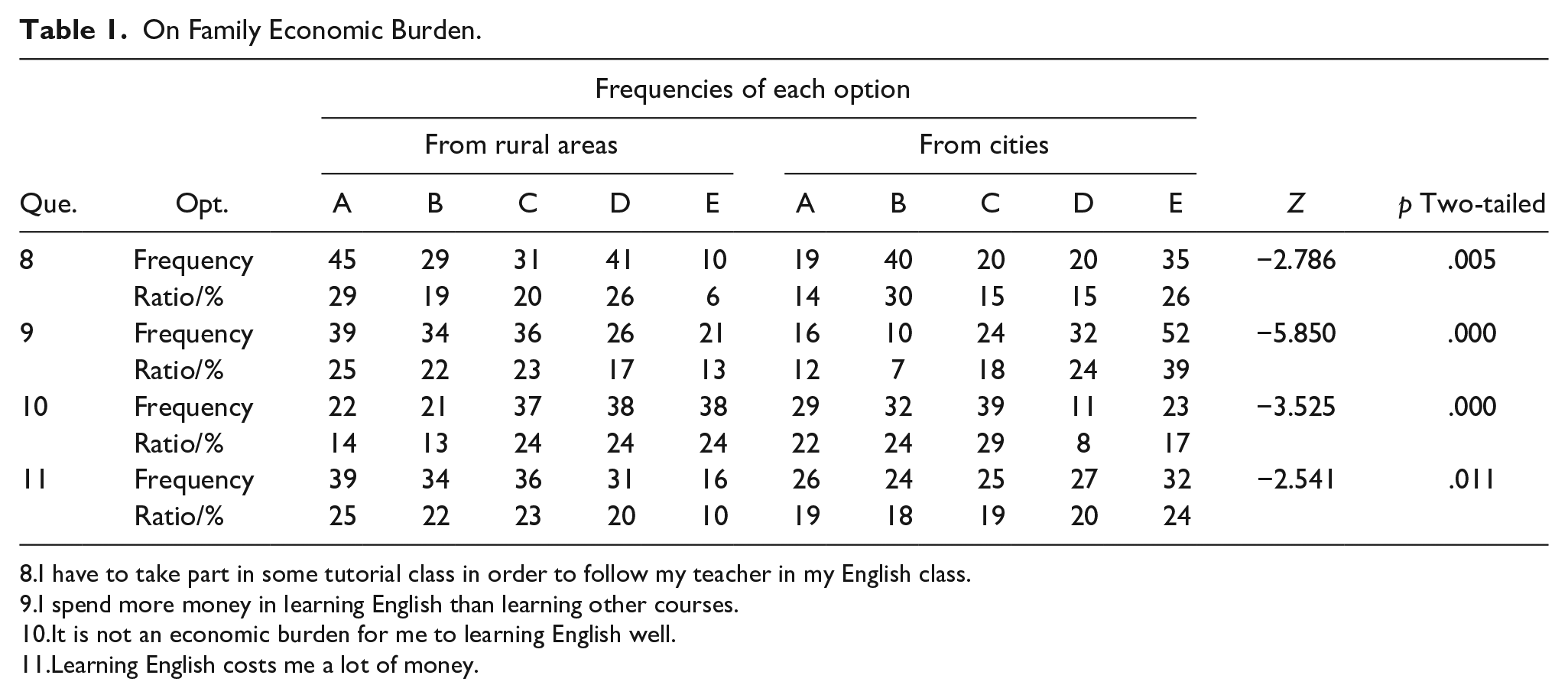
I have to take part in some tutorial class in order to follow my teacher in my English class.
I spend more money in learning English than learning other courses.
It is not an economic burden for me to learning English well.
Learning English costs me a lot of money.
Decreasing English Acquisition Confidences
Foreign language acquisition is affected by many factors. Previous study (Yao, 2013) has reported that self-confidence is a vital factor determined the performance of foreign language acquisition. If a learner cannot catch up with others s/he will lose self-confidence and learning interests gradually. Usually non-English major students learn English in big classes in China. More than 60, even 100 students learn English in one classroom guided by one English teacher. Those with better English abilities will have more opportunities to communicate with their teachers in the class; while those with worse English abilities are paid little attention by their teachers or classmates. As inadequate English learning conditions, those from rural areas are weak in terms of English listening and speaking (Zhang, 2009). When they enter into universities, they have to study English in an English immersion environment. Therefore, it is a challenging task for them to follow their teachers in English class. Few of them have the skills to communicate with their teachers in English. Previous studies (Yao, 2017; Wang, 2012) have verified that learning in an environment without encouragement or appreciation will decrease learners’ self-confidences. Thus, a one-way English immersion teaching approach will decrease their self-confidences for those from rural areas theoretically.
The survey results in this study have verified that Chinese non-English major students have similar viewpoints to the deductive results. The statistical results reveal that the numbers of students from rural areas who choose the option of “strongly agree” and “agree” in question 4 ([33% + 28%] vs. [10% + 19%]) or question 12 ([21% + 42%] vs. [20% + 20%]) are higher than those from cities; while lower in question 5 ([11% + 14%] vs. [30% + 18%]) or question 6 ([12% + 19%] vs. [25% + 34%]). The Mann-Whitney U test results show that the p values in question 4, question 5, question 6, and question 12 are .000, .001, .000, and .002, respectively. All of them are less than .05. That is to say, the English learning confidences of those from cities are significantly higher than those from rural areas. The interview results have verified the deduction, either. One female student from a rural area has told the interviewer that she is unconfident in learning English as she cannot see her progress in learning English. Table 2 reveals the different opinions to the aforementioned four questions between students from rural areas and from cities.
On Self-Confidence.
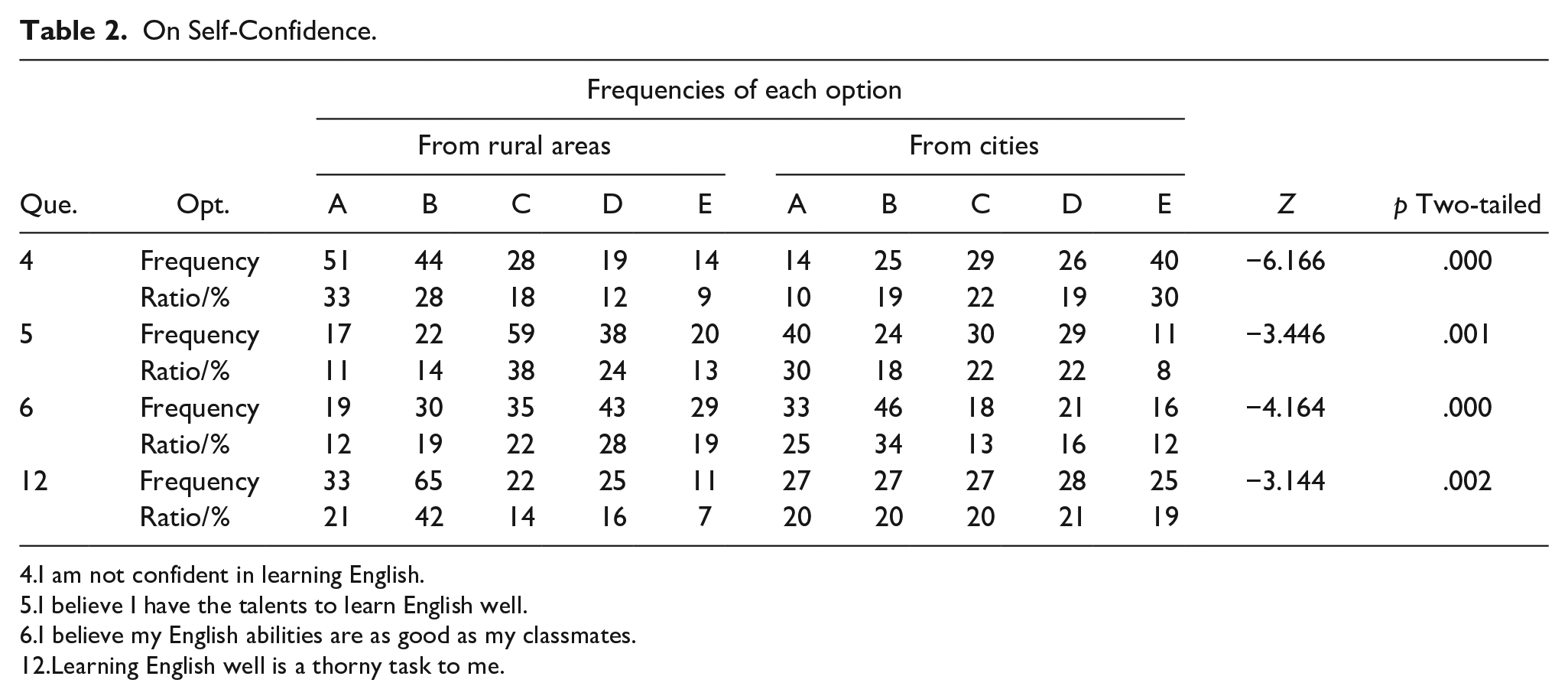
I am not confident in learning English.
I believe I have the talents to learn English well.
I believe my English abilities are as good as my classmates.
Learning English well is a thorny task to me.
Mismatching with Career Requirements
Chinese students study in universities with a variety of purposes. According to a report by Colleague and Author (2016), those from rural areas highlight the opportunities of finding a good job after university education very much. Therefore, they prefer the majors of various kinds of Engineering. On the other hand, those from cities usually choose their majors according to their academic interests. Different careers require different English skills and English levels. For example most Chinese engineers work in small and micro enterprises in China and they have little chance to communicate with others in English, especially at the beginning of their career. Thus, they are not eager to have English oral skills. However, current college English policies in China pay little attention to students’ personal requirements, which require all students to develop English listening, speaking, reading, writing and translating skills, and call for a one-way English immersion teaching approach (The Foreign Language Teaching Steering Committee of Colleges and Universities, 2016). From the aforementioned analysis we can conclude that a one-way English immersion teaching approach is inequitable to the future career requirements for those from rural areas theoretically.
The survey results in this study have verified that Chinese non-English major students have similar viewpoints to the deductive results. The statistical results reveal that the numbers of students from rural areas who choose the option of “strongly agree” and “agree” in question 7 are higher than those from cities ([30% + 22%] vs. [10% + 17%]); while lower in question 1 ([16% + 23%] vs. [25% + 31%]), question 2 ([12% + 12%] vs. [34% + 15%]), and question 3 ([8% + 28%] vs. [28% + 18%]). The Mann-Whitney U test results show that the p values in question 1, question 2, question 3, and question 7 are .001, .000, .019, and .000, respectively. All of them are less than .05, which means the aforementioned differences are significant. The interview results have verified the deducted results, either. Most students from rural areas in the interview tell the researcher that a one-way English immersion teaching approach does not match with their career. Table 3 reveals the different opinions to the aforementioned four questions between students from rural areas and from cities.
On Career Requirements.
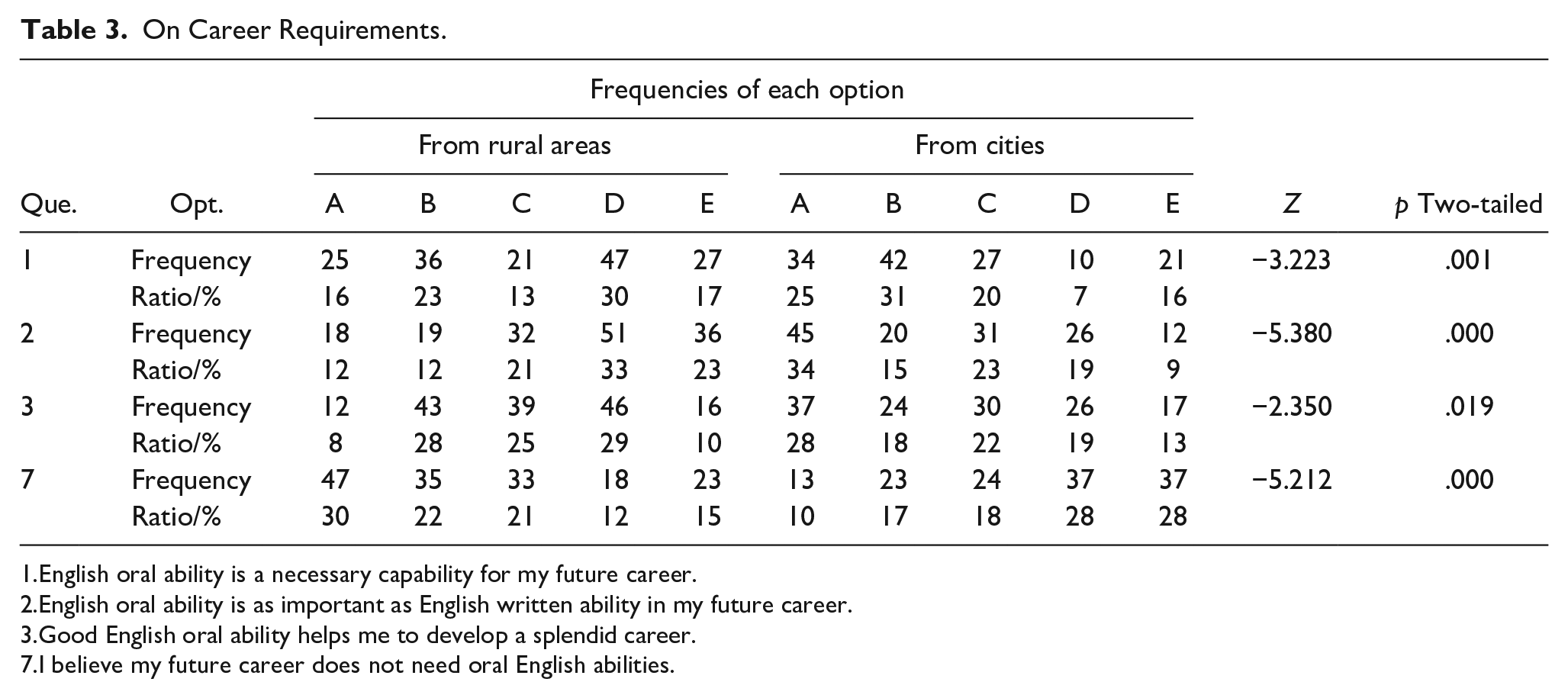
English oral ability is a necessary capability for my future career.
English oral ability is as important as English written ability in my future career.
Good English oral ability helps me to develop a splendid career.
I believe my future career does not need oral English abilities.
Discussion
The study investigates and analyzes the inequity of a one-way English immersion teaching approach to Chinese non-English major students from rural areas. It finds that a one-way English immersion teaching approach is unfriendly to those from rural areas at least in three aspects: in order to follow their teachers in English class, those from rural areas have to participate in tutorial classes after class, which cost the students and their families huge amounts of money; although those from rural areas try their best to follow their teachers in English class and catch up with others, they still do not believe that they can learn English as well as other students, which decreases their self-confidences in English acquisition; a one-way English immersion teaching approach highlights students’ English oral skills, which is mismatched with their future career requirements for those from rural areas.
Previous study (McKay, 2010) has reported the fact that the Chinese macroscopic policies support English language teaching in elite schools in primary education and secondary education, which is regarded as an inequity. Current study has found that the Chinese microscopic policies, such as teaching approach, are inequitable to those from rural areas, especially in tertiary education. The findings in current study have some close links with McKay’s findings.
As a developing country China is faced with huge amounts of sustainable development issues; the most essential one is the unbalanced development (including education development) between cities and rural areas (Yao, 2019b). The essential data in rural areas indicating the level of social development such as the Per Capita Disposable Income, the Per Capita Consumption Expenditure, and the Medical Technical Personnel in Health Care Institutions Per 1000 Persons, are merely a quarter or a third of those in cities (The National Bureau of Statistics of the People’s Republic of China, 2017). Owing to the unbalanced social development level, the education level in rural areas lags behind that in cities greatly. Chinese official data (The Population and Employment Statistics Division of National Bureau of Statistics of the People’s Republic of China, 2016) show that those over 6 years old without access to formal education in cities, towns, and rural areas are 2.29%, 4.97%, and 8.65%, respectively; while the illiterate rates are 1.99%, 4.71%, and 8.57% in cities, towns, and rural areas, respectively. The aforementioned data illustrate the differences of the prevalent rate of education among cities, towns, and rural areas clearly.
The performance of the unbalanced development between cities and rural areas in China varies in different social aspects. Supporting English language teaching in elite schools is one of the performances of the unbalanced development (Bing, 2008), as most of the elite schools are located in cities. While in rural schools there is a lack of professional English teachers. In some schools the English lessons have to be taught by non-English major teachers. Those non-English major teachers do not have enough English skills, especially English listening and speaking skills. In addition, in rural schools there is a lack of teaching facilities, especially informational technology facilities such as computers or DVDs. Owing to the bad learning conditions, students from rural schools are not good at English. They are especially weak at English listening and speaking skills. Although students in cities and rural areas access English educations differently in their primary education and secondary education, when they enter into universities they have to be educated with the same teaching approach under the authority’s guidance (The Foreign Language Teaching Steering Committee of Colleges and Universities, 2016; The Ministry of Education of the People’s Republic of China, 2017a, 2017b). Much worse, as Chinese education authorities and universities hold urban-centered viewpoints toward English education at tertiary schools, the teaching approach is unfriendly to learners from rural areas.
Regarding this social and educational development conditions, China does not have the abilities to improve the English teaching conditions in rural areas to the same level as those in cities in a short period of time. Therefore, the inequity of English education in primary education and secondary education to students from rural areas will last for a long time. In order to decrease the inequity of English acquisition to university students from rural areas, the Chinese governments can improve the English education in tertiary schools in the following aspects. Firstly, the governments and the universities are required to alter their urban-centered viewpoints toward English education. They should return the rights of choosing English teaching approach to English teachers and the teachers are required to select the suitable teaching approach based on the students’ career requirements and the English abilities. Secondly, the universities are required to train the English oral abilities of those from rural areas without any charge, in order to help them follow their teachers in their English class. Thirdly, English teachers should encourage those from rural areas to participate in the teaching activities actively and pay much attention to the students’ self-confidences.
Conclusion
The study adopts a hermeneutic research method, a questionnaire survey, and some interviews to investigate the inequity of a one-way English immersion teaching approach to those from rural areas. It finds that this teaching approach is inequitable to those from rural areas in at least three aspects, which include increasing their burdens in wealth, decreasing their English acquisition confidences, and mismatching with their career requirements. The study calls for policymakers and English teachers to enrich the English teaching approaches in the future and pay more attention to the requirements of those from rural areas.
Looking back on the study, we find several limitations. Firstly, the study selects research participants from North China University of Science and Technology. The students in North China University of Science and Technology have no special characters in learning English and their experience of learning English in a one-way immersion teaching approach can reflect the character of non-English major college students’ English learning, at least partially. However, it is better to enrich the sources of the participants. Secondly, it is better to explain the findings from multi-aspects with transdisciplinary knowledge.
Supplemental Material
sj-doc-1-eus-10.1177_00131245211027514 – Supplemental material for Is a One-Way English Immersion Teaching Approach Equitable to Those Chinese Non-English Major Students from Rural Areas?
Supplemental material, sj-doc-1-eus-10.1177_00131245211027514 for Is a One-Way English Immersion Teaching Approach Equitable to Those Chinese Non-English Major Students from Rural Areas? by Chunlin Yao in Education and Urban Society
Footnotes
Acknowledgements
We would like to thank the Education and Urban Society editors and the anonymous reviewers for their mentorship. Professor Ma and professor Zhai in North China University of Science and Technology offered the study great help.
Declaration of Conflicting Interests
The author(s) declared no potential conflicts of interest with respect to the research, authorship, and/or publication of this article.
Funding
The author(s) received no financial support for the research, authorship, and/or publication of this article.

Supplemental Material
Supplemental material for this article is available online.
Notes
Author Biography
References
Supplementary Material
Please find the following supplemental material available below.
For Open Access articles published under a Creative Commons License, all supplemental material carries the same license as the article it is associated with.
For non-Open Access articles published, all supplemental material carries a non-exclusive license, and permission requests for re-use of supplemental material or any part of supplemental material shall be sent directly to the copyright owner as specified in the copyright notice associated with the article.
