







Abstract
The factors that influence the construction of a teacher’s sense of self-efficacy are complex. The authors used a qualitative research design to explore the reflections of a sample of 25 K-12 early career teachers as they made sense of their own abilities. The results show that theorized sources of self-efficacy—mastery experiences, vicarious experiences, and verbal persuasion—all remain important but are interpreted through each participant’s unique background and conception of identity. Teacher Self-Efficacy emerged as a construct that both influenced and was influenced by this collection of individual factors. This study provides insight into how each teacher’s unique experiences interact dynamically with school environments and personal stories to shape their sense of self-efficacy. The findings can influence how new teachers are supported by coaches and teacher educators to build the confidence and motivation necessary to persist through the challenges of teaching.
Introduction
Developing a committed, skilled, and thoughtful teaching force is a pressing need for education, and teacher self-efficacy (TSE) has come to be an important construct in considering quality teachers. Self-efficacy is the perception of one’s abilities to carry out specific actions (Bandura, 1997) and it is highly relevant in the field of education where teachers are faced with endless challenges that require creativity, resilience, and motivation. This is particularly true for teachers who work with historically underserved students and within structures that are stressful, under-resourced, ever-changing, and compounded by cultural differences. In such settings, teachers must constantly confront internal questions about what they are capable of accomplishing and whether they believe they can make an impact within their school environment (Ball, 2009; Freire, 2014).
These are questions of human agency, of beliefs in one’s ability to be more than a product of surrounding conditions but an active contributor to the world. Early studies found that self-efficacy is related to motivation, positive outlook, and persistence in the face of challenges (Bandura, 1997). In education, strong relationships have been found between teacher perceptions of their self-efficacy and indicators like student academic achievement, better discipline, lower burnout, and the use of more innovative teaching strategies (Aloe et al., 2014; Caprara et al., 2006; Tschannen-Moran et al., 1998; Zee & Koomen, 2016). These studies have offered insight into how teachers’ self-reported perceptions of self-efficacy relate to a range of indicators, but we are still learning about how such perceptions grow and change.
Bandura (2001) theorized that perceptions of self-efficacy are at the heart of the dynamic interplay of behavioral, environmental, and personal factors. The present study used a qualitative methodology to gain deeper insight into the role of self-efficacy in the interrelationship of these factors. Through this interpretive process we saw early-career teachers’ growing identities, unique backgrounds, and school environments reciprocally interacting with a sense of self-efficacy to build perceptions of what was possible.
TSE has been defined as the beliefs teachers hold about their ability to influence students and includes domains such as learning, motivation, and building trusting relationships (Klassen et al., 2011; Siwatu, 2007; Tschannen-Moran et al., 1998). Numerous studies have shown it to be a potentially powerful factor in the success of teachers. Self-efficacy in teachers has been shown to have a relationship to higher student achievement (Caprara et al., 2006; Tschannen-Moran & Hoy, 2001; Tschannen-Moran et al., 1998). Teachers with higher perceived self-efficacy have greater commitment to the teacher profession (Chesnut & Burley, 2015; Klassen & Chiu, 2011), higher job satisfaction and engagement (Caprara et al., 2006; Skaalvik & Skaalvik, 2014), and a lower chance of experiencing burnout (Aloe et al., 2014; Skaalvik & Skaalvik, 2007). They have also been shown to demonstrate higher instructional quality in the classroom (Holzberger et al., 2013; Klassen & Tze, 2014). Zee and Koomen (2016), in their review of some 165 studies on teacher self-efficacy, summarize the instructional strengths of teachers with high senses of self-efficacy by writing that they “tend to effectively cope with a range of problem behaviors; use proactive, student-centered classroom behavior strategies and practices; and establish less conflictual relationships with students,” (p. 998).
While TSE seems to be important, the processes through which it develops are still not well understood (Klassen et al., 2011). Bandura (1997) theorized self-efficacy could develop through four main sources: mastery experiences, vicarious experiences, verbal persuasion, and the experience of physiological and emotional symptoms. Of these, mastery experiences—experiences of success in actual (or simulated) teaching—have the largest impact on the development of self-efficacy (Pfitzner-Eden, 2016; Wang et al., 2017). In practice, professional development has also been shown to have a positive effect on TSE (Puchner & Taylor, 2006; Bruce & Ross, 2008; Tschannen-Moran & McMaster, 2009), as has experiences of verbal persuasion through teacher collaboration (Goddard & Kim, 2018). Siciliano (2016) shared an example of the importance of verbal persuasion by using a social network analysis to argue that relationships with trusted colleagues can influence TSE. Additionally, factors such as personality type and school environment have been related to the development of teacher self-efficacy (Björk et al., 2019).
Many studies of TSE have been quantitative and relied on a variety of survey instruments (Klassen et al., 2011). Researchers have questioned the validity of results from studies based on TSE surveys. Self-efficacy is a highly situational and dynamic construct (Bandura, 1997; Schunk & DiBenedetto, 2016), and studies of TSE have revealed how perceptions can change across circumstances and time (Holzberger et al., 2013; Hoy & Spero, 2005). This variability, however, is sometimes masked when researchers represent dynamic perceptions by labeling teachers with discrete labels as “high” and “low” self-efficacy (Wheatley, 2005). Other issues with survey data include the accuracy of self-reported survey data, confusions arising from subtle changes in the phrasing of survey items, the different scales used, and an inability to lend insight into the underlying cognitive processes whereby experiences and knowledge are interpreted as beliefs (Kim & Seo, 2018; Skaalvik & Skaalvik, 2007; Wyatt, 2014).
For these reasons, qualitative investigations have been suggested as a necessary addition (Klassen et al., 2011; Tschannen-Moran et al., 1998; Wheatley, 2005; Wyatt, 2014). Qualitative investigations both provide insight into Bandura’s original four sources of self-efficacy, and also allow researchers to go beyond the original theory. For example, Siwatu and his colleagues have conducted a series of mixed methods studies that have researched TSE beliefs around culturally responsive teaching practices (Siwatu, 2011; Siwatu et al., 2016). They found that for new teachers working across lines of difference, general teacher beliefs are often disconnected from confidence in particular actions necessary to connect with students. Furthermore, their participants discussed how unsuccessful mastery experiences that included working directly with students of different cultural backgrounds could deepen their doubts and lower their self-efficacy around culturally responsive practices. In another study, Wang et al. (2017) found evidence in their interviews of teachers that TSE was shaped by a wider range of sources than Bandura’s original four, including knowledge of students, rapport with students, and previous working experience. These studies suggest that perceptions of TSE are complex and point to the value of exploring how teachers make sense of their experiences in developing a perceptions of self-efficacy.
When considering opportunities to persevere in the face of challenges, to sharpen instructional skills, or adopt a culturally responsive stance, we need to know more about how experiences are interpreted by teachers and refracted through their unique contexts, personal histories and evolving identities. This is important because, as teacher educators, we must better understand the construct of TSE if we are to support new teachers in fostering their sense of self-efficacy. This project uses in-depth interviews with a group of teachers to explore these questions further. Our research questions are:
What factors influence the development of self-efficacy in teachers?
What relationships emerge in how these factors influence the development of TSE?
Method
Framework for Conducting Observations and Data Analysis
Our qualitative research design is framed by a belief that understandings of TSE can be enriched through qualitative and interpretive explorations of teacher perspectives (Klassen et al., 2011; Tschannen-Moran et al., 1998; Wheatley, 2005; Wyatt, 2014). As such, our analysis focuses particular attention to the conditions under which certain ideas or intentions emerge or are suppressed by teachers, to the unique stories that they share, and to the experiences that have particular meaning. Beyond a direct recounting of experiences, self-efficacy beliefs are cognitively constructed and culturally mediated, both products and influencers of identity and perception (Bandura, 1997; Schunk & DiBenedetto, 2016). The words of our participants can provide rich insight into their perception of the many factors that combine to shape a person’s belief in their ability to influence students; describing and interpreting these words and phrases can surface both the concrete facts and underlying feelings present in the language used by teachers (Wang et al., 2017).
This stance is informed by grounded theory and narrative analysis. Grounded theory is a set of methodological and analytical practices that allow theories to be constructed from the data (Chun Tie et al., 2019); it is designed to prevent biases from shaping conclusions and foreground the subjective perceptions of participants (Charmaz, 2006). Data analysis is a continuous process that allows themes and ideas to emerge from participants’ words rather than be based in preconceived categories. Narrative analysis opens data to multiple interpretations and conceptions of realities. The researcher develops a “double vision,” both empathizing with the narrator and taking a position of judgment. This can help organize interpretations of actions and move beyond a simple recounting to understand how raw experience is transformed into meaning (Riessman, 2008).
The purpose of the present study is to construct a well-rounded picture of our participants’ interpretations of their teaching experiences through their interests, concerns, and biases, as well as their priorities and underlying reasons for becoming teachers. Making sense of the various experiences in teaching is an interpretive process involving an individual’s unique mix of culture, identity, and personal history. Participant interviews can provide rich insight into the many factors that combine to influence this process and shape a person’s self-efficacy beliefs.
Participants
Data for this study was collected at a graduate school in a large city in the northeast. All graduate students (N = 25) work full time across grade levels in both district and charter schools (see Table 1). Many are lead teachers (n = 16) with full teaching loads and responsibilities, while others are “teacher residents” who teach part-time under the supervision of a mentor teacher and support instruction throughout the day. In the evening they attend weekly graduate classes and complete coursework as part of an alternate certification program.
Participant Demographics (N = 23).
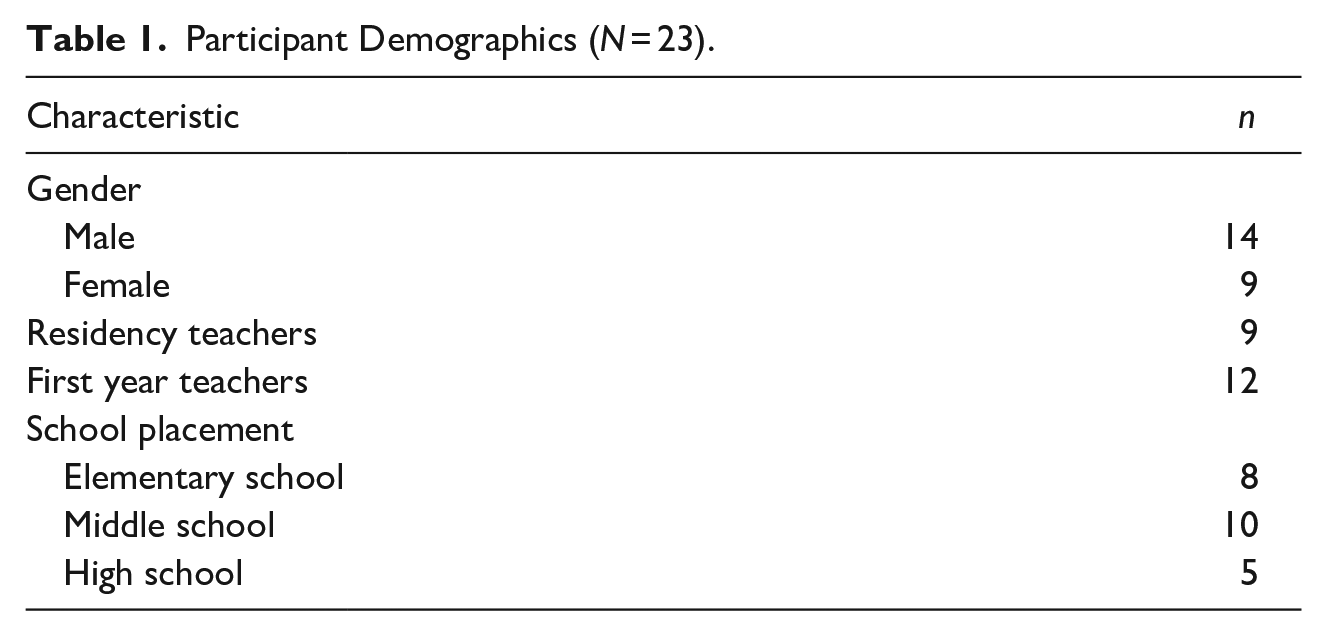
Study participants were selected from a range of first year graduate students. Participants were recruited through a direct appeal in their graduate classes. They were given a brief presentation on the concept of self-efficacy and the design of the study and then were asked to fill out an optional interest form. Participation was completely optional, and participants received no compensation in exchange for their participation.
Data Collection Procedure
Interviews
Participants were interviewed during the fall using a semi-structured interview protocol. Interviews typically lasted 30 to 60 minutes and were recorded and transcribed. Transcripts were checked against the recordings for accuracy. Prior to coding, we removed identifying information from all transcripts.
We developed interview questions across three broad categories: (1) personal and teaching background; (2) beliefs about self-efficacy and related topics; and (3) beliefs about schooling. Interview questions included the items below:
How would you describe your background?
Describe your school and classroom.
What do you find most promising and most challenging about your work with students?
How much control do you feel you have in addressing those challenges?
What have you learned/experienced at your school site that has influenced your beliefs about your teaching abilities?
Data Analysis
As part of the data collection process, we created brief reflective memos (Marshall & Grossman, 2014) of a selection of interviews to capture initial impressions; these helped identify potential themes and surfaced interviewer biases. Interview transcripts were then coded to highlight different themes present in the words of our participants. Coding is the process of “generating names and labels for phenomena identified in the data,” (Marshall & Grossman, 2014, p. 222). To develop our codes, our research team first started with “deductive codes” based in theories of self-efficacy as well as our initial impressions of the interviews. For example, codes like “Mastery Experiences” or “Vicarious Experiences” come directly from Bandura’s writing on self-efficacy, whereas codes such as “Personal Accomplishments” and “Productive Struggle” emerged through repeated readings of interview transcripts. One challenge in creating our final codebook was narrowing our initial themes into a final list of codes (Elliott, 2018); this included distinguishing between more general codes (like “Teacher Mindset”) from specific codes (“Responses to Feedback”). Another challenge was recognizing how a single sentence or phrase could be legitimately aligned with multiple codes.
After creating our codebook, our research team engaged in a norming process. Transcripts were independently coded, then our team discussed discrepancies to build our common understanding. Once we were confident that our team coded in a reasonably similar manner, we created a system to ensure our process was conducted with reliability. To reduce bias, each transcript was independently coded by two different researchers, and a third researcher then resolved any discrepancies.
Statements around self-efficacy were then analyzed for evidence of developing self-efficacy. This step allowed us to see how perceptions of self-efficacy varied as participants spoke about different topics, and we could then place these statements alongside other codes to help identify themes in our data.
To briefly illustrate our process, here is a quote from one of our participants, Mai, a high school math teacher: Every day I went to school and I tried different things to get to know them, and nothing ever worked. Like, one on one instruction, I came to their basketball game, I sit with them during lunch. There’s a game room at school and I always go over there and I played Uno with them. But once it came to class, they’re like, “Miss, get away from me!”
This quote was initially coded as a statement of her self-efficacy because Mai was expressing frustration that “nothing ever worked” even as she tried different strategies to connect with a group of students in her class. We later went back and further coded this as related to self-efficacy around relationship building. This statement could also be an example of a “mastery experience,” and could be further classified as a statement of low self-efficacy. Underlining the variable nature of self-efficacy, elsewhere Mai made statements that were considered examples of high TSE in relationship building and in other domains such as content-knowledge or developing curriculum.
Results
Our analysis of interviews with teachers showed self-efficacy to be both highly fluid and variable. Although we never explicitly asked about self-efficacy, the concept was everywhere in the words of participants. Our research team coded over 800 instances of self-efficacy surfacing in a variety of dimensions of the work of teachers and ranging in the degree of development.
The qualitative data from interviews revealed a more robust picture of the factors that influence the development of teacher self-efficacy. In some areas, like inclusive education, teachers had little to say; in others, like classroom management or relationships with students, teachers had many reflections. Over the course of an interview some participants expressed a more developed sense of self-efficacy in some domains but not others, mixing hope with stark statements about their limitations. Participants also expressed a range of ideas about self-efficacy within the same domain moving along a continuum of developing self-efficacy. Yvette, for example, repeatedly reflected on her ability to foster student confidence, saying at one point: “I think that having the ability to have kids believe in themselves, I would say, [is] one of my biggest impacts.” Yet toward the end of her interview she definitively stated “[My] biggest challenge? Motivating students. Because I feel that no matter how much good of a relationship you have with a kid it’s their own personal beliefs and whatever it is that they’re going through that can impede them from feeling motivated.” This sort of variability in perceived self-efficacy arose repeatedly in our interviews and shifted as participants responded to interview questions.
Within this variability, we identified four themes connected to the development of teacher self-efficacy. First, descriptions of relationships with students played a prominent role in how teachers perceived their ability to teach effectively. Similarly, self-assessments of participant TSE were related to how they discussed their school environment. A third theme considered how teachers’ reasons for entering the profession were related to their beliefs about their self-efficacy. Lastly, participant reflections about their identity were an important backdrop against which perceptions of TSE were created and developed.
Perceptions of Self-Efficacy: Relationships
As we coded our transcripts for perceptions of self-efficacy, the most frequent theme concerned the relationships teachers developed with students. Whether we asked about what they were most proud of in their teaching, what factors they felt the most influence over, or where they had doubts, teachers returned to the subject of relationships with students. Teachers spoke of the strong connections they built with students and the confidence it gave them to carry out the work of teaching. However, sometimes thinking about relationships appeared as a barrier to action.
“Building that rapport really helps me out when I actually have to teach part of the lesson,” said Latisha, an English teacher resident at a high school. Latisha was talking about her first forays into teaching, and found that relationships opened the door to instruction: “[Students are] kind of like, ‘Oh, this teacher really cares, and she wants me to do well. And so, I’m gonna, like, stop playing footsie with my friend.’” Speaking about relationships was a way to find evidence of their success even when there might be challenges elsewhere. For Michael, a fourth grade teacher resident, the ability to connect with students was a bright spot in his teaching: One of the strengths that I’d say is just, rapport, at this point. I have a good relationship with a lot of my kids. And I have a good relationship with a lot of my kids who seem to be a little bit more off task or out of focus. I wish. . .it would be nice if I could use some of that relationship to help to put more productive work on paper instead of just not disturbing everyone else around them. . . . the ultimate step would also be getting themselves to get back to learning.
In Michael’s case, his relationship with students was clearly a source of pride. He still saw challenges in getting more productive work from his students, but Michael also saw possibilities in continuing to connect with his students. Casey, another resident teacher in her first year, shared how prominently relationships with students figured in her thinking about teaching.
Before I started teaching, I wasn’t confident that I could make relationships with the kids. And now I think I’m way more confident [. . .] I would say when I was younger, I was really bad at it. I didn’t understand the nuances of how to get people to like you, or if they didn’t like you, I would feel so defeated and inside myself. I was not confident at all. And I don’t know what switched. I’ve seen other senior teachers where they just have this power of, like, they know what that student needs. I’m not there yet, but, man, that’s like a super power.
Strong relationships with students fostered confidence in other areas; these examples show a clear connection between how teachers view their ability to connect with students and their belief in what they are capable of achieving in the classroom. For Casey, as her thinking about relationships had changed, so too did her belief in herself.
Identifying moments of strong relationships didn’t always lead to action. In fact, when teachers were aware of an absence of a relationship, it could be the reason to discontinue effort. Mai was a first year teacher at a transfer high school and she recounted an interaction with a student that led her to pull back: So one time, [this student] was refusing to do her work. She was about to leave a room and just sit in the restroom the rest of the period. That happens a lot at the school and I was trying to help her out. And then she be like “Lady! Get the F away from me!” [. . .] and that happens all the time. It just took me time to realize that that’s just how they are. And I don’t want to chase her to the bathroom. So I just [. . .] I just kind of ignore her.
This frustrating experience with a student resulted in apathy and distancing. “I don’t know what to do,” she continued, and her solution was to ignore students who wouldn’t listen to her. Reflecting the highly situational and variable nature of self-efficacy, for Mai this one impactful experience served as a signal to decrease her effort when interacting with this student. Whereas some of our teachers discussed student relationships as a pathway to trying out new things and increasing effort, in this case the situation was reversed.
Nor are perceptions of relationships always accurate; a few examples of strong relationships might serve as cover for other more underlying concerns. Josefina demonstrated this dynamic when she recounted one strong relationship with a student: I also was able to build relationships with most of [the students]. I remember one student, Ruth. We were in the classroom, and she’s crying. And I’m wondering, what was the problem. She said there’s a trip coming u, and she doesn’t have a shirt. So, I found her a shirt, and she was just so ecstatic about that. It turned out that her father was a pastor in the church. I think she mentioned it to her parents, and then the pastor invited me to the church and I started going to that church. So it was an extended relationship.
Like Mai, one interaction had made a big impression on Josefina. After immigrating to the United States from St. Lucia as a teenager with her mother, she had spent several years as an instructor at a local college. Now as a first year high school teacher, she was experiencing overwhelming struggles adjusting to the demands of public education. “It’s difficult. It’s challenging. And there’s more than just talking—there is disrespect,” she said. Her time with Ruth was evidence for her that she was having success as a teacher. For Josefina, this evidence belied deeper struggles in her new job. Even as she said “I was able to build relationships with most of [the students],” she hints that her classroom culture was not strong and she didn’t discuss other examples of strong relationships. Ultimately, Josefina quit teaching within 2 months of this interview.
School Environment
A second theme concerned the importance of school environments on teacher statements of self-efficacy. The way teachers perceived their own abilities was related to reflections on the level of support felt from administrators and colleagues. Teachers who described strong school cultures also shared a personal investment in the school vision and a belief in their ability to contribute. When participants found their environments unsupportive or challenging, teachers’ perceptions of their abilities were calibrated by relationships with colleagues in ways that were reassuring at times and frustrating at others.
Fifteen teachers had positive descriptions of their school environment, and we found these to frequently exist alongside beliefs in one’s ability to contribute to the school culture. “We do a really good job just, like, listening to each other and we have a really good adult culture,” is how Yvette, a third year math teacher, spoke of her school in a typical example of a positive description. Jill, also a third year teacher who had just arrived in a new school, described her school as a “merging of mindsets.” She was new to teaching kindergarten, and her principal’s support fostered her effort. “[My principal] always tells us we need to find our ‘kindergarten jeans’ and find what works for us and make it work in our way.” This type of encouragement translated into concrete actions in Jill’s classroom Next year, all of our kids could be in each other’s classrooms and we need to have some shared vision of success. I came from a school last year that was much more progressive and so I had a hard time adjusting to the school expectations. And so that came with working with my principal a lot on giving the why behind certain expectations that we hold and that’s helped me buy into that vision.
Victoria also described a very supportive school environment, a place with “compassionate” discipline, strong parent outreach, and an emphasis on trying to understand student perspectives. “Everyone is invested,” is how Victoria described her school, “You can feel the investment from the adults, and it seems like a well-oiled machine.” Victoria was a first year teacher and this support was important to her feeling confident in her teaching. In this environment, she shared several examples of how she viewed her potential as a teacher. Concerned about her relationship building, she was trying a new student survey to strengthen her class culture: I felt like they got to see that I am a human and want to get to know them. Just making an effort to narrate all of these human things that I’m doing. If I’m being vulnerable around them, the idea is that they will come around.
She didn’t know yet if her efforts were successful, but getting to know her students was something of a risk—it required her to be vulnerable—and she was willing to try in the belief that her efforts would pay off. Both Jill and Victoria’s statements about the effort they put forth—giving the “why” behind expectations and working on relationship building—were fostered within supportive school environments.
Eight teachers described environments that were unsupportive or challenging. In these cases relationships with colleagues surfaced as a reference point for perceptions of self-efficacy. Vincent, shared one example: I feel as if I may have cultivated some kind of reputation of being inconsistent, of being inadequate, of being on, you know, just not the best one to be paired up with. You know, kind of like the broken crayon in the box.
This was Vincent’s first year as a lead teacher in second grade. He was describing his time as an assistant teacher, and though the experience was difficult, it shaped how he approached his current work. “I ended up becoming jaded,” he said, “and I feel this year, I’m not gonna really go for that. I’m going to just try to do my job the best way I possibly can.” Though Vincent’s interview is filled with passion for education, his statements show a wavering sense of self-efficacy. He doesn’t speak of specific actions where he is making an effort and instead shares that he feels as if he were “just being thrown off the boat and being told to swim.” The experience had left him feeling like a “broken crayon.”
In other cases, conversations with colleagues could be reassuring when other factors in the school failed to offer support. Adam, a first year high school chemistry teacher, illustrated this thought process when reflecting on his classroom management challenges: So I’ve never felt like, “Oh man, I’m going to quit.” But, there were times when I wondered if I was actually doing a good job. And that was because I thought that the problems I was experiencing in my classroom were, you know, unique. When I started talking to other teachers, I started to realize, you know, you’re not only . . .not only are you not alone right now, but every single person who does this for the first time. . .it’s rare that they do not go through what you’re going through. And that was very reassuring for me.
Adam was initially concerned about student behavior in his classroom, feeling isolated and alone. Hearing from a colleague that such issues were common was reassuring. Indeed, Adam’s re-telling suggests a powerful role for conversations that are sometimes interpreted as gossip: I go to teachers and I’m like, “Okay, how is Mauricio in your class? Because, he’s fucking crazy.” [. . .] If I hadn’t had those conversations, I would just think this child is wild in chemistry, you know, but then I go and I talked, and I’m like, “Oh, he’s wild everywhere.”
Considering the performance of colleagues is not always reassuring, though. Kaytee, a first year high school social studies teacher at a charter school, found herself reflexively comparing her performance to other, more experienced colleagues.
I still forget all that [about her colleagues extra experience] when the test scores come back and I’m like, “Oh my god, he’s scoring 10% higher than I am on everything. Why is that? Why are my kids not doing that?” Because I feel like I should be, and maybe that’s kind of, like, arrogant, [. . .] And I know my coworker, but. . . shouldn’t I be doing better?
Kaytee compares her student assessment data to that of her colleague and feels her performance should at least be equal given her background studying history. When she falls short, doubt creeps in. Whether affirming or not, colleagues served as an important reference point against which teachers were constantly measuring their own abilities.
Taken together, these examples demonstrate that teachers’ school environments, including the people with whom they work, could be a support for teachers’ developing self-efficacy or lead to further questioning of their own abilities within those environments.
Reasons for Entering the Profession
The way teachers spoke of their reasons for entering the profession was related to statements of self-efficacy. Some participants spoke of a life-long desire to become a teacher, while others came later to their decisions but showed a clear purpose for engaging with their work. These different ways of talking about why they became a teacher were often accompanied by statements about what they believed they were capable of accomplishing. We found strong beliefs in personal self-efficacy to be associated with a clarity of purpose for their work as teachers.
Fifteen of our teachers shared that teaching was always part of their vision for themselves. For example, Kaytee shared, “I knew I wanted to be a teacher, but I didn’t really know what for.” Vincent also discussed becoming a teacher as part of his identity since childhood: “As a child, I always saw myself being in front of the classroom.” From his first job in high school teaching after school to his current teaching position, Vincent shared, “the only job I’ve ever had was some kind of a job with children. . .it’s the only resume that I’ve actually built and I’m used to it.” These examples included experiences like babysitting siblings, being told by family that they were good with kids, or working at a camp. Often, these explanations lack an intentionality or a clear grounding in purpose. “Being a teacher was never the goal,” as Vincent said. “it was just always something that was, like, in my head.”
When asked to describe how his year was going, Vincent responded “I feel like I’m developing. . .sometimes, you know, I feel like it sticks and other times, not so much.” Even with years of teaching-related experiences, Vincent seemed to question the impact of his teaching: “I think no matter how much I’m preparing, there’s something that’s not clicking. I’m trying to figure out what it is.” Similarly, Kaytee shared her uncertainty about her progress, “I know that I’m doing what I should be doing, even though it’s kind of, you know, taking me a little off my guard in 5th grade.”
Casey was different in that she did not always know that she wanted to be a teacher, but she was encouraged by one of her college professors: “And so I started thinking, and I got a job at the Writing Center and I started helping the people that were struggling in English. I liked it a lot.” As mentioned above, Casey was finding her way as a first year teacher and as she thought about her career choice she showed an optimism and an acceptance that she had room for growth: Hopefully, people are in the field for the right reasons. Or maybe they are just taking a risk, like maybe I’ll try teaching for a year and see if it works out. [. . .]. I know that this is what I need to be. Like, education is important, even if these kids don’t care what I’m saying, even if I don’t get through to one student like at least I tried.
Vincent and Kaytee always considered being a teacher; Casey was encouraged later in life. Yet these teachers shared explanations that lacked an intentionality and clear grounding in purpose. Vincent shared beliefs that he is still growing in the field yet he appeared to be unsure of how to do so. Kaytee both feels like teaching is “what she should be doing” and feels “off my guard,” a dual sense of wanting to be a teacher and also struggling with that role. Casey felt being a teacher was “what I need to be.” Most teachers in this group knew early on they wanted to be teachers, but their reasons lacked a clarity about what they hoped to accomplish. Like Kaytee, they were “trying to figure out what it is,” trying to understand what they were capable of doing as teachers.
Another set of teachers entered the field after dissatisfaction with a different field. Darren explained, “After I worked in industry, I realized that it wasn’t really for me. I wanted something I could really sink my teeth into. . . like, when I’m on my deathbed, and I think about my contribution to the world.” Similarly, Ezra, who had previously worked in consulting where he felt like a “cog in this huge firm’s machine,” spoke of wanting to have a positive impact on the world. “It seemed like the most likely way of doing that, the most immediate way would be to be a teacher.” These statements show decisions to become a teacher as a search for deeper meaning in their lives.
Teachers in this group questioned their ability to teach; but they also affirmed their potential as challenges arose. Sean, previously an internet entrepreneur, discussed his struggles with lesson planning: “It’s one of those things where you never have enough time,” he said. “Sometimes lessons do really well and I’m like ‘Yes! this worked.’ And sometimes they don’t do so well.” When asked to elaborate, he drew direct connections from his own learning to provide tangible examples: I’m learning a lot about discourse, really liking discourse. . .There was one lesson where they thought about a problem that teens face in America and I gave them a sharpie to start drawing on paper and that really engaged them. When they get to interact with each other and share their ideas, it was a really good and engaging class. . .it is powerful when they figure it out themselves.
A third set of teachers had both come to teaching as a first choice and spoke with great purpose. Yvette had a variety of experiences related to education that brought her to the field and solidified for her a clear purpose. “I felt like there was like no other path, like, it felt like the universe,” she said. Yvette had experienced challenges at a previous school: “When I wanted to quit, I didn’t quit because of the impact I would have had on the kids.” She describes a cornerstone of her job as including and empowering kids: “I think it’s all about how do I make them feel when they were there. I don’t want to be in the classroom and never feel like the teacher never really listened to what I have to say.” Yvette emigrated from the Dominican Republic in grade school and the power of education in her experience has stayed with her as she became a teacher.
Like the group who had changed careers, these participants’ sense of self-efficacy was connected to their purpose and became more defined as they learned from their experiences. Their motivations often included an element that reached beyond the classroom. Ashanti’s career path brought her to teaching to inspire students toward “owning their progress themselves, so teaching them that despite the circumstance and distractions. . ., there’s still a job to do and you can do this work.” Her own experiences growing up and later at a local non-profit organization had shaped her desire to inspire students to succeed in their lives. When asked why she entered teaching, Ashanti responded, “Equitable education for all. That’s what I can say I strive to apply more and more everyday through my approach and teaching.” She went on to share her beliefs in her ability to do so: I don’t actually see an area that I couldn’t support my students. . .I think it probably comes from my advocacy background. Like we did almost everything. We were basically social workers. So when I look at this role, I’m just like, it’s the same thing but I’m teaching a subject. I don’t question whether there has been anything that I feel like I cannot support a student with.
Participants who sought out the teaching profession “to make the biggest impact in this world” spoke more tangibly about their teaching experiences and their abilities to impact positive change in their students’ lives. Without this purpose so clearly articulated, participants who entered the profession with more general and vague ideas of teaching showed an uncertainty about their work. Perhaps that would change with time and experience, but in the current moment their sense of self efficacy remained developing. When combined with reflections on experiences of success, teachers demonstrated feelings of agency to act not only in the classroom but to impact larger efforts for equality and social justice.
Identity and Conceptions of Self-Efficacy
It is difficult to discuss relationships with students, school environments, or reasons for entering the profession, without discussing participant identity. Themes of identity consistently emerged in our data and showed a complex relationship with TSE. As part of our interviews, we didn’t explicitly ask our participants about their identity or how they viewed themselves. Instead, we asked about their teaching background and how they became a teacher. Yet, in reading the interview transcripts we noticed frequent statements that gave clues about how participants viewed themselves as people. For example, Darren said “I love learning. And I’m curious.” Mai claimed that “I always thought of myself as self-sufficient.” Ashanti shared that “. . .my hair will always change every time you speak to me, probably because that’s just me.” Vincent proclaimed “I’m an artist, first and foremost [. . .] I’m just a naturally introspective person in general. I’m constantly trying to find ways where I can elevate myself.” These statements show participants naming the characteristics of who they believe themselves to be and what they value in themselves. Such perceptions of self interacted with participants’ own personal histories to influence how they viewed their abilities in teaching.
One example comes from Carsin. When discussing her background, she said “You’ve heard like DACA and stuff? Yeah, so I’m like one of those people.” The experience of attending public school, and then public university, being rejected for federal student aid, and being denied access to voting, had all shaped how she related to institutions: “I’m trying hard to, like, grapple with it and not be ashamed of it. Yeah, so it’s hard not to be even though it wasn’t my fault, in a way, I still feel very ashamed.” Yet, she had also managed to graduate from college, earn strong grades, and establish herself as a competent and confident teacher. Now in her sixth year of teaching, she spoke of establishing a well-ordered and focused classroom, and she expected her students to put forth effort. When asked about her challenges, she identified connecting with parents as an area of struggle: I wish I got along more with parents, I think, [. . .] This is going to sound really bad, but you’re supposed to care about the parents but I don’t really care that much. Like, my mom didn’t ever really come to school. She only came for report cards and she didn’t really communicate with [my teachers] and I still like. . . did what I had to do and a part of me feels like the parents should motivate their kids to do what they have to do.
Carsin wishes she had better relationships with her students’ families; yet, her own experiences as a student crop up when she notes that “my mom didn’t ever really come to school.” She continued: “Part of me is, like, I have a bunch of kids that don’t know their times tables. I called their parents 2 weeks ago. And then I texted their parents and none of them learned their times tables. So then it’s like, where does it. . .you know? I don’t know.” Her personal history with schooling shaped how she views the role of the teacher and has come to influence her sense of self-efficacy. She wants to both place the responsibility for motivation on her students’ parents, at the same time she is aware that this isn’t an accepted line of thinking.
Another example comes from Stephanie, a first year teacher working in a small middle school that was in its second year of existence. “Culturally, I’m Hispanic,” is how Stephanie described herself, and she saw this as very important for her work with her students. “Most of [my students] are Dominican, I’m Mexican. but at the same time, I can speak their language, so, and also I kind of look almost like them, too.” While Stephanie is perhaps generalizing about her students and their backgrounds, her perception of both her own identity and that of her students serves as a foundation for her belief in her ability to build connections: [My students are] used to having teachers, like, I don’t know in their past experiences for those who’ve been there longer, they’ve maybe went through elementary school here, you know, your teacher’s commuting from [the suburbs], I’m commuting from the [same neighborhood], I see you on the bus, you know. So, I guess, also, living in the same city, growing up in the same city, and, like, knowing some of the community around where they live sort of helps as well.
Her background and identity as both Hispanic and a Spanish speaker are important to help build confidence in forging a connection with her students. Mary, a middle school teacher at an all-girls school, shared a similar sentiment. “Once they find out I’m Puerto Rican, [my students] find somebody to click with and because a lot of them are South Asian, they have felt this need for more than just white teachers or teachers that aren’t necessarily their identity.”
Identities underwent transformations, too, as teachers considered their self-efficacy. This mutually evolving relationship between identity and self-efficacy stood out in Darren’s reflections. Earlier, he described himself as a “friendly dude,” but this self-perception ran up against challenges in the classroom: . . .something I struggle with is, how do I build relationships with these kids? [. . .] Sometimes the kids get to me a little bit. Sometimes the stuff they say is genuinely, like, a little bit hurtful [. . .] My main tactic was, if I don’t like somebody, I’m not going to give you the time of day. And now I’m reminded that when you work in a school, you have to show up and see these people and interact, day in and day out.
Darren was re-evaluating how he saw himself in his approaches to students. He is directly comparing his past experiences (from childhood and adolescence) to direct experiences working in school, and the comparison is leading him to reconsider the tactics he has used to cope with such experiences in the past. These examples show how teacher perceptions of their background can play a major role in building teacher self-efficacy.
Discussion
The present study builds on the literature about the importance of teacher experiences in the development of self-efficacy, and adds to the literature by providing insight into how personal factors like identity and intentions complexly interact to shape TSE and influence human agency. Bandura (2001) theorized that the drive to action is borne of personal, behavioral, and environmental factors, all reciprocally influencing one another to form beliefs about one’s self-efficacy. Our present study lends insight into how the interplay of these factors shape the self-efficacy beliefs of teachers that can turn intentions and ideas into specific actions.
Aligned with prior research (e.g., Pfitzner-Eden, 2016; Thomas & Mucherah, 2016; Wang et al., 2017), we found mastery experiences to play a prominent role in teacher reflections on self-efficacy. For example, instances of building strong relationships with students, a type of mastery experience, held great significance for our teachers. This is demonstrated when Josefina shared her interactions with Ruth or when Latisha spoke of the connections she was forging with her students. Negative mastery experiences also stood out as a mechanism for creating or confirming doubts in one’s self-efficacy (Siwatu et al., 2016). For example, Carsin’s unsuccessful attempts to connect with parents or Mai’s failure to motivate a reluctant student show how certain experiences can become mental anchors about one’s perceived ability.
Our study also provided examples of the importance of vicarious experiences and verbal persuasion as sources of TSE. Others have shown how relationships with trusted colleagues provide words of encouragement and models of good teaching (Bruce & Ross, 2008; Goddard & Kim, 2018; Siciliano, 2016). For our participants, perceptions of the work of colleagues served as reference points for teachers to gage their own developing self-efficacy. This included observations of colleagues’ practice and conversations with them. Adam used conversations with his colleagues to realize that he wasn’t alone, that his efforts weren’t failures but instead a normal part of becoming a teacher. Other statements showed evidence of a sense of “collective efficacy,” a belief in the joint capability of faculty that has been explored as important to individual TSE (Goddard et al., 2004; Skaalvik & Skaalvik, 2007; Strahan Née Brown et al., 2019). For example, when Victoria described her faculty as invested in the work and “like a well-oiled machine,” or when Jill said “it’s been a lot of merging of mindsets,” participants were connecting with a cultural context within their schools that influenced perceptions of individual teacher self-efficacy.
Our findings about the interplay of personal factors such as teacher intentions and identity with behavioral and environmental factors provide new contributions to the existing literature on TSE. The beliefs that our teachers held about their purpose as educators combined with their past experiences as critical elements in the exercise of personal agency. Some teachers spoke of their work as an act of social justice, a way to empower students, and even a search for deeper meaning, and in their statements we saw evidence of a more developed sense of self-efficacy. This was less apparent in teachers who spoke more generally about their reasons for becoming a teacher, suggesting that perceptions of self-efficacy develop through grounding one’s self in a clear purpose for teaching.
The impact of school environment is large. Many of our teachers worked in supportive school climates even as they faced the challenges of serving largely marginalized students. Stressful school environments pose steep psychological costs as events and interactions can become threats (Björk et al., 2019). Identity and purpose can serve as important bulwarks against challenging schools by acting through developing self-efficacy. Teachers’ intentions and their sense of identity are deeply personal factors. Our study shows how they intersect complexly with behavioral and environmental factors in the development of self-efficacy. The construct of self-efficacy offers a way of understanding how people choose from multiple possibilities and turn intentions into specific actions (Bandura, 2001). Personal factors can be seen as a set of fluid beliefs about one’s self and one’s abilities and a key cognitive link in understanding how teachers exercise personal agency in their work.
Teachers’ conception of their identity emerged as an important internal cognitive factor, a connection little explored in the literature on self-efficacy. Teachers’ professional identities are complex and continuously negotiated, both self-realized and socially ascribed, deeply informed by individual histories and ever-changing through the work (Gee, 2000; Olsen, 2008). These qualities are apparent in this study. TSE appeared throughout to be shaped by personal identities; in turn, how teachers realized their TSE re-formed conceptions of personal identity. Stephanie and Mary saw their identities as minorities deepen and strengthen beliefs in their ability to build relationships. Darren entered teaching believing he was a “friendly dude” and found himself having to reconsider that description as he sought to establish order in his classroom. Latisha thought of herself as warm, but was revising that understanding as she realized she wasn’t reaching certain students. Teacher perceptions of their self-efficacy changed alongside their changing conceptions of who they were as people and why they entered education.
The findings from this study have several potential implications for teacher education. First, as those working with teachers become more aware of the contours and key influences that mold identity, they can be more responsive and intentional. For new teachers, strengths can be overlooked, fears can be confirmed, and successes missed; thus, teachers can be supported in understanding how they see themselves, their strengths, and their ability to make an impact. Second, new teachers can be given opportunities to articulate and continually revise their purpose for teaching. This can help teachers connect their intentions to larger purposes such as equity and social justice that we found influenced teacher motivation. Lastly, understanding how novice teachers assess themselves in relation to their colleagues and their school’s expectations is critical to surfacing the vulnerabilities and doubts used to self-assess progress. Without constant reflection in community with others, teachers will find their own ways to make sense of their potential in isolation. Guided, generative reflection (Ball, 2009) can support teachers viewing their school environments in ways that build on their personal factors to create possibilities for action. This research serves as a call to action for teacher educators and school leaders to be intentional about supporting teacher reflection to continuously shape identity and purpose, thereby influencing TSE.
There were several limitations to the present study. First, the current study only used interviews at a single point in time. These interviews were part of a larger longitudinal study that includes follow-up interviews with participants. Secondly, our interview questions asked broadly about self-efficacy in search of how perceptions develop, but we didn’t explicitly ask participants to rate themselves quantitatively. There may be benefits to pairing open-ended questions with teacher ratings of self-efficacy to better understand their in-the-moment rationales (Siwatu et al., 2016). Given the prominence of relationships with students in our interviews and the reciprocal relationship between identity development and relationship building, another limitation is the lack of explicit connections with Culturally Responsive Teaching in both our interview questions or analysis. This is being considered in our plans for future studies.
There are several areas that will be useful for future research. As mentioned, there could be value in having teachers reflect on their rated perceptions of self-efficacy. This could be particularly valuable when using the Culturally Responsive Teacher Self-Efficacy Scale (Siwatu, 2007) and provide insight into the multiple factors a teacher considers as they are deciding on a self-efficacy rating. In asking probing questions to further explore survey items, the work of Siwatu et al. (2016) revealed that pre-service teachers expressed doubt about their ability to implement culturally responsive practices when in the classroom. Building off the important findings that this study was able to reveal through its deeper qualitative exploration, future research could explore the experiences of in-service teachers working across lines of difference. Reflections on these experiences could shed light on the personal factors, as well as the behavioral and environmental factors, that do or do not promote teachers’ beliefs in their ability to have impact in diverse classrooms.
Additionally, there is a need for more longitudinal studies to understand how perceptions of self-efficacy change over extended periods of time as new experiences and learnings are encountered, and as teachers gain more experience being responsive to students when teaching across lines of difference (Holzberger et al., 2013; Hoy & Spero, 2005). Klassen and Durksen (2014) used weekly self-efficacy surveys to study stress in pre-service teachers over the course of 8 weeks; this type of design could be expanded to include teacher reflections to learn more about the interplay of personal factors in the development of self-efficacy. The importance of the statements of colleagues emerged in this study and it would be worthwhile to further explore this aspect. While Siciliano (2016) found a quantitative relationship between the quality of relationships with faculty and changes in self-efficacy ratings, it would be interesting to learn more about the personal factors that influence how teachers learn to trust or distrust the verbal persuasions of their colleagues, and perhaps how this both positively and negatively impacts teacher self-efficacy ratings.
Conclusion
Perceptions of self-efficacy are fundamental to a sense of human agency, a belief that one is more than a product of one’s environment but also an active contributor. This study used qualitative interviews to explore perceptions of self-efficacy in early career teachers. The themes that surfaced in our study show the dynamic interplay of personal, behavioral, and environmental factors as they shape fluid and shifting perceptions of self-efficacy. Considering the interaction between relationship building (behavioral), one’s motivations and identity (personal), and school contexts (environmental) provided unique insight into the formation of beliefs about one’s ability to carry out actions. Reflections on successful relationships with students and the value of specific school cultures were important sources of developing TSE. We showed how teachers’ reasons for entering the profession and their notions of themselves—their identity—interacted with behavioral and environmental factors to mutually construct their senses of self-efficacy. As teachers reflected, a picture emerged of self-efficacy as a fluid and complex concept constructed both socially and individually, influencing teacher beliefs about what they were capable of accomplishing as active agents in the world.
Footnotes
Acknowledgements
Special thanks to Rebecca Abramson, Alivia Nuzzo, Dr. Naama Wrightman, Dr. Shoshana Cohen-Fraade, and Maura Donahue, for their essential contributions as part of our research team.
Author note
Jill G. Ordynans is now affiliated to Touro College, School of Career and Applied Studies., New York, NY, USA.
Matthew S. McCluskey is now affiliated to Texas A&M, San Antonio, TX, USA.
Declaration of Conflicting Interests
The author(s) declared no potential conflicts of interest with respect to the research, authorship, and/or publication of this article.
Funding
The author(s) received no financial support for the research, authorship, and/or publication of this article.
