







Abstract
This study aimed to predict the culturally responsive teacher roles based on cultural intelligence and self-efficacy using machine learning classification algorithms. The research group consists of 415 teachers from different branches. The Bayes classifier (NaiveBayes), logistic-regression (SMO), lazy-classifier (KStar), meta-classifier (LogitBoost), rule-learner (JRip), and decision-tree (J48) were employed in the assessment of the predictive model. The results indicated that JRip rule-learner had a better performance than other classifiers in predicting the culturally responsive teachers based on six attributes used in the study. The JRip rule-learner classified the culturally responsive teachers as low, medium, or high with an accuracy of 99.76% (CCI: 414/415) [Kappa statistic: 0.996, Mean Absolute Error (MAE): 0.003, Root Mean Square Error (RMSE): 0.043, Relative Absolute Error (RAE): 0.663, Relative Squared Error (RRSE): 9.244]. The results indicated that all classifiers had an acceptable performance but JRip rule-learner had a better performance than the other classifiers in predicting the culturally responsive teachers.
Keywords
Introduction
One of the most important components of the learning-teaching process is the teacher. The personal and professional competencies of teachers are important criteria for the qualified teaching process (Karataş, 2020a). In this context, teachers are expected to design the teaching process in accordance with culturally responsive pedagogy principles and practices. Banks (2015) make it clear that changes in country and classroom demographics around the world require all teachers to be prepared to teach diverse learners. Moreover, it is stated that the academic success of learners will increase if teachers adopt culturally responsive pedagogy and create a suitable learning environment (Abacioglu et al., 2020; Siwatu et al., 2016). For that reason, the teacher must have the competencies of a “culturally responsive teacher.” According to Gay (2018), the competencies of culturally responsive teachers are being aware of their own cultural identity and prejudices, tending to learn the worldviews of groups that are different from their own culture, and applying culturally responsive teaching methods.
Culturally responsive pedagogy argues that every student should be approached without prejudice and that students should not be discriminated against due to their cultural and ethnic characteristics (Banks & Banks, 2019). According to Villegas and Lucas (2007), and that teachers should develop positive attitudes and beliefs about other cultures and be aware of their own cultural references. According to Rychly and Graves (2012) teachers should be able to adopt their students’ perspectives. In other words, teachers should be able to empathize with their students and understand the cultural dynamics that guide their students’ thoughts and feelings. In this context, in order for teachers to gain socio-cultural awareness and to adjust their teaching according to cultural diversity, they should have a high level of “cultural intelligence.” As the level of cultural intelligence increases, the level of prejudice and discrimination against others decreases (Baltaci, 2017). Chen (2010) found in his research that people with high intercultural sensitivity are non-prejudiced and tolerant of individuals from different cultures.
Due to the cultural mixture of contemporary classrooms, cultural intelligence has become progressively more important in the educational context (Petrović, 2011). On the other hand, it may not be enough for teachers to have high cultural intelligence in order to perform in accordance with culturally responsive pedagogical approaches. At the same time, teachers should have a high level of general self-efficacy. Studies reveal that teachers with a high perception of self-efficacy are more generative in teaching and are more willing to use new methods and strategies (Aparisi et al., 2020; Cruz et al., 2020). Therefore, a teacher’s perception of self-efficacy is thought to be an important factor in the success of the teaching process. In this context, teachers should have high self-efficacy to be able to design the teaching process in accordance with culturally responsive pedagogy.
Based on research in the literature, it can be concluded that teachers must have both a high level of cultural intelligence and self-efficacy in order to have culturally responsive teacher competence. Within this context, this study examines whether the cultural intelligence and general self-efficacy levels of teachers predict the perception levels of culturally responsive teachers. Cruz et al. (2020) suggest revealing the factors which play a role in a teacher becoming culturally responsive. In the literature, there has been research related to teachers’ cultural intelligence (Kang et al., 2019; Petrović, 2011; Watkins & Noble, 2016) self-efficacy (Dilekli & Tezci, 2020; Schipper et al., 2020; Song et al., 2020) culturally responsiveness and competence (Karataş & Oral, 2015; Barnes & McCallops, 2019; Gaias et al., 2019; Szlachta & Champion, 2020). These research studies found relationships between certain of the related variables. However, there is no study in the literature that investigates these three variables together. In the other hand, it was argued that the analysis performed by machine learning algorithms has real-like results (Awad & Khanna, 2015). In recent years, educational studies have been used machine learning classification algorithms. For example, Arseniev-Koehler and Foster (2020) investigated the effect of national culture on learning and affections in the U.S. by using machine learning classification algorithms. Further, researchers from several countries investigated key factors predicting students’ academic performance by using machine learning algorithms (Contreras et al., 2020; Golino et al., 2014; Sekeroglu et al., 2019). Likewise, factors predicting performance of teachers (Gutiérrez et al., 2018), and effectiveness of teachers’ student assessments (Duzhin & Gustafsson, 2018) were investigated by using machine learning algorithms. Whereas there is a limited number of research focusing on use of machine learning algorithms in the field of culturally responsive teaching. Therefore, this is a unique study that predicts the culturally responsive teacher roles with cultural intelligence and self-efficacy using machine learning classification algorithms. Moreover, the findings of this research are expected to contribute to the literature. In addition, one aim is to draw attention to the training of future teachers with culturally responsive teacher competencies, as well as contributing to teacher training programs.
Literature Review
Culturally Responsive Teacher
The culture in which an individual is born gives the individual a frame of reference regarding ways of understanding and exploring the world beyond their race and mother tongue. Therefore, the cultural context of the individual is an important factor to be taken into account in the educational process. Depending on this, the educational system should provide an environment where students feel safe, approved of with their cultural characteristics and where their learning expectations are realized. More clearly, the educational system should be culturally responsive to the values of individuals (Ontario Ministry of Education [OME], 2013). The most important component of the educational system is teachers. Therefore, teachers should also be culturally responsive and design the teaching process according to culturally responsive pedagogy. Brown (2007) states that culturally responsive teachers should adopt culturally responsive pedagogical approaches in the learning-teaching process, considering the social, economic and political contexts of their students and being aware of any racist thoughts or prejudices they may have. Culturally responsive pedagogy proposes to design the educational process by considering these differences, instead of ignoring the individual and the cultural differences of each student (Karataş & Oral, 2016).
It should be emphasized that in order for teachers to be culturally responsive, they must be aware of their prejudices regarding cultural differences (Banks, 2015; Slavin, 2019). Believing in the power of culturally responsive pedagogy, teachers create learning opportunities in the classroom without isolating any student, but support all students’ learning (Milner, 2011). According to Siwatu (2007), while culturally responsive teachers provide knowledge for their students, they have a role in developing classroom practices and creating a positive classroom environment by establishing a connection with their cultural background and home life experiences. A number of these roles provide the student with a warm and supportive learning environment compatible with their cultural values, minimizing the effects of cultural incompatibility in the classroom, and communicating effectively with their students. Rychly and Graves (2012) define the characteristics of culturally responsive teachers as caring about students, empathizing with them, being aware of their own cultural reference points, and having cultural knowledge for their students.
Teachers who do not recognize the relationship between culture and classroom behavior may not implement teaching strategies that may enhance the educational quality of students (Gay, 2002). On the other hand, planning and implementing the learning-teaching process, in accordance with the culturally responsive pedagogy approach, may present difficulties. This is because the teacher should consider the cultural background and experiences of each student in the teaching process. Similarly, the teacher is expected to approach students in accordance with the principles of social justice and equality pedagogy without discrimination (Taylor & Sobel, 2011). Therefore, a high level of general self-efficacy belief and cultural intelligence capacity is considered as the primary condition for teachers to implement culturally responsive pedagogy in the classroom environment. Watkins and Noble (2016) argue that for teachers to have a positive attitude toward cultural diversity, their cultural intelligence capacity should be high. According to Kang et al. (2019) teachers’ multicultural teaching efficacy positively influences their cultural intelligence. On the other hand, it has been determined that those with high cultural intelligence also have high self-efficacy and their professional performance has increases (Ang & Van Dyne, 2015). Siwatu (2011) reports in his study that teachers with high self-efficacy beliefs better reflect culturally responsive pedagogy practices in the classroom environment. In addition, certain studies have found a positive relationship between teacher competence and attitudes toward socio-cultural diversity and inclusive practices (Karataş, 2020b; Gutentag et al., 2018; Romijn et al., 2020; Siwatu & Starker, 2010). These arguments can lead us to consider that the culturally responsive teacher would positively and significantly relate to general self-efficacy and cultural intelligence.
Cultural Intelligence
While national borders continue to highlight the boundaries of the world map, global dynamics and rapid technological advances are driving schools toward a more heterogeneous and multicultural environment (Velarde et al., 2022). Therefore, students from different cultural and ethnic backgrounds have to meet in classrooms (Arnold & Versluis, 2019). While this situation can enrich the classroom experience for students and teachers, it also brings a number of difficulties (Author, 2020b; Barron et al., 2010). Teachers must have high cultural intelligence in order to overcome these difficulties and to act as a crossroads at intercultural intersections. Triandis (2006) also emphasizes that successful interaction in different cultures requires cultural intelligence. According to Ang and Van Dyne (2015), cultural intelligence is an individual ability that enables an individual to communicate effectively with individuals from different cultures. Rockstuhl and Van Dyne (2018) state that the intelligence level of cultural individuals has effects on various issues, such as intercultural reasoning, decision-making, intercultural harmony, and intercultural performance. Earley et al. (2006) notes that although cultural intelligence could be classified as a form of interpersonal intelligence, it is completely different from emotional and social intelligences, due to the domains of metacognitive CQ, cognitive CQ, behavioral CQ, and motivational CQ.
Although cultural intelligence is currently a relatively under-researched structure, it has gained attention in research on psychology, business administration and management, international marketing, and understanding consumer behavior in recent years (Afsar et al., 2021; Le et al., 2021; Li, 2020; Randrianasolo et al., 2020). Goh (2012) highlights the growing potential of cultural intelligence and its applications in various educational issues. Therefore, studies on cultural intelligence need to be transferred to educational fields. In fact, there have also been studies in the field of education related to cultural intelligence. For example, Piwowarczyk (2016) conducted a review study about the importance of cultural intelligence in the higher education process. Kamal Abdien and Jacob (2019) evaluate the cultural intelligence (CQ) of students from hotel schools in Egypt and Spain. Beneroso and Alosaimi (2020) examine the cultural intelligence levels of students studying in a chemical engineering department. Velarde et al. (2022) discuss the impact of school administrators’ cultural intelligence levels on achieving a healthy school climate. Pekoz and Gursimsek (2020) analyze the relationship between preschool teachers’ cultural intelligence levels and their multicultural attitudes. The point that researchers generally agree on is the greater inclusion of cultural intelligence in educational research. Within this context, one of the intelligence areas that a culturally responsive teacher should have is cultural intelligence. Cultural intelligence encourages educational stakeholders to be more culturally responsive. In addition, the provision and maintenance of a multicultural interaction environment by teachers depend on their cultural intelligence levels (Pekoz & Gursimsek, 2020). Goh (2012) propose that high cultural intelligence of teachers has a positive impact on students’ cultural intelligence. Moreover, teachers’ cultural intelligence plays a vital role in closing the academic achievement differences arising from cultural differences (Dahdah, 2017). Based on this, it is seen as necessary to conduct a study that examines the effect of cultural intelligence on the perception of culturally responsive teachers, in terms of enriching the related literature.
General Self-Efficacy
Another factor affecting teachers’ success in the teaching process is a general self-efficacy belief. Opinions that self-efficacy can be generalized enable the introduction of a new concept called “general self-efficacy” from the concept of “self-efficacy” developed by Bandura (Scherbaum et al., 2006). Self-efficacy is defined as the belief that a person can successfully perform the necessary behavior that can produce the desired results in a certain context (Bandura, 1977). However, self-efficacy defines a narrow field when conceptualized as relating to a specific field or a situation while general self-efficacy is a concept that deals with human behavior and reactions in a general context and in a wider range (Karataş & Başbay, 2014). General self-efficacy is the prediction of an individual’s ability to be successful, achieve, and cope (Judge & Bono, 2001). Luszczynska et al. (2005) define general self-efficacy as a person’s belief in competence in coping with stressful and difficult life events. According to Xu (2020), general self-efficacy refers to people’s belief in their ability to perform in different situations in general.
Teachers may encounter various problems from time to time during their educational activities. General self-efficacy aims at a broad and stable sense of personal competence to deal effectively with a variety of stressful situations (Schwarzer et al., 1999). Teachers with high general self-efficacy choose to perform more challenging tasks (Schwarzer & Hallum, 2008). Wilde and Hsu (2019) report that individuals with high general self-efficacy are more successful at completing a particular task than those with low overall self-efficacy. In this context, teachers with high self-efficacy have a greater capacity to solve problems in planning, organizing, and carrying out necessary activities for educational goals (Skaalvik & Skaalvik, 2007). Telef (2011) states that teachers with a strong sense of self-efficacy are willing to display specific and observable behavior, such as trust, effort, persistence, and effort. It is also reported that if the general self-efficacy of teachers is high, their generativity levels are also high (Aparisi et al., 2020). Dolgun (2016) states that teachers with high levels of self-efficacy will devote more time to educational work, guiding students in the face of difficulties and working to increase their academic success. In the same way, it is stated that teachers with high self-efficacy perception are more successful in their professional lives, they can cope with the problems they encounter in the teaching process, and their performance and motivation are high in the teaching process (Cruz et al., 2020).
In the literature, there are studies that have investigated the concept of the culturally responsive teacher and self-efficacy together (Kotluk, 2018; Siwatu, 2007). Teachers with culturally responsive teaching self-efficacy have beliefs and expectations that students from different races, languages, religions, beliefs and socio-economic levels can be successful. At the same time, they have the perception that they can design teaching processes according to cultural differences (Siwatu et al., 2016, 2017). In a study conducted by Kotluk (2018), teachers’ views on culturally responsive education are highly positive. However, the teachers stated that they felt inadequate designing a course according to cultural differences in the teaching process. Author (2015) state in their study that teachers do not have enough equipment to carry out culturally responsive teaching practices. In order for culturally responsive pedagogy to be integrated into the teaching process, teachers must have positive perspectives toward this pedagogy. In addition, teachers’ competencies of culturally responsive teaching should be increased and their general self-efficacy beliefs should be at a high level. Accordingly, it can be seen that studies on the general self-efficacy of teachers are limited in the literature. It is important to add a specific study to the literature on general self-efficacy and the perception of culturally responsive teachers.
Theoretical Background
The inspiration of this study is the “theory of culturally relevant pedagogy” developed by Ladson-Billings (1995). According to the theorist, culturally relevant pedagogy is the integration of the individual’s cultural characteristics with the teaching process. She states that teachers have great responsibilities and that their personal and professional capacities should be strengthened in order to become “culturally responsive teachers.” At this point, new research is needed to reveal the factors that affect the perception of culturally responsive teachers and to gain new insight. Although there has been no specific research, it can be concluded from the literature that a teacher is expected to have a high level of both cultural intelligence and general self-efficacy in order to be a culturally responsive teacher. The cultural intelligence level of teachers enables them to consider the cultural differences of their students and to guide them to establish connections between their cultural prior knowledge and new knowledge. To be able to maintain high expectations of success from their students, to overcome the difficulties faced in the teaching process and to show persistence in culturally responsive pedagogy are all thought to be related to the general-self-efficacy belief of teachers. In this context, the present study assumes that the general self-efficacy and cultural intelligence of teachers would have direct or indirect effects on the perception of culturally responsive teacher competences. Based on this assumption, we tested the effect of cultural intelligence and general self-efficacy on the perception of culturally responsive teachers. In addition, by testing the relationship between these variables, we aim to obtain more information regarding the professional development of teachers. Within this context, we try to answer the question, “Do the cultural intelligence and general self-efficacy of teachers predict the perceptions of culturally responsive teachers?”
Method
Sample and Procedure
The study recruited 415 teachers by using a convenience sampling method. There were 169 female and 243 male teachers. The teachers were aged between 21 and 60 years old, majority of them (76%) were between 21 and 44 years old. 46.1% of the participants has an experience between 3 and 11 years, 17.2% has an experience between 12 and 15 years, 10.7% has an experience between 16 and 19 years, and 26% has an experience between more than 20 years. Further, 3.4% of the teachers were employed in kinder garden, 30.1% of them were employed in primary school, 47.8% of them were employed in secondary school, and 18.7% of them were employed in high school.
Measures
Cultural Intelligence Scale (CIS): The CIS was developed by Ang et al. (2007) and adapted into Turkish language by Ilhan and Cetin (2014). The scale has 20 items and four subdimensions, including “metacognitive” (four items), “cognitive” (six items), “motivational” (five items), “behavioral” (five items). Sample items include: “I am conscious of the cultural knowledge I use when interacting with people with different cultural backgrounds; I know the legal and economic systems of other cultures; I enjoy interacting with people from different cultures; I change my verbal behavior (e.g., accent, tone) when a cross-cultural interaction requires it.” They reported that Cronbach’s alpha internal consistency values ranged from 0.71 to 0.79. However, Cronbach’s alpha values were ranged between 0.81and 0.87 in the present study.
General self-efficacy scale (GSE): The GSE scale, developed by Schwarzer and Jerusalem (1995), consists of two sub-dimensions and 10 items. The scale was adapted into Turkish by Aypay (2010). The sub-dimensions of the scale are: “effort & resistance and ability & confidence.” Cronbach’s alpha values were reported as 0.63 and 0.79, respectively. Whereas, Cronbach’s alpha values were found as 0.69 and 0.87 in the present study. Sample items include: “I can always manage to solve difficult problems if I try hard enough; If someone opposes me, I can find the means and ways to get what I want; It is easy for me to stick to my aims and accomplish my goals.” Cronbach’s alpha values were ranged between 0.81and 0.87 in the present study.
Culturally responsive teacher roles scale: The scale, developed by Nayir (2019), consists of two sub-dimensions and 19 items. The sub-dimensions of the scale are: “culturally-regulating teacher and culturally-mediating teacher.” Cronbach’s alpha values were reported as 0.93 and 0.88, respectively. Whereas, Cronbach’s alpha values were found as 0.79 and 0.76 in the present study. Sample items include: “Supports students to think from different perspectives; Tries to get information about students’ family structures; Uses positive examples of different cultures in the course.”
Results
The study developed a predictive model, which has six attributes, including four cultural intelligence dimensions (i.e., Metacognitive, Cognitive, Motivational, and Behavioral) and two general self-efficacy dimensions (i.e., Effort and Resistance, Ability and Confidence) to predict culturally responsive teachers. The SPSS (v.23) is used to generate the descriptive statistics. This research further employed machine learning classification algorithms using Weka (v.3.8.4) data mining tool to test the predictive model.
Descriptive Statistics
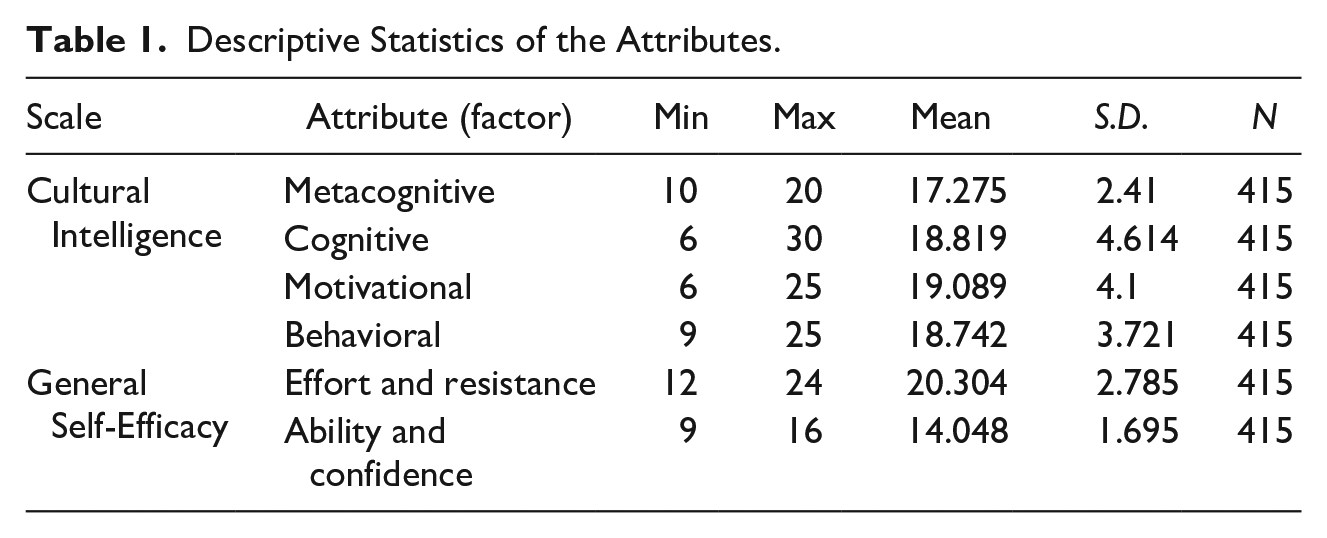
This research employs the machine learning classification algorithms to predict the culturally responsive teacher roles based on subdimensions of the cultural intelligence and general self-efficacy. Culturally responsive teachers were labeled as low (N = 115), medium (N = 176), and high (N = 124) using percentiles. The predictive model, which was built on the six attributes (factor), was tested by Waikato Environment for Knowledge Analysis (WEKA) software using the 10-fold cross-validation method. Table 1 shows the descriptive statistics of the six attributes (factor).
Descriptive Statistics of the Attributes.
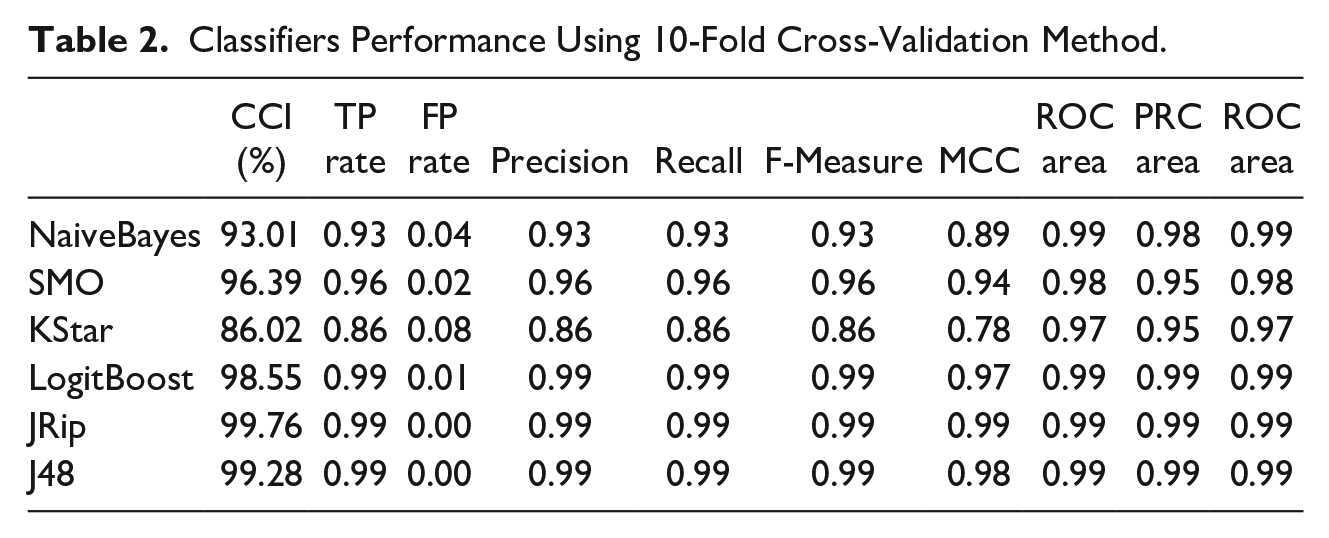
Classifiers Performance Using 10-Fold Cross-Validation Method
The Bayes classifier (NaiveBayes), logistic-regression (SMO), lazy-classifier (KStar), meta-classifier (LogitBoost), rule-learner (JRip), and decision-tree (J48) were employed in the assessment of the predictive model. CCI, Precision, The True Positive (TP) rate, False Positive (FP) rate, Recall, F-Measure, and Receiver-Operating-Characteristic (ROC) area metrics were used to evaluate the performance of the classifiers (Ye, 2003). The performance of the classifiers was tested by using the 10-fold cross-validation method, which uses 10% of the data to test effectiveness of the classifier, while 90% of the data were used to train the classifier (Arpaci, 2020). Table 2 indicates that the JRip rule-learner had a better performance than the other classifiers in predicting the culturally responsive teachers. The JRip rule-learner predicted the culturally responsive teachers with an accuracy of 99.76% (CCI: 414/415). The JRip classifier had a better performance in precision (0.998), TP rate (0.998), and ROC area (0.998). In general, the findings indicated that the aforementioned attributes could classify the culturally responsive teachers as low, medium, and high with an acceptable accuracy in most cases.
Classifiers Performance Using 10-Fold Cross-Validation Method.
Evaluation metrics for machine learning classification enable us to quantify performance of the classification algorithms. A number of evaluation metrics were used in this study for supervised learning. One of the evaluation metrics was Correctly Classified Instances (CCI) or Accuracy, which was calculated by following formula:

Recall (R) (True Positive Rate (TPR) or Sensitivity) was another evaluation metric used in the study. Percentage of the culturally responsive teachers that were correctly identified by the classifiers was calculated by following formula:

Precision (P) (Positive Predictive Value (PPV)), which ranges between 0 and 1 was another metric used in the study. The P values approach 1 when the False Positive (FP) values approach 0. The precision was calculated by following formula:

F-Measure, which is the harmonic mean of the Recall (R) and Precision (P), was another metric used in the study. The F-Measure was calculated by following formula:

Matthews Correlation Coefficient (MCC) was used to evaluate effectiveness of the classifiers. MCC is a balanced measure even the size of each classes were different. The MCC was calculated by following formula:

Decision Tree
Figure 1 shows the visual presentation of the J48 decision tree. The J48 predicted the low, medium, or high culturally responsive teachers with an accuracy of 99.28% (CCI: 412/415). The J48 had a good performance in precision (0.993), TP rate (0.993), and ROC area (0.998). Figure 1 shows that the “Effort and Resistance” dimension is the “root” node with 10 leaves. It is worthy to note that general self-efficacy factors (effort and resistance along with ability and confidence) were more important than the cultural intelligence for the prediction and classification of the teachers as low, medium, or high based on the attribute values.
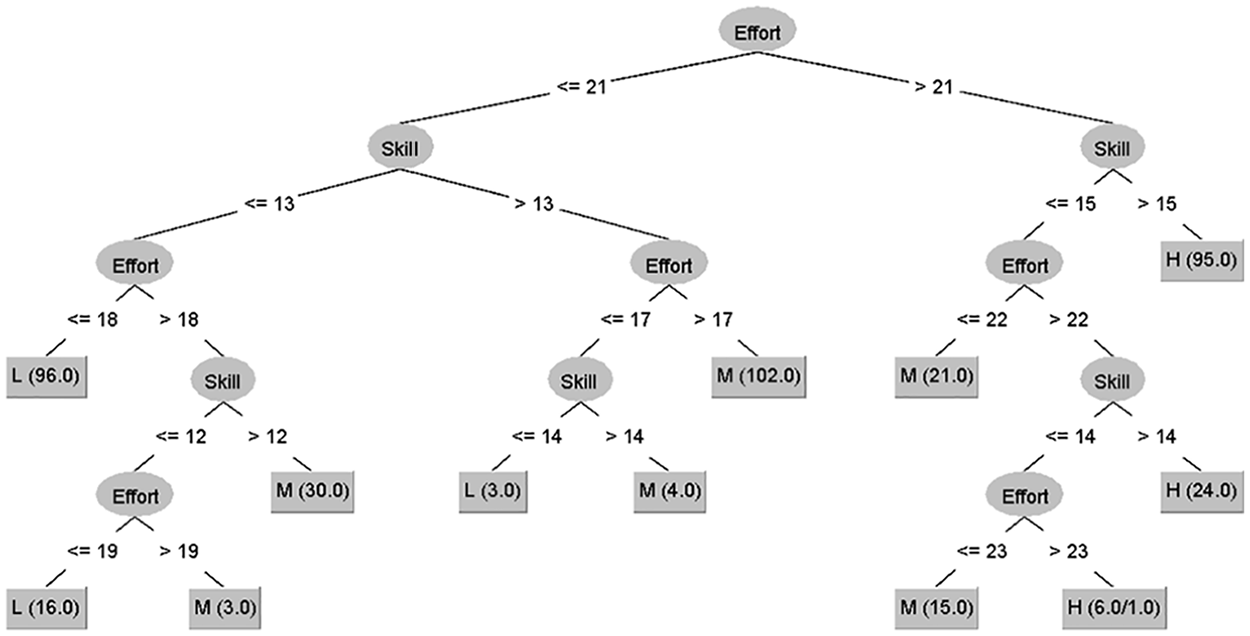
J48 decision tree.
Classification Errors of the Classifiers
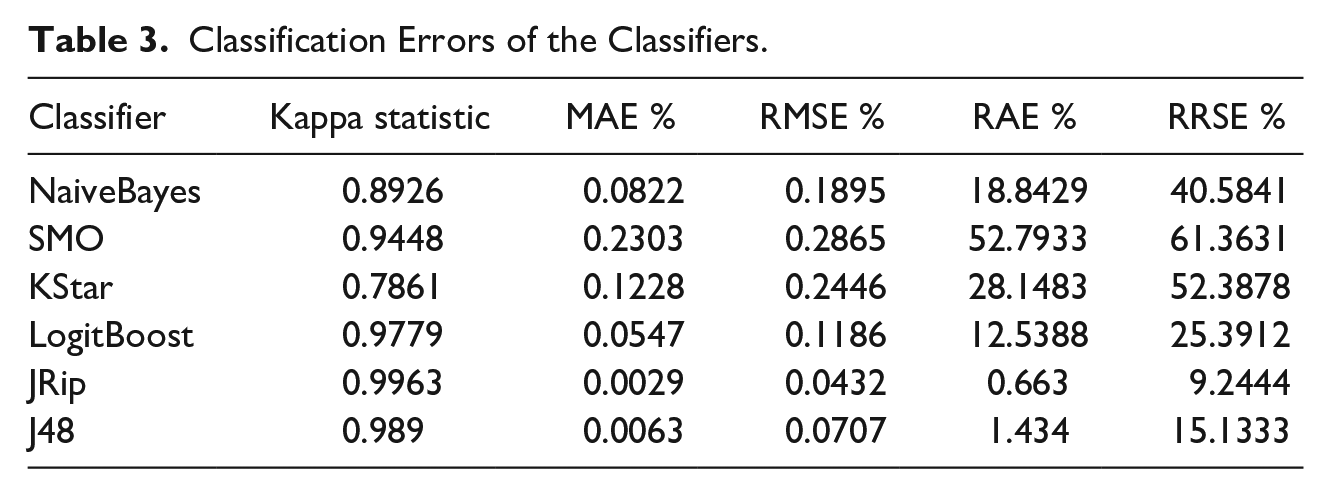
Table 3 shows the classification errors including Root Mean Squared Error (RMSE), Mean Absolute Error (MAE), Relative Absolute Error (RAE), and Root Relative Squared Error (RRSE). As a rule of thumb, a higher Kappa statistic and a lower RMSE, RRSE, and RAE value indicates a better fit (Arpaci, 2019; Arpaci et al., 2021). Kappa Statistic can be defined as “the degree of agreement between two sets of categorized data” (Kumar & Sahoo, 2012). The greater the Kappa statistic, the higher the agreement. The mean absolute error (MAE) can be defined as “the sum of absolute errors divided by number of predictions” (Kumar & Sahoo, 2012). MAE can measure how the predicted model resembles to the actual model. The root mean square error (RMSE) can be defined as “the square root of sum of squares error divided number of predictions” (Kumar & Sahoo, 2012). The lower the RMSE, the higher the accuracy. The results indicated that all classifiers had an acceptable performance but JRip rule-learner had a better performance than the other classifiers.
Classification Errors of the Classifiers.
Discussion and Conclusion
We aim to predict culturally responsive teacher roles based on cultural intelligence and self-efficacy using machine learning classification algorithms. The results indicate that teachers’ cultural intelligence and general self-efficacy greatly predicts the perceptions of culturally responsive teachers. Therefore, our assumption that “cultural intelligence and general self-efficacy” structures affect the perceptions of culturally responsive teachers is confirmed. This finding appears to be consistent with other study findings in the current literature and the views of theorists (Abacioglu et al., 2020; Gay, 2018; Ladson-Billings, 1995; Pekoz & Gursimsek, 2020; Petrović, 2011; Rychly & Graves, 2012). Petrović (2011) reports that a teacher with high cultural intelligence has great potential to become a culturally responsive teacher. Pekoz and Gursimsek (2020) find a positive relationship between preschool teachers’ cultural intelligence levels and their multicultural attitudes. According to Rychly and Graves (2012), teachers need to be able to empathize with their students and to understand the cultural dynamics that guide their students’ thoughts and feelings. Howard (2003) states that teachers should support the well-being of students in academic, social, emotional, psychological, and cultural aspects. Similarly, teachers should develop positive attitudes and beliefs regarding other cultures and be aware of their own cultural reference frameworks (Banks, 2015; Villegas & Lucas, 2007). If this is not the case, teachers who have not acquired cultural awareness may approach their students in a biased way and label them as unsuccessful (Aronson & Laughter, 2016; Chamberlain, 2005), cannot offer equal educational opportunities, and cause cultural conflict between students’ school life and their cultural life experiences (Jones et al., 2017). In the same way, unless teachers show positive attitudes toward cultural diversity and are aware of their prejudiced attitudes and beliefs about other cultures, they cannot effectively apply culturally responsive pedagogy (Author, 2019; Nieto, 2004). In this context, a teacher must have high cultural intelligence in order to use culturally responsive pedagogy effectively. It is stated that when individuals’ cultural intelligence levels increase, they will be more tolerant and less ethnocentric toward cultural differences (Bowman et al., 2016). In a similar way, as the level of cultural intelligence increases, the level of prejudice and discrimination against others is expected to decrease (Baltaci, 2017; Chen, 2010). Ugur (2019) finds a positive relationship between cultural intelligence and intercultural sensitivity in his research. These explanations show us that if teachers’ cultural intelligence levels are low, they will not be able to be effective culturally responsive teachers. At this point, the cultural intelligence of teachers should help them to be aware of the cultural characteristics of their students and they should know how to design a learning-teaching process according to cultural diversity.
Along with the cultural intelligence of the teacher, a high level of general self-efficacy is also required for culturally responsive pedagogy practices. Researchers have found that teachers “self-efficacy influences their teaching behavior and their students’ motivation and achievement” (Clark, 2020; Duffin et al., 2012; Skaalvik & Skaalvik, 2007). Moreover, it has been stated in research studies that teachers with high general self-efficacy will solve the problems they encounter in the teaching process and their performance will be higher (Aparisi et al., 2020; Cruz et al., 2020; Wilde & Hsu, 2019). Romijn et al. (2020) review teacher self-efficacy in a cross-national setting. They find that teachers’ perception of cultural diversity affects teachers’ self-efficacy and that teachers’ self-efficacy affects the quality of their teaching practices in the classroom. Similarly, it has been reported that those teachers who are culturally responsive with a perception of teacher self-efficacy will also design their teaching processes according to cultural differences (Siwatu et al., 2016, 2017). Teachers should make an effort to apply culturally responsive pedagogy on their students in the teaching process. Teachers who apply culturally responsive educational methods see culture as an effective tool to strengthen academic and social success (Author, 2020a). The culturally responsive teacher chooses commitment and challenges socio-cultural barriers to student learning (Gist, 2014). Culturally responsive teachers are expected to show better understanding of differences, to accept students as they are, and successfully managing the classroom environment with cultural diversity (Author, 2020b; Gay, 2018; Howard, 2003; Norman, 2020). At this point, teachers’ general self-efficacy should also be high. Teachers may encounter stressful or challenging situations in the teaching process. It may be difficult to relate course contents according to cultural differences. Trying to make applications in the learning-teaching process according to the principles of social justice and equality pedagogy may cause them to devote more time and effort to this. Considering all these situations, the teacher will inevitably have difficulties. In addition, it has been found that as time spent in culturally diverse classroom increases, teachers’ burnout increases if they have low self-efficacy in managing the culturally diverse classroom and designing the learning process (Gutentag et al., 2018). Furthermore, research (Alev, 2018; Kotluk, 2018; Telef, 2011; Yildirim & Ilhan, 2010) shows that teachers can achieve success and a positive mood when their general self-efficacy is high, that they are persistent and diligent in the teaching process and that they do not give up in the face of failure. As can be understood from the literature, teachers should have a high general self-efficacy belief in order to exhibit culturally responsive teacher behavior.
Teachers have to improve their knowledge, teaching skills, and professional competencies for students from different cultural backgrounds (Farinde-Wu et al., 2017). In this context, the teacher-training process offers an important opportunity for prospective teachers to increase their cultural intelligence capacity and to increase their general self-efficacy. Undergraduate education programs are critical for prospective teachers to gain culturally responsive teacher competencies (Karataş, 2018; Ladson-Billings, 1995; Skepple, 2015). At this point, Villegas and Lucas (2007) argue that the course content of the undergraduate educational process should be structured in a way that will give prospective teachers the roles of culturally responsive teachers. Kidd et al. (2008) emphasize the preparation of culturally diverse interaction environments and internship practices for prospective teachers. Author (2018) suggests providing opportunities for sightseeing and observations for prospective teachers in places where there are different cultural groups while Akcaoglu (2017) recommends watching movies and videos. On the other hand, Prater and Devereaux (2009) emphasize that the responsibility of training culturally responsive teachers is in the hands of teacher educator experts. Researchers place the most important role on the teaching staff in training culturally responsive prospective teachers. The instructor’s culturally responsive pedagogy knowledge, skills, and tendencies, as well as activities to be carried out in the teaching process, are important for prospective teachers to acquire a culturally responsive pedagogical perspective (Banks, 2015; Darling-Hammond et al., 2002; Gay, 2018).
In conclusion, the cultural intelligence and general self-efficacy belief of the culturally responsive teacher should be high. In this way, teachers can motivate themselves and show effort and persistence while designing the teaching process. In the same way, they can approach their students without prejudice and practice social justice in the classroom.
Limitations and Directions for Future Research
As in any scientific study, this study also has certain limitations. Our study group comprised teachers working in Turkey with several branches in different provinces. Researchers from different countries can test the findings of this study by reaching larger and more comprehensive samples. Another limitation can be defined as the cross-sectional, self-reporting, and sample size nature of the data precluding a deeper investigation of the research problems. Therefore, future research may include information from multiple sources of information to test the accuracy of these self-report findings. In-depth examination could be conducted by arranging both qualitative and mixed method research designs. We predict teachers’ perceptions of culturally responsive teachers through the variables of cultural intelligence and general self-efficacy. Future studies may be conducted to predict the perceptions of culturally responsive teachers through different variables. Teachers’ culturally responsive teaching practices can be observed in the classroom, and the contribution of cultural intelligence and general self-efficacy to these practices could be investigated. Finally, by analyzing the content of teacher training programs, examination could be made as to whether these programs are adequate and appropriate in the training of culturally responsive teachers.
Footnotes
Declaration of Conflicting Interests
The author(s) declared no potential conflicts of interest with respect to the research, authorship, and/or publication of this article.
Funding
The author(s) received no financial support for the research, authorship, and/or publication of this article.
