







Abstract
Deficit ideologies permeate urban spaces particularly when mostly Black and Brown students attend neighborhood schools. Wealth concentrated in suburban areas further perpetuates stereotypes of urban as deficient, but empirical data has yet to interrogate these ideas. Using the National Household Education Survey and regression analysis of variance, this research determines the relationship between parents’ satisfaction with their child’s school and school location (rural, suburban, urban). Then, using race as a moderator, this study aims to ascertain if there is a relationship between parental satisfaction by race and urbanicity of the school their child attends. Implications address the systemic and structural components that contribute to deficit ideologies.
Terms such as “at-risk,” “underachieving,” “disadvantaged,” and “in crisis” are often ascribed to Black and Brown students (African American and Latinx students) in urban schools at rates that far surpass value-added language (Lane, 2018; Stevenson & Ross, 2015; Turner, 2020). This kind of language has both macro and micro-level effects. At the macro level, deficit ideologies around urban schools create a self-fulfilling prophecy that contributes to school segregation and shifts funds away from quality urban schools. Schools then create policies around deficit language to justify inequitable practices (Callahan, 2005; Fairbrother, 2008; Skiba et al., 2002; Townsend, 2000) that push Black and Brown students out of mainstream classrooms and into special education and juvenile detention (Boyd, 2021; Gregory et al., 2010). At the micro-level, Billingham and Hunt (2016) found that White parents who hold a pro-white stereotype bias avoid enrolling their students in schools with high levels of Black students even though the quality of urban schools in recent years has increased. Black and Brown parents in particular have had to weather the real consequences related to the stigma of urban schools that has led to the mishandling of academic achievement, behavior, and social milieu. With larger amounts of emergent bilingual students allocated in urban centers, schools face additional resource shortages when middle to upper income parents switch schools based on reputation (Schneider, 2017). Parents also deal with negative stereotypes placed on Black and Brown students by teachers and administrators that have resulted in the beginnings of resegregation by race, and by proxy location (Carter et al., 2017).
Although “urban” was a term that originally described the population size of a particular school setting, it is now unfortunately used to define schools that are underfunded, poorly staffed, and lacking in parental involvement (Huguley et al., 2021; Schaffer et al., 2018), matching the same deficit language used to describe Black and Brown students. Ironically, in a study by Lewis-McCoy (2016), Black parents shared their negative perceptions of the predominantly White suburban schools their children attended. The researcher determined that Black parents “expressed great fear of structural and cultural mistreatment” (Lewis-McCoy, 2016, p. 322). Similarly, Golann et al. (2019) found that there was a disconnect between what Black and Brown parents desired in school discipline and what the schools perceived these parents wanting. Huguley et al. (2021) challenged future researchers to attend to the context of the learning environment and school setting, citing that “inattention to context can bias our notions of best practices” (p. 14).
The current study fills a gap in research by investigating the deficit orientation that has become ubiquitous in how many stakeholders, administrators, and practitioners alike think about urban settings. By using the National Household Education Survey (U.S. Department of Education, 2016) and regression analysis of variance, this research sought to analyze the relationship between parents’ satisfaction with their child’s school and the geographic location of that school (rural, suburban, or urban). Then, using race as a moderator, this study investigated if parental satisfaction differed based on the race of the parent. In analyzing the relationship between parent satisfaction and school location, this research seeks to provide a positively framed empirical perspective on urban schools and offer a viewpoint that challenges the deficit thinking that is currently perpetuated around urban environments.
Literature Review
Urban Education
Statistics surrounding the prevalence of deficit ideologies in education beg the question about why these ideologies tend to center on urban environments (Buendía, 2011; Richard Milner et al., 2015; Welsh & Swain, 2020). Rural schools suffer from a similar scarcity of resources but rarely receive the stigma of moral depravity and attacks on local communities for their perceived lack of value in education. Historically, “urban” has evolved significantly as a categorization of school type. Tyack (1974) operationalized “urban” through bureaucratization, highly concentrated populations, and a shift in ways of thinking and acting brought on by modernization. He explained that “despite frequent good intentions and abundant rhetoric about ‘equal educational opportunity,’ schools have rarely taught the children of the poor effectively—and this failure has been systematic, not idiosyncratic” (p. 11). Tyack’s association of urban with poverty is not original, but it would not be until the 1966 Coleman Report that the effects of poverty on school achievement would be blamed on students and their families/local communities (Buendía, 2011).
Tyack (1974) saw a movement toward “urban” ways of thinking as a consequence of a shift in the means of production from small rural communities to cities where large numbers of people congregated. With this shift, workplace relationships became impersonal and structured to fit the growing demands of urbanism, and people started to define themselves based on the working groups they belonged to. Schools began to reflect the differentiated economic roles of society, taking on a social efficiency model that saw students as cogs in a system of production. The more efficiently that system could prepare students for their designated societal roles, the more successful the model (Tahirsylaj, 2018). Tyack (1974) also defined “urban” in the context of a technological revolution. Mass media replaced tradition with a more unified approach to norms of behavior (Tyack, 1974), which later contributed to reliance of deficit paradigms in understanding non-White Americans (Buendía, 2011).
Black people did not have direct access to urban education in its origins (Tyack, 1974). In his seminal work, Anderson (1988) argued that compulsory, mass public education was an idea that originated from previously enslaved African Americans and that began in rural areas, yet “urban” education has come to mean education for mainly Black and Brown students in metropolitan areas. Decades after slavery had ended and Black people had made gains in accessing urban education, the mandated publication of the 1966 Coleman Report began to change the definition of “urban” because it attempted to address poor academic performance of students with low socioeconomic status who happened to be concentrated in city centers that they had previously been excluded from Buendía (2011). The Coleman Report concluded that poor people were “lacking the fundamental knowledge essentials as well as a family structure whose values were conducive to socializing their children into a pro-education outlook” (Buendía, 2011, p. 2). Buendía (2011) argued that immigrants and racial minorities’ core existence were ascribed to a geographical location in the public imagination through depictions in mass media. In this sense, Black and Brown people became urban people.
Richard Milner (2012) noted that many school leaders tend to associate “urban” with problems that plague schools and occur outside the control of administration. As a result, Milner proposed a typology with which to arrive at a common definition of “urban” in order to advance the field. He defined “urban intensive” as large metropolitan areas that are highly dense, “urban emergent” as slightly smaller cities that also suffer from lack of resources, and “urban characteristic” as schools not located in metropolitan areas but potentially experiencing similar challenges, such as a growing emergent bilingual population in conjunction with limited resources and training. Richard Milner et al. (2015) operationalized “urban” as related to population size and density, amount of diversity within student demographics, and number of resources. He explained, “The reality of large, growing cities and districts is that there is a need to rethink the manner in which educators are equipped to manage student learning” (p. 531). Richard Milner (2008) pushed for the examination of urban spaces through a different non-deficit lens in relation to Black and Brown problems in education. Attempting to further extend Milner’s typology, Williams et al. (2022) utilized longitudinal spatial, demographic, housing, and employment data from the past century in five different school districts in and around the Houston metro region to highlight two important elements missing from the original framework; (1) historically marginalized families lived in categorically different school districts yet experienced the same deficit paradigms as urban intensive areas; and (2) belonging to a non-urban school district does not exclude a student from attending a school that have the same challenges and opportunities for growth as urban school district. Their findings highlight the ever-pressing need to detach deficit paradigms away from the classification of schools and school districts.
Deficit Paradigms
Unfortunately, many educators are not equipped to address the needs of diverse learners outside of deficit ways of thinking, and Black and Brown students continue to be underserved in the classroom (Chapman et al., 2014; Ford et al., 2019; Gregory et al., 2010) and overly represented in the categories of suspension, corporal punishment, and arrests (Government Accountability Office (GAO), 2018). This is in-part correlated to beliefs and practices within the classroom that tend to rely on stereotypes and ignore the cultural differences present between teacher and student (Gregory et al., 2010; Hamilton & DeThorne, 2021; Skiba et al., 2002; Wright, 2021). Townsend (2000) demonstrated the propensity for White teachers to reward behavior that is individualistic even though Black students thrive in classrooms that include community-based learning (Gregory et al., 2010). In classrooms that were predominantly White and suburban, teachers’ language centered on academics, but teachers in predominantly Black classrooms used language that was more focused on behavior management (Townsend, 2000). Similarly, teachers of emergent bilinguals tended to associate limited English proficiency with limited intelligence, and their classrooms demonstrated this as teachers weakened the curriculum, lowered their academic expectations of emergent bilinguals, and recommended Latinx students to low-track classes (Callahan, 2005).
Researchers such as Emdin (2016) are addressing this gap between a majority White teaching workforce and students of color, but a wide swath of teachers remain ill-prepared (Zeichner et al., 2016) as deficit beliefs and practices extend from preparation programs wherein cultural knowledge is not at the forefront. According to Hoffman et al. (2020), placing pre-service teachers in diverse settings without proper training or opportunity to reflect with diversity conscious educators reinforces misconceptions and deficit perspectives. Although those orchestrating student teacher placements have good intentions, this kind of structural issue becomes a systemic form of racism as these teachers enter the workforce.
The systemic deficit views of educators at all levels of the schooling system continue to contribute to the mistreatment of students of color across school locations (Chapman et al., 2014; Gregory et al., 2010). After controlling for parent education, enrollment in free lunch programs, and family income, the racial and ethnic descriptor of a student remains a major predictor of discipline (Gregory et al., 2010). Contrary to popular belief, the highest rates of disproportionate discipline practices amongst Black and Brown students continue to be in predominantly White, wealthy suburban schools (Gregory et al., 2010). And, while these schools provide greater access to course offerings, resources, and extracurricular activities, Black and Brown students identified a multitude of racial disparities including an underrepresentation in advanced courses, feelings of isolation, and inaccessible after school programs due to high costs or lack of transportation (Chapman et al., 2014; Crabtree et al., 2019; Kettler & Hurst, 2017).
Even more concerning is the effect that this deficit paradigm has on the parents within the community. The exclusionary practices on Black and Brown students extended to their families with parents reporting feelings of fear as their young children entered school. In a study conducted by Leath et al. (2020), mothers of Black boys attending mostly White schools were anxious that teacher and peer bias would inhibit learning. Black mothers whose sons attended predominantly Black schools were equally concerned with White teacher bias as well as the overall achievement of Black boys within the schooling system. Mothers across the study were fearful of the overdiagnosis of behavior problems and suggestions of retention or special education (Leath et al., 2020). In research with immigrant families, Lightfoot (2004) explained that immigrant parents living in poverty are not seen as “full of knowledge and capable of doing well for their children” (p.105) due to deficit language used by well-intentioned people. Similarly, Gross et al. (2020) studied the perceptions of involvement from the perspective of administrators, teachers, and Latinx parents. The researchers found that administrators’ and teachers’ perceived ideologies of parental engagement directly aligned to extant literature based on deficit paradigms.
Thus, despite their desire for educational equity, Black and Brown parents, along with their children, are left feeling unwelcome and excluded from public schools (Howard, 2015; Townsend, 2000). With this discriminatory practice based on decades-long ideals of White privilege within school involvement, many schools miss out on the relationship between community and school (Love et al., 2021) as parents of color opt into school choice as an alternative for school engagement (Leath et al., 2020).
Parental Involvement as a Counter-Narrative to Deficit Ideologies
It must be noted that historically, Black and Brown parents have been involved in public education (Fields-Smith, 2005). They successfully became literate and created public schools for their communities despite racism and discrimination at every turn, showing their resilience and inherent cultural value in education (Anderson, 1988). African Americans willingly banded together with White conservatives whose political interests and values differed greatly in the charter school movement as a desperate act to attain educational equity for their children. Goodridge (2019) explained: In the wake of Brown, the African American community waited for the ruling’s decisionto deliver increased educational opportunities for their children. As the decades passed, agrowing number of families began losing faith in state-mandated education, controlled, asthey saw it, by gatekeepers drawn from the reservoir of white privilege. The educationalaspirations of marginalized communities would continue to be undermined by theintransigence of traditional education; this contributed significantly to the rise of thecharter school movement as a growing number of African Americans began exploring alternative ways of accessing equitable public education. (p. 283)
Goodridge (2019) traced the unification of the African American community around charters back to their fight for equal educational opportunity post-slavery. She discussed that although the Brown decision was vital in breaking down segregation, its failure to help Black people gain educational equity was the underpinning of their interest in the charter movement as an alternative vehicle to equity. Even current research conducted by Leath et al. (2020) demonstrated that almost one-third of Black mothers preferred charter and private schools as a means to avoid racial disparities.
Likewise, Latinx parents began advocating for their children’s education as early as the 1920s through mutualistas, or community organizations (Rothrock, 2017). The mutualistas provided support through monetary donations, cultural events, and political activism (Rothrock, 2017). This movement gave rise to educational reform for Latinx community members and inspired the creation of the League of United Latin American Citizens (LULAC) by “Mexican American parents, scholars, lawyers, and youths” in 1929 (Valencia, 2002). LULAC, along with other organizations became responsible for an active litigious involvement in equal educational opportunities for Latinx students. As Valencia (2002) explain, “notwithstanding the range of outcomes of this litigation as a whole. . . taking their cases to court for over the last 70 years speaks to the reality that Mexican Americans highly value education” (p. 93). In a review of recent narrative work stemming from the families themselves, the fierceness of Latinx parents’ high expectations for their children’s education is well-documented (Cavanagh et al., 2014; Durán et al., 2020; Valencia, 2002).
Despite the historical context of Black and Brown parental advocacy in education, perceptions of school involvement continue to be defined by the gatekeeping White, middle class. However, much of the parental support for students of color is rooted in the community and grounded in relational activities (Latunde & Clark-Louque, 2016; Townsend, 2000 Valencia, 2002). Hutchins (2010) found that church attendance and participation contributed to academic achievement amongst Black students. In a survey of 130 parents of Black K-12 students, the participants noted their support of learning at home, consistent school communication, and community experiences as their methods of parental involvement (Latunde & Clark-Louque, 2016). Other after-school enrichment programs are crucial to families, and this community involvement plays a role in teaching Black students to have pride in their racial and cultural history of scholastic excellence (Leath et al., 2020), demonstrating that parents of color do emphasize the importance of education and are involved in their children’s schooling success (Townsend, 2000). This involvement may not take on “White” and “traditional” forms of involvement such as Parent Teacher Association (PTA) membership or daytime volunteering in the school but is instead grounded in community experiences (McGee & Spencer, 2015).
Although conceptual and commentary articles have discussed the deficit views surrounding urban education environments, few studies have conducted statistical analyses to investigate whether these frameworks have impacted the perspectives of stakeholders such as parents. Given the normative constructions of deficit thinking surrounding school location, it is necessary to consider the sentiment of Black and Brown parents rather than defer to the deficiency-minded, White-centered viewpoints typically appraised. Ideologies that undergird the field of urban education have implications for school environments and student achievement, as well as how well school faculty utilize the strengths, culture, and resources of the local community.
Theoretical Framework
Valencia’s (1997a, 1997b) deficit thinking model provides a framework by which school location and parent satisfaction can be explored. The deficit thinking model was developed as a means to address the orthodoxy that holds people of color hostage to negative perceptions and presents a context for education in terms of the results on schooling practices as related to this social construct (Valencia, 1997a, 1997b).
Deficit thinking consists of six characteristics: blaming the victim, oppression, pseudoscience, temporal changes, educability, and heterodoxy. Blaming the victim creates a person-centered description of school failure by directly linking individuals to their group membership. In this case, Black and Brown students in urban locations are ascribed as low performers and/or lacking in motivation. Victim blaming avoids the structural inequalities present in Black and Brown students’ schooling location and contributes to the oppressive nature of the deficit thinking model. It is the oppressors (teachers, administrators, school boards, or other government officials) who hold power over communities of color. The mismatch between oppressor and student fails to address the possibilities of school success and victim blaming persists. Valencia (1997a, 1997b) contends that researchers can also serve as oppressors in these settings. Researchers who maintain deficit thinking contribute to a pseudoscience that is entrenched with negative attitudes toward Black and Brown students, flawed methodologies, and findings that uphold deficit paradigms surrounding school location. This pseudoscience is further exacerbated by the temporal changes in society wherein the alleged deficits are attributed to inferior genetic makeup, lesser culture and class, or insufficient familial constructs. All of this combined is used to prescribe Black and Brown students to special education, at risk, or behavioral categories as the expectation of their educability is minimized by the oppressors. Ultimately heterodox opinions must be explored as a means to dismantle the characteristics of deficit thinking and to disentangle the traditional, orthodox ways of understanding (i.e., urban equates to bad).
Within the context of parent satisfaction and school location these constructs of the deficit thinking model help to explain the negative ideologies surrounding urban schools. Currently “the popular at-risk construct, now entrenched in educational circles, views poor and working class children and their families (typically of color) as being predominantly responsible for school failure while frequently holding structural inequality blameless” (Valencia, 1997a, 1997b, p. xi). Valencia and Solórzano (1997) explain that for decades pseudoscience researchers have used poverty and the class system as a means to illustrate the inherent flaws of those individuals in low-income, often urban communities. The persistent victim blaming in these communities contributes to over-disciplining, high rates of special education referrals, and overall mistreatment of Black and Brown students (Chapman et al., 2014; Ford et al., 2019; Gregory et al., 2010), as oppressors ignore the systemic contexts and institutional racism that exist for communities of color and/or urban areas.
The goal for this research aligns with the heterodox goal of the deficit thinking model and seeks to mitigate any further damage done to Black and Brown students by acknowledging the power of perception. If the prevailing deficit orientations associating non-White with low quality schools continue, especially in frameworks employed for research, the risk of students believing that poverty has a culture (Payne, 2005) and thereby adopting deficit views of their own ability based on their school location will persist. Similarly, according to Lightfoot (2004), “language subtly shapes and constrains the way we perceive reality” (p. 91). Our perceptions of reality inform policy decisions that then impact students and parents. The deficit thinking model provides a lens with which to see how victim blaming and oppression can inadvertently affect student achievement and particular types of schools that share a common set of characteristics, in this case schools labeled as “urban.”
Current Study
Several scholars have written about the phenomenon of using “urban” as a proxy for Black and/or Brown students rather than in reference to school context (Lewis et al., 2008; Richard Milner, 2012; Schaffer et al., 2018; Williams et al., 2022), but no literature exists examining satisfaction with schools based on level of urbanicity—in essence investigating a surface-level phenomenon empirically. The context of school location is an important facet of truly understanding hidden bias (Huguley et al., 2021) and deficit thinking (Valencia, 2002) within public schools. There is a clear dichotomy between what is perceived by White, patriarchal standards and what is actualized through accounts of Black and Brown students and their families (Fairbrother, 2008; Golann et al., 2019; Leath et al., 2020). While society clings to the idea that urban schools are lacking (Callahan, 2005; Fairbrother, 2008; Skiba et al., 2002; Townsend, 2000) and suburban schools are spaces of excellence (Chapman et al., 2014; Gordon, 2012), the paucity of research surrounding Black and Brown parents’ satisfaction with schools opens a space for the following research questions to be explored:
Is there a relationship between a parent’s satisfaction with their child’s school and school location (suburban, rural, and urban)?
Is the relationship between parent satisfaction with their child’s school and school location moderated by the child’s race?
Method
Participants
A total of 14,075 parents from across the United States responded to the 2016 National Household Education Survey through the National Center for Education Statistics. Upon closer inspection within the topics of interest for this study, 552 responses were not included due to missing data, resulting in a total sample size of 13,523. Race, as indicated by respondents, is presented in Table 1.
Profile of Respondents (n = 13,523).
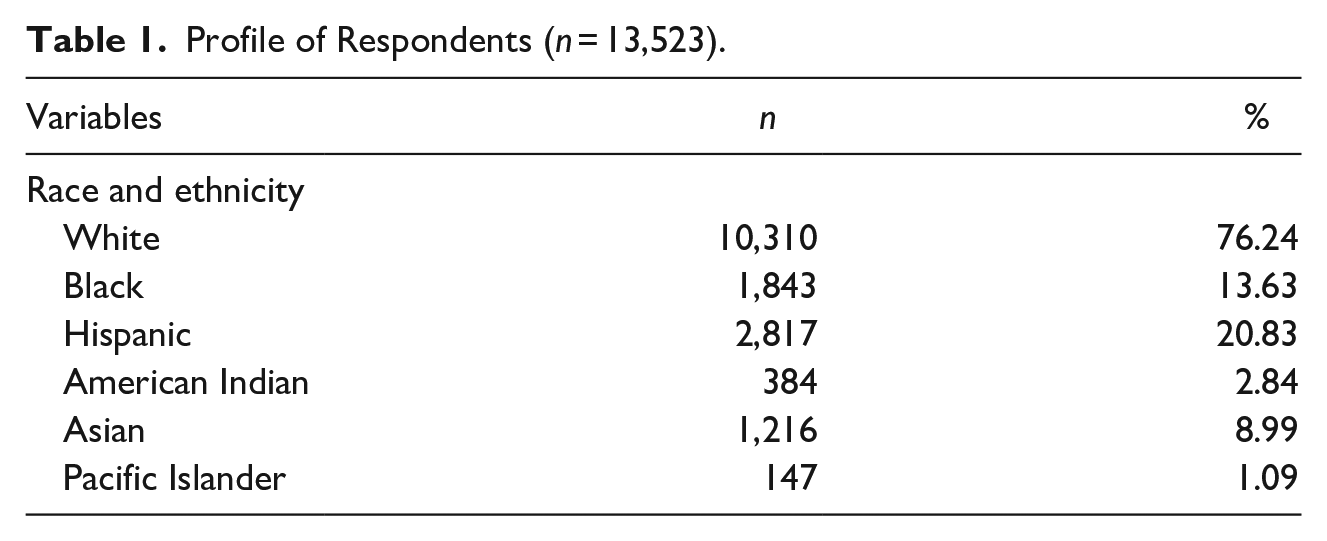
In the current study, we chose to focus on the parental satisfaction of Black, Hispanic (as identified by NHES and NCES, the researchers will continue to denote Hispanic as Latinx), and White parents (N = 11,820).
Procedures
Data for this investigation were gathered from the National Center for Education Statistics’ (NCES) National Household Education Survey (NHES) and specifically addressed parent and family involvement in education. As per NCES, NHES uses a two stage design.
Individuals in sampled households are asked to complete a screener questionnaire. Based on all individual responses within the household, each of those individuals received a topical survey(s) that best fits their role within the household. For the parent and family involvement survey, the unit of analysis is the child, and the respondent is the child’s parent or guardian. This data was then downloaded from the NCES website and uploaded within STATA/IC 16.1.
Measures
Parent satisfaction
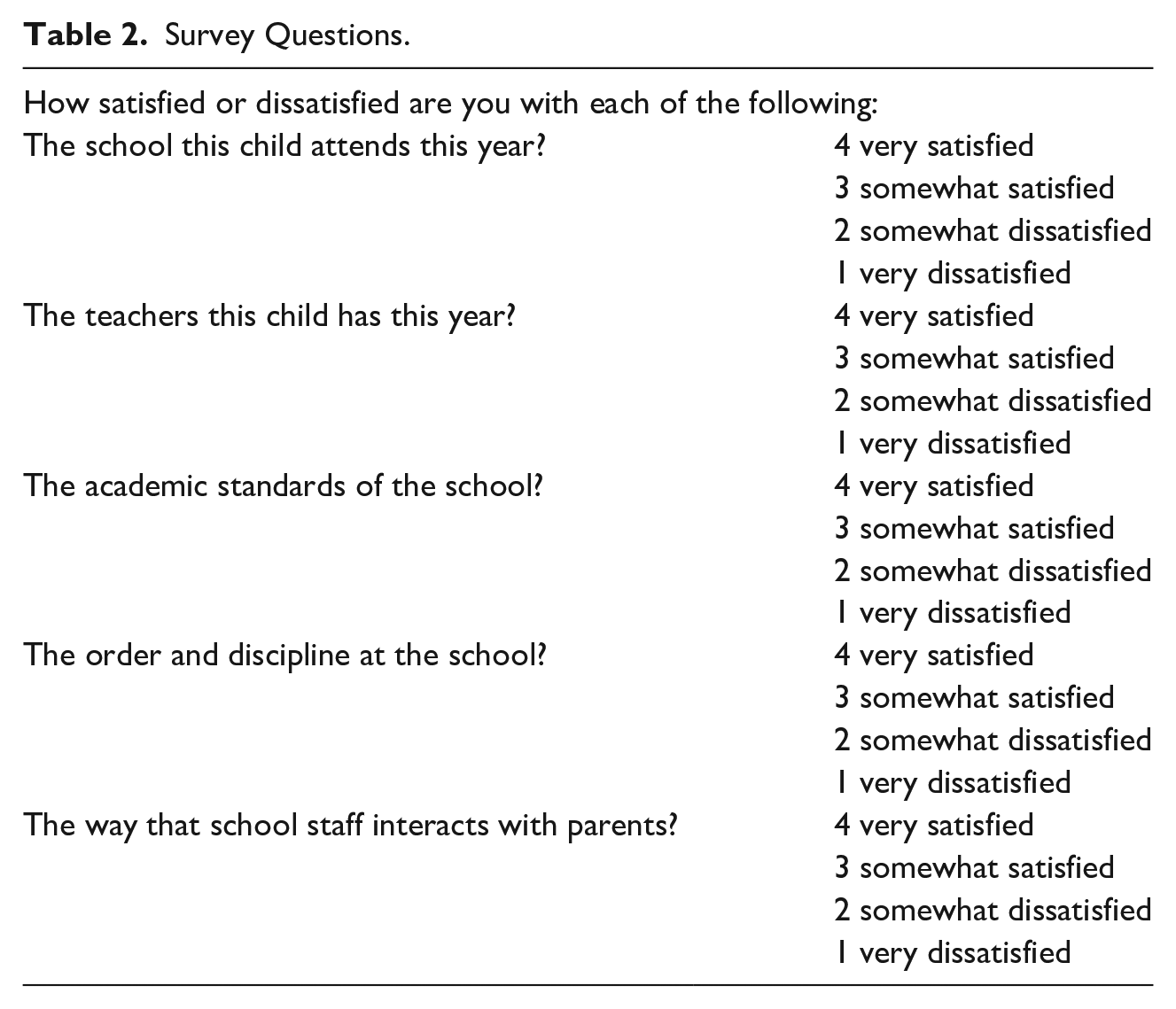
A composite variable was created for parent satisfaction that included satisfaction with the school, teacher, academic standards, order and discipline, and staff interactions with parents (M = 3.47, SD = 0.602). Parents/guardians were asked a total of five questions pertaining to their satisfaction with their child’s school with the option to select “very satisfied,” “somewhat satisfied,” “somewhat dissatisfied,” or “very dissatisfied.” The NHES dataset coded responses on a scale of 1 to 4 with 1 being “very satisfied” and 4 being “very dissatisfied.” For ease of interpretation, the decision was made to reverse code responses with 1 being “very dissatisfied” and 4 being “very satisfied” (Table 2). Because these questions were extracted as a subset from the full survey, reliability was verified and resulted in an overall Cronbach’s alpha of 0.89.
Survey Questions.
Location
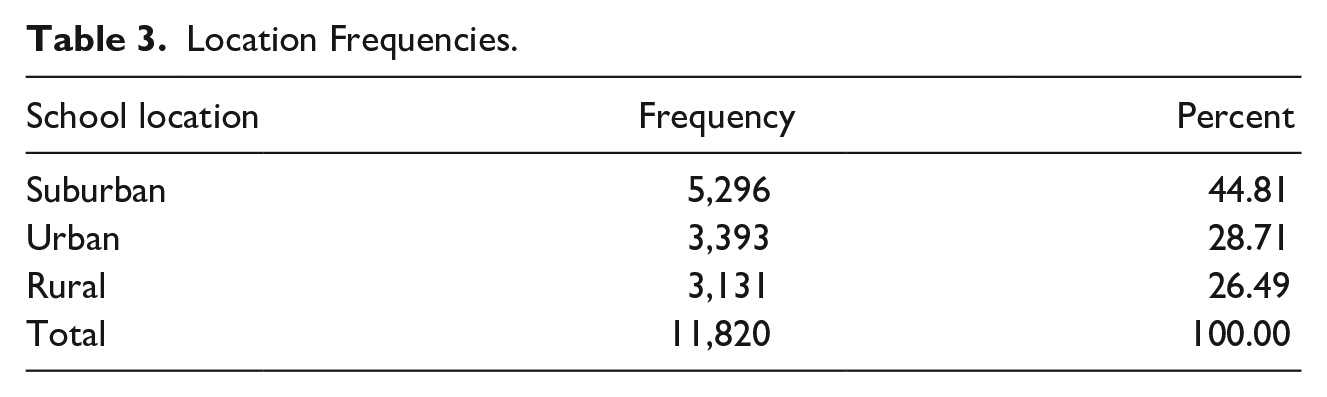
To determine the location of respondents (urban, suburban, and rural), NHES asked parents/guardians to provide the address for the school their child attended. By collecting this data, it was determined that 4,192 schools were located in a city (an area defined by NCES as a territory inside an urbanized area and inside a principal city), 6,325 schools were located in a suburban area (an area defined by NCES as a territory outside a principal city and inside an urbanized area), and 3,558 schools were located in a town or rural location (an area defined by NCES as a territory that is a least 10 miles from an urban cluster or that is census-defined as a rural territory). NHES further classified the community types of “city” and “suburban area” as small, medium, and large. The community types of “town” and “rural” were classified as fringe, distant, or remote. However for brevity, we opted to merge the classifications of small, medium, and large and fringe, distant, and remote into one classification of community type. Similarly the classification of town and rural were combined to answer the research questions leaving the locations of urban (city from the dataset), suburban (suburb from the dataset), and rural (town and rural combined from the dataset). Table 3 shows the frequencies of each location.
Location Frequencies.
Data Analysis
STATA IC/16.1 was used for the data analysis. More specifically, we used a moderated regression analysis as the means to test how the moderated variable (race) affects the relationship between location (X) and parent satisfaction (Y). This two-step process allowed us to isolate the interaction effect from the main effect of school location. The first model investigates school location’s effect on parent satisfaction and addresses research question 1.

For our first model, we created simple contrast codes for our three locations, using suburban as our control. We chose suburban schools for our reference group because of the positive rhetoric surrounding the suburbs in literature about school resources, academic leadership, and school environments. Because rural and urban environments are often discussed using deficit language, the comparison between these environments and suburban environments as a control yields the most stark comparison and is most easily interpretable. We hypothesized that overall parents would be more satisfied with suburban schools than with rural and urban schools.
The second model includes the moderator of race and addresses research question 2.

Within this model, the researchers utilized simple contrast codes for the three groups: White, Black, and Hispanic. We chose White as our reference group because we are interested in comparing parent satisfaction of Black and Brown children to their White counterparts, the latter of which often attend schools that are better funded and that provide more academic and extra-curricular opportunities. Additionally, discipline is one of the five variables that makes up the parent satisfaction composite variable. Most recent literature has shown disproportionate disparities between the number of Black and Brown children suspended versus White children (Chapman et al., 2014; Ford et al., 2019; Government Accountability Office (GAO), 2018; Gregory et al., 2010). Thus, comparing Black and Brown children to White children corresponds to current data trends and helps us most effectively test our research question. We hypothesize that parents of Black and Brown students will be less satisfied with their child’s school regardless of school location.
Findings
Using a sequential multiple regression model, the researchers aimed to investigate the relationship of school location on parent satisfaction moderated by race. Before creating the composite mean of parent satisfaction, Cronbach’s alpha was used to assess the reliability of each variable separately, which resulted in a 0.89 reliability for the set. Then, the five variables related to parent satisfaction were combined to form a composite variable. Below (see Table 4) are the individual descriptive statistics for each variable in the model and correlations between variables. The researchers hypothesized that school location would predict parent satisfaction better than using the average mean score of survey items (M = 3.47).
Summary of Descriptive Statistics and Correlations (n = 11,820).
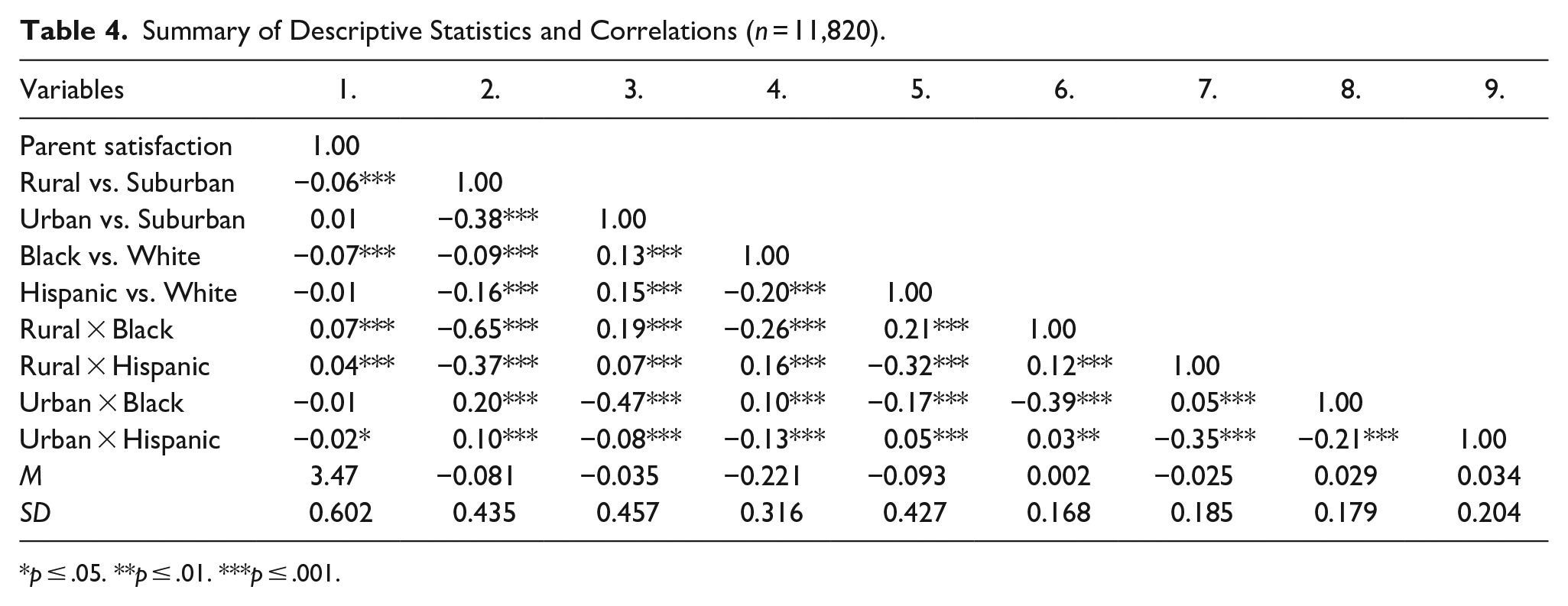
p ≤ .05. **p ≤ .01. ***p ≤ .001.
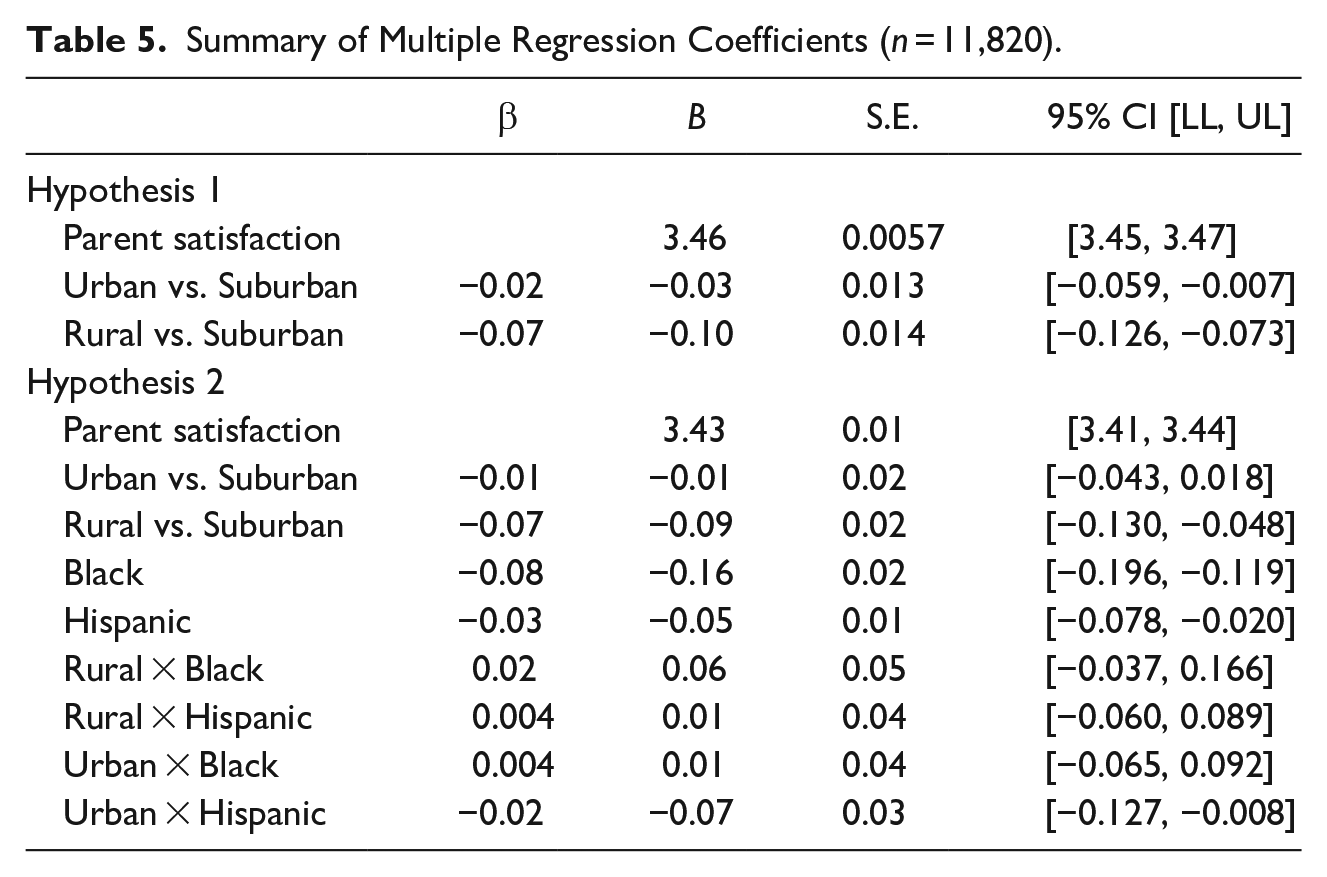
First the researchers tested the hypothesis that parents would be more satisfied with suburban schools than with urban and rural schools. The model for the first hypothesis explained. Forty five percent of the variability in parent satisfaction (F2,11,817 26.83, p < .001). When a parent in the sample (N = 11,820) had a child who attended an urban school, their composite satisfaction score decreased by 0.03 compared to a parent with a child at a suburban school (95% CI [−0.059, −0.007]). This decrease was statistically significant. For parents with children at a rural school, their composite satisfaction score decreased by 0.10 (95% CI [−0.126, −0.073]) compared to suburban schools. This decrease was statistically significant.
Next the researchers tested the moderating effect of race on school location to address the hypothesis that overall parents of Black and Brown students would be less satisfied with their child’s school regardless of the school location. When adding race to the model, the overall model explained an additional. Seven percent of the variability in parent satisfaction (F4,1181534.36, p < .001). The mean parent satisfaction for the Black parents of the students in suburban schools is 0.16 point smaller than the White parents of the students in suburban schools (95% CI [−0.197, −0.126]), and parents with Hispanic students had a −0.052 unit decrease in satisfaction across all school locations (95% CI [−0.079, −0.026]). The only interaction term that was statistically significant in the model with moderation were parents who had Hispanic students in urban schools (B = −0.07, 95% CI [−0.127, −0.008]). See Table 5 for the summary of our multiple regression coefficients separated by hypotheses.
Summary of Multiple Regression Coefficients (n = 11,820).
Discussion
The purpose of this article was to examine the relationship between a parent’s satisfaction with their child’s school and that school’s location. The literature demonstrates that urban schools have been repeatedly labeled as lacking in achievement, funding, and parental involvement (Huguley et al., 2021; Schaffer et al., 2018), and suburban schools are portrayed as places of greatness (Chapman et al., 2014; Gordon, 2012). Therefore, previous research demonstrates the necessity of considering parental insight across urbanicity (Huguley et al., 2021), as parental perception of school type can impact neighborhood segregation and by extension school resources. The current study extends the literature by examining the satisfaction of parents across school locations and investigating if a child’s race and ethnicity moderate the relationship between parent satisfaction and school location. Findings from this study showed that parents are more satisfied with suburban schools. When race is included as a moderator, the findings are consistent with the literature. The model indicated that Black and Latinx parents are less satisfied with their child’s school across locations as compared to their White counterparts. The only statistically significant interaction effect was parents of Latinx students attending urban schools: they were less satisfied than the parents of Latinx students attending suburban schools.
Despite these findings, it is important to note that the models only explain a small portion of variability in parent satisfaction (R2 = 0.45% and 1.22%, respectively). While it was not surprising that suburban parents expressed the most satisfaction for their schools compared to parents with children at urban and rural schools and that White parents are more satisfied than both Latinx and Black parents, the amount that the models left unexplained was unexpected. Looking at the models as a whole and the mean of the parent satisfaction composite variable (M = 3.47), parents with children of all colors and school locations are generally satisfied with their schools, at least according to these survey items, and school location has almost no bearing on their satisfaction even though both of the models were statistically significant. Race as a moderator explains additional variability but not much more than school location. These results guided by the deficit thinking model seek to both draw attention to this phenomenon and the need to extricate “urban” from “bad” so as a means to turn the tide for urban schools.
These findings speak to the deficit thinking that surrounds urban schools, and they demand a recalibration when describing urban environments. This begins at the micro level with teachers. White teachers often have deficit perspectives of urban spaces due to limited resources (Chapman et al., 2014; Ford et al., 2019; Gregory et al., 2010), cultural differences (Gregory et al., 2010; Hamilton & DeThorne, 2021; Skiba et al., 2002; Wright, 2021), placing blame as evidenced by the over disciplining of students of color (Government Accountability Office (GAO), 2018), and an overall lack of preparedness to teach in urban environments (Hoffman et al., 2020; Zeichner et al., 2016). Thus, it should become the responsibility of teacher education programs (TEPs) and new teacher induction programs to combat this systemic phenomenon of victim blaming. By simply placing preservice teachers in urban field experiences, TEPs assume they are dismantling the deeply held stereotypes of young, White teachers (Hoffman et al., 2020). However, this placement tends to further entrench the beliefs of these teachers (Brown & Rodriguez, 2017; Hoffman et al., 2020) doing little to combat the oppressive practices seen in urban schools. Even when preservice teachers were given opportunities to hear the experiences of urban youth from local high schools, many instead diminished the “significance of what the youth researchers could contribute to their learning” and focused on “discrediting, discounting, and disbelieving” the accounts of these students (Brown & Rodriguez, 2017, p. 80). Alvarez and Richard Milner (2018) stress the “exigency of teacher education to play a role in supporting teachers to build the kinds of knowledge necessary for consciousness raising and actively engaging in race talk in the classroom with their students” (p. 393). This may allow for a space wherein the attitudes of teachers, administrators, and educational policy-makers can better align with the mostly positive perceptions of the community surrounding the urban school (Chambers & Michelson, 2020; Chen, 2020).
The deficit orientation of White teachers extends to include parents and contributes to an overall perception of Black and Brown parents being uninterested or disengaged in their children’s schooling (Gross et al., 2020; Love et al., 2021; Valencia, 2002). However, educational stakeholders in urban communities would do well to seek to understand the role that their parents can play in the success of their schools. When given the opportunity, Black and Brown parents have transformed schools (Cavanagh et al., 2014; Durán et al., 2020) and even when limited or ignored by the school environment, continue to persist in supporting their children at home and in the community (Latunde & Clark-Louque, 2016; Townsend, 2000; Valencia, 2002). The data presented here showed that parents, overall, are satisfied with their child’s school. Urban school stakeholders should capitalize on this finding and move toward ways of thinking that would be inclusive of parents. By engaging with parents of color, schools can disrupt the deficit thinking surrounding parent involvement and reimagine a new heterodoxy of the term.
At the macro level, the overwhelming permeation of victim blaming within the United States’ education system contributes to Black and Brown families being held responsible for their own marginalization. Blame undergirds the deficit thinking model and is often used as a means to shudder the culpability away from educational policy back to parents, location of the school, and student demographic. Instead it is critical to understand the structural inequalities that are ever-present that surround the education system in order to dismantle inequities within the education system (Williams et al., 2022). This is evident in the findings presented above: If parents’ satisfaction with their child’s school is minimally affected by school location, contrary to the stereotypes claiming the opposite, then why do “urban” schools seem to be failing at a rapid pace while suburban schools continue to thrive? Schneider (2017) provides some insight in his analysis: As a growing body of research suggests, however, test scores don’t truly measure school quality. And, if that is the case, chances are the greatest threat to urban schools isn’t a flaw in the design or execution of urban education. Instead, it is a self-fulfilling prophecy—one in which privileged families presume city schools to be failing and, in taking flight from them, bring about a real decline. (p. 6)
Chen (2020) reported that school shutdowns continued in major cities across America in 2020 despite parent and teacher complaints. Similarly, in a study on low-income urban parents’ satisfaction of schools, Chambers and Michelson (2020) found that these parents “express[ed] favorable attitudes toward their neighborhood schools” (p. 299). This contradicts policies that enforce school shutdowns when not performing well on standardized tests. According to Rosales (2015), Darling-Hammond explained that “mass closures reflect shortsighted policies rooted in punitive reform models such as the recently rewritten federal K-12 education law, No Child Left Behind (NCLB).” Chambers and Michelson (2020) suggest that “politicians seeking to further push for. . . exit based solutions to low-performing neighborhood schools may encounter significant local resistance” (p. 316).
Richard Milner (2012) acknowledged that urban education depends on the people who attend these schools as well as the realities experienced by surrounding communities, but he made a distinction between this definition and deficit perspectives. He stated, “There is a rich array of excellence, intellect, and talent among the people in urban environments—human capital that make meaningful contributions to the very fabric of the human condition in the United States and abroad” (p. 558). While denying this assertion would breed racism and/or classicism, deficit ideologies that inadvertently deny this assertion and continue to blame urban communities for their own decline remain prevalent. This is specifically evident with the mass movement of White families to suburban areas (Roda & Wells, 2013). Because of the association of urban schools as “bad,” White parents flock to suburban neighborhoods as a means to escape the negative perceptions associated with urban environments. However, as based on the data presented above, parents of White students enrolled in urban schools are not less satisfied than their suburban counterparts. Thus, it is important that stakeholders and researchers alike thoughtfully consider the discourses they use surrounding urban schools. If researchers continue to approach these environments believing in their inherent depravity, the risk of perpetuating deficit ideologies that are grounded in the low expectations for school environments and teacher excellence will remain. This orthodox way of thinking then further contributes to segregation via the myth of parents’ negative perceptions of urban schools.
Limitations
Our study presents several limitations and areas for further research. Our model, although statistically significant, accounts for a small amount of the variability in parent satisfaction. This is both a limitation and strength of our research, considering our investigation into deficit orientations surrounding urban schools. While our research is limited in its ability to explain what factors do influence parent satisfaction, it affirms that there is a relationship between a parent’s satisfaction with their child’s school and school location but that this relationship does not explain a large part of parent satisfaction. Thus, our research supports that the deficit thinking model is an appropriate lens to reveal how unfounded deficit stereotypes remain both prevalent and untrue to reality. However, our small variability is a limitation in that it leaves more unknown than it answers. A mixed methods research design would strengthen our work by providing us more insight related to parental views of school location, reasons why this relationship is weak, and whether parents of various racial and ethnic groups are aware of deficit perspectives based on school location.
Additionally, the definitions of school location for this survey were unique and a potential limitation in that they were taken from zip codes and defined solely by “urbanized” areas and principal cities. It is entirely possible that having participants self-identify their school type would result in a much larger percentage of variability explained by a model that compares parent satisfaction to school location. Richard Milner (2012) provided a story in his work about a rural principal who considered his school “urban” due to issues that resided outside of the building’s employees and stakeholders. The school was full of students living in poverty and had issues related to achievement, truancy, and lack of parental involvement — all components that the principal associated with “urban” schools. Milner’s research highlights a flaw in our dataset: its level of urbanicity is defined by zip code (metropolitan vs. rural landscape) and size without accounting for parent, teacher, and stakeholder perception of their school type. This may have skewed our results and obscured the true relationship between parent satisfaction and school type.
We would have also expected White parents with students at urban schools to have lower perceptions of their school type than their non-White counterparts based on the deficit thinking model. While research on in-school tracking—namely that even within urban schools, White students are tracked for advanced placement and specialized classes—could provide a plausible explanation for why our data was not what we expected regarding White parents and urban schools, our results neither confirm nor deny this phenomenon. It is also possible that creating a composite variable of parent satisfaction obscures individual reasons where parents may be more or less satisfied with components of their child’s school. This research shows a need for more complex models and varied research designs in order to answer questions related to deficit orientations, parental satisfaction, and school location.
Implications and Conclusion
Our study highlights that knowing a school location does little to predict parent satisfaction although our results were statistically significant, and knowing the race of students does little more. Therefore, our results imply that school location is a surface-level identifier that gives us little insight about the systemic and structural components that make up school environments. Changing the dialog to value-added language rather than deficit-laden ideologies when speaking about urban and rural schools, as well as those who teach Black and Brown populations, would contribute to more innovative policy solutions. These schools are full of students waiting for stakeholders to see their capabilities and environments that need new vision. Parents of children in urban schools believe in their potential; this study challenges us to do the same.
Footnotes
Declaration of Conflicting Interests
The author(s) declared no potential conflicts of interest with respect to the research, authorship, and/or publication of this article.
Funding
The author(s) received no financial support for the research, authorship, and/or publication of this article.
