






Abstract
This paper shares the results of a meta-analysis on the parental-relational component of parental-involvement and its association with the academic and behavioral outcomes of urban students. This meta-analysis includes 76 quantitative studies. The results indicated that statistically significant effects emerged across students of different backgrounds, including differences by age groups, race, gender, and nationality. The results were also substantial in the highest quality studies. The significance of these results is discussed.
Keywords
Introduction
Parental involvement has become one of the most debated facets of education today (Ferrara, 2009; Gibson & Jefferson, 2006). The discussion over parental support for children’s studies has not been limited to educators, but has also become a salient topic among parents, social scientists, and politicians (McKenzie, 2008). Meta-analyses undertaken over the last 20 years have examined the relative contributions of different facets of parental involvement. A meta-analysis statistically combines all the relevant existing studies on a given subject, in order to determine the aggregated results of said research. A meta-analysis is among the most popular type of academic articles, as measured by citations, because it enables people to grasp what the overall body of research on a given topic indicates (Cooper et al., 2019).
Although academic discussions and theorizing about parental involvement have become especially prominent in the last four decades or more, in part because of the surging rates of divorce from 1963 to 1980, the nature of these debates has changed. Research on parental involvement in the 1980s and 1990s was overwhelmingly school-based in emphasis (J. L. Epstein & Becker, 1982). In most of the more prominent parental involvement theories of the time, 80% to 85% of the components of parental engagement tended to be school-based (J. L. Epstein & Becker, 1982). However, the increased usage of meta-analyses and examination of nationwide data sets over the last two decades have caused many people to base their notions of parental involvement to be based on data and facts more than mere conjecture (Henderson et al., 2011).
The academic studies that utilized these techniques began to shed light on home-based aspects of parental involvement. As time has passed and more sophisticated quantitative studies have been done, it has become evident that theoretical scholars have not only underestimated the efficacy of home-based parental involvement, but also examined this parental engagement in a very narrow way. Increasingly, meta-analyses have revealed that the “how to” directives that are the essence of myriad expressions of school-based family involvement yield not especially large effects sizes, when it comes to raising academic achievement (Jeynes, 2010, 2011). In addition, over the years an increasing body of research suggests that the quality of parental relationships is important. What was argued first and foremost, of course, was that the quality of relationships between parents and their children is salient. However, true holistic parental involvement also requires that mothers and fathers do what they can to have strong positive relationships with the teachers (Dettmers et al., 2019). Moreover, the quality of the relationship between the parents will also tend to be associated with higher scholastic outcomes among their children (Cherlin, 2013).
All in all, the concept of parental involvement, at least its most salient components, is undergoing a reevaluation. Decades ago, H. H. Horne (1931, 1932) warned that the emphasis on school-based teaching methodology was becoming so overemphasized and unbalanced at the expense of cultivating relationships that it would do much harm to educating children. Even if Horne was only partially right, his observations may help explain why parental involvement, as conceptualized by many, tends to emphasize “how to” school-based activities more than it does relationships. It clearly benefits parents, teachers, children, and education at large if there is a clearer understanding of the most important aspects of parental involvement. This includes procuring a better understanding of the importance of the parental relationships component of parental involvement. The results may also give insight to some parents about alternative expressions of involvement, if they are unable to be as engaged as they would like in school-based activities.
A meta-analysis, in essence, statistically summarizes the existing body of research, and can be much more effective than a typical single study in determining the association between relational parental involvement and student outcomes. Until recently, there were simply not enough studies done on the relational component of parental involvement, to justify a meta-analysis. However, now a meta-analysis can be very useful in addressing this topic.
Review of the Literature
The results of certain studies suggest that relational parental involvement may be a good deal more necessary than school-based parental involvement in order for urban students to thrive in schools (Jeynes, 2010, 2011). Some of the most salient components of relational parental involvement are as follows. First, the reality is that mothers and fathers can engage in all the recommended parental school-based activities that they want. However, if they do not have a strong positive communicative relationship with their children, participating in what most teachers would perceive as the right actions will not produce that large of a benefit on the children’s scholastic achievement and behavior (Jeynes, 2018). In other words, although teachers, educators, and academics often focus on caregivers taking the right actions, what is often even more vital is the state and quality of the relationship between parents and their children (Jeynes, 2005). If there is a positive and frequent level of communication between parents and their children this is a real indication of the presence of a loving relationship (Jeynes, 2015).
Second, the quality of relationship between a couple may also have an impact on the academic outcomes and behavior of their children (Ambert, 2020; McDowell, 2020). There are a variety of reasons for this fact (Ambert, 2020). Among the advantages of a stable parental relationship include: (1) children tend to thrive the most when they are raised in a stable household, (2) when parents are close to one another and have a high quality marriage, etc., they can engage in developing a common strategy designed to benefit children in the most positive way (McDowell, 2020). Without a close parental relationship, and especially if there is discord and friction, it may be much more difficult to develop a strategy for the child that provides hope and even the expectation that a child can reach his or her highest potential (Ambert, 2020).
Third, it is helpful to know the extent to which the quality of a parent’s relationship with a teacher is close and strong (Constantino, 2021). The parents who engage in school-based activities the most may or may not possess a level of interaction that is one of mutual respect, a strong common plan designed to identify and strengthen the gifts and weaknesses of the parents’ children, and may or may not have a relationship with the teacher that is close enough to conclude that a given teacher understands their child (Constantino, 2021).
Many urban students, that is, those living in cities, especially some of those of color, face a larger number of hurdles in life than most (Milner, 2012). They often encounter a dearth of opportunities, resources, and other expressions of support (Jeynes, 2011; Milner, 2012). With these challenges in mind, relational parental involvement can be a source of strength for many youths in the classroom. Often, teachers criticize urban families for not being as engaged as the instructors think they should be (Yamamoto & Holloway, 2010). However, this criticism may be unfair, because educators have a tendency to define parental participation based largely on school-based expressions (Jeynes, 2011; Milner, 2012; Yamamoto & Holloway, 2010).
Some have hypothesized that urban parents are frequently quite involved in their children’s schooling, but demonstrate a lot of that engagement at home in subtler expressions that teachers often do not see (Jeynes, 2010). Unfortunately, if instructors are unaware of salient features of parental relations, most notably strong positive bonds between the parents themselves as well as with their children, it can lead to negative portrayals and stereotypes of urban parental engagement (Mapp et al., 2008). Some social scientists are sharing data that indicate that love and relationships may be the most important keys to effective parental involvement rather than attending school functions, checking homework, and other school-based expressions (Jeynes, 2011; Warren et al., 2009).
Although numerous educators have focused on the importance of parental involvement, if children are to excel in school; no meta-analysis that focuses totally on the influence of the relational parental involvement component of this involvement, specifically on the academic achievement and behavior of the urban youth population, has ever been published in an academic journal. This reality largely contributes to a dearth of knowledge that exists regarding how much the presence of relational parental involvement, as a facet of parental involvement, can help urban students.
There are a number of studies that have now been undertaken examining the relational parental involvement component of parental involvement and scholastic outcomes. However, there are certain disadvantages of isolated studies that make it difficult to reach definite conclusions. First, a large number of these studies have certain shortcomings, such as having sample sizes that are too small to allow generalization to specific populations (Lee & Bowen, 2006). Second, many studies limit themselves to a certain section of the country or to a particular demographic group. This approach also limits the degree to which one can generalize the results to apply to the overall urban population (Cowan et al., 2009). Third, studies often have only results with or without sophisticated controls (e.g., by race, socioeconomic status, gender, and previous academic achievement) rather than with both. Both sets of data points are very valuable. Results without sophisticated controls give a sense of the stand-alone efficacy of relational parental involvement. Nevertheless, results with sophisticated controls are also salient, because they consider that other variables may work either through relational parental involvement, in conjunction with this variable, or even separately (Cooper et al., 2019; Greenhouse & Iyengar, 1994). Fourth, a large number of the studies focus on only certain groups of students in particular situations (e.g., J. Epstein, 2001). Consequently, by examining the results of a single study, it may not be possible to develop principles about what aspects of parenting may be helpful to the broad spectrum of urban students (Saracho, 2008).
Enough studies have now been done examining the relational parental involvement component of parental involvement, so that it is now possible to examine this issue in a meta-analysis, with reference to urban youth specifically. This meta-analysis tests the hypothesis of whether or not relational parental involvement possesses a relationship with academic achievement (i.e., GPA, standardized tests scores, and other measures especially teacher ratings), parental involvement overall (other than relational parental involvement), and student behavior outcomes, associations that are often missed by teachers because most theories of parental involvement focus on school-based expressions of parental involvement such as attending school functions and volunteering at school. This meta-analysis draws its theoretical framework primarily from Urie Bronfenbrenner’s Ecological Systems Theory. The Ecological Systems Theory embraces educational systems as “complex, dynamic systems with multidirectional linkages and processes” (Johnson et al., 2011, p. 9) over time, and situates family-school partnership activities within Bronfenbrenner’s (in Johnson et al., 2011) ecological systems model (e.g., microsystem, mesosystem, exosystem, macrosystem, and chronosystem). Bronfenbrenner acknowledges the importance of expressions of relational parental support such as the relationship between the parents themselves, with their children, and with those who educate their children.
Methods
In this project, 60 major data bases were searched (Psych Info, ERIC, Sociological Abstracts, Wilson Periodicals, and so forth) to find studies examining the effects of relational parental involvement on the academic and behavioral outcomes of urban children from grades K-college freshmen. I also searched journal articles on relational parental involvement to find additional research articles that addressed this issue for urban students. Although this comprehensive search yielded hundreds of articles and papers on this topic, nearly all of these articles were not quantitative in nature. Ninety-five studies were found that quantitatively addressed the relationship under study and 80 studies of those that had a sufficient degree of quantitative data on urban students to include in this meta-analysis. Among the 80 studies that possessed a sufficient degree of quantitative data to include in this meta-analysis, the total number of subjects was 239,649.
Analytical Approach
This meta-analysis examined the association between relational parental involvement and urban student outcomes in pre-kindergarten to early college urban levels. With this background in mind, the following research questions arise. More specifically, seven issues are especially pertinent to parents and educators. This meta-analysis’ first research question (#1) addressed whether there is a statistically significant relationship between relational parental involvement and the extent of parental involvement overall. This meta-analysis’ second research question (#2) addressed whether there is a statistically significant relationship between relational parental involvement and pre-kindergarten-college urban student achievement. This meta-analysis’ third research question (#3) addressed whether there is a statistically significant relationship between relational parental involvement and pre-kindergarten-college urban student behavior.
Fourth (research question #4), are the effects for relational parental involvement about the same for U.S. urban studies versus those urban studies outside the U.S.? All nations that emerged as a suitable subject of study were included in the meta-analysis. This question is very important because researchers outside the United States, very understandably, believe that the United States is the only focus of a disproportionate percentage of the research. They feel that this emphasis is neither balanced nor it is helpful to discerning whether the same phenomena also exist in other countries.
Fifth, are the effects of relational parental involvement greater for certain ages of urban students (research question #5)? Given that the overall trend for parental involvement studies is that the effects of parental involvement tend to be greater for younger pupils than older ones, it is a worthy question to determine whether the same pattern holds for relational parental involvement. The sixth question addressed whether studies identified as being “high quality” demonstrated the same results as for the overall meta-analysis (research question #6)? Seventh, are the effects of the relational parental involvement component of parental involvement approximately the same or different for minority students versus majority students in these city settings (research question #7)? For example, in the United States, this would be addressing whether the effects of relational parental involvement are different or similar for African American and Latino students (and others) versus white students.
The procedures employed to conduct the meta-analysis are outlined under this heading (Analytical Approach), and the following headings are listed below: Data Collection Method, Statistical Methods, Study Quality Rating, Effect Size Statistics, and the Defining of Variables.
Each study included in this meta-analysis met the following criteria:
(1) It needed to examine the relational parental involvement component of parental involvement in a way that could be conceptually and statistically distinguished from other primary variables under consideration. For example, if a family practiced relational parental involvement and its influence and it could not be statistically isolated from the other features, the study was not included in the analysis.
(2) It needed to include a sufficient amount of statistical information to determine effect sizes. That is, a study needed to contain enough information so that test statistics, such as those resulting from a t-test, analysis of variance, and so forth, were either provided in the study or could be determined from the means and measures of variance listed in the study.
(3) If the study used a control group, it had to qualify as a true control group and therefore be a fair and accurate means of comparison. Moreover, if the research utilized a control group at some times but not others, only the former comparisons were included in the meta-analysis.
(4) Only urban students were included. These students are also designated as such in large data sets.
(5) The study could be a published or unpublished study. This was to reduce the likelihood of publication bias.
Due to the nature of the criteria listed above, qualitative studies were not included in the analysis. Although qualitative studies are definitely valuable, they are difficult to code for quantitative purposes and any attempt to do so might bias the results of the meta-analysis.
Data Collection Method (Coding and Rater Reliability)
In order to obtain the studies used in the meta-analysis, a search was performed using every major social science research database (e.g., Psych Info, ERIC, and so forth), totaling 60 data bases, to find studies examining the relationship between relational parental involvement and the academic and behavioral outcomes of youth from grades kindergarten to college freshmen, as well as the other components of parental involvement overall. The search terms included relational parental involvement, parental involvement, communication, parents, schools, family, education, race, African American, Latino, international, Africa, Middle East, Asia, Europe, parental support, partnership, reading, attendance, homework, parental style, and a good number of other terms. Reference sections from journal articles on parental involvement were also examined to find additional research articles. Although this comprehensive search yielded hundreds of articles and papers on parental involvement, nearly all of these articles were not quantitative in nature.
A number of different characteristics of each study were included for use in this study. These characteristics included: (a) report characteristics, (b) sample characteristics, (c) intervention type, (d) the research design, (e) the grade level or age of the students, (f) the outcome and predictor variables, (g) the length (in weeks) that relational parental involvement was examined, (h) the attrition rate, and (i) the estimate of the relationship between relational parental involvement and student outcomes. Two coders, who had been coding for at least 10 years, coded the studies on these characteristics and had 96.5% agreement on their coding of the study characteristics, including the definition of the variables included in the study.
Report Characteristics—Each study entry began with the name of the author of the study. Then the year the study was recorded, followed by the type of research report.
Sample characteristics included the number of students sampled, their locations, and how they were selected, for example, via random selection, stratified random selection, or via advertisement.
Intervention Type—The experimental or procedural manipulation used, if any, was recorded to determine the effects of relational parental involvement on student outcomes.
Research Design—The studies in this meta-analysis were categorized into three basic types of designs. First, it was noted the studies that employed some type of manipulations to assess the effects of relational parental involvement.
The second type of design included studies that took cross-sectional measures of the effect of relational parental involvement without utilizing any kind of manipulation. The third type of design involved the calculation of a correlation coefficient between relational parental involvement and student educational and behavioral outcomes.
For studies that employed a manipulation to measure the effects of relational parental involvement, the details of the length of manipulation, method of training, the outcome measures, and other relevant features were recorded.
For the cross-sectional studies and correlation studies, if it was available, the following were also recorded: (a) the socio-economic status of participants in the sample and (b) the types of behavioral and academic measures that were used.
The length (in weeks) of the relational parental involvement assessment, which was particularly important because secondary analyses were performed to determine if there was a relationship between the length that relational parental involvement was studied and the effects that emerged in various studies.
The grade level or age of the students was coded, including means and standard deviations, when they were available.
The outcome and predictor variables from each study were coded to include the different ways that achievement was measured.
Attrition Rate—When available, the attrition rate of each study was coded.
The estimate of the relationship between relational parental involvement and student achievement and behavior—The process of the effect size estimation is described in the next section.
Statistical Methods and the Effect Size Statistics-
Effect sizes were computed from data in such forms as t tests, F tests, p levels, frequencies, and r-values via conversion formulas provided by Glass and his colleagues (Glass et al., 1981). When results were not significant, studies sometimes reported only a significance level. In the unusual case that the direction of these not significant results was not available, the effect sizes were calculated to be zero.
For studies with manipulations, we used the standardized mean difference to estimate the effect of relational parental involvement. The d-index (Cohen, 1988) is a scale-free measure of the separation between two group means. Calculating the d-index for any comparison involved dividing the difference between the two group means by either their average standard deviation or by the standard deviation of the control group. In the meta-analysis, we subtracted the experimental group mean from the control group mean and divided the difference by their average standard deviation. As a supplement to these analyses, the Hedges’ “g” measure of effect size was used (Cooper et al., 2019). Since it employed the pooled standard deviation in the denominator, it customarily provided a more conservative estimate of effect size. Hedges also provided a correction factor that helped to adjust for the impact of small samples.
Calculating Average Effect Sizes
Two sets of statistical procedures were also used to distinguish between those analyses that included sophisticated controls (socioeconomic status, race, gender, or previous achievement) and those studies that did not. The results of these procedures are listed in different columns in the Results section, with the degree of statistical significance and 95% confidence intervals listed for each. An overall effect size was then determined, combining the studies that did and did not use sophisticated controls, based on the overall mean. No analyses of statistical significance were completed on the combined effect sizes, except in certain cases where the sample size was low, given the different structure of the studies involved. A weighting procedure, based on the inverse of the variance, was used to calculate average effect sizes across all the comparisons.
Although it is helpful to calculate the basic effect sizes, unaffected by other variables such as socioeconomic status, gender, race, previous achievement, etc., it is also important to have effect sizes for when these controls are in place. For example, socioeconomic status could be related to relational parental involvement. Previous student achievement could also theoretically affect relational parental involvement. In examining the effects without these controls, one could argue that even though relational parental involvement may influence student achievement, previous achievement could also affect certain aspects of relational parental involvement.
For studies that involved cross-sectional measures of the relationship between parental relational parental involvement and achievement, student behavior, and the overall expression of parental involvement, the following procedures were undertaken. For those studies that attempted to statistically equate students on other variables, the preferred measure of relationship strength was the standardized beta-weight, b. These parameters were determined from the output of multiple regression analyses. If beta-weights could not be obtained from study reports, the most similar measures of effect (e.g., unstandardized regression weights) were retrieved.
Calculating Average Effect Sizes
A weighting procedure was used to calculate average effect sizes across all the comparisons. First, each independent effect size was first multiplied by the inverse of its variance. The sum of these products was then divided by the sum of the inverses. Then, 95% confidence intervals were calculated. As Hedges and Vevea (1998) recommend, all the analyses were conducted using fixed-error assumptions in one analysis and applied random-error assumptions in the other. Random-error assumptions were the ones presented in this paper, because this procedure yields more conservative effect sizes.
If there was more than one effect size presented in the results section, the effect size that was chosen was based on that which referred to: (a) the overall sample and (b) the purest measure of relational parental involvement, as explained in the section below on study quality. In the case of results that included clear statistical outliers, the presence of these outliers was acknowledged, and then supplemental analyses were run without such an outlier in order to estimate the degree to which the presence of an outlier might have affected the results.
Tests of homogeneity were completed on the relational parental involvement measures to gain a sense of the consistency of specific relational parental involvement scales across studies.
Study Quality Rating
Two researchers coded the studies independently for quality, the presence of randomization, and whether both the definitional criteria for relational parental involvement and specific aspects of relational parental involvement were met. Study quality and the use of random samples were graded on a 0 (lowest) to 3 (highest) scale. Quality was determined using the following:
(1) Did it use randomization of assignment? (2) Did it avoid mono-method bias? (3) Did it avoid mono-operation bias? (4) Did it avoid selection bias? (5) Did it use a specific definition of parental relational parental involvement?
We calculated inter-rater reliability by computing percentage of agreement on the definition of the relational parental involvement component of parental involvement, issues of randomization, and quality of the study. Inter-rater reliability was 100% on whether a study examined relational parental involvement, 95% for issues of randomization in a given study, and 93% for the quality of the study. For the specific components of quality, inter-rater agreement percentages were 97% for randomization, 92% for avoiding mono-method bias, 93% for avoiding mono-operation bias, 92% for avoiding selection bias, and 97% for using a specific definition of parental expectations.
Two supplementary analyses were done to include first, only those studies with quality ratings of 3, and second, only those studies with quality ratings of 2 to 3.
Defining of Variables
For the purposes of this study, parental involvement was defined as parental participation in the educational processes and experiences of their children. Relational parental involvement was defined as parents having strong and positive relationships with their child (student under study), the other parent of the child, and the teacher.
Academic achievement was defined by such measures as grade point average (GPA), standardized test scores, and other measures. Additional academic indicators, referred to as “other measures,” included assessments of whether a child had been left back a grade and teacher self-report ratings, etc.
Generally speaking, it is preferable to have academic measures that include more than one type of outcome, rather than only one such as standardized tests, GPA, or teacher ratings. The shortcoming of using just one academic measure is that it is not clear whether the results might be due to something unique about that one scholastic measure. One can have greater confidence in the results of a given study if the effects hold across multiple academic measures rather than merely one (Greenhouse & Iyengar, 1994).
Behavioral outcomes included the degree to which students got in fights, obeyed school and classroom rules, were sent to the principal’s office, and teacher ratings.
Results
The results of the meta-analysis indicate that high relational parental involvement was quite consistently associated with higher levels of overall parental involvement (i.e., other than the relational parental involvement component), stronger academic outcomes, and better behavioral results than was the case with low relational parental involvement. Table 1 indicates that for the totality of outcome measures combined the effects ranged from 1.71 of a standard deviation to 0.00. For the specific measures the effects were: (1) from 1.71 and 0.00 between relational parental involvement and overall parental involvement and (2
Studies Included in the Meta-Analysis Listed by Author, Year of Study, Distinctions of Study, and a Variety of Other Characteristics.

One should note that in a meta-analysis, there is a common metric needed to combine the results of the given studies. Almost always that common metric is “standard deviation units.” If the reader is not that familiar or totally unfamiliar with this term, one should not be concerned. What is important to remember is that the meta-analyses completed over the last 20 years indicate that taken together, the effects of parental involvement amount to almost a full grade point, for example, the difference between a “B” and “C.” The larger the numbers presented for each component of these qualities, the greater the average contribution of that particular aspect of parental involvement. Most studies that present results in standard deviation units have numbers around 0.20, 0.30, and 0.40. Numbers higher than these tend to be very high and numbers less than these tend to be low. It is important for the reader to remember, however, that when considering the power of parental participation, one should recall that this consists of the combined effects of all the aspects of parental involvement. With this in mind, it becomes quite apparent that parental engagement can have a puissant impact on children’s scholastic and behavioral outcomes. It is relational parental involvement, one component of parental involvement, that is examined in this paper.
Table 2 indicates that the effects of relational parental involvement were associated with higher levels of parental involvement overall. The relational parental involvement variable yielded a statistically significant outcome of 0.39 (p < .001), 95% CI [0.17, 0.61], of a standard deviation unit, without sophisticated controls. When sophisticated controls were included in the analysis the effects were 0.33 (p < .01), 95% CI [0.10, 0.56], of a standard deviation unit. Table 2 also shows that the effects of relational parental involvement were associated with higher levels of student academic achievement at 0.40 (p < .001), 95% CI [0.18, 0.62], of a standard deviation unit, without sophisticated controls. The inclusion of sophisticated controls did not change the outcome much. In this case, the effects were 0.38 (p < .001), 95% CI [0.16, 0.60], of a standard deviation unit.
Effects of Parental Relational Involvement for Overall Parental Involvement, Academic Achievement, and Student Behavior With- and Without- the Use of Sophisticated Controls.
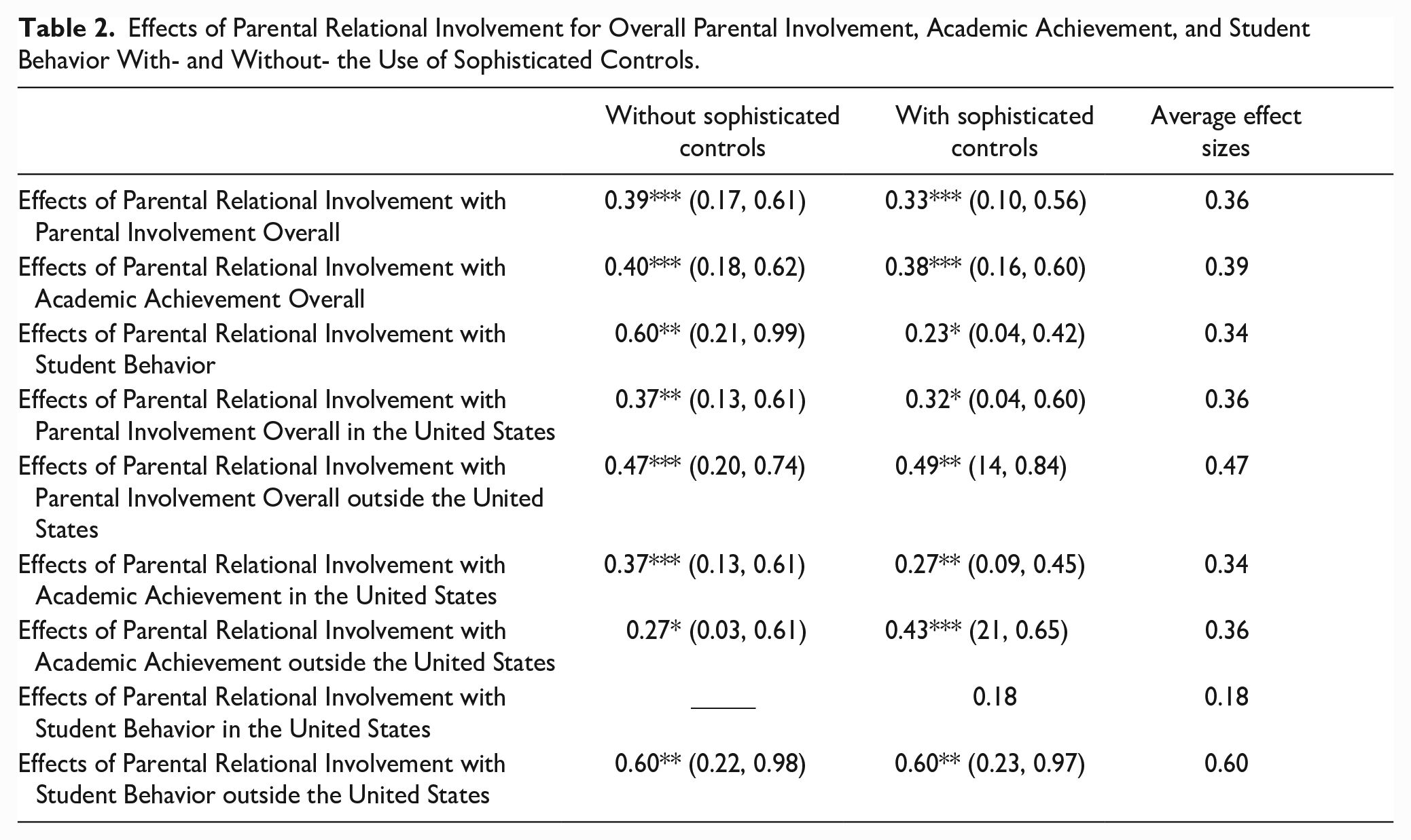
In addition to relational parental involvement being associated with higher levels of overall parental involvement and pupil academic achievement, with and without the use of sophisticated controls, there was a relationship with better student behavior as well. Relational parental involvement produced a statistically significant result of 0.60 (p < .01), 95% CI [0.21, 0.99], of a standard deviation unit, without sophisticated controls. For this variable, the inclusion of sophisticated controls did change the outcome more than in the cases of parental involvement overall and academic achievement, but the results were still statistically significant. The results were 0.23 (p < .05), 95% CI [0.04, 0.42].
Table 2 indicates that the effects for relational parental involvement were statistically significant for studies both within and outside the United States of America. First, there was an association between relational parental involvement and overall parental involvement. When sophisticated controls were not utilized, the results were 0.37 (p < .01), 95% CI [0.11, 0.63], of a standard deviation unit, for the American population and 0.47 (p < .001), 95% CI [0.20, 0.74] outside the United States. When sophisticated controls were included, the results were 0.32 (p < .05), 95% CI [0.04, 0.60], of a standard deviation unit, for the American population and 0.49 (p < .01), 95% CI [14, 0.84] outside the United States. The inclusion of sophisticated controls did not change the outcome much.
Second, there was an association between relational parental involvement and student academic achievement, for both the studies including Americans and those from countries other than the United States. When sophisticated controls were not utilized, the results were 0.37 (p < .001), 95% CI [0.13, 0.61], of a standard deviation unit, for the American population and 0.27 (p < .01), 95% CI [0.09, 0.45] for students outside the United States. When sophisticated controls were included, the results were 0.32 (p < .05), 95% CI [0.03, 0.61], of a standard deviation unit, for the American population and 0.43 (p < .001), 95% CI [21, 0.65] for students outside the United States.
Third, there was a relationship between relational parental involvement and student behavioral outcomes for studies that included populations of students outside those in the United States, but not for pupils in the United States. Moreover, in the case of the students outside the U.S.A., the effects were 0.60 whether or not sophisticated controls were included in the analysis. When sophisticated controls were not utilized, the results were 0.60 (p < .001), 95% CI [0.22, 0.98], of a standard deviation unit. When sophisticated controls were included, the results were 0.60 (p < .001), 95% CI [23, 0.97]. With the American students, the effects approached but did not reach statistical significance at 0.18.
Results for Students in Elementary-, Middle-, and High School
The general trend in the data is that when the analyses were averaged out after combining the results of analyses with both the non-inclusion of sophisticated controls and their inclusion, the effects of relational parental involvement did tend to rise with the grade level of the student. In the case of the association between relational parental involvement and overall parental involvement the average effect sizes were 0.35 for those in elementary school, 0.40 for middle school, and 0.42 for secondary school. Although the differences between these results were not statistically significant, the trend is there. Moreover, the effects for relational parental involvement were statistically significant for elementary-,middle-, and secondary grade levels.
A similar trend emerged the association between relational parental involvement and academic achievement. The average effect sizes were 0.33 for those in elementary school, 0.37 for middle school, and 0.39 for secondary school. Although the differences between these results were not statistically significant, the trajectory is noteworthy. Moreover, the effects for relational parental involvement were statistically significant for elementary-, middle-, and secondary grade levels.
For the association between relational parental involvement and student behavioral outcomes, there were not enough data to conduct an analysis at the various grade levels.
Findings When Adjusted for the Quality of the Study
Table 3 indicates that the effects for relational parental involvement with overall parental involvement, academic achievement, and student behavioral outcomes for high quality studies were very similar to the overall results for the meta-analysis. The effects of those studies with quality ranking of 2 and 3 were 0.37** (p < .01), 95% CI [0.13, 0.61] when sophisticated controls were not used and 0.31** (p < .01), 95% CI [0.09, 0.53] when they were; quite close to the effects for the entire meta-analysis. The results for studies limited to a quality rating of 3 were 0.35** (p < .01), 95% CI [0.12, 0.58] when sophisticated controls were not used and 0.29* (p < .05), 95% CI [0.05, 0.53], when they were. For the association between relational parental involvement and academic achievement, the effects of those studies with a quality ranking of 2 and 3 were 0.38** (p < .01), 95% CI [0.12, 0.64] when sophisticated controls were not utilized and 0.36** (p < .01), 95% CI [0.11, 0.61], when they were. Slightly smaller effects emerged, when these controls were included. The numbers were slightly smaller when only those with a quality ranking of 3 were examined.
Effects of Parental Relational Involvement for Overall Parental Involvement, Academic Achievement, and Student Behavior With- and Without- the Use of Sophisticated Controls for High Quality Studies and Different Age Groups.

Note. NA = Not Applicable.
For high quality studies that examined student behavioral outcomes the pattern was slightly different. When sophisticated controls were not included in the analysis of studies with a quality rating of 2 to 3, the effects were 0.58** (p < .01), 95% CI [0.19, 0.97]. When sophisticated controls were included in the analysis, the effects were 0.38* (p < .05), 95% CI [0.10, 0.66]. When the analyses were limited only to the studies with a quality rating of 3, the effects were 0.55** (p < .01), 95% CI [0.17, 0.93], (0.17, 0.93) when there were no sophisticated controls and 0.36* (p < .05), 95% CI [0.09, 0.63], when there were.
The meta-analytic results that include only high quality studies (those rated only 3 out of 3 or 2 or 3 out of 3) are important, because they should confirm the overall results of the meta-analysis. That is, if the effects of the high quality studies approximate those of the overall meta-analysis of all the studies, one will get the impression that the statistical summary that the meta-analysis provides is an accurate and high quality one. If, on the other hand, the results apparent in the high quality studies are a good deal smaller than what results manifest themselves in the overall meta-analysis, this is not a particularly good sign. It could suggest that any robust findings could be a result of a number of studies undertaken using hastily combined procedures rather than high quality ones.
Examining the Effects of Relational Parental Involvement for Minority Students
In addressing the association between relational parental involvement and the other variables under examination, because almost none of the studies outside the United States identified racial minority students, there were not that many studies that distinguished between studies that used- and did not use sophisticated controls. Therefore, in this set of analyses both studies that included sophisticated controls and those that did not were included in the meta-analysis together. The results indicated a strong association between relational parental involvement and academic achievement 0.66 (p < .01), 95% CI [24, 1.08] and relational parental involvement and student behavioral outcomes 0.33 (p < .05), 95% CI [05, 0.61]. However, the association between relational parental involvement and overall parental involvement approached, but did not reach statistical significance (0.17, p > .05).
Discussion
Relational Parental Involvement and Overall Parental Involvement (i.e., Research Question #1—Whether There is a Statistically Significant Relationship Between Relational Parental Involvement and the Extent of Parental Involvement Overall)-
The more meta-analytic work is done on parental involvement, the more it becomes clear that over the last two decades the academic community has learned a good deal more about this topic that can be utilized by both educators and families. Until 20 years ago most theorists focused on school-bases parental engagement which admittedly has a positive influence on the outcomes of children and adolescents. Nevertheless, through especially meta-analyses and the examination of nation-wide data sets, the evidence is clear that home-based parental involvement, which is often more subtle in its manifestations, has a considerably larger influence, on average than school-based parental participation. The findings of this meta-analysis regarding relational parental involvement, which is not entirely home-based, but is more home-based than school-based, apparently confirms this overall trend.
Taken together with the results of other meta-analyses on parental involvement, the overall trend is clear, that is, interactions matter. Interactions and relationships that are highlighted by consistency, love, and balance apparently are more important than simply engaging in the right activity. Admittedly, a lot of writings in sacred texts in churches, synagogues, and other houses of worship have communicated these same conclusions for centuries. However, the availability of meta-analytic data to support these conclusions will make it more likely that these truths will actually be practiced.
Research Question #2—Whether There is a Statistically Significant Relationship Between Relational Parental Involvement and Pre-kindergarten-College Urban Student Achievement
The findings that children thrive academically when there is a foundation of positive and upbuilding parental relationships with the other parent, teachers, and their children should be an encouragement to many. A plethora of parents are frustrated by not being able to attend every school function that they would like. However, they can be encouraged that finding the time to love, care, and connect yields, on average, positive results.
Research Question #3—Whether There is a Statistically Significant Relationship Between Relational Parental Involvement and Pre-kindergarten-College Urban Student Behavior?
The results clearly show a strong association between relational parental involvement and student behavioral outcomes, when sophisticated controls are not included in the statistical analysis. The effects are not as strong when sophisticated controls are included. Nevertheless, both sets of analyses are statistically significant. There are two questions, in particular, that arise, as a result of the analysis. First, why is the result so large, when sophisticated controls are not included? Second, why is the difference in effects pretty substantial, depending on whether or not sophisticated controls are included?
There is a real possibility, based on this meta-analysis, that relational parental involvement is even more strongly related to student behavior than it is to scholastic outcomes. There are many other studies that are included in meta-analyses, that suggest that the presence of a father in particular, has a greater positive impact on student behavior than it does on academic achievement (e.g., Jeynes, 2015). In a real sense, this combination of results makes perfect sense.
Regarding the second point, a large part of relational parental involvement is based on the quality of the relationship that exists between the parents. This includes examining non-intact families. When there is a broken family, whether it is caused by divorce, an out-of-wedlock birth, etc., research indicates that this has a huge impact, on average, on socioeconomic status (SES). Family dissolution particularly has an impact on family income. To the extent that the family dissolution component of relational parental involvement causes a reduction in SES, especially the income component of this measure, is the cause of the decline in SES, the result that includes sophisticated controls likely understates the actual relationship.
Research Question #4—Are the Effects for Relational Parental Involvement About the Same for U.S. Urban Studies Versus Those Urban Studies Outside the U.S.?
It is apparent that relational parental involvement has at least as much of an impact in foreign nations, as it does in the United States. This is in contrast to other studies that indicate that there are some aspects of parental involvement that have less of an impact in foreign nations, as they do in the United States. Further study is clearly needed to determine why, but it is conceivable that in foreign nations, on average, the efficacy of relational parental involvement could compensate for other facets of parental involvement that tend to especially thrive in the United States.
Research Question #5—Are the Effects of Relational Parental Involvement Greater for Certain Ages of Urban Students?
This research question yielded some interesting results, indicating that, on average, the effects of relational parental involvement appear to steadily increase from elementary school to middle school to high school. This finding is quite salient in terms of appreciating the value of relational parental involvement. The reality is that meta-analyses and other research indicates that a number of parental involvement components decline in their efficacy over the years a student spends in school. However, apparently with relational parental involvement this is not the case.
Research Question #6—Did Studies Identified as Being “High Quality” Demonstrate Similar Results as Analyses Examining the Entire Sample?
As noted in the Results Section, the effects of high quality studies are quite similar to those found for the analyses done for all of the studies combined. These results apply to relational parental involvements associations with overall parental involvement, academic achievement, and behavioral outcomes. Table 3 indicates that the effects for relational parental involvement for both sets (studies rated 3 only and those rated 2–3). The effects of relational parental involvement for both sets of high quality studies were associated with higher levels of parental involvement overall at levels, quite similar to the effects found for the entire study. The effects tended to be mostly in the mid-.30s without sophisticated controls and around 0.30 with sophisticated controls. The effects that emerged for high quality studies were also similar to the overall results in the cases of academic achievement and student behavior.
Research Question #7—Are the Effects of the Relational Parental Involvement Component of Parental Involvement Approximately the Same or Different for Minority Students Versus Majority Students in These City Settings?
Given that a large percentage of the students included in this meta-analysis were children of color, there is no question that the findings that emerged for relational parental involvement apply to children of color. Nevertheless, although American studies did a good job of distinguishing these students from others included in the studies, studies outside the United States need to do a better job in this regard, so that more specific comparisons are easier to make.
Final Thoughts
Perhaps the most remarkable finding regarding the effects of the relational parental involvement is its consistency across almost all variables. The results are consistent across age, race, gender, academic measure, and scholastic subject. These findings are encouraging and suggest that relational parental involvement may be of help across population groups.
Footnotes
Declaration of Conflicting Interests
The author declared no potential conflicts of interest with respect to the research, authorship, and/or publication of this article.
Funding
The author received no financial support for the research, authorship, and/or publication of this article.
