







Abstract
Modern society is organized as a social hierarchy, and individuals of higher status enjoy access to various advantages. Pierre Bourdieu, attempting to quantify social hierarchy, argued it can be observed through an individual’s possession of three intertwined, yet distinct, types of capital: economic capital (material resources), cultural capital (level of education) and social capital (social networks). It also known that acquiring higher education (greater cultural capital) is positively correlated with an increase in an individual’s income (economic capital). Our study examined whether population groups of two community types in Israel – Kibbutz (based on socialist principles) and Urban (based on capitalistic principles), held different views regarding encouraging their children to acquire higher education, as viewed through the prism of the three types of capital. We conducted a qualitative study of in-depth interviews with two population groups (15 individuals per group), one residing in Kibbutz, the other in Urban areas. Our study found significant differences in how each group guides their children to acquire higher education, a phenomenon which could increase inequality in Israeli society.
Introduction
Western Capitalistic society is structured as a social hierarchy, with various population groups placed on different levels within this structure, with known advantages and disadvantages to an individual’s position in the hierarchy (González et al., 2016). Bourdieu (Bourdieu, 1984, [1986] 2010), proposed examining the three types of capital an individual hold, to determine their rank within the social hierarchy: economic capital (their material resources), cultural capital (their level of education) and social capital (their social network). These three capital types form a blend of separate, yet intertwined, elements.
A unique form of settlement exists in Israel, rarely found in other Western countries: a form of collective settlement, originally founded based on communist principles and becoming more of a socialist nature over time, while gradually assimilating western capitalistic culture (Kahana & Kaminer, 2020). Little attention has been devoted to studying the changes that have taken place – and continue to occur – with the Kibbutz society, with a constant infiltration of Western capitalist values as part of a globalization and modernization process.
Furthermore, the relationship between the Kibbutz settlement form, whose position in the social hierarchy differs from that of Urban settlements – which are for the most part based on Western Capitalistic principles, with regard to education and acquiring higher education.
Therefore, we chose to investigate this phenomenon, while examining it in the context of Bourdieu’s theory of the three types of capital (Bourdieu, [1986] 2010).
It is known that a higher level of academic education will increase an individual’s chances of moving up in the social hierarchy, as well as obtaining high income work, stable employment and job security (Marginson, 2019). This also increases economic capital. Furthermore, the third type of capital, social capital – interconnected with the first two capital types, also benefits individual’s who possess it more widely and broadly.
In this context, our study will examine whether there are differences between two populations in Israel – Kibbutz and Urban dwellers, in how they direct their children to pursue higher education? Additionally, we explored the three types of capital among these two groups, in an attempt to distil the relationship between the types of settlement, the three capital types, and the application of values emphasizing the importance of high education, while considering two distinctively different worldviews, the capitalist and the socialist.
Social Hierarchy in Modern Society
Social hierarchy is the ranking of individuals, based on their possession of wealth and material comfort (McMaughan et al., 2020). The first to try to quantify it was Karl Marx, framing it as the class struggle taking place in society (Marx, [1867] 1972). In Marx’s view, social status does not indicate a social group, but rather reflects exploitative relationships with a wealthy group leveraging it’s resources to further increase the capital in its possession – while maintaining their position of privilege and preventing other groups from encroaching on their advantages.
In capitalist society, a dichotomy exists between two classes – the capitalists (bourgeoisie) and below them, the working class (proletariat). Their established class relations define that the working class is subordinate to the capitalist and accordingly produce goods under constant supervision, through the “labor process,” for the capitalist’s use, (Marx & Engels, [1848] 1967).
Three Forms of Capital
In addition to Marx’s theory, we also refer to Weber’s theory of status, Lenski’s “Status crystallization” (Lenski, 1954, 1956), Wright’s (1979) “theory of contradictory situations,” and Goldthorpe’s ideas (Goldthorpe, 2010; Goldthorpe et al., 1982). The currently prevailing theory regarding an individual’s position in the social hierarchy and their possession of different types of capital, is that coined by Pierre Bourdieu (Bourdieu, 1984): “Capital” includes all material and symbolic goods within a social structure, whose scarcity justifies the effort expended in attaining them (Bourdieu, [1986] 2010). This framework combines three distinct, yet connected, elements:
The three forms of capital all contribute to an individual’s economic capital. A person with a high level of social capital can leverage it to increase their economic capital, which can then be converted into material gain (e.g., when they learn of a prestigious job position) or to accumulate more cultural capital (e.g., networking with experts – which increases the individual’s cultural capital). On the other hand, an individual with little cultural capital will not enjoy these privileges. The upper tier is populated by those possessing large amounts of these types of capitals, while those who have none will be positioned at the bottom. And over time, these social gaps will grow (Bourdieu, 1999, [1986] 2010).
The Kibbutz in Israel: History and Evolution
The Kibbutz movement represents a distinctive form of community and socio-economic organization. It originated with early 20th century Zionist efforts to establish a new way of life and settle in (then) Palestine. The Kibbutz in Israel was traditionally considered an agriculture-based community. The pioneer Kibbutz, named with the Hebrew word for “gathering” or “cluster,” were founded on principles of equality, joint work and communal (rather than personal) property (Kahana & Kaminer, 2020). The founding members sought to realize socialist and communist ideals, transform Jewish society and create a bond with the land. The Kibbutz functioned not only as agricultural outposts, but also as defense lines and played a crucial part in the establishment of the infrastructure for the State of Israel. The Kibbutz development can be outlined in several stages – from idealism and growth during the pre-state era, to the formation of the movement following the 1948 War of Independent and the crisises and challenges resulting from shifting social and economic circumstances- transforming Israel into a Western capitalist state (Melber et al., 1999).
Later years were characterized by the transformation of Kibbutz from their original form, to adapt to modern social and economic conditions. During the 1980s and 1990s, many Kibbutz underwent privatization – and reinvented themselves to cope with economic hardship, shifting toward a more individualistic and capitalistic model (Moskovich, 2023). This process included diminishing communal living quarters, implanting differential wages and, in some cases, launching new residential initiatives, as well as entrepreneurship.
The ideological shifts were significant, and are reflected in the Kibbutz’s attempts to balance their core values with an emerging reality of a competitive global economy. These changes resulted in the heterogenous nature of the contemporary Kibbutz movement, varying from the traditional collectives to the privatized more individualistic communities (Ben-Rafael & Topel, 2017). Therefore, the Kibbutz evolution highlights extensive sociological issues with regard to modernism, communal life, and the negotiation between collective and individual identity.
The Kibbutz These Days: Demography and Cultural Changes
The demographic profiles and the social-cultural dynamics existing in contemporary Kibbutz offer an intriguing sociological study. Recent studies have examined the transformations in the Kibbutz population and culture, reflecting broader social trends and internal evolution within these unique communities. The Kibbutz residents, formerly mostly a homogenous group seeking a socialist lifestyle, have diversified in both socio-economic backgrounds and personal ideological viewpoints (Blasi, 2017).
Kibbutz residents comprise a small percentage (approximately 1%) of the Israeli population. However, this figure does not reflect the cultural and economic impact of these communities on the Israeli nation. The Kibbutz’s’ worth is commonly described as disproportional to their size, contributing significantly to agriculture, industry and security (Barkin & Bennet, 2020). Recent data indicate there are 270 Kibbutzim across Israel, although the numbers vary in wake of privatization and merging of some communities (Ben-Rafael, 2020).
The move toward privatization and differential wage systems, where Kibbutz members have different incomes based on their occupation, is a complete departure from traditional collective ideology of equal sharing among members. This change has been extensively studied, revealing complex reactions among Kibbutz members, as they attempt to reconcile the benefits of financial incentives with the values of communal living.
Furthermore, the demographic distribution within the Kibbutz has shifted dramatically. The original Ashkenazi Jewish population became increasingly multi-cultural with members of diverse ethnic background, mirroring the patterns of immigration to Israel. Notably, the Kibbutz communities display a multi-generational structure, with many members being descendants of the founding generations (Palgi & Reinharz, 2014). This has sparked discussions about preserving the original Kibbutz values in view of the challenges facing modern Israeli society.
Another characteristic of the change in Kibbutz life has been the role of women and the evolution of gender roles. Historically, Kibbutz strove for gender equality, with women participating in all forms of labor and administration. Nonetheless, there is still room for improvement regarding gender roles, especially in the area of caregivers and leadership, where traditional gender stereotypes tend to persist (Spiro, 2017).
With regard to cultural changes, Kibbutz have also adapted to global environmental and technological trends. Many have initiated eco-friendly practices, leveraging their traditional close ties with nature to adopt sustainable methods and renewable energy sources (Livni, 2017). Furthermore, digital technologies have influenced both economic structure and social life on Kibbutz, facilitating new communication channels, fostering entrepreneurship and encouraging educational initiatives among the community members (Manos & Gidron, 2021).
Research Question
Our study aims to answer the question: is there a difference between Urban and Kibbutz dwellers in Israel, regarding how they perceive the importance of their children acquiring higher education? At a higher level, we examined whether the urban and Kibbutz populations – who differ in their possession of the three types of capital – have different approaches in guiding their children to pursue higher education, as well as their perceptions and worldview regarding the importance of being educated.
Methodology
Research Approach
Our study uses a qualitative approach (constructivist) to describe phenomenon in general terms, rather than focusing on the specific individuals enrolled in the study. This approach helps explore the context of the phenomenon and reach a better understanding of reality.
Research Population
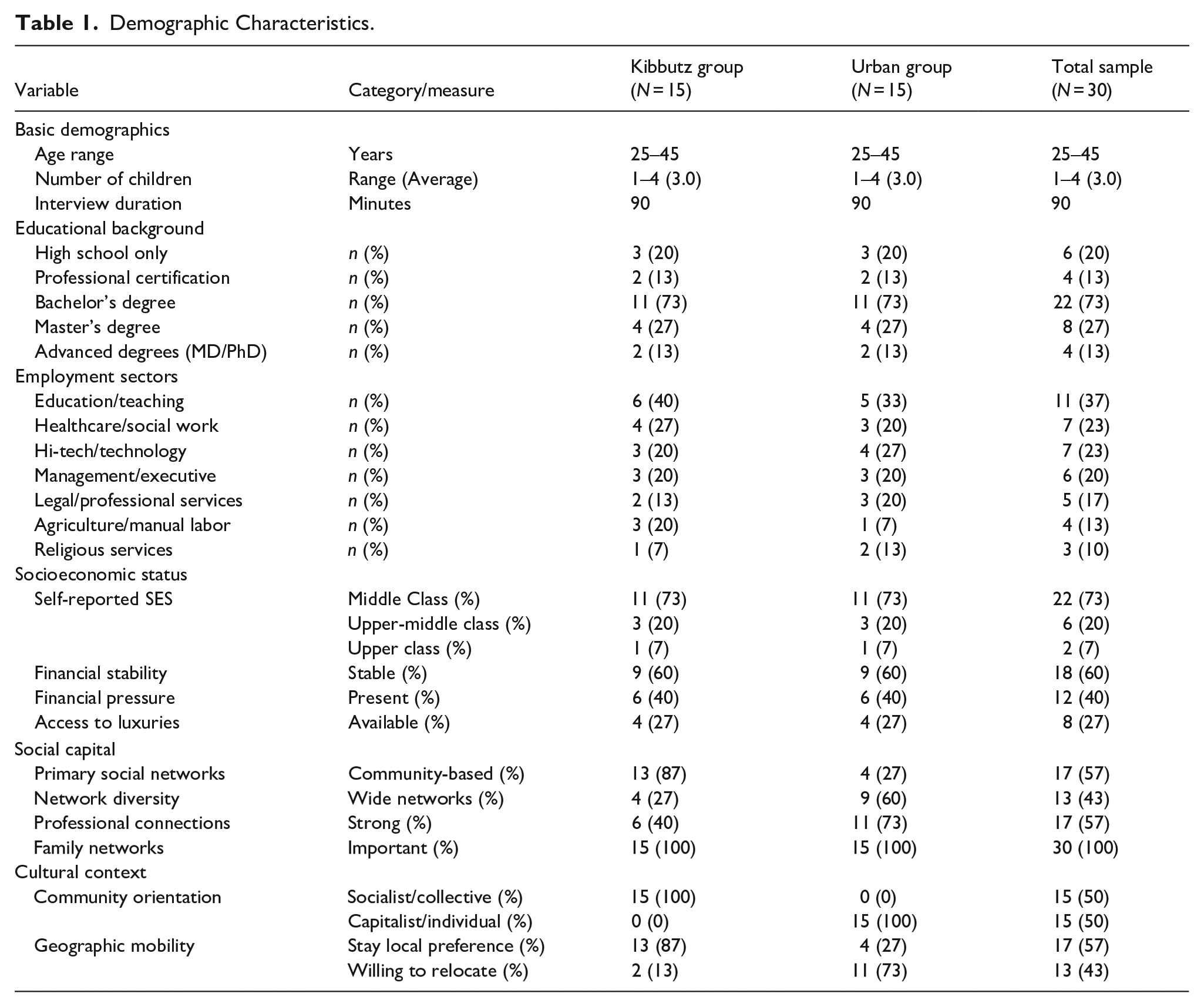
Our study included 30 interviewees, divided into two groups of 15 participants each. Group A included individual from the Kibbutz population in Israel, Group B included individuals from the urban population in Israel. Both groups were homogenous, ranging in age from 25 to 45, each family unit included 1 to 4 children, averaging three children per family. The only difference between the two groups was their residential type, urban versus Kibbutz (See Table 1).
Demographic Characteristics.
Research Tools
All 30 participants received an in-depth interview. The interview (Appendix A) included several categories (Shkedi, 2003) intended to assess the participant’s familial and socioeconomic background (in terms of their possession of the three types of capital), as well as examine their actions, beliefs and worldviews regarding the importance of acquiring higher education.
Part 1: Included background questions concerning the socioeconomic status of the interviewee’s family.
Part 2: Included questions regarding the perceptions of the interviewee’s family, in regard to the importance of acquiring higher education. This section had separate categories:
a. Actions regarding acquiring education, specifically higher education.
b. Attitudes and perceptions regarding acquiring education, specifically higher education.
Data Collection Procedure
We were aided by two research assistants, who received modest compensation for conducting the interviews. After instructing them on proper data collection procedures and interview techniques, our assistants interviewed each participant for approximately 1.5 hr. The full interviews are in our possession.
Data Analysis
We used text fragment analysis techniques (Shkedi, 2003) to analyze the data. At first we used “Conceptual Perspective” methods, followed by four stages of analysis:
a.
b.
c.
d.
Reliability
To enhance our study’s reliability, we hold records of all the interviews conducted by our research assistants. Furthermore, the analysis section includes numerous, varied examples of interviewees responses– all authentic and original – organized by the various categories established during the study.
Our study was approved by the Institutional Ethics Committee of the Western Galilee College.
Findings
During analysis of the data, we identified three overall themes. The first was a background variable of the studied population (the economic and cultural capital held by the participants). This variable was subdivided into two categories: the family’s socioeconomic status and parental education and occupation.
The second theme was also a background variable of the studied population (the participants’ cultural capital). The third theme was the object of our research (the attitude of parents from different community types regarding scholastic achievements, and the importance of higher education). This theme encompassed several key themes: the importance of higher education within the two populations, parental actions and resources invested in a future-oriented perspective, challenges faced by parents in supporting their children’s pursuit of higher education and beliefs about parental responsibility to encourage acquisition of high education.
First Background Variable: Economic Capital (Occupation and Income) and Cultural Capital (Parents’ Education)
Parental education ranged from high-school diplomas to advanced academic degrees, with most parents holding at least a BSc. One interviewee responded: “I have a bachelor’s degree and teaching certification for special education, my partner has a bachelor’s degree” (A.Y). There is a clear link between educational level and socioeconomic status, with holders of more advanced degree generally reporting higher status.
Parental occupations are diverse and trend toward academic and professional employment. Education, caregiving, hi-tech and management are among the leading areas of employment. “I work for one of the largest accounting firms in Israel, Brit Pikuach, I specialize in auditing” (N.)
Families of higher socioeconomic status tend to have more prestigious occupations in fields such as Medicine, Law and Hi-tech.
The number of children per family ranges from 1 to 4, averaging three children per family. No definitive connection between the number of children and the family’s socioeconomic status was observed.
The families’ financial situations vary significantly, with some reporting stability, while others face financial pressures: “There is no financial difficulty, we have no financial pressure, while I do dream of taking at least a year off from work, we don’t really have that option right now” (H.T). Another interviewee states: “We enjoy a high standard of living, but we are basically in survival mode financially, our salaries come in and we manage, but this was our decision to have a high standard of living, we own a home on the Kibbutz.” (Y.P)
It is evident that families of higher socioeconomic status report less financial pressure, and are able to afford “luxuries” such as trips abroad and extracurricular activities for their children.
To summarize, there is a clear connection between socioeconomic status and educational level and employment stability. Families with higher education and more prestigious occupations tend to report higher socioeconomic status and less financial difficulties. It is important to note that even families identifying as upper class are aware of the need for sound financial habits, and occasionally experience financial pressure, especially in regard to the purchase of housing on the Kibbutz.
Parental education ranges from high-school level to advanced academic degrees. Most parents acquired academic education and hold at least a BSc. Several parents have second or third degrees, for example: “Sivan, who is a Doctor of Medicine Sciences.” However, some parents had professional certification or only high school level education, and were employed in roles such as car mechanics or teacher’s aides.
Parental occupations are diverse and trend toward academic and professional employment. There is a variety of occupations, ranging from white collar careers, such as attorneys and hi-tech, to technical jobs and service providers – like car mechanics and synagogue sexton. The diversity of occupations indicates notable differences of income and socioeconomic status. The number of children per family ranges from 1 to 4, averaging three children per family. No definitive connection between the number of children and the family’s socioeconomic status was observed.
The families’ financial situations vary significantly, with some reporting stability, while others face financial pressures: “It is very difficult for us to afford enrolling our children in extracurricular activities and informal education” (I). While another interviewee responded: “My family doesn't have any economic pressure. We enjoy financial security, and can afford to purchase whatever we need, and more.”
Families of higher socioeconomic status tend to report less financial pressure and greater access to “luxuries,” such as trips abroad and extracurricular activities for their children.
In summary, there is a clear relationship between socioeconomic status, educational level and employment stability. Families with higher education and more desirable occupations tend to report higher socioeconomic status and less financial difficulties. Families identifying as upper class still exhibit awareness of the need for sound financial habits, and occasionally experience financial pressure.
Parents’ Education
In families of lower socioeconomic status, the educational level is lower, with more of them having only high school education or certificate studies. “I graduated from high school without a diploma, I've practiced Yoga for over 2000 hours, I’m a Yoga Instructor” (I.G)
In the area of employment, there is a variety of occupations, both on the Kibbutz and outside of it. High class families tend to have occupations such as Medicine, Law, Hi-tech and Senior Management. “I am the CEO of a Tourism Company” (M.). Among lower class families- more common occupations are Education, Services and Physical Labor. Incomes vary accordingly, with families of higher status reporting greater income: “Our household income is about 50,000” (C.S.).
There is a clear connection between educational level, occupation and economic status. Participants with higher education have more lucrative professions and a higher economic status. There are also successful business owners, who do not have higher academic education. Comparing men and women, it is evident that while many of the women are employed in fields related to education and caregiving, the men are more inclined to technical, managerial, or self-employed occupations. However, there are some women in senior management positions and in rewarding careers, such as medicine.
Occupation and education affect Kibbutz families’ financial stability and security. Families with higher education and high-income occupations report less financial pressure. “We don't experience financial pressure, but our daughter often does. She chose to live in New York and I can only wire her money occasionally” (I.G). Conversely, families with lower income face more financial challenges, especially connected to purchasing housing on the Kibbutz.
To summarize, our analysis shows that the Kibbutz population has a wide range of educational levels and occupations, which influence families’ socioeconomic status and financial security. While the Kibbutz provides a supportive framework, these differences in education and employment create economic and social inequality among families.
In families of lower socioeconomic status, the educational level is lower, with more cases of only high school education or certificate studies. “My education level is high school, I have 12 years of schooling and a high school diploma. My husband also completed 12 years of schooling, he does not have a high school diploma or an academic education” (Y.).
Regarding employment, there is a variety of occupations, both within their residential area and beyond. Families of higher socioeconomic status tend to have occupations such as Medicine, Law, Hi-tech and Management. “I’m the Lab Head at Sheba Hospital Tel Ha’Shomer, and my wife is the Dean of Medicine at Bar Ilan Galilee” (A.). We also heard from (A.Y.): “I’m employed as a sexton in a synagogue. This is a respectable job, however the wages are very low, my wife works as an assistant in an Orthodox daycare.”
There is an evident link between educational level, occupation and economic status. Participants with higher education have more lucrative professions, and report a higher economic status.
Comparing men and women, it is evident that while many of the women are employed in fields related to education, hi-tech, law and accounting, the men are more inclined to technical, managerial or self-employed occupations. However, there are some women in senior management positions and in lucrative occupations.
Occupation and education affect urban families’ financial stability and security. Families with higher education and high-income occupations report less financial pressure. “Our family doesn't experience financial pressure. Our employment is secure, we’ve been running the family business for years and our income is stable” (A.V). Meanwhile, (N.) described the financial pressure their family faces: “Yes, we have significant financial pressure in my family, we can barely cover our routine expenses like rent, groceries, clothing and our children’s needs. We pass up a lot of things and experience financial difficulty frequently.”
To summarize, our analysis shows that the urban families have a wide range of educational levels and occupations, which influence their socioeconomic status and financial security. These variations in education and employment cause economic and social disparity among the families.
Second Background Variable: Social Network Circles of the Parents (Social Capital)
Alongside the relationships within the Kibbutz, workplace connections are also important, especially for those employed outside the Kibbutz. Family ties are also significant, with some interviewees mentioning being close with their extended family. There are also connections formed through hobbies and leisure activities.
The occupations of their social networks mostly reflect the socioeconomic levels of the families. Families with higher socioeconomic status tend to connect with individuals in similar or parallel professions. “My friends are doctors or in the nursing field, my husband’s are from hi-tech and industry” (K.S.). Families of lower socioeconomic status tend to maintain relationships with others engaged in similar professions, mainly in the fields of education, services and skilled trades.
Kibbutz families engage in extensive leisure activities, however there are marked differences between different classes. Families of higher socioeconomic status can afford more trips abroad, dining out and costly leisure activities. “They are all enrolled in extracurricular programs, mainly on the Kibbutz. We try to create family experiences, nature trips, not so much overseas, but we do go on hikes frequently. Rather than visiting museums, we prefer to explore nature and our surroundings” (A.G).
There are significant differences in the size and nature of the social networks of the different classes on the Kibbutz. Families of higher status report wider social networks, including more connections outside the Kibbutz. Families of lower status tend to form relationships within the Kibbutz and with immediate family.
There is a clear link between the socioeconomic status of Kibbutz families and the nature and size of their social networks. Families of higher status enjoy wider social networks, which provide greater opportunities for professional and social connections. “We have our social circle of friends on the Kibbutz, and we have other circles outside the Kibbutz, and I have a network of friends from my military service that we still keep in touch” (Y.).
In summary, our analysis shows that the social networks within Kibbutz reflect the economic and social transformations they have undergone. While the Kibbutz remains a key source of social connections, the variations in socioeconomic status lead to disparity in the size, nature and variety of social networks. Families of higher status enjoy broader social networks that grant more opportunity for professional and social connections, whereas families of lower social status tend to focus more on local and familial connections.
In summary, our analysis shows that the social networks within Kibbutz reflect the economic and social transformations they have undergone. While the Kibbutz remains a key source of social connections, the variations in socioeconomic status lead to disparity in the size, nature and variety of social networks. Families of higher status enjoy broader social networks that grant more opportunity for professional and social connections, whereas families of lower social status tend to focus more on local and familial connections.
“I have several social networks, my family circle, which is the family I created and my sisters, my social circle of co-workers at my current job and people who studied with me during my academic years, and a circle of close childhood friends who still keep in touch” (S.)
In addition to work connections, family is important. some interviewees, especially women, mention close ties with extended family. All interviewees emphasized the importance of the familial relationship. There are also relationships formed at work: “I have a variety of social networks including my family, I am close with my three sisters, friends from work, school, childhood friends and social circles based on parents of my children's friends and classmate” (H.).
The occupations of the people in the social circles often reflect the socioeconomic status of the families themselves. Families of higher status tend to maintain relationships with those in similar professions. For example, (A.) Laboratory Head at Sheba Hospital stated: “I feel a sense of belonging within social circles of research and science professionals, entrepreneurs, politicians and academics.”
Families of lower social status connect with others in similar occupations. (N.), a sexton in a synagogue notes: “My social circles are comprised of people who pray in the synagogue, I have a few friends left from the Yeshiva, those who didn't move after we married. My family and I are members of a small, closeknit Orthodox community in the town of Safed.”
There is a strong link between socioeconomic status and the breadth of social networks among urban dwellers. Families of higher status enjoy larger social networks, which afford them many opportunities for professional and social connections.
In summary, social networks among urban dwellers reflect their economic and social development. Variations in socioeconomic status result in disparities in the scope and nature of these networks. Families of higher status benefit from broader social networks that offer more opportunities for professional and social connections, while families of lower social status tend to emphasize local and familial relationships.
Parents’ Attitudes – Regarding the Importance of Their Children’s Educational Attainment
Families of higher socioeconomic status attribute great value to higher education. The parents tend to view education as the key to personal and professional success: “Education is the best way to guarantee our children’s future. Beyond acquiring knowledge, they also develop critical thinking and life skills that will benefit them in all aspects of life” (M.L.). Parents place great importance on the prestige of the academic institution, and encourage their children to enroll in leading universities.
Families of lower socioeconomic status have a markedly different outlook. While they recognize the importance of education, they focus more on acquiring professional skills that will ensure financial security: “It’s important for the children to choose a field they can earn a living from. It doesn’t have to be an academic degree; professional certification could be adequate” (I).
Parents mention a variety of reasons for valuing higher education. Higher class families emphasize personal and professional development, pursuing a meaningful career and creating social and professional networking: “Higher education opens doors. It’s not just the knowledge, it’s also the people you meet and the connections you make” (A.K.). Families of lower socioeconomic status focus more on financial stability and job security.
The impact of education on employment prospects and social standing is viewed as significant by parents, but with different emphases. Among parents of higher socioeconomic status, higher education as viewed as a crucial element for success: “In today’s world, an academic degree is just the starting point. You need advanced degrees to really stand out” (Y.P.). Meanwhile, parents of lower socioeconomic status recognize the importance of education, but also point out the value of practical skills and work experience.
In conclusion, Kibbutz parents recognize the importance of education, although different classes focused on varying aspects. Families of higher socioeconomic status tend to view higher education as the key to success – and a way to secure a promising future for their children, emphasizing the academic institution’s prestige and the personal and professional growth opportunities that education can offer. Whereas, families of lesser socioeconomic status also recognize the value of education, but tend to focus more on the practical benefits – such as employment potential and earnings. The perception of education among Kibbutz members has clearly undergone major transformation, and is now viewed as central element in shaping children’s future, both economically and socially.
Families of higher socioeconomic status place greater value on higher education. Parents are inclined to consider education a critical element to professional success: “Nowadays, education is the key to personal advancement, and someone lacking it is considered less successful in their independent adult life. This also makes adult life more difficult, which is why my husband and I are actively committed to providing our children with an education, making life easier for them in the future, and opening up opportunities” (S.)
While families of lower socioeconomic status also recognize the importance of education, they tend to focus more on satisfaction and avoiding hardship: “From my perspective, with no education and the challenges I faced in finding suitable employment, my children’s education is very important to me. However, my partner sees things differently, she believes the children should do what is best for them, and that not everyone is interested in academic studies, so she doesn’t urge them in that direction” (Y.)
Parents note several reasons for valuing higher education. Families of higher socioeconomic status stress personal and professional growth, developing a successful career and forming social and professional connections: “It is my belief that education and guidance are crucial cornerstones in my children’s lives. I consider them to be crucial tools for success in life, both personally and professionally” (A.)
Parents regard the impact of education on employment opportunities and social status as substantial. Among those of higher socioeconomic status, education is considered an essential condition for success in life: “It is very important for my children to obtain higher education, it opens doors and helps them achieve more in life” (A.). Parents of lower socioeconomic status acknowledge the value of education, but place emphasis on practical skills and experience.
Overall, urban parents widely acknowledge the importance of education, with emphasis on different aspects, depending on socioeconomic status. Families with higher socioeconomic status generally view higher education as a key success factor and a means of securing a promising future for their children, emphasizing the academic institution’s prestige and the personal and professional growth opportunities education offers. Families of lesser socioeconomic status also assign value to education, but generally place more emphasis on the practical and employment aspects.
Theme 1: The Importance of Higher Education for Children Among the Two Populations
The motives for considering education important can be inferred from the parents’ occupations. Statements such as “I'm a social worker and Director of a Psychiatric Assisted Living Faculty” (H.T) imply that education is viewed as an instrument for professional development and social contribution. There is a clear link between educational level, occupation and economic status.
Despite the absence of direct reference to the Kibbutz core values in the context of education, there is evidence of a blending of Kibbutz ideals and personal aspirations. Statements like: “I've been a Customer Account Manager in Shlomo Sixt for the past 13 years, my husband works in Cool Vision, a hi-tech company,” denote the significance of personal development alongside supporting the community.
In conclusion, the interviews paint a clear picture of the value Kibbutz parents assign to higher education, both for professional development and contributing to the community. This outlook blends traditional Kibbutz ideals and current trends of personal and professional growth.
A blend of parental values and attitudes toward their children’s education are expressed by statements like, “My wife believes in education and wants them to be educated, to contribute to society as much as possible, to be curious, to question, and to seek knowledge out of interest and an authentic desire to learn, because only when you do something out of true passion, does it turn out for the best” (A.). This implies the significance placed on community contribution along with personal growth.
In conclusion, the interviews illustrate the value urban parents ascribe to higher education, both for professional growth and as a mean for community contributions. This perspective combines urban values and current trends of personal and professional growth.
Theme 2: Parents’ Actions and Resources Dedicated to Their Children’s Pursuit of Education
The motivation to support their children’s combination seems to combine the desire to secure their future with the Kibbutz communal ideals. As described by A.G: “I bring what I believe in. To me, Yoga is a way of life, listening, serenity, contributing to the community, a healing tool.”
The challenges Kibbutz parents encounter in relation to their children’s education are linked to financial status and geographical location: “I don't know anyone who doesn't. We just built a house on the Kibbutz, and on a Kibbutz you have to come up with the capital up front, you can’t just take out a mortgage” (A.K). This statement indicates financial pressures which could impact the ability to invest in education.
The strategies parents use to foster their children’s education, include investing in clubs and enrichment activities, as well as emphasizing the values of learning and personal development. “I bring them along most of the time; everything has to be done with humor and kindness, and a lot of sensitivity.” (H.T). This highlights an educational approach emphasizing soft skills, in conjunction with formal knowledge.
Overall, Kibbutz parents invest significant resources in their children’s education, blending traditional Kibbutz values and mindfulness to the importance of education in in the modern world.
In conclusion, it is evident that Kibbutz parents invest significant resources in educating their children, combining traditional Kibbutz values – with recognition of the importance of education in the modern world. These efforts include financial and emotional support, as well as imparting the value of education and personal development. They face unique obstacles related to the Kibbutz social and economic structure, which impacts their ability to invest in their children’s education.
In summary, urban parents devote substantial resources to their children’s education, blending traditional values with recognition of the importance of education in the modern world. This investment includes both financial and emotional support, as well as conveying the importance of education and personal development. However, there are distinct challenges in regard to the family’s social and economic structure, influencing their ability to promote their children’s education.
Theme 3: Challenges by Parents From Both Settlement Types in Pursuit of Their Children’s Education
The impact of these obstacles on parent’s ability to promote their children’s education is significant. Some parents find themselves having to choose between education and other expenses: “We don't experience financial pressure, but our daughter often does. She chose to live in New York and I can only send her money occasionally” (I.G). This demonstrates the challenge of supporting higher education, especially when it involves relocating to a distant area.
In spite of these obstacles, Kibbutz parents adopt various coping strategies. Some stress the importance of education as a long-term investment. Another leading approach makes use of the Kibbutz communal resources: “I’m the Kibbutz Cultural Director, my husband works in construction and owns his own company” (A.G). This demonstrates how parents combine employment on the Kibbutz with career development, which could allow them to support their children’s education.
To conclude, Kibbutz parents face a variety of challenges when providing education for their children, including financial pressure, geographical location and occasional conflict with traditional Kibbutz practices. Nevertheless, they have adopted creative coping strategies, utilizing the unique benefits of Kibbutz life, while balancing communal values and personal aspirations.
Another issue is lack of time: “The main challenge our family faces is finding time to help with schoolwork and assignments, as well as prepare for exams. We do our best to dedicate time” (A.) These scheduling constraints reduce the children’s options and limit their choices of study topics. “One of my children has ADD and takes Ritalin, so it’s not simple. Adjusting the dosage and medication was a complex process with health implications. My husband understood this was necessary for them to pursue education and was supportive” (S.).
In conclusion, urban parents face a variety of obstacles to acquiring education for their children, including financial pressure, health concerns and most of all - the parents’ busy schedules. Their main trade-off is in balancing the practical financial constraints of urban living, with the desire to grant their children the best possible educational opportunities.
Theme 4: Parental Beliefs Regarding Their Responsibility for Their Children’s Education
Parents’ view of their role in advancing their children’s education is varied. Some see it as complementary to the Kibbutz education system, as stated by M.: “I am the CEO of a Tourism Company, alluding to the shared responsibility between parents and the community.”
The conflict between parental responsibility and Kibbutz ideals are most evident in the context of financial investment in education: “I don't know anyone who doesn't. We just built a house on the Kibbutz, and on a Kibbutz you have to come up with the capital up front, you can’t just take out a mortgage” (A.K). This statement highlights the tension between the desire to invest in the children’s future- and commitment to the Kibbutz principles of sharing and equality.
The main reasons noted by parents for the importance of their involvement in their children’s education refer to the desire to secure a better future for their children, and provide them with opportunities- which the parents themselves lacked. As stated by one mother: “I think that first and foremost is ‘honor your father and mother so that their days may be long’, seeing others and not just yourself, honoring our body with nutrition and modesty” (I.G.), emphasizing the importance of imparting skills and values for personal development.
In conclusion, Kibbutz parents feel responsible for their children’s education, and face the challenge of reconciling Kibbutz values with their personal aspirations. However, they must deal with the dilemmas arising from the tension between their desire to provide their children with the best opportunities, and their commitment to Kibbutz ideals of equality and sharing. A balance must be achieved between their personal parental obligation and the communal role of the Kibbutz in educating the next generation.
To summarize, urban parents have a keen sense of responsibility for the children’s education, and must deal with several challenges. Their own education impacts how they guide their children in pursing education. Some parents, primarily those who do not hold academic degrees or diplomas, encourage their children to attain education in order to avoid the hardships the parents experienced in their own jobs (namely physical labor). Others believe that a sense of responsibility will lead their children to pursue education and secure a promising future, security and stable income.
Discussion
While collecting and analyzing the data, we identified differences between the two population groups in our study. Systematically, for the majority of variables examined, characteristics of a socialistic lifestyle continued to hold a central role for the Kibbutz population whose communities were founded on socialist (and even communist) philosophies. Whereas the urban population consistently emphasized values aligned with Western capitalist views, which is more deeply rooted in our era as a result of modernization processes.
The three types of capital (Bourdieu, 1986) for these populations exhibit these findings. With regard to our participants’ social capital (their social networks), it appears that the Kibbutz population tends to form close social bonds with other Kibbutz members (Bott, 1957) – both childhood friends and others who relocated later on to the Kibbutz – and they also tend to participate frequently in social activities taking place on the Kibbutz. This behavior corresponds to Coleman’s definition of social capital, as the framework of an individual’s privileges and obligations within their community (Coleman, 1988).
On the other hand, it would appear that the social ties of the urban population are more scattered, and they tend to connect more with classmates and work colleagues. These relationships seem based more on professional and occupational interests, and may advance them in terms of their social status and position in the social hierarchy.
In terms of the cultural capital held by both populations, it appears that Kibbutz members tend to acquire higher education at a limited number of academic institutions circumscribed by their geographical area. There appears to be some barrier which preserves Kibbutz members’ desire to remain close to their familiar environment, and reluctance to disengage from their intimate community. Conversely, the urban population exhibits decentralization in this regard as well in the context of cultural capital, pursuing higher education in more distant academic institutions, sometimes at great distance from their city of residence. This phenomenon indicates the greater inclination of the urban population to move away from their familiar environments in the pursuit of advancement, in alignment with the capitalist lifestyle, which emphasizes independence and individuality.
With regard to the third, and most critical type of capital – economic capital, the urban population showed more of a tendency to attempt and increase it, with emphasis on the importance of a personal career and individual professional advancement. This population also expressed a greater sense of financial security in accordance with their income (i.e., higher income granted more financial security). In contrast, Kibbutz members, raised on socialist ideals, noted the importance of contribution to the community, activities within the Kibbutz (often voluntary or modestly compensated) and combining employment outside and inside the Kibbutz. This population was less focused on achievement, competitiveness and career advancement. Accordingly, their economic security was viewed as dependent on the security of community as a whole, and they tended to rely on community support as a safeguard against economic disadvantages. Therefore, it seems that investment in one’s career – resulting in greater financial income and an improved position in the social hierarchy – are more widespread among the urban population.
After reviewing the three types of capital, we examined variables regarding approaches to pursing higher education among both populations. These variables also showed a distinct difference between the two populations. Whereas the perception of higher education among the urban population was based on capitalist values and ideals, Kibbutz members approached this issue on the basis of socialist views, as Kibbutz have taught since their founding (Kahana & Kaminer, 2020).
Urbanites considered higher education to be a significant instrument for social and economic advancement, in the hopes that their children would be upwardly mobile in adulthood. Many of them tend to pursue education in more desirable and contemporary fields, such as Finances and Hi-tech. Meanwhile, Kibbutz members tended to integrate Kibbutz values and their personal aspirations with regard to higher education. Consequently, some elected to forgo higher education in favor of operating within the Kibbutz, setting and sustaining their existing community. Others acquired education in more socially inclined fields – such as education or social work, with some even employed on the Kibbutz in these roles, with the goal of preserving and maintain the communal-socialist traditions of their heritage (Barkin & Bennet, 2020).
There is also a marked difference between the populations in their approach to obtaining higher education. Whereas the Kibbutz population tended to existing utilize communal resources – such as community enrichment classes and the Kibbutz library, among others, the urban population reported investing substantial material resources in enriching their children, for example – costly tutors.
We also found distinctions of a “capitalist-socialist” nature regarding the obstacles faced on the path to higher education by the two population groups. Urbanites described materialistic-capitalist difficulties, such as financial strain in covering tuition costs or the competitive nature of admission to prestigious academic institutions. Kibbutz members mentioned “socialist” difficulties such as tension between Kibbutz values (based on giving, mutual assistance and shared responsibility) and acquisition of higher education, which on the one hand allows social mobility, but on the other hand- damages the equality and community values characterizing Kibbutz settlements.
In conclusion, we found that among the urban population, higher education is considered a primary and even essential goal, and parents guided their children toward it. Meanwhile, the Kibbutz population showed greater acceptance of alternatives to formal higher education, such as supporting their children’s employment in various areas of the Kibbutz (such as agriculture) or alternatively, non-academic studies, and were more focused on the collective and the supporting community.
Our study identified different patterns among the settlement types, urban and Kibbutz, with regard to pursuing higher education. While the Kibbutz population continues to be characterized by socialist worldviews (based on communist ideology), the urban population holds a capitalist outlook. In the context of acquiring higher education, which is closely tied to increasing economic capital and progressing in the social hierarchy (Marginson, 2019), it appears that the social disparity between these two populations will continue to increase. As widening social gaps harm the fabric of social solidarity in countries where they exist, we recognize the social need to make higher education accessible to Kibbutz members, with the goal of preventing further widening of these gaps – which are not beneficial to any society (Benhabib et al., 2017) – in the coming years.
Research Limitations and Suggestions for Future Research
Our study was qualitative, and as such- the number of participants was low compared to a quantitative study. We believe that follow-up studies – based on the findings in our study - could examine the same research questions while using quantitative tools for data analysis. We also recommend including additional questions in the interviews with participants (See Appendix A). Expanding the range of questions posed to the participants with regard to their families and the three types of capital (economic, cultural and social) could potentially provide broader picture of the perceptions of members from the two settlement types, regarding the importance of higher education. For example, questions regarding possession of the three types of capital in the parents’ origin family would allow broader mapping of the phenomenon, with the understanding that there is intergenerational transfer of capital within family units. It may also be helpful to study an additional form of settlement in Israel – Moshav members, in order to have a more complete understanding of the pursuit of higher education among different settlement types.
We believe that additional exploration of the inherent differences among various forms of settlement with regard to education, in general, and the importance of higher education, in particular, will shed light on a better comprehension of this subject, and will aid in mapping potential steps in reducing the existing class polarization in Israel, and among different settlement types, in particular.
Footnotes
Appendix A

Funding
The author(s) received no financial support for the research, authorship, and/or publication of this article.
Declaration of Conflicting Interests
The author(s) declared no potential conflicts of interest with respect to the research, authorship, and/or publication of this article.