







Abstract
Public colleges and universities are neither funded equitably nor perceived as being equal. This is especially true for those institutions serving urban populations, where the student bodies are understandably comprised of part-time, non-traditional, older, and first-generation students. In colleges of education, specifically, these graduate students are often full-time public-school teachers and administrators. This case study looks deep inside an urban public university offering readers intimate, first-person life histories of two faculty members as authors. The University of New Orleans was created as the first integrated university to serve the city of New Orleans in 1958. Using the Department of Educational Leadership as the primary unit of analysis, the research describes the transition from a “Whites only” master’s and doctoral program toward becoming a more equitable, diverse, and inclusive graduate leadership program – reflective of the surrounding school districts – during the decade of the 1990s.
Preface
On March 21st, 2025, the Department of Educational Leadership at the University of New Orleans honored 17 doctoral alumni. The event occurred at the Homer Hitt Alumni Center on the UNO campus. Over 200 people were in attendance. Joining UNO Associate Professor Brian Beabout in welcoming alumni, friends, and guests was the newly appointed President of UNO, Dr. Kathy Johnson. Her brief remarks reminded the audience that at its peak, UNO had a student enrollment of over 17,000 students. Today, that number has dropped to just over 6,000. She emphasized that it was now time for UNO to remember and recover its unique role as the premier urban public university in the city of New Orleans. However, hanging over the event was the news that “Louisiana’s top two state lawmakers have asked the Board of Regents to study the possibility of moving the financially embattled University of New Orleans back into the LSU System” (Hutchinson, March 7, 2025). The proposal comes as UNO experiences an acute budget crisis.
The school faces a $10 million budget shortfall and has implemented a spending freeze, layoffs and staff furloughs in an attempt to make ends meet. University officials have kept open the possibility of further layoffs and furloughs. UNO’s budget crisis is largely tied to enrollment. The school had an enrollment of around 17,000 before Katrina, with an immediate drop to around 6,000. For the fall 2024 semester, its total student body was 6,488 (Hutchinson, March 7, 2025).
Although the event was to honor UNO alumni, both authors of this case study were in attendance to show their support for the educational leadership program and the university. Many among the 17 awardees had been graduate students of Professors Luis Miron and Ira Bogotch back in the 1990s. One former student posted on Facebook the following:
Friday evening, 3.21.25: I met President Johnson at the UNO Reunion for Educational Leadership professors and graduates. She came to speak with me, a stranger sitting alone, waiting for my former professors, Dr. Ira Bogotch and Dr. Luis Miron. We enjoyed some pleasant, informal time together. Dr. Johnson’s graciousness helped make my evening a truly special one.
Introduction
On theoretical grounds, our chapter traverses across two conceptual lines: the material and the performative. We focus primarily on the material distinctions (e.g., underfunding), contrasting an educational institution serving the working class in the city of New Orleans (i.e., the University of New Orleans) and the Land-Grant, Research 1 flagship university (i.e., Louisiana State University) located in the capital city of Louisiana, Baton Rouge. These binary institutions and their social class environments reflect the persistent systemic racism and inequitable funding at the state and local community levels, benefiting the flagship(s) at the expense of the “urban” public institution(s).
As to the performative (e.g., misunderstood and underappreciated) as Laclau and Mouffe (1998) suggest in Hegemony and Socialists Strategy, the pervasive usage of the hegemonic ideology of the “urban,” by its very repetitive understanding, in large part shapes, if not overly determines, the fate of such colleges and universities, albeit not all, but most urban, community-oriented spaces of higher learning. In our case and within the context of education in the city of New Orleans, pre-Hurricane Katrina, the discussion focuses on “urban” crises, meaning the social construction of urban education broadly (Miron, 1996). The essentially performative character of naming is the precondition of power and politics (Laclau & Mouffe, 1998). Our narratives will illustrate the perpetual and ideological state of ongoing deficit models that are embedded in the repeated retellings of urban lived experiences, namely, poverty, underperforming schools, systemic racism, and, in the case of New Orleans, Catholicism. According to Miron (1996), all too often, “the term urban becomes synonymous with problem (p.189, italics in the original).
Narrative Background and Context
Ira had a standing job offer to renew his contract as a secular principal at a Miami Beach K-12 Yeshiva when he received a phone call from Luis Miron, who was serving as the Search Committee Chair at the University of New Orleans (UNO) in the Department of Educational Leadership. The year was 1990.
“Would you be interested in coming for an interview?”
Finally, a university was interested! It was not only a university with a doctoral program but also a first-generation public university in one of Ira’s favorite cities, New Orleans. In truth, Ira had never heard of UNO. When he asked members of his dissertation committee if they knew anyone there, the only two names that came up were Wilma Longstreet in Curriculum and Instruction and “What’s his name?” a professor who had run unsuccessfully for the Orleans Parish School Board.
It didn’t matter. It was a job interview for a tenure-track assistant professor.
Ira booked a flight into New Orleans and checked into Howard Johnson (even then, a condemned building that has now been torn down). Luis scheduled dinner at a local Pizza Hut on Old Gentilly Road, New Orleans. It was the evening before the scheduled job interview. Luis wasted no time telling Ira about his area of scholarship: “critical theory.”
Critical theory? Ira had just graduated with an Ed.D. in educational leadership from Florida International University in Miami-Dade, having researched school-based management and shared decision-making. But in neither coursework nor the dissertation had he come across “critical theory.” So, he wisely just listened.
Luis proceeded to talk about William “Bill” Foster, his work, and the man. Ira could understand only a few words he was saying, “radical” and “critical” as they applied to the field of educational leadership.
The following day, the full Search Committee asked Ira about his research on school leadership, decision-making, and his experiences as a principal. Fortunately, there were no questions on critical theory.
Later that day on the ride back to the airport with the Department Chair, Ira was offered his first job in the academy. He would remain at UNO for the next decade, which is the span of time covered by this case study.
Framing Collective Memories
What you have just read comes from the first author’s memories. But how do readers come to know the various meanings of the encounter and its truths? Can we trust memory as a medium for conducting research? The literature asserts that memory is more than what resides in any one individual mind. That is, according to Halbwachs (1992), memory is a collection of people, places, and events grounded within social structures. Other memory scholars have developed theories that explain how memory is social, communicative, and cultural (Assmann & Czaplicka, 1995). Assmann defines communicative memory as an unstructured type of autobiographical memory in which everyone is allowed to be a part of the communicative interactions. In her “invitation” to memory studies, Eril (2011) wrote that cultural memory represents “The sum total of all the processes (e.g., biological, social), which are involved in the interplay of past and present within sociocultural contexts” (p. 39). Extending our understanding of memory to everyone and the everyday, Rigney (2005) wrote:
Cultural memory can thus be described as a “working memory” which is continuously performed by individuals and groups as they recollect the past selectively through various media and become involved in various forms of memorial activity, from narrating and reading to attending commemorative ceremonies or going on pilgrimages. (p. 17)
Therefore, the recollections of both Ira and Luis are necessarily selective, rather than comprehensive, highlighting what each author individually and collectively experienced [and remembered] while at UNO in the decade of the 1990s. The memories, however, are also purposeful, deliberately seeking to advance the mission of all urban public universities and, specifically, the values of diversity, equity, and inclusion. These institutions are positioned marginally within higher education. Because, in part, they attract non-traditional, first-generation, commuter students, their low status and reduced state funding (i.e., underappreciated and underfunded, respectively) shape faculty lives working inside an urban public university. While such characterizations may and have been challenged (Diner, August 31, 2017; Miron, 1996), what is obvious is the disparity of state funding models tilted toward Carnegie classifications ranging from Research I to Land-Grant and flagship universities, which directly and inequitably affects state and local policies governing urban schools, K12 and higher education (Pew Charitable Trust, 2019). One of the earliest descriptions [circa 1970] describing an urban university was by Edward M. Spicer, titled, What is an urban university?
An urban university must serve all elements of a diverse society; it should be void of the elitism sometimes found in traditional universities. In addition, it should be relevant and contemporary in its teaching, research and public service responsibilities – and sensitive to the issues and problems of the community it serves and which surround it (Spicer, n.d., p. 4. Emphasis added.)
With this focus, we ask readers to keep in mind that the city of New Orleans has its own unique socio-cultural attributes in terms of what it means to be labeled urban. In this specific context, the term urban acts like a floating signifier in the sense that its meaning has multiple interpretations depending upon whom, what, how, and where it is used. For example, to some, the meaning of urban represents crowded, substandard housing for the city’s poor and immigrant populations. To others, urban encompasses a chic upscale lifestyle. With respect to New Orleans specifically, its arts, music, especially jazz (e.g., the Marsalis family), and its southern literary traditions (e.g., Tennessee Williams) come into play alongside the dynamics of race (a historical binary of Black and White in New Orleans) and poverty. To better understand New Orleans, we believe it is necessary to embrace its rich historical (i.e., diaspora) African American traditions. Here, we follow Morrison (1995) on memory in that she deliberately recentered the narratives of marginalized peoples as their own genre.
The material and performative realities of the lived experiences of faculty inside urban public universities have not been adequately researched in the field of educational leadership. We have selectively chosen to interrogate facts surrounding the doctoral program’s development, graduate admissions, and the inequities resulting from the intersections of higher education funding and demographics – both race and religion. While writing as privileged academics, we were constituent members of the city’s urban public university, quite distinct from our colleagues at the state’s flagship university, Louisiana State University (LSU). For this reason, our positionalities must also be acknowledged.
The Setting: An Urban Public University
The stated mission of the University of New Orleans was the integration of races and opportunities for all its residents (https://www.uno.edu/about-uno/history). In 1958, the University of New Orleans opened its doors as the first fully integrated public university in the South (https://www.ulsystem.edu/our-universities/university-of-new-orleans/). While the media’s stated mission said “fully integrated,” historically and contextually, UNO had served mostly white students before 1990. Just a few miles away from its Lakefront campus was the Southern University of New Orleans (SUNO), the city’s historically black public university. One of the first objectives for the newly hired faculty was to “discover” and remedy the reasons why UNO had not enrolled more African American students (Allen-Haynes et al., 2023). The demographics of New Orleans were a majority of Black residents, 308, 364 out of the total population of the city at 496,938 https://www2.census.gov/library/publications/decennial/1990/cp-2/cp-2-20-1.pdf; US Census, 1990). The White population totaled 173,305, and there were only 15,900 Hispanic residents in 1990.
Those early founders [of UNO], notwithstanding, did not have a panoramic vision of a university for all New Orleanians. Theirs was a limited goal which included “whites only,” the rule, but not the exception for our city fifty years ago. To be sure just a few months earlier New Orleans had just ended racial separation in public transit, but City Park and Audubon Park as well as the public auditorium remained either separated by race, or for use by whites only. At that time such an innocent occurrence of today’s interracial luncheon addressed by an African American speaker was unthinkable and may have resulted in mass arrest. And this racial separation was accepted, if not approved by most blacks and whites. (Cassimere, 2008)
Moreover, in Louisiana, the flagship is named Louisiana State University, and it is also a land grant university, as in A & M. The public urban university is the University of New Orleans, formerly LSUNO. The latter designations of land grant and flagship universities have higher status and typically receive more state funding to support research activities than their urban sister universities. In Louisiana, funding models differentially support the two missions. “In 1997, the Board of Regents introduced a funding model that contained several performance indicators. Higher education institutions were to report on four core objectives and related goals: total enrolment, minority enrolment, retention (campus and state-wide), and graduation rates” (Center for Higher Education Policy Studies, March 2015, p. 140). It was during this period of the case study that measures of equity were beginning to enter into the higher education finance debates.
In general, comparing flagship with urban public universities is not straightforward. Flagships will set admissions and tuition criteria to favor student enrollment on a full-time basis for traditional university undergraduate and graduate students. Conversely, the urban public university enrolls first-generation, non-traditional (aka part-time and older) students while receiving fewer resources and not being included in the state metrics for timely (i.e., with 4–5 years) graduation rates.
In short, there is a long history of the economic pain inflicted on urban public universities because of the “do more with less” (i.e., austerity policies), which, in our view, necessitates adjustments in faculty lives. According to Blyth (2013), there is nothing commonsensical about austerity. The underfunding happens even as urban public universities seek to provide college students with a leg up on the equity ladder across society.
From Memories to Methods
The theories of memory discussed above do not specify specific research procedures and methods. How one traverses the social to the cultural accounting for different dynamics of race, class, and religion needs to be made explicit. Not all our memories can claim to meet the same truth-value criteria. Our procedures and methods followed Sikes’s (2010) call for critical reflectivity and honesty about our situations as UNO faculty with respect to how we made sense of our work individually, collectively, and institutionally. In so doing, we were cognizant of representing ourselves and others ethically, that is, adhering to a “do no harm” ethic. This was essential in relating to readers our personal recollections (Fossey & Glover, 2006; Wall, 2008). For this reason, we chose to use both real names and pseudonyms for our UNO colleagues who were involved with retelling of this narrative.
Further, our reliance on memories (i.e., personal, collective, social, structural, cultural) in retelling past events comes with methodological limitations. To minimize these limitations, we have set precise borders for our case study: the UNO educational leadership doctoral program and faculty from 1990 to 2000. For analysis, we relied on Smith and Watson’s (2010) taxonomy in describing our intersecting roles and directionalities. These researchers divided “life history” as follows: (1) a personal history that follows a chronology; (2) a clear description of who is narrating at any one time (i.e., the subject) and what is being narrated (i.e., the object); and (3) the different and competing ideological positions represented by the narrations from participant to participant. For example, Luis Miron’s ideological “I” was always a critical theoretical perspective that he employed as a conceptual framework in his published research as well as in his advocacy work to dismantle systemic racism in the city of New Orleans. This was also reflected in his pedagogy and doctoral advising of students. Similarly, Ira Bogotch drew upon his past experiences within urban public universities at the undergraduate (i.e., Brooklyn College) and graduate (Florida International University in Miami) levels. Pertinent to his own positionality in this study is his having worked for 5 years in the Office of Master Planning during the historic Open Admissions program at the City University of New York. His background, ironically (i.e., as a New York Jew in a predominantly Catholic city), fit distinct aspects of the city of New Orleans in terms of his abilities to build collegial relationships with external partners, including the parochial Archdiocesan schools as well as the public schools throughout the state of Louisiana. Collectively, both authors extended their perspectives on community-beyond-the-university borders to include school systems, politics, and religions.
Given the multi-directionality and ideological differences in our individual and collective memories, the methods do not objectify our evidence; rather, our examples illustrate and support a narrative retelling of personal and professional experiences. Much like early Feminist methodologies (Gilmore, 2022), our approach here challenges the objective and value-neutral stance taken by many educational leadership researchers. For us, and this study, a neutral stance represents a wrong turn as it decontextualizes and ignores the history of what it means to be an educator at a public university in the city of New Orleans.
Narrating Our Findings
Ira parked his car in the faculty lot across from the College of Education at the University of New Orleans (UNO). The College of Education was located next to the Cove, an on-campus jazz club where the famous patriarch Ellis Marsalis held court every Tuesday evening. As Ira was about to enter the college, a youngish-looking man ran up to him asking, “Are you the new Jewish professor?” He didn’t wait for any response before saying, “You made a big mistake coming here; this place is poison. I was just denied tenure. They will never tenure a Jew here. You should send out your CV and start looking for another job right away!”
Yes, Ira was the new Jewish professor, but no, he would not be moving his family again and start to look for a new job on his very first day at UNO. The young man said that he had been a political science professor for the past six years before going up for tenure. After he was denied tenure and promotion, he was given a full year to find a new job, which he did at Appalachian State.
In his head, Ira is saying, “Okay, UNO may never have tenured a Jew before. So, I will be the first Jew tenured.” Unshaken (not really!), Ira walked up the bare steel staircase to the 2nd-floor offices and checked in with the secretary, whom he had met during his interview visit a few months earlier. This time, there was a definite chill in her reception, but he just ignored it. She then walked Ira to a tiny cubicle with a desk. That’s right, the College of Education had an open classroom concept, which was the dominant architectural style when UNO was originally designed. It was so middle school. The cubicles had 7-foot portable barriers which didn’t come anywhere close to the gymnasium height of the ceiling with its steel beams.
Ira could hear the professor in the cubicle speaking on the phone. He heard the following: “I’m really sorry. We hired the Hebrew. I’m sure something will come through for you.” The Hebrew? Ira? Who uses that term in referencing Jews? What kind of goyem says that? In less than a 30-minute time span, Ira had twice been identified as first “the new Jewish professor” and just now as “the Hebrew.”
Resetting the Educational Leadership Mission
Most UNO educational leadership faculty had recently been hired into their first academic positions. The two exceptions were an experienced school law professor, Francis Post, 1 and the Associate Dean, who had run and lost for the school board. The others newly hired were Carol Carpenter, Samuel Edwards, Gracie Alexander, Luis Miron, and Ira Bogotch. Curiously, Ira was the only one on the faculty with school administrative experiences (i.e., the principalship) and with an urban public university background.
The year before, 1989, Luis Miron and Samuel Edwards decided to rebrand the educational leadership graduate programs. They did this deliberately, studying how the program had previously excluded diverse students by holding fast to a composite 1,000 Graduate Record Exam score while also overemphasizing candidates’ spelling and grammatical usage errors in admissions’ essays. What they found (Allen-Haynes et al., 2023) was that Black applicants were being unfairly penalized over their White counterparts. In contrast, Luis and Samuel began to actively recruit graduate student candidates who were working in the New Orleans Public School system (St. John, 2022). This affirmative action admissions process took a while to see results. Eligible graduate students were still choosing to go to the state’s flagship Louisiana State University, 70 miles north in Baton Rouge. Other residents chose to go out-of-state, either to Mississippi or to better-known institutions like Vanderbilt University in Nashville. Nevertheless, UNO was now beginning to admit more graduate students of color into their educational leadership graduate programs.
One of the inescapable truths that the progenitors of the educational leadership doctoral program [at UNO] as multiple lives experienced it in the 90s-2000s—and in the present—is the abiding presence of racism, both personal and ‘systemic,’ historically responsible for the chronic underfunding of UNO and its education programs. Despite the reality that UNO’s neighbor down the street from Robert E. Lee Blvd across the tracks, Southern University of New Orleans (SUNO-a historically Black institution) was similarly underfunded—no doubt more so. The very image of UNO from its founding as an “urban” institution created an indelible image in the minds of white power-brokered state legislatures in Baton Rouge: UNO, a university that, over time, would fund Black students. This is how the “word is passed” (see Smith, 2021). It’s our task to not only keep this word in our minds, but also to forever bear its reckoning not only in the past but to bear witness to its consequences in the present “Of the lived experience of Blacks in this country, Baldwin (1962) had observed:” What your sense of reality is, what your
Anecdotally, African American students would privately say to the newly hired faculty that their past UNO experiences were negative; but now, they told us that their current experiences racially were respectful, intellectually playful, and exceeded their expectations. Nevertheless, what persisted throughout the city were the narratives of UNO as being a White public institution.
UNO’s high academic standards and isolation caused many to believe that it was cold and uncaring. While it was largely untrue, it was a reputation which endures to this day (Cassimere, 2008).
While none of the faculty could change the historically racial narratives, the students came to know that our new moral purpose as faculty was to rebuild the image of a previously racist institution (Cassimere, 2008). The difficulty was that the city of New Orleans was and still is structurally and systemically racially segregated. Nevertheless, the educational leadership faculty continued to struggle in remaking both its professoriate and student body into the primary pathway for all educators teaching and leading public and parochial education in and around Orleans Parish.
The graduate students who were now coming to UNO recognized what Luis and Samuel were doing and were willing to give UNO a second look.
If we could attract them first to our principal preparation programs (i.e., masters), then we just might convince some to stay for their doctorates. Towards that end, we started cohorts and offered innovative curricula focused on critical and action pedagogies emphasizing the writings of Chris Argyris (i.e., action learning), Michael Apple and William Foster (i.e., critical theory), Roland Barth and Thomas Sergiovanni (i.e., headlearners and moral leaders), Donald Schon (i.e., reflective practitioners), and Lee Bolman and Terrance Deal (i.e., reframing).
The 1990s at UNO were filled with academic innovations in leadership education for schools and in higher education. The core faculty team of Associate Dean Warren Robbins, Samuel Edwards, Luis Miron, and Ira Bogotch had been rethinking the doctoral program. The core faculty would and could play nice, when necessary, but the dynamics could also become contentious – ideologically. These dynamics called for us to be agile and flexible as educational leaders despite our strong views. It helped that faculty meetings were more about academics than about conducting business: we would study collectively Schon’s works on reflective practice and then engage in knowledge transfer with our graduate students. The following quote comes from one such student who saw an early draft of this case.
The awareness – gained at UNO – the importance of “Ethical Schools” “Ethical environments” (Starrett and nudging by Bogotch and others toward Social Justice thinking, helped, in the context of Critique! It really advanced our more radical (activist) self. Other courses including all the CORE courses, Miron and Edward’s at UNO and including xxxxe’s class on “Chaos Theory” were all integrated into our own thinking. (M. Thornburg,
2
Personal Communications, December, 2022)
Our graduate students were all educational leaders who carried forward the many ideas and values from UNO. Between the years 1989 and 1996, there were 63 doctoral graduates in school leadership and higher education: UNO literally reshaped the landscape of public, private, and parochial educational institutions throughout the city and its surrounding Parishes. Such is the power of an urban public university and the role of educational leadership. However, at no time could the faculty forget what it meant to do more with less. That was our reality.
Adjusting to Doing More With Less
An event that happened in either the first or second week of the 1990 academic year when Ira was hired is described as follows:
UNO professors had not received salary raises in almost a decade, typical of underfunded universities. The salaries at UNO were embarrassingly low, and so the announced raise was a much-talked-about event. In fact, when Ira and the other newly hired faculty interviewed, they were told that they could expect a six to eight percent raise in their first year. That went a long way in convincing them to agree to the ridiculously low offer: in Ira’s case the offer was for $29,000 for nine months. The previous year as principal, he had earned $45,000.
When the salary raises came through at the end of the first pay period, none of the incoming faculty received a raise. They were furious. Here is when the more experience Francis Post intervened:
She specifically told me not to complain. As I remember, Francis’ immediate response was, “No, I’ll go by myself and speak for the two of us.” Of course, no raises were forthcoming. A year later, Francis was gone (to Dayton University), but Ira stayed – in large part because of the courage and care she showed to him.
Faculty salaries can play an outsized role in terms of retention at urban public universities. Just prior to 1990, Charles Teddlie had left UNO and joined LSU: Bruce Thompson went from UNO to Baylor/Texas A&M; Rick Ginsburg left to go to the University of South Carolina. This dynamic remained throughout the 1990s. Many of the professors who left would later be named “distinguished” professors elsewhere at Research 1 institutions.
Struggling to Maintain a Research 1 Ethos
Associate Dean Warren Robbins repeatedly told the faculty that what was expected was that they attend and present at the American Educational Research Association conferences (AERA). He said something to the effect that “You can do whatever else you want here at UNO, but make sure you go every year to AERA.” So, I/we did just that.
Yet, what was and is still amazed us was the extraordinary range of “whatever else’s” that UNO faculty accomplished: UNO became a Satellite Campus for Accelerated Schools, the Hank Levin brainchild during the New American Schools movement; UNO partnered with Xavier and the Baptist Ministries to run the Greater New Orleans Leadership Center; UNO received a state subcontract to train all first and second-year school principals throughout the state of Louisiana; Parish partnerships flourished, especially with the School Board of St. Bernard; there were professional development workshops for the Archdiocese of New Orleans; and, for Ira, specifically, he did a 1-year stint with the Louisiana State Department of Education to facilitate the development of the Louisiana Principal Leadership Standards based on the national ISSLC model. Faculty at UNO did the “whatever else” extremely well. And yet, we all would leave.
At the annual AERA conferences, Ira followed in the footsteps of LSU Chair Kofi Lomotey and Bruce Thompson (formerly of UNO), bringing as many doctoral students as possible. He would introduce them to the many researchers being read in coursework. Years later, Ira watched how newly hired Linda Tillman took these mentoring practices to a new level while being a first-time UNO professor. She, too, would leave.
Faculty Supporting Faculty
A key strategy at UNO was to support one another toward tenure and promotion in the face of this resource-poor setting, with low salaries and limited travel funds. Toward this objective, Frances Post obtained a book contract; she envisioned this writing project as a platform for the new UNO faculty to publish. Post herself set a mentoring example in her preface:
As a professor of educational administration, I am daily in contact with aspiring and present educational administrators in our classrooms, in schools, and in government agencies. I admire them greatly. Their perseverance, creativity, and leadership can, and do, make a difference in the education and lives of our nation’s children (First, 1992, p. xv).
Francis Post went from one faculty cubicle to another, describing her plan for a text on educational policies. Her aim was not only to build collegiality and give the many assistant professors a publishing opportunity but also to highlight what the future of public and private education might be in New Orleans. She made it clear that she wanted all of us to contribute to her new text. Looking back, this was the first of many other “co-learning/co-writing/co-mentoring” collaborative opportunities afforded our faculty and doctoral students at UNO (First, 1992; Miron & Green, 2023; St. John, 2023).
This policy text became a window into the value systems and political strategies of the new UNO faculty. For example, Luis Miron challenged the structural compliance models of school leadership. He argued for parental community support for school change, especially within fiscally strapped urban settings.
Here a broader definition of school leader must prevail if the school site administrator is to be successful in finding financial and human resources to effectively implement either state policy decisions (e.g. curriculum mandates) or school-level educational policy. (Miron, 1992 p. 175)
Miron articulated a district-community-based coalition of national players, including the Urban League, NAACP, and United Teachers of New Orleans, with advice from the American Civil Liberties Union. His was a concept of leadership (which included students) that extended beyond the legal authority figures in the school and district. This line of community leadership – disrupting the “leader” – “follower” dichotomy – was carried forward by faculty contributions from Edwards, Carpenter, and Bogotch.
Bridging Our Own Identities Within the City
One distinctive feature of New Orleans is Catholicism. In the 1990s, close to 35% of the K12 students went to parochial schools. At the same time, Ira identified himself as a northeastern Jew.
So, the question surrounding Ira’s narrative is “Why didn’t I (or any other faculty member for that matter) talk to Ira about his religion, Judaism? After all, wasn’t his professional experience as a principal of a Jewish school? Understanding the everyday lived experience of these markers of identity—one’s religion and faith—are key in any effort to resist discrimination and bias, as well as in the broader struggle to reduce systemic racism when religion is so intimately tied to one’s ethnic identity. Too often the issue of racism in America is all-to-often caught up in the racial Black-White binary. Ira’s religion remained conspicuously hidden, or absent, during the 6 years I taught there. Only the occasional invitations to Hannukah. These events, like “diversity week” in the schools are shallow representations of religious and ethnic identities”
For Ira and his family (wife and two small children), living in Catholic New Orleans was less about the collision of religions than it was about who on faculty felt like outsiders having to continuously struggle to win the trust of Whites, Christians, African Americans, and Baptists. Repeatedly during his ten years, Ira would have to say to himself only, “Just give so-and-so one more year; I am not going anywhere. Let’s see if she/he/they will invite me inside next time.” In other words, Ira was living this Michele Fine dis-tanced (Fine, 1994a) reality as both insider and outsider (Fine, 1994b). He came to realize that if he was to survive and thrive (i.e., earn tenure and promotion and be invited into research/professional development projects), he would have to ignore the continuing ignorance about Jews.
As the one who chaired the search committee, it was immediately obvious that Ira 1 brought to the faculty-table invaluable practitioner experience as a school principal, deep familiarity, and apparent comfort working in an urban environment, growing up in NYC and working in Washington, D.C., San Francisco, and Miami . . . . After noting his previous employer(s), Ira’s religion never again entered our minds. As a novice to UNO, I had no idea that prior to Ira’s arrival, UNO had apparently hired only one tenure-track “Jew.” As an immigrant Latin American who grew up in New Orleans, I was intimately aware of prejudice and racism; however, I had inadvertently bought into the black-white racial binary in the city.
Navigating Faculty Losses
Toward the end of the 90s, almost all the faculty mentioned above had left for various professional, personal, and political reasons. Still around, Carpenter and Bogotch had a serious decision to make. Do we, too, leave; do we muddle through shorthanded as almost all urban public universities do from time to time? Or do we try to rebuild UNO’s educational leadership faculty as we approached the new millennium? This is a question that far too many of us in educational leadership have to ask, yet very little has been written about this topic. The reality is that outstanding faculty come and go. Exemplary faculties quickly become empty shells of themselves, leaving only past institutional reputations with little correspondence with realities. These effects tend to have more lasting effects at resource-poor urban public universities than at flagships.
The decision was made to stay and recruit new faculty. We would try to sell a magical dream. We had nothing tangible to offer candidates. Whomever we brought to UNO would not only help to bring UNO back to its former prominence, which had remained a national secret. The two openings were for first-time assistant professors; fortunately, history repeated itself. There were two outstanding candidates: Barry Solomon from Cornell, and Teresa Lindell from The Ohio State. Now, instead of just Carpenter and Bogotch, we were four strong. The question was whether we could become a cohesive faculty who would bond with our master’s, doctoral students, and alumni into the future of educational leadership at UN.
We knew that while bringing in new faculty, it was important not to erase or ignore the department’s past. That had to be clearly established in everyone’s minds – most importantly, the student’s minds. At the same time, we had to remind Barry that UNO was not Cornell (i.e., Ivy League and a land grant university) and remind Teresa that UNO was not The Ohio State (i.e., a flagship and land grant university). Many new and even veteran professors do not realize that their references to past universities can be taken as an insult to students and current faculty. Carol and Ira willingly served in mentoring roles without any guarantees we would be successful.
In our department leadership roles, it was our responsibility to secure resources and support. There were always issues of salary, how grant monies were spent, class teaching assignments, and travel monies, as UNO was never funded equitably.
I can clearly remember one administrative meeting in which I was requesting funds for the school leadership program, and I felt that it was being denied because someone in the administration didn’t support me. I knew that if this were true, I could not adequately serve [the new faculty members]. I consulted with Carol because I didn’t want to trust such feelings alone. All she said was that it was possible, but she didn’t think it was such a big deal. I disagreed. Not being able to secure resources or support for others is a big deal. But what was an even bigger deal staring me in the face was that I would have to leave UNO and no longer work with my friend and colleague, Carol Carpenter.
By now, both Barry and Teresa were on their way to having very successful careers. While I had felt bad about others who had left UNO, my leaving was different. How do you end a ten-year educational leadership love affair that had brought me so much joy, so much learning, and so many good memories?
Conclusions: The Why for Urban Public Universities
If a retelling of history is meant to broaden understanding and motivate (Blount, 2008), then we cannot and should not leave the past in the past. The underfunding, misunderstanding, and underappreciation of urban public universities persist systemically and contingently (Laclau & Mouffe, 1998). Challenges to the survival of public education, K12 as well as higher education, have intensified in today’s political climate of “divisive concepts” and “culture war.” All this is to say that this first-person case study of UNO, 1990 to 2000, sought to not only engage readers by using narrative methods as the primary genre (Morrison, 1995) that brings to light how the dynamics of race, urban spaces, and identities intersect. For both authors, UNO and the city of New Orleans were more than just two spaces for collegial interaction and career success. That is, remembering is as much about cherishing memories that go beyond professional responsibilities.
The dynamics of these intersections have led us now to ask new and different research questions. For example, we wonder whether educational leadership researchers at urban public institutions tend to conduct different studies than their Research 1, flagship colleagues. How does place influence one’s research agendas? To what extent does research funding or the absence of funding affect research topics and methods when studying educational leadership? In terms of New Orleans, how do the constructions of race, urban, and religion play out in state legislative decisions, such as the takeover of K12 public schools or the cutting of UNO budgets after Hurricane Katrina? Were these real problems of mismanagement and underperformance – as reported in the media – or issues related to systemic racism? How can we discount underlying contextual factors influencing these political actions by state legislators and Department of Education bureaucrats in the capital of Baton Rouge, the home of the flagship university, Louisiana State University (LSU)? Is there evidence to support our beliefs that state legislators thought they knew better than the residents themselves in the city of New Orleans?
No matter how poorly a state’s flagship metrics may be, the state legislature is made up mainly of alumni from prestigious flagship universities who then vote on education budgets statewide. Urban public universities respond with other metrics regarding the diversity of faculty and students, but that has not historically been a winning argument, whether in 1990, 2005, or 2025. If the reality is that the urban public university is the higher education stepchild within the state, then no amount of celebrity hiring, publicity, or rebranding can overcome the continued lack of institutional funding that is expected and received by the flagship university.
Narratives of urban universities variably demonstrate how race, class, and religion shape the politics and policies of higher education. We bear witness to the failures of flagship universities in recruiting and enrolling students of color:
“Flagship universities are not accepting a lot of students — including Black and Latino students — who probably could succeed if they went there,” said David Hawkins, executive director for educational content and policy at the National Association for College Admission Counseling. “They’re exacerbating racial inequities instead of combating them.” (Lumpkin et al., April 18, 2021).
Recounting Limitations of Memories
In writing these first-person life histories, Smith and Watson’s (2010) taxonomy was a constant reminder of the many limitations – that is, partial truths – attached to each self-narrative. Neither Ira nor Luis is the same person depicted in this case study. Both of us have begun to experiment with alternative genres as legitimate research methods. We challenge traditional modalities and genres, seeking to push the boundaries of our scholarly research journals (Arar et al., 2024; Miron & Green, 2023). Most relevant, we no longer believe that theory and methods should co-exist as separate fields (Bogotch, 2023; Lê & Schmid, 2020; Miron & Green, 2023; St. John, 2022). Rather, we urge researchers to explicitly assert interactions between their theories and methods.
From a historical perspective, educational leadership researchers in urban public universities need to tell their stories neither from a deficit orientation nor from a value-neutral position on urban austerity (i.e., do more with less). These are not common sense (Blyth, 2013). Rather, we see our retelling as aligned with what Leonardo and Hunter (2007) called the imagining of urban. For us, UNO’s Department of Educational Leadership continues to reside in our memories as more than a place where we both worked. The positive and negative memories are still in flux, often as contradictions, for example, collaboratively developing an innovative doctoral curriculum despite institutional constraints and systemic resistance. Both constitute the “facts” in this case, and both need to be remembered (see Appendix A).
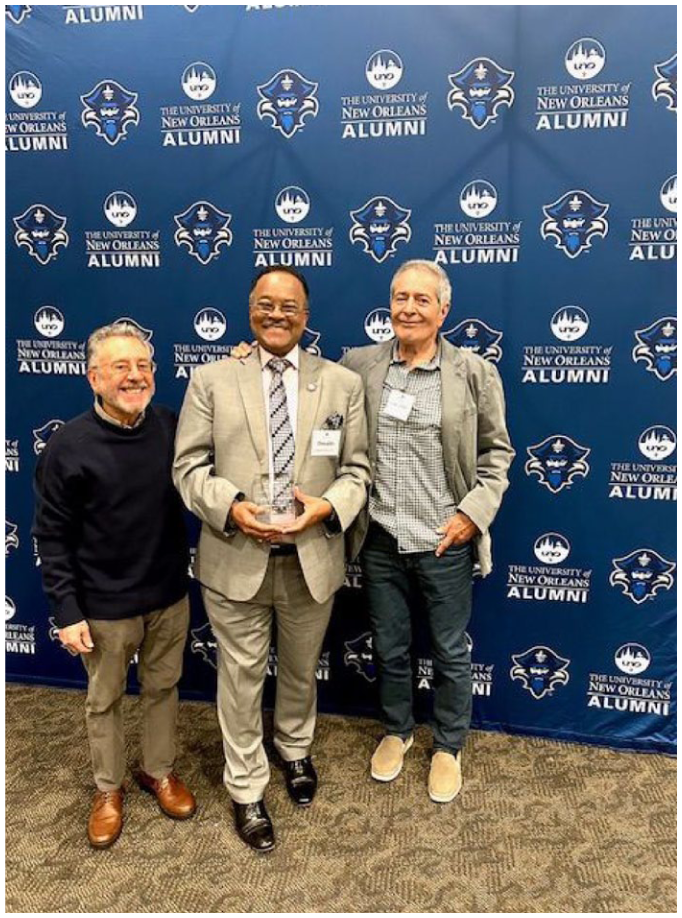
Dr. Donaldo Batiste 3 (1993) center with two of his UNO professors, Ira Bogotch on the left and Luis Miron on the right.
Wouldn’t it be true that each of us as readers will find our own truths/lessons in your reflections? I doubt you should apologize for that.  (S. Bauer,
4
UNO faculty member. December, 2022, personal communication)
(S. Bauer,
4
UNO faculty member. December, 2022, personal communication)
Footnotes
Appendix A

Funding
The authors received no financial support for the research, authorship, and/or publication of this article.
Declaration of Conflicting Interests
The authors declared no potential conflicts of interest with respect to the research, authorship, and/or publication of this article.