






Abstract
How to effectively reduce academic disparities and promote educational equity has attracted much attention in recent years. Introduced in China in 2021, the Double Reduction Policy (DRP) seeks to advance fairness in education, yet its effectiveness remains widely debated. This study critically examines the implications of the DRP, focusing on its role in narrowing achievement gaps across socioeconomic groups and between urban-rural students, as well as its impact on equalizing educational outcomes. Using national data from the Chinese Family Panel Studies (CFPS) for 2020 and 2022, a quantitative comparative approach is employed to assess policy effects. Statistical analyses explore variations across socioeconomic and regional contexts. The findings indicate that the DRP has contributed to reducing urban–rural disparities (narrowed by 0.283, p < .01) and weakening the influence of socioeconomic status (SES) on achievement (SES × Policy = −0.363, p < .01). Yet, parents continue to assume that family and school influences are the most significant for their children’s performance, regardless of what the evidence shows as an equalizer. Hence, notable inequalities persist offering important insights for advancing equity-oriented and sustainable reforms.
Introduction
Educational equity is a central concern in education policy reform throughout the world (Ainscow et al., 2025). However, urban–rural disparities and socioeconomic status (SES) often intersect to jointly shape students’ access to educational resources and academic outcomes (OECD, 2023; Zahl-Thanem & Rye, 2024). A persistent gap exists between urban and rural students in access to high-quality resources, including qualified teachers, school facilities, and extracurricular investment (Z. Zhou et al., 2023), thereby weakening education’s role in promoting social mobility (Bourdieu & Passeron, 1990; Durst & Bereményi, 2024).
Primary education, though widely regarded as a universal right, can reproduce inequality when disparities in access and quality persist from the outset (G. M. Alam, 2021; Roohi et al., 2021). In response, many countries have implemented policies to rebalance regional resource allocation and reduce SES-related inequalities through more comprehensive approaches (G. M. Alam & Parvin, 2024; Gui et al., 2026). While some reforms have achieved limited progress, no policy has fully eliminated the structural effects of SES. This study reviews selected international approaches to examine their impacts and limitations and to clarify the scope of inquiry.
For example, Finland is often regarded as a model of educational equity, supported by well-trained teachers and equalized funding that ensures access to quality education regardless of background (J. Liu, 2024). However, recent evidence indicates declining academic performance and widening gaps linked to socioeconomic and immigration status, raising concerns about the sustainability of its achievements (OECD, 2022). In contrast, Singapore adopts a streaming system that assigns students to academic tracks based on standardized test performance (J. R. Wu, 2022). While intended to provide differentiated pathways, it has been criticized for disproportionately channeling low-SES students into vocational tracks, limiting upward mobility (Amiri et al., 2025).
Other initiatives include Norway’s inclusive funding model, which provides equalization grants and targeted support across regions (Uthus & Qvortrup, 2025), and the UK’s “London Challenge,” which improved outcomes in low-performing urban schools (Mansaray & Hutchings, 2013). However, questions remain regarding their long-term effectiveness in reducing SES-related and regional inequalities.
Similarly, China, home to the world’s largest education system (Gui et al., 2026), introduced the Opinions on Further Reducing the Burden of Homework and Off-Campus Training for Compulsory Education Students, marking the official launch of the “double reduction” policy (DRP; MOE, 2021). The policy aims to reduce students’ academic burden and curb private tutoring (shadow education), which is widely accessed by high-income families and exacerbates educational inequality (Z. Liu et al., 2024). Compared with equity-oriented reforms in other countries, China’s DRP represents a high-intensity regulatory intervention that directly restricts after-school training to weaken the link between SES and educational opportunities (Jia et al., 2025). It was expected to alleviate academic burden and promote more equitable access to resources (Z. Zhou et al., 2023).
However, gaps remain between expected and actual outcomes. Restricted tutoring has contributed to rising housing demand in high-quality school districts, as families seek access through school zoning (Jia et al., 2025). At the same time, demand for tutoring has not declined but shifted to informal forms such as one-on-one tutoring (J. Liu & Bray, 2025). These developments suggest that the DRP’s implications for educational equity require further evaluation in light of its unintended consequences.
Moreover, international cases show that even large-scale reforms cannot fully eliminate the influence of SES and regional disparities in education, highlighting a central concern of this study: education, often viewed as a vehicle for social mobility, may also reproduce inequality without deliberate equity-oriented design (Eden et al., 2023). Against this backdrop, this study focuses on China’s DRP, identifies key literature gaps, and outlines its scope, objectives, and research questions.
Research Gap and Scope: Objective and Questions
With the introduction of China’s DRP in 2021, a growing body of research has emerged, yet important gaps remain in assessing its overall effects. Most existing studies rely on post-implementation surveys or interviews, focusing on short-term outcomes such as student academic and psychological burden (Chen & Lin, 2026; D. Wang et al., 2022), teacher workload (Yongtao, 2025), parental anxiety (Ren & Zhao, 2024), and the private tutoring sector (Z. Liu et al., 2024). Although some studies examine equity and access to resources across socioeconomic groups, they are mainly based on local surveys, case studies, or qualitative reviews (Hong, 2023; Z. Liu et al., 2024; Tang et al., 2026) and rarely focus on student outcomes. Overall, most prior research is qualitative or narrative in nature, and the limited quantitative studies rely on small samples. To date, no study has used nationally representative data to examine the policy’s impact on educational equity.
In doing so, there remains a lack of comprehensive and detailed investigation into how the implementation and effects of the DRP on academic outcomes vary across different socioeconomic backgrounds and China’s diverse regions (urban-rural settings) using national-level data. Such research is crucial for understanding the policy’s differential impacts from various SES groups and for identifying urban–rural contexts where adjustments may be needed to better achieve its goals of promoting educational equity and sustainable education.
This study aims to address these gaps by providing an overall analysis of the DRP’s effectiveness in improving academic outcomes and educational equity across socioeconomic and regional variations in China. By examining the policy’s outcomes, this study contributes to ongoing discussions on educational reform and equity in China and offers evidence-based implications for educators and policymakers seeking to enhance the effectiveness of future educational initiatives. Accordingly, the study sets out the following specific objectives: (1) to estimate the effect of DRP on the urban-rural gap in academic performance; (2) to assess its influence on SES-related disparities; and (3) to deepen understanding of the policy’s role in fostering equitable and sustainable education.
According to the research objectives, the study addresses the following research questions:
These research questions will be examined in the findings and discussion sections, followed by a conclusion. The upcoming sections outline the literature review before explaining the research design in detail.
Review of the Literature
Firstly, the roles of SES and regional disparities in educational gaps are examined. Subsequently, urban–rural differences are discussed in the Chinese context. Then, the link between education policy and educational equity is explored based on urban–rural realities, followed by an overview of China’s Double Reduction policy to clarify the research context. Finally, the research framework is developed to strengthen the theoretical foundation of the study.
Socioeconomic and Urban–Rural Inequalities: Educational Patterns
SES and urban-rural disparity are two key factors contributing to educational disparities (G. M. Alam & Parvin, 2024; Khan & Khan, 2025). SES, typically indicated by household income, parental occupation, and education level, has generated significant interest and debate in shaping access to education and academic achievement since the publication of the Coleman Report in 1966 (Tompsett & Knoester, 2023). While education can improve individuals’ income and social mobility (Tang et al., 2026), advantaged groups still have greater access to quality education (Gui et al., 2026). In urban–rural contexts, unequal resource allocation further intensifies this gap (G. M. Alam & Parvin, 2024; Cao & Huo, 2026), with urban students benefiting from better school facilities, teacher quality, learning materials, and economic conditions, leading to consistently higher academic performance (Khan & Khan, 2025; L. Wang et al., 2026).
At the macro level, SES inequality and uneven urban–rural development jointly constrain access to quality education and reinforce intergenerational inequality (Saini, 2022; Zahl-Thanem & Rye, 2024). Although education is expected to enhance human capital and reduce disadvantage (G. M. Alam, 2021), it may also reproduce inequality when high-SES groups convert existing advantages into further educational gains (Bourdieu & Passeron, 1990). Ensuring equal access to quality education is therefore recognized as a basic human right (OECD, 2023). However, Social Reproduction Theory suggests that such efforts often struggle to overcome deep-rooted inequalities (Backer & Cairns, 2021). Hence, empirical research on education policies is essential for understanding their role in mitigating or potentially reinforcing educational inequality.
Educational Inequality in China: Urban–Rural Disparities
Although the effects of socioeconomic status (SES) and urban–rural differences on educational inequality are globally observed, the institutional roots of this issue are particularly pronounced in China. Urban–rural educational inequality is a structural outcome shaped by the household registration (hukou) system (Ruan, 2024). Since its establishment in the 1950s, the hukou system has restricted rural residents’ access to urban public services, thereby exacerbating disparities in economic development, resource allocation, and educational opportunities between urban and rural areas (Xu & Wu, 2022). Evidence from large-scale studies, including the Chinese General Social Survey (CGSS) and the Rural–Urban Migration in China (RUMiC) survey, consistently shows that substantial urban–rural educational gaps persist, with rural students remaining disadvantaged in learning outcomes and access to higher education (Song & Tan, 2022; Zhang et al., 2015).
Previous studies further attribute these disparities to multiple factors, including family SES, school infrastructure, teacher quality, and unequal access to resources (Khan & Khan, 2025; L. Wang et al., 2026). Recent policy interventions have partially reduced urban–rural barriers but also generated new forms of inequality. For instance, rural–urban teacher exchange programs and policies promoting rural students’ access to urban schools aim to narrow regional gaps in educational outcomes (R. N. Wang et al., 2025). However, while teacher exchange programs improve rural resource provision, rural labor migration has increased the prevalence of left-behind children and reduced parental involvement in education. In contrast, the “rural-to-urban student migration” model enhances student mobility and academic achievement but may reduce household labor productivity (R. N. Wang et al., 2025). Together, these mechanisms reinforce the intergenerational persistence of urban–rural educational inequality, which further extends into and is continuously shaped by evolving policy interventions.
Policy Interventions for Educational Equity: Urban–Rural Realities
Education is widely regarded as a key driver of sustainable development (G. M. Alam & Parvin, 2024). Accordingly, governments worldwide invest substantial resources in designing and implementing education policies to guide institutional development (McCambly & Anderson, 2020). Education policy plays a central role in social transformation by shaping effective and adaptable education systems and promoting individuals’ intellectual, social, and economic development (A. Alam & Mohanty, 2023). It has long been closely linked to equity in educational access and outcomes (Eden et al., 2023).
Equity emphasizes fairness by ensuring access to quality education regardless of background (Gui et al., 2026), while access focuses on removing barriers to participation and benefit. Together, they underpin an inclusive education system (Eden et al., 2023). Historically, education policy reform has been shaped by societal needs, political ideologies, and evolving understandings of equity and access (Ishimaru & Galloway, 2021).
In contexts with a pronounced urban–rural divide, particularly in China, education policy faces clear structural contradictions and practical constraints (L. Wang et al., 2026). Although policy goals typically emphasize social justice, implementation outcomes are often complex and uncertain (R. N. Wang et al., 2025). Despite continued efforts, disparities in educational outcomes persist across SES groups and are especially evident in enduring urban–rural gaps in access and achievement (Flanagan et al., 2021; Song & Tan, 2022). Therefore, policymakers need to account for diverse stakeholder needs when designing and implementing education policies so that inequalities associated with SES and the urban–rural divide are better addressed (Cao & Huo, 2026; Eden et al., 2023).
Under this climate a common policy may be an incomplete prerequisite to resolve the distinct reality that the urban or rural counterpart may distinctly face for its own context. On the other hand, a common policy framework with either urban or rural influence may adversely affect the other counterpart. For instance, determining a single schooling schedule by prioritizing an urban setting may increase dropout rates for children who support their families with household work (G. M. Alam, 2025). Similarly, based on rural communication and communal harmony, setting school transportation and security policy may not serve the needs of floating urban children (G. M. Alam, 2026).
China’s Double Reduction Policy: Origins and Design
Developing countries continue to improve access to education by reducing disparities and promoting social inclusion (G. M. Alam, 2021). In China, the 9-year compulsory education system and broader educational expansion have enabled near-universal school enrollment (Z. Zhou et al., 2023), with primary and junior secondary enrollment rates reaching very high levels between 2012 and 2021 (MOE, 2021). However, this expansion has not eliminated educational inequality, and disparities in access to high-quality education remain substantial (Z. Liu et al., 2024).
Chinese families have long relied on shadow education, driven by the belief that private tutoring improves performance in a highly competitive exam-oriented system (Tang et al., 2026). This has fueled a large tutoring industry, valued at about 475 billion RMB, with some households spending up to 20% of annual income on it (Yang et al., 2024). Participation is uneven: rural students attend tutoring at roughly half the rate of urban students (X. Wu, 2017), and low-SES families have limited access, making shadow education a key manifestation of educational inequality (Tang et al., 2026).
In response and aligned with Sustainable Development Goal 4 (SDG4), which emphasizes inclusive and equitable quality education (Tang et al., 2026), the Chinese State Council introduced the Double Reduction Policy nationwide on July 24, 2021 (MOE, 2021). The policy aims to reduce academic burden, improve student well-being, and narrow SES- and region-related disparities. However, theoretical perspectives differ on its expected effects. Structural-functionalism suggests education policy tends to reinforce existing social structures (Eden et al., 2023), while conflict theory views reforms as arenas of competing interests that may reproduce inequality (Morgan & Hauptmeier, 2021). Given its recent implementation, the policy’s effectiveness in reducing academic pressure and educational inequality remains uncertain. Therefore, examining its impacts across SES groups and regions is essential for understanding its role in promoting educational equity in China.
Theoretical Background: Research Hypotheses
This study employs social reproduction theory (Bourdieu & Passeron, 1990) and the theory of justice (Rawls, 1999) as its theoretical foundation. Despite having particular presumptions, these frameworks are complementary. Education is widely recognized as a basic human right and a key driver of social mobility, shaping individuals’ opportunities and outcomes (Gui et al., 2026; Qudsia, 2024). Rawls’ theory of justice argues that social institutions should prioritize the least advantaged, providing normative support for equity-oriented education policies (Qudsia, 2024; Rawls, 1999). Accordingly, ensuring equitable access to education has become a central concern in both policy and research (Jang & Reardon, 2019).
In contrast, social reproduction theory suggests that educational inequality is reproduced across generations, as students from higher-SES families benefit from greater cultural capital and institutional advantages (Gui et al., 2026). Thus, although education and policies such as China’s Double Reduction Policy aim to promote equity and SDG 4, students from advantaged backgrounds often retain stronger adaptive advantages, meaning that reforms intended to reduce inequality may inadvertently reinforce existing disparities (Tang et al., 2026). This tension highlights the need to empirically assess the policy’s actual effects.
Moreover, students’ academic outcomes are shaped by both family SES and urban–rural disparities (G. M. Alam & Parvin, 2024; Erdem & Kaya, 2023). Nevertheless, effective educational interventions across all levels remain essential for reducing inequality and limiting the reproduction of socioeconomic advantage (G. M. Alam, 2021).
Based on the above theoretical discussion, the following hypotheses are proposed:
Methods
The difference-in-differences (DID) method is commonly used in longitudinal policy evaluation (G. M. Alam & Forhad, 2023). However, it requires a treated group and an unaffected control group that satisfies the parallel trends assumption (G. Wang et al., 2024). As the DRP was implemented nationwide, no valid untreated control group exists, making DID inappropriate in this context. Therefore, this study adopts a quasi-experimental pre–post design to examine the relationships among the policy, SES disparities, and regional differences in academic performance, thereby improving the robustness of the estimates.
Data Source
This study uses data from the Chinese Family Panel Studies (CFPS), a nationally representative biennial longitudinal survey of Chinese individuals, families, and communities conducted by the Institute of Social Science Survey (ISSS) at Peking University (PKU, 2024). Since 2010, CFPS has surveyed 42,590 individuals from 14,960 households across 25 provinces, collecting rich longitudinal data on family background, economic activities, education, student outcomes, and household dynamics (PKU, 2024; Z. Zhou et al., 2023). The dataset is nationally representative and includes detailed information on children under 16.
The DRP was implemented in 2021 in primary and junior secondary schools (MOE, 2021). Accordingly, this study uses CFPS data from 2020 (pre-policy) and 2022 (post-policy, the latest available wave). To ensure comparability, the sample is limited to students in compulsory education and further divided into urban and rural groups based on household registration or residence. After data cleaning, missing value treatment, and variable matching, the final analytical sample is obtained. Table 1 reports the key demographic characteristics of the sample across the two waves.
Descriptive Statistics of the 2020 and 2022 CFPS Sample.
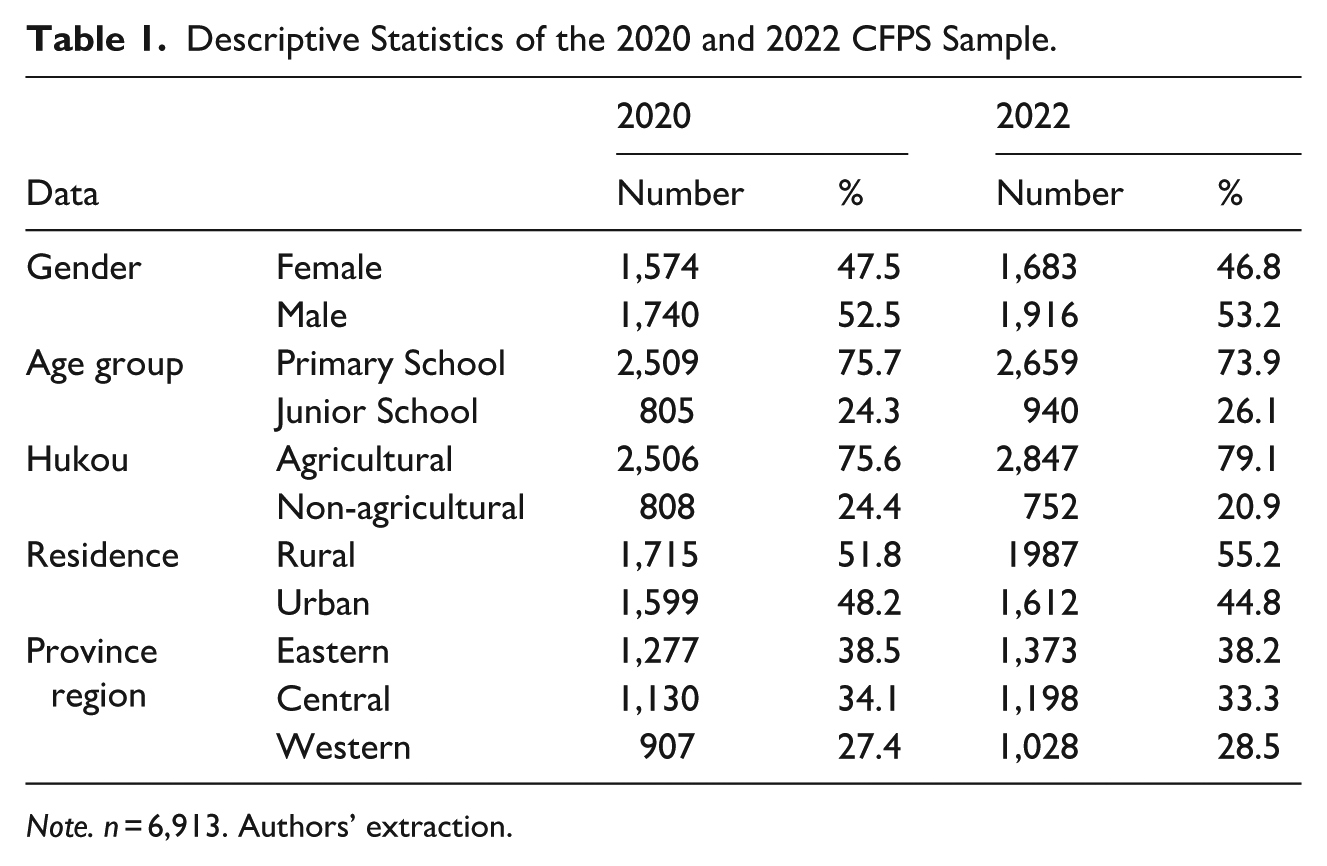
Note. n = 6,913. Authors’ extraction.
Variable Construction
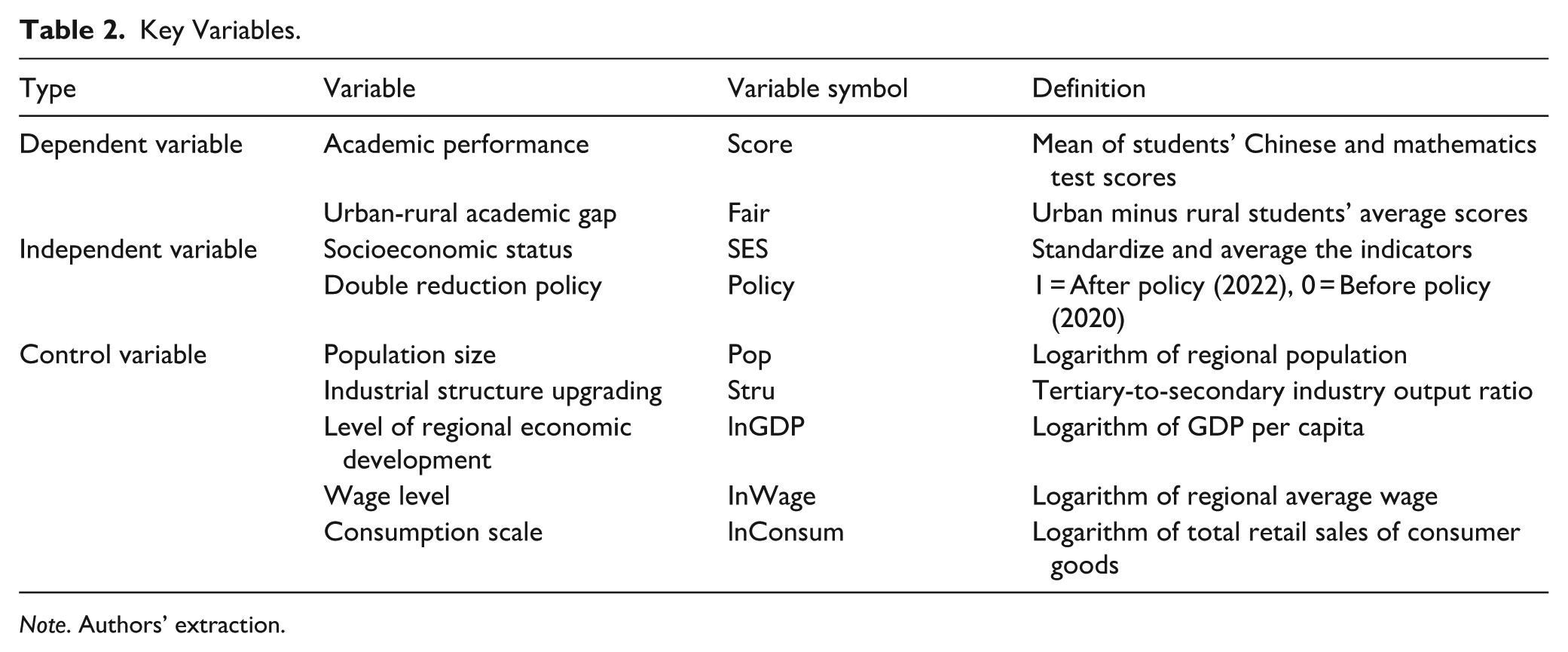
In this study, the dependent variable is academic achievement. For descriptive analysis, it is measured as the average of mathematics and Chinese scores from the CFPS. For inferential analysis, individual scores are aggregated to the district/county level, where separate averages are calculated for urban and rural students. The urban–rural gap is then derived by subtracting rural from urban averages, serving as the main dependent variable in subsequent t-tests and regression analyses.
The key independent variables include the policy indicator and SES. Following prior studies, the Double Reduction Policy (DRP) is coded as a binary variable (0 = pre-policy, 1 = post-policy; Tang et al., 2026), treated as a structural policy indicator. SES is measured using parental education, parental occupation, and household income from CFPS. Following OECD guidelines, each indicator is standardized (z-scores) and averaged to construct a composite SES index (Tang et al., 2026).
To reduce omitted variable bias, macro-level district and county controls are also included. Specific variable definitions are presented in Table 2.
Key Variables.
Note. Authors’ extraction.
Empirical Model and Data Analysis
To address Research Question 1 (RQ1), which examines urban–rural differences in academic performance before and after the DRP, independent-samples t-tests are conducted in three steps. First, data from 2020 and 2022 are pooled to test overall urban–rural differences in academic performance. Second, urban and rural students are compared separately within each year to examine changes before and after DRP. Third, at the district/county level, scores are aggregated to compute separate urban and rural averages, and their difference is defined as the urban–rural achievement gap. A t-test is then applied to compare this gap between 2020 and 2022, providing regional-level evidence of policy impact.
To examine Research Question 2 (RQ2), whether DRP moderates the impact of SES on academic achievement across urban and rural areas, a regression model including an interaction term is constructed.

In this equation, the dependent variable is the disparity in academic performance between urban and rural students in district i during year t. The key explanatory variables are SES and policy implementation status. The control variables include population size, industrial upgrading index, level of economic development, wage level, and consumption scale in district i during year t. Moreover, the interaction term SES × Policy is introduced to examine the moderating role of the DRP in the relationship between SES and the academic performance gap. In addition, β0 represents the constant term. μ i and λt denote individual and time fixed effects, respectively, controlling for unobserved time-invariant heterogeneity and common temporal shocks, while ε it represents the error term.
Building on the earlier findings, this study further examines Research Question 3 (RQ3), focusing on practical steps to ensure education equity and sustainable education.
Results and Discussion
The results and discussion are presented concurrently due to the nature of quantitative research, while the implications and conclusions are addressed in the following concluding section.
Urban–Rural Academic Gaps Under the DRP (RQ1)
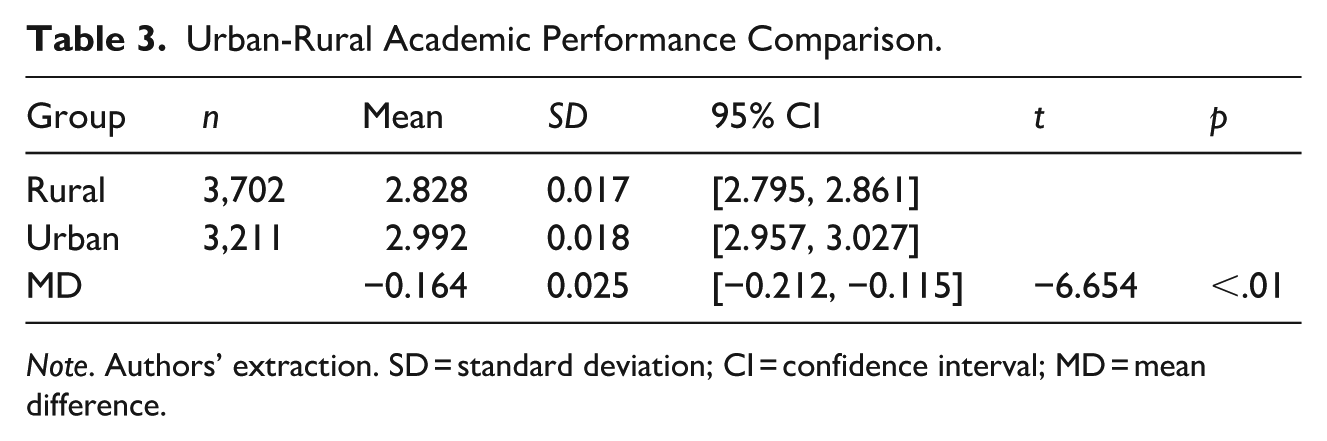
A three-level independent samples t-test was conducted to address RQ1 regarding the impact of the DRP on urban–rural academic gaps and to test Hypothesis 1. Initially, based on the urban–rural classification of students from the pre- and post-policy samples, an independent samples t-test was conducted on students’ academic performance. The results show that the mean score of rural students (M = 2.828) is 0.164 (p < .001) lower than that of urban students (M = 2.992), indicating that rural students perform significantly worse than their urban counterparts (see Table 3). Suggested here is a persistent academic gap between urban and rural students.
Urban-Rural Academic Performance Comparison.
Note. Authors’ extraction. SD = standard deviation; CI = confidence interval; MD = mean difference.
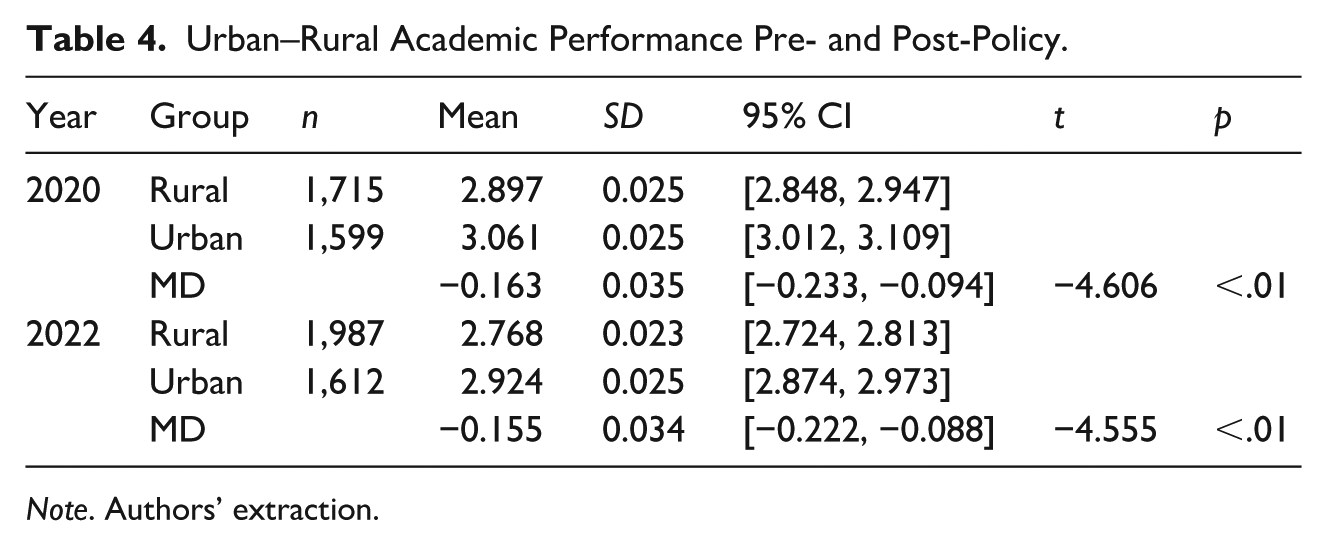
Building on the comparative analysis between urban and rural students, further independent samples t-tests were conducted separately for the pre-policy and post-policy periods. As shown in Table 4, a statistically significant urban–rural gap in academic performance persisted in both periods. However, the magnitude of the gap diminished from −0.163 (p < .001) in 2020 to −0.155 (p < .001) in 2022, suggesting a slight narrowing of the urban–rural disparity following the implementation of the Double Reduction Policy.
Urban–Rural Academic Performance Pre- and Post-Policy.
Note. Authors’ extraction.
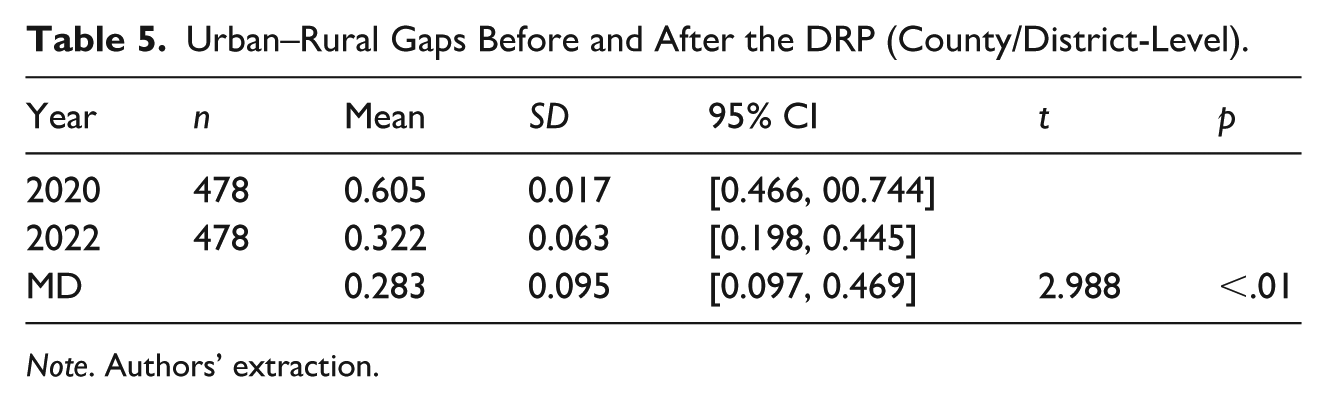
To further examine the equalizing effect of the DRP on academic achievement gaps, this study selects counties and districts with complete data in both years and conducts a comparative analysis at the macro level. A balanced panel of 956 counties is used to compare urban–rural academic differences before and after policy implementation. As shown in Table 5, the urban–rural achievement gap after the DRP (M = 0.322) decreased by 0.283 (p < .001) compared to the pre-DRP level (M = 0.605). Hence, these results support Hypothesis 1 (H1), indicating that the DRP significantly narrowed the academic performance gap between urban and rural students.
Urban–Rural Gaps Before and After the DRP (County/District-Level).
Note. Authors’ extraction.
The findings suggest that the DRP has to some extent narrowed the academic gap between urban and rural students, consistent with its goal of promoting educational equity. Prior research shows that urban and high-income families have greater access to extracurricular tutoring and shadow education, which has contributed to widening disparities between advantaged and disadvantaged students (Z. Liu et al., 2024; Tang et al., 2026). The results, including both pre–post comparisons and county-level analyses, consistently indicate a reduction in the urban–rural achievement gap, suggesting short-term policy effectiveness.
However, county-level results also reveal that although the gap has narrowed, urban students continue to significantly outperform rural students. In 2022, the mean urban–rural difference remained −0.155 (p < .001), indicating persistent disparities rather than full convergence. While prior studies have mainly focused on resource allocation, this study extends the analysis to academic outcomes, with findings still confirming enduring urban–rural inequality (Z. Liu et al., 2024).
Some scholars have further argued that following the implementation of the DRP, certain urban families shifted toward private one-to-one tutoring or underground supplementary tutoring services (Kong, 2023; Lyu & Lam, 2025). These alternatives are often more concealed and substantially more expensive, potentially intensifying educational stratification based on household economic capacity (Z. Zhou et al., 2023). This highlights the possibility of unintended policy consequences.
SES-Related Academic Gaps Under the DRP (RQ2)
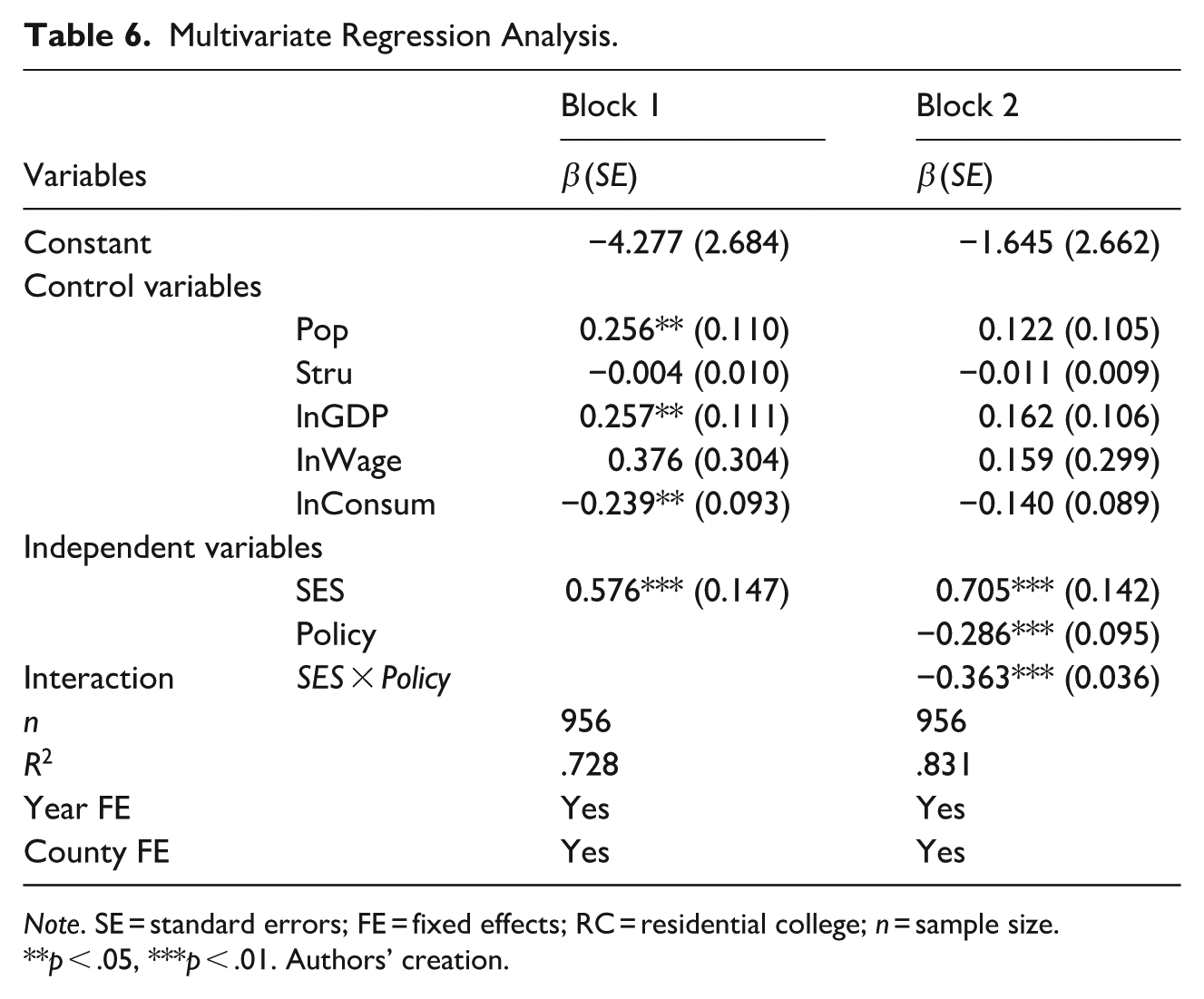
A multiple hierarchical regression analysis was conducted to address RQ2 and evaluate Hypothesis 2 concerning the effect of SES on academic performance and the moderating role of the DRP. The regression model was estimated in two sequential blocks: (1) Block 1 included the control variables and the key explanatory variable (SES); and (2) Block 2 additionally introduced the policy dummy variable and the interaction term SES × Policy. The results are reported in Table 6.
Multivariate Regression Analysis.
Note. SE = standard errors; FE = fixed effects; RC = residential college; n = sample size.
p < .05, ***p < .01. Authors’ creation.
In Block 1, after controlling for population size (β = .256, p < .05), regional economic development (β = .257, p < .05), and consumption level (β = −.239, p < .05), SES disparities exerted a significant positive effect on the urban–rural academic achievement gap (β = .576, p < .01). This indicates that higher levels of SES inequality were associated with wider academic disparities between urban and rural students.
In Block 2, the interaction term SES × Policy significantly predicted the urban–rural academic gap (β = −3.363, p < .01). The negative coefficient supports Hypothesis 2, suggesting that the DRP weakened the association between SES disparities and academic performance differences.
The regression results indicate that SES plays a significant and positive role in academic performance, which is highly consistent with Bourdieu’s theory of cultural reproduction (Bourdieu & Passeron, 1990). Within this theoretical framework, families transmit economic, cultural, and social capital across generations, thereby reproducing educational advantages through greater access to high-quality educational resources (Jang & Reardon, 2019).
Moreover, when comparing the findings on the policy’s moderating role with prior studies, it becomes evident that the DRP has weakened the channels through which family background is converted into academic advantage by restricting shadow education and expanding after-school services (Tang et al., 2026). However, some studies on China’s burden-reduction reforms suggest that such policies may have inadvertently widened disparities in educational expenditure and study time between high- and low-income families (Z. Zhou et al., 2023). Furthermore, following the implementation of the DRP, some high-SES families shifted to more covert alternatives, such as one-to-one private tutoring, which involves higher costs and remains inaccessible to low-income households (Larbi & Fu, 2025; Z. Liu et al., 2024).
Taken together, although the DRP has significantly weakened the effect of SES on the urban–rural academic achievement gap in the short term, thereby providing initial evidence of progress toward educational equity, several challenges remain. According to Z. Zhou et al. (2023), stringent conditions are required for education load reduction strategies to be effective. Measures aimed at reducing the burden of schoolwork and after-school tutoring can only succeed when competition for admission is limited or when access to higher education is sufficiently broad. In short, against the backdrop of continued intense competition for school admissions, this remains a profound challenge to the DRP’s efforts to further advance educational equity.
Policy Effects on Educational Equity and Sustainable Education (RQ3)
Aligned with the above findings, the DRP has produced observable progress in promoting educational equity. The urban–rural academic gap decreased significantly from 0.605 in 2020 to 0.322 in 2022, nearly a 50% reduction. In addition, the interaction term analysis suggests that the policy has mitigated the influence of family SES differences on urban–rural academic disparities. This indicates that, by regulating off-campus tutoring, the DRP has strengthened school-based education and, to some extent, advanced compulsory education from equality of opportunity toward greater process equity (Z. Liu et al., 2024; Tang et al., 2026).
From the perspective of sustainable education, the effectiveness of promoting educational equity needs to be carefully assessed. Although policies have narrowed the academic gap between urban and rural areas in the short term, the main effect of SES remains significant (β = .705, p < .01). Furthermore the urban-rural academic gaps still exist after the policy’s implementation (M = 0.322, p < .01). It suggests that the privileged class may still maintain their educational advantage through covert channels (Larbi & Fu, 2025). If this situation persists for a long time, it will probably weaken the ability of education systems to promote sustainable equity at the intergenerational level (Fan, 2023).
SDG4 emphasizes inclusive, equitable, and high-quality education. However, the imbalance in educational resources between rural and urban areas remains a widespread issue (Khan & Khan, 2025), which hinders the achievement of sustainable education goals. Given the persistent disparities in educational performance between urban and rural students before and after the DRP, further policy efforts are needed to establish compensation mechanisms for disadvantaged groups and improve the quality of rural after-school services (Z. Liu et al., 2024; Z. Zhou et al., 2023). Such measures would enhance the education system’s capacity for self-optimization and sustained progress toward equity.
Implications
Before noting the limitations and further research that needs to be done and highlighting the conclusion, let us explore the implications of this study in two parts. The first part explains the theoretical implication, and this precedes the examination of the practical one.
Theoretical Implication
Building on these findings, several theoretical, practical, and policy implications can be identified. Theoretically, this study contributes to educational equity literature by engaging with justice theory (Rawls, 1999) and social reproduction theory (Bourdieu & Passeron, 1990), illustrating how policy intervention can mitigate the effects of socioeconomic and regional inequalities on educational outcomes. More broadly, education inequality remains a persistent global challenge, reflected in unequal access, dropout rates, and academic disparities, each with distinct consequences (Gui et al., 2026). By focusing on academic outcomes, this study further emphasizes education as a fundamental human right and highlights the importance of structural policies in advancing equitable educational development.
Moreover, this study offers practical implications for multiple stakeholders. For policymakers, the results highlight the need to further refine and adjust the DRP to better address the remaining disparities. For school educators, the findings emphasize the importance of adopting more inclusive teaching approaches that account for the diverse needs of students from various SES levels. At the same time, stakeholders at different levels are encouraged to recognize and strengthen their roles in fostering a more equitable and inclusive education system.
Educational Equity: Urban Versus Rural Reality
Furthermore, this study provides policy implications for refining the DRP and its supporting measures. Although the DRP has shown initial positive effects (Larbi & Fu, 2025), its implementation has also generated unintended consequences that require policy attention (Fu & Guo, 2024). Evidence suggests that practices such as one-on-one tutoring and live-in tutors have persisted after the reform (D. Wang, 2024). Due to their economic advantages, middle- and high-income families are better able to access these costly services, potentially turning shadow education into a new mechanism of class reproduction (J. Zhou & Fan, 2025). In rural areas, expanded after-school service programs may also increase hidden burdens on disadvantaged families by reducing students’ time for household and agricultural work (Fu & Guo, 2024). Overall, these dynamics suggest that the long-term effects of the DRP may unintentionally reinforce rather than reduce educational inequality, highlighting the need for more balanced policy adjustments.
However, as the DRP is primarily set in the perspective of urban-living parents who are intensely preoccupied with their professional obligations, there may be gradual negative causal consequences developing for rural children or for urban floating students. The government may be able to encourage DRP penetration in China, a country with a rapidly expanding economy, which may in some way demonstrate a hopeful short-term effect. However, poor countries may not get the same results from implementing this kind of strategy. Furthermore, parents in China continue to compete fiercely and make significant investments to send their children to highly reputable and renewed schools. As a result, regardless of what the data indicates as an equalizer, parents continue to believe that family and school factors are the most important for their children’s success (Tang et al., 2026).
Limitations and Future Research
Despite the important implications discussed above, this study has several limitations. First, the estimation of the policy’s net effect remains constrained and largely reflects short-term outcomes. Although a pre–post comparative design is applied, the period from 2020 to 2022 overlaps with multiple concurrent factors, including the COVID-19 pandemic and reforms to new curriculum standards. Therefore, the observed narrowing of the urban–rural achievement gap cannot be fully attributed to the DRP. In addition, due to data constraints, only one post-implementation year is included, limiting the assessment of the policy’s long-term sustainability.
Second, the measurement of academic outcomes is relatively narrow. This study relies solely on Chinese and mathematics scores as proxies for academic performance, without incorporating non-cognitive outcomes such as creativity, critical thinking, or mental health. As a result, the evaluation of “sustainable education,” which emphasizes holistic competence development, remains incomplete. Third, the exclusive use of quantitative methods limits deeper interpretation of the findings and the understanding of lived experiences behind the observed patterns.
Recognizing these limitations, several directions for future research are suggested. More robust quasi-experimental approaches could better isolate the causal effects of the DRP, while longer time horizons would help assess its sustainability. Future studies may also adopt a more comprehensive framework for academic development to better evaluate whether the DRP promotes holistic and equitable learning outcomes in the context of sustainable education. Finally, integrating quantitative and qualitative methods would provide a more nuanced understanding of the policy’s effectiveness.
Conclusions
This paper examines the impact of China’s DRP, focusing on its implications for educational equity and academic disparities across SES and urban–rural contexts. Using a quantitative and comparative analysis, it captures the policy’s multifaceted effects, highlighting both achievements and ongoing challenges. The findings suggest that the DRP has contributed to narrowing SES- and region-related academic gaps, consistent with its intended objectives. In particular, reduced urban–rural differences in academic performance and the policy’s moderating effect on the SES–achievement relationship indicate progress toward a more equitable educational environment.
However, persistent inequalities remain. Despite improvements, significant disparities continue, particularly among rural students and those from lower socioeconomic backgrounds. These gaps highlight the need for further policy refinement and more targeted interventions to ensure more equitable distribution of the benefits of reform and fuller realization of educational equity.
Footnotes

Funding
The authors received no financial support for the research, authorship, and/or publication of this article.
Declaration of Conflicting Interests
The authors declared no potential conflicts of interest with respect to the research, authorship, and/or publication of this article.