






Abstract
Introduction
Over the past two decades, educational policy makers across the globe have been involved in policy initiatives that hold schools accountable for increasing student achievement. When you look beneath the surface of a school that successfully deals with these external accountability pressures, you will indisputably find an excellent school leader (Leithwood & Riehl, 2003). School leadership plays a significant role in improving classroom teaching and enhancing student learning (Leithwood, Harris, & Hopkins, 2008). Research has demonstrated that the school leader is pivotal in promoting conditions such as shared vision for instruction, norms of collaboration, trust, shared decision making and collective responsibility—conditions considered to be important for school improvement (Geijsel, Sleegers, van den Berg, & Kelchtermans, 2001; Leithwood, Jantzi, & Steinbach, 1999; Silins, Mulford, & Zarins, 2002; Sleegers, Bolhuis, & Geijsel, 2005; Smylie & Hart, 1999; Stoll, Bolam, & Collarbone, 2002). Moreover, school principals affect student achievement and learning via the influence they exert on teachers and the school organization (Bryk, Sebring, Allensworth, Luppescu, & Easton, 2010; Hallinger & Heck, 1998, 2011; Leithwood, Seashore Louis, Anderson, & Wahlstrom, 2004; Leithwood & Sun, 2012; Robinson, Lloyd, & Rowe, 2008; ten Bruggencate, Luyten, Scheerens, & Sleegers, 2012). Although these studies have demonstrated the importance of effective school leadership for school improvement and effectiveness, they do not address how school leaders, in their day-to-day work, learn to develop and sustain effective leadership.
Scholars in the field of educational administration regard expertise as an adequate indicator for the general effectiveness of school leaders (Allison, 1996; Leithwood & Stager, 1989; Sleegers & Spillane, 2009). As a consequence, researchers have started to pay attention to the evaluation of training programs and assessment standards for improving school leaders expertise. For example, in formal leadership training, a problem-based learning approach forms a good preparation for educational leaders to effectively deal with complexity and change in the school system, and to facilitate teacher and student learning (Bridges & Hallinger, 1997; Hallinger, 2005). Moreover, setting assessment standards to evaluate leadership performance has been shown to positively affect school improvement (e.g., Goldring, Huff, Spillane, & Barnes, 2009; Portin, Feldman, & Knapp, 2006). However, as Goldring et al. (2009) report, the general knowledge base for school leader professional development programs is rather weak.
Yearly, an immense amount of time and money is spent on formal training to facilitate leadership expertise, and new training programs frequently appear on the scene. Yet little of all training experience is transferred to the job (Blume, Ford, Baldwin, & Huang, 2010; Wexley & Latham, 2002). Particularly for leaders who work in a context of change and educational reform, knowledge from training quickly gets outdated, and achievement standards shift. Therefore, the contribution of these programs to school leaders’ learning and development is questionable (D. V. Day, Fleenor, Atwater, Sturm, & McKee, 2014). Alternatively, on-the-job learning has proven to be highly transferrable to daily practice. Yet strong empirical evidence about how leadership expertise may develop through on-the-job learning is scarce.
Research in the broader field of workplace learning has shown that on-the-job learning keeps professional knowledge and skills up to date, stimulates the creation of new knowledge (Paavola, Lipponen, & Hakkarainen, 2004), and helps employees to effectively respond to technological innovations and societal change (DeNisi, Hitt, & Jackson, 2003; Hurtz & Williams, 2009). In the educational context, researchers have emphasized the importance of ongoing and lifelong professional learning among teachers (Clarke & Hollingsworth, 2002; Jarvis, 1987; Kwakman, 2003; Marsick & Watkins, 1990; Putnam & Borko, 2000; Sleegers et al., 2005; Smylie, 1995). Specifically, empirical studies have shown that both personal (e.g., self-efficacy, motivation) and organizational factors (e.g., leadership, climate, trust, social support) affect professional learning in schools (Kwakman, 2003; Richardson & Placier, 2001; Smylie, Lazarus & Brownlee-Conyers, 1996). Importantly, however, these studies solely focused on teachers, but not on school leaders. As school leaders are in the position to instigate change, to deal with external policy pressures, and to set an example for all learning in schools, it is quite remarkable that we know little about school leaders’ learning at the workplace, and the factors that stimulate such learning. Providing insight in school leaders’ workplace learning may therefore form a valuable addition to current literature on school leaders’ training, assessment, and practice.
This study examines secondary school leaders’ engagement in professional learning activities and the role that personal and school context factors play in stimulating their workplace learning. For this purpose, we define a school leader as an official in secondary education, who carries an integral responsibility for (a part of) an educational program. School leaders encompass people occupying various roles and functions such as principals, deputy and assistant principals, leadership teams, school governing boards, and school-level staff involved in leadership tasks (Pont, Nusche, & Moorman, 2008). Importantly, guided by Organisation for Economic Co-operation and Development (OECD) principles, effective school leadership may not reside exclusively in formal positions but may be distributed across a number of individuals in the school instead. The precise distribution of these leadership contributions can vary depending on factors such as governance and management structure, levels of autonomy and accountability, school size and complexity and levels of student performance (Pont et al., 2008).
We take the school leader as the focus of our research and provide insight in several individual (i.e., reflection and career awareness) and social (i.e., asking for feedback, challenging groupthink) professional learning activities. Moreover, we will examine how environmental (i.e., learning climate, social support, task variation) and personal (i.e., self-efficacy) antecedents affect school leaders’ engagement in these individual and social professional learning activities. We argue that building schoolwide capacity for professional learning is not only eminent for teachers and students (e.g., Runhaar, 2008; Sleegers et al., 2005; Smylie & Hart, 1999) but also for school leaders, as their ability to learn at the workplace sets an example, and forms an important prerequisite to cope effectively with the accountability pressures and changes schools are confronted with. Indeed, professional learning is crucial at all levels of the school organization: the student, the teacher, and the school leader (Verbiest, 2012). In the next section, we provide a theoretical framework and an overview of the professional learning activities, and personal and school factors that may affect school leaders’ learning. We discuss the hypothesized relationships between personal and environmental factors, and school leaders’ engagement in professional learning activities. We continue with an empirical investigation to test this model.
Framework
To understand school leaders’ professional learning we not only need a thick description of what learning activities school leaders are engaged in but also why they are engaged in these activities. Therefore, we take a person–environment interactionist perspective (Billett, 2001; C. Day, 2000; Ellström, 2001; van Woerkom, 2004) to investigate the joint impact of environmental and personal factors on professional learning. This interactionist approach allows us to move beyond a mere systemic approach to change, in which professional learning generally serves an instrumental function to problem solving (Dewey, 1933) in response to structural or cultural changes in the working environment (Argyris & Schön, 1996; Nonaka & Takeuchi, 1995). Moreover, it also allows us to move beyond a mere psychological approach in which professional learning is affected by personal factors such as self-efficacy, autonomy, and self-construal (e.g., Runhaar, Sanders, & Yang, 2010; Spillane, Reiser, & Reimer, 2002; van Rijn, Yang, & Sanders, 2013; van Veen, Sleegers, & van de Ven, 2005). Rather than investigating systemic and psychological factors on school leaders’ learning separately, we combine both approaches in one research model.
In the school context, educational scholars have already stressed the need for research on the interplay between environmental and personal factors to professional learning (Richardson & Placier, 2001; Smylie & Hart, 1999). Indeed, a few recent studies have focused on the joint impact of the school environment and personal factors on teachers’ professional learning, and also provided first evidence for the mediating role of motivation in the relationship between the school context and professional learning (Geijsel, Sleegers, Stoel, & Kruger, 2009; Thoonen, Sleegers, Oort, Peetsma, & Geijsel, 2011). Yet these studies focused on teachers. More research is needed to provide insight in how environmental and personal factors jointly affect professional learning of school leaders.
Drawing on general theories about work-related learning, namely, the job demands–control model (Karasek & Theorell, 1990) and the theory on learning potential of jobs (Onstenk, 1997; see also van Woerkom, Nijhof, & Nieuwenhuis, 2002), we hypothesize that the environmental factors, task variation, learning climate, and social support affect school leaders’ professional learning. Additionally, in line with previous studies on teacher learning (Geijsel et al., 2009; Thoonen et al., 2011) we expect that the personal factor self-efficacy plays a mediating role in the relationship between these environmental factors and professional learning. We also control for individual differences such as gender and tenure in our research model. Recent research has shown that these characteristics affect teachers’ professional learning (van Rijn, 2014), and more specifically, that the level of leadership learning attenuates with increased years of experience (Hirst, Mann, Bain, Pirola-Merlo, & Richver, 2004). To test our model (see Figure 1), we used data from a sample of 1,150 school leaders in Dutch secondary education. Below, we provide a theoretical conceptualization of the variables in our model, and discuss the expected relationship among them.

Theoretical model of the relations among school leaders’ environmental factors (task variation, learning climate, and social support), the personal factor (self-efficacy), and professional learning (reflection, career awareness, asking for feedback, and challenging groupthink), with covariates (hypotheses in parenthesis).
School Leaders’ Professional Learning
In the past decades, research on workplace learning has expanded rapidly. Recent work of Billett (2004) and Tynjälä (2008) identified three modes of workplace learning, which differ in their degree of formalization, namely, incidental, informal learning (i.e., all learning activities take place as a side effect of working on the job), intentional, nonformal learning (i.e., intentionally reflecting on working experiences on the job) and formal, off the job training (i.e., training in courses and classes). In this study, professional learning is conceptualized as a nonformal learning activity that takes place in the school and that continues during the entire career (Jarvis, 1987; Kwakman, 2003; Marsick & Watkins, 1990; Putnam & Borko, 2000; Sleegers et al., 2005; Smylie & Hart, 1999). Importantly, our focus on intentional but nonformal learning activities among school leaders indicates that they are voluntary, they occur on-the-job, and they are reflective in nature.
Scholars have used many different professional learning activities to capture the content of professional learning (e.g., Endedijk & Bronkhorst, 2014; Kwakman, 2003; Meirink, Meijer, Verloop & Bergen, 2009). One of the first scholars to recently identify different intentional, nonformal learning activities at the workplace is van Woerkom (van Woerkom, 2003; van Woerkom & Croon, 2008). Based on extensive interviews and scale construction analyses in various organizations, van Woerkom defined intentional learning activities as “a set of critically reflective work behaviors, carried out individually or in interaction with others, aimed at optimizing individual or collective practices, or critically analyzing and trying to change organizational or individual values” (van Woerkom & Croon, 2008, p. 326).
Within this framework, a first categorization is between individual and social professional learning activities (Kwakman, 2003; Lohman, 2005; Schön, 1983; van Woerkom, 2004). Individual learning activities are carried out individually without interaction with colleagues or supervisors. With individual learning activities, employees explore and reflect on their own values, interests, abilities, and career goals, for example, by reflecting on past performances and focusing on future career goals. In our study, individual learning activities pertain to school leaders’ reflections and thoughts about their own functioning and career. Social learning activities are carried out together with other colleagues. With social learning activities, employees acquire new knowledge, skills, information, and ideas in social interaction with others, for example by sharing knowledge, asking for feedback, and challenging groupthink. Importantly, social learning can take place on different interaction levels, such as dyadic systems, work groups, and organizations (e.g., Digenti, 1999; Garavan & McCarthy, 2008). In our study, social learning activities pertain to activities by school leaders in interaction with other colleagues in a leadership position.
A second categorization in learning activities can be made by distinguishing between learning about the current working situation, or about change in the future working situation. This categorization is based on the distinction made by Sessa and London (2008) between adaptive, generative, and transformative forms of learning. Adaptive learning is concerned with gathering new and existing knowledge about a current task or performance. For example, how can I as a school leader improve the traditional instructional strategies that teachers use in their classrooms? Generative and transformative learning are more future-oriented and refer to more radical changes in the current status quo. For example, as a school leader how I can change teachers’ classroom practices from a more traditional to a problem-based instructional approach to better instill the necessary competences in students needed for their future career. In similar vein, Paavola et al. (2004) conceive of learning as a knowledge acquisition (i.e., learn more about the current status quo) or as knowledge creation (i.e., create new knowledge by instigating change) activity (see also Sessa & London, 2008). For school leaders, both forms of learning are important, and thus, we focus on professional learning activities about both the current situation and learning oriented toward future change.
Based on the two categorizations described above, we investigate four learning activities derived from the model of critically reflective working behaviors (van Woerkom, 2003; van Woerkom & Croon, 2008) that are either individual or social and focus either on a current or a future situation. The first is reflection, a form of individual learning focused on optimizing current working activities. The second is career awareness, an individual, learning activity related to one’s own future professional career. The third is asking for feedback, a social form of learning from other colleagues about current performances. Finally, the fourth is challenging groupthink, a social learning activity aimed at criticizing the current status quo to instigate future change.
Reflection
Although the concept of reflection has been defined in different ways in the literature (Brooks, 1999), many authors consider Dewey (1933) as its founder. Dewey had an instrumental conception of reflection in relation to knowledge building. In his mind, reflection is a rational thought-process to gain new insights, skills, and knowledge in response to a problematic or confusing situation (see also Argyris & Schön, 1996, for similar viewpoint). In this sense, Dewey takes the environment as the starting point to which individuals have to flexibly adapt by means of reflection. Other scholars perceive reflection as the emancipation of the individual and its ability to make free choices (Brookfield, 1987; Habermas, 1984). Here, reflection refers to the individual and the development of his self-awareness and career identity. It does not only occur in response to a negative event but also emerges from within, in response to a positive need for self-change and improvement (Marsick, 1988). In this study, we conceive of reflection as an individual learning activity with both an instrumental problem solving and an emancipatory function (van Woerkom, 2004). Reflection refers to thinking back on what one has done and experimenting in the mind by formulating new hypotheses and alternative approaches to improve performance (Schön, 1983). A recent study on school leaders’ workplace learning demonstrated that reflection is one of the key activities for school leaders to, for example, improve skills, competencies and to formulate own learning goals (Hulsbos, Evers, & Kessels, 2016).
Career awareness
Career awareness can be seen as a further extension of reflection, particularly focused on one’s career development in the future and it is an important aspect of workplace learning activities (van Woerkom & Croon, 2008). Those with high career awareness have a clear vision on their core work motives and the extent to which their function satisfies these motives. Following Cunliffe (2004), career awareness refers to existential critical reflectivity that is focused on the question, “What kind of person do I want to be in my work?” Career awareness signals an intention to orient oneself toward future opportunities in or outside the current job, aimed at self-realization and development (Marsick, 1988).
While there is some indirect evidence that a career growth orientation is positively related to self-development as a leader (Boyce, Zaccaro, & Wisecarver, 2010), thus far little is known about career awareness among those in a school leadership position, how it is affected by personal and environmental factors, and what impact it has on a successful career as a leader. In advancing their future careers, research has shown that school leaders tend to focus on developing leadership and motivation skills, negotiation tactics, and strategic decision-making (Pont et al., 2008). Mostly, school leaders’ anticipation toward their future career evolves in an unplanned, emergent matter, meaning that they have a vision about the future, but there is no concrete plan to reach the career goals (Hulsbos et al., 2016). Therefore, since school leaders are the ones to steer into new directions and seek new opportunities for learning and development, this research aims to make a first step to increase insight in the determinants of career awareness among school leaders.
Asking for feedback
The well-known expression “It’s lonely at the top” is often mentioned when it comes to school leaders and their position of power (Hulsbos et al., 2016). As leaders climb the ladder of professional success, more people will work for them and they will be admired and scrutinized for it. While individual development of abilities and competencies is important for school leaders, their professional learning does not take place in isolation. Research has shown that feedback is one of the core methods in leadership development (Seifert & Yukl, 2010). Asking for feedback suggests that one is open for discussion and the interpretation of others, critical to one’s own insights or abilities and willing to learn from the perspective of others (van Woerkom & Croon, 2008).
To operationalize asking for feedback in the context of school leaders, a critical question is: From whom and when do school leaders ask for feedback in their daily work? Because teachers are in a subordinate role, they are likely reluctant to provide feedback to a superior school leader. Indeed, school leaders indicate that they mainly engage in feedback seeking activities with fellow school leaders, and rarely with teachers. In doing so, school leaders meet with other divisions or visit school leaders from other locations (Hulsbos et al., 2016). To this end, we focus on asking for feedback in interaction with fellow school leaders.
Challenging groupthink
Finally, leaders cannot always be engaged in harmonious social interaction with their colleagues, as this may lead to groupthink, an irrational or dysfunctional decision-making outcome caused by a high desire to avoid conflict and reach consensus (Janis, 1982). For example, school leaders who want to be “liked” by their subordinates may fall prey to conforming to majority opinions all too quickly without considering alternative viewpoints, individual creativity, and constructive conflict—social aspects highly important for enhancing collective forms of learning in organizations.
An important reason why the investigation of challenging groupthink is crucial among Dutch secondary school leaders, is because relative to other countries, school leaders in the Netherlands have high autonomy in their work. They hold considerable decision-making authority on aspects such as the content of the curriculum, the hiring, and firing of staff, and in financial decisions. To this end, it is the responsibility of the school leaders to critically address the status quo and initiate changes in the current system (Pont et al., 2008). We investigate challenging groupthink aimed to criticize the current state of affairs and to stimulate change toward a better future (van Woerkom & Croon, 2008).
Antecedents of Professional Learning: The Person–Environment Interaction
Billett (2004) argues that the nature of individuals’ engagement in learning activities at the workplace depends both on the extent to which the workplace provides opportunities for such engagement (environmental factors) and on the extent to which individual motivation, capacities, and self-confidence drive such learning (personal factors). Following Billett, this means that, to understand how school leaders learn at the workplace, we focus on both environmental and personal aspects that may influence their professional learning activities.
The environment: Task and school organizational factors
Research in various traditions point to the importance of aspects of the work environment for employee’s level of professional learning (i.e., Kwakman, 2003; Thoonen et al., 2011; van Woerkom, 2004). In this study, we distinguish between three aspects of the work environment of school leaders that we expect to affect their engagement in professional learning activities, namely (a) the nature of the task (i.e., task variation), (b) the informational environment (i.e., school learning climate), and (c) the social environment (i.e., social support). We base this distinction on general theories about work-related learning, namely, the job demands–control model (Karasek & Theorell, 1990) and the theory on learning potential of jobs (Onstenk, 1997; see also van Woerkom et al., 2002).
Task variation
The job demands–control model (Karasek & Theorell, 1990) states that a combination of high task demands and control lead to learning and motivation for competence development. While it is not always clear from the theory which task characteristics belong to the demands and which to the control, in general task variation is perceived as belonging to both: an opportunity to take control (van Veldhoven & Meijman, 1994) over a large breath and variety of task demands (Kwakman, 2003; Onstenk, 1997). Empirical evidence has indicated that, relative to other task characteristics (i.e., task autonomy, task clarity; see Hackman & Oldham, 1975), task variety affects professional learning at the workplace the most (van Woerkom, 2004). In line with these findings, we therefore expect school leaders’ perceived task variety to have a positive impact on their engagement in professional learning activities. Since task variety adheres to the current working situation, potentially its effect is particularly pronounced for learning activities that focus on the current situation (i.e., reflection and asking for feedback), than on learning activities oriented toward future change (i.e., challenging groupthink and career awareness).
School learning climate
Onstenk (1997) distinguishes between the information environment, referring to available job aids and learning facilities, and the social environment, referring to participative-decision making, help, and social support (see also Kwakman, 2003). Drawing on this distinction, we will examine the impact of the school’s learning climate as the informational environment, and social support as the social environment, on school leaders’ professional learning.
A school’s climate has been studied from multiple perspectives, varying from individuals, work groups, or schools. In general, school climate refers to a relatively enduring quality of the school environment as subjectively experienced by members in the school (W. K. Hoy & Miskel, 2008). Based on this general definition, we focus on school leaders’ subjective experience of interpersonal, procedural, and physical school conditions that facilitate learning (e.g., Emmons, Comer, & Haynes, 1996). From the literature, we can specify several conditions that determine whether there is a learning climate in organizations. First, in a learning climate there is time and space available to reflect not only with direct colleagues but also with other teams, divisions or departments (Mayo & Lank, 1994; Pedler, Burgoyne, & Boydell, 1991; Swieringa & Wierdsma, 1990). Second, in a learning climate there is tolerance for making mistakes and room for critique (Pedler et al., 1991). Finally, in an organization with a strong learning climate all employees have a chance to take part, discuss, and contribute to decisions (Onstenk, 1997). To date, little is known about the effect of a school’s learning climate on leaders’ engagement in professional learning activities. Indirect evidence was provided in studies that have shown a positive effect of teachers’ cooperation and participative decision-making on their level of reflection, asking for feedback, and information sharing (i.e., Kwakman, 2003; Thoonen et al., 2011). Yet learning climate itself was not investigated. Also, in these studies the target population was teachers, not school leaders. We focus on the school leader and expect that his or her perceptions of school learning climate also facilitate his or her engagement in professional learning activities.
Social support
Social support is usually defined as “the existence or availability of people we can rely on, people who let us know that they care about, value and love us” (I. G. Sarason, Levine, Basham, & Sarason, 1983, p. 127). Perceived social support refers to the feeling of being acknowledged and helped by colleagues (Kwakman, 2003). Relatively little research is done on the role of social support for professional learning in organizations, and even less so in school settings. Although there is evidence to suggest that trust is an important prerequisite for professional learning in schools (Bryk & Schneider, 2002; Coburn & Russell, 2008; Thoonen et al., 2011), trust is not the same as social support. Trust is particularly important for professional learning in response to uncertain or unstable situations as trust reduces feelings of uncertainty and vulnerability. Social support, however, comes in response to a sense of commitment toward the school and staff. Leaders who act on behalf of the school’s best interest will likely gain more social support. This implies that social support as perceived by school leaders may especially have a positive impact on their engagement in social learning activities, like asking for feedback, and challenging groupthink, because these learning activities may directly feed back into good working conditions and opportunities for staff and students. Yet when it comes to individual forms of learning such as reflection or career awareness, the role of social support is still unknown. One might expect that social support has no relevant role to play or even serve an inhibiting function when it comes to one’s individual career aspirations and reflections. Specifically, school leaders’ future career aspirations and reflections likely concern what is best for the personal professional career and may be unrelated or even in conflict with what is best for the school environment. Especially when school leaders’ career aspirations lie outside the current school. Therefore, social support can be expected to have no or even a negative effect on leaders’ individual reflections and career awareness.
Taken together, based on our theoretical framework that guides our inquiry, we hypothesize that task variation, learning climate, and social support will affect school leaders’ engagement in professional learning activities (Hypothesis 1). For social support in particular, we will explore the nature of its impact on school leaders’ engagement in professional learning activities.
The person: Self-efficacy
Prior research has shown that three types of personal factors typically affect professional learning at work, namely, expectancy, value, and affective components of motivation. The expectancy component has been conceptualized in a variety of ways but the basic construct involves self-efficacy, or the future-oriented belief about the level of competence that a person expects he or she will display in a given situation (Bandura, 1997). Value components are often conceptualized as perceived commitment or importance of the work, and affective components refer to aspects like difficulty with change, personal well-being or tolerance toward uncertainty (Peetsma, Hascher, van der Veen, & Roede, 2005; Pintrich & De Groot, 1990).
Importantly, relative to the value and affective components of motivation, in most empirical research self-efficacy explains most variance in professional learning at school (see, for overview, Tschannen-Moran & Hoy, 2001). Specifically, studies demonstrated that teachers with a strong sense of self-efficacy tend to exhibit great levels of planning and organization, they are more open to new ideas and organizational change, are more resilient when working with students who are struggling, and are more willing to try new methods (Berman, McLaughlin, Bass, Pauly, & Zellman, 1977; Geijsel et al., 2009; Thoonen et al., 2011). However, in these studies self-efficacy is focused on specific aspects of classroom teaching (i.e., classroom management, instructional strategies, student engagement) but not on general beliefs about personal competence. In our study, we focus on school leaders’ general level of self-efficacy in the work context (Schyns & von Collani, 2002) and investigate its effect on the four professional learning activities.
Previous studies have already demonstrated the positive impact of self-efficacy on reflection and asking for feedback. Specifically, these studies demonstrated that those who are highly efficacious are more willing to reflect on their work, because they believe that they are competent enough to improve their performance and strategies. Moreover, those with high levels of self-efficacy are not afraid to be confronted with their own weak points, and open to strengthen their strong points, by reflecting and asking for feedback from others (Geijsel et al., 2009; Oude Groote Beverborg, Sleegers, & van Veen, 2015; Runhaar et al., 2010; Thoonen et al., 2011). In similar vein, we expect self-efficacy to have a positive effect on school leaders’ level of reflection and asking for feedback.
Far less is known about the impact of self-efficacy on future-oriented learning activities, including challenging groupthink and career awareness (van Woerkom, 2004). To understand the impact of self-efficacy on challenging groupthink, we assume that the same mechanisms will apply as in the case of asking for feedback, because both professional learning activities are social in nature: Those who are highly self-efficacious are more open to peers and are less afraid to criticize others or being criticized by others. Thus, we expect that school leaders with a strong sense of self-efficacy are less afraid to confront others with disconfirming viewpoints and are more willing to move toward innovation and change. Additionally, prior literature has shown that the stronger people’s self-efficacy beliefs, the more career options they consider to be possible and the better they prepare themselves educationally for different occupational pursuits (Lent & Hackett, 1987). In line with this, we expect that school leaders’ awareness of their career opportunities will be positively related to the belief that such opportunities can be competently and efficaciously approached.
To conclude, we expect that school leaders’ self-efficacy will positively affect their engagement in professional learning activities (Hypothesis 2).
The mediating role of self-efficacy
According to Gielen (1995), self-efficacy is an intermediate variable between, on the one end, characteristics of the working environment and on the other end professional learning behavior. Therefore, we expect that task variety, learning climate and social support as characteristics of the working environment offer school leaders an “efficacy boost” (A. W. Hoy & Spero, 2005) and thereby contribute to their engagement in professional learning activities. The more school leaders perceive that their job varies with time and consists of different elements, the more this will contribute to the belief that they are able to successfully cope with the complexities and challenges they as a leader have to deal with. Also, a strong learning climate as well as sufficient social support by colleagues is expected to foster the belief that one is capable of doing one’s job competently. Indeed, findings from studies into teacher’s engagement in professional learning activities have clearly shown that the impact of school organizational factors (i.e., trust, collaborative structures, providing support and intellectual stimulation) on teachers’ professional learning in school is mediated by their sense of self-efficacy (Geijsel et al., 2009; Oude Groote Beverborg et al., 2015; Thoonen et al., 2011). Based on the above-mentioned arguments and findings, we therefore also expect that the impact of the school environment on school leaders’ professional learning activities will be mediated by self-efficacy (Hypothesis 3; see Figure 1 for model overview).
Method
School Context and Sample
In the Dutch school system, students aged between 12 and 18 years follow secondary education on one of three levels namely, prevocational secondary education (VMBO; 4 years), general secondary education (HAVO; 5 years) and pre-university education (VWO; 6 years). While most pupils are selected for a track at the end of primary school, the Dutch system is unique because secondary schools have the freedom to delay track selection in the first 2 years in so-called “bridge classes” that combine different levels (e.g., HAVO/VWO). School organizations may offer all these tracks and years, or only offer specific ones (e.g., VMBO only), or they may separate the “bridge classes” from other classes in different subunits or buildings. Importantly, the various school leadership positions are shaped in accordance with the school’s organizational structure. This means that in Dutch secondary education, school size, hierarchy, and structure vary greatly, and so do tasks and responsibilities of school leaders. Moreover, the Dutch school system is highly decentralized, with schools making 86% of key decisions (compared with an OECD average of 41%) and the remaining 14% by the government. There is no national curriculum (although there are national examinations). This allows school leaders for extensive freedom over what is taught and how it is taught, subject to a final assessment in an examination (OECD, 2016).
The data collection for this study was conducted among all school leaders from all Dutch secondary schools. The schools were contacted via the Secondary Education Council (VO-raad), an organization that operates as a mediator between schools and the Ministry of Education, Culture and Science. This council plays a crucial role in translating national educational policy initiatives for schools and facilitating school leaders and teachers to implement educational reforms initiated by the Ministry. For all the schools, the principals were asked if all school leaders in a formal leadership position in their schools were willing to participate in the research. While in some countries (England, Ireland, Northern Ireland, Scotland) formal school leadership functions are very uniform and defined in great detail, in other countries school leader tasks are described only in broad terms (Finland, French Belgium), loosely regulated (Denmark, Norway), or not even formalized in a legislative framework at all (Netherlands; Pont et al., 2008). To this end, to describe school leadership in the Netherlands, a more decentralized model is used with wide variations between schools in how leadership tasks are distributed across several functions. In other words, in our Dutch sample, secondary school leadership was often shared among several people across several function profiles. To this end, we followed the broad definition of school leaders of the OECD to define our sample: “School leadership can encompass people occupying various roles and functions such as principals, deputy and assistant principals, leadership teams, school governing boards and school-level staff involved in leadership tasks” (Pont et al., 2008, p. 18). Specifically, this definition includes school principals (the school head teacher, director, or administrator who holds the highest leadership position within an individual school), school deputy or assistant principals (a director or school leader who holds responsibility for a sector or location of a school), as well as other school leadership personnel (school-level professional personnel other than principals/directors, whose primary or major responsibility is for school leadership, management, and administration, such as team leaders, HR directors, and other management staff).
The questionnaire was sent out to the principals who distributed the questionnaires to the formal leaders in their school. The questionnaires were administered via paper and pencil. In total 1,163 school leaders of secondary schools participated in the survey. Five participants did not fill out any of the questions beyond demographic information and were omitted from further analyses. For some of the remaining 1,158 participants, a substantial number of missing values was detected. As a conservative cutoff point, omitted all participants with missing values more than 10%, resulting in 8 participants being removed from the data set. The new data set consisted of 1,150 participants, who answered more than 90% (high validity) of all measured items. For the remaining missing values, we conducted Little’s (1988) chi-square to test the null-hypotheses that missings were completely at random (MCAR). Results show that the MCAR, χ2(12,951) = 13052.94, p = .263. Therefore, we proceeded with the data analysis without further treatment of the remaining missings.
The final sample consisted of 1,150 school leaders (938 men; 207 women; 5 unknown). The average age of school leaders was Mage = 51.70 (SD = 5.73), ranging from 28 to 64 years. The years of experience in a leadership role was on average Mleader = 8.45 (SD = 7.55) years, ranging from 1 to 37. The types of leadership positions varied substantially, with more than 30 different categories emerging from the responses to the open-ended question: “What is the name of your current school leadership position?” This variation was in line with the broad definition of a school leader and the Dutch system school as described earlier. Together with several experts, we categorized the school leaders in formal leadership positions, namely (a) the school principal (N = 618; e.g., school head/director) and (b) the deputy or assistant school principals (N = 393; e.g., school sector or division director), and more informal leadership positions, namely (c) the other school leadership personnel (N = 139; e.g., team leaders, financial managers).
For all school leaders in the Netherlands, generic competences were recently formulated by Andersen and Krüger (2013), which are (a) to create a shared vision and direction; (b) establishing a coherent organization for the primary process; (c) promoting cooperation, learning, and research; (d) strategic dealing with the environment; (e) analyzing and problem solving (higher order thinking). Concrete day-to-day roles and tasks for school leaders that fit to this profile are to hire and fire personnel; to shape the organizational climate; to invest in teachers, methods, and curriculum; to have contact with external parties such as school boards, parents, and councils. Importantly, however, in contrast to other countries, exact function profiles for different types of school leaders in the Netherlands are not available which, according to a recent report by the OECD (2016) is a clear point of critique in Dutch secondary education. Nevertheless, it can be assumed that the higher the leadership position, the more strategic and visionary the roles and tasks are. Moreover, in the first two categories of formal school leader positions (school principals and assistant principals) in our data set, the focus is on the primary process of design and strategic decision-making about educational policy and reform in the school. In the last category, school leaders either have a directory function in a school, unrelated to the primary educational process (finance, administration, HR), or an executing function in implementing and coordinating education.
Measures
All model variables were measured using existing, well-validated scales on professional learning (van Woerkom, 2003), school environment (questionnaire “Beleving en Beoordeling van Arbeid” [Perception and assessment of work]; VBBA; van Veldhoven & Meijman, 1994), and self-efficacy (Geijsel et al., 2009; van Woerkom, 2003) adapted to the target population of school leaders. All items were scored on 4-point Likert-type scales (1 = almost never, 2 = sometimes, 3 = often, 4 = almost always). Originally, the questionnaire contained 100 items, divided over several scales. We only included those items reflecting the content of our model variables, namely, relating to the school environment (organizational climate, social support, task variation), self-efficacy, and professional learning (reflection, career awareness, asking for feedback, and challenging groupthink).
Professional learning
To inspect the factor structure of the multidimensional concept of professional learning, we performed both exploratory factor analysis (using principal components analysis with oblimin rotation in SPSS) and confirmatory factor analysis (AMOS). Following Field (2009), we considered factor loadings higher than .30 and clearly discriminating between factors (difference >.10) in relation to other factors suitable. In total, 33 items were used to measure the professional learning activities. First, exploratory factor analysis on the nine items measuring reflection, revealed that the nine items loaded on two factors. We decided to only include the six items of the first factor (31% explained variance), because the other three reverse-coded items formed an unreliable scale (α = .15). Findings from the exploratory factor analyses on the 12 items measuring asking for feedback showed three components: asking for feedback from fellow school leader colleagues (26% explained variance) from the board (16% explained variance), and from students and parents (13% explained variance). We only included the seven items on feedback from fellow school leader colleagues. For challenging groupthink (seven items) we found two factors, with six items loading on a first factor and one item loading on a second factor. Deletion of this item resulted in a one-factor solution (36% explained variance). Finally, findings from the exploratory factor analysis on the items measuring career awareness (five items; 1 reverse) showed that all items loaded on one factor. However, the factor loading on the reverse-scored item was too low (<.30) and thus deleted (57% explained variance on four items).
To examine discriminant validity of the four activities measuring professional learning, we conducted exploratory factor analyses on the 23 remaining items. Based on the findings, we removed six items that loaded relatively low and/or on did not discriminate between factors. As a final step, we used AMOS to conduct confirmatory factor analysis on the remaining 17 items with the four factors reflection, asking for feedback, career awareness, and challenging groupthink, obtaining maximum likelihood estimates with robust standard errors and a robust chi-square measure of overall goodness of fit (Yuan & Bentler, 2000). In line with the recommendations in the literature (Kline, 2011; Schumacker & Lomax, 1996), the value of the χ2 divided by the degrees of freedom should be less than 3, the value of the CFI should exceed .90, and the value of the root mean square error of approximation (RMSEA) should approximate .06 or less (Hu & Bentler, 1999; Schumacker & Lomax, 1996). 1 The model fit of the comparative fit index (CFI) was good, with χ2(113) = 292.81, p < .001, χ2/df = 2.51, CFI = .958, RMSEA = .037. All factor loadings were above .40 and significant (see Appendix A for the full confirmatory factor analysis [CFA]). In addition, the homogeneity of the scales was good (career awareness α = .76; asking for feedback α = .79) to satisfactory (reflection α = .63; challenging groupthink α = .60).
As a final step, we also conducted a second-order CFA to investigate whether a model in which the four latent variables measuring learning activities would load on a higher order latent construct called “professional learning.” We did so in order to test whether all four variables indeed all significantly contributed to professional learning. The model fit of this second-order CFA was good as well, with χ2(115) = 338.50, p < .001, χ2/df = 2.94, CFI = .948, RMSEA = .041. Importantly, all four learning activities significantly contributed to the latent construct professional learning (standardized estimates were the following: reflection, β = .99, p < .001; asking for feedback, β = .75, p < .001; career awareness, β = .58, p < .001; challenging groupthink, β = .18, p = .02.
Personal and environmental factors
For the unidimensional predictor variables in our model, we performed exploratory factor analysis and calculated Cronbach’s alpha (α). Self-efficacy was measured with six items (e.g., I have the feeling that I can work effectively). Exploratory factor analysis (principal components analysis) revealed a one-factor structure (44 % explained variance) and reliability of the scale was good (α = .73). Task variation was measured with six items (e.g., My work is varied). Exploratory factor analysis revealed that, after removal of one reverse-scored item, a one-factor structure was found (49% explained variance), with good reliability (α = .74). Learning climate was measured with six items (e.g., In our school it is considered normal that you can learn from your mistakes). Exploratory factor analysis revealed a one-factor (49% explained variance) with high internal consistency (α = .79). Social support was measured with five items (e.g., My fellow school leaders are helpful). Exploratory factor analysis revealed one factor (65% explained variance) with high reliability (α = .86). See Appendix B for the full item list.
Analyses
All descriptive statistics (M, SD) and correlations (Pearson’s r) between the model variables are depicted in Table 1. The model depicted in Figure 1 was tested with structural equation modeling, using the computer program AMOS, obtaining maximum likelihood estimates with robust standard errors, and a robust chi-square measure of overall goodness of fit (Yuan & Bentler, 2000). In addition, we also report the associated RMSEA and the CFI (Hu & Bentler, 1999). As stated before, we used the following criteria for model fit. The fit of the model is considered acceptable when RMSEA ≤ .06 and the CFI is above .95, χ2 > .05, and the value of χ2 divided by the degrees of freedom should be less than 3 (Hu & Bentler, 1999; Kline, 2011; Schumacker & Lomax, 1996). If appropriate, model modifications were carried out on the basis of standardized residuals and modification indices. Effect sizes are considered small at .05, moderate at .15, and large at .35 (Field, 2009).
Means (M), Standard Deviations (SD), and Correlations (Pearson’s r) Between All Model and Control Variables (N = 1,150).

Note. Gender: 0 = male; 1 = female. Tenure: in years.
*p < .05. **p < .01 (two-tailed).
Results
Maximum likelihood robust estimation of our model showed a moderate fit as indicated by χ2(8) = 29.08, p < .001, χ2/df = 3.63, CFI = .99, RMSEA = .05. The modification indices indicated that freeing up the path between tenure and task variation and gender and task variation would result in a significant decrease in the χ2. Indeed, this led to good model fit: χ2(6) = 5.25, p = .51, χ2/df = .88, CFI = 1.00, RMSEA = .00. The model fit of our model improved significantly: Δχ2(2) = 23.58, p < .001. Subsequently, we investigated the parameter estimates between the model variables and eliminated all insignificant paths. In this more parsimonious model, eight paths were eliminated, resulting in a good model fit (χ2[14] = 14.74, p = .40, χ2/df = 1.05, CFI = 1.00, RMSEA = .01). This model was not significantly worse than the more complex model: Δχ2(8) = 9.49, p = .30.
In Figure 2, all the significant standardized regression coefficients of the final model are reported. The findings showed that the direct effects of the environmental factors on school leaders’ engagement in professional learning activities differed. Task variation had a moderately, positive effect on school leaders’ level of reflection (0.15) and small on asking for feedback (0.10), but no significant effect on career awareness and challenging groupthink. Learning climate had a moderately positive direct effect on asking for feedback (0.27) and reflection (0.17) and a small direct effect on career awareness (0.11). No significant direct effects were found for challenging groupthink. Social support had a small positive effect on asking for feedback (0.13) and challenging groupthink (0.11), but a small negative effect on the individual learning activities reflection (−0.06) and career awareness (−0.12). Based on these findings Hypothesis 1 could partly be supported. Finally, self-efficacy had moderate effects on school leaders’ engagement in all professional learning activities (0.16, reflection; 0.19, asking for feedback; 0.24, challenging groupthink; 0.21, career awareness), confirming Hypothesis 2.

Structural equation model with standardized estimates on school leaders’ professional learning.
The school environment factors learning climate (0.25) and task variation (0.37) had a moderate-to-high impact on school leaders’ level of self-efficacy. Only, social support did not contribute to the level of self-efficacy. Just as with the individual learning activities, social support does not seem to play a role in personal motivational factors. Since there was no significant path between social support and self-efficacy, we only tested whether effects of learning climate and task variation on the professional learning activities were mediated by self-efficacy, using indirect effects testing. In Table 2, all standardized direct effects, indirect effects, and total effects are reported. For both task variation and learning climate, there was an indirect effect via self-efficacy on all professional learning activities. So even in absence of a direct effect, for example of task variation on career awareness, the positive impact of task variation on school leaders’ self-efficacy increased their level of career awareness (see also Preacher & Hayes, 2008). These findings partly confirmed the mediating role of self-efficacy in the relationships between environmental factors and school leaders’ engagement in professional learning activities as predicted in Hypothesis 3.
Standardized Direct, Indirect, and Total Effects for Independent Variables (X; School Environment), Intermediate Variable (M; Person), and the Dependent Variables (Y; Professional Learning) Among School Leaders (N = 1,150).
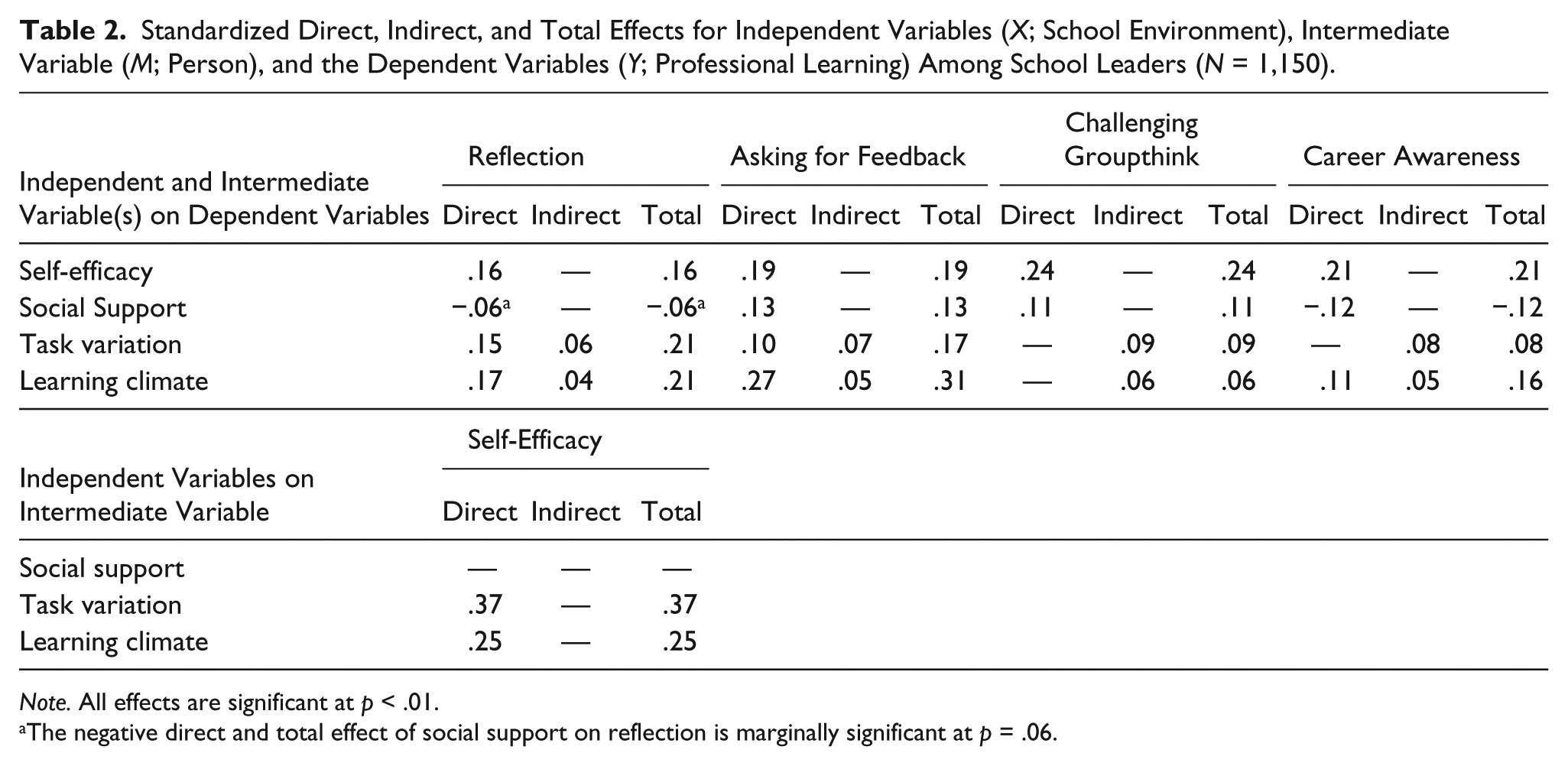
Note. All effects are significant at p < .01.
The negative direct and total effect of social support on reflection is marginally significant at p = .06.
Finally, in Table 3, the percentages of explained variances for the intermediate variable self-efficacy and the dependent variables with professional learning activities are reported. The model explained a considerable proportion of the variance in self-efficacy (26%) and asking for feedback (28%) among school leaders in Dutch secondary education. For reflection and career awareness this was somewhat lower, and for challenging groupthink only 8%.
Percentage of Explained Variance for Structural Equation Model on Dutch School Leaders’ Professional Learning.

Additional Multiple Group Comparisons
Since the type of school leaders varied highly in the data set, we performed additional multiple group comparisons on the final structural equation model, to investigate whether different learning patterns would emerge across the three types of school leaders we classified (i.e., school principal, deputy, or assistant school principal, other school leadership personnel). Multiple group comparison is a method to directly test the hypothesis that model fit is different across different subgroups in a sample. The hypothesis is rejected when the Δχ2 test between the unconstrained (subgroups are different) and the constrained (subgroups are the same) model is not significant (Gaskin, 2011). In addition, since the Δχ2 is sensitive to sample size, we also inspected ΔCFI, since a value higher than .01 is also indicative of a significant decrease in fit and more robust to sample size (Cheung & Rensvold, 2002).
First, we conducted a multiple group comparison, differentiating between all three groups. The model fit for the unconstrained model, in which regression paths are allowed to vary across groups, was χ2(42) = 52.58, p < .127, χ2/df = 1.25, CFI = .99, RMSEA = .02. The constrained model, in which regression paths were fixed to be equal across the groups, showed a model fit of, χ2(84) = 96.82, p = .16, χ2/df = 1.15, CFI = .99, RMSEA = .01. The models were not significantly different from each other, Δχ2(42) = 44.24, p = .38, ΔCFI = .00. In a second multiple group comparison, we differentiated between (a) all formal school leaders (school principals and deputy or associate principals) and (b) informal school leaders. Again, no differences emerged between the unconstrained (χ2[28] = 33.00, p = .24, χ2/df = 1.18, CFI = 1.00, RMSEA = .01) and the constrained (χ2[49] = 58.28, p = .17, χ2/df = .19, CFI = 1.00, RMSEA = .01) model, Δχ2(21) = 25.28, p = .23, ΔCFI = .00. Thus, in the current model, learning patterns among different types of school leaders were stable.
General Discussion
In Dutch secondary education, school leaders are highly autonomous and, thus, expected to be capable of developing their own system of quality assurance through reliable and valid self-evaluation, and to provide information on performance indicators, such as student achievement, parent satisfaction, and teacher professionalization. This requires a new type of school leadership that, in literature, is often referred to as “leadership for learning,” “the learning professional” and “inquiry-based learning” (e.g., Hallinger, 2011). This type of leadership places great emphasis on school leaders’ reflective, investigative, and collaborative skills in their daily work (Andersen & Krüger, 2013). Given this emphasis on professional learning, it is remarkable that school leaders’ informal or nonformal learning has received very little attention in both policy and research (OECD, 2016). In fact, 83% of the members of the General School Leaders Association (AVS, 2012) in the Netherlands believe that the government devotes insufficient attention to professional development of school leaders. Moreover, outcomes of a recent OECD report (2016) about the Dutch educational system stated that “Secondary school leaders are knowledgeable of regulations and their application, but less able to reflect on their own actions, to create a professional learning culture and to use data” (p. 126). To this end, insight in how leaders learn on-the-job to improve their professional development is paramount.
In this study, we investigated school leaders in secondary education on their engagement in professional learning activities at work. Specifically, we took a Person × Context fit approach to understand school leaders’ learning, and embedded our framework in theories about adult learning, work-place learning, the job demands–control model, and the theory of learning potential of jobs. We distinguished between social and individual forms of professional learning, and focused on either the current or future work situation. Specifically, we investigated the learning activities reflection, asking for feedback, career awareness, and challenging groupthink. We tested a model with data from 1,150 Dutch school leaders in secondary education. The results showed that school leaders’ learning is indeed embedded within the tasks and school environment, and also depends on school leaders’ personal driving forces (Billett, 2004). We provide a detailed discussion of our findings and place them in the context of both theory and practice.
Antecedents of School Leaders’ Professional Learning
First, results showed that task variation had a positive effect only on professional learning activities pertaining to the current working situation, but not the future. Thus, to the extent that school leaders perceive to have a nice pallet of different tasks on their hands, reflection and asking for feedback on how those various tasks are executed form important tools for learning. Yet challenging groupthink and career awareness were not affected by school leaders’ task variety. Potentially, high workload evolving from the large number of tasks and responsibilities of school leaders do not allow task variety to foster professional learning activities beyond monitoring the current state of affairs. In light of the job demands–control model (Karasek & Theorell, 1990), one could argue that a high task load causes the demands to outweigh the perceived control, and thus, obstructs the school leader from engaging in more transformational types of learning (Paavola et al., 2004). Indeed, research demonstrated that school leaders in Dutch secondary education face barriers when engaging in professional development, such as a lack of money, time, and resources to initiate change, and to shape their professional future (Hulsbos et al., 2016; Inspectorate of Education, 2014). Thus, in future research, an indicator of work load or pressure would be able to provide insight in whether demands indeed exceed control in school leaders’ current task description, and whether they should be given more time and space to critically reflect on the current status quo and to develop a vision on future development.
Second, we investigated the impact of both the instrumental (i.e., learning climate) and the social (i.e., social support) working environment on school leaders’ professional learning activities (Onstenk, 1997). Our results revealed that learning climate affected all professional learning activities in a positive manner except for challenging groupthink. This latter finding could be considered counterintuitive given that we conceptualized learning climate as a climate in which there is room for making mistakes for critique and for improvement (Onstenk, 1997; Pedler et al., 1991). On the other hand, a learning climate also entails that there is sufficient time and space to critically reflect. Perhaps school leaders perceive that the learning climate does offer room for feedback and reflective activities on current and future developments, but not on the more radical forms of learning that entail critically discussing and changing current norms and values in the school (i.e., challenging groupthink). All in all, the fact that perceived learning climate positively affects school leaders’ reflection, asking for feedback and career awareness, but not challenging groupthink asks for a more nuanced investigation of learning climate, that also includes more objective aspects of learning climate, to establish the conditions under which (e.g., time, space, money) such climate facilitates school leaders’ learning.
Third, prior research demonstrated that social support is an important prerequisite for on-the-job learning (Kwakman, 2003; Ouweneel, Taris, van Zolingen, & Schreurs, 2009). Yet the current study results reveal that the effect of social support was only positive for social learning activities (i.e., asking for feedback and challenging groupthink), but negative for individual learning activities (i.e., reflection and career awareness). Even more so, social support was the only school factor that was not positively related to self-efficacy. To our knowledge, the idea that social support may have a facilitating effect on some forms of learning, and an inhibiting effect on others is new. It is widely acknowledged that social support is one of the most important contributing factors to employees’ work outcomes, and the literature offers very few explanations for potential negative effects of social support at work, particularly in relation to workplace learning. Nevertheless, we aim to provide three potential explanations. First, since social support is generally associated with higher well-being at work (B. R. Sarason & Duck, 2001) one could argue that little social support can be a trigger to start thinking about a potential career elsewhere and reflect on professional opportunities in a different working context. Second, social support is likely to serve collective school interests (and thus collective forms of learning) but not necessarily individual ones. Therefore, when school leaders receive a lot of social support from their fellow school leaders this may be meddlesome or it may interfere with the formation of own visions and thoughts. Put differently, colleagues who offer social support to a fellow school leader are likely to, at least partly, do so out of self- or school-interests. If however, a school leader engages in individual learning activities that do not directly serve these interests (e.g., when seeking a career elsewhere, or applying for a competitive position), social support may hinder, rather than facilitate individual learning. Third, a final explanation for a negative effect of social support on individual learning activities could follow from the threat-to-self-esteem model (Deelstra et al., 2003). If a school leader often seeks social support, this may imply feelings of insecurity or incompetence. Indeed, social support was the only variable that was not positively related to school leaders’ perceived self-efficacy. Consequently, asking too much social support may cause overdependence on the input of others (asking feedback, etc.), and potentially inhibits school leaders from engaging in individual learning activities. Overall, based on these potential explanations of our results, in future research we recommend a more fine-grained investigation of different sources and motivations of social support to more fully understand its differential impact on social and individual professional learning activities.
Finally, self-efficacy is an important factor contributing to the level of professional learning among school leaders. The belief that one is capable of doing the job of a school leader well is an important prerequisite for social and individual forms of professional learning, pertaining both to the current and future working situation. This finding forms a valuable addition to existing literature in which the positive role of self-efficacy for professional learning was demonstrated among teachers (Bandura, 1993; Geijsel et al., 2009; Thoonen et al., 2011) and employees from several industrial, financial, and service companies in the profit sector (van Woerkom, 2003). Furthermore, this result directly contrasts the overall assumption by Dutch school boards and councils that school leaders’ lack of professional development is due to a lack of personal motivation by the school leaders (OECD, 2016). Based on our data, self-efficacy was the strongest predictor of professional learning across all four different types. Moreover, a great deal of the influence of a school’s environment on leadership learning is exerted through self-efficacy. In other words, self-efficacy is an important personal driving force that mediates the relationship between school environment and school leadership learning. This pattern of results is in line with prior work on self-efficacy demonstrating that as conditions for learning improve, this first activates a belief (i.e., a cognition) in one’s own abilities and competencies to learn, before actual learning activities (i.e., behavior) start taking place (Bandura, 1993; Zimmerman, 2002). In school contexts, this effect has been shown for both students (e.g., Zimmerman, Bandura, & Martinez-Pons, 1992) and teachers (e.g., Geijsel et al., 2009; Thoonen et al., 2011). Importantly, our findings demonstrate that this mediation model also applies for school leaders’ professional learning. In fact, even when school environmental factors did not directly affect professional learning (e.g., learning climate on challenging groupthink), they still had an indirect effect via self-efficacy.
Overall, these results underline the importance of our Person × Environment framework to understand the conditions under which school leaders’ professional learning is facilitated. In line with the OECD (2016) evaluation report, we recommend that educational boards, councils, and policy makers provide the necessary time, money, resources, and support that provides school leaders with the opportunity to engage in day-to-day professional learning activities. Given that such resources are provided, it is then up to the school leader himself or herself, and the belief in his or her own capacities for learning to take these opportunities.
Toward a Multidimensional Approach to School Leaders’ Professional Learning
In this research, we took a multidimensional approach to understand professional learning among school leaders. In prior research, oftentimes, the choice of learning activities in empirical research lacks a clear rationale (see also Kwakman, 2003; van Woerkom, 2003). To understand school leaders’ engagement in professional learning activities, we conceptualized professional learning as an ongoing constructive process that is embedded within the person and the social context of the school (van Woerkom & Croon, 2008). Moreover, we included more adaptive and transformative forms of professional learning (Paavola et al., 2004; Sessa & London, 2008) and categorized school leaders’ learning activities as focused on the school’s current state of affairs in order to protect and sustain teacher’s and student’s successful achievements, and as focused on steering into new, future directions of change when current ways of working are no longer effective. Thus, we categorized four professional learning activities into a social–individual learning, and a current–future learning dimension., The results of our higher order CFA revealed good model fit and thus confirms that the four learning activities selected in this study indeed all significantly contribute to the latent construct “professional learning.” Thus, from both a theoretical and empirical viewpoint we can be confident that the behaviors we measured with this for activities are relevant to school leaders’ professional learning.
The larger need for innovative, flexible, and self-steering work environments has boosted scientific research on nonformal and informal workplace learning (Tynjälä, 2008). In school contexts too, due to rapid societal changes (e.g., ICT, the Internet, globalization) the meaning of knowledge has changed and so has the meaning of professional learning and education. While taxonomies of professional learning activities have been provided in other professional fields, such as for nurses (Berings, Poell, & Gelissen, 2008), teachers (Endedijk & Bronkhorst, 2014; Kwakman, 2003), and engineers (Endedijk, Hoekman, & Sleegers, 2014), a recent literature review revealed that there is hardly any empirical work providing insight in professional learning activities of school leaders (Hulsbos, Evers, Kessels, & de Laat, 2014). In our view, our approach to school leaders’ professional learning activities enriches our current understanding of how school leaders learn and the factors that facilitate such learning. We hope that the two (social vs. individual) by two (current vs. future) grid for learning activities offers a springboard for future researchers to integrate and further expand this framework including other professional learning activities used in recent studies such as knowledge sharing (van Woerkom, 2003), networking, communities of practice (Hulsbos et al., 2016) reading professional literature and keeping up to date (Geijsel et al., 2009; Kwakman, 2003). Importantly, when changes are implemented in school leaders’ task descriptions, social support systems, and school climate, it should be considered that different aspects of their professional learning might be triggered or inhibited (i.e., social, individual, future- or present-oriented).
Practical Implications
From a more practical viewpoint, a key question is what insights the current study results offer for policy makers in the Netherlands to further improve school leaders’ engagement in professional learning. In contrast to other OECD countries such as Australia, Canada, and Singapore, in the Netherlands there are currently no formal educational requirements to become a school leader, nor are there formal professionalization requirements to further advance school leaders’ careers. Consequently, school leaders’ nonformal learning largely depends on their own initiative and motivation to self-reflect and to ask for feedback from colleagues (OECD, 2016). Indeed, recent research revealed that school leaders indicate to engage in professional learning activities mostly in response to external pressures for school reform or innovation, and to have a lack of time and resources to move beyond this adaptive type of learning to engage in more progressive, knowledge creating forms of learning (Hulsbos et al., 2014).
To this end, we recommend that educational policy makers and researchers further establish a formal professionalization program for school leaders based on nonformal learning principles. For example, to facilitate professional learning focused on the current working situation, enriching professional development programs with practice-based learning assignments that have build-in moments of reflection and feedback may offer a springboard for school leaders to engage in these learning activities more frequently on a day-to-day basis. Moreover, to facilitate the more future-oriented, progressive learning activities such as changing the status quo or challenging groupthink, exchange programs and network meetings with other school leaders outside the own school environment would be valuable. This may allow school leaders to take a step back, hear new perspectives, and think “outside the box.”
Limitations and Future Research
A first limitation is the single source nature of our data. The data for this research were gathered with self-report questionnaires. Even though self-report questionnaires correspond to the lingual and reflective nature of the constructs we were interested in, mere reliance on self-report measures may run at risk of common method bias. Inclusion of other methods (i.e., large-scale observations, logs, and interviews) and additional samples (i.e., 360 degrees feedback; Seifert & Yukl, 2010; self-other agreement, Fleenor, Smither, Atwater, Braddy, & Sturm, 2010) allows for data triangulation and may provide an even more complete and detailed picture of the mechanisms to understand school leaders’ professional learning. Nonetheless, in our study most of the variables are about attitudes or perceptions about work and learning, and little critique exists on using self-report measures for that purpose. The potential critique on self-report measures mainly pertains to indicators of the objective job environment (Spector, 1994). To this end, future studies could include perceptions of others (e.g., teachers, students) in to measure, for example, learning climate. Alternatively, one could use objective data from HR departments to operationalize the task variation of school leaders. Such a multimethod approach may validate our findings further.
Second, despite the relatively high-explained variance of the professional learning activities, the residual variance is high enough to warrant more or other explanatory variables of school leaders’ learning. Particularly for challenging groupthink, the explained variance was merely 8%. Overall, the mean level of challenging groupthink was above the midpoint of the scale with a standard deviation comparable to the other variables (see Table 1). Thus, school leaders do challenge groupthink and they vary in their level of doing so. However, from a methodological viewpoint, the internal reliability of the scale was rather weak (α = .60 and factor loadings of .40). Despite the fact that this is still within acceptable standards (Field, 2009) it could explain why little variance was explained. A lack of internal consistency could be caused by reversed item formulation (Schriesheim, Eisenbach, & Hill, 1991), or by a large variation in the interpretation of items by different leaders in different schools. To illustrate the latter, challenging the current state of affairs can be seen as a constructive (something good) or a deconstructive (something bad) form of conflict depending on the conflict management style of the leader (i.e., forcing or avoidant, vs. problem solving; De Dreu, Evers, Beersma, Kluwer, & Nauta, 2001). Therefore, conflict management style may be an important personal factor to take into account in future research to understand whether leaders interpret challenging groupthink as something negative or positive.
In addition, it may also be interesting to investigate not only self-efficacy (“yes I can”) but also collective efficacy (“yes we can”) as a factor that impacts on school leaders’ learning. To illustrate this, challenging groupthink is the ability to speak up against the collective opinion and thus it clearly requires self-efficacy. Yet does it also require collective efficacy? One could argue that, if anything, collective efficacy enhances groupthink (i.e., like-mindedness in the group) rather than challenges it. Future research should focus on the interplay between collective- and self-efficacy in relation to school leaders’ learning activities on both the individual and social level.
Furthermore, our study was cross-sectional in nature. This means that the structural equation analysis cannot reveal causal relations, as it offers a “snapshot image” of the situation. To ensure causality, longitudinal studies are needed on school leaders’ learning cycles and trajectories. In particular, a longitudinal study may reveal that the relationship between school leaders’ professional learning and the school environment is circular; to the extent that school leaders ask for feedback, reflect, challenge, and so on, this may facilitate the school’s learning climate and vice versa. Such a longitudinal approach can contribute to a deeper understanding of the dynamic interplay between the school environment and the learning of school leaders.
In line with the bulk of research on a Person × Context perspective on workplace learning, we find evidence that the school environment impacts on school leaders’ self-efficacy and in turn on their workplace learning (e.g., Geijsel et al., 2009; Thoonen et al., 2011; van Woerkom, 2004). However, school leaders are not randomly assigned to schools, but might select schools to work in those that fit them as a person. For example, highly self-efficacious school leaders may self-select in school environments with a strong learning climate. Future research should investigate these selection effects and its consequences for school leaders’ workplace learning.
Finally, at present, there are about 2,825 school leaders in secondary education in the Netherlands (Inspectorate of Education, 2014). We were able to include more than 40% of the entire population in our sample. Thus, we feel confident about the generalizability of our findings to the Dutch population of school leaders in secondary education and their value to understand broader patterns of school leader’s professional learning. The additional multiple group analysis we conducted indeed demonstrated the robustness of the model across different types of (formal and informal) school leaders in the Netherlands. Nevertheless, sensitivity to the school’s social and instrumental environment may not always be similar for different school leaders, and may affect their professional learning in a different way. Moreover, the impact of school context and personal factors on school leaders’ professional learning is likely to vary cross-culturally, given that school systems vary largely, as well as the level of decentralization and, thus, school leader responsibility (OECD, 2016). To this end, future research should replicate these findings in different countries and cultures.
Moreover, as we have demonstrated in this study, demographic background such as gender, tenure and type of educational background may also impact on professional learning. Indeed, women scored higher on most professional learning activities, which is in line with recent findings by the Dutch Ministry of Education, Culture and Science (Inspectorate of Education, 2014) showing that female school leaders score higher on basic competencies for school leadership (e.g., creating a joint vision, facilitating cooperation, strategic leadership). Further studies on how demographic and status differences affect school leadership learning could paint an even more fine-grained picture of school leaders’ professional learning.
We close our discussion by offering a few starting points for future research. In this article, we demonstrated that school leadership learning is happening, relevant and that it consists of multiple dimensions. Also, we provided insight in antecedents of school leaders’ professional learning, pertaining to the school environment, tasks, and personal driving forces. Nevertheless, the ultimate goal of understanding school leaders’ workplace learning is to improve their leadership practice and, as a result, teacher practice and student learning outcomes. In this study, no measures of learning outcomes were included. Yet prior studies on teachers’ workplace learning already demonstrated that it is very hard to measure learning outcomes with self-report data (e.g., questionnaires, diaries) other than changes in knowledge and beliefs and changes in emotions and intentions for practice (Bakkenes, Vermunt, & Wubbels, 2010). Similarly, for school leaders, Hulsbos et al. (2016) clearly demonstrated that they hardly report other outcomes of reflective learning activities than changes in individual knowledge and skills. Indeed, compared with formal learning, learning outcomes of nonformal workplace learning are less predictable and often produce implicit knowledge and situation-specific competences. Consequently, “hard” performance and improvement outcomes of this type of learning are very hard to capture (Tynjälä, 2008), and therefore, scarce in literature on workplace learning.
Nevertheless, the next challenge is to investigate the consequences of school leaders’ professional learning activities. For example, how does workplace learning relate to transformational leadership (e.g., Geijsel et al., 2009) in which providing vision and intellectual stimulation are central. Also, how does leadership learning relate to authentic leadership development (Avolio & Gardner, 2005) whereby leaders and followers gain self-awareness and establish open, transparent, and trusting relationships? Finally, what consequence does the learning school leader have for the learning capacity of teachers and students? Longitudinal in-depth studies, using multimethod techniques and sources, are needed to find out how and to what extent changes in school leaders’ workplace learning activities indeed lead to changes in practice, and to find answers to the question whether all learning is as equal or as valuable. In other words, does it matter what type of learning activities school leaders engage in (e.g., future oriented, socially) for their ability to respond effectively to implementation of educational innovations and change? Responding to complex and changing environments is still one of the greatest challenges for school leaders in Dutch education today. Therefore, understanding what type of professional learning contributes to that is important.
Conclusion
Around the beginning of the new millennium, a large-scale educational reform was implemented in Dutch secondary educations. Its aim was for students to not only learn traditional subject matter but also to acquire social and technical competencies that provide the opportunity to construct their own knowledge. This call for lifelong learning, has led educational scholars to extensively investigate professional learning in schools: First among students, and then among teachers to help them transfer to a new role as facilitator of lifelong learning. Thus far, the role of school leaders’ professional learning has been neglected in this process. Yet school leaders are at the forefront of successfully implementing educational reform and improving the quality of teacher and student learning. In this research we offer insight in school leaders’ professional learning, and demonstrate that their learning activities are embedded within the school environment and driven by personal motivation.
Footnotes
Appendix A
Factor Analysis CFA on Professional Learning Dimensions.

| Component |
||||
|---|---|---|---|---|
| Asking for Feedback | Challenging Groupthink | Career Awareness | Reflection | |
| I discuss with my fellow school leaders how I have developed | .64 | |||
| I discuss with my fellow school leaders our criteria for performing well | .52 | |||
| If I think I have not done my work well, I discuss this with my fellow school leaders | .58 | |||
| I discuss with my fellow school leaders what I find important in my work | .61 | |||
| I ask my fellow school leaders for feedback | .74 | |||
| I invite my fellow school leaders to assess my work critically | .64 | |||
| When I do not agree with a fellow school leader, I keep quiet (reverse-scored) | .46 | |||
| I do not easily express criticism to my fellow school leaders (reverse-scored) | .40 | |||
| When I am the only one to disagree with the rest, I just keep quiet (reverse-scored) | .66 | |||
| When I do not agree with something at work, I find it hard to say so (reverse-scored) | .57 | |||
| I am consciously occupied with my career | .68 | |||
| I am continually occupied with my career development | .82 | |||
| I think about what sort of work I would like to be doing in 5 years’ time | .67 | |||
| I reflect on the way I do my work | .58 | |||
| I think about my communication with fellow school leaders at school | .59 | |||
| I compare my own school with similar ones | .41 | |||
| I think about what I have not done well in the past year | .63 | |||
Note. All estimates are significant at p < .001.
Appendix B
List of Independent and Intermediate Variables.

| Self-Efficacy I have the feeling that I can work effectively |
| I have sufficient self-confidence to defend my point of view about my work |
| I am satisfied with the quality of my work |
| I have the feeling that I am becoming an increasingly better school leader |
| I have the feeling that I am successful in my work |
| I feel appreciated for my leadership skills |
| Task Variation |
| Creativity is required for my work |
| My work is varied |
| My work makes sufficient demands on all my skills and capacities |
| In my work I have sufficient variety |
| My work requires me to take initiative |
| Learning Climate |
| In our school it is considered normal that you can learn from mistakes |
| Time is spent on reflecting jointly on our goals |
| Time is reserved to make plans for improvements |
| School leaders jointly reflect on what still needs to be learned |
| In our school they look for the causes of success and failure |
| In our school they review what has gone well and what has not |
| Social Support |
| I can rely on my fellow school leaders when I have some problems in my work |
| I can ask my fellow school leaders for help if necessary |
| I can work well with my fellow school leaders |
| I have good contact with my fellow school leaders about my work |
| My fellow school leaders are helpful |
Declaration of Conflicting Interests
The authors declared no potential conflicts of interest with respect to the research, authorship, and/or publication of this article.
Funding
The authors received no financial support for the research, authorship, and/or publication of this article.