







Abstract
Introduction
In recent years, the United States has seen both progress and resistance to the Lesbian, Gay, Bisexual, Transgender, Queer (LGBTQ) rights movement. To illustrate, in 2015, the U.S. Supreme Court delivered a landmark decision in favor of marriage equality nationwide (Obergefell v. Hodges, 2015). Despite this victory for the LGBTQ community, many important issues that affect the everyday lives of LGBTQ people remain unresolved, such as transgender bathroom rights, same-sex health insurance coverage, same-sex adoption, and the refusal of service. To further complicate the lack of legal clarity, there has been a growing effort to counteract LGBTQ progress with legislation. Most notably, in March of 2016, North Carolina passed HB2, which required individuals to use the bathroom that corresponds with the gender they were assigned at birth. Facing pressure, the Governor of Georgia decided to veto a similar bill passed by the Georgia Legislature (Georgia House Bill 757, 2015-2016).
Following these events and in response to inquiries from school districts, the U.S. Department of Justice (DOJ) and the U.S. Department of Education Office for Civil Rights (OCR) issued a joint Dear Colleague Letter on Transgender Students (U.S. Department of Education & U.S. Department of Justice, 2016). While many school districts were relieved to receive guidance, the release of this letter was met with mixed responses, including a lawsuit filed on behalf of 11 states that challenged the federal agencies’ authority to issue such guidance (Texas v. United States, 2016). Under the new administration, on February 22, 2017, OCR and the DOJ released guidance to rescind the 2016 Dear Colleague Letter on Transgender Students (U.S. Department of Education & U.S. Department of Justice, 2017). Given the inconsistent messaging school districts have received from the courts and OCR, the law in the area of LGBTQ rights is complex and, arguably, uncertain. In the face of this complexity, understanding the legal landscape can help empower educational leaders to promote LGBTQ inclusion.
A significant and growing body of LGBTQ educational research examines the experiences of students, employees, and the substance of leadership training (Brunner, 2013; Capper, Theoharis, & Sebastian, 2006; Kosciw, Palmer, Kull, & Greytak, 2013; Lugg, 2003; Marshall & Hernandez, 2013; O’Malley & Capper, 2015). This project aims to complement this work by taking a macro-level look at the broader legal and policy considerations that may constrain or enhance a leader’s ability to promote LGBTQ inclusion. Through an examination LGBTQ issues, this article will explore the relationship between various sources of legal authority and the role of law in education policy and practice (Mead, 2009).
This article will begin with a brief literature review, followed by an overview of social justice leadership, which will serve as the primary theoretical framework for this article. Building on this foundation, the focus will shift to constitutional provisions, civil rights laws, and legal cases to equip educational leaders and researchers with the requisite legal knowledge to deepen their ability to advocate for LGBTQ students. The next section will revisit the social justice framework in light of current law and provide examples of the ways in which social justice leaders can apply the law to promote LGBTQ inclusion. Given the complexity of the law and the current political climate, this skill set will assist educational leaders and researchers who work in states or communities that present varying levels of resistance to LGBTQ issues. The legal principles discussed in this article have broad application beyond LGBTQ issues, as they provide a framework for understanding complex ways in which sources of legal authority relate to one another, which can be applied to numerous issues that arise in educational context. Moreover, this article touches on politics and the need to balance competing interests (Shapiro & Stefkovich, 2016), both significant issues in the everyday work of educational leaders.
Literature Review
LGBTQ Equity and Inclusion
The need to proactively address LGBTQ inclusion is immediate and pervasive. According to the GLSEN 2015 School Climate Survey, 57.6% of students felt that their safety was in jeopardy due to their sexual orientation, and 43.3% of students felt unsafe due to their gender expression (Kosciw, Greytak, Giga, Villenas, & Danischewski, 2015). Students reported experiencing harassment and assault at alarming rates (e.g., 70.8% of LGBTQ students reported verbal harassment based on their sexual orientation and 54.5% based on their gender expression; Kosciw et al., 2015). Eighty percent of students indicated that their school district had discriminatory policies or practices in place. Sixty-six percent of the students indicated that they experienced this discrimination personally, while 74% reported that other students were affected by discriminatory policies and practice (Kosciw et al., 2015). This is significant, particularly in light of research suggesting that a negative school climate can affect a student’s academic, social, and psychological well-being (Birkett, Russell, & Corliss, 2014; Kosciw et al., 2013).
Despite the inequities that exist for LGBTQ students, “[I]n the general literature on educational leadership preparation, social justice and equity are not central and sexual identity is hardly addressed at all.” (O’Malley & Capper, 2015, p. 294). Moreover, there is limited educational leadership research on intersectionality and the experiences of multiply marginalized students (Capper & Young, 2014). O’Malley and Capper (2015) found that many leadership preparation programs that prioritize social justice tend to focus on some marginalized groups and underemphasize others, including LGBTQ students. Educational leaders need to be aware of the inequities that exist and be prepared to address these inequities. Research demonstrates that Gay Straight Alliances (GSAs) and explicit, LGBTQ-inclusive school policies can improve a student’s educational experience (Kull, Greytak, Kosciw, & Villenas, 2016; Lee, 2002; O’Malley, 2013). However, a significant percentage of social justice-oriented leadership preparation programs are not preparing leaders to create an LGBTQ inclusive curriculum, craft LGBTQ inclusive antibullying and antiharassment policies, and collect relevant data (O’Malley & Capper, 2015). These skills are necessary to LGBTQ-inclusive, social justice leadership. Given the connection to civil rights and the broader institutional factors that influence policy and practice in schools, legal literacy can serve as a meaningful tool to enhance these skills.
Legal Literacy
In accordance with professional standards, educational leaders are expected to possess the requisite skills to analyze legal and ethical issues. For example, Educational Leadership Constituent Council (ELCC) standards address law, equity, and social justice. Specifically, ELCC Standard 5.0 states: A district-level education leader applies knowledge that promotes the success of every student by acting with integrity, fairness, and in an ethical manner to ensure a district system of accountability for every student’s academic and social success by modeling district principles of self-awareness, reflective practice, transparency, and ethical behavior as related to their roles within the district; safeguarding the values of democracy, equity, and diversity within the district; evaluating the potential moral and legal consequences of decision making in the district; and promoting social justice within the district to ensure individual student needs inform all aspects of schooling. (ELCC, 2011)
The knowledge and skills described in this standard are at the heart of this article.
A recent case involving transgender inclusive policies, G. G. v. Gloucester County School Board (2016), discussed later in this article, brought LGBTQ inclusion in education to the forefront. The significant number of amicus briefs filed by educational organizations in support of transgender students in the case show that educational leaders are ready move the needle toward social justice for LGBTQ students (e.g., Brief for School Administrators From Thirty-One States and the District of Columbia as Amici Curiae in support of Respondent, Gloucester County School Board v. G.G., 2017). However, to bolster this commitment, educational leaders must possess legal literacy to navigate the nuances of the law, particularly as it relates to marginalized populations (Pazey & Cole, 2013). Unfortunately, research demonstrates that both teachers and educational leaders are not adequately prepared to analyze and appropriately address legal issues that arise in schools (Decker, 2014; Pazey & Cole, 2013; Schimmel & Militello, 2007; Umpstead, Decker, Brady, Schimmel, & Militello, 2015). Most teachers are “uninformed or misinformed” about the legal rights of teachers and students, and the majority get their legal information from other teachers (Schimmel & Militello, 2007, p. 262). According to Schimmel and Militello (2007), “Too many teachers view the law as a source of fear and anxiety-an invisible monster lurking in the shadows of the classroom, hallways, or playground, waiting to ensnare any educator who makes an innocent mistake” (pp. 257-258). School leaders are also unsure of the status of the law and if they are acting in accordance with the law. In a survey of nearly 500 school principals, 85% indicated that they would change their behavior if they knew the correct answer to the survey questions about the legal rights of students and teachers (Militello, Schimmel, & Eberwein, 2009). The law is often taught from a liability perspective. As a result, it is not surprising that teachers and educational leaders do not feel ownership for the law and instead view it as an imposition of barriers (Bull & McCarthy, 1995).
Despite this lack of knowledge, education law is threaded throughout education policy and practice. Broadly, topics include negligence, school finance, special education, freedom of speech, employment law, and student discipline, among many others (Alexander & Alexander, 2012). The trend in education law court decisions is away from broad remedial orders and toward court-ordered specific remedies and interventions (Superfine & Goddard, 2009). Such court decisions have a direct impact on educational policy and school personnel. Educational leaders must not only understand how to avoid legal pitfalls but also how to proactively use legal literacy to serve as a tool to advocate for students. Based on these two areas of research, educational leaders are in need of additional training and professional development in both law and LGBTQ issues. This article is situated at the intersection of these two growing bodies of research.
Framework
This article will primarily rely on a social justice framework (Cambron-McCabe & McCarthy, 2005; Capper et al., 2006; Karpinski & Lugg, 2006; Theoharis, 2007, 2009; Theoharis & Scanlan, 2015). As stated by Theoharis (2007), social justice leaders “make issues of race, class, gender, disability, sexual orientation, and other historically and currently marginalizing conditions in the United States central to their advocacy, leadership practice, and vision. This definition centers on addressing and eliminating marginalization in schools” (p. 223). Moreover, it is important for leaders to acknowledge and seek to dismantle systems of oppression that compound inequities experienced by multiply marginalized individuals such as LGBTQ students of color, LGBTQ students with disabilities, LGBTQ students experiencing homelessness, and undocumented students who identify as LGBTQ (e.g., Burdge, Licona, & Hyemingway, 2014; Choi, Wilson, Shelton, & Gates, 2015; Duke, 2011). According to Capper et al. (2006), social justice leaders must possess “critical consciousness, knowledge and practical skills” (p. 212). Critical consciousness requires leaders to engage in critical reflection, including personal biases, privilege, systems of oppression, and discrimination. Building on critical consciousness, knowledge of education law and policy can serve as an important tool for leaders to better understand their role in perpetuating or dismantling policies and practices that contribute to inequities. Moreover, understanding the nuances of the law will empower social justice leaders to enact social justice with greater confidence.
The law answers the “May We?” and “Must We?” questions, while the “Should We?” questions are best left to policy makers, including on-the-ground policy makers such as building- and district-level administrators (Mead, 2009; Mead & Lewis, 2016). For example, must we allow a GSA if we allow other student groups? Must we permit same-sex couples to attend prom? May we prohibit a student from wearing a T-shirt with an antigay message without violating the First Amendment’s guarantee of Freedom of Speech? May we separate students on the basis of sex for particular classes or extracurricular activities? These questions are legal questions, which inform policy decisions (Superfine, 2009). Within the boundaries set by the law, social justice can serve as a lens through which leaders answer the policy-related “Should We?” questions. The use of social justice as a driving force also impacts the ways in which leaders may relate to and use the law, which this article aims to illustrate.
It is important to note that we do not intend to equate the law with social justice (Cambron-McCabe & McCarthy, 2003; Lugg, 2003). On the contrary, we recognize that legality is linked to power and privilege. Nonetheless, not knowing the law can lead to unnecessary restrictions on authority or it may unknowingly lead an administrator to act outside the bounds of discretion. We also recognize that there may be rare instances where a leader decides to act outside the bounds of discretion in furtherance of a commitment to social justice. However, when this individual is aware of the law, this individual is better able to assess the consequences of this decision. The law is replete with grey areas that have the potential to turn into black and white law; a social justice leader with knowledge of the law may decide to take a risk and face a possible lawsuit in hopes of achieving a ruling that benefits LGBTQ students districtwide, statewide, or nationwide. Moreover, because the law is dynamic, it is important for social justice leaders to understand interrelated sources of legal authority to assess the implications of legal activity at the local, state, and national levels.
Method
This article employs legal research methodology (Eckes & McCall, 2014; Mead & Lewis, 2016; McCarthy, 2010, 2016; Russo, 2015) to illuminate the breadth of the law affecting LGBTQ issues. More specifically, this article examines the U.S. Constitution, relevant state and federal statutes and their corresponding regulations. According to Mead (2009), “Legal research may seek to capture the current statutory boundaries and jurisprudential thinking on a topic in order to describe its implications, both for current practice and for future policy development” (p. 287). To retrieve relevant resources, we used the LexisNexis legal database, as well as the U.S. Department of Education’s website, which includes guidance, complaint decisions, and other informational resources. This article does not purport to cover every legal decision or piece of legislation. On a related note, because this area of law is rapidly evolving in a patchwork fashion, most recent updates may not be reflected in this article. Therefore, it is important for readers to review most recent developments in the law. Moreover, this article focuses on student-related concerns. This decision does not aim to minimize the concerns that directly affect LGBTQ teachers and administrators. On the contrary, we recognize that the laws affecting LGBTQ adults are similarly complex and unsettled. However, in the present article, we aim to offer a framework that illustrates the complexity of the law and, through example, demonstrate how educational leaders can use legal literacy to more effectively and confidently advocate for LGBTQ student inclusion.
Legal Authority
Legal battles over LGBTQ issues revolve around a number of legal theories and sources of legal authority, including the First and Fourteenth Amendments of the U.S. Constitution, Title IX of the Education Amendments Act of 1972, and relevant state laws. Available avenues for redress include filing a lawsuit, filing a complaint with the U.S. Department of Education Office for Civil Rights, state-level resolution mechanisms, and district-level dispute resolution options. This article will explain the similarities and differences between each of these options.
First Amendment
The visible presence of LGBTQ youth in schools has grown (Lambda Legal, n.d.), and many LGBTQ students seek to gather support by forming GSAs. There are several Supreme Court cases that focus on student speech that affect LGBTQ students and GSAs in particular. In Tinker v. Des Moines Independent Community School District (1969), the Supreme Court held that schools can only suppress student speech when it materially and substantially interferes with school operations or infringes on the rights of others. Later, the Supreme Court determined that schools may also limit lewd and obscene student speech (Bethel School Dist. No. 403 v. Fraser, 1986) and school-sponsored speech to align with the school’s basic educational mission (Hazelwood School District v. Kuhlmeier, 1988).
Freedom of Speech claims have arisen in a number of cases involving students who wear T-shirts with progay or antigay messages (Eckes, 2017; Fossey, Eckes, & DeMitchell, 2010; Lewis, 2015). Regional courts of appeal have reached different outcomes in such cases. For example, in one case, a student in Illinois wore a T-shirt that read “Be Happy Not Gay” (Zamecnik v. Indian Prairie Sch. Dist., 2011). The Seventh Circuit Court of Appeals, with jurisdiction over Illinois, Indiana, and Wisconsin, determined that this message did not create a material and substantial disruption and therefore the speech was protected. A student in California wore a T-shirt that read “Homosexuality is shameful. Romans 1:27” on the front, and “Be ashamed. Our school has embraced what God has condemned” (Harper v. Poway Unified Sch. Dist., 2006). The Ninth Circuit Court of Appeals, with jurisdiction over California, Hawaii, Alaska, Idaho, Arizona, Montana, Washington, Nevada, and Oregon, applied the second prong of the First Amendment standard and found that the message infringed on the rights of other students. Therefore, the speech was not protected.
Opposition to GSAs has also come in the form of policies that ban programs that do not align with the stated core values of the school, are sex-based, or do not directly relate to the school curriculum (Caudillo v. Lubbock Independent School District, 2004; Woods, 2009). Increasingly, these arguments against GSAs have been struck down under the Equal Access Act, which compels federally funded secondary schools to provide equal access to extracurricular clubs (Gonzalez v. School Board of Okeechobee County, 2008). The exclusion of GSAs often turns on whether sex education is included within the platform of the group, which then could classify it as a sex-related activity not related to the school’s goals (Caudillo v. Lubbock Independent School District, 2004). However, the courts have warned that GSAs that focus on nonsexual activities should be treated in the same fashion as all other noncurricular clubs and provided with the same resources (Gonzalez v. School Board of Okeechobee County, 2008; Straights & Gays v. Osseo Area Schools—District No. 279, 2008).
Fourteenth Amendment
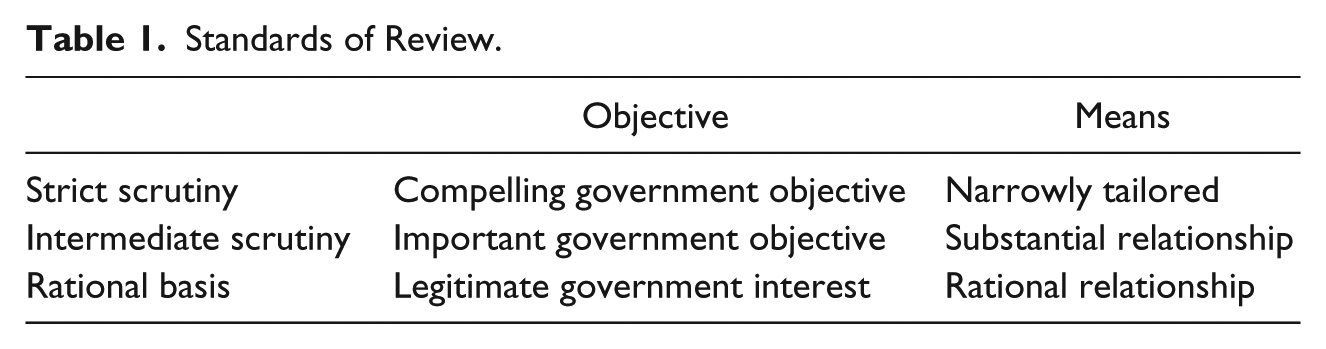
The Fourteenth Amendment to the U.S. Constitution reads as follows: “No state shall make or enforce any law which shall . . . deny to any person within its jurisdiction the equal protection of the laws” (U.S. Const. amend. XIV). When analyzing discrimination, courts apply various tests to determine whether the action violates the Fourteenth Amendment (Table 1). The least rigorous of these standards is rational basis. This test merely requires that there be a rational basis for the government action (United States v. Carolene Products Company, 1938). While there has been some discussion over whether this will change in the future, currently, the rational basis test is the standard that courts generally apply for cases involving discrimination on the basis of sexual orientation. The most rigorous test applies a standard that is referred to as “strict scrutiny” (Fisher v. University of Texas at Austin, 2013). This test requires courts to determine if the action is narrowly tailored to meet a compelling state interest. This particular test is applied when government actions involve racial discrimination. Between rational basis and strict scrutiny, courts apply an intermediate level of scrutiny, sometimes referred to as heightened scrutiny (United States v. Virginia, 1996). This level of scrutiny applies when courts analyze sex discrimination. This test requires an “exceedingly persuasive justification” for an action that aims to serve an “important governmental objective” (United States v. Virginia, 1996).
Standards of Review.
As an illustration, several states have laws that restrict discussions of homosexuality in schools (Human Rights Watch, 2017). Homosexuality cannot be discussed in science, history, literature, or any classroom context. Students in these states who do not identify as heterosexual cannot obtain information about safe sex or healthy relationships from their health teachers (Human Rights Watch, 2017). Under the rational basis test, such laws could survive scrutiny with the argument that discussions about sexual orientation and gender identity belong in the home. In contrast, policies which use race as factor, such as admission policies, must meet a higher burden to survive the strict scrutiny standard (e.g., Fisher v. University of Texas at Austin, 2013).
Nabozny v. Podlesny (1996) was the first successful federal lawsuit alleging that school officials’ failure to protect a gay student from other students’ bullying constituted discrimination based on gender and sexual orientation under the Fourteenth Amendment. However, in Nabozny, the court refused to address whether heightened scrutiny should be used in equal protection cases where gay and lesbian students were victims of discrimination, stating that rational basis was sufficient for their purposes. The case largely rested on the egregious nature of the facts that the school repeatedly failed to enforce their antiharassment policies to the detriment of a student based on other students’ perception of his sexual orientation. The Nabozny case demonstrates that school districts may face legal repercussions under the Equal Protection Clause for failure to respond to harassment and bullying on the basis of sexual orientation.
Although these standards provide a helpful framework, their application is very fact specific. Moreover, because these tests are so dependent on the specific set of facts, a claim that a particular practice violates the U.S. Constitution is more likely to be resolved in a court of law, a process that can be very time-consuming. However, state and federal statutes can provide a useful and more specific source of authority to bolster the protections available under the Equal Protection Clause of the Fourteenth Amendment. Title IX is an example of such a statute.
Title IX
The U.S. Department of Education Office for Civil Rights is responsible for enforcing a number of federal civil rights laws that prohibit discrimination on the basis of race, color, national origin, disability, age, and sex. Title IX states that “[N]o person in the United States shall, on the basis of sex, be excluded from participation in, be denied the benefits of, or be subjected to discrimination under any education program or activity receiving Federal financial assistance” (Title IX of the Education Amendments of 1972). Title IX violations may be redressed through lawsuits or complaints to the OCR. Unlike filing a lawsuit, which requires the individual filing a complaint to be an injured party, anyone who suspects sex discrimination has a right to file a complaint with OCR.
Courts have clarified the circumstances where a school may be sued for Title IX violations. An entire institution is covered by Title IX if any part of the institution receives federal funds (Civil Rights Restoration Act of 1987, 1988). Under Title IX, institutions can be liable for monetary damages for intentional discrimination (Franklin v. Gwinnet, 1992), retaliation after a complaint (Jackson v. Birmingham, 2005), or if the school has notice of peer to peer harassment and is deliberately indifferent to it (Davis v. Monroe County Board of Education, 1999).
OCR communication and federal case law have confirmed that harassment against LGBTQ students is illegal although LGBTQ students are not specifically mentioned in the text of Title IX. In their 2010 Dear Colleague Letter, the Office for Civil Rights clarified that “gender-based” harassment against LGBTQ students, such as harassment based on sexual orientation or gender identity, violates Title IX (U.S. Department of Education, 2010). Two primary rationales have developed to support these claims in federal courts: gender stereotyping and per se sex discrimination. Gender stereotyping links discrimination based on sexual orientation with a failure to conform with masculine or feminine stereotypes and has been generally accepted as a valid rationale linking sexual orientation with sex discrimination under Title IX (Doe v. Se. Greene Sch. Dist., 2006; Eilenfeldt v. United, 2015; Montgomery v. Indep. Sch. Dist. No. 709, 2000; N.K. v. St. Mary’s Springs Acad. of Fond du Lac Wis., Inc., 2013; Riccio v. New Haven Board of Education, 2006; Snelling v. Fall Mt. Regional Sch. Dist., 2001; Theno v. Tonganoxie Unified Sch. Dist. No. 464, 2005; Walsh v. Tehachapi Unified Sch. Dist., 2011). Although more straightforward, the per se sex discrimination rationale has been successful to a lesser extent (Estate of Brown v. Ogletree, 2012; Ray v. Antioch United School District, 2000; Roe v. Gustine Unified Sch. Dist., 2009; Schroeder v. Maumee Bd. of Educ., 2003). Under this rationale, courts accept that harassment based on perceived sexuality is squarely within the type of discrimination prohibited under Title IX.
Notable OCR complaints
In November of 2011, the National Center for Lesbian Rights filed a complaint on behalf of a transgender student enrolled in Arcadia Unified School District in California (OCR Case Number 09-12-1020; DOJ Case Number 169-12C-700). The complaint asserted that a student was required to use the nurse’s office as both a locker room and bathroom, an inconvenience that caused him to miss instructional time. The student also experienced teasing from classmates as a result of using the nurse’s office for these purposes. For a school trip, the student was denied access to the male cabin and was required to stay alone. Under the terms of the resolution agreement, the school district was required to treat the student in the same manner as all other male students. The school district was also required to make appropriate changes in district policy in order to ensure equal access for transgender students. To address systemic changes in policy implementation and climate, training and professional development were also included in the terms of the resolution agreement.
In November of 2015, the U.S. Department of Education Office for Civil Rights issued a decision regarding a complaint filed against Township High School District 211 in Palatine, Illinois. The complaint alleged that the district violated Title IX’s prohibition on sex discrimination. More specifically, the complaint asserted that the school district violated Title IX when it refused to grant a student access to the locker room that corresponded with her gender identity. According to the terms of the Palatine resolution agreement, the school district was required to take individual and systemic action. These actions included allowing the student access to the girls’ locker room, providing privacy curtains in the girls’ locker room, and providing additional options for any students seeking greater privacy (OCR Case # 05-14-1055).
Recent OCR guidance
Individual complaint decisions are not the most efficient way to address common civil rights violations. As a proactive and high impact measure, the U.S. Department of Education issues guidance to address such concerns. The U.S. Department of Education issued guidance on Title IX in its May 2016 Dear Colleague Letter on Transgender Students (U.S. Department of Education & U.S. Department of Justice, 2016). The document laid out the legal standard under Title IX and warned school districts of the potential repercussions for failure to comply. An accompanying document showcased best practices currently used in school districts across the country (U.S. Department of Education, 2016). Following the release of the Dear Colleague Letter on Transgender Students, multiple states sought input of the court. Specifically, opponents of the guidance argue that the agency exceeded its authority by creating requirements and protections not intended by Congress. As discussed above, the guidance was withdrawn on February 22, 2017, and the federal government deferred decisions about transgender students to states and local school districts.
State Law
Educational leaders must also be aware of relevant state laws and their relationship to federal law, as this relationship can affect LGBTQ inclusion both locally and nationally. For example, under Wisconsin law, [N]o person may be denied admission to any public school or be denied participation in, be denied the benefits of or be discriminated against in any curricular, extracurricular, pupil services, recreational or other program or activity because of the person’s sex, race, religion, national origin, ancestry, creed, pregnancy, marital or parental status, sexual orientation or physical, mental, emotional or learning disability. (Wisconsin Statute 118.13)
While sex and sexual orientation are included, the law does not specifically mention gender.
GLSEN has identified two types of state laws that may be used to protect LGBTQ students in school (GLSEN, n.d.-b). Eighteen states and the District of Columbia have antibullying laws that specifically protect against harassment that is based on a student’s gender identity or sexual orientation. Twelve of those states also have laws that prohibit discrimination based on gender identity or sexual orientation. Arizona and Maine have antibullying laws only, and Wisconsin laws protect against discrimination based on sexual orientation only. Additionally, nine states have laws that may stigmatize LGBTQ students and create unsafe atmospheres. Seven of these states have laws known as “no promo homo” laws, which forbid educators from discussing LGBT issues with students. For example, by statute in Alabama, sexual health education “[c]lasses must emphasize, in a factual manner and from a public health perspective, that homosexuality is not a lifestyle acceptable to the general public and that homosexual conduct is a criminal offense under the laws of the state” (GLSEN, n.d.-a).
In the current political climate, state laws are receiving increasing attention. Educational leaders can find it difficult to stay up-to-date on state laws regarding LGBT issues. A few social justice organizations provide updated information online that leaders may find useful (e.g., Human Rights Campaign, http://www.hrc.org/state-maps; or GLSEN, https://www.glsen.org/article/state-maps).
Emerging, High-Profile Case Law
In April of 2016, before the U.S. Department of Education released its guidance on transgender students, a federal appeals court ruled in favor of a transgender student from Virginia, who sought access to facilities that correspond with his gender identity (G. G. v. Gloucester County School Board, 2016). The student asserted his right to do so under both the Fourteenth Amendment and Title IX. Granting deference to the U.S. Department of Education’s prior guidance, the court determined that Title IX protects transgender students from sex discrimination. The case was appealed to the Supreme Court. In March 2017, the Supreme Court vacated the appeals court judgment and remanded the case to the circuit court, citing uncertainty based on the Department of Education’s retraction of guidance on transgender students (Howard, 2017).
Following the Department of Education’s retraction of the 2016 guidance, a federal district court in western Pennsylvania ruled in favor of several transgender students seeking to use facilities that correspond with their gender identity (Evancho v. Pine-Richland Sch. Dist., 2017). The court cited the recent retraction of the guidance on transgender students and determined that the students would likely not succeed on the merits of their Title IX claim. However, the court granted a preliminary injunction based on the merits of the students’ equal protections claims stating “the District is treating them differently from other students who are similarly situated on the basis of their transgender status” (Evancho v. Pine-Richland Sch. Dist., 2017). Of particular importance is that the court concluded that a heightened scrutiny standard under the equal protection applied to transgender students under a 4-factor test used by the Supreme Court (Evancho v. Pine-Richland Sch. Dist., 2017). The court analyzed whether this new classification of transgender students (1) has historically been subjected to discrimination (Lyng v. Castillo, 1986, p. 638); (2) bears a defining characteristic that “frequently bears no relation to ability to perform or contribute to society” (City of Cleburne v. Cleburne Living Ctr., 1985, pp. 440-441); (3) exhibits “obvious, immutable, or distinguishing characteristics that define them as a discrete group” (Lyng v. Castillo, 1986, p. 638); and (4) is a “minority or politically powerless” (Lyng v. Castillo, 1986, p. 638). The application of the heightened scrutiny standard shifts the burden of proof to the state actor to show they have not violated the Fourteenth Amendment and provides more protection to protected classes than the lower rational basis standard.
In May of 2017, the Seventh Circuit Court of Appeals upheld a lower court’s decision to grant a preliminary injunction in favor of a transgender student, Ash, who sought to use the bathroom that corresponds with his gender identity (Whitaker v. Kenosha Unified School District, 2017). A preliminary injunction allows for the court to take immediate action so that a party may not suffer irreparable harm while the case works its way through the system. To reach its decision, the court assessed the likelihood of Ash’s claims under both Title IX and the Equal Protection Clause of the Fourteenth Amendment. Specifically, the court determined that Ash has sufficiently demonstrated a likelihood of success on his Title IX claim under a sex-stereotyping theory. Further, because the policy’s classification is based upon sex, he has also demonstrated that heightened scrutiny, and not rational basis, should apply to his Equal Protection Claim. The School District has not provided a genuine and exceedingly persuasive justification for the classification. (p. 3)
The court was similarly unpersuaded by the school district’s claim that affirming the injunction and in turn, permitting Ash to use the boy’s bathroom, would result in harm to parents or students. According to the court, “[T]he harms identified by the School District are all speculative and based upon conjecture, whereas the harms to Ash are well-documented and supported by the record” (p. 3). This decision is binding authority in Illinois, Wisconsin, and Indiana.
As this section demonstrates, the status of the law is complicated and may vary by jurisdiction. It is important for leaders to be aware of the law at the local, state, and national levels. Knowledge of the legal system and relevant legal activity can help educational leaders make informed decisions and apply legal reasoning to counteract any resistance they may encounter.
Discussion
Through “critical consciousness, knowledge and skills” (Capper et al., 2006), social justice leaders aim to dismantle systems of discrimination and oppression. The findings presented in the preceding section delineate the legal bounds of leadership discretion in enacting social justice. Through example, this section will illustrate how educational leaders can apply their critical consciousness and knowledge of the law to promote LGBTQ inclusion. Specifically, this section will focus on the First Amendment/The Equal Access Act, Title IX, the Fourteenth Amendment, and relevant state law.
The First Amendment and the Equal Access Act
Research demonstrates that GSAs are a powerful support system for LGBTQ students (Kull et al., 2016; Lee, 2002; O’Malley, 2013). Moreover, the Equal Access Act requires school districts to treat all noncurricular student groups equally. In the face of resistance, a social justice leader can turn not only to research but also the Equal Access Act and corresponding case law for guidance and support. If a school district allows other noncurricular student groups, it must also allow a GSA. It is worth noting that this does not mean, however, that a school district is required to permit a hate-based student group or hate speech, which would violate school district policies regarding bullying, harassment, and discrimination. A leader can use this knowledge of the law to support the formation of LGBTQ inclusive student groups.
The Fourteenth Amendment
In the context of the Equal Protection Clause of the Fourteenth Amendment, at the national level, courts have been reluctant to provide increased protection to the LGBTQ community. For example, the marriage equality decision was based on the denial of a fundamental right (marriage) rather than discrimination against a historically marginalized group. However, some local federal courts have addressed discrimination directly. In the Pennsylvania case described in the previous section, the school district argued for a rational basis test, which would require any rational basis for its decision not to accommodate transgender students. The plaintiffs, transgender students who were denied access to facilities that corresponded with their gender identity, argued for a heightened level of scrutiny, which is a much higher burden for the school district to meet. This distinction is legally significant, and educational leaders should be aware of the implications of either standard. The court ultimately decided that the higher standard was appropriate and the school district failed to provide sufficient evidence to justify their actions. School districts within this jurisdiction can use this decision to assert their authority and affirmative duty to protect transgender students from discriminatory practices. Although this decision is not binding on school districts across the country, knowledge of the facts, the court’s analysis, and the outcome of the case can be used to advocate for LGBTQ inclusive policies. Educational leaders should keep this decision and other LGBTQ case law inside and outside the educational context on their radar.
Title IX
At least for the time being, the Supreme Court has declined to determine whether Title IX requires school districts to provide accommodations to transgender students. Moreover, the U.S. Department of Education has rescinded the Title IX guidance that addresses this issue head-on. However, Title IX’s protections remain. The U.S. Department of Education Office for Civil Rights, through complaint investigations, has found Title IX violations in school districts that refuse to accommodate transgender students. Similarly, the U.S. Department of Education has made clear that school districts have an obligation to protect all students from bullying and harassment (U.S. Department of Education, 2010; U.S. Department of Education & U.S. Department of Justice, 2017). This has direct implications for district policy and practice. A recent study suggests that school districts with policies that specifically provide protection for students based on sexual orientation and gender identity/expression demonstrate greater student safety than districts without specific protections (Kull et al., 2016). It is important to note that even though the guidance has been rescinded, school districts are free to create inclusive policies consistent with the guidance. A legally savvy social justice leader can navigate these nuances to argue in favor of support for LGBTQ students, as both a legal and ethical imperative.
State Law
In the absence of comprehensive and clear protections under federal law, favorable and inclusive state law can provide meaningful support. As described by Griffin and Ouellet (2002), Statewide legal mandates and recommendations provided external legitimacy and “back-up” support for administrators, educators, parents, and students at the local level who anticipated or faced community opposition to such initiatives as launching a GSA. Legal mandates alone, however, did not insure long-term school change. School administrators and educators reported that legal mandates containing specific recommendations along with access to technical and financial resources to support individual school initiatives were essential to the successful implementation of safe school strategies. (p. 4)
However, depending on where an administrator resides, state law may be silent or outright hostile toward LGBTQ students (Karpinski & Lugg, 2006). Educational leaders should familiarize themselves with the substance of state antibullying, antiharassment, and antidiscrimination laws and any ongoing discussions to amend such laws. Similarly, state education agencies, through regulations or guidance, may provide an additional avenue for support or resistance. Consequently, social justice leaders need to be aware of their state context and how it may affect their efforts.
From existing research, we know that social justice work is often met with resistance (Theoharis, 2007, 2009). Balancing competing interests is a part of everyday work of educational leaders. For example, students are beginning to assert that the inclusion of transgender students violates the privacy rights of other student. However, some courts seem unpersuaded by this argument (e.g., Doe v. Boyertown Area Sch. Dist., 2017). Understanding the relationship between various sources of legal authority and the limitations or protections available will help equip social justice leaders as they work to meet the needs of all students and promote inclusion.
Implications
The use of law as a means to promote LGBTQ inclusion has implications for research, policy, practice, and leadership preparation. School leaders should engage in ongoing maintenance and professional development in the area of education law, including discussions with in-house counsel. Knowing the areas of law that are settled and those that are not will assist leaders in their social justice mission. As a part of this effort, it is important to recognize the role of federal courts to protect marginalized groups (e.g., Equal Protection Clause), as opposed to state statutes that represent the will of the majority. Consistent with existing work related to equity audits, identifying inequities is critical (Skrla, McKenzie & Scheurich, 2009; Skrla, Scheurich, Garcia & Nolly, 2004). Leaders should proactively support data collection and analysis related to LGBTQ issues (Arredondo, Gray, Russell, Skiba & Snapp, 2006). These data can be tied to a school district’s legal obligation to protect students from bullying and harassment (U.S. Department of Education, 2010; U.S. Department of Education & U.S. Department of Justice, 2017). It is also important for leaders to use their knowledge of the law to advocate for LGBTQ inclusion at the local, state, and national levels. For example, in the G.G. case, a group of administrators from 31 states submitted a “friend of the court” brief in support of transgender students (Brief for School Administrators From Thirty-One States and the District of Columbia as Amici Curiae in support of Respondent, Gloucester County School Board v. G.G., 2017). Drawing from the leaders’ experiences, this brief argues that inclusive policies create a safe learning environment and provides evidence to dispel common arguments used to counter transgender inclusion.
Knowledge of the law can inform and shape school district policy. For example, a court case or federal guidance may provide clarity on a school district’s legal obligations with regard to dress codes. Similarly, changes in the status of state law regarding bullying and harassment may have a direct impact on the required elements of school district policy.
Researchers should similarly examine the role of the law in their work. Researchers can explore how the law can hinder or support leaders’ ability to realize their vision and mission. While this article focuses on LGBTQ inclusion specifically, the premise can be applied to research on social justice leadership in general. In this way, this article seeks to encourage scholars to further integrate the law into the theory of social justice leadership. Furthermore, in broad strokes, this article emphasizes the macro-level laws that influence micro-level policies and practices, which can be applied to many areas of educational leadership research.
Relatedly, educational leadership programs should work to integrate social justice and equity into education law courses (O’Malley & Capper, 2015; Parker & Shapiro, 1992) and similarly integrate law into equity and diversity courses. For example, education law faculty should include cases that address the legal issues related to LGBTQ inclusion. McKenzie et al. (2008) assert that “preparation programs for social justice must teach prospective principals how to recognize structures that pose barriers to students’ progress and create proactive structures and systems of support for all students at the macro and micro level” (p. 126). Understanding the strengths and limitations of current law can help leaders achieve this goal.
It is important to note that this article does not aim to oversimplify LGBTQ student identity. Identity is complex and multiply marginalized students experience compounded inequities. Consequently, it is important for educational leaders, policy makers, and researchers to take intersectionality into consideration when applying a social justice framework to the law.
Conclusion
The impact of law on education policy and practice is far-reaching and complex. LGBTQ law is composed of many intersecting sources of legal authority. Educational leaders, researchers, and leadership preparation programs need to be aware of the ways in which the law can hinder or support social justice leadership. As illustrated in this article, legal literacy is more than a tool that can be used to avoid legal liability; it can be used as a proactive advocacy tool to promote social justice and LGBTQ inclusion.
Footnotes
Declaration of Conflicting Interests
The authors declared no potential conflicts of interest with respect to the research, authorship, and/or publication of this article.
Funding
The authors received no financial support for the research, authorship, and/or publication of this article.