







Abstract
Keywords
The significant impact of principals on quality education is supported by substantial empirical research over the past 15 years (Leithwood, Patten, & Jantzi, 2010; Robinson, Lloyd, & Rowe, 2008). Leadership by the principal is considered the primary driver of organizational improvement efforts at the school level (Bryk, Sebring, Allensworth, Luppescu, & Easton, 2010). Principals “provide the necessary guidance over time to sustain a coherent program of schoolwide development” (Bryk et al., 2010, p. 46) that encourages positive relationships with parents and communities, enhances professional capacities, nurtures a student-centered learning climate, and guides instructional practices. These practices, in turn, are associated with increased student achievement (Leithwood et al., 2010).
In fact, when considering school-level variables, the evidence indicates that principals are second only to teachers in their impact on student learning (Leithwood, Seashore Louis, Anderson, & Wahlstrom, 2004). In their meta-analyses of different types of leadership, including research by Leithwood and Jantzi (1999, 2000, 2006), Robinson et al. (2008) found that instructional leadership had an average effect size of 0.42 across multiple measures in 12 distinct studies. School leadership is often enacted through a range of practices that complement the pursuit of instructional goals such as shaping aspects of school conditions that affect teacher turnover (e.g., Boyd et al., 2011; Grissom, 2011), job satisfaction (e.g., Bogler, 2001; Griffith, 2004), efficacy (e.g., Blase & Blase, 1999; Walker & Slear, 2011), and teacher burnout (e.g., Pas, Bradshaw, & Hershfeldt, 2012; Skaalvik & Skaalvik, 2011).
As the awareness of how quality leadership influences school conditions and student learning has grown, more research has focused on the programs in which leaders are being prepared (Darling-Hammond, LaPointe, Meyerson, & Orr, 2009; Orr & Pounder, 2010; Young, Crow, Murphy, & Ogawa, 2009). The most noteworthy effort to create a unified research summary and research agenda for the future on school leadership preparation programs are the two editions of the Handbook of Research on the Education of School Leaders (Young et al., 2009; Young & Crow, 2017). These two comprehensive overviews of the research on leadership preparation are critical to the field because of their breadth and depth. The most recent handbook (2017) explores influences on leadership preparation, program features, and program evaluation. As noted by the editors (Young & Crow, 2017) of this volume, it “maps the landscape of leadership preparation research, providing both a cohesive, empirical assessment of the knowledge base and an essential tool for charting future work” (p. 1).
Although there is a rich research foundation for leadership preparation that is documented in the edited handbook by Young and Crow (2017), from a methodological perspective, it has been primarily descriptive. The empirical research on what makes preparation programs effective has been constrained by the use of single program designs, or at best, cross-sectional studies (e.g. Darling-Hammond et al., 2009). Many studies tend to use limited samples at a single point in time. As a result, the field has more to learn about a range of topics such as recruitment and selection of students, program content and delivery, assessment of student learning, and program effectiveness in developing the school leaders who can achieve our aspirational goals for education (Fuller, Reynolds, & O’Doherty, 2017; Murphy & Vriesenga, 2004; Ni, Hollingworth, Rorrer, & Pounder, 2016; Tucker, Young, & Koschoreck, 2012). Young and Crow (2017) note that “current research is beginning to move beyond descriptive studies of program implementation to focus on outcomes” (p. 314) such as “leader impact.”
Researchers in this area have developed a consensus about the following program elements that contribute to graduates’ preparedness and ability to lead: rigorous recruitment, research-based content, curricular coherence, field-based internships, problem-based learning strategies, cohort structures, mentoring, and university–district partnerships (Davis, Darling-Hammond, LaPointe, & Meyerson, 2005). Building on this foundation, more recent studies identify the program features that are associated with greater learning outcomes for graduates and increased engagement in effective leadership practices such as school improvement work (e.g., Darling-Hammond et al., 2009; Orphanos & Orr, 2013; Orr, 2011; Orr & Orphanos, 2011).
Using a national sample drawn from multiple sites, Darling-Hammond et al. (2009) conducted the most comprehensive study of preparation programs to date. Data were collected on a host of contextual variables through surveys, interviews, observations, and document analysis. Program graduates were asked about other program participants, program experiences, their leadership learning and beliefs, their leadership practices, their school climate, and their school improvement progress. Perceptions by program graduates were corroborated by teachers and district staff. Graduates of the initial preparation programs in this study
“rated themselves significantly better prepared for leading instruction and school improvement,”
“were significantly more likely than the comparison group to hold positive beliefs about, and feed strongly committed to, the principalship,” and
Their teachers “confirmed their stronger leadership for instructional improvement and greater development of collaborative organizations than did other teachers nationally.” (pp. 180-181)
The findings from this study indicated significant and differential effects on graduates based on participation in exemplary programs. Three major outcomes of preparation programs were used to assess effectiveness: candidate’s effective leadership practice, the resulting climate of the schools in which the candidates worked, and perceptions of progress on school improvement (pp. 203-205). As a result, there is a growing consensus that leadership preparation matters and that program resources and design features are integral to well-prepared graduates who make a difference in schools and the lives of students (Darling-Hammond et al., 2009; Orphanos & Orr, 2013; Orr, 2011).
Furthermore, Darling-Hammond et al. (2009) identified the three conditions for supporting exemplary programs:
Program champions, individuals or teams who guided their development and implementation;
Partnerships, close working relationships between universities and school districts; and
Financial supports, resources from various sources to offset program participation and more intensive internships. (pp. 125-146)
The researchers found that “designing and implementing programs that produce strong principals requires an understanding of how to organize and finance key components and supports” (p. 133).
Even more limited is our understanding of how preparation programs are situated in the broader context of the higher education system (Baker, Orr, & Young, 2007) and it is the focus of this study. Despite the scope of the two editions of the Handbook of Research on the Education of School Leaders (Young et al., 2009; Young & Crow, 2017), the growth of leadership preparation programs was not addressed. The only other examination of where school leaders are prepared was undertaken by Baker et al. (2007). They provided a national perspective on the production of principal candidates during the years of 1993-2003 but there has not been a similar scan of the field since then or by other researchers. We ask a similar set of questions as they did 10 years ago: What types of institutions are offering leadership preparations programs? How many graduates are being prepared? What are the trends over the past decade? Is the supply of graduates matching the demand in U.S. schools?
Five years ago, a report by the National Conference of State Legislatures (Shelton, 2012) argued that “the nation is facing a shortage of principals with high-level leadership skills” (p. 5). Assertions such as this require empirical research to interrogate both the “shortage” and the “high-level leadership skills” aspects of their claim. These workforce questions have received minimal attention in the literature but are important from a systems perspective because principals are the “catalytic agents for systemic improvement” (Bryk et al., 2010, p. 45) in schools. According to the research base (e.g., Darling-Hammond et al., 2009; Orphanos & Orr, 2013; Orr, 2011), where and how principals are prepared may play a large part in whether public schools have the individuals needed to lead schools in the demanding context of the 21st century. This study examines the trends in the preparation of new leadership candidates in terms of overall numbers and where they are receiving the graduate degrees that make them eligible for the principalship. We address the where of principal preparation and encourage other researchers to explore the how of preparing educators with high-level leadership skills using more robust methodological approaches. We begin with a brief overview of how aspiring leaders move through the leadership pipeline to provide a context for the questions of supply and demand for principals. We then provide a national perspective on the demand, supply, and alignment of supply with demand for principals by focusing specifically on the pursuit of an administrative credential as a critical point of entry into the pipeline (see Figure 1).
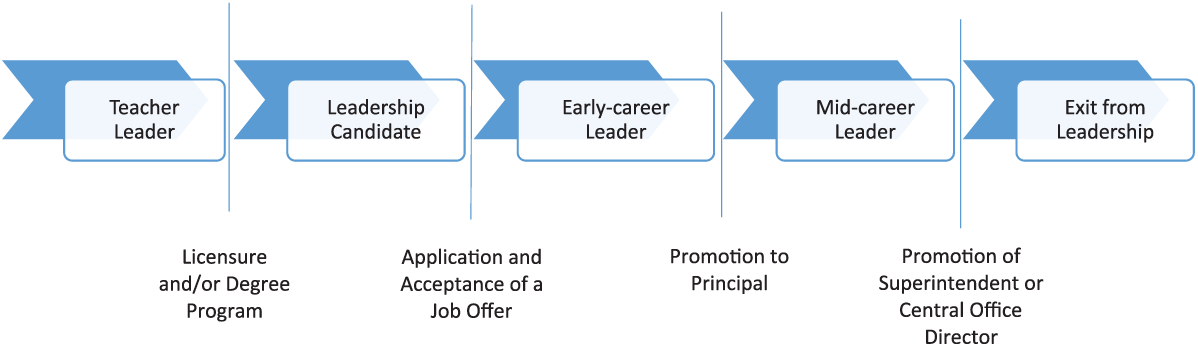
Career pathway for school leaders.
Career Pathway of School Leaders
Recognition of the need to build a leadership pipeline for schools is a relatively recent policy concern as researchers and policy makers have expanded their attention beyond teacher quality to include leadership quality (Hitt, Tucker, & Young, 2012; Pont, Nusche, & Moorman, 2008). Both teacher and leader quality have been assessed based on a variety of metrics such as credentials, performance of professional responsibilities, or outcomes of these efforts, such as student achievement (Chiang, Lipscomb, & Gill, 2012; Hill, Umland, Litke, & Kapitula, 2012; Knight et al., 2012). Assessing leader quality has been a challenge for the field and has been debated strenuously (American Educational Research Association, 2015; Fuller & Hollingworth, 2014). There is general consensus, however, that quality leaders are those who “understand teaching and learning; who are able to support their school staff, student bodies, and school communities; and who are willing to question structures and norms in their efforts to meet the needs of those they lead” (Young & Crow, 2017, p. 1).
Entry into the leadership pipeline is often “haphazard” (Turnbull, Riley, & MacFarlane, 2015) but typically involves the basic steps indicated in Figure 1, which reflects individual actions in the career development process (Pounder & Merrill, 2001). Teacher leaders are encouraged to pursue administrative credentials or individuals self-select to do so. Leadership candidates complete an administrative preparation program, typically based in universities, but increasingly in alternative programs (Hackmann, 2016). Once the leadership candidate earns an administrative credential, he or she applies for administrative positions and begins a career in administration. For those who are successful and enjoy the work, there is continued employment and possible promotions until retirement. Others choose to remain in teaching or exit the profession, in which case new applicants are needed to fill newly vacated positions. An overview of the principal pipeline follows that briefly highlights major stages in the career pathway for school leaders that are most pertinent to issues of supply and demand (see Figure 1), beginning with the first stage: pursuit of an administrative credential.
Pursuit of an administrative credential
The administrative credential, referred to as a license or certificate in different states, serves an important function for the public. The most common state policy requirements for principal licensure are teaching experience, passing a licensure exam, and a master’s degree (Anderson & Reynolds, 2015a). The credential suggests that competent, educational professionals are serving in administrative positions, though there is no research to substantiate a relationship between licensure and performance as an administrator (McCarthy & Forsyth, 2009). According to the Education Commission of the States (2017), in 2015, a majority of state requirements for the principal license included some form of educational experience (47 states) and a minimum of a master’s degree in some field for principal licensure (45 states).
Many states also offer alternative pathways to licensure. In a recent review of the principal preparation program accreditation literature, Hackmann (2016) called for more research on the “varied avenues for attaining an administrative license across the United States” (p. 61). The thin research on the selection and recruitment of candidates into leadership preparation programs (Crow & Whiteman, 2016) suggests that individuals pursue the administrative credential for a number of reasons, including increased salaries, personal growth, desire to make a difference, and professional challenge (DeAngelis & O’Connor, 2012; Joy, 1998; Lankford, O’Connell, & Wyckoff, 2003; Pounder & Crow, 2005). For example, many teachers historically have pursued administrative degrees without the intention of moving into administration (e.g., DeAngelis & O’Connor, 2012; Gajda & Militello, 2008). We return to this point in greater depth later in our overview.
Application for and acceptance of administrative position
Administrative candidates aiming to become principals are typically drawn from the ranks of teacher leaders, curriculum specialists, instructional coaches, and department heads (Myung, Loeb, & Horng, 2011; Turnbull et al., 2015). Often these are individuals who have been “tapped” by principals, assistant principals, district leaders, or others. In one study of a large southern school district, 93% of the principals reported being tapped by another educator to pursue a leadership position (Myung et al., 2011).
Advancement from the assistant principalship to a principalship position also has been found to be influenced by professional, personal, and motivational factors (Walker & Kwan, 2009). For example, assistant principals who are seeking personal growth and who are actively involved in professional development opportunities within their schools are more likely to pursue the principalship. Gajda and Millitello (2008) found that 75% of Massachusetts principals indicated a desire for more responsibility and professional challenge as the primary reason for pursuing a principalship.
Demand for Leadership Preparation Completers
At the cusp of the 21st century, there were dire warnings about impending shortages of school leaders (McAdams, 1998; Olson, 1999; Steinberg, 2000), but these shortages did not materialize (Grogan & Andrews, 2002; Pounder, Galvin & Shepherd, 2003; Roza & Swartz, 2003). Subsequent studies (Gajda & Militello, 2008; Papa & Baxter, 2005; Papa, Lankford, & Wyckoff, 2002) have repeatedly found “far greater numbers of individuals certified to be administrators than of positions requiring such certification” (DeAngelis & O’Connor, 2012, p. 469). This overall strong supply does not tell the whole story, however, because not all certified individuals pursue administrative positions and supply is not necessarily well-matched to geographic areas and types of schools (Baker et al., 2007; DeAngelis & O’Connor, 2012; Pijanowski, Hewitt, & Brady, 2009).
Research suggests that the previous decade’s reports of a shortage of licensed principal candidates were exaggerated (Browne-Ferrigno & Muth, 2008; Gates, Ringel, Santibanez, Ross, & Chung, 2003). The predictions of shortages were predicated on assumptions regarding a constant number of newly prepared principals and projected retirements. Retirement waves did not happen during the last decade, nor do they appear to have occurred in more recent years. This is evident in results from the Principal Follow-up Survey (PFS), which the National Center for Education Statistics (NCES) began administering in the 2007-2008 school year. The PFS tracks movement and retention trends among a representative subset of principals who participate in the national Schools and Staffing Survey. Administered in 4-year intervals, findings from the PFS suggest that principal decisions to change schools and leave the profession have remained relatively stable since then. Of the active 117,140 principals serving in public, private, and Bureau of Indian Affairs-funded schools during 2007-2008, 80% remained in the same school during the following year while 6% switched schools and 12% left the principal profession in 2008-2009 (Battle, 2010). Three years later in 2011-2012, these figures were similar for the 114,330 school principals (Goldring & Taie, 2014). Hence, the percentage of principals leaving the profession on an annual basis appears to be around 12% and one third to one half of those individuals is retiring, suggesting a small but steady demand for principals nationwide of roughly 10,000 per year (Goldring & Taie, 2014).
Though principal turnover and retirement rates appear to be consistent on a national, aggregate level with 12% of principals exiting the profession in recent years, it is important to note that levels of turnover appear to differ markedly depending on locality and school context (Burkhauser, Gates, Hamilton, & Ikemoto, 2012). Suburban schools generally experience slightly less turnover than rural and urban schools (Goldring & Taie, 2014; Partlow, 2007) and that more disadvantaged schools experience greater difficulty hiring new principals than their low-poverty, high-achieving peers (Béteille, Kalogrides, & Loeb, 2012). Variations in the ability to hire principals reflect not only the school context, but also the state context due to the number of preparation programs and licensed principal candidates. We now turn to an overview of principal supply and the graduate programs that prepare them.
Supply of School Leaders
The growth in educational leadership program offerings and degrees awarded in the United States was evident at the turn of the 21st century. The number of institutions offering master’s degree programs increased by 16% (from 396 to 459) and the number of master’s degrees awarded increased by 90% (from 8,292 to 15,720) in the 1993-2003 time period (Baker et al., 2007). Policy reports indicate that 45 states mandate that principals hold a master’s degree of some type (Education Commission of the States, 2017) and 30 states require a master’s degree in educational leadership for the principalship license (Anderson & Reynolds, 2015a). Possibly as a result of these state policies, the number of new candidates eligible for principal positions in 2003 was almost double that being produced a decade earlier. The field of educational leadership also experienced a 25% growth in specialist program offerings and a 48% increase in doctoral program offerings from 1993 to 2003. Both of these degree programs often have an embedded licensure credential.
Although the increase in the number of available programs may offer more choices and lower costs for students, numerous scholars have raised questions about quality as the field of educational leadership preparation expanded so rapidly (Baker et al., 2007; Hackmann & McCarthy, 2011; Orr, 2007). Are these programs able to offer the program features that are emerging as linked to positive outcomes like principal impact? Baker et al. (2007) offered “academic drift” as one explanation for their finding that the research universities’ market share in leadership preparation degrees granted decreased while the market share of comprehensive college and university production more than quadrupled between 1993 and 2003. In this case, lower status institutions were adding degree programs typically offered by higher status institutions. Possible explanations for these changes are attributed either to generating more revenue or to increasing their institutional prestige (Baker et al., 2007). We found no research on whether these large-scale changes have affected national levels of candidate preparedness to successfully lead a school in the 21st century.
Quality of supply
Darling-Hammond et al.’s (2009) seminal study found that among the many key elements of exemplary leadership preparation programs, defined as those that “offer visible evidence that they affect principals’ knowledge, skills, and practices, as well as success in their challenging jobs” (p. 24), are knowledgeable faculty, well-designed administrative internships, proper mentoring and advisement from expert principals, close cooperation with districts to identify qualified candidates, and a comprehensive and coherent curriculum aligned to state and professional standards. Other researchers have since substantiated Darling-Hammond et al.’s findings regarding quality faculty (Hackmann & McCarthy, 2011), mentoring and internships (Clayton, Sanzo, & Myran, 2013; Davis & Darling-Hammond, 2012; Rhodes & Fletcher, 2013; Turnbull, Riley, & MacFarlane, 2013), university–district partnerships (Davis & Darling-Hammond, 2012), and coherent curriculum (Orphanos & Orr, 2013). Studies by Orr (2011) and Orr and Orphanos (2011) support Darling-Hammond et al.’s (2009) general findings regarding preparation program components critical to effective principal preparation. Overall, substantial institutional resources are required to adequately provide the core components necessary for an exemplary principal preparation program. With the near doubling of educational leadership master’s degrees awarded between 1993 and 2003 (Baker et al., 2007), one may question the capacity of any institution to provide the necessary elements for high-quality preparation, such as the provision of well-designed administrative internships with proper mentoring and advisement from expert principals. Likewise, questions as to whether institutions can adequately create strong district partnerships and coherent curricula may be pertinent regarding the rapid expansion of programs and institutions offering leadership preparation programs. Concerns about capacity to create these conditions for high quality preparation programs are accentuated in less-resourced institutions (e.g., Darling-Hammond et al., 2009; Manna, 2015).
Higher education research has established that less-resourced institutions in the post–recession era have taken actions to increase revenue sources that include expanding program offerings, increasing enrollments, decreasing resource allocations to students, and increasing tuition (Barr & Turner, 2013). One indicator of lower institutional resources is often found in undergraduate admissions selectivity as less selective institutions in recent years have received lower student and government subsidies and, consequently, have experienced reduced funding (e.g., Bound, Lovenheim, & Turner, 2010; Hoxby, 2009). Other potential signifiers of resources are the Carnegie Classifications. Baker et al. (2007) used the 1994 version of the Carnegie Classifications to provide partial overviews of institutional funding and degree output (see Appendix A). No empirical research has examined educational leadership program expansion or degree production using indicators of potential resources, a requirement for exemplary preparation, since Baker et al.’s study was published.
Alignment of supply and demand for school leaders
A supply and demand analysis of credentialed principal candidates is further complicated by the fact that not all school leadership program graduates intend to become administrators and some graduates are pursuing alternative professional goals. As early as 2002, Grogan and Andrews noted that there were roughly two to three potential, licensed candidates for every open principal position on an annual basis. This apparent oversupply, however, may be misleading.
As previously mentioned, not all those who are certified to become principals want to pursue the position. For instance, Gajda and Militello (2008) found that only about half of the teachers holding licensure in Massachusetts actually intended to become administrators. In contrast, DeAngelis and O’Connor (2012) determined that roughly 69% of a random sample of Illinois’ 1999-2000 newly certified educational administration candidates did attempt to gain administrative positions within the first 2 years of certification. One potential reason for enrollment in educational leadership preparation programs is a pay boost (e.g., DeAngelis & O’Connor, 2012). A recent inventory of educational policy by the National Council on Educational Quality found that the vast majority (96%) of the major school districts of the United States still grant pay increases to teachers for master’s degrees (Chingos, 2014).
Even when educational leadership program graduates pursue an administrative position, being offered an administrative position often requires persistence and patience. Using Texas administrative data from 1995-2007, Fuller and Orr (2006) found that between 43% and 48% of Texas educational leadership students gained a leadership position within 2 years of completion and 60% gained a position within 6 years. A more recent study of new principal cohorts in North Carolina from 2006-2007 to 2009-2010 found that it took the average first-year principal 5 years to reach his or her position after completing formal principal preparation program requirements (Bastian & Henry, 2015). This means that there is a reserve pool of candidates with the intention of becoming principals that might not be hired. Furthermore, these state-based analyses suggest substantial variation by geographic location in the proportion of degree and principal certificate completers who seek administrative positions.
In summary, the critical importance of the school leader and his or her influence on creating conditions conducive to learning and academic achievement has been firmly established (Leithwood & Jantzi, 2008; Leithwood et al., 2004, 2010; Robinson et al., 2008). The preparation that school leaders receive through their academic studies and clinical placements can make a difference in the candidates’ capacity to make a difference as novice principals (Cosner & Tozer, 2015). Based on Baker and et al.’s study (2007), we know that there was a rapid expansion of new educational leadership programs early in this century. Very little is known about how many candidates have been produced subsequent to that study, what types of institutions are producing them, and what are the possible implications for field of educational leadership.
Research Questions
Given the limited knowledge about the leadership pipeline and the role that preparation programs play in the quantity and preparedness of administrative candidates as noted by Hackmann (2016), we explore the following questions regarding principal preparation and its relationship to the labor market supply and demand in this study:
Method
We make use of several datasets and analytical strategies in our study due to the large scale of our interrelated research questions. In many ways, the availability and reach of pertinent data encourages the use of similar analytic approaches as Baker et al. (2007). In doing so, this study not only depicts trends in principal preparation for this century but also helps complete a picture of educational leadership preparation trends spanning over 20 years when Baker et al.’s findings and ours are combined. Our study employs additional university classification and selectivity proxy systems to deepen the understanding of changes over years.
Data Sources
We accessed three large national datasets provided by the U.S. Department of Education to answer the study’s research questions: Integrated Postsecondary Data System (IPEDS), restricted-use Barron’s Admissions Competitiveness Index Data Files, and Common Core Data (CCD). First, we examine the IPEDS data to determine how educational leadership program offerings and completion rates have changed in the years 2000-2014 for Research Question 1. The NCES annually collects survey information from every institution of higher education in the United States that participates in the federal student aid program. It is mandatory for all institutions receiving Title IV federal financial aid to report to IPEDS. The IPEDS Degree Completion survey has relevant data for this study. The Degree Completion data includes the number of degrees and certificates granted at each institution by department and award level per year for Research Question 2. The year corresponds with the number of degrees granted in that given academic year (July 1-June 30). In our analyses, we indicate year as that corresponding to the end of the academic year (e.g., 2014 refers to the 2013-2014 academic year). Please also note that the completion data only reflects the number of graduates per academic year; institutions do not report student enrollment by department or program. Thus, we cannot determine whether an institution had educational leadership programs in existence each year; we can only determine whether it graduated students in educational leadership programs and how many. Degree levels are differentiated by postbaccalaureate, master’s, education specialist, and doctoral classifications as provided by IPEDS. These data do not include the number of administrative certificates awarded, only academic degrees. Many programs offer “state-approved programs” that confer a certificate for endorsement that are untethered to academic degrees.
To better understand trends in types of institutions awarding degrees, we also use three systems for categorizing postsecondary institutions: 1994 Carnegie Classification, 2000 Carnegie Classifications, and Barron’s Admissions Competitiveness Index. The 1994 Carnegie Classifications were traditionally used to classify universities by group, such as Research I or Master’s II, according to institutional resources and outputs (e.g., undergraduate student enrollment, graduate student enrollment, research activity). We incorporate the 1994 Carnegie Classifications to provide a comparison with Baker et al.’s (2007) analysis that used the 1994 classifications. The 2000 Carnegie Classifications are technically an updated version of the 1994 Carnegie Classifications, but the 2000 version contains more institutional classifications (see Appendix A for the 1994 and 2000 Carnegie Classification systems and criteria, respectively.)
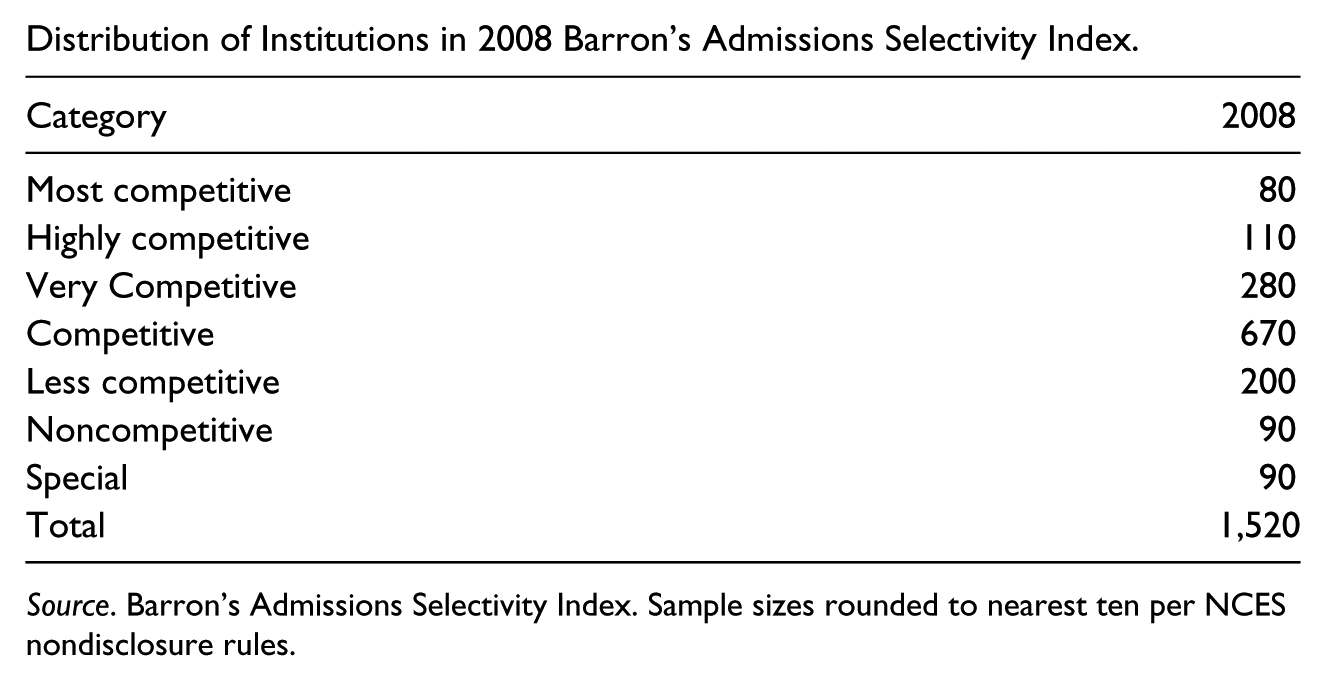
Both the 1994 and 2000 Carnegie Classifications convey some sense of institutional type and offerings. We gain an even more comprehensive profile of institutions conferring educational leadership degrees using the objective NCES Barron’s Admissions Competitiveness Index. (See Appendix B for distribution of institutions based on this index.) This dataset, a measure of university undergraduate admissions selectivity, is widely employed in higher education (e.g., Dale & Krueger, 2002; Umbach, 2007) and K-12 research (e.g., Ingersoll, Merrill, & May, 2014; Kelly & Northrop, 2015; Lankford, Loeb, & Wyckoff, 2002). Researchers also commonly employ Barron’s in tandem with Carnegie Classifications to gain a fuller picture of institutional characteristics (e.g., Umbach, 2007; Zhang, 2005). Barron’s divides postsecondary institutions into seven categories based on levels of undergraduate selectivity: most competitive, highly competitive, very competitive, competitive, less competitive, noncompetitive, and special. Postsecondary institutions fit into one of the seven categories based on GPA, class rank, and test scores of accepted undergraduates as well as the institution’s overall undergraduate acceptance rate. We use the 2008 index because it is the NCES restricted-use data file closest to the midpoint in time across our 2000-2014 analysis. Barron’s Index rankings have been remarkably stable over time (e.g., Bastedo & Jaquette, 2011; M. C. Long, 2010). Using the Barron’s Index year closest to the midpoint of our data further ensures that the assigned selectivity rating best reflects that in both 2000 and 2014.
We acknowledge that undergraduate admissions selectivity is not a measure of either institutional quality or graduate program quality. It is, however, one additional way of classifying institutions that may create a better understanding of the higher education context for the offering of leadership preparation programs. For instance, highly selective institutions have had an increase in government and institutional subsidies for students while less selective schools have generally seen a decrease in the same subsidies for their students in the 21st century (e.g., Bound et al., 2010; Hoxby, 2009). Decreased subsidies pressure less-resourced universities to often increase tuition, reduce resource allocation for students, and expand enrollments and degree offerings (Barr & Turner, 2013).
We analyzed the NCES K-12 datasets to answer our third and final research question. The comprehensive and annual CCD is the U.S. Department of Education’s primary database for K-12 education. The CCD tracks fundamental school statistics and demographics such as enrollment, student ethnicity, and teacher-to-student ratio, for every school in the country, and the most recently available data are from the 2013-2014 school year.
Data Analyses
Four national datasets were used to answer three research questions on the number and types of programs offering educational leadership programs and their resulting graduates, trends in these demographics, and the demand for these graduates based on student growth in K-12 public schools. For Research Questions 1 and 2 regarding the number preparation programs and graduate production, the data have been disaggregated when possible to give a more nuanced profile of the leadership preparation terrain and make some observations about the characteristics of these programs.
Programs conferring degrees and degrees awarded by institution type and selectivity
Using the IPEDS Degree Completion files, we first collapsed the Classification of Instructional Programs Codes pertaining to educational leadership into one category. 1 We then isolated the number of educational leadership degree program graduates first by institution and award level (postbaccalaureate certificate, 2 master’s degree, education specialist degree, doctoral degree), and then by year from 2000 to 2014. This allowed us to calculate how many degrees were conferred and how many institutions awarded these degrees on a national level by year.
The 2000 Carnegie Classifications were already included in the IPEDS dataset; however, we needed to merge the 1994 Carnegie Classifications into the IPEDS dataset because our timeframe for analysis spanned the use of both classification sets. The dual classification systems provided a more robust description of the institution types (e.g., Research I, Master’s II) that offered and awarded educational leadership degrees over the 15-year period of 2000-2014. We ran various descriptive analyses with both classification systems across different award levels and combinations of award levels. These classifications offer some sense of institutional status, resources, and output. We also merged the Barron’s Admissions Competitiveness Index 2008 with this file in an effort to identify the academic profile of these institutions. The Barron’s selectivity index does not offer any direct indication of institutional or program quality; it does offer a better understanding of the institutional profile. We ran various descriptive analyses on different measures of selectivity, including analyses grouping the two most selective university categories (most competitive, highly competitive) together as is common in other research using the Barron’s Index (e.g., Brewer, Eide, & Ehrenberg, 1999; Zhang, 2005).
Changes in the types of institutions awarding degrees and certificates
We used Carnegie Classifications merged with the IPEDS data on institution types that offered and awarded educational leadership degrees during this 15-year period to generate trend lines and make numerical comparisons. The most recent dataset provides numerical counts for the academic year of 2013-2014, referred to as 2014 in our charts. We begin our period of analysis (2000-2014) with the turn of the century and overlap it with the period of analysis (1993-2003) used by Baker et al. (2007) to provide a 20-year retrospective on the growth of the field.
Principal demand
Lastly, we used the CCD in conjunction with our findings on principal candidate production to determine whether states are producing enough principal candidates by state. Similar to Baker et al. (2007), we standardized the number of degrees conferred in 2014 as a ratio per 10,000 students within each state in 2013-2014 to estimate the production rate. We also standardized the number of schools in the state per 10,000 students to determine how many total principal positions existed in each state in 2013-2014 to estimate national and state demand rate for principals. It was necessary to take this approach because there were inconsistencies in the data reporting protocol for administrators across states in the 2013-2014 CCD.
Limitations
The large-scale nature of this study presents several limitations. First, the only national-level dataset available to examine our research questions regarding distribution of programs and degrees is the IPEDS data. IPEDS has several shortcomings for our purposes. First, IPEDS only collects information on institutions that participate in the federal student aid program. This means that the accredited, alternative principal licensure programs were excluded from our analysis of principal candidate production. Therefore, our findings represent a smaller number of principal candidates than actually are produced each year in total. We also have no way of distinguishing the Doctor of Education (EdD) from Doctor of Philosophy (PhD) within the doctoral level awarding of degrees.
The Carnegie Classifications accompanying IPEDS have their own limitations, too. First of all, the 1994 and 2000 Carnegie Classifications focus on school resources (federal and private grant funding) and outputs (various types and number of degrees produced each year). While these classifications may reveal certain trends, they are still focused on resources and outputs. We thus merged the Barron’s Index into our data for analyses to gain a better understanding of the university profiles.
The Barron’s Admissions Selectivity Index has several limitations as well. Similar to the Carnegie Classifications, the level of an institution’s selectivity according to the Barron’s Index does not indicate program quality. Furthermore, the Barron’s Index measures undergraduate, not graduate, program selectivity. Therefore, a graduate-level institution profile may be even further removed from undergraduate selectivity rankings. This measurement of undergraduate selectivity also means that several graduate schools of education were excluded for this part of the analysis. Despite these drawbacks, Barron’s Index provides an additional perspective on the profile of a university and complements the institutional characteristics we find in the Carnegie Classifications. The Barron’s Index provides supplementary information for understanding the types of institutions in which principal preparation programs are offered. This may be especially pertinent given (a) how critical knowledgeable faculty and quality internships are to quality principal preparation (e.g., Darling-Hammond et al., 2009) and (b) findings that financial constraints preclude many programs from providing these critical preparation components (e.g., Darling-Hammond et al., 2009; Manna, 2015).
Lastly, we use time-invariant labels (1994 Carnegie Classifications, 2000 Carnegie Classifications, Barron’s Admissions Competitiveness Index) to categorize institutions. The three classification systems’ data files were released at specific times and, in the case of Barron’s, multiple-year intervals. Despite these limitations, these are the only university classifications based on objective and multiple measures available at the national level. It is important to remember that these classifications, though universities are long associated with them, are indicators of past performance and do not necessarily reflect changes postmeasurement.
Delimitation
For-profit institutions are included in our analyses for Research Questions 1 and 2 but excluded from our examination of Research Question 3. We omitted for-profit institutions in this state-level analysis because some for-profits, namely online degree granting institutions, award degrees in multiple states. Regardless of where the degree recipient is located, IPEDS lists the degree as earned in the institution’s flagship state. Therefore, a person in Pennsylvania may earn a degree from the University of Phoenix and the degree is counted as earned in Arizona instead of Pennsylvania. Our inability to anchor these degree recipients in a geographic location for a supply and demand analysis was the rationale for the exclusion of for-profit institutions. The resulting comparison of only master’s degrees from nonprofit institutions to PK-12 students yields a more conservative estimate of the production of administrative candidates at the state level.
Findings
Leadership Preparation Programs and Degree Production
As an overview of the institutions offering degrees in education leadership, Table 1 summarizes the number of institutions producing one or more certificates or degrees by award level in this century. In 2014, based on the national databases we used, a total of 705 distinct institutions awarded certificates and degrees for one or more of the following levels: postbaccalaureate, master’s, specialist, and doctorate. There were 1,164 degree-granting programs within these 705 institutions. The number of institutions that offered master’s degrees was equal to the combined number of institutions that offered postbaccalaureate certificates, specialist degrees, and doctoral degrees. Overall, IPEDS institutions were credited with awarding 32,614 degrees and certificates to aspiring educational leaders in 2014, equal to roughly one-third the number of sitting principals in this country (see Table 2) and three times the number of principals who retire in a given year. The majority, more than two thirds, of these degrees were master’s degrees. In sum, 623 institutions graduated 22,206 educational leadership master’s degree students while 186 programs conferred specialist degrees to 4,385 individuals, and 301 institutions granted 4,385 doctoral degrees in 2014.
Total Institutions Conferring Degrees in Educational Leadership by Year and Award Level.
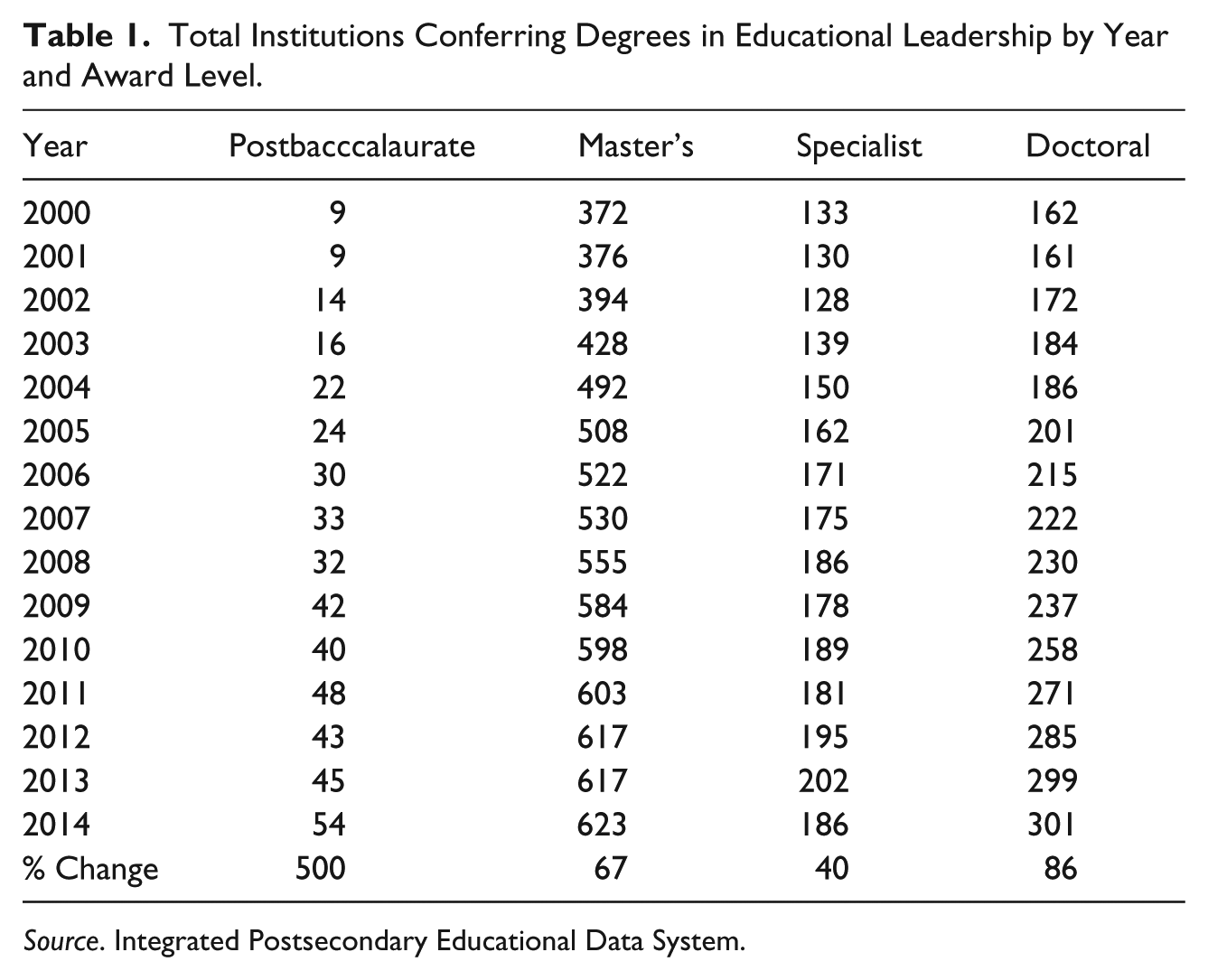
Source. Integrated Postsecondary Educational Data System.
Total Degrees in Educational Leadership Conferred by Year and Award Level.
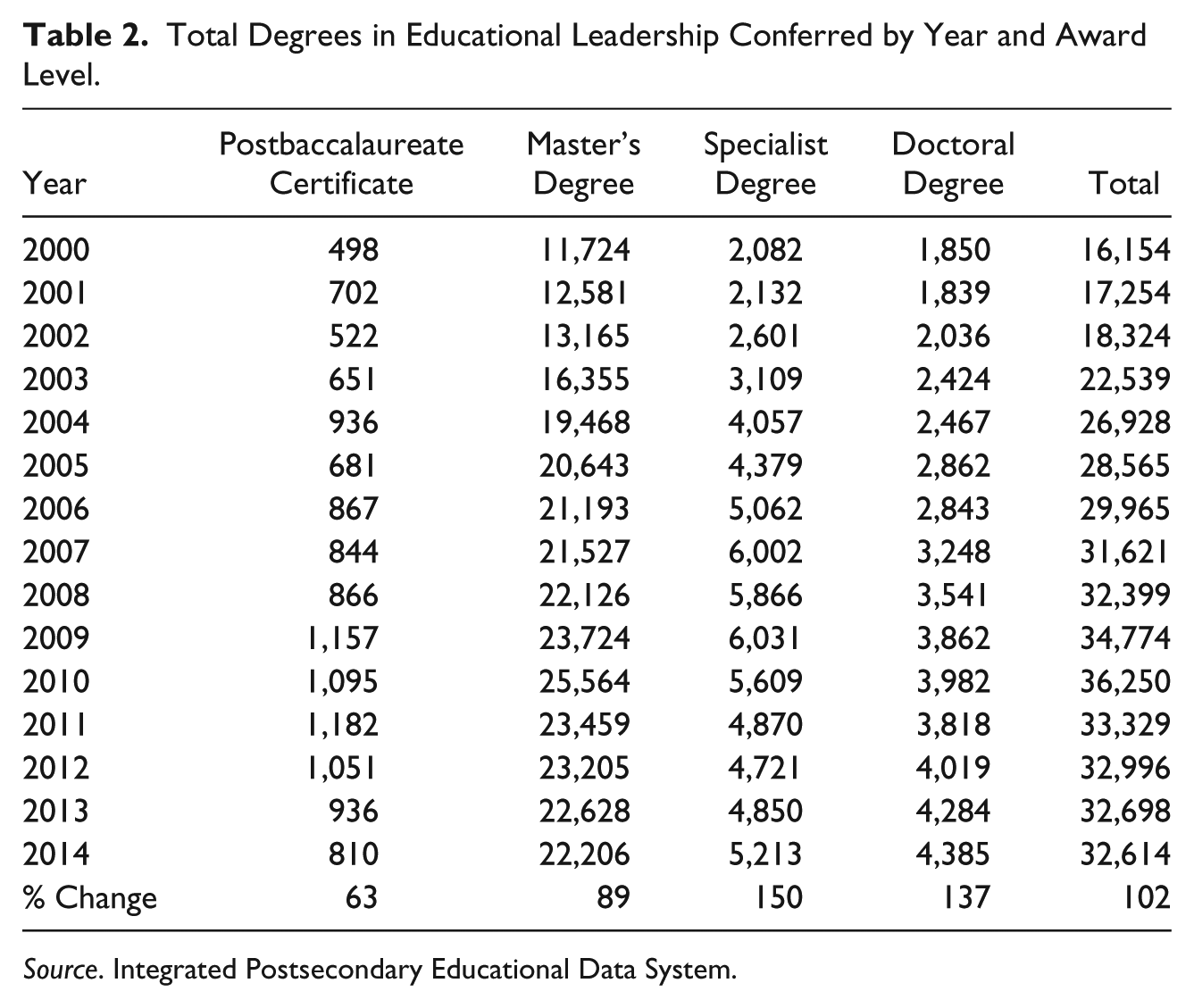
Source. Integrated Postsecondary Educational Data System.
Production Trends in Leadership Preparation Programs
Overview
Turning our attention to the changes in principal preparation program offerings and degree production between 2000 and 2014, we found a large and dramatic increase in the number of institutions conferring advanced certificates and degrees and the number of certificates and degrees awarded. The total number of distinct institutions offering advanced certificates and degrees (postbaccalaureate certificate, master’s degree, specialist degree, doctorate) increased by 72% while the number of degrees awarded went up by 102% during this time period (see Tables 1 and 2). Master’s degrees were the most frequently conferred degree type in both 2000 and 2014. Dividing the number of master’s degrees by total number of educational leadership degrees by year, a slightly larger percentage of educational administration degrees was awarded at the master’s level in 2000 (72% of 32,614) than in 2014 (68% of 16,154). This small decrease in share coincided with an increase of over 10,000 master’s degrees granted per year. This increase is similar in magnitude to the changes in master’s degree production from 1993-2003 reported by Baker et al. (2007).
During the time period of 1993 to 2003, the number of programs graduating master’s degree students in educational leadership grew by 16% and the number of master’s degrees awarded grew by 90% (Baker et al., 2007). We found increases of 67% in the number of institutions awarding master’s degrees and 89% in the number of master’s degrees awarded from 2000 to 2014, representing a growth in the number of master’s programs equal to 250 and in the number of diplomas equal to roughly 10,500 (see Tables 1 and 2).
Trends
Although there was a substantial increase in degrees conferred over this 15-year period, the increase was not constant and principal preparation program degrees awarded dipped slightly in 2010. The number of educational leadership master’s degrees awarded noticeably peaked in 2010 and has declined since then as shown in Table 2 and Figure 2. Specialist degrees reached their highest point in 2009 and then visibly declined until 2013. A similar trend took place with postbaccalaureate degrees as they peaked in 2009 as well. Interestingly, doctoral degree completions went down in 2011 but have climbed back up steadily since, reaching their highest point in the most recent year of data.
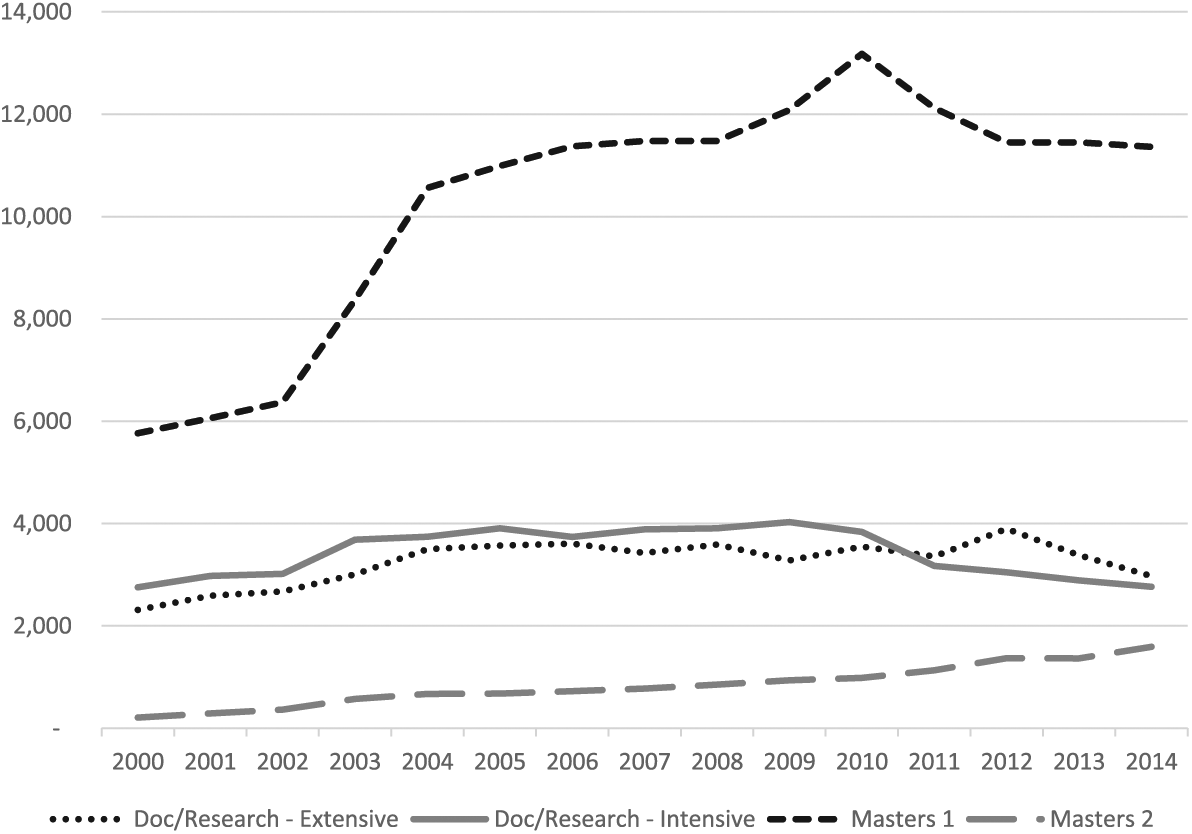
Master’s degrees completed by institution type (2000 Carnegie Classification).
Trends by University Classification
The preceding analysis has indicated a substantial growth in the number of educational leadership candidates but the question remains as to who is preparing these candidates. As described in the methodology, we chose to use the best and most relevant available indicators of university type: Carnegie Classifications and Barron’s Admission Selectivity Index. Our analysis of the data using these categorizations is discussed below.
2000 Carnegie Classification
We found clear patterns in the numbers of graduates at various award levels attending different types of universities over time using the IPEDS graduate data. (see Appendix A for 2000 Carnegie Classification criteria.) Most notably, we found a tremendous gain in educational leadership master’s programs and degrees produced by Master’s I institutions, those with a small number of graduate programs. In 2014, 290 Master’s I institutions conferred 11,362 degrees, representing a little over half of all educational leadership degrees awarded. Since 2000, 101 more (53% increase) Master’s I institutions award master’s degrees in educational leadership and they produce double the number of graduates as the Master’s I institutions did in 2000 (see Table 3). Master’s II institutions increased their small market share of master’s degrees while Doctoral/Research-Extensive and Doctoral/Research-Intensive universities (those with substantial graduate programs) lost significant shares of the master’s degree marketplace.
Master’s Degrees in Educational Leadership Conferred by Year and 2000 Carnegie Classification.
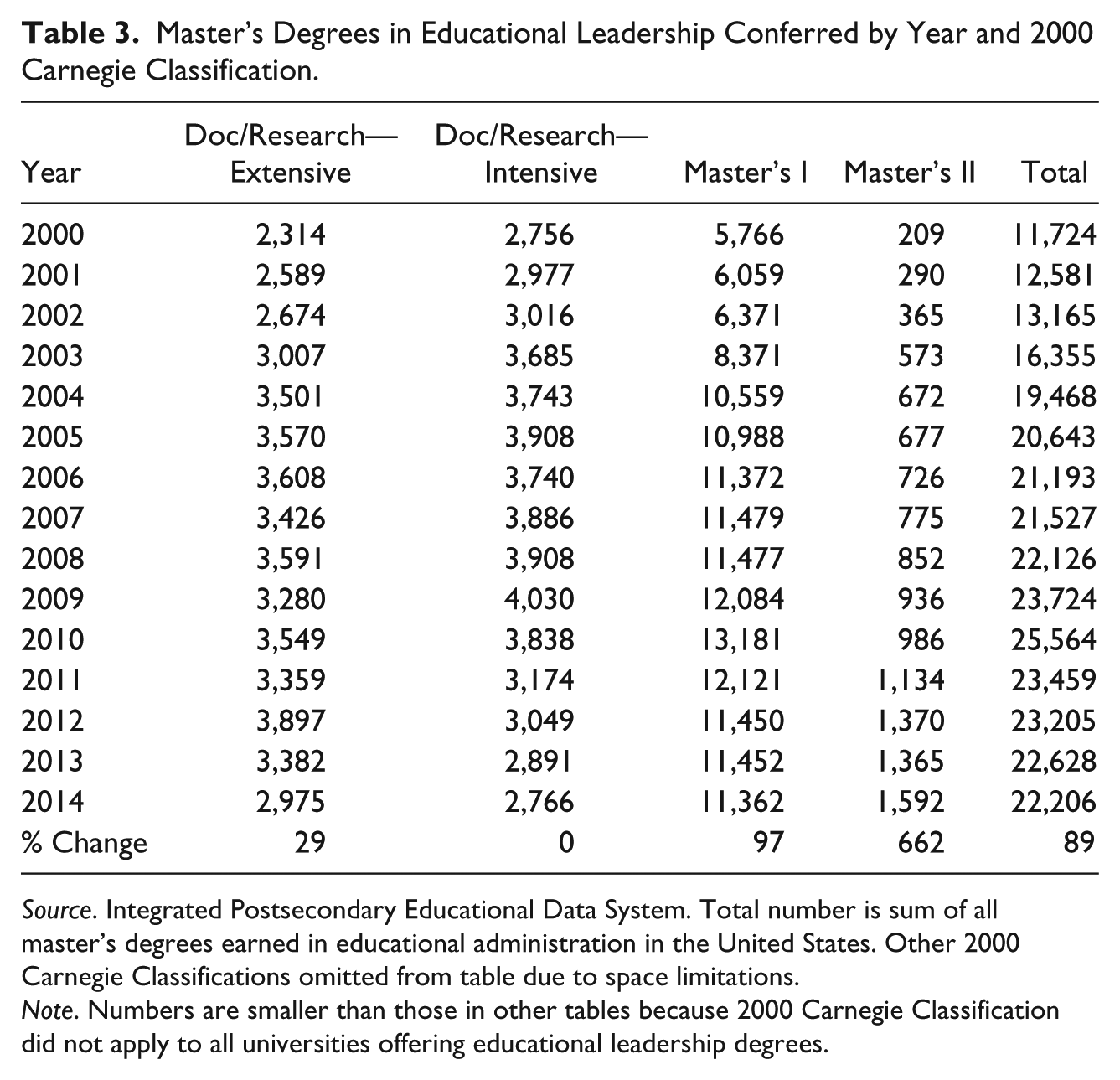
Source. Integrated Postsecondary Educational Data System. Total number is sum of all master’s degrees earned in educational administration in the United States. Other 2000 Carnegie Classifications omitted from table due to space limitations.
Note. Numbers are smaller than those in other tables because 2000 Carnegie Classification did not apply to all universities offering educational leadership degrees.
We also see large shifts in educational leadership doctoral degree completions using the 2000 Carnegie Classification as depicted in Figure 3. Master’s I institutions increased their share of the doctoral degrees granted from 195 in 2000 to 1,471 in 2014, representing an increase in market share from 11% to 34% over this time period.
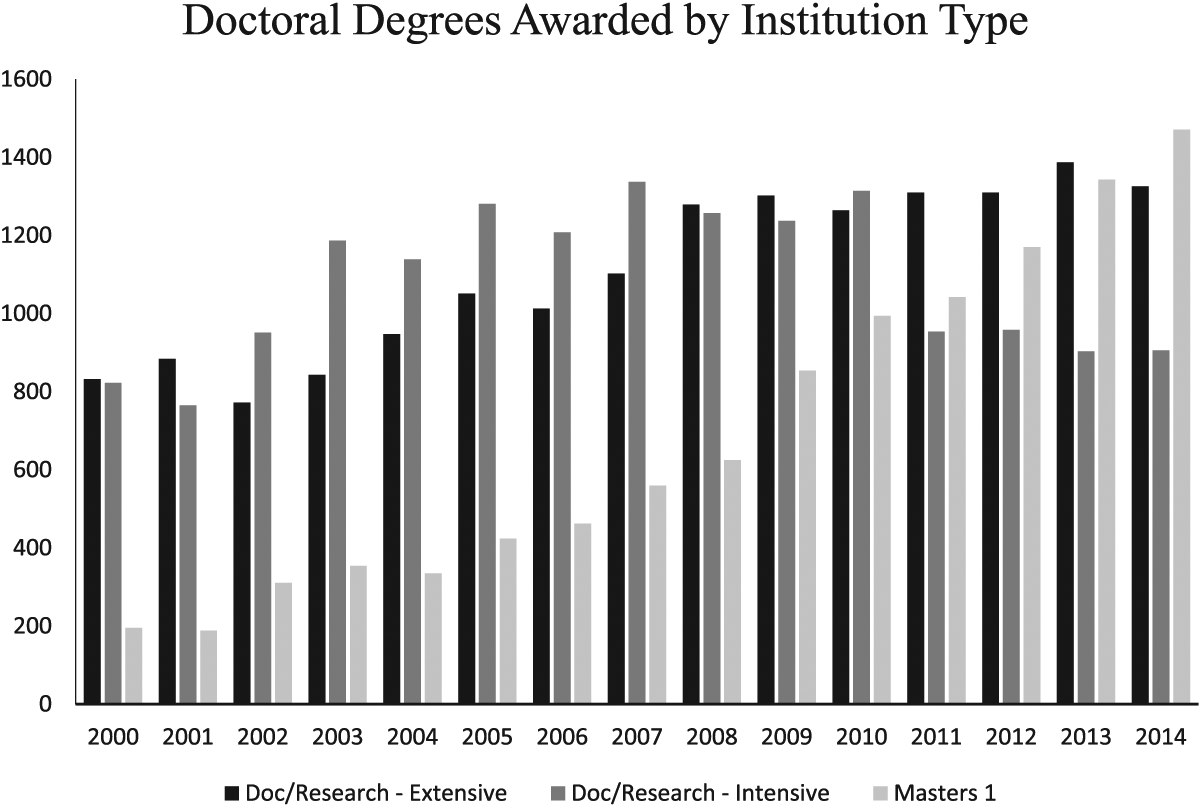
Doctoral degrees completed by institution Type (2000 Carnegie Classification).
1994 Carnegie Classification
When we apply the 1994 Carnegie Classifications to the IPEDS graduation data, we find clear growth trends. The labels for types of institutions used in 1994 were different but they can be clustered by those granting doctoral degrees and those that do not. It is important to note that 1994 Carnegie Classifications only apply to universities that existed and received classifications in 1994. Thus, for-profit institutions and other nonprofits established post-1994 are not included in this analysis.
In particular, the number of graduates produced by Research I, Research II, Doctoral I, and Doctoral II universities (those with doctoral programs) did not substantially increase relative to Comprehensive I, Comprehensive II, Baccalaureate I, and Baccalaureate II universities and colleges (those institutions with no doctoral programs). The latter group of institutions increased their number of graduates substantially. (See Appendix A for 1994 Carnegie Classification criteria and Table 4 for changes in degrees 2000-2014.)
Changes in Degrees Conferred in Educational Leadership by 1994 Carnegie Classification.
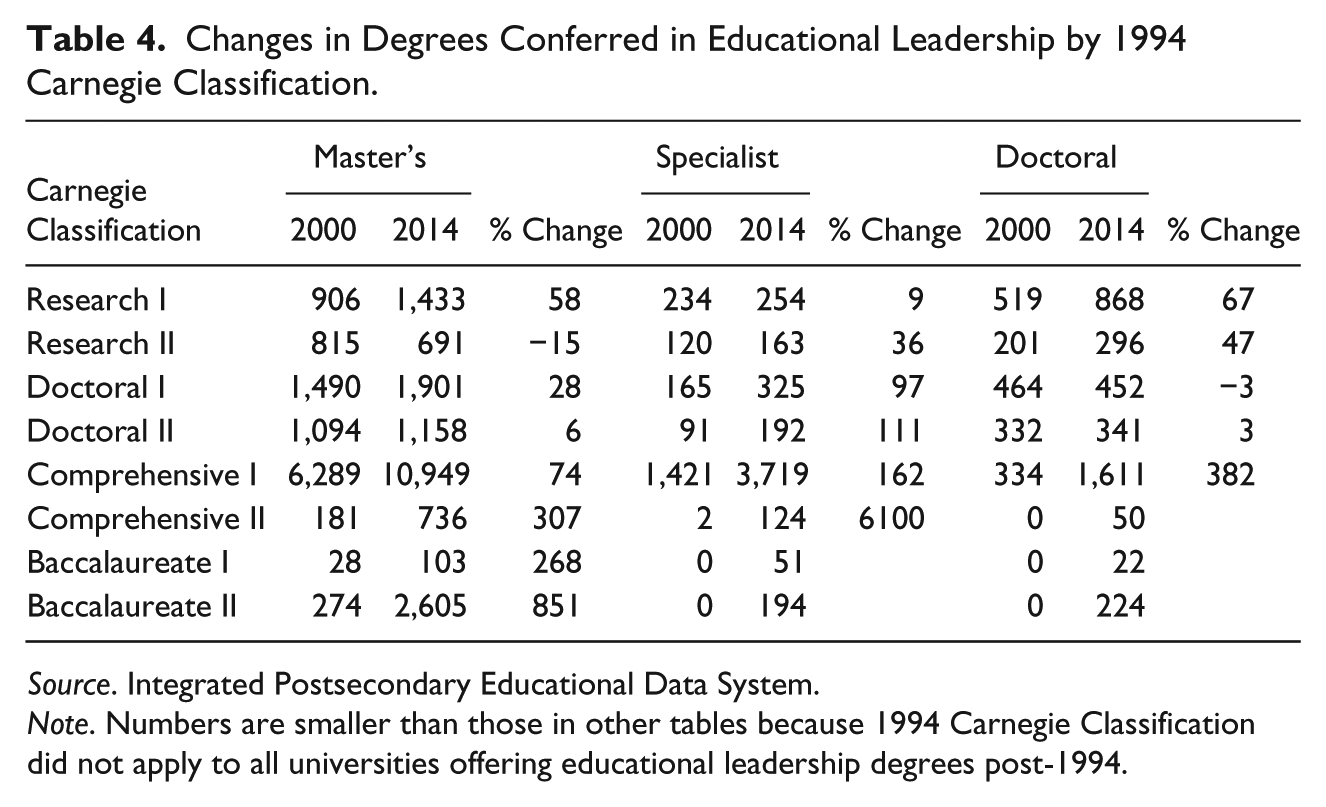
Source. Integrated Postsecondary Educational Data System.
Note. Numbers are smaller than those in other tables because 1994 Carnegie Classification did not apply to all universities offering educational leadership degrees post-1994.
Master’s degrees
Illustrating some of these trends, master’s degrees granted by Comprehensive I institutions increased from 6,289 in 2000 to 10,949 in 2014, maintaining the same relative market share during this 15-year time frame (see Table 4). Meanwhile, the number of master’s degree graduates produced by Baccalaureate II institutions grew almost 10 times from 2000 to 2014. Baccalaureate IIs graduated 2,605 educational leadership master’s degree students in 2014, which is more graduates than the combined number produced by Research I and Research II institutions. These institutional distinctions are important because this latter group of institutions offer doctoral degrees and are considered more selective and better resourced (Baker et al., 2007), possibly indicating conditions for better quality preparation programs.
Education specialist and doctoral degrees
Similar growth outside of Research I, Research II, Doctoral I, and Doctoral II institutions was evident in specialist degrees and doctoral degrees conferred. The awarding of specialist degrees increased in Comprehensive I institutions by 162%, from 1,421 in 2000 to 3,719 in 2014 while specialist degree production across all other institution types remained relatively small (see Table 4). Correspondingly, doctoral degrees granted remained stagnant at Doctoral I and Doctoral II institutions and only 10 more programs graduated students in 2014 than in 2000 from Research I, Research II, Doctoral I, and Doctoral II universities combined (see Tables 4 and 5). Meanwhile, the total number of Comprehensive I institutions granting doctoral degrees in educational leadership more than tripled and there was almost a quadrupling of doctoral degree production. One hundred and seventeen Comprehensive I institutions graduated 1,277 doctoral students in 2014, almost double that of the next leading producer (51 Research I institutions that graduated 868 students).
Changes in Institutions Conferring Degrees in Educational Leadership by 1994 Carnegie Classification.
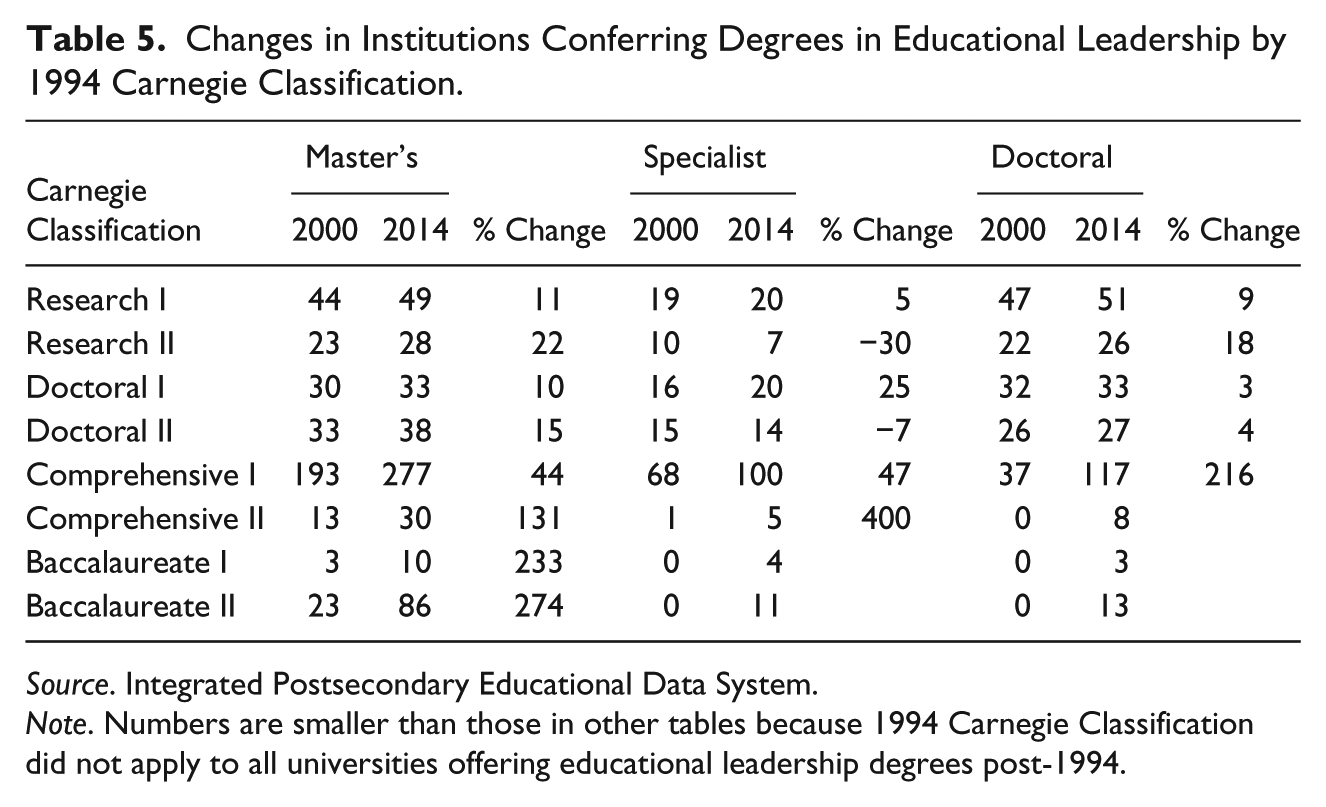
Source. Integrated Postsecondary Educational Data System.
Note. Numbers are smaller than those in other tables because 1994 Carnegie Classification did not apply to all universities offering educational leadership degrees post-1994.
Barron’s Admissions Selectivity Index
In our attempt to get a fuller picture of institutional profiles, we used the Barron’s Admission Selectivity Index and applied it to the institutions in the IPEDS data set. We found patterns similar to those exhibited in the Carnegie Classifications. Observed increases in educational leadership programs and diplomas granted came from less prestigious and selective universities. For ease of interpretation and following general guidelines used by other researchers with the Barron’s Index, we paired institutions as follows: elite (most competitive and highly competitive), middle (very competitive and competitive), and low (less competitive and noncompetitive). (See Appendix B for the number of institutions in each category in 2008.) Note that all counts are rounded to the nearest ten per NCES nondisclosure rules.
Master’s degrees
The disparity in degree production by institution undergraduate selectivity was notable. The number of elite institutions offering leadership programs increased from only approximately 30 in 2000 to about 40 in 2014 (see Table 6). This increase coincided with 470 more students graduating from elite schools with master’s degrees in educational leadership in 2014 than 2000 from these most selective institutions (see Table 7). Meanwhile, the number of programs in middle institutions grew by about 130 from 2000 to 2014 and produced approximately 6,670 more graduates (see Tables 6 and 7). The low institutions increased the number of educational leadership programs by roughly 50 and produced about 1,460 more graduates.
Changes in Degrees Conferred in Educational Leadership by Barron’s Admissions Selectivity Index.
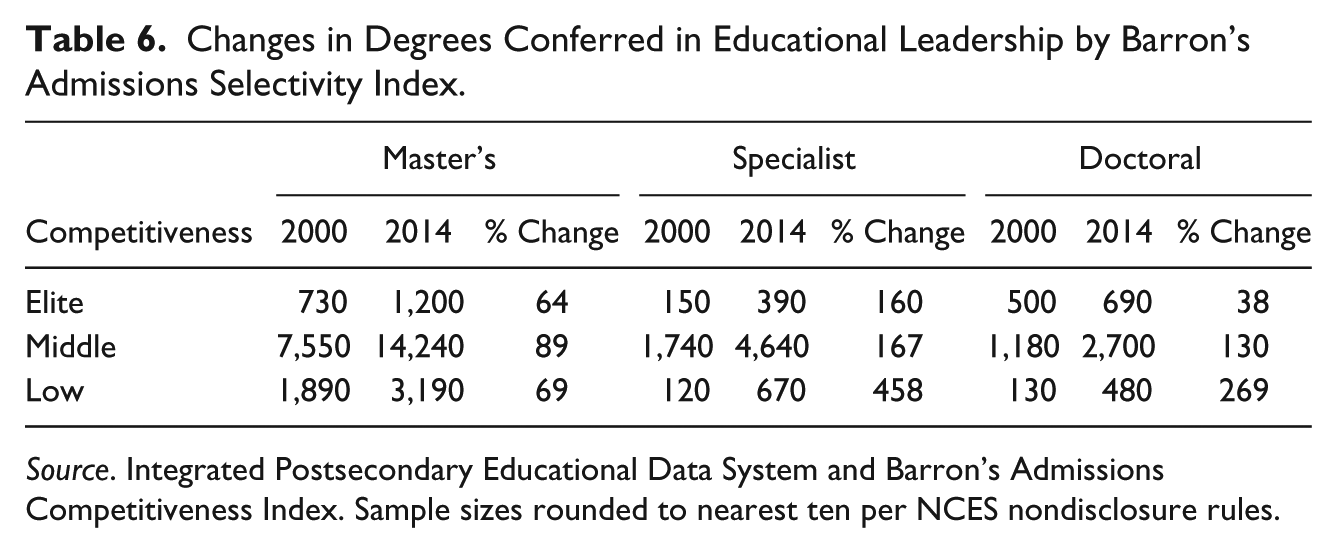
Source. Integrated Postsecondary Educational Data System and Barron’s Admissions Competitiveness Index. Sample sizes rounded to nearest ten per NCES nondisclosure rules.
Changes in Institutions Conferring Degrees in Educational Leadership by Barron’s Admissions Selectivity Index.
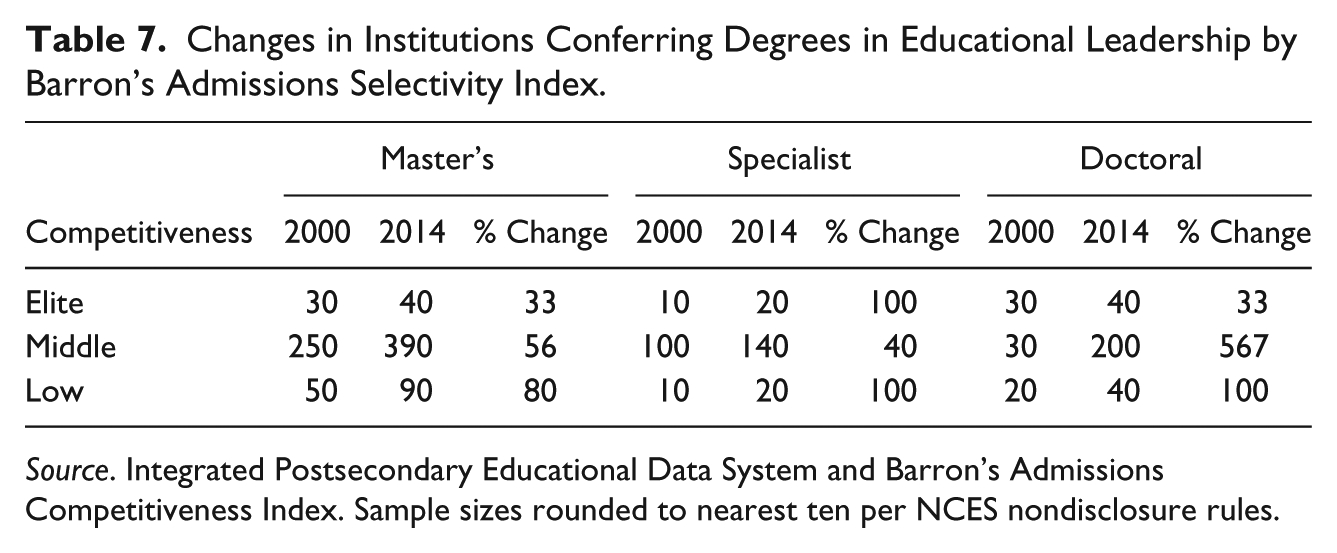
Source. Integrated Postsecondary Educational Data System and Barron’s Admissions Competitiveness Index. Sample sizes rounded to nearest ten per NCES nondisclosure rules.
Specialist and doctoral degrees
The disparities are also evident in specialist degrees. The elite institutions accounted for only 240 more graduates while the middle institutions increased their master’s graduations by approximately 2,900 students from 2000 to 2014 (see Table 6). Although low institutions graduated fewer students than the most elite institutions in 2000, the low institutions graduated about 330 more students than the elite institutions in 2014. This represents a roughly 458% increase in graduates from the low institutions over that time period.
Finally, disparate growth again is evident at the doctorate level. The number of doctoral students who graduated from elite schools actually decreased between 2000 and 2014. Meanwhile, 100 additional programs were available in the middle institutions and there was an increase of 1,530 doctoral graduates from middle universities and colleges over the same time period (see Tables 6 and 7). One explanation for these dramatic increases in supply would suggest a greater demand for educators who are certified for the principalship, so we next turn our attention to what we know about demand.
Principal Demand
By simply looking at the small but steady national demand for roughly 10,000 new principals per year (Goldring & Taie, 2014), it becomes clear that the more than 22,000 master’s degree recipients in 2014 would more than fill the open positions that year alone. From 2000 to 2014, approximately half a million (426,410) individuals graduated with degrees in educational leadership, or almost three times the number of open positions for new principals over the same time period. If we use master’s degrees as our modal credential for educational leadership and calculate the number of new master’s degree graduates per 10,000 students, we found what appears to be a substantial production of principal candidates this century. In 2000, roughly 2.5 principal candidates holding master’s degrees were produced for every 10,000 students but in 2014, there were 4.0 newly graduated master’s degree-holding candidates per 10,000 students (see Figure 4). These numbers are an underrepresentation of the total number of principal certified candidates produced each year because we are only including master’s degree recipients and not candidates prepared via other pathways. Production varies tremendously by state as seen in Table 8. This preliminary analysis comes from a forthcoming report.
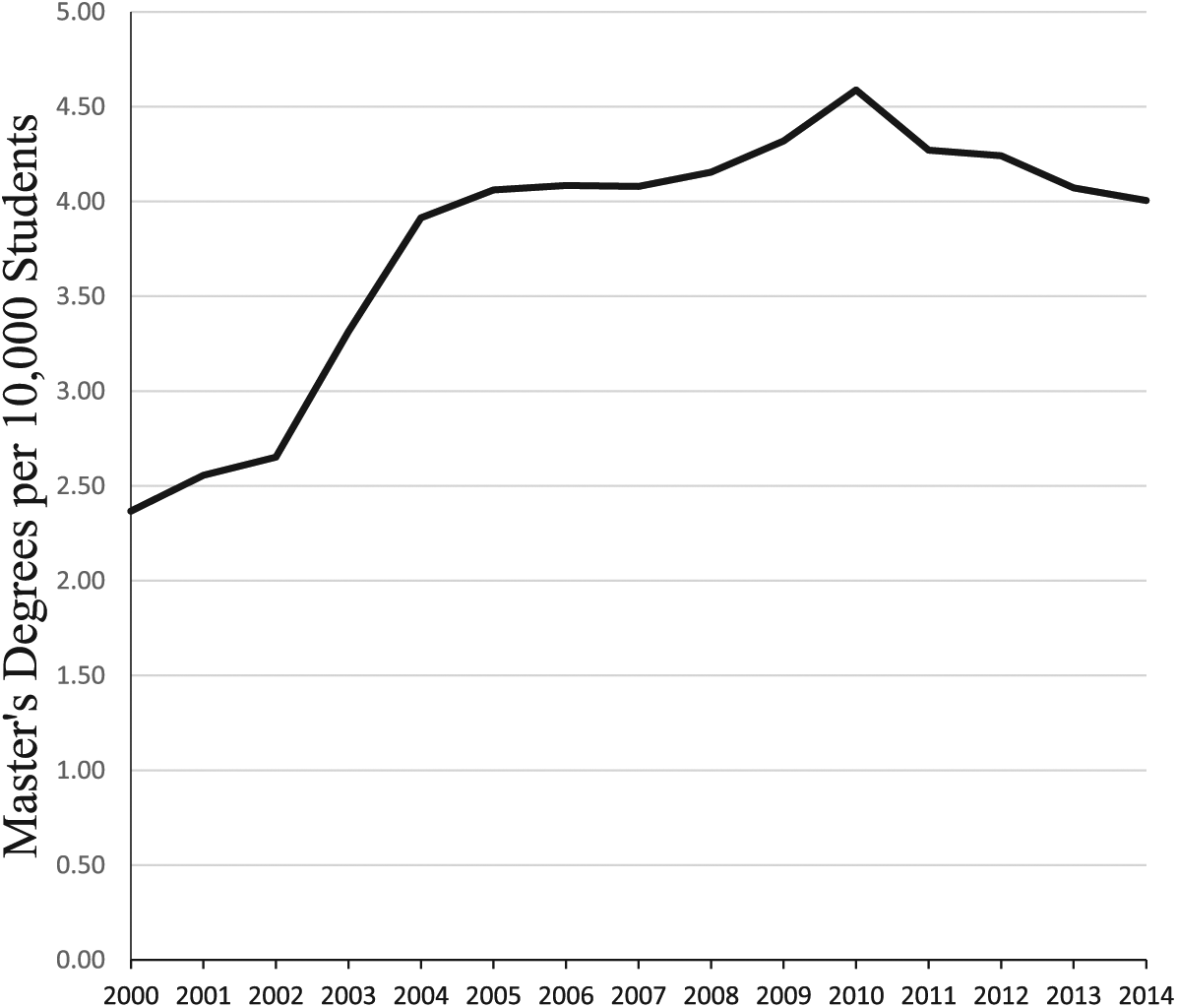
Master’s degrees per 10,000 public school students.
Master’s Degrees in Educational Leadership per 10,000 Students by Year and State.
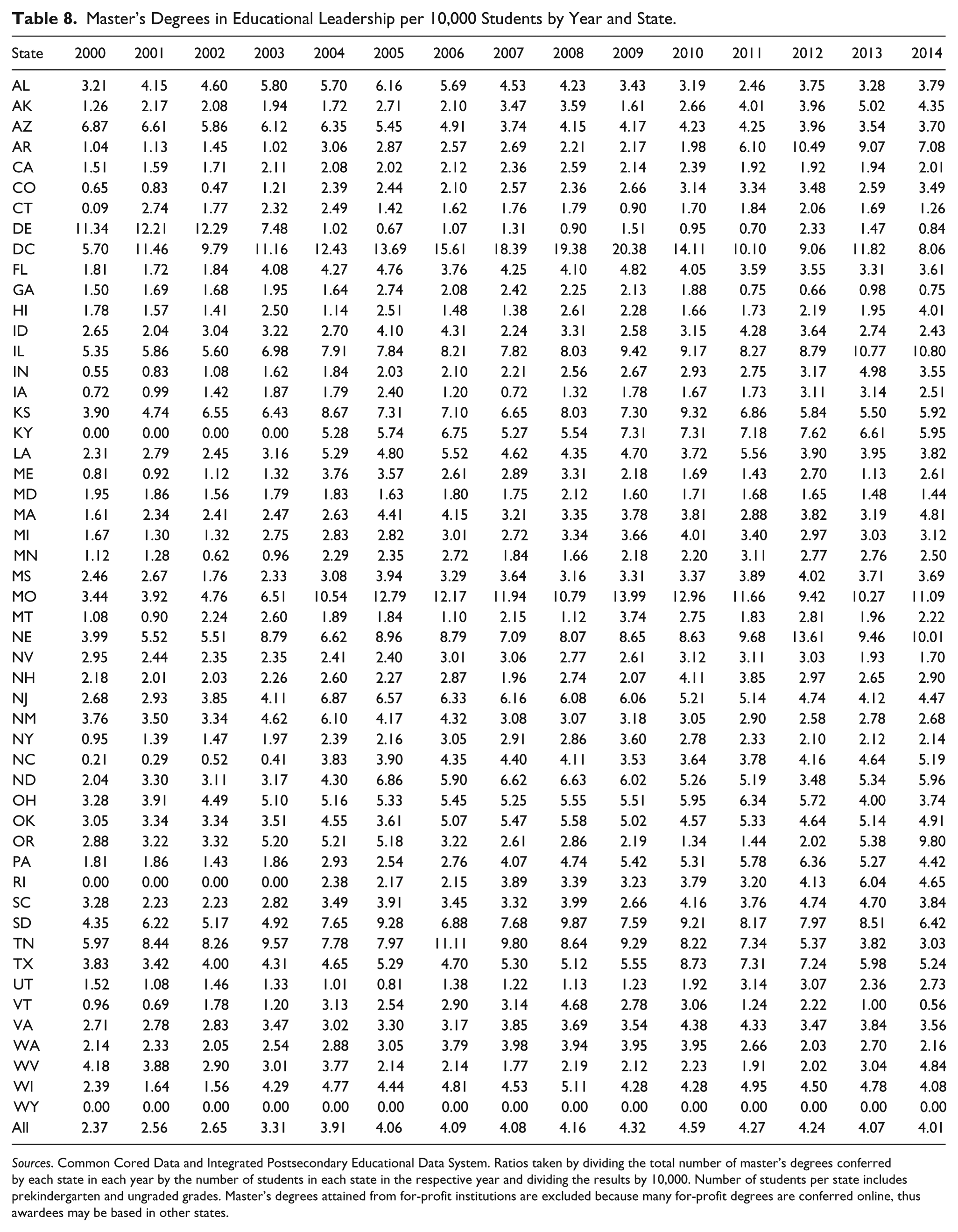
Sources. Common Cored Data and Integrated Postsecondary Educational Data System. Ratios taken by dividing the total number of master’s degrees conferred by each state in each year by the number of students in each state in the respective year and dividing the results by 10,000. Number of students per state includes prekindergarten and ungraded grades. Master’s degrees attained from for-profit institutions are excluded because many for-profit degrees are conferred online, thus awardees may be based in other states.
Discussion
Leadership Preparation Programs and Degree Production
It is clear that from 2000 to 2014, there has been substantial growth in both the number of: (a) institutions granting educational leadership degrees and (b) degrees awarded in educational leadership. Overall, there was a 72% increase in the number of institutions (451 in 2000 and 775 in 2014) offering educational leadership programs at one or more levels and there were twice as many educational leadership graduates (32,614) produced in 2014 as compared with graduates in 2000 (16,154). Although an earlier study by Baker et al. (2007) did not note changes in the total number of institutions granting one or more type of educational leadership degrees (e.g., master’s, specialist), they did report changes in offerings by master’s, specialist, and doctorate categories. In summary, Baker et al. (2007) found the number of institutions granting master’s degrees grew by 16% (from 396 to 459), specialist degree institutions by 25% (from 129 to 161), and doctoral degree-granting institutions by 48% (from 132 to 195). This coincided with a 90% increase in master’s degrees (from 8,292 to 15,720), 96% in specialist degrees (from 1,718 to 3,361), and 31% growth in doctoral degrees (from 1,736 to 2,202) during the 1993-2003 time period. This tremendous growth has persisted since Baker et al.’s study.
Production Trends in Leadership Preparation Programs
Although the growth in both the number of programs and graduates in the past 15 years is substantial and striking, it is not uniform across all institution categories. The number of universities and colleges granting degrees of all types in educational leadership has stayed the same or grown across all categories (see Table 1). Overall degree production by year, however, has not shown the same steady rise. Production peaked for postbaccalaureate degrees in 2011, master’s degrees in 2010, and specialist degrees in 2009. In fact, postbaccalaureate degrees and master’s degree production has decreased yearly since reaching these peak production years. Only leadership doctoral degree programs and conferred doctoral degrees have continued to grow over each of the past 15 years. This trend may be at odds with increased post-recession undergraduate enrollment increases at 4-year institutions, but could be consistent with coinciding lower undergraduate completion rates (e.g., Shapiro et al., 2015). General patterns in enrollment and degree completion are difficult to determine because IPEDS only captures degree completion for educational leadership programs. Furthermore, the nature of undergraduate and graduate degree programs, student compositions, and time to completion may make for unfair comparison. A body of research focuses on undergraduate enrollment and completion rates related to the Recession (e.g., Barr & Turner, 2013; B. T. Long, 2015) but we are unaware of any studies that examine these trends at the graduate level.
We speculate that postbaccalaureate, master’s, and education specialist degrees and certificates peaked pre-2014 for several reasons. One explanation may be that the financial demands of graduate school are experienced differently by practicing educators. As is indicated in Table 2 and Figure 2, the slight decreases in recent years appear to lag behind the Recession of 2008. These lags in degrees conferred appear to correspond with the timing of the recession and time needed to complete each program following the recession. Master’s degrees usually require 2 years of study and we see the first decrease in 2010, leading us to believe that fewer people entered into school leadership master’s programs in postrecession years and/or post-recession years had higher program attrition rates. We apply the same thinking to the specialist degree, generally a 1-year program, production decrease post-2009. The Recession may have led to (a) lower or loss of teacher tuition subsidies, (b) career and/or financial instability, and/or (c) fewer leadership opportunities because of budgetary cuts that eliminated assistant principal positions.
State policies allowing alternative pathways for attaining principal licensure may also be a factor in these recent decreases in degree conferral. As of Spring 2015, 32 states had policies in place creating alternative pathways for attaining licensure. These policies allowed individuals to attain administrative licensure without meeting many of the traditional requirements, such as earning advanced degrees (Anderson & Reynolds, 2015b). Such policies are relatively new and research on alternative principal licensure programs is scarce. Thus, it is difficult to determine the reasons students choose to attend these programs and whether they do so in lieu of enrolling in accredited, postsecondary institutions.
Lastly, the shrinking teacher pool (Sutcher, Darling-Hammond, & Carver-Thomas, 2016) may also be related to somewhat lower leadership program graduation rates. Anderson and Reynolds’ (2015a) report found that teaching experience is required to lead a school in 39 states. The shrinking pool of experienced teachers who might be interested in leadership opportunities and these state requirements for teaching experience, could mean a smaller applicant pool for principal preparation programs.
The reasons for the changes in overall degree production, especially the increases in the number of doctoral degrees granted over the past 15 years is unclear. Based on this descriptive study, we can make four well-substantiated assertions:
The number of institutions granting all degree types in educational leadership has continued to rise this century.
The number of degrees granted in educational leadership is substantially larger in each degree category in 2014 than 2000.
The types of institutions offering principal preparation degrees have changed dramatically over this time period.
The production rates of graduates in institutions that are recognized as being less selective and less resourced have increased substantially between 2000 and 2014.
We have serious concerns as to what these assertions mean for the quality of principal preparation programs, the principal candidate pool, the principalship, and ultimately the quality of our public education system.
Indicators of Quality
Baker et al. (2007) noted “academic drift” taking place in principal preparation between 1993 and 2003. Using the 1994 Carnegie Classifications (see Appendix A), the authors found that master’s degree programs offered by Comprehensive institutions grew by 16% and degrees granted by these programs increased by 90%. Our findings (see Tables 4 and 5) show that this trend has continued. Baker et al. expressed concern that the resources and admission requirements in Comprehensive universities and colleges might adversely affect the quality preparation programs and the principal candidates who complete them. Likewise, Hackmann and McCarthy (2011) argued that Comprehensive institutions may not have the same capacity to sufficiently prepare school leaders. As noted in their Foreword, “such shifts in where the majority of educational leaders are being prepared is striking and raises questions about the supply and demand of educational leaders, institutional capacity, program quality, and the faculty who are preparing future educational leaders” (p. x). Using this logic, the emergence of Baccalaureate II institutions and degrees conferred by them may be cause for concern as well. Production of graduates by institutions labeled as Baccalaureate II has been impervious to the overall decline in master’s degrees granted since 2010 (see Tables 4 and 5). In fact, Baccalaureate II institutions graduated more leadership master’s students than Research I and Research II universities in 2014 combined. If questions arise regarding Comprehensive institutions’ financial capacity to properly educate future leaders, what concerns should there be about programs in less-resourced Baccalaureate institutions? The question of resources has become even more critical given a recent report from the Center on Budget and Policy Priorities showing that states continue to fund higher education at lower rates than prior to the 2008 recession (Mitchell, Palacios, & Leachman, 2014).
The same concern about program quality arises when looking at offerings and completions by 2000 Carnegie Classifications: Can such rapid and large increases in Master’s I and Master’s II program and degree growth coincide with the development of program features that are found in exemplary programs? Are the necessary supports for exemplary programs in place for these programs? Doctoral institutional growth and degree production have remained stagnant over the 2000-2014 time period while Master’s I degree production has almost doubled and that of Master’s II degree production has increased by a factor of more than six. This rapid expansion presents challenges for the field of educational leadership preparation as a whole. Knowledgeable faculty, well-designed internships, strong mentoring, meaningful partnerships with districts, and coherent curricula aligned with standards are critical components of impactful preparation programs (e.g., Darling-Hammond et al., 2009; Orr, 2011) and financially supporting these program features in a rapidly expanding market would be a challenge for institutions. Unfortunately, it is unknown whether such growth has coincided with an increase in the capacity of programs to provide resources necessary for high-quality principal preparation programs and positive principal practice and school-based outcomes (Darling-Hammond et al., 2009).
Conclusions
The patterns and trends in principal preparation noted in the study by Baker et al. (2007), which bracketed the decade of 1993-2003, have continued and accelerated. Almost double the number of master’s degrees in educational leadership was granted in 2014 as compared with 2000. During this same timeframe, the number of master’s degrees granted by doctoral/research institutions, as designated by their Carnegie classification, remained relatively constant. The dramatic growth in the number of degrees granted is attributed to institutions with the Carnegie classification of Master’s I or II. Our findings are consistent with Baker et al.’s (2007) in that “the greatest and seemingly most rapid expansion in programs is among institutions that are less able to deliver a quality program” (p. 306) because they are less selective and less well-resourced. Both studies raise questions about the quantity and quality of program graduates. Nationally, the increased production is disproportionately larger than what would be expected based on demand as measured both by principal retirements and student population growth. Assuming a yearly principal retirement rate of 10,000 (Battle, 2010; Goldring & Taie, 2014), master’s degree production alone in the 21st century would yield a pool of more than 135,000 credentialed candidates who did not obtain principal jobs. This number increases to roughly 192,000 when both master’s and specialist degrees are combined. However, the growth in the number of individuals with educational leadership credentials may be building professional capacity within schools in the form of teacher leaders, mentors, and instructional coaches as strong teacher leadership can have positive effects on teacher leaders’ colleagues (Wenner & Campbell, 2017). Does the emergence of university-based teacher leadership programs lead to higher percentages of principal preparation candidates with the intent to become principals? A larger pool of applicants may give school districts greater choice; however, concerns about the quality of candidates persist which may suggest that moving more leadership candidates through the pipeline does not necessarily address the concerns about the “shortage of principals with high-level leadership skills” (Shelton, 2012, p. 5).
Additionally, the surplus of newly minted principal candidates raises questions about the purpose of these programs for individuals, universities, and the field at large. Substantial resources in the form of tuition reimbursements and time are being expended to prepare individuals for positions that they do not pursue. Are these resources being used in the most productive manner? Would limited resources be better used to prepare fewer individuals with greater commitment to pursuing leadership positions? Are less resourced programs worthwhile for candidates or do they place the candidates at a disadvantage in terms of career advancement and, more importantly, in terms of their ability to have a positive impact on teaching and learning? From a diversity perspective, do principal candidates reflect the student population in terms of ethnicity and gender? Does production differ by ethnicity and gender, have these candidate demographics changed over time, and do candidate demographics vary by institutional type and resources? These questions correspond with important issues of equity and social justice for aspiring and acting principals that our field cannot ignore (Fuller et al., 2017).
The findings of this study are cause for concern. Many questions are raised about the quantity and quality of our educational leadership workforce. We have used the most accurate datasets available to provide a detailed description of the educational leadership preparation landscape in terms of institutions and degree production but many nontraditional preparation programs are entering the marketplace and we have no data on their number or their participants. As a result, our numbers do not reflect the full extent of principal production and it is a conservative estimate. The field must learn more about alternative preparation program offerings and licensure routes of all types (i.e., university-based, district, intermediate) along with completion figures to fully understand the breadth and nature of principal candidate production in the 21st century.
The question of preparation program quality is even more elusive. Our use of Carnegie Classifications and the Barron’s Index are a crude means of classifying postsecondary institutions and we need more in-depth studies of program elements in various types of institutions to determine with the quality of principal preparation as defined by Darling-Hammond et al. (2009). Such future examinations must also push to include alternative licensure programs and routes because so little is currently understood about them despite the possibility that they may produce a large number of principal candidates (Hackmann, 2016). Only then can we fully explore the impact of selectivity and resources on preparation programs, and the implications for candidate preparation to lead in challenging school contexts.
More broadly, there appears to be a misalignment of current principal production with the needs of school systems. On a national level, there has been an increase in the ratio of certified leadership candidates to students suggesting a surplus but our state analysis suggests that the supply of candidates is not uniform. Further research is needed to examine the supply of and demand for principals based on geographic location and a host of additional variables. The next step may be to explore supply and demand at a more granular level, possibly by state or region, to more strategically invest scarce resources in the support of high potential leadership candidates and to create a more robust pipeline of high quality candidates for the nation’s schools and students.
Footnotes
Appendix A
Appendix B
Distribution of Institutions in 2008 Barron’s Admissions Selectivity Index.
| Category | 2008 |
|---|---|
| Most competitive | 80 |
| Highly competitive | 110 |
| Very Competitive | 280 |
| Competitive | 670 |
| Less competitive | 200 |
| Noncompetitive | 90 |
| Special | 90 |
| Total | 1,520 |
Source. Barron’s Admissions Selectivity Index. Sample sizes rounded to nearest ten per NCES nondisclosure rules.
Declaration of Conflicting Interests
The authors declared no potential conflicts of interest with respect to the research, authorship, and/or publication of this article.
Funding
The authors received no financial support for the research, authorship, and/or publication of this article.