







Abstract
Introduction
The impact of leadership on student outcomes has long been a topic of interest. Although there are several studies, investigating the impact of leadership on students’ academic success, there are limited number of studies that investigate the impact of leadership on students’ non-academic outcomes such as student commitment, attitudes towards school and sense of belonging to school (e.g. Canlı, 2020; Leithwood & Jantzi, 2000; Özdemir, 2017). In this study, the correlation between social justice leadership of school principals and students’ alienation from school was investigated in Turkey. Thus, the study is considered to contribute to the literature on the impact of leadership on non-academic student outcomes. On the other hand, both social and educational inequalities have been emphasized and school principals are expected to exhibit social justice leadership behavior to eliminate the educational inequalities (Ryan, 2006). However, there is insufficient evidence on how social justice leadership behavior of school principals affects the students. Thus, this study will also contribute to the literature on the impact of social justice leadership on students.
Alienation from school is concerned with negative attitudes and behaviors containing cognitive and emotional elements towards the academic and social areas of the school (Hascher & Hadjar, 2018). Students alienated from school do not consider the school valuable, do not find education-instruction activities meaningful, do not feel the need for education, are not proud of their schoolwork, do not have a desire to be a good student, and do not identify with the school (Hascher & Hagenauer, 2010). They do not participate in classroom activities, attempt to prevent instruction of the courses in the classroom, and exhibit undisciplined behavior, a tendency to drop out of school (Brown et al., 2003a), and even suicidal ideation and violence (Schulz & Rubel, 2011). In addition, alienation from school is one of the reasons for academic failure (Hadjar et al., 2015). Considering all these, alienation from school is an important problem in terms of education and society. Prevention of alienation from school is important for giving students a chance to succeed, primarily in education and subsequently in life (Hascher & Hadjar, 2018), and for ensuring social well-being. In this regard, the roles of school leaders in particular are significant. It is morally and ethically imperative for school leaders to facilitate the teaching and learning process in order to make a positive difference in the lives of all students. Also, school leaders should put all students at the center of education, and they should consider the well-being of students in determining their decisions, actions and policies (Normore & Blanco, 2006).
Factors affecting alienation from school such as placement in special education, gender and race (Brown et al., 2003b) are discussed in the context of inequality and injustice in education. It is emphasized that alienation will occur when social justice is not ensured in education (Mahmoudi et al., 2018a, 2018b). This situation can be addressed within the framework of a mutual relationship. What we want to say here is that if inequalities and the lack of justice can cause alienation, the existence of alienation may also signal that there are inequalities and injustices. School principals can guide the social justice practices in schools by identifying the alienation areas of the students.
Practices of social justice leaders in education take place in two fields, namely educational and equality. The educational field includes curriculum, assessment and pedagogy. The field of equality includes knowledge, skills and critical consciousness (Brooks et al., 2017). In this context, the practices of social justice leaders in education can be examined in terms of the academic and social aspects of the school. Since school alienation is a set of negative cognitive and emotional attitudes towards the social and academic domains of schooling (Hascher & Hadjar, 2018), social justice leadership behaviors of principals towards the school's academic and social domains can be associated with alienation from school.
In Turkey, it is determined that students’ alienation is at a moderate level (Ayık et al., 2015). However, some reasons for school dropout such as academic failure, unwillingness, dislike of school, absenteeism, disciplinary problems (Bayhan & Dalgıç, 2012) may show that students are alienated from school. On the other hand, different results have been obtained in the level of alienation in terms of the socioeconomic status of students and their gender (e.g. Ayık et al., 2015; Sanberk, 2003; Şimşek & Katıtaş, 2014).
It can be stated that there is not enough research on school principals’ social justice leadership practices in Turkey. According to, Beycioglu and Ogden (2017), principals in Turkey abstain from talking about injustice arising from ethnic origin, religion, language or racial diversity. The authors indicate the reason for this as the fact that talking about these matters in schools in Turkey is seen as taboo. In social justice leadership practices, school principals in Turkey try to eliminate the feeling of otherness by creating equal educational opportunities for students who have different ethnic cultures, different religions, or lower socioeconomic status. School principals receive grants from philanthropists, businessmen, parents and teachers for students with low socioeconomic status. School principals collaborate with school staff and the community to ensure social justice at school. Additionally, they try to create a fair school environment and in order to help students, they strive to obtain information about students’ socioeconomic status, individual differences, abilities, etc. However, centralized structuring, lack of resources and limitation of authority hinder social justice leadership behaviors (Arar et al., 2017, 2019; Beycioglu & Ogden, 2017).
In this study, whether there was a significant correlation between social justice leadership and school alienation and whether social justice leadership significantly predicted school alienation were investigated. Furthermore, this study investigated the level of student perceptions about social justice leadership and alienation from school and whether there was a significant difference between these perceptions based on gender, socioeconomic status and student grade level. Thus, the correlation between the social justice leadership of school principals and students’ alienation from school was examined based on the findings obtained for these independent variables, and it was considered that this would clarify the subject further.
Initially, the literature on social justice leadership and alienation from school is examined in this study. The relationship between social justice leadership and school alienation is examined conceptually. Information about the society and the education system in Turkey is given. After information on the study methodology is provided, the findings are presented. The study findings are discussed in the context of Turkey. Finally, the limitations of the study are mentioned, and recommendations are presented for future studies and practitioners.
Alienation
Alienation is defined as “the state or experience of being isolated from a group or an activity to which one should belong, or in which one should be involved” (Mann, 2001, p. 8). Factors such as students’ lack of control over their lives, lack of learner autonomy, lack of proud emotions towards the skills required at school, the perceived irrelevance of the knowledge taught at school, lack of teacher sympathy, strict school regulations, and indifference of parents towards school affairs contribute to alienation (Kunkel et al., 1973). The bureaucratic structure of schools, crowded classrooms, a heavy curriculum and course load, the absence of a democratic management approach, the exclusion of students from determination of the teaching processes (Erjem, 2005), differences in the behaviors of teachers towards students, and peer rejection (Morinaj et al., 2017) are other factors that cause alienation.
Alienation has been described as a multidimensional concept (Calabrese & Schumer, 1986). Educational studies have often utilized the alienation models developed by Dean and Seeman (Brown et al., 2003b). While Seeman (1959) conceptualized alienation as powerlessness, meaninglessness, normlessness, social distance (isolation) and self-alienation, Dean (1961) supported with empirical evidence the idea that alienation included only three dimensions; social distance (isolation), powerlessness and normlessness.
Powerlessness dimensions reflects the feeling of a lack of control over events by individuals (Seeman, 1983). These students tend to give up in the first challenge or failure they experience as they see working harder to succeed as be a waste of time. Normlessness dimension is associated with the inconsistency of the student's self-value system with school norms (Shoho et al., 1997). In this dimension, alienated students consider it their right to break social rules, prioritize prominence, and obey the rules only superficially (Silverman et al., 1970). They can participate in gang activities more easily, because such groups give the message that it is appropriate to violate the rules. Individuals who experience alienation in the social isolation dimension often talk about dropping out of school, indicating that there is no one in the school whom they can trust or who can support them (Brown et al., 2003a). They feel lonely, tend to dissent from group norms and standards, desire to be with themselves rather than others, and spend time alone (Brown et al., 2003b). Self-alienation dimension is the inability of individuals to comprehend the internal meaning of tasks and inability to feel proud of the work they do. The self-alienated individuals are interested in external factors such as salary, rewards etc. They act with the expectation of a reward for their actions or with the thought that these actions may affect others (Seeman, 1959). Thus, it could be suggested that self-alienated students are not proud of the activities conducted at school, participate in school activities in order to receive a reward that they deem valuable, and conduct these activities to satisfy others. Meaninglessness dimension entails a sense of inability to predict results. Students who experience alienation in this dimension do not find school activities meaningful. They have no reason to participate in educational activities conducted at school. They do not believe that school activities are necessary or beneficial for them (Rafalides & Hoy, 1971).
Social Justice Leadership
Social justice leadership is significant in the leadership style of school principals (Ryan, 2006). Social justice leaders focus on the lives of disadvantaged groups, inequalities and opportunities in education, and the factors that cause inequality, and attempt to achieve equality through practices that are culturally adequate and fair (Furman, 2012). In this context, social justice leaders are the architects and founders of a new social order where the disadvantaged groups possess the same educational and social opportunities as the advantaged groups (Jean-Marie et al., 2009). Thus, they should be competent to replace the existing unequal structures with more equitable structures, as well as identifying factors that cause inequality (DeMatthews & Mawhinney, 2014). They should investigate their values regarding race, class, language, sexual orientation, etc. with a critical approach and the effects of these factors on leadership practices. They should build trust-based relationships with colleagues, teachers, students and other cultural groups (Furman, 2012). They should communicate and collaborate with all school stakeholders when conducting social justice practices at schools (Capper & Young, 2014) and should have three objectives: to increase academic achievement, to create a critical conscience and to implement inclusive practices (McKenzie et al., 2008).
Social justice leaders endeavor to improve the academic achievement of all students at school (Capper & Young, 2014; McKenzie et al., 2008). In particular, increasing the achievements of disadvantaged students should be a primary objective for social justice leaders. Thus, they should eliminate the practices preventing both emotional development and academic achievements of disadvantaged students. By focusing on disadvantaged groups, they provide equal opportunities to all disadvantaged groups (Theoharis, 2007). They focus on structural inequalities due to the lack of learning opportunities instead of explaining students’ success and failure with personal factors (Trujillo & Cooper, 2014). They pay attention to and respect differences. They acknowledge that each child can be successful and encourage all stakeholders to provide collaborative guidance on the road to achievement (Theoharis, 2007).
Social justice leadership is based on an approach that determines the correct and incorrect current practices and acts to correct the incorrect practices (Rivera-McCutchen, 2014). Thus, principals as social justice leaders identify the inequalities hidden within the day-to-day management of the school by critically investigating the school issues, policies, budget and culture (DeMatthews, 2014). They prepare their students to live as critical citizens in the society. They also attempt to create a critical conscience among their staff (McKenzie et al., 2008). They create an environment for teachers to review their beliefs about different income levels, languages and students (Dantley & Tillman, 2010, cited by Trujillo & Cooper, 2014). They compel these stakeholders to consider social justice issues and to question the status quo, and in doing so, they act as activists working towards change (DeMatthews, 2014).
Social justice leaders think about why and how the schools are unfair for some students, and they determine the roles of schools and administrators to create a more equal social order (Nieto, 2011, cited by Trujillo & Cooper, 2014). The roles of social justice leaders also include the implementation of inclusive practices. However, these inclusive practices should include all disadvantaged groups, not only the students with disabilities (Capper & Young, 2014). Thus, they design and implement school policies and distribute resources to remove existing inequalities based on factors such as race, socioeconomic status, language, gender, etc. (Trujillo & Cooper, 2014). They make efforts to ensure that disadvantaged students are included in the same classrooms as their peers instead of studying in separate classrooms. Therefore, they create opportunities for the inclusion of students in heterogeneous classes instead of homogeneous classes (McKenzie et al., 2008).
The main focus of social justice leadership practices is students. Some studies (DeMatthews, 2018; Theoharis, 2007) show that social justice leaders create a safer school environment by reducing discipline problems in their schools and increase the academic success of students. Moreover, the social justice leadership leads students to have positive attitudes towards school and to increase their commitment and belonging to the school (Canlı, 2020; Özdemir, 2017). In this context, it can be said that the social justice leadership is effective on both academic and non-academic outcomes of students.
Conceptual Framework: The Relationship between Social Justice Leadership and School Alienation
In this section, it is explained theoretically how school principals can affect students’ alienation from school when they display social justice leadership behaviors. The alienation of students from school is discussed in a four-dimensional structure as normlessness, powerlessness, meaninglessness and social isolation. Social justice leadership is considered in three dimensions as support, critical consciousness and participation. Social justice leadership behaviors are examined hereinafter in terms of each dimension of alienation.
Alienation and social justice leadership in terms of the meaninglessness
Academic alienation is affected by education opportunities that indicate the quality and quantity of education (Mahmoudi et al., 2018a). In the meaninglessness dimension that emphasizes the academic alienation of students, students cannot establish a connection between the subjects in the curriculum and their own lives. They think that what is taught at school will not contribute to their current and future lives (Hakim et al., 2018), and thus consider what is taught as unnecessary pieces of information. In such a case, the curriculum and classroom teaching process may not address the individual characteristics and needs of students. Since social justice leaders aiming to increase the academic success of students have critical consciousness skills (McKenzie et al., 2008), they can critically examine the classroom curriculum and teachers’ in-class teaching process in order to identify inequalities and problems that prevent learning. In addition, they encourage teachers to critically examine whether their possible prejudices related to characteristics such as race, class and gender are reflected in the classroom teaching process and whether they provide equal learning to all students (Kose, 2007). This enables teachers aware of inequalities in the classroom teaching process and problems that prevent learning. Also, in social justice leadership, it is required to learn what students think and need in order to provide them with a better education service. Since students have the knowledge and experience of injustice in school, it is accepted that obtaining students’ opinions is important in identifying the problems at school (Wang, 2018). Hence, social justice leaders can develop students’ critical consciousness skills (McKenzie et al., 2008) in order to enable students to express their views on the things impeding their learning or unequal practices. Students can provide opinions on what kind of a curriculum and teaching process should be in place for them. Thus, social justice leaders can make the necessary changes in the curriculum and classroom teaching process and make them more suitable for students (Santamaría, 2014).
High quality education reduces students’ alienation from school (Hascher & Hagenauer, 2010). In this respect, providing in-service training for teachers so that school principals can provide a good education in line with the needs of students can reduce students’ academic alienation (Mahmoudi et al., 2018a). School principals who adopt social justice perform practices such as enabling teachers to share feedback with each other and providing support for effective teaching from specialists in order to ensure the professional development of teachers (DeMatthews & Mawhinney, 2014). As stated, social justice leaders should also have the ability to design a teaching process that addresses students’ individual characteristics and be able to teach it to the teachers. In this way, they can ensure the professional development of teachers in creating an effective teaching process that addresses all students (McKenzie et al., 2008). Under such circumstances, the efforts of social justice leadership to ensure the professional development of teachers can reduce alienation, as it ensures that all students are provided with a quality teaching service.
In line with this information, the fact that school principals, as social justice leaders, have critical consciousness of themselves, develop critical consciousness in teachers and students, and enable students to express their opinions, may indicate that behaviors of social justice leadership in the critical consciousness dimension can reduce alienation in the dimension of meaninglessness. As social justice leaders, school principals’ efforts to increase students’ success and provide an equitable education environment may indicate that behaviors of social justice leadership in the support dimension can reduce alienation in the dimension of meaninglessness. In addition, obtaining the opinions of students in determining the curriculum and the teaching process may show that behaviors of social justice leadership in the participation dimension can reduce alienation in the dimension of meaninglessness.
Alienation and social justice leadership in terms of the normlessness
Students who become alienated in the normlessness dimension resist the existing order in school and perform behaviors that do not comply with the school rules (Hakim et al., 2018). They exhibit negative behaviors in the classroom, they may use bad language in the presence of their teachers and friends, and solve problems by fighting (Cao, 2016). This situation creates an unsafe environment for other individuals in the school as well. Creating a school environment where everyone feels safe is an important component of social justice leadership (Wang, 2018). Research studies (DeMatthews, 2018; Theoharis, 2007) indicate that social justice leaders create a safer school environment by reducing discipline problems in their schools.
Although alienation can be a source of motivation that encourages individuals to strive to overcome existing inequalities, excluded individuals can be directed to violent behavior (Mahmoudi et al., 2018b). This situation can be interpreted as the result of anger which emerges as an individual response to situations where the values of the individual are at risk and their rights are restricted, which is degrading and marginalizing for individuals (Dantley & Green, 2015). When students feel that they do not have equal educational means and opportunities, their academic motivation decreases and as a result they either drop out or exhibit undisciplined behavior at school (Mahmoudi et al., 2018a). Social justice leaders critically approach the structure of the school, and the policies and practices at school (Furman, 2012). They have the skills to communicate with students and obtain their views on current inequalities (Wang, 2018) in order to eliminate these inequalities and to take actions towards fairer policies and practices (DeMatthews & Mawhinney, 2014).
Students whose needs and expectations are not met by the education system may rebel against the education system and society (Mahmoudi et al., 2018b). Social justice leaders care about the needs of students (Wang, 2018), put students at the center of education and take into account students’ interests when making important decisions (Normore & Blanco, 2006). They develop critical consciousness of the fact that schools need to be changed to meet students’ academic and affective needs (Tillman et al., 2006). Establishing cooperation between school administrators, parents and teachers is necessary to meet the different needs of students (Zhang et al., 2018). Social justice leaders establish a collaborative environment (Capper & Young, 2014; Normore & Blanco, 2006; Wang, 2018), care about the participation of families in education in order to increase the success of students, and communicate with families by ensuring their participation in education through various activities (DeMatthews, 2018). It can be identified whether students have inequalities arising from their family life by communicating with families. They can obtain an idea about the personal needs of students based on their family life and on the information families provide regarding the characteristics of their children. In addition to the foregoing, if social justice leaders can ensure democratic participation in decision making (Wang, 2018), this may also ensure that students participate in the creation of rules and thus adopt and enforce them.
In the light of this information, as social justice leaders, school principals’ creation of a safe environment and equal educational opportunities, and their efforts to meet students’ individual (academic and affective) needs may show that behaviors of social justice leadership in the support dimension can reduce the level of alienation in the dimension of normlessness. As social justice leaders, school principals’ having critical consciousness and allowing students to express their opinions may indicate that behaviors of social justice leadership in the critical consciousness dimension can reduce alienation in the dimension of normlessness. Ensuring the participation of students in the determination of the rules may indicate that behaviors of social justice leadership in the participation dimension can reduce alienation in the dimension of normlessness.
Alienation and social justice leadership in terms of the powerlessness
Excluding students from decision making regarding the rules and processes at school can cause alienation, as it will create the feeling that school life is guided by others (Grecu et al., 2019). This situation reveals alienation in the dimension of powerlessness. Alienation in the powerlessness dimension is caused by a feeling of lack of control over events (Seeman, 1983). This situation can be associated with the sense of autonomy. Autonomy indicates having control over events and reduces academic alienation (Mahmoudi et al., 2018a). Autonomy can only develop in a democratic environment. Social justice leaders both establish and support democratic processes (Santamaría, 2014). With democratic processes, students participate in decisions about themselves and have the opportunity to express themselves. According to Slater et al. (2014), it is important for school principals who adopt social justice to ensure that students express themselves and listen to their opinions since this will make them feel valuable.
In the light of this information, as the leaders of social justice, creating a democratic environment and obtaining the views of students about the processes in school may indicate that behaviors of social justice leadership in the critical consciousness and participation dimensions can reduce alienation in the dimension of powerlessness. Furthermore, the effort to provide equal educational opportunities to every student in this way may show that behaviors of social justice leadership in the support dimension can reduce alienation in the dimension of powerlessness.
Alienation and social justice leadership in terms of the social isolation
Alienation in the social isolation dimension occurs when a person does not have a sense of belonging to the social environment which he is and keeps himself away from that social environment (Sanberk, 2003). Students who become alienated in this dimension isolate themselves from their teachers and friends (Hakim et al., 2018). This may be due to students’ relationship with their teachers and friends. Differences in teachers’ behavior towards students and peer rejection may lead to alienation (Morinaj et al., 2017). Having positive relationships between student-student and teacher-student reduces alienation from school (Hascher & Hagenauer, 2010). A school environment with mutual acceptance, respect, trust and support in the teacher-student relationship reduces the academic alienation of students (Mahmoudi et al., 2018a). This situation indicates an environment where social justice is enabled. One of the important components of social justice leaders is to create a school environment where everyone feels valued, accepted, respected and safe (Wang, 2018). In addition, social justice leaders can develop critical self-reflection skills of students and teachers. According to Brown (2004), critical self-reflection strategy is the critical examination of an individual's values, assumptions and beliefs by that individual. In such a case, teachers and students can critically examine whether their behavior is affected by their possible bias and assumptions, and they can correct their behavior accordingly. Thus, social justice leaders can create awareness and tolerance towards differences among individuals. This, in turn, can lead to more sincere and supportive relationships among individuals in the school. In this context, behaviors of social justice leadership in the critical consciousness dimension may reduce alienation in the social isolation dimension.
Society and Education System in Turkey
Turkey is a democratic and secular state, the Presidency of which is governed by the government system. The official language of the country is Turkish. Many people of different ethnic origins live in Turkey. Although there are no statistical calculations regarding ethnicity in the census in the country, an estimated 70–75% of the country consists of Turkish people, 19% of Kurdish people and the rest of other minorities. 99.8% of the people in Turkey are Muslim and 0.2% have different religions (CIA, 2019).
In the Turkish education system, which has a central structure, formal education consists of preschool, primary school, middle school, high school and university. The education before university is under the supervision of the Ministry of National Education. Universities are affiliated to the Higher Education Council. 12-year compulsory education is applied in Turkey, which includes primary school (4 years), middle school (4 years) and high school (4 years). Central exams are carried out in moving from middle school to high school and in moving from high school to higher education. Students are placed in high schools according to the score they obtain in the central exam held by the Ministry of National Education. This situation causes students to be grouped according to their success levels in high school and creates a difference in success levels between schools. Besides, there were differences in success levels between regions in Turkey. It was determined that the success level decreased towards the east of the country and socioeconomic status affected student success (MoNE, 2019).
Turkey has struggled with the problem of inequality of opportunity in education for years. In order to eliminate inequality in education and to increase the compulsory education period, various campaigns which ensure that girls are being sent to school, free distribution of textbooks, free support and training courses, boarding schools, mobile education, the Fatih Project (creating equality in terms of the technological infrastructure of schools), inclusive practices for students with disabilities, etc. have been carried out. Nevertheless, with the 2023 Education Vision of the Ministry of National Education, Turkey aims to provide equal opportunities in education by improving the quality of educational services such as professional development support, curriculum and infrastructure changes for disadvantaged schools and disadvantaged students, and teachers working in the disadvantaged regions.
Method
This study was conducted as a correlational research. Correlational research studies investigate the correlation between two or more variables and aim to determine the correlation between these variables, and the direction and degree of the correlation (Walliman, 2011).
Population and Sample
The study population included 20,944 students attending public high schools in Adıyaman province where is located in the Southeastern Anatolia Region of Turkey. The study sample was determined with the cluster sampling method. In this method, initially, large clusters are selected, and in the second stage, smaller clusters are selected by the simple random or stratified sampling method. Since this sampling method includes multiple stages, it is also known as the multistage sampling method (Balcı, 2001). In order to determine the individuals that would be included in the sample, the high schools were clustered based on socioeconomic levels (low, middle and high) and two schools at each level (a total of 6 high schools) were determined randomly. Then, a class was randomly selected from each grade level and the implementation was conducted with 610 students in these classes. The socioeconomic levels of the schools included in the study were identified according to the opinions of the school principals. The principals stated the socioeconomic level (low, middle and high) of their schools by considering the socioeconomic levels of the parents of students in their schools. Based on the socioeconomic levels stated by the school principals, two schools from each level were determined and a total of 6 schools were included in the sample. All of the principals of the schools included in the study were men. The number of students for per teacher in schools changes between 11–16 students. Only the students answered the two scales used in the study. The data of the study consist of students’ perceptions about their alienation from school and the principals’ social justice leadership behaviors.
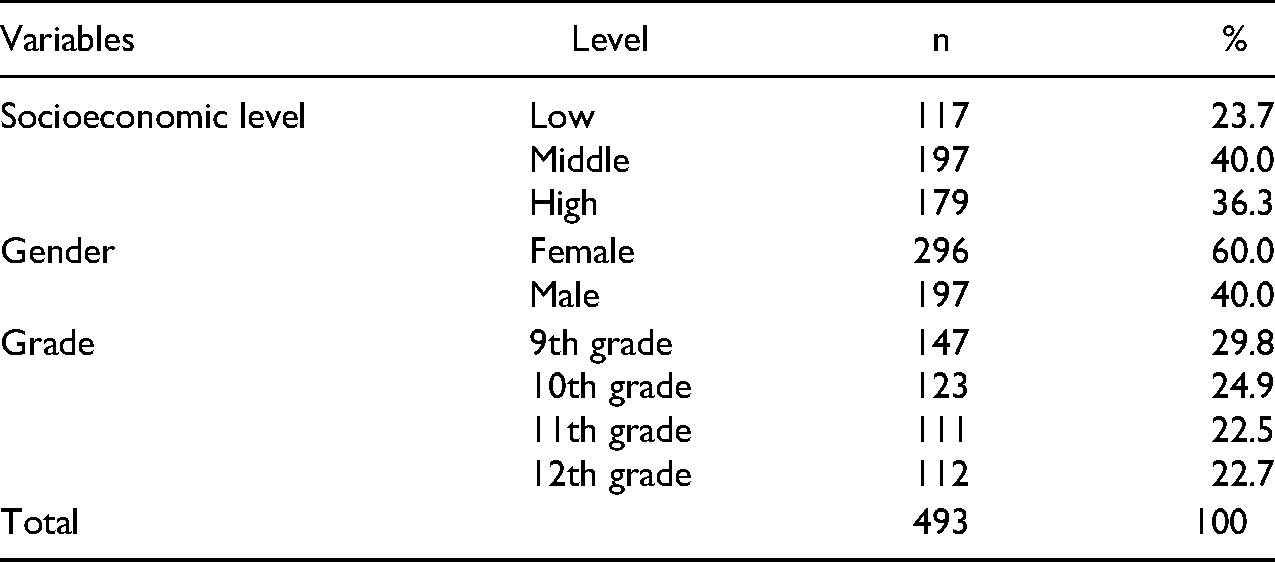
Missing and incomplete forms and forms with outliers were excluded from the data analysis and the data collected from 493 scale forms were included in the analysis. Participant demographics are presented in Table 1.
Participant Demographics.
Data Collection Instrument
The “Social Justice Leadership Scale” developed by Özdemir and Kütküt (2015) and the “Student Alienation Scale” developed by Sanberk (2003) were used in the study. “The Social Justice Leadership Scale” includes 24 items in three dimensions [support (12 items), critical conscience (9 items) and participation (3 items)]. An increase in scale score indicates an increase in social justice leadership behavior of school principals. The exploratory and confirmatory factor analysis were performed with the data collected from 424 high school students. The total amount of variance explained by the three dimensions was 57%. The eigenvalue of the support dimension was 10.604, this dimension alone explained 23.50% of the total variance, and the item factor loading values ranged between 0.71 and 0.57. The eigenvalue of the critical consciousness dimension was 1.787, this dimension alone explained 23.274% of the total variance, and the factor loading values of the items ranged between 0.75 and 0.65. The eigenvalue of the participation dimension was 1.231, this dimension alone explained 9.978% of the total variance, and the factor loading values of the items ranged between 0.79 and 0.64. As a result of the confirmatory factor analysis, it was determined that the t-values of the items were significant. The ratio of χ2 value to degrees of freedom was determined as 2.11. Goodness-of-fit indices were calculated as RMSEA = 0.05, GFI = 0.97, AGFI = 0.96, CFI = 96, NNFI = 0.95, NFI = 0.92 (Özdemir & Kütküt, 2015). It was found by Özdemir and Kütküt (2015) that the Cronbach alpha coefficient of the scale was 0.94. In the present study, the Cronbach alpha coefficient was also determined as 0.94. The “Social Justice Leadership Scale” is a 5-point Likert-type scale. The points given to each statement in the scale are as follows: (1) I strongly disagree; (2) I agree a little; (3) I somewhat agree; (4) I mostly agree; (5) I strongly agree. Information about the dimensions of the scale is given below.
Support
This indicates the efforts of school principals to reduce disadvantages. School principals strive to provide students with quality and equal education opportunities. They create the physical facilities necessary for students to improve themselves and direct students to improve themselves. School principals strive to prevent failure and increase success. School principals support low-income and disabled students who are disadvantaged (e.g., “The school principal creates a comfortable school environment for our disabled friends.”).
Critical consciousness
This indicates that school principals have critical consciousness skills and encourage the development of critical consciousness in students. School principals have a critical perspective. School principals are tolerant of differences and respect these differences. School principals encourage students to be open-minded, enable students to express their opinions, and encourage students to tolerate and respect differences (e.g., “The school principal encourages us to respect different cultures.”).
Participation
This indicates that school principals engage students in decision making. School principals obtain the opinions of the students in making decisions concerning the students (e.g., “The school principal obtains our opinion while determining the school dress code.”).
The “Student Alienation Scale” includes 17 items in four dimensions [powerlessness (4 items), meaninglessness (5 items), normlessness (5 items) and social isolation (3 items)]. The items in the meaninglessness dimension are positive, while the items in the other dimensions are negative statements; thus the meaninglessness dimension scores are reversed. An increase in scale score indicates an increase in alienation. The exploratory factor analysis of the scale was conducted with the data collected from 525 high school students. The total variance explained by all four dimensions together was 50.87%. The eigenvalue of the meaningless dimension was 4.1, this dimension alone explained 24.44% of the total variance in alienation, and the factor loading values of the items ranged between 0.65 and 0.76. The eigenvalue of the normlessness dimension was 1.9, the variance it explained alone was 11.26%, and the factor loading values of the items ranged between 0.60 and 0.72. The eigenvalue of the social isolation dimension was 1.4, this dimension alone explained 8.50% of the total variance in alienation, and the factor loading values of the items ranged between 0.65 and 0.80. The eigenvalue of the powerlessness dimension was 1.1, this dimension alone explained 6.66% of the total variance in alienation, and the factor loading values of the items ranged between 0.52 and 0.73 (Sanberk, 2003). The Cronbach's alpha coefficient of the scale was found to be 0.79 by Sanberk (2003). In the present study, the Cronbach's alpha coefficient was determined as . 81. The “Student Alienation Scale” is a 5-point Likert-type scale. The points given to each statement in the scale are as follows: (1) I strongly disagree; (2) I disagree; (3) I do not know; (4) I agree; (5) I strongly agree. Information about the dimensions of the scale is given below.
Meaninglessness
This indicates that students consider their school experiences to be meaningless and that the teaching activities will not benefit them (e.g., “I have the chance to use the information provided by the school in my life.”). Statements in this dimension are reverse-scored items. In other words, the scores given to the statements in this dimension are reversed (If the score given is 1 it is taken for analysis as 5, while a score of 2 is taken for analysis as 4, and so on).
Powerlessness
This indicates that the events, processes and decisions regarding students’ own future in the school are perceived to be beyond their control and guided by others (e.g., “Decisions are made about my future at school, but nobody asks for my opinion.”).
Normlessness
This indicates behavior of students against the rules of the school (e.g., “I sometimes write on the desks and walls even though I know we should not be writing on them.”).
Social isolation
This indicates that the student does not want to be in the social environment of the school (e.g., “I feel happy when I don't have to go to school.”).
Data Collection
Ethical rules were taken into consideration before the implementation in the study. Initially, the required institutional approval was obtained. Then, the aim of the study was explained to school principals by visiting the schools and the required approvals were obtained. Before the application of the scales, the aim of the study was explained to the students and it was stated that the collected data would not be used for any purpose other than the aim of the study and that they could answer the questions with peace of mind. Only volunteering students participated in the study. The study data were collected using the scales administered to the students during the visits conducted by one of the authors to the schools during the 2017–2018 academic year fall semester.
Data Analysis
Missing and incomplete scale data were excluded from the analysis. Then, the presence of outliers was investigated and it was determined that there were 37 outliers. The data skewness varied between −0.559 and 1.116, and the kurtosis varied between −1.162 and .139. It can be assumed that the data were distributed normally due to the fact that the skewness was less than 3 and the kurtosis was not greater than 10 (Kline, 2011).
Descriptive statistical analysis was conducted to determine the level of students’ perceptions of alienation from school and their perceptions of school principals’ social justice leadership. In order to determine whether there was a significant difference between students’ perceptions of school alienation and school principals’ social justice leadership in terms of students’ gender, t-test was conducted. One-way analysis of variance was conducted in order to determine whether there was a significant difference between students’ perceptions of school alienation and social justice leadership of school principals in terms of the socioeconomic level of the school and the grade level of the students. Correlation analysis was conducted to determine whether there was a significant relationship between students’ perceptions of alienation from school and their perceptions of school principals’ social justice leadership. In the correlation analysis, “r” value was interpreted as .10 = “low”, .30 = “medium”, and .50 = “high” correlation (Cohen, 1988). Multiple linear regression analysis was conducted to determine whether the students’ perceptions of school principals’ social justice leadership significantly predicted their perceptions of alienation from the school. The fact that the paired correlation values between the independent variables were between 0.517 and 0.746 (less than 0.80), the tolerance values were between 0.420 and 0.693 (greater than 0.20), the VIF values were between 1.443 and 2.381 (less than 10) and the CI values were between 5.318 and 13.674 (less than 30) demonstrated that there were no multiple correlation problems between the independent variables (Büyüköztürk, 2012). In the regression analysis,
Findings
The results of the descriptive statistical analysis conducted on student perceptions about school alienation and school principals’ social justice leadership are presented in Table 2.
Descriptive Statistical Analysis Results for Student Perceptions about School Alienation and School Principals’ Social Justice Leadership.
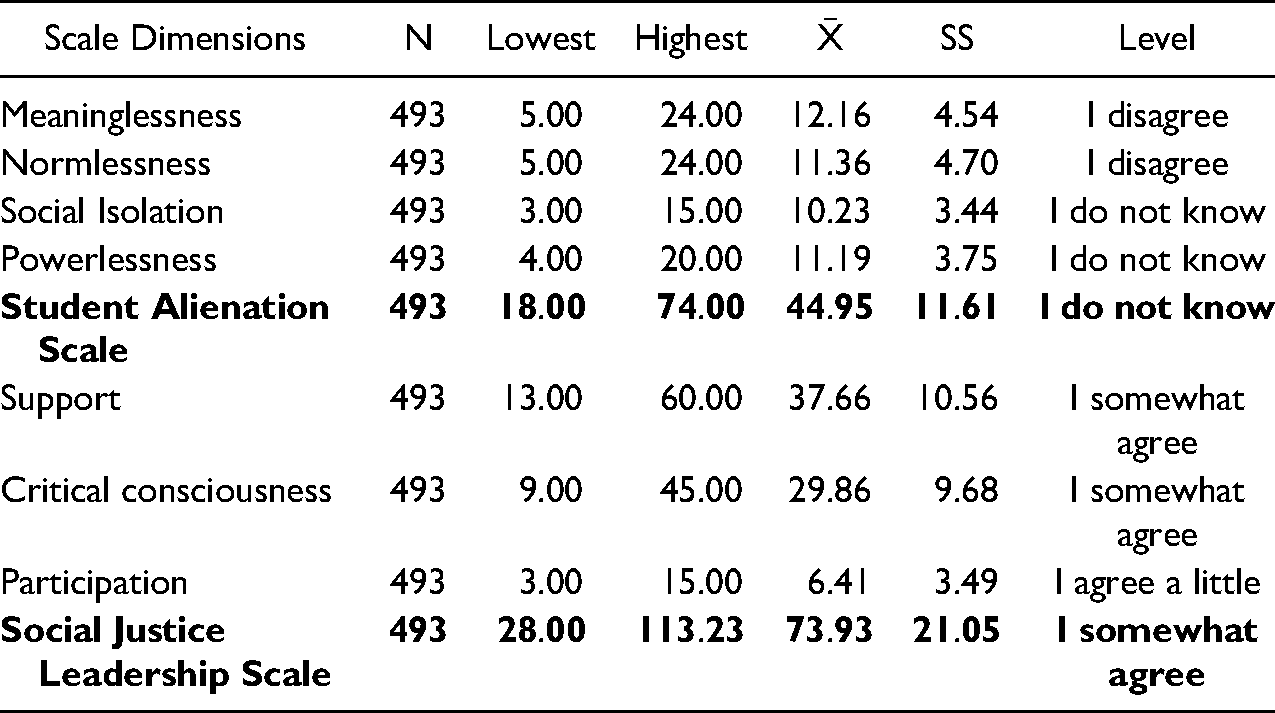
According to Table 2, the perceptions of students about the statements in the overall school alienation scale and in the social isolation and powerlessness dimensions were at the “I do not know” level, while in the meaninglessness and normlessness dimensions, they were at the “I disagree” level. According to this, the students were alienated from the school at a medium level. Students were alienated in terms of the meaninglessness and normlessness dimensions below medium level, and in terms of social isolation and powerlessness at a medium level. As well as showing that students were alienated from school, this finding shows that students’ alienation in the dimensions of social isolation and powerlessness was higher than their alienation in the dimensions of meaninglessness and normlessness.
While the students’ perceptions about the statements in the overall social justice leadership scale and in the critical consciousness and support dimensions were at the “I somewhat agree” level, their perceptions in the participation dimension were at the “I agree a little” level. Accordingly, school principals demonstrated social justice leadership behaviors at a medium level. This finding shows that school principals did not display social justice leadership behaviors at a sufficient level. School principals demonstrated behaviors in the support and critical consciousness dimensions at a medium level, and behaviors in the participation dimension below medium level. According to this finding, principals exhibited social justice leadership behaviors in the dimensions of support and critical consciousness more than in the dimension of participation.
T-test was applied to determine whether there was a significant difference between student perceptions about school alienation and social justice leadership of school principals based on the student gender variable, and the findings are presented in Table 3.
Analysis of Student Perceptions about School Alienation and Social Justice Leadership of School Principals Based on Gender Variable.
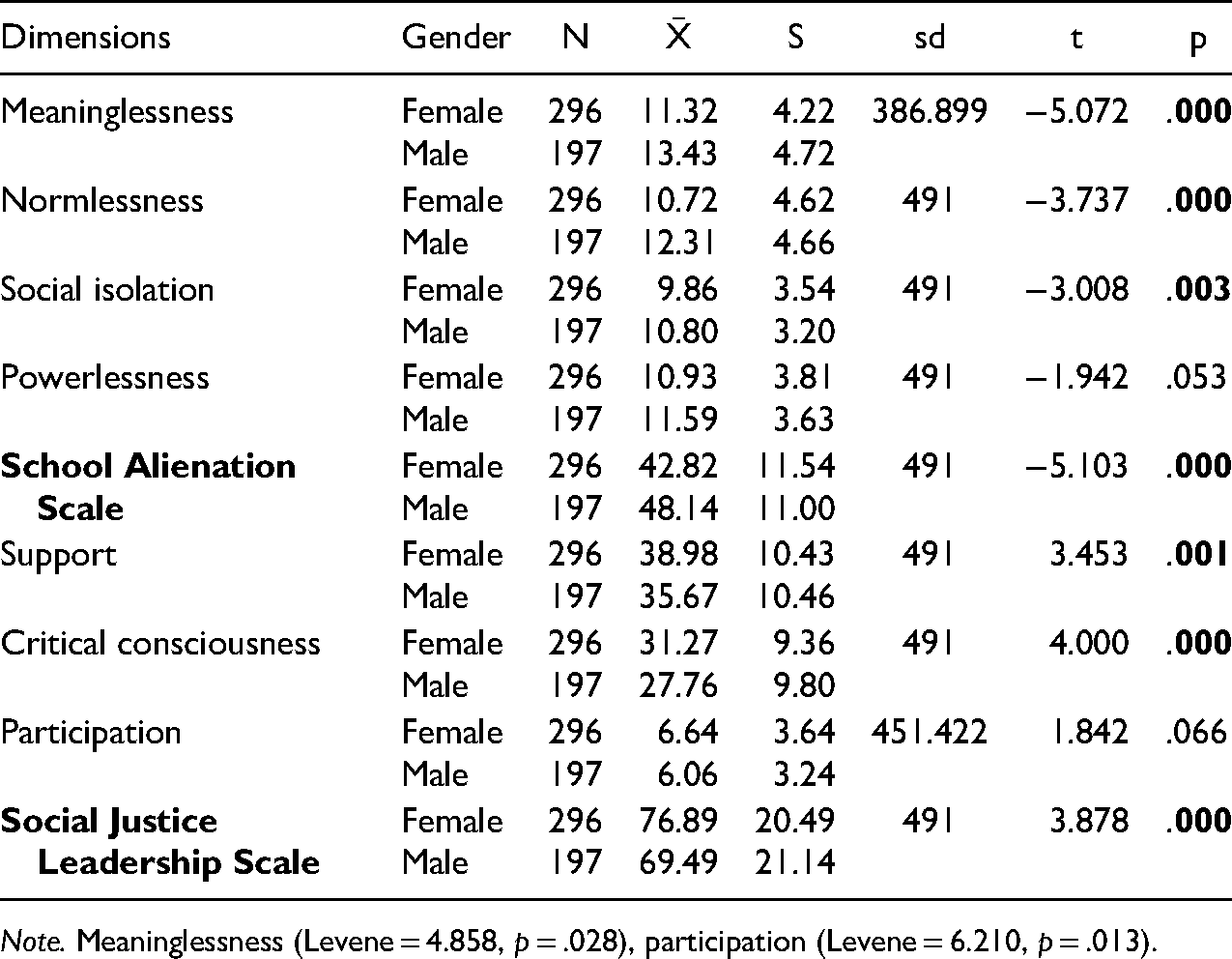
Note. Meaninglessness (Levene = 4.858, p = .028), participation (Levene = 6.210, p = .013).
According to Table 3, there were significant differences between the perceptions of students about the overall school alienation scale (t (491) = −5.103, p < .05), and the meaninglessness (t (386.899) = −5.072, p < .05), normlessness (t (491) = −3.737, p < .05) and social isolation (t (491) = −3.008, p < .05) dimensions based on the gender variable. Boys were more alienated from school than girls. In terms of dimensions, boys were more alienated than girls in terms of the meaninglessness, normlessness and social isolation dimensions. There were also significant differences between student perceptions about the overall social justice leadership scale (t (491) = 3.878, p < .05), and the support (t (491) = 3.453, p < .05) and critical consciousness (t (491) = 4.000, p < .05) dimensions based on the gender variable. School principals demonstrated more social justice leadership behaviors according to the opinions of girls than to those of boys. In terms of dimensions, school principals demonstrated behaviors regarding the support and critical consciousness dimensions more according to the opinions of girls when compared to the opinions of boys.
One-way analysis of variance was conducted to determine whether there was a significant difference between student perceptions about school alienation and social justice leadership of school principals based on the socioeconomic status of the school, and the findings are presented in Table 4.
Analysis of Student Perceptions About School Alienation and Social Justice Leadership Based on School Socioeconomic Level.
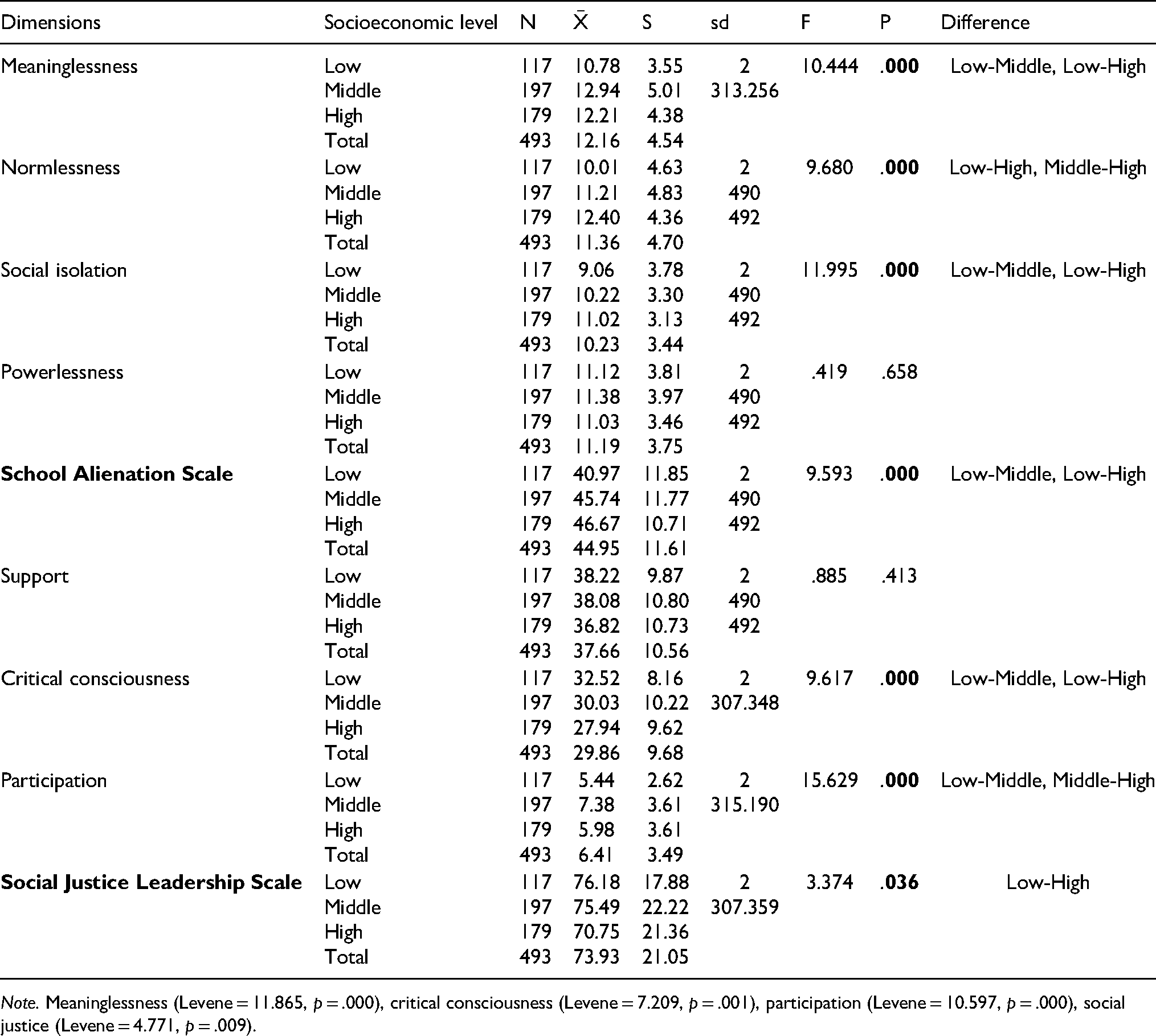
Note. Meaninglessness (Levene = 11.865, p = .000), critical consciousness (Levene = 7.209, p = .001), participation (Levene = 10.597, p = .000), social justice (Levene = 4.771, p = .009).
As seen in Table 4, there were significant differences between the perceptions of the students about the overall school alienation scale (F (2, 490) = 9.593, p < .05), and the meaninglessness (Welch (2, 313.256) = 10.444, p < .05), normlessness (F (2, 490) = 9.680, p < .05) and social isolation (F (2, 490) = 11.995, p < .05) dimensions based on the school socioeconomic level. Students in low socioeconomic level schools were less alienated from their schools compared to students in middle and high socioeconomic level schools. Students in low socioeconomic level schools were less alienated from their schools in terms of the meaninglessness dimension compared to students in middle and high socioeconomic level schools. Students in high socioeconomic level schools were more alienated from their schools in terms of the normlessness dimension compared to students in low and middle socioeconomic level schools. Students in low socioeconomic level schools were less alienated from their schools in terms of the social isolation dimension compared to the students in middle and high socioeconomic level schools.
There were significant differences between the perceptions of the students about the overall social justice leadership scale (Welch (2, 307.359) = 3.374, p < .05), and the critical consciousness (Welch (2, 307.348) = 9.617, p < .05) and participation (Welch (2, 315.190) = 15.629, p < .05) dimensions based on the socioeconomic level of the school. School principals demonstrated more social justice leadership behaviors according to the opinions of students in low socioeconomic level schools compared to students in high socioeconomic level schools. School principals demonstrated more social justice leadership behaviors in the critical consciousness dimension according to the opinions of students in low socioeconomic level schools compared to students in middle and high socioeconomic level schools. School principals demonstrated more social justice leadership behaviors in the participation dimension according to the opinions of students in middle socioeconomic level schools compared to students in low and high socioeconomic level schools.
One-way analysis of variance was conducted to determine whether there was a significant difference between student perceptions about school alienation and social justice leadership of school principals based on student grade level, and the findings are presented in Table 5.
Analysis of Student Perceptions about School Alienation and Social Justice Leadership Based on Student Grade Level.
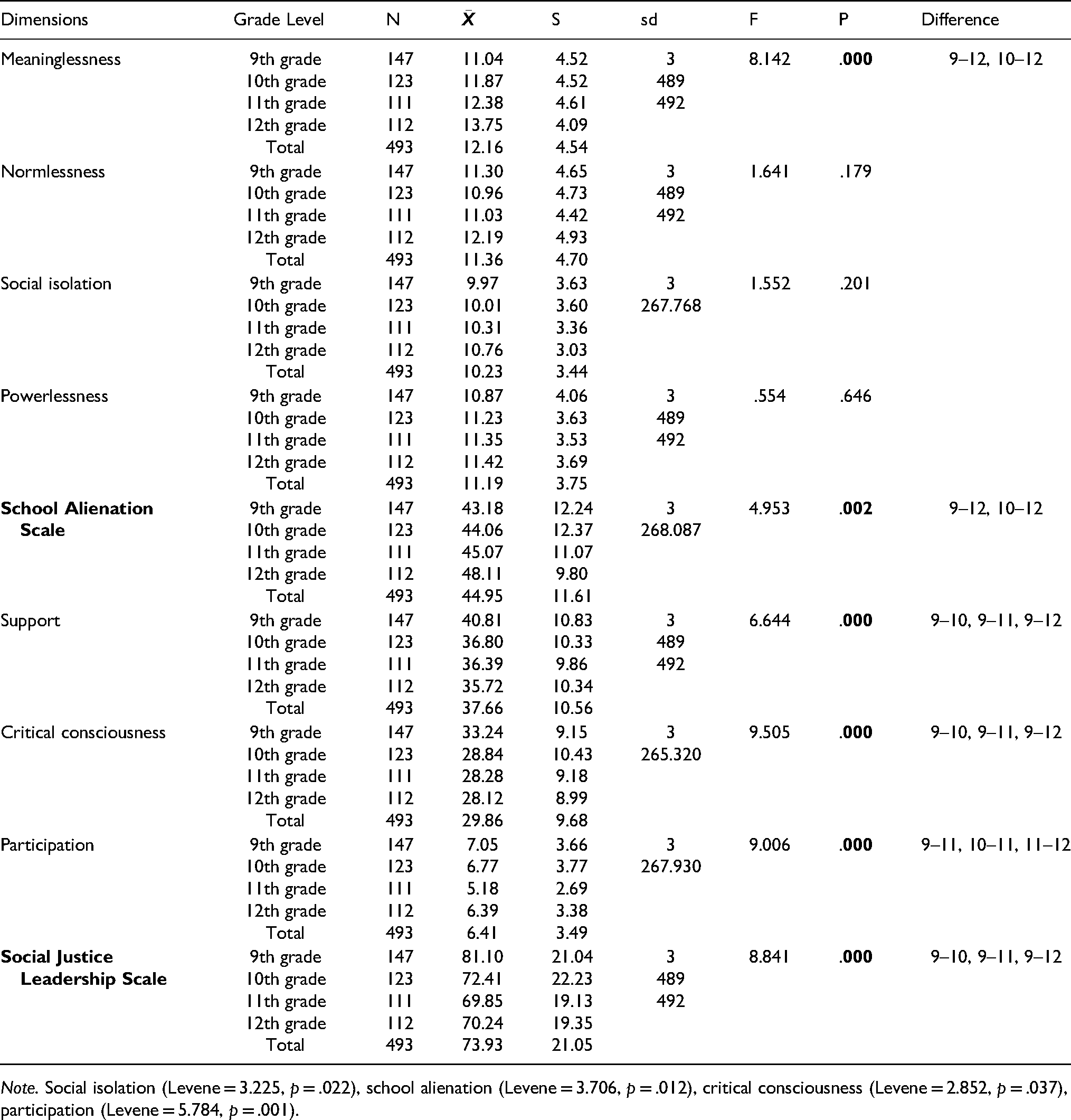
Note. Social isolation (Levene = 3.225, p = .022), school alienation (Levene = 3.706, p = .012), critical consciousness (Levene = 2.852, p = .037), participation (Levene = 5.784, p = .001).
According to Table 5, there were differences between student perceptions about the overall school alienation scale (Welch (3, 268.087) = 4.953, p < .05) and the meaninglessness (F (3, 489) = 8.142, p < .05) dimension based on student grade level. 12th grade students were more alienated from school than 9th and 10th grade students. 12th grade students were also more alienated from school than 9th and 10th grade students in terms of the meaninglessness dimension.
There were significant differences between the perceptions of the students about the overall social justice leadership scale (F (3, 489) = 8.841, p < .05), and the support (F (3, 489) = 6.644, p < .05), critical consciousness (Welch (3, 265.320) = 9.505, p < .05) and participation (Welch (3, 267.930) = 9.006, p < .05) dimensions based on student grade level. School principals demonstrated more social justice leadership behaviors according to the opinions of 9th grade students than according to those of 10th, 11th and 12th grade students. School principals demonstrated more behaviors regarding the support dimension according to the opinions of 9th grade students than according to those of 10th, 11th and 12th grade students. School principals demonstrated more behaviors regarding the critical consciousness dimension according to the opinions of 9th grade students than according to those of 10th, 11th and 12th grade students. School principals demonstrated fewer behaviors regarding the participation dimension according to the opinions of 11th grade students than according to those of 9th, 10th and 12th grade students.
Correlation analysis was conducted to determine whether there was a significant correlation between the perceptions of the students about their alienation from the school and school principals’ social justice leadership, and the findings are presented in Table 6.
Correlation between Perceptions of Students about School Alienation and Social Justice Leadership.
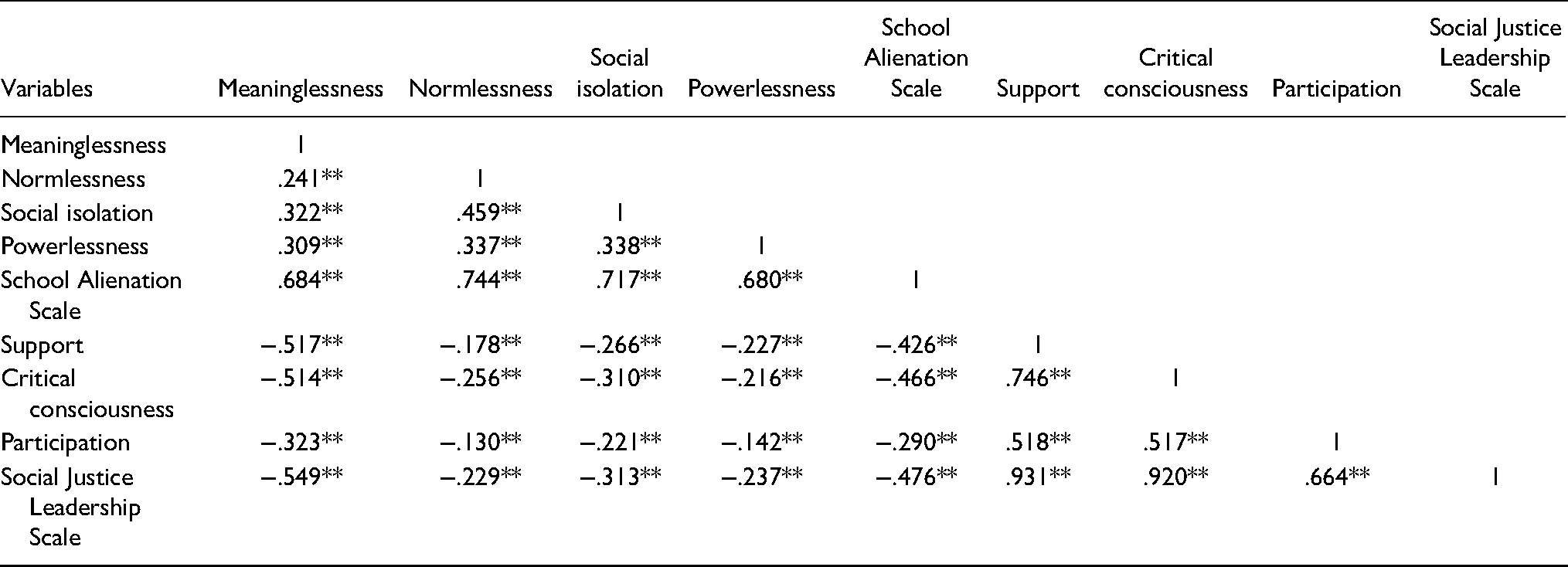
As seen in Table 6, there were a high significant and negative correlations of meaninglessness with support (r = −.517, p < .01) and critical consciousness (r = −.514, p < .01). According to this relationship, social justice leadership behaviors of school principals in the dimensions of support and critical consciousness will greatly reduce students’ alienation in the dimension of meaninglessness. There was a medium significant and negative correlation between meaninglessness and participation (r = −.323, p < .01). According to this relationship, social justice leadership behaviors of school principals in the participation dimension will cause a moderate decrease in students’ alienation in the dimension of meaninglessness. Accordingly, social justice leadership behaviors in the dimensions of support and critical consciousness will reduce students’ alienation in the dimension of meaninglessness more than in the dimension of participation.
There was a low significant and negative correlation of normlessness with support (r = −.178, p < .01), critical consciousness (r = −.256, p < .01) and participation (r = −.130, p < .01). According to this relationship, social justice leadership behaviors of school principals in the dimensions of support, critical consciousness and participation will slightly reduce the alienation of students in the dimension of normlessness.
There was a low significant and negative correlation of social isolation with support (r = −.266, p < .01) and participation (r = −.221, p < .01). According to this relationship, social justice leadership behaviors of school principals in the dimension of support and participation will slightly reduce students’ alienation in the social isolation dimension. There was a medium significant and negative correlation between social isolation and the critical consciousness dimension (r = −.310, p < .01). According to this relationship, social justice leadership behaviors of school principals at the level of critical consciousness will cause a moderate decrease in the alienation of students in the social isolation dimension. According to this, social justice leadership behaviors in the critical consciousness dimension will reduce the alienation of students in the social isolation dimension more than in the dimensions of support and participation.
There was a low significant and negative correlation of powerlessness with support (r = −.227, p < .01), critical consciousness (r = −.216, p < .01) and participation (r = −.142, p < .01). According to this relationship, social justice leadership behaviors of school principals in the dimensions of support, critical consciousness and participation will slightly reduce students’ alienation in the dimension of powerlessness.
There was a medium significant and negative correlation between school alienation and social justice leadership (r = −.476, p < .01). According to this relationship, social justice leadership behaviors of school principals will cause a moderate decrease in students’ alienation from school.
The results of the multiple linear regression analysis conducted to determine whether the perceptions of the students about the social justice leadership behavior of school principals significantly predicted their alienation from the school are presented in Table 7.
Results of Multiple Linear Regression Analysis on Prediction of School Alienation and its Dimensions by Students’ Perceptions about Social Justice Leadership.
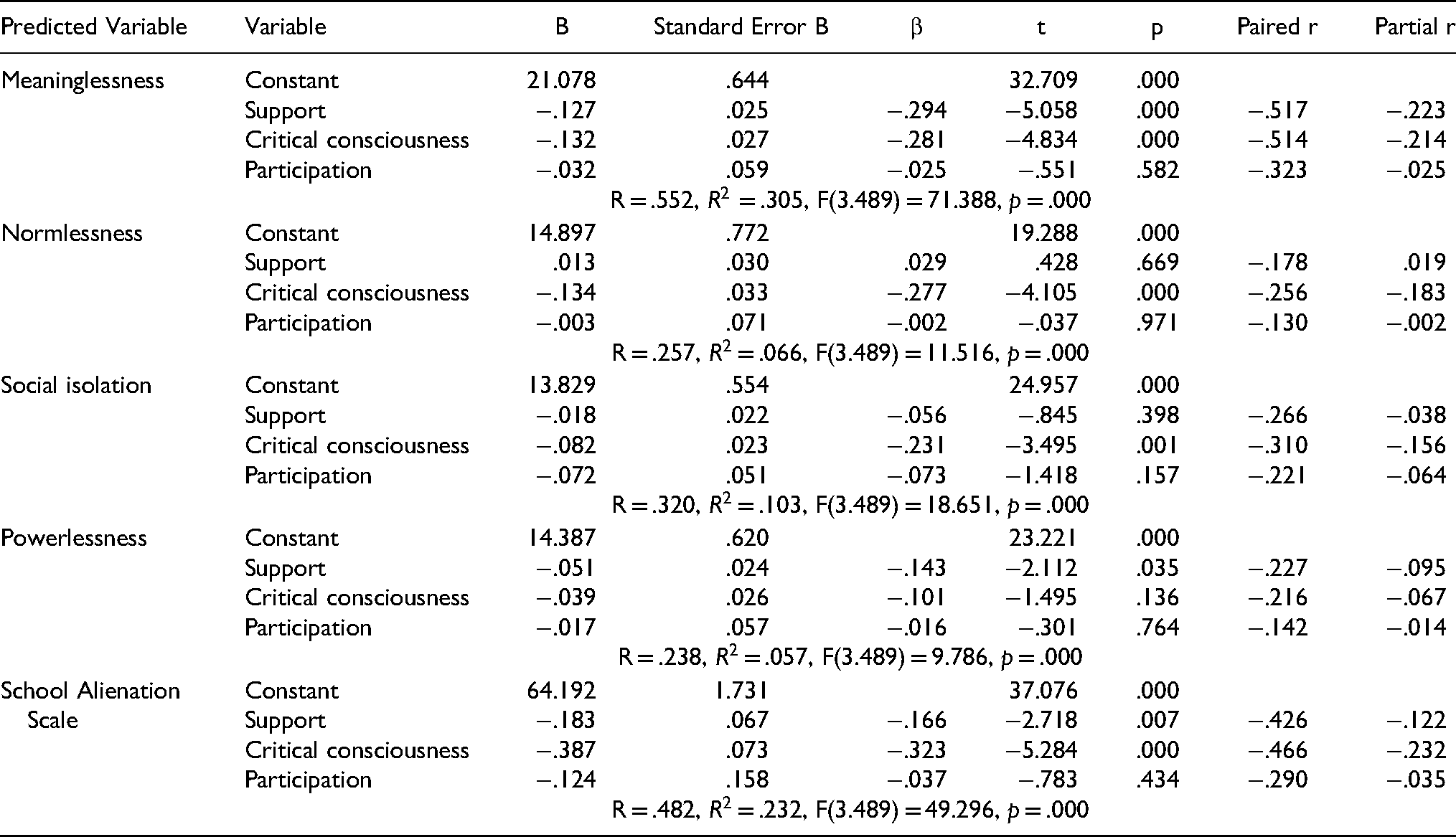
According to Table 7, the social justice leadership behaviors of school principals significantly predicted the alienation of students in the meaninglessness dimension (R = .552,
Social justice leadership behaviors of school principals significantly predicted students’ alienation in the normlessness dimension (R = .257,
Social justice leadership behaviors of school principals significantly predicted students’ alienation in the social isolation dimension (R = .320,
Social justice leadership behaviors of school principals significantly predicted students’ alienation in the powerlessness dimension (R = .238,
Social justice leadership behaviors of school principals significantly predicted students’ alienation from school (R = .482,
Discussion, Conclusion and Implications
In this study, a moderately negative significant correlation was found between the alienation of the students from school and the social justice leadership of the school principals. It was found that the social justice leadership of school principals significantly predicted the alienation of students from school. The social justice leadership behaviors of school principals affected the alienation of the students from school moderately. In such a case, it can be suggested that the social justice leadership behaviors of school principals will not prevent the alienation of students from school completely, but that it can decrease it at a moderate level. However, only behaviours in the critical consciousness and support dimensions affected students’ alienation from school. The effect of the critical consciousness dimension on the alienation of the students from school was more than that of the support dimension. These findings indicate that when school principals demonstrate social justice leadership behaviors, especially in the support and critical consciousness dimensions, students will be less alienated from school. According to the findings, girls were less alienated from school than boys, students from low socioeconomical level schools were less alienated than those from high socioeconomical level schools, and 9th grade students were less alienated than 12th grade students, and the former stated that school principals demonstrated social justice leadership behaviors more. These findings also showed that when school principals demonstrate social justice leadership behaviors, students will be less alienated from school.
In this study, significant negative correlations were found between the dimensions of social justice leadership behaviors of school principals and the dimensions of school alienation of students. However, the levels of these correlations were different. Social justice leadership behaviors of school principals were also a significant predictor of students’ school alienation dimensions. However, the effects of school principals’ social justice leadership behaviors on students’ school alienation dimensions were different. The effect of school principals’ social justice leadership behaviors on the alienation of students in the meaninglessness dimension was large, while it was small in the other dimensions. In this case, the social justice leadership behaviors of school principals reduce the alienation of students in the meaninglessness dimension more than their alienation in the other dimensions. This finding can be explained by the fact that the meaninglessness dimension is related to the academic field, academic success is important because there is an exam-based education system in Turkey, and the majority of the academic success differences in the country are due to inequality in education (Tansel, 2015). However, only behaviors in the support and critical consciousness dimensions affected the alienation of students in the meaninglessness dimension. This finding indicates that in order to reduce alienation of students in the meaninglessness dimension, school principals should display behaviors in the support and critical consciousness dimensions. However, the effect of the support dimension on the alienation of the students in the meaninglessness dimension was greater than that of the critical consciousness dimension. This finding shows that in reducing the alienation of students in the meaninglessness dimension, the social justice leadership behaviors of school principals in the support dimension are more important than their behaviors in the critical consciousness dimension. This situation indicates that it is much more important for social justice leaders who aim to increase academic success (McKenzie et al., 2008) to be “action-oriented and transformative” (Furman, 2012, p. 195). In Turkey, socioeconomic level stands out in academic success differences. In this respect, school principals who adopt social justice in Turkey draw attention to the disadvantages of students with a low socioeconomic level and take their support as a basis (Beycioglu & Ogden, 2017). The presence of additional education services (private lessons and study centers) and private schools in Turkey causes an increase in the effect of socioeconomic level on academic success. Families with high socioeconomic status can provide additional education services (private lessons, study centers, etc.) to their children, support their children's education with different course resources and send them to private schools. However, students with a low socioeconomic level do not have such opportunities.
Social justice leadership behaviors in the critical consciousness dimension affected the alienation of students in the normlessness dimension. This finding indicates that in order to reduce the alienation of students in the normlessness dimension, school principals should demonstrate social justice leadership behaviors in the critical consciousness dimension. However, the effect of school principals’ social justice leadership on the normlessness dimension was small. This finding can be explained by the reaction of students in Turkey to the school, rules and management and by their expressing themselves, as well as by their displaying undisciplined behaviors for different reasons (being influenced by media series, being influenced by friends, youth psychology etc.) (Sarpkaya, 2007).
Social justice leadership behaviors in the critical consciousness dimension affected the alienation of students in the social isolation dimension. This finding indicates that in order to reduce the alienation of students in the social isolation dimension, school principals should demonstrate social justice leadership behaviors in the critical consciousness dimension. Alienation in the social isolation dimension is related to the social domain of the school. Students in high schools in Turkey have a heterogeneous structure in terms of race, belief, gender, and socioeconomic level. However, the impact of school principals’ social justice leadership on alienation in the social isolation dimension was small. This finding can be explained by the fact that, in Turkey, it is ensured that everyone in the field of education is deemed equal under the law. One of the basic principles of the Turkish national education system is “Generality and Equality”. According to this principle, nobody is granted privileges in education because of their characteristics, such as their language, religion, race, gender, etc., and everyone is equal. In this respect, the laws in Turkey emphasize that there should be no discrimination among students in education, and that equal treatment and necessary opportunities should be provided. However, it was stated that discrimination was experienced in Turkey due to differences such as gender, race, religious sect or political view (Arar et al., 2017). This suggests that equality may not be achieved only by law. Another reason for the effect being small is that the values of justice, friendship, respect, love and benevolence are determined as root values in the values education given to students in schools. Another reason is that Turkey is a state where different races have lived together since the time of the Ottoman Empire. The coexistence of different races may have taught people to be tolerant and respectful of differences.
Only the social justice leadership behaviors in the support dimension affected the alienation of students in the powerlessness dimension. This finding indicates that in order to reduce the alienation of students in the powerlessness dimension, school principals should demonstrate social justice leadership behaviors in the support dimension. However, the effect of school principals’ social justice leadership on the powerlessness dimension was small. This situation can be explained by the centralist structure of the Turkish national education system. Educational policies and decisions are determined by the Ministry of National Education in Turkey. School administrators, teachers and students are expected to implement these decisions. These decisions and policies affect the educational future of students. Another reason is that there is an exam-based system in Turkey. The educational futures of students are shaped by their exam results rather than their own opinions.
In this study, school principals demonstrated social justice leadership at a medium level according to the students. Similar findings were found in different studies conducted in Turkey (Canlı, 2020; Özdemir, 2017). This shows that school principals in Turkey do not adequately display social justice leadership behaviors. School principals who adopt social justice leadership may be abstaining because they face many obstacles. Factors that prevent social justice leadership from occurring in Turkey are often cited as external factors. These are factors such as having a central education system, limited authority and lack of resources (Arar et al., 2017). In addition, it may be because school principals do not know how to achieve social justice. In this respect, researchers recommend preparatory programs to improve school principals’ ability to provide social justice (Brown, 2004; McKenzie et al., 2008). In Turkey, there is no education that prepares school principals for social justice leadership. On the other hand, the policies determined by the school principals themselves may also prevent social justice. For example, some school principals in Turkey create selective classes in schools. Such selective classes cause inequality of opportunity, discrimination and labeling in education (Canlı et al., 2019). When the findings of the study were analyzed in terms of the dimensions of social justice leadership, the lowest dimension in which the school principals demonstrated social justice leadership behaviors was the participation dimension. This finding may indicate that school principals are influenced by the centralist structure of the Turkish national education system and that school principals are reluctant to engage students in decision-making processes at school.
It is believed that the present study significantly contributes to the literature by reporting that there is a correlation between social justice leadership of school principals and student alienation from school. Based on the results of the study, it is recommended that school principals demonstrate social justice leadership behaviors in order to reduce the alienation of students from school. Social justice leadership behaviors, especially in the support and critical consciousness dimensions, reduce the alienation of students from school. In this regard, school principals should strive to reduce the disadvantages of students to prevent failure and increase success, and to provide students with quality and equal education opportunities. They should create the physical facilities necessary for students to improve themselves, guide students to improve themselves, and support disadvantaged students. School principals should have critical consciousness skills and create the necessary opportunities for students to develop critical consciousness. To this end, school principals should have a critical perspective. School principals should be tolerant of differences and respect these differences, encourage students to be open-minded, enable students to express their opinions, and encourage students to tolerate and respect differences.
However, it should be stated that there are some limitations due to the study sample and the utilized scales. Since the study was conducted with high school students in Turkey, the findings could not be generalized to students in different countries. In order to reach a conclusion about the correlation between social justice leadership of school principals and student alienation, further studies should be conducted with different measurement instruments and different samples. Future qualitative studies can investigate the basic details of this correlation. Future studies can investigate the correlation between school principals’ social justice leadership and disadvantaged students’ alienation from school, and investigate the effect of the type of disadvantage on the correlation between social justice leadership and school alienation. Moreover, further analysis of the correlation between social justice leadership of teachers and student alienation from school will contribute significantly to the literature on the impact of social justice leadership on student alienation.
Footnotes
Declaration of Conflicting Interests
The author(s) declared no potential conflicts of interest with respect to the research, authorship, and/or publication of this article.
Funding
The author(s) received no financial support for the research, authorship and/or publication of this article.

Supplemental Material
Supplemental material for this article is available online.