







Abstract
Introduction
Educational crises are becoming increasingly common as schools respond to racial injustice, gun violence, hurricanes, health pandemics, war, and political instability. Crises can also be disruptive to student learning. The COVID-19 pandemic disrupted education in an unprecedented manner and exacerbated student learning inequities (Haderlein et al., 2021; Kilbride et al., 2022; Weddle et al., 2024). Estimates suggest that student test scores in Fall 2021 in math were 0.20–0.27 standard deviations lower relative to same-grade peers in Fall 2019, while reading test scores were 0.09 to 0.18 standard deviations lower (Kuhfeld et al., 2022). Economically disadvantaged, Black, Latino/a/x, and English learners exhibited lower achievement in the 2020–21 and 2021–22 school years relative to White and more affluent students, as did students in districts offering remote instruction for longer time periods (Goldhaber et al., 2022; Halloran et al., 2021; Kilbride et al., 2022).
In documenting the consequences of the pandemic, researchers have pointed to variation in student learning across contexts (Kilbride et al., 2022; Kogan & Lavertu, 2021; Pier et al., 2021; Sass & Goldring, 2021; Weddle et al., 2024). Less is known about why such variation occurred. Recent studies suggest that certain districts weathered the storm better than others by offering in-person (versus remote) instruction (e.g., Goldhaber et al., 2022) and by engaging in effective crisis leadership (Grissom & Condon, 2021). On the surface, these findings suggest that effective crisis leaders resumed in-person schooling as quickly as possible. Yet this interpretation does not account for the influence of local context and existing organizational capacity on district decision making (De Voto & Superfine, 2023; Marsh et al., 2022). An emphasis on reopening schools also does not explain how certain remote districts performed comparably in terms of student achievement to in-person districts in the pandemic, nor does it capture other approaches that districts may have pursued to support student learning in crisis (Weddle et al., 2024).
Our inquiry is situated within a research practice partnership with the Michigan Department of Education, and is part of a broader study examining student learning during the pandemic across varied local contexts. To better understand district approaches for crisis response, we conducted a multiple case study of five Michigan school districts that adopted different instructional modalities (i.e., in-person, hybrid, and remote) and performed better-than-predicted on benchmark assessments during the 2020–21 school year.
Michigan is an apt location for examining local-level responses to the pandemic. The state includes 835 public and charter school districts across urban, suburban, and rural contexts. It also has a long history of local control, contributing to stark differences across communities’ educational preferences and districts’ pandemic related policies such as instructional modality. Within this context, we ask the following questions: 1) How did school districts that demonstrated better-than-predicted student test scores during the 2020–21 school year support student learning in crisis?; and 2) How did school districts use existing organizational resources in similar or distinct ways across instructional modalities?
Our work offers in-depth insights into how local leaders leveraged existing organizational resources to weather an unanticipated and disruptive crisis. In so doing, we identify critical organizational resources for pandemic response that need to be cultivated and equitably distributed across districts before new crises unfold. In all districts, leaders committed to existing resources such as staff-student relationships, school-family relationships, and curricula and instructional models that they perceived as addressing foundational needs in their environment and having an established track record of supporting student learning prior to the pandemic. In instances when demands from the pandemic were not aligned with existing capacity, leaders leveraged existing resources such as staff expertise, staff collaboration, and school-family relationships to build out new approaches for teaching and learning in distinct ways across in-person, hybrid, and remote modalities. While these approaches worked collectively to support student learning, they also contributed to pervasive burnout among leaders and educators.
Literature Review
To ground our inquiry, we draw on prior literature examining local decision making and student outcomes during the COVID-19 pandemic. We then examine emerging research on the use of district and school resources to support student learning in the pandemic.
Local Decision Making and Student Outcomes During the Pandemic
During the 2020–21 school year, much decision making about school reopening and instruction amidst the pandemic was situated at the local level. Studies from earlier in the pandemic suggest that political partisanship played a large role in shaping school reopening preferences (Grossmann et al., 2021; Lipsitz & Pop-Eleches, 2020). More recent studies suggest that a multitude of factors in addition to politics shaped districts’ decision making, including information uncertainty, COVID-19 spread, health guidelines from federal and state authorities, the decision making of neighboring districts, teacher demands, and parent preferences (Christian, Jacob & Singleton, 2022; Singer et al., 2022).
Differences in district decision making about instructional modality contributed, in part, to inequities in student access to learning opportunities and widening achievement gaps. Camp and colleagues (2022) find that school district policies for instructional modality, political partisanship, parents’ perceived risk from the pandemic, and local COVID-19 outbreaks were all associated with the in-person learning racial gap between White students and students of color. Other studies have found more pronounced test scores declines in districts offering more days of remote instruction during the 2020–21 school year, though remote school districts recouped some of these losses upon resuming in-person instruction in the 2021–22 school year (Goldhaber et al., 2022; Kilbride et al., 2022; Kuhfeld et al., 2022).
While instructional modality can explain discrepancies in student learning during the pandemic, it does not fully account for the variation in district performance (Weddle et al., 2024). Other factors that might explain differences in district test performance include local investment in learning resources such as internet connectivity, school supplies, quiet places to work, and regular support from teachers (NAEP, 2022a, 2022b). Additionally, districts may have taken proactive steps to ensure equity for academically at-risk students, engage and communicate with families, plan for school re-openings, and attend to students’ social and emotional wellbeing to minimize disruptions to student learning (e.g., DeArmond et al., 2021; Gross et al., 2021; Reich et al., 2020; Rigby et al., 2020).
Exploring Districts’ Approaches and Organizational Context for Pandemic Response
While districts and schools attempted to meet student needs in a variety of ways, less is known about how district leaders responded to their local context. As Jabbar and colleagues (2023) note, early reports of district and school responses to the pandemic did not use theory to interrogate how organizational conditions and context shaped pandemic response across diverse communities. This understanding is important for knowing which conditions necessitate certain responses, even if unfavorable for student learning, and when certain responses can be pursued with success.
Organizational capacity is an important local factor that can influence pandemic response. Some studies have emphasized crisis preparedness in terms of emergency school closure plans, access to technology, and established communication protocols; suggesting that existing infrastructure and policy may be critical for crisis response (DeMatthews et al., 2021; Ondrasek et al., 2021). Other studies have pointed to the existing skills or expertise of school actors including the willingness of teachers to experiment with new instructional techniques (Khanal et al., 2021) and the crisis leadership of school principals (Grooms & Childs, 2021; McLeod & Dulsky, 2021; Stone-Johnson & Weiner 2020).
Notably, because districts could not anticipate the pandemic and lacked access to prescribed solutions or tools, districts’ existing organizational resources were likely critical to determining what approaches districts could pursue to support student learning in crisis (De Voto & Superfine, 2023; Jabbar et al., 2023). In comparing the response approaches of two districts in Illinois, De Voto and Superfine (2023) call attention to the differential access to resources between districts in the form of technology capacity (e.g., digital devices, education technology coaches), instructional materials and supports (e.g., curriculum support staff, pacing guides), physical classroom space, and collaborative networks among leaders and staff. Inequities in existing resources contributed to resource-poor districts facing more challenges to support student learning relative to resource-rich districts.
Building on this work, we focus on the interplay between crisis leadership and existing organizational resources as salient local conditions for shaping student learning in crisis. Focusing on districts that demonstrated better-than-predicted test scores in the 2020–21 school year, we identify promising approaches for crisis response that can inform future crisis preparation, as well as existing organizational resources that enable these response approaches. By following district cases that adopted different instructional modalities and served racially, linguistically, and socioeconomically diverse students, our findings point to similarities and differences in crisis response and organizational capacity across varied local contexts.
Conceptual Framework
Foregrounding the role of crisis leadership as part of the organizational capacity of districts and schools, we first focus on the competencies and approaches that local leaders need for navigating crises such as the COVID-19 pandemic. We next draw on organizational theory to examine how leaders can leverage existing resources to support student learning amidst crisis.
The Role of Leaders in Navigating Crisis
Crises are urgent situations that require decisive action from organizational leaders (Smith & Riley 2012). Crises can be sudden, meaning that they occur unexpectedly and have a locus of control that exists beyond the control of organizational leadership. Alternatively, crises can be smoldering; defined as small problems that build up within an organization due to managerial mismanagement or inattention (James & Wooten, 2005).
Limited research exists on the role of districts and schools in situations of crises, particularly with regards to how district and school leaders are supposed to support students, staff, and school communities (Mutch, 2015). Nevertheless, scholars have described how organizational leaders in other contexts respond to crises across distinct phases including crisis mitigation and prevention, preparation, response, recovery, and learning (Grissom & Condon, 2021; James & Wooten, 2005). Notably, because the COVID-19 pandemic was a sudden and unprecedented crisis, districts and schools had done little in terms of mitigation, prevention or preparation (DeMatthews et al., 2021; De Voto & Superfine, 2023; Stone-Johnson & Weiner, 2020). Nevertheless, local leaders still had to respond to the crisis at hand, leading us to situate the study in this critical phase of crisis response.
Crisis response involves gathering data from varied stakeholders, making sense of incomplete or piecemeal information, making swift decisions that consider both short and long-term consequences, and maintaining trust among stakeholders (Fletcher & Nicholas, 2016; Potter et al., 2021; Sutherland, 2017; Thornton, 2021). These tasks are arguably more complex in a sudden and unanticipated crisis (Sutherland, 2017), placing additional demands on existing organizational conditions such as leadership (Striepe & Cunningham, 2021). Critical leadership skills for crisis response include sensemaking of imperfect information, being flexible and adaptive, communicating with stakeholders, building relationships, and centering decision making around the organization's core mission (Boin et al., 2013; Fletcher & Nicholas, 2016; McLeod & Dulsky, 2021; Potter et al., 2021; Thornton, 2021).
How education leaders respond to sudden crises also depends on local context (Mutch, 2015). Leadership attentiveness to organizational capacity is an illustrative example of how local context can shape crisis leadership (De Voto & Superfine, 2023). The overall capacity of an organization dictates what is possible for crisis response (Pearson & Clair, 1998). When organizations lack certain resources, leaders may not act appropriately despite knowing what needs to be done (McLaughlin, 1987). Indeed, some scholars argue that crisis leaders demonstrate their knowledge of an organization's history, culture, and capacity through their decision making (Bhaduri, 2019).
Organizational Theory on Strategic Resource Use
We draw on organizational theory to focus on the interplay between leadership and existing resources during crisis response. Organizational theorists define resources as existing stocks of human, physical, financial, reputational, social, and/or organizational capacity (Montgomery, 1995). In taking this view, we explore local capacity for navigating the pandemic beyond leader skills and competencies to include other essential inputs such as existing curricula and instructional programs that support coherent instruction, relationships between schools and families, the professional capacity and relationships among school staff, and aspects of school climate such as relationships between staff and students (Bryk et al., 2010).
While existing organizational resources can constrain crisis response, they can also be a source of strength. Organizational theorists who adopt an open systems perspective focus on the interaction between organizations and their environment, arguing that resources can be advantageous when aligned to external demands, when there is internal capacity to adapt to circumstances, or when resources buffer against external pressure (March, 1991; Scott, 2003).
Kraatz and Zajac (2001) outline four perspectives on how crisis leaders use existing organizational resources in crisis response. These include: (1) resources as barriers to learning, characterized by organizational resources deterring or misdirecting search behaviors of the organization necessary to adapt to changing external conditions; (2) resources as environmental buffers that decouple organizations from their external environment and desensitize decision makers from responding to external trends; (3) resources as commitments that perpetuate existing, distinctive organizational approaches that have shown success in the past and are valued ends in and of themselves; and (4) resources as facilitators where existing productive resources that are underutilized can be further exploited for adaptation, innovation and change to the benefit of organizational performance.
The efficacy of the above approaches varies depending on the extent to which organizational resources are considered strengths (versus limitations), and the extent to which organizations need to align with external pressures in their environment. Take for example a district that is facing high infection rates in the local community (i.e., a salient external threat). This district may be forced to shutter schools and find that it is lacking in instructional procedures for remote learning (i.e., an organizational constraint). At the same time, the district might employ qualified staff with existing collaborative networks (i.e., organizational strengths) to build out a new remote learning program (i.e., prompting a resources as facilitators approach). In what follows, we surface these kinds of patterns when describing the strategic use of organizational resources in five Michigan school districts that delivered better-than-predicted student achievement gains in the 2020–21 school year under different instructional modalities.
Methodology
We use a nested case study design to examine districts’ approaches for supporting student learning during the pandemic across Michigan. Case study methods are well suited to examine a phenomenon as it unfolds in its real-world context (Creswell & Poth, 2016; Yin, 2014), and can also be useful for making comparisons across sites. As is typical in case study research, we relied upon triangulation from various sources of data (i.e., interviews with a range of leaders in each district) and used these perspectives to expand theory on crisis response. Following mutually defined guidelines developed with the Michigan Department of Education, we identified a purposive sample of Michigan school districts that adopted different instructional modalities, performed better than predicted in terms of Spring 2021 benchmark assessments, and varied in terms of student demographics, location, and district type. Details on this study's analytical approach for measuring school districts’ achievement growth is available in Appendix A.
Table 1 shows substantial variation in local context across the district cases. We report general instead of specific descriptors (i.e., levels of student demographics instead of percentage values) to protect district confidentiality. Among in-person districts, District A is a large district with a majority non-white and economically disadvantaged student population, whereas District B enrolls predominantly white students and a lower share of students from economically disadvantaged families. We see similar variation across hybrid districts. District C enrolls a predominantly white and rural student population, while District D is larger in size with a sizable population of English learners and students who are economically disadvantaged. District E, a remote district case, is a charter network in a large city with almost all non-white and economically disadvantaged students.
Summary of District Cases and Interview Participants.
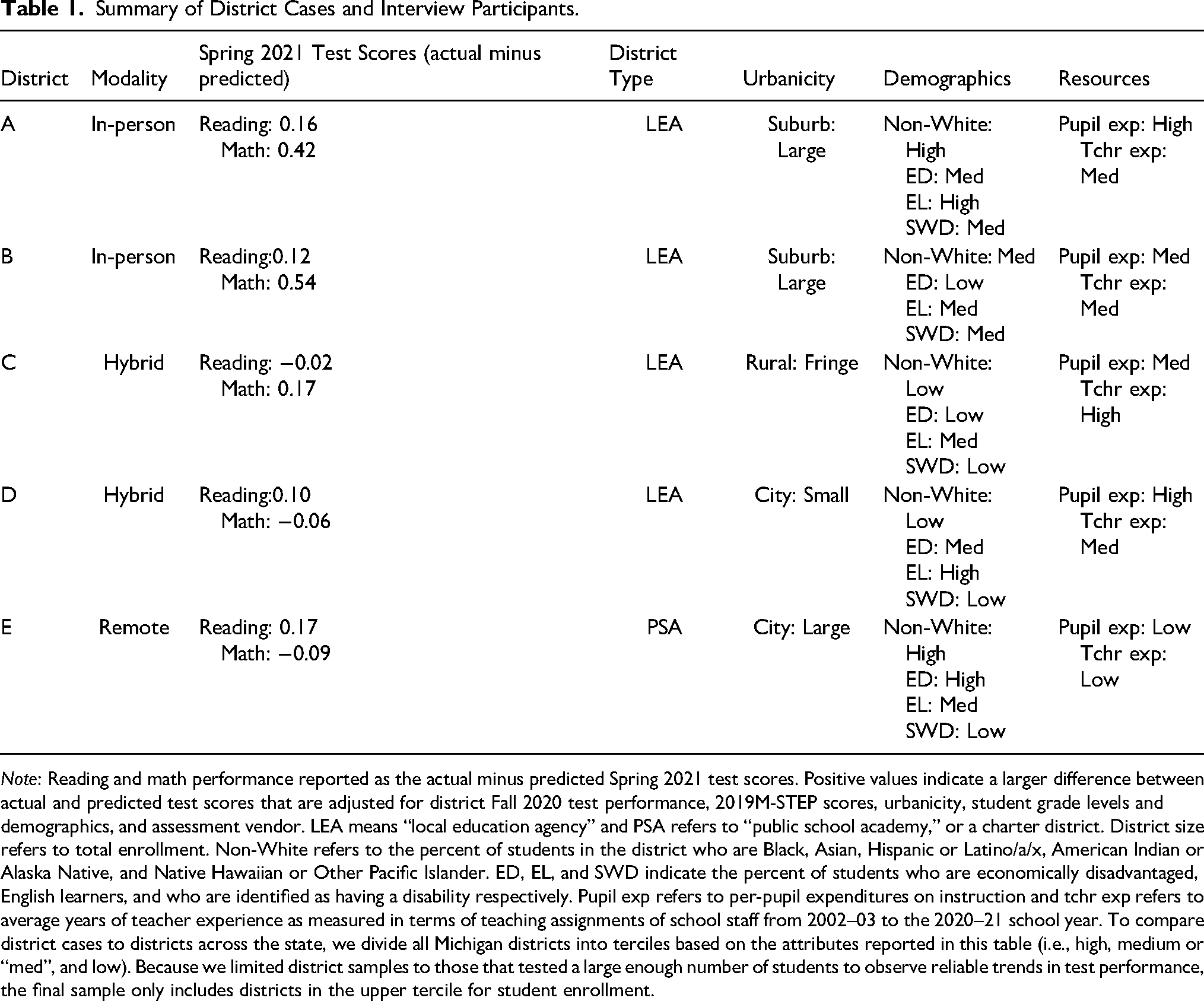
Note: Reading and math performance reported as the actual minus predicted Spring 2021 test scores. Positive values indicate a larger difference between actual and predicted test scores that are adjusted for district Fall 2020 test performance, 2019M-STEP scores, urbanicity, student grade levels and demographics, and assessment vendor. LEA means “local education agency” and PSA refers to “public school academy,” or a charter district. District size refers to total enrollment. Non-White refers to the percent of students in the district who are Black, Asian, Hispanic or Latino/a/x, American Indian or Alaska Native, and Native Hawaiian or Other Pacific Islander. ED, EL, and SWD indicate the percent of students who are economically disadvantaged, English learners, and who are identified as having a disability respectively. Pupil exp refers to per-pupil expenditures on instruction and tchr exp refers to average years of teacher experience as measured in terms of teaching assignments of school staff from 2002–03 to the 2020–21 school year. To compare district cases to districts across the state, we divide all Michigan districts into terciles based on the attributes reported in this table (i.e., high, medium or “med”, and low). Because we limited district samples to those that tested a large enough number of students to observe reliable trends in test performance, the final sample only includes districts in the upper tercile for student enrollment.
Table 1 also demonstrates variation in test score performance and resources across districts. While in-person district cases outperform Spring test score growth predictions in both reading and math (0.12–0.16 and 0.42–0.54 standard deviations respectively), hybrid and remote cases each exceed predicted growth performance in one subject (math for District C and reading for Districts D and E). In-person and hybrid districts also have higher per-pupil expenditures on instruction and average teacher experience than the fully remote district case. That said, none of the district cases are consistently in the highest tercile of the state for these resources. This trend suggests districts may have relied on other organizational capacities for responding to crises, corroborating this study's approach to identify these capacities through inductive analysis.
Data Collection
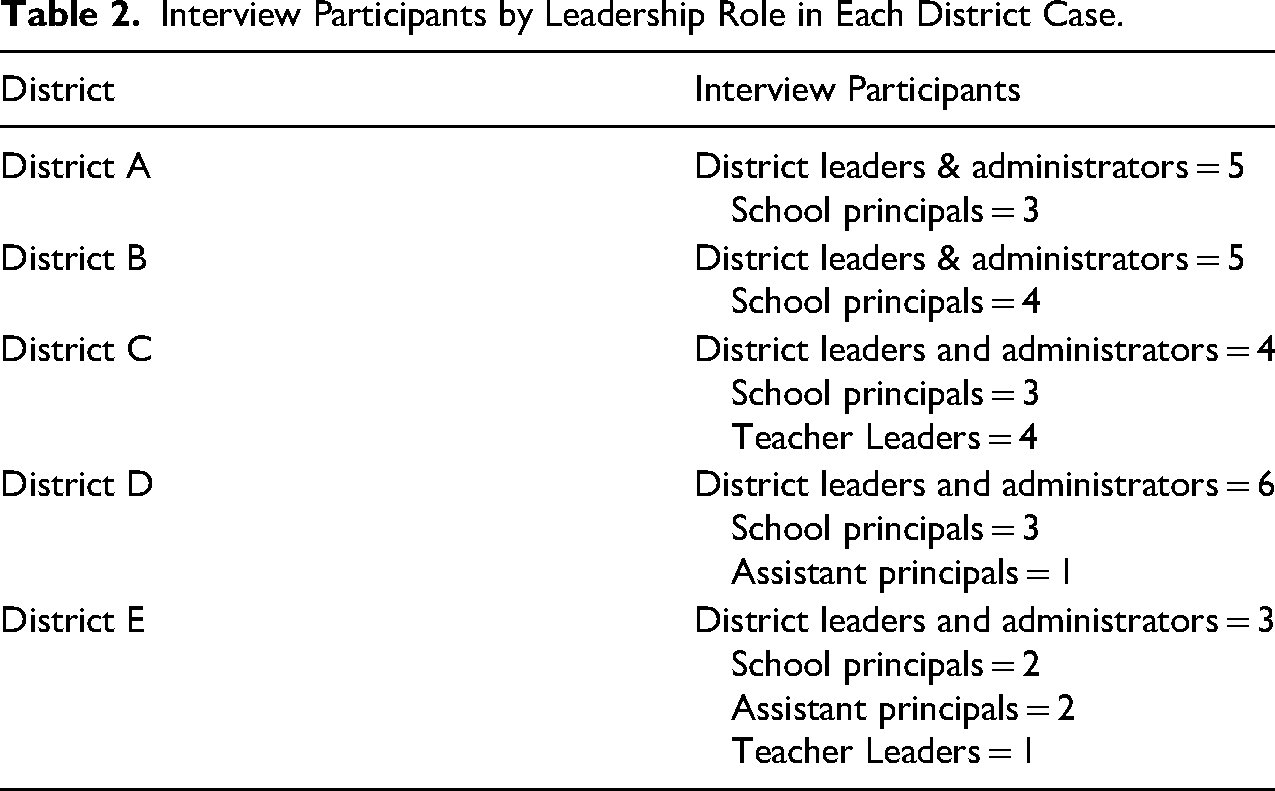
We interviewed 46 district, school, and teacher leaders across district cases in the Spring of 2022 (ranging from eight to 11 interviews per site). For each district case, we requested interviews from the superintendent and district level administrators whom we identified as relevant participants based on their professional roles. We then asked participants to recommend other stakeholders who led pandemic response efforts for interviewing, especially those involved in a leadership capacity at schools. Our primary goal was to gather insights from a variety of leadership perspectives in each district.
Following this approach, we recruited interview participants from senior district leadership (superintendents, assistant superintendents) as well as those overseeing departments relevant to COVID response such as English language development, special education, instructional technology, curriculum, and elementary and secondary education. We also interviewed school principals and assistant principals across school levels in the district, and teacher leaders who were union representatives or those identified by district leadership as contributing to COVID-19 response efforts. Table 2 outlines the number of interview participants by leadership roles in each district.
Interview Participants by Leadership Role in Each District Case.
Interviews were conducted via Zoom and lasted approximately 60 to 90 minutes. Interview questions focused on leaders’ initial awareness of the COVID-19 pandemic, priorities to support staff, students and families while navigating the pandemic, opportunities to collaborate with other stakeholders in pursuit of shared goals, and each district's instructional modality and shifts in modalities offered over time. We also asked about approaches for using technology, providing student access to learning opportunities, supporting student engagement in learning, supporting the needs of special student populations, communicating with families, attending to student wellbeing and health, and providing other support and resources for teaching and learning (as defined by interview participants). For each of these approaches, we asked participants to reflect on approaches that worked well, those that did not, factors that contributed to implementation success, and any perceived barriers and challenges. These questions helped us to determine how leaders used new and existing resources to respond to the pandemic. We asked the same questions of every participant given that all were involved in leading pandemic response efforts for their district and school. For school and teacher leaders, we included additional probes to learn about school approaches for pandemic response. Appendix B outlines our interview questions and probes.
Analysis
We transcribed and coded the interviews based on broad conceptual categories as identified in our interview protocol. These preliminary codes included leaders’ initial awareness of the pandemic, leader priorities for the 2020–21 school year, descriptions of local context and instructional modality, the role of collaboration in enabling response efforts, approaches for supporting instruction and student health and wellbeing, practices for engaging families, organizational resources that enabled pandemic response, and barriers or challenges to implementation, including limits to organizational capacity. We met as a research team to build out the codebook in close alignment with the interview protocol prior to coding the data. We then met weekly to review coding and identify inductive codes that emerged from an initial reading of the data. For example, we observed that staff burnout was a prominent theme discussed by local leaders and agreed to code for this theme throughout analysis.
After coding the interview data, we documented emerging themes in memos for each district case. Aligning with best practices for case study research, we used the memo to move beyond summaries of data to provide a richer understanding of emerging themes (Miles et al., 2019. We focused closely on the relationship between the phenomena of interest and context (Yin, 2014), in this case, how local leaders used existing organizational resources in their local context to respond to the pandemic in ways that enabled student learning. For example, in these memos we elaborated on the pressures of the pandemic in the local context of each district case; how local leaders responded to pressures in terms of stated priorities, instructional modality, and approaches for supporting student learning and wellbeing; and how leaders leveraged both new and existing resources to execute their priorities for pandemic response. Where relevant, we documented limitations to existing organizational capacity and unintended outcomes of crisis response. We included supporting excerpts for each theme to establish a chain of evidence. We also triangulated claims from interview participants (i.e., interviews across district and school levels) to ensure credibility in findings (Creswell & Poth, 2016).
Drawing on these district case memos, we next wrote a cross-case memo to explain and compare how local leaders used existing organizational resources during pandemic response across district cases. This stage of analysis drew closely on concepts from the conceptual framework. We first compared the demands, pressures, or threats that the pandemic placed on districts and schools. We then classified approaches and resources for responding to these external conditions in alignment with concepts of crisis leadership and the four perspectives on resource use as outlined by Kraatz and Zajac (2001): (1) resources as barriers to learning, (2) resources as environmental buffers, (3) resources as commitments, and (4) resources as facilitators. Notably, we did not find evidence of the first two approaches, but identified several themes related to prioritizing resources that were already in place prior to the pandemic (indicating a resources as commitments approach) and leveraging existing resources to adapt and develop new ways of teaching and learning (indicating a resources as facilitators approach). We noted the extent to which themes were shared across instructional modalities in the district cases. Given that districts could and did offer students access to multiple modalities (i.e., in-person and hybrid districts offered a fully remote option for a smaller share of students in the district), we leveraged evidence across district cases when making claims about instructional modality.
Limitations
While this study offers a rich understanding of how crisis leadership and strategic resource use can shape district responses to the pandemic in varied local contexts, there are some limitations to our research design. First, while our sampling approach allowed us to deeply examine districts that delivered better-than-predicted achievement results, it is possible that peer districts with less successful test scores engaged in similar approaches for crisis response. Without gathering comparable data from peer districts, we cannot make definitive or causal linkages between the district pandemic response approaches observed in this study and student achievement trends in the pandemic. As such, we strictly interpret findings as suggestive of promising practices for crisis response. Given the study's sampling approach, we further acknowledge that our findings may be distinct from other districts in Michigan and nationwide where student test scores declined substantially during the pandemic.
Relatedly, we recognize that test scores can be a narrow measure for identifying districts that successfully navigated a crisis, especially one as challenging and disruptive as the COVID-19 pandemic. At the same time, test scores and academic recovery from the pandemic continue to be policy priorities for federal, state, and local governments, making it informative to learn from districts that mitigated disruptions to student learning. To counterbalance the study's focus on test scores, we sampled districts from different instructional modalities, as well as districts that served students from different racial, ethnic, linguistic, and socioeconomic backgrounds. Through analysis of these distinct cases, we surface local conditions that could have challenged pandemic response and student achievement (i.e., in remote districts), and shed light on how districts adapted to unique challenges in these contexts. The reach of data collection within cases is also limited to leaders at the district and school levels. As such, our findings do not include the valuable perspectives of teachers, school staff, family members, and students.
Findings
Figure 1 provides an overview of our main findings. We find that local leaders engaged in both resources as commitments and resources as facilitators approaches depending on external pressures from the pandemic, their own skills and capacities as crisis leaders, and the extent to which external pressures aligned with existing organizational capacity. Consistent with a resource as commitments approach, leaders continued to prioritize staff-student relationships, school-family relationships, and existing curricula and instructional models that they perceived as being appropriately aligned with the foundational needs of educators, students, and families stemming from the pandemic. Leaders also perceived these resources as contributing to student learning prior to the pandemic and offering a reliable path forward amidst ongoing uncertainty and disruption.
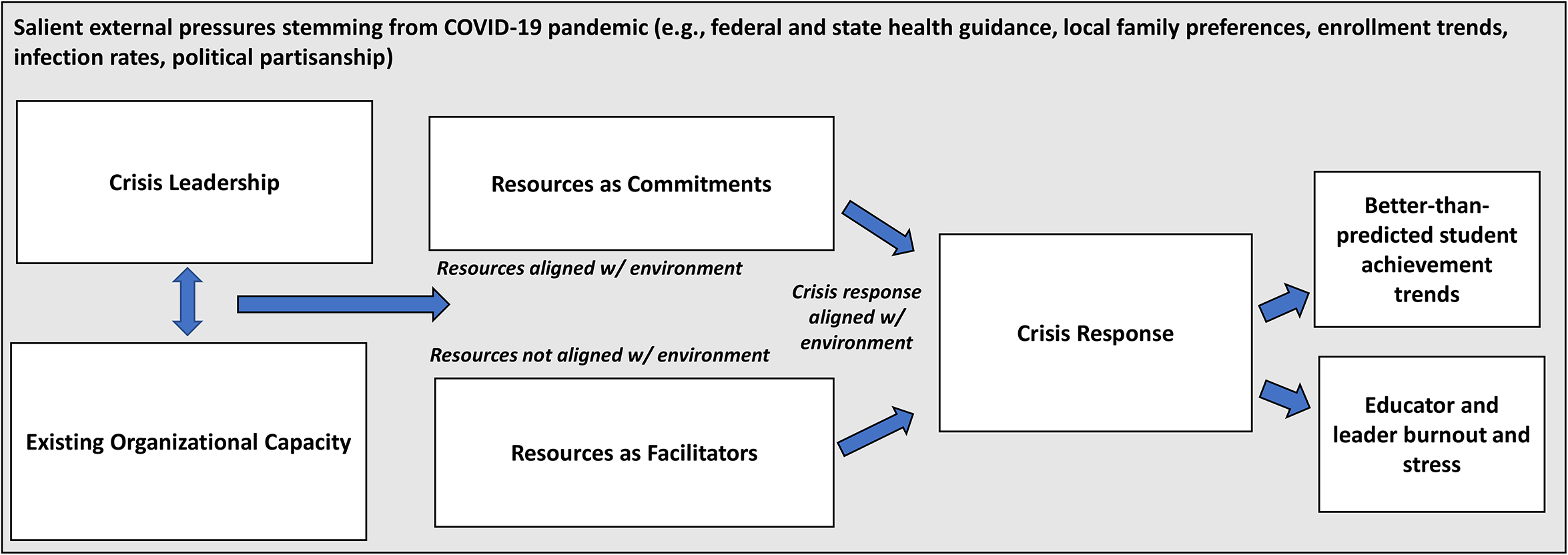
Findings on district response approaches to COVID-19 pandemic.
While we observed similar resources as commitment approaches across cases, districts varied in their use of resources as facilitators for change by instructional modality. In these situations, districts’ existing organizational capacity was not aligned to the needs in their environment, prompting leaders to search for underutilized capacity that could be leveraged to build out new ways of teaching and learning. Leaders relied on staff expertise, staff collaboration, and school-family relationships to: 1) ensure the safety of educators and students while learning in-person; 2) keep students engaged in learning in remote and hybrid environments; and 3) personalize academic support for remote and hybrid students.
As shown in Figure 1, districts’ resource driven approaches facilitated conditions that aligned the work of schools with demands in their external environment and in so doing, worked to productively engage students, educators and families in teaching and learning. These approaches, in turn, may have contributed to better-than-predicted student achievement during the 2020–21 school year but also contributed to high levels of leader and educator burnout. We elaborate on these findings by first describing the common crisis leadership approach shared across districts and subsequently their resource driven approaches used to support student learning.
Responsive Crisis Leadership Coming into the Pandemic
Beginning in summer 2020, the Michigan state legislature passed a bipartisan “Return to Learn” package of bills that gave Michigan school districts substantial local discretion to determine their instructional modality for the 2020–21 school year. Amidst heightened local control and ongoing uncertainty, local leaders in the district cases acted as responsive crisis leaders to understand stakeholder preferences and build consensus and trust in district policies. Leaders’ responsiveness to stakeholder needs was largely consistent with how they engaged students, families and educators prior to the crisis. In other words, responsive crisis leadership was a general strength across the district cases.
Local leaders maintained a student-centric mission when making decisions in the pandemic, demonstrated care and empathy for students, educators and families, and maintained relationships and trust with stakeholders both inside and outside of schools. A teacher from a hybrid district shared how their superintendent was integral to building relationships between school and communities and between administrators and teachers which, in turn, drove how their school responded to the COVID-19 pandemic. They shared, “The way our school handled this pandemic, I thank God every day that I was under our current superintendent.” An administrator in another district shared that they worked most of their career in the same district because of the student-centric mindset of previous and current superintendents: The reason why I have always stuck around in [District] is because I believe the leaders have always had the right mindset [which is] students first. I think our superintendent truly embodies that. […] [They are] great to work for, very understanding, [an] empathetic individual who fights for students’ rights. Who wouldn’t want to be part of that, right?
Information searching was another common practice across local leaders. We interpret this behavior as indicative of two trends. First, the external pressures generated by the pandemic across local communities were intense and salient such that leaders could not ignore them. Second, leaders actively used organizational resources to gather information about the pandemic rather than use resources as barriers to learning or to buffer schools from pandemic pressures.
Across all cases, local leaders employed multiple information search strategies to learn from a wide range of stakeholders affected by the pandemic, including surveys, town halls, school board meetings, COVID metric reports, staffing internal committees, and meetings with stakeholder groups such as the teachers’ union. They engaged internal and external stakeholders throughout the school year – from students, families, community partners, school staff, board members, state and local health officials, to the CDC – to assess the severity of the pandemic and stakeholder preferences. Information searching defined leaders’ priorities and rallied distinct groups around a common course of action. Leaders’ persistent outreach to stakeholders also helped them “get a pulse” of shifting community preferences in an evolving crisis.
A teacher from a hybrid school district explained that they “did a lot of surveys” of families, students, and teachers and at times engaged in “really difficult discussions [that were]…polarizing” but that these efforts ultimately brought “people together and do what we thought was best for all students.” The superintendent from an in-person district shared that hearing the challenges and complaints of low-income parents in school board meetings who desperately needed to get back to work led them to prioritize “get[ting] schools back in person.” A central office administrator from a remote district shared that rising COVID infection rates in fall of 2020, along with no vaccines, left their school community feeling especially vulnerable to COVID exposure. These circumstances led the district to offer remote instruction in accordance with “everyone's comfort level” and to reassess shifts in instructional modality through stakeholder surveys throughout the year.
Besides responsive crisis leadership, districts included in this study benefited from other existing organizational resources that informed how leaders responded to pandemic challenges. In fact, a rather striking finding from our analysis was leaders’ emphasis on utilizing the resources available within their organizations to respond to the pandemic. This is not to say that leaders did not use external resources shared by federal and state governments such as COVID relief funding, digital devices, Internet connectivity, health guidelines, and roadmaps for school re-openings. Rather, translating these external inputs into action required further use of existing organizational capacities. Below, we elaborate on how leaders used existing resources to respond to the pandemic depending on perceived external demands and perceived capacity.
Resource as Commitments to Address Foundational Needs
Consistent with a resource as commitments approach to organizational crises, leaders continued to prioritize and/or invest in existing resources that had contributed to student learning prior to the pandemic and offered a reliable path for navigating pandemic challenges. Across all districts, leaders relied on 1) existing staff-student relationships to respond to student trauma stemming from the pandemic; 2) existing school-family relationships to support family needs and maintain trust with the local community; and 3) existing curricula and instructional resources to support engagement in student learning.
These resources as commitment approaches were justified based on leaders’ perceptions of their external environment and the alignment of existing organizational resources to stakeholder needs. Leaders perceived students’ emotional trauma, family hardships, and the disruption to student learning routines in Spring 2020 as foundational needs or gaps that needed to be targeted first so that learning could take place. They also perceived the need to cultivate trust with the local community to motivate school staff who were themselves struggling from personal challenges related to the pandemic. At the same time, leaders had access to existing organizational resources in terms of staff-student relationships, school-family relationships, and existing curricula and instructional resources that could support the needs of educators, students, and families. As such, leaders perceived the continued use of or further investment in these resources as valuable outcomes of pandemic response in and of themselves.
Prioritizing Staff-Student Relationships to Respond to Student Trauma
Leaders prioritized existing staff-student relationships to provide students with social and emotional support in response to trauma stemming from the pandemic and its isolation. Staff-to-student relationships were valued in and of themselves, as they signaled that schools were providing a safe space for students to reckon with their feelings; a critical first step for enabling academic learning. The superintendent of an in-person district identified student wellness as her “top priority…because, if you do not have that component and Maslow's hierarchy, you need to meet the basic needs before we can do any of the academics here.” They went on to explain that “school closures, COVID, isolation [were] traumatic for all of us” as such, it was important to make students feel safe and ensure that “they have what they need.” A teacher in a remote district shared that many of her students had lost family members during the pandemic and that her “biggest thing really started with supporting [students] emotionally…the first step was really just trying to help the students recover from the pandemic.”
Moreover, in all district cases, participants identified caring staff-student relationships as a distinct resource that districts had cultivated in advance of the pandemic and had previously contributed to student learning. Maintaining caring staff-student relationships was not only necessary for responding to foundational student needs in the pandemic, but also central to the beliefs and practice of school staff and part of schools’ prior track record of academic success. As one school principal in a hybrid district explained: I am a huge believer in relationships. I talk to my teachers about that every year. I am like you build these relationships; kids are willing to do extra for that…That is what we try to do…to let the kids know that we care about them, we want them here, and then, when they were not here, we are saying, “Where were you? We missed you. What is going on?”
Similarly, the special education director in an in-person district shared that their staff were “very good” primarily because of their close relationship with students. Another high school principal in the same district shared that they could not think of a specific approach that contributed to student learning aside from the fact that teachers and students shared close ties coming into the pandemic. The director for English language development in another in-person district shared that “the best thing about [their district] are the people who work in their system,” going on to share that the district was recognized nationally and locally for educating multilingual students. Reflecting on how her team stayed connected to multilingual learner students during the pandemic, they shared: “Our staff really made the difference there by going the extra mile…A lot of the success of that, I think, is attributed to the fact that we had strong relationships with students and families before the pandemic.”
Investing in School-Family Relationships to Respond to Family Needs and Build Trust
Leaders also invested in existing school-family relationships to respond to the devastating effects of the pandemic on students’ families. These relationships provided access to information about families’ unique needs that districts could then address to stabilize students’ home environments; a necessary condition for enabling student learning. Because districts had maintained close connections to families prior to the pandemic, engaging in these relationships was a trusted approach for learning about family needs and responding to pandemic challenges. Investing in school-family relationships further benefited districts by establishing a sense of trust with the surrounding community that, in turn, motivated school staff to continue educating students despite facing challenges of their own.
Districts shared multiple examples of how school-family relationships allowed them to identify and support family needs, from the mental health needs of parents to the food, housing, technology, and socioeconomic insecurity of families. The superintendent of a hybrid district shared that, even prior to the pandemic, special education staff worked with families to develop parenting skills appropriate for the needs of students with disabilities. Expanding this existing approach made sense since parent anxiety and needs for support became more acute once the pandemic hit. As they explained, “a big part of that was the parenting skills to help the parents through this too…it is always a part of what we do, but even more so with the pandemic now.”
In another hybrid district, an administrator shared how all district staff – from administrators to teachers to bus divers – carried out home visits to provide families with resources. Conducting home visits provided direct access to families and further strengthened the relationship between the district, the schools, and the families. Because district and school staff had cultivated relationships with families in previous years, families could be open about their needs for support, allowing districts and schools to proactively respond to these needs. In explaining why the district did not outsource home visits to an entity outside of the district, an administrator shared “it was more helpful that our staff went out to the homes [of students] because we had those connections with the students and families.”
Investing in school-family relationships was mutually beneficial, as school staff perceived these ties as fostering trust with the local community and further motivating their efforts to educate students. One district administrator in a hybrid district shared: We have had challenges, but there were some…successes too. [The pandemic] strengthened a lot of relationships with families too. Parents even saying things to me like, “I learned with my son. I was watching the teacher.”…To hear parents say that is huge. As challenging as it was, some good came of it.
Using Existing Curricula and Instructional Models to Support Continuity in Learning
Leaders in all districts described Spring 2020 when schools were physically closed as disrupting student learning in ways that needed to be quickly remedied. In reflecting on what separated their district from others in the state, one superintendent shared that “it was a continuous curriculum. I did not stop the learning.” Another superintendent shared that providing continual access to in-person learning was imperative for ensuring equity for students. As they put it, “As an equity play, as a social justice decision, we need[ed] to open our schools.”
To continue student learning amidst ongoing disruption, all districts relied on curricula maps, pacing guides, and/or instructional models that they had developed in advance of the pandemic. These resources had contributed to students’ academic success in the past and would continue to do so even during a pandemic. A school principal in a district offering in-person and remote instruction explained that the district relied on its existing curriculum and instructional model to continue teaching and learning in both modalities. As they put it, “we just tried to…keep doing what we have been doing because we did feel like our academic success was there prior to the pandemic, so we did not want to veer off course.” They elaborated on how school staff translated their in-person instructional model into an online program. Another thing we felt strongly about is we have an instructional model in place, like how we teach every single subject—every single lesson, and we were trying to think how we could take that instructional model and implement it remotely. [The model] was our focus lesson, collaboration with students, and then independent learning with students with teacher support weaved in there. Those are the components that we would have if we were in the classroom.
Similarly, leaders in the remote and hybrid district cases dedicated extensive time and resources prior to the pandemic toward developing curriculum maps and intervention-based approaches to instruction in collaboration with teaching staff. These resources and approaches embodied the expertise of educators on what and how students needed to learn and as such, continued to support student learning during the pandemic. In the remote district case, educators continued an existing practice of scheduling an hour of intervention-based instruction to support student learning in reading and math. As one school leader explained, “One thing that I believe our school has always done well—at least for the past four to five years that I have been here—we have intervention built into our schedule.” By continuing this structure during remote instruction, leaders leveraged an existing and distinctive organizational strategy that was already ingrained in teacher practice and familiar to students.
In hybrid districts, leaders leveraged curriculum maps to identify essential standards to focus instruction for the limited number of days when students attended school in-person. One leader had worked with teachers across subject areas and grades over a “three-year span” prior to the pandemic to identify essential standards that are vertically aligned from elementary to middle and high school. As they explained, “We really broke down what it means with the standards, what the essential criteria would look like for students to demonstrate mastery. We put any necessary rubrics in there for what it would look like if you were evaluating it, so that you knew that the students got it.” These criteria and rubrics embodied the collective knowledge of teachers and served as the foundation for the district's hybrid instructional model. As the same director shared, “we do not know how the rest of the year is going to pan out [but] if we focus on those critical, essential standards, and we really spend time making sure that the kids know them very well, we are going to get them to the next point when we are back.”
Consistent with a resource as commitments approach, we observed local leaders persisting with existing organizational resources that they perceived as addressing foundational needs stemming from the pandemic and that were effective at supporting student learning prior to the pandemic. Yet persisting with existing organizational resources was not always a sufficient response to severe environmental threats. As we describe below, leaders also engaged in a resources as facilitators approach in which existing resources supported adaptation and change.
Resources as Facilitators of New Ways of Teaching and Learning
Unlike the previous examples of a resources as commitments approach where districts’ existing organizational resources were well aligned to address the needs of the pandemic, there were instances when districts’ existing resources were not aligned to their external environment. In response to limits in organizational capacity, leaders searched for other existing resources that could be further leveraged to support adaptation and change.
The use of existing resources as facilitators for change varied across instructional modality in response to different pressures or demands in local context. In-person and hybrid districts leveraged collaboration among leadership and staff to develop safety protocols that would keep educators and students safe while meeting families’ intensifying demands for in-person learning. Remote and hybrid districts leveraged staff expertise, staff collaboration, and school-family relationships to develop new instructional processes to keep students engaged in learning while responding to parents’ and educators’ continued concerns of high local infection rates. They also used staff collaboration to individualize academic support for students with varied needs.
Collaboration Among Leadership and Staff to Develop Safety Protocols
Districts facing external demand from parents to offer in-person instruction had the challenging task of designing in-person or hybrid instructional modalities that could keep students in the classroom while also attending to safety concerns of parents and staff. Reflecting on parent demands for in-person instruction in their district, one superintendent empathized with parents wanting to “make sure their kids had opportunities to be with their friends. The social aspect was huge. Having connections to their teachers was also huge.” Speaking to the overwhelming demand for in-person instruction in their community, the superintendent of a hybrid district shared, “I had 90 percent of the parents who wanted to be face-to-face, they were not afraid to be [in-person]. …Hybrid is the only thing I could do to keep [infections] mitigated.”
As the above quote suggests, leaders in in-person and hybrid districts had to balance demand for in-person instruction with the availability of physical classroom space to adhere to social distancing and other health guidelines. Educator concerns for safety and health and hesitations about returning to in-person instruction was another factor that constrained district capacity for in-person instruction. Balancing internal capacity with parent expectations was easier for some districts to do than others. District B located in a rural area with smaller sized student population was able to offer in-person instruction for all students who opted for this modality. In District A, leaders described a nearly fifty-fifty split in parent and educator preferences for in person and remote instruction that made it feasible to offer in-person instruction to families. In contrast, for hybrid districts, limited physical space and educator concerns were a bigger constraint in the presence of overwhelming parental demand for in-person schooling, making a full return to in-person instruction untenable.
While leaders could not immediately create more physical space, they could address safety concerns by leveraging collaboration among leadership and staff to design new safety protocols for mitigating COVID-19 spread within school buildings. In one district, this meant problem solving between district administrators and building leaders about protocols and procedures to be developed in each school building to ensure student and staff safety, and that each school had appropriate support. As one administrator shared: “We would get together and come up with this large picture, and…then we all sit down and figure out together what is district-wide and what is building specific in implementing these changes or policies, procedures, whatever it might be.” A school principal in another in-person district shared that “the first step, a big step” was developing safety protocols so that staff and families felt safe to come in. This inherently involved teachers being flexible in practice and accepting additional responsibilities such as regularly cleaning classrooms. As they explained, “Every desk [needed to be] sprayed and wiped down, for example, in between classes. Every classroom had hand sanitizer bolted to the wall…[we provided] cleaning materials to teachers and shared with them how they needed to become cleaners now”.
Engaging internal collaborative networks helped teachers commit to district efforts to appease parent demands for in-person instruction. Through collaboration with leadership, staff could have input on the design of the modality and received assurance that their concerns for safety were heard. The school principal in a hybrid district shared how they worked with their school improvement team to develop a hybrid instructional plan “that everyone could buy into.” They noted that this collaborative approach helped the school avoid union issues, with teachers in their schools instead “putting aside [grievances] for what was best for the kids.” Similarly, a teacher in the same district shared how much they appreciated being able to openly share concerns of teachers with senior leadership as the district was designing its hybrid modality. They explained, “I am appreciative for having the opportunity and [for being] given that freedom by my building administrator…It was a very difficult time but I value that experience.”
Staff Collaboration and School-Family Relationships to Engage Students in Learning in Remote and Hybrid Modalities
Whereas in-person and hybrid districts had to adapt to create new in-person learning environments that were safe for students and staff, remote and hybrid districts had to adapt to create new instructional routines and procedures that could keep students engaged in learning while at home. In these districts, there was notable demand from local health authorities, families, and staff to mitigate COVID spread by engaging in remote instruction. Yet local leaders also faced pressure from within and outside of their school systems to engage students in learning. In the remote district case, leaders framed this pressure in terms of preserving student enrollment, which was at risk of declining if parents were unsatisfied with the quality of instruction or because students might completely disengage from the educational system and “be lost.”
While local leaders overwhelmingly felt pressure to engage students in learning, their school systems did not have the existing capacity to support engaged learning in a remote or hybrid environment. Commenting on the limited knowledge of teachers to use technology in general, one district administrator shared, “jumping on a Zoom call for, I would say 60 percent of the people was a foreign…we had a lot of challenges on getting equipment, simple stuff like document cameras, so they could do Zoom from their desktop, extra laptops to push out.” In the remote district case, an administrator shared that not only was remote instruction new to teachers, but that students (especially early-grade learners) and parents lacked the skills, time, and resources to support engaged learning at home.
While remote and hybrid districts did not initially know how to support engaged learning, local leaders pivoted to meet this new demand. Notable instructional changes that remote and hybrid districts pursued included re-designing school schedules to give students regular breaks from screen time, offering a balance of synchronous and asynchronous instruction, and allowing teachers and specialists to work with students in small group settings or meet with students one-on-one. One school administrator shared how their school principal was “a genius” for developing a schedule with a cohesive mix of social experiences, synchronous instruction, asynchronous instruction or independent work time, as well as an extended lunch break so that students could have “breathing room” between classes. In another district that offered both in-person and remote instruction, leaders developed a master schedule for its remote program where students would meet as a whole class but then break out into small groups for “productive group work or collaborative time,” allowing teachers to “engage with four or five kids at a time.” The district also shortened the regular school day by an hour so that teachers could meet one-on-one with remote students and have dedicated time to plan and prepare for instruction.
Undergirding these new instructional approaches was staff expertise and collaboration to build out new learning experiences for students. The school principal in a district with a remote program shared how the collective talent among staff drove changes to instruction. As they put it, “We used the talent that we had within the district to create some of those pieces to help our remote students. There was a lot of collaboration time just among teachers that were remote to share different ideas, different platforms.” A kindergarten teacher in a remote district “appreciated being on [a] committee to share [their] perspective” with early grade teachers to modify the school's instructional schedule to meet the needs of their young students. Having time to plan with other teachers “was helpful because virtual teaching in kindergarten through second grade is very different than virtual teaching in any other grade level.” In a hybrid district, a special education director shared that having scheduled planning time on virtual days was “a gift” that allowed her staff to work closely with classroom teachers on differentiating instruction.
School-family relationships were also used to provide guidance, support, and routines to support student learning at home. Across cases, educators were available beyond the typical school day to answer questions from parents, help students to complete assignments, and keep students focused on learning tasks. Educators described extensive communication with families about each week's instructional plan and schedule, as well as directions for assignments. One high school teacher in a hybrid district noted, “There were lots of questions. That is why I felt the need to communicate every single week. […] I invited parents to join my Google Classroom so they had access to the platform that I was using.” Similarly, a teacher in a remote district described communicating weekly with parents to set expectations for student learning. They described sharing a “Peek of the Week” with a list of Zoom links and assignments for each day and followed up with reminders and emails for parents to submit assignments.
Ongoing and detailed communication was necessary to engage parents as partners in supporting student learning at home. Parents in turn were largely responsive to the guidance and materials shared with them. A teacher in the same hybrid district shared, “We have a pretty supportive community, pretty involved parents. I did not have any trouble getting [assigned] work back, none at all. They just brought it back.” Similarly, a school principal in a remote district shared that having a strong “rapport with parents” allowed them to understand their expectations for teaching and learning and work completion at home.
Collaboration between Teachers and Specialized Staff to Individualize Academic Support
The pandemic vastly expanded the range of student need for academic support, requiring school staff to individualize approaches for each student. Student needs varied based on instructional modality (e.g., remote versus in-person), school level (i.e., elementary, middle, or high school students), existing academic needs (e.g., students that were not on track for completing high school), conditions at home to support student learning, and the social, economic, and health concerns of families. The need for differentiated support was arguably more pronounced in districts in which students were learning remotely. As one district administrator explained, “teachers just had to get creative as to how they were going to engage their students at the different levels and what worked for them.”
Beyond teacher expertise and effort, local leaders identified staff collaboration as an existing organizational resource that could be further leveraged to individualize instruction. In particular, leaders prioritized relationships between general educators and administrators, specialized staff (e.g., special education and English language development teachers), social workers, and school-family liaisons. One demonstrative example is the joint effort of classroom teachers and specialist staff to offer push-in and tiered supports for instruction. Several leaders described using tiered academic instruction to ensure students did not “fall through the cracks” amidst shifts in instructional modality and periods of remote instruction. Under this tiered model, teachers would focus on grade level or “tier 1” instruction while specialist staff would provide additional “tier 2” or “tier 3” support for students who are not at grade level or had other learning needs (e.g., multilingual learners, students with disabilities).
While a tiered approach to academic intervention is not novel, educators in the remote and hybrid districts noted that they provided more push-in interventions for tier 2 and 3 instruction than they ever had prior to the pandemic. Several participants in a remote district shared that it was easier for resource teachers such as special educators or speech therapists to do push-in interventions in general education classes since they did not have to spend time moving between classrooms or traveling between schools; they could simply “click in” to where they needed to be. One principal commented, “I’ve never been able to have students [receive] that much intervention, ever.” An English language director in another district that offered both in-person and remote instruction shared that resource teachers started directly supporting students in the virtual classroom. This leader shared, “[Support staff] are now suddenly actually in those learning environments more than they were before.” Following a hybrid schedule, another district dedicated its virtual days for special area teachers, instructional coaches, early childhood specialists, English language instructors, and other resource teachers to provide direct instruction and one-on-one support to elementary students.
The increased provision of push-in supports was driven by close working relationships between general education and specialist teachers. Leaders shared examples of teachers requesting outreach and support from social workers, counselors, English language development specialists, behavioral specialists, and special education teachers. Such connections often focused on re-engaging students who were absent or not participating in class. Leaders noted the importance of sharing responsibility for student learning across roles, as opposed to depending solely on core content teachers. Describing the benefits of engaging multiple staff in intervention approaches, a teacher in a hybrid district explained: “I never felt like I was doing it alone. I would have the support of my special education teacher. I would have the support of the school counselor. […] Even our building principal was reaching out to parents. […] I think that whole-group approach was really helpful.” In another hybrid district, an elementary principal shared working closely with the schools multi-tiered school support team to consider “what co-teaching should look like in the hybrid model” and noted that “staff supporting special populations were part of their school's strong professional learning community culture.”
The Cost of Supporting Student Learning Amidst the Pandemic: Staff and Leader Burnout
Our analysis also revealed the significant toll of pandemic response efforts on leaders and educators. Regardless of instructional modality, leaders described the 2020–21 school year as taking a toll on themselves, their teachers, and their staff. Leaders recognized that some efforts to meet student needs in the moment had harmful, longer-term consequences for staffing and staff wellbeing. One teacher leader shared how the abrupt transition to fully remote instruction unleashed a cycle of teacher retirements and unfilled staff vacancies in the 2021–22 school year that continued to make their work challenging: “I could see why people are retiring… it is exhausting because there are days where I have to do so much during my plan[ing time] and I cannot, because I am covering other classes.”
Indeed, the COVID-19 pandemic brought on overlapping stressors such as navigating sanitation, health and safety concerns, learning new technology, supporting students and families through trauma, and transitioning back and forth between instructional modalities, all of which contributed to educators’ overload. Several leaders described teachers as experiencing significant stress and anxiety from trying to support student learning during such a challenging year. One principal explained, “[Teachers] really took it to heart when students were failing or weren’t showing up… It's that kind of stuff that stresses them out and makes the burnout horrible.” Similarly, a district leader described teachers as being under “pressure” to “be available all the time” during the school year. Reflecting on the toll of the pandemic, a school leader summarized, “They did an amazing job keeping afloat [but] they were tired. They were tired at the end of the year, for sure.” As these examples demonstrate, significant demands on teachers contributed to heightened stress and burnout as they went above and beyond to support students and families for a prolonged period of time.
Leaders in remote and hybrid districts also described added workload and stress for educators. In particular, while these leaders lauded the efforts of teachers to communicate with families about the logistics of instruction, they noted that this communication was time intensive. Some leaders also discussed the added burden for teachers who were responsible for teaching both in-person and remote students and shared that this contributed to teacher burnout. A school principal framed hybrid as “tricky,” indicating that “it was challenging but we got it done.” Thus, while remote and hybrid districts leveraged resources in new ways to support learning amidst crisis, and to meet external demands from governmental authorities and families to maintain instructional quality, these efforts came at the cost of educator wellbeing.
Leaders also reflected on their own wellbeing. Describing the negative impact of navigating multiple stressors, one principal shared, “in my position, trying to make sure that we’re giving the right attention to each layer was a juggling act, for sure…. My focus was supporting others, whether that be teachers, whether that be students […] What didn’t go well is my own level of social emotional wellbeing. There just was no time for myself.” This quote is representative of a sentiment we heard across all districts; leaders were concerned about wellbeing. A school leader explained, “We want to make sure everyone is taken care of. We want to make sure our students are good. We want to make sure our parents are good, but we have to make sure we are good as well.”
Discussion
Findings from this study provide an in-depth understanding of local education leaders’ successes and challenges as they navigated the COVID-19 pandemic. Across cases, attentive crisis leadership and sustained information search facilitated responses which included a mix of both resources as commitments and resources as facilitator approaches. Following a resources as commitments approach, leaders persisted with existing organizational strengths such as staff-student relationships, school-family relationships, and existing curricula and instructional models to address foundational needs of educators, students, and families, and to provide a reliable path forward for continuing student learning.
In cases where existing capacity was not aligned with external demands, leaders leveraged existing resources such as staff expertise, staff collaboration, and school-family relationships to adapt and change. Following a resources as facilitators approach, local leaders developed new safety protocols for in-person instruction and used technology in new ways to support student engagement in learning and to individualize academic support. While these resource-driven approaches may have contributed to better-than-expected student achievement in the district cases, we also observed pervasive leader and educator burnout.
Our findings offer novel insights on the interplay between crisis leadership and organizational capacity that has been understudied in the existing literature. Consistent with prior studies (e.g., Grissom & Condon, 2021; Potter et al., 2021; Thornton, 2021), we find that responsive crisis leadership consists of activities such as information searching, open communication with stakeholders inside and outside of schools, building trust, and being flexible or adaptive in decision making.
More importantly, while prior studies have largely considered organizational capacity as a constraint to crisis leadership, we offer insights on how crisis leaders perceive organizational capacity in relation to their external environment in ways that position resources as assets, strengths, or catalysts for adaptation and change. Specifically, we find that local leaders either commit to existing organizational resources in pandemic response efforts or use resources as facilitators for change. These results are consistent with other studies showing that, in the face of a crisis, educational organizations rely on resources and approaches that have brought them success in the past (e.g., De Voto & Superfine, 2023; Kaul et al., 2022), or leverage existing knowledge, skills, and talent within schools to respond to external pressures for change (e.g., Strunk et al., 2016).
Our findings also add nuance to Kraatz and Zajac (2001)'s theory on strategic resource use in crisis, which we used as the basis for the conceptual framework in this study. Drawing on longitudinal quantitative data on institutions of higher education, Kraatz and Zajac argue that resource-rich institutions with historical resource endowments are less likely to engage in adaptive strategic change in response to environmental turbulence, and that this disinclination to change can be beneficial to institutional performance. We applied this theory in the pandemic, drawing on qualitative data from varied district contexts. Consistent with Kraatz and Zajac (2001), we found that districts can also commit to existing resources and approaches in response to environmental pressures. However, this approach appears to be driven by local leaders’ perceived alignment between existing resources and external demands, and not by leaders’ defiance of environmental shifts. In contrast, when leaders perceived misalignment, they leveraged existing resources to adapt to pandemic-related pressures. Our findings also highlight intangible resources, such as school-to-family relationships and staff collaboration, that may be critical to crisis response but are not readily measured through financial data such as resource endowments.
Similar to Kraatz and Zajac (2001), we did not find evidence of local leaders using existing resources as environmental buffers or barriers to learning in the pandemic. That said, there is extensive evidence of decoupling or loose coupling in K-12 educational settings where district or school leaders can resist external demands for change, or buffer their organizations from environmental pressures (e.g., Spain & Woulfin, 2019). Given the salience of the pandemic, and the intense pressure initially placed on districts and schools from higher-level authorities and local communities in Michigan, it may not have been feasible for districts in our study to use resources as barriers to learning or environmental buffers during the first pandemic school year of 2020–21. An interesting line of inquiry would be to understand how districts’ strategic use of resources evolved overtime in the pandemic, especially as external pressure to conform to sanitation and health guidelines wanes and new pressures emerge.
Implications for Policy and Practice
In the context of an unprecedented disruption to education, our findings suggest that districts can engage in responsive crisis leadership and resource driven approaches to support student learning. We observed consistent evidence of responsive leadership and resources as commitment approaches across district cases, suggesting that these approaches may be broadly beneficial and responsible for district success in supporting student learning regardless of instructional modality. For example, investing in school-family relationships to support family needs and cultivate trust between educators and the local community appears to be an appropriate crisis response strategy across contexts. Our findings align with existing evidence on the importance of strong leadership, school-family ties, student-staff relationships, and instructional guidance and coherence for school effectiveness in general (e.g.,. Bryk et al., 2010).
We also observed differences in the use of resources as facilitators of change by instructional modality, suggesting that there may be distinct pressures in the local environment of districts that require leaders to use existing resources to adapt in different ways. While all district cases were pushed to adapt and change, remote and hybrid districts were arguably pushed to the greatest lengths, as they had to develop entirely new, technology-enabled structures, routines, and collaborative approaches to engage students in learning and personalize academic support. This suggests that flexibility and adaptation are necessary pandemic responses, especially in communities facing pervasive concerns for health and safety.
Yet adaptation comes with risk. There is no guarantee that the new safety protocols developed by in-person or hybrid districts were full-proof against COVID-19 spread, nor that the instructional approaches developed by remote and hybrid districts were comparable to or better than in-person instruction. Anecdotal accounts from in-person district cases suggest that COVID-19 outbreaks did occur on campus and were traumatizing for school staff who had to suddenly pivot to remote instruction while suffering from illness. Our achievement data further suggests that remote and hybrid districts did not perform as well as in-person districts, and we also observed acute educator burnout and stress in these districts.
Given the risks associated with organizational change in crisis, leaders may need to pursue a balanced set of resource driven approaches. One way that district cases demonstrated balance is by adhering to reliable, resource as commitments approaches alongside undertaking change in other areas. In addition to balanced approaches to crisis response, federal and state policymakers may need to provide additional resources, support, and flexibility to communities that are more exposed to crises and face greater pressure to adapt and change.
More importantly, the findings demonstrate that districts relied on existing organizational capacities to engage in the above-mentioned response approaches. These existing capacities are not readily quantifiable and observable in administrative data, nor do they necessarily correlate with conventional measures of district resources such as per-pupil spending or average years of teacher experience. To prepare for future crises, federal, state, and local governments need to invest holistically in district and school resources over time, and work to ensure that these resources are equitably distributed across communities.
First and foremost, districts benefited from access to curricula, pacing guides, instructional models, and intervention routines that they perceived as successful in supporting student learning prior to the pandemic and were grounded in the daily practice of educators. These existing materials and routines were the building blocks on which districts recreated a sense of normalcy and routine in student learning following disruptions to schooling in Spring 2020 and were largely seen as reliable inputs for ensuring students’ academic success. Additionally, some of the in-person and hybrid districts benefited from access to physical classroom space and school facilities that could accommodate a quicker return to in-person learning for some if not all students.
The promising approaches described in this paper also depended on robust leadership and a healthy school workforce. Across cases, responsive crisis leadership, relational resources, and dedicated school staff enabled a student and family-centric response to the COVID-19 pandemic. At the same time, participants shared that COVID-19 pandemic efforts took a significant toll on leaders’ and educators’ wellbeing. To help districts and schools develop a workforce that is prepared for future crises, policymakers should prioritize long-term investments in leader and educator pipelines. Such initiatives will require attending to leader and educator preparation, work conditions in schools, professional development, workload, and compensation. Given concerns of heightened stress and burnout, it is critical that policymakers solicit input from educators about sources of work stress and dissatisfaction and act to mitigate these concerns.
Across cases, leaders described school-based collaboration across roles as essential to promoting students’ access to learning opportunities. Educators benefited from structures enabling collaboration, such as shared leadership approaches of district administrators and building leaders, dedicated time to plan instruction, and routines and tools for general educators to collaborate with specialized staff. As such, leaders need to consider how to dedicate time, structures, routines, and tools to support teacher input on school decision making, collaborative planning, and students’ access to instruction. Leaders may consider how virtual opportunities to communicate can be leveraged to support collaboration amidst recovery efforts.
The districts included in this study also had strong relationships with families coming into the pandemic. These relationships, in turn, afforded leaders a deep understanding of families’ needs and provided a foundation for partnering with families to continue educating students amidst disruptions and transitions. Families were included in district leaders’ decision making about instructional modality, promoting parent and student support for these modalities. During and beyond pandemic recovery, it will be critical for leaders and staff to sustain relationships with families. In addition, policymakers should develop policies and processes that incentivize and facilitate school-family partnerships and joint decision making.
Additionally, the remote and hybrid district cases demonstrated innovative approaches to using technology to promote students’ access to learning opportunities. To ensure technology is used effectively during and beyond recovery efforts, additional resources may be needed to bolster infrastructure and capacity. State leaders and policymakers could expand access to the Internet and devices, as well as provide ongoing training and support for leaders and educators on using technology both in and beyond the classroom. Such training should attend not only to the effective use of technology for instruction and learning, but also to how technology can be used to deepen communication and partnership between schools and families.
Directions for Future Research
While the perspectives shared across districts provide a richer understanding of how organizational resources were leveraged during the COVID-19 crisis, additional research is needed to examine efforts to sustain successful approaches over time. Moreover, our study only included districts where students performed better than expected on benchmark assessments. It is possible that districts that did not perform as well on assessments engaged in similar resource driven approaches, or faced other limits to organizational capacity that we cannot observe. Future research should examine how organizational resources may have been used differently in districts with different student achievement trends. It will also be important for future research to include students’ and families’ perspectives on learning during and beyond crisis, especially in light of our findings demonstrating how strong staff-student and school-family relationships were valuable resources for crisis response. Finally, research is urgently needed to address approaches for promoting educator and leader wellbeing and addressing burnout. Given this study's findings about some of the harmful consequences of pandemic response on staff wellbeing and staffing, future research is needed to examine the relationship between pandemic response approaches and long-term trends of teacher work conditions and attrition from schools.
Footnotes
Appendix A.
Appendix B.
Declaration of Conflicting Interests
The authors declared no potential conflicts of interest with respect to the research, authorship, and/or publication of this article.
Funding
The authors disclosed receipt of the following financial support for the research, authorship, and/or publication of this article: This work was supported by the Michigan Department of Education,
