







Abstract
Introduction
Are you bored with life? Then throw yourself into some work you believe in with all your heart, live for it, die for it, and you will find happiness that you never thought could be yours ( Carnegie, 1948 ).
For many school principals, leadership is exactly such work: a role that demands not only long hours and visible decisions but also a deep and often unseen emotional and cognitive investment. Each day, they move between classroom visits, parent complaints, teacher support, student crises, policy directives, and administrative pressures (Hayes & Derrington, 2023; O’Malley et al., 2015; Rousmaniere, 2013). Within contemporary perspectives on positive school leadership, such investment is understood as part of the inner psychological resources that enable principals to sustain influence and relational presence in their schools (Murphy & Louis, 2018). In this stream of encounters, it is not just what principals do that matters but how they feel about their school, how they think about their future, and how much energy they can still bring to the work (Crow et al., 2002; Gill & Arnold, 2015; Johnson et al., 2022). These inner experiences constitute a silent force that quietly shapes how principals interpret events, sustain effort, and remain present for others in demanding school environments (Taktak, 2025).
Although leadership research has richly documented principals’ formal responsibilities, working conditions, and stressors (Hallinger, 2014; Marsh et al., 2023), much less is known about how their psychological lives unfold from one day to the next. Principals’ work is inherently dynamic: a supportive conversation with a teacher, a conflict with a parent, or a sudden policy requirement can rapidly alter the emotional tone of the day and the expectations they carry into tomorrow. Such experiences give rise to daily fluctuations in psychological states—short-term changes in affective and cognitive experiences that occur within the same person across days. For example, a principal who ends Tuesday feeling deeply connected to their school may wake on Wednesday more hopeful about their career and more willing to invest effort in challenging tasks. Another principal, after a discouraging day, may start the next morning with lower expectations and reduced energy. Capturing these within-person shifts is essential for understanding how principals actually sustain leadership under real-world conditions.
Diary research in organizational and educational settings has shown that employees’ and teachers’ engagement, affect, and self-regulation vary meaningfully from day to day in response to changing demands and resources (Bakker & Bal, 2010; Sonnentag et al., 2010; Vujčić et al., 2022). These studies demonstrate that psychological states are not static traits but dynamic processes that accumulate, spill over, and shape work behavior over short time frames. Yet, to the best of our knowledge, no diary study has focused on school principals. Existing knowledge about principals’ motivation, commitment, and engagement is based almost entirely on cross-sectional or long-interval designs that treat their attitudes as relatively stable characteristics (Chang et al., 2015; Skaalvik, 2020). This absence is striking given that principals’ effectiveness depends heavily on short-term sensemaking, emotional availability, and sustained engagement in the face of constantly shifting school realities.
In the present study, we concentrate on three psychological resources that are central to both organizational research and educational leadership: affective commitment, career optimism, and work engagement. Consistent with positive school leadership, these resources represent a leader's inner motivational infrastructure that supports meaning-making, resilience, and sustained engagement (Murphy & Louis, 2018). Affective commitment reflects the emotional bond and sense of personal meaning that principals attach to their school; it anchors their leadership in identification with the school's mission and community (Chang et al., 2015; Mercurio, 2015). Career optimism represents a future-oriented cognitive stance toward one's professional trajectory, shaping how principals construe opportunities, risks, and long-term possibilities in their work (Harris & Willower, 1998). Work engagement—comprising vigor, dedication, and absorption—captures the energetic and purposeful investment of employees in their work (Bakker & Bal, 2010; Schaufeli & Bakker, 2004). Within a positive school leadership perspective, these three constructs can be viewed as components of the inner motivational infrastructure through which principals enact leadership in complex and often adverse conditions (Murphy & Louis, 2018; Murphy et al., 2017).
We draw on AET (Weiss & Cropanzano, 1996) to argue that principals’ daily affective experiences at work are not isolated moments but part of a temporal chain linking emotions, cognitions, and behavior. AET proposes that workplace events trigger affective reactions, which then shape cognitive appraisals and subsequent work attitudes. Applied to the principalship, this suggests that the emotional quality of the school day—reflected in a principal's affective commitment after work—may influence how they think about their career when they wake the next morning, and that this cognitive orientation in turn shapes the engagement they can bring to their leadership across that day (Ouweneel et al., 2012). In other words, the silent force of daily commitment, optimism, and engagement may represent a micro-level mechanism through which principals either sustain or lose their capacity to lead. The Iranian educational context offers a particularly revealing setting in which to examine these dynamics. Iranian principals operate under conditions of economic instability, resource constraints, and evolving policy requirements, while still being held responsible for instructional quality, equity, and school improvement (Chang et al., 2015; Tamadoni et al., 2024). These challenging conditions make it especially important to understand how principals’ affective and cognitive resources shift across days and how such short-term processes contribute to sustaining engagement in their leadership. In this context, the aim of this daily diary study is to illuminate the daily within-person relationships between principals’ affective commitment after work, their career optimism at the beginning of the next workday, and their work engagement by day's end. Accordingly, this study addresses the following research questions:
Given the resource constraints, policy volatility, and administrative pressures that characterize Iranian schools, principals’ psychological states are likely to fluctuate meaningfully from day to day, making the Iranian context a particularly informative setting for studying short-term leadership processes.
Literature Review
This section begins by outlining the educational context that shapes Iranian principals’ daily psychological experiences. We then review research on day-to-day leadership dynamics, work engagement, and affective and cognitive resources relevant to the study.
Research Context
The Iranian education system is organized into sequential stages, beginning with a one-year preschool program for five–year–olds, followed by six years of primary education (grades 1–6) for children aged six to twelve. Lower secondary education covers grades 7 to 9 (ages 12–15), concluding with an assessment that directs students into either academic or technical/vocational tracks for higher secondary education (grades 10–12) aimed at students aged 15 to 18 (Van den Heuvel-Panhuizen et al., 2021). The academic year is divided into two semesters, starting in late September and ending in January, with the second semester running from winter to June (Manouchehri & Burns, 2023).
Within this context, school principals frequently face challenges related to economic instability, limited resources, and evolving policy requirements, which can significantly influence their leadership practices and the daily operation of schools (Tamadoni et al., 2024). Moreover, affective commitment among principals is likely to vary, shaped by both their everyday experiences and broader environmental pressures (Chang et al., 2015).
Empirical studies indicated that, specifically in Iran, school principals generally exhibit affective commitment and career optimism, qualities associated with their ability to manage the demands of their roles (Amini Kahrizsangi et al., 2022; Kouhsari et al., 2023). Career optimism and positive cognitive orientations have also been linked to principals’ capacity to address challenges and sustain motivation in complex educational settings (McGuigan & Hoy, 2006). This commitment may help cultivate positive cognitive resources, such as career optimism, which are associated with motivation and engagement in leadership roles (Kouhsari et al., 2025). The use of a daily diary methodology in this study enables the examination of within-person fluctuations in affective and cognitive resources, providing insights into how principals’ emotional experiences after work relate to their career optimism and engagement the following day. This approach responds to recent calls for more dynamic and contextually grounded research designs in education studies (Civitillo et al., 2024; Fan et al., 2025).
Daily Fluctuations in Principals’ Roles
School principals work in organizational environments characterized by continual change, unpredictable challenges, and shifting interpersonal demands (Dimmock, 1999; Fink & Brayman, 2006; Lee & Li, 2015). Their daily responsibilities—managing instructional quality, responding to crises, supporting teachers, and addressing policy pressures—require ongoing adaptation and rapid shifts in attention, emotion, and judgment (Hallinger et al., 2020; Stauffer & Mason, 2013). Despite this inherently dynamic role, much of educational leadership research continues to conceptualize leadership styles, behavioral patterns, and work-related attitudes as relatively stable traits or enduring personal characteristics (Hallinger, 2014). This trait–centric perspective limits our understanding of how principals actually sustain leadership effectiveness within the fluctuating realities of school life, where demands and resources vary meaningfully from day to day (Marsh et al., 2023).
To address this blind spot, scholars increasingly argue for greater attention to within-person variability in leadership processes. Diary studies in noneducational settings have examined a broad range of daily leadership styles and behaviors, including daily transformational leadership (e.g., Hetland et al., 2018; Lanaj et al., 2015; Tims et al., 2011), daily transactional leadership (Breevaart et al., 2014; Lanaj et al., 2015), daily servant and empowering leadership (Kuonath et al., 2021; Schilpzand et al., 2018), and daily ethical and authentic leadership (Bormann, 2017; Macamo & Klasmeier, 2024).
Diary research in educational settings—although far less extensive—shows similar patterns. Teachers’ daily engagement, motivation, performance, and well-being fluctuate meaningfully with changes in job demands, emotional experiences, and available resources (Bakker & Bal, 2010; Vujčić et al., 2022). Students also exhibit substantial day-to-day variability in engagement and self-regulated learning (Bakker et al., 2015; Venz et al., 2018). Yet, despite these insights, we found no evidence of any diary study conducted with school principals, even though principals’ work is among the most dynamic, relationally intensive, and multifaceted roles in the school organization. This gap is striking, given that principals’ effectiveness depends heavily on their short-term sensemaking, emotional availability, energy, and capacity to respond adaptively to unfolding events.
Positive school leadership offers a leadership-specific rationale for focusing on principals’ psychological resources. Positive school leadership conceptualizes effective leadership as grounded in the leader's emotional-moral virtues, positive psychological orientation, and capacity to cultivate meaning, trust, and relational strength within the school community (Murphy & Louis, 2018). Within this framework, psychological resources such as affective commitment (emotional attachment to the school), career optimism (future-oriented cognitive expectations), and work engagement (energetic, purposeful investment in work) represent the inner motivational infrastructure through which principals enact leadership (Banwo et al., 2022; Cherkowski, 2018; Murphy et al., 2017; Yu et al., 2025). These resources enable principals to sustain influence, support teachers, and foster positive school climates—particularly under demanding and unpredictable conditions (Cherkowski et al., 2020; Murphy & Louis, 2018).
Against this backdrop, examining daily patterns of affective commitment, career optimism, and engagement can offer a theoretically grounded and empirically needed contribution to educational leadership research. By focusing on the within–person dynamics of these leadership resources, this study responds directly to calls for more dynamic, practice-proximal understandings of principals’ work and advances leadership scholarship toward a more realistic account of how principals remain effective, resilient, and relationally available in the face of volatile and shifting school environments.
Work Engagement
Work engagement was first introduced by Kahn (1990) as the active and energetic involvement of individuals in their work roles (Bakker, 2022), and its study has since expanded alongside the development of positive psychology, which shifted the focus of research toward optimal functioning and human strengths (Seligman & Csikszentmihalyi, 2000).
Schaufeli and Bakker (2004, p. 295) define work engagement as a “fulfilling, positive, work-related state of mind.” Work engagement comprises the core components vigor, dedication, and absorption (Sonnentag & Kühnel, 2016). Vigor is characterized by high levels of energy and mental resilience while working, the willingness to invest effort in one's work, and persistence even in the face of difficulties, whereas dedication refers to being strongly involved in one's work and experiencing a sense of significance, enthusiasm, inspiration, pride, and challenge (Bakker & Bal, 2010). Finally, absorption is characterized by being fully concentrated and happily engrossed in one's work, whereby time passes quickly (Bakker & Bal, 2010; May et al., 2004). As applied to the work of school principals, these components enable principals to meet various demands of leading complex school organizations (Chughtai & Buckley, 2009; Skaalvik, 2020). In this sense, engagement functions as a leadership resource, strengthening principals’ capacity to sustain focus, manage challenges, and foster a positive school climate (Federici & Skaalvik, 2011; Koch et al., 2015).
Work engagement is generally considered a relatively stable construct due to the ongoing influence of specific job and organizational features (Macey & Schneider, 2008). Nevertheless, it can be assumed that there are short-term (i.e., daily or weekly) fluctuations in the experience of work engagement within one person (Bakker & Bal, 2010). Diary studies have demonstrated that work engagement varies not only between individuals but also fluctuates within individuals over time (e.g., Bakker et al., 2015; Sonnentag et al., 2010). This means that an individual's level of engagement can change from day to day, reflecting dynamic shifts in their psychological state rather than remaining fixed. Empirical research has demonstrated that on days when individuals experience higher levels of engagement, they tend to exhibit greater proactivity (Sonnentag et al., 2010), improved performance (Xanthopoulou et al., 2009), reduced fatigue throughout the workday (Sonnentag et al., 2012) and increased positive affect in their environment (Culbertson et al., 2012). As work engagement is both affective and cognitive in nature (Ouweneel et al., 2012; Schaufeli et al., 2002), we chose both affective and cognitive individual predictors of work engagement (i.e., affective commitment and career optimism, respectively).
Affective Commitment and Optimism
Meyer and Allen (1984) first identified affective commitment as the emotional attachment that an individual develops toward an organization (Mercurio, 2015). Jaros et al. (1993) further described affective commitment as “the psychological connection grounded in feelings of loyalty, affection, belonging, warmth, and pleasure” (p. 954). Meyer and Herscovitch (2001) emphasized that affective commitment lies at the heart of organizational commitment. Becker et al. (2013) reinforced this view, highlighting that affective commitment is characterized by positive emotions such as happiness and joy, reflecting its fundamentally emotional nature. Following prior research (e.g., Becker & Billings, 1993; Becker et al., 2013), our study considers affective commitment primarily as an affect-based construct. Previous studies revealed that individuals who feel emotionally attached to their organization tend to experience less emotional exhaustion and cynicism (e.g., Galletta et al., 2019; Gillet et al., 2015; Lapointe et al., 2012), whereas chronic strain and burnout erode affective commitment over time (Ahmed, 2015; Gillet et al., 2015; Madigan & Kim, 2021). Longitudinal research indicates that affective commitment is one of the strongest negative predictors of turnover intentions and actual turnover (Bentein et al., 2005; Cooper-Hakim & Viswesvaran, 2005; Weng & McElroy, 2012). Previous longitudinal research has shown that employees are more likely to feel strong affective commitment when they work in supportive, fair, and empowering environments, with favorable psychosocial work characteristics, high perceived organizational support, and limited career plateauing predicting higher or increasing affective commitment over time (Boyd et al., 2011; Clausen & Borg, 2010; Panaccio & Vandenberghe, 2009; Tremblay, 2021).
From a positive school leadership perspective, affective commitment reflects the value-based attachment that anchors principals’ leadership, shaping their sense of moral purpose, identification with the school community, and willingness to invest in teacher and student development (Murphy & Louis, 2018). Recent longitudinal research with school principals shows that affective occupational commitment is not merely a static psychological resource but a dynamic component of principals’ professional identity that evolves in response to their working conditions and leadership context. Houle et al. (2022) identified distinct trajectories of principals’ affective occupational commitment over two years and demonstrated that these trajectories are driven by leadership-relevant conditions such as professional autonomy, relationships with school personnel, and managerial self-efficacy and are linked to burnout, job satisfaction, and turnover intentions. This work emphasizes that principals’ commitment and well-being are tightly embedded in how they experience their leadership role and school as an organization, rather than being purely intrapsychic states.
A growing body of diary and longitudinal evidence demonstrates that affective commitment varies meaningfully within individuals over time. While some diary studies have treated affective commitment as a relatively stable, trait–like attachment to the organization (e.g., Rivkin et al., 2018), a growing body of diary research shows that affective commitment also operates as a dynamic, state-like construct that shifts meaningfully with daily work experiences. Using a daily diary design, Koopman et al. (2016) found that employees report higher affective commitment on days when engaging in organizational citizenship behavior (OCB) generates positive affect without hindering progress on core work goals. These effects were stronger for promotion-focused employees and weaker—or even reversed—for prevention-focused employees. Similarly, Hoeve et al.'s (2018) diary study of novice nurses revealed that more than half of the variation in affective commitment occurs within persons across weeks and that week to week changes in complexity of care, perceived support, and perceived competence reliably predict corresponding changes in commitment. Complementing this evidence, De Vries et al. (2019) showed that affective organizational commitment fluctuates substantially within individuals—66% of its variance was within person—and decreases on days when employees fully telework from home. Longitudinal studies likewise confirm that affective commitment is not fixed but shifts systematically over time in response to variations in career plateauing, leadership quality, role overload, job stress, organizational support, and person–organization fit (e.g., Abdelmoteleb, 2019; Clausen & Borg, 2010; Lariviere et al., 2014; Morin et al., 2016; Tremblay, 2021; Vandenberghe et al., 2011). Together, these findings highlight the malleable, state-like character of affective commitment.
AET, as proposed by Weiss and Cropanzano (1996), provides a useful framework for understanding how such daily patterns of affective commitment may translate into cognitive evaluations. It explains that specific occurrences in the workplace activate emotional responses, which subsequently shape individuals’ affective states and cognitive appraisals. These emotional experiences function as meaningful work events that influence employees’ moods and shape their expectations for the upcoming workday (Ouweneel et al., 2012; Weiss & Cropanzano, 1996). In this framework, affective commitment can be viewed as an affect-laden evaluation of one's relationship with the organization that accumulates across daily events and, in turn, informs broader anticipatory attitudes. These affective states then lead to cognitive appraisals that affect anticipatory attitudes such as optimism, including career optimism—positive expectations about future work-related outcomes (Ouweneel et al., 2012).
Optimism is commonly defined as a generalized expectation that good things will happen in the future, consistent with Carver and Scheier's (1981) self-regulation theory of dispositional optimism, which explains how positive outcome expectancies influence persistence, coping, and goal-directed behavior (Rottinghaus et al., 2012). Career optimism is one of the most fundamental and widely validated expectancy-based cognitive constructs, with a long theoretical lineage in self-regulation research (Alarcon et al., 2013; Carver & Scheier, 1981), and it highlights individuals’ readiness to cope with evolving career demands and to respond adaptively to career-related challenges (Lin et al., 2022). In demanding systems like Iran, principals regularly deal with parent conflicts, teacher performance issues, district-level evaluations, bureaucratic pressures, and uncertainties about promotion, all of which influence their daily expectations about their future in school leadership and in turn, their career optimism.
In the context of career optimism, scholars emphasize that individuals with higher levels of this cognitive resource tend to perceive new career opportunities as attainable and realistic (Eva et al., 2020), interpret career events positively (Santilli et al., 2017), maintain positive expectations regarding the attainment of their career goals (Boileau et al., 2021; Haratsis et al., 2015), and view career setbacks as temporary rather than permanent (Volmer & Wolff, 2018). Rottinghaus et al. (2005) defined career optimism as “a disposition to expect the best possible outcome or to emphasize the most positive aspects of one's future career development, and comfort in performing career planning tasks” (p. 11). This definition highlights career optimism as a future-oriented cognitive resource that reflects positive expectations about one's career development. In educational settings, career optimism has been linked to the formation of career plans and success in leadership roles (Taylor et al., 2019). Furthermore, daily career optimism functions as an expectancy-based self-regulatory resource that promotes active coping and persistence in goal pursuit (Boileau et al., 2021), which is directly relevant to how principals sustain effort and engagement in their careers. Within positive school leadership, career optimism equips principals with the future-oriented cognitive frame necessary for resilient leadership, allowing them to envision possibilities, cope with adversity, and model hope for their staff and students (Murphy & Louis, 2018). Thus, principals’ career optimism is not only a cognitive resource but also a leadership capacity that can support sustained engagement with school improvement.
Although optimism was initially conceptualized as a relatively stable personality trait, researchers have increasingly shown that it can also fluctuate as a dynamic, changeable state (Boileau et al., 2021; Leahy et al., 2023; Ouweneel et al., 2012). Xanthopoulou et al.'s (2012) diary study demonstrated that day-level autonomy was significantly associated with day-level career optimism. These findings support the view that optimism, and particularly career-related optimism, can vary meaningfully from day to day in response to work events. Previous research revealed that, within AET framework, optimism is uniquely positioned as a proximal cognitive appraisal shaped by affective experiences (Penza & Gasiorowska, 2023). Based on this theory, we suggest that stronger affective commitment after work contributes to greater optimism at the start of the next day. This proposition aligns with the core idea that positive emotional events foster constructive cognitive processes, thereby promoting adaptive attitudes toward work (Ouweneel et al., 2012; Weiss & Cropanzano, 1996). Consequently, we hypothesized that affective commitment after work is positively linked to career optimism at the beginning of the next working day (H1), addressing a current gap in research on how after-work emotions influence next-day positive cognitive orientations among school principals.
Optimism and Work Engagement
Optimism can facilitate more effective coping with interpersonal conflicts and work-related stressors (Van den Brande et al., 2020). Within the work context, personal resources characterized by positive anticipations about one's capabilities and future success are recognized as key motivational drivers of work engagement (Xanthopoulou et al., 2009). Individuals who hold optimistic beliefs regarding their ability to meet work demands and achieve goals tend to demonstrate higher levels of involvement and energy at work (Öztekin, 2025).
Moreover, several daily investigations have consistently shown that psychological capital—a construct encompassing optimism, resilience, hope, and self-efficacy—was positively linked with work engagement across various populations (e.g., Alessandri et al., 2018; Sheng et al., 2019). On a daily level, optimism alongside other personal resources such as self-esteem and self-efficacy has been found to significantly predict fluctuations in work engagement (Bakker, 2014). Building on this evidence, the present study specifically examines the role of career optimism experienced at the start of the workday as a predictor of the three core dimensions of work engagement—vigor, dedication, and absorption—measured at the end of the same day. Accordingly, we hypothesized that career optimism experienced at the beginning of the workday will be positively associated with the three core dimensions of work engagement—vigor, dedication, and absorption—measured at the end of the same day. Specifically, career optimism will be expected to predict vigor (H2a), dedication (H2b), and absorption (H2c).
Affective Commitment, Optimism and Work Engagement
Positive emotions have been shown to foster proactive behaviors (Fredrickson, 2004), while personal resources such as self-efficacy and optimism are significant predictors of work engagement (Alessandri et al., 2018; Sheng et al., 2019). In a study, Fredrickson et al. (2008) reported that positive emotions did not have a direct effect on engagement; rather, this relationship was mediated by psychological resources such as hope. Additionally, Ouweneel et al. (2012), in a diary study involving 59 employees over five consecutive working days, demonstrated that the experience of positive emotions exerted an indirect effect on work engagement through the mediating role of hope across days. Their findings highlighted the value of adopting an individual and daily perspective on work engagement, which yields meaningful insights into effectively enhancing employee engagement in organizational practice.
We expect that school principals’ affective commitment following the previous workday serves as a reference point for establishing their career optimism at the beginning of the next workday. Subsequently, the level of career optimism at the beginning of the day is expected to predict the school principals’ work experiences during that day, thereby directly influencing their reported vigor, dedication, and absorption by the end of the same day. Accordingly, we hypothesized that affective commitment after the working day is indirectly associated with the three dimensions of work engagement—vigor, dedication, and absorption—after the next working day, mediated by the level of career optimism at the beginning of the next working day. Specifically, we proposed that affective commitment influenced vigor (H3a), dedication (H3b), and absorption (H3c) through their effect on career optimism. A conceptual framework and the corresponding hypotheses are illustrated in Figure 1.
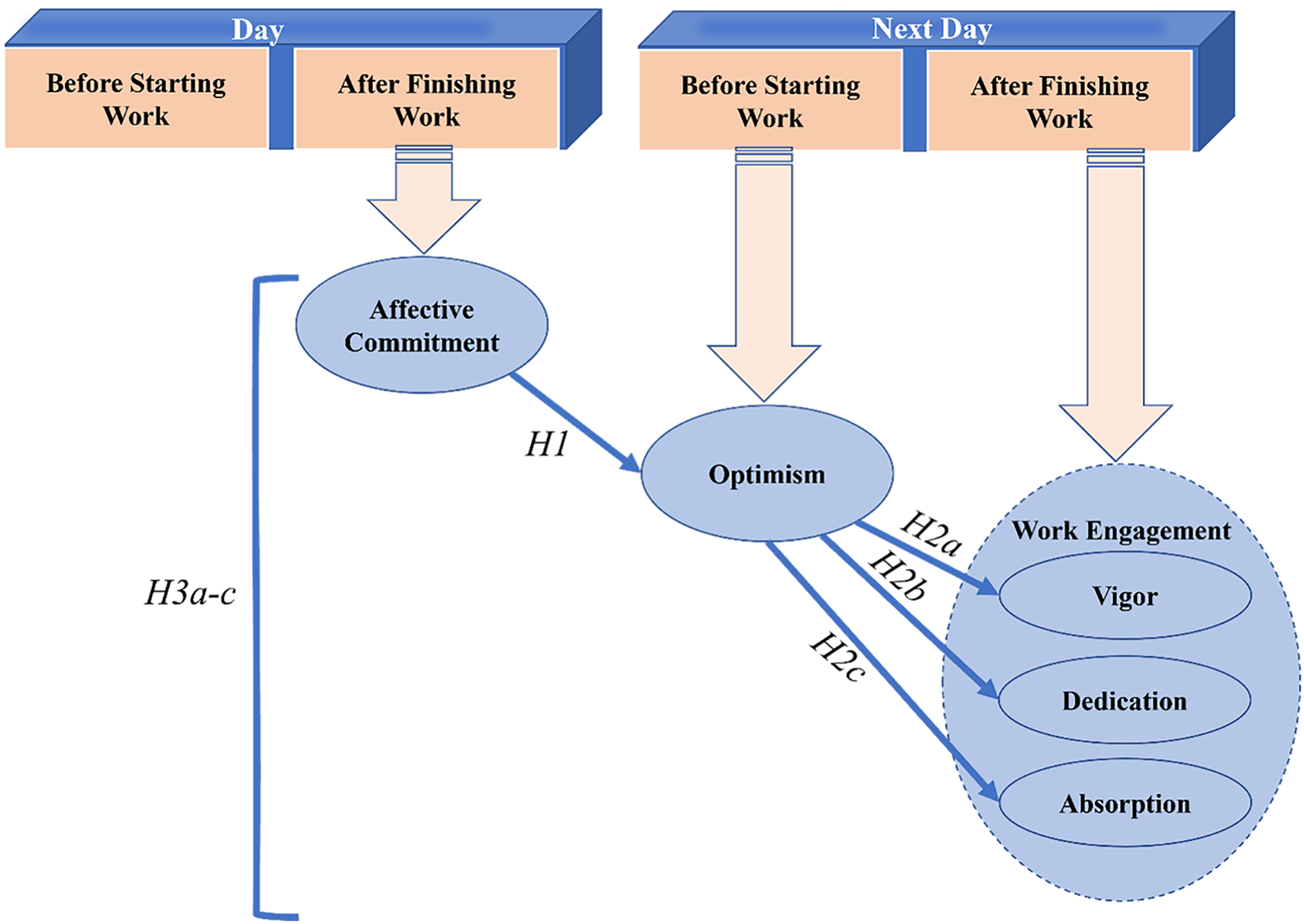
A hypothesized model of daily affective commitment, optimism, and engagement.
Demographic Influences on Work Engagement in Diary Studies
Most diary-based research on daily work engagement consistently shows that demographic factors such as age, gender, education, and tenure have little to no influence on day-to-day variations in engagement (Bakker & Bal, 2010; Bakker & Oerlemans, 2019; Sonnentag et al., 2008; Wang et al., 2023).
Despite these findings, a few studies have noted subtle demographic differences in daily work engagement. Gender in particular has occasionally emerged as a significant predictor. For instance, in a sample of Australian school teachers, Garrick et al. (2014) found that daily work engagement differed by gender—with male teachers reporting higher day–to–day engagement than their female counterparts. A similar pattern was observed by Baethge et al. (2018), who reported that being female was associated with slightly lower engagement both day–to–day and week-to-week when high time pressure was present, whereas male employees showed higher engagement under the same conditions. Age effects, on the other hand, tend to be less consistent. Garrick et al. (2014) noted that older teachers experienced more daily fatigue (acute end-of-day tiredness) than younger teachers, yet age did not significantly predict their daily engagement levels. However, Baethge et al. (2021) found that older workers reported modestly higher engagement across days than younger workers; the authors hypothesized that greater age may be associated with an increased capacity or motivation to remain engaged on a daily basis.
Other demographic and work-related factors such as education, years of experience, or type of work setting (e.g., school type for teachers) have rarely shown any strong influence on engagement fluctuations. For example, Bakker et al. (2015) included age and gender as controls in a student diary study (reasoning that these might influence engagement and performance), but the core within-person relationships were unaffected by these factors. Likewise, in a daily job–crafting study, Bakker and Oerlemans (2019) empirically checked several background variables (e.g., age, gender, education, tenure) and found no meaningful correlations with day-level work engagement or related states, leading them to exclude those variables from their final models. Generally, researchers often account for age, gender, experience, and other personal factors as a precaution, but the day–to–day ebbs and flows of engagement are far more strongly linked to situational and psychological variables than to one's demographic background (Baethge et al., 2018; Garrick et al., 2014; Sonnentag et al., 2008).
Theoretical Foundation
AET serves as a useful framework to explore how everyday experiences at work shape individuals’ emotional responses and subsequent cognitive and behavioral outcomes (Weiss & Cropanzano, 1996). At its core, AET highlights that specific workplace events—whether discrete incidents or ongoing conditions—trigger emotional reactions that fluctuate throughout the workday (Ashkanasy & Daus, 2002; Brief & Weiss, 2002). These emotional fluctuations are important because they directly influence individuals’ psychological states, which in turn affect their attitudes and behaviors on a day-to-day basis (Wegge et al., 2006).
Unlike more stable, cognitive forms of commitment, affective commitment is inherently tied to emotions and is sensitive to the quality of recent work events, making it a key affective state shaped by daily workplace dynamics (Becker et al., 2013). According to AET, these affective states experienced after the workday do not simply fade away but influence employees’ cognitive outlooks at the start of the next workday (Wegge et al., 2006). This temporal connection suggests that a positive affective commitment at the end of one day can foster a more positive cognitive orientation (career optimism) at the beginning of the next day. Career optimism, understood as the expectation of favorable outcomes, functions as a psychological resource that supports motivation and goal-directed behavior throughout the workday (Carver & Scheier, 2014).
Career optimism, shaped by prior emotional experiences, plays a significant role in influencing work engagement, which includes vigor, dedication, and absorption (Schaufeli et al., 2002). AET proposes that cognitive resources like career optimism mediate the relationship between earlier affective reactions and later work-related behaviors. This means that individuals who start their day with higher career optimism are more likely to demonstrate greater energy, commitment, and focus by the end of the day (Junça-Silva et al., 2017). This sequence highlights how affective commitment experienced after work can indirectly impact next-day engagement through its influence on career optimism.
Method
The present study employed a daily diary design—an intensive longitudinal method involving repeated self-reports of experiences as they occur each day (Bolger et al., 2003; Ohly et al., 2010). Diary studies collect data at the daily level (or multiple times per day), allowing participants to report experiences close to their occurrence. This approach improves ecological validity by capturing life as it is lived and is well-suited for examining within-person dynamics. In contrast to one-time cross-sectional surveys, diary methods reduce retrospective bias and reveal short-term fluctuations in mood, cognition, and behavior (Bolger et al., 2003; Ohly et al., 2010). For example, Bolger et al. (2003) note that daily assessments provide more precise estimates of day-to-day variation, and Ohly et al. (2010) emphasize that diary designs enable analysis of within-person processes that static surveys cannot capture. Thus, given our interest in how principals’ end-of-day affective commitment influences next-day career optimism and engagement, a daily diary method was chosen to track these variables in real time across workdays.
Participants
Participants were recruited using a uniform invitation procedure administered across all selected schools. A standardized script and identical written information were provided to every principal to ensure neutrality in communication and to avoid any interpersonal bias. Recruitment procedures were scheduled in ways that minimized disruption to principals’ work routines, in line with recommended practices for diary studies that involve daily participation.
A two-stage cluster sampling strategy was employed to obtain a diverse and methodologically robust sample of principals from primary and secondary schools in Tehran. In the first stage, six educational districts (Districts 2, 4, 5, 6, 18, and 19) were selected from the city's 22 districts in consultation with senior specialists in planning, evaluation, and educational supervision at the Tehran General Department of Education. As the highest provincial authority responsible for overseeing school performance across the full K–12 system, the department maintains administrative datasets that monitor educational quality uniformly across primary and secondary schools. Consultation with system-level experts ensured that district selection reflected the structure of Tehran's educational system rather than privileging any particular school level.
District selection was guided by the department's internal administrative performance reports, which are generated through routine annual and mid–year supervisory cycles. These reports constitute the core accountability mechanism for evaluating school quality in Tehran and include indicators that apply across the K–12 continuum. High–stakes academic indicators—such as results from national final examinations (emteḥānāt nahāʾī) in Grades 9 and 12, acceptance rates into gifted and talented schools (tizhooshān), and district rankings in the national university entrance examination (konkūr)—are complemented by qualitative inspection reports assessing instructional quality, classroom processes, student achievement, average grades, and adherence to curriculum expectations. The six selected districts demonstrated multi-year stability in these performance indicators, providing a coherent and evidence–based first–stage sampling frame.
A second criterion for district selection was socioeconomic heterogeneity. Tehran exhibits substantial spatial variation in socioeconomic resources, which shapes the educational conditions under which principals operate. The General Department of Education maintains internal socio-demographic profiles summarising district-level differences in average household income, housing prices, homeownership rates, and proxies for purchasing power. These indicators correspond with patterns documented in empirical studies of Tehran's socioeconomic stratification and its relationship with educational inequality (Fasihi, 2020). The selected districts encompassed lower-, middle-, and higher-income areas, ensuring that the sampling frame captured the contextual diversity in principals’ work environments. This combined performance-and-SES rationale aligns with international guidelines for multi-stage cluster sampling in educational research, which emphasize selecting heterogeneous but administratively coherent clusters to maximize contextual variance while maintaining equivalence in governance structures (George, 2021; Henderson & Sundaresan, 1982). In the second stage, a complete list of schools within each selected district was obtained, and 120 schools were selected using probability-proportional-to-size random sampling to prevent over- or under–representation of districts. Principals of all selected schools were invited to participate. Of the 120 contacted principals, 119 completed the study and provided usable data (response rate = 99.2%).
All participants were first briefed on the study's objectives and procedures and then received a set of daily diary questionnaires to be completed over five consecutive working days (Saturday through Wednesday), reflecting the Iranian educational calendar. On each of these days, principals received standardized reminder messages via Asanak, an Iranian bulk SMS messaging provider—one reminder before the start of the workday and another after the workday had ended—to prompt timely completion of the morning and evening diary entries. Each questionnaire was marked with a unique ID code so that entries could be matched across days without recording any personal identifiers. To maximize compliance, the research team monitored completion, provided occasional follow-up reminders by phone or email when necessary, and remained available throughout the diary period to address questions.
Ethical approval and formal permission to conduct this study in schools was obtained from the Tehran General Department of Education, the official authority responsible for authorising and overseeing school-based research in the province. Approval was documented in the department's official research authorization letter (No. 3–1000–506). All procedures adhered to internationally recognized ethical principles for human-participant research, including voluntary participation, informed consent, confidentiality, secure data handling, and the right to withdraw at any time. Principals were informed that participation was entirely optional, that their responses would be reported only in aggregate form, and that no identifying personal data would be collected. Completed questionnaires were stored securely and used exclusively for research purposes.
To acknowledge their time and encourage full participation, each principal received a gift card (equivalent to US $50) upon completing all five days of diaries, consistent with recommended incentive practices for diary research (Ohly et al., 2010). A total of 119 school principals completed all questionnaires over the five-day period (N = 119; total observations = 1,190). The sample included 53 males (44.5%) and 66 females (55.5%). The average age of participants was 47.36 years (SD = 11.89), with an average work experience of 10.84 years (SD = 10.46). Among the respondents, 52.9% were employed in secondary schools, while 47.1% worked in primary schools.
Measures
Baseline Measures
Baseline measures were collected once before the diary period.
Baseline Affective Commitment
Principals’ affective commitment was measured using the five-item scale developed by Allen and Meyer (1990). A representative item from this scale is “This school has a great deal of personal meaning for me.”
Baseline work-related career optimism
Principals’ career optimism was assessed using six items based on the Career Optimism subscale of the Career Futures Inventory (Rottinghaus et al., 2005). Sample items included “Thinking about my career inspires me.”
Baseline Engagement
Principals’ work engagement was measured using the short form of the Utrecht Work Engagement Scale (Schaufeli et al., 2006), comprising three subscales: vigor, dedication, and absorption. Each subscale included three items. Sample items include “At my work, I feel bursting with energy” for vigor, “I am enthusiastic about my job” for dedication, and “I get carried away when I am working” for absorption.
Diary Measures
The questionnaires utilized in this study were adapted from well-established and validated scales. To accommodate the demands of daily diary methodology and to reduce participant burden, the number of items and the response time frame were carefully modified (Ohly et al., 2010). In line with methodological recommendations for daily diary research aimed at maintaining construct validity while minimising respondent fatigue, the original instruments were refined to suit repeated daily administration (Ohly et al., 2010; Scharp et al., 2021).
Daily Affective Commitment
Principals’ affective commitment was assessed after work using a five-item scale modified from Allen and Meyer (1990). A representative item from the scale is “Just now, I feel that the school has a great deal of personal meaning for me.”
Daily Career Optimism
Daily career optimism was assessed using three items based on the Career Optimism subscale of the Career Futures Inventory (Rottinghaus et al., 2005). These items were modified to suit the specific context of this study. Sample items included: “I feel excited when I think about my career today.”
Daily Engagement
Daily work engagement was measured using a modified version of the Utrecht Work Engagement Scale (Schaufeli et al., 2006), consisting of three subscales—vigor, dedication, and absorption—with each subscale comprising three items. Sample items included “I felt energetic at work today” (vigor), “I am proud of the things I did at work today” (dedication), and “I was completely absorbed in my work today” (absorption).
Responses for all constructs were recorded on a six-point Likert scale. Furthermore, items were carefully reworded to specifically reflect daily work–related experiences. The reliability of all scales was found to be satisfactory, as reported in Table 1.
Means, Standard Deviations, Intercorrelations, ICC, and Reliabilities (on the Diagonal Between Brackets) of the Study Variables.
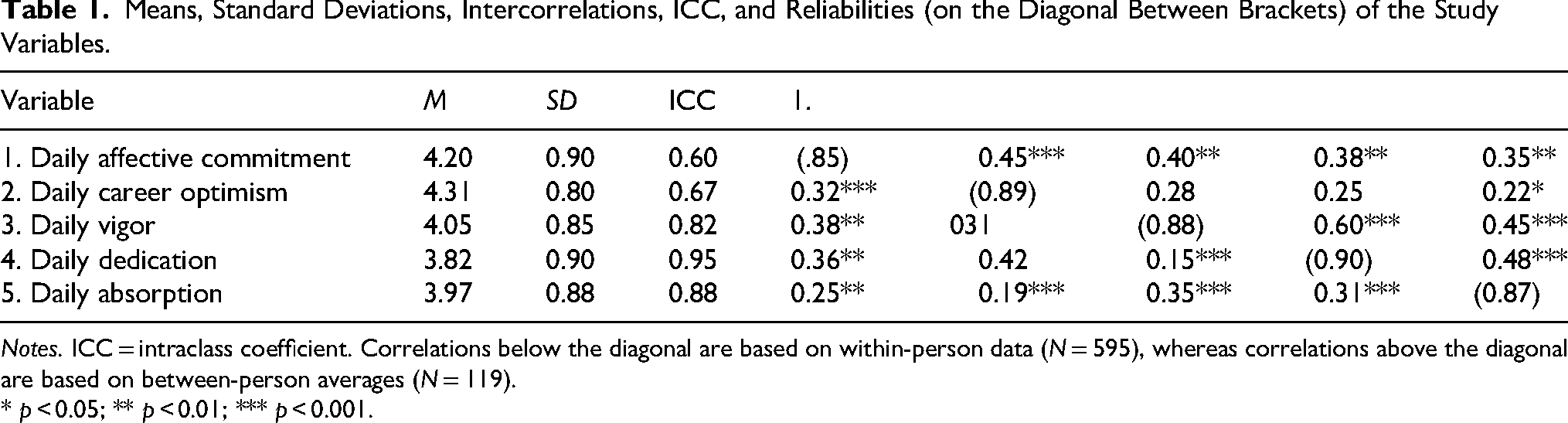
Notes. ICC = intraclass coefficient. Correlations below the diagonal are based on within-person data (N = 595), whereas correlations above the diagonal are based on between-person averages (N = 119).
* p < 0.05; ** p < 0.01; *** p < 0.001.
Prior to the main data collection, the instrument underwent both pre-testing and pilot testing with a sample of 25 school principals who were excluded from the final study cohort. Additionally, five experts in survey methodology and educational technology conducted an independent review of the instrument, ensuring its methodological rigor. This diverse group contributed critical feedback regarding the clarity and relevance of the items. Based on their recommendations, the instruments were refined to fit their language and improve their reliability and validity for the current research.
Analysis Strategy
The diary dataset comprised repeated daily observations nested within principals, with day-level responses (Level 1) clustered within individuals (Level 2). This hierarchical arrangement introduces non–independence among observations originating from the same participant and renders traditional single–level regression models inappropriate due to violated independence assumptions (Raudenbush & Bryk, 2002). Hierarchical linear modeling (HLM) therefore provides the most suitable analytic framework, as it simultaneously partitions within-person variability from stable between-person differences and yields unbiased estimates in clustered data structures (Bolger et al., 2003; Ohly et al., 2010). In the present analyses, Level 1 represented day–to–day deviations in principals’ experiences, whereas Level 2 captured consistent interindividual differences.
This approach is particularly appropriate for distinguishing between-subject effects, such as individual differences in baseline levels of career optimism, and within-subject effects, such as the influence of daily fluctuations in affective commitment on daily levels of career optimism, independent of baseline and prior levels (Snijders & Bosker, 2011). To facilitate interpretation, day-level variables were centered at the person mean, effectively removing between-person variance, while person–level variables were centered at the grand mean (Enders & Tofighi, 2007). This centring strategy ensures that the results reflect within-person dynamics rather than stable differences between individuals (Nezlek, 2008). The analytical approach utilized multilevel modeling to examine growth models, a methodological framework widely adopted for investigating within-person dynamics in repeated–measures designs (Singer & Willett, 2003). This study specifically focused on intraindividual variation by modeling temporal patterns while controlling day-level fluctuations across the five-day observation period (Hoffman, 2015).
The diary data (twice daily for 5 consecutive workdays) were treated as equally spaced measurements. Because participants completed surveys at the same two times each day (upon waking and after work), we defined time as the sequential day index, representing uniform 24–hour intervals across the study. We incorporated time into our multilevel models to account for any overall linear trend in the outcome across the five days. Following Ouweneel et al. (2012), we also tested a quadratic time factor to capture possible curvilinear (nonlinear) patterns over the week (for example, an increase that slows or reverses). Dummy indicators for each day were additionally included to allow for any specific day–to–day effects. Baseline levels and prior–day values of each outcome were also entered as controls to capture between-person differences and autoregressive effects, as recommended in diary studies (Ferron et al., 2010; Nezlek, 2012). To test the mediation hypotheses (Hypotheses 3a–3c), the Monte Carlo Method for assessing mediation (Zhang, 2014) was employed. This method is particularly suited for examining mediation effects in studies where variables are measured at successive time points, as in the present design.
Results
Initial Analysis
Table 1 summarized the means and standard deviations for all variables examined in the study. Initial models included linear day, quadratic day, day–dummy variables, and demographic covariates. We found that the quadratic time term and the day dummy effects did not significantly predict any outcomes beyond the linear time trend, and demographic controls did not alter the key predictor estimates. Consequently, only the linear day variable was retained in the final models; the quadratic and dummy time terms (and demographic covariates) were removed. To quantify the proportion of variance attributable to within-person or between-person sources, the within-person variances of daily career optimism and daily engagement were calculated, as these constructs served as dependent variables in the analysis. Table 1 displays the means, intraclass coefficients (ICCs), standard deviations, and correlations for the variables examined in this study. As indicated by the ICCs in Table 1, between 60% and 95% of the variance in the daily variables is attributable to stable differences between principals, implying that the remaining 5% to 40% reflects within-principal fluctuations across days. These non-trivial within-person components indicate meaningful day-to-day variation in principals’ affective commitment, career optimism, and engagement.
Additionally, we constructed a measurement model designed to assess the construct validity of daily assessment instruments. The results of model fit were acceptable: χ2 (330) = 950.000, RMSEA = 0.06, CFI = 0.94, TLI = 0.90, and SRMR = 0.08. Furthermore, the standardized factor loadings ranged from 0.72 to 0.95, all statistically significant (p < 0.001). This indicates that our daily measures reliably captured the intended constructs, lending confidence to the following analyses.
Model Testing and Hypothesis Evaluation
To empirically test the proposed hypotheses, a series of hierarchical linear models were estimated and compared based on their fit to the data. Initially, a null model was specified, incorporating only the intercept to predict the outcome variable. Subsequently, Model 1 extended this by including time as a covariate, along with the baseline measurement and the previous day's value of the dependent variable to control for temporal and autoregressive effects. The final model (Model 2) further incorporated person–level predictor(s) to evaluate their unique contribution beyond the control variables. Detailed results, including the model fits, parameter estimates for both predictor and control variables, and the proportion of variance metrics by each model, are comprehensively reported in Tables 2 through 5. Table 2 displays the multilevel modeling results for predicting daily career optimism at the start of the next workday.
Multilevel Estimates of Models Predicting Daily Career Optimism at the Beginning of the Next Day.
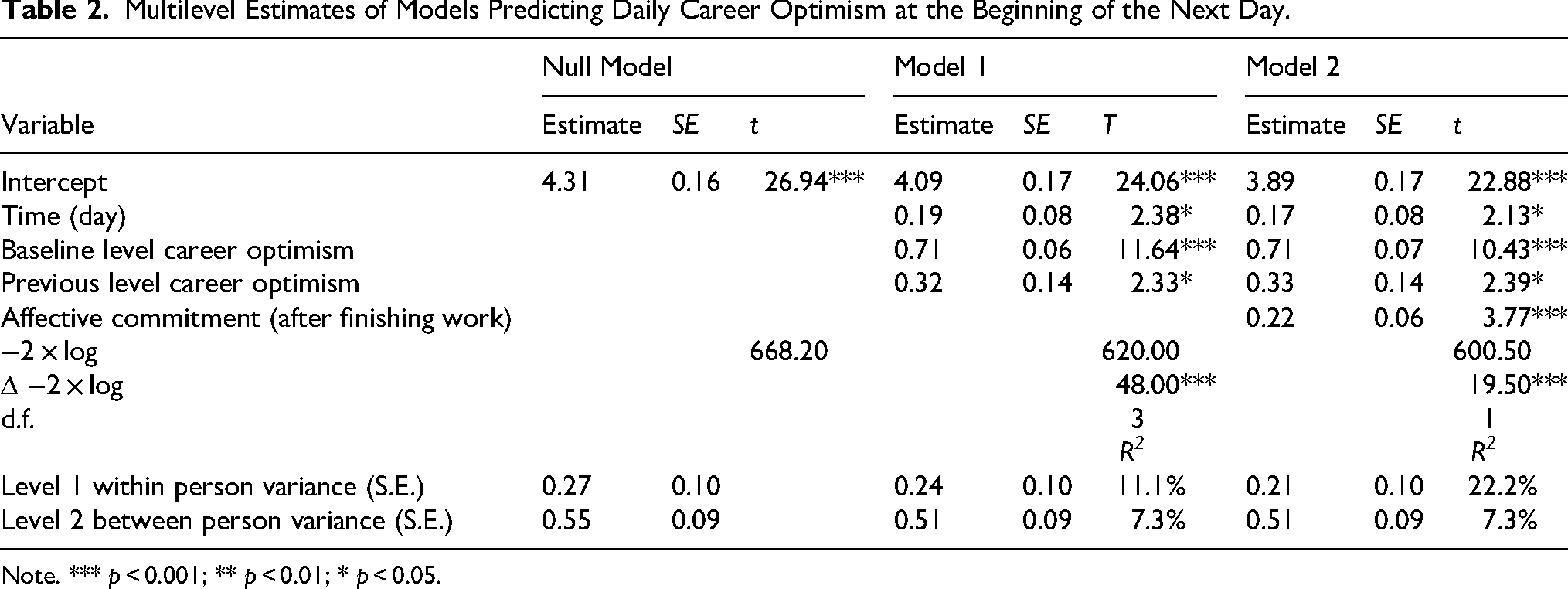
Note. *** p < 0.001; ** p < 0.01; * p < 0.05.
Model 2, which incorporated affective commitment after work, provided the best fit (−2 × log = 600.50), significantly outperforming both the Null Model (Δ −2 × log = 67.70, p < 0.001) and Model 1 (Δ −2 × log = 19.50, p < 0.001). Affective commitment emerged as a significant positive predictor of career optimism (γ = 0.22, SE = 0.06, t = 3.77, p < 0.001), supporting Hypothesis 1. This means that a principal who ends a day feeling deeply connected to their school tends to start the next day with greater optimism about their career. This might manifest as approaching the new day with more ambitious goals or resilience in tackling challenges, because the strong emotional bond with the school has carried over into a positive outlook for tomorrow. Other factors such as time (day), baseline career optimism, and prior career optimism also positively influenced career optimism across models. Collectively, the predictors accounted for 22.2% of within-person and 7.3% of between-person variance in career optimism, indicating that daily variations in affective commitment meaningfully contribute to next-day career optimism.
Table 3 summarizes the models predicting daily vigor at the end of the workday. Model 2, which added affective commitment after work and career optimism before work, improved model fit significantly over the Null Model (Δ −2 × log = 60.00, p < 0.001) and Model 1 (Δ −2 × log = 10.00, p = 0.002). Time, baseline vigor, and prior vigor consistently predicted vigor positively. However, career optimism at the start of the day did not significantly predict end-of-day vigor (γ = 0.02, SE = 0.06, t = 0.31, p = 0.75); thus, Hypothesis 2a was not supported. This suggests that starting the day optimistic about one's career did not automatically translate into feeling more energized by day's end.
Multilevel Estimates of Models Predicting Daily Vigor After the Next Day.
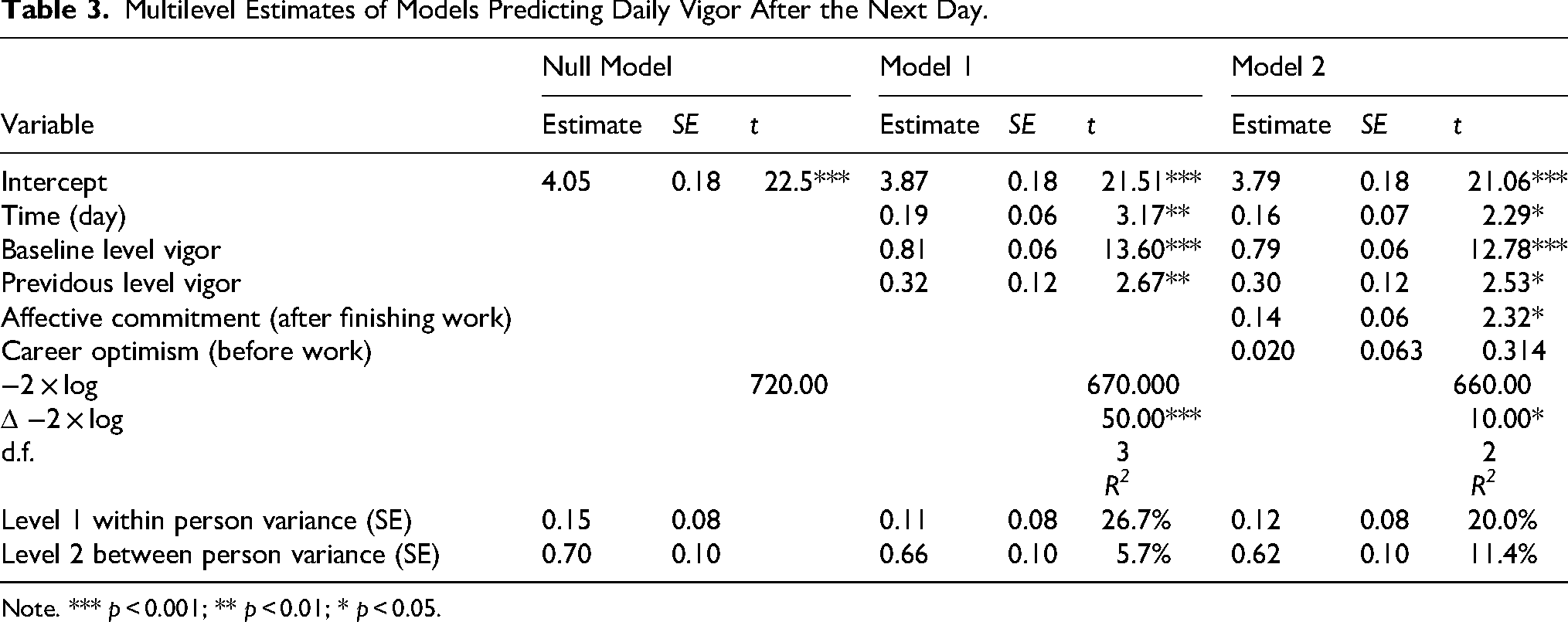
Note. *** p < 0.001; ** p < 0.01; * p < 0.05.
In contrast, affective commitment after work positively predicted vigor (γ = 0.14, SE = 0.06, t = 2.32, p = 0.023), suggesting emotional attachment post-work influences daily vigor fluctuations. Explained variance was 26.7% within–person in Model 1, dropping slightly to 20.0% in Model 2; between-person variance explained increased from 5.7% to 11.4%. In everyday leadership practice, this suggests that when principals move through a day feeling that their school “matters deeply” to them, they are more likely to experience higher energy and persistence in their leadership work, for example, by staying present in classrooms, following through on difficult conversations, and remaining engaged in problem-solving late into the day. In other words, it was the emotional connection to the school that truly fuelled their energy, more so than thinking positively about the future.
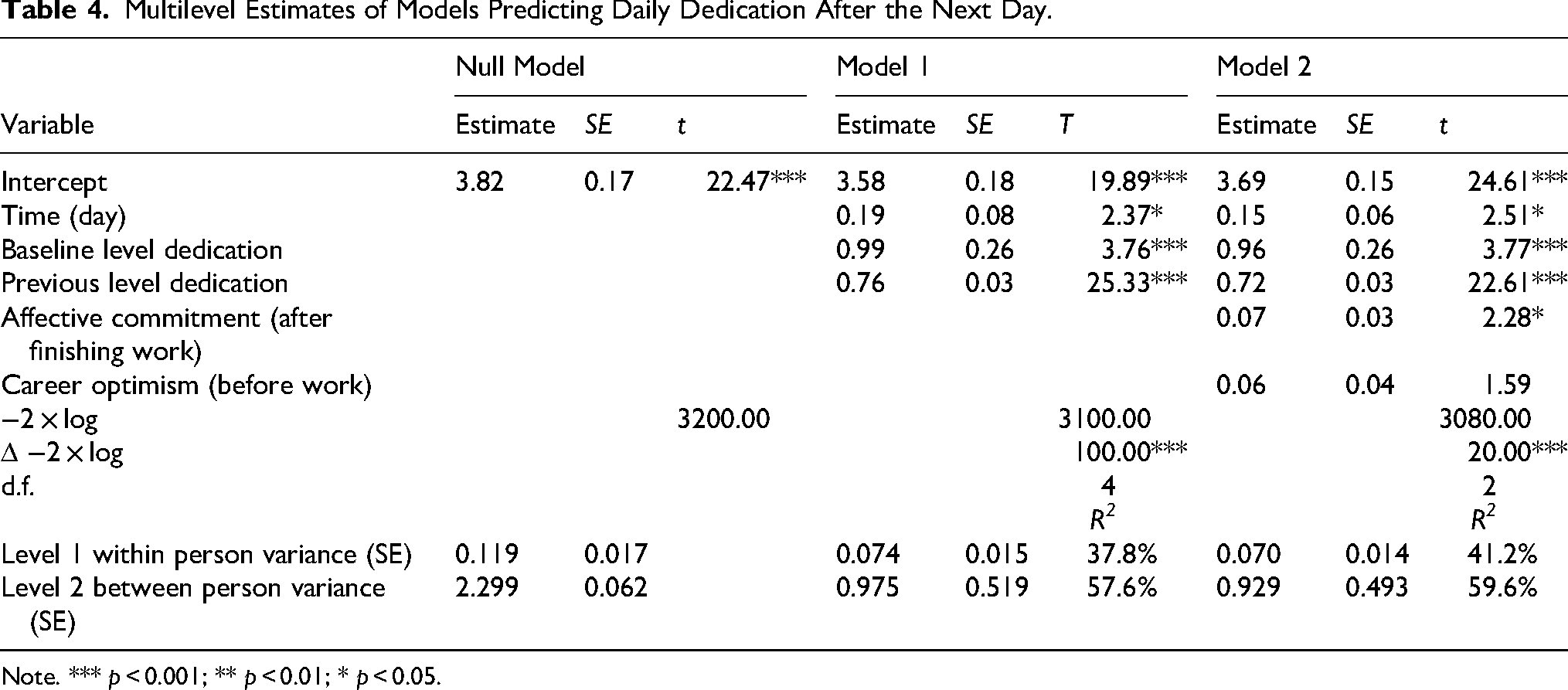
The results in Table 4 focus on daily dedication at day's end. Incorporating affective commitment and career optimism before work in Model 2 significantly enhanced fit relative to the Null Model (Δ −2 × log = 100.00, p < 0.001) and Model 1 (Δ −2 × log = 20.00, p < 0.001). Time, baseline dedication, and previous dedication were robust positive predictors, with baseline and prior dedication showing particularly strong effects (γ = 0.96 and 0.72, respectively, both p < 0.001). Affective commitment positively influenced dedication (γ = 0.07, SE = 0.03, t = 2.28, p = 0.023), indicating that emotional investment in workday experiences fosters dedication. However, career optimism at the start of the day did not have a significant effect (γ = 0.06, SE = 0.04, t = 1.59, p = 0.11), failing to support Hypothesis 2b. This indicates that even when principals began a day feeling optimism, it did not significantly boost how dedicated they felt by day's end.
Multilevel Estimates of Models Predicting Daily Dedication After the Next Day.
Note. *** p < 0.001; ** p < 0.01; * p < 0.05.
The models explained 37.8% and 41.2% of within-person variance and 57.6% to 59.6% of between-person variance, reflecting substantial explanation of individual differences. From a leadership perspective, this means that when principals feel more than usually attached to their school community, they are more likely to experience their work as meaningful and inspiring on that same day—for example, feeling proud of what has been accomplished, experiencing their leadership as significant, and staying psychologically committed to school improvement efforts even when conditions are difficult.
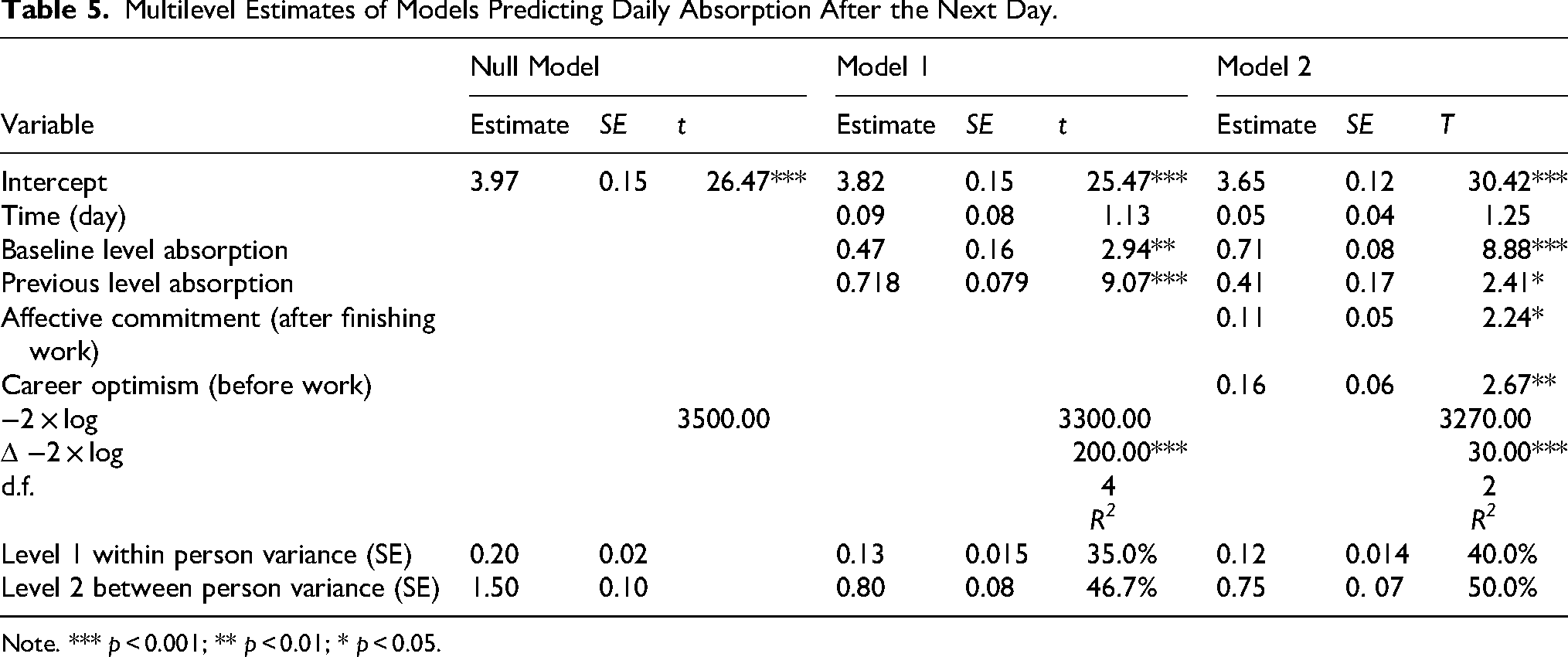
Table 5 presents findings on daily absorption at the end of the workday. Baseline and prior absorption were strong, consistent positive predictors across models (e.g., baseline absorption γ = 0.71, p < 0.001). Model 2, which added affective commitment and career optimism before work, significantly improved fit over both the Null Model (Δ −2 × log = 200.00, p < 0.001) and Model 1 (Δ −2 × log = 30.00, p < 0.001). Notably, career optimism at the start of the day positively predicted absorption (γ = 0.16, SE = 0.06, t = 2.67, p = 0.008), supporting Hypothesis 2c.
Multilevel Estimates of Models Predicting Daily Absorption After the Next Day.
Note. *** p < 0.001; ** p < 0.01; * p < 0.05.
Affective commitment also had a positive effect (γ = 0.11, SE = 0.05, t = 2.24, p = 0.026). Explained variance increased from 35.0% to 40.0% within-person and from 46.7% to 50.0% between-person, underscoring the important roles of career optimism and affective commitment in fostering absorption. In reality, this pattern indicates that when principals start the day feeling optimistic about their career and end the previous day feeling emotionally bonded to their school, they are more likely to become fully immersed in their leadership work.
Table 6 presents findings on mediation analyses using marginal mediation methods that revealed that career optimism at the start of the next working day significantly mediated the relationship between affective commitment after work and daily absorption (indirect effect = 0.035, 95% CI [0.003, 0.067]). However, the indirect effects on vigor (0.004, 95% CI [−0.023, 0.032]) and dedication (0.013, 95% CI [−0.005, 0.032]) were not statistically significant, indicating no mediation via career optimism for these two dimensions. Thus, affective commitment appears to enhance principals’ capacity for deep, focused leadership work partly because it feeds into next–day career optimism, which then makes it easier to concentrate and stay absorbed in demanding leadership tasks; in contrast, principals’ daily energy and enthusiasm seem to depend more directly on how demanding and resourced their workdays are, rather than being channelled primarily through optimism.
Direct and Indirect Effects of Affective Commitment on Vigor, Dedication, and Absorption Through Career Optimism.
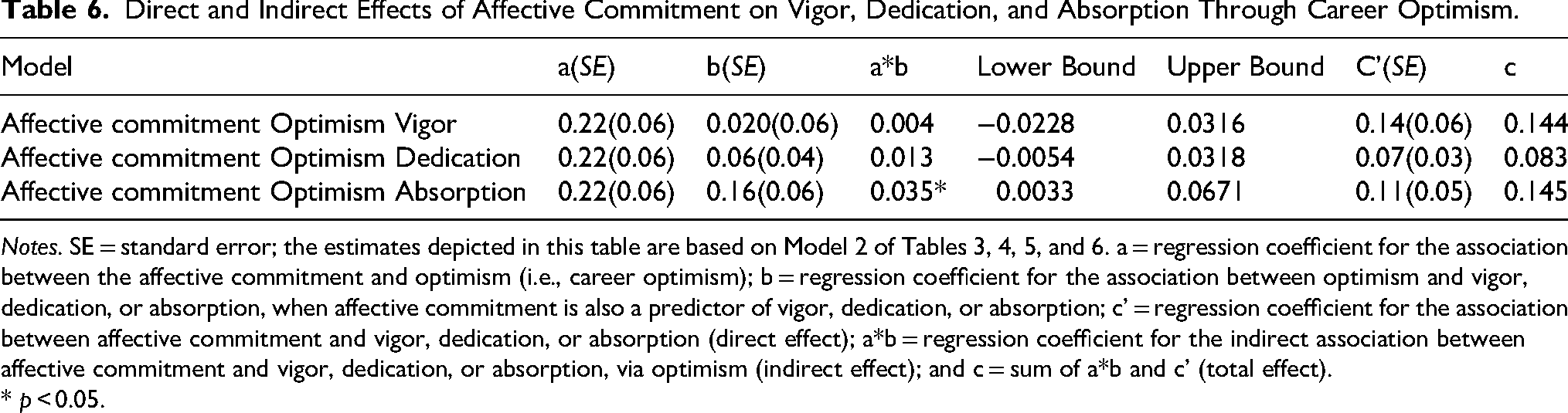
Notes. SE = standard error; the estimates depicted in this table are based on Model 2 of Tables 3, 4, 5, and 6. a = regression coefficient for the association between the affective commitment and optimism (i.e., career optimism); b = regression coefficient for the association between optimism and vigor, dedication, or absorption, when affective commitment is also a predictor of vigor, dedication, or absorption; c’ = regression coefficient for the association between affective commitment and vigor, dedication, or absorption (direct effect); a*b = regression coefficient for the indirect association between affective commitment and vigor, dedication, or absorption, via optimism (indirect effect); and c = sum of a*b and c’ (total effect).
* p < 0.05.
Across outcomes, the final multilevel models explained approximately 20% to 41% of the within-person variance and 7% to 60% of the between-person variance (Tables 2–5). For career optimism and vigor, the models accounted for more variance at the within-person level than at the between-person level, whereas for dedication and absorption, the between-person R2 values exceeded the within-person R2 values. This findingindicates that principals’ daily psychological states are shaped both by stable individual differences and by meaningful day-to-day fluctuations.
In summary, the multilevel models show that principals’ emotional attachment to their school and their day-to-day optimism about their career are not abstract psychological tendencies but daily leadership resources. When these resources are higher than usual, principals are more energetic, more dedicated, and especially more deeply absorbed in their work. These daily shifts describe how principals’ inner experiences translate into visible leadership—how they show up in classrooms, support teachers, respond to crises, and sustain the demanding work of school improvement from one day to the next.
Discussion
This diary study explored the daily within-person relationships between affective commitment, career optimism, and the three dimensions of engagement (vigor, dedication, and absorption) among school principals in Iran.
Daily Dynamics of Affective Commitment and Optimism
Our findings support Hypothesis 1, which posited that affective commitment at the end of a workday would predict career optimism at the beginning of the next day. This aligns with AET, which suggests that affective experiences at work shape individuals’ cognitive evaluations and expectations for future events (Weiss & Cropanzano, 1996). A possible explanation for this dynamic is that emotional reactions, such as affective commitment, lead individuals to evaluate their work experiences and subsequently change their expectations for the following workday (Stone et al., 2006). Specifically, affective commitment may foster the belief that they may achieve the goals they have set for themselves, thereby positively influencing their level of career optimism (Ghasemzadeh et al., 2020). When principals feel emotionally attached to their schools at the end of a workday, they are more likely to appraise the upcoming day positively, fostering a sense of career optimism. This cognitive appraisal process is consistent with prior research showing that positive emotional states enhance individuals’ expectations for future success (David et al., 2024; Lyubomirsky et al., 2005). Research has shown that positive affective experiences, such as emotional attachment to one's organization, enhance cognitive resources like career optimism, which in turn influence work-related behaviors (Fredrickson et al., 2008). In educational leadership, principals who feel emotionally connected to their schools are more likely to perceive challenges as opportunities for growth, further reinforcing their optimistic outlook (McGuigan & Hoy, 2006). This may suggest that a principal who leaves work on a positive note—for example, after a successful teacher meeting or a grateful interaction—may wake up the next day feeling more optimism and energized to tackle new challenges. Positive leadership perspective further suggests that these positive emotional connections serve as psychological capital, broadening principals’ perspectives and building their resilience (Shahid & Muchiri, 2019), which aligns with our finding that end–of–day commitment feeds next–day optimism.
However, the strength of this relationship may be influenced by the specific context of Iranian school principals. The Iranian educational system is characterized by evolving policy demands, economic instability, resource constraints, bureaucratic complexities, and high societal expectations for educational outcomes (Tamadoni et al., 2024). In such settings, affective commitment may act as a protective factor, helping principals maintain a positive outlook despite daily adversities (Kouhsari et al., 2023). Additionally, the collectivist cultural norms prevalent in Iran emphasize interpersonal relationships and emotional bonds, which may improve the impact of affective commitment on career optimism. Research in similar high-stress environments has shown that emotional attachment to one's organization can mitigate the negative effects of job stress and enhance adaptive cognitive resources (De Pedro et al., 2018). These contextual factors highlight the importance of emotional investment in fostering career optimism among Iranian school principals. For Iranian principals, who often rely on intrinsic motivation and emotional resilience to navigate their roles, affective commitment may be particularly critical in fostering next-day career optimism (Sennun, 2002). Positive leadership scholarship similarly highlights that in challenging conditions, qualities like trust, compassion, and hope are essential to sustain leaders’ well-being and optimism (Cann et al., 2021; Goetz et al., 2024).
Temporal Relationship Between Optimism and Engagement
Our study revealed that career optimism at the start of the workday significantly predicted end-of-day absorption (H2c) but not vigor (H2a) or dedication (H2b). These results suggest that optimism operates differentially across the dimensions of engagement, with its impact being strongest on absorption. Career optimism as a cognitive and emotional resource enhances individuals’ ability to focus and persist in tasks by fostering positive appraisals of challenges and promoting a sense of control (Carver & Scheier, 2014). This positive expectancy of outcomes likely facilitates absorption. Empirical evidence from organizational studies supports this, showing that optimistic individuals are more likely to experience deep concentration and task absorption (e.g., Salminen et al., 2014). Vittorio's (2024) study revealed that career optimism reduces distractions and negative thoughts, enabling individuals to fully immerse themselves in their work. This implies that strategies boosting career optimism—such as setting attainable goals or reflecting on past successes (Kulophas & Hallinger, 2020)—might help principals become fully absorbed in demanding tasks like curriculum planning or solving student issues by heightening their focus. This aligns with positive leadership principles that emphasize cultivating positive emotions and meaning to deepen engagement: leaders who foster positive expectancy and purpose tend to be more fully absorbed in tasks (Goetz et al., 2024).
The nonsignificant relationships between career optimism and vigor or dedication may be due to the distinct nature of these engagement dimensions. Vigor, characterized by physical and mental energy, may be more strongly influenced by physiological and situational factors rather than cognitive resources like career optimism (Blume & Dettmers, 2024). Similarly, dedication, which reflects a sense of pride and enthusiasm for one's work, may be more closely tied to job characteristics than to career optimism (Harzer & Ruch, 2014; Rudolph & Zacher, 2025). Although optimism can enhance positive appraisals of tasks, it may not inherently create the conditions necessary for dedication. Career optimism may enhance mood but fail to be translated into a profound sense of enthusiasm or significance (Bunjak et al., 2022). While several studies support the positive effect of career optimism on vigor and dedication (e.g., Rotich, 2020; Salminen et al., 2014), other research has shown nonsignificant or inconsistent relationships between career optimism and these engagement dimensions (e.g., Cheng et al., 2014; Roux, 2010). The non–significant relationships with vigor and dedication highlight the limitations of career optimism in addressing the complex, multidimensional demands of these constructs. Positive leadership perspectives suggest that increasing vigor and dedication may require holistic support like promoting well-being, autonomy, and purpose (Murphy & Louis, 2018).
In the Iranian context, the differential impact of career optimism on engagement dimensions may reflect the unique stressors faced by school principals. The high demands of the role, coupled with systemic challenges, may limit the extent to which career optimism can enhance energy (vigor) or enthusiasm (dedication). However, career optimism may still facilitate absorption by providing a cognitive buffer against distractions, enabling principals to maintain focus despite external pressures—a dynamic that aligns with the cultural emphasis on resilience and perseverance (Soleimani et al., 2024). This highlights the need for interventions designed for Iran's context, such as stress-management training and resource support, to complement optimism's benefits and help principals sustain vigor and dedication under pressure (Kouhsari et al., 2023). Positive leadership research in Iran suggests integrating local cultural strengths (e.g., community values and faith) into leadership development, illustrating how culturally adapted positive practices bolster commitment and focus (Hakkak et al., 2021; Javadian et al., 2019).
Mediating Role of Optimism in Engagement
The mediation analyses revealed that career optimism at the start of the workday significantly mediated the relationship between affective commitment after work and daily absorption (H3c) but not vigor (H3a) or dedication (H3b). The significant mediation for absorption aligns with the notion that affective commitment enhances cognitive resources, which in turn foster task immersion (Rotich, 2020). Affective commitment, by reinforcing principals’ emotional connections to their schools, likely enhances their career optimism, enabling them to approach tasks with greater focus and engagement. Previous empirical evidence has shown that affective commitment indirectly influences absorption through cognitive resources like career optimism (e.g., Sekhar, 2022). The lack of mediation for vigor and dedication may be attributed to the distinct mechanisms underlying these dimensions. Career optimism may function as a resource caravan passageway that facilitates the acquisition of cognitive resources, thereby potentially enhancing absorption (Salminen et al., 2014). Nonetheless, when physical and emotional resources are depleted due to work demands, career optimism might be insufficient to fully offset such losses, which could explain its limited mediating role in relation to vigor and dedication. From a positive leadership angle, this suggests that strengthening leaders’ affective bonds and hope can create a self-reinforcing loop of focus and immersion (Lanaj et al., 2023).
Cheng et al. (2014) revealed that optimism's influence may be necessary but not wholly adequate for maintaining a full range of engagement dimensions, particularly those involving energetic and affective components. Absorption is often conceptualized as a task-specific state characterized by deep immersion in a particular activity (Bakker & Bal, 2010). Optimism, through the enhancement of positive outcome expectancies, may contribute to this focused form of engagement. Conversely, vigor and dedication are understood as more comprehensive forms of engagement that encompass broader emotional and energetic investment in work overall (May et al., 2004). These dimensions may depend on sustained motivational and physiological resources, which career optimism alone may not sufficiently support (Cheng et al., 2014). These findings suggest that while career optimism mediates task-specific outcomes, its role in broader dimensions of engagement may be context-dependent.
In the Iranian context, the mediating role of career optimism for absorption may reflect principals’ need for cognitive resources to address complex and demanding roles. Absorption, as a state of deep focus, is particularly valuable in environments characterized by uncertainty and resource constraints (Tamadoni et al., 2024). However, the lack of mediation by career optimism (for vigor and dedication) may reflect the specific demands of the Iranian educational context. In a resource-constrained environment, principals’ energy levels and sense of pride may be more strongly influenced by external factors, such as the availability of resources or the support they receive from their communities. Positive leadership perspectives would interpret this as a cue to supplement cognitive interventions with holistic support; for instance, enhancing community engagement and providing tangible support aligns with positive leadership's emphasis on serving others (Driscoll & McKee, 2007), which could in turn boost principals’ overall energy and dedication.
Theoretical Implications
The findings of this study contribute significantly to the theoretical understanding of how daily affective and cognitive processes influence work engagement in school leadership, particularly through the lens of AET. The significant relationship between affective commitment and next–day optimism supports AET's proposition that affective experiences at work influence cognitive appraisals and expectations for future events. This extends the theory by highlighting the complex and temporal nature of these relationships, showing that principals’ emotional attachment to their schools at the end of a workday fosters a positive outlook at the start of the next day. The study also contributes to the literature on work engagement dimensions by demonstrating that it varies significantly within individuals over short time periods. This aligns with recent research emphasising the importance of within-person fluctuations in work–related well-being (e.g., Albulescu et al., 2025). By understanding these daily dynamics, our study provides more understanding of how principals’ engagement behaviors are shaped by their emotional and cognitive resources. In line with the positive school leadership perspective (Murphy & Louis, 2018), our results suggest that everyday positive interactions and commitments serve as building blocks of leaders’ flourishing; attending to these micro-moments can enrich leadership frameworks by integrating concepts of strengths and well-being.
Practical Implications
The daily dynamics identified in this study suggest several concrete implications for strengthening principals’ day-to-day leadership functioning. A central pattern is that end-of-day affective commitment shaped next-morning career optimism, indicating that the emotional meaning principals attach to their school at the close of each workday plays a significant role in how they cognitively approach the next. This temporal linkage highlights the value of attending to principals’ end-of-day experiences, a period rarely considered in policy or leadership preparation. Practices that help principals finish the day with a sense of direction, contribution, or relational connection may reinforce the cognitive expectations they carry into the following morning. Prior work shows that meaning-focused reflection can consolidate positive evaluations of workdays (Fisher & To, 2012), and such short, structured routines could be adapted to leadership contexts—for instance, through brief end-of-day summaries emphasising progress on instructional goals or successful interactions with teachers (Tamadoni et al., 2024). These routines are not peripheral “add-ons”; they map directly onto the sequence observed in this study, where commitment today feeds optimism tomorrow, ultimately influencing how principals engage with their work.
The finding that morning career optimism predicts same–day absorption but not vigor or dedication carries additional practical implications. Optimism is theorized as a future-oriented expectancy that shapes goal pursuit and cognitive investment (Carver & Scheier, 2014), and the diary evidence suggests that it facilitates becoming deeply immersed in leadership tasks. This pattern implies that practices designed to activate optimism—such as reviewing long–term objectives, recalling previous successes, or identifying strategic priorities for the day—may be most beneficial when principals anticipate tasks requiring sustained focus. However, because optimism did not enhance vigor or dedication, these latter aspects of engagement may depend more on contextual or structural supports (Bakker & Demerouti, 2017), such as manageable administrative loads, protected time for instructional work, or adequate staffing. The implication is not that optimism-building routines are ineffective, but rather that they have specific rather than global effects on engagement and should therefore be aligned with particular categories of leadership work.
The diary method itself also offers insight into how leadership support can be structured. Principals’ successful completion of twice-daily assessments over consecutive workdays illustrates that brief, regular self-monitoring is feasible even in demanding school contexts. Research on daily reporting indicates that such micro-reflection can increase leaders’ awareness of patterns in their own cognitive and emotional processes (Bolger et al., 2003; Uy et al., 2010). For school systems and leadership development programs, incorporating short diary-inspired checks could help principals track fluctuations in commitment, optimism, and engagement and identify the events that systematically shape their daily functioning. When used for developmental purposes, these data can support more targeted coaching conversations, helping principals examine how specific meetings, interactions, or administrative pressures influence their capacity to remain engaged across days. Positive education and leadership initiatives often incorporate similar reflective practices, suggesting that guiding individuals to record not only challenges but also successes each day could reinforce their strengths and well-being (Seligman, 2015).
These temporal patterns also speak to leadership policy. If affective commitment, optimism, and engagement shift meaningfully from one day to the next—as shown in this study—then policies and supports that operate only on monthly, quarterly, or annual cycles fail to address the variability that shapes principals’ real-time leadership behavior. System-level decisions that attend to the daily rhythm of principals’ work may better support consistent engagement. For example, avoiding the clustering of major administrative demands across consecutive days may reduce sequences of low end-of-day commitment that compromise next-day optimism. Similarly, leadership preparation programs could incorporate structured multi-day reflection exercises to help principals identify the recurring conditions under which their engagement is strengthened or depleted. By aligning system supports with the timescale on which principals’ psychological resources fluctuate, policy can more directly sustain their daily leadership performance.
Finally, these implications should be interpreted with attention to context. The sample consisted of principals in Tehran, operating in a high-pressure, resource-constrained environment. While the mechanisms identified here are consistent with the AET and self-regulation perspectives on optimism (Carver & Scheier, 2014), their application may require adaptation in schools with different structural or cultural conditions. Nonetheless, a central insight holds across contexts: principal support strategies are likely to be more effective when they address the processes unfolding within days and across successive days, rather than focusing solely on stable traits or long-term averages. Such an approach aligns leadership development and policy with the lived temporal structure of principals’ work. Positive leadership research in Iran stresses that spiritual and cultural factors deeply shape how positivity is experienced, suggesting that interventions should incorporate local values and beliefs about resilience and hope (Ahmadnia & Shad, 2017; Hakkak et al., 2021).
Methodological Implications
This study offers important methodological contributions by demonstrating the value of employing a daily diary approach to capture the dynamic and temporal aspects of school principals’ affective and cognitive experiences. Firstly, this study is among the first (as far as we know) to utilize a daily diary methodology in the school principals’ domain, providing valuable methodological insights for educational leadership research. By capturing principals’ experiences and psychological states in real time, this approach reduces recall bias and enables the examination of within-person dynamics often overlooked by cross-sectional or retrospective designs. Secondly, employing a daily diary design allowed us to capture complex within-person variations in affective and cognitive states related to work engagement. By controlling for baseline levels and previous-day values of outcome variables, we isolated the unique effects of daily affective commitment and career optimism. Finally, this study highlights the importance of a daily perspective on work engagement in school principals. While prior research often treats principal work engagement as a stable trait, our findings demonstrate significant within-person fluctuations over short periods, aligning with recent studies emphasising the dynamic nature of work-related engagement in non–educational settings. This emphasis on daily experiences echoes positive education methods that encourage frequent reflection to build self-awareness and resilience.
Although the quantitative diary design represents a key strength of this study, several limitations should be acknowledged when interpreting the results. This research depended on self-report data, which can potentially inflate common method variance (Podsakoff et al., 2003). Nonetheless, the presence of such variance does not automatically compromise the validity of our findings. We mitigated substantial method bias by employing well–validated instruments characterized by strong construct validity, demonstrated through reliable coefficients and clear factor structures, in line with recommended standards (Conway & Lance, 2010). Future studies would benefit from adopting longer–term longitudinal diary designs incorporating multiple methods, such as gathering data from diverse sources like colleagues and teachers, to better capture how these daily dynamics shape long-term outcomes, offering a fuller picture of the principalship in challenging contexts. Future research may also consider examining other cognitive resources—such as hope or self-efficacy—to determine whether they play complementary roles in principals’ day-to-day functioning.
Conclusion
What unfolded in this research was a tapestry of emotional and cognitive processes, woven into the fabric of daily leadership. Affective commitment, that deep emotional bond principals feel toward their schools, proved to be more than a fleeting sentiment—it was a beacon, guiding them toward a brighter outlook for the next day. In the Iranian context, where economic instability and resource constraints often loom large, this emotional attachment became a lifeline, fostering resilience and a sense of purpose. The diary method, with its ability to capture the ebb and flow of daily experiences, revealed a striking truth: optimism, born from this commitment, did not merely lift spirits—it sharpened focus. Principals who began their day with career optimism were more likely to lose themselves in their tasks, fully absorbed in the work that defines their roles. Yet, this optimism did not fuel vigor or dedication in the same way, a reminder that energy and enthusiasm are shaped by forces beyond positive thinking alone.
In a challenging environment marked by systemic pressures, these findings reveal the profoundly human side of educational leadership. The emotional investment principals hold, paired with a hopeful orientation toward the future, becomes a quiet but enduring force that carries them through adversity. It is a testament to their capacity to remain steady, even when the odds seem immovable. And within this steadiness lies the living pulse of positive leadership—the kind that does not announce itself through grand declarations but through the emotional clarity and composure leaders bring into each ordinary day. It is a reminder that even in the most demanding circumstances, optimism and connection can illuminate a way forward, shaping a future that feels possible rather than predetermined. These daily emotional movements—subtle, often unseen—form the true architecture of how leaders influence their schools, not through dramatic acts of authority but through the tone, presence, and meaning they cultivate moment by moment. This study invites us to see leadership not as a fixed role but as a dynamic journey, animated by the shifting inner landscapes that guide each day's decisions, actions, and hopes.
Footnotes

Funding
The authors received no financial support for the research, authorship, and/or publication of this article.
Declaration of Conflicting Interests
The authors declared no potential conflicts of interest with respect to the research, authorship, and/or publication of this article.