







Abstract
Purpose
This study investigates the language urban PK-12 superintendents use to frame the orthography of the wake. The orthography of the wake is the widespread media circulation of Black social, material, and psychic death, exemplified by the murder of George Floyd. Although superintendents are often tasked with framing how their school systems respond to crises, there is a lack of leadership preparation to respond to the orthography of the wake. Given the recurring deaths of Black Americans in police interactions, superintendents should be better equipped to respond to this issue. Analyzing superintendent statements and their framing of the orthography can better prepare leaders to support Black communities in these situations.
Methods
This study examines the public statements of 51 urban PK-12 superintendents in response to George Floyd's murder. It applies Black annotation and redaction to investigate how superintendents’ language humanizes or marginalizes Black life. A frame analysis approach is used to assess the beliefs and actions articulated by superintendents when discussing the orthography of the wake.
Findings
The superintendent's diagnostic frames reflect a range of beliefs that directly discuss and avoid the orthography. Their prognostic frames advocate engaging in actions such as reflective conversations, reading learning resources, and examining policies, often centered around values including equity, anti-racism, and racial violence.
Implications
This study argues that superintendents must develop a deeper awareness of the orthography. Furthermore, their actions should move beyond general discussions of equity and anti-racism to specifically address the orthography in ways that directly support Black communities.
Introduction
On May 25, 2020, Minneapolis Police Officer Derek Chauvin murdered George Floyd, an unarmed Black man. Chauvin restrained Floyd by pressing his knee on Floyd's neck for over nine minutes despite pleas that he could not breathe. The killing prompted media outlets to report on the event, epitomizing what Sharpe (2016) describes as The Orthography of the Wake (hereinafter “Orthography”), or the widespread reporting of Black social, material, and psychic death from everyday or extraordinary events (Sharpe, 2016). Sharpe's (2016) concept of the Wake—how the enduring legacies of slavery continue to shape the lived experiences of Black Americans, analogous to the turbulent water trail left in the path of a moving ship—serves as a conceptual foundation for the Orthography. The Orthography can be traced back to the time of slavery, as reports document Black Americans being killed or otherwise inhumanely treated by state forms of law enforcement (Moore et al., 2018; Robinson, 2017). Scholars argue that the legacy of chattel slavery persists similarly to the way violence against Black bodies and the taking of Black lives remain ongoing issues since the slave trade ended (Hartman, 2008; Sharpe, 2016; Wilderson, 2010).
Sharpe (2016) argues that a remnant of slavery in contemporary society is the continued murder and inhumane treatment of Black Americans by society and law enforcement. Though devastating, the orthography is visible in contemporary media coverage, where police violence against Black Americans and their deaths have become tragically routine. Media reports about the deaths of Michael Brown, Philando Castile, Breonna Taylor, Atatiana Jefferson, and Tamir Rice, among others, exemplify the repeated police violence faced by unarmed Black Americans. These are not isolated incidents, as research consistently demonstrates that police disproportionately kill Black individuals (Chaney & Robertson, 2015; Thomas et al., 2021). Floyd's murder intensified widespread emotional and psychological trauma, with Black Americans experiencing the highest levels of depression and anxiety in its aftermath (Eichstaedt et al., 2021). This trauma extends to Black youth, whose emotional well-being is significantly harmed by witnessing such violence, whether directly or through media reports (Dreyer et al., 2020; Staggers-Hakim, 2018).
Within days of Floyd's murder, urban PK–12 superintendents publicly responded to the reports of his death by issuing statements that interpreted the incident and described how their school systems would respond. The way social actors frame an issue helps audiences make sense of their experiences by attaching beliefs to an issue that may guide their actions (Goffman, 1974). Snow and Benford (1988) identify three types of frames: diagnostic frames define a problem, prognostic frames propose actions or solutions, and motivational frames inspire or mobilize people to act. Scholars argue that superintendents frame issues for their school communities by articulating problems, advocating solutions that create pathways for action, and motivating collective response (Park et al., 2013; Woulfin et al., 2016). However, prior research suggests that superintendent framing can contain contradictions that obscure both the nature of the problem and the proposed solutions (Woulfin et al., 2016).
Analyzing the presence of contradictions in how urban superintendents frame Floyd's murder is particularly important to consider, as the language these leaders utilize may or may not appropriately respond to harm or catalyze systemic change for Black communities. This study focuses on urban PK–12 superintendents for two reasons: first, superintendents will most likely describe the district's vision and respond to crises or racial incidents (Bishop et al., 2015; Bridgeforth, 2021; Tienken, 2021); second, urban superintendents lead school systems where social factors profoundly impact school operations (Milner, 2012). Urban superintendents are uniquely positioned to respond to violence directed at the Black community because they play a crucial role in accurately representing and supporting their communities after reports of violence against Black Americans. While existing studies have explored how superintendents frame issues (e.g., data-driven, decision-making, and teacher evaluation policy [Park et al., 2013; Woulfin et al., 2016]), no research has addressed how these leaders frame the Orthography. This gap is critical to fill given the routine exposure of school communities to media outlets reporting violence perpetrated against Black communities in urban centers and the lack of leadership preparation superintendents receive for addressing such incidents.
Sharpe (2016) calls for a critical analysis of public responses to the Orthography, arguing that such messages often claim to humanize Black life while ultimately demonstrating a disregard for it. This study draws on Sharpe's (2016) concepts of Black annotation and redaction to analyze how urban superintendents framed Floyd's murder. Black annotation and redaction involve evaluating whether a message demonstrates disregard for Black life by examining how it shapes what audiences are encouraged to do, think, or feel in response to violence directed at Black communities (Sharpe, 2016). When these responses demonstrate disregard for Black life, annotation (adding to) and redaction (subtracting from) become strategies for imagining a message that affirms and supports Black communities.
Nixon and colleagues (2022) illustrate this approach in a youth participatory action research project in which young people conducted a photovoice study examining school personnel's responses to racial incidents involving Black and Indigenous youth. Students staged and photographed images in response to prompts such as, “How are school staff responding to more overt forms of racism?” (p. 134) and “Take a photo that conveys where a student might have been had they not been pushed out” (p. 138). In one image depicting students being pushed out, a student stood in front of the school doors. After taking the photo, the youth engaged in redaction “(by covering or cutting parts of the photograph) and added to their image (by drawing or writing upon the image)” (p. 138). The final edited image removed the student entirely, leaving a white space in front of the school building to symbolize exclusion due to racialized interactions with school personnel. In other images, added text conveyed students’ unease about responding to interpersonal racism. The project culminated in youth-generated recommendations for school staff, ranging from acknowledging racial harm to increasing funding for diverse student organizations and supportive spaces.
This study examined how superintendents defined Floyd's death and the actions they proposed in response, identifying contradictory framing that may signal a disregard for Black life. After identifying these contradictions, the statements were annotated and redacted. This process provided insight into how superintendents might craft framing that more explicitly supports and affirms Black communities. Methodologically, the study employs frame analysis (Lindekilde, 2014) to identify how 51 urban superintendents framed their responses to George Floyd's murder. Frame analysis is well-suited to this study because it breaks statements into distinct elements to identify how a social actor defines a problem and proposes actions to address it. Frame analysis was employed to examine urban superintendents’ statements, distinguishing diagnostic framing, which defined Floyd's murder, and prognostic framing, which articulated the proposed actions in response. Guided by this approach, the study investigated the following questions:
Although urban PK–12 superintendents did not use the term Orthography, their diagnostic framing of reports about Floyd's murder reflected a continuum of responses, ranging from avoiding direct discussion of anti-Black violence to explicitly naming the murder of a Black American. The actions and solutions they proposed included facilitating reflective conversations, promoting educational resources, and examining existing policies and practices. This study underscores the importance of urban PK–12 superintendents intentionally framing such instances of violence against Black communities in ways that are more clearly supportive and affirming.
Literature Review
Policing and the Orthography of the Wake
Policing is historically and structurally connected to the ongoing violence directed at Black communities. Modern policing has its roots in slave patrols, which protected the financial interests and safety of White Americans from slaves and free Black Americans (Robinson, 2017). Once slave ships landed, slave patrols protected White Americans through constant surveillance and inhumane treatment, such as whipping and mutilation, to control slaves and free Black Americans (Moore et al., 2018; Robinson, 2017). Reports of unarmed slaves being murdered by state-sanctioned slave ships can be traced as early as 1619 (Robinson, 2017). After the abolition of slavery, police departments emerged throughout the 1800s in urban centers to protect White American interests from a growing number of African Americans and immigrants (Potter, 2013). Robinson (2017) demonstrates the commonality of police brutality in urban centers to break up riots challenging unfair employment practices among immigrants and minorities in the 1880s. Sharpe (2016) draws a connection between policing and the Orthography, emphasizing the disproportionate killing of unarmed Black Americans and the persistent over-surveillance of Black communities. Sharpe (2016) argues that these practices contribute to racial disparities in the United States criminal justice system, where Black citizens comprise approximately 60% of the incarcerated population despite representing a significantly smaller share of the general public.
Violence directed at Black communities extends into urban school systems through the presence of police, especially in documented incidents involving school resource officers. Whittenberg and colleagues (2022) report that since 2011, Black students have endured 84.4% of police assaults in PK–12 schools, including tasers, pepper spray, and physical abuse. Studies by Heise and Nance (2021) and Turner and Beneke (2020) demonstrate that resource officers disproportionately target Black students with harmful and racist practices. These incidents are frequently reported by the media and examined by scholars, prompting public responses from superintendents who articulate their beliefs about the incident and actions to their communities.
As an analytic lens, the Orthography highlights the link between historical and structural violence and the actions of superintendents responding to reports of injury, over-surveillance, and premature death affecting Black Americans. A historical thread extends from the origins of policing in slave patrols (Moore et al., 2018; Robinson, 2017) to the contemporary deployment of school resource officers (Heise & Nance, 2021; Turner & Beneke, 2020; Whittenberg et al., 2022). This through line illustrates the institutionalization of Black communities experiencing persistent, disproportionate violence aimed at controlling behavior and actions. These patterns underscore the critical role superintendents play in shaping responses to the harm Black communities experience in schools. Their framing influences how problems are understood and how Black communities are supported or further marginalized.
While the literature acknowledges the disproportionate policing and violence faced by Black students, there is limited research examining how superintendents’ framing of such incidents may cultivate school environments that meaningfully support and affirm Black communities. This study addresses that gap by analyzing how superintendents framed George Floyd's murder, revealing how their discourse can either reinforce or challenge entrenched systems that regulate and constrain Black life. By situating these frames within their broader historical context, the study contributes to a deeper understanding of how shifts in superintendent framing may inform practices that more effectively support Black communities.
Superintendent Preparation for Responding to the Orthography of the Wake
Superintendents play a multifaceted role in ensuring that their school systems maintain equity and meet the diverse needs of all students. Superintendent preparation programs provide critical learning on topics necessary to effectively lead systems, such as budget development, communicating a vision, community engagement, conflict resolution, legal responsibilities, and project management (Tienken, 2021). However, a notable gap in superintendent leadership preparation is supporting these administrators in responding to violence directed at Black communities. Cambron-McCabe and McCarthy (2005) argue that leadership preparation programs serving superintendents have not adequately addressed issues of race and racism. This gap in preparation is evidenced by findings in a national survey in which most superintendents reported feeling unprepared to lead conversations about race and equity (Tienken, 2021). In addition, Thiede (2020) examined leadership preparation programs and national and state leadership standards to provide recommendations on the knowledge and skills superintendents should acquire in licensure programs. However, Thiede's (2020) analysis of university preparation programs and leadership standards did not offer recommendations for superintendents on how to develop an understanding of, or strategies to address, issues of race and racism.
Superintendents are increasingly called upon to develop critical consciousness for their communities and to implement policies and practices that address forms of racial violence directed at Black communities (Bridgeforth, 2021; Diem & Welton, 2020; Waite, 2021). While there is growing recognition that superintendents must respond to racially violent incidents affecting Black communities, the empirical literature has yet to investigate how they frame and respond to media reports of violence impacting Black communities. Given the endemic nature of such incidents and their disproportionate impact on Black communities, superintendents must be better prepared to address these issues. Analyzing superintendent statements about Floyd's murder and exploring the implications of framing can better prepare these leaders to support Black communities when such incidents occur.
Research on Responding to the Orthography of the Wake
Prior scholarly literature on PK
Two strategies noticeably absent from the above examples are the institutions’ attempts to change policy due to the incident and their working with Black communities to address the issue. Brown and colleagues (2022) stated that policy change was seldom mentioned in the 45 statements they reviewed to address racial incidents. None of the statements highlighted how the educational leaders collaborated with people in the impacted community to create the statement or discussed how they would partner with the impacted community to address the racial incident. Educational leaders not collaborating with the impacted community is notable: Dumas (2016) argues that addressing violence against Black communities requires engaging in conversations that imagine new ways of being that address the status quo.
Within the PK–12 realm, I was not able to identify a study investigating urban superintendent responses to the murder of George Floyd. However, a notable study by Bridgeforth (2021) analyzes the response of PK–12 administrators (principals, school-based leadership teams, district public relations officers, and school superintendents) to racial incidents with a lens toward their ability to confront anti-Blackness. Bridgeforth (2021) suggests that educational leaders issue statements about racial incidents to demonstrate their institution's commitment to values, such as diversity, respect, and tolerance, as well as to signal progress on these issues or outline actions they plan to take in response to the event. Often, these statements did not address the centrality of race or racism inherent in the incident, valorize the district's reputation, and separate the school system from the perpetuation of anti-Blackness (Bridgeforth, 2021).
Prior research investigating statements made by educational leaders in response to racial violence against Black communities provides critical analysis. However, prior studies focus on higher education leaders, limiting their applicability to PK–12 systems. Additionally, Bridgeforth's (2021) data set for the study covers 2014–2019, which is prior to Floyd's murder, and the theoretical framework draws on critical race theory. Floyd's murder was a distinct manifestation of the Orthography, as widespread media reporting on the killing of a Black man contributed to shifts in national consciousness and prompted policy responses. Dumas and ross (2016) suggest that critical race theory can provide an essential understanding of race and racism; however, critical race theory does not provide incisive language to analyze the specificity of the Black experience. This study will contribute robustly to the literature because it examines an impactful moment with specific analysis to support leadership practice change of superintendents responding to violence against Black communities.
Theoretical Framework: Black Annotation and Redaction
Black annotation and redaction provide an analytical lens for interrogating the Orthography. Sharpe (2016) describes Black annotation and redaction as a counter to the Orthography, which often demonstrates a disregard for Black life, even when the goal is humanization. This approach involves a two-step process: First, it requires analyzing how Black life is depicted in a piece of media or text. When media or text portray Black communities or Blackness primarily with neglect or disregard, Black annotation and redaction become essential to imagine beyond this narrow framing of Black life.
The second step in this process involves actively revising or reimagining the text through annotation and redaction. This step asks what can be added to (annotation) or removed from (redaction) the text to challenge the Orthography and “make Black life visible, if only momentarily” (Sharpe, 2016, p. 124). In practice, Sharpe (2016) describes Black redaction as the deliberate obscuring of elements within images or texts, often using black boxes, to draw attention to what has been made invisible. Black annotation, by contrast, employs asterisks, notes, or supplemental commentary that foregrounds contextual information and exposes the ways in which Black life has been disregarded.
Collectively, superintendents’ statements about George Floyd's murder exemplify the Orthography, as the widespread circulation of media reports about his killing by police reflects recurring patterns of historically and structurally rooted violence against Black communities. Urban superintendents across the United States responded swiftly, using district-sanctioned social media platforms to issue public statements that acknowledged his murder and its implications for their school systems. While these statements have the potential to support the well-being of Black communities, Sharpe (2016) calls for a critical examination of what such public responses to violence and death compel audiences to think, feel, and do. Without careful attention, statements intended to support Black communities may reinforce historical and structural patterns of anti-Black violence by framing such harm as disconnected from broader systems or by failing to center Black life in meaningful ways.
Multiple studies in education have drawn on the practice of Black annotation and redaction to examine photographs and texts, demonstrating how Black communities are disregarded or rendered invisible (Coles & Kingsley, 2021; Nixon et al., 2022; Okello, 2023; Stewart et al., 2025). For example, Coles and Kingsley (2021) facilitated a learning activity in which students critically analyzed media portrayals of the death of Trayvon Martin, an unarmed Black teenager murdered by a security guard. Through this analysis, students identified how media messaging reinforced narratives that diminished the significance of Martin's life. Specifically, students noted that news coverage emphasized Martin's prior school suspension, which was tied to an unsubstantiated claim that he possessed a baggie containing marijuana residue. After identifying these issues, students engaged in Black annotation and redaction to challenge the narrative and reassert Martin's humanity. In one instance, a student annotated the article with the note, “What he did in school isn’t a reason he got shot” (p. 472), explicitly rejecting the relevance of the suspension to his murder. In another instance, the student redacted the article's title by taping it over, leaving only the phrase “Trayvon Martin was” (p. 472). This redaction functioned to obscure content that diverted attention from the central issue, the unjust killing of a Black youth. As this study demonstrates and Okello (2023) argues, Black annotation and redaction can be a powerful tool in education research for “a systematic process of reviewing, interpreting, and assessing various kinds of printed and electronic source material” (p. 163). Although these methods have been applied in work with students and in the training of educational researchers, they have not been widely used in educational leadership. To date, no studies have applied Black annotation and redaction to examine educational leadership preparation or leadership practice.
In this study, Black annotation and redaction are used to critically interpret and assess how urban PK–12 superintendents’ statements about George Floyd's murder either disregard Black life or make it visible. The first step in the analytic process involved examining how Black life was represented in each statement. This was accomplished through close interpretation of specific words and phrases to assess how meaning was constructed in relation to Black communities. For example, statements that attributed Floyd's murder solely to racism, without naming police violence as a structural and historical form of harm rooted in the legacy of slavery, were interpreted as demonstrating a disregard for Black life because they obscured the systemic nature of the racialized state violence experienced by Black communities.
Such instances created opportunities to engage in Black annotation and redaction, reframing statements in ways that more fully reflected the lived experiences of Black communities and offered more substantive recognition of harm. In the next step, I annotated and redacted portions of each statement to more explicitly center Black life. Working digitally, I identified specific words or phrases that warranted redaction and areas requiring annotation to provide additional context or specificity. For example, annotation was used to address omissions, such as the absence of Floyd's race or the failure to name systemic anti-Black violence. Redaction was applied to vague or imprecise language that diluted the meaning of Floyd's murder. In cases where statements relied on generalized references to racism, redaction highlighted how Black life was rendered invisible through the avoidance of naming police violence and structural anti-Blackness. By applying Black annotation and redaction to urban superintendent discourse, this study extends critical Black studies frameworks into educational leadership research and offers a novel approach to interrogating and supporting administrators in developing more thoughtful responses to the needs of Black communities.
Methods
Researcher Positionality
The selection of Black annotation and redaction to analyze the urban superintendent's frames about the murder of Floyd is supported by my identity as a Black male scholar. Sharpe (2016) describes Wake Work as an introspective activity in which an individual examines their position in relation to the persistent racial violence that shapes Black life. As a Black male scholar who experiences racial violence in everyday settings, my interest in this investigation derives directly from noticing the persistent way that educational systems respond to violence in Black communities with performative statements that fail to confront the root causes of harm.
I can attest to feeling a sense of disregard when recognizing that leaders’ messages have not adequately responded to the systemic form of harm inflicted on Black communities. By taking an intentional stance that centers Black life in this study, my positionality enriches the data collection and analysis by situating the superintendents’ frames within a broader historical and social context. Drawing on Black annotation and redaction allows me to view the superintendents’ frames as important texts that carry implications for supporting the psychological and emotional well-being of Black communities. Investigating the subtleties in the frames enables a critical interrogation of the ethical responsibility of superintendents and how they must be conscious about the type of care they offer or fail to offer to Black communities.
My positionality provides a critical lens through which to investigate superintendent frames, but this stance does introduce the possibility of bias. To mitigate bias, systematic data collection, analysis of multiple data sources, and sharing emerging findings at research conferences were conducted to solicit feedback and strengthen analytic rigor. The subsequent data collection and analysis sections describe in greater detail the steps that were taken to ensure a systematic and robust data collection and analysis process.
Data Collection
Initial data collection occurred in late April 2021, more than ten months after George Floyd's murder, and focused on a regional educational unit comprising 35 school districts. This unit was selected because it encompassed geographically diverse contexts, including urban, suburban, and rural classifications. A search of district websites and social media platforms yielded 10 official statements. For the purposes of this study, an official statement was defined as a press release posted on a district website or social media platform that explicitly communicated a district or school-based leader's position on Floyd's murder. These statements were issued by a range of actors, including principals, school board members, and superintendents. However, this approach yielded a limited number of superintendent-authored statements and introduced variability across leadership roles and district contexts. To establish a bounded and systematic analytic focus, the data collection strategy was revised in August 2024 to focus exclusively on urban PK–12 superintendents.
Superintendents leading urban-intensive and emergent districts became the focus of the purposive search because their leaders are most likely to be affected by, and to respond to, social issues (e.g., housing, poverty, and policing) given inadequate resources in diverse, densely populated communities (Milner, 2012). Milner (2012) defines “urban intensive” as major cities, such as New York, Chicago, Los Angeles, and Atlanta. “Urban emergent” refers to large cities, such as Nashville, Austin, Columbus, and Charlotte (Milner, 2012). Additionally, Welsh and Swain's (2020) interpretation of redefining the meaning of “urban” was included among the inclusion criteria, given the rapid growth of urban emergent districts driven by displacement and gentrification. Many cities have a loose alignment between districts and city lines, so county school districts were considered for inclusion.
In September 2024, a second round of data collection began, focusing on urban superintendents leading urban-intensive and emergent districts who issued a statement about George Floyd's murder. The decision to collect an official statement about Floyd's murder from the district website or social media platforms was carried over from the initial search. During this second search, I initially reviewed a list of the 200 largest cities and 120 largest school districts in the United States, applying the concepts of urban intensive and urban emergent (Milner, 2012; Welsh & Swain, 2020) to bound the scope of the superintendent statements that would be included in the final sample. For example, Yonkers, New York, was excluded from the sample because it is considered a suburb of New York City. After shifting the focus to urban intensive and emergent superintendents, none of the statements from the original regional educational unit comprising 35 school districts were included in the analysis. Only one district met the criteria for urban-intensive or urban-emergent classification. However, no superintendent-authored statement from that district was identified for inclusion in the dataset during the initial phase.
After narrowing the sample to urban-intensive and urban-emergent districts, ChatGPT was used to generate an initial list of 50 superintendents from the 200 largest cities who had issued public statements regarding Floyd's murder. ChatGPT was employed at this stage solely as a tool to expedite the aggregation of publicly available information. From this list, each district website was then independently searched to verify the presence of a superintendent-authored statement. This process yielded 23 confirmed statements. Of the remaining cases, five district webpages were inaccessible due to errors (e.g., “404 Not Found”). For 22, no relevant statements were identified for the others, despite multiple keyword searches utilizing Google or the district website keyword searches using the superintendent's name, district name, murder of George Floyd, George Floyd, and response to George Floyd's murder in multiple combinations. During the search process, ChatGPT was found to have identified current superintendents rather than those who issued statements at the time of Floyd's murder. As a result, additional searches were conducted to identify eligible statements in accordance with the established inclusion criteria.
During a third Google search in October 2024, I identified an archive of superintendent statements about Floyd's murder that yielded 21 additional responses within the inclusion criteria. One statement was excluded from the sample due to its dual focus on both the murder of George Floyd and the killing of an unarmed Latino male by police. This statement was omitted to maintain consistency with the inclusion criteria that focus on the murder of George Floyd.
A fourth and final search was conducted in November 2024 among the remaining 200 largest cities and 120 largest school districts to identify statements by superintendents about Floyd's murder in urban intensive or emergent school systems (Milner, 2012; Welsh & Swain, 2020). This search identified 33 school districts that warrant consideration for inclusion but were not previously reviewed. Of these 32 urban districts, 7 superintendents issued statements incorporated into the final sample. The 26 excluded districts had statements that were either inaccessible, yielded no results, or were issued by leaders other than the superintendent, such as school board members.
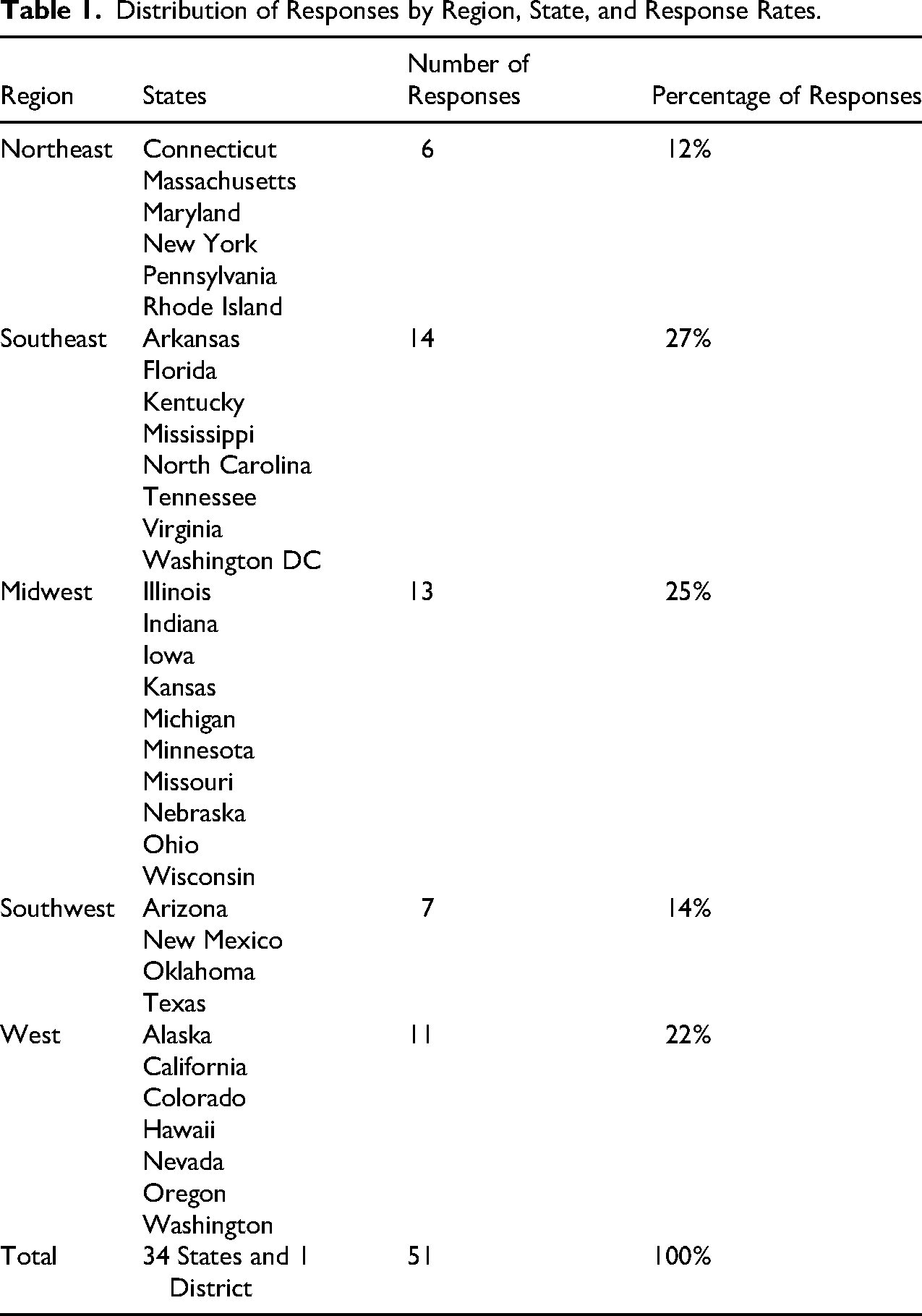
The sample comprised 51 statements issued by urban intensive or emergent PK–12 superintendents across the United States, representing 34 states and one federal district. The Northeast accounted for the fewest responses (N = 6; 12%), whereas the Southeast had the highest representation (N = 14; 22%). Statements were grouped into five regions based on National Geographic classifications, which reflect shared cultural, linguistic, and environmental characteristics. Twelve school districts issued joint statements, most often in collaboration with school board members. Although these joint statements incorporated the beliefs and actions of multiple stakeholders, they were included in the sample because they reflect the superintendent's stance as a central component of the district's response. Table 1 provides a detailed categorization of the sample by region, state, and response rates.
Distribution of Responses by Region, State, and Response Rates.
Data Analysis
The official statements of the urban PK–12 superintendents were examined using frame analysis (Lindekilde, 2014). Frame analysis is an effective theoretical lens and research method. The concept is conceptually grounded in organizational theory and explains how social actors use language to create ideas that get others to act (Goffman, 1974). Framing by a social actor constructs meaning for audiences about a phenomenon in multiple ways, including body language and verbal and written communication (Goffman, 1974). Snow and Benford (1988) provide a paradigmatic study of frame analysis for educational research, suggesting collective action occurs by distilling critical ideas from a broader event(s) to propose problems and solutions that de/legitimize organizational actions. Frame analysis explores how a social actor communicates three core elements of the broader event: diagnostic, which creates understanding by describing a problem; prognostic, which fosters action by suggesting potential solutions; and motivational, which provides reasons for participating in collective action (Snow & Benford, 1988).
Educational researchers have widely drawn on the concept of framing (Coburn, 2006; Park et al., 2013; Spillane et al., 2002; Woulfin et al., 2016). For example, Coburn (2006) examined how a principal invoked diagnostic and prognostic framing while interpreting problems during policy implementation, demonstrating how leaders’ messages shape their communities’ understanding of problems and the legitimacy of proposed solutions. Similarly, Woulfin and colleagues (2016) found that superintendents may convey contradictory messages in their diagnostic and prognostic framing, thereby limiting communicative effectiveness. Such contradictions are especially salient in this study, as messages addressing violence against Black communities may appear humanizing while simultaneously disregarding or diminishing Black life (Sharpe, 2016).
Frame analysis as a research method is widely used in communication studies to investigate how public issues are discussed in media sources (David et al., 2011; Matthes & Kohring, 2008). Data analysis often reveals how social actors apply core framing elements to a public issue (Lindekilde, 2014; Matthes & Kohring, 2008). Frame analysis is similarly utilized in educational research as researchers will code social actor statements for core framing elements. Davies (2002) coded data to investigate how the education commissions brought together in 1950, 1968, and 1995 framed progressive values in their educational reform efforts. Floyd's murder was a public issue discussed in media outlets by urban PK–12 superintendents through district websites and social media accounts. Frame analysis provides a suitable analytical methodology to investigate the underlying beliefs and actions that emerged in the superintendents’ responses to Floyd's murder.
All official statements from urban superintendents were uploaded as they appeared on district websites and social media platforms for storage and analysis in Dedoose (DeCuir-Gunby et al., 2011). Two strategies, iterative deductive/inductive coding and writing analytic memos, were used to analyze the collected statements. The code application was standardized by utilizing MacQueen and colleagues’ (2008) method, which includes a definition of when to use and when not to use, as well as examples for each code. For the first coding round, deductive codes were created using frame analysis and Wake Work. Codes from frame analysis included diagnostic, prognostic, and motivational. These codes were developed to identify the core framing elements present in the statements. Inductive codes were developed and utilized after the initial coding round. Subcodes were generated for each frame to facilitate deeper analysis of the data. The diagnostic frame sub-codes exemplify the deeper analysis because historical and systemic dimensions were identified in the urban superintendents’ beliefs about the problem. Wake Work codes, such as Black annotation and Black redaction, were included to describe areas where an urban superintendent could have added or subtracted from their statements to center Black lives. Lastly, I developed the code contradictory frame based on Woulfin and colleagues’ (2016) claim that superintendents may frame issues in ways that are contrary to what is occurring, thereby creating ineffective communication. For example, this code was applied in instances of Floyd's murder being described as racism or not explicitly addressing the centrality of the death of Black Americans.
Concurrent with coding, analytic memos were drafted to make methodological decisions, narrow the study's focus, and develop higher inference claims (Miles & Huberman, 1994). Memos were created in Microsoft Word to track the note's date, collate relevant quotes, and develop themes to describe emerging interpretations. Tracking the data and emerging claims allowed for a deeper analysis and description of how the urban superintendent's beliefs and actions framed Floyd's murder. Diagnostic frames were grouped into three categories based on how the superintendent addressed the Orthography. There were cases where the diagnostic frame was near the boundary of two categories. Utilizing analytic memos supported thoughtful analysis as a rationale for placement into a category that was given for these boundary cases. One analytic memo describes how a statement was categorized within the second claim category: this superintendent racializes George Floyd's murder by explicitly identifying him as Black and framing the act of violence as emblematic of the callousness and everyday affronts experienced by Black individuals. However, the superintendent's subsequent focus on addressing racial and social inequities contradicts their argument. The call to address racial and social inequities does not necessarily equate to a direct commitment to the needs and well-being of Black communities. Therefore, superintendents providing a more nuanced frame could differentiate between broad calls for equity and concrete actions aimed at addressing historical and ongoing injustices faced by Black communities. The discussion section analyzes the findings to highlight the nuances of the framing of violence affecting Black communities.
Data Quality
Reliability and validity are paramount when conducting frame analysis because the concept can be challenging to identify and code (Matthes & Kohring, 2008). A key strategy to combat reliability issues is naming and applying the criteria used to code data consistently (Matthes & Kohring, 2008). A common strategy in frame analysis methodology is deductive coding in connection to well-established concepts. Utilizing MacQueen and colleagues’ (2008) codebook development method was an effort to establish consistent application of codes through clear definitions of when and when not to use them, with examples developed for clarity. Codes were primarily developed deductively in connection with the Orthography and frame analysis. Code application was conducted iteratively to standardize usage and refine themes to reach saturation, ensuring a comprehensive analysis. Validity was established with clear inclusion criteria by focusing on urban intensive and emergent PK–12 superintendents who posted messages on district websites or social media. To address challenges in frame identification, analytic memos were developed throughout the research process to describe the application of codes, establish patterns, and provide commentary for placement in final categories. The researcher identity statement was created at the start of the research process to critically reflect on positionality and biases to mitigate any unintended influence on the analysis. These methodological approaches ensure that data were collected and analyzed through a trustworthy, reliable, and valid process.
Limitations
This study has a notable limitation. Data collection was conducted approximately four years after urban PK–12 superintendents initially issued statements regarding Floyd's murder. During the data collection process, many district websites no longer included the relevant press releases or learning resources. As a result, multiple urban districts were excluded from the study because relevant data were unavailable. Thus, the findings do not comprehensively analyze all urban PK–12 superintendents.
Findings
Diagnostic frames describe a social actor's belief about why a problem is occurring (Snow & Benford, 1988). The urban PK–12 superintendents’ diagnostic frames about Floyd's murder could be divided into three categories: (1) not naming Floyd as Black and evading the centrality of racial violence perpetrated against Black communities, (2) naming Floyd as Black but not describing the situation as a specific form of racial violence perpetrated against Black communities, and (3) racializing Floyd as Black and describing the situation as a historical or systemic form of racial violence perpetrated against Black communities.
Eighteen statements are in category one, “not naming Floyd as Black and evading the centrality of a specific type of racial violence perpetrated against Black communities.” For example, an excerpt from the joint statement made by a superintendent and their school board in category one is exemplary of this categorization: Like many of you, we began this week in a place of personal reflection and heartbreak as we process the deaths of George Floyd, Ahmaud Arbery, Breonna Taylor and countless others. As a society, this is not the first time that systemic tragedies of equity and race have faced our nation. It reinforces the significant need to address these issues at a national and local level.
This statement evokes the names of three Black Americans, George Floyd, Ahmaud Arbery, and Breonna Taylor, without suggesting they are Black. In addition, this statement describes the problem as stemming from “systemic tragedies of equity and race” rather than a specific type of racial violence perpetrated against Black communities. Across the other seventeen statements, none identified Floyd, Arbery, or Taylor as murdered Black Americans. In addition, the other seventeen statements describe the problem with terms such as disenfranchisement, oppression, racism, racist brutalities, racial inequities, racial injustices, and systemic racism. These diagnostic frames are contradictory because they fail to directly name the victims as Black and rely on generalized language that obscures the persistent, targeted nature of violence against Black communities. Black annotation could be used in these cases to insert a note clarifying that George Floyd was a Black man who was murdered. Alternatively, redacting vague terms, such as disenfranchisement or racial inequities, can draw attention to the need for more specific language that highlights the legacy of police violence directed toward Black communities.
Fifteen statements are emblematic of category two, “naming Floyd as Black but not describing the situation as a specific form of racial violence perpetrated against Black communities.” An excerpt from a superintendent in this category provides an exemplary diagnostic frame: This district stands with our community in grieving the recent tragic deaths of George Floyd, a Black man in Minnesota, and Tony McDade, a Black Trans man in Florida. I share in the hurt, confusion, and anger about what is happening in the District and around the nation. Our community will not tolerate any actions or policies that sanction or perpetuate racism and racial violence.
The statement by this superintendent provides greater clarity in racializing Floyd and McDade as Black. However, their stance has contradictory language, demonstrated by describing the problem as racism and racial violence. The other fourteen statements exemplify how superintendents use contradictory diagnostic frames to identify the problem with language such as bias, bigotry, hatred, persistent racism and aggression, racial and social inequities, and prejudice. Similar to category one, Black annotation and redaction can be employed to draw attention to and make Black life more visible. For instance, annotation can be used to insert notes that highlight how these are not simply tragic deaths but connected to a historical legacy of violence rooted in slavery and continually directed at Black communities. Redaction could be used to remove vague terms, such as bias, hatred, or prejudice, which obscure the specific, systemic nature of the violence inflicted on Black communities.
Lastly, eighteen statements fall within category three, “racializing Floyd as Black and describing the situation as a historical or systemic form of racial violence perpetrated against Black communities.” A notable diagnostic frame from a superintendent reads: My heart breaks for the Black lives that continue to be lost to racist brutality and the failure of recognizing our shared humanity. As Superintendent I am enraged and disheartened to know how easily and senselessly Black lives are taken. I feel frustrated that, even in broad daylight and in front of cameras and eyewitnesses . . . there seems to be no slowing of this type of racist violence: George Floyd. Ahmaud Arbery. Titi Gulley. Michael Brown. Tamir Rice. Quanice Hayes. Aiyana Jones. Eric Garner. Stephon Clark. Sandra Bland. Kendra James. Trayvon Martin. As we go into the weekend, I will remember their names and reflect on how we can proactively create the conditions so that every Black student is seen, heard and supported.
This statement racializes Floyd and eleven other Black Americans who have been murdered by law enforcement. Additionally, this statement explicitly acknowledges that Black Americans experience racial violence at the hands of law enforcement, highlighting a specific and persistent form of harm faced by this community. Lastly, the superintendent provides a diagnostic frame: systemic schooling conditions impede Black students from receiving support. The other seventeen statements provide similar diagnostic frames describing Floyd's murder as a historical or systemic problem Black communities experience. For example, an excerpt from a superintendent declares, “A history that finds Black people defined first as not even human and then, once forced to be acknowledged as human, systematically treated—through both individual actions as well as government policies—as inferior people.” These statements collectively require little to no Black annotation and redaction because these frames analyze the problem as related to historical or systemic racial violence specifically perpetrated against Black communities.
A social actor communicating a prognostic frame suggests a solution to the problem identified in a diagnostic frame (Snow & Benford, 1988). However, these prognostic frames can convey contradictory messages that fail to align with the diagnostic frame, ultimately hindering the implementation of meaningful action (Woulfin et al., 2016). Black annotation and redaction offer an analytic lens to examine how superintendents may produce such contradictions in their prognostic framing. For example, when a superintendent fails to engage with the systemic and racialized nature of violence against a Black man, they risk conveying a contradictory frame that can undermine their efforts to meaningfully support the emotional and psychological well-being of the Black community they serve. This section examines the range of superintendent prognostic frames following Floyd's murder, from those marked by contradictions to those that directly advocate addressing harm directed toward Black communities.
Two prognostic frames that will be discussed in detail appeared most often across the statements about Floyd's murder: (1) reflective conversations and (2) value-based commitments to district practices or policies. Other notable solutions were proposed. For example, one superintendent discussed the need to address the shortage of Black teachers in the state's university preparation programs so that Black students could have more role models. Seven superintendents referenced the impact of calling out and addressing racism when it is encountered.
Thirteen urban PK–12 superintendents offered learning resources in multiple formats, such as reading material, videos, and reflective questions. The message page is unavailable in 6 of the 13 statements or leads to pages without learning materials. The 7 statements with available learning resources often elicited reflective thinking and prepared guardians to talk with their children. Six of the 7 remaining statements had distinct reading materials addressing the violence against Black communities. For example, one superintendent shared How Black Americans Can Cope with Anxiety and Racism: A Mindfulness Approach to Dealing with the Stress from Racism by Dr. Jessica Graham-LoPresti, Dr. Tahirah Abdullah, Amber Calloway, and Dr. Lindsey West.
Reflective Conversations
The most common prognostic frame, appearing in 28 statements, proposed creating reflective dialogue spaces. Seventeen statements with prognostic frames suggested that guardians should have reflective conversations with their students. An urban PK–12 superintendent shared, “Please talk to your children, your friends, and your family about George Floyd's death. If your children are too young to discuss hatred, violence, and ignorance, start with conversations about the importance of empathy, acceptance, and kindness in our world.”
Additionally, six statements had prognostic frames that suggest school staff will or have engaged in reflective conversations to process and address issues of racism and inequity. An urban PK–12 superintendent stated, “Over 1,000 individuals have participated in ‘Courageous Conversations About Race,’ including our teachers, administrators, School Board members, and non-instructional support staff, such as campus security staff, food service workers, bus drivers, and others.” Lastly, four urban PK–12 superintendents called on members of the legislature to engage in reflective conversations about racism and inequity surrounding Floyd's murder. An excerpt from one urban PK–12 superintendent reads, I ask our community, especially our youth, to demonstrate peacefully and to exert energy through civic action – participate, vote, make your voice heard by disrupting inequities each and every day. But the responsibility doesn’t fall on you alone. We need honest and frank conversations, from every level of government and to hold those standing silently to account.
Collectively, these statements often demonstrate the urban PK–12 superintendents communicating contradictory prognostic frames for their community to engage in reflection to discuss Floyd's murder. For instance, one superintendent statement structured its reflective conversations with staff by drawing on Singleton's (2014) concept of courageous conversations, which encourages individuals from racially marginalized groups to share personal stories with listeners so that people outside the marginalized community can learn from their experiences. However, in contexts where there are few Black staff or where historic and systemic violence against Black communities is not explicitly addressed, conversations risk becoming performative exercises rather than transformative dialogue. This may inadvertently reinforce silence around the murder of Black Americans rather than addressing it by focusing on broad concepts, such as inequity or injustice, which allows institutions to engage in reflection without naming the centrality of reports of police violence that disproportionately impact Black communities. Black annotation might be utilized to shift the focus in these prognostic frames so that the reflective conversations can engage in more specific discussion about the history of police violence directed at Black communities. Black redaction might be used to remove language, such as hatred, violence, and ignorance, to highlight the usage of general terms that obscure meaningful reflection centered on the differential impact Floyd's murder has on Black communities (Dreyer et al., 2020; Eichstaedt et al., 2021; Staggers-Hakim, 2018).
Value-Based Commitments to District Practices or Policies
Twenty-five statements about Floyd's murder had prognostic frames that asserted the enactment of various policies and practices connected to district values. The values in the statements addressed equity, justice, and anti-racism. To fulfill those values, the urban PK–12 superintendents described actions, such as developing an equity office, passing an equity policy, and stating that the district commitments will help them interrogate their policy and practices. A Maryland superintendent shared: We must recommit ourselves, examine our own practices, and disrupt the insidious barriers that have plagued our education system and negatively impact our students, families, and staff. It's why we created an equity office, adopted an equity policy, and have started the deliberate work required to create a new way forward. This work is about acknowledging ways in which institutions, by their very design, have been historically complicit in marginalization and our refusal to collude any longer.
Collectively, these prognostic frames are contradictory because the values they center, such as equity policies or commitments to social justice, may be too general to meaningfully address the specific needs of Black communities. These values could be more effectively aligned by explicitly focusing on the historical and systemic forms of violence directed at Black communities. Black annotation could be used to specify how equity policies might tangibly support Black communities, through actions such as the equity office providing learning opportunities that interrogate the persistence of police violence in Black communities. Black redaction, in turn, could be applied to remove broad terms, such as equity or social justice, in order to underscore the inadequacy of generalized language and call for more precise commitments that directly confront harm directed at Black communities.
Although value-based commitments to equity, justice, and racism were most common across statements, five of the twenty-five included language that more explicitly referenced the needs of Black communities. For example, one superintendent's prognostic framing appeared to more directly engage the needs of Black students. Their statement asserts: We believe deeply in ensuring students are healthy, supported, engaged, challenged, safe, and socially and emotionally intelligent. Our district has put policies and practices into place to make sure that everyone in the community has the opportunity to learn and work in an environment where they are treated with dignity and respect, free from bullying or harassment. Our district does not discriminate on the basis of color, ethnicity, gender, sexual orientation, gender identity, transgender status, religion, national origin, ancestry, age, marital status, veteran status or disability. We know we have work to do to ensure we reach our aspirations for our African American and Black students. We commit to doubling down our efforts with the African-American Equity Task Force and Black Excellence Resolution. To all our African American students and staff: you matter. Black Lives Matter. We see you, and we support you.
This prognostic frame illuminates the value of treating everyone interacting with the district with respect and dignity. Additionally, the superintendent emphasizes the need to serve Black students and staff through direct language and actions. Their actions describe a values-based commitment through policy and practice targeting the needs of Black students and staff. This statement highlights how a prognostic frame can address the needs of both the broader school community and Black communities. The dual emphasis of this framing may reduce the need for Black annotation and redaction, suggesting a more inclusive approach to addressing the harm caused by Floyd's murder.
Discussion
Black Annotation and Redaction of Superintendent Diagnostic Frames: Developing a Consciousness About the Orthography
Urban PK–12 superintendents making official statements condemning the actions of police in the murder of George Floyd was a potentially impactful step toward better serving their Black school communities. However, the urban PK–12 superintendents often communicated contradictory diagnostic and prognostic frames about the Orthography of the Wake (“Orthography”). Contradictory frames are problematic because they convey information that can confuse listeners and hinder progress toward meaningful actions toward identified problems (Woulfin et al., 2016). Research question one illuminates how urban PK–12 superintendents frame the murder of George Floyd by examining diagnostic frames or how urban PK–12 superintendents defined it as a problem (Snow & Benford, 1988). In 33 of 51 statements, the centrality of police murdering Black Americans was either obfuscated or not described as a distinct form of racial violence perpetuated against Black communities.
One category of diagnostic frames did not name Floyd as Black and evaded the centrality of racial violence perpetrated against Black communities. These diagnostic frames are contradictory because the superintendent abandons a discussion that relates the problems as specifically happening to a Black person or a specific type of racial violence perpetuated against Black communities. By not racializing George Floyd and utilizing multicultural terms, such as oppression and racism, these urban PK–12 superintendent frames could utilize Black annotation and redaction because the language prevents a specific conversation about the experience of Black Americans.
A second category of diagnostic frames racialized Floyd as Black but did not link the murder to a specific form of racial violence that impacts Black communities. These statements collectively could utilize Black annotation and redaction because they have not readily engaged with the specificity of racial violence perpetrated against Black communities. These two categories of urban PK–12 superintendent contradictory frames are problematic because these issues convey either a limited understanding or an unwillingness to directly impart a consciousness about the way society has persistently perpetuated violence against Black Americans. In those statements, where little to no Black annotation and redaction was needed, these leaders framed their beliefs about Floyd's murder with direct language that described the situation as a Black man who experienced a specific type of historical or systemic violence impacting Black communities.
These findings have important implications for improving how superintendents are prepared to respond to violence impacting Black communities through their diagnostic frames. More than half of the analyzed superintendent frames required some form of Black annotation and redaction, revealing a pattern of contradictory framing. Multiple factors may contribute to this trend. Cambron-McCabe and McCarthy (2005) argue that superintendent licensure programs have historically failed to meaningfully address issues of race and racism. This lack of preparation is particularly concerning given that many superintendents report feeling unprepared to lead conversations about race or racism (Tienken, 2021). Responding to media reports about violence directed at Black communities requires not only an understanding of the historical and contemporary disregard for Black Americans but also careful reflection on how one's framing of the issue may reinforce or challenge enduring structures of anti-Black violence.
Superintendents are often responsible for responding to crises and incidents involving race (Bishop et al., 2015; Bridgeforth, 2021; Tienken, 2021). Equipping these leaders with the knowledge and tools to accurately recognize, describe, and respond to these challenges in ways that center and support Black communities is crucial. Reforming leadership preparation programs is a critical lever for change. Curricula could include coursework that interrogates the historical and ongoing structural imperilment of Black life. Drawing on In the Wake: On Blackness and Being (Sharpe, 2016) as a foundational text could cultivate the consciousness necessary to confront disregard directed toward Black communities. Introducing tools such as Black annotation and redaction into pre-service preparation would equip aspiring superintendents with strategies for analyzing and reconstructing the diagnostic framing they may be called upon to produce as in-service leaders.
Okello (2023) outlines a lesson plan that guides aspiring researchers in conducting document analysis to practice Black annotation and redaction. Participants are encouraged to describe the text, situate it within its historical context, identify underlying meanings, and annotate key sections to surface these insights. A similar approach could be adapted for aspiring superintendents, who might analyze media coverage; prior superintendent statements concerning Floyd's murder; or other instances of violence against Black communities. For example, aspiring superintendents could examine media reports of school resource officer violence against Black students and use Black annotation and redaction to identify framing that obscures or affirms Black life, while also designing strategies to support the psychological and emotional well-being of Black communities. Annotation might involve highlighting omissions, such as drawing connections to the historical patterns of police violence against Black communities. Redaction could be used to remove language that centers on unrelated prior disciplinary infractions, thereby refocusing attention on the structural conditions shaping the incident.
Black Annotation and Redaction of Superintendent Actions: Toward Actions That Center Black Communities in Frames About the Orthography of the Wake
Research Question 2 examines how urban PK–12 superintendents frame their proposed actions and solutions in public responses to the murder of George Floyd. Drawing on Snow and Benford's (1988) concept of prognostic framing, this analysis identifies the actions and solutions superintendents propose in response to the problem as they define it. The prognostic frames articulated by urban superintendents were often contradictory, as they failed to meaningfully address the persistent reporting of violence directed at Black communities. One exemplar of such contradiction is the frequent call for reflective conversations aimed at addressing “systemic inequities,” “racial injustice,” or “racism.” While these discussions can contribute to positive change, the lack of specificity in these contradictory frames can obscure the importance of having specific discussions about the historical and systemic nature of violence impacting Black communities. As a result, the discourse can remain abstract, circumventing difficult but necessary conversations about police brutality and systemic extrajudicial violence against Black communities. Black annotation and redaction can be used as tools to shift these prognostic frames and ensure that institutional responses create structured opportunities to critically engage with anti-Black violence and its broader historical and structural context. Doing so would help ensure that reflective dialogue is grounded in addressing disproportionate police brutality against Black communities rather than generality and avoidance.
A practical step urban superintendents can take to strengthen their prognostic frames is to replace discussion frameworks that focus on generalized discussions of race and racism with approaches that center accountability and historical consciousness regarding the experiences of Black Americans. For example, Porcher and Bertrand (2023) advocate for the use of the Black Gaze Framework, which provides a structure for engaging deeply with Black history, elevating the voices and narratives of Black communities, and developing actionable steps that explicitly center Blackness in policy and practice. Integrating reflective discussion frameworks, such as the Black Gaze Framework, into professional development can shift school systems away from contradictory prognostic framing and toward dialogues that directly address structural violence against Black violence.
Conclusion and Future Research
Urban superintendent frames regarding the murder of George Floyd communicated definitions and actions along a continuum ranging from obfuscation to direct acknowledgment of the violence directed toward a Black American. The diagnostic and prognostic frames articulated by urban PK–12 superintendents were critically analyzed through the lens of Black annotation and redaction (Sharpe, 2016). However, this study did not examine the tangible impact of these statements. Scholars have raised concerns that public declarations often risk being performative in response to events impacting Black communities, such as Floyd's murder (Brown et al., 2022; Casellas Connors & McCoy, 2022). Thus, more research must be completed to investigate whether these superintendent statements contribute to meaningful change for Black communities, or if they merely represent an organizational practice that co-opts language in ways that ultimately dehumanize. As Sharpe (2016) argues, responses to the Orthography of the Wake may appear humanizing while simultaneously reinforcing a disregard for Black communities.
Another aspect of this study that warrants further investigation is how demographic factors, such as the percentage of Black students enrolled in a district or the superintendent's racial or ethnic background, may influence the types of frames identified. Diem and Welton (2020) argue that demographic shifts have contributed to increasingly segregated school districts and that, within this context, school leaders are more likely to offer color-evasive responses that sanitize sociopolitical issues. Additionally, scholars suggest that a leader's racial or cultural background can shape their ability to recognize and address inequities (Alston, 2005; Santamaria & Santamaria, 2016; Waite, 2021). However, research demonstrates that school leaders may reinforce racist or white supremacist structures regardless of whether they share the same racial background as the students they serve (DeMatthews et al., 2017; Khalifa, 2015). Future research could examine whether demographic factors impact how superintendents frame incidents involving the Black community.
Future research could build on these concepts to examine how urban PK–12 superintendents propose or implement policies that intentionally center Black life. For example, a study drawing on Black annotation and redaction in conjunction with frame analysis methods could investigate how superintendent beliefs are reflected in policy decisions, particularly in response to specific forms of violence affecting Black communities, such as disproportionate disciplinary practices or the continued employment of school resource officers. This line of inquiry could reveal whether such policies address or perpetuate violence against Black communities. This analysis would offer critical insight into the degree to which institutional actions align with commitments to genuinely support Black communities.
Footnotes

Ethical Considerations
This study was undertaken with approval from Arizona State University's Institutional Review Board. ASU IRB determined that the protocol for STUDY00018374 is considered exempt pursuant to Federal Regulations 45CFR46 (4) Secondary research on data or specimens (no consent required) on 8/23/2023. A modification #MOD00023882 to the original proposal was granted on 9/16/2024.
Funding
The author received no financial support for the research, authorship, and/or publication of this article.
Declaration of Conflicting Interests
The author declared no potential conflicts of interest with respect to the research, authorship, and/or publication of this article.