







Abstract
Computer-adaptive classification tests focus on classifying respondents in different proficiency groups (e.g., for pass/fail decisions). To date, adaptive classification testing has been dominated by research on dichotomous response formats and classifications in two groups. This article extends this line of research to polytomous classification tests for two- and three-group scenarios (e.g., inferior, mediocre, and superior proficiencies). Results of two simulation experiments with generated and real responses (N = 2,000) to established personality scales of different length (12, 20, or 29 items) demonstrate that adaptive item presentations significantly reduce the number of items required to make such classification decisions while maintaining a consistent classification accuracy. Furthermore, the simulations highlight the importance of the selected test termination criterion, which has a significant impact on the average test length.
By administering items in a sequential manner, adaptive assessment procedures usually reduce the average length of computerized tests without significantly increasing their measurement error (see Fayers, 2007; Forbey & Ben-Porath, 2007; Reise, Ainsworth, & Haviland, 2005). A variant of such procedures are adaptive classification tests that focus on validly classifying respondents in two or more proficiency groups, for example, to differentiate between students who already master a specific subject and those who do not. So far, adaptive classification testing has been dominated by dichotomous achievement tests (e.g., Hambleton & Xing, 2006; Jodoin, Zenisky, & Hambleton, 2006; Vos & Glas, 2010). Many applied settings, however, administer instruments with polytomous response formats. For example, miscellaneous clinical symptoms (e.g., anxiety or depression) are frequently assessed with polyomous self-report scales. Comparably, occupational aptitude testing that increasingly relies on web-based screening procedures to eliminate obviously unqualified candidates from the recruitment process (see Nye, Do, Drasgow, & Fine, 2008) frequently incorporates personality scales with polytomous response formats (Ployhart, Weekley, Holtz, & Kemp, 2003). In both cases, adaptive classifcation testing can reduce the burden placed on respondents by administering fewer items while still allowing for an efficient and precise classification of, for example, patients or applicants in groups with inferior versus superior trait levels. However, up to now, reasearch on polytomous adaptive classification testing is scarce and is addressed by a few studies only.
The purpose of this study is twofold. First, it extends existing findings concerning test efficiency on dichotomous adaptive classification testing (Finkelman, 2008, 2010; Wouda & Eggen, 2009) to polytomous items. It is demonstrated that frequently used personality scales, which contain as few as 12 items, can be further shortened by adopting a procedure of sequential item presentation. Second, a simulation experiment underpins the importance of choosing an appropriate stopping rule, as the test termination criterion significantly affects the average test length (ATL).
Adaptive Classification Testing
In conventional fixed-length tests, all examinees are usually presented with the same items. As a consequence, proficient examinees are frequently administered items that are too easy for them, and less proficient examinees receive too many difficult items. These items are not very informative and hardly contribute to an individual’s proficiency estimate (Mead & Drasgow, 1993). In computerized adaptive testing (CAT), items are administered examinee driven in a sequential order. The choice of the next item depends on an examinee’s interim proficiency estimate. In CATs, each examinee is administered different items and only as many items as required to reach a decision in terms of sequential testing (Wald, 1947). As a consequence, CATs usually lead to a significantly reduced test length (Hol, Vorst, & Mellenbergh, 2007; Reise & Henson, 2000). A special form of traditional CATs are computerized-adaptive classification tests (CACT), which classify examinees in two or more groups. In contrast to a point estimate of an invididual’s proficiency (as is done in CATs), the goal of CACTs is the accurate classification of examinees in different proficiency groups. As soon as an unambiguous classification decision for an examinee is reached, the testing procedure is stopped. The construction of a CACT requires numerous decisions by the test developer that can affect its accuracy and ATL, such as the choice of proficiency estimator (Yang, Poggio, & Glasnapp, 2006), the item selection algorithm (Thompson, 2009), or practical constraints such as item exposure or content controls (Eggen & Straetmans, 2000). This study focuses on three of such elements that have been proven to be influential for dichotomous CACT (Finkelman, 2008; Thompson, 2007; Wouda & Eggen, 2009): (a) the size of the item pool, (b) the test termination criterion, and (c) the number of classification groups.
Item Pool Size
As the item selection algorithm has to select matching items for each proficiency level, adaptive tests usually require large item pools. The size of the item pool affects the test efficiency and also the classification accuracy (Lau & Wang, 1999). Larger pools usually contain more informative items around the cutscore and thus increase the overall test quality. Typical pools for dichotomous items usually contain more than 100 items, sometimes even more than 300 items. So far, the only study that explicitly compared the effect of the item pool size on polytomous CACTs reported a better classification accuracy and test efficiency for a larger item pool containing 266 items as opposed to a smaller 90-item pool (Lau & Wang, 1999). For the smaller pool, the average test length increased about 47% while simultanously producing up to a third more classification errors. Both item pools in this study, however, were rather large and, thus, are rather unrealistic for clinical or personality assessments in applied settings. In the context of polytomous CATs, there are reports that item pools with as few as 25 to 30 items might be sufficient to reach reliable proficiency estimates (Dodd, Ayala, & Koch, 1995; Hol et al., 2007; Wang & Wang, 2001). Reise and Henson (2000) even demonstrated that the facets of the NEO PI-R (Revised NEO Personality Inventory), which contain eight items each, can be reduced to half by applying an adaptive item presentation procedure. So far, no study has demonstrated yet if well-established personality scales, which form only short item pools, can benefit comparably from polytomous CACT.
Test Termination Criterion
A commonly used test termination criterion is the sequential probability ratio test (SPRT; Wald, 1947), a simple likelihood ratio test between two competing hypotheses (e.g., mastering vs. nonmastering for an examinee). In the first step, a cutscore θc is set on the latent proficiency scale to determine the classification groups. The choice of θc is typically based on the empirical distribution of the relevant proficiency in a reference sample or on subjective professional judgments of an expert group (see Cascio, Alexander, & Barret, 1988, for a review). In personnel selection, for example, a cutscore may be established from an incumbent group (e.g., current employees of an organization) and—based on various cost–benefit considerations—set at a value below the mean to exclude obviously unqualified candidates who do not possess a required miminum value of an elemental proficiency from the selection process (Society for Industrial and Organizational Psychology, 2003). In the second step, an indifference region δ is specified around that cutscore within which examinees cannot be properly classified. For an intermediate proficiency estimate, θ k , after administering k items, the SPRT tests the hypothesis H0: θ k = θc + δ versus H1 = θc − δ by calculating the ratio between two likelihoods, λ k = L(θc + δ)/L(θc − δ). An evaluation of the ratio with regard to two decision points, A = α/(1 − β) and B = (1 − α)/β, leads to one of three conclusions (Spray & Reckase, 1996; Wald, 1947): (a) if λ k is less than or equal to A, then H1 is accepted; (b) if the ratio is greater than or equal to B, then H0 is accepted; or (c) if the likelihood ratio falls between A and B, then another item is administered.
The SPRT can be inefficient in cases where it administers another item, even though this observation cannot change an examinee’s classification decision. This is illustrated by Finkelman (2008, Example 1): After presenting the kth item, the likelihood ratio statistic λ k might be moderate enough to satisfy neither decision (a) nor (b). However, even if one administered all remaining items, the classification decision would be unlikely to change. For such cases, Finkelman (2008, 2010) has recently proposed stochastically curtailed versions of the SPRT (SCSPRT), which also halt further testing when the probability of a change of the classification decision is rather unlikely or even impossible. The SCSPRT extends the SPRT by specifying two additional stopping rules. Given k observations, the SCSPRT also halts further testing and accepts H1, if the probability of keeping the current classification decision after presentation of the remaining items is higher than a predefined threshold, γ. Conversely, the SCSPRT stops and accepts H0 if this probability exceeds γ′. This curtailed version of the SPRT can lead to significantly reduced ATLs in both two-group (Finkelman, 2008, 2010) and three-group classifications (Wouda & Eggen, 2009) while maintaining a consistent classification accuracy. So far, the SCSPRT has not yet been evaluated in the context of polytomous CACT.
Number of Cutscores
The goal of typical CACTs is the classification of examinees in one of two groups, such as failing versus passing. In some cases, however, multiple classification decisions are of interest; for example, when identifying job applicants with inferior, mediocre, and superior proficiencies. Multiple cutscores put an additional strain on the item pool. The proficiency area, that is, where a test requires the greatest number of items to make a decision, is near the cutscore (Spray & Reckase, 1996). When using more than one cutscore, the item pool has to be large enough to provide a reasonably large number near all cutscores. So far, research on polytomous CACT with multiple cutscores is scarce and supported by a single study only. Thompson (2007) compared various design features of polytomous CACT, including the shape of the item bank, the choice of test termination criterion, item selection procedure, and number of cutscores (two-vs. three-group classifications). Compared with the other factors studied, the latter resulted in considerably longer tests; three-group classifications required nearly four times as many items as comparable two-group classifications. The study, however, used a rather artifical pool of 60 simulated items. So far, no study has established yet if CACT provides an advantage with regard to test efficiency for personality scales that comprise only a small set of items for the classification of examinees in more than two groups.
Overview of Studies
Two Monte Carlos studies evaluated the impact of polytomous CACTs on established personality tests for two dependent variables: (a) ATL and (b) the percentage of correct classifications (PCC). The experimental design manipulated three independent variables: (a) the length of the scales and thus the available size of the item pool (k1 = 12, k2 = 20, and k3 = 29 items), (b) two test termination rules, SPRT (Spray & Reckase, 1996) and SCSPRT (Finkelman, 2008), and (c) the number of cutscores, resulting in two-group classifications to identify individuals with inferior proficiencies and three-group classifications that distinguish examinees with inferior, mediocre, and superior trait levels. As smaller item pools are likely to have fewer matching items around the cutscore, PCC is assumed to be larger for short scales, particularly for three-group classifications. In line with previous results for dichotomous items (Finkelman, 2008; Wouda & Eggen, 2009), it is assumed that the SCSPRT will outperform SPRT and result in a lower ATL while maintaining a consistent PCC.
This yielded a completely crossed 3 (item pool size) × 2 (test termination criterion) × 2 (number of cutscores) ANOVA design. All simulations were programmed in R (R Development Core Team, 2009).
Study 1
Method
Simulees
Proficiency estimates for the simulees were selected at 21 equidistant points within [−4, 4]. For each estimate, responses to the items of the three scales (see Instruments and Item Parameter Estimation section) according to the graded response model (GRM; Samejima, 1969) were simulated for 2,000 simulees, thus generating a total sample size of N = 42,000.
Instruments and Item Parameter Estimation
The choice of instruments was motivated by their test length, thus resulting in different item pool sizes for the CACT simulations. Hence, we selected three established scales in personality research for our analyses: Conscientiousness was assessed with 12 items from the German version of the NEO-FFI (NEO Five Factor Inventory; Borkenau & Ostendorf, 1993), achievement motivation was operationalized with a 29-item scale 1 by Schuler and Prochaska (2001), and generalized opinion leadership was measured with 20 items by Batinic, Gnambs, Appel, and Wiesner (2010). All items were answered on 5-point response scales.
Item Parameter Estimation
The item parameters for the conscientiousness and achievement motivation scale were estimated from a random sample of N = 1,500 prospective students (883 women), who provided a series of cognitive and self-report measures as part of a voluntary study orientation program (see Bergmann, 2008, for details). Item calibration of the generalized opinion leadership scale was conducted with the norm sample (N = 1,575, 848 women) presented in Batinic et al. (2010).
CACTs require known item parameters. The item parameter estimation process involves three steps: (1) checking the assumption of unidimensionality for the item set, (2) identifying the appropriate response model and estimation of the item parameters, and (3) adjudging the fit of the items to the selected response model.
Dimensionality
To assert that an individual’s response probability is a function of one latent trait, the dimensionality of the items sets was analyzed by factor analyzing the polychoric correlation matrices of the data sets. Parallel analysis and a visual comparison of the second eigenvalues confirmed that the three data sets were truly unidimensional. In addition, the ratios of the first and second eigenvalue were 5.2 (conscientiousness), 3.30 (achievement motivation), and 9.13 (opinion leadership). Furthermore, Reckase (1979) recommended that the dominant first factor accounted for at least 20% of the items variance for acceptable item calibration. For the three items sets, the first factor explained 42% (conscientiousness), 30% (achievement motivation), and 52% (opinion leadership) of the variance of items, indicating an adequate latent factor.
Model selection
To determine the optimal response model for the data set, four polytomous item response theory models were fitted to responses of the two samples with ltm (Rizopoulos, 2006) and compared on the basis of Schwarz’s Bayesian information criterion (BIC; see Kang, Cohen, & Sung, 2009): (a) generalized partial credit model (GPCM; Muraki, 1992), (b) GPCM with equal discrimination parameters, (c) GRM (Samejima, 1969), and (d) GRM with equal discrimination parameters for all items. On the basis of the BIC criterion, the GRM was deemed the optimal response model for all three scales. The resulting item parameters for the three scales are summarized in Table 1.
Summary of Item Parameter Estimates
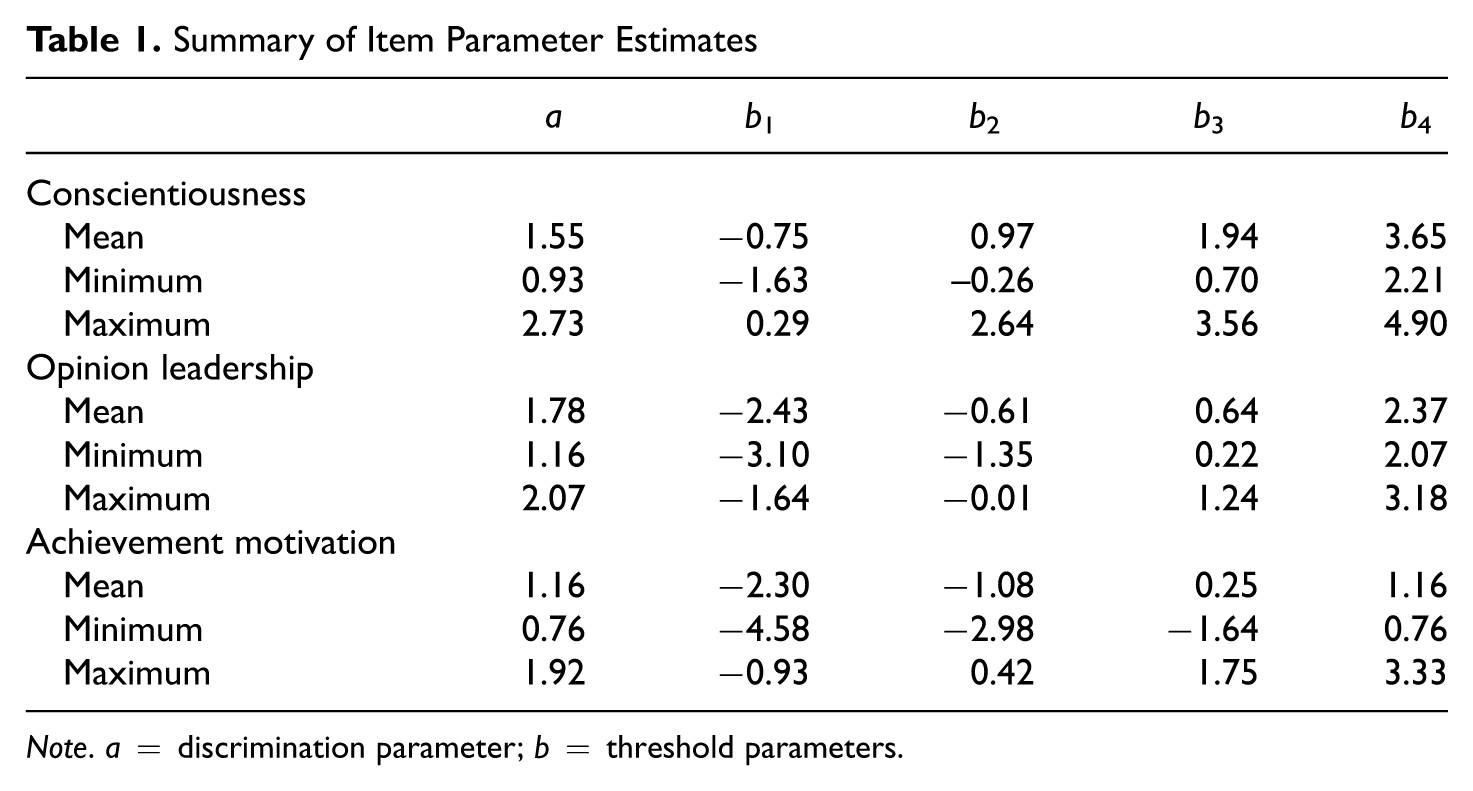
Note. a = discrimination parameter; b = threshold parameters.
Item fit
To assess the fit of the items to the response model, the adjusted chi-square statistic to degree of freedom ratio (Chernyshenko, Stark, Chan, Drasgow, & Williams, 2001) for item pairs and triplets were inspected. Ratios exceeding 3.5 indicate severe model misfit. The opinion leadership scale displayed moderate misfit, with about 20% of all margins exeeceding the specified threshold. The GRM, however, is rather robust when the number of deviant items is smaller than the remaining item set (Sinar & Zickar, 2002). The two- and three-way margins for the conscientiousness and achievement motivation scale exhibited no item misfit (<5% of pairs and triplets exceeded the specified threshold).
Altogether, the GRM represented an appropriate response model for the three scales in this study.
CACT Simulation
A simulee’s latent proficiency was derived by the weighted maximum likelihood estimator (Warm, 1989). Cutscores were selected at the 25th and 75th percentile of the proficiency distribution in the calibration samples: θc = {−0.48, 0.68} for conscientiousness, θc = {−0.64, 0.65} for opinion leadership, and θc = {−0.61, 0.70} for achievement motivation. The item sequence for a simulee was determined by maximizing Kullback–Leibler information at the cutscore, which selects items based on their ability to discriminate between simulees near the cutscore (see Thompson, 2009). For the three-classification case, Kullback–Leibler information was maximized at the cutpoint nearest to the current θ estimate (see Wouda & Eggen, 2009). Regarding the indifference region, δ, previous simulations demonstrated that an increase in δ results in significantly longer tests (Eggen, 1999; Lau & Wang, 1999). As our simulations used rather small item pools—12 items in one case —δ was set at a rather high value of 0.2, the upper limit studied by Eggen (1999), to increase the probabilities of reaching a classification decision without administering the complete scales. Following Finkelman (2008), the error rates α and β were set at .05, resulting in A = 1/19 and B = 19. For the SCSPRT, the probability thresholds γ and γ′, which indicate early test termination, were given values of .95. The SPRT for three-group classifications followed the generalized Sobel and Wald (1949) procedure proposed by Eggen and Straetmans (2000).
Results
The ATLs of the tests (see Figure 1) were highly influenced by the test termination criterion. The difference in mean number of items that were administered between the SPRT and the SCSPRT varied along the latent proficiency scale for conscientiousness within Δk = [3.04, 8.26], for opinion leadership within Δk = [1.00, 8.88], and for achievement motivation within Δk = [2.99, 18.20]. The number of cutscores had virtually no effect on these results, with the exception of a comparable increase in ATL around the second cutpoint. Considering the latent proficiencies, the SCSPRT demonstrated to be particularly effective around the cutscores. As the item pools obviously had difficulties in classifying simulees near the cutscores, the traditional termination criterion, SPRT, continued to administer items, even though they were insufficient to improve the classification decisions. Thus, the SPRT administered the complete scales around the cutscores. The SCSPRT, however, prevented the continued item presentation, which resulted in considerably shorter test lengths: ATL near the cutscore reached 5.02 (conscientiousness), 9.92 (opinion leadership), and 9.84 (achievement motivation) for two-group classifications and 5.41, 10.17, and 10.93 for three-group classifications. Hence, the SCSPRT cut the longer scales to about half or even one third of their original length while maintaining a comparable classification accuracy as the SPRT.
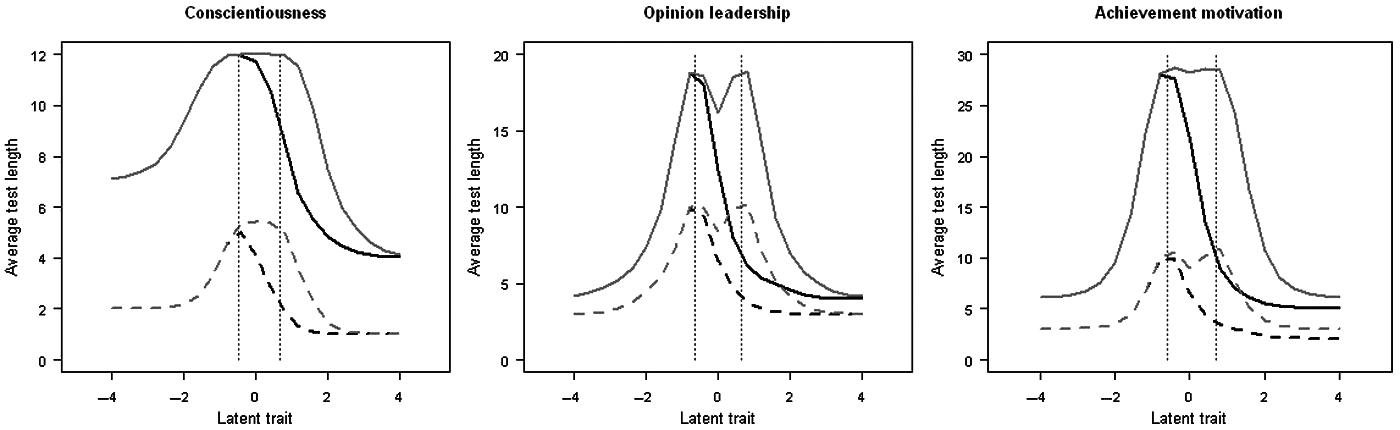
Average test length of CACT simulations (Study 1)
The respective classification accuracies of the CACT simulations were only marginally affected by the test termination criterion (see Figure 2). For two-group classifications, the classification accuracy reached an average PCC of .96 (conscientiousness), .98 (opinion leadership), and .97 (achievement motivation). For three-group classifications, the PCC was slightly lower, with .93, .96, and .95, respectively. The more conservative stopping rule, SCSPRT, had virtually no effect on the PCC and led for all scales, in both two- and three-group conditions, to an average decrease in PCC of less than .01. Although, generally, PCC seemed quite high, it was highly dependent on the proficiency level. PCC was very high at the more extreme proficiencies, but decreased considerably around the cutscores. For the longer scales, PCC fell to about .74 around the cutscores, and for the short conscientiousness scale, PCC was even as low as .60. However, as seen before, the CACTs using SPRT administered the complete scales near the cutscores. Hence, the decreased PCCs are not a result of the adaptive presentation mode itself but rather a reflection of the overall quality of the administered scales and their limited measurement precision, that is, their increased measurement error, at the cutscores.
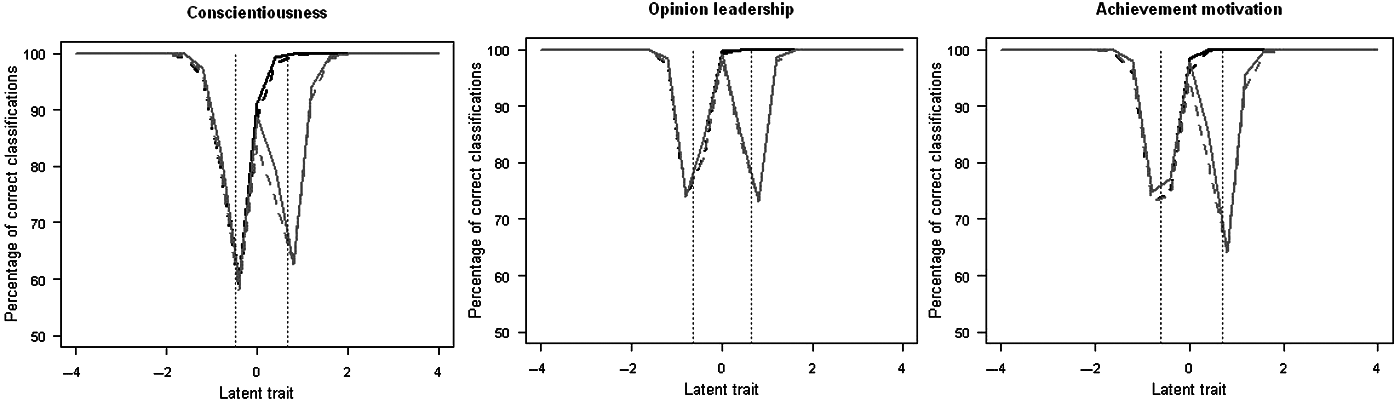
Classification accuracy of CACT simulations (Study 1)
Study 2
The second study extends the previous results in two important aspects. First, we compared polytomous CACTs with fixed-length tests, as Reise and Henson (2000) reported that some adaptive tests do not outperform tests with a fixed length when administering a selection of, for example, the most discriminating items to all respondents. Hence, the first aim of the second simulation was a comparison of adaptive classification tests with tests containing a fixed number of items. Second, we replicated the results from Study 1 with empirical responses. Although the use of simulated data is common practice in psychometric research, there is no guarantee that generated pseudo-samples are indeed representative of real data (see Micceri, 1989; Steiger, 1977). In practice, item responses can be influenced by numerous factors, for example, the current mood, response sets, or less than perfect fit of the applied item response model. Hence, the second goal of the study was a confirmation of the adpative tests’ advantages with regard to their test length under more naturalistic conditions.
Method
Simulees and participants
The proficiencies for the simulees were randomly drawn from normal distributions with means and standard deviations that were derived from the proficiency distributions estimated in the calibration samples (see Study 1): M = 0.097 (SD = 0.860) for conscientiousness, M = 0.003 (SD = 0.957) for opinion leadership, and M = 0.045 (SD = 0.972) for achievement motivation. For each scale, responses to the items according to the GRM (Samejima, 1969) were simulated for 50,000 proficiencies.
The empirical responses stem from two independent samples. The first sample includes N = 4,110 (2,354 women) prospective students with a mean age of M = 19.24 (SD = 1.14) from Bergmann (2008). From the available data set of the years 2003 to 2009, N = 2,000 students were randomly selected for the real-data simulation, including the conscientiousness and achievement motivation scales. A second sample of N = 2,000 (1,347 women) members of a commercial market research panel (mean age M = 28.00, SD = 11.13) provided measures of opinion leadership as part of an anonymous web-based survey.
Item parameters and test procedures
The CACT simulations were conducted analogously to Study 1 with the same item parameters. In addition, a series of fixed-length tests were created for each scale by ranking the kj items according to their discrimination indices and subsequently administering the items in this order to all respondents. This resulted in kj fixed-length tests for each scale comprising ij = 1, . . ., kj items. Each fixed-length test was created by selecting the first ij administered items of the scale (see Hol et al., 2007, for a similar procedure).
Results
In line with Study 1, the CACT simulations demonstrated a considerable reduction in the number of administered items for most conditions, particularly for two-group classifications with the modified test termination criterion, SCSPRT. Using the traditional stopping rule, SPRT, the simulation administered the full 12-item conscientiousness scale in nearly 60% of all cases and resulted in a rather large ATL of 10.24 items (see bar chart in Figure 3). Although the longer scales yielded larger savings of about 8.58 (opinion leadership) and 11.52 items (achievement motivation) and, thus, reduced these scales to about 57% of their original length, the complete scales were still administered to about a quarter to a third of all simulees. In contrast, the more conservative test termination criterion, SCSPRT, led to considerably shorter tests, particularly, for those cases near the cutscores that could not be classified unambigously. Hence, testing was stopped for all simulees before the complete scales were administered (see bar charts in Figure 3). As a consequence, the SCSPRT used only about 21% (achievement motivation) to 31% (opinion leadership) of the available item sets. These results for the generated response sets were closely mirrored by the real-data simulations, which displayed comparable test reductions (see Table 2). Again, the SPRT had difficulties in classifying simulees around the cutscores and thus reduced ATLs only marginally (see Table 2). SCSPRT, in contrast, was more parsimonious and led to ATLs of 4.64 (conscientiousness), 8.56 (opinion leadership), and 8.82 (achievement motivation) for two-group classifications. Hence, the superiority of the modified test termination criterion for polytomous CACTs could be equally demonstrated with simulated and empirical responses.
Average Test Length and Percentage of Correct Classifications (Study 2)
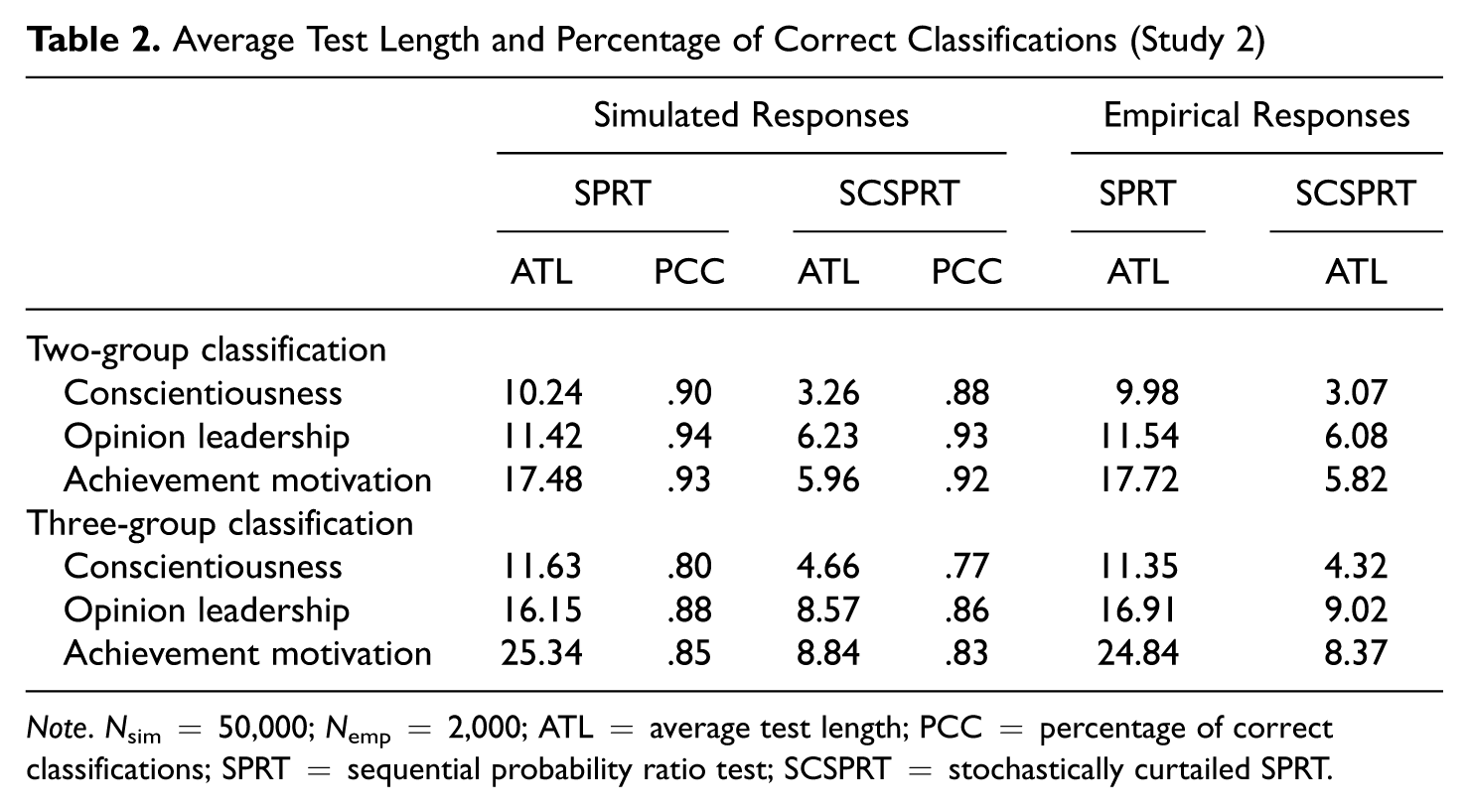
Note. Nsim = 50,000; Nemp = 2,000; ATL = average test length; PCC = percentage of correct classifications; SPRT = sequential probability ratio test; SCSPRT = stochastically curtailed SPRT.
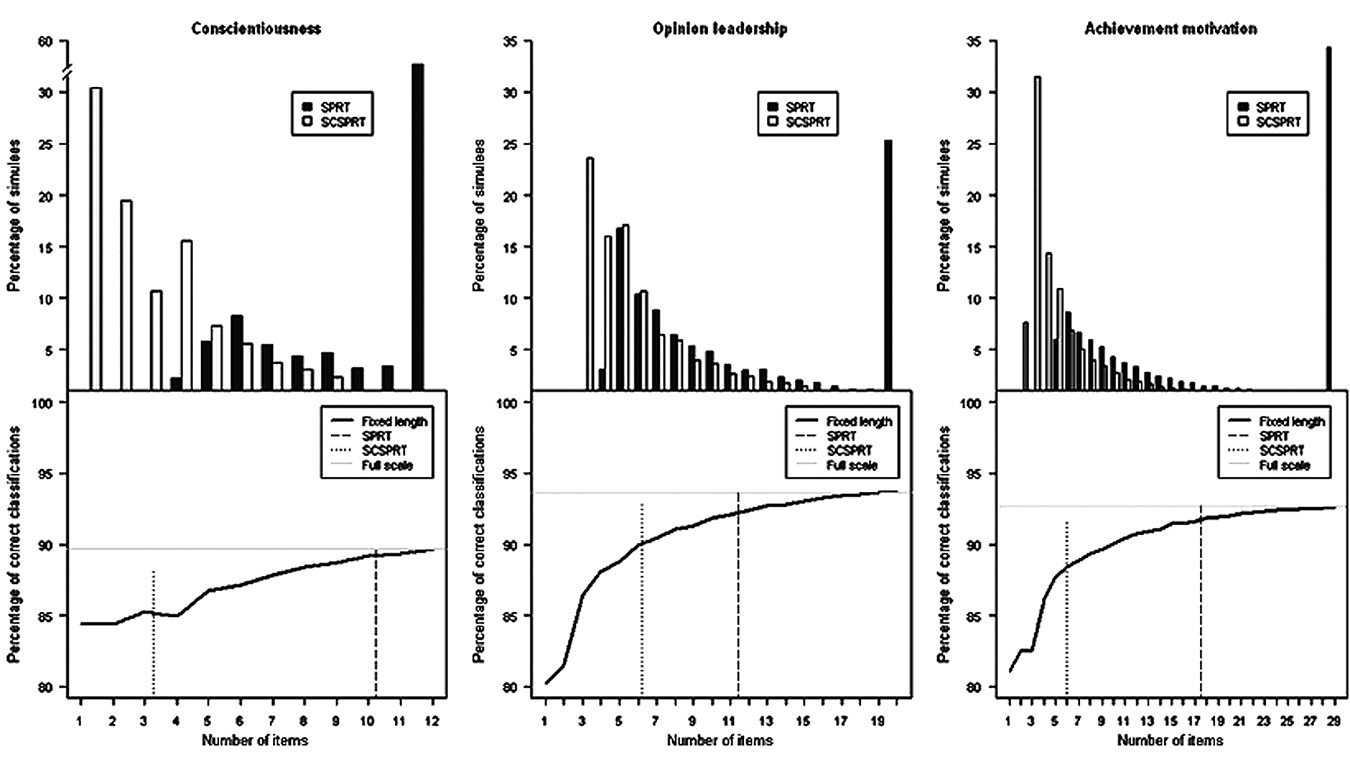
Distribution of test lengths and average classification accuracies for adaptive two-group classifications in comparison with fixed-length tests (Study 2).
Although the SCSPRT resulted in significantly shorter tests, it had only a marginal impact on PCCs. The difference in PCCs between SPRT and SCSPRT varied from .01 to .03, with higher differences for the short conscientiousness scale and three-group classifications (see Table 2). Furthermore, in terms of their classification accuracies, the adaptive procedures even proved superior to comparable fixed-length tests (see bold lines in the lower charts of Figure 3). As expected, with an increase in the number of administered items, the PCCs of the fixed-length tests gradually rise until they reach the maximum classification accuracy of the complete scales (horizontal line in Figure 3). However, the adaptive procedures (dashed and dotted lines in Figure 3) do not function significantly worse than tests that administer the complete scales. Although they use fewer items, their PCCs are comparable with the full scales’ accuracies. Although the SPRT reaches similar PCCs to the complete scales, accuracies for the SCSPRT fall on average one to two points below those of the full scales. No fixed-length tests that contained only a subset of items resulted in comparable or even higher PCCs than the adaptive procedures. Hence, simply selecting the most discriminating items to create short fixed-length versions of a test did not result in classification accuracies that are comparable with those of the adaptive procedures.
Discussion
Polytomous CACTs resulted in considerably shorter tests while maintaining comparable classification accuracies. The presented simulations for both two- and three-group decisions demonstrated that the ATLs of the administered instruments were reduced to, in the best of cases, about 30% to 40% of the entire scale. This was confirmed with simulated data sets and also with empirical responses. Difficulties mainly arose for proficiencies near the cutscores. Depending on the overall measurement precision of the instruments, the PCCs increased considerably in this region. This was, however, not specific to the adaptive presentation mode but was an inherent weakness of the instruments themselves. Classifications that were based on the entire scales resulted in virtually identical error rates as classifications with CACTs using SPRT. Hence, in the area around the cutscores, increased error rates are to be expected in any case. Adaptive procedures cannot change this. CACTs, however, reach comparable classification results with a considerably reduced number of items on average.
The actual ATLs of CACTs were highly influenced by three factors: (a) the length of the original scale and thus the available size of the item pool, (b) the test termination criterion, and (c) the number of classification groups.
Item Pool Size
The number of available items that can be administered to an examinee primarily affected the classification accuracies around the cutscores. Shorter scales have fewer items that are informative near the cutscores and thus cannot classify examinees in this region properly. To account for the limited classification precision in this area, the adaptive tests administered more items of the scales. In many cases, however, these additional items were little informative and did not improve the classification accuracy. Hence, for the shortest scale in this study, which contained 12 items only, PCC fell about 10% points below that of the two longer scales. This was even worse for three-group classifications, where informative items around two cutscores are needed. In contrast, the two longer scales hardly differed in terms of PCC. Even ATLs were comparable for both longer scales, at least when considering the SCSPRT. This mirrors previous results for polytomous CATs (Dodd et al., 1995; Hol et al., 2007), concluding that item pools with as few as 20 to 30 items can be sufficient to reach reliable proficiency estimates. The item pools in this study, however, used items from constructed fixed-length scales, which were not developed for adaptive test administrations. These scales usually contain items that are informative across a broad span on the latent proficiency scale. Item pools that have been explicitly constructed for adaptive classification purposes, however, typically include more items around the cutscores and fewer items at the tails of the proficiency distribution. Hence, for appropriately constructed item pools, the effects of CACTs on ATLs are likely to be even more pronounced.
Test Termination Criterion
The choice of the stopping rule had considerable implications for ATLs. As the CACTs had difficulties in classifying examinees near the cutscores, the traditional termination criterion, SPRT, administered almost all items to these examinees. This, however, did hardly improve the classification accuracy. In contrast, the SCSPRT resulted in early test termination for these cases and led to considerably shorter ATLs. This mirrors previous results for dichotomous CACTs (Finkelman, 2008; Wouda & Eggen, 2009). Furthermore, the modified test termination criterion was also superior to shortened fixed-length tests that administered the same, that is, the most discriminating, items to all respondents. Such fixed-length tests resulted in significantly more misclassifications than adaptive tests with SCSPRT. Hence, fixed-length classifiction tests could not approximate the error rates of adaptive tests with examinee-driven item selection and test termination.
Cutscores
The cutscores mark the regions on the proficiency scale where the most informative items are required. Hence, the region around the cutscores also exhibited the most misclassifications. Depending on the location of the cutscores on the proficiency scale, the cutscores have a huge impact on the overall PCC of a sample. The current simulations specified the cutscores at the 25th and 75th percentile of the proficiency distribution and resulted in PCCs around .92 (achievement motivation) for two-group classifications and a considerably lower PCC of about .83 for three groups. As the error rates in a sample depend on the selected cutscores, cutscores, for example, closer to the median of the proficiency distribution are expected to increase the overall PCC. Furthermore, PCCs are influenced by the quality of the item bank; error rates will increase the fewer items that are located near the cutscores. For traditional personality scales, this would most likely be the case for more extreme cutscores set near the tail of the proficiency distributions as these scales usually have less items discriminating well at the extremes. In terms of test lengths, the results are in line with Thompson (2007). Three-group decisions required about 40% to 50% more items and, thus, increased the ATLs of the instruments considerably. However, for CACTs using SCSPRT, this translates in about three items only.
Conclusion
CAT has become increasingly popular during the past two decades (Reise et al., 2005). Consequently, many tests including admission tests, such as the well-established Graduate Management Admission Test (GMAT) have been converted to adaptive versions (Rudner, 2010). Adaptive tests are a means to construct shorter measurement instruments without sacrificing measurement precision. Traditionally, a representative sample of items from a long scale are selected to form a short version. As the example of the 12-item conscientiousness scale demonstrated in this article, such short scales tend to produce more misclassifications near the cutscores than longer scales. The presented adaptive procedure, however, can make use of the entire scale while administering only as much items to an examinee as needed to reach a classification decision. This leads to a classification accuracy comparable with that of the full scale, with a considerably reduced number of items on average. This is particularly true for the modified test termination criterion proposed by Finkelman (2008), which reduces the average test length to about one third of the entire scale. Although these results were demonstrated in two independent studies with simulated as well as empirical responses, the generalizability of the findings might be affected by the choice of the three personality scales that were used as item banks for the simulations. Although the use of empirically derived instead of artificially generated item parameters rendered rather realistic conditions for the simulations, the study’s results have to be interpreted in light of the specific item locations of the item banks and might not be readily generalizable to other instruments. In practice, CACTs typically operate with explicitly constructed item pools that optimize item information and, thus, include more items near the cutscores. Hence, to derive more general conclusions about the effects of the test termination criterion on CACTs, future research should experimentally vary characteristics of the item pool (e.g., the number of items near the cutscore). For appropriately designed item banks, the effect of the modified test termination criteria, SCSPRT, on ATL may be even more pronounced.
Footnotes
We like to thank Christian Bergmann for providing the data sets for the simulations in this paper.
The authors declared no potential conflicts of interests with respect to the authorship and/or publication of this article.
The authors received no financial support for the research and/or authorship of this article.