







Abstract
Three studies are reported that examine the effects of valence on connectedness with nature. In Study 1, results showed that the implicit association test (IAT) effect is robust to the valence of the stimuli. Participants showed stronger self-nature than self-built associations, regardless of whether the stimuli were positively or negatively valenced. Study 2 further tested that the positive IAT effect is due to the valence of the stimuli and showed an equally large IAT effect and a strong positive correlation between the positively and negatively valenced IAT stimuli. In Study 3, we address potential confounding effects of valence with a newly matched set of stimuli. Results were consistent with our prior findings in showing that valence of the stimuli did not affect the IAT scores. We conclude that while there are individual differences in connectedness with nature, such beliefs are not affected by positive or negative aspects of natural or built environments.
Keywords
Recent studies of environmental attitudes and proenvironmental behavior have identified connectedness with nature as an important psychological construct (Arnocky, Stroink, & De Cicco, 2007; Dutcher, Finley, Luloff, & Johnson, 2007; Mayer & Frantz, 2004; Nisbet, Zelenski, & Murphy, 2009; Schultz, 2002; Schultz & Tabanico, 2007). Connectedness refers to an individual’s belief about the extent to which he or she is part of the natural environment. This belief has been described as “primitive” and “zero-order,” and research has found it to be predictive of environmental concerns, intentions to act in a proenvironmental way, and broad-based measures of proenvironmental behaviors (Schultz, 2002; Schultz, Shriver, Tabanico, & Khazian, 2004).
At the implicit level, studies have made use of the implicit association test (IAT; Bruni, Fraser, & Schultz, 2008; Schultz & Tabanico, 2007). The IAT-Nature procedure measures the strength of the cognitive association between “self” and “nature,” and the cumulative results have yielded several clear findings. First, across these studies there is a consistent IAT effect, wherein participants show stronger associations between self and nature, than between self and built. However, there is considerable variability in these associations, and approximately 25% of the participants showed the opposite pattern, wherein it was easier to associate self with built stimuli. Second, the IAT effect showed a moderate level of test–retest reliability, even across a 4-week period (r = .49). Finally, in most cases the IAT scores correlated in meaningful ways with explicit measures of environmental attitudes.
Although the IAT-Nature procedure has generated a meaningful pattern of results, there are several methodological issues that call into question the construct validity of the IAT-Nature procedure. Previous research using the IAT has found considerable variation depending on the stimuli selected to represent the categories. Two issues in particular are noteworthy: frequency and valence of the stimuli. First, the frequency of occurrence of a word in everyday language affects a person’s reaction time to it (Greenwald, McGhee, & Schwartz, 1998; Ottaway, Hayden, & Oakes, 2001). Words that are used more frequently tend to be processed more quickly and therefore have shorter response latencies. In the previous studies by Schultz et al. (2004) and Schultz and Tabanico (2007), the natural and built words were selected on the basis of face validity. In comparing the natural words (animals, birds, plants, whales, and trees) with the built words (building, car, city, factory, and street), we find that the natural words were slightly less frequent (and had fewer letters) than the built words. Using the MRC Psycholinguistic Database, we found the mean frequency ratings for the built words (M = 186) to be slightly higher than the mean frequency for the natural words (M = 145). These differences between the stimuli could have affected the IAT results. Although the predicted direction of the effect would have been opposite to what was observed (i.e., built words being more frequent should give them an advantage over nature), there still was a strong IAT effect for self-nature.
A second limitation with the previous studies involves the valence of the words selected. Greenwald et al. (2002) argued that there are three important associations that can be assessed with implicit measures: self-valence associations (esteem), concept-valence associations (attitudes), and self-concept associations. This balanced identity model suggests that in assessing just one aspect of the associations, as is common in IAT research, it is important to control for the other two associations. In our previous studies, nature and built words were not matched for valence. A post hoc analysis of stimulus word valence using Bradley and Lang’s (1999) Affective Norms for English Words showed that the nature words (M = 6.50) were more positive than the built words (M = 6.10). Thus, what we interpreted as an association with the natural environment may in fact simply be a tendency to associate self with positive valence.
Previous research has found contradictory information regarding IAT use and selection of stimulus words with varying valences (Bluemke & Friese, 2006; De Houwer, 2001; Govan & Williams, 2004; Mitchell, Nosek, & Banaji, 2003; Steffens & Plewe, 2001). For instance, Govan and Williams (2004) concluded that both the category labels and stimuli items may affect the outcomes. In fact, they suggest that the items may redefine the category labels in the minds of the participants. For example, when positive words are shown to the participant, it is possible the participant is redefining the category from say, “animals” to “nice animals.” And, Mitchell et al. (2003) found that the contextual differences, such as the race or ethnicity of the experimenter, may have changed the IAT scores depending on whether the stimuli were previously liked or disliked by the participant (using race, White and Black), with items that were liked eliciting a stronger IAT response than items that were disliked. Yet, when De Houwer (2001) completed a similar task using a British sample (liked and disliked foreigners) the valence of the actual words did not affect performance; however, differences in the concepts did affect performance.
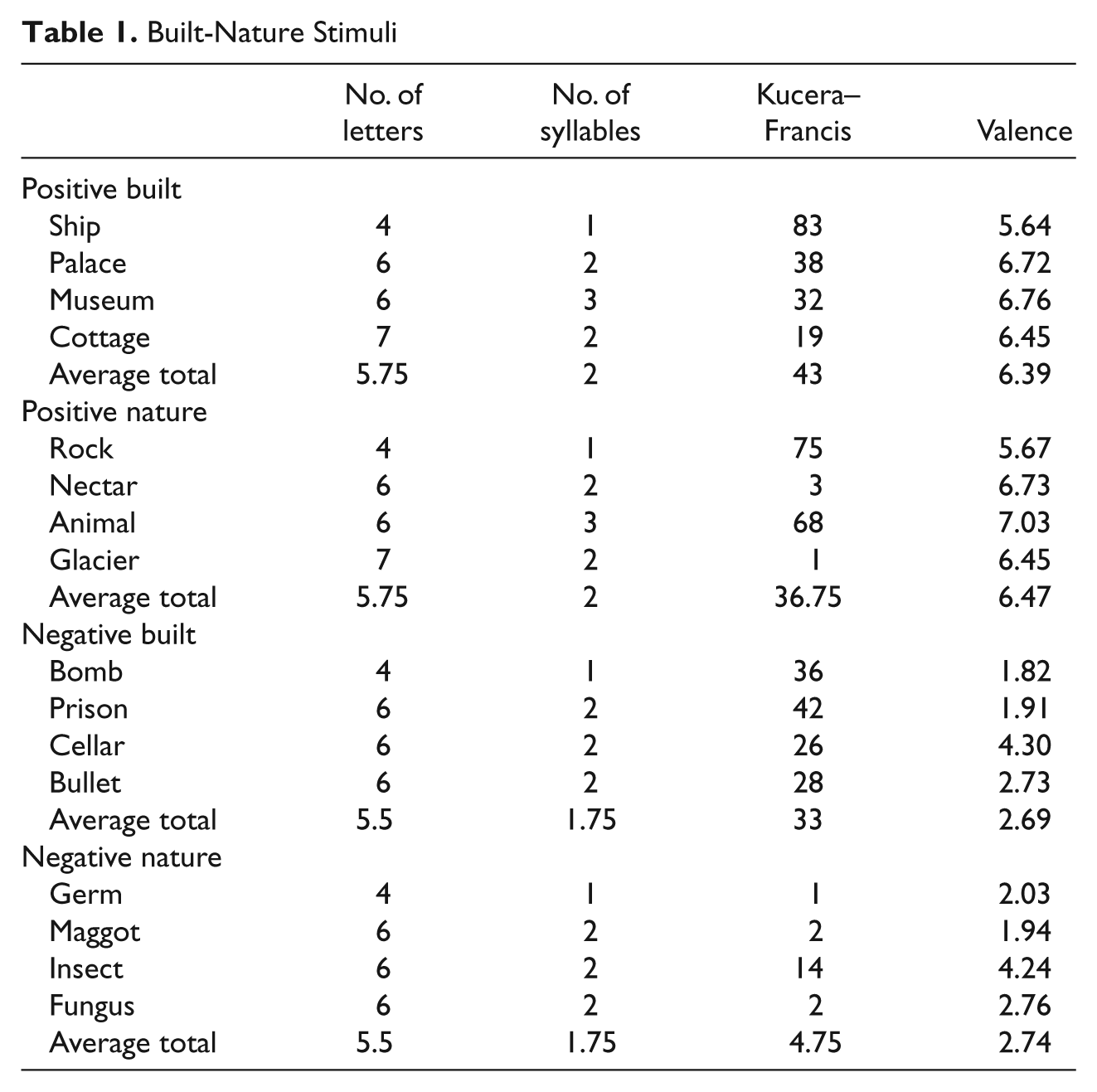
In this article, we present three studies addressing these methodological issues and expanding on the construct of connectedness with nature. First, we conducted extensive pilot work to generate words for each concept (built and nature) that were similar on valence, frequency, number of syllables, and length of word. Second, we generated two sets of matched items—positive items and negative items. Items, valences, and frequencies are shown in Table 1. 1 Based on our conceptual model of connectedness with nature, we tested two hypotheses:
Built-Nature Stimuli
Hypothesis 1. The positive and negative IAT stimuli will produce similar IAT effects.
Hypothesis 2. The positive and negative IAT scores will be positively correlated at levels similar to test–retest (r = .49) reported by Schultz et al. (2004).
Although these methodological issues are important in and of themselves, they contribute to the growing literature on the conceptual effects regarding connectedness with nature. For instance, Schultz and Tabanico (2007) suggest that connectedness with nature is a zero-order primitive belief (see also Bem, 1970, or Rokeach, 1968, for elaboration on primitive beliefs). Once established, connectedness then serves as a guide for the formation of other beliefs relating to nature (e.g., environmental programs, concern for environmental problems, and policies). If varying the valence of the stimuli used to measure this belief changes the underlying results of one’s connectedness with nature, then we have evidence that connectedness with nature may not be a zero-order primitive belief, but rather they may be a first-order belief. In a first-order belief, we have the ability to use logical thinking processes that stem from our direct sensory experiences. That is, if we find that individuals are more strongly connected with positive aspects of nature then with negative aspects, this would suggest a logical thinking process stemming from direct sensory experience with nature, such as thorns, spiders, and bees. The current studies serve to further examine and understand this underlying belief system of connectedness with nature.
Study 1
Method
Participants
Participants were 80 university students, recruited from the Psychology Department’s Human Participant Pool (56 women, 21 men, 3 missing; Mage = 22.18; SD = 4.82). A sample size of 80 was selected based on a power analysis of an anticipated medium correlation coefficient between scores on the positively and negatively valenced IAT.
Materials
Two sets of materials were used for the study: an IAT and a questionnaire. The questionnaire contained four measures of environmental attitudes (a revised version of the New Environmental Paradigm: Dunlap, Van Liere, Mertig, & Jones, 2000; the Environmental Motives scale (EMS): Schultz, 2001; the Environmental Identity scale: Clayton, 2003; and the Inclusion of Nature in Self scale (INS): Schultz, 2002). Although the questionnaire was utilized in the current study, results from the questionnaire are not reported.
IAT
The computerized IAT procedure was administered on a desktop PC using Inquisit Version 1.32 distributed by Millisecond Software. Following the introduction, participants were presented with seven blocks of trials. There were four categories of words used: “Me,” “Not Me,” “Nature,” and “Built.” The blocks were presented as follows:
Block 1: Nature–Built
Block 2: Me–Not Me
Block 3: Nature/Me–Built/Not Me
Block 4: Nature/Me–Built/Not Me
Block 5: Built–Nature
Block 6: Built/Me–Nature/Not Me
Block 7: Built/Me–Nature/Not Me
Two versions of the IAT were administered to counterbalance for order of Nature/Me (Blocks 3 and 4 above) and Built/Me (Blocks 6 and 7 above). In the first rotation of the IAT the Nature/Me blocks were presented first; in the second rotation, the Built/Me blocks were presented first. Participants completed the IAT procedure twice: once for the positively valenced words and a second time for the negatively valenced words. The order of administration (positive or negative first) was counterbalanced so that half of the participants completed the positive first and the other half completed the negative first.
Stimulus words for the Built and Nature categories were matched on valence, frequency of occurrence in the English language, number of syllables, and number of letters and can be seen in Table 1. Words representing the ME category were: I, Me, Mine, Myself, Self, and My. Words representing the NOT ME category were: It, Other, Their, Them, They, and Theirs. The words were presented in random order within each of the blocks.
Responses to the IAT were analyzed using the Statistical Package for the Social Sciences (SPSS) script provided from the IAT website (http://faculty.washington.edu/agg/iat_materials.htm). In this initial study, data were collected in such a way that raw scores for each stimulus were not recorded. Means and standard deviations for the response latencies within each block will be presented. In addition, aggregate D-scores will also be presented based on the block-level data. In subsequent studies, we will follow the “improved” procedure and report analyses of individual-level D-scores (cf., Greenwald, Nosek, & Banaji, 2003).
Procedure
On arriving at the laboratory, participants provided informed consent. They were then randomly assigned to receive one of two rotations of the IAT and a valence order (positive or negative first). Next, participants completed the first IAT followed by the questionnaire and then the second IAT. After completing the second IAT, participants were debriefed.
Results
A total of 80 participants completed the questionnaire, positive IAT, and negative IAT. The IAT score on the positively valenced IAT (positive Nature/positive Built) ranged from −208.50 to 542.80 (M = 121.81, SD = 146.39, d = .85). The IAT score on the negatively valenced IAT (negative Nature/negative Built) ranged from −316.80 to 997.50 (M = 132.09, SD = 203.54, d = .77).
To test our first hypothesis, we examined the differences in mean reaction time by rotation (compatible first or second) and by order (positive first or negative first). The mean reaction times were analyzed using a 2 (order) × 2 (rotation) × 2 (valence) mixed model analysis of variance (ANOVA; valence was a within-subjects variable, order, and rotation were between-subjects). The results yielded two significant effects: a main effect for rotation (compatible first or second) F(1, 72) = 12.92, p < .01 and a two-way Valence × Order interaction, F(1, 72) = 8.55, p < .01. Mean scores showed that the IAT effect was larger when the incompatible blocks were presented first (M = 198, SD = 143) than when the compatible blocks were presented first (M = 63, SD = 129). Mean scores for the significant Valence × Order interaction showed that participants who completed the positive IAT first showed a larger IAT effect for the positive items (M = 159, SD = 161) than for the negative items (M = 113, SD = 171). For participants who completed the negative IAT first, the IAT effect was larger for the negative items (M = 150, SD = 230) than for the positive items (M = 86, SD = 123).
To test our second primary hypothesis, we calculated the correlation coefficient between the positive valence IAT and the negative valence IAT. The results yielded a statistically significant correlation (r = .48, p < .01).
Discussion
Study 1 found evidence for the generalizability of the findings across both positive and negatively valenced concept items. In this study, the positive and negative IAT stimuli produced similar IAT effects (D-scores of .85 and .77, respectively). In addition, the positive and negative IAT scores were positively correlated at levels similar to test–retest (r = .49) reported by Schultz et al. (2004). This suggests that connectedness with nature (as operationalized through the IAT-Nature) was not affected by valence. However, the valence of the stimuli was examined across different IAT’s and not within the same IAT. Study 2 examines the effect of valence within a single IAT. In this study, each participant completed four IAT’s to better understand how stimuli valence affects the IAT effect.
Study 2
Method
Participants
Data were obtained from 129 undergraduate students (25 males, 104 females; Mage = 22.41, SD = 4.80) at California State University, San Marcos. Participants were recruited from the Psychology Department’s Human Participant Pool. The sample size was selected to allow for at least 30 participants in each of four testing conditions, providing 80% power to detect a large effect.
Materials
This study utilized both the IAT and a questionnaire. The questionnaire consisted of five measures of environmental attitudes, four from the previous study and the General Ecological Behavior scale (Kaiser, 1998). Although the questionnaire was used in this study, results from this information are not reported here.
IAT
The IAT used in this study was the same as reported in Study 1 and was administered using Inquisit. However, in the present study, four versions of the Nature IAT were used. The four versions of the IAT-Nature were created containing various combinations of positive and negative stimulus words taken from Study 1 for the Nature and Built categories:
Positive Nature–Positive Built
Negative Nature–Negative Built
Positive Nature–Negative Built
Negative Nature–Positive Built
In addition, a corrected scoring algorithm was used in this study. Scores for the IAT were calculated using the improved scoring algorithm provided by Greenwald et al. (2003). The improved scoring procedure uses both the compatible and incompatible trials of the IAT to create individual-level D-scores for each participant. The D-score is computed by calculating the difference between the reaction time of the compatible and incompatible and dividing the difference by the standard deviation. Separate scores were generated for the compatible (Nature-Me; Built-Not Me) items and for the incompatible (Nature-Not Me; Built-Me) items. These scores were computed for the positively valenced items and then again for the negatively valenced items. More specifically, to obtain a D-score, time difference (D1) between the compatible and incompatible practice trials were calculated as follows: incompatible practice minus compatible practice. In addition, the time difference (D2) between the compatible and incompatible test trials was calculated as follows: incompatible test minus compatible test. A standard deviation was calculated for practice blocks and for test blocks. The time difference score for the practice blocks was divided by the standard deviation of the practice blocks and added to the time difference score for the test blocks divided by the standard deviation of the test blocks. Finally, the sum is divided by two, which produces the D-score.
The internal consistency of the positive and negative IATs was assessed by correlating two subscales (D1 and D2). Results showed that D1 (M = .37, SD = .59) was significantly correlated to D2 (M = .35, SD = .52), r = .67, p < .01.
Procedure
After providing informed consent, participants completed a computerized test and a written questionnaire. The order of these tasks was randomly determined. For the computerized portion of the test, participants were randomly assigned to complete one of the four IAT tests, using a blocked assignment procedure. IAT rotation (compatible or incompatible first) was also randomly determined. All participants were tested individually. On completion of both the computer and questionnaire tasks, participants were debriefed.
Results
Across the four IAT tests, data were screened for high error rates. Two participants were excluded from the analysis of the IAT due to high error (error rates greater than or equal to 25%). The IAT D-score across the remaining 127 participants ranged from −.80 to 1.29 (M = .38, SD = .49).
Next the IAT D-scores were examined by valence type. The IAT D-scores for the positively valenced IAT (positive Nature/positive Built) ranged from −.80 to 1.09 (M = .32, SD = .49) and −.66 to 1.29 (M = .37, SD = .55) for the negatively valenced IAT (negative Nature/negative Built). The IAT D-scores for the positive Nature/negative Built IAT ranged from −.47 to 1.22 (M = .45, SD = .50) and from −.50 to 1.41 (M = .38, SD = .45) for the negative Nature/positive Built IAT.
A univariate ANOVA was used to test the primary hypothesis about the effect of word valence on the IAT scores and the general tendency to show a preference for nature. In addition, the effect of IAT rotation and order of materials administration was included in this analysis. There was not a significant difference of the D-scores between test version, F(3, 113) = .38, p = .77. However, there was a main effect of rotation, F(1, 113) = 120.24, p < .01. Mean scores showed that the IAT effect was larger when the compatible (Nature/Me) trials were first than when the incompatible (Built/Me) trials were first, regardless of the valence of the stimulus word. There was not a main effect of order (presenting explicit vs. implicit materials first) and no significant interactions were found.
Study 3
Studies 1 and 2 have shown that valence of the stimuli in the IAT-Nature does not affect the scores. However, in a recent article, Verges and Duffy (2010) report data showing that IAT scores are affected by the valence of the stimuli. Using a different set of stimuli, their results showed that when the valences were changed, more negative words produced lower IAT effects. In fact, for negative stimuli, the IAT effect was reversed such that participants showed stronger self-built connections than self-nature connections. Because these findings are opposite to our results, the purpose of Study 3 was to use the negatively valenced stimuli presented in Verges and Duffy (2010) to better understand how negatively valenced stimuli affect one’s implicit connectedness with nature.
Method
Participants
Participants were 68 California State University, San Marcos (CSUSM) students (male = 12, female = 56). Participants were recruited from two Social Psychology classes and received extra credit for participating in this study.
Materials
All materials were administered via the World Wide Web at http://www.conservationpsychology.org/game. An online questionnaire was developed to measure explicit environmental concerns and demographic variables. Several measures of explicit environmental concern and demographic questions were included in an online questionnaire (EMS: Schultz, 2000, 2001; INS: Schultz, 2002; Personal Concern: Dunlap, Gallup, & Gallup, 1992, 1993). However, while these measures are part of the current study, these results are not reported here.
IAT
Implicit associations were measured using a game version of the IAT, known as FlexiTwins (Bruni & Schultz, 2010). FlexiTwins is based on the traditional IAT as presented above with several modifications. First, FlexiTwins differs from the traditional IAT in that it is a colorful, animated game. In this computerized game version, two frogs are shown on lily pads, one on the left and one right side of the screen. Background graphics show scenes from nature and can be turned on or off. FlexiTwins is similar to the traditional IAT in that stimuli are presented one at a time; however, unlike the traditional IAT wherein the stimuli are presented directly in the middle of the screen, these stimuli fall from the top to the bottom of the screen. FlexiTwins also uses sounds, which present feedback and give FlexiTwins a game-like feel that is not present in the traditional IAT. In addition, built-in feedback reminders pop up on the screen, reminding participants to catch as quickly and accurately as possible. The game version was developed to be fun, attractive, and easily used with a wide range of ages and has been validated against the traditional laboratory version. See Brookfield Zoo (2006) for information about the reliability and validity of FlexiTwins as a measure of implicit connectedness with nature.
To account for outliers and error, each response time per stimulus lower than 300 milliseconds (ms) or larger than 3,000 ms were excluded from further analysis. This exclusion controls for participants being very fast or very slow, and helps control for error. Calculations are made using data that encompass the total time a stimulus is present until a correct response is made, regardless of whether it was preceded by an incorrect response. With the exception of the treatment of outliers, the D-score computations follow Greenwald et al.’s (2003) improved scoring algorithm as described in Study 2.
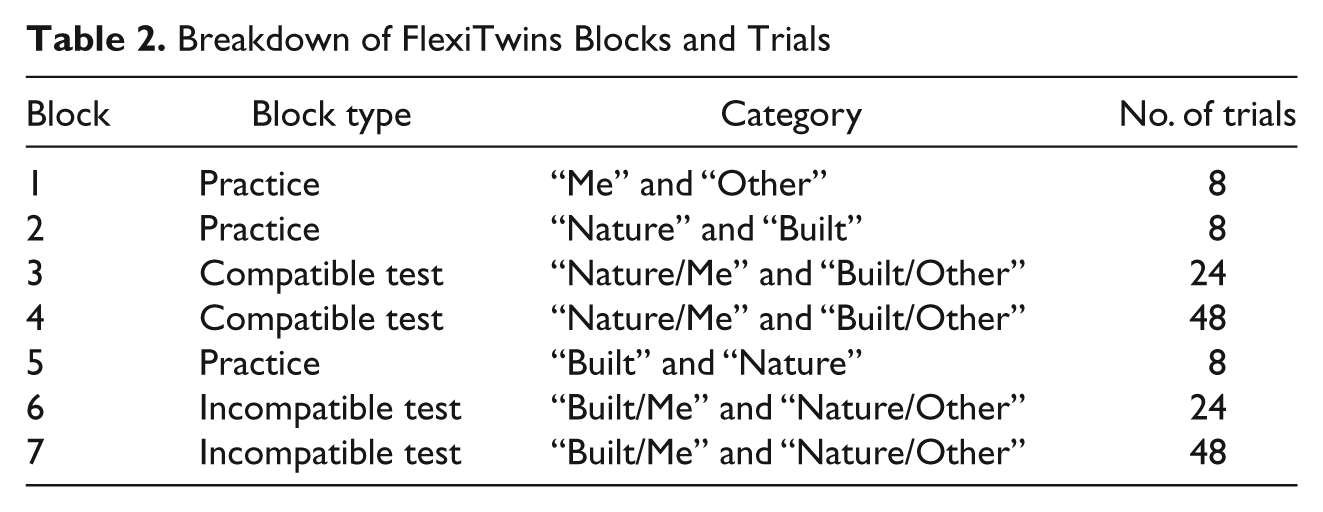
Blocks and trials are the same as those outlined in Study 1, with the following changes being made to the current study (see Table 2). In this game, the participants’ name was used as the “Me” category, and a random list of other names was used as the “Other” category. In this block, participants are instructed to catch “Me” stimuli on the left and “Other” stimuli and the right. The stimuli used for the built category were the words: bed, clothing, house, toy, and trophy. The stimuli used for the nature category were the words: bees, fungus, manure, snake, and thorn. These words were taken from Verges and Duffy (2010) to conceptually replicate their findings and create a negative-nature IAT.
Breakdown of FlexiTwins Blocks and Trials
The internal consistency of FlexiTwins was assessed by correlating two of the subscales (D1 and D2) generated by the game. Results showed that FlexiTwins D1 (M = .64, SD = .44) was significantly correlated to FlexiTwins D2 (M = .44, SD = .38), r = .48, p < .01.
Procedure
After reading informed consent and agreeing to participate in the study by clicking the “I Agree” button, participants completed an online questionnaire and then proceeded to play FlexiTwins. Finally, participants were debriefed.
Results and Discussion
Complete data were obtained from 68 participants. Three participants were removed from further analyses, two due to errors on FlexiTwins greater than or equal to 25% and one participant was removed from the data set as an outlier, with a D-score of 2.35. The total working sample for further analysis was 65 participants. FlexiTwins D-scores ranged from −.31 to 1.48 (M = .54, SD = .36). Approximately 6% of the D-scores were in the negative direction (endorsing stronger associations with Self-Built).
The results from this study replicate the results from Studies 1 and 2, showing that the valence of the stimuli did not affect the IAT scores. In this sample, the D-scores were still primarily in the positive direction, suggesting that the valence of the stimuli used did not affect connectedness with nature. And, when compared to other similar samples of college students using nonnegative-nature IAT’s the means are comparable. For instance, Bruni and Schultz (2010) reported that the D-scores of a sample of college students ranged from −.97 to 1.90 (M = .44, SD = .45, N = 62). In the current sample, the students D-scores on the negative-nature IAT ranged from −.31 to 1.48 (M = .54, SD = .36, N = 65). These scores are slightly higher than the previous sample.
Although these results reported do not replicate findings reported by Verges and Duffy (2010), we need to acknowledge that our study was not an exact replication. To start, our study used FlexiTwins as a measure of the IAT whereas Verges and Duffy used a traditional version of the IAT. Although FlexiTwins was designed following the principles of the IAT, it also introduces images, colors, and visual and auditory reminders that are not part of the traditional IAT. There were also differences within the IAT itself. We used the traditional layout of the IAT as presented by Greenwald et al. (2003) and includes both practice and test blocks; whereas Verges and Duffy used a brief IAT (Sriram & Greewald, 2009) which does not include the practice block. In addition, the number of stimuli differed between our study and the study by Verges and Duffy, although prior studies have shown that the number of stimuli within each block generally do not affect the IAT scores (Nosek, Greenwald, & Banaji, 2005). We also used the improved scoring algorithm proposed by Greenwald et al. (2003); whereas Verges and Duffy did not. Finally, our study was conducted over the Internet, whereas Verges and Duffy collected their data in the laboratory. Although these technical differences may explain the differences observed across the two studies, we think there are other more likely explanations.
General Discussion
Connectedness with nature has attracted considerable research attention and a number of measurement tools have been proposed. Among these is the IAT-Nature, which measures connectedness with nature at an implicit level. In the current article, we examine implicit connectedness with natural and built environments, using both positively and negatively valenced stimuli. Across three studies, we show that IAT-Nature scores are unaffected by the valence of the stimuli.
Results from Study 1 provide evidence for an overall IAT effect, whereby participants showed a stronger connection to natural versus built environments. The results also show that this IAT effect generalizes across both positively and negatively valenced concept items. In this study, the positive and negative IAT produced similar effects. In Study 2, we replicate this effect using a within-subjects design and also show positive correlations in the connectedness scores of individuals across positively and negatively valenced versions of the procedure. Finally, in Study 3 we used a different set of stimuli, drawing on a recent article by Verges and Duffy (2010). Again, our results show a strong tendency for individuals to have stronger self-nature associations than self-built associations, regardless of whether the natural or built objects are positively or negatively valenced.
From the findings reported in this article, we draw several conclusions. First, the IAT-Nature procedure continues to provide a useful platform from which to approach connectedness with nature. If connectedness is indeed “primitive,” then asking participants to self-reflect and report their strength of association might pose measurement problems. Given the strong social desirability associated with environmental attitudes and beliefs, it seems likely that self-reports will be affected by many aspects of the testing situation. We are not suggesting that self-report measures cannot provide a usable measurement approach, but rather that the IAT procedure can provide an alternative means of measuring these beliefs.
The results reported in this article also show that individuals are equally connected to positive and negative aspects of nature. This is not to say that individuals like positive and negative nature equally as much, which would be an attitudinal expression. In our studies, we measured self-concept associations and not concept-valence associations (i.e., attitudes). Therefore, our results show that individuals are equally connected to positive and negative natural environments, but (by definition) there are differences in attitudes toward positively and negatively valenced aspects of nature.
Methodologically, the lack of stimulus valence effects has been shown in other domains. But conceptually, the finding has implication for the construct of connectedness. According to the Inclusion Model (Schultz, 2002), connectedness with nature serves as a primitive belief that affects subsequent attitudes and behaviors. Connectedness with nature has an adaptive basis, such that forming a connection with nature helps an individual to survive. Connectedness is a cognitive construct, and not affective, which means that the good–bad dimension of nature (i.e., valence) is largely irrelevant to our sense of connectedness. Understanding nature and our place in it, provides a foundation for understanding ourselves. Consistent with this model, our results show no differences between connectedness to positively or negatively valenced objects. In fact, in Studies 2 and 3 where valence and nature/built were fully crossed, participants showed a stronger connection to nature (using negatively valenced stimuli) than to built (using positively valenced stimuli).
Interestingly, our results also show substantial individual differences in connectedness with nature. In fact, while the overall tendency is for individuals to have stronger self-nature associations than self-built, some participants show stronger self-built associations. These individual differences are generally stable over time, but prior studies have shown that they can change with experience. For example, Bruni et al. (2008) showed that spending a day at the zoo resulted in higher connectedness with nature scores. Similar results were reported by Schultz and Tabanico (2007), who also reported that other recreational activities like golfing or exercising did not produce a change in connectedness scores.
In Study 3, we drew on a recent article by Verges and Duffy (2010) in which they showed a reversed IAT-Nature effect. In essence, when the stimuli for nature were negative, participants showed a stronger self-built than self-nature association. Although our study was not designed to provide a direct replication of Verges and Duffy (2010), the differences in results are noteworthy. In fact, the two studies show opposite results—Verges and Duffy (2010) showing a reversed IAT effect with negatively valenced items and our results showing no affect of valence on IAT scores. Although we have previously acknowledged the methodological differences between the two studies, it is also worth commenting on more substantive explanations. First, the location of the studies was different. Verges and Duffy completed the IAT in Indiana and our studies were conducted in Southern California. With this in mind, weather could have played a key role in the differences obtained in the two studies. Southern California has a temperate climate. Most days are pleasant, with its coldest month being December when the average temperature overnight is 50°F. In August, the warmest month, the average daytime temperature rises to 78°F (rssweather.com). Indiana, on the other hand, is not a temperate climate, with the coldest month being January when the average temperature overnight is 19°F. In July, the warmest month, the average daytime temperature rises to 86°F (rssweather.com).
These differences in weather could play a role in the connectedness a person experiences with nature. Our participants from Southern California may have a stronger connection with nature because they can experience nature in a more positive way than participants in Indiana who may experience more negative aspects of nature. Thus, when measured using a Negative IAT, participants who experience more negative aspects of nature might have a different reaction to negative stimuli than participants who do not experience these negative aspects of nature. In addition, differences in how often a person experiences nature may also be a factor in the differences seen. For example, because the participants from Southern California have mild weather they are likely to spend more time in nature (e.g., walking, hiking, going to the beach, and gardening). However, the participants from Indiana are not as likely to spend free time enjoying the outdoors and are more likely to think of how the weather keeps them from certain activities. In short, weather interferes with their everyday activities. They tolerate weather rather than enjoy it. It is possible that in other areas of California where the climate is more extreme, IAT scores would look more like Indiana participants. As researchers further investigate psychological domains using the IAT, it is important to consider other aspects, such as the environment, that may influence IAT scores, not just within convenience samples, but across the United States and internationally.
Of course, there may be other explanations for the differences between these two studies. Another possible explanation in differing IAT effects is the number of years the individual has spent in their current location. It is possible that students who are in a new city because they have just moved to attend college are less connected to their present natural environment. These studies (both ours and Verges & Duffy, 2010) used college students as their sample; however, many of the students at California State University have lived in California for most of their lives and are not in an overly new environment, thus, producing a difference in their overall connection to nature.
Taken together, the current results are consistent with previous findings using the IAT-Nature procedure. As in previous studies, we find that individuals have a tendency to form stronger self-nature associations, than self-built associations. The current article extends this effect to show that the strength of associations is not affected by valence of the nature words used in the testing procedure. This finding diverges from other reports in this area, and warrants further study.
Footnotes
The author(s) declared no potential conflicts of interests with respect to the authorship and/or publication of this article.
The author(s) received no financial support for this research and/or the authorship of this article.