







Abstract
Housing options, such as retirement villages, that promote and encourage healthy behaviors are needed to accommodate the growing older adult population. To examine how environmental perceptions relate to walking, residents of retirement villages in Perth, Australia, were sampled, and associations between a wide range of village and neighborhood environmental attributes and walking leisurely, briskly, and for transport were examined. Perceived village features associated with walking included aesthetics (odds ratio [OR] = 1.72), personal safety (OR = 0.43), and services and facilities (OR = 0.80), whereas neighborhood attributes included fewer physical barriers (OR = 1.37) and proximate destinations (OR = 1.93). Findings suggest that locating retirement villages in neighborhoods with many local destinations may encourage more walking than providing many services and facilities within villages. Indeed, safe villages rich with amenities were shown to be related to less walking in residents. These findings have implications for the location, design, and layout of retirement villages.
Keywords
Encouraging older adults to remain physically active is important not only because of the global phenomenon of an aging population but also because of the well-known physical and mental health benefits it affords, and the fact that participation levels decrease with age (Chodzko-Zajko et al., 2009; Nelson et al., 2007; Prohaska et al., 2006). Walking, whether for recreation or transport-related purposes, is a common form of physical activity in older adults (Eyler, Brownson, Bacak, & Housemann, 2003; Tudor-Locke, Jones, Myers, Paterson, & Ecclestone, 2002). It is a highly accessible, low cost form of physical activity that can easily be integrated into daily routines, and is primarily undertaken in neighborhood streets and public open spaces (Lee & Moudon, 2004).
Research on neighborhood designs and built environment characteristics that support or deter walking has burgeoned in the last decade (Saelens & Handy, 2008). To date, some evidence shows that residential density, street connectivity, access to services (e.g., shops, parks, recreation facilities), safety from traffic, and neighborhood problems are related to older adults’ walking (Gomez et al., 2010; Hall & McAuley, 2010; Li, Fisher, Brownson, & Bosworth, 2005; Mendos de Leon et al., 2009; Michael, Beard, Choi, Farquhar, & Carlson, 2006; Nagel, Carlson, Bosworth, & Michael, 2008; Rodriguez, Evenson, Roux, & Brines, 2009; Shigematsu et al., 2009). However, for the most part, reported findings for the influence of the neighborhood environment on walking have been varied and inconsistent (Van Cauwenberg et al., 2011).
In many countries, the aging population has also focused more attention toward the housing needs of older adults. Although terminology differs greatly, between and within countries, the spectrum of available neighborhood housing options ranges from aging in place to living in residential aged care facilities. Retirement villages, which have independent living units and various services provided within a supportive environment, are one housing option available in Australia. They can be likened to independent living facilities in the United States or sheltered housing in the United Kingdom, and it is estimated that approximately 5% of Australians aged 65 years and above live in retirement villages (Jones, Howe, Tilse, Barlett, & Stimson, 2010).
Contrary to neighborhood environments, very little research has examined environmental factors within retirement villages and residents’ walking behavior (Joseph & Zimring, 2007; Joseph, Zimring, Harris-Kojetin, & Kiefer, 2005; Kerr et al., 2011). Joseph and Zimring (2007) found that long, accessible, well-connected paths with no steps and key destinations along the way were associated with walking within retirement communities. Yet, when modeling reasons for moving into retirement villages, Stimson and McCrea (2004) identified three pull factors: village environment and affordability (e.g., village services and facilities provided), location of the village (e.g., access to public transport, distance to recreation facilities), and maintenance of existing lifestyle and familiarity (e.g., close to previously used services). These findings indicate that retirement village factors in addition to aspects of the surrounding local neighborhood are important, which suggests that both warrant investigation when studying environmental influences on walking.
Focusing on relationships between walking and the built environment of both retirement villages and surrounding local area is consistent with social-ecological models of behavior (Satariano & McAuley, 2003). These propose multiple levels of interacting factors that influence health-enhancing behaviors, from individual factors to a wide range of social and environmental factors (Sallis et al., 2006). Other factors include interpersonal relationships and cultural processes (e.g., social networks and social support systems), physical environment factors (e.g., built and natural environment), organizational factors (e.g., rules and regulations within institutions), community factors (e.g., networks and relationships among organizations), and public policy (e.g., laws and policies; McLeroy, Bibeau, Steckler, & Glanz, 1988; Stokols, 1992). It is likely that retirement village residents’ walking patterns are shaped by interpersonal and environmental conditions within and outside the setting; thus, environmental factors at multiple levels need to be studied.
Although elements of the built environment can be measured objectively, they may not correspond to an individual’s own perception of his or her environment and how it relates to behavior (Weden, Carpiano, & Robert, 2008). Indeed, Bowling and Stafford (2007) reported that objective and subjective neighborhood measures captured different environmental attributes, which did not overlap and were independently related to physical and social functioning in older adults. Moreover, environmental perceptions may be more proximal to certain health outcomes, compared with objective measurements (Weden et al., 2008; Wen, Hawkley, & Cacioppo, 2006). Differences arise in how people experience the same neighborhood environment because perceptions may be influenced by past experiences, demographic differences, and physical and cognitive functioning (Wen et al., 2006). One study found that older adults perceived sidewalk obstructions as a problem in their neighborhood, yet trained auditors found no obstructions present (Michael et al., 2006). Another reported that older adults perceived desirable environmental features to be less true of their neighborhood than younger adults (Cao, Mokhtarian, & Handy, 2010). Lawton’s seminal ecological model of aging posits behavior as being dependent on the interaction between the demands of the environment and an individual’s capacity to deal with the environmental demands (Lawton, 1980, 1982; Lawton & Nahemow, 1973). For older adults, uneven surfaces or sidewalk cracks, for example, may be perceived as a more challenging environmental feature than for those younger. Age-related changes in physical functioning may decrease confidence or ability to negotiate environmental challenges, which in turn becomes a barrier to walking. Thus, examining the role of older adults’ environmental perceptions and how it relates to their own walking behavior is just as—if not more—important as objective environment measures.
Irrespective of how the environment is measured, associations between environmental attributes and behavior may be biased when self-selection is not taken into account (Boone-Heinonen, Gordon-Larsen, Guilkey, Jacobs, & Popkin, 2011; Cao, Mokhtarian, & Handy, 2009). Residential self-selection occurs when individuals predisposed to certain behaviors purposefully seek to live in environments conducive to their preferred behavior (Mokhtarian & Cao, 2008). For example, active older adults may choose to relocate to retirement villages and neighborhoods supportive of physical activity opportunities. Only one study has considered its influence within the context of senior housing settings, providing evidence that older adults did indeed self-select into retirement communities based on the supportive recreational environment (Grant-Savela, 2010).
In summary, one major limitation of the existing literature is that none to date have jointly considered retirement village environment features alongside the environment immediately surrounding a village, that is, the local neighborhood area in which the retirement village is located. Although researchers have tended to focus either on neighborhood environment attributes or on retirement village factors in isolation, the present study was designed to investigate both. Given that the population of interest is older adults, their own perspective and perceptions of the environment are important to consider, as is the possibility of residential self-selection bias. Therefore, this article examines perceptions of the retirement village and local neighborhood built environment, and associations with walking behaviors among retirement village residents. We hypothesized that perceived walkability features of village and neighborhood environments would be related to residents’ walking, and these would differ according to walking purpose (i.e., leisure, brisk, or transport-related walking). Furthermore, we expected perceived walkability features to retain significance after adjustment for self-selection factors (i.e., residents’ preference for walkability characteristics when moving to the retirement village).
Method
This cross-sectional study was conducted in Perth, Australia, with data collected from July to December 2009. Ethics approval for the study was received from The University of Western Australia Human Research Ethics Committee (RA/4/1/2151).
Sample Recruitment
Retirement village recruitment
Through the Retirement Village Association of Western Australia, 92 villages located in the Perth metropolitan and Peel regions were identified. These were manually geocoded in a Geographic Information System (GIS), and a 400-m service area, based on road networks, was created for each village. The reference point for generating the service area was the main entrance of the village, and service areas included the village site itself. A walkability score, comprising residential density, street connectivity, and land-use mix measures, was calculated for each village’s service area (Christian et al., 2011; Frank et al., 2010). Retirement villages were ranked according to their walkability score. Managers of the highest and lowest ranked villages were contacted by mail and telephone, until 32 villages agreed to participate in the study (response rate = 48.6%).
Recruitment of participants within selected villages
Informed written consent was provided by village management to allow the research team to contact and invite village residents to participate in the study. A variety of recruitment methods were employed. These included invitation letters delivered to randomly selected residents or residents volunteering in response to an invitation from either the village contact person or the research team. In some villages, briefing sessions were held to identify residents interested in participating. Overall, 325 residents provided written informed consent and participated in the study.
Study Procedures
In collaboration with the village contact person, a date and time was arranged for the research team to visit and attend each retirement village. Participants met with the research team in a group setting within the retirement village to complete a comprehensive questionnaire. Participants having difficulty completing the questionnaire or preferring to complete the questionnaire in their own home were individually assisted by a member of the research team. All questionnaires were reviewed by the research team to ensure completeness, and any missing responses were followed up with participants. A subsample (n = 65) completed the questionnaire again after 7 days.
Managers completed a brief questionnaire on retirement village characteristics; other village factors (i.e., site area and Euclidean distance to the Perth Central Business District [CBD]) were computed using ArcGIS 10.
Dependent Variables
Walking was measured using the Community Healthy Activities Model Program for Seniors (CHAMPS) questionnaire, which assesses frequency and duration of specific physical activities meaningful to older adults and has adequate reliability and validity (Cyarto, Marshall, Dickinson, & Brown, 2006; Stewart et al., 2001). Single items on weekly minutes of walking leisurely for exercise or pleasure, walking fast or briskly for exercise, and walking to do errands were dichotomized (yes/no) at ≥150 min for leisure and brisk walking and ≥60 min for transport walking.
Independent Variables
Village environment
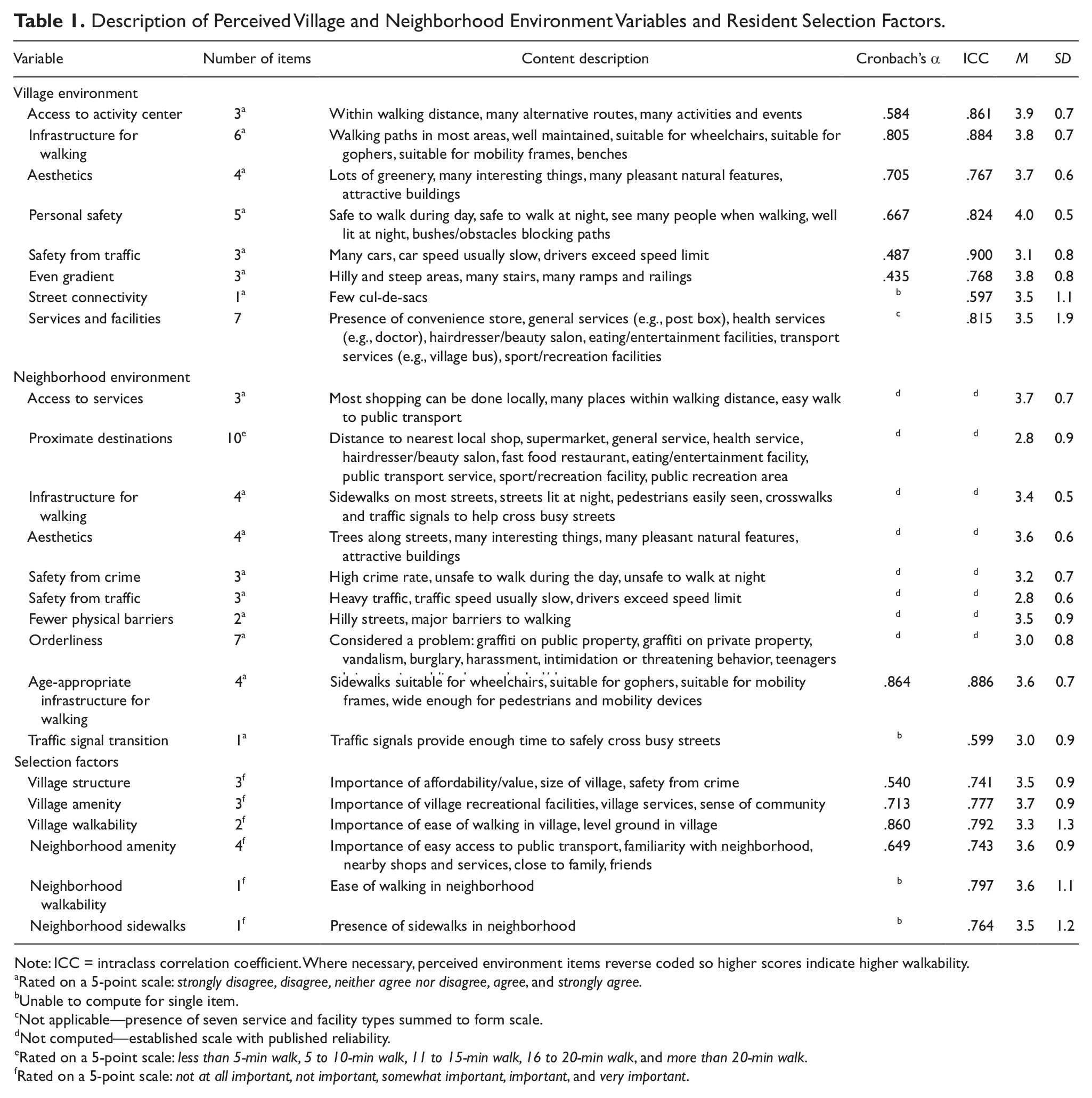
The abbreviated version of the Neighborhood Environment Walkability Scale (NEWS-A) was the basis for measuring resident perceptions of village environment (Cerin, Leslie, Owen, & Bauman, 2008; Cerin, Saelens, Sallis, & Frank, 2006). Selected NEWS-A items were modified to be more applicable to the retirement village context, and items irrelevant to the village setting were excluded. Additional items, again specific to the village context, were also included in the new survey tool. Items were rated on a 5-point Likert-type scale and, where necessary, were reverse coded so that higher scores indicated a more conducive walking environment. Principal components analysis with varimax rotation was performed on 25 single items, resulting in the formation of six subscales and one single item explaining 57.2% of total variance and showing adequate internal consistency and test–retest reliability (see Table 1). In addition, participants reported the presence of services and facilities within their village, with items summed.
Description of Perceived Village and Neighborhood Environment Variables and Resident Selection Factors.
Note: ICC = intraclass correlation coefficient. Where necessary, perceived environment items reverse coded so higher scores indicate higher walkability.
Rated on a 5-point scale: strongly disagree, disagree, neither agree nor disagree, agree, and strongly agree.
Unable to compute for single item.
Not applicable—presence of seven service and facility types summed to form scale.
Not computed—established scale with published reliability.
Rated on a 5-point scale: less than 5-min walk, 5 to 10-min walk, 11 to 15-min walk, 16 to 20-min walk, and more than 20-min walk.
Rated on a 5-point scale: not at all important, not important, somewhat important, important, and very important.
Neighborhood environment
The neighborhood was defined as everywhere within a 10 to 15-min walk from the retirement village. Perceptions of the neighborhood environment were captured using subscales from NEWS-A (see Table 1). Consistent with Cerin and colleagues (2010), single items for hilly streets and major barriers to walking were combined to form a “Fewer Physical Barriers” subscale. Four original items were combined to form an “Age-Appropriate Infrastructure for Walking” subscale, whereas the final one remained a single item (Traffic Signal Transition). These showed moderate internal consistency and reliability. Again, higher scores indicate a more walkable environment.
Selection factors
Participants rated the importance of 17 factors in their decision to move to their current retirement village. Items showing the highest frequency in the “not important” category were excluded (wheelchair accessible, closeness to parks, level ground in neighborhood) and the remaining items underwent principal components analysis with varimax rotation. Four subscales explaining 61.4% of total variance were formed, with two items, which loaded onto multiple factors, kept as single items (see Table 1).
Covariates
Age, sex, highest level of education, and physical functioning were considered as covariates. Physical functioning was measured using the Medical Outcomes Study (MOS) physical functioning measure. Items were scored and transformed to a 0 to 100 scale according to the rules outlined by Stewart and Kamberg (1992). Higher scores point to better physical functioning, with a perfect score of 100 indicating no health-related limitations to physical activity.
Statistical Analyses
Descriptive statistics were computed for all study variables using SPSS Statistics 19. To assess relationships between perceived village environment variables (8) and neighborhood environment variables (10), Spearman’s rank order correlation coefficients were computed. Logistic regression with generalized estimating equations was used to adjust for village-level clustering and explore associations between perceived environment and the odds of leisure walking, brisk walking, and transport walking. Separate models for each environment variable were fitted, adjusting for age, sex, education, physical functioning, sampling method (i.e., randomly sampled participant vs. conveniently sampled participant), and neighborhood walkability. Variables with p < .2 were regressed in adjusted combined models, thus controlling for other environment variable effects. Village and neighborhood selection factors were added to the combined models to adjust for self-selection effects.
Results
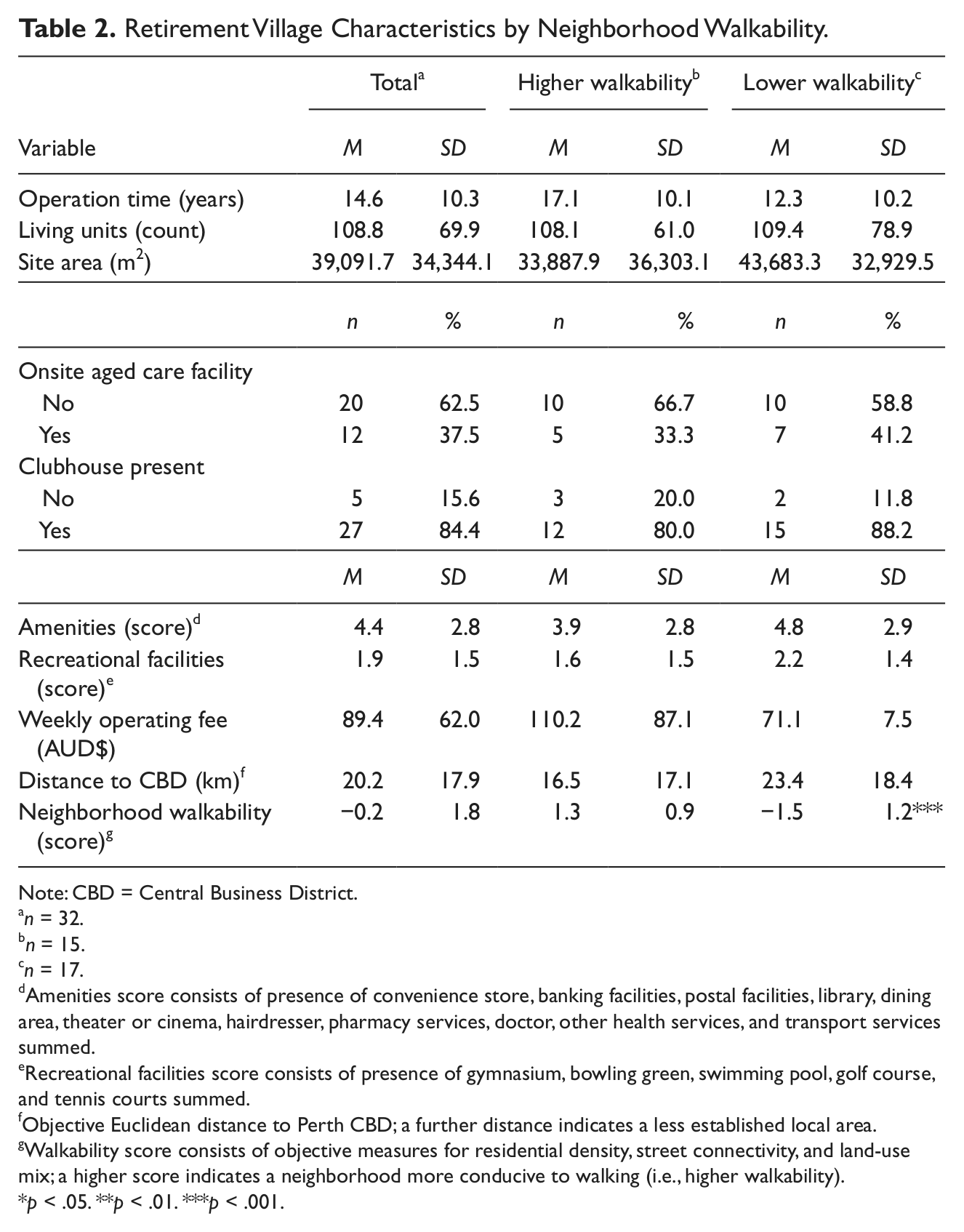
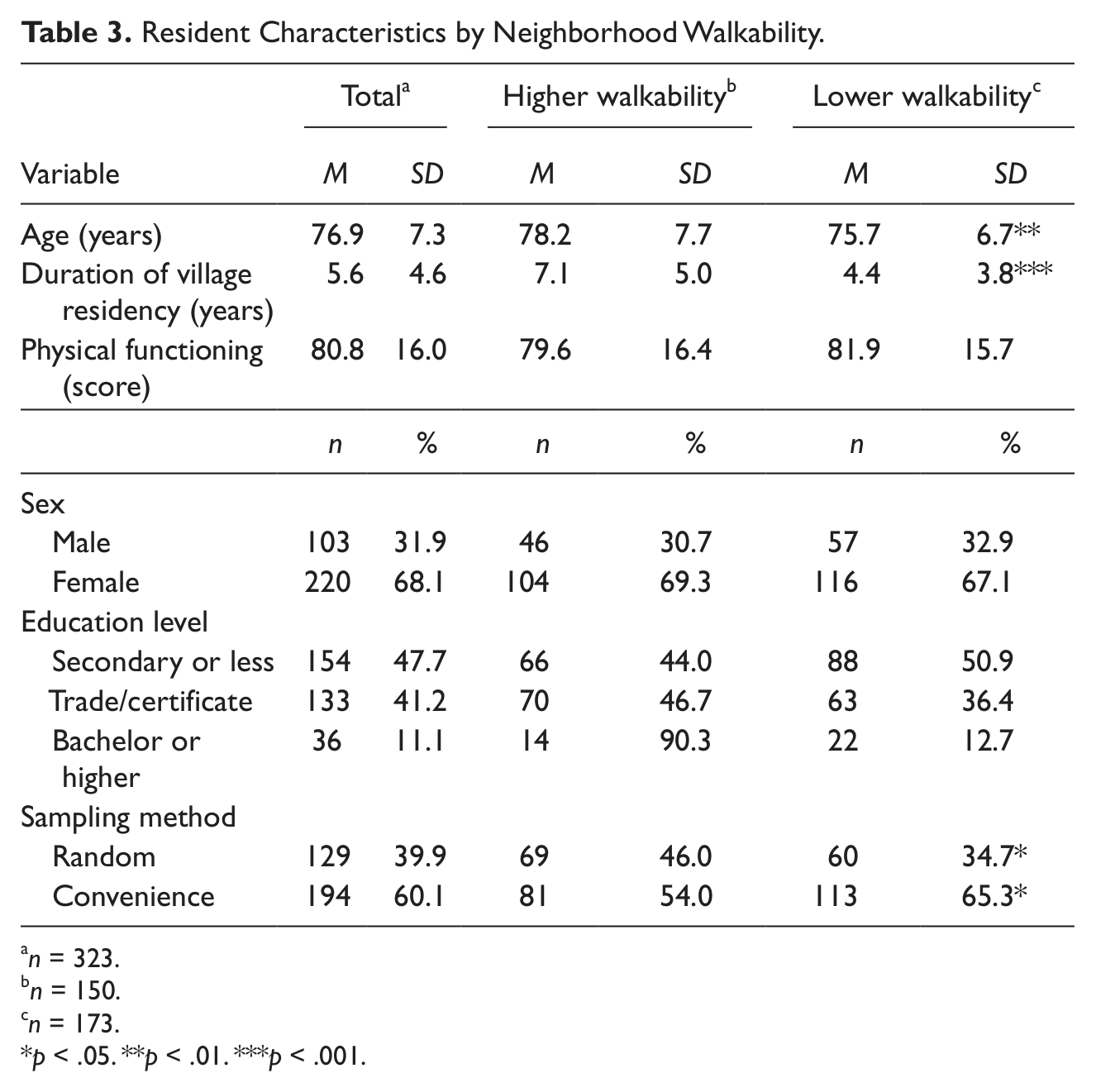
Two participants with missing data were excluded leaving 323 participants for analyses. Tables 2 and 3 report retirement village characteristics and resident characteristics for the study sample by neighborhood walkability category. On average, retirement villages contained 108.8 living units to house residents (SD = 69.9, range = 15-326); most had a communal “clubhouse” (84.4%) and nearly two recreational facilities within the village. Although differences were not statistically significant, villages with higher walkability had been in operation for longer, had higher weekly operating costs, and were located in more established local areas (i.e., shorter distance to CBD). Average age of participants was 76.9 years (SD = 7.3, range = 53-94), whereas duration of village residency ranged from 1 month to more than 21 years (M = 5.6, SD = 4.6). Residents from villages in higher walkable neighborhoods were significantly older and had lived in their village significantly longer than lower walkable neighborhoods. The samples were fairly high functioning in terms of health-related limitations to physical activity; physical functioning scores ranged from 36.7 to 100, with a mean of 80.8 (SD = 16.0). Most participants were female (68.1%) and had completed secondary school or less (47.7%). Significant differences were found for the resident sampling method according to walkability, with residents recruited by convenience sampling methods more likely to be from villages in lower walkable neighborhoods. Overall, 31.3% of participants reported ≥150 min of leisure walking per week, 19.2% reported ≥150 min weekly brisk walking, and 38.1% engaged in ≥60 min walking for transport per week.
Retirement Village Characteristics by Neighborhood Walkability.
Note: CBD = Central Business District.
n = 32.
n = 15.
n = 17.
Amenities score consists of presence of convenience store, banking facilities, postal facilities, library, dining area, theater or cinema, hairdresser, pharmacy services, doctor, other health services, and transport services summed.
Recreational facilities score consists of presence of gymnasium, bowling green, swimming pool, golf course, and tennis courts summed.
Objective Euclidean distance to Perth CBD; a further distance indicates a less established local area.
Walkability score consists of objective measures for residential density, street connectivity, and land-use mix; a higher score indicates a neighborhood more conducive to walking (i.e., higher walkability).
p < .05. **p < .01. ***p < .001.
Resident Characteristics by Neighborhood Walkability.
n = 323.
n = 150.
n = 173.
p < .05. **p < .01. ***p < .001.
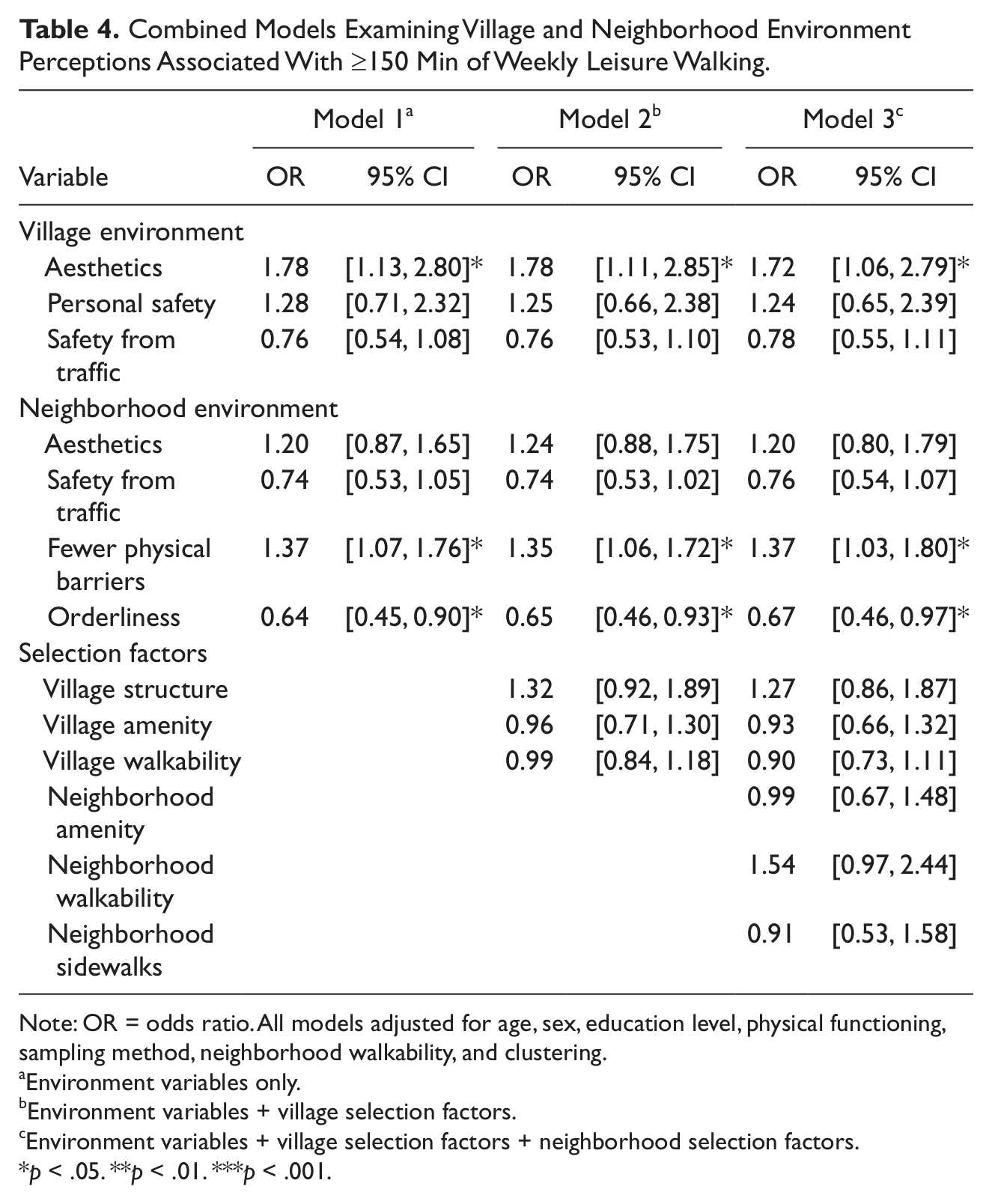
The strengths of associations between village and neighborhood environmental variables were mostly small, with perceived aesthetics showing the strongest relationship, despite its modest correlation (ρ = .365, p < .001). Village and neighborhood environment variables with p < .2 in the separate models were included in combined models for each walking behavior. Higher scores for perceived environment attributes specify higher walkability and a more conducive walking environment. As reported in Table 4, the odds of leisure walking increased by 78% for every one-unit increase in the perceived village aesthetic score (95% confidence interval [CI] = [1.13, 2.80]) and by 37% for every one-unit increase in perceptions of fewer physical barriers in the neighborhood (95% CI = [1.07, 1.76]). In contrast, higher scores for neighborhood orderliness were negatively associated with leisure walking odds (odds ratio [OR] = 0.64, 95% CI = [0.45, 0.90]). All relationships remained constant with progressive adjustment for village (Model 2) and neighborhood (Model 3) selection factors.
Combined Models Examining Village and Neighborhood Environment Perceptions Associated With ≥150 Min of Weekly Leisure Walking.
Note: OR = odds ratio. All models adjusted for age, sex, education level, physical functioning, sampling method, neighborhood walkability, and clustering.
Environment variables only.
Environment variables + village selection factors.
Environment variables + village selection factors + neighborhood selection factors.
p < .05. **p < .01. ***p < .001.
Table 5 presents the combined model for brisk walking, which included four village variables and three neighborhood variables. For every one-unit increase in positive perceptions for personal safety within the village, the odds of brisk walking were approximately halved (95% CI = [0.22, 0.98]). Moreover, brisk walking odds were significantly reduced for residents reporting higher scores for perceived street connectivity within the village (OR = 0.74, 95% CI = [0.54, 0.99]). Every additional service or facility present within the village reduced the odds of brisk walking by 0.82 (95% CI = [0.68, 0.99]). Associations between neighborhood environment perceptions and brisk walking attenuated slightly with adjustment for selection factors.
Combined Models Examining Village and Neighborhood Environment Perceptions Associated With ≥150 Min of Weekly Brisk Walking.
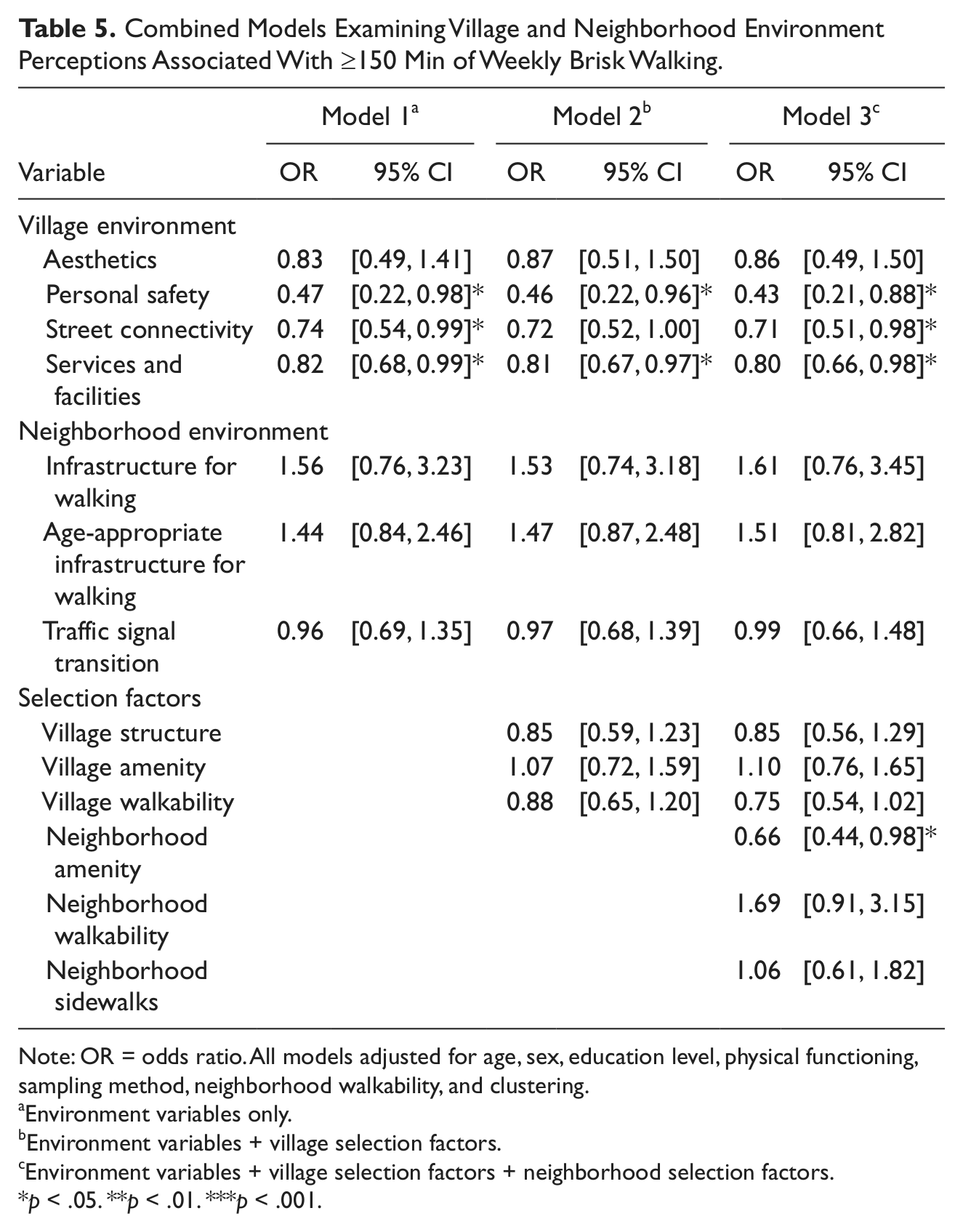
Note: OR = odds ratio. All models adjusted for age, sex, education level, physical functioning, sampling method, neighborhood walkability, and clustering.
Environment variables only.
Environment variables + village selection factors.
Environment variables + village selection factors + neighborhood selection factors.
p < .05. **p < .01. ***p < .001.
Perceiving a more even gradient within the village (i.e., perceiving the village to be more level and flat) was negatively associated with the odds of walking for transport; this remained so with progressive adjustment (OR = 0.60, 95% CI = [0.41, 0.89]; see Table 6). In contrast, every one-unit increase in score for perceived proximate destinations within the neighborhood immediately surrounding the village nearly doubled the odds of transport walking, independent of selection factors (95% CI = [1.48, 2.53]).
Combined Models Examining Village and Neighborhood Environment Perceptions Associated With ≥60 Min of Weekly Transport Walking.

Note: OR = odds ratio. All models adjusted for age, sex, education level, physical functioning, sampling method, neighborhood walkability, and clustering.
Environment variables only.
Environment variables + village selection factors.
Environment variables + village selection factors + neighborhood selection factors.
p < .05. **p < .01. ***p < .001.
Discussion
We found preliminary support for our hypothesis that environmental perceptions within and outside of retirement villages related to residents’ walking, and different village and neighborhood attributes were related to specific walking behaviors (i.e., walking leisurely, briskly, and for transport). Specifically, village aesthetics and fewer physical barriers within the neighborhood were positively associated with leisure walking, whereas neighborhood proximate destinations were positively related to walking for transport. However, negative associations were found between neighborhood orderliness and leisure walking, village even gradient and transport walking, various village environment attributes (personal safety, street connectivity, and services and facilities), and brisk walking. Overall, these relationships were independent of village and neighborhood preferences at the time residents moved into their retirement village.
Although others have reported nonsignificant findings in relation to perceived aesthetics (Shigematsu et al., 2009; Sugiyama, Thompson, & Alves, 2009), we found a positive association between aesthetics within the village environment and leisurely walking. However, this was the exception as all other significant village environment perceptions were in the counterintuitive direction. Positive perceptions of accessible services and facilities, personal safety, street connectivity, and even gradient all negatively related to residents’ walking. These findings are inconsistent with other research showing physical activity facilities within retirement communities to be correlated with resident participation in physical activity (Joseph et al., 2005) and path use for recreational walking within retirement communities relating to high connectedness and the presence of destinations along the path (Joseph & Zimring, 2007). However, neither of the above studies considered the internal environment within the retirement community and the local neighborhood environment surrounding the retirement community. Although a supportive village environment may be related to some amounts of walking, the presence of too many village facilities may detract from residents’ active living because facilities are located too close for residents to accumulate sufficient minutes of physical activity. Our results suggest that residents who perceived their villages to be more walkable were less likely to achieve the recommended amounts of walking needed to promote and maintain health (Chodzko-Zajko et al., 2009; Nelson et al., 2007). This may be due to residents only walking within the confines of the village environment rather than venturing outside into the surrounding neighborhood environment. This was similarly noted by Kerr and colleagues (2011) who suggested that incidental activity was more likely to occur when seniors left the campus environment of retirement communities, with too many destinations on campus reducing the need to leave.
We found residents who perceived fewer physical barriers in the neighborhood surrounding their retirement village (i.e., less hilliness and no major barriers to walking) were more likely to walk leisurely. Furthermore, the importance of having places to walk to in the surrounding neighborhood environment was evident in our study, as perceiving more neighborhood destination types locally was positively related to residents’ walking for errands. The importance of proximate destinations for older adults is repeatedly reported in the literature (Cao et al., 2010; King, 2008; Michael et al., 2006; Nagel et al., 2008; Rodriguez et al., 2009; Shigematsu et al., 2009). Regardless of whether older adults choose to age in place or live in senior housing complexes such as retirement villages, proximity to salient neighborhood destinations remains a strong correlate of walking. Moreover, our findings were independent of objective neighborhood walkability and preference factors. This highlights the importance of perceived measures of the environment for older adults particularly. Because perceptions are influenced by past experience and differences in physical and cognitive functioning, how older adults experience and perceive barriers to walking and proximity to destinations within their neighborhood, and how these relate to their walking in turn, may be more important than objective measurements (Cao et al., 2010; Wen et al., 2006).
Given the importance of how older adults perceive their environment and the possible interactions between perceived and objective environments, future research should combine perceived and objective measures of village and neighborhood environments to gain a more complete understanding of built environment influences on walking among retirement village residents. This approach also has a theoretical basis in social-ecological models of behavior and the ecological model of aging, which allow investigators to study distal to proximal correlates of behavior (Lawton & Nahemow, 1973; McLeroy et al., 1988; Stokols, 1992). Our findings suggest that extending measures to include perceived and objective village and neighborhood environments are warranted. Although we adjusted for objective neighborhood walkability category in all our models, more specific objective neighborhood measures should be considered. Furthermore, the most appropriate way in which to objectively measure village environments may differ to that of neighborhood environments. Just as we adapted selected NEWS-A items to be applicable to the retirement village context for the present study, environmental audit tools may need to be modified or developed to better measure village environments objectively. An example of this is the recently developed Audit of Physical Activity Resources for Seniors (APARS) tool (Kerr et al., 2011).
Our findings have policy and practice implications for the location, design, and layout of retirement villages. The negative association between village services and facilities and brisk walking, and the positive relationship between neighborhood destinations and transport walking, suggests that locating retirement villages within amenity-rich neighborhoods may increase residents’ physical activity more than simply incorporating services and facilities within the village itself. This contrasts with the current observed trend, whereby amenity-rich villages are located on the outskirts of urban sprawled suburbia. Given the potential policy implications of this finding, future research to confirm these results is warranted, together with cost-effectiveness studies to help determine whether, rather than providing many facilities within villages, it may be more appropriate to locate villages in well-serviced, accessible neighborhoods.
Although not statistically significant, we found that newer villages with more amenities and recreational facilities were located in less established neighborhoods with lower walkability. This may be because the larger parcels of land required for constructing amenity-rich retirement villages are less expensive on the urban fringe. However, to maintain the activity levels of retirement village residents, it may be preferable to colocate smaller retirement villages within town or neighborhood centers in new and established areas. Planning policies may need to provide guidance on the siting of future senior housing complexes. In Western Australia, where this research was conducted, the government’s planning policy for the design and approval of urban development recommends that retirement complexes be situated near neighborhood centers (Western Australian Planning Commission, 2007). However, the extent to which this policy is implemented requires investigation. Our preliminary findings suggest that perhaps it is not. It may be, for example, that incentives are required to encourage property developers to adhere to this guideline.
In addition to the location of retirement villages, the accessibility and connectivity of the retirement village with the wider neighborhood surrounds must also be considered. Even though villages may be physically located near destinations, the presence of barriers such as heavily trafficked streets or gated villages with limited access points may limit accessibility and ease of traveling by foot. For example, many retirement villages tend to be gated or enclosed within walls. Although providing residents with the sense of security many seek when moving into retirement villages, access points to the local environment may be limited. With appropriate security gates, it should be possible to maximize access from the village to the surrounding neighborhood while maintaining much-valued security. This may need to be considered in future villages.
The relative importance of village and neighborhood environments may differ according to the age and physical functioning of residents. For older residents and those with more physical limitations than those in our sample, the village environment may become more important over time. Thus, ensuring the retirement village itself is walkable is equally as necessary as locating villages in supportive neighborhood environments. Although we found that a supportive village environment was negatively associated with walking, it is possible that facilities and resources within retirement villages may be more important for other forms of physical activity (e.g., flexibility and muscle strengthening exercises), and for other aspects of health and well-being. In examining physical attributes of retirement communities, Sugihara and Evans (2000) found that proximity to the main activity center was significantly correlated with place attachment and social support. The authors suggested that locating living units near the activity center may foster a sense of community within the retirement community (Sugihara & Evans, 2000).
Limitations
This study was not without its limitations, which must be considered alongside the interpretation of results and findings. The cross-sectional study design means that causality cannot be inferred, and other aspects consistent with social-ecological models, such as organizational influences, were not examined. In addition, walking outcomes were self-reported by participants and may be prone to recall bias and not as accurate as objective measurements. Recruitment methods also differed across the sample. The original strategy was to recruit village residents by having a contact person within the retirement village distribute invitation letters to randomly selected residents. However, at the time of approaching village managers, concerns were raised that made it necessary to use a variety of techniques to recruit residents and maximize participation rates. For example, some village managers insisted that residents be approached on a voluntary basis and not randomly, whereas others did not want village management involved in the study, which then eliminated the role of the “gatekeeper.” In Australia, the availability of housing options for seniors has received very little policy attention, and as a consequence, no comprehensive or standardized data on retirement villages or village residents exist (Jones et al., 2010). Accordingly, we were unable to assess the representativeness of our sample. Even though analyses controlled for sampling method used, participants may not be a true representation of retirement village residents, and the generalizability of findings may be compromised. Survey administration within a group setting also warrants consideration. Although residents were instructed to complete the questionnaire individually, the nature of group dynamics also has the potential to influence participants’ responses. Nevertheless, given the age of our sample and the retirement village context, the strengths of this survey mode, which include high response rates and the ability to clarify items to participants, were seen to outweigh its limitations. Despite the aforementioned study limitations, our findings are somewhat consistent with those reported elsewhere. Furthermore, they highlight some salient discoveries that should form the basis of further investigations.
Conclusion
Few studies of older adults consider built environments within and outside retirement villages, and this is one of the first to comprehensively assess environmental perceptions for both environments. Perceptions of the built environment within retirement villages and in the neighborhood surrounding villages were related to walking among residents of retirement villages. Our findings suggest that locating retirement villages in neighborhoods with many destination types may encourage more walking among village residents than simply providing many services and facilities within retirement villages. Indeed, retirement villages rich with services and facilities may be “too” convenient and actually limit the amount of walking undertaken by residents. These findings have key implications for policy and practice, and highlight the importance of considering layout, design, and facilities of retirement villages alongside neighborhood attributes in which the village is located.
Footnotes
Acknowledgements
Funding bodies are gratefully acknowledged.
Declaration of Conflicting Interests
The authors declared no potential conflicts of interest with respect to the research, authorship, and/or publication of this article.
Funding
The authors disclosed receipt of the following financial support for the research, authorship, and/or publication of this article: Nathan is supported by an Australian Postgraduate Award, Wood by a Population Health Capacity Building Grant (No. 458668), and Giles-Corti by National Health and Medical Research Council (NHMRC), Principal Research Fellowship (No. 1004900).