






Abstract
Place attachment provides insight on why and to what extent individuals value a particular setting. Most investigations involving place attachment and environmental attitudes have been conducted in terrestrial settings; little work has addressed proenvironmental behavior in marine settings. The purpose of the current investigation was to extend Stern et al.’s work, which indicates that individuals’ environmental worldviews (EWVs) influence their attitudes toward anthropogenic impacts on the environment. We hypothesized a model wherein place attachment partially mediates the relationship between recreational visitors’ EWV and their awareness of consequences of negative impacts on Australia’s Great Barrier Reef. We then compared this model with competing models. Our results suggest that place attachment is a useful addition to studies that use Stern et al.’s value-belief-norm model.
Keywords
Over the past several years, the World Conservation Union (WCU) added several types of coral to its threatened species list (International Union for the Conservation of Nature, 2007). While the WCU cited climate change and coral bleaching as the most prominent threats to coral reefs, many other anthropogenic activities affect reefs. Human activities, on-shore (e.g., development for agriculture and urban runoff) and in-water (e.g., overfishing, shipping, and recreational uses) can negatively influence the health of a marine ecosystem.
One marine context in which these issues are becoming increasingly problematic is Australia’s Great Barrier Reef (GBR). The GBR stretches more than 2,300 km along the northeast coast of the continent and provides habitat for thousands of species of flora and fauna (CRC Reef Research Centre, 2004). The task of protecting this resource falls to the managers of the Great Barrier Reef Marine Park (GBRMP; a World Heritage Area, managed by the Great Barrier Reef Marine Park Authority [GBRMPA]), which includes most of the GBR. However, due to the many complex decisions required to manage the GBR, protected area managers cannot manage it without the support of the public. In response, the GBRMPA has identified several stakeholder groups that it engages in the decision-making process. These include commercial fishing interests, shipping industry representatives, tourism industry managers, and recreational visitors. While all stakeholder groups should be engaged in planning processes, recreational visitors (i.e., local residents and tourists who use the reef for recreational activity) are a particularly important group because of their volume (7 million per year) and their contribution to the local and national economy (more than a billion dollars annually; GBRMPA, 2007).
Researchers’ attempts to understand individuals’ proenvironmental behavior are often framed by the context of the relationship between the individual and a specific setting. Investigations of the human–place bond often fall within the rubric of place attachment (Altman & Low, 1992). Past research has indicated that those with strong bonds to the landscape have greater sensitivity toward resource conditions and are more inclined to act as stewards of the landscape (Stedman, 2002; Vaske & Kobrin, 2001). Research conducted in terrestrial settings has illustrated that there is a positive association between the attachment an individual has to a setting, more intense general environmental beliefs (Raymond, Brown, & Robinson, 2011; Wynveen, Kyle, Absher, & Theodori, 2008), greater awareness of effects of human activity on the ecosystem, and stronger attitudes toward protecting the resource (Stedman, 2003). However, although the research has examined relationship pairs between each of the constructs listed, the literature does not identify the chain of relationships that connects general environmental beliefs, place attachment, and perceptions of negative environmental impacts. Hence, this investigation sought to address the gap in the literature by identifying the order, direction, and magnitude of the relationships between these constructs.
Literature Review
In the place literature, perceptions of impacts on the environment and place attachment have received considerable attention for more than two decades. However, there have been only a handful of studies that have addressed relationships between individuals’ attachment to place and their impact perceptions (e.g., Bonaiuto, Carrus, Martorella, & Bonnes, 2002); fewer still have been conducted in aquatic environments (e.g., Devine-Wright, 2011), and none in marine protected areas. Moreover, most of those studies have not attempted to determine how place attachment is related to other constructs that influence an individuals’ awareness of human impacts on the environment.
Awareness of Consequences (AC) of Environmental Impacts
Several authors have sought to explain individuals’ AC of impacts and intention to reduce those impacts on the environment using frameworks that have adapted theories such as Fishbein and Ajzen’s (1975) theory of reasoned action or Ajzen’s (1985) theory of planned behavior (Monroe, 2003). Most of these frameworks, however, fail to account for the individual’s general environmental attitudes prior to perceiving the impact. A notable exception was suggested by Stern, Dietz, Kalof, and Guagnano (1995) in their value-belief-norm (VBN) theory of environmentalism. They operationalized AC by asking respondents to consider the effect of the impact on themselves, others, and the ecosystem. Stern et al.’s findings have illustrated that an individual’s values, social interaction, and knowledge about the environment inform the creation of an individual’s environmental worldview (EWV), which in turn, influences his or her AC of place-specific environmental impacts.
EWV is a set of general beliefs about the Earth and human–environment relations (Stern et al., 1995) and has been operationalized in terms of two dimensions, anthropocentrism and biocentrism (Absher, Vaske, & Bright, 2008; Vaske & Donnelly, 1999). The anthropocentric dimension represents a human-centered view of the nonhuman world wherein human values and experience are paramount and nature’s value lies only in what it can produce for human society. In contrast, the biocentric dimension is a nature-centered view that values all forms of life equally and implies that people are not the center of existence; and that nature has inherent value (Eckersley, 1992).
Several studies have found empirical support for a relationship between EWV and AC of impacts on the environment (Nilsson, von Borgstede, & Biel, 2004; Steg, Dreijerink, & Abrahamse, 2005). However, Stern et al.’s (1995) conceptualization of this relationship has its critics. Schultz, Shriver, Tabanico, and Khazian (2004) suggested that one of its limitations is that it measures general attitudes toward natural environments but does not include a construct representing the relationship between the individual and a specific setting within the environment. Schultz et al. contended that a worldview is too general a concept to use alone and suggested that a measure connecting the individual to specific environmental concerns is also needed.
Schultz proposed a solution to this gap in Stern et al.’s (1995) work by developing a psychological model for “inclusion with nature” (IWN; Schultz, 2002). The first dimension of the model is “connectedness to nature.” Schultz et al. (2004) argued “that an individual’s belief about the extent to which s/he is part of the natural environment provides the foundation for the types of concerns a person develops, and the types of situations that will motivate them to act” in a proenvironmental manner (p. 32). The second dimension is “caring for nature.” Schultz summarized this dimension as a feeling of “intimacy, or at least caring, for an animal or place” (p. 68). Finally, Schultz suggested that IWN includes a “commitment to protect nature,” which he defined as “a person’s willingness to invest time and resources into” protecting the resource (p. 68). This conceptualization of IWN does respond to Schultz et al.’s criticism of Stern et al.’s work; however, alternate concepts should also be explored.
Place Attachment
Low and Altman (1992) advocated that “place attachment involves an interplay of affect and emotions, knowledge and beliefs, and behaviors and actions in reference to a place” (p. 5). Measures of place attachment provide insight on why and to what extent individuals form positive and negative bonds with a particular setting. In this regard, Williams, Patterson, Roggenbuck, and Watson (1992) developed a two-dimensional scale composed of Place Identity and Place Dependence. Place identity refers to the cognitive connection people share with the setting, which is a substructure of the concept of self-identification (Proshansky, 1978). Place dependence is the perceived functional utility of a setting for facilitating goal achievement (Stokols & Shumaker, 1981). Other researchers have suggested additional dimensions, including familiarity, belongingness, and social bonding (Bricker & Kerstetter, 2000; Kyle, Graefe, & Manning, 2005).
In the context of this investigation, we used a model of place attachment developed by Kyle, Mowen, and Tarrant (2004). This scale expanded Williams et al.’s conceptualization of place attachment by also including an affective dimension and a social dimension, resulting in a four-dimensional model consisting of place identity, place dependence, affective attachment, and social bonding. The conceptualizations of place identity and place dependence were carried over from Proshansky (1978) and Stokols and Shumaker (1981), respectively. Affective attachment consists of the emotional bonds to a place that are formed by interaction with the setting and others (Jorgensen & Stedman, 2001; Milligan, 1998). Social bonding was operationalized as the social ties to a setting that are developed through shared experiences in the place (Mesch & Manor, 1998).
While we agree that incorporating a measure of IWN into the VBN model begins to address Schultz et al.’s (2004) criticism of VBN, we propose place attachment as an alternative. We suggest that place attachment not only shares strengths with IWN but also includes several distinctions that warrant consideration. Regarding similarities, both constructs have been theorized to reflect the individuals’ self-identity and both have an affective component. In addition to these common components, however, place attachment has been theorized to include dimensions related to the functional utility of the setting to the individual and to the social relationships that take place in a setting. Hence, the concept of place attachment provides a different, and slightly more holistic, understanding of the relationship between a person and a specific setting.
Beyond conceptual differences, place attachment has been operationalized differently than IWN. In their critique, Schultz et al. (2004) suggested that the needed construct should be a measure of the connection between the individual and the natural environment. The “inclusion of nature to self” (Schultz, 2001), “environmental concern” (Schultz, 2000), and “implicit connections with nature” (Schultz et al., 2004) scales proposed as measurements for IWN lack the geographical specificity that place attachment provides. That is, the scales associated with IWN have been operationalized by asking individuals to respond to items that focus on their relationships with the natural environment in general or with particular environmental concerns. However, measures of place attachment have been operationalized to focus the respondents’ attention on the human–place bond specific to the individual and to the specific geographical setting.
Given that place attachment and IWN have been conceptualized and operationalized in substantively different ways, we suggest that place attachment is an alternative construct to be considered as an addition to VBN that addresses Schultz et al.’s concerns and contributes to the model’s explanation of AC.
The Logic of an EWV–Place Attachment–AC Relationship
Past research has demonstrated the plausibility of the hypothesized structures reflected in Figure 1. 1 There is empirical evidence supporting the effect of an individual’s EWV on their AC of impacts on the resource in the context of climate change (Nilsson et al., 2004) and energy development (Steg et al., 2005). However, there has been very little work investigating the EWV–place attachment relationship. Some authors (e.g., Bonaiuto et al., 2002; Stern et al., 1995) have argued that attitudes toward specific settings flow from values toward the environment in general. In relation to place attachment, it may be that individuals become attached to settings that conform to or express aspects of EWV that they have incorporated into their self-identity. Among empirical tests of the EWV–place attachment relationship, Bonaiuto et al. (2002) reported a positive correlation between general environmental attitudes and place attachment using data collected from residents who lived in or near two Italian national parks. Furthermore, Wynveen et al. (2008) observed that, among residents living near a national forest in California, the more biocentric a resident’s worldview, the greater their attachment to the national forest. Hence, it is plausible that EWV is an antecedent to the attachment individuals have to a natural resource setting.
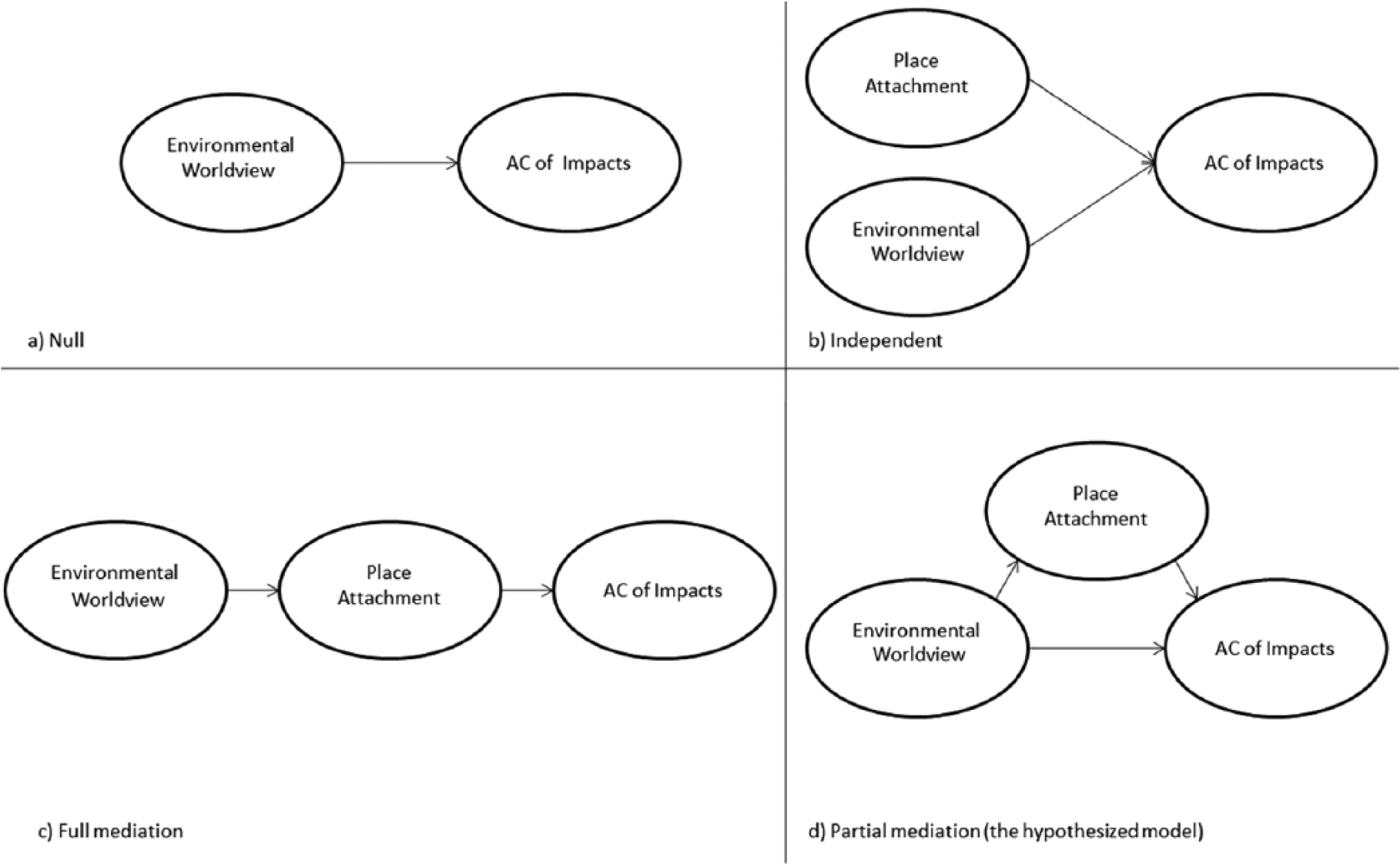
Potential models of the relationship between EWV, place attachment, and visitors’ AC of impacts.
The relationship between an individual’s place attachment and his or her attitudes toward negative impacts on the resource has received slightly more attention (Kaltenborn, 1997; Vorkinn & Riese, 2001). For example, in their article concerning place attachment and environmental conditions along the Appalachian Trail, Kyle, Graefe, et al. (2004) observed that respondents with higher place identity scores were more critical of environmental impacts encountered along the trail. However, those with a higher degree of place dependence did not appear to be as sensitive to use impacts and depreciative behavior.
One group of researchers, Raymond et al. (2011), have tested one mediation model of the influence of place attachment on the constructs described in the VBN framework. In the context of the conservation of native vegetation in South Australia, their results indicated that respondents’ place attachment was related to their attitudes toward negative environmental impacts. However, the researchers did not test whether all the place attachment dimensions mediated the relationship between EWV and attitudes toward impact. They only included a measure of “bonding with nature” in their mediation test.
In sum, the place attachment literature suggests that it may be a useful construct in improving the VBN model, providing an alternative response to Schultz et al.’s (2004) criticism of Stern et al.’s (1995) framework. Specifically, past research has hypothesized and empirically identified relationships between two VBN constructs—EWV and attitudes toward negative impacts. Furthermore, Raymond et al. (2011) suggested that these relationships may be best characterized in a mediation model. Hence, the purpose of this investigation was to develop a model wherein place attachment mediates the relationship between EWV and GBR visitors’ AC (Figure 1, Model d), and then to compare this model with competing models (it is important to note that during initial analyses, we tested and ruled out a moderation model, which was not supported by the data). As noted, we hypothesized that the addition of place attachment to Stern et al.’s model would improve the literature’s description about how nature-based values influence perceptions of human-influenced impacts on nature.
Method
Participants
To test our hypothesized model, we obtained the sample for this study through a telephone survey that was part of a larger investigation of Australian residents’ values associated with the GBR. At the conclusion of the phone survey, respondents were invited to provide their name and email or postal address to participate in a follow-up survey. In all, 727 (71%) phone survey respondents agreed to participate in a postal-mail/email follow-up. A nonresponse bias check revealed no difference between those agreeing to participate in the follow-up survey and those declining with regard to several sociodemographic (e.g., age, income, and education) or GBR visitation variables. We used a modified Dillman (2000) method to increase the response rate. Our procedure is outlined as follows: Surveys were distributed from November 2008 to February 2009. Those who chose the email option received an email message and survey (an Adobe Acrobat Professional form) up to 4 times over an 8-week period. Those who chose the postal-mail option were contacted up to 3 times over approximately the same 8-week period, receiving (a) a cover letter and survey, (b) a postcard reminder, and (c) a second survey and cover letter. For both contact methods, unique identifiers were used so that once a survey was returned; the respondent’s contact information was deleted from the sampling list. This procedure elicited a 49% response rate with 106 of 235 responding to the email survey, and 218 of 431 completing the postal survey, for a total N = 324 (61 of the addresses obtained from the phone survey were invalid).
The age range of respondents was 18 to 82 years (M = 50; SD = 13.8). Just more than half were male (57%). Only a few had not completed their secondary education (6%), many had attended a technical college (58%) or university (29%), and 7% had graduate education. Respondents’ incomes were well dispersed with about half (52%) earning less than AUD60,000 per year, almost one third earning between AUD60,000 and AUD99,999, and the remaining 18% earning more than AUD100,000 per year. All respondents indicated that they had visited the GBRMP to participate in a recreational activity; 76.2% (n = 229) had done so within the past year. During their most recent visit to the GBRMP, many participated in recreational fishing (n = 85, 28.3%). Others went to walk along a beach (n = 77, 25.7%), scuba/snorkel (n = 31, 10.3%), or swim (n = 28, 9.3%).
Construct Measurement
We adapted three existing scales to measure the variables depicted in Figure 1. The 15-item New Environmental Paradigm (NEP) Scale (Dunlap, Van Liere, Mertig, & Jones, 2000) measured respondents’ EWV (i.e., their level of environmental concern) on a 5-point scale (see Table 1). To assess the level of the respondents’ attachment to the GBRMP, we asked them to respond to 16 items adapted from Kyle, Mowen, et al.’s (2004) four-dimensional (i.e., place identity, place dependence, affective attachment, and social bonding) Place Attachment Scale (see Table 2). Respondents indicated their level of agreement with each statement on a 5-point scale. Finally, to gauge AC on the GBR, respondents replied to 3 items developed by Stern et al. (1995) for each of five types of environmental impacts. To improve the validity of the measure, Stern et al. recommend prompting respondents with specific impacts rather than a global measure. The five impacts, which we identified through interviews of recreational visitors and GBRMPA managers, were water quality, overfishing, climate change, coastal development, and tourism activities (see Table 3). The items asked the respondents to indicate the seriousness of the impact on a 5-point scale.
EWV (NEP) Scale—Item Means, Factor Loadings, and Reliabilities.
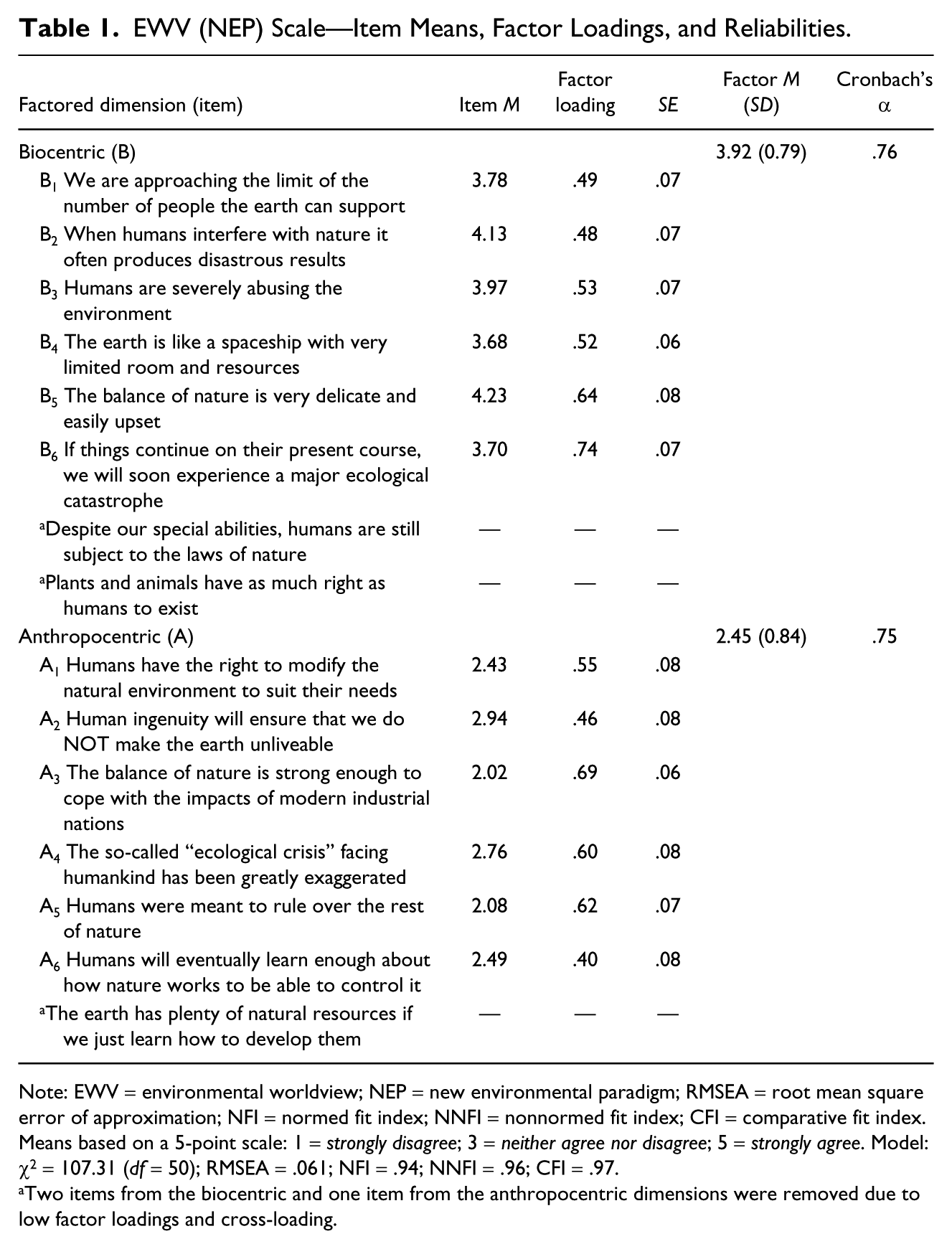
Note: EWV = environmental worldview; NEP = new environmental paradigm; RMSEA = root mean square error of approximation; NFI = normed fit index; NNFI = nonnormed fit index; CFI = comparative fit index. Means based on a 5-point scale: 1 = strongly disagree; 3 = neither agree nor disagree; 5 = strongly agree. Model: χ2 = 107.31 (df = 50); RMSEA = .061; NFI = .94; NNFI = .96; CFI = .97.
Two items from the biocentric and one item from the anthropocentric dimensions were removed due to low factor loadings and cross-loading.
Place Attachment Scale—Item Means, Factor Loadings, and Reliabilities.

Note: GBRMP = Great Barrier Reef Marine Park. Means based on a 5-point scale: 1 = strongly disagree; 3 = neither agree nor disagree; 5 = strongly agree.
Two items from the place dependence and one item each from the affective attachment and social bonding dimensions were removed due to low factor loadings and cross-loading.
AC of Environmental Impacts—Item Means, Factor Loadings, and Reliabilities.

Note: Means based on a 5-point scale: 1 = won’t really be a problem; 3 = somewhat of a problem; 5 = very serious problem.
Analyses
We analyzed the survey data by first performing a confirmatory factor analysis (CFA) using LISREL 8.80 to assess the hypothesized two-dimensional EWV model, the four-dimensional place attachment model, and the AC Scale to verify that each item loaded onto their hypothesized factors. The assessment of the model was provided through several goodness-of-fit indices: root mean square error of approximation (RMSEA), comparative fit index (CFI), normed fit index (NFI), and nonnormed fit index (NNFI; Byrne, 1998). For the RMSEA, values ≤.08 indicate acceptable fit (Stieger & Lind, 1980). For the CFI and NNFI values, ≥.95 indicate acceptable fit (Bentler & Bonett, 1980). Finally, we calculated a Cronbach’s alpha for each of the factors as an indicator of the scales’ internal consistency. The alphas reported were calculated using the final set of items for each factor used in the analyses.
After completing the CFA, we tested the hypothesis that place attachment partially mediated the relationship between EWV and AC. Because this investigation has been one of the first to examine all three constructs in a single model, we also tested a null model and two other models considered to be potential competing explanations. Hence, this analysis compared four models, wherein place attachment (a) was a partial mediator between EWV and AC, (b) was not included (null model), (c) was a full mediator between the other constructs, and (d) was treated as a variable independently, aside from an individual’s EWV, influencing a recreational visitor’s AC on the GBR (Figure 1).
To facilitate the determination of which model best fits these data, we first computed composite variables for the EWV dimensions using a parceling technique (Matsunaga, 2008). The composite variables were computed by calculating the mean of the six items that comprised each dimension; hence, higher means indicate a greater biocentric worldview and lower means, a more anthropocentric view. We chose only to parcel the EWV dimensions because, although measured using two dimensions, EWV has been operationally defined and reported in previous studies as the amalgamation of both dimensions along the anthrocentric–biocentric continuum (Absher et al., 2008). For this analysis, it was important not to parcel the place attachment dimensions because previous research (Raymond et al., 2011; Wynveen et al., 2008) has indicated that each dimension may have a unique relationship with the other variables.
We then tested each of the models using covariance structure analysis (a table of the covariance matrix is available as Online Appendix Table 1 at http://eab.sagepub.com/) and determined model superiority based on the same goodness-of-fit indices as mentioned above (Byrne, 1998) and on evaluation of the model solutions (e.g., squared multiple correlations; Perez, 1996). In addition, we used the Akaike Information Criterion (AIC) to compare models because it accounts for parsimony and overparameterization of the model; the lowest AIC reflects the best-fitting model (Akaike, 1987).
Results
Measurement Validation
Before beginning our confirmatory factor analyses, we analyzed the data to ensure that it met the assumptions of CFA and covariance structural analyses (e.g., sample size, normality, and multicollinearity). Finding no problems with the data, we began by testing the measurement of EWV. After we removed two items from the biocentric dimension and one item from the anthropocentric dimension, due to low factor loadings (<.40) and cross-loading (Hair, Black, Babin, & Anderson, 2010), the results indicated that the two-dimensional model of EWV was a good fit for these data, χ2 = 107.31 (df = 50); RMSEA = 061; NFI = .94; NNFI = .96; CFI = .97, (Table 1). The internal consistency for each dimension was also acceptable, that is, greater than .70 (biocentric: α = .76; anthropocentric: α = .75). Using the parceling technique described above, we then computed composite variables for each of the EWV dimensions that were used for the remainder of the analysis. The EWV item descriptive statistics indicated that the respondents held a slightly biocentric EWV (biocentric factor M = 3.92, SD = .79; anthropocentric factor M = 2.45, SD = .84).
We then tested the measurement model of the variables hypothesized to measure EWV, the four dimensions of place attachment, and the five impact types. Several items were removed to improve model fit (see Tables 1 and 2). As reported in Table 2, the internal consistency for each place attachment dimension was also acceptable (α = .70-.94). The descriptive statistics indicated that the respondents were moderately attached to the GBRMP (place dependence: M = 3.58, SD = .97; place identity: M = 3.11, SD = 1.04; affective attachment: M = 3.73, SD = .89; social bonding: M = 3.79, SD = .89). Finally, as reported in Table 3, the Cronbach’s alphas for the respondents’ AC of the five impacts ranged from .86 to .94. The mean score for each impact indicated that respondents perceived impacts of coastal development (M = 2.12, SD = 1.03) as the most serious problem for the GBRMP. The respondents indicated that overfishing (M = 3.02, SD = .99) was the least problematic.
Initially, we assumed that covariance among exogenous concepts was freely estimated and the uniqueness associated with each measured variable was uncorrelated. However, the preliminary analysis indicated that model fit improved for the null model when we allowed for covariance among several sets of error terms. Hence, the model was respecified allowing for a covariance in error between the following AC variables: OF3 (overfishing) and WQ3 (water quality); CC1 (climate change) and WQ1, CC3 and WQ3, CC3 and OF3; CD1 (coastal development) and WQ1, CD1 and CC1; and TA3 (tourism activities) and CD3, TA1 and OF1 (see Table 3). Our decision to allow for covariance between these variables was based on the likelihood that the common source of error stemmed from identical item wording and level of measurement (Byrne, Shavelson, & Muthen, 1989). Furthermore, we allowed for covariance between the four place attachment dimension latent variables. The goodness-of-fit indices of the measurement model indicated that it fit the data well. That is, after removing four items from the Place Attachment Scale, the goodness-of-fit indices indicated that the measurement model fit the data well, χ2 = 816.40 (df = 324); RMSEA = .07; NFI = .95; NNFI = .96; CFI = .97. These modifications were held across all four models compared in the remainder of the analysis, which is described in the next section.
Model Comparison
Following the testing of the measurement model, we tested each of the structural models. The goodness-of-fit indices of each model are reported in Table 4. The fit indices do not vary greatly between the models; however, based on the RMSEA statistic, all three models that included place attachment were a better fit to these data than the null model. Considering that the partial mediation model exhibited the lowest chi-square value (887.61), lowest RMSEA (.071), and lowest AIC statistic (1,001.26) of the models, we examined the chi-square difference between the partial mediation model and the next best model, the independent model (χ2 = 892.99, RMSEA = .084, NFI = .95, NNFI = .97, CFI = .97). The chi-square difference, Δχ2(df = 1) = 5.38, p ≤ .05, indicated that the partial mediation model fit these data better. Furthermore, a test for difference between the models’ RMSEA values (ΔRMSEA = .006, Δdf = 1, p ≤ .01) indicated that the partial mediation model had a significantly lower RMSEA value than the independent model (this test had a statistical power greater than .95; Preacher & Coffman, 2006). Moreover, previous studies have indicated a relationship between EWV and place attachment (Bonaiuto et al., 2002; Wynveen et al., 2008), suggesting that these constructs are not independent of one another. Hence, we decided to retain the partial mediation model for the remainder of the analysis.
Goodness-of-Fit Indices of Competing Models.

Note: RMSEA = root mean square error of approximation; NFI = normed fit index; NNFI = nonnormed fit index; CFI = comparative fit index; AIC = Akaike information criterion.
EWV–Place Attachment–AC Relationship
The results of the relationships tested in the partial mediation model are depicted in Figure 2 (a matrix of the correlations between the constructs—that is, the latent variables—is available as Online Appendix Table 2 at http://eab.sagepub.com/). EWV was a positive and significant predictor of each of the place attachment dimensions (place identity: β = .26; t = 4.00; p ≤ .001; place dependence: β = .26; t = 3.40; p ≤ .001; social bonding: β = .24; t = 3.55; p ≤ .001; affective attachment: β = .30; t = 4.29; p ≤ .001) and each of the AC variables (coastal development: β = .70; t = 9.39; p ≤ .001; tourism activities: β = .58; t = 7.59; p ≤ .001; water quality: β = .94; t = 6.61; p ≤ .001; overfishing: β = .86; t = 9.81; p ≤. 001; climate change: β = .85; t = 11.01; p ≤ .001). Specifically, as respondents’ EWV became more biocentric, their intensity of attachment to the GBR increased. Also, respondents with stronger EWV expressed greater concern over all the impacts threatening the GBRMP.
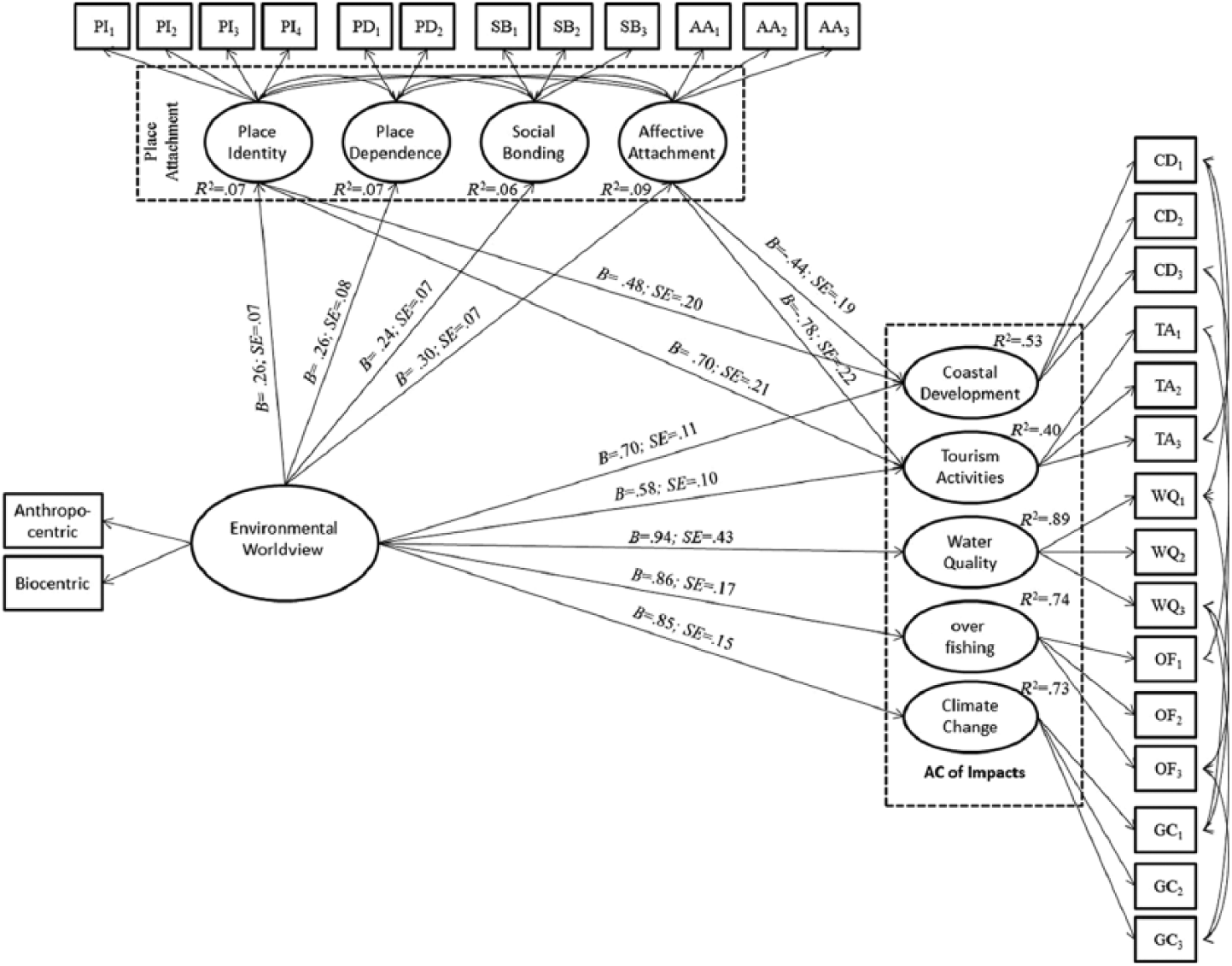
Final EWV–place attachment–AC of impact model.
Regarding the place attachment dimensions, only the place identity and affective attachment dimensions were significantly related to respondents’ AC of any of the impacts. Place identity was positively related to AC of coastal development (β = .48; t = 3.49; p ≤ .001) and tourism activity (β = .70; t = 4.13; p ≤ .001) impacts. This finding indicates that the more respondents identified with the GBR, the more likely they were to express concern over coastal development and tourism activity. However, we observed that the opposite was true for the relationships between affective attachment and coastal development (β = −.44; t = −3.18; p ≤ .001) and tourism activities (β = −.78; t = −4.48; p ≤ .001). That is, as the respondents’ emotional attachment to the GBRMP increased, their concern over coastal development and tourism activity impacts declined. It must be noted, that, at first, we suspected that the opposing directionality of the two paths between the place attachment dimensions and AC might indicate a normality or multicollinearity problem among the latent variables. However, normality (e.g., normality plots and skewness coefficients) and multicollinearity (e.g., variance inflation factor, correlation guidelines, and tests for interaction effects) diagnostics did not indicate a problem with the data or the model.
The variance explained in the place attachment dimensions by EWV ranged from .07 to .09. The variance explained by EWV and the place attachment dimensions in each of the impact variables ranged between .40 and .89.
Discussion
During this investigation, we sought to contribute to the literature concerning perceptions of environmental impacts. Specifically, using constructs and relationships identified in the literature on the VBN framework, we developed and tested a model wherein place attachment mediated the relationship between EWV and GBR visitors’ AC of negative impacts on the environment. The results supported the hypothesis that, for recreational visitors to the GBRMP, place attachment partially mediates the relationship between EWV and AC on the marine environment. The data indicated that EWV was directly related to AC concerning all five impacts measured and all four dimensions of place attachment. Furthermore, EWV was indirectly related to the respondents’ AC of two of the impacts via place attachment. Specifically, the place attachment dimensions of place identity and affective attachment partially mediated the relationship between EWV and the respondents’ AC of coastal development and tourism activities. The data indicated that including place attachment as a partial mediator significantly improved the model fit over the original model without place attachment.
Including place attachment in a model of the relationship between EWV and AC provided insight on how values shape people’s attitudes and feelings toward place, and how those place-specific sentiments shape their perceptions of anthropogenic impacts. Specifically, our results indicated that EWV has almost equally strong connections to all four place attachment dimensions. This indicates that worldviews influence cognitive and affective perceptions of place. Furthermore, these results confirm the findings of Wynveen et al. (2008) and support Bonaiuto et al.’s (2002) assertion that attitudes toward specific settings flow from general environmental beliefs. This may be especially true for the GBRMP because of its iconic status; that is, due to mass media (e.g., movies, advertisements, and books), many Australians (and arguably many people worldwide) have the perception of the GBR as a pristine environment that is worth protecting (Wynveen, Kyle, & Sutton, 2010). Hence, it is possible that our respondents, who had a more biocentric worldview, found their idealized landscape in the GBRMP. In turn, they developed a greater intensity of attachment to the setting to which their EWV conformed. A management implication of this assertion is that protected area managers need to be aware of (and possibly attempt to influence) the culturally shared thoughts and feelings that are ascribed to the landscape that they manage. Moreover, they need to take an active role in contributing to conversations that help shape those thoughts and feelings that contribute to stakeholders’ place attachment and their perceptions of impacts on the resource. This could be accomplished via passive communications (e.g., web pages and brochures) and/or active communication efforts (e.g., live interpretive events and public meetings).
This investigation also allowed us to describe the place attachment–AC relationship with greater detail than previous studies (e.g., Raymond et al., 2011; Vorkinn & Riese, 2001). Specifically, we observed that aspects of attachment that concern the individual’s expression/confirmation of their identity relates to greater sensitivity to impacts, but greater emotional attachment to a setting relates to lower sensitivity to impacts. This finding supports Kyle, Graefe, et al.’s (2004) findings that place identity, but not place dependence, is related to individuals’ AC and also builds upon the previous work by identifying the role of affective attachment. Hence, managers may want to identify ways to increase place identity (e.g., encouraging visitors to reflect on how their perceptions of the resource reflect/express their self-identity in interpretive presentations and other interactive events) to increase visitors’ sensitivity to impacts and, hopefully, encourage impact-limiting behavior.
One possible explanation for the directional difference between place identity and affective attachment in the relationships identified lies in the distinction between the two dimensions. That is, affective attachment is a shallower (i.e., not as central to the individual) form of attachment compared with place identity (Bricker & Kerstetter, 2000). Hence, an increased emotional bond decreases sensitivity to impacts because it does not necessarily require a cognitive consideration of the setting in relation to the individual. However, because place identity is a subset of self-identity (Proshansky, 1978), individuals with increased place identity have considered their perceptions of the setting more deeply. Those who identify with a setting incorporate the setting into their self-definition and then express stronger bonds with the place. Furthermore, if the place is part of oneself, then the negative impacts to the setting are substantially more concerning to the individual.
In addition, our findings indicated that only two of the five impacts considered by the respondents were related to the intensity of attachment they ascribed to the GBRMP. This raises the question, “Why does the type of impact matter in the relationship between place attachment and AC of impacts? Two possible explanations seem likely. First, as suggested by Tuan (1977) and Altman and Low (1992), place attachment provides insight as to why individuals value a setting. Hence, different groups of people may identify different aspects of a setting as important to them. Each aspect of the setting is affected differently by each type of impact (Hinrichsen, 1997). Hence, one group may perceive the seriousness of an impact differently from another because aspects of the setting they value are negatively affected to varying degrees. However, perceptions of impacts are affected by other phenomena, such as activity type and newly acquired information. In their study on national park visitors’ perceptions of impacts, Floyd, Jang, and Noe (1997) suggested two factors that may play a role. First, they hypothesized that the primary type of activity in which the respondent participated may influence their perception of an impact (e.g., Does the visitor’s participation in a certain activity cause the visitor to focus on the resource?). Second, Floyd et al. suggested (supported by the concept of the “recency effect”) that perception of impacts is affected by information recently gained about the resource or impact (e.g., observation of the cause of an impact or reading literature about an impact’s effect on the resource).
Finally, taking into account each of the individual relationships and their associated implications described above potentially informs the literature on VBN theory. Our results provide empirical evidence that the VBN framework can be improved by including place attachment. Adding place attachment into the VBN framework incorporates a setting-specific measure that improves the framework and thus its ability to model individuals’ AC of impacts within a specific geographic context. The contextual specificity that place attachment provides directly addresses Schultz et al.’s (2004) criticism of VBN’s lack of specificity beyond general environmental attitudes. We suggest that place attachment may be a more appropriate construct to add to the VBN model than others proposed (e.g., IWN; Schultz, 2002) because place attachment measures go beyond providing information on general human–environment relationships by providing insight into the bond between an individual and a specific place. Regarding the role of place attachment in the full VBN model (vs. our use of just EWV and AC), there has not been any research that would suggest that the relationships identified would change by including the remaining VBN constructs (i.e., those that follow after AC). In fact, Steg et al. (2005) indicated that in the VBN model, “each variable in the casual chain is related to the next variable, and may also be directly related to variables further down the chain” (p. 417). Hence, including place attachment may improve the full VBN model beyond just improving the relationships tested in this investigation. Based on the findings of the current investigation, future research should include a multidimensional measure of place attachment in the full VBN model.
Limitations
While considering our observations, it is important to recognize that the data may be limited. First, the setting is unique. There is only one GBR, and it has the distinction of being labeled as one of the seven natural wonders of the world; hence, it receives a quantity and quality of attention that other natural areas do not. Second, one could argue that our sample was homogeneous in that most of the respondents were relatively well-educated Australians of European decent. Although this is representative of a majority of GBRMP visitors, we acknowledge that there are other cultural groups that may hold differing worldviews and perceptions of the GBR. Finally, although we were able to determine that the partial mediation model was superior to the other models, ideally longitudinal data are needed to confirm our hypothesized temporal sequencing, given the limitations of cross-sectional data. These limitations notwithstanding, this investigation contributed to the literatures on place and VBN theory.
Conclusion
The results of this investigation indicated that the attachment a recreational visitor feels toward a specific setting, along with their EWV, relates to their AC of certain impacts. This finding provides a possible solution to Schultz et al.’s (2004) criticism of Stern et al.’s (1995) VBN theory; place attachment can serve as the construct that brings specificity to the VBN framework. The results of this investigation also contribute to the place literature by suggesting that EWV may be an antecedent to place attachment. Confirmation of these findings may lead to a modification of the VBN theory and will further researchers’ and protected area managers’ understanding about the formation and maintenance of visitors’ attachment to natural resource settings.
Footnotes
Declaration of Conflicting Interests
The authors declared no potential conflicts of interest with respect to the research, authorship, and/or publication of this article.
Funding
The authors received no financial support for the research, authorship, and/or publication of this article.
Notes
Author Biographies
References
Supplementary Material
Please find the following supplemental material available below.
For Open Access articles published under a Creative Commons License, all supplemental material carries the same license as the article it is associated with.
For non-Open Access articles published, all supplemental material carries a non-exclusive license, and permission requests for re-use of supplemental material or any part of supplemental material shall be sent directly to the copyright owner as specified in the copyright notice associated with the article.
