






Abstract
Despite the growing effort to promote walking to school through environmental interventions, the corresponding impact of residential self-selection has not been examined. This study investigated how built environments, social factors, and personal factors, including self-selection of a close-to-child’s-school home and a walkable neighborhood, influenced walking-to-school behaviors. Parental survey data from 20 elementary schools in Austin, Texas, were analyzed using structural equation models. Significant factors included self-selection variables, parental education, car ownership, number of adults/children in the household, school bus availability, parental perceived home-to-school distance, and the presence of convenience stores, bus stops, and office buildings en route to school. The self-selection of a close-to-child’s-school home had a smaller effect on walking-to-school behaviors than parental perception of home-to-school distance. The self-selection of a walkable neighborhood was significant, while parental perception of their neighborhood’s walkability was insignificant. Future efforts to promote walking to school should include both environmental interventions and educational programs.
Introduction
Childhood obesity has become an important public health problem. The rate of obesity among 6- to 11-year-old children has increased from 7% in 1980 to nearly 18% in 2010 (National Center for Health Statistics, 2012; Ogden, Carroll, Kit, & Flegal, 2012). Physical activity has been promoted as a healthy behavior that helps reduce the risk of obesity and prevent chronic diseases (U.S. Department of Health and Human Services, 2008). The practice of a physically active lifestyle in childhood can help control weight and build healthy bones, muscles, and joints (Report to the President, 2000) and may continue into adulthood (Ferreira et al., 2007).
Walking to school has been promoted as a means to increase children’s physical activity and energy expenditure (Metcalf, Voss, Jeffery, Perkins, & Wilkin, 2004; Tudor-Locke, Ainsworth, & Popkin, 2001). Nevertheless, there was a significant decline in the use of walking and cycling for school travel, from 47.7% in 1969 to 12.7% in 2009 among students in kindergarten through eighth grade (N. C. McDonald, Brown, Marchetti, & Pedroso, 2011). A growing number of studies have examined personal, social, and built environmental factors related to children’s walking-to-school behaviors. Built environments, in particular, have been increasingly studied for their potential to promote population-level changes toward more physically active lifestyles, including an increased use of walking for travel to school.
Some studies have also shown that walking behaviors may be influenced by attitude-induced residential self-selection—that is, home or neighborhood choice based on a preference for a specific lifestyle and travel mode (Cao, Mokhtarian, & Handy, 2009). This may also apply to walking-to-school behaviors. Without accounting for residential self-selection, it is possible for relevant studies to overestimate the contribution of built environments and the effectiveness of environmental interventions in promoting walking to school.
However, to our knowledge, the impact of residential self-selection on walking-to-school behaviors has never been examined. This study is the first to examine the relative impacts of built environments and residential self-selection on children’s walking-to-school behaviors, while also considering the impacts of other personal and social factors. Two self-selection variables—the selection of a close-to-child’s-school home location and a walkable neighborhood—are considered.
Literature Review
A systematic review of relevant literature was conducted to identify variables that have been related to walking-to-school behaviors. Most previous studies were based on the socioecological theory, which considers human behaviors to be influenced by interactive multilevel factors on intrapersonal, interpersonal, institutional, community, and public policy levels (McLeroy, Bibeau, Steckler, & Glanz, 1988). Using a modified socioecological perspective, previous studies have identified personal, social, and built environmental factors that are associated with children’s walking-to-school behaviors (T. McMillan, Day, Boarnet, Alfonzo, & Anderson, 2006; Timperio et al., 2006; Zhu & Lee, 2008, 2009).
Among personal factors, negative correlates include child’s/parent’s personal barriers (e.g., time constraints), child’s/parent’s minority ethnicity background, and parent’s education level, household income, and car ownership (Brophy et al., 2011; D’Haese, De Meester, De Bourdeaudhuij, Deforche, & Cardon, 2011; N. C. McDonald et al., 2011; Trapp et al., 2011; Wong, Faulkner, Buliung, & Irving, 2011; Zhu & Lee, 2008, 2009). Positive correlates include parent’s positive attitudes toward walking or physical activity (Leslie, Kremer, Toumbourou, & Williams, 2010; Loucaides, Jago, & Theophanous, 2010; Mendoza et al., 2010; Zhu & Lee, 2008, 2009). Results regarding the impacts of child’s grade and gender have been inconsistent in previous studies (Pont, Ziviani, Wadley, Bennett, & Abbott, 2009).
In terms of social factors, the availability of school bus service and safety concerns are two important factors that reduce the likelihood of walking to/from school (Napier, Brown, Werner, & Gallimore, 2011; Nelson & Woods, 2010; Rodriguez & Vogt, 2009; Zhu & Lee, 2008, 2009). Peer influence from neighbors (concerning the walking behaviors of other children and parents) may also play a role (Leslie et al., 2010; Panter, Jones, Van Sluijs, & Griffin, 2010b; Trapp et al., 2011; Zhu & Lee, 2008, 2009).
For built environmental factors, distance from home to school is the most important barrier for walking to/from school, while pedestrian infrastructures (e.g., sidewalk availability and quality), busy roads, and certain land uses (e.g., convenience stores) en route to school have also been shown to have significant impacts (Davison, Werder, & Lawson, 2008; Panter, Jones, & van Sluijs, 2008; Pont et al., 2009; Timperio et al., 2006; Trapp et al., 2011; Zhu & Lee, 2008, 2009).
However, another possible correlate—residential self-selection—has not been studied for its impact on walking to school, despite the existing evidence of its influence on adults’ walking behaviors. Cao et al. (2009) reviewed 38 empirical studies for the impact of residential self-selection on travel behaviors. Most of the studies that examined the impact of residential self-selection and built environments on walking (e.g., walking to stores, nonwork walking trips, and general walking trips) showed that both of these factors had significant effects. However, results about the relative impacts of these factors on walking are inconsistent. Some studies found the influence of built environments to be stronger than that of self-selection (Cao, 2010; Cao, Handy, & Mokhtarian, 2006; Salon, 2006). For example, one study of eight neighborhoods in northern California reported that neighborhood type (traditional vs. suburban) played a stronger role on the frequency of walking to stores than travel-related attitudes and neighborhood preference (Cao, 2010). Some other studies reported that the effect of residential self-selection exceeded that of built environments (Bagley & Mokhtarian, 2002; Frank, Saelens, Powell, & Chapman, 2007). For instance, in a study in Atlanta, Georgia, people who did not prefer a walkable neighborhood walked very little regardless of the actual walkability of the neighborhood in which they lived (Frank et al., 2007). Furthermore, it is possible that people with certain neighborhood preferences do not find matching homes and neighborhoods with corresponding environment characteristics (Schwanen & Mokhtarian, 2005). This further complicates the understanding of the relative impacts of residential self-selection and built environments.
It should also be noted that these self-selection studies primarily focused on adults’ walking behaviors. The impacts of residential self-selection on children’s walking behaviors may be even stronger, as children are more vulnerable and subject to challenges in built environments (Morris, Wang, & Lilja, 2001). Children also have limited autonomy for their own travel (Ferreira et al., 2007). Their school travel modes are most likely determined by parents, who often accompany their children on school trips (Zwerts & Wets, 2006). It is likely that parents consider the ease and safety of school travel as important factors for their choice of home and neighborhood. Parents who prefer letting their children walk to school may intentionally choose to live close to school and to live in a walkable neighborhood.
Method
This study explored the following four research questions:
Answers to these questions will help us better understand the impacts of residential self-selection and environmental interventions on children’s walking-to-school behaviors.
This study’s conceptual framework (Figure 1) was developed based on the socioecological theory (McLeroy et al., 1988), with reference to conceptual frameworks used in earlier walking-to-school literature (T. E. McMillan, 2005; Sirard & Slater, 2008). It considers walking-to-school behaviors to be influenced by personal, social, and built environmental factors, while including residential self-selection as an important personal factor that influences walking to school not only directly but also indirectly through its impact on the home and neighborhood where children live.
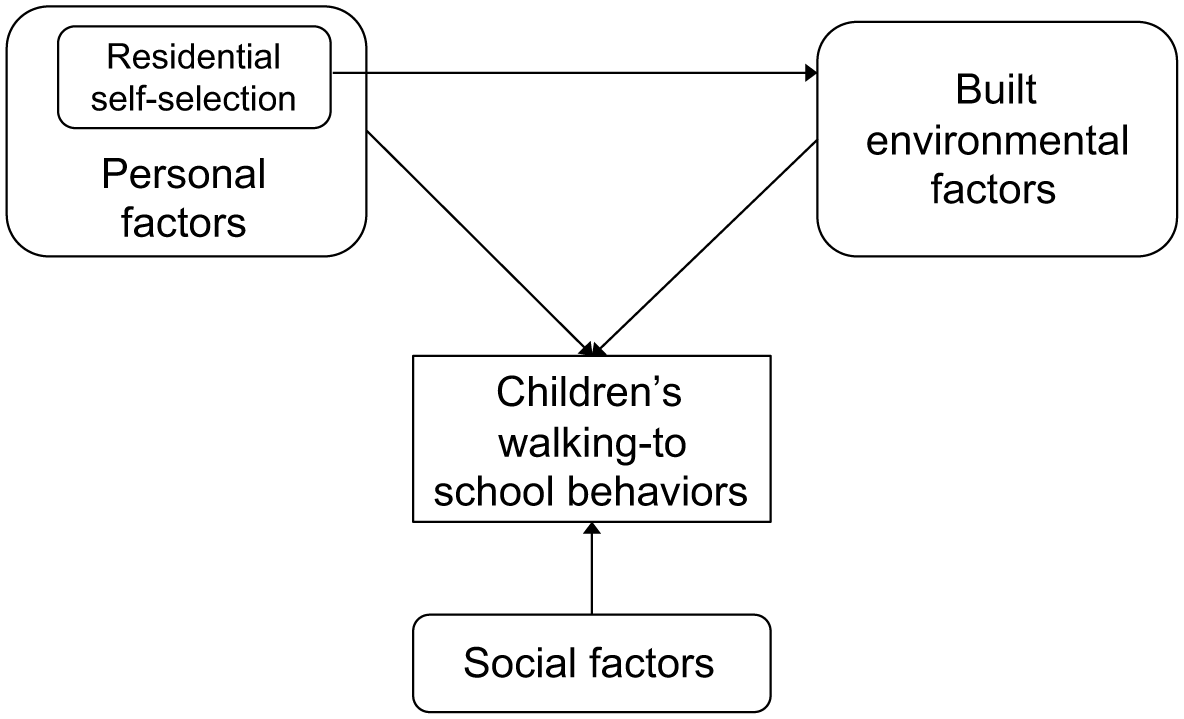
Conceptual framework for children’s walking-to-school behaviors.
Study Area, Population, and Data
This study used 2007 parental survey data collected from 20 public elementary schools in the Austin Independent School District in Austin, Texas. The 20 selected schools and their attendance areas feature diverse physical environmental characteristics, ranging from inner-city neighborhoods with high density, small parcels, and well-connected, grid-like street networks to suburban neighborhoods with low density, larger parcels, and cul-de-sac street networks with low street connectivity. These schools’ sociodemographic features represent the corresponding diversity in the school district. Lower-income schools with higher percentages of Hispanic students were oversampled in order to better understand the need of this population group, which is at high risk of childhood obesity (Ogden et al., 2012). The wide range of variation in the study setting and population offers a unique opportunity to answer the research questions.
Survey questions were developed based on literature review and three previously validated instruments. More detailed information about the survey was reported in an earlier publication (Zhu & Lee, 2009). A total of 11,880 questionnaires in both English and Spanish were distributed to parents of children in the 20 selected schools. Teachers helped by including a cover letter, which explained the study, and a questionnaire in each student’s weekly folio, which the student brought home. The parent/guardian finished the survey at home and asked his or her child to return it to the teacher. A total of 2,597 valid surveys were returned, yielding a mean valid response rate of 22.7%, with a range of 9.2% to 40.3% across 20 schools. This rate is comparable with response rates (range = 10%-40%) reported by Sommer and Sommer (1997) for surveys of the general population but is a bit lower than results from Baruch’s (1999) analysis of surveys in academic studies. Nonresponse bias is tested on three variables (Hispanic ethnicity, gender, and availability of school bus service), none of which showed evident bias. Among the sample population and the total population, Hispanic students represented 64.2% and 66.6%, female students represented 50.7% and 48.6%, and students receiving school bus service represented 27.2% and 26.9%, respectively.
Variables and Measurements
The survey collected information about personal, social, and built environmental factors that may relate to the binary outcome variable—whether a child walks to or from school on a normal school day. For most study variables, Likert-type scale questions were used to ask parents/guardians how much they agreed or disagreed with each statement using a scale of 1 (strongly disagree) to 5 (strongly agree).
Personal factors included sociodemographic variables, personal barriers/attitudes, and residential self-selection (Table 1). Sociodemographic variables consisted of child’s gender, grade level, Hispanic ethnicity, parent’s highest education level, household car ownership, number of children, and number of adults. Personal barriers/attitudes included two latent factors: parent’s and child’s personal barriers to walking and positive attitudes toward walking. Self-selection factors were captured by a question about the main reasons for respondents to choose their current homes and neighborhoods. Seven prespecified choices included “housing price,” “close to work,” “close to child’s school,” “quality of school,” “quality of neighborhood,” “easy to walk around,” and “others. Please specify.” Respondents were asked to “choose all that apply.” Two of the choices—“close to child’s school” and “easy to walk around”—were included in this study because they were most relevant to the likelihood of parents letting their child walk to/from school.
Descriptive Statistics and Odds Ratios From a Series of Bivariate Logistic Regressions Predicting Walking to/From School Using Individual Independent Variables.
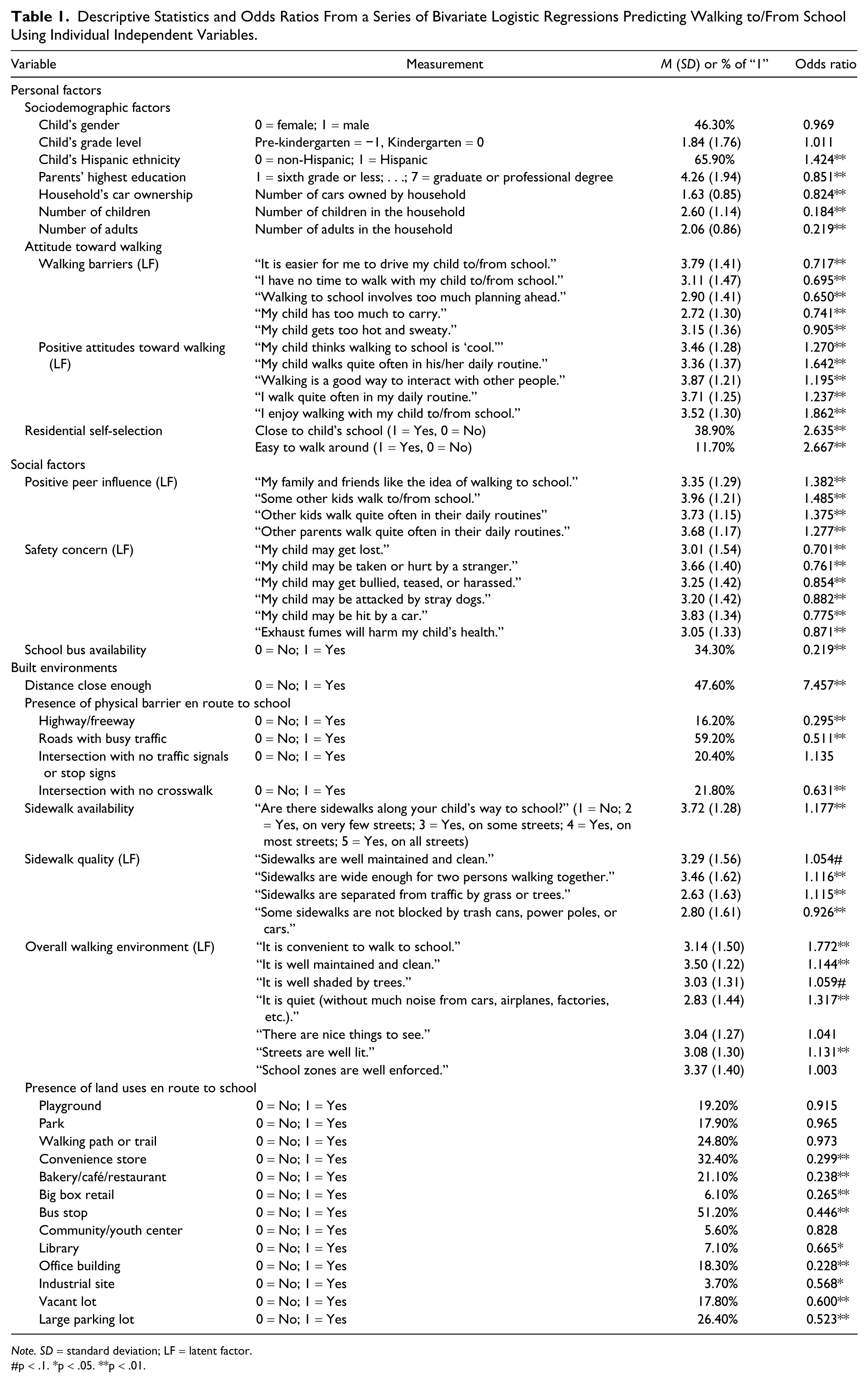
Note. SD = standard deviation; LF = latent factor.
p < .1. *p < .05. **p < .01.
Social factors included peer influence, safety concerns, and the availability of school bus service. Perceived built environmental factors included home-to-school distance being close enough, sidewalk availability, sidewalk quality, the presence of physical barriers to walking, specific land uses en route to school, and overall walking environment. The selection of land use variables was decided based on previous literature and researchers’ assumptions about possible land uses that might have impacts on children’s school travel. The overall walking environment was a latent factor measured by questions about convenience of walking, maintenance of the environment, tree shade, quietness, nice things to see, street lighting, and school zone enforcement.
Data Analysis
SPSS 12.0 was used to examine the descriptive statistics of each variable and its bivariate correlation with the outcome variable (Table 1). To answer the first research question, binary logistic regressions were conducted to predict the residential self-selection of a “close-to-child’s-school” home location and an “easy-to-walk-around” neighborhood, respectively, using sociodemographic variables. For the second question, cross-tabulation tables were generated to understand how many parents with relevant residential self-selection find a matching home and neighborhood. Binary logistic regressions were used to examine whether parents with these self-selection considerations were more likely to live in residences with corresponding characteristics.
For the third and fourth questions, M-Plus 6.11 was used to test a structural equation model (SEM; Figure 2) that predicted walking to/from school using personal, social, and built environmental factors. The measurement models were tested first for confirmatory factor analysis to generate the latent variables and to detect the cross-loading issue. If the value of modification indices between two items was greater than 10% of the chi-square of model fit, this study correlated them to control the measurement error (Joreskog & Sorbom, 1996). The structure model was then tested to examine the full model. Because the outcome variable is a binary measure, using maximum likelihood estimation could produce incorrect test statistics and standard errors (Brown, 2006). Among several estimation methods for dichotomous outcomes, weighted least square has been frequently used (Brown, 2006) and thus was used in this study’s SEM model.
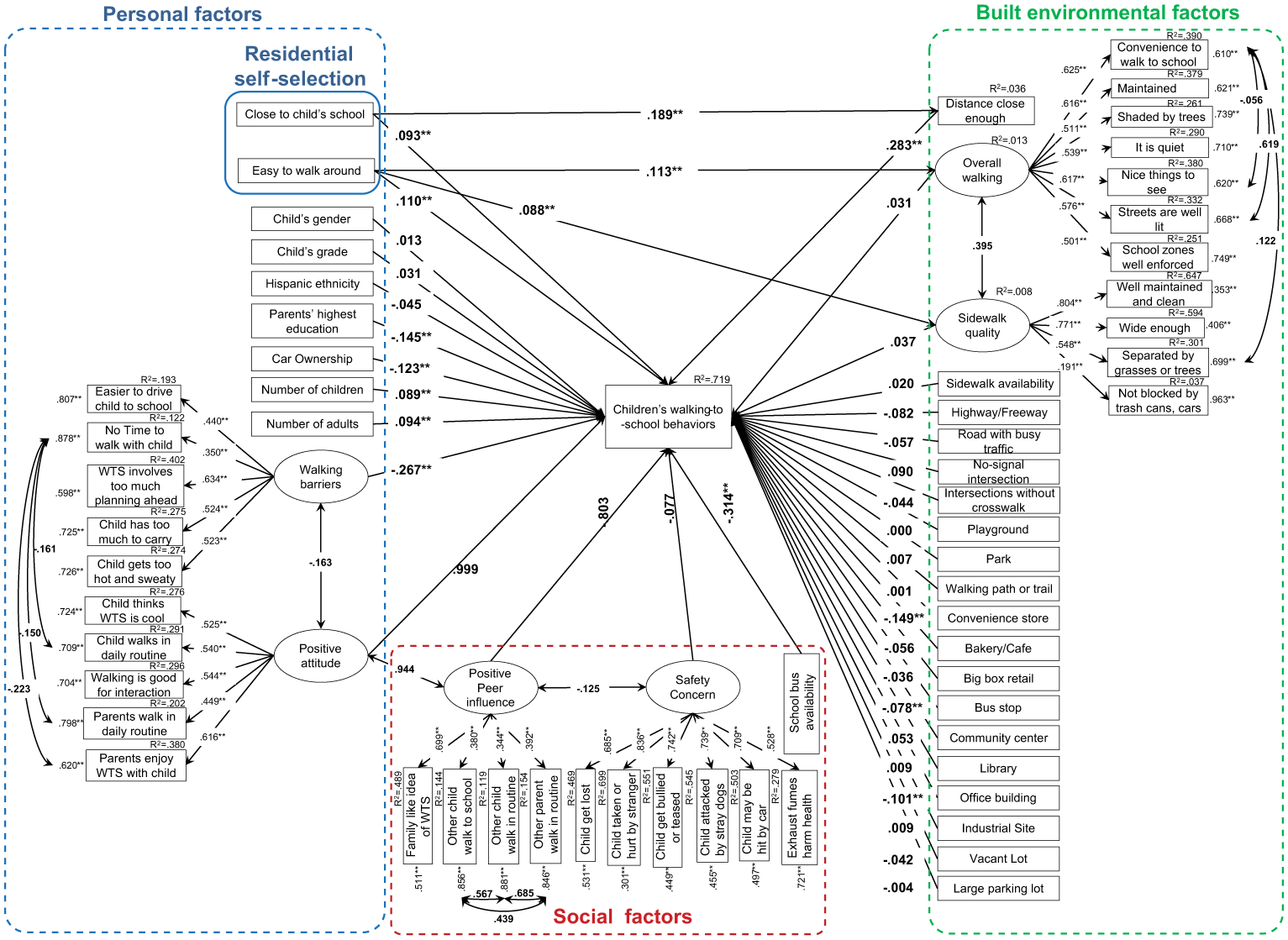
Standardized results of the structural equation model predicting children’s walking-to-school behaviors using personal, social, and built environmental factors.
Results
Results for the first question, “Who considers a ‘close-to-child’s-school” home location and an ‘easy-to-walk-around’ neighborhood when choosing their residence?” (Table 2), showed that Hispanic parents were more likely to consider living close to their child’s school (p < .01). One possible reason is that Hispanic families own fewer cars (as shown by the survey data) and are more dependent on alternative travel modes such as walking for school travel. In contrast, parents with a higher education level were less likely to consider living close to their child’s school when choosing their home, probably because they would choose driving their children to school regardless of the distance to school. Other sociodemographic variables did not show significant correlations with self-selection factors. In addition, the self-selection of a “close-to-child’s-school” home location and an “easy-to-walk-around” neighborhood were correlated with a coefficient of 0.21 (p < .01).
Results From the Binary Logistic Regressions Predicting Two Residential Self-Selection Factors Using Sociodemographic Variables.
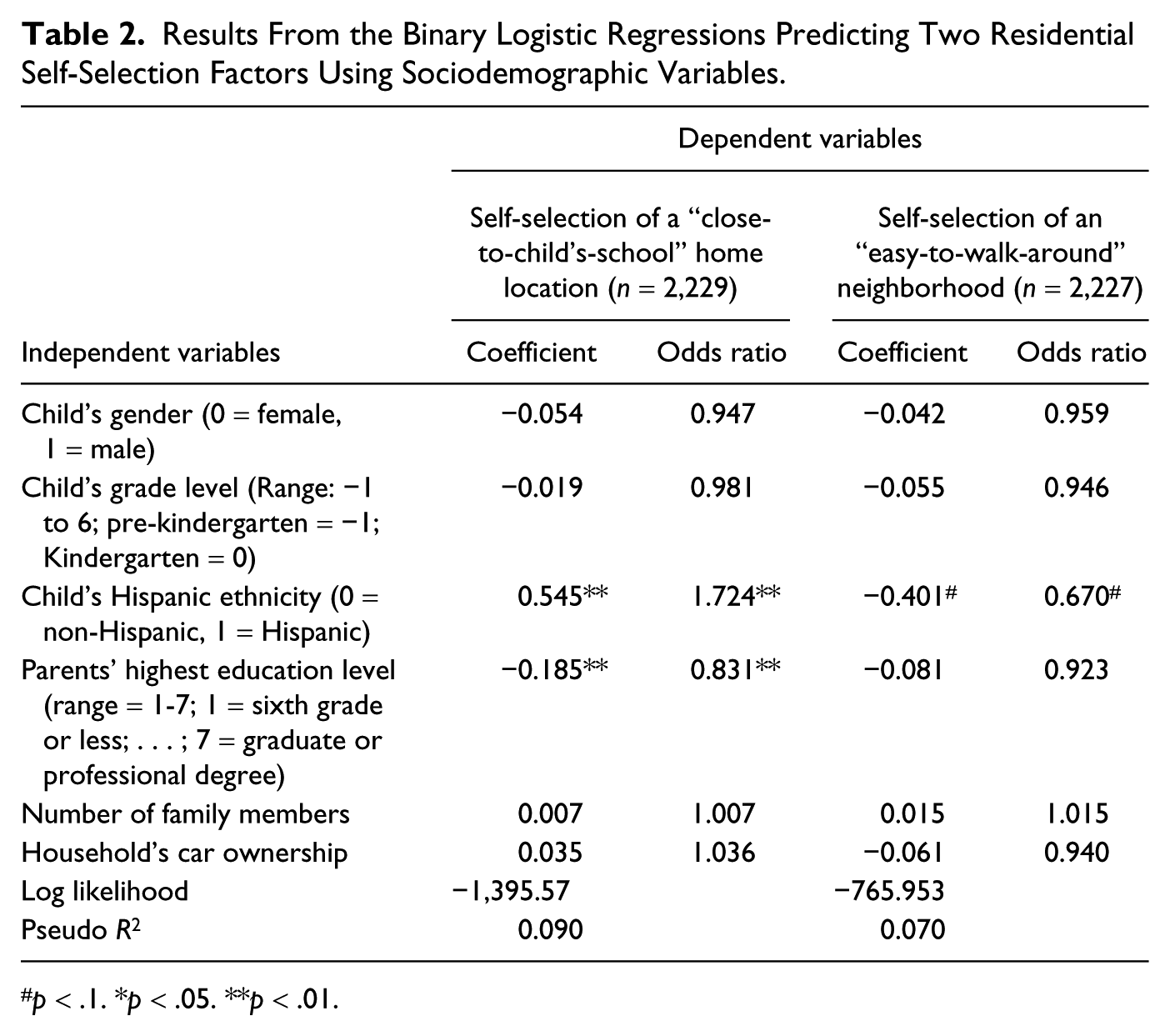
p < .1. *p < .05. **p < .01.
The second question concerns “how many parents with such residential self-selection considerations find a matching home and neighborhood.” Results showed that 61.71% of the parents who considered living close to their child’s school when choosing their homes reported their selected home to be close enough for their child to walk to school. In contrast, among those who did not consider this distance factor in home selection, only 39.08% perceived the distance to be close enough for their child to walk to school. In addition, 73.97% of the parents who considered living in an easy-to-walk-around neighborhood when choosing their homes reported their selected neighborhood to be walkable, as indicated by a mean score of 3 or higher for the seven Likert-type scale items (range = 1-5) used to capture the overall walking environment (Table 1). In contrast, among those who did not consider this “easy-to-walk-around” factor, only 55.16% reported their selected neighborhood to be walkable. Results from binary logistic regressions showed that parents with self-selection considerations of a “close-to-child’s-school” home location (or an “easy-to-walk-around” neighborhood) were more likely to live in a home that is considered as being close enough for their child to walk to school, with an odds ratio of 2.512 (or in a neighborhood that is being reported as walkable, with an odds ratio of 2.269).
For the SEM model (Figure 2), the χ2, which measured the discrepancy between the observed and model-based covariance matrices, is 1,823.91. The degree of freedom is 1,323. The root mean square error of approximation (RMSEA), which measured the amount of error of approximation per model degree of freedom by controlling for sample size, is 0.014, indicating a good fit (Brown, 2006). The comparative fit index (CFI) is 0.90, which also illustrates a good model fit (Brown, 2006).
For the third research question, “Does such residential self-selection influence children’s walking-to-school behaviors directly and indirectly (through affecting the selected home and neighborhood)?” both self-selection variables showed direct impacts on walking to/from school. Parents who considered living close to their child’s school (coefficient = 0.093, p = .001) and living in a walkable neighborhood (coefficient = 0.110, p = .001) when choosing their home were more likely to let their children walk to/from school. In addition, the self-selection of living close to school showed an indirect impact: Parents who considered living close to school in their home choice were more likely to report their selected home to be close enough to school, and this perceived close distance had a significantly positive association with walking to/from school. Such an indirect impact was not significant for the self-selection of an easy-to-walk-around neighborhood.
The fourth question asked “Do built environments have significant impacts on walking-to-school behaviors after accounting for residential self-selection?” Results showed that several built environmental factors were significant. A perceived “close enough” distance between home and school was still significantly related to walking to/from school. It is the second strongest predictor, with a standardized coefficient of 0.283 (p < .01), which is only lower than the coefficient (0.314) of school bus availability (p < .01). Among different land uses en route to school, the presence of “convenience stores,” “bus stops,” and “office buildings” were negatively associated with walking to/from school. A possible explanation is that such land uses may make parents feel it is unsafe for their children to walk nearby, as they may encounter busy vehicle traffic and concerns for “stranger danger.” In addition, in contrast to researchers’ assumptions, sidewalk quality and overall walking environment were insignificant.
In addition, some other personal and social factors were significantly associated with walking to/from school. Among personal factors, the higher the parent’s education level or the more cars the household owned, the less likely it was that the child would walk to/from school. These findings are consistent with previous studies (Bringolf-Isler et al., 2008; Ewing, Schroeer, & Greene, 2004; Fulton, Shisler, Yore, & Caspersen, 2005; N. C. McDonald et al., 2011; Yelavich et al., 2008; Zhu & Lee, 2008, 2009). The number of adults and children in the household were positively associated with walking to/from school. One possible explanation is that these households are more likely to have an adult accompany children to walk to/from school or to let siblings walk together, which can lessen safety concerns. This can be partially supported by an earlier finding from this study that about 75% of the students were accompanied by a parent or guardian while walking to/from school (Zhu & Lee, 2008). Child’s and parent’s walking barriers were negative correlates for walking to/from school. This is also consistent with previous studies (T. E. McMillan, 2007; T. McMillan et al., 2006; Panter, Jones, van Sluijs, & Griffin, 2010a; Salmon, Salmon, Crawford, Hume, & Timperio, 2007; Zhu & Lee, 2008, 2009; Ziviani, Scott, & Wadley, 2004). For social factors, only the school bus availability showed a significant association (negative) with walking to/from school, with the largest standardized coefficient (0.314) among all significant variables. This is reasonable as school bus service is generally considered as safe and convenient, and parents are likely to let their child take school bus if it is available.
In terms of the relative impacts of residential self-selection and built environments, the results are mixed. The total effect of the self-selection of a “close to school” home location (coefficient = 0.146) was smaller than the impact of the corresponding built environmental factor—distance being close enough for child to walk (coefficient = 0.283). However, for residential self-selection of an “easy-to-walk-around” neighborhood (total effect coefficient = 0.117), the corresponding built environment measure of overall walking environment did not have a significant impact on walking to/from school.
Discussion and Conclusion
This study has some limitations. First, two self-selection variables were captured as binary instead of continuous variables. As a result, these variables were not able to reflect the fine-grained differences that may exist in the weights given to these factors in the home selection process. Second, subjective measures of built environments were used, and may not completely represent the objective conditions. For example, parents who walk to/from school with their child may have a better knowledge about details of built environments than parents who always drive their child to/from school.
Despite these limitations, this study contributed important knowledge about the impact of residential self-selection on children’s walking-to-school behaviors, which has never been studied before. Findings from this study have important implications for future interventions targeting the promotion of walking-to-school behaviors.
First, parental perceived home-to-school distance and certain land uses en route to school remained significant after considering the impact of residential self-selection on walking to/from school. In particular, distance to school was the second important predictor, and its effect was larger than the effect from the self-selection of a close-to-child’s-school home location. This supports the continued use of environmental interventions to promote walking to school, and highlights the need for more efforts in developing schools within walkable distance. To make such interventions possible, it is necessary to reverse recent trends of building schools in peripheral instead of central locations (N. McDonald, 2010). Policy support and coordination are needed among school development, land use, and transportation planning groups. On the other hand, the overall walkability of neighborhood environment was not significant. This implies that improving walkability alone, such as providing more sidewalks (as some current programs have been focusing on), without reducing school travel distance is likely not sufficient to effectively promote walking to school.
Second, parent’s attitude-induced self-selection of home and neighborhood had significant impacts on walking-to-school behaviors, suggesting the importance of education programs targeting relevant attitudes toward walking. Finally, parent’s and child’s personal barriers to walking were also significant. It is a latent factor captured by variables such as time constraint, convenience of driving, too much planning needed to walk to school, child having too much to carry, and child getting too hot and sweaty. To help lift these barriers, both education programs and environmental interventions are needed to make walking to school more convenient and safer. This provides support for the multilevel approaches used in the federal Safe Routes to School programs. Other programs such as “Walking to School Bus” also have potential to help reduce concerns about parent’s time constraint in walking with a child to/from school.
In summary, promoting walking to school is going to require long-term efforts and coordination from multiple levels (e.g., policy changes, environmental interventions, and educational programs) to make schools more walkable and to make parents and children more willing to choose walking over alternative transportation modes.
Footnotes
Declaration of Conflicting Interests
The authors declared no potential conflicts of interest with respect to the research, authorship, and/or publication of this article.
Funding
The authors disclosed receipt of the following financial support for the research, authorship, and/or publication of this article: This study is supported by a grant (No. 65695) from the Robert Wood Johnson Foundation Active Living Research Program.