







Abstract
Evidence from past pro-environmental programs suggests that the invalidation of individuals’ expectations could lead them to drop out of a given program. The aim of this research is to evaluate the impact of the invalidation of expectations on individuals’ commitment to a waste-sorting program. We focused on the hierarchy that may exist among these expectations by drawing on the dichotomy between central and peripheral cognitions proposed within the framework of the theory of social representations. In this perspective, expectations are the result of a body of socially constructed knowledge and can be characterized either by a central (essential) or peripheral (non-essential) status. Results show that withdrawing from the program is significantly more frequent when the experimenter invalidates a central cognition than when he invalidates a peripheral one. This moderating effect highlights the importance of taking into account representations with a view to explaining or preventing withdrawal from pro-environmental programs.
Waste management is a critical issue for many governments. Indeed, the increased generation of municipal solid waste, linked to the growth of population and urbanization (Hoornweg & Bhada-Tata, 2012) and to economic development (Sokka, Antikainen, & Kauppi, 2007), has made waste management one of the most expensive services provided by cities (Hoornweg & Bhada-Tata, 2012). In the meantime, waste treatment solutions such as incinerators and landfills have been challenged by citizens (Bucciol, Montinari, Piovesan, & Valmasoni, 2013; Wan, Shen, & Yu, 2014). Indeed, landfills and incinerators are characterized by high economic costs and concerns about their consequences for human and environmental health, resulting in the unwillingness of citizens to have them in their neighborhood (Bucciol, Montinari, & Piovesan, 2011; El-Fadel, Findikakis, & Leckie, 1997; Garrod & Willis, 1998; Kinnaman & Fullerton, 2000; Mazzanti & Zoboli, 2008). As a consequence, considerable attention has been paid on one hand, to the reduction of household waste, and on the other hand, to waste-sorting practices among citizens.
However, as noted by Souchet and Girandola (2013), it is rather difficult to implement pro-environmental behaviors even for people who show positive attitudes toward environmental programs (McKenzie-Mohr, Lee, Schultz, & Kotler, 2011). Yet, many strategies have been used: monetary incentives (e.g., Bucciol et al., 2013), the nudge approach (Thaler & Sunstein, 2008), persuasive communication (e.g., Burn, 1991; Burn & Oskamp, 1986; Cialdini, 2003; Pelletier & Sharp, 2008), and binding communication (Zbinden, Souchet, Girandola, & Bourg, 2011), among others.
Although most of these approaches seem to yield a noticeable improvement in waste-sorting behaviors, inducing individuals to commit to waste-sorting programs for the long term can still be considered an important issue. Indeed, some of these approaches are characterized by limitations that may restrict their long-term effectiveness. This is for example the case with the use of monetary incentives to promote waste-sorting behaviors. Indeed, some findings suggest that once incentives are removed, behaviors tend to disappear as well (Luyben & Bailey, 1979; Pardini & Katzev, 1983). Furthermore, although numerous factors determine sorting behavior (e.g., Chu & Chiu, 2003; Everett & Peirce, 1993; Guerin, Crete, & Mercier, 2001; Hornik, Cherian, Madansky, & Narayana, 1995; Perrin & Barton, 2001; Roberts, 1996), social factors can lead individuals to stop sorting waste by contradicting their expectations regarding their behavior. Thus, in the case of shared containers, non-sorting neighbors could have a negative influence. As noted by Dur and Vollaard (2015), non-sorting individuals may change the perceived descriptive norm for sorting and reduce sorting by others (see also Cialdini, Reno, & Kallgren, 1990). As Kirakozian (2014) pointed out, “individuals might feel discouraged from recycling and may stop recycling because they think it is futile in the face of neighbors’ behavior” (p. 17). Moreover, in addition to non-sorting behaviors, individuals who sort waste but are not familiar with the correct sorting behaviors may have the same negative influence (Kirakozian, 2014). In short, this explanation is based on the idea that to continue sorting, individuals must consider that their behavior is useful. In the same perspective, Wan et al. (2014) observed that perceived policy effectiveness on waste sorting is predictive of sorting intentions. Considered together, these results indicate that information that impairs the efficiency of an individual’s waste-sorting behavior can lead to the inhibition of this behavior. More precisely, in such cases, individuals may conclude that their behavior is useless as it will not lead to the reprocessing of their sorted waste.
In the same perspective, earlier work has shown that rumors encouraging resistance to waste-sorting programs reduced participation. Thus, Ojala (2008) noted the existence of rumors leading people to think that sorted and unsorted waste ended up all in the same containers and was all treated identically (burned or buried in landfills). In addition, and aside from rumor, sorted waste may accidentally be mixed and treated indiscriminately as happened in Gothenburg in Sweden (Ordóñez, Harder, & Rahe, 2013). Within the context of a waste-sorting program, such a failure in the reprocessing of sorted waste may lead participants to drop out of the program (Pieters, 1991). These examples are far from describing a widespread phenomenon. Indeed, the rumors identified by Ojala were referred to within the context of interviews conducted on 11 reluctant recyclers, whereas the other examples refer to occasional cases where sorting individuals were confronted with a failure at professional waste-processing level.
Nevertheless, these examples illustrate the fact that participation in a waste-sorting program can be affected by the invalidation of individuals’ expectations regarding the utility of the behavior, especially regarding its capacity to lead to the reprocessing of sorted waste. Indeed, although commitment is an important variable for the understanding of waste-sorting behaviors (Tonglet, Phillips, & Read, 2004), the examples we mentioned also underline its link with individuals’ expectations regarding waste sorting. Thus, if those expectations are not fulfilled, individuals may break their commitment to the program.
The aim of the present research is to experimentally explore the impact of the invalidation of expectations on individuals’ commitment to a waste-sorting program. In that perspective, we will also focus on the hierarchy that may exist among these expectations. Indeed, it is possible to consider that although some expectations could not be challenged without affecting individuals’ commitment, some other less essential expectations could be challenged without leading to such negative consequences. This question has important implications. Effectively, if transposed to other target behaviors such as waste reduction, energy saving, and water saving, it could be possible to identify the key expectations that a pro-environmental program must fulfill to avoid losing participants. It could also be possible to anticipate dropouts by identifying the factors that could impair individuals’ commitment. Nevertheless such a goal is based on the employment of a heuristic theoretical and methodological framework that can hierarchize expectations and draw hypotheses as to the impact of the invalidation of these expectations on participation. In that perspective, we will draw on the concept of social representation (SR; Moscovici, 2008) and more precisely the structural approach to SRs (Abric, 1993, 2001; Rateau, Moliner, Guimelli, & Abric, 2011).
Expectations and SRs
Expectations regarding waste sorting can be considered to result from a body of socially constructed knowledge. More precisely, through education, communication, and exposure to various media, people are likely to construct a certain representation of a given object such as waste sorting, and this representation is likely to lead them to form expectations toward the latter. SRs can be defined as “systems of opinions, knowledge and beliefs particular to a culture, a social category, or a group with regard to objects in the social environment” (Rateau et al., 2011, p. 478). In this perspective, the structural approach considers that SRs are constituted of two groups of cognitions: the central cognitions composing the (central) core of the SR and the cognitions forming the peripheral system (Abric, 1993). The central core contributes to the organization of the SR and generates its meaning (Abric, 1993, 2001); it is stable (Abric, 1993, 2001) and will not vary if the context changes (Flament, 1995; Lo Monaco, Lheureux, & Halimi-Falkowicz, 2008; Wagner, Valencia, & Elejabarrieta, 1996). Moreover, the central core brings together the consensual cognitions of the SR of a given object. However, peripheral cognitions are more subject to interindividual variation and allow the SR to evolve and to be adapted to various contexts (Rateau et al., 2011). In more simple terms, whereas some cognitions (i.e., opinions, knowledge, beliefs) appear as context-free and as essential in the way we see the objects of our social environment (i.e., the cognitions composing the central core), some others are more flexible and support contradictions (i.e., the peripheral cognitions).
Thus, this dichotomy between central and peripheral cognitions could allow us to hierarchize expectations toward waste sorting as SRs are considered systems of expectations and anticipations (Abric, 1994). Moreover, the central core is composed of unconditional cognitions (cognitions that are inseparable from the object and are necessary to its definition), whereas peripheral cognitions are considered conditional (it is possible to challenge these cognitions without invalidating the object as a whole). As a consequence, the absence or the invalidation of central cognitions (or central expectations) related to waste sorting are more likely to lead people to change their relationship to this behavior than the absence or the invalidation of peripheral cognitions. Indeed, the differential vulnerability of central and peripheral cognitions provides an opportunity to connect the SR model to the theory and method of low balling (Cialdini, Cacioppo, Bassett, & Miller, 1978).
Commitment, Low-Ball Procedure, and SRs
According to Kiesler and Sakumura (1966), “commitment is the pledging or binding of an individual to behavioural acts” (p. 349). For these authors, our ideas do not commit us, our acts do. According to the circumstances, participants will feel more or less bound by the act they were induced into performing. Commitment is the link between people and their actions, and such a link is stronger when the person acts in a context of freedom rather than in one of constraint. According to Joule, Girandola, and Bernard (2007), it is not the “subjects” per se who commit to their actions in accordance with their ideas. Commitment can also be considered more “external” because the fact of committing oneself (or not) to one’s actions derives from circumstances with their objective characteristics” (p. 501). The commitment variable (cf. Kiesler, 1971) can be handled using factors in two categories (Joule & Beauvois, 1998): on one hand, the visibility of the act and its importance and, on the other hand, the reasons for the act and the context of freedom. Indeed, the more visible and/or important for a given individual an act is, the more commitment-inducing it is. For example, an act such as a public promise is more commitment-inducing than a private promise that one makes for oneself. The reasons behind what one does or is about to do can be external (i.e., circumstances or the situation) or internal (i.e., an individual’s personal will). External reasons decrease commitment; they loosen the relationship between an individual and his acts. For instance, the stronger the reward and punishment, the more the behavior is justified. Internal reasons tighten the relationship between an individual and his acts. It is therefore possible to increase commitment by encouraging self-attribution. Finally, the context in which the individual lives should give him a “free” subject status. Commitment theoreticians regard freedom of choice as the main commitment factor (e.g., Carpenter, 2013; Girandola, 2005; Guéguen et al., 2013; Guéguen & Pascual, 2000). If we want to increase the probability of an individual changing his or her attitude, he or she must perform an act in a strongly commitment-inducing context (i.e., free choice, with the absence of promise, rewards, threat or punishment, Joule et al., 2007). In this manner, the person will be able to form an a posteriori bond between what he is and what he does, and finally between what he is and the cause to be defended or promoted (e.g., environmental protection, waste sorting, etc.). Moreover, commitment can produce behavioral change in the short and long term (Girandola & Roussiau, 2003).
On this basis, individuals’ waste-sorting behaviors are likely to be strongly linked to their commitment to this object (i.e., waste sorting) or to a given waste-sorting program (Tonglet et al., 2004). Indeed, as individuals choose freely to engage in a waste-sorting program, they are expected to be committed to their decision. However, as we mentioned earlier, some factors may invalidate individuals’ expectations and thus affect their commitment. Such a situation is very similar to the low-ball procedure (Cialdini et al., 1978). Indeed, the low-ball procedure consists in first inducing individuals to make a decision and second in informing them of fictitious advantages or hidden disadvantages. As a result, with this procedure, once the decision is made, people generally maintain their first decision despite the announcement of the truth concerning the fictitious advantages or hidden disadvantages. As Cialdini et al. (1978) noted, “commitment to perform an action is the determining condition for the occurrence of a low-ball effect” (p. 474). Therefore, participants who decided to participate in a waste-sorting program are expected to stay committed to this program even if some of their expectations are invalidated. Yet, as noted by Pieters (1991), some of the individuals who decided to engage in a waste-sorting program chose to quit the program once they learned that the waste they sorted would not be reprocessed.
Such a phenomenon could be explained by considering the hierarchy of individuals’ expectations regarding waste sorting or, in other terms, the structural status (central or peripheral) of their cognitions about the program. On the basis of Pieters’ (1991) observation, it is possible to draw the hypothesis that the guarantee of reuse may be a central cognition related to the individual’s SR of waste sorting. Invalidating such a central cognition would impair its unconditional link with the SR object (i.e., between reuse and waste sorting) and affect individuals’ commitment. In other terms, and to take another example, if people consider that making donations should always and in all cases help people in need, if it does not, why make donations? Conversely, if the challenged expectation was more peripheral (i.e., thus, more conditional), then individuals would stay committed to the program as peripheral cognitions are less essential to the definition of the object.
In this perspective, the present research is focused on the impact of the invalidation of expectations on commitment and refers to situations where expectations related to a given object are invalidated after individuals decided to act in relation to this object. More precisely, this research aims to demonstrate that the structural status of the cognitions associated by individuals with a given environmental program or with a behavior related to this program could represent a determining factor for the program’s potential success or failure. Indeed, a hidden or unexpected disadvantage that would contradict belief in the program could prevent individuals from trying to change their behaviors. Consequently, two studies were conducted. The first one aimed at identifying the structural status (central or peripheral) of the cognitions related to the SR of waste sorting. The second study aimed at evaluating the potential moderating effect of the structural status of these cognitions using the low-ball procedure. In this perspective, the low-ball procedure was used within the context of a hypothetical waste-sorting program.
Study 1: Identification of the Structure of the SR of Waste Sorting
To manipulate the structure of the SR of waste sorting and test our hypotheses, a first step focused on the identification of the structural status (central or peripheral) of the cognitions associated with the target behavior. The cognitions associated with the SR of waste sorting were gathered on the basis of research carried out by Dupré (2013). Indeed, to evaluate the structural status of the cognitions associated with a given SR, it is first necessary to identify these cognitions. In this perspective, different methodologies are available such as interviews or verbal associations. Verbal associations constitute one of the most used methodologies to gather cognitions associated with a given object (Abric, 1994). Indeed, a large number of studies conducted on different types of objects have used this methodology (e.g., Dany, Urdapilleta, & Lo Monaco, 2015; Di Giacomo, 1981; Piermattéo, Lo Monaco, Moreau, Girandola, & Tavani, 2014; Wagner et al., 1996). Verbal associations consist in asking participants to associate a variable number of words (generally three to five words; Flament & Rouquette, 2003) with the object of representation under study. Dupré (2013) used a verbal association task on a sample of 432 students from a French university to gather the content for the SR of waste sorting. As this research was recently conducted on a similar large sample, we decided to use the cognitions identified by this author. These cognitions are a set of terms generated by the sample with regard to waste sorting (e.g., useful, nature, trash can, etc.). However, to determine the structural status of these terms (central or peripheral), a second step where they are submitted to another sample is necessary (Flament & Rouquette, 2003; Lo Monaco et al., 2008).
Method
In such a perspective, the different cognitions identified by Dupré (i.e., the terms generated by the sample regarding waste sorting) were used within the framework of the test of context independence (TCI; Lo Monaco et al., 2008). This methodology aims at identifying the structural status of representational elements (Lo Monaco et al., 2008) and is based on insensitivity to context variations as a theoretical characteristic of central cognitions (Abric, 1993, 2001; Flament, 1995; Wagner et al., 1996). More precisely, different characteristics have been attributed to the central core in the literature. As we mentioned earlier, the central core contributes to the organization of the SR, gathers the consensual cognitions of the SR of a given object, and generates its meaning. As a consequence, these properties lead the central core to be also characterized by a certain stability leading central cognitions to be relatively insensitive to context variations (Abric, 1993, 2001). However, peripheral cognitions characterized by interindividual variations and allowing an individualized view of the object can change more easily to be adapted to context variations. To sum up, although central cognitions do not vary easily to maintain a common and a stable view of the object among the members of the group, peripheral cognitions can evolve and thus allow the representation to adapt to context variations. Thus, the TCI aims at distinguishing central from peripheral cognitions on the basis of their theoretical reaction regarding context changes. A central cognition is expected to be associated with a given object whatever the context is, whereas the link between a peripheral cognition and this object is expected to be more conditional, depending on context variations. Thus, the TCI aims at specifying the trans-situational or contingent character of every representational element by asking individuals whether they consider that a given cognition is associated with a given object “always, in all cases” (Lo Monaco et al., 2008).
Population and procedure
Forty participants (31 women, M age = 22.05; SD = 1.91) from a French university were asked to complete a questionnaire. The questionnaire was composed of 10 questions, each one evaluating 1 of the 10 cognitions gathered by Dupré (2013). The 10 questions were formulated in the same way, and only the evaluated cognition varied from one to another. For instance, concerning the cognition “recycling,” the question was, “In your opinion, is ‘recycling’ a practice that is linked always, in all cases, to waste sorting.” 1 For each question, participants were asked to choose between four possible answers: definitely no, probably no, probably yes, or definitely yes. Thus, for every cognition, a proportion of answers “probably yes” or “certainly yes” significantly different from the consensus (i.e., a proportion of 100%) allowed us to conclude on a peripheral status. In the other case, as the cognition was consensually considered to be linked to the object “always and in all cases,” it was possible to consider it as a central one. The evaluated cognitions were considered central when the percentage of responses to the modalities “definitely yes” and “probably yes” was above the threshold defined by the Kolmogorov–Smirnov test (Abric, 2003; Kanji, 1999; Lo Monaco et al., 2008; Moliner, Rateau, & Cohen-Scali, 2002). More precisely, if that percentage was above the calculated threshold, it was possible to consider that it was not statistically different from a percentage of 100, which would indicate a consensus among the individuals of the surveyed sample.
Results and Discussion
The results, presented in Table 1, indicate that the SR of waste sorting seems to be composed of five central cognitions with more than 78% endorsement (e.g., useful, nature, environment, recycling, ecology) and five peripheral cognitions with less than 78% endorsement (cleanliness, energy saving, trash can, money savings, glass).
Percentage of Acceptance and Structural Status of the Cognitions Associated With the Social Representation of Waste Sorting.
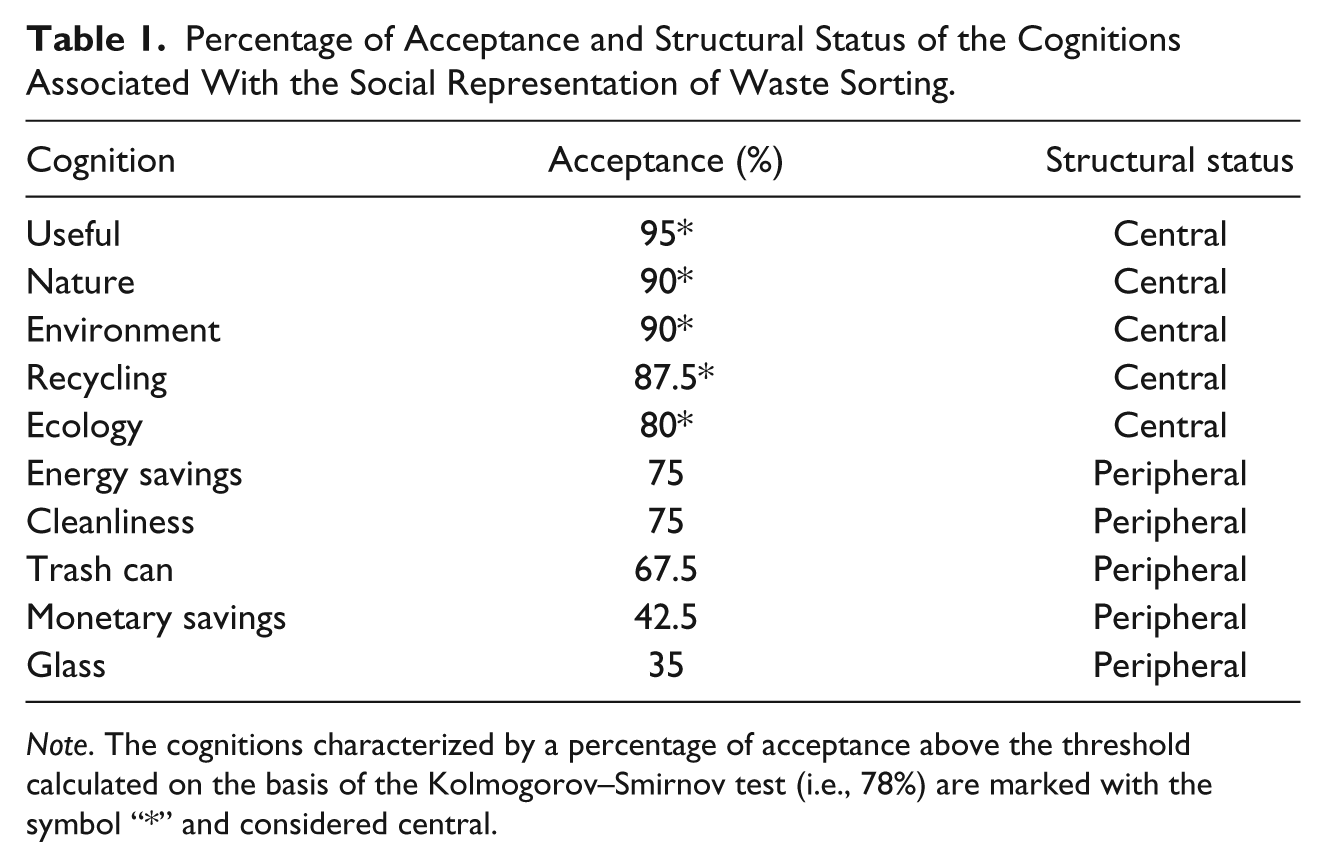
Note. The cognitions characterized by a percentage of acceptance above the threshold calculated on the basis of the Kolmogorov–Smirnov test (i.e., 78%) are marked with the symbol “*” and considered central.
These results indicate that the SR of waste sorting seems to be perceived in a positive manner by the participants, as the cognition characterized by the highest acceptance percentage is “useful.” Moreover, the cognitions “nature” and “environment” allow us to consider that the purpose of waste sorting (i.e., environmental protection) contributes to the definition of the meaning of this object. Otherwise, we also note that individual waste sorting and professional recycling are strongly linked. Concerning the peripheral system, it appears that most of the cognitions characterized by a percentage of endorsement below the threshold are related to more concrete aspects of waste sorting (e.g., trash can, monetary savings, glass). In accordance with the properties defined by Abric (1994), these concrete cognitions seem to be more related to the behaviors related to waste sorting, such as the glass that is sorted from household waste and trash cans that help with sorting.
Among the different cognitions that we evaluated, we needed to select a central and a peripheral one to manipulate the structural status in the second study. To this end, we chose the cognitions “recycling” and “monetary savings” respectively. In addition to the fact that these cognitions are clearly central and peripheral, respectively, they also seemed better suited to the cover story used in the second study.
Study 2: The Low-Ball Procedure and the SR of Waste Sorting
The aim of Study 2 was to evaluate the potential moderating effect of the structural status (central or peripheral) of the cognitions associated with the SR of waste sorting on the low-ball procedure in a hypothetical pro-environmental program. As a reminder, we hypothesized that in contrast to the “classical” effects associated with the low-ball procedure, participants committed to a pro-environmental program would give up this program more easily once they were led to believe that the program contradicted a central cognition linked to their SR of waste sorting. However, if the contradiction is based on a peripheral cognition, or if there is no contradiction at all (i.e., control condition), a significantly lower proportion of participants should give up the program. Moreover, no significant difference in the proportion of withdrawal should be observed between the control condition and the condition in which a peripheral cognition has been invalidated.
Method
Population
Ninety participants (52 women, M age = 22.90; SD = 2.23) from a French university participated in this study. The participants were randomly divided into three groups: invalidation of a central cognition (n = 30), invalidation of a peripheral cognition (n = 30), and no invalidation (i.e., control condition, n = 30). Two additional participants were omitted from the analyses because we could not contact them prior to the conclusion of the study.
Procedure
Three students conducted the experiment. Each one of these three students approached participants presenting themselves as a member of a pro-environmental association (the association was fictitious but presented as a real one named “the Civic Association for Ecology and Sustainable Development”). This student invited the individual to participate in a new program of waste sorting organized within the context of a partnership between the association and their local community. This program was presented as an experimental 3-week program that consisted of delivery to the individual’s home of three sets of trash bags, each one a specific color, to facilitate waste sorting and the identification of the recyclable type by garbage collectors. Individuals who agreed to participate in this test program had to sign a form containing the logo of the association, the community, and a summary of the program’s aims. More precisely, participants had to indicate their name, surname, and phone number, and to sign underneath a statement indicating that they agreed to engage in the program. This form had a dual purpose. On one hand, it was a means of gathering information about participants to identify them and contact them later. On the other hand, it was also a way of highlighting the individual’s own decision to participate in the program, thereby strengthening his or her commitment. In this perspective, this form acted as a behavioral contract, a technique that aims at improving individuals’ commitment to promote a given behavior (Burn & Oskamp, 1986; Dupré, 2014; Pallak & Cummings, 1976).
The participants who agreed to join the program were then contacted again the following day to confirm their participation. The phone call was made by another experimenter who presented himself as a member of the district in charge of the program (in fact it was one of the other two students who conducted the experiment). This phone conversation was also the occasion to induce the invalidation of the central or the peripheral cognition. Thus, the experimenter had to follow a specific scenario that varied from one condition to another. Although experimenters who recruited the participants were not aware which experimental condition participants would be allocated to, the experimenters who made the phone calls, given the scenario, had access to this information. However, to limit the influence of experimenters’ expectations on the results, they received the instruction not to deviate from a precise scenario. In the control condition, the experimenter asked participants whether they still wanted to participate in the program. If they answered positively, he requested their address to send them the trash bags and the instruction book related to the program. Participants who chose not to continue the program were thanked, and the phone conversation was ended. In the condition related to the invalidation of a peripheral cognition (i.e., non-essential cognition), participants were told that, as the program was recent, the sorting plan related to the program was not finalized and thus could not generate any profit, and as a consequence, the program would not really allow the community to save money. Then, the experimenter asked the participants whether they still wanted to participate in the program and depending on their choice, ended the phone conversation in the same way as in the control condition. In the condition related to the invalidation of a central cognition (i.e., essential cognition), participants were told that, as the program was recent, the sorting plan related to the program was not finalized, and thus, it would not be possible to actually recycle the garbage sorted by the participants. Then, the experimenter asked the participants again whether they still wanted to participate in the program and depending on their choice, ended the phone conversation in the same way as in the control condition. Five days after the first phone call, we contacted all the participants a final time to reveal the real objective of the study and to thank them for their participation.
Results and Discussion
Within the framework of this study, our only dependent variable was the proportion of participants who chose to withdraw from the program (cf. Table 2). Using logistical regressions, we observed that the proportion of withdrawals in the peripheral invalidation condition (36.67%) did not differ from the proportion of withdrawals in the control condition (16.67%), B = 0.97, Wald = 2.38, p < 1. Moreover, as expected, the proportion of withdrawals in the central invalidation condition (80.00%) differed significantly from the proportion of withdrawal in both the control condition (16.67%), B = −2.76, Wald = 17.72, p < .001, and the peripheral invalidation condition (36.67%), B = −1.79, Wald = 9.37, p < .01.
Proportions of Participants Who Withdrew From the Program Among the Different Conditions.
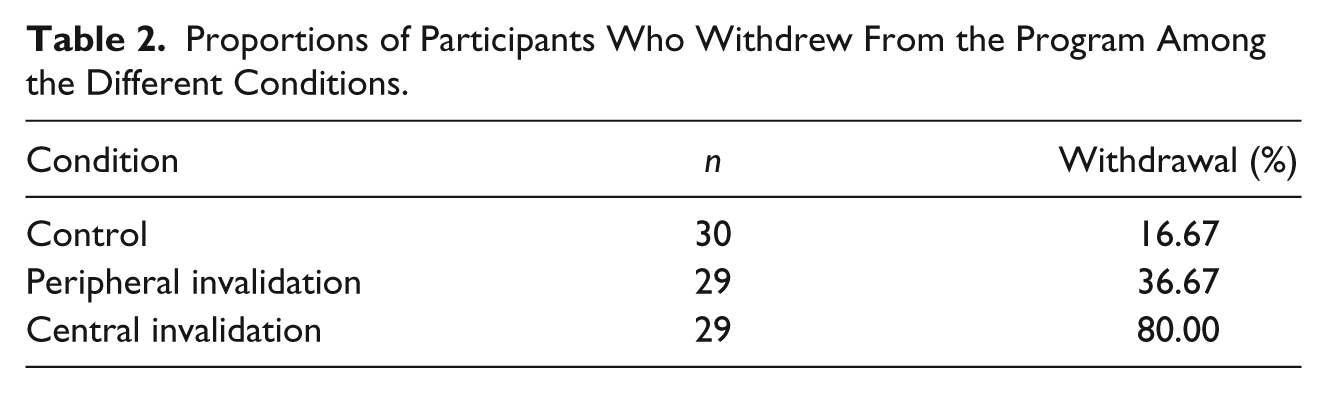
In accordance with our hypotheses, it appears that the participants who were committed to an environmental program were more likely to abandon it if one aspect of this program contradicted a central cognition of their SR of waste sorting. However, the invalidation of a peripheral cognition does not seem to lead to a significant increase of withdrawal from the program compared with the control condition. As a consequence, it seems that the SR shared among the participants can influence their commitment to a given program if for some reasons, this program invalidates a central cognition associated with this SR. Thus, from the perspective of the low-ball procedure, it appears that even if the participants decided freely to participate in the program and were committed to their decision, a hidden disadvantage that is linked to a central cognition can neutralize the freezing effect (Lewin, 1947) that binds participants to their decision.
General Discussion
The results of the two studies allowed us, on one hand, to identify the structure of the SR of waste sorting, and on the other hand, to highlight the moderating role of the structural status (central or peripheral) within the framework of the low-ball procedure. In this regard, one can assume that the hidden disadvantage concerning the central core of the SR could lead the participants to consider that they cannot sort if this activity does not lead to actual reprocessing of sorted waste. This effect of the invalidation of central and peripheral cognitions on withdrawal is close to the “calling into question technique” (Moliner, 1989, 1992), which relies on the structural approach to SRs. This technique aims at determining the structural status of representational elements by invalidating their link with the representational object.
More precisely, as one of the properties of central cognitions is to generate the meaning of the representation (Abric, 1993), the invalidation of such cognitions is expected to prevent the recognition of the object. This should not be the case with the invalidation of peripheric cognitions given the fact that they are considered non-essential. Within the context of this research, it may be that when the central cognition was invalidated, participants’ waste-sorting behavior lost its meaning, and they would not have any difficulty in breaking their commitment. Indeed, according to Cialdini et al. (1978), the theory of commitment (Kiesler, 1971) reflects low-ball effects. Individuals agree to a first request that predisposes them to accept the final request even if the latter is more costly (Guéguen, Pascual, & Dagot, 2002; Joule, 1987) or even deviant from a norm (Guéguen & Pascual, 2014). It is clear that our results are not consistent with a strong commitment from the participants. In fact, participants do not systematically agree to the second request when it contradicts a central cognition (i.e., “recycling”) of the SR of waste sorting. Thus, it is possible to suppose that the invalidation of the unconditional link between waste sorting and ultimate recycling would lead the participants to break the link established between themselves and their first decision. In a different vein, a second explanation of these results draws on the self-perception theory (Bem, 1972) and the principle according to which, from a self-perception perspective, individuals infer their attitude(s) from their behavior(s). Thus, if the first decision to become involved in the program could make the participants think that they are in favor of protecting the environment, the contradiction of the central cognition could accentuate such a self-perception. Indeed, the contradiction of a central cognition could accentuate self-perception in terms of responsibility toward environmental issues to the extent that if the essential aspects concerning our representation of waste sorting are threatened, as pro-environment individuals, we cannot continue to participate in a program that does not fit in with our views.
Although different, these two interpretations converge on the decisive role of the structural status of the cognitions. Indeed, it appears that the non-recognition of the object due to the invalidation of a central cognition could be the main factor in explaining withdrawal from the program. In line with this reflection, recent work by Lheureux and Lo Monaco (2011) based on research conducted by Katerelos (2003) shows that the invalidation of a central cognition can still lead to the recognition of the object when, simultaneously, participants are provided with the confirmation of another central cognition. Thus, considering these results would improve the procedures that lead the participants to maintain their commitment in carrying out the requested act.
Nevertheless, this research is characterized by some limitations. The first one relates to a methodological aspect concerning the TCI and more particularly to the modalities of response generally associated with that technique (Lo Monaco et al., 2008). As a reminder, participants had to answer a question for each cognition associated with the SR of waste sorting such as the following: “In your opinion, is ‘recycling’ a practice that is linked always, in all cases, to waste sorting.” To answer these questions, participants had to choose one answer from a 4-point scale (i.e., 1 = definitely not; 2 = rather not; 3 = rather yes; 4 = definitely yes). However, it is possible to consider that these response modalities were inadequate for the question. Indeed, if participants think that a given element is always and in all cases associated with the object, it seems illogical to choose the answer “probably yes.” In other terms, the relative responses proposed (i.e., “rather yes” or “rather not”) seem unsuitable for the assessment of a trans-situational link (i.e., “always, in all cases”). As a consequence, a dichotomous choice modality (i.e., “yes” or “no”) would have been more suitable. However, results tend to suggest that participants interpreted the gradation of the modalities of response as a way of expressing their confidence in their choice. This hypothesis is strengthened by the convergent results obtained through the comparison between the TCI and other scales that aim to reveal the structural status (central or peripheral) of cognitions and that are not characterized by such a discrepancy between the question and the response modalities (Lo Monaco et al., 2008).
Another concern is the generalization of the results of Study 2 as the experimenters who called participants on the phone, given the scenario they had to follow, were aware of each participant’s experimental condition. Thus, despite the fact that they received the instruction not to deviate from these scenarios, we cannot rule out the possibility that they subtly influenced participants to make a choice that was in line with their expectations regarding the results. Moreover, as only two cognitions were used (i.e., a central one and a peripheral one), one must be cautious in concluding that the observed results are more the consequence of the structural status of the cognitions than the consequence of their specific meaning.
Besides, in addition to a distinction based on structural status, research conducted within the framework of the structural approach to SRs allows us to consider a distinction based on the nature of cognitions (Guimelli, 1998; Guimelli & Rateau, 2003; Rateau, 2002). In that perspective, cognitions characterized by a normative nature are linked to the values and norms that are prominent in a given group, whereas cognitions characterized by a functional nature are more related to the behaviors linked to the object of SR. Moreover, some cognitions can also be characterized by both a normative and a functional nature and are referred to as mixed elements (Guimelli, 1998). Within such a framework, the two cognitions drawn on in that research (i.e., “recycling” and “monetary savings”) could be characterized by a normative and a functional nature respectively. However, establishing such a distinction based on the nature of cognitions (Guimelli, 1998; Guimelli & Rateau, 2003; Rateau, 2002) requires the use of specific methodologies (i.e., the Basic Cognitive Schemes Model; Fraïsse & Stewart, 2002; Gruev-Vintila & Rouquette, 2007; Guimelli & Rouquette, 1992; Rouquette & Rateau, 1998) that were not drawn on in that research. Indeed, this research was mainly focused on the structural status of cognitions as the distinction between central and peripheral cognitions allowed us to expect differentiated behaviors following the invalidation of cognitions. Nevertheless, the distinction of cognitions on the basis of their nature constitutes an opportunity to deepen the links between SRs and the low-ball technique as central cognitions can be characterized by different natures (Guimelli, 1998; Guimelli & Rateau, 2003).
However, the results of Study 2 are in line with our hypothesis and allow us to conclude that the invalidation of the cognition “recycling” within the framework of a waste-sorting program can lead individuals to leave the program. Moreover, some cognitions can be characterized by both functional and normative natures (i.e., can lead individuals to withdraw from that program). This result is linked to important issues within an applied perspective.
Indeed, from an applied perspective, the results of this research highlight the importance of beliefs and their decisive role in the functioning of a pro-environmental program. In fact, even if our operationalization was based on an invalidation originating directly from one of the managers of the program presented to the participants, one can assume that similar effects could be observed after a “natural” invalidation originating from the participants’s environment, via media or rumors, as in the examples presented in the introduction of this article. In this perspective, taking into account the SRs involved in environmental programs (and their structure) would allow managers to deal in depth with the explanation of practices (or the absence of practices). However, taking account of SRs could also help to limit the negative effects of some factors on individuals’ commitment. This would consist in boosting the information campaigns accompanying environmental programs based on behavioral commitment, through the employment of central cognitions associated with the implied SR. Moreover, it would be useful to counter any undermining information through the employment of other cogent central cognitions.
As a conclusion, our contribution shows that it is necessary to consider the structure of the SR with respect to commitment, whether to optimize its effects or to avoid situations leading to withdrawal. In fact, interventions that use pro-environmental behavior change techniques need to be carefully planned before they are implemented (e.g., Steg & Vlek, 2009) to avoid, for example, a negative low-ball impact on behavioral change.
Footnotes
Declaration of Conflicting Interests
The author(s) declared no potential conflicts of interest with respect to the research, authorship, and/or publication of this article.
Funding
The author(s) received no financial support for the research, authorship, and/or publication of this article.