







Abstract
Behavioral spillover theory has potential for promoting meaningful behavior change. Spillover occurs when engagement in environmental behaviors affects the adoption of other environmental behaviors. By testing a new experimental model of spillover, this article is the first to concurrently investigate three predicted mechanisms of spillover—self-identity, self-efficacy, and contribution ethic—on different types of environmental behavior. The experimental spillover model examined how triggering self-perceptions (i.e., self-identity, self-efficacy, and contribution ethic) may influence the likelihood of spillover to occur from engagement in household behaviors to intentions for other environmental behaviors. Triggering self-identity was associated with increased private- and public-sphere intentions. Contrary to expectations, contribution ethic was not associated with decreased intentions, and instead was associated with increased public-sphere intentions. Self-efficacy did not uniquely influence intentions. These findings demonstrate that everyday behaviors can provide an “entry point” for other behaviors, strengthening self-perceptions and generating positive spillover.
Keywords
A key challenge for environmental sustainability advocates is identifying how to encourage the uptake of behaviors that will have greater environmental benefit (Kneebone, Smith, & Fielding, 2017; Stern, 2000). Spillover is a phenomenon that could be used to increase environmental engagement, and there is a growing body of literature describing spillover between environmental behaviors (see Truelove, Carrico, Weber, Raimi, & Vandenbergh, 2014, for a review). Spillover has been conceptualized as occurring when engaging in environmental behavior increases the likelihood of adopting other environmental behaviors (Lanzini & Thøgersen, 2014), or when an intervention influences the adoption of behaviors that were not targeted by the intervention (Carrico, Raimi, Truelove, & Eby, 2018; Truelove et al., 2014). However, we adopt the conceptualization of spillover as occurring when engagement in environmental behavior affects conscious or unconscious processes that influence the adoption of other environmental behavior (Dolan & Galizzi, 2015).
The effects of spillover can be positive, when initial engagement increases subsequent engagement, and negative, when initial engagement diminishes adoption of other behaviors. We argue that conscious and unconscious mechanisms influence the likelihood and direction of spillover (Dolan & Galizzi, 2015). Existing research highlights the importance of investigating underlying mechanisms for fostering spillover, such as identity or efficacy (Lacasse, 2016; Lauren, Fielding, Smith, & Louis, 2016; Steinhorst, Klöckner, & Matthies, 2015). However, a number of challenges remain, with research evidence suggesting that spillover effects are likely to be weak and dependent on various conditions, such as holding strong personal norms for environmental behavior (Thøgersen & Ölander, 2003) or utilizing decision-making processes that influence choice of engagement in environmental behavior (Truelove et al., 2014). This highlights the need to better understand mechanisms that mediate spillover. The aim of the current research is to investigate how self-perceptions can act as processes that influence the likelihood of spillover, as little is known about these pathways. Knowledge about the effectiveness of these processes in promoting spillover is vital to understanding how spillover can be utilized as a meaningful behavior change mechanism.
Examining how spillover mechanisms concurrently influence different types of behaviors is important for understanding how spillover may be used as a functional behavior change mechanism. Stern (2000) conceptualizes private- and public-sphere behaviors as different types of environmentalism. Private-sphere environmentalism has direct environmental consequences (e.g., consumer purchase decisions and waste disposal behaviors). Public-sphere behaviors seek to influence environmental policies, comprising behaviors such as petitioning or attending public rallies. As such, public-sphere environmentalism has an indirect effect on the environment, but has potential to achieve a wider societal influence. Past research has investigated spillover from private-sphere behaviors to public-sphere behavior. For instance, Lanzini and Thøgersen (2014) showed evidence that an intervention encouraging private-sphere behaviors through verbal and monetary encouragement increased engagement in public-sphere behaviors. Other research has investigated how spillover mechanisms operate on influencing spillover from one private-sphere behavior (disposing of a bottle) to a public-sphere behavior (support for campus environmental fund; Truelove, Yeung, Carrico, Gillis, & Raimi, 2016). The usefulness of spillover as a behavior change mechanism needs to be tested, and the effectiveness of mechanisms needs to be concurrently observed on different types of environmental behavior. As everyday contexts offer the opportunity for people to engage in various and different behaviors in both private and public spheres, it would be useful to understand how mechanisms influence spillover to different behaviors at the same time. This would allow researchers and practitioners to understand how spillover mechanisms influence how individuals prioritize their behavioral choices. However, there is no research that has investigated how multiple spillover mechanisms concurrently influence intentions for private- and public-sphere behaviors.
An important principle of spillover relates to its potential to build on past environmental behaviors. Many simple environmental behaviors (e.g., putting waste in the bin, recycling, or turning off lights) have become normative behaviors, with few people attributing their adoption of such behaviors to environmental motives. These existing behaviors provide a large pool of behaviors that could be utilized as catalysts for change. Reminding individuals of their existing behaviors and cueing environmental outcomes to shift self-perceptions is a potential entry point for spillover to occur. We argue that past behaviors could be leveraged as a way of promoting spillover to other environmental behaviors, through the influence these past behaviors have on self-perceptions of individuals. Self-perception theory considers individuals to be observers of their behavior, and that individuals make inferences about their attitudes, beliefs, and other internal states, based on observation of their behavior (Bem, 1972). Following this logic, if individuals were to make an inference about their engagement in environmental behavior, they might come to see themselves as being the type of people who care about the environment. This self-perception might then motivate individuals to adopt other behaviors concordant with their self-perceptions. For example, individuals who perform pro-environmental behaviors may then adapt their attitudes and self-image to align with these behaviors, which in turn is theorized to make them more likely to act environmentally in the future (Thøgersen & Ölander, 2003). Bandura (1997) reasons that mastery of a behavior can create and strengthen beliefs of capability or efficacy. We suggest this process can be extrapolated to other self-perception beliefs. Engagement in an environmental behavior influences our self-perceptions via our own cognitive appraisals of our past behavior.
Individual engagement in environmental behaviors may occur in the absence of strong environmental values (Dean, Lindsay, Fielding, & Smith, 2016). It has been argued that behavior change interventions can use existing behaviors to promote self-perceptions, to enhance broader environmental engagement (Dean et al., 2016). Recent research suggests a potential role for past environmental behavior to enhance self-perceptions and increase spillover. Specifically, triggering self-identity and self-efficacy through reminding individuals of their past behavior may foster positive spillover—increased likelihood of performing other behaviors (Lauren et al., 2016; Truelove et al., 2016; van der Werff, Steg, & Keizer, 2014a, 2014b). Of note, evaluations of behavior do not necessarily lead to positive self-perceptions that have a positive influence on spillover. Contribution ethic, or feeling as though you have “done your bit” for the environment, is theorized to reduce behavioral intentions (Thøgersen & Crompton, 2009). Despite the importance of understanding the processes underpinning spillover, there has been no concurrent examination of spillover mechanisms in relation to different types of environmental behavior.
This article is the first to concurrently examine three spillover mechanisms—environmental self-identity salience, enhancing one’s perceptions of their environmental self-efficacy, and triggering one’s sense of contribution ethic—and how these mechanisms may simultaneously influence the likelihood of spillover to occur from past behavior to private- and public-sphere behaviors.
Environmental Self-Identity and Spillover
Self-identity is how one sees oneself (Whitmarsh & O’Neill, 2010) and can be strengthened through the behaviors one chooses to perform (van der Werff et al., 2014b). Environmental self-identity has an important influence on environmental behavior (Whitmarsh & O’Neill, 2010) and spillover (Truelove et al., 2014). Engaging in environmental behaviors can act as a reminder of why one performs environmental behaviors. When behaviors cue this self-identity, the likelihood for spillover may increase.
Environmental self-identity has been theorized to mediate spillover between environmental behaviors (Thøgersen & Crompton, 2009; Whitmarsh & O’Neill, 2010), and this mediation has been demonstrated empirically through manipulation of self-identity salience (Lacasse, 2016; Truelove et al., 2016; van der Werff et al., 2014a). Two studies have manipulated identity salience via reminders of past engagement in environmental behaviors (Lacasse, 2016; van der Werff et al., 2014a). For example, van der Werff et al. (2014a) enhanced perceptions of environmental self-identity by providing reminders of engaging in common environmental behaviors. Compared with a control group, the enhancement of self-identity increased intentions to perform other environmental behaviors, such as choosing an environmentally friendly product. The studies of van der Werff et al. (2014a) and Lacasse (2016) suggest that there is a bidirectional relationship between identity and related behaviors: Identity influences behaviors and performing behaviors associated with a particular identity can also reinforce identity. Research has not yet examined the influence of self-identity on spillover into different types of environmental behaviors, nor how its role compares with other proposed mechanisms of spillover.
Self-Efficacy and Spillover
Self-efficacy is a personal appraisal of one’s capability to mobilize the motivation, cognitive resources, and behavior required to cope with a situation (Bandura, 1997). Self-efficacy is a modifiable construct that can be enhanced through experience, learning, and feedback on performance (Ashford, Edmunds, & French, 2010; Gist & Mitchell, 1992). Successfully engaging in a behavior can increase perceptions of one’s capabilities (Bandura, 1977). The findings of Corral-Verdugo, González-Lomelí, Rascón-Cruz, and Corral-Frías (2016) show that sustainable behaviors are positively associated with intrinsic motives of self-efficacy, satisfaction, and autonomy. The dynamic nature of self-efficacy, in particular its dependence on past behaviors and its influence on future behaviors (Bandura, 1986), is suggested to lead to a virtuous cycle where motivation is gained from inferring environmental competence from environmental engagement (De Young, 2000). This suggests that self-efficacy is a potential mechanism for promoting spillover. Self-efficacy has been theorized to influence spillover (Lanzini & Thøgersen, 2014; Thøgersen & Crompton, 2009), and there is correlational evidence suggesting that self-efficacy mediates spillover from easy to more difficult environmental behaviors (Lauren et al., 2016). As such, self-efficacy has been claimed to be a mediating mechanism that can make positive spillover more likely to occur. Despite the potential for self-efficacy in promoting spillover, there are no experimental studies manipulating self-efficacy for the purpose of examining its role in spillover from existing behaviors to future pro-environmental behaviors.
Contribution Ethic and Spillover
Adoption of environmental behaviors could have a negative influence on subsequent behaviors if the initial behaviors are deemed as satisfying one’s contribution ethic. A contribution ethic is the sense that individuals have already “done their bit” or feeling as though enough has been done to address a problem (Thøgersen & Crompton, 2009). There has been limited empirical investigation into contribution ethic, and very little is understood about how contribution ethic is formed and how it influences behavior. Contribution ethic is proposed to influence what is deemed as a fair contribution, and this sense of a fair contribution then guides the choice of action (Thøgersen & Ölander, 2003). When individuals sense a high contribution ethic, as in feeling they have contributed a fair share, they may feel reduced intentions to do anything further. Hence, contribution ethic is theorized to lead to negative spillover of environmental behaviors.
The influence of contribution ethic could explain instances of negative spillover observed in past research. Specifically, Thøgersen (1999) found that households who sorted their waste for recycling felt less obliged to consider the consequences of the waste they produce through their consumption choices. Furthermore, feedback given to households about their water consumption was found to subsequently decrease water use while also increasing electricity use (Tiefenbeck, Staake, Roth, & Sachs, 2013). Given the importance of avoiding untended consequences when promoting environmental behaviors, it is imperative to investigate how patterns of past behaviors may undermine intentions for future behaviors, and whether this is mediated via contribution ethic.
Current Research
Past research suggests there are numerous mechanisms of spillover (Carrico et al., 2018; Steinhorst et al., 2015; Truelove et al., 2016), and that both private- and public-sphere behaviors are strongly influenced by efficacy and identity (Fielding, McDonald, & Louis, 2008; Johe & Bhullar, 2016; Rabinovich, Morton, Postmes, & Verplanken, 2009; Tabernero & Hernández, 2011). Examining how these mechanisms concurrently influence different types of behaviors is important for understanding how spillover may be used as a meaningful behavior change mechanism. Self-perceptions were proposed by Thøgersen and Crompton (2009) as underlying mechanisms that drive spillover. The self-perceptions of self-efficacy and self-identity have been established as mediators of spillover (Lacasse, 2016; Lauren et al., 2016; Steinhorst et al., 2015; Truelove et al., 2016; van der Werff et al., 2014a, 2014b). However, the effects of these self-perceptions have never been investigated concurrently, nor have their effects been examined on different types of environmental behaviors. Also, there has never been an empirical investigation into contribution ethic and the influence it may have on spillover. This study addresses these gaps by triggering multiple mechanisms of spillover—self-identity, self-efficacy, and contribution ethic—through testing a new experimental model of spillover. This new model tests whether past behavior can trigger self-perceptions by reminding individuals of their past engagement in household (private-sphere) behaviors, and examining how these triggered self-perceptions motivate intentions for other private-sphere, as well as public-sphere environmental behaviors.
We hypothesize that being reminded of performing “many” environmental behaviors (compared with a control condition of “few” behaviors) will increase environmental intentions indirectly by changing self-perceptions. Specifically, reminders of past behavior will lead to (a) increased self-identity as well as (b) increased self-efficacy, and both will be indirectly positively associated with future intentions. Also, reminders of past behavior will lead to (c) increased contribution ethic, which will be indirectly negatively associated with intentions.
Method
Participants
We recruited 274 university students to participate in an online survey for course credit (Mage = 19.66 years, SD = 4.33, and 70% female). Students came from various disciplines, such as health (35.1%), science (21.6%), psychology (15.1%), and arts (13.1%), as well as other disciplines, such as business, law, and communication (15.1%). The study was advertised via an online participant pool and was described as measuring student engagement in water-related behaviors.
Design
A between-subjects design randomly allocated participants to one of two conditions. Both conditions completed a behavior checklist manipulation (adapted from Lacasse, 2016), which assessed past engagement in 13 household environmental behaviors (see supplemental material). Easy behaviors were selected to increase the strength of the manipulation. Two conditions were utilized:
High past behavior condition: Participants in this condition were asked to check behaviors they “at least sometimes do.” This provided an opportunity to check a high number of behaviors.
Low past behavior condition: Participants in this condition were asked to check behaviors they “always do.” This provided an opportunity to check a low number of behaviors, because it is unlikely for participants to confidently admit to doing lots of the behaviors “always.”
As this study is testing a novel experimental model of spillover, we focused on comparing our manipulation (high past behavior reminder) to an active control (low past behavior reminder). Differences between the intervention and an active control allow us to draw inferences about the specific effect of the experimental model, which could be extended in future research.
Procedure
Those in the experimental conditions received the behavior checklist and were asked to count the number of behaviors they had chosen. The behavioral intentions were issued after the manipulation, with the mediator measures issued after this. Questions about age, gender, degree, and whether English was their first language were answered before participants were debriefed. The survey was designed to take 10 min, with the average time taken being 9.21 min (SD = 12.99).
Dependent Measures
Intention of engaging in six behaviors within the next 6 months were measured using six items. The six behaviors tapped into private-sphere and public-sphere environmentalism. The private-sphere behaviors were “pick up someone else’s litter,” “purchase an eco-friendly product,” and “use an eco-friendly product” (α = .76). Public-sphere behaviors were “volunteer for an environmental group,” “donate to an environmental group,” and “participate in a demonstration to support an environmental cause” (α = .79). Responses were coded on a 7-point scale (1 = extremely unlikely; 7 = extremely likely).
Mediators
Environmental self-identity was measured using three items adapted from Fielding et al. (2008):‘I think of myself as a person who protects the environment,’ ‘To engage in ways that protect the environment is an important part of who I am,’ and one item that was reverse scored, ‘I am NOT the type of person who would protect the environment’ (1 = strongly disagree; 7 = strongly agree; α = .83).
Self-efficacy, related to protecting the environment, was measured using four items adapted from Earley, Gibson, and Chen (1999), Steinhorst et al. (2015), and Tabernero and Hernández (2011): ‘I feel capable of engaging in actions that help protect the environment’ (1 = not at all capable; 7 = totally capable), ‘I am certain that I can engage in actions that help protect the environment’ (1 = certain cannot do; 7 = highly certain can do), ‘I am confident that I can engage in actions that help protect the environment’ (1 = not at all confident; 7 = totally confident), and ‘I believe that I can engage in actions that help protect the environment’ (1 = do not agree; 7 = strongly agree; α = .86).
Contribution ethic was measured using three items developed for this study as there are no established scales to draw from. Participants were presented with the question, “How much have you done to protect the environment?” followed by three semantic differential scales with 7-point response options. These were as follows: 1 = not enough, 4 = enough, 7 = more than enough; 1 = less than my share, 4 = done my share, 7 = more than my share; and 1 = less than most, 4 = same as most, 7 = more than most (α = .86).
Statistical Analyses
The measurement model was assessed using confirmatory factor analyses (CFA) and the hypothesized model was assessed using structural equation modeling (SEM), by using the Lavaan package in RStudio (Rosseel, 2012). Goodness of fit was evaluated using chi-square test, comparative fit index (CFI), and Tucker–Lewis index (TLI) equal or greater than .95 (Hu & Bentler, 1999); and root mean square error of approximation (RMSEA) and standard root mean residual (SRMR) lower than .08 (MacCallum, Browne, & Sugawara, 1996). Fit measures to test the covariances explained by the model were as follows: goodness of fit index (GFI) and adjusted goodness of fitness index (AGFI) greater than .90 (Hu & Bentler, 1995). Fit measures between different models are compared using Akaike information criterion (AIC), where lower values indicate better fit (Bozdogan, 1987). Hypotheses were tested using bootstrapping with 5,000 resamples (Hayes, 2013).
Results
Manipulation Checks
As shown in Table 1, those in the high past behavior condition checked significantly more behaviors than those in the low past behavior condition and therefore our manipulation was successful. Independent sample t tests also revealed no significant differences between conditions for any of the measures, suggesting that being placed into a condition did not directly influence self-identity, self-efficacy, or contribution ethic, nor did it influence intentions. There were also no significant differences between conditions on gender or age.
Descriptive Statistics of Key Variables Across Each Condition.
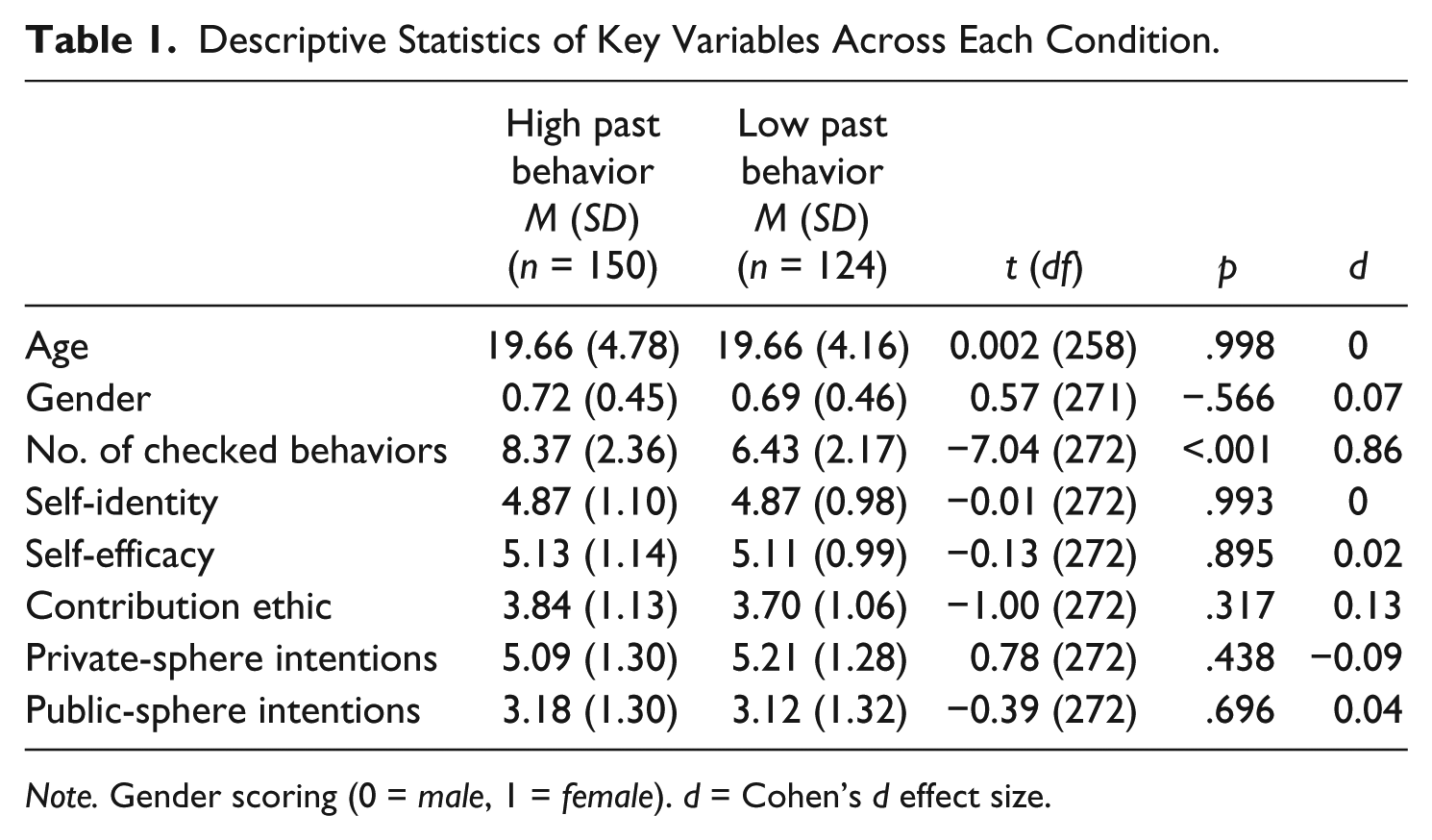
Note. Gender scoring (0 = male, 1 = female). d = Cohen’s d effect size.
As shown in Table 2, correlation analyses indicate that the manipulation was positively associated with the number of behaviors checked, but was not associated with any other variable. The number of checked behaviors was positively associated with every variable, suggesting that the more behaviors individuals had checked, the greater the likelihood of them experiencing heightened self-identity, self-efficacy, and contribution ethic.
Correlations Between Variables.
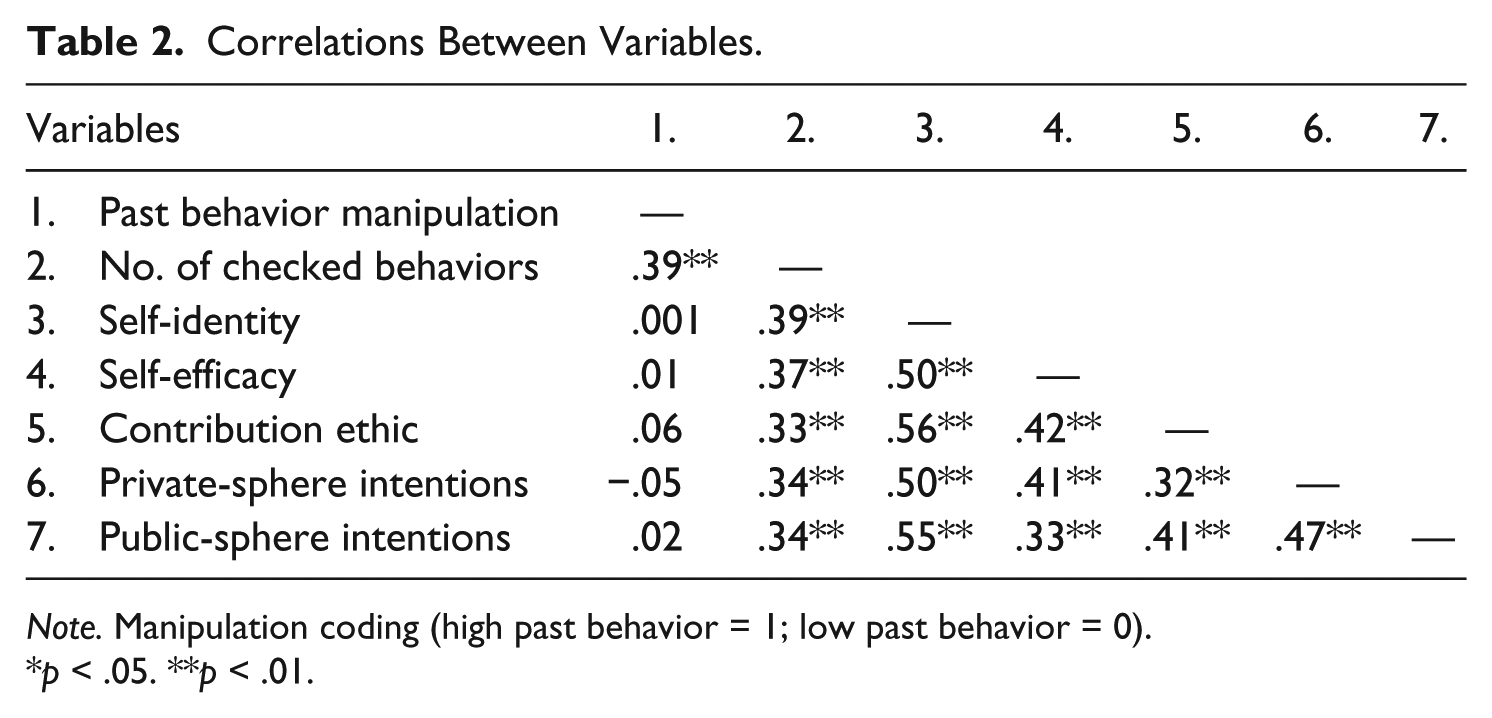
Note. Manipulation coding (high past behavior = 1; low past behavior = 0).
p < .05. **p < .01.
The measurement model (which included all five latent factors with covariances between each factor) exhibited adequate model fit (χ2(93) = 153.41, p < .001; CFI = 0.97; TLI = 0.97; RMSEA (90% CI [confidence interval]) = 0.05 [0.04, 0.06]; SRMR = 0.05. This establishes all parameters as identified and enables estimation of the structural equation model. The intention measures supported a two-factor solution, χ2(7) = 12.15, p = .096; CFI = 0.99; TLI = 0.98; RMSEA (90% CI) = 0.05 [0.00, 0.10]; SRMR = 0.02, more than a one-factor solution, χ2(8) = 32, p < .001; CFI = 0.96; TLI = 0.93; RMSEA (90% CI) = 0.11 [0.07, 0.15]; SRMR = 0.07, with the two-factor structure fitting the data significantly better than the one-factor structure, Δχ2(1) = 19.85, p < .001. This supported our conceptualization of these two scales as representing intentions for two types of behavior (i.e., private- and public-sphere). We also made allowance in each model for the strong correlation between the buying and using of eco-products items (r = .83, p < .001).
Hypothesis Testing
The structural model is presented in Figure 1, with the standardized parameter estimates presented in Table 3 and the standardized indirect effects in Table 4. The fit statistics show that the hypothesized model adequately fits the relationships in the data, χ2(115) = 176.25, p < .001; CFI = 0.97; TLI = 0.97; RMSEA (90% CI) = 0.05 [0.03, 0.06]; SRMR = 0.05; GFI = 0.93; AGFI = 0.90; AIC = 14,216.22.
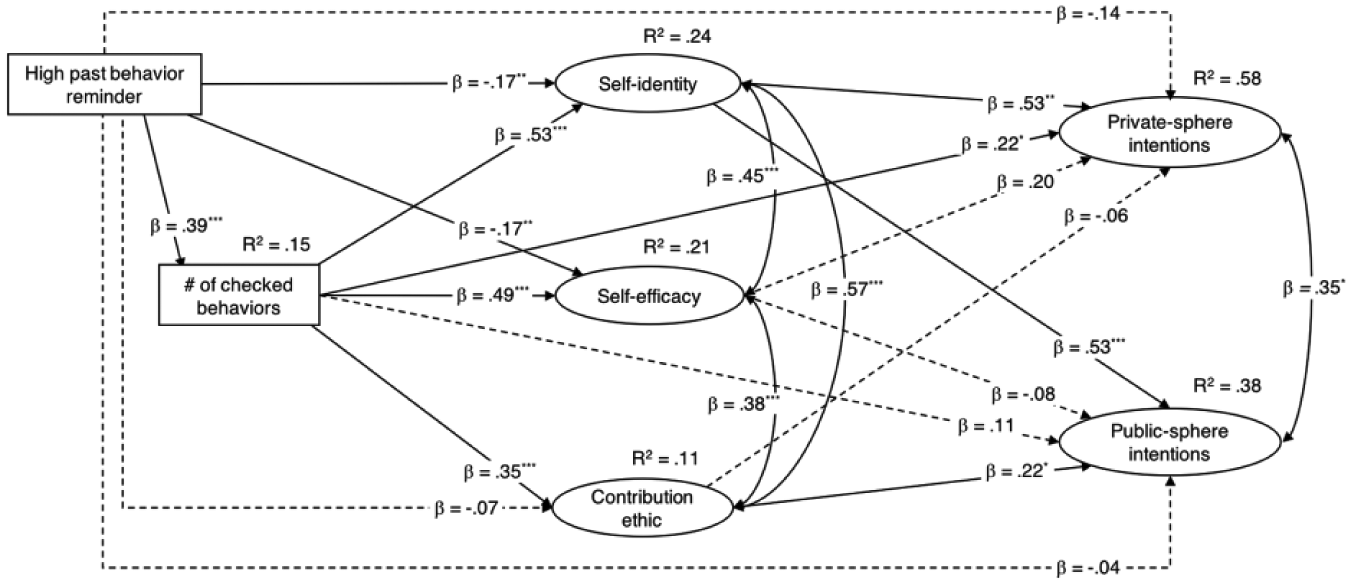
Hypothesized structural equation model depicting standardized coefficients, significant pathways signified by solid lines, and nonsignificant pathways signified by broken lines.
Standardized and Unstandardized Estimates for the Hypothesized Model.
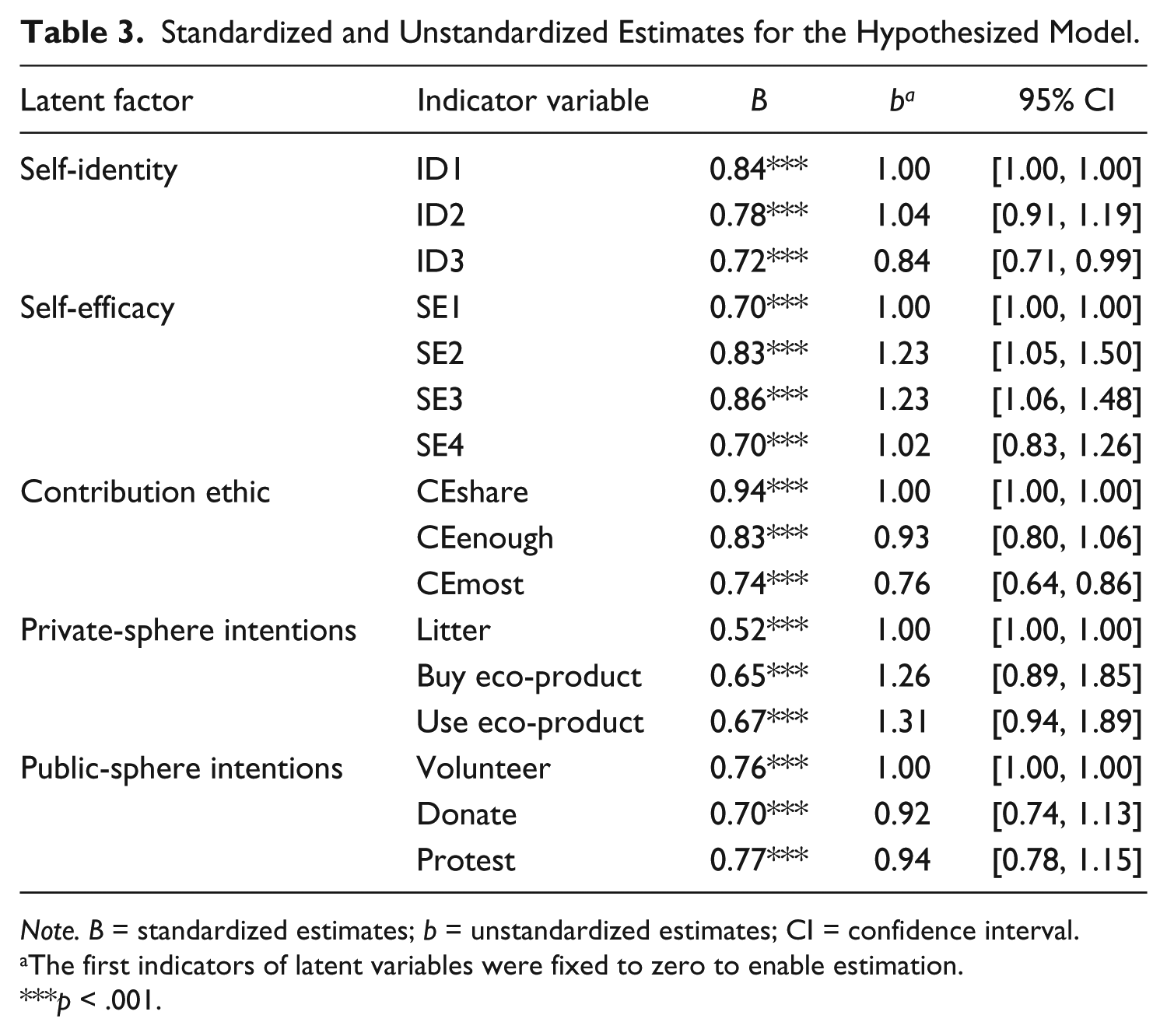
Note. B = standardized estimates; b = unstandardized estimates; CI = confidence interval.
The first indicators of latent variables were fixed to zero to enable estimation.
p < .001.
Standardized Indirect Effects of the Hypothesized Model.
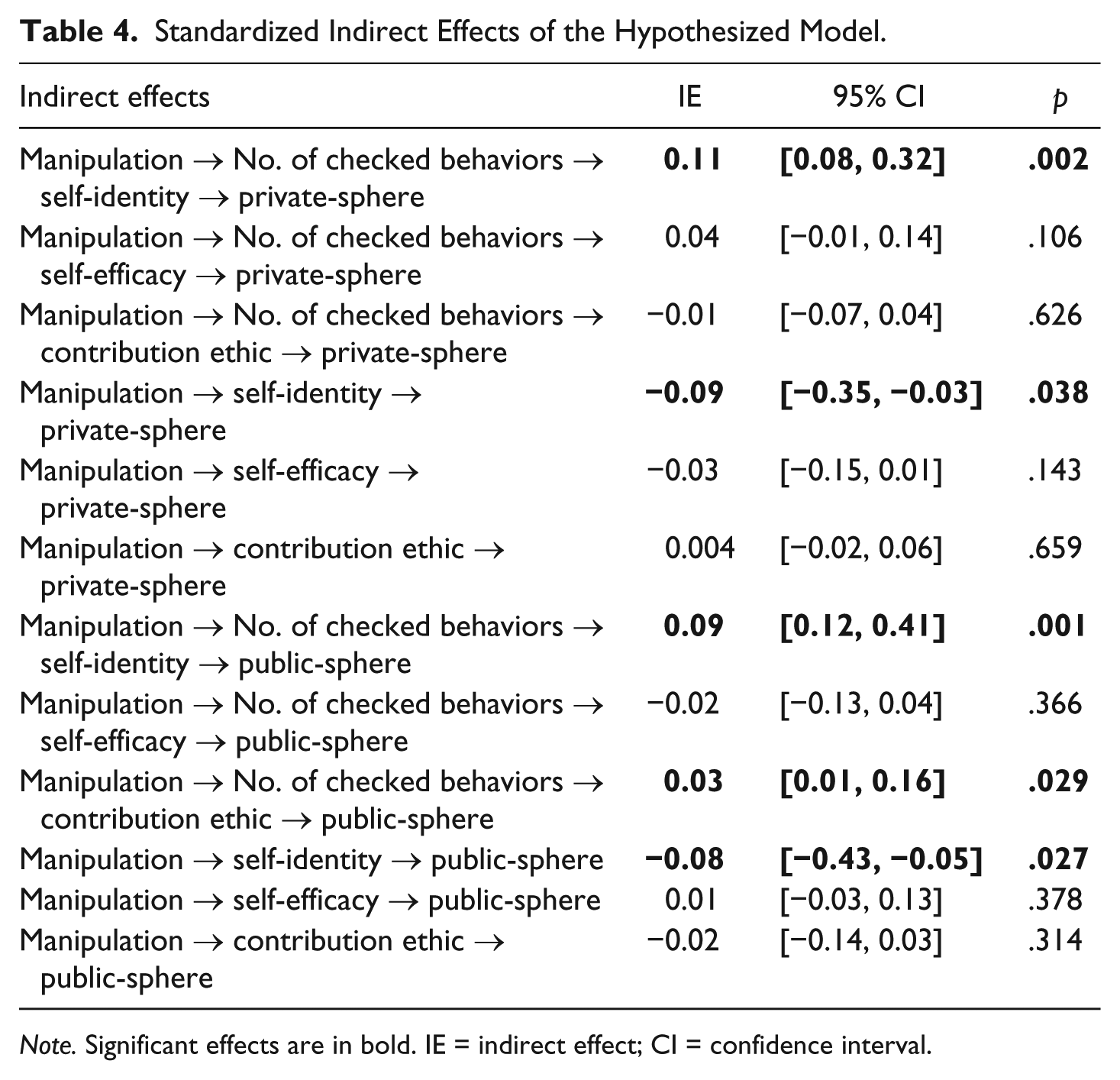
Note. Significant effects are in bold. IE = indirect effect; CI = confidence interval.
Our results present mixed support for our hypotheses (see Table 4). In line with Hypothesis 1, the reminder of past behavior exerted positive indirect effects via increased recognition of past behaviors and increased self-identity to increased intentions for private- and public-sphere behaviors. This finding is indicative of positive spillover. There was no support for Hypothesis 2, as self-efficacy was not associated with either intention. Hypothesis 3 was also not supported, as the effects of contribution ethic were counter to the predicted negative association with intentions. Although the reminder of past behavior increased contribution ethic, this then increased public-sphere intentions. This finding is indicative of contribution ethic being a mechanism of positive, rather than negative, spillover.
The significant negative pathways from manipulation to self-identity and self-efficacy, after the effect of the number of checked behaviors was accounted for, suggests an untheorized suppression effect. Particularly, those in the high past behavior condition who did not endorse a higher number of behaviors reported lower self-identity than those in the low past behavior condition. This then was associated with decreased private- and public-sphere intentions.
We tested an alternative model to investigate whether the inclusion of contribution ethic in the model affected the strength of effects through self-efficacy. This model contained only self-identity and self-efficacy as mediators. The structural model, the standardized parameter estimates, and the standardized indirect effects are presented in the supplemental material. This alternative model explained the relationships in the data adequately, χ2(76) = 94.43, p = 0.075; CFI = 0.99; TLI = 0.99; RMSEA (90% CI) = 0.03 [0, 0.05]; SRMR = 0.03; GFI = 0.96; AGFI = 0.94; AIC = 12174.66; Δχ2(39) = 81.82, p < .001. Similar to the hypothesized model, the alternative model confirms that self-identity is a positive mediator of the relationship between past behaviors to private- and public-sphere intentions and did not detect any significant mediation effects of self-efficacy.
Discussion
This study demonstrated that a reminder of past engagement in household environmental behaviors can trigger self-identity and contribution ethic, which, in turn, is associated with increased intentions for other environmental behaviors. This is the first study to concurrently examine three predicted mechanisms of spillover (two established mechanisms—self-identity and self-efficacy—and one novel mechanism—contribution ethic) and assess their effectiveness in fostering intentions for private- and public-sphere behaviors.
This study tested a novel experimental model of spillover and established an evidence base for further research into how past behavior can be used as an entry point for spillover. Our findings demonstrate that self-perceptions can be cued through reminders of past behavior, which suggests people make inferences about their self-perceptions based on their past behavior. We argue this may indicate that past behaviors will only catalyze to others when the initial behavior creates strong self-perception cues. This finding supports research that speaks to the importance of behavior signaling identity as a means for fostering spillover (Lacasse, 2016; van der Werff et al., 2014a). Cueing self-perceptions or self-identity through past behavior may not occur naturally for many people, which could be why spillover—as a phenomenon—is difficult to witness in experiences and the real world. Our findings also suggest that these effects are most pronounced in people who are at least somewhat engaged (e.g., doing a number of behaviors already).
The utility of this study would be apparent for applied practitioners wishing to leverage what people already do for the environment. Our findings demonstrate the functionality of using a behavior checklist to prompt self-perceptions. Practitioners may use these findings to inform strategies for behavior change interventions, such as by using a checklist to prompt self-identity to encourage adoption of a particular behavior. The suppression effect suggests that approaches utilizing past behavior to trigger self-perceptions may not be suitable for those disengaged with environmental issues however—as they have fewer behaviors to draw on. Future research might investigate how self-perceptions may be triggered in those who are not engaging in very many environmental behaviors already, perhaps by encouraging behaviors that are perceived as similar to the prime behavior (Margetts & Kashima, 2017).
Self-Identity as a Spillover Mechanism
The influential nature of environmental self-identity as a spillover mechanism is apparent in this study, with self-identity mediating positive pathways from household behaviors to both private- and public-sphere intentions. These findings imply that self-identity is an important motivating mechanism for spurring engagement in both direct and indirect environmental behaviors. This confirms research that highlights the mediational importance of environmental self-identity (Truelove et al., 2016; van der Werff et al., 2014a, 2014b). When environmental self-identity is incorporated into one’s conception of the self and it is made salient in a given situation, individuals are likely to adhere to the prescribed behaviors associated with the salient identity. Specifically, when we incorporate a sense of caring about the environment into our self-concept, we are motivated to influence the world in more positive ways.
Self-Efficacy as a Spillover Mechanism
Unexpectedly, self-efficacy did not emerge as a mechanism for positive spillover, as it did not predict intentions to engage in either private- or public-sphere behaviors. This is in contrast to research showing that self-efficacy is associated with environmental intentions for picking up others’ litter or rehabilitating riverbanks (Lauren et al., 2016), as well as using reusable shopping bags (Lam, 2006; Lam & Chen, 2006). One reason for our finding could be the general nature of self-efficacy assessed in the present study: We assessed self-efficacy related to “protecting the environment,” rather than toward a specific behavior, such as “recycling a bottle.” Self-efficacy theory reinforces the importance of measuring self-efficacy relating to a specific behavior, and that this is a stronger predictor of engagement than a general measure of self-efficacy (Bandura, 1977). With regard to public-sphere behaviors, it may be that individual perceptions of self-efficacy alone are not enough to motivate public-sphere behaviors. Jugert et al. (2016) found that collective efficacy was a key influence on public-sphere behaviors, and that self-efficacy was necessary for the experience of collective efficacy. As this study attempted to manipulate self-efficacy and not collective efficacy, it seems reasonable to expect that public-sphere behaviors would not be influenced by self-efficacy alone.
Contribution Ethic as a Spillover Mechanism
This is the first study to investigate contribution ethic and how it may act as a spillover mechanism. Our finding, that contribution ethic mediated positive pathways, is counter to predictions and how it has been theorized within the literature. In contrast to spillover theory that conceptualizes contribution ethic as having a demotivating influence (Thøgersen & Crompton, 2009), we observed that contribution ethic had a motivating effect on public-sphere intentions. Aligned with this, contribution ethic was positively correlated with self-identity and self-efficacy, as well as being susceptible to enhancement through increased recognition of past behaviors. There are a number of explanations for this finding. Guagnano, Dietz, and Stern (1994) conceptualized contribution ethic within a contribution model, where context was seen to stimulate contributory giving. Furthermore, contribution ethic is theorized to be informed by the belief that environmental problems are issues that are experienced collectively and, as such, require a collective solution that everyone must contribute to in order for the solution to have an impact on the issue (Guagnano et al., 1994; Thøgersen & Noblet, 2012). This suggests that contribution ethic could enhance environmental behaviors because individuals have a desire to contribute to collective issues (Kahneman, Ritov, & Jacowitz, 1993). As public-sphere behaviors are part of collective solutions to collective issues, it seems reasonable for an increased contribution ethic to predict intentions for these behaviors.
Adding to this explanation, there is the possibility that norms have a moderating effect on contribution ethic. Perhaps contribution ethic predicts intentions when the new behaviors are also viewed as descriptively normative (what others commonly do, that is, part of the normatively defined “fair share”; Cialdini, Kallgren, & Reno, 1991). Individuals who recognize the behaviors as being injunctively normative (what others think should be done; Cialdini et al., 1991) may also recognize a sense of moral obligation and so they feel compelled to do more in the future. Past research has shown that self-identity increased moral obligation, which in turn increased sustainable product choice (van der Werff, Steg, & Keizer, 2013). Put differently, norms may define the content of the identity, so that when an identity is triggered, the evoked moral and social obligations are normatively defined. Being a student in one context may mean studying 10 hr a week and never visiting the library, whereas in another context, being a student may mean studying 30 hr a week and visiting the library every day. Similarly, the range of behaviors linked to environmental identities may vary depending on situational norms, with more broadly defined identities more likely to invoke spillover. In this sense, contribution ethic and moral obligation are obviously complex constructs that would benefit from further investigation, and we suggest future research examines their effects on environmental behavior and how norms may influence these effects.
Another possibility for why contribution ethic was associated with increased intentions was the absence of influence from self-serving bias. A self-serving bias would lead people to believe that their behaviors contribute more than they really do or to over-exaggerate the contribution they have made (Pieters, Bijmolt, van Raaij, & de Kruijk, 1998). The propensity for contribution ethic to lead to negative spillover is theorized to increase when individuals use self-serving bias to interpret the impact of their contributions (Thøgersen & Crompton, 2009). There is no way of knowing whether self-serving bias had an impact on contribution ethic in this study. It is possible that the lack of relationship between contribution ethic and private-sphere intentions stems from self-serving bias, decreasing intentions for these behaviors. Behaviors in the manipulation and private-sphere behaviors were both household behaviors. This alignment may increase the risk of self-serving bias, attenuating the potential positive effect of contribution ethic on private-sphere intentions. In the absence of a measure of self-serving bias, it is impossible to determine the role that this moderator may play. Future research should strive to investigate how self-serving bias influences contribution ethic, and whether those who use self-serving bias to interpret their contributions may be less inclined to engage in other environmental behaviors than are those with less self-serving bias about their contribution.
Drawing on Past Behavior as a Way of Fostering Spillover
The focus of this study was to test a new experimental model of spillover, which drew on the influence of past behaviors in a novel way, that is, by assessing whether past behaviors could trigger self-perceptions, as a means for encouraging environmental engagement. An untheorized suppression effect also suggests that our manipulation was only successful to the extent that participants checked behaviors, and that reminding individuals of past behaviors may only generate positive spillover in those who already perform environmental behaviors. In participants with minimal engagement in the checklist behaviors, our reminder manipulation may have inadvertently operated as a reminder of inaction. This group experienced decreased self-identity and self-efficacy, and were less likely to exhibit positive spillover. This suppression effect is an important reminder that environmental messages can generate unintended consequences (e.g., Schultz, Nolan, Cialdini, Goldstein, & Griskevicius, 2007) and highlights the challenges of designing behavior change messages that are effective in heterogeneous social groups.
Although the suppression effect highlights the importance of considering the audience, it also highlights the challenge of drawing on past behaviors. The challenge is knowing what number of past behaviors can influence self-perceptions. As our findings suggest that greater breadth of experience is important for past behavior to increase intentions through self-perceptions, this raises the question of the minimum number of behaviors that may influence self-perceptions. For example, does spillover require a person to be partly engaged or can a single behavior be used to shift self-perceptions and influence behavioral intentions? Although some research has looked at the prospect of spillover from an individual behavior to other behavior (Truelove et al., 2016), we wanted to see whether a checklist alone would be enough to influence self-perceptions. We suggest future research could look at how a checklist may be used to change actual behavior, through triggering self-identity.
Limitations
There are some limitations within this study. There was no objective measure of behavior, so it cannot be concluded whether the enhancements of self-perceptions mobilize actual behavior (however, see the study by Webb & Sheeran, 2006, which shows intentions lead to change in behavior). The online nature of this study meant that it was difficult to capture an objective measure of behavior. This could be decreased in future research by developing techniques that capture objective behavior in an online context, such as by signing online petitions or engaging in online tasks. Another potential limitation was our reliance on a student sample. Student samples provide the advantage of testing novel models within a homogeneous sample. However, findings generated from student samples may not generalize to the broader community (Peterson, 2001), reinforcing the importance of further research in representative community samples to directly inform practice. Furthermore, our data exhibit strong correlations between mediators. Such correlations can influence findings in some approaches to regression-based modeling. However, one strength of SEM, as used in this study, is its capacity to control for correlations between latent variables, so that the unique effects can be examined, even in the presence of correlated variables (Pugesek, Tomer, & von Eye, 2003). The strong interrelationships highlight the value of experimental research in the future, however, so that the role of the two variables (self-identity and contribution ethic) can be orthogonally manipulated.
With any social survey, it is difficult to rule out the potential influence of social desirability bias. However, we contend that social desirability bias does not influence the effects found in this study as the survey was conducted online. The environment of online surveys helps avoid issues of social desirability more so than other methods (Grimm, 2010), with participants reporting more accurately on sensitive information in online surveys than in telephone or interactive voice recognition methods of survey administration (Kreuter, Presser, & Tourangeau, 2008). Furthermore, the high variation in means between private- and public-sphere intentions suggests social desirability bias was not driving the effects. However, it is impossible to rule out the effects of bias within this study. Future research would benefit from including social desirability measures within the design, to help rule out bias and strengthen the validity of the findings.
There is a possibility that the division of the intention items may depict levels of engagement frequency, rather than depicting private- and public-sphere behavior types. Although research suggests that the distinction between private- and public-sphere behaviors is important (Stern, 2000), these behaviors may also vary in engagement frequency, with private-sphere behaviors being typically performed daily or weekly, whereas public-sphere behaviors are usually performed less frequently. It is important for future research to investigate how frequency of occurrence may influence the propensity for spillover to occur. This study investigated how high-frequency private-sphere behaviors influence self-perceptions, and how this may be associated with high-frequency private-sphere intentions and low-frequency public-sphere intentions. Future research would benefit from also including high-frequency public-sphere behaviors, such as signing online petitions or sharing information on social media, as these behaviors are likely to be adopted more regularly than the public-sphere behaviors investigated within this research (i.e., volunteering and protesting).
Spillover also has the potential to explain how individuals maintain momentum after engaging in a behavior. The everyday behaviors we do help us to form notions about our self that go on to influence our subsequent actions.
Our findings reinforce the importance of past behaviors in promoting adoption of new behaviors. Specifically, we demonstrate the utility of individuals’ past behaviors at prompting their self-perceptions and how influential these perceptions can be on their subsequent intentions. In addition to strengthening our understanding of spillover mechanisms, our findings highlight the practical importance of accessible entry-points into other environmental behaviors. Rather than diminishing the likelihood of adopting additional behaviors, these “entry point” behaviors can be used to strengthen self-perceptions and facilitate spillover into high-impact environmental behaviors.
Footnotes
Declaration of Conflicting Interests
The author(s) declared no potential conflicts of interest with respect to the research, authorship, and/or publication of this article.
Funding
The author(s) disclosed receipt of the following financial support for the research, authorship, and/or publication of this article: Funding Sources: Cooperative Research Center for Water Sensitive Cities, Commonwealth of Australia.
Supplemental material for this article is available online.
Author Biographies
References
Supplementary Material
Please find the following supplemental material available below.
For Open Access articles published under a Creative Commons License, all supplemental material carries the same license as the article it is associated with.
For non-Open Access articles published, all supplemental material carries a non-exclusive license, and permission requests for re-use of supplemental material or any part of supplemental material shall be sent directly to the copyright owner as specified in the copyright notice associated with the article.
