







Abstract
Coastal flooding risks are becoming increasingly important because of the increasing vulnerability of coastal territories and the rise of ocean levels in relation to climate change. Studying the adaptation to these phenomena requires taking into account the coping strategies (problem-focused or emotional-focused coping) implemented by the inhabitants of the exposed territories. A theoretical model of situational and dispositional factors determining these strategies has been proposed and tested empirically with 583 inhabitants of the island of Guadeloupe, which is exposed to said coastal flooding risk. The fit index confirms the adequacy of the model. The results indicate that coastal flooding risk perception, difficulties to regulate emotions, and place attachment predict avoidance coping. Vigilant coping is only predicted by perceived action efficiency. The roles of duration of residence and distance from the sea have been highlighted.
Introduction
Research studies concerning the adaptation to climate change and environmental risks are fundamentally focused on the vulnerability of geographical areas (Adger & Kelly, 1999) as well as technical challenges (Pearson & Schuldt, 2018). Some researchers take an interest in risk appraisal by citizens (Breakwell, 2001; Safi et al., 2012; Spence et al., 2011, 2012). Few studies, however, investigate the link between the perceived vulnerability of the inhabitants in the exposed zones and the adaptation strategies which are adopted. Our starting point is the idea that objective vulnerability, that is, unequal exposure to a hazard, coupled with socioeconomic vulnerability (Cutter et al., 2003; Navarro, 2017), does not provide sufficient explanation of individuals’ protection behavior. Vulnerability refers to the conditions prior to an event which render the likelihood of being harmed more or less significant (Metzger & D’Ercole, 2011; Thouret & D’Ercole, 1996). However, this objective vulnerability is interpreted by individuals (Breakwell, 2001, 2010; Fleury-Bahi, 2008), producing a gap between objective reality and the appraisal made of it (Navarro, 2017). Some studies show that there is no direct link between preventive action and risk perception, particularly regarding to flooding risk (Bonaiuto & De Dominicis, 2011; Bonaiuto et al., 2016; De Dominicis et al., 2015). Cognitive and emotional variables (Terpstra, 2011), place residence attachment (Bonaiuto et al., 2016), risk evaluation (Navarro et al., 2016), and the sense of personal efficacy (Bandura, 1997) can indeed contribute to explaining this gap.
Our objective is to formulate and empirically test an explanatory model of coping strategies in the face of coastal flooding risk. We are focusing on coastal flooding risk as it remains misunderstood from the viewpoint of its appraisal by the public and the type of protection/adaptation action envisaged (Flanquart, 2012). Indeed, research studies show that inhabitants of exposed areas tend to underestimate this risk (Goeldner-Gianella et al., 2017; Michel-Guillou & Meur-Ferec, 2017).
Which factors best explain the adopting of adaptive strategies to cope with coastal flooding risk?
The intergovernmental group of experts on climate change (Intergovernmental Panel on Climate Change [IPCC], 2014) has announced a global rise in ocean levels, gravely impacting coastal areas (Nicholls & Cazenave, 2010). The increase in flooding risk and potential modification of storm patterns (Nicholls, 2002) are coupled with significant pressure by real estate on the coast, increasing the latter’s vulnerability (Chadenas et al., 2014; Meur-Férec et al., 2008). Coastal flooding can be defined as a temporary invasion of coastal areas by sea. The growing attraction for the coast during the 20th century, especially due to tourism, has had a particular impact on coastline urban development (Chaumillon et al., 2017). Moreover, an increase of the coastal population on a worldwide scale is expected (Nicholls, 2002).The vulnerability of coastal zones is also due to spatial inequalities, building characteristics, quality and level of urbanization, growth rates, and economic vitality (Creach, Chevillot-Miot, et al., 2015; Creach, Pardo, et al., 2015; Cutter et al., 2003; Leone et al., 2011; Lumbroso & Vinet, 2011).
Determinant Factors of Coping Strategies in Relation to Coastal Flooding Risk
Certain populations live exposed to hazards on a daily basis and must therefore elaborate coping strategies. Certain research studies indicate that it is possible to identify cognitive and affective mechanisms that influence the intention to act to protect oneself from risks (Siegrist et al., 2005; Terpstra, 2011). A reduction in the perception of the probability of occurrence (cognitive aspect), together with a decrease in fear (affective aspect) explain the reduction in the intention of taking preventive action when faced with flooding risk (Terpstra, 2011). According to the transactional approach, coping encompasses all of “the cognitive and behavioral efforts made to master, tolerate, or reduce external and internal demands and conflicts among them” (Lazarus & Folkman, 1984, p. 141). This process accounts for the individual’s acts and thoughts in the face of a threatening situation and is a stabilizing factor which enables the subject to maintain psychological adaptation. Coping is the result of an assessment of a subject’s cognitive and affective competences, together with the appraisal of threat and of context. Besides, a correlation was identified between coping strategies and the stress caused by global environmental problems such as climate change (Homburg et al., 2017). To this day, coping is considered to play a significant role in adapting to current environmental problems.
Generally, two types of coping strategies are recognized in the literature (Lazarus & Folkman, 1984; Lazarus & Launier, 1978; Moos & Billings, 1986): strategies focused on the problem and strategies focused on emotions. Meta-analyses confirmed these two coping meta-strategies and defined their particularities (Suls & Fletcher, 1985). Actually, the problem-focused strategies help to keep a state of vigilance and to address the issue, whereas the emotion-focused strategies allow us to avoid problems and manage psychological tension. As for the efficiency of one or the other, the scientific literature concurs in considering that it depends on the situation and the characteristics of the problem, and that it is not possible to oppose them (Bruchon-Schweitzer, 2002; Homburg et al., 2017). Studies have shown that people exposed to environmental risks and who experience a high level of psychological stress tend to use more emotion-focused coping strategies, rather than problem-focused ones, notably when the risks are technological or industrial (Lopez-Vazquez & Marván, 2004). When the risks are natural, the use of problem-focused coping is favored because people consider themselves more powerless in the face of an industrial risk than compared with a natural one (Lopez-Vazquez, 2001; Lopez-Vazquez & Marván, 2012).
However, although distinctions between emotional and cognitive dimensions are always difficult to make as they interact, some variables have a stronger implication in one or the other of these two aspects. Predictors of coping strategies may be dispositional in nature, that is, related to the cognitive or affective characteristics of the individual and possibly generalizable to a set of situations. Thus, each kind of strategy will relate to one of these two dimensions: problem-focused coping will depend on a more cognitive dimension while emotion-focused coping will depend on a more affective dimension. The latter will be more automatic and the former more reflective. Yet in the transactional approach, situational factors specific to the characteristics of the event, the nature of the problem or its controllability, are also identified. Together, they can explain the implementation of a particular coping strategy.
The dispositional affective factors of coping strategies
Among dispositional factors, the role of the affect is fundamental in the development of coping strategies. Indeed, in the approach to emotion regulation (Gross et al., 2006), the two best-known models, emotion regulation and coping strategies, are differentiated by their level of generality: thus, emotion regulation strategies (Delelis et al., 2011; John & Gross, 2007), which are more general, can enable the prediction of coping strategies, which are more specific and oriented toward the threatening situation. As for emotion regulation, it is defined as the sum of the processes involved in the adaptation to relatively powerful emotional episodes (Berking, 2007, 2010), as there is a consensus regarding the idea that emotions are not uncontrollable forces, and that we are capable of modulating them when necessary (Koole, 2009; Medrano & Trógolo, 2014). Adaptive emotion regulation consists of modulating emotional experiences without eliminating them (Gratz & Roemer, 2004; Kaufman et al., 2015), which supposes a monitoring and assessment of the latter, in a sort of awareness of the emotional state (Delelis et al., 2011; Gross & Muñoz, 1995; Gross & Thompson, 2007). Thus, the emotion regulation processes underlie the coping strategies. They enable the management and the reduction of the psychological tension caused by a stressful situation. The regulation of emotions is an indispensable variable for implementing coping strategies which will help us face environmental risks.
Another affective variable determining coping strategies for facing environmental risks is place attachment. Place attachment has been identified as a variable which plays a fundamental role in coping with coastal flooding risk (Michel-Guillou et al., 2015; Michel-Guillou & Meur-Ferec, 2017). This approach is based on the idea that a positively appraised place contributes to “a powerful emotional awareness of belonging both to a place and a localized group” (Félonneau, 2003, p. 172). The concept of place attachment refers to the positive affective link between an individual and some places (Billig, 2006; Low & Altman, 1992; Moser, 2009; Shumaker & Taylor, 1983). Although often accompanied by cognition and action, the concept of attachment is strongly marked by the affective dimension, in other words, the emotions and feelings related to some places (Korpela, 2012). According to Hidalgo and Hernández (2001), this positive link leads the individual to remain close to the place in question, spatially and temporally, which is why the factors with a greater influence on attachment relate to the duration of residence (Fleury-Bahi et al., 2008). Place attachment is considered to be a factor prone to influencing risk perception (Ruiz & Hernández, 2014). A high index of place attachment can go hand-in-hand with the underestimation of the risk or its acceptance. This is indeed the case for flooding risk, as the people who are strongly attached to their environment keep a sense of control over events and therefore have a weak sense of vulnerability (Michel-Guillou et al., 2016). Some studies have also shown that strong place attachment may well lead to high-risk perception, but only for people living in a low-risk zone (Bonaiuto & De Dominicis, 2011). Place attachment is considered as a factor liable to influence attitudes and adaptative behavior in the face of risks: the more a person is attached to a place, the more they will try to adapt to the risk (Silver & Grek-Martin, 2015; Zhang et al., 2010). Moreover, strong place attachment goes together with resisting moving away from the area (Weiss et al., 2006), or wishing to return to places still considered to be dangerous (Boon, 2014; Chamlee-Wright & Storr, 2009).
In a context of risk exposure within the place of residence, place attachment becomes a major emotional variable to maintain a psychological adaptation in the individual. However, motivational processes linking place to self-regulation require further study (Korpela, 2012). Korpela’s (2012) “environmental self-regulation hypothesis” indicates that psychological influences of the environment are treated according to cognitive activity following some basic motivational principles. Korpela (1989) exposes the idea that our physical environment is used as a way to maintain emotional balance as well as coherence and self-esteem. Evidence of the relations between restorative experiences, self-regulation, and place attachment has been found. Indeed, an implementation of emotional regulation strategies related to one’s favorite places has been identified, which indicates a link between favorite places and restorative experiences (Korpela et al., 2001).
Finally, the role of emotion regulation in adapting to the situation can have an effect on the modulation of emotional experiences linked to the place, if the latter is subjected to a threat. Studies examining the relationship of the regulation of feelings and the attachment of children show that there is a link between a flexible capacity to accept or integrate positive and negative feelings and being more attached to the place (Cassidy, 1994).
The dispositional cognitive factors of coping strategies
The cognitive determinants of coping strategies include risk perception and the evaluation of the possibility of coping with the threat, which significantly determine our decisions and our actions (Sjöberg, 2000; Slovic, 1987). Risk perception refers to the evaluation an individual has of potential direct harm to their well-being, in terms of the gravity and the probability of occurrence of the hazard. It influences both stress and coping strategies because risk perception depends on the individual’s evaluation of an unfavorable gap between the demands of the threatening situation (perceived stress) and the appraisal of the resources available to the individual to cope (perceived control) (Lazarus & Folkman, 1984). Therefore, this approach integrates threat perception, its destructive potential and its probability of occurrence (Slovic et al., 2004). Indeed, risk perception corresponds to the measure of how real the risk is according to the individual (Coppieters et al., 2004; Kellens et al., 2013; Krien & Michel-Guillou, 2014). Risk is an individual and subjective construction, which is influenced by both social and environmental factors. In its social dimension, risk construction is linked to experience (Lupton, 1999; Masuda & Garvin, 2006) and communications with others (Kasperson et al., 1988). In its environmental dimension, risk perception is linked to place attachment and spatial distance from the threat (O’Neill et al., 2016). Indeed, environmental risk perception is thus linked to the degree of exposure to a risk, to the sense of loss of control and the lack of efficient means of defense, and to beliefs, together with familiarity with the geographical area (Moser, 1998; Navarro, 2017; Navarro & Michel-Guillou, 2014).
Other variables that may determine coping strategies are the perceived efficiency of actions, which refers to how people believe they can do something to protect themselves against a hazard (Demarque et al., 2011; Gruev-Vintila & Rouquette, 2007). In other words, this dimension refers to a sense of self-efficacy in one’s own action. As proposed by Bandura (1997), it refers to the “belief in their own capacity to organize and carry out the action sequences requisite for obtaining certain results” (Bandura, 1997, p. 3). Perceived efficacy pertains to the degree of influence that individuals believe they have over the situation (Nuissier, 1994). Thus, even if people consider a hazard as potentially very serious, they can decide not to engage in adaptation behavior, especially if they consider doing anything useful to protect themselves. Conversely, the more significant the risk is considered to be, the more we consider that taking action can be effective, and the more the intentions to act increase (Baggio & Colliard, 2007; Bohn-Bertoldo & Bousfield, 2011; Navarro et al., 2016).
The situational determinants of coping strategies
Two situational determinants of coping strategies to face coastal flooding risk have been identified in the literature: distance from the sea, which is the source of the threat (Arias et al., 2017; Kellens et al., 2011), and the inhabitants’ duration of residence: the longer one resides in a place, the more attached one grows to it (Fleury-Bahi et al., 2008) and the more one perceives the existence of the risk as a form of social–environmental inequality. This exposure presents in the form of spatial and temporal proximity in relation to the individuals’ experience: this is the case after having been living close to a hazard for a long time (Navarro, 2017). These are contextual variables (Sjöberg, 2000; Sjöberg et al., 2004), which, in certain cases, can generate an absence of fear as regards the threat (Bickerstaff, 2004; Maderthaner et al., 1978). Thus, studies have demonstrated that the greater the size of the geographical area, the more the feeling of being sheltered from any threat is reduced (Roy, 2005). In coastal areas, geographic proximity explains risk perception and the adoption of adaptative strategies, since physical proximity plays a role in the psychological acceptance of the risks, making them more concrete (Milfont et al., 2014). Indeed, these contextual variables represent indirect predictors of coping strategies, as they are mediated by other variables such as risk perception or place attachment.
Hypotheses and Theoretical Model
This literature review allows us to put forward several hypotheses. The two identified types of coping strategies, problem-focused (vigilant coping) and emotion-focused (avoidant coping) strategies, can be used by the inhabitants of zones exposed to environmental risks. However, the activation of one or the other depends on different factors: problem-focused strategies (vigilant coping) will be predicted positively by coastal flooding risk perception (CFRP; gravity and probability of occurrence; Hypothesis 1 [H1a]) and by perceived action efficacy of (Hypothesis 1 [H1b]). Place attachment (Hypothesis 1 [H1c]) and emotion regulation difficulties (Hypothesis 1 [H1d]), will negatively predict these strategies. The emotion-focused strategies (avoidant coping) will be predicted negatively by the CFRP (Hypothesis 2 [H2a]) and perceived action efficacy (Hypothesis 2 [H2b]), and will be predicted positively by place attachment (Hypothesis 2 [H2c]) and emotion regulation difficulties (Hypothesis 2 [H2d]) (see Figure 1).
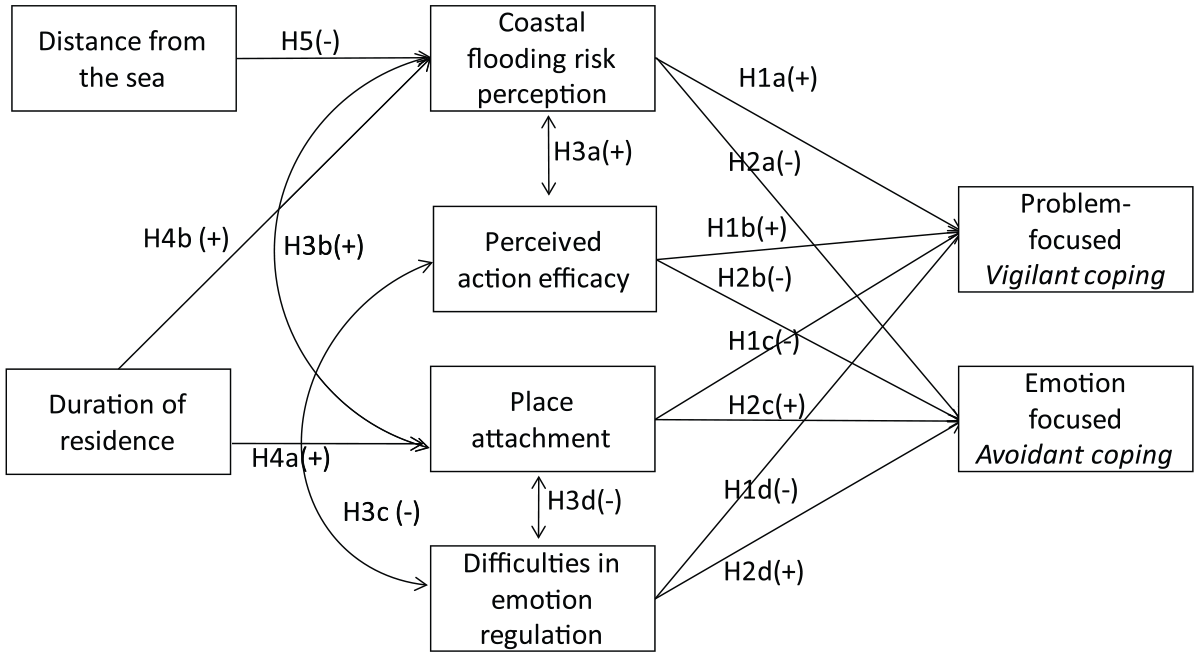
Theoretical path model of coping with coastal flooding risks.
The predictive variables also covary between each other. Risk perception covaries positively with perceived action efficacy (Hypothesis 3 [H3a]) and negatively with place attachment (Hypothesis 3 [H3b]); perceived action efficacy covaries negatively with emotion regulation difficulties (Hypothesis 3 [H3c]), while the latter also covaries negatively with place attachment (Hypothesis 3 [H3d]). Situational variables will also determine the dispositional variables. Place attachment and risk perception are predicted positively by duration of residence (Hypothesis 4 [H4a and b]). Finally, distance from the sea is a negative predictor of risk perception (Hypothesis 5 [H5]): living close to the coast can amplify the perception of flooding risk.
Method
Participants
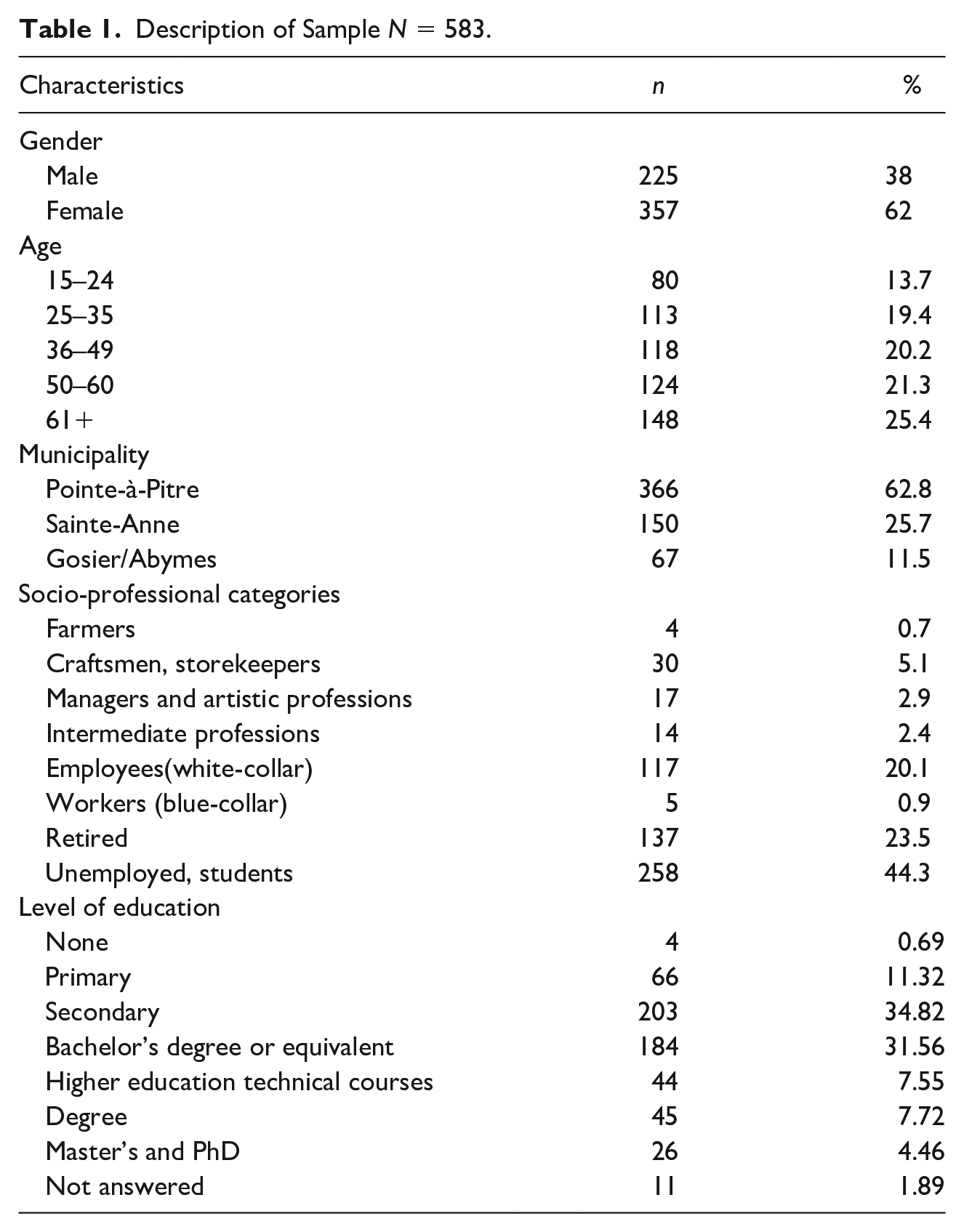
The data were obtained from a quota sampling of 583 participants (Mage = 47; SD = 18). They all lived in six different areas at risk of coastal flooding located in Guadeloupe, a French overseas department and an island in the Lesser Antilles in the Caribbean, an island representing the contribution of French culture and administration in the Caribbean. The participants have an average duration of residence in their town of 32 years (SD = 22). 62% are women, and most live in the island’s main town, Pointe-à-Pitre (63%) (see Table 1). In our sample, we can observe a small over-representation of women, because even if at the departmental level women make up 52% of the inhabitants of the island, in the city of Pointe-à-Pitre they represent 55% of the population, and in Sainte-Anne, 52%.
Description of Sample N = 583.
Site selection was based on coastal risk prevention plans published by the French government. All the participants were living inside the areas exposed to coastal flooding phenomena: territories with significant flooding risks (TRI documents, Direction de l’Environnement et de l’Aménagement de Guadeloupe). The survey was carried out during summer 2016 using face-to-face interviews. The participants were informed of the aims of the study, and their informed consent to participate was obtained. The mean duration for completing the questionnaire was 25 min.
Measures
The Environmental Risk Coping Scale (López-Vazquez & Marván, 2004, 2012): The original version identifies two dimensions: problem-focused and emotion-focused. For every item, the participants were asked to indicate a frequency (from never to always) on a 5-point scale. For the current sample, the two-factor structure was confirmed: problem-focused (e.g., item: “I have a prevention plan and I follow it”) and emotion-focused (e.g., item: “I try not to think about the problem”).
CFRP (Lemée et al., 2018): These scales of 14 items measure risk perception for coastal flooding. For every item (e.g., items: “People living in coastal flooding risk areas will be exposed to increasing risk of flooding” and “The coastal flooding risk I am exposed to worries me”), the participants were asked to identify their degree of agreement on a 5-point scale.
Perceived Efficacy of Action: We used a French-language adaptation of the scale of three items used by Navarro et al. (2016) for flooding risk. For every item (e.g., item: “My possibilities of action regarding flooding by sea are very considerable”), participants were asked to measure their degree of agreement on a 5-point scale.
Difficulties in Emotion Regulation Scale–Short Form (DERS-SF, Kaufman et al., 2015): This is a short version of 18 items on the DERS of Gratz and Roemer (2004). For every item (e.g., item: “When I’m upset, I believe there is nothing I can do to make myself feel better”), the participants were asked to indicate a frequency (from never to always) on a 5-point scale.
Place Attachment Scale (Hernández et al., 2007; Hidalgo & Hernández, 2001): For every item (nine items, for example, item: “I feel at home in this neighborhood”), the participants were asked to identify their degree of agreement on a 5-point scale. The original version has a high reliability index.
Distance from the sea was measured via the distance in meters between the place of residence (GPS coordinates were recorded when the survey was carried out) and the coastline, by a GIS (geographic information system) analysis.
The duration of residence in the municipality was measured by the number of years and months indicated by the participants.
Finally, questions on socio-demographic characteristics and socioeconomic status were asked.
All scales have already been used on French populations and have been validated in French.
Data Analysis
A confirmatory factor analysis (CFA) was conducted for each variable (see Table 2). A structural equation model (SEM) was then performed with the application AMOS21®, without latent variables, and only with observed variables, which are aggregates of the items loading on each variable as confirmed by the CFA. The maximum likelihood method was used to test the links proposed in the theoretical model. The adequacy of this model is evaluated via several adjustment indices: chi-square (χ2) and normed chi-square (χ2/df), the root mean square error of approximation (RMSEA), the root mean square residual (RMR), the adjusted goodness of fit (AGFI), the Tucker–Lewis index (TLI), and the comparative fit index (CFI). For the model to be accepted, χ2 must not be significant, normed χ2 must be below 2 (or even 3), the indices AGFI, TLI, and CFI must be greater than .90 and the RMSEA and RMR should ideally be below .05 (Schumacker & Lomax, 1996), but a value between .05 and .08 is acceptable (Hu & Bentler, 1999). The analyses are conducted using the bootstrapping technique with a resampling at 1,000 of the confidence intervals (CIs) at 95% for the indirect effects (Shrout & Bolger, 2002).
Descriptive Statistics and Fit Indices for the Different Measures.
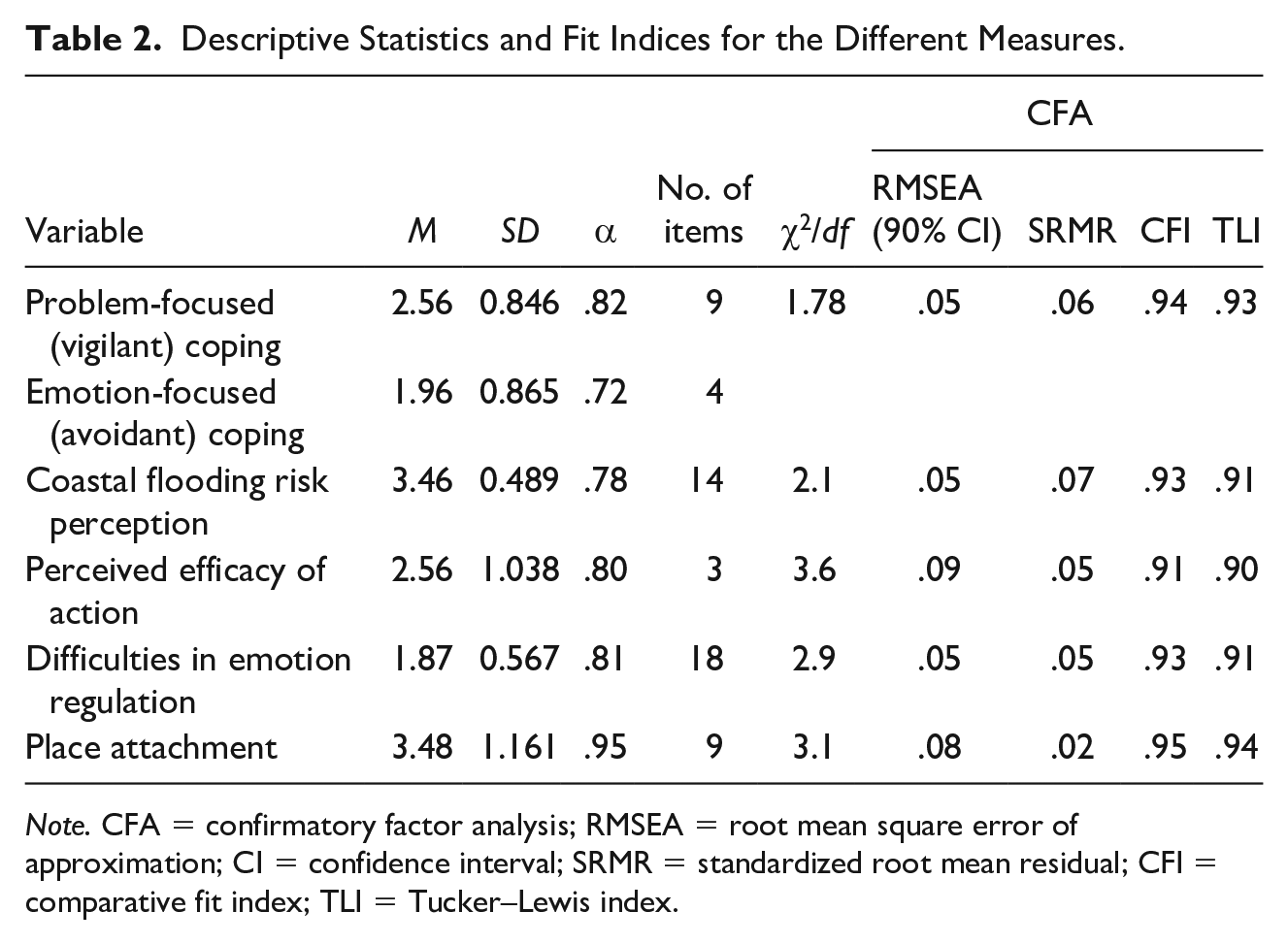
Note. CFA = confirmatory factor analysis; RMSEA = root mean square error of approximation; CI = confidence interval; SRMR = standardized root mean residual; CFI = comparative fit index; TLI = Tucker–Lewis index.
Results
Descriptive Statistics and CFA
Table 2 presents the mean scores observed for the different variables, the standard deviation, the Cronbach alpha reliability, and the fit indices of CFA for each variable.
Path Model for Coping Strategies
The structural equation modeling revealed good fit indices: χ2 = 6.32 (χ2/df = 3), p = .042. RMSEA = .06, 90% CI [.01, .11], RMR = .02, AGFI = .96, CFI = .97, TLI = .82 (see Figure 2). The model adjusts correctly to the data, even if the TLI does not reach the expected threshold (≥.90), and also because its value is not too weak (Hu & Bentler, 1999).
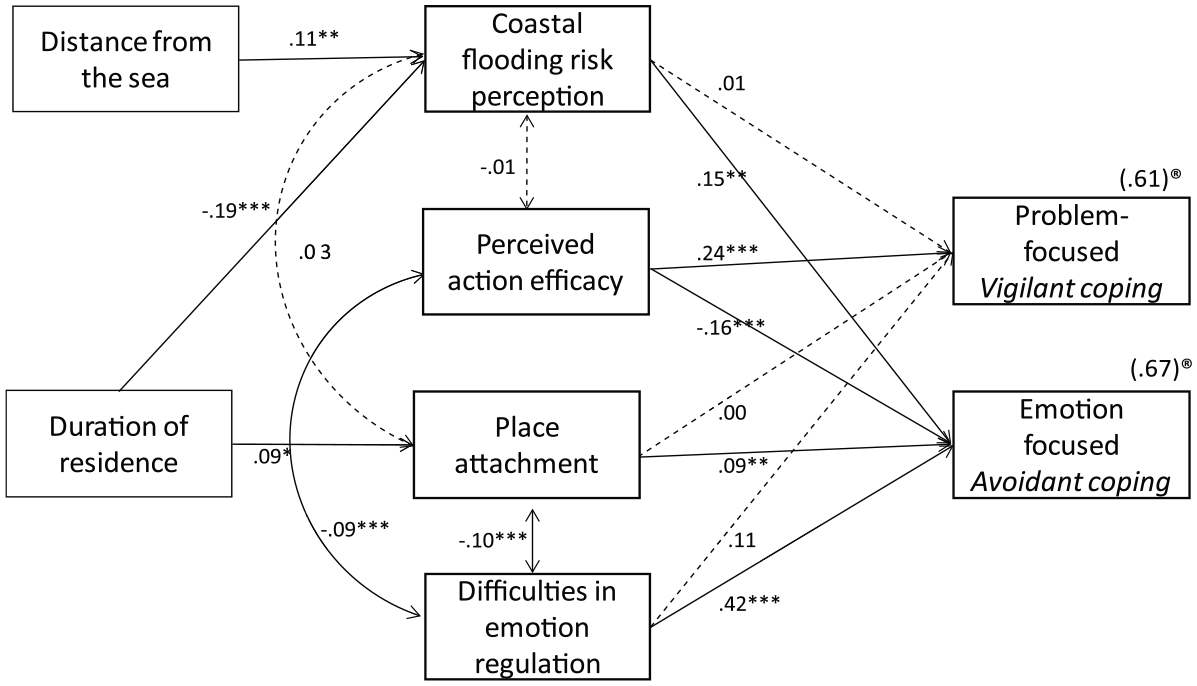
Path model of coping coastal flooding risks.
The percentage of explained variance (R2) for both dependent variables, problem-focused and emotion-focused coping, is 61% for the first one and 67% for the second one. The role of flooding risk perception is especially interesting as, contrary to our hypotheses, risk perception does not explain problem-focused (vigilant) coping (β = .01, p = ns) but explains emotion-focused (avoidant) coping positively (β = .15, p < .01). As predicted, problem-focused coping is explained by perceived action efficacy (β = .24, p < .001). Emotion-focused coping is predicted negatively by perceived action efficacy (β = −.16, p < .001) but positively by place attachment (β = .09, p < .01). Difficulties in emotion regulation positively predict emotion-focused coping (β = .42, p < .001) and does not predict problem-focused coping, contrary to our expectations (β = .11, p = ns). Place attachment has no significant correlation with problem-focused coping (β = .00, p = ns).
Similarly, covariance between flooding risk perception and perceived efficacy of action is negative, but not significant (β = −.01, p = ns). The covariance between risk perception and place attachment is not significant (β = .03, p = ns). Also, as predicted, difficulties in emotion regulation covary negatively with place attachment (β = −.10, p < .001) as well as perceived action efficacy (β = −.09, p < .001). Finally, distance from the sea positively predicts flooding risk perception (β = .11, p < .01), which contradicts our hypothesis, as with duration of residence, which negatively predicts risk perception (β = −.19, p < .001). Duration of residence also predicts place attachment (β = .09, p < .05) in the direction predicted by our hypothesis.
Discussion
This research has enabled us to generate a certain number of hypotheses which aim to explain the adoption of strategies developed to cope with coastal flooding risk by the people exposed to it. The objective is not to verify if the protection behaviors are indeed carried through, but to identify the psychological adaptation strategies considered as a prerequisite for action.
The results show that perception of coastal flooding risk predicts emotion-focused coping strategies, which are directed toward reducing psychological tension and enabling the individual to avoid confronting the problem directly through action. Furthermore, we observe that other factors must be integrated for risk perception to predict problem-focused coping strategies, such as informing oneself about a threat, speaking about it or organizing an action plan. Such is the case for perceived efficacy of action. In other words, the perception of flooding risk alone, the “awareness” of the existence of the threat and of its gravity, is apparently not enough to explain the fact that people adopt strategies to solve the problem or protect themselves. The risk must also be considered by the individuals as a vital matter, that would impact them personally, and they need to perceive their action as efficient in terms of protection. If there is no feeling that the action is efficient, the tendency will be to adopt emotion-focused coping, enabling the individual to avoid acting on the issue.
These results appear interesting in the light of the very nature of the risk in question, because it is highly probable that this dynamic is not present for other more frequent risks or hazards. Such is the case for inland flooding or landslides, for instance, which are hazards for which high perception of risk goes hand in hand with engaging in problem-focused coping strategies (Navarro et al., 2016; Siegrist et al., 2005; Terpstra et al., 2006; Zapa-Pérez et al., 2017). The results observed here in relation to coastal flooding can be explained by the fact that this is a phenomenon still considered as unlikely and which consequently generates fewer problem-focused coping strategies (Bernardo, 2013). Another possible explanation for this absence of direct link between risk perception and problem-focused coping is the privileged character of coastal areas and notably their high perceived value (Michel-Guillou et al., 2015). Indeed, the economic and urbanization stakes of these areas make them both attractive and vulnerable (Creach, Chevillot-Miot, et al., 2015). In short, the fact that risk perception explains emotion-focused coping and not problem-focused coping in our study is may be due to different factors. We can cite the fact that there is a low occurrence of the submersion hazard, and that the latter is not considered as a vital risk, in addition to the high (coastal) territory valuation, which makes it possible to minimize the threat or underestimate the exposure. Thus, it is possible that for our sample, according to the kind of risk processed (coastal flooding risk), that the low risk perception could be explained by a low occurrence probability perception (Bernardo, 2013), as by familiarity with the environment and the source of risk (Moser, 1998). The risk’s low level perception leads to a cognitive and emotional management of information, without including a search for sustainable solutions, involving the implementation of risk management behaviors’ or strategies.
The high value placed on these areas generates strong attachment and therefore a preference for emotion-focused coping strategies, for these are places with which individuals identify, and even depend upon (Williams & Vaske, 2003). The longer the duration of residence in the town, the stronger the attachment becomes. However, recent studies show that although adaptive changes are recognized as necessary by locals with a strong place attachment, these adaptations are better accepted and considered as just when they are “proactive” and involve the community in decision-making (Clarke et al., 2018).
Regarding difficulties in emotion regulation, we notice that this variable positively predicts emotion-focused coping. The link with problem-focused coping is positive but not significant. Both strategies consider the emotional dimension, but the latter will be exclusive in emotion-focused strategy. In addition, the more difficulties people have to regulate emotions, the more avoidance will be present as a coping strategy. The adaptive character will be more limited over time. However, some conditions define the relative efficiency of a specific strategy. Avoidance is globally associated with a short-term positive adaptation. Vigilance is more efficient than avoidance as it relies more on cognitive aspects than on emotional treatment. On long-term issues, avoidance gives better results at first, but the more time goes by, the more vigilance becomes effective (Suls & Fletcher, 1985). This is the case for coastal flooding risk. Avoidance can be efficient at the beginning of the risk announcement, but becomes inefficient subsequently and a vigilance strategy could then be put into place if the risk is considered as significant and if the action is considered as efficient.
Another unexpected result regards the role of distance from the sea on risk perception. Our results suggest that people who are spatially close to the sea tend to be less worried by flooding risk, while other studies show that inhabitants of coastal areas are sensitive to it and engage in actions to face up to climate change (Milfont et al., 2014). It is possible that flooding risk, which is more concrete than the more abstract concept of climate change, has a psychological distancing effect (Milfont et al., 2017; Spence et al., 2012). This could be put down to the actualization of a spatial bias which would indicate that for the people most exposed to the risk, the problem of flooding is relative. These people may thus be engaging in a strategy which could be assimilated to risk denial. Indeed, studies show that risk perception increases with the size of the geographical area (Fleury-Bahi, 2008; Uzzell, 2000), and that the risk becomes more collective. With regard to climate change, the studies also indicate that individuals tend to consider that it only affects other people or future generations (Spence et al., 2012). However, people living closest to the coast express greater conviction that climate change is real and are all the more supportive of the legislation regulating carbon emissions (Milfont et al., 2011). A prospective question to be studied will be to understand what favors moving from a passive, more immediate strategy in the face of the announced threat, a strategy which enables the psychological tension to be managed, toward a strategy that is more problem-focused in the long term and favors action toward solving the problem.
In conclusion, “perception of risk” alone, including negative feelings, is not enough to motivate protective behaviors. Other psychological factors come into play in explaining coping strategies and eventually the willingness to act. Similarly, objective factors related to temporal and spatial proximity play a significant role in the assessment of the threat. The development of the type of coping strategies is explained by a differentiated risk assessment. Thereby, it is necessary to use communication strategies that are also differentiated and adapted to the type of identified coping strategies.
A major limitation of our research is the fact of treating a single type of risk still considered as less frequent: coastal flooding risk. In terms of perspective for the future, it would be interesting to test the model according to cultural contexts and other risks considered more frequent. Another limit of our study that can be mentioned is related to the very particular cultural context of the French territories in the Caribbean. Indeed, Guadeloupean’s people are not representative of the French metropolitan population, this is why it could be interesting to test the model. It could work differently within the metropolitan coastal area (Lemée et al., 2019). In that case, we could assume that cultural elements can also explain coping strategies.
Another important limitation of our study is the questioning on the intention to act, and not the proper act. Indeed, it is necessary to explore the role of coping in the explanation of the action, especially since this territory is highly impacted by the effects of climate change, such as cyclones Irma, José and Maria, which severely affected the Caribbean in September 2017. Furthermore, the absence of behavioral measures as such is also a limitation, as our study is restricted to the evaluation of coping strategies, which could be considered as a measure of behavioral intention.
In addition, there are other limitations to our study, such as its cross-sectional nature, which is a limitation for the generalization of the results. Actually, longitudinal studies showed that risk perception can change over time (Bernardo, 2013) as coping strategies. A longitudinal study could test and confirm our model.
Further opportunities regarding the application of these results may be of interest to adapt better to these events, which have become frequent. These results allow us to make assumptions about how to approach adaptation to natural hazards. However, precautions should be taken regarding the generalization of this explanatory model. Finally, it would be necessary to test different risk communication strategies and their impact on protective behavior. Research is ongoing on these aspects.
Footnotes
Declaration of Conflicting Interests
The author(s) declared no potential conflicts of interest with respect to the research, authorship, and/or publication of this article.
Funding
The author(s) disclosed receipt of the following financial support for the research, authorship, and/or publication of this article: This research was supported by the French National Research Agency within the framework of the CLIMATRisk project (grant number: ANR-15-CE03-0002-01).
