







Abstract
Marine debris and litter are a global problem with human and environmental health impacts. Motivating individuals to engage in active pro-environmental behaviors (active PEB), such as picking up litter, requires messages that address salient beliefs about combining physical activity (PA) with pro-environmental action. This research draws on two national surveys of U.S. adults residing in coastal areas. In Study 1 (N = 512) higher levels of past PA, PEB, and active PEB participation were associated with a greater number of active PEB related beliefs. In Study 2 (N = 545), positively valanced belief themes were more consistently associated with future active PEB intentions, although the most promising themes varied by prior PA, PEB, and active PEB engagement. The findings can inform future multiple behavior change interventions aimed at mitigating the impact of marine debris on both people and ecosystems.
Introduction
Litter and debris on coastlines, most of which are plastic, have significant environmental, human health, and economic impacts (Krelling et al., 2017; Wheeler et al., 2012; White et al., 2013, 2014; Wyles et al., 2016). One pro-environmental prevention strategy to mitigate marine litter and debris is ensuring proper disposal before the litter or its fragments enter marine habitats. Volunteers who pick up litter and debris play a crucial role in intercepting litter before it reaches these environments. Litter cleanup is commonly characterized as a pro-environmental behavior (PEB; Esfandiar et al., 2022). In addition to its environmental impact, the act of picking up litter typically involves walking on various surfaces (e.g., roadsides, along rivers, in marshes), bending, squatting, reaching, and lifting, which promote functional fitness (DeSimone, 2022) and offer physiological benefits of physical activity (PA). Therefore, litter cleanup is considered an active pro-environmental behavior (active PEB), a behavior that incorporates both health-enhancing PA and environmental health benefits. Despite growing interest in other active PEB like active transportation, little is known about public beliefs and motivations surrounding litter cleanup as an active PEB. Through a two-phase sequential survey approach, this study aimed to fill that gap by testing the associations between current PA, PEB, and active PEB participation with beliefs that influence individuals’ engagement in litter cleanup during PA and examining whether relationships between beliefs and future behavioral intentions vary by individuals’ prior engagement in related behaviors, to inform future promotion of active PEBs.
Active Pro-Environmental Behaviors
Active PEBs typically involve PA that yields simultaneous benefits for both human and environmental health (Rosa & Collado, 2020) which is different from less physically active forms of PEBs (e.g., energy saving or recycling at home). Although a recent study on “litter walking” highlights its eco-friendly nature and potential to promote PA (Schoeppe et al., 2025), empirical research on litter cleanup remains limited and focused on “plogging,” a combination of jogging and litter collection (Jaberi, 2023; Raghavan et al., 2022). Far less is known about litter cleanup as a form of active PEB, particularly in terms of the general public’s motivational drivers. While initiatives like the Leave No Trace program have promoted litter prevention among outdoor recreationists (Marion & Reid, 2001), and organizations like Keep America Beautiful advocate for litter cleanup, the prevalence and underlying motivations for voluntary litter cleanup as an active PEB remain understudied.
Multiple Behavior Change
Multiple behavior change is conceptualized as the adoption of two or more concurrent behaviors contributing to a single goal or multiple-related goals, often within the domain of health promotion (Prochaska et al., 2008). For example, lifestyle behaviors such as PA, healthy eating, and smoking cessation are often promoted together to reduce the risk of chronic diseases such as type 2 diabetes and coronary heart disease (Geller et al., 2017). More recently, there has been growing interest in integrating individual health behaviors with pro-environmental actions, reflecting the increasing recognition of the interdependence between human and environmental health (Bjørnarå et al., 2017; Geller et al., 2017; Nigg & Nigg, 2021; White et al., 2016). Active transportation has received the most attention in this regard, as it is a sustainable form of PA that contributes to environmental goals by reducing carbon emissions (Nash et al., 2022; Short et al., 2021).
The present study extends this line of inquiry by examining litter cleanup as an example of active PEB. Traditionally, litter cleanup has been treated as a single-domain PEB. However, this limited framing overlooks the fact that litter cleanup often co-occurs with recreational outdoor activities such as walking, kayaking, or fishing. Positioning it as a form of PA, in addition to an environmental action, opens new opportunities to engage broader populations.
Despite growing attention to integrated behaviors, little is known about what types of messages or intervention strategies can promote such concurrent engagement. The few descriptive studies on “plogging” (i.e., the combination of jogging and picking up litter) suggest potential for dual-benefit behaviors (Jaberi, 2023; Lee & Choi, 2023; Martínez-Mirambell, Boned-Gómez, et al., 2023; Martinez-Mirambell, García-Taibo, et al., 2023). Framing marine debris and litter cleanup as a complementary behavior to outdoor recreation may increase engagement in active PEB among coastal residents and visitors, as more than half of U.S. residents engage in outdoor recreational activities (Outdoor Industry Association, 2023).
Promotion of Litter Cleanup and Physical Activity
Previous research suggests that PA (Esposito et al., 2016; Nigg et al., 2009), PEBs (Yuriev et al., 2020), and by extension, active PEBs (Liu et al., 2025) can be understood through the framework of the Theory of Planned Behavior (TPB; Ajzen, 1985). TPB posits that behavioral intentions, and ultimately behavior, are shaped by attitudes, perceived norms, and perceived behavioral control. The model has been successfully applied to PA across activity types (Eves et al., 2003) and demographic groups (Nigg et al., 2009), as well as to a broad range of environmental behaviors (Ai & Rosenthal, 2024; Chaudhary et al., 2023; Clercq et al., 2026; Gangl et al., 2022; Yuriev et al., 2020). In addition, TPB also provides a useful framework for identifying theory-driven beliefs that can be leveraged in message design to promote behavior change (Hornik, 2007; Hornik & Woolf, 1999).
Although scholars have increasingly called for extending TPB to inform multiple behavior change interventions (Hornik, 2007), the majority of TPB-informed empirical studies still focus on single behaviors. While TPB acknowledges that prior behavior can influence future intentions, it does not explicitly address how engagement in one behavior may shape attitudes, perceived norms and behavioral control, and intentions for a different but related behavior. Building on the multiple behavior change perspective, an important question is how to promote active PEBs, such as litter cleanup during recreational PA, by leveraging individuals’ existing behavioral patterns, motivations, and beliefs.
The Compensatory Carry-Over Action Model (CCAM; Lippke, 2014) offers a complementary framework to TPB for understanding the motivational and behavioral dynamics underlying active PEB. CCAM posits that individuals pursue higher-order goals, such as connecting personal health and environmental protection, under shared life values through multiple subordinate behaviors. These behaviors may support one another through carry-over mechanisms; when behaviors are perceived as complementary rather than conflicting, individuals experience stronger motivation and are more likely to follow through on their intentions (Orehek & Vazeou-Nieuwenhuis, 2013; Rhodes et al., 2015). In contrast to goal conflict, goal facilitation fosters synergy between behaviors, improving adherence and long-term behavior change (Conner et al., 2016). Thus, engaging in litter cleanup while walking may facilitate both physical and environmental goals, creating a sense of goal congruence and behavioral synergy. Framing active PEB as a multiple-goal behavior that simultaneously serves mutually-reinforcing health and environmental aims may help reduce psychological barriers, increase engagement, and facilitate goal attainment (Kollmuss & Agyeman, 2002; Legault, 2023). The extent to which one behavior can facilitate, or carry-over to, another is important to consider for active PEBs because the link between behavioral intention and actual behavior is stronger when goal conflict is reduced (Conner et al., 2016).
Ultimately, to design effective interventions promoting active PEB, it is essential to identify perceived advantages and disadvantages of combining PA with PEB in order to align messaging strategies with individuals’ higher-order goals and self-regulatory capacities. However, beliefs do not operate in isolation. In line with the CCAM principles, individuals’ prior behavioral engagement, whether in PA, PEB, or the combination of both (active PEB), may also influence how strongly those beliefs predict intentions. Thus, exploring how prior behavior in related domains may influence the belief–intention association is critical for tailoring messages to different audience segments and for advancing theory-based approaches to multiple behavior change.
In this study, TPB guided the categorization and analysis of belief structures underlying active PEBs, specifically examining how attitudinal, social, and control beliefs relate to individuals’ intentions to engage in coastal litter cleanup during physical activity. At the same time, informed by the theoretical insights of CCAM, which emphasizes that motivational and self-regulatory resources developed in one behavioral domain can transfer to another, we also examined whether prior engagement in related behaviors, specifically PA, PEB, and active PEB, may influence the strength of the belief–intention relationship. Individuals with greater experience or success in PA or PEB may be more likely to view active PEBs as both beneficial and feasible, thus reinforcing intention through carry-over effects. Integrating TPB with CCAM allows for a richer understanding of the psychological mechanisms underlying active PEB and offers practical insights for developing messaging strategies that promote synergistic behaviors benefiting both environmental and human health.
Building on these theoretical insights, we hypothesized past behavior will shape current perceptions and future intentions, as in TPB, such that individuals with greater prior engagement in PA and PEB would report more perceived advantages and fewer disadvantages to combining the two behaviors. In line with CCAM, we also anticipated a carry forward of beliefs to active PEB where individuals with a strong history of PA may be more responsive to health-related belief themes (i.e., clusters of beliefs emphasizing similar ideas), such as those emphasizing physical and mental health benefits, whereas those with higher levels of prior PEB engagement may find pro-environmental themes more salient and motivating when considering engagement in active PEBs.
Materials and Methods
To address these research aims, we conducted two complementary survey studies with independent samples of U.S. coastal residents. This cross-sectional, two-phase approach is appropriate for formative message-development research because it allows for the identification of salient beliefs and promising message themes that can inform subsequent experimental testing. First, an elicitation study was conducted to identify participants’ beliefs regarding the advantages and disadvantages of combining PA and litter cleanup. We then categorized the beliefs based on TPB-informed belief structures (i.e., attitudinal, social, and control; Liu et al., 2025). While this approach provides rich insight into the types of beliefs held, it does not capture the extent to which participants endorse these beliefs or their potential downstream impact on future behavior. It is possible that certain belief themes may be more strongly associated with intentions to engage in active PEB, and thus more promising for intervention, depending on individuals’ prior PA and PEB engagement. In other words, differences in active PEB participation may not stem solely from the types of beliefs expressed, but from the strength with which these beliefs influence intentions to engage in the behavior. The second study, a belief ranking study, assessed the endorsement strength of the identified belief themes, as well as their associations with intention to engage in future active PEB. This second phase offers critical insights into which belief structures may be the most promising targets for intervention efforts aimed at promoting active PEBs like coastal litter cleanup. Together, these two studies contribute to a deeper understanding of how active PEBs are conceptualized and motivated, extending the literature beyond the traditional focus on active transportation or single behaviors to explore broader forms of PA integrated with environmental action. Moreover, by examining variations based on existing PA and PEB engagement levels, this work refines strategies for encouraging more widespread participation in active PEBs to address pressing environmental challenges like marine debris.
All procedures and materials for both studies were approved by the University of Georgia Institutional Review Board prior to data collection (PROJECT00005430 and PROJECT00007650).
Samples and Setting
Two separate Qualtrics surveys were conducted among national samples demographically representative of US adults living in coastal areas (NOAA Office for Coastal Management, 2017). Qualtrics recruited participants from their existing research pool based on the eligibility criteria: age 18 years or older and living in a coastal area as defined by zip codes for coastal counties (NOAA Office for Coastal Management, 2017). Attention check items and post-hoc speed checks were employed for data quality. Data collection occurred in spring 2022 (Study 1) and spring 2023 (Study 2). Qualtrics applied gender and race/ethnicity quotas based on the coastal US adult population. Informed consent was obtained electronically, with interested individuals documenting their consent by selecting “Next” to begin the survey after reading the consent letter.
Measures
In both studies participants responded to questions regarding their current participation in outdoor PA, PEB (i.e., litter cleanup), and active PEB, intention and willingness to engage in active PEB in coastal areas in the future, as well as demographic items that were used as control variables in statistical analyses. Study 1 prompted qualitative responses for the advantages/facilitators and disadvantages/barriers to picking up litter during outdoor activities along the coast. Study 2 included a random selection of belief statements derived from Study 1 about combining outdoor PA and litter cleanup as described below.
Demographic Variables
Participants reported their age (in years), race and ethnicity, gender, and duration of residency in their current location. Region of the country was derived from the provided zip code used to determine eligibility. The dataset of coastal counties did include some areas of the country better described as shorelines. However, they were included in Study 1 for consistency with the documentation (NOAA Office for Coastal Management, 2017).
Outdoor Physical Activity Participation
Because the study focused on beliefs associated with active PEB, defined as picking up marine debris during outdoor physical activity (OPA), only activities that occur in outdoor spaces were assessed, as it is a leverage point for encouraging future active PEB. Participants self-reported the number of times during a typical week that they engaged in OPA for at least 10 min, separated into light-intensity activities (e.g., yoga, fishing), moderate-intensity (e.g., brisk walking, easy swimming), and vigorous-intensity (e.g., running, soccer) activities. Items were adapted from a previously validated measure to include the word “outdoors” to define the activity.
Pro-Environmental Behaviors (PEBs)
Participants were asked separate questions about PEBs generally, near the beach, and near the beach while being active. A definition of PEBs was provided to participants (Kollmuss & Agyeman, 2002) who then reported the frequency (“Never” to “Always”) on a 7-point Likert-type scale of their engagement for the purpose of protecting the environment in general, engaging in PEBs near the beach, and the combination of PA and PEBs near the beach.
Beliefs about Combining PA and PEB (Study 1)
Detailed methods about the elicitation and qualitative coding process have been reported elsewhere (Liu et al., 2025). Briefly, participants were asked to respond to open-ended prompts listing up to five advantages and five disadvantages of combining litter pickup with PA in coastal spaces. Iterative coding was conducted by at least two coders using the TPB framework of attitudinal, social, and control beliefs (inter-coder reliability Cohen’s κ = 0.85–1.00). A total of 137 unique belief statements within 20 themes were categorized. The total number of beliefs and the counts within each of the three belief categories were calculated for each participant.
Belief Themes and Ranking (Study 2)
Each participant responded to a randomly selected and ordered half of the 137 beliefs, yielding 260 to 281 participant responses per belief. Participants were given the stem: “If I pick up trash while being active outdoors, I am likely to. . .” followed by each belief statement and rated their likelihood on a scale from 1 (very unlikely) to 5 (very likely). Each participant received a random selection of approximately half of the items. Themes were derived in Study 1 and then re-applied to the beliefs in this study for analysis. Further details on the belief ranking methods and thematic coding have been published previously (Liu et al., 2025).
Intention to Engage in Active PEBs in Coastal Areas
Three items assessed participants’ intentions to engage in active PEBs (i.e., combining OPA with litter cleanup) in the future. First, participants were asked how likely they were to engage in litter and debris cleanup while being active in coastal areas in the next 6 months. Response options were on a 7-point Likert-type scale ranging from “Definitely Will Not” to “Definitely Will.” The other two items asked whether participants intend to and will participate in both OPA and litter cleanup at the beach at the same time. Responses were on a 7-point scale ranging from “Strongly Disagree” to “Strongly Agree.” A mean score was computed from these three items to generate a single intention variable for regression analyses to reduce type 1 error, with higher scores indicating stronger intentions to engage in active PEBs in coastal areas. Cronbach’s alpha was calculated and indicated strong internal consistency (α = .91).
Analysis Plan
In both studies, means and standard deviations were calculated for age and the frequency of OPA by intensity level (light, moderate, vigorous). Descriptive analyses were conducted to summarize the distributions of gender, race, ethnicity, and the frequencies of current litter and debris cleanup activities (i.e., PEB), both separately and when combined with OPA.
TPB Belief Types by Prior Behavior
The mean, standard deviation, median, and range of beliefs were calculated by the three TPB-informed categories and separately by whether the belief was an advantage or disadvantage. As anticipated, the belief counts (range 0 to 10) were not normally distributed based on the skewness, kurtosis, and Shapiro-Wilk values (Table 3). Therefore, separate Kruskal–Wallis tests were conducted to assess the differences in the number of advantage or disadvantage beliefs elicited categorized by TPB construct by participation in ordinal OPA, PEB, and active PEB variables. This approach was selected over correlation analyses to enable examination of differences across degrees of participation in OPA, PEB, and active PEB. Effect sizes (η2) also are provided (Cohen, 2008).
Differences in Belief-Intention Relationships by Past Behavior
In Study 2, responses from the moderate- and vigorous-intensity PA questions were summed to generate the Godin Leisure Time Physical Activity score and values stratified into two groups at ≥24 and ≤23 based on established cut points (Amireault & Godin, 2015; Godin, 2011). PEB and active PEB were each stratified into two groups based on their sample-specific medians to create relatively balanced comparison groups for an initial, parsimonious examination of subgroup differences in belief-intention associations (Iacobucci et al., 2015). These stratifications created comparison groups (e.g., higher vs. lower PA, PEB, and active PEB) for subsequent belief ranking analyses.
Belief themes were ranked using the Relative Promise Index (RPI) and odds ratio (OR) metrics (Hornik & Woolf, 1999; Liu et al., 2025). The RPI is derived from the “percent to gain” (% to gain) indicator, which estimates the maximum additional percentage of the population projected to adopt the desired intention (e.g., intention to engage in active PEB) if 100% of the population were to endorse a given belief or belief theme (Brennan et al., 2017; Hornik & Woolf, 1999). For example, if 30% of the population currently intends to engage in active PEB but 70% of strong belief endorsers report this intention, then persuading all non-endorsers to adopt the belief would be expected to increase the overall intention rate to 70%. The projected “gain” in intention would therefore be 30 percentage points (70%–40%). This metric helps identify beliefs with the greatest potential for shifting intentions, assuming the relationship between belief and intention is causal and that endorsement can be increased through intervention (Parvanta et al., 2013).
Following prior practice (Brennan et al., 2017), % to gain values were standardized to create the RPI for easier interpretation and cross-theme comparison. Specifically, the mean % to gain was set to 50, with values one standard deviation (SD) above and below the mean rescaled to 67 and 33, respectively. Themes with RPI values ≥ 67 were considered more promising, while those with values ≤33 were considered less promising.
The odds ratio (OR) measures the strength of the relationship between each belief theme and the dichotomized intention variable, which categorized respondents as either having some level of intention to engage in active PEB (“Probably will” to “Definitely will”) or having no/uncertain intention. We calculated this by performing logistic regression analyses, where each theme variable served as the independent variable and intention was the dependent variable, controlling for age, gender, race, and ethnicity. A higher OR indicates a stronger association between the theme and the intention to engage in active PEB in the future. RPI and odds ratios with 95% confidence intervals were calculated for each theme with the dichotomized intention variable. Comparisons of the OR confidence intervals were used to test effect modification across PA, PEB, and active PEB stratification groups. Analyses were conducted in Stata v18 (StataCorp, College Station, TX, USA).
The percent to gain metric, together with the percent to move metric, which was less central to this study but potentially informative for messaging campaign feasibility, was calculated and included in the Supplemental File to provide a more comprehensive messaging analysis across subgroups.
Results
Study 1
Participant characteristics and prevalence of general PEB and active PEB are provided in Table 1 (N = 512). The majority of participants engaged in general PEB at the beach or in active PEB less than “about half the time” with approximately 10% of participants doing active PEB along the coast “usually” or “all of the time.” Means, standard deviations, and ranges for all belief categories are provided in Table 2. Participants reported an average of 2.55 (±1.62) advantage beliefs.
Participant Characteristics.
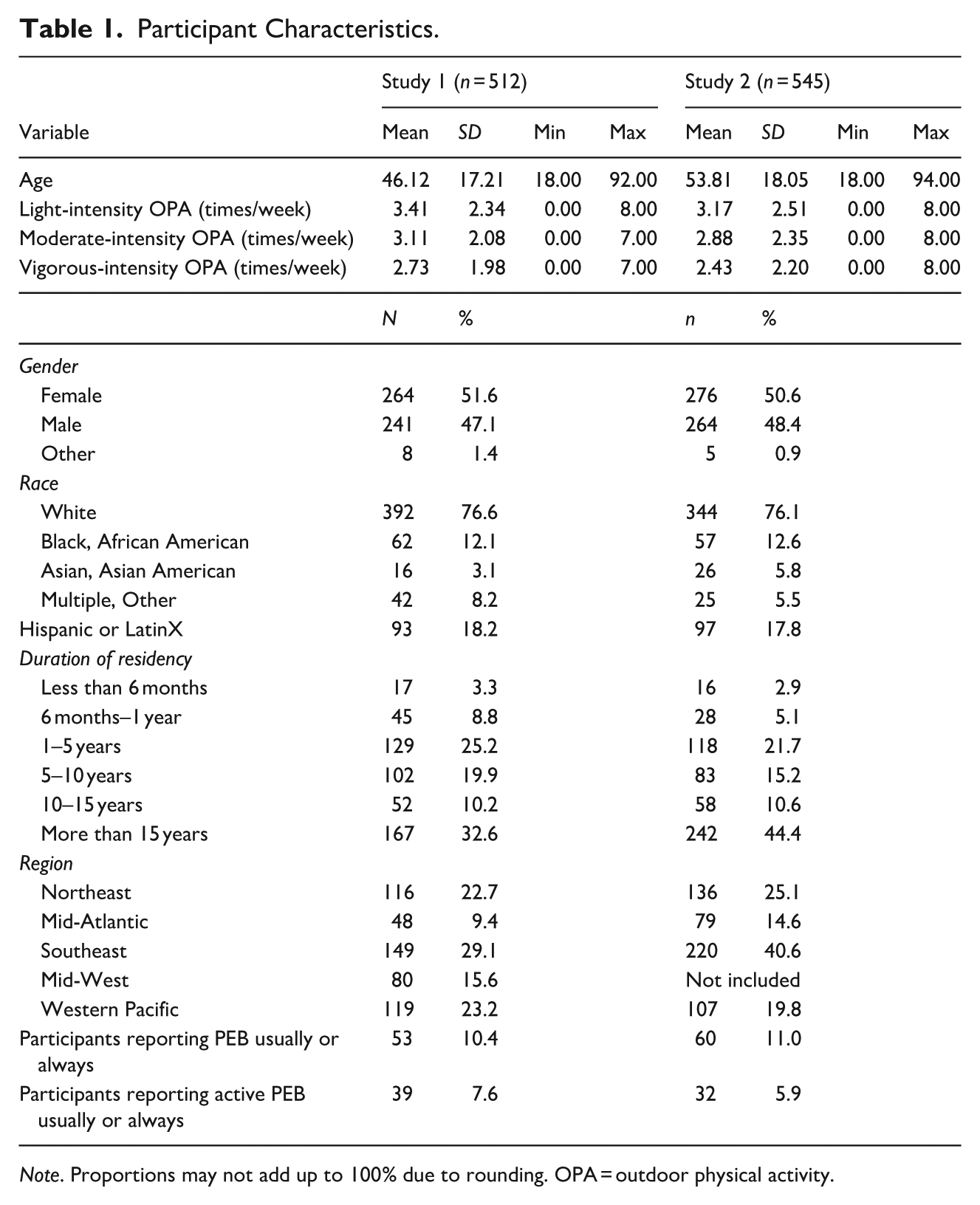
Note. Proportions may not add up to 100% due to rounding. OPA = outdoor physical activity.
Descriptive Statistics for Number of Belief Statements Generated by Participants.
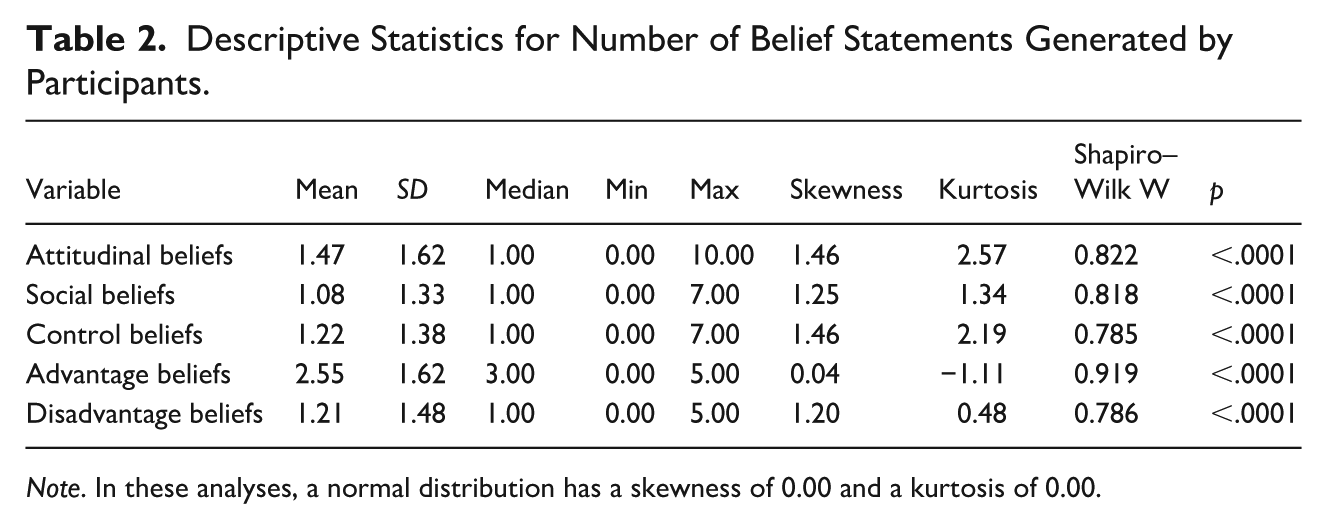
Note. In these analyses, a normal distribution has a skewness of 0.00 and a kurtosis of 0.00.
Participants engaging in greater moderate- and vigorous-intensity PA reported significantly more advantage beliefs relative to participants who did not participate in moderate- and vigorous-intensity PA (p = .003 and p = .006 respectively). Engagement in more PA at any intensity was associated with greater control beliefs (light-intensity PA p < .001, moderate-intensity PA p < .001, vigorous-intensity PA p = .013). No differences in other TPB constructs were detected and effect sizes for all tests were small (Supplemental Tables 1–3).
Similar trends were seen for PEB and active PEB with higher participation being associated with more advantage beliefs (PEB p < .0001, active PEB p = .001). Interestingly, never participating in PEB was also associated with reporting fewer disadvantage beliefs (p = .001; Supplemental Tables 4 and 5). Unlike the PA results, less engagement in PEB and active PEB was associated with fewer social beliefs (PEB p = .000, active PEB p = .010) than participants with greater PEB and active PEB engagement. Only prior PEB, not active PEB, was significantly associated with control beliefs (p = .001).
Study 2
Participant characteristics for Study 2 are presented in Table 1 (N = 545). Similar to the first study, about half of the sample (50.6%) was female and the average age was 53.81 years (±18.05). The sample was similar to national demographic data for coastal counties with 80.6% White and 17.8% Hispanic or LatinX.
Effect Modification of Prior Behavior
Across stratifications, advantage (pro) beliefs consistently ranked the most promising, with Physical Health Consequences-Pro emerging as a particularly robust theme across all groups (Tables 3–5). For participants with higher PA, Physical and Mental Health Consequences-Pro ranked among the top three most promising themes. By contrast, less active participants had promising themes of Physical Health Consequences-Pro, Task Completion and Efficiency-Pro, and Community Contribution-Pro most salient.
Effect Modification of Belief Ranking Metrics by Level of Physical Activity Participation.
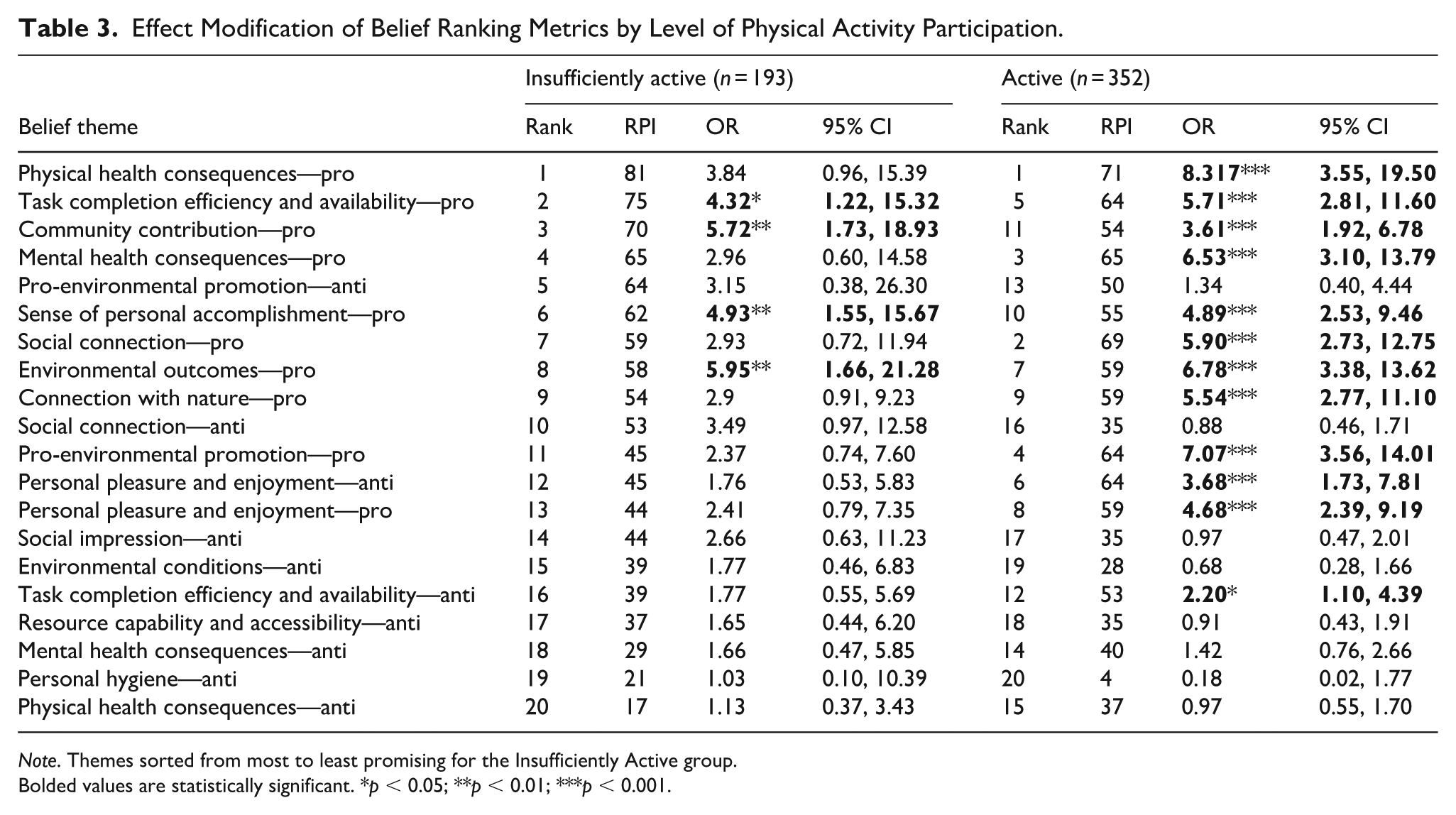
Note. Themes sorted from most to least promising for the Insufficiently Active group.
Bolded values are statistically significant. *p < 0.05; **p < 0.01; ***p < 0.001.
Effect Modification of Belief Ranking Metrics by Level of Pro-Environmental Behavior Participation a .
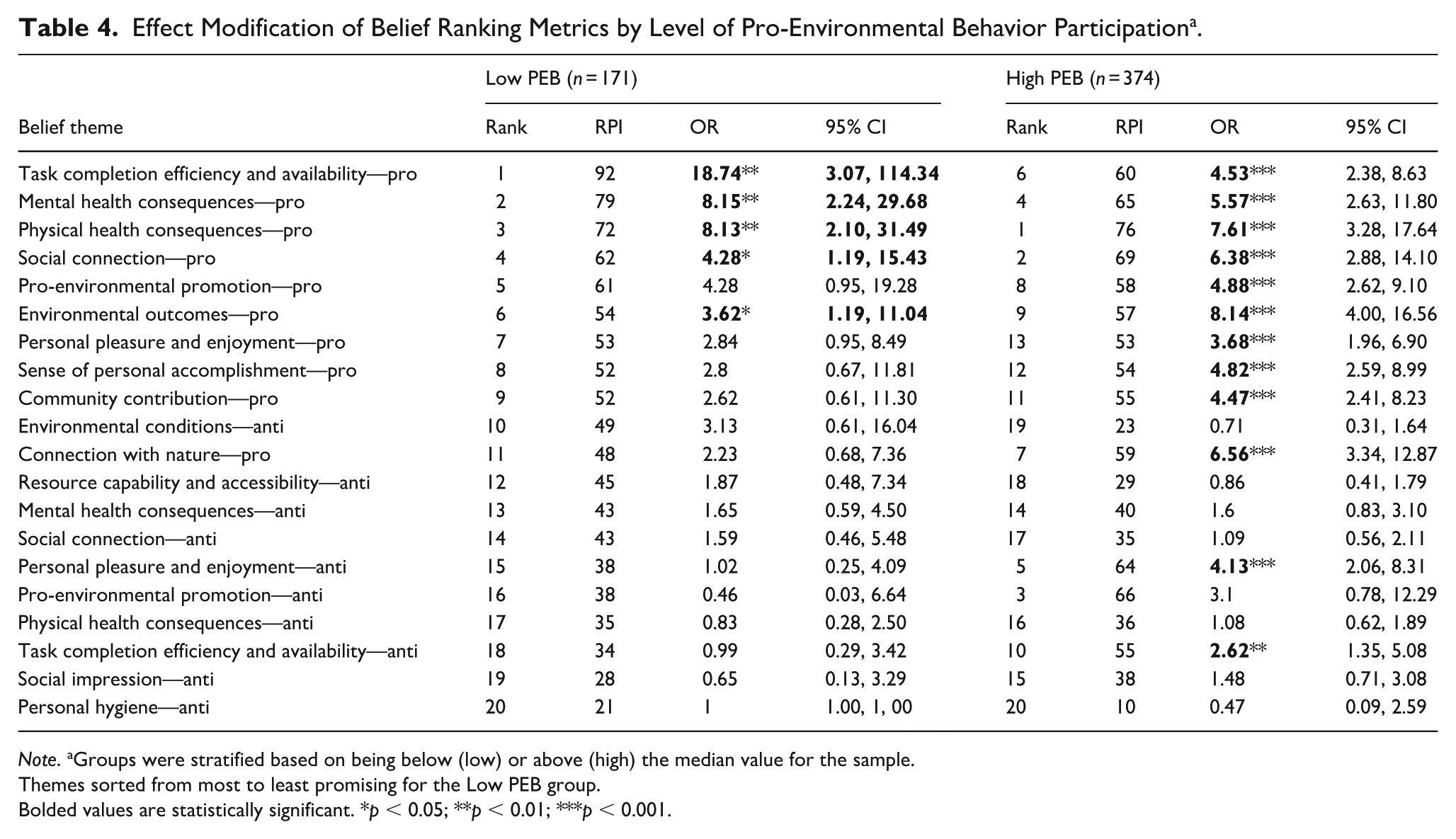
Note. aGroups were stratified based on being below (low) or above (high) the median value for the sample.
Themes sorted from most to least promising for the Low PEB group.
Bolded values are statistically significant. *p < 0.05; **p < 0.01; ***p < 0.001.
Effect Modification of Belief Ranking Metrics by Level of Active PEB Participation a .
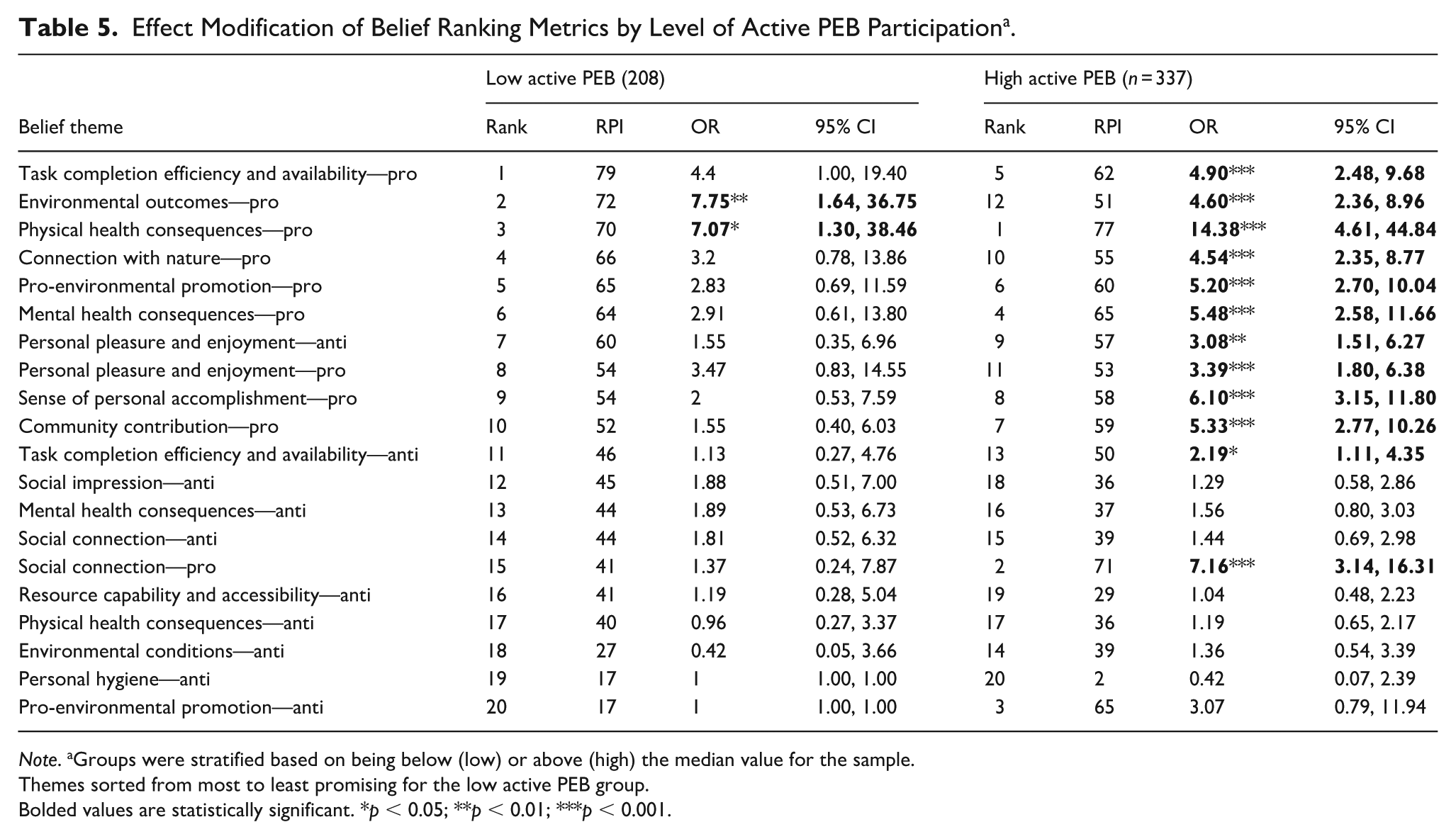
Note. aGroups were stratified based on being below (low) or above (high) the median value for the sample.
Themes sorted from most to least promising for the low active PEB group.
Bolded values are statistically significant. *p < 0.05; **p < 0.01; ***p < 0.001.
For participants with higher PEB, Physical Health Consequences-Pro was the most promising theme, followed by Social Connection-Pro and Pro-Environmental Promotion-Anti. In contrast, lower PEB participants found Individual Health Benefits (both physical and mental) and Task Completion and Efficiency-Pro more promising.
For participants with prior active PEB participation, the top themes were Physical Health Consequences-Pro, Social Connection-Pro, and Pro-environmental Promotion-Anti. In the low active PEB group, Task Completion Efficiency and Availability-Pro, Environmental Outcomes-Pro, and Physical Health Consequences-Pro were the most promising.
Across groups, both individual health and pro-environmental beliefs were associated with greater PA, PEB, and active PEB participation based on the OR analyses (Tables 3–5). For the less active group, Pro-Environmental Promotion-Pro, Community Contribution-Pro, Task Completion Efficiency and Availability-Pro, and Sense of Personal Accomplishment-Pro were associated with stronger future intentions for active PEB, but not individual health benefits. The low PEB group had statistically significant associations primarily between individual outcome beliefs with future active PEB intentions. In the low active PEB group, only Physical Health Consequences-Pro and Environmental Outcomes-Pro were significantly associated with intention.
Both health-related and pro-environmental themes were thus associated with stronger intentions, though the specific mix of salient beliefs varied by prior behavior. Community-oriented and efficiency-related themes also emerged as important, particularly for subgroups less engaged in PA or PEB.
Three ORs were equal to 1.00: Low PEB and Low active PEB with Personal Hygiene-Anti and Low active PEB with Pro-environmental Promotion-Anti. This occurred because all participants in these groups selected the same response, indicating they did not strongly endorse the beliefs in these themes while still reporting the highest intention to engage in active PEB. The lack of variability in responses resulted in an OR of 1.00 with no confidence interval. Additionally, several ORs displayed wide CIs (Tables 3–5), reflecting substantial variability and smaller sample sizes within some cells. The % to gain and % to move values are provided in Supplemental Tables 6–8.
Discussion
These studies add to the pro-environmental behavior and multiple behavior change literature by examining salient and promising beliefs that can be used to promote active PEB, defined in this study as the combination of litter cleanup with outdoor physical activity. Guided by TPB and CCAM, we examined whether attitudinal, normative, and control beliefs about active PEB varied by individuals’ prior levels of PA, PEB, and active PEB. We also assessed how prior engagement in these behaviors modified the belief–intention link.
Belief Patterns by Prior Behavior
A key finding of Study 1 is that participants with higher levels of prior PA, PEB, and active PEB were more likely to generate and endorse advantage beliefs, echoing past research on motivations for “plogging” and similar behaviors (Chae & Kim, 2022; Jaberi, 2023; Kim et al., 2023). This pattern may reflect experiential familiarity, such that those with greater experience likely form beliefs based on firsthand benefits (Collado et al., 2013; Kolb, 1984) rather than disadvantages (Bem, 1972; Festinger, 1957) or selective attention toward confirming beliefs (Nickerson, 1998). Additionally, increased health and environmental literacy due to frequent exposure to cleanup campaigns (Jorgensen et al., 2021) may have contributed to greater awareness of related issues, enabling participants to more easily articulate the advantages of this behavior combination (Otto & Pensini, 2017).
Interestingly, the lack of differences by current PA participation in the elicitation study was contrary to our hypothesis, nor were there differences in the number of beliefs by TPB construct. This may suggest that prevailing societal narratives about the combination of PA and PEB are relatively consistent across individuals, regardless of their PA engagement levels. Prior research suggests that individuals share broadly internalized cognitive schemas regarding environmental concerns because the underlying mental structures guiding these perceptions are widely shared (Schultz, 2001), even among those not currently engaging in PEBs. These findings represent the initial steps to building out the relevant beliefs and norms for active PEB. Future studies should further consider the degree to which past and current behavior influence belief patterns.
Consistencies and Differences in Belief–Intention Relationships Across Subgroups
Study 2 observed that advantage (Pro) beliefs were consistently ranked as the most promising in their association with intentions to engage in active PEB across all groups. This finding aligns with research on message framing research in both PA (Williamson et al., 2020) and PEB contexts (Kim et al., 2023; Kolandai-Matchett & Armoudian, 2020; Nabi et al., 2018), indicating that gain-framed messages emphasizing benefits, efficacy, or positive emotions are particularly effective. The salience of advantage beliefs across groups suggests that positively framed appeals may be especially useful when promoting active PEB, whether emphasizing short-term social rewards or long-term health benefits (Unger & Steul-Fischer, 2021; Wang et al., 2024) and may present an opportunity to leverage outdoor PA promotion as a means to concurrently encourage PEB.
This study also demonstrated that different types of prior behaviors shaped which beliefs were most strongly associated with intentions, consistent with the idea that prior behavioral experience may influence the salience of TPB-related beliefs. For participants with higher PA, both physical and mental health beliefs were particularly salient, while those with lower PA prioritized efficiency and community themes. Among participants with higher PEB, social connection and pro-environmental promotion beliefs were more influential, whereas those with lower PEB were more responsive to health-related themes and efficiency. Similarly, higher active PEB participants emphasized social and environmental themes, while lower active PEB participants focused more on health and environmental outcomes. One possible explanation for these subgroup differences lies in the role of outdoor exposure. Prior research shows that exposure to nature via outdoor PA and recreation is associated with greater frequency of pro-environmental behaviors (Hartig et al., 2007). Individuals who feel connected to and appreciative of outdoor recreation experiences are more likely to report stronger pro-environmental attitudes and intentions (Baird et al., 2020; Han, 2023). Interestingly, these findings contrast with the lack of subgroup differences in Study 1, highlighting the novelty of this research on active PEBs and the need for more studies to test the utility of behaviorally tailored persuasive messaging.
Theoretical Implications
While TPB offers a useful foundation for understanding health and environmental behaviors, scholars have argued that TPB has limited consideration of environmental and contextual factors and is an imperfect application to multiple behavior change (Sniehotta et al., 2014). Existing studies of multiple behavior change suggest that including facilitation of multiple goals or intentions for greater than one behavior improves TPB modeling (Presseau et al., 2013; Rhodes et al., 2015; Rhodes & Blanchard, 2008). Further research in both PA and PEB points to the addition of values (Ateş, 2020) and identity (Rhodes, 2024) as meaningful additions to TPB. Indeed, across both PA and PEB research, perceived behavioral control consistently predicts behavioral intentions (Esfandiar et al., 2022; Presseau et al., 2013), reinforcing the value of TPB as a starting point, and highlighting the need for greater specificity and inclusion of systems factors when applied to behaviors that integrate domains, such as active PEBs (Armitage, 2015; Kollmuss & Agyeman, 2002; Sniehotta et al., 2014).
Integrating TPB with CCAM helps address these critiques and offers a more comprehensive framework for understanding how multiple behaviors can align under shared goals. While TPB identifies belief categories (attitude, norm, control) most predictive of intention, and therefore useful targets for message design, CCAM explains why these beliefs may resonate more or less depending on individuals’ prior behavior. In the context of this study, the presence of broadly relevant beliefs suggests consistency with multiple behavior change frameworks such as CCAM, which posit that behaviors cluster when they contribute to higher-order, internally-consistent goals (Legault, 2023; Masson & Otto, 2021; Prochaska et al., 2008; Rhodes et al., 2016). Likewise, themes related to social connection or environmental promotion may reflect identity-based goals, facilitating carry-over effects across behavioral domains (Geller et al., 2017). An individual already invested in PA or PEB may find it easier to integrate behaviors, perceiving synergy and feasibility due to aligned values or routines. This emerging dual-framework approach informs more tailored communication strategies by addressing both belief content (via TPB) and audience segmentation based on behavior history (via CCAM).
Practical Implications
The findings of this study highlight several opportunities for designing effective communication strategies to promote active PEBs such as litter cleanup during outdoor PA. Messages should foreground advantage beliefs or gain-framing, particularly health-related benefits, which emerged as broadly resonant across groups. Messages may be tailored to subgroup differences to enhance effectiveness but more research is needed to discern the extent of focus on the primary goal (PA or PEB). This may involve addressing compensatory cognitions (e.g., the belief that engaging in PA alone offsets environmental responsibility) and creating supportive contexts that make integrating litter cleanup into PA routines feel natural and feasible (Duan et al., 2024). Finally, message development and testing should move beyond traditional TPB constructs to incorporate identity and goal facilitation. Interventions that highlight shared higher-order goals, such as aligning environmental stewardship with personal health or community well-being, may be especially powerful. Future research should evaluate how appeals to identity (e.g., outdoor enthusiast, environmental steward) interact with message framing to shape and sustain engagement.
Limitations
Several limitations should be noted. First, the samples in both studies were limited to coastal counties using an online survey panel. It is possible that attachment to and appreciation of spaces differs for coastal versus inland residents and there may be differences in the online survey panel relative to the general population. Our findings may not generalize beyond coastal populations even if litter and debris are prevalent across the United States. Future work should replicate these studies with inland areas to assess the consistency of beliefs and themes across geographic contexts. Second, the elicitation study capped responses at five advantages and five disadvantages, and framed them in those terms, which may have biased responses. This could mask potential responses and patterns that would have emerged in less structured open-ended responses. Participants also may have omitted some beliefs despite having space at the end of the questions for any additional content. Also, the beliefs elicited do not necessarily indicate a level of agreement or endorsement of that belief. The combination of the elicitation study with the belief ranking study overcomes this limitation. Third, in the belief ranking study, PA participation was assessed in episodes of at least 10 min (Amireault & Godin, 2015; Godin, 2011). A greater number of PA episodes may have been reported or some people were incorrectly classified as active in our dataset because the episode duration was 10 min versus 15 min in the original measure. Potential misclassification was likely small in magnitude because only about one-third of US adults engage in activity bouts of at least 10 min (Luke et al., 2011) and question wording was unlikely to affect the validity of the data (Godin, 2011). Splitting the sample at the median for the PEB and active PEB frequencies may not be the most reliable way to stratify groups. However, the differences in High versus Low PEB and active PEB groups for the belief ranking study provides preliminary evidence that current behavior may influence messaging effectiveness. Future research should consider approaches that retain the continuous nature of the variables. The belief ranking approach also presents methodological limitations. Both the RPI and OR metrics assume a causal link between belief endorsement and behavioral intention, yet the cross-sectional nature of these studies prevents causal inference. In addition, some themes produced little or no variability in responses, which resulted in uninterpretable ORs of 1.00. Wide confidence intervals for certain subgroups likewise suggest that small sample sizes within cells may have yielded unstable estimates. Future research may consider longitudinal designs, experimental message testing, or mixed-method elicitation to better capture the complexity of belief–intention relationships.
Small effect sizes between belief counts and PA, PEB, active PEB could indicate a lack of meaningful association, no differences in beliefs by degree of participation in PA, PEB, or active PEB, or error in sampling or measurement. Some results showed greater participation was associated with generating more advantage beliefs, but no consistent trends were found across analyses. We used a demographically representative sample of coastal US residents. This adds to the generalizability of our study but may create a washout effect of the associations between beliefs and PA, PEB, or active PEB participation. Study 2 addressed this potential washout effect by stratifying participants by degree of participation, but no differences were detected in the ORs either. This suggests that the measurement of variables may not be precise enough to accurately measure the variables of interest. Imprecise measurement may be related to the use of self-report data, wording of the questions or response options, or the way the belief variables were summarized for analysis. Self-report data was selected for this study to allow for a demographically-representative sample optimizing generalizability. Future studies may sample in a geographically selective way to allow for the use of device-based measures. Finally, both the elicitation and belief ranking studies were cross-sectional, precluding inferences about causation.
Conclusions
Little is known about active pro-environmental behaviors beyond active transportation. Similarly, multiple behavior change research consists primarily of studies where multiple behaviors contribute to a single goal (e.g., physical activity and diet for weight management). This study addresses gaps in what is known about multiple behavior change for PA and litter cleanup together as active PEB. Findings suggest that gain-framed messages may be broadly effective, particularly for those less motivated by PA. These findings provide guidance for generating persuasive communications promoting concurrent goal facilitation for physical activity and marine debris and litter cleanup. Future research is needed to develop and test these messaging strategies using comprehensive theoretical models that account for existing PA habits, pro-environmental behaviors, and the potential for each behavior to support the other. This may include well-controlled trials to assess visual attention paid to the messages or elucidate emotional response, as well as pragmatic intervention studies that could yield highly generalizable results leading to scalable implementation across settings.
Supplemental Material
sj-docx-1-eab-10.1177_00139165261455145 – Supplemental material for Developing Active Pro-Environmental Campaign Messaging: Variations in Belief Themes by Physical Activity and Pro-Environmental Behavior Participation
Supplemental material, sj-docx-1-eab-10.1177_00139165261455145 for Developing Active Pro-Environmental Campaign Messaging: Variations in Belief Themes by Physical Activity and Pro-Environmental Behavior Participation by Jennifer L. Gay, Jiaying Liu, Yidi Wang, Devin Land, Gavin Cloud and Katy Smith in Environment and Behavior
Footnotes
Acknowledgements
We would like to thank Katy Smith of the University of Georgia Marine Extension and Georgia Sea Grant and Lea King-Badyna of Keep Golden Isles Beautiful for their constant support and connection to the community, ensuring this research will benefit the coastal ecosystems.

Ethical Considerations
All procedures and materials were approved prior to conduct of the study by the University of Georgia Institutional Review Board and informed consent was documented prior to participation (PROJECT00005430 and PROJECT00007650).
Consent to Participate
Informed consent was documented from participants prior to completing the surveys.
Author Contributions
JLG, JL, and KS conceived of the research aims. JLG and JL developed the methods, were responsible for the acquisition of data, as well as analysis and interpretation of the data, and contributed substantially to the writing and review of the manuscript. YW contributed to the analysis and interpretation of the data and assisted in writing and reviewing the manuscript. KS, GC, and DL contributed to the writing and review of the manuscript.
Funding
The authors disclosed receipt of the following financial support for the research, authorship, and/or publication of this article: This work was supported in part by a seed grant from the Owens Institute for Behavioral Research at the University of Georgia.
Declaration of Conflicting Interests
The authors declared no potential conflicts of interest with respect to the research, authorship, and/or publication of this article.
Data Availability Statement
De-identified data from this study are not available in a public archive. De-identified data from this study will be made available (as allowable according to institutional IRB standards at time of IRB approval) by emailing the corresponding author.
Supplemental Material
Supplemental material for this article is available online.
Author Biographies
References
Supplementary Material
Please find the following supplemental material available below.
For Open Access articles published under a Creative Commons License, all supplemental material carries the same license as the article it is associated with.
For non-Open Access articles published, all supplemental material carries a non-exclusive license, and permission requests for re-use of supplemental material or any part of supplemental material shall be sent directly to the copyright owner as specified in the copyright notice associated with the article.
