







Abstract
Student absenteeism is a barrier to learning and an issue that requires policy intervention. Students with disabilities are of particular concern, as they miss school more often than students in any other demographic group. Affecting a key attribute of school structures, policies promoting full-day kindergarten began as an effort to improve opportunities for students from disadvantaged backgrounds, but no studies have provided causal evidence as to whether full-day kindergarten enrollment relates to school attendance. No studies have examined whether effects exist for students with disabilities in the long term. Using a nationally representative sample of children with disabilities in the United States (N = 2,120), we employed an instrumental-variable strategy that capitalized on state-level policy shifts of full-day kindergarten offerings as an exogenous source of variation. We found that full-day kindergarten structures related to a sharp increase in absenteeism for children with disabilities in kindergarten and first and second grades. We found no relationship to absenteeism for these children in later years of primary schooling. We discuss policy implications of these findings.
Vice president Kamala Harris, while serving as California's attorney general, helped to raise our nation's awareness of the fact that our schools are facing an absenteeism “crisis” (Office of the California Attorney General, 2013, 2015). National data showed that approximately 20% of students are absent 10% of school time—a cutoff that most states have now termed as being “chronically absent” (Jordan & Miller, 2017). These rates are even higher for children just starting out in school: National data indicate that almost 25% of kindergartens are at or near the threshold for being chronically absent (Gottfried, 2014; Romero & Lee, 2007). In elementary school, absenteeism is highest in kindergarten (Balfanz & Byrnes, 2012).
That said, absenteeism is not a strain on all students equally. When considering vulnerable subgroups of the population, particularly students with disabilities (SWDs), the rates of absenteeism are disproportionately higher. Although little research exists in this area, the evidence that does exist is striking. Cortiella and Horowitz (2014) reported that some SWDs had 50% more absences in their freshman year compared with those without disabilities. In the earlier grades—the focus of our current study—the patterns remain equally as alarming. In elementary school, SWDs are more than 50% more likely to be chronically absent than students without disabilities (Civil Rights Data Collection, 2016).
The concern with such excessive absenteeism, particularly at a young age, is that the effects of missing school are pervasive. Though researchers have not extensively examined the effects of absenteeism for SWDs, the body of research that does exist agrees that there are damaging effects in the general student population, leading toward lower academic performance, worsened socioemotional development, and greater educational disengagement and alienation (Chang & Romero, 2008; Connolly & Olson, 2012; Cook et al., 2015; Ehrlich et al., 2014; Gershenson et al., 2017; Goodman, 2014; Gottfried, 2011, 2014; Gottfried & Kirksey, 2017).
Policy Response
As one way to address these issues, federal policy has, for the first time in American history, begun to hold schools accountable for student absenteeism (Jordan & Miller, 2017). It has materialized through the authorization of the Every Student Succeeds Act (ESSA; Gottfried & Hutt, 2019), in which states are required to include a fifth, nonacademic measure of school performance. At present, a majority of states and Washington, D.C., have selected this “fifth indicator” metric to be chronic absenteeism (Jordan & Miller, 2017).
Yet, holding schools accountable rests on a key assumption that absenteeism is malleable and that schools can therefore implement or support programs to improve school-going behavior (Gottfried & Hutt, 2019). Consequently, there has been increased exploration of specific school-based programs or interventions (i.e., programs at school that rely on ongoing practices and personnel, in contrast to programs and personnel that are sourced from the community and social service programs beyond the school system) that might contribute to or alleviate this crisis. Most research on reducing absenteeism has focused on interventions or programs that are external to school, such as mailers and text-messaging programs (Robinson et al., 2018; Rogers & Feller, 2018; Smythe-Leistico & Page, 2018) and coaching or mentoring programs (Balfanz & Byrnes, 2012; Childs and Grooms, 2018). Although some attendance interventions or programs have shown promise, they can be implemented inconsistently, are complex, and often lack generalizability (Balu & Ehrlich, 2018).
Schools might address the absenteeism crisis by leveraging existing school-based structures and programs, such as kindergarten length, which are less explored by researchers. Limited and mostly descriptive research on existing school structures and programs suggests a positive effect on reducing absenteeism, such as serving breakfast as part of the regular school day (Kirksey & Gottfried, 2021), school transportation (Gottfried, 2017b), and special education (Gottfried, Stiefel, et al., 2019a; Gottfried, Sublett, et al., 2019b). This study inquires into whether the same positive relationships exist when looking at full-day versus part-day kindergarten.Schools might address the absenteeism Schools might address the absenteeism crisis by leveraging existing
school-based structures and programs, such as kindergarten length…
Why Focus on Kindergarten Length?
Empirical Studies on Full-Day Kindergarten for SWDs
The expansion of full-day kindergarten has been significant in the United States, with approximately 70% of kindergartners in full-day programs, and this stands in contrast to 50% from less than 20 years earlier (Children's Defense Fund, 2012; U.S. Department of Education, 2010). Much research has been devoted to addressing how being in full-day kindergarten affects outcomes for students in the general population (Clark & Kirk, 2000; Cooper et al., 2010). Much less is known about if attending full-day kindergarten or part-day kindergarten affects SWDs’ outcomes.
Through fixed effects and propensity score matching, Gottfried and Le (2016) found evidence that SWDs in full-day kindergarten had higher achievement outcomes at the end of kindergarten compared with those in part-day kindergarten. Gottfried and Le also found reduced socioemotional development by the end of kindergarten, including higher frequencies of internalizing behavior and lower frequencies of self-control. Using fixed effects, Gottfried and Little (2018) found a positive association of full-day kindergarten on executive functioning, including working memory and cognitive flexibility. The effects faded by second grade, however.
Gottfried (2017a) is the only known study to examine the link between full-day kindergarten and SWDs’ absences, though only for short-term effects due to data availability. In contrast to the current study, Gottfried (2017a) was a descriptive piece and found that in full-day kindergarten, SWDs had more absences compared with SWDs in part-day kindergarten. That said, because the work was descriptive, there may have been underestimation in this link between full-day kindergarten and attendance for numerous reasons. For example, highly involved parents might be sending their children to full-day kindergarten and may ensure their children would be at school each day (Cannon et al., 2006; Gottfried, 2017a). Or, it might be that families from low-income backgrounds are more likely to choose full-day kindergarten (Clark & Kirk, 2000; Karweit, 1992). Hence, these selection issues would underestimate the effect of full-day kindergarten, given omitted-variable bias, like family involvement, access, resources, and so forth. This example, among many, motivates the need for a more causal estimation approach of full-day kindergarten (DeCicca, 2007), as was done in this present study. Second, longitudinal data were not available at the time of the study, and hence, long-term effects were not evaluated.
Framing: Full-Day Kindergarten, SWDs, and Absenteeism
Short-term effects
Gottfried (2017a) suggested that these negative effects of full-day kindergarten on absenteeism arose due to the stress of transitioning into formal schooling. Leaving home for kindergarten can create school-going anxiety for both children and their families (Wildeneger et al., 2008). Both children and their families must adapt to developing logistics, growing accustomed to new peers and adults, and taking on new academic challenges (Bogart et al., 1980; Gottfried, 2015). In full-day kindergarten, these issues might be compounded, given the longer school day, which has been shown to be taxing on children's development (Guddemi, 2010; Logue, 2007). Thus, if full-day kindergarten increases school stress, and this type of socioemotional taxation has been linked to negative attitudes about going to school, then this may ultimately lead to school-refusal behaviors (Egger et al., 2003; Giallo et al., 2010; Kearney & Albano, 2004). Because parents are responsible for getting children to school, school refusal in young children leads to absenteeism via the parent, either through child coercion or because parents “give in” (Kearney & Albano, 2004).
For SWDs, having different educational needs might exacerbate the stress of transitioning into school and going into a full-day structure for both children and families. For example, some SWDs can have issues with behavior and attention (Blackorby et al., 2010), and longer kindergarten days might increase issues around these disabilities (Gottfried, 2017a; Karweit, 1992). As a second example, SWDs face additional barriers that include addressing physical illness as well as therapy services, and this may limit their ability to attend school for as much time as other children. Hence, SWDs in full-day kindergarten who must leave the classroom for these services—as well as parents who have been used to scheduling them during the day—might experience higher frustration and fatigue, more negative attitudes about attending school, more exhibited school-refusal behaviors, and ultimately, more missed school days during kindergarten. Having different educational needs might exacerbate the stress of transitioning into school and going into a full-day structure for both children and families
Long-term effects
Policy research often focuses on immediate or same-year effects of the “treatment” variable (Evans & Ngatia, 2018). For instance, in a review of 111 education interventions at the elementary school level, only 10% had examined any long-term effects (McEwan, 2015). This is problematic, given that understanding if there are fade-out effects or gains helps to understand the relative importance of a policy, setting, or structure (Bailey et al., 2016).
To address this research issue and related to full-day kindergarten, what has been described thus far applies to the short-run effects—why SWDs’ absences might increase during the kindergarten year itself. Researchers have not established the long-term effects of full-day kindergarten on SWDs’ absenteeism. That said, there is some evidence of some tapering long-run effects of full-day kindergarten (Gottfried, Sublett, et al., 2019b). However, given no work in the overlap of these two areas, we must rely on speculation. We propose both possibilities of having as well as not having any long-run effects. Researchers have not established the long-term effects of full-day kindergarten on SWDs' absenteeism
On the one hand, more absences in full-day kindergarten might lead to more absences in future years. Researchers have established that absenteeism begets absenteeism (Connolly & Olson, 2012; Ehrlich et al., 2014; Gottfried, 2017c). Hence, if SWDs are absent more frequently in full-day kindergarten, a trajectory may be set for being absent in future years. This may be through a negative learned behavior or perhaps through educational disengagement from missing school in such a formative year of education as kindergarten (Gottfried, 2014).
On the other hand, it is possible that although SWDs in full-day kindergarten have more absences in kindergarten itself, this pattern may taper and not continue beyond this first year of school. Although full-day kindergarten may be especially stressful for SWDs (and hence why we see short-run effects of more absences), it is also the first time that many SWDs and their families receive necessary disability resources to be successful in school (Fenlon, 2005). Therefore, being in a longer school day—although potentially emotionally taxing in the actual year of kindergarten—may be providing SWDs with more hours of specialized school-based services, greater time to learn to develop relationships with teachers or peers, or more time to complete schoolwork (Elicker & Mathur, 1997). Hence, schools may gain a greater capacity to address the needs of SWDs if they are in school for a longer time. In turn, although kindergarten itself may be stressful and taxing, SWDs might be receiving supports to set them on a trajectory for better performance in future elementary school years. In other words, the transition into kindergarten may be difficult for students with unique needs, but over time with the correct supports, school becomes less stressful, the transition into elementary school is eased, and students’ attitudes about school become more positive. Thus, students may be less absent once fully adjusted.
Of course, these mechanisms might differ by disability—and this motivates our second research question. For instance, Gottfried and Le (2016) found that SWDs with learning disabilities or communication disorders particularly benefited academically from being in full-day kindergarten. On the other hand, the stress of the longer day associated with full-day kindergarten might be particularly taxing for those with other types of disabilities. Gottfried and Le found lower interpersonal relationships for those SWDs with physical disabilities in full-day kindergarten. Though Gottfried (2017a) found no differences by disability on short-run effects of full-day kindergarten on SWDs’ absenteeism, heterogeneity is still worth addressing in this study on long-run outcomes.
Current Study
In the direction of studying existing school structures, our study examined whether attending full-day kindergarten was linked to absenteeism for SWDs. We specifically focused on full-day kindergarten for key reasons. First, as mentioned previously, the rates of absenteeism in kindergarten are alarmingly high and the highest of any year in elementary school. Hence, it is imperative to identify early drivers of such rates to limit such damaging behavior.
Second, as mentioned, SWDs are absent more often than students without disabilities, as early as in elementary school. Therefore, understanding the contexts in which this exists is necessary to address this behavior and provide supports to reduce it. Our study fills this gap by asking the following research questions:
In addition to short-term outcomes, are there long-term absenteeism outcomes for SWDs in full-day kindergarten versus part-day kindergarten? Do associations differ based on the type of disability?
At present, more than at any other time in our nation's history, SWDs are being educated in general education schools and classrooms (U.S. Department of Education, 2016). And in fact, participation rates of full-day kindergarten versus part-day kindergarten for SWDs mirror those of the general child population (Carlson et al., 2010). Yet, almost nothing is known about whether different types of general education schooling structures have an effect on SWDs’ outcomes.
Second, most analyses of absenteeism (and of full-day kindergarten, for that matter) have ignored SWDs. This is an important oversight given the dramatic disproportionality by which SWDs experience absenteeism. SWDs in elementary school are more than 50% more likely to be chronically absent than students without disabilities (National Center on Educational Outcomes, 2018). Chang and Davis (2015) argue that rather than attributing these absences to health, we instead need to focus whether school structures are supportive. Thus, we do just that.
As for the second research question, in education policy research, it is most often the case that SWDs are treated as a homogenous group in empirical analyses (Gottfried & Hutt, 2019). This is certainly a limitation of prior policy research, because SWDs represent a heterogeneous group of students who may respond differently to the same settings (Coie et al., 1990; Freeman & Alkin, 2000; Kozleski & Jackson, 1993; Siperstein & Leffert, 1997). Thus, in this study, because of the small body of research on SWDs in empirical education policy research (e.g., Gottfried & Hutt, 2019; Gottfried & Le, 2016), we examine SWDs as a general category as well as specific disability groups.
These groups include those with learning disabilities, communication disabilities, emotional or behavioral disabilities, and physical disabilities. Although the data set does not allow for the analysis of each of the categories of the Individuals With Disabilities Education Act, these four groupings are important to study. As shown in Gottfried and Le (2016), students with different disabilities (e.g., learning disabilities and communication disabilities) had stronger achievement outcomes in full-day kindergarten compared with students from other disability groups. Children with physical disabilities had lower socioemotional scores in full-day kindergarten compared with children with other disabilities. Clearly, the way that children from different disability groups perform in full-day kindergarten differs by disability. Hence, it is important to determine if differential patterns emerge for outcomes like attendance, a measure of educational engagement held as important by researchers, policy makers, and practitioners alike.
Method
Data Set
This study used data from the Early Childhood Longitudinal Study–Kindergarten Class of 2010–11 (ECLS-K:2011). The National Center for Education Statistics (NCES) at the U.S. Department of Education compiled the data. Information was collected about children in kindergarten through fifth grade. Measures were obtained about the children, their families, and their schools via direct assessments of children and surveys administered to parents, teachers, and school administrators. More information about this data set is available on the ECLS website (https://nces.ed.gov/ecls).
The final sample of children in this study included those who entered kindergarten with a disability at school (N = 2,120). To arrive at this analytic sample, we took the following steps. First, the full, original sample all children (with and without disabilities) was limited to those children who entered kindergarten with a disability, as noted by having an official individualized education program (IEP) on record at the start of kindergarten. It was not possible to determine any other official disability status at school other than to examine the IEP. The final sample of children in this study included those who entered kindergarten with a disability at school
For subgroup analyses, we divided our sample into four primary disability categories consistent with prior research using the ECLS-K:2011 (Gottfried, 2014, 2017b): learning disabilities (n = 380), communication and speech disabilities (n = 530), emotional or behavioral disabilities (n = 230), and physical disabilities (n = 190). Given the relatively small sample sizes of each of the individual disability categories under the Individuals With Disabilities Education Act, it was not possible to examine disability by disability (Gottfried & Le, 2016). However, we relied on prior research to divide the sample into these smaller subsamples based on IEP on file at school.
There were measures in the ECLS-K:2011 data set with suppressed or ignored responses. Such missing data cannot be assumed to be missing at random and, if unaddressed, could bias estimates regarding the key association of interest. Thus, when examining variables of the children who were identified as having a disability in kindergarten, we used multiple imputation using chained equations to account for missing observations on all variables (Royston, 2004). Specifically, we imputed 20 sets of plausible values of the missing information for the child observations for which there were nonzero weights. Sample weights were provided in the data set. The weights were employed in both the imputation and in all analyses. Note that the only variable that was not imputed in our analysis was disability status. Also note that throughout this study, sample sizes have been rounded to the nearest tens digit throughout this study, per NCES rules of using the restricted version of these data.
We examined the extent to which certain variables contained missing data prior to imputation. Specifically, we observed that some variables contained as little as 1% of missing data, whereas others contained up to 31% missing data. Note that a majority of variables were missing less than 10% of data. Additionally, our results are robust with or without imputation.
Absenteeism
Our outcome was the number of days students missed school. These absences were derived from the spring teacher reports of student performance. In the spring survey waves, the teachers were asked to report the number of absences the child had in that school year. There was a discrete number of answer choices on the teacher's student assessment form, including zero, one to four, five to seven, eight to 10, 11 to 19, and 20 or more. In accordance with prior research using the ECLS-K:2011 (Gottfried, 2014; Gottfried et al., 2016; Gottfried & Hutt, 2019), responses were coded as category midpoints, which allows for the interpretation of continuous coefficients of the number of days a child missed school. 1 Note that in fourth and fifth grades, if a child had more than one teacher, the teacher who taught reading was the teacher who reported absences.
Full-day kindergarten and part-day kindergarten
In the kindergarten wave, teachers reported whether the child attended a part-day (morning or afternoon) or an all-day structure. In accordance with previous research (e.g., Cannon et al., 2006), any child who attended the all-day structure was in full-day kindergarten. Thus, the reference group was composed of children who attended either a part-day morning kindergarten session or a part-day afternoon kindergarten session.
Control Measures
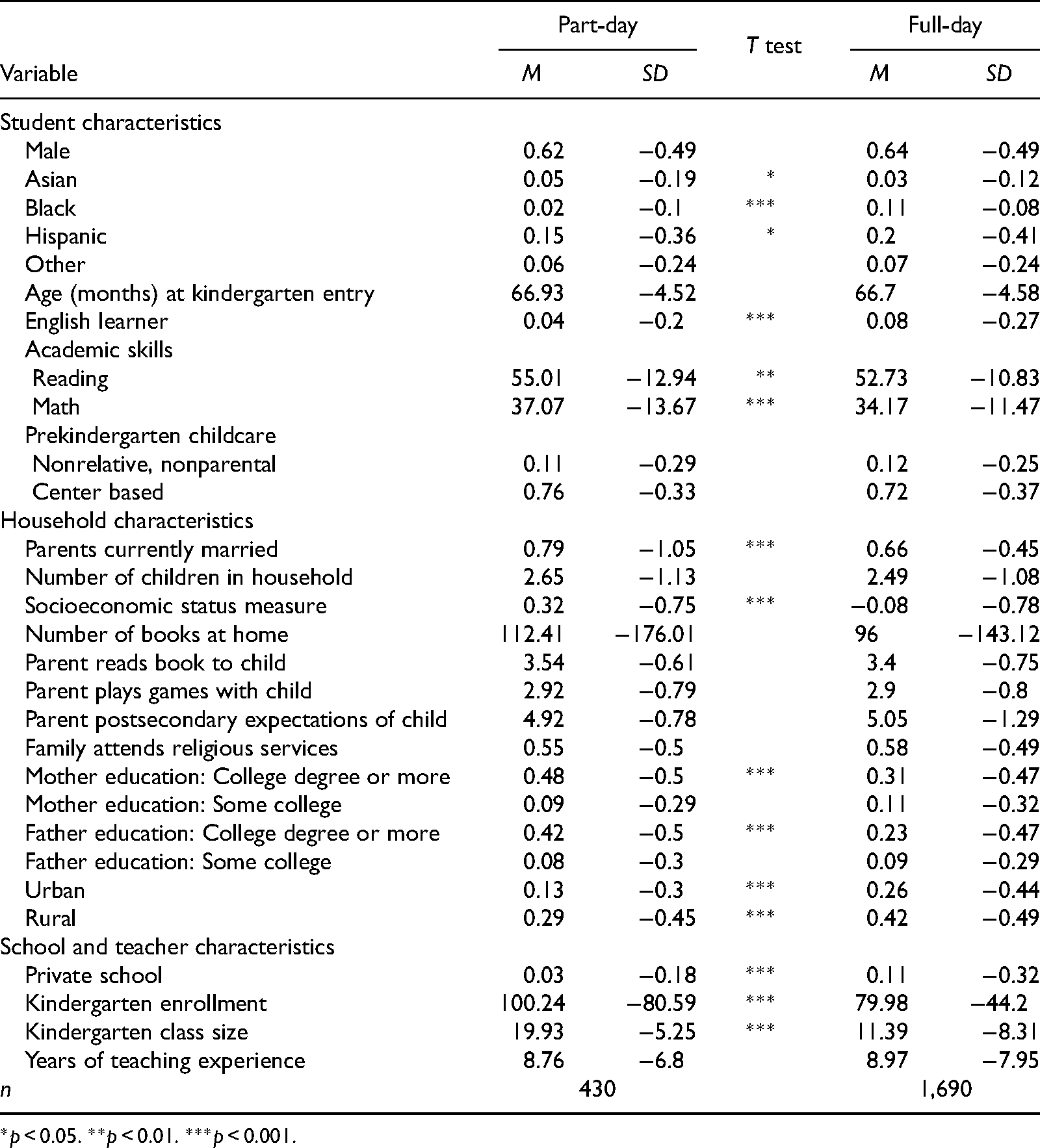
The covariates selected for this study were determined based on Cannon et al.’s (2006) study, which examined the causal effect of full-day kindergarten on academic achievement using the previous ECLS-K cohort from 1998–1999. We implement a similar research design as Cannon and colleagues, and as such, we posit similar justifications for the use of such covariates. The selected covariates are presented in Table 1, dividing the sample into those children who attended full-day kindergarten versus part-day kindergarten.
Comparing Descriptive Statistics of Children With Disabilities in Full- Versus Part-Day Kindergarten.
*p < 0.05. **p < 0.01. ***p < 0.001.
Student characteristics include gender, race, age at kindergarten entry (in months), and English learner status. Next were academic skills. Students’ academic achievement was assessed in both math and reading across elementary years. Academic assessments were administered in fall and spring, and we opted to include only the fall assessment to avoid confounding the known relationship between test scores and absences that occur in the same year (Gottfried & Kirksey, 2017).
Next, in the kindergarten school year, parents were asked about prekindergarten childcare that was given to their child in the year prior to kindergarten enrollment. From this information, we created two binary indicators: whether the child had nonrelative childcare or attended center-based care.
We then included a set of household characteristics. The first were related to family structure and included the following measures: whether the child's biological parents are married and the number of children under the age of 18 living in the household. To account for socioeconomic status (SES), we included the NCES-provided SES measure, the number of books at home, whether a parent reads or plays games with a child on a weekly basis, a scale of postsecondary expectations of the child (1–5), and binary measures for levels of education for each parent. Last, we included measures indicating a urban or rural setting.
Finally, we included school and teacher characteristics. These included whether the child was attending a private school, the size of the kindergarten enrollment, the child's kindergarten class size, and the years of teaching experience accumulated by the child's teacher.
Comparing children in full-day kindergarten versus part-day kindergarten
Table 1 presents the covariates, as described previously, by the full-day kindergarten and part-day kindergarten samples. Between the two columns of descriptive statistics, we present tests of statistically significant differences between the two groups. As seen in Table 1, children attending part-day kindergarten versus full-day kindergarten differed on observable characteristics. Specifically, full-day kindergarten attendees were more likely to be Black and Hispanic. English learners were more likely to attend full-day kindergarten. Full-day kindergarten children were less likely to have biological parents who were currently married and belong to households with lower SES and have mothers and fathers who were less likely to have a college degree or greater. Children attending full-day kindergarten were more likely to attend schools in urban and rural communities (versus suburban communities). Finally, the children in full-day kindergarten were more likely to be in private schools, schools with lower kindergarten enrollment, and schools with smaller kindergarten class sizes.
Empirical Strategy
We began our analysis with a simple bivariate ordinary least squares (OLS) regression:
Next, we added the covariates described previously and listed in Table 1:
Differences between results from models outlined in Equation 1 and Equation 2 indicate how accounting for sociodemographic and child characteristics can change the interpretation of the relationship observed between full-day kindergarten and student absenteeism. For example, children attending full-day kindergarten appear to have slightly lower kindergarten-entry academic skills on both reading and math. By including covariates for academic skills prior to kindergarten entry, we are removing any influence that academic skills may have on SWDs’ attendance in kindergarten as well as later years and further isolating the relationship between full-day kindergarten and absenteeism.
County fixed effects
Next, we added fixed terms for the counties in which students attended school, which is necessary to control for the potential of having observed or unobserved confounding county-level variables that bias the relationship between full-day kindergarten enrollment and absenteeism. This is also consistent with the regressions used by Cannon et al. (2006). The use of county fixed effects reduces bias by eliminating variation between counties in the regression, which removes all potential country-level confounders on the probability of attending full-day kindergarten that also relate to absenteeism. This is necessary in the current study, because although ECLS-K:2011 allows us to include a rich set of control variables pertaining to students, there is no possibility of including all factors that relate to county-level policies and programs, such as factors related to the availability of full-day kindergarten.
We employed the following county fixed-effects regression. Factors that are being controlled for in the following regression include all observed and unobserved county-level variation:
Instrumental-variable (IV) strategy
Next, we addressed selection bias due to factors within counties, such as parents’ preferences to send their children to full-day kindergarten. Using a two-stage least squares IV model, we capitalized on variation in state policies that significantly influence full-day kindergarten offerings. State policies was used as an instrument for the probability that a child will attend full-day kindergarten, which removes bias from this key predictor related to parental choice, preferences, and knowledge of full-day kindergarten. The specific measure of state policies was whether a child attended a school in a state required all school districts to offer at least one full-day kindergarten. This measure was determined using state kindergarten policies gathered from Key State Education Policies on K–12 Education: 2008 (Stillman & Blank, 2009). From this report, there were 14 states and the District of Columbia that have a mandate that requires districts to offer at least one full-day kindergarten. Thus, the instrument for children attending schools in these states was coded as 1 and the remainder coded as 0. These included children attending schools in states that either have no full-day kindergarten mandate or states that have an instituted policy that requires districts to offer either full-day kindergarten or part-day kindergarten. Within our sample, approximately 370 (25%) of the sample of SWDs attended schools in states with the full-day kindergarten requirement. We capitalized on variation in state policies that significantly influence full-day kindergarten offerings
The IV approach is motivated by the fact that we cannot control for all factors that contribute to the remaining selection bias that will be present from results from models presented previously. For example, some families may be more likely to seek out schools that offer full-day kindergarten if the families hold beliefs that full-day kindergarten is academically, socially, financially, or otherwise beneficial for children and their families. For example, lower-income families may be more likely to have single parents who have to work during the day and thus must send their child to full-day kindergarten. In turn, they are less flexible to take care of the child if they want or need to miss school. Hence, full-day kindergarten would be selected due to family economics. On the other hand, if families decide to send their SWDs to full-day kindergarten because they believe it is academically beneficial, it is likely that these parents are also more involved with their children's education at home, recognize the importance of school attendance, and bridge home-to-school transitions, all of which likely correspond to their children attending school more frequently (Ansari & Purtell, 2018). Finally, it might be the case that families with fewer resources at home (e.g., fewer books) might prefer full-day kindergarten as a way to supplement home life. If any of these were the case for families in our sample, without controlling for family-level preferences—a factor predictive of full-day kindergarten enrollment as well as absenteeism—the relationship between full-day kindergarten and absenteeism would contain significant selection bias.
We isolate the causal pathway between full-day kindergarten enrollment and absenteeism for SWDs using a two-stage least squares IV strategy. The first stage of the IV empirical approach estimates the probability of a child attending full-day kindergarten based on the state policy instrument:
FDK represents whether the child attended full-day kindergarten, and Policy represents the full-day kindergarten policy instrument. The equation includes the list of control variables as mentioned previously. Policy is used to predict the probability that SWDs are enrolled in full-day kindergarten, holding constant the characteristics outlined in Table 1. Then, the newly predicted values of full-day kindergarten are used in the second stage, similar to Equation 2, to predict the effect of full-day kindergarten on absenteeism for SWDs. We isolate the causal pathway between full-day kindergarten enrollment and absenteeism for SWDs using a two-stage least squares IV strategy.
Assumptions
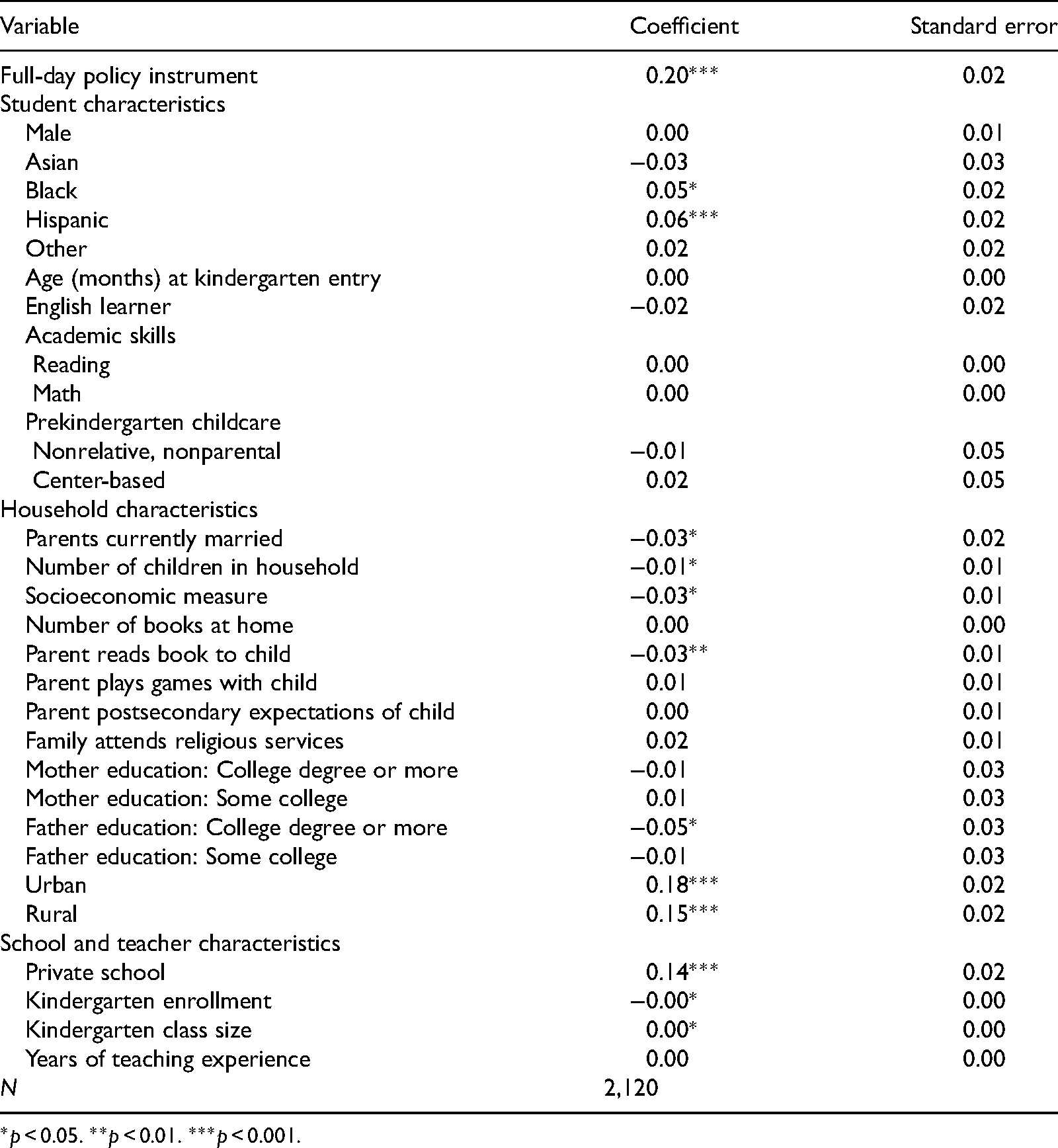
The IV approach is capable of providing causal estimates of the effect of full-day kindergarten on student absenteeism, assuming that the state full-day kindergarten policy is highly correlated with participation in full-day kindergarten. The predictions of full-day kindergarten enrollment based on the instrument are demonstrated in Table 2. The coefficient on the instrument was a strong positive predictor of full-day kindergarten enrollment.
First-Stage Instrumental Variable Results: Full-Day Policy and Fall Covariates Predicting Full-Day Kindergarten.
*p < 0.05. **p < 0.01. ***p < 0.001.
It is also important that the selected instrument impacted the outcome of interest only via the treatment variable. We have to assume that states’ full-day kindergarten policies do not directly relate to absenteeism. Theoretically, this would be an issue only if policies were in response to student absenteeism and states viewed full-day kindergarten as a means of improving attendance for their schooling populations. We have no reason to suspect this, as current dialogue underlying the motivation for sending children to full-day kindergarten is focused on academic readiness (Cooper et al., 2010).
Another assumption underlying the IV strategy is the stable unit treatment value assumption, which requires that there be no spillover between the treatment and control groups. This means that we have to assume that SWDs in full-day kindergarten programs are not causing SWDs in part-day kindergarten programs to be more or less absent, and vice versa. We do not believe this is likely.
Finally, the IV approach includes the monotonicity assumption, which assumes that there are no families in our sample that are more likely to send their SWDs to part-day kindergarten because of the full-day kindergarten state policy (Angrist et al., 1996). We believe it is highly unlikely that we violate that assumption, as the full-day kindergarten policies merely expand full-day kindergarten access. We have seen no evidence to date that suggests full-day kindergarten state policies may lead to some families changing their minds to send their children to part-day kindergarten when they were preparing to send them to full-day kindergarten.
Last, note that effects from the IV model can be generalized only to the “compliers” in the sample. In the IV strategy, “compliers” refers to those SWDs in our sample who attended full-day kindergarten only because they attended school in a state with a policy that required districts to offer a full-day kindergarten program. Therefore, the generalizability of the IV estimates is limited compared with the OLS and fixed-effects models.
Long-term estimates
As with the kindergarten year, we employed our empirical models in the same way for child observations during the first-, second-, third-, fourth-, and fifth-grade years of schooling. For these years, the analysis compared SWDs, classified as such in the year of kindergarten entry, who attended full-day kindergarten with SWDs who attended part-day kindergarten in the year of kindergarten entry.
Subgroup analysis
To address the second research question, we also extended the OLS and county fixed-effects models to examine differences in associations between disability classifications. As mentioned previously, the classifications examined include students with learning disabilities, communication or speech disabilities, emotional and behavioral disabilities, and physical disabilities.
As mentioned previously, a key assumption underlying the IV approach is the use of a strong instrument that meets certain criteria in the first stage. Although first-stage criteria were met when employing the IV on the full sample, these criteria were not met in most subgroup analyses. Therefore, we were unable to examine differences based on disability classification using the IV approach due to this significant inconsistency. we were unable to examine differences based on disability classification using the IV approach
Results
Baseline Estimates
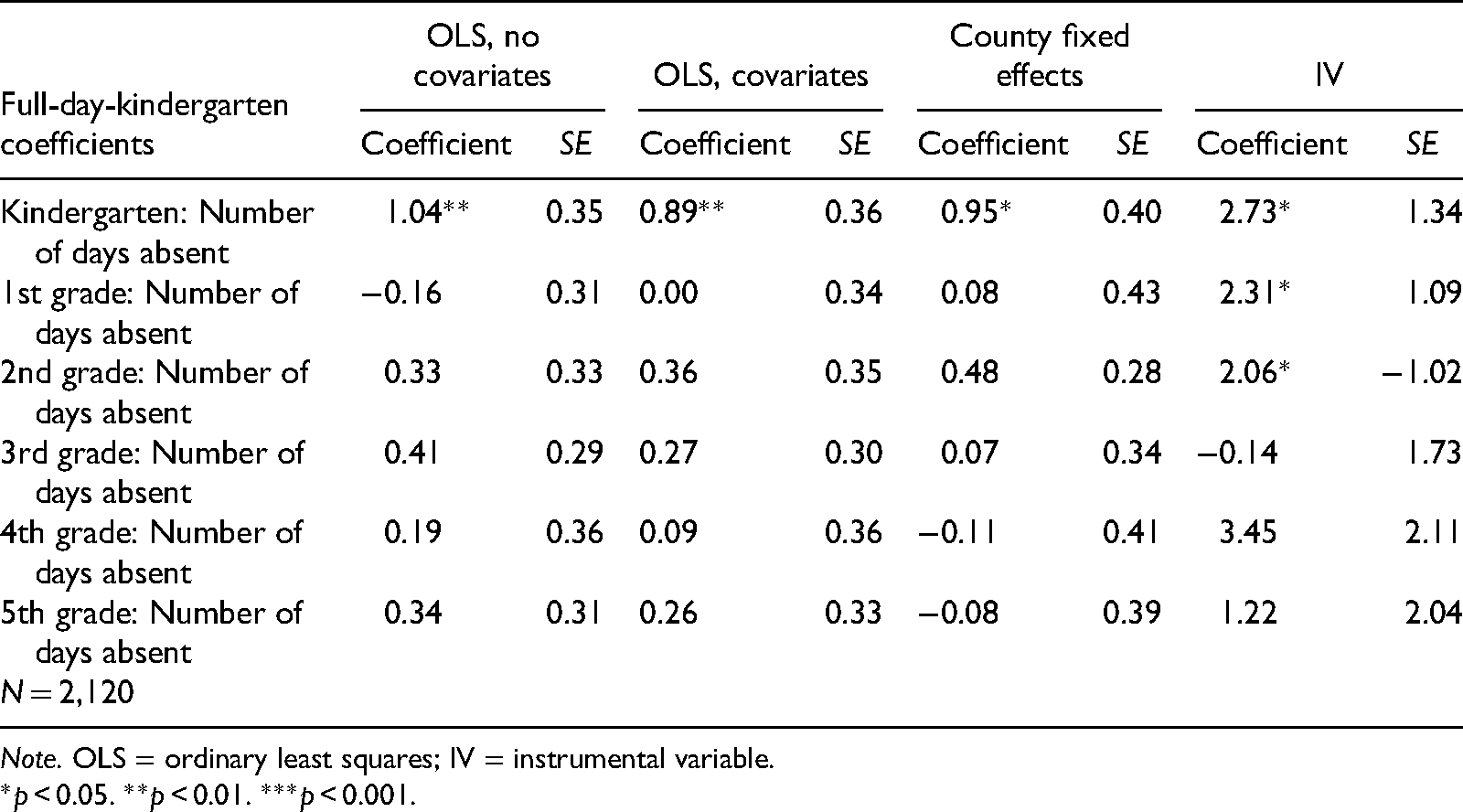
Table 3 presents the OLS estimates of students’ attendance in all elementary grades with and without covariates. Recall all coefficients for the dependent variable can be interpreted as the number of days absent. The first set of columns in Table 3 contains estimates produced by Equation 1. Recall that this specification included a binary indicator of full-day kindergarten enrollment, which we will then compare with results from other models to observe how estimated effects of full-day kindergarten differ as more variation and selection bias are removed. Because the primary focus of our guiding research questions was the relationship between full-day kindergarten and absenteeism among SWDs in six different grades in elementary school, we have chosen to limit our discussion to the estimates for the full-day kindergarten coefficients, though all control variables are included in the models.
Regression Models Predicting Short- and Long-Term Absenteeism Outcomes From Attending Full-Day Versus Part-Day Kindergarten.
Note. OLS = ordinary least squares; IV = instrumental variable.
*p < 0.05. **p < 0.01. ***p < 0.001.
As seen from the first set of columns, the baseline OLS model estimates produced by this first specification indicated that SWDs in full-day kindergarten tended to be more absent compared with SWDs in part-day kindergarten in the kindergarten school year. Specifically, SWDs in full-day kindergarten were absent on average 1.04 days (SE = 0.35) more compared with SWDs in part-day kindergarten. As seen from the descending rows in columns 1 and 2, there was no statistically significant association between full-day kindergarten enrollment and observed absenteeism in first through fifth grades in the baseline model.
The next two columns present estimates from the OLS model that includes the full set of covariates described in Table 1. After accounting for these observed characteristics, the magnitude of the relationship between full-day kindergarten and absenteeism for SWDs drops slightly to 0.89 additional days of absence (SE = 0.36). Again, as with the baseline model, the OLS model with covariates did not produce statistically significant results that indicate full-day kindergarten relates to long-term absenteeism outcomes for SWDs.
The third set of columns in Table 3 contains the estimates of full-day kindergarten enrollment produced by our second model specification, which sought to mitigate potential estimation bias by holding constant all county-level variation. These estimates are listed in the third and fourth columns of Table 3. After accounting for all observed and unobserved county-level factors, full-day kindergarten enrollment was again associated with an increase in absences. This estimate was just slightly bigger than the one produced by Equation 2 (0.95 more days absent; SE = 0.40). Similar to the results outlined in the first two sets of columns, the county fixed-effects model elicited no statistically significant associations between full-day kindergarten enrollment and absenteeism in first through fifth grades of elementary school.
The final set of columns in Table 3 contains the estimates of full-day kindergarten enrollment produced by our final and most rigorous model specification. Recall this model sought to reduce unobserved heterogeneity by exploiting an exogenous source of variation produced by whether the state of the kindergarten programs required school districts to offer a full-day kindergarten option for families. As shown in Table 2, this instrument was highly predictive of full-day kindergarten enrollment.
As seen from Table 3, the IV estimates are substantially larger with regard to the effect of attending full-day kindergarten on absenteeism in the kindergarten school year. After accounting for omitted variable bias using the IV approach, SWDs in the analytic sample who enrolled in full-day kindergarten were, on average, 2.73 days more absent in the school year compared with their part-day-kindergarten counterparts (SE = 1.34). The IV model also indicates that this effect extends into the first and second grades. For SWDs who attended full-day kindergarten, these students were 2.31 days more absent in first grade compared with first-grade students who attended part-day kindergarten (SE = 1.09). For the second-grade school year, this estimate drops slightly to 2.31 days and remains statistically significant (1.02). The IV model did not yield statistically significant results when examining absences in the third-, fourth-, or fifth-grade years.
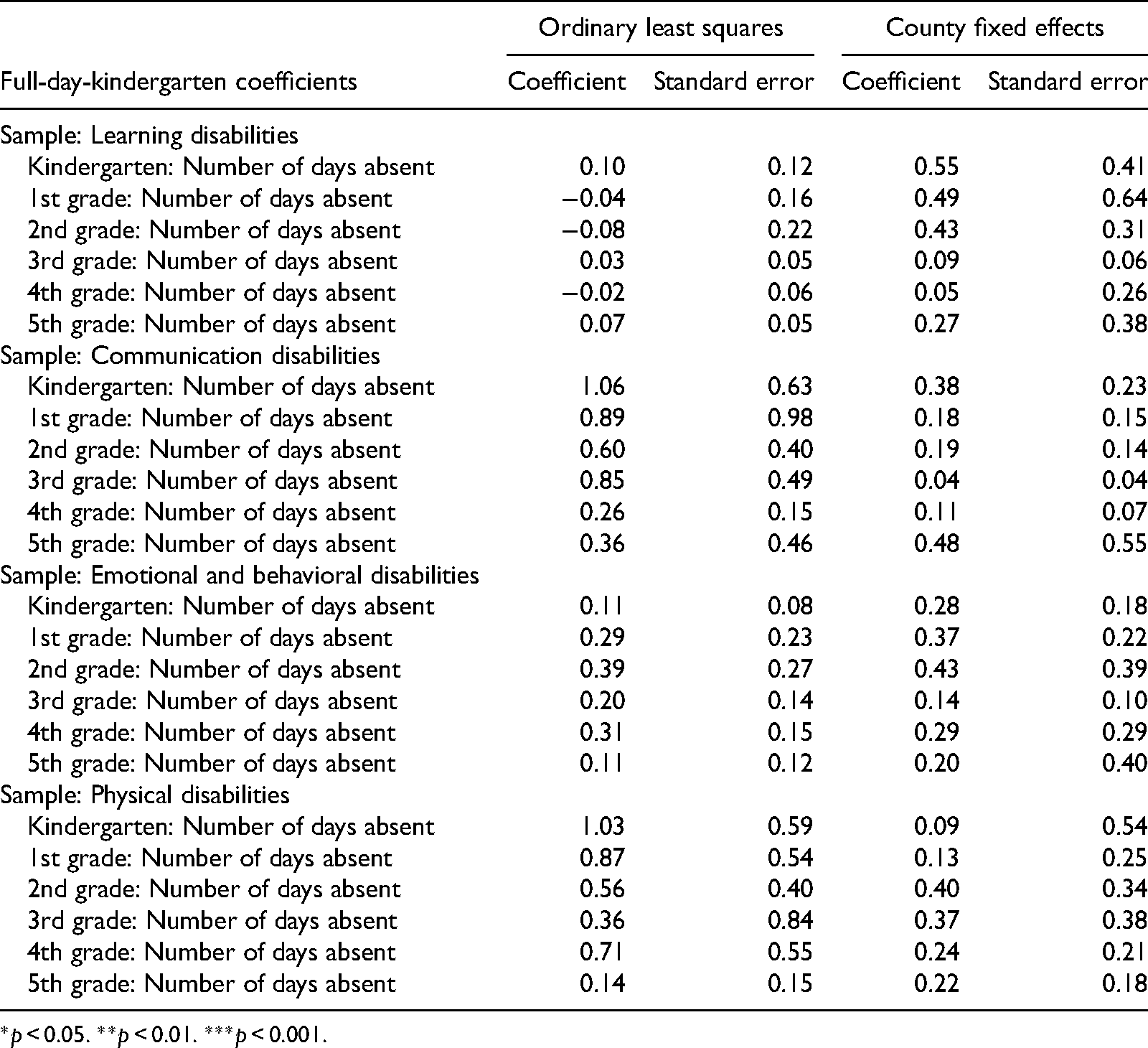
Table 4 presents results differentiated by disability classification for students. As seen from Table 4, none of the empirical specifications elicited statistically significant relationships between full-day kindergarten enrollment and absenteeism in either kindergarten or the later years of elementary school.
Differences in Short- and Long-Term Effects by Disability.
*p < 0.05. **p < 0.01. ***p < 0.001.
Discussion
Interpretation of Analysis and Findings
Our evidence suggests that SWDs in full-day kindergarten have higher absenteeism in the kindergarten school year across models, and when referring to the most rigorous specification, this effect is significantly larger than previously estimated and extends into the first- and second-grade school years for SWDs. The effect sizes are fairly large given prior research. In the instance of the kindergarten school year, the standardized beta coefficients (similar to Cohen's d; Cohen, 1992) ranged from 0.23 to 0.83. In first grade, the estimated effect size from the IV specification is 0.61, and in the second grade, 0.56. These effect sizes are consistent with prior research, both experimental and quasiexperimental. As compared with the latter, Kirksey and Gottfried (2018) elicited a 0.34 effect size estimate for the relationship between having classmates from the previous school year and the next-year absenteeism. As compared with the former, Robinson et al. (2018) examined the role of mailers to parents and their children's absenteeism and produced an effect size of 0.14. As for descriptive work, Brookmeyer et al. (2006) found a relationship between school climate scales and absenteeism for students with an effect size of 0.40. Our findings for full-day kindergarten programs appear to be larger with these previous studies in terms of meaningful magnitudes.
In addition to our work being in line empirically with past research, the importance of these findings is from the perspective of chronic absenteeism. Chronic absenteeism occurs anywhere from 2 weeks onward of missing school (Gottfried, 2014). If students are considered chronically absent after 10 days in some schools and districts, then policies and practices that reduce absenteeism by even 1 day can be significant—moving children away from the low threshold of chronic absences.
The results of our study underscore the importance of understanding how structures, programs, and interventions affect SWDs beginning as early as kindergarten. Out of all years of primary school, absenteeism is indeed highest in kindergarten (Balfanz & Byrnes, 2012), and this is especially true for SWDs (Gottfried, 2017b). This study presents good and bad news for policy makers concerned with SWDs attending full-day kindergarten. First, all empirical models employed in this study indicate that SWDs enrolled in full-day kindergarten had significantly more absences in the kindergarten school year compared with their part-day-kindergarten counterparts. Perhaps more importantly, when controlling for omitted-variable bias based on parental selection into full-day kindergarten, the estimates grow substantially: about 2.5 times what was previously estimated. This underscores the importance of controlling for selection bias when evaluating effects in instances such as these.
Moreover, findings from the IV model indicated that the negative effects of full-day-kindergarten enrollment on student absenteeism extend farther than was previously expected based on prior research. Prior research has shown in multiple ways that the effects of full-day-kindergarten enrollment tend to taper off by first grade and no positive (or negative) effects persist into later years of elementary school. Our findings suggest this may not be the case for SWDs with regard to absences. When controlling for omitted variable bias, our findings suggest that SWDs who were in full-day kindergarten were more absent in first and second grades compared with their peers in those grades who attended part-day kindergarten. Findings from the IV model indicated that the negative effects of full-day-kindergarten enrollment on student absenteeism extend farther than was previously expected based on prior research
On the other hand, although our results show that SWDs experienced negative effects related to absenteeism in the first 3 years of elementary school, these associations disappear in the later years of schooling. This perhaps suggests that SWDs who were in full-day kindergarten may eventually recover from these negative consequences in the remaining years of elementary school.
Limitations
The results of this study provide new causal evidence and help move dialog forward in absenteeism, early education, and policy spheres. That said, the research design does raise a few limitations, which should be considered when understanding the results. First, although the results certainly suggest that attending full-day kindergarten links to absenteeism, it is not possible from our study to determine the mechanisms. We discussed them at length in the beginning of this study, but they do remain conceptual and speculative. Hence, the results cannot support or dispute any particular pathway by which the results have arisen. We urge future research to build upon this current study through qualitative research, where it would be possible to identify in more depth the mechanisms that undergird our quantitative findings.
A second limitation is that we cannot observe students beyond elementary school. This is a limitation of the data collection, which was beyond our control as the data were collected by the U.S. Department of Education. That being said, future researchers might seek out a source of data that follows students from kindergarten through high school graduation (or beyond). Although there is no known nationally representative data set such as this, perhaps future research could rely on smaller samples to explore this time span and compare with the findings in this study.
Third, though we can observe absenteeism outcomes, this study was not able to examine health outcomes—many of which would be relevant to SWDs. To extend the research of this current study, it would be useful to know to what extent school structures also contribute to health outcomes. Although these are not available in ECLS-K, this would be a call for future researchers.
Finally, though the estimates are plausibly causal through our IV strategy, they are not experimental. Hence, findings here must be interpreted as quasiexperimental evidence, relying on a causal methodology. It would be ideal to assign children randomly to full-day kindergarten and part-day kindergarten to confirm the findings of this present study.
Implications
Given these results and limitations notwithstanding, we pose three implications for policy makers. First, our findings suggest there should be greater attention to supporting SWDs in the earliest years of schooling. As mentioned in the introduction, SWDs miss more school compared with students without disabilities (United States Department of Education, 2016; Cortiella & Horowitz, 2014; Gottfried, 2017b; Gottfried & Hutt, 2019). Given attention paid toward how school structures themselves might be linked to increased or decreased absenteeism (e.g., Gottfried, 2017b), this study examined whether the length of kindergarten was linked to attendance patterns. Our findings suggest that for SWDs—a group already at risk for higher absences rates—attending full-day kindergarten drives absenteeism even further.
This raises questions not about the merits of enrolling SWDs in full-day kindergarten, especially given the achievement benefits of being in full-day kindergarten, but rather about specific ways in which policy makers and educators can support SWDs and their families in full-day kindergarten. For example, as mentioned in our introduction, school transitions into kindergarten are challenging and are possibly made even more difficult for SWDs, all which in turn might raise absenteeism disproportionately for SWDs (Gottfried, 2017b; Karweit, 1992). And although the results of this study cannot untangle the precise mechanisms driving the findings, prior research highlights that supporting schooling transitions for SWDs can increase parental involvement in schools (Pears et al., 2015), which is an established way of reducing absenteeism (Gottfried & Hutt, 2019).
Another example raised in our framing pertains to health. Given the additional health challenges faced by some SWDs, it would be imperative to ensure that children and families in full-day kindergarten programs who do have health considerations receive adequate health supports so that they do not miss school. Again, our study cannot disentangle these mechanisms, though they provide motivation for further investigation into not simply the whether—the focus of this study—but also the how, the potential focus for future research.
And yet, we raise a concern from the policy sector. There are many examples from states that have already begun to dedicate more resources to promote better attendance in the early elementary years (Atchison & Pompelia, 2018). For example, the 2018 California Education Code now requires that districts dedicate resources and time to promoting connections between elementary schools and prekindergarten (Cal. Educ. Code § 8974). That being said, statutes such as these do not mention any focus on SWDs, which we view as a significant oversight. One example from which states can learn is West Virginia's Regulations for the Education of Students with Exceptionalities (Policy 2419), which has spelled out the state's role in support early childhood transitions for SWDs. Our study calls for all states, particularly those adding more resources to promote full-day kindergarten, to follow suit to ensure that appropriate attention is being paid to this crucial transition for SWDs.
Similarly, policy makers might revisit policies and resources dedicated to supporting the long-term trajectories for SWDs in full-day kindergarten. Although there are academic benefits for attending full-day kindergarten for SWDs in the kindergarten school year, no research has shown that these positive benefits extend into later grades. On the other hand, our results do in fact show negative effects with regard to student absenteeism from the kindergarten school year into the second grade. Taking the findings of the present study with those observed in prior research, it is important that policy makers, educators, and parents take into account the long-term effects of structures and programs on students. To do so, we urge these stakeholders to consider child, home, and school factors that may help to explain why full-day kindergarten participation is not supporting SWDs over the long term (Rimm-Kaufman & Pianta, 2000). To acknowledge differences in whether some SWDs may be better or worse off in full-day kindergarten, we recommend that policy makers put in place resources to support the individual and contextual differences to ensure that children are developmentally ready to succeed in a full-day kindergarten environment regardless of disability (Elkind, 2001; Miller & Almon, 2009). Policy makers might revisit policies and resources dedicated to supporting the long-term trajectories for SWDs in full-day kindergarten
The final implication concerns the lack of variation in our findings based on disability classification of SWDs. We found no evidence that the classification of students moderated the results, indicating our results represent main effects that are experienced similarly across disability classifications. However, we still recommend future research and policy consider these groups as different units, as our study was unable to draw from a large sample size.
