







Abstract
Despite growing calls to increase diversity in science, technology, engineering, and mathematics (STEM) fields, students with learning disabilities (SWLDs) remain underrepresented in STEM at the postsecondary level. Considering this call for increased diversity as a means to expand and strengthen STEM success, we used the High School Longitudinal Study of 2009 to explore how participation in engineering career and technical education (E-CTE) links to postsecondary educational outcomes for SWLDs. Particularly, we examined how E-CTE participation relates to postsecondary remedial course taking, enrollment in a 4-year postsecondary institution, and declaration of a STEM major. Results from school fixed-effects estimations suggest that each credit of E-CTE earned is associated with fewer remedial college courses, a higher likelihood of enrolling in a 4-year as opposed to sub-baccalaureate institution, and increased odds of declaring a STEM major. To conclude, we discuss the implications of our findings for both policymakers and practitioners.
Over the past two decades, career and technical education (CTE) has evolved from focusing on preparing students for immediate postsecondary low-wage, entry-level employment to preparing students for college and high-demand, high-wage careers (Conneely & Hyslop, 2018). To this end, the federal government has placed an emphasis on preparing students for success in science, technology, engineering, and mathematics (STEM) fields through participation in CTE programming as legislated under the Perkins Act, now in its fifth iteration (Plasman et al., 2021). Students with learning disabilities (SWLDs) have not been left out in this effort as the federal government is focused on increasing the participation of traditionally underrepresented populations in postsecondary STEM education (Thurston et al., 2017). This push aligns with a national need to increase the quality and number of highly qualified science and engineering professionals to keep up with global competition (Athanasia & Cota, 2022).
Participation in CTE, particularly STEM-CTE (i.e., CTE falling into the engineering, technology, and computer and information sciences categories), is one potential way to increase the STEM-trained workforce and to help CTE participants secure high-paying jobs (Carnevale et al., 2013). Encouraging entry into this field of study and ultimately employment comes at a time when there is expected to be a shortfall of qualified STEM workers to meet the demand to fill projected vacancies (Benish, 2018). By 2026, there will be an anticipated six million STEM occupation openings (Sargent, 2017). In contrast, there are expected to be only approximately five million qualified STEM professionals to fill these positions—a shortage of one million individuals. Given STEM occupations are among the most lucrative fields and the growing necessity for a postsecondary credential to secure one of these positions (Peterson et al., 2015; Rozek et al., 2019), promoting persistence along the STEM pathway from high school to college and into career is likely a path toward success.
By smoothing the overall transition from high school into postsecondary education (PSE), a key point at which many students exit the STEM pathway (National Science Board, 2015), it may be possible to not only increase STEM persistence but also increase access for key student groups that have been traditionally underserved and underrepresented in STEM fields and in PSE more generally (Benish, 2018). One chronically underrepresented subpopulation in STEM fields—from high school through career—and 4-year postsecondary programming is individuals with learning disabilities (James & Singer, 2016; A. Lee, 2022; National Science Foundation, 2021). In STEM, individuals with disabilities are substantially less likely to earn a postsecondary degree than their nondisabled peers (Friedensen, 2018). Further, individuals with disabilities make up less than 10% of the 25 million–strong science and engineering workforce (Friedensen et al., 2021).
This discrepancy in STEM is further exacerbated by the underrepresentation of individuals with disabilities in PSE more generally. Some estimates suggest individuals with learning disabilities in particular may be more than two-thirds less likely to earn a postsecondary credential than individuals without disabilities (I. H. Lee et al., 2015). STEM-CTE coursework may by one potential lever by which to improve persistence in STEM and into PSE more generally for SWLDs, given the design of these courses to be particularly engaging and relevant (Gottfried et al., 2014). As mentioned previously, STEM-CTE comprises coursework falling into the two clusters of computer and information sciences (CS-CTE) and engineering career and technical education (E-CTE). Although both courses in both of these clusters are designed to provide opportunities to complement traditional academic STEM courses (e.g., biology, chemistry, algebra) through hands-on and experiential learning activities, they approach these learning activities through different tactics (Gottfried & Sublett, 2018). CS-CTE courses focus on One chronically underrepresented subpopulation in STEM fields and 4-year postsecondary programming is individuals with learning disabilities.
Across the country, there is a call to increase expanding and strengthening STEM participation through increased diversity (DeVry University, 2021; Xue & Larson, 2015). Simultaneously, there is evidence that SWLDs have the ability to succeed in STEM fields given appropriate instructional accommodations (Heiman & Precel, 2003; Orr & Hammig, 2009). However, few studies explore the role STEM-CTE—even fewer focusing on E-CTE more specifically—may play in supporting this group of students as they make the difficult transition from high school into college STEM fields. As such, we seek to fill this gap in the literature by responding to the following research questions:
What is the relationship between E-CTE participation in high school and enrollment in remedial coursework in college for SWLDs? How does participation in E-CTE in high school link to enrollment in a 4-year postsecondary institution compared with a sub-baccalaureate institution for SWLDs? What association exists between E-CTE participation in high school and STEM major declaration in college for SWLDs?
Responding to these research questions will allow for a comprehensive view of how E-CTE participation may ease the transition from high school into college for SWLDs and encourage persistence along the STEM pathway into high-skill, high-demand STEM careers. Through our first research question, we look to determine whether E-CTE participation relates to increased college readiness as measured by the ability of students to more immediately participate in credit-bearing coursework. Given the growing need for a 4-year degree to obtain employment in lucrative STEM careers, responding to our second research question will provide evidence as to the role E-CTE may play in encouraging SWLDs to maintain and act on high educational expectations. Finally, we examine whether E-CTE participation is linked directly to progression along the STEM pathway from high school into college.
College Going for SWLDs
Even though the number of students with disabilities who enroll in college has more than tripled in the past two decades, postsecondary outcomes for those with and without disabilities remain disproportionate (Hong, 2015). In considering SWLDs specifically, Lee et al. (2015) found this group of students to be 70% less likely to earn a college credential than their peers without disabilities. Given the projections for STEM careers to increase considerably over the next decade, if the current trends related to college completion for SWLDs persist, SWLDs’ prospects for employment in STEM fields are worsened at the same time the national economy is likely to face a high-skill STEM personnel crisis (Rothwell, 2014). Remedial coursework, 4-year college enrollment, and STEM major declaration each represent relevant postsecondary outcomes that relate to differences in college participation and completion for SWLDs.
First, traditionally underserved student groups tend to be more likely to require remedial coursework in college (Alliance for Excellent Education, 2011). This is an issue given the fact that students who participate in remedial instruction have significantly reduced chances of eventually completing a postsecondary degree (Jimenez et al., 2016; Rosenbaum, 2018). Of note, SWLDs fall into this category of being more likely to require remedial education, with 21% of students with disabilities in 4-year postsecondary institutions taking remedial coursework compared with 14% of their nondisabled peers (NCES, 2022). These high rates of remedial coursework suggest that SWLDs may need additional support to ensure success as measured by on-time graduation and receipt of a STEM degree at the postsecondary level. Given the reliance on practical application of math and science concepts to tangible problems, E-CTE course taking may serve as a buffer to support SWLDs in their STEM pursuits (Hawley et al., 2014).
A second issue in college-going behavior related to opportunities after college concerns the types of postsecondary institutions in which students enroll. In particular, compared with students without disabilities, SWLDs are more likely to enroll in 2-year (or less) postsecondary programs rather than 4-year programs at a rate of nearly 2 to 1 (Gerber, 2009). There are numerous reasons why this may be the case. First, SWLDs are more likely to underperform on college entrance exams, which likely limits their postsecondary options (Gerber, 2009). Second, 2-year colleges tend to be more accommodating to the specific needs of SWLDs through the provision of more support services to encourage persistence and retention (Gregg, 2010). Although 2-year institutions may provide additional accommodations, the disproportionate access to 4-year institutions is a particularly troubling issue with respect to SWLDs in STEM. This is because many STEM careers today require at least a bachelor's degree, without which SWLDs risk not enjoying the higher expected lifetime earnings associated with such STEM occupations (Business Roundtable, 2014; College Board, 2023).
Finally, and directly related to the progression along the STEM pipeline, recent estimates suggest that students with disabilities who go on to earn bachelor's degrees are substantially less likely to have initially declared a STEM major than students without disabilities (Postsecondary National Policy Institute, 2022). Coupled with the fact that relatively few—only about 18%—students in general who graduate high school go on to earn a degree in a STEM field, there is clear evidence of an underrepresentation of SWLDs majoring in STEM in college (de Brey et al., 2019).
E-CTE and Benefits of Participation
Existing federal policies work to alleviate some of these educational disparities faced by SWLDs. The Perkins Act (reauthorized in 2006 and 2018), which governs and funds CTE in the United States, is particularly clear about the need to better engage students from special populations—including economically disadvantaged students, English learners, individuals preparing for nontraditional fields, migrant students, foster-care youth, and, central to this study, students with disabilities—through experiential and career-related learning opportunities with a strong emphasis on improving academic knowledge and technical skills in STEM fields (Edgerton, 2022). Many of the tenets of CTE as outlined in the Perkins Act—engagement in hands-on activities, demonstrations, and lab experiences—also align with much of the sentiment laid out under Universal Design for Learning as described in the Higher Education Opportunity Act of 2008 (Gronneberg & Johnston, 2015). The alignment between instructional techniques in CTE coursework and accommodations suggested for SWLDs may make E-CTE coursework a particularly useful area by which to ease the transition into PSE and encourage this group of students to persist along the STEM pipeline.
E-CTE coursework is primarily designed to expose and enable students to adopt problem-solving skills through the practical application of math and science concepts. As a subsidiary of the general high school CTE curriculum, E-CTE courses focus on applying engineering and technology concepts to encourage the development of academic and technical knowledge and skills (Plasman et al., 2023). Such courses include Principles of Engineering, Surveying, Digital Electronics, Computer-Assisted Design, and Modeling and Simulation Technology (Gottfried & Plasman, 2018). Although these courses reinforce academic math and science notions, they are not exclusively focused on preparing students for PSE alone. They also have direct relevance for both career and academic persistence in STEM fields, especially for SWLDs.
Currently, much STEM instruction in high school lacks integration across disciplines, and STEM concepts are often taught in siloes (Gottfried & Bozick, 2016). This is a potential missed opportunity given that instructional methods that integrate applied learning concepts likely help students better develop skills for success in PSE and career (Stone & Lewis, 2012). As one means of integrating STEM concepts and delivering instruction through applied learning opportunities, STEM-CTE courses emphasize the relevance of academic math and science concepts in relation to job experiences through incorporation of experiential quantitative reasoning, logic, and problem-solving skills (Plasman & Gottfried, 2018). These courses are meant to serve as a complement to traditional, academic STEM courses and provide students an opportunity to strengthen their academic knowledge (Shifrer & Callahan, 2010). Further, this experiential approach to learning promotes STEM interest and enhances achievement in STEM as measured by standardized test scores and grades in math and science coursework (Bozick & Dalton, 2013; Doll et al., 2013; Dougherty & Harbaugh Macdonald, 2020; Gottfried et al., 2014; Gyasi et al., 2021; Rozek et al., 2017).
There is little work focused specifically on E-CTE, but there is a growing body of work focusing on the benefits of STEM-CTE more broadly. For students in the general population, STEM-CTE has proven crucial in several ways. Lansford and Kirksey (2023) explain the relevance of STEM-CTE coursework to student retention through increased school attendance. As a result of active engagement through the heavy reliance on math and science concepts to solve concrete problems (Brand et al., 2013), students may assign greater value to STEM-CTE coursework as it prepares them for both college and career. This value attachment may bring previously unrealized relevance to traditional math and science lessons, thereby encouraging students’ interest in staying in school (Plasman et al., 2021; Terry et al., 2016). In addition to increased odds of graduating high school, participation in STEM-CTE coursework is associated with higher math test scores by 12th grade, a high probability of enrolling in PSE, and declaring a STEM major in college (Gottfried et al., 2014; Gottfried & Bozick, 2016; Plank et al., 2008). STEM-CTE courses may be particularly beneficial for SWLDs given the applied nature of these courses.
STEM Capital and E-CTE
The science capital framework (Archer et al., 2012, 2015) can be applied broadly to STEM and provides a valuable lens with which to understand the availability of STEM-associated resources to individuals (Archer et al., 2015). The framework describes how STEM-related resources at an individual's disposal influence their decisions to pursue STEM fields (Nomikou et al., 2017). These resources, skills, and characteristics build over time and ultimately aid in supporting success in the STEM context (Moote et al., 2020). Drawn from Bourdieu's (1977, 1986) conceptualization of capital in his classic theory of practice, and later forms of capital, the framework considers the extent of an individual's exposure to specific types of STEM-related capital (e.g., economic, social, cultural, and symbolic) and how each component encourages STEM inclinations in education and career (Archer et al., 2012). Greater exposure to these forms of capital implies greater access to STEM-related resources, which is correlated with a higher tendency to pursue STEM pathways into college and career. For instance, Archer et al. (2014) noted that students with family backgrounds rich in STEM-related characteristics are more likely to pursue careers in STEM fields due to greater exposure to STEM-related experiences (e.g., visits to science museums, STEM-related conversations, etc.).
Central to the STEM capital framework is a set of STEM-related attitudes, including STEM self-efficacy, STEM identity, and STEM utility. Self-efficacy in general refers to an individual's conviction regarding their ability to complete a task successfully (Bandura, 1977). STEM self-efficacy involves confidence in one's ability to evaluate and desirably apply STEM-related knowledge and skills to real problems (Liu et al., 2014). STEM identity refers to the level at which individuals perceive themselves as STEM people and perceive that others view them as STEM people (Dou et al., 2019). As a form of social identity, self-identifying as a STEM person and being recognized and accepted as such by others, especially those in the STEM community, build a sense of belongingness that further drives the pursuit of STEM proficiency (Cheryan et al., 2015; Kim et al., 2018). The third attitudinal dimension of STEM capital, utility, refers to the value derived from engagement and completion of a STEM-linked task. Students’ attachment of utility value to particular courses in school relates positively to course-specific performance and eventual persistence along a related pipeline (Hecht et al., 2019). Ultimately, the expectations of success and the utility derived from engagement are vital determinants of academic performance and occupational decisions (Eccles, 1983; Linnenbrink-Garcia et al., 2018).
Prior empirical work links attitudinal aspects of STEM capital to participation in STEM-CTE courses such as those found in E-CTE programming. For example, the strength of one's STEM self-efficacy is dependent on the level of STEM knowledge and skills acquired by the individual, and students in E-CTE courses have opportunities to reinforce STEM knowledge and boost overall STEM success (Stone et al., 2008), thereby improving STEM self-efficacy. As mentioned previously, Plasman et al. (2022, 2023). provided empirical evidence that participation in STEM-CTE coursework directly links to improved STEM self-efficacy for SWLDs. The formation of STEM identity can be linked to informal science-related practices that the individual experiences, such as hands-on STEM lessons, including those found in E-CTE coursework, that emphasize relevance and engagement (Dabney et al., 2013; Maltese et al., 2014). A key component of STEM utility is relevance, which is also a core principle in CTE programming (Plasman & Gottfried, 2018). Higher attitudes of STEM utility in turn help students reinforce the efforts they put into STEM coursework, thereby positively influencing achievement in STEM fields (Rozek et al., 2017).
Taken together, improving each of the identified STEM attitudes through participation in E-CTE coursework is likely to improve STEM achievement in high school, thereby reducing the need for remedial coursework in college. Among the 19% of 1st-year college students who needed remedial instruction in 2016, three-fourths needed remediation in math alone (National Center for Education Statistics [NCES], n.d.). High STEM self-efficacy, identity, and utility have the potential to increase STEM achievement in high school through improved standardized test scores, grades, and grade point average (GPA). This could lower the need to participate in remedial coursework in PSE given the relationship between performance in high school STEM coursework and later remediation (Whiton, 2015). Furthermore, STEM utility is a direct measure of relevance; and, given the growing expectation to earn a 4-year degree required to pursue a STEM career, students with higher STEM utility attitudes may be more likely to attend 4-year institutions. Finally, individuals who have higher feelings of STEM identity are likely to have greater interest in persisting along the STEM pipeline and identifying STEM as a major of study in college.
Method
High School Longitudinal Study of 2009
To respond to our identified research questions, we rely on the most recent nationally representative dataset that follows students through high school and into PSE: the High School Longitudinal Study of 2009 (HSLS) collected by NCES at the U.S. Department of Education (Duprey et al., 2020). This nationally representative, longitudinal dataset was designed to focus specifically on STEM themes, thereby serving our interests quite well. Further, it is the most recent nationally representative dataset that includes information relating to high school course taking, STEM attitudes, and postsecondary outcomes. For a complete description of the instrumentation and data collection methodology, see Duprey et al. (2020).
We received all appropriate institutional review board approvals required to use the restricted dataset. This study followed a cohort of students who entered the ninth grade in 2009 through their postsecondary decisions and experiences. The study establishes a baseline in the fall of 2009 when students first entered high school as ninth graders. Follow-up surveys were conducted in 2011–2012, 2013, and 2016. During the 2013–2014 academic year, NCES collected high school transcripts and added postsecondary transcripts in the most recent data update during the 2017–2018 academic year. Though this full dataset focuses on a cohort of students who graduated high school nearly a decade ago, it is the most recent nationally representative dataset that focuses on high school students over time. Additionally, to explore postsecondary outcomes, it is necessary to track individuals longitudinally over an extended period of time.
Transcript data are central to our analyses. High school transcripts include detailed information on students’ course-taking histories as well as grades and credits earned. To allow for standardization across schools that may use different credit or calendar systems, credits are reported as Carnegie units, which equate to how many hour-long classes students attend every day over the course of a school year. Importantly, these high school transcript files include unique course codes using the schema outlined in the school courses for the exchange of data (SCED) to identify fields of study into which each course falls (National Forum on Education Statistics, 2014). These course codes allow us to identify E-CTE courses, other CTE courses, and academic courses. Postsecondary transcripts include information on major declared as well as the number of remedial courses in which a student participated. NCES also created a flag indicating whether the declared major fell into a STEM field. Finally, during the 2016 follow-up, NCES identified the type of institution into which each student enrolled.
Across the full HSLS sample, there are more than 23,000 students from more than 900 high schools represented. However, we limited our sample based on learning disability status, nonmissing outcomes, and nonzero weights. Specifically, we use the NCES-provided weights that account for each of the three data collection waves in which we were most interested: baseline survey, transcript data, and postsecondary survey. Given our analyses are predicated on enrollment in a postsecondary institution, our final sample included 440 SWLDs. In other words, this final analytic sample is not meant to be representative of the expected SWLD population based on the baseline sample as inclusion in our sample was limited solely to those students who were observed in attendance at a postsecondary institution. To comply with NCES guidelines, we round all our sample sizes to the nearest 10. To account for missing data on baseline and control measures, we used multiple imputation to impute 20 additional datasets as suggested in prior work (Graham et al., 2007). More specifically, we used a chained regression strategy with a multiple-imputation-then-deletion technique as described by von Hippel (2007). Under this technique, we used all available variables in the imputation phase and then deleted the imputed values on the outcome and key predictor variables (i.e., learning disability status and E-CTE credit completion). Across our full dataset, we had a missingness of approximately 11%, a value at which multiple imputation provides very reliable estimates (J. H. Lee & Huber, 2021).
SWLDs
We center our analyses on students identified as having a learning disability. We chose to rely on a parent-reported indicator identifying whether they had ever been told their child had a specific learning disability by a doctor or other professional. We chose to use this measure because the administrative data identifying whether a student had an individualized education plan (IEP) had a large amount of missingness and to account for the potential that some students may have had a specific learning disability and chosen not to report that to the school (Freeman et al., 2023). It is also worth mentioning that it is not possible to identify the type of specific learning disability with which a student was diagnosed.
E-CTE Course Taking in High School
We relied on the NCES SCED codes as described earlier to identify courses that fell into the E-CTE category. Under the SCED coding scheme, this included courses such as Engineering Design, Principles of Engineering, and Computer Integrated Manufacturing. We chose to define course taking as the number of credits earned, as simply counting the number of courses taken does not account for differential lengths of courses (e.g., quarter-, semester-, or yearlong), nor does it account for whether a student actually passed a course. By using the standardized Carnegie units, we are able to make more appropriate comparisons. As such, reference to course taking throughout this study refers to the number of credits earned. Across our sample of SWLDs, students earned an average of approximately 0.07 engineering credits during high school, with those participating in engineering coursework earning an average of 1.15 engineering credits.
Outcomes
Remedial Coursework
Our first research question identifies remedial coursework as the outcome of interest. Here, we define remedial coursework as the total number of remedial courses taken, where a remedial course is operationalized using postsecondary transcript course descriptions that include terms such as “developmental,” “remedial,” “precollegiate,” and “basic skills” (Chen & Simone, 2016). This measure includes the number of both math and English remedial courses. Across our analytic sample, SWLDs enrolled in just under one and a half (1.41) remedial courses on average upon entering postsecondary programming.
Four-Year College Enrollment
Our second research question explores the link between E-CTE and the decision to pursue postsecondary credentialing at a 4-year or sub-baccalaureate institution. In the 2016 follow-up, NCES created a measure identifying the type of institution in which an individual was enrolled with respect to selectivity: highly selective 4-year institution, moderately selective 4-year institution, inclusive 4-year institution, unclassified 4-year institution, 2-year institution, and less-than-2-year institution. We used this information to create a binary indicator identifying whether a student was enrolled at a 4-year institution (coded 1) or a sub-baccalaureate institution (coded 0). Approximately 46% of our sample enrolled in a 4-year college.
STEM Major
Our final research question examined the relationship between E-CTE participation and SWLDs’ decisions to pursue a STEM major in college. Here, we use the indicator NCES created that identifies whether a student's declared major upon first entering a postsecondary program falls into one of the SMART grant–identified STEM fields. This indicator includes such fields as mathematics, natural science, engineering, and computer and information sciences (Blume-Kohout & Scott, 2022). As such, students were coded 1 if they majored in one of the SMART-identified STEM fields and 0 otherwise. Just under a quarter (23%) of students in our sample initially declared a STEM major.
Control Variables
To account for potential differences in our outcomes related to observable characteristics, we included a wide array of control variables in our estimates. We chose appropriate variables based on prior work on CTE course taking as well as those aligned with STEM capital (Archer et al., 2015; Bozick & Dalton, 2013; Dougherty et al., 2018; Plasman & Gottfried, 2018). These variables fall across three different categories: sociodemographic variables, academic history and attitudes, and school-level variables. We pulled these variables from the baseline survey in 2009 when possible, except for variables related to academic performance (e.g., GPA, academic credits, other CTE credits). Note that the STEM capital variables are included across both the sociodemographic-variable category (parent employed in a STEM occupation) and the academic-history-and-attitudes category (STEM self-efficacy, STEM identity, and STEM utility). Table 1 presents the descriptive statistics for our analytic sample.
Descriptive Statistics.
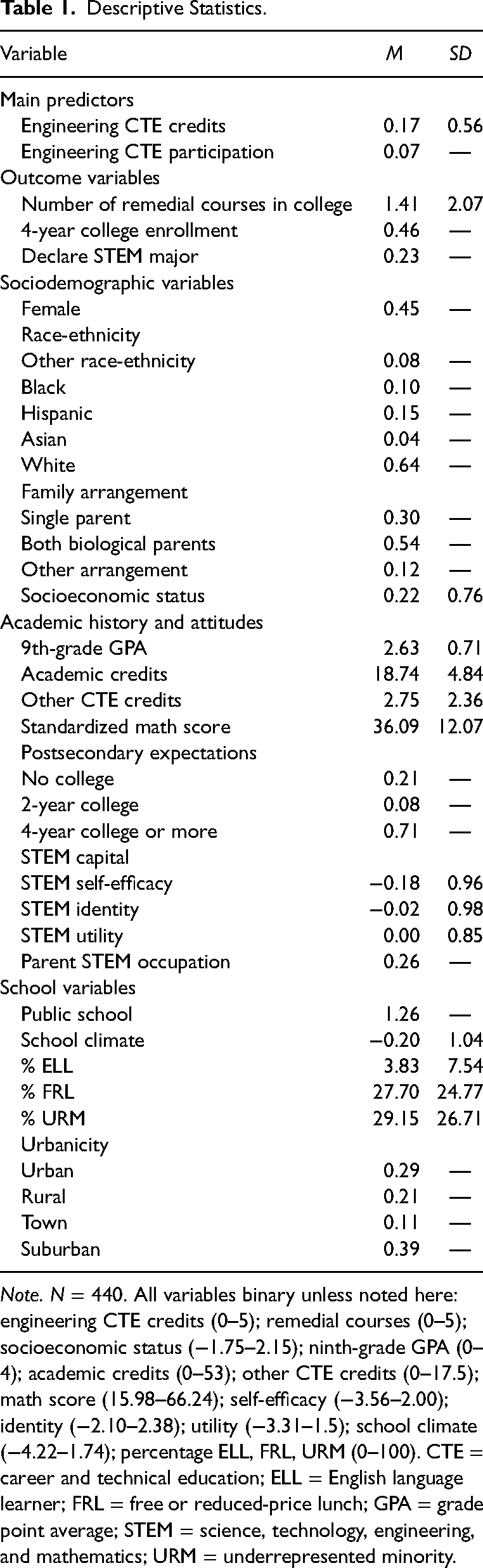
Note. N = 440. All variables binary unless noted here: engineering CTE credits (0–5); remedial courses (0–5); socioeconomic status (−1.75–2.15); ninth-grade GPA (0–4); academic credits (0–53); other CTE credits (0–17.5); math score (15.98–66.24); self-efficacy (−3.56–2.00); identity (−2.10–2.38); utility (−3.31–1.5); school climate (−4.22–1.74); percentage ELL, FRL, URM (0–100). CTE = career and technical education; ELL = English language learner; FRL = free or reduced-price lunch; GPA = grade point average; STEM = science, technology, engineering, and mathematics; URM = underrepresented minority.
Here, we first present information related to each of our identified outcomes and E-CTE course taking. The next category, sociodemographic variables, includes gender, race-ethnicity, family arrangement, socioeconomic status, and whether a parent was employed in a STEM occupation. Turning next to the academic-history-and-attitudes category, we include the following variables: postsecondary expectations, STEM self-efficacy, STEM identity, STEM utility, ninth-grade GPA, math standardized test score, academic credits earned, and other CTE credits earned. Finally, our school-level variables include overall school demographics (e.g., percentage English language learners, percentage free or reduced-price lunch, percentage non-White), a binary indicator identifying whether the school is public, urbanicity (e.g., urban, rural, or town, with suburban serving as the reference category), and a measure of school climate. The school climate measure is a composite created by NCES that indicates the extent to which certain factors are considered problematic at the school (e.g., drug use, bullying, vandalism) as identified on the baseline school administrator survey.
Analysis Plan
We respond to each of our research questions first using the following baseline equation:
In addition to our baseline estimations, we include a school fixed-effects model to test the sensitivity of our findings. Under this strategy, we account for unobserved bias at the school level that may ultimately have some relation to either E-CTE course taking or the identified outcome of interest. By focusing on variation within a school, we are able to account for factors at the school level about which we do not have information through the available dataset. This might include policies regarding access to different types of courses or access to college counselors as well as practices with respect to identifying SWLDs or inclusion in general education classrooms. Through a school fixed-effects model, we hold all these time-invariant factors constant at the school level and focus on the variation within a school. The following equation exemplifies our use of school fixed effects:
This model is quite similar to the baseline model except for the addition of the term γ j , which replaces the school-level variable vector and represents a vector containing a binary indicator for enrollment in a given high school with one school held out to serve as the reference category. Again, this allows us to account for both observed and unobserved school-level factors. Given the more rigorous nature of this method, our school fixed-effects design is the preferred model for each of our analyses.
Test of Robustness: E-CTE Binary Participation
For a different perspective on the relationship between E-CTE coursework and postsecondary outcomes, we also examined E-CTE participation as a binary predictor. In other words, regardless of the number of E-CTE credits earned, we were interested in determining whether there was a benefit of ever participating in E-CTE. For this estimation, we relied on school fixed-effects estimates. The equation for this model is identical to that in Equation (2) except that in this instance, the ECTE i variable takes on a binary form. In addition to now being able to observe how E-CTE participation more generally relates to our outcomes, we are also able to observe the predicted probabilities related to participating in E-CTE. Through this postestimation technique, we hold all our covariates constant at the means and are thus able to observe the differences in outcomes uniquely for those who did and did not participate in E-CTE.
Results
Research Question 1: E-CTE and Remedial Coursework
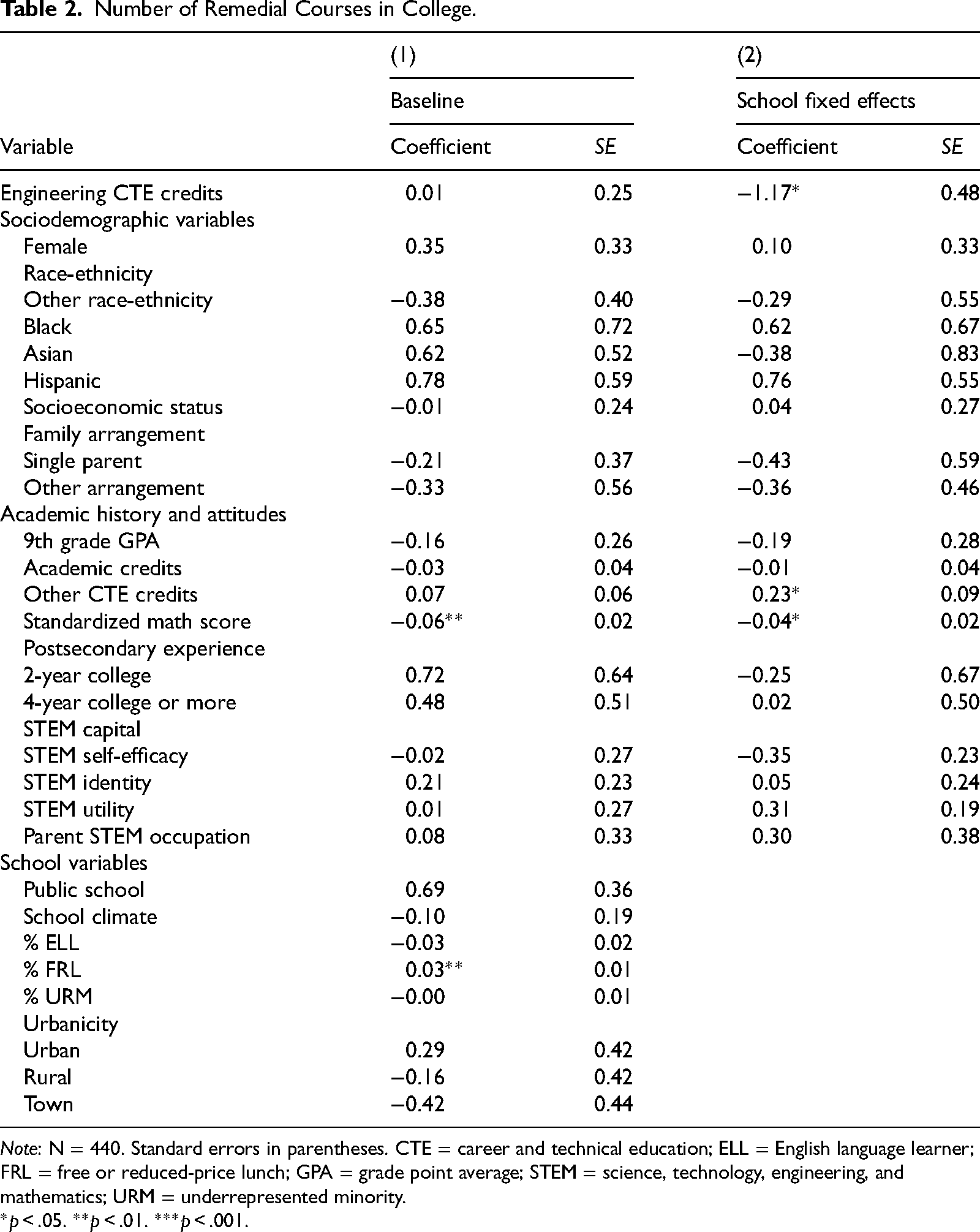
Our first research question sought to identify the relationship between E-CTE participation and remedial coursework in PSE for SWLDs. We were interested in determining whether SWLDs who earned more E-CTE credits could be expected to take fewer remedial courses in college than those SWLDs who did not earn any E-CTE credits. Table 2, Model 1, presents the results of this analysis. As a reminder, this and all subsequent analyses focus on an analytic sample that includes only students identified as having a learning disability. Our baseline estimate linking E-CTE course taking to the number of remedial courses in college suggests there is no relationship. It is also noteworthy that very few of our covariates are directly related to the number of remedial courses SWLDs take in college. Only the standardized math score was significantly related to fewer courses (−0.06, p < .001), while students from schools with higher proportions of students receiving free or reduced-price lunch (0.03, p < .01) were expected to enroll in more remedial courses. Note that none of the STEM capital variables had direct relationships with the number of remedial courses a student took.
Number of Remedial Courses in College.
Note: N = 440. Standard errors in parentheses. CTE = career and technical education; ELL = English language learner; FRL = free or reduced-price lunch; GPA = grade point average; STEM = science, technology, engineering, and mathematics; URM = underrepresented minority.
*p < .05. **p < .01. ***p < .001.
Our school fixed-effects model (Model 2) tells a different story. Under this model, we see that each additional E-CTE credit a student earns is related to an expected reduction in the number of remedial courses in college (−1.17, p < .05). Participation in other fields of CTE, on the other hand, is associated with an increase in the number of expected remedial courses (0.23, p < .05). As in our baseline model, higher math scores were associated with a decrease (−0.04, p < .05) in expected participation in remedial coursework.
Research Question 2: E-CTE and 4-Year College Enrollment
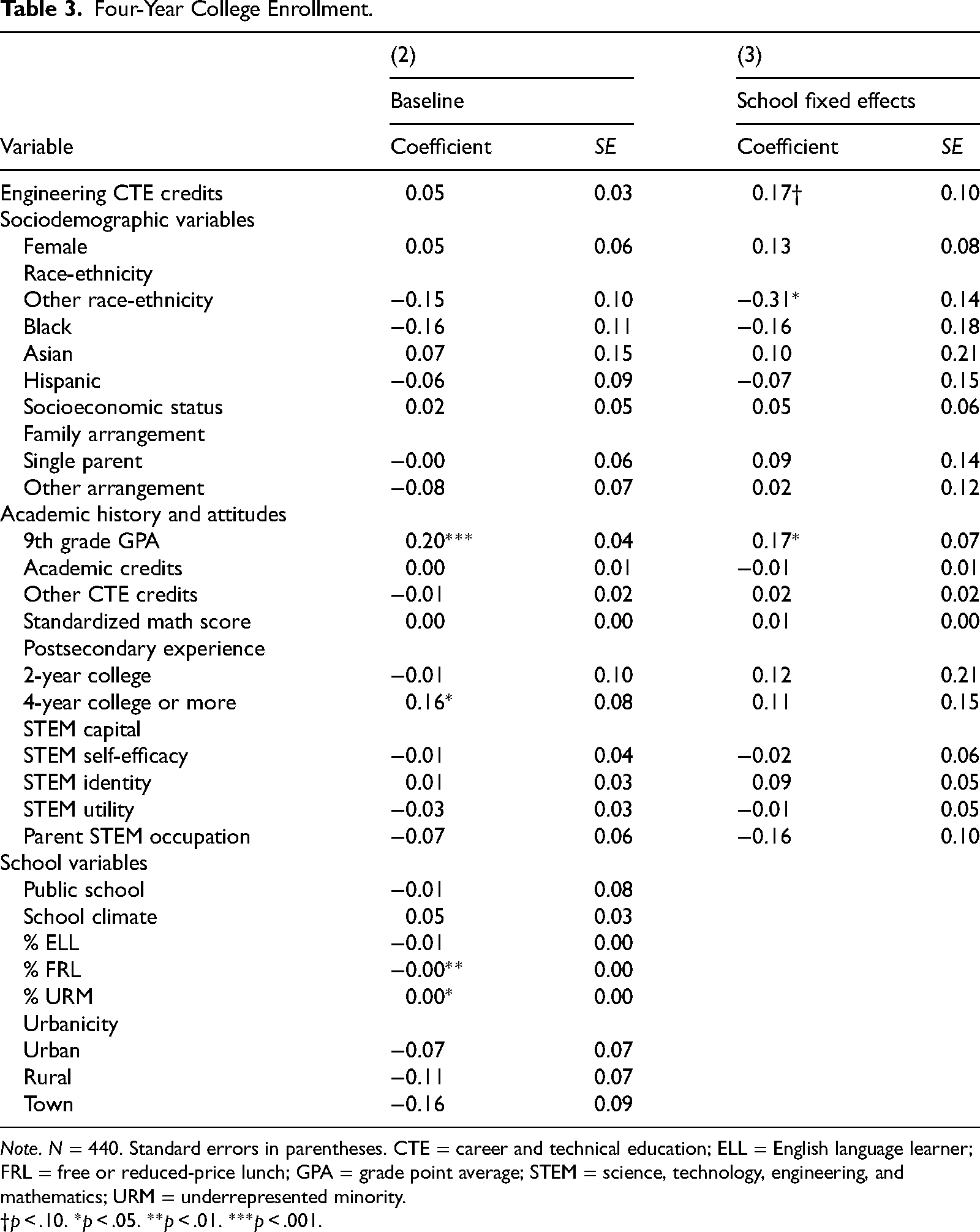
Our second research question inquired as to any association between E-CTE course taking and 4-year enrollment as opposed to sub-baccalaureate postsecondary institution. Again, this analysis focuses solely on SWLDs. Model 1 in Table 3 presents the baseline estimates. Given the binary nature of our outcome, associated estimates can be interpreted as percentage increases in the probability of enrolling in a 4-year institution. Under this estimation strategy, we do not see any significant relationship between E-CTE course taking and enrollment in a 4-year institution for SWLDs. There are a few covariates worth mentioning that are significantly associated with 4-year college enrollment. Specifically, students with higher ninth-grade GPAs (0.20, p < .001) and students with higher postsecondary expectations (0.16, p < .05) are significantly more likely to enroll in a 4-year institution. School variables are predominantly nonsignificant with only trivial significance associated with the percentage of free or reduced-price lunch recipients (−0.00, p < .01) and the percentage of underrepresented minority students (0.00, p < .05). Again, none of the STEM capital variables were significant.
Four-Year College Enrollment.
Note. N = 440. Standard errors in parentheses. CTE = career and technical education; ELL = English language learner; FRL = free or reduced-price lunch; GPA = grade point average; STEM = science, technology, engineering, and mathematics; URM = underrepresented minority.
†p < .10. *p < .05. **p < .01. ***p < .001.
Turning next to our school fixed-effects model (Model 2 in Table 3), we see a positive relationship between E-CTE credits and 4-year college enrollment, though this relationship is only significant at the 0.10 level. Regardless, each earned E-CTE credit is related to approximately 17% higher probability of enrolling in a 4-year college. Additionally, as in our baseline model, we see a significant relationship between ninth-grade GPA and 4-year college enrollment (0.17, p < .05), whereas SWLDs identifying as other race-ethnicity were significantly less likely to enroll in 4-year colleges (−0.31, p < .05). All other covariates were not significant.
Research Question 3: E-CTE and STEM Major
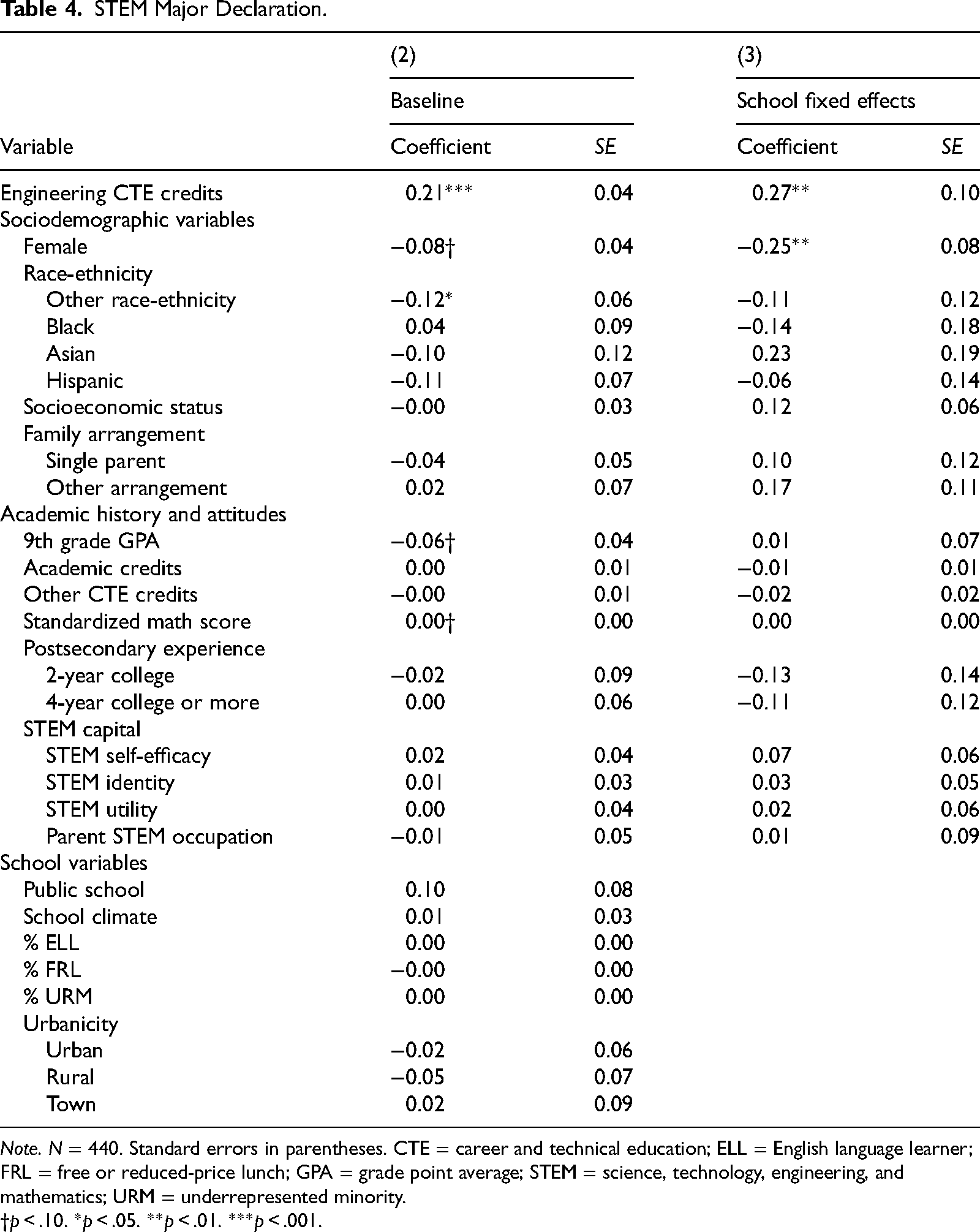
Our final line of questioning asked as to the potential relationship between participation in E-CTE in high school and later decisions to major in a STEM field in PSE. Again, this analysis focuses only on comparing SWLDs and, being a binary outcome, examines the relationship between earning E-CTE credits and the probability of identifying a STEM major of study. Table 4, Model 1, contains the results of this analysis. Here, we see a strong, positive, and significant relationship between earning E-CTE credits and a student's decision to declare a STEM major in PSE. Specifically, for each additional E-CTE credit, SWLDs have about 21% higher probability of declaring a STEM major. The only other variable associated with a higher probability of STEM major declaration was math score (0.00, p < .10). Students with higher ninth-grade GPA (−0.06, p < .10) as well as female students (−0.08, p < .10) and students identifying as other race-ethnicity compared with White (−0.12, p < .05) SWLDs were less likely to declare a STEM major.
STEM Major Declaration.
Note. N = 440. Standard errors in parentheses. CTE = career and technical education; ELL = English language learner; FRL = free or reduced-price lunch; GPA = grade point average; STEM = science, technology, engineering, and mathematics; URM = underrepresented minority.
†p < .10. *p < .05. **p < .01. ***p < .001.
Results from our school fixed-effects model (Table 4, Model 2) provide further support as to a positive and significant relationship between E-CTE credit earning and declaration of a STEM major. Here, the magnitude was quite similar to our baseline model, with each additional earned E-CTE credit associated with 27% higher probability of declaring a STEM major. Here, female SWLDs were observed as having approximately 25% lower probability of declaring a STEM major than their male counterparts. As in our each of our other analyses, STEM capital variables were again nonsignificant.
Test of Robustness: Any E-CTE Participation
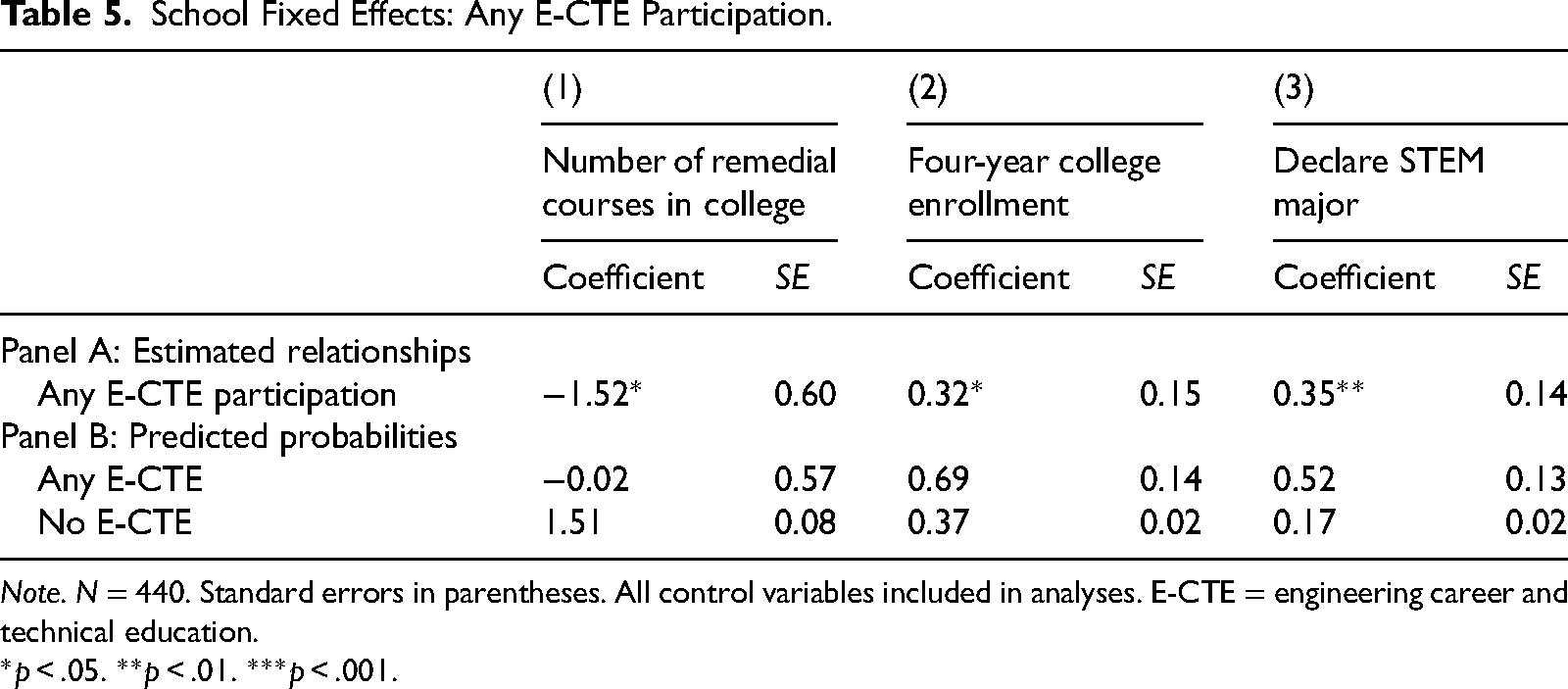
Observing E-CTE participation as credit accumulation helps to highlight the cumulative impact, such that the more credits a student takes, they may see additional benefits with respect to a given outcome. However, many students take less than one credit of engineering or do not necessarily accrue a full credit for a given course (e.g., if a student took an hourlong, one-semester-length course, they would accrue only a half credit). For this reason, we chose to also explore how any E-CTE participation may link to our outcomes of interest. Table 5 presents the school fixed-effects estimates as well as the marginal effects for each identified outcome.
School Fixed Effects: Any E-CTE Participation.
Note. N = 440. Standard errors in parentheses. All control variables included in analyses. E-CTE = engineering career and technical education.
*p < .05. **p < .01. ***p < .001.
As evidenced in the findings, our conclusions are largely similar to those from our E-CTE credit accumulation estimates. With regard to the number of remedial courses in college, SWLDs who ever earned E-CTE credit could be expected to take about one and a half fewer remedial courses (see Model 1). Model 2 shows that SWLDs who ever earned any E-CTE credit had approximately 32% higher probability of enrolling in a 4-year college as opposed to a sub-baccalaureate postsecondary institution when compared with non-E-CTE participants. Our final model (Model 3) provides further evidence that E-CTE participation is linked to declaration of a STEM major for SWLDs, as those who ever participated in E-CTE had approximately 35% higher probability of declaring a STEM major than nonparticipants.
By calculating the predicted probabilities of each of our outcomes at the means of the other covariates after obtaining our main estimates, we see additional evidence that E-CTE participation is likely related to a range of benefits in PSE. More specifically, SWLDs who take E-CTE courses are expected to take essentially zero remedial courses, whereas SWLDs who do not take E-CTE courses are expected to take about one and a half remedial courses in college. Looking at enrollment in a 4-year institution, we see that SWLDs who take at least one E-CTE course have nearly twice the probability (69% vs. 37% for nonparticipants) of enrolling in a 4-year postsecondary institution. Finally, E-CTE SWLD participants have 3 times higher probability of declaring a STEM major than do nonparticipants (52% vs. 17%). These predicted probabilities help better contextualize the relationship between E-CTE participation and our identified postsecondary outcomes.
Discussion
PSE has never been more of a practical necessity than in our current globalized economy (Barton, 2008). Many of the most lucrative careers, as well as many middle-skills employment opportunities, require at least some minimum postsecondary qualification (Holzer, 2012). This need for postsecondary educational experience is even more pronounced in STEM fields. Unfortunately, not all student groups are equally represented in STEM studies in college, thereby creating potential areas of inequity and a lack of diversity later in careers. In particular, SWLDs represent one group for whom it is worth considering levers to encourage a smoother transition from secondary school into postsecondary STEM fields. Although the push for STEM excellence remains a federal priority as evidenced in national initiatives and policies such as the Perkins Act and the Next Generation Science Standards, this is not to say that all students must pursue STEM pathways into college and career. However, all students should be provided access to educational opportunities allowing them the option to pursue these pathways should they choose.
In this study, we explored how participation in E-CTE—one category of STEM-focused career-related coursework—may be particularly well suited to support this transition period for SWLDs. Relying on the concept that participation in E-CTE courses is an efficient means of supporting the development of STEM capital for SWLDs in the form of skills, attitudes, and resources—which ultimately relates to persistence along the STEM pathway into PSE (Plasman et al., 2021)—we explored how participation in E-CTE linked to remedial course taking, enrollment in a 4-year postsecondary institution, and declaration of a STEM major.
Although a truly causal analysis is not possible given the nonrandom sorting of students into E-CTE coursework, our sophisticated descriptive work highlights some intriguing findings. Under our more rigorous and preferred school fixed-effects strategy, we found that each E-CTE credit was significantly related to a reduction in the number of remedial courses in which a SWLD participated once enrolling in college. Exploring this relationship in a different approach through whether a student ever participated in an E-CTE course, our predicted probabilities models show that SWLDs who ever took an E-CTE course were expected not to have to take any remedial courses in college. Students who did not participate in E-CTE, meanwhile, were expected to take approximately one and a half remedial courses. Given prior research showing underserved student groups, such as those with disabilities, are more likely to participate in remedial coursework in postsecondary institutions (Alliance for Excellent Education, 2011; NCES, 2022), our results suggest that E-CTE participation may be one way to help alleviate this necessity. Although our work here did not explore the direct mechanisms for this result, prior work suggesting that E-CTE coursework provides extra opportunities for students to reinforce academic learning may be a key explanation (Gottfried et al., 2014; Plasman et al., 2023). This is an important finding given the generally negative relationship between remedial coursework and eventual completion of a college credential in conjunction for the higher likelihood of SWLDs to have to participate in remedial coursework once reaching PSE (Rosenbaum, 2018).
In looking at the relationship between E-CTE course taking and enrollment in a 4-year institution, our school fixed-effects models suggest a beneficial relationship for SWLDs. For each additional E-CTE credit earned, SWLDs had progressively higher probabilities of enrolling in a selective institution. Likewise, any E-CTE participation was linked to significantly higher probability of enrollment in a 4-year college. Considering SWLDs are substantially less likely to enroll in 4-year institutions in general (Gerber, 2009), our results suggest participation in E-CTE may support pursuit of a 4-year credential. This is a particularly noteworthy finding given the growing requirement in STEM careers for a bachelor's degree at minimum (Noonan, 2017). Additionally, earning a bachelor's degree is linked to higher lifetime earnings compared with a 2-year degree (College Board, 2023).
Our final set of analyses explored how E-CTE participation in high school links to eventual declaration of a STEM major in PSE. Again, we found a significant and beneficial relationship across each of our estimation strategies. Specifically, each additional E-CTE credit a SWLD earned suggested higher probability of STEM major declaration under both our baseline and school fixed-effects models. Additionally, any E-CTE participation was linked to significantly higher probability of later STEM major declaration. In this case, SWLDs had more than 3 times higher probability of STEM major declaration if they ever participated in E-CTE compared with those who did not participate in E-CTE. As such, E-CTE appears to bolster pursuit of high-demand majors in fields that are undersupplied (Conneely & Hyslop, 2018) and in which SWLDs are underrepresented (A. Lee, 2022).
Aside from our main findings, there are a few additional considerations worth highlighting. First, prior work has established very little difference between students who do and do not participate in E-CTE with respect to demographic characteristics as well as academic attitudes and history (Plasman et al., 2023). Notably, this study included a focus on E-CTE participation differences by learning disability status. Although not focused specifically on E-CTE, other work in STEM-CTE has come to similar conclusions with respect to differences in academic history and attitudes between participants and nonparticipants—namely, that there are very few observable differences, even within the SWLD population (Gottfried et al., 2021; Plasman et al. 2022). From a strictly descriptive standpoint, Plasman et al. (2021) found SWLDs who did not participate in STEM-CTE were equally as likely to express interest in a STEM-related career as those SWLDs who did participate in STEM-CTE. Although it is not possible to say with 100% certainty, it is likely that SWLDs who do and do not go on to participate in E-CTE are entering high school with relatively similar attitudes toward STEM and postsecondary pursuits.
Second, it is noteworthy that there was no observable relationship between any of our identified outcomes of interest and our STEM capital variables after accounting for the other included characteristics. This is not to say there is no relationship. Prior work has shown that participation in E-CTE in high school is expected to help SWLDs develop stronger feelings of STEM self-efficacy and STEM identity (Plasman et al., 2023). As such, it is quite possible that there is an indirect effect of E-CTE on later postsecondary outcomes through these STEM capital variables. On the other hand, it is also possible that the STEM capital framework is not applicable for SWLDs in the same way as for nondisabled students as described by Archer et al. (2015). As such, future work may look to empirically test this theoretical framework as it relates specifically to SWLDs.
Implications
STEM careers offer high remuneration. They also require individuals to be highly trained and to excel in both general employability skills as well as technical skills. As such, many of these careers require individuals to earn 4-year degrees. The results of our study indicate that participation in E-CTE coursework may help students, specifically those with learning disabilities, with initial progression along the STEM pathway from high school into college. Although pursuing a STEM degree in college and employment in a STEM field should not be the ultimate goal for all individuals, regardless of disability status, it is important that all students—particularly members of more traditionally underserved populations, such as those with learning disabilities—are provided access and opportunity to follow along these career pathways. Our findings that E-CTE is related to a reduction in the number of remedial courses, an increase in the probability of enrolling in a selective 4-year institution, and higher probability of declaring a STEM major for SWLDs present a handful of implications for policymakers and practitioners. These findings align with the goals of existing federal Perkins legislation with respect to increasing participation among special populations—of which students with learning disabilities represent one group—and encouraging stronger integration between technical skill instruction and rigorous academic coursework especially in math and science fields.
With respect to policy implications, there are a number of important considerations. First, the potential reduction in remedial coursework in conjunction with the higher probability of enrollment in a selective 4-year institution is particularly noteworthy. Given that SWLDs are more likely to participate in remedial coursework—especially in 4-year institutions (NCES, 2022)—and our finding that E-CTE participation is associated with increased odds of enrollment in 4-year institutions, the idea that E-CTE participation may help reduce the number of remedial courses in which a student participates is truly a positive finding. Across all students, those who enroll in remedial coursework are less likely to finish college, and these courses also incur huge costs on students and their families (Jimenez et al., 2016). With the ballooning cost of higher education in general, and the amount of student debt individuals are taking on to simply participate in higher education, finding ways to reduce the need for remedial education prior to enrollment in credit-bearing coursework at postsecondary institutions should be included in this policy discussion. E-CTE may be one potential lever to move in the right direction.
A second policy implication relates to the increased probability of declaring a STEM major. SWLDs are typically less likely than their nondisabled peers to declare and earn a STEM major (Hawley et al., 2013), and although there is debate as to whether there is shortage of qualified individuals in the STEM workforce, many of the skills learned in STEM fields of study are in high demand regardless of whether a STEM-trained individual pursues a STEM career or not (National Science Board, 2015). Further, increasing diversity of thought in STEM industries by including individuals from typically underrepresented backgrounds, such as individuals with learning disabilities, is a focal point for employers as well as policymakers (James & Singer, 2016). As such, any opportunities to nurture interest for underrepresented populations to pursue STEM at the postsecondary level should be embraced. Again, E-CTE represents one such option.
E-CTE participation in high school is beneficial for SWLDs beyond outcomes at the secondary level.
Limitations and Future Research
As with all research, it is impossible to account for everything. Our project is no different, and there are a few limitations worth mentioning. First, we relied on a secondary dataset. As such, we are limited to the variables included and therefore cannot account for the fact that students must make the conscious decision to participate in E-CTE coursework. This is an inherent difficulty in trying to move beyond descriptive studies of CTE in general to truly causal work. Although our exploratory work does provide compelling evidence as to the potential benefits of E-CTE participation, it is not possible to say with complete confidence that it was E-CTE that caused these outcomes. As mentioned already, though correlational evidence across the existing research based suggests there are few significant differences between SWLDs on non-SWLDs based on their E-CTE decisions in high school, there may still be unobservable differences for which we are unable to account. Future studies may look to rely on random assignment to establish more causal evidence. Likely the best opportunity for such a study would be through examining high schools or high school programs that use random lotteries to make admissions decisions. One potential drawback of such a study is that it would likely limit the sample of SWLDs.
Second, in relying on a nationally representative dataset focused on high school students, we are limited in exploring the postsecondary outcomes for SWLDs due to the reduced sample size. Each of our decisions relating to the focus of our study may result in the loss of students. Specifically, in focusing on SWLDs, we immediately reduce the sample size substantially. Additionally, we are limited by both sample size and data granularity in our ability to examine differences by type of learning disability. In looking at postsecondary outcomes, we further reduce the sample size by not including those individuals who do not attend college. To address these secondary data issues, future research may look to rely on administrative data that include a more complete sample of SWLDs, though such an analysis would be unable to account for many of the attitudinal variables we are able to include here. With access to such administrative datasets at either the state or district level, we would be able to more accurately identify relationships given the census nature of these datasets and substantially larger analytic sample of SWLDs, which could include a more specific focus on the unique relationship with engineering specifically. Further, we would be able to account for and identify potential differences and changes over time. Finally, this would allow for the opportunity to disaggregate by specific type of learning disability to provide more insight into how these different designations may influence students’ experiences and outcomes.
A third limitation is that we are unable to identify exactly what aspects of E-CTE may be particularly beneficial for SWLDs. Though federal policy outlines the need for CTE courses to combine academically rigorous instruction with the instruction of technical skills—and a focus on STEM skills in particular—there is a lack of in-depth knowledge in the field at present exploring how the individual courses are structured, how information is delivered to students, or how well instructors are able to truly integrate math and science concepts into more practical instruction. Again, this is a function of working with a secondary dataset. Future work could examine the content of these courses, how instruction is delivered, and more detailed information as to students’ experiences. Though such work would be limited in scope due to the intense nature of the research, subsequent findings would provide a more complete view as to how and why E-CTE in high school may benefit students in college.
Conclusion
Despite these potential limitations, our study provides strong evidence of the potential for high school E-CTE coursework to benefit SWLDs as they transition into PSE. Our findings that SWLDs who do complete E-CTE coursework in high school are expected to take fewer remedial courses in college, more likely to enroll in a selective 4-year institution, and more likely to declare a STEM major show that E-CTE coursework can be used a means to support SWLDs into college and along the STEM pathway. Given the push under Perkins legislation to support STEM-CTE and students from underrepresented populations, our work provides evidence that these policy emphases are not misguided.
