







Abstract
The purpose of this study was to evaluate the types of spelling errors made by children with mild to moderate hearing loss (CMMHL) compared with children with typical hearing (TH) and to determine if types of spelling errors were related to linguistic or audiologic factors. CMMHL and TH completed measures of spelling, spoken language, speech production, and reading. Children's spellings were coded for linguistic-based spelling errors using the Multilinguistic Coding System. The relation of types of linguistic spelling errors and children's performance on standardized language assessments, as well as audiologic factors, was evaluated. CMMHL did not make more spelling errors than TH; however, they exhibited a higher proportion of phonological awareness errors and a lower proportion of mental grapheme representation errors in their spellings. Phonological awareness errors and mental grapheme representation errors were related to relevant linguistic performance. Better-ear pure-tone average was related to total frequency of spelling errors and phonological awareness spelling errors, and better-ear Speech Intelligibility Index (SII) was related to semantic knowledge spelling errors. This study supports the use of linguistic spelling error analysis with CMMHL and provides evidence of the relation of types of linguistic spelling errors to linguistic knowledge and audiologic factors.
Children with mild to moderate hearing loss (CMMHL) comprise approximately 40% of children with permanent hearing loss (Porter et al., 2016). Despite recent evidence that spelling accuracy of CMMHL does not differ from that of their peers with typical hearing (Tomblin et al., 2020), much research suggests that linguistic error coding of spelling in elementary school children can reveal weaknesses in children's linguistic skills, making it more clinically meaningful than holistic correct/incorrect scoring (e.g., Aho & Werfel, 2021; Masterson & Apel, 2010; Werfel & Krimm, 2017). Linguistic error coding of spellings has exposed differences in linguistic skills from children with typical hearing (TH) across multiple populations of children who are deaf and hard of hearing, including children who use cochlear implants (Apel & Masterson, 2015), children who use total communication (Bowers et al., 2014), children who are hard of hearing (Quick et al., 2021), and children with mild to profound hearing loss (Aho & Werfel, 2021). The purpose of this study was to evaluate the utility of linguistic spelling analysis in identifying language-based literacy weaknesses in CMMHL.
Linguistic Basis of Spelling
Types of linguistic knowledge utilized during spelling can include phonological awareness, orthographic knowledge, morphological knowledge, and semantic knowledge (Apel & Masterson, 2001; Collins & Wolter, 2017). According to the repertoire theory of spelling, children who are successful spellers use linguistic knowledge that is in their repertoire and that is applicable to the particular word that is being spelled (Masterson & Apel, 2010; Wolter et al., 2009). The use of any particular type of linguistic knowledge, such as phonological awareness, does not occur at the exclusion of others, such as orthographic knowledge, which differentiates the repertoire theory of spelling from others, such as stage theory (Collins & Wolter, 2017; Treiman & Bourassa, 2000), which posits that children move through stages in which they primarily utilize different types of linguistic knowledge.
Importantly, the correct spelling of a word often can be reached by two different spellers using two distinct types of linguistic knowledge. For example, one child might spell the word “cat” from mental graphemic representation knowledge (word spellings stored in long-term memory), whereas another child might use phonological awareness (analysis of word's component speech sounds) to discern the individual sounds in the word and letter-sound knowledge to map those sounds to logical letters. Therefore, linguistic error analysis of children's spelling errors provides insight into their linguistic knowledge and how they apply their linguistic knowledge to a literacy task.
Phonological awareness
Phonological awareness is the understanding that words are comprised of phonemes that are separable and manipulable (Collins & Wolter, 2017). It has long been known that phonological awareness plays an important role in word-level decoding and spelling (Adams, 1990; Kim, 2020; Read, 1986). Children's earliest spelling attempts are characterized by the representation of sounds in words, even before the onset of formal literacy instruction (Read, 1986). Research has shown that children who are deaf and hard of hearing exhibit more phonological errors in spelling than TH Geers & Hayes, 2011). This difference is hypothesized to be related to their limited access to the acoustic signal (Leybaert & Alegría, 1995; Sutcliffe et al., 1999).
Orthographic knowledge
Orthographic knowledge encompasses orthographic pattern knowledge and mental graphemic representation knowledge (Apel, 2011). Orthographic pattern knowledge involves letter-sound knowledge as well as the knowledge of general spelling rules and patterns, including rules that place positional and contextual constraints on certain letters or letter combinations (e.g., neither ck nor ng cannot occur in initial position in English words; Apel, 2011). Mental graphemic representations are word-specific spellings that have been stored in the child's long-term memory after repeated exposure to the specific word (Collins & Wolter, 2017). Several studies have demonstrated that preschool- and kindergarten-age children learn initial mental graphemic representations implicitly with little to no active phonological recoding (Apel, 2010; Apel et al., 2011, 2012; Wolter & Apel, 2010). As children build their mental graphemic representation inventory, their spelling becomes more accurate and automatic (Ehri & Wilce, 1987). Orthographic knowledge has consistently been shown to be a strength for children who are deaf and hard of hearing (e.g., Ambrose et al., 2012; Werfel, 2017)
Morphological knowledge
Morphological knowledge involves the understanding of the morphological structure of words, or knowledge that words are comprised of smaller, meaningful word parts called morphemes (Apel & Werfel, 2014). Understanding morphological structure helps individuals form conventional spellings of words. Conventional spelling of many English words relies on orthographic information of morphemes rather than the phonological structure (Venezky, 1999). For example, the word “worked” would be spelled workt using surface-level phonology. However, conventional spelling relies on the morphological past-tense marker at the expense of surface-level phonology. This implicit awareness of morphological structure of words influences a child's early spellings as early as kindergarten (Apel & Werfel, 2014) and continues to develop throughout their school-age years (Berninger et al., 2010). Werfel et al. (2022) reported that preschool children who are deaf and hard of hearing use far fewer morphological markers in spoken language compared with peers with typical hearing, and Walker et al. (2020) reported that morphological deficits for children who are deaf and hard of hearing persist well into the school-age years.
Semantic knowledge
According to the lexical quality hypothesis (Perfetti & Hart, 2002), early literacy skills can be predicted not only by phonological and orthographic knowledge but also by semantic knowledge, or knowledge of word meaning (Mimeau et al., 2018). For example, to successfully spell homophones, such as “where” and “wear,” children must invoke their knowledge of word meaning; they can no longer rely solely on the phonological or orthographic components to spell the word correctly. Children's vocabularies continue to develop throughout schooling, not peaking until middle age, well into adulthood (Hartshorne & Germine, 2015; Sorenson, 1933). Vocabulary knowledge of children who are deaf and hard of hearing is lower than that of their peers with typical hearing (Lund, 2016; Walker et al., 2019; Werfel et al., 2022).
Oral Language and Literacy in Children With Mild to Moderate Hearing Loss
Children who are deaf and hard of hearing demonstrate deficits in oral language skills, particularly vocabulary and morphosyntax, in the preschool years (Lund, 2016; Werfel et al., 2023). Recently, more children who are deaf and hard of hearing eventually develop age-appropriate oral language skills (Ching & Leigh, 2020). Literacy skills, however, continue to be a significant area of weakness (Camarata et al., 2018).
Compared with children with profound hearing loss, CMMHL have more access to auditory information and are more often educated fully in general classrooms (Porter et al., 2016). However, CMMHL still have restricted access to auditory input and are faced with learning spoken language from a partial, degraded, or distorted signal even in the mildest cases (Halliday et al., 2017), and there is variation in reading and language outcomes of CMMHL (Camarata et al., 2018; Tomblin et al., 2015). Even when CMMHL have access to hearing aids, they may remain unable to extract enough auditory information to develop appropriate skills for development of linguistic structures such as phonological awareness (Park et al., 2013).
Few studies have addressed spelling in CMMHL. Children with severe to profound hearing loss have lower spelling accuracy than TH (Apel & Masterson, 2015). Quick (2017) reported that CMMHL produced fewer phonologically plausible errors than TH, suggesting that CMMHL have incomplete phonological representations of many words. Quick et al. (2021) reported that the distribution of spelling error types differed between second and fourth grades. For the younger CMMHL, errors were characterized by multiple phonological errors within a single word, omission of affixes, and use of illegal graphemes. For the older CMMHL, errors were characterized by producing fewer affixes that were phonologically plausible. Importantly, the misspellings from Quick (2017) and Quick et al. (2021) were produced in a writing task in which children chose which words to write rather than a dictated spelling task. When choosing the words that they can write, the CMMHL produced fewer misspellings in general than TH, yet the CMMHL still produced different types of linguistic errors compared with the types exhibited by TH.
The Impact of Audibility on Spelling
The degree to which children who are deaf and hard of hearing fall behind their peers with typical development on language and literacy outcomes increases with the severity of hearing loss (Tomblin et al., 2015). When worn consistently, hearing aids are associated with improved language skills for CMMHL (Walker et al., 2015). However, pediatric hearing aid use varies widely. For children 7 years and younger, studies have reported daily wear-time averages between 4 and 8 hr per day (Jones & Launer, 2010; Munoz & Hill, 2015; Walker et al., 2013). Research suggests that aided hearing along with duration of hearing aid experience positively impacts overall spoken language scores (Tomblin et al., 2014). Aided audibility is also associated with higher vocabulary scores (Stiles et al., 2012), and hours of hearing-aid use per day predicts grammar and vocabulary skills (Walker et al., 2015). Hearing-aid dosage, a measure of hearing-aid use that also takes into account overall auditory access, is related to higher listening comprehension scores (Walker et al., 2020). Less is known about the impact of audibility on spelling proficiency. Quick et al. (2021) recently reported that second-grade CMMHL with lower audibility produced more phonological and orthographic spelling errors; however, no relation of audibility and spelling errors was observed for fourth-grade CMMHL.
Methods of Scoring Children's Spellings
Traditional spelling assessments administered in school score each word as either correct or incorrect (Hilden & Jones, 2012). The goal of this scoring is to determine what percentage of the words were spelled correctly. However, scoring spellings in this way does not provide insight into the students’ specific errors and patterns of errors. No distinction is made between a student making one or multiple errors on a given word. Additionally, holistic scoring does not provide information for teachers or clinicians about specific linguistic weaknesses to target in instruction or intervention.
Because of the limitations of holistic spelling scoring, researchers have developed several linguistic-based spelling scoring systems. The scoring system we have selected, the Multilinguistic Coding System of Spelling Errors (MLC; Aho & Werfel, 2021; adapted from Bowers et al., 2014), is based in the repertoire theory of spelling. It differs from other linguistic spelling error systems in several ways. First, many spelling error analysis systems focus on only some aspects of the linguistic basis of spelling while excluding others. For example, Phonological-Orthographic-Morphological Analysis of Spelling (POMAS; Bahr et al., 2012), POMplexity (Benson-Goldberg, 2014), and POMplexity for Roots and Affixes (Quick & Erickson, 2018) are limited to errors of phonology, orthography, and morphology, and POMplexity for Roots and Affixes focuses only on multimorphemic words. The MLC also includes a category for semantic errors, representing a linguistic area that is known to be impaired in children who are deaf and hard of hearing (Werfel et al., 2022). Second, the MLC treats errors of phonological awareness differently than other scoring systems. The MLC follows the spelling sensitivity score (Masterson & Apel, 2010) in considering errors of phonological awareness only those that represent an omission or addition of a phoneme, indicating incomplete or incorrect analysis of the phonological structure, or a letter transposition that changes the phonological structure of a word (e.g., sotp for “stop”). Other systems additionally include in this category what they call phoneme substitutions, in which a phoneme is represented with an illegal grapheme (e.g., Bahr et al., 2012; Quick & Erickson, 2018). We do not include this error in the phonological awareness category, because incorrectly representing a phoneme is an orthographic error rather than an error involving the phonological structure of a word. Third, the MLC provides more information than holistic scoring or the spelling sensitivity score, which provides a broad picture of most frequent types of word spellings for individual children (e.g., a score near 3 indicates mostly correct spellings, above 2 indicates mostly legal but incorrect spellings, between 1 and 2 indicates mostly illegal spellings, and below 1 indicates most words contain omissions) but is not so complex to impede its use in clinical settings. For example, the POMAS contains 41 possible categories, and very specific knowledge of linguistics is needed for accurate scoring. The MLC represents a middle ground, providing an in-depth analysis of linguistic features using categories that do not require extensive linguistic training (Bowers et al., 2014)
The Current Study
Studies have shown that CMMHL score significantly lower on standardized academic tests of language and literacy than their typical-hearing peers in Grades 1 through 4 and are at greater risk for failing at least one grade (e.g., Bess et al., 1998; Blair, 1985; Werfel, 2017; Werfel et al., 2023). Types of linguistic knowledge, such as phonological awareness, orthographic knowledge, morphological knowledge, and semantic knowledge, are key components for later academic success, and spelling is a key component (Levesque et al., 2021; Treiman et al., 2019). Interestingly, spelling as a component of broader literacy is understudied in children who are deaf and hard of hearing. In a recent study of reading abilities of fourth graders who are deaf and hard of hearing, Walker et al. (2020) noted that “future directions should explore writing in children with mild hearing loss, including spelling and different genres of written expression” (p. 26). The purpose of this study was to evaluate the types of spelling errors made by CMMHL compared with TH utilizing a multilinguistic coding system and if types of spelling errors are related to scores on related linguistic knowledge measures or audiologic factors. We addressed the following research questions:
Do CMMHL exhibit more spelling errors than TH? Do CMMHL and TH differ on proportion of error type by spelling category? Are frequency of spelling error types related to those skills as measured by standardized assessments? Is there a relation between audiological variables and frequency of spelling error types?
Method
Study procedures were approved by the Institutional Review Boards at Vanderbilt University and the University of South Carolina. This study was a secondary analysis of data obtained during a larger study on listening effort and fatigue in children with mild to moderate hearing loss. The conducted research was not preregistered.
Participants
Participants included 66 children in Grades K through 7: 29 CMMHL (16 boys) and 37 TH (14 boys). All children had nonverbal intelligence within or above the average range, and their primary language spoken was English. Children with visual impairments that were not corrected by glasses were not be eligible to participate. Children with diagnoses other than hearing loss and secondary speech, language, and/or literacy impairments were also excluded from participation. Children received a comprehensive audiologic examination that included air and bone conduction threshold testing, as well as tympanometry, or this audiological information was taken from clinical files if the child had received an audiologic exam within the previous 60 days.
Tables 1 and 2 provide information on the distribution of grade and race, respectively. Neither differed across groups. Table 3 provides additional demographic information by group. Independent-samples t tests indicated that groups did not differ on age, but group differences were observed for nonverbal intelligence, spoken language, and speech sound production. Maternal education did not differ across groups, χ2(6, N = 65) = 3.871, p = .694, and the majority reported “some college.”
Distribution of Grade by Group.
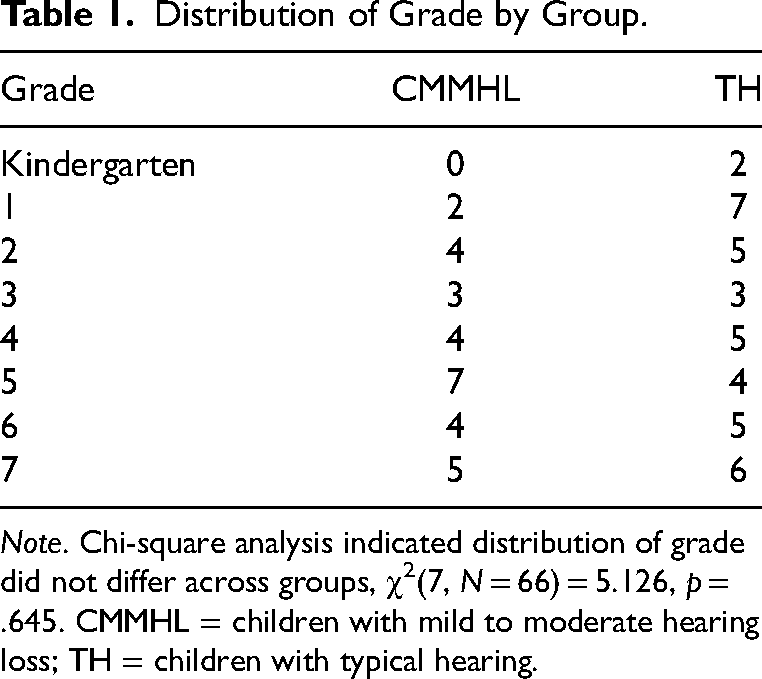
Note. Chi-square analysis indicated distribution of grade did not differ across groups, χ2(7, N = 66) = 5.126, p = .645. CMMHL = children with mild to moderate hearing loss; TH = children with typical hearing.
Distribution of Race Identity by Group.
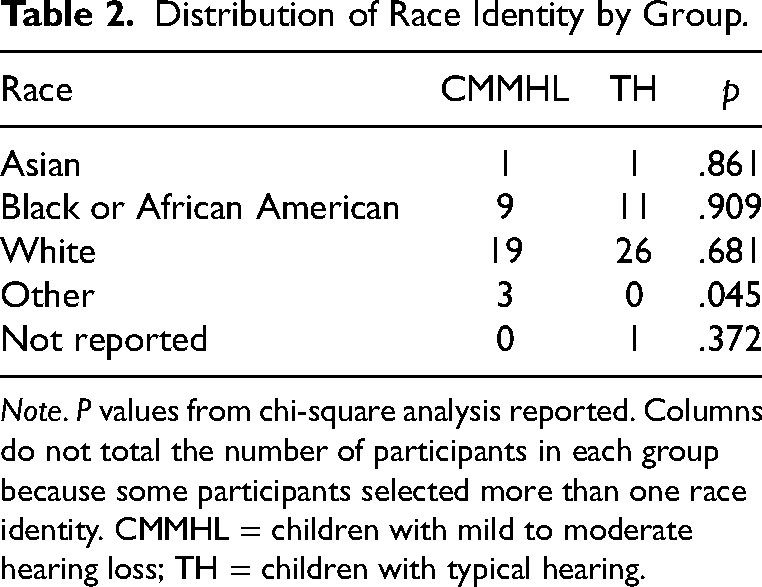
Note. P values from chi-square analysis reported. Columns do not total the number of participants in each group because some participants selected more than one race identity. CMMHL = children with mild to moderate hearing loss; TH = children with typical hearing.
Demographic Measure Standard Scores by Group.
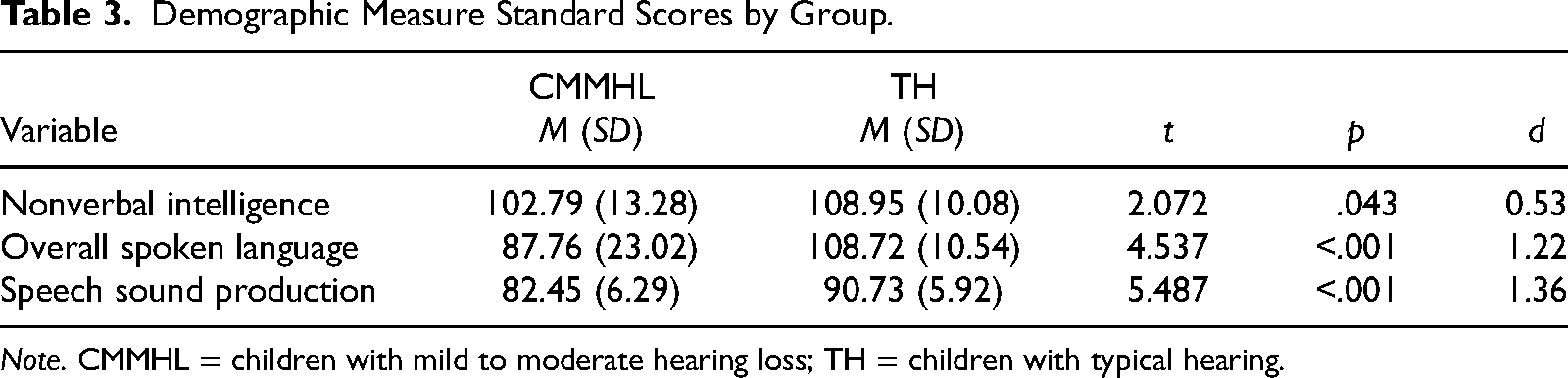
Note. CMMHL = children with mild to moderate hearing loss; TH = children with typical hearing.
In the hearing loss group, average age at identification was 5.58 years (SD = 3.15; range = 0–11; median = 5.83). Average age at first hearing aid was 6.75 years (SD = 3.26; range = 0.67–12; median = 6.58). Better-ear pure-tone average (PTA) was 33.85 dB on average (SD = 12.45; range = 10–55; median = 35), better-ear Speech Intelligibility Index (SII) was 77.50 on average (SD = 14.16; range = 42 −97; median = 80.50), and CMMHL wore their hearing aids on average 6.13 hr at school each day (SD = 2.69; range = 0–9; median = 7).
Measures
Participants completed a battery of language and literacy measures as part of the larger study. Next, we report the measures used in the present analysis.
Descriptive Measures
The Test of Nonverbal Intelligence–Fourth Edition (TONI-4; Brown et al., 2010) was administered to describe participants' nonverbal intelligence (reliability = .83–.89). Children picked from an array of pictures to complete a pattern. The Clinical Evaluation of Language Fundamentals–Fourth Edition (CELF-4; Semel et al., 2003) was administered to describe participants’ overall spoken language performance (reliability = .80–.92). Participants completed the subtests required to calculate the core language score on the CELF-4. The Arizona Articulation Proficiency Scale–Third Edition (Fudala, 2000) was administered to describe participants’ speech sound production performance (reliability = .96). Children named pictures to measure their production of speech sounds within single words. The Test of Word Reading Efficiency−Second Edition (TOWRE-2; Torgesen et al., 2012) was administered to describe word-level fluency skills (reliability = .90–.91).
Outcome Measure
Participants completed both forms of the Test of Written Spelling–Fourth Edition (TWS-4; Larsen et al., 1999) on separate days (reliability ≥ .90). The TWS-4 measures children's ability to spell single words to dictation. Words are spoken aloud, used in an example sentence, and spoken aloud again. Repetitions of the item prompt were allowed as requested by the participant. Standard scores were calculated per test manual instructions for descriptive purposes.
Multilinguistic Coding of Spelling Errors
The primary outcome measure of interest in the present study was a linguistic error analysis of children's misspellings on the TWS-4. Coding followed the multilinguistic coding scheme described in Aho and Werfel (2021). First, all words that received a score of 0 between the basal and ceiling for each participant were transcribed on a scoring sheet (see supplemental appendix). For each misspelled word, the coder classified each spelling error within the word as an error of phonological awareness, orthographic pattern knowledge, mental grapheme representation (MGR), morphological knowledge, semantic knowledge, or other. Each misspelled word could receive more than one error code, but each error within the word received only one code.
Phonological awareness errors were defined as an omission and/or addition of a phoneme to a word or a letter transposition that changed the sound order within the word. Orthographic pattern knowledge errors were defined as an illegal phoneme-grapheme correspondence or an illegal positional constraint of a grapheme. Mental graphemic representation errors were defined as a legal but incorrect phoneme-grapheme correspondence that followed positional constraints or a letter transposition that did not change the sound order within the word. A morphological knowledge error was defined as the omission, addition, or incorrect spelling of an affix or the omission, nondropping, or incorrect spelling of a juncture. Semantic errors were defined as a correct spelling of a real word that was not the target word. Other errors were defined as an error that did not fit any of the previous categories. This code was rarely used and typically involved the use of nongraphemes, such as a numeral, in a word's spelling.
Analysis
Using the previously described coding system, the first two authors separately coded each spelling error. For each participant, the sum of errors within each category and the total number of errors were calculated. Sums were converted to proportions for each participant by dividing the number of errors in each category by the total number of errors for that child. Point-by-point reliability, calculated for 33% of participants, was 85.05%.
To address the first research question, an independent-samples t test was computed to compare the total number of spelling errors between groups. To address the second research question, a Mann-Whitney U analysis was completed. To address the third and fourth research questions, Pearson r correlation analyses were completed; only CMMHL were included in these three analyses.
Results
Research Question 1: Difference in Total Number of Spelling Errors of CMMHL and TH
First, we were interested if CMMHL produced a greater number of spelling errors than TH. An independent-samples t test revealed that the total number of spelling errors did not differ between groups (see Table 4).
Descriptive Statistics for Total Number of Spelling Errors.

Note. CMMHL = children with mild to moderate hearing loss; TH = children with typical hearing.
Research Question 2: Difference in Proportion of Error Types by Spelling Category of CMMHL and TH
Next, we were interested if CMMHL showed a different proportion of spelling errors within linguistic categories compared with their peers with typical hearing. CMMHL had a higher proportion of phonological awareness errors in their spelling than TH. CMMHL also had a lower proportion of MGR errors compared with TH. No other significant differences in proportion of errors emerged between groups for the other spelling error types (see Table 5 for full results).
Descriptive Statistics for Proportion of Spelling Errors by Linguistic Category.
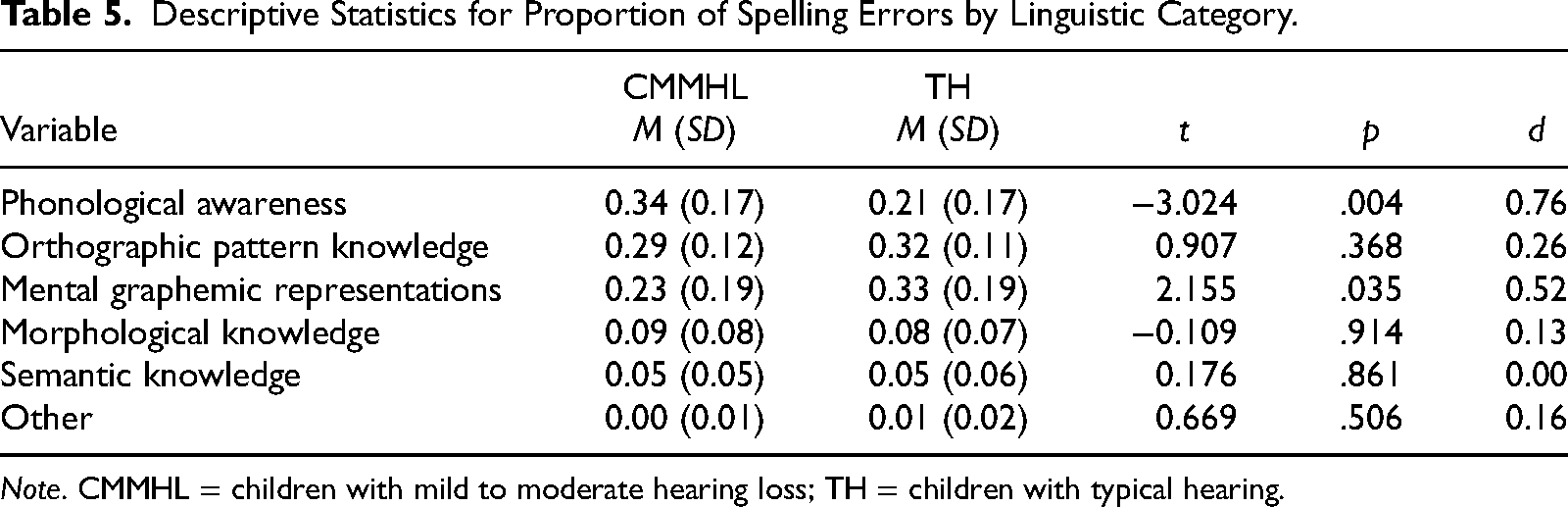
Note. CMMHL = children with mild to moderate hearing loss; TH = children with typical hearing.
Research Question 3: Relation of Spelling Error Types to Linguistic Skills
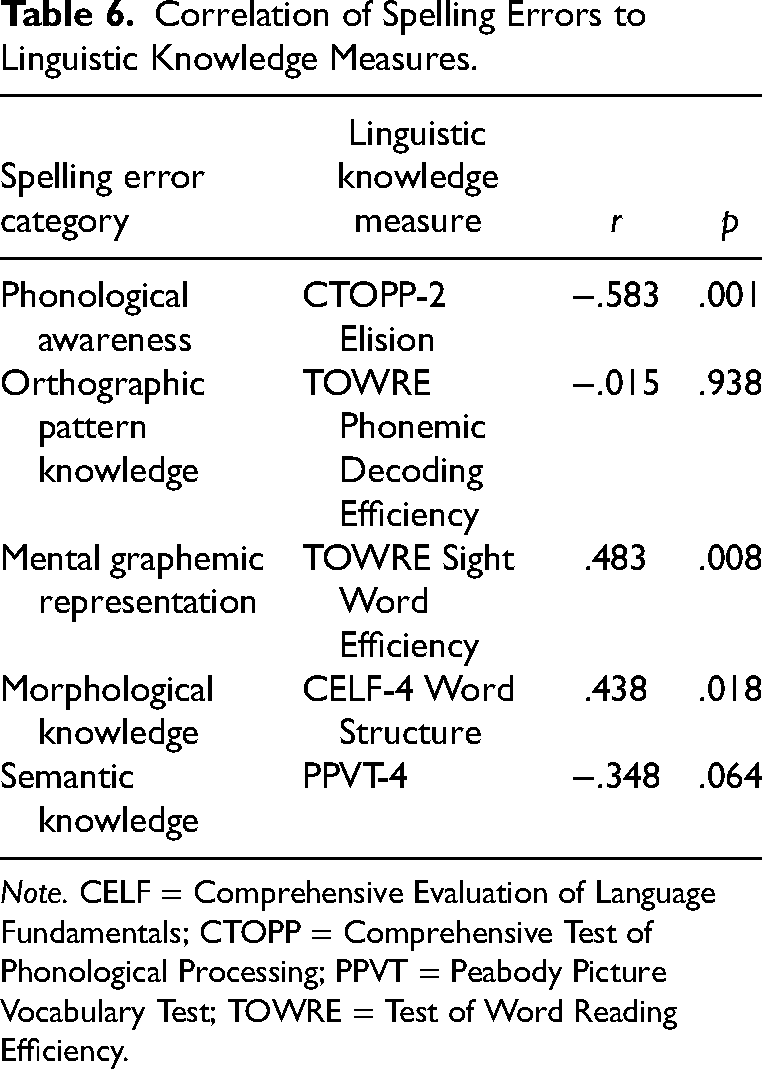
Third, we were interested if the frequency of spelling errors of each type were related to performance on relevant linguistic measures for CMMHL. We used Pearson r correlations for these analyses. Frequency of spelling errors by error type was correlated with performance on standardized measures that assessed corresponding linguistic areas. As seen in Table 6, the number of phonological awareness errors was inversely correlated with their raw score on the Comprehensive Test of Phonological Processing - 2nd Edition (CTOPP-2; Wagner et al., 2013) Elision subtest. That is, making fewer phonological awareness errors was correlated with a higher score on the CTOPP-2. A relationship was also present between number of mental graphemic representation spelling errors and performance on the TOWRE-2 Sight Word Efficiency subtest (SWE). A relationship was also present for both groups between the number of morphological knowledge errors and raw score on the CELF-4 Word Structure subtest; however, as the number of morphological knowledge spelling errors increased, performance on the measure increased. There was no relationship between number of orthographic pattern knowledge errors and performance on the TOWRE-2 Phonemic Decoding Efficiency subtest or the number of semantic knowledge errors and performance on the Peabody Picture Vocabulary Test - 4th Edition (PPVT-4; Dunn & Dunn, 2007).
Correlation of Spelling Errors to Linguistic Knowledge Measures.
Note. CELF = Comprehensive Evaluation of Language Fundamentals; CTOPP = Comprehensive Test of Phonological Processing; PPVT = Peabody Picture Vocabulary Test; TOWRE = Test of Word Reading Efficiency.
Research Question 4: Relation of Spelling Error Types to Audiological Variables
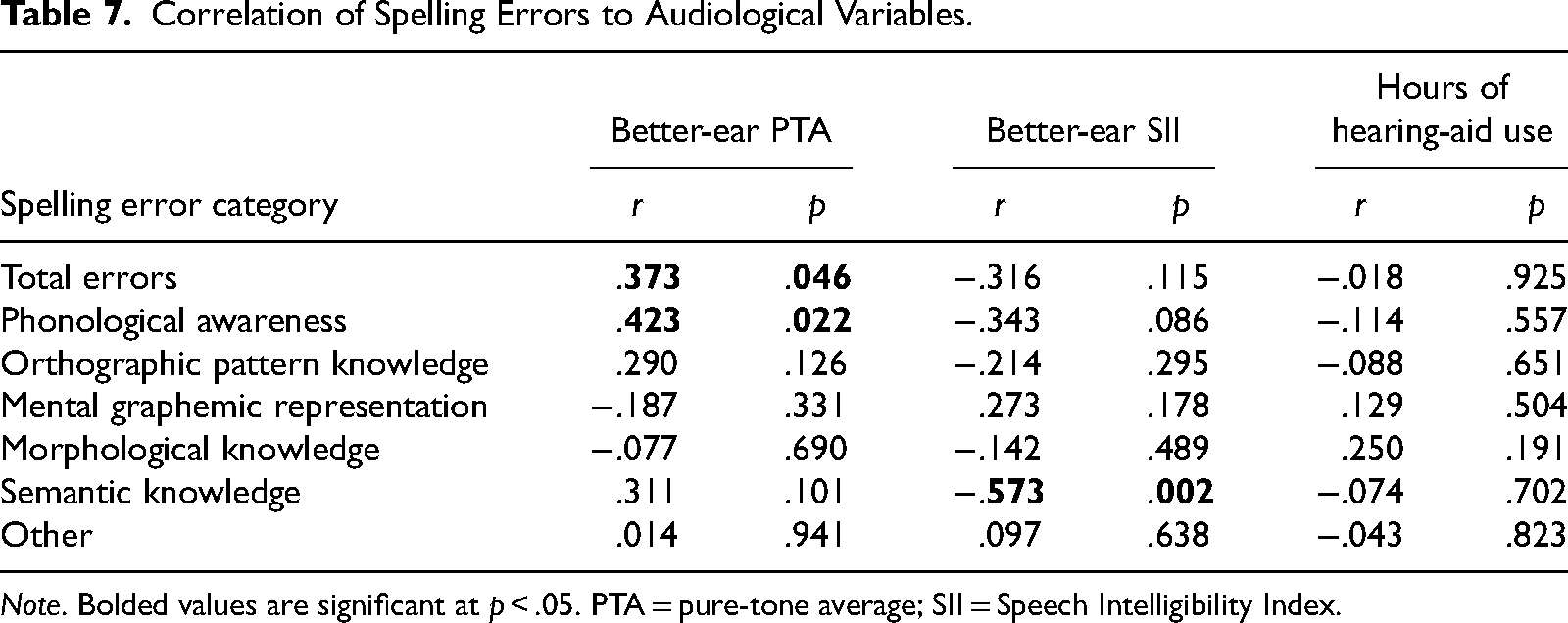
Results were mixed. First, better-ear PTA was related to the total frequency of spelling errors and to the number of phonological awareness errors made by CMMHL, such that lower better-ear PTA (i.e., more audibility) was associated with fewer spelling errors, specifically fewer spelling errors attributed to phonological awareness difficulties. Second, better-ear SII was related only to the number of semantic knowledge errors made by CMMHL, such that higher SII (i.e., more audibility) was associated with fewer semantic spelling errors. In contrast, hearing-aid use at school was not related to frequency of errors of any of the spelling categories. See Table 7.
Correlation of Spelling Errors to Audiological Variables.
Note. Bolded values are significant at p < .05. PTA = pure-tone average; SII = Speech Intelligibility Index.
Discussion
This study investigated error types of CMMHL compared with TH in spelling using multilinguistic coding analysis. Differences between groups were investigated as well as the relation of spelling error types to assessments measuring related skill areas and the relation of spelling errors to audibility. First, we asked if CMMHL exhibited more overall errors than TH. We determined that the overall number of errors between groups was not significant. Next, we investigated whether CMMHL demonstrate a different pattern of errors by error type than TH. We found that CMMHL had proportionally more phonological awareness errors and proportionally fewer MGR errors than TH. Additionally, we investigated if proportion of error types was related to scores on standardized measures that assess that skill area. Differences emerged between groups on correlation between spelling errors and standardized measures. We were also interested in determining if there was a relationship between the number of hours of hearing-aid use at school and spelling error types. Hearing aid use was not related to any of the spelling error categories. Last, we were interested if there a relationship between better ear (PTA) and spelling error types. Better-ear PTA was related to number of phonological awareness errors: Lower PTA was related to fewer phonological awareness errors.
Overall Errors and Proportion of Error Types
No differences were detected in the total number of errors between CMMHL and TH. Both groups exhibited similar numbers of spelling errors overall even though differences emerged upon further analyses of error types. CMMHL had proportionally more phonological awareness errors than TH. This finding is not surprising given previous research that children who are deaf and hard of hearing have delayed phonological awareness skills (Werfel, 2017) and more specifically that children who are deaf and hard of hearing evidence more phonological awareness errors in their spelling compared with TH (Geers & Hayes, 2011; Quick et al., 2021; Straley et al., 2016). A phonological awareness error indicated a mismatch between the number of sounds in a word and the number of phonemes used to spell it. This finding is also consistent with previous findings that for children who are deaf and hard of hearing, phonological awareness errors are more common than orthographic or morphological-based spelling errors (Bowers et al., 2014, 2016).
On the other hand, TH made proportionally more spelling errors that were plausible but incorrect for a given word, classified as MGR errors. An MGR error represented a plausible but incorrect spelling for a given sound combination in a word. In order for an error to be classified as MGR, there must be the correct number of phonemes for the sound (otherwise it would be labeled as a phonological awareness error), and it must be a plausible spelling for that sound (otherwise it would be labeled as orthographic pattern knowledge [OPK]). MGR spelling errors evidence a more attuned phonological system than phonological awareness or OPK errors, because MGR errors must contain the correct number of phonemes as well as logical representations of each of those phonemes. More MGR compared with phonological awareness or OPK errors may indicate a more advanced developmental stage of spelling. These mental representations are developed only after repeated exposure to a specific word (Collins & Wolter, 2017).
One interpretation of our findings is that CMMHL, despite having similar spelling accuracy, have delayed acquisition of spelling that is exhibited via error type rather than accuracy. Alternatively, the differences observed in proportion of spelling errors across CMMHL and TH may indicate different routes to spelling words rather than different stages of spelling acquisition. That is, CMMHL may use a visual approach to spelling rather than a phonological one. It is vital for future work to continue to elucidate the path to successful spelling for children who are deaf and hard of hearing, because this knowledge is needed to maximize the impact of literacy instruction for this population.
Correlation of Standardized Measures and Frequency of Spelling Error Types
Types of spelling errors were then compared with performance on standardized measures that assess related skills for both groups. Group differences emerged. For CMMHL, performance on the CTOPP-2 Elision subtest, a measure of phonological awareness skills, was correlated with phonological awareness errors. As CMMHL scored higher on the CTOPP-2 subtest, they made fewer phonological awareness errors. Higher performance on the CTOPP-2 Elision subtest was indicative of fewer phonological awareness spelling errors.
For both groups, performance on the TOWRE-2 SWE was correlated with MGR spelling errors, and performance on the CELF-4 Word Structure subtest was correlated with morphological knowledge (MK) errors. However, for these correlations, as performance on the measure increased, number of errors also increased. That is, better performance on the TOWRE-2 SWE was correlated with more MGR errors, and better performance on the CELF-4 Word Structure subtest was correlated with more MK errors. As mentioned earlier, the presence of MGR errors indicate a relatively attuned phonological system, as each MGR error represents a plausible spelling for a given sound. Therefore, it is not surprising that a larger number of MGR errors is associated with better performance on the TOWRE-2 SWE. Additionally, a greater number of MK errors may also indicate a more advanced stage of spelling development. Morphological awareness skills continue to develop throughout elementary school years and into middle school (Apel & Werfel, 2014; Berninger et al., 2010).
The correlation of phonological awareness, MGR, and morphological errors with performance on standardized measures of each underscores the utility of linguistic coding analysis on spelling errors to inform areas of weakness and select therapy targets. Our interpretation that the MLC analysis detected weaknesses in linguistic skills was corroborated by standardized testing. This finding lends support to previous studies that have utilized linguistic error coding of spellings to identify weaknesses in linguistic skills (Aho & Werfel, 2021; Apel & Masterson, 2015; Bowers et al., 2014; Quick et al., 2021).
Audibility and Spelling
Hearing-aid use in school was not correlated with number of errors or proportion of the error categories. That is, more time spent listening with hearing aids was not associated with fewer spelling errors overall or fewer error types in any of the error categories. Notably, our measure looked specifically at hours of hearing-aid use during the school day. Maternal education was found to be predictive of hours of hearing-aid use for school-age children who are deaf and hard of hearing (Walker et al., 2015). Therefore, it is possible that the variation of hearing-aid use at school is not sufficient to drive differences in spelling skills.
However, we did find that within the group of CMMHL, differences emerged relating to the association of audiological variables and types of spelling errors observed. Lower better-ear PTA, a measure of unaided hearing levels, was associated with fewer phonological awareness spelling errors. This finding suggests that children with more residual hearing, unsurprisingly, make fewer spelling errors related to the sound structure of words. Additionally, lower better-ear SII was associated with more semantic spelling errors. This finding suggests that children whose hearing aids provide lower audibility make more whole-word spelling errors (e.g., errors in which a child wrote a real word that was not the target word). This finding is consistent with previous research that found SII to be predictive of word and nonword repetition in school-age children with hearing aids (Stiles et al., 2012). Previous work has indicated the importance of aided and unaided audibility for language acquisition (e.g., Tomblin et al., 2020; Walker et al., 2015), and we propose that our findings extend this work to suggest that audibility is also vital for the acquisition of literacy skills. Children with lower unaided audibility appear to be more likely to have difficulty parsing the phonological structure of words. Children with typical development already require a greater signal-to-noise ratio on speech-in-noise listening tasks to match adult performance (Corbin et al., 2016; Nishi et al., 2010). Children with lower SII appear to be more likely to mishear the target word, as evidenced by correctly spelled responses of words that were not the intended target (e.g., shore for “sure”; empire for “entire”), resulting in a larger number of semantic errors.
Clinical and Educational Implications
This study supports the use of MLC for analysis of spelling errors for school-age children. Valuable information was obtained about the development and application of phonological awareness skills in CMMHL, which is relevant for speech-language pathologists (SLPs) and educators working with clinical populations that struggle with literacy skills. This information could be used to develop intervention targets and identify foundational areas of weakness underlying reading difficulties. Furthermore, MLC analysis could be used in conjunction with standardized assessments or as a progress-monitoring tool. There is minimal administration required to complete the MLC analysis; it could be completed from existing written work, such as a writing sample collected from the classroom. In order to complete MLC analysis, SLPs or educators would complete the MLC table located in supplemental materials. The target spelling is written in the first column, with the student's attempted spelling of the word in the next column. Then, each error would be categorized according to error type; see Aho and Werfel (2021) for more details. This analysis would provide more details about students’ linguistic skills and application of those skills to spelling and writing.
Additionally, this study provides evidence that within the range of mild to moderate hearing loss, differences in spelling ability and phonological awareness skills are evident. Professionals working with individuals who are deaf and hard of hearing should be mindful of the spectrum of difficulties that may impact this population. Although hearing thresholds are classified into categorical variables, language-related weaknesses may not be and may be present across the spectrum of hearing difficulties.
Children with lower SII may be more likely to mishear words during a spelling assessment or classroom instruction in general. This finding in concert with the greater signal-to-noise ratio required by children on listening to speech in noise to match adult performance (Corbin et al., 2016; Nishi et al., 2010), and the prevalence of high levels of background noise in classrooms (Picard & Bradley, 2001) suggests that audibility-related deficits for children with even mild-moderate hearing loss may be responsible for a significant portion of academic and literacy-related difficulties. Those working with CMMHL should consider the effects of decreased audibility and monitor speech perception and comprehension.
Summary
The spelling error types for CMMHL were evaluated and compared with those for a group of TH. Results of this study indicate that the number of overall errors were similar for both groups, but CMMHL exhibited more phonological awareness errors than their peers with typical hearing; Better PTA was related to fewer phonological awareness errors for CMMHL, and lower SII was related to more semantic errors, suggesting that audibility is important for children's spelling acquisition and performance. This study supports the use of linguistic spelling error analysis with CMMHL and provides evidence of the relation of types of linguistic spelling errors to linguistic knowledge and audiologic factors.
Supplemental Material
sj-docx-1-ecx-10.1177_00144029241254100 - Supplemental material for Spelling Errors in Children With Mild to Moderate Hearing Loss: Relations to Linguistic and Audiologic Factors
Supplemental material, sj-docx-1-ecx-10.1177_00144029241254100 for Spelling Errors in Children With Mild to Moderate Hearing Loss: Relations to Linguistic and Audiologic Factors by Gabriella Reynolds, Krystal L. Werfel, Sarah Hudgins, Stephen Camarata and Fred H. Bess in Exceptional Children
Footnotes

References
Supplementary Material
Please find the following supplemental material available below.
For Open Access articles published under a Creative Commons License, all supplemental material carries the same license as the article it is associated with.
For non-Open Access articles published, all supplemental material carries a non-exclusive license, and permission requests for re-use of supplemental material or any part of supplemental material shall be sent directly to the copyright owner as specified in the copyright notice associated with the article.
