







Abstract
Professionals play an important role in when and how families access autism services. Black families often experience disparate access to autism services compared to White families. Family Peer Advocates (FPAs) are professionals who have personal experience with the diagnostic process, school-based supports, and community-based services, and provide training and support to families. Understanding the experiences of FPAs may help researchers and practitioners better address the needs of Black autistic children and their families. The purpose of this qualitative study was to explore FPAs’ experiences providing autism-related services and resources for Black families with autistic children. We conducted focus groups with 32 FPAs from two agencies in one southeastern state. Three themes emerged from our inductive data analysis regarding FPA experiences: (a) serving multiple roles; (b) working with “zero resources”; and (c) variations in racial responsivity. Given our findings, we call for FPAs to ensure they are considering and responding to the intersecting impact of race on families’ experiences with autism diagnosis and services.
Autism knowledge and awareness are essential in order for parents, caregivers, and other family members to recognize early autism characteristics and to obtain helpful services (Rivera-Figueroa et al., 2022). Once children are identified, families must navigate autism services, interventions, therapies (e.g., speech, occupational), individualized family service plans (IFSPs), and individualized education programs (IEPs; Pearson et al., 2020). Given these needs, professionals play an important role in when and how families access and navigate autism services and systems (Carlson et al., 2020; Dinora & Bogenschutz, 2018).
Despite the critical role professionals have in supporting families as they navigate disability services and systems, Black families often have disparate experiences with professionals, compared to White families (Bilaver et al., 2021). Black parents typically wait 3 years between the time they first mention a developmental concern about their child to healthcare professionals and the time they receive an autism diagnosis, which is significantly longer than White parents (Constantino et al., 2020). Healthcare professionals, educators, and other service providers are less responsive to the needs of Black parents raising autistic 1 children and are less knowledgeable about autism in historically marginalized populations (Dababnah et al., 2021; Pearson & Meadan, 2018; Pearson et al., 2020; Rivera-Figueroa et al., 2022). Black parents often feel that racial bias infiltrates their exchanges with healthcare providers (Dababnah et al., 2018; Lovelace et al., 2018), that their concerns go unacknowledged or are dismissed (Harry & Ocasio-Stoutenburg, 2020), and that their expertise is not respected (Burkett et al., 2015, 2017). Even when Black families access support groups, they report experiencing isolation, being misunderstood, and being “tokenized” by professionals (Lewis et al., 2022, p. 2022). Weitlauf et al. (2023) found that nearly 25% of the Black and multiracial participants in their study believed that race negatively affected their experiences navigating autism diagnosis and support. These barriers contribute to later autism identification and lower service access, use, and quality among Black families (Rivera-Figueroa et al., 2022; Stahmer et al., 2019).
In addition to the systemic barriers they face in the United States, Black families are often exposed to misinformation about autism and may be less familiar with autism in general (Rivera-Figueroa et al., 2022). Similarly, findings in international studies revealed limited autism knowledge and awareness in historically marginalized populations (e.g., Kandeh et al., 2020). Consequently, limited autism knowledge contributes to disparities in accessing services (Burkett et al., 2015; Lewis et al., 2022; Stahmer et al., 2019). However, when Black parents are knowledgeable about autism and skilled at advocating for their children, they are better prepared to combat systemic disparities, which benefits their children (Iadarola et al., 2020).
Professionals can help families better understand autism characteristics, identify relevant services and interventions, and negotiate systems of care (Jamison et al., 2017; Stahmer et al., 2019). One specific type of professional role is the family peer advocate (FPA). FPAs, who are sometimes referred to as parent educators, are typically employees (or volunteers) affiliated with statewide or local nongovernmental organizations that provide direct support to autistic persons and their families (e.g., state Autism Society, Autism Alliance; Jamison et al., 2017). The exact scope of work and processes for support vary by organization, but FPAs are often community-based professionals who provide training, coaching, and support to parents and family members in a family-to-family model of care (Wisdom et al., 2011). FPAs are distinct from other professional roles because they have personal experience with the diagnoses and services for which they offer support (e.g., parent of an autistic person; Jamison et al., 2017). For example, in this study, all of the FPAs were mothers of children with disabilities. FPA support has been linked to reduced stress levels in Black caregivers of autistic children (Jamison et al., 2017). FPAs can help families advocate for services activities and resources (Harry & Ocasio-Stoutenburg, 2020). However, FPAs’ advocacy efforts can unintentionally strengthen hierarchies and the oppression of families when they are not mindful of the historical ways advocacy has been racialized in the United States (Harry & Ocasio-Stoutenburg, 2020).
While several studies have examined the experiences of FPAs providing support to caregivers of individuals with mental health conditions (e.g., Munson et al., 2009), little is known about the experiences of FPAs supporting families raising autistic children. Understanding the experiences of FPAs may provide insight into the reasons Black families raising autistic children have negative experiences with autism professionals. Therefore, the purpose of this study was to explore FPAs’ experiences providing autism-related services and resources for Black families with autistic children in one southeastern state. Two research questions (RQs) guided this study: (1) What are the experiences of FPAs who provide support for Black families raising autistic children? and (2) to what extent do FPAs feel prepared to address the needs of Black families raising autistic children through parent training?
Theoretical Framework
We employed a DisCrit theoretical framework to guide this study (Annamma et al., 2013, 2022). DisCrit joins elements of Disability Studies (Charlton, 1998) and Critical Race Theory (Ladson-Billings & Tate, 1995), enacting Crenshaw's (1991) intersectionality theory, which identities overlap and intersect in complex ways, some of which may compound discrimination, stigma, or harm. This joining strengthens the limitations inherent in each individual framework. Disability Studies often does not thoroughly consider the impact of race, and Critical Race Studies often does not theorize disability meaningfully (Annamma et al., 2013; Bell, 2006; Blanchett, 2006; Leonardo & Broderick, 2011). DisCrit helps to negotiate the nuanced, conflicting, and interdependent nature of race and disability. DisCrit comprises seven tenets; we draw upon two for this study.
DisCrit Tenet 2 “troubles singular notions of identity,” asserting that holding several markers of difference from societal norms (e.g., race, disability, gender, language) is inherently complex and requires negotiation of multiple stigmatized identities (Annamma et al., 2013, p. 11, 2022; Solorzano & Bernal, 2001). Black families with autistic children navigate both disability and racial landscapes related to diagnosis, services, supports, and interventions for their children. The intersections of disability and race may be experienced in various ways for these families. FPAs must understand this. DisCrit Tenet 3 emphasizes the socially constructed nature of race, ability, and disablement (i.e., as differing from the so-called norm, vs. biological differences; Mirza, 1998), while acknowledging that these social constructions assert “material and psychological impacts” (Annamma et al., 2013, p. 11). Despite being socially constructed, the impact of race and disability (both separate and together) is real. The lived experiences of Black families raising autistic children have implications for how they seek support from FPAs and the extent to which they can obtain high-quality services. Therefore, DisCrit was instrumental in shaping the study development, data collection, and analysis.
Method
We conducted focus groups with FPAs from a large, autism-specific nonprofit agency and a federally funded parent training organization in one southeastern state. We employed a generalist descriptive qualitative method to guide our discovery, whereby we attempted to understand the experiences of a specific population by gathering perceptions (Lauterbach et al., 2022). We received institutional review board approval before the start of data collection and aligned our study with quality indicators in special education research by conducting member checking, triangulating data, forming a diverse research team, and providing thick descriptions of themes (Brantlinger et al., 2005). The authors had no relationship with either organization outside of the study.
Positionality and Reflexivity
Our research team is racially, culturally, and neurotype diverse. We also represent a broad range of professional experiences and expertise related to special education, psychology, clinical mental health, and family engagement. The Principal Investigator (PI; first author) and third author are faculty members in special education who both served in family resource roles before roles in academia. The second, fourth, and fifth authors are doctoral students in educational equity who contributed to data collection, analysis, and manuscript development. All three doctoral student authors are parents of autistic children; one doctoral student author identifies as an autistic woman. Four of our research team members are Black, and one author is White. We each brought a variety of experiences to data analysis, including experiences as autistic individuals navigating services, family members advocating for Black autistic children, and practitioners supporting families raising autistic children.
Throughout our study, we engaged in reflective conversations regarding our identity and assumptions in designing and implementing this study (Brantlinger et al., 2005; Trainor & Graue, 2014). This led to a continuous revision of our focus group questions and thematic analysis. We also shared and received feedback on our methods and results from critical friends who were not part of the research team but who had experience in supporting caregivers raising autistic children (Baskerville & Goldblatt, 2009).
Participants
Recruitment
We used purposive sampling to recruit study participants, which is non-probability sampling used to identify specific groups of participants with similar characteristics (Onwuegbuzie & Collins, 2007). After obtaining institutional review board (IRB) approval, we contacted the directors of two statewide autism family support organizations and asked for their assistance in recruiting participants. One organization offered direct support specifically to autistic individuals and their families. The other organization was an education center that provided direct assistance to family members raising children with disabilities. Both organizations served families of all racial and ethnic backgrounds. We did not require participants to serve a certain number of families or a certain percentage of Black families to participate. FPAs from these organizations support parents at various stages of autism service provision, including before and after receiving an autism diagnosis.
Directors of these organizations contacted FPAs on their staff and invited them to participate in a focus group interview. We then sent FPAs a Doodle poll (www.doodle.com) with potential focus group dates and times; interested FPAs selected the focus group that worked best for their schedules. Participants received a $60 honorarium for their participation.
Demographics
Our study took place in one southeastern state where Black people comprise 22.3% of the population (United States Census Bureau, 2021). A total of 32 FPAs from two large family support organizations in one southeastern state participated in one of five focus groups. Focus group sizes ranged from 5 to 7 participants. FPAs served a variety of roles in their respective organizations. All FPAs had a child with a disability; the majority of the FPAs had a child with autism (n = 28; 87.5%). Most participants identified as white (n = 24; 75%), which reflects the racial makeup of the autism service professional workforce (e.g., Behavior Analyst Certification Board, 2022; National Center for Education Statistics, 2022). Most participants held a bachelor's or master's degree (n = 24; 75%). On average, participants had 17 years of experience supporting families (See Table 1). Twenty-three participants supported parents directly (daily interaction with families), six coordinated group meetings with families, and three were directors or managers in their respective organizations. The managers and directors did not support families directly, but supervised staff members who did.
Participant Demographics
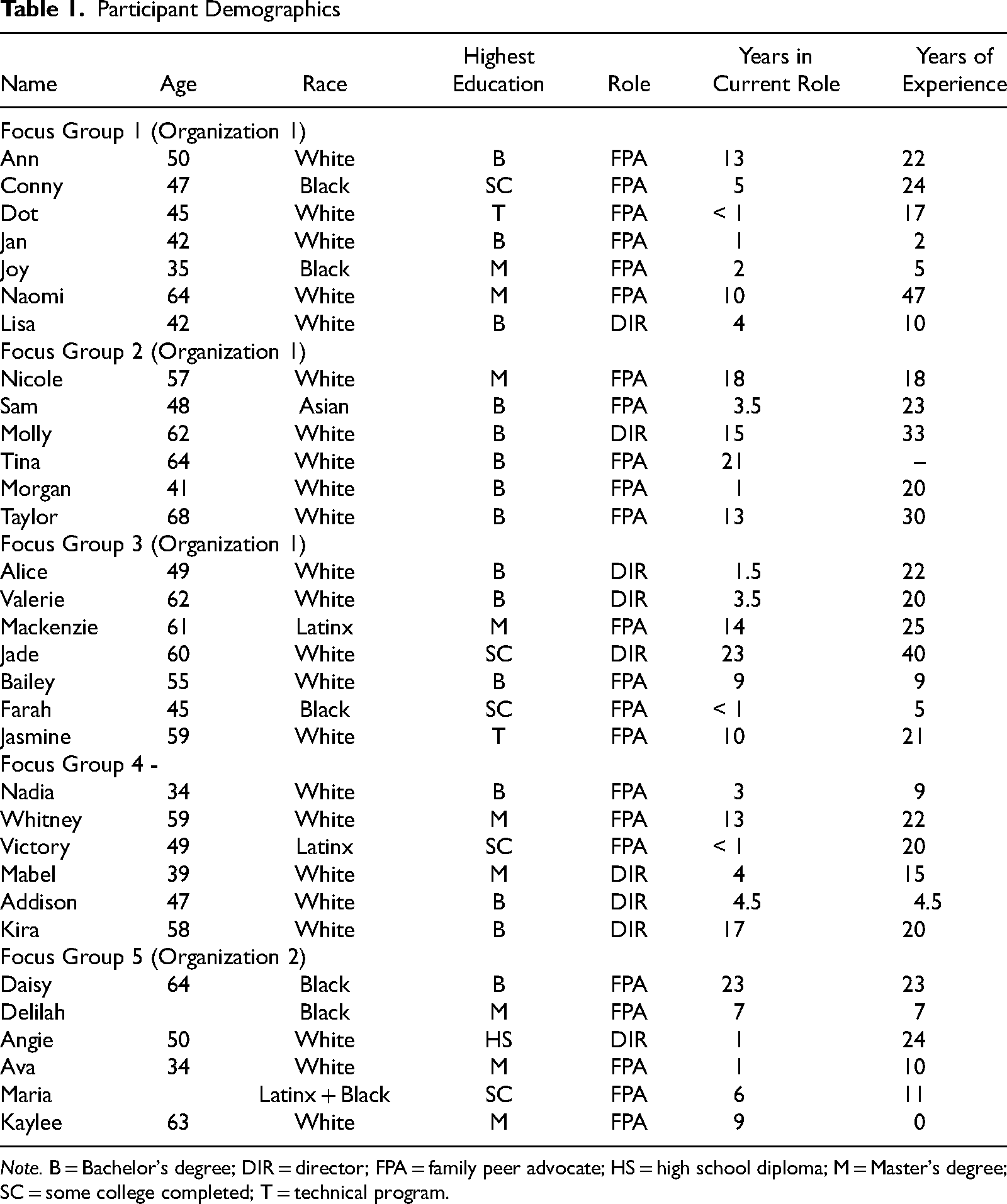
Note. B = Bachelor's degree; DIR = director; FPA = family peer advocate; HS = high school diploma; M = Master's degree; SC = some college completed; T = technical program.
Data Collection
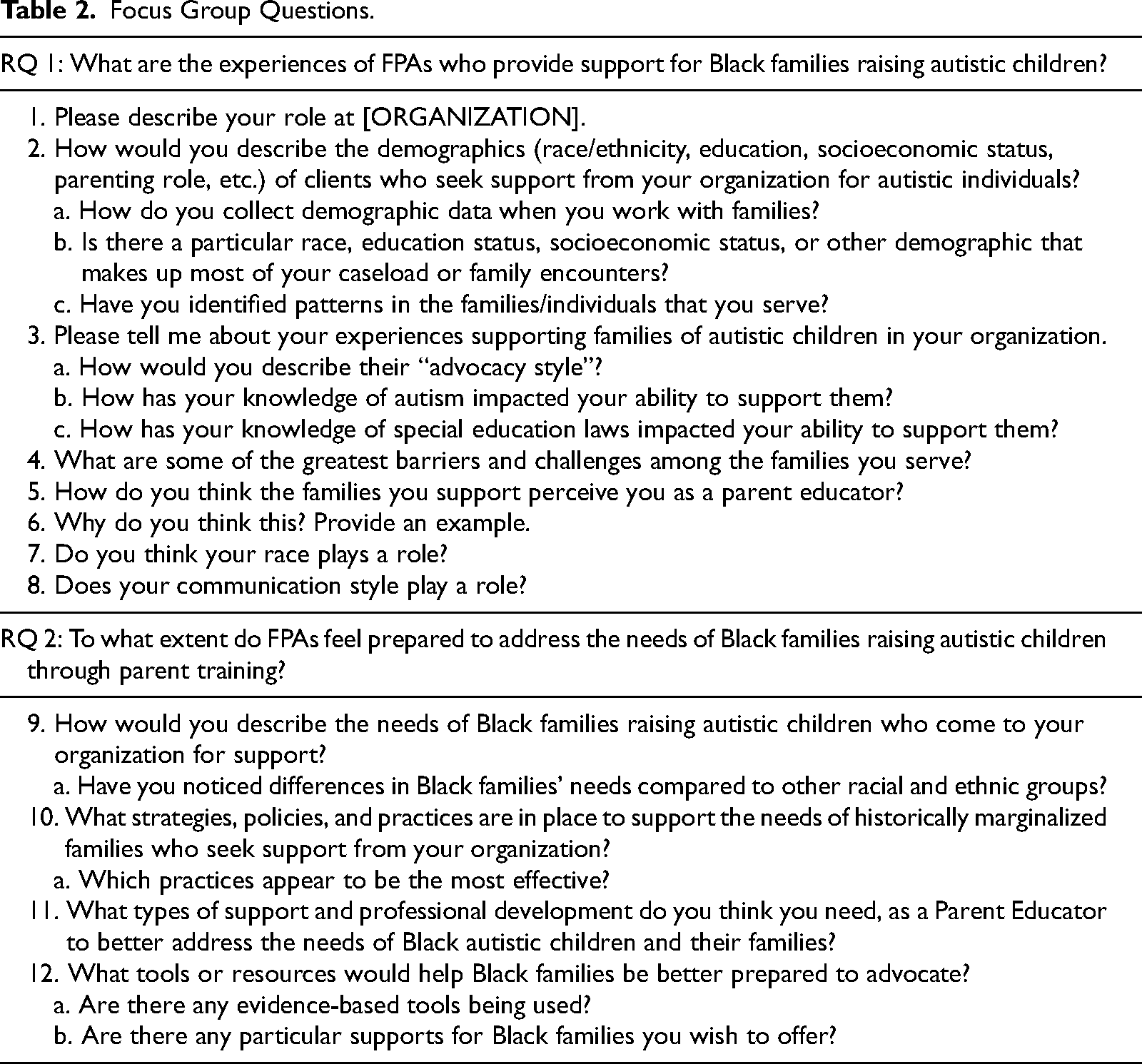
We obtained written informed consent from participants prior to beginning the focus groups. We developed a focus group protocol that included 10 open-ended questions designed to address our two research questions (see Table 2 for this protocol). We drew from the two DisCrit tenets in our theoretical framework to create the questions, which probed FPAs’ social constructions of race and dis/ability and their experiences supporting families who were navigating multiple stigmatized identities (Annamma et al., 2013). A semi-structured method guided our focus group procedures (Kvale & Brinkmann, 2015). The first author conceived the research questions, planned the study, and led recruitment efforts. The second and fourth authors conducted the focus groups. Focus groups were conducted via Zoom video conferencing (www.zoom.us) in December 2021. First, the focus group leaders thanked the participants for joining. Next, the leaders asked participants each question in the protocol in the same order and provided opportunities for all participants to answer. When needed, leaders asked clarifying questions (e.g., “could you explain more?”) or prompted the group to extend the discussion (e.g., “would anyone else like to share an example?”). While we asked specific questions about supporting Black families, we did not operationalize “Black families” for our participants to allow them to conceptualize Black families in their own way. Focus groups lasted between 60 and 120 min (M = 103 min). After completing all questions, leaders thanked the participants for their time and ended the meeting.
Focus Group Questions.
Data Analysis
We illustrate our data analysis process in Figure 1. The focus group interviews were transcribed via Zoom and Otter.ai and verified by two research team members. After transcription verification, two researchers (i.e., second author, fourth author) coded the five focus group transcripts using an inductive open coding method (Saldaña, 2021). Together, the researchers generated 85 codes. Next, the authors met to discuss their codes and collaboratively refine codes. The authors came to an agreement if their codes were disparate. There were between 0 and 5 coding discrepancies per transcript (M = 3). The pair consolidated the codes through dialogic consensus (Kvale & Brinkmann, 2015) into 23 codes and created a new codebook with definitions incorporating facets of both codebooks. This was achieved by examining commonalities between codes and grouping codes that described similar phenomena to reduce repetition. For example, “Several Roles” (second author code) and “Jack of All Trades” (fourth author code) became “Multiple Roles.” We list the key themes, example codes, and definitions in Table 3.
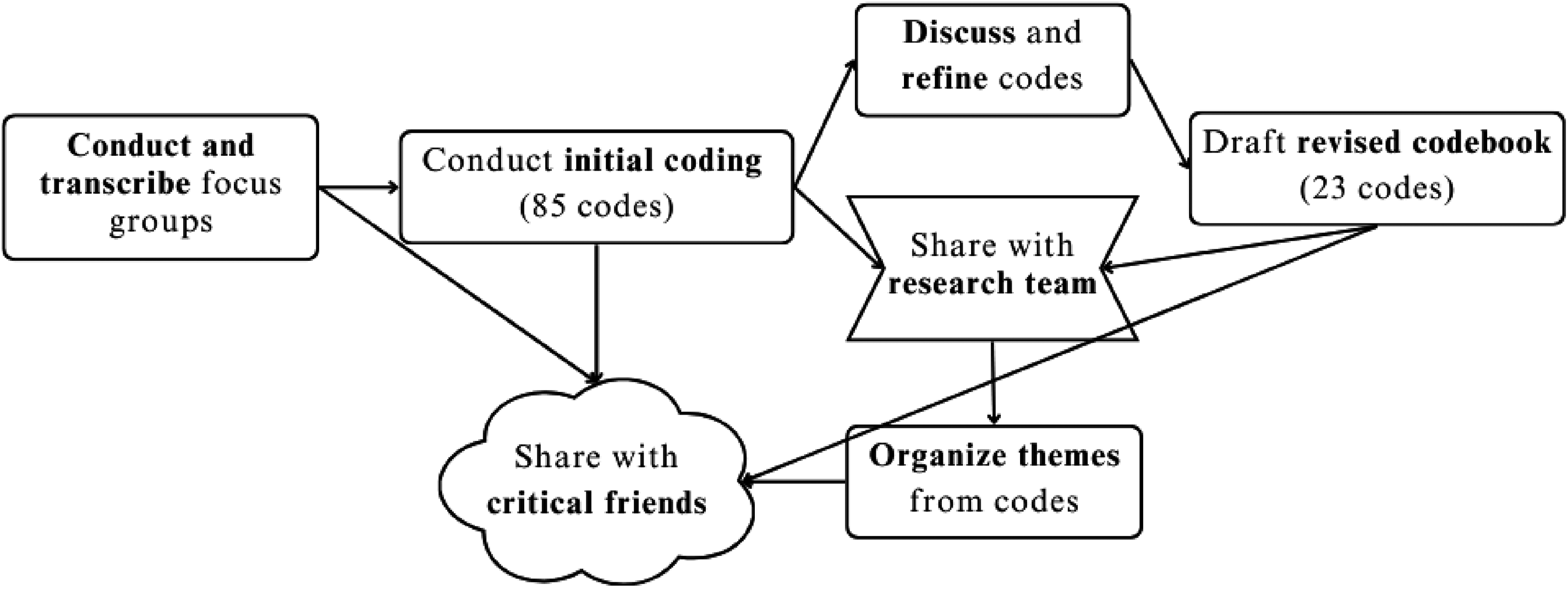
Coding Process
Themes, Codes, and Definitions
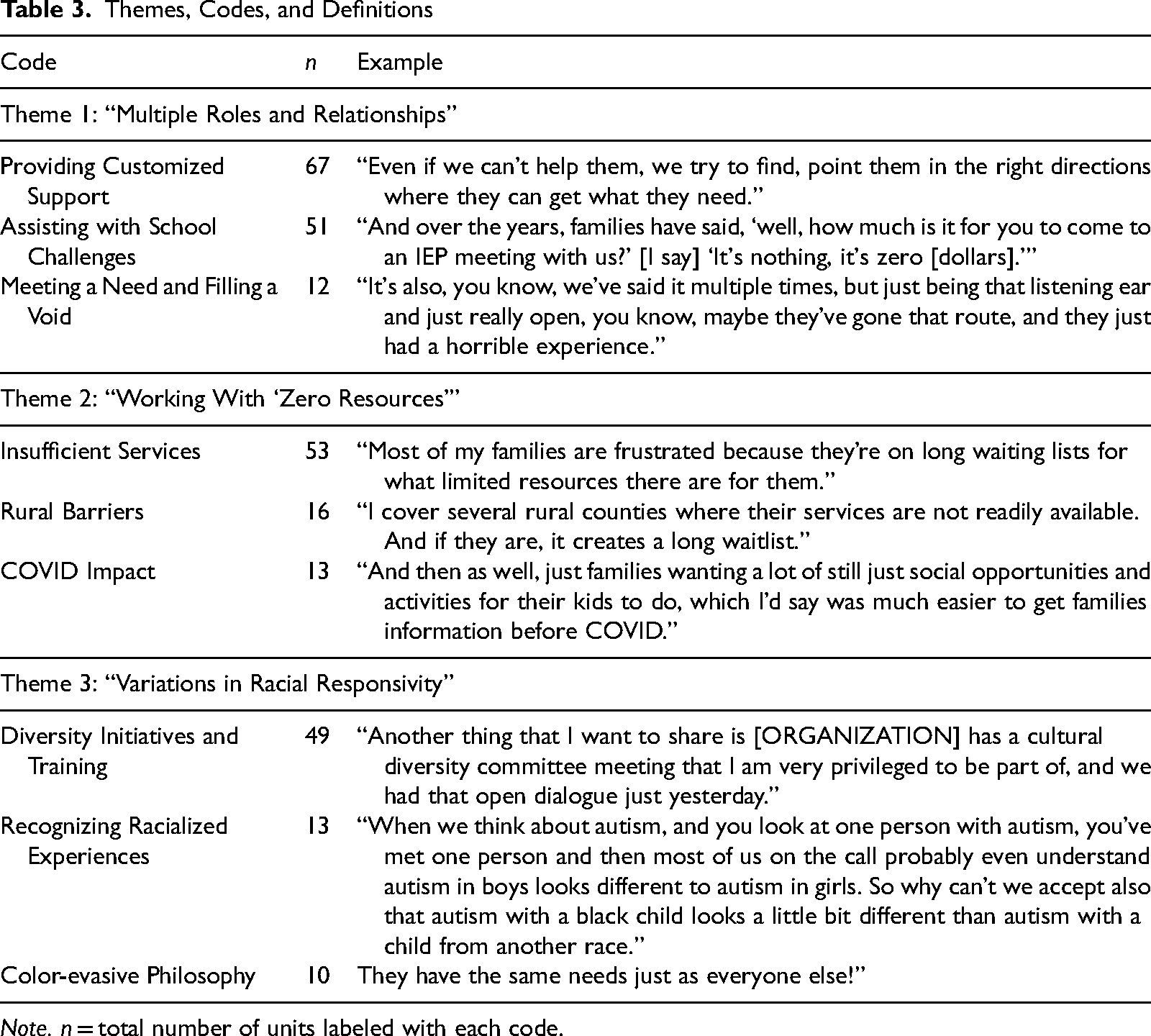
Note. n = total number of units labeled with each code.
Next, the pair reread each transcript to ensure units were coded appropriately. We also reread the transcript to identify any disconfirming data within each code. At each stage, the pair shared the data analysis method and codebook with the first and third authors; these team members served as a form of triangulation and verification (Brantlinger et al., 2005). Last, the coding pair brought the final code list to the team. As a team, we discussed patterns in the data and connections between participants’ experiences and our theoretical framework. We sought to identify if and to what extent the codes substantiated or contradicted these DisCrit tenets. We dialogically formed three themes that best organized and represented the codes and major findings and contributions.
Member checking
After generating themes, we randomly selected one participant from each focus group (n = 5) for member checking (Birt et al., 2016). We sent our final themes, definitions, and evidence to these participants and asked them to confirm or revise the themes. Four participants responded and confirmed that the themes were valid and representative of their respective focus groups.
Results
Through our study, we sought to identify the lived experiences of FPAs who provide support for Black families raising autistic children. We report themes based on the research question they address. Three themes emerged related to FPA experiences supporting Black families: (a) serving multiple roles, (b) working with “zero resources,” and (c) variations in racial responsivity.
RQ 1: What are the Experiences of FPAs who Provide Support for Black Families Raising Autistic Children?
Multiple roles and relationships: “We’re the Swiss Army Knife”
FPAs often described their ability to align the level and type of support they provide with the stated or perceived needs of each family they worked with. For example, Ann reflected on her multifaceted role: “We are part lawyer, part therapist, part, you know, autism, I don’t want to say ‘autism expert,’ part teacher, part … we’re the Swiss Army knife, so to speak, we do a little bit of everything.” Jan recounted, “I’ve met people at McDonald's to get paperwork done, you know, we just find out whatever resource they’re in need of is what we try to do for them.” Later in the same group, Naomi echoed, “I’ve gone to the YMCA with a family whose child disrupted the Y, and we help them [i.e., the staff] understand and find ways to accommodate this family.” Tina shared how their ability to connect families and service agencies aids parents: [For] some of them I might go to every single IEP [meeting] they ever have. And I think, you know, when we’re talking to them on the phone or sitting down with them, and they’re telling us our concerns, we’re bringing all that [information] into the meeting. Parents get into the meeting and can’t process it all and they can’t necessarily describe what their concerns are. And so we can kind of jump in and say, “Well, you know, when we were talking, this is what you said was really important to you,” and, you know, trying to give that perspective to other professionals who may not really fully understand a parent's perspective. I think it starts with, you know, actually validating experiences. And that helps to gain trust. And trust is so useful. And, you know, building those relationships, whether it's the parent's voice, or the actual child themselves, their voice, you know, just knowing that people come from history, and we learned from our parents. I know there are lots of people who are feeling bias or thinking that they are experiencing bias, and then that's invalidated for them. They’re told not to trust their own instincts in their own gut, in situations when they know differently. As a Black person, and you know, as a mama, I know that one of the things that I feel is that I had to overcome a lot of stereotypes and stigma and myths related to autism, just in my own community and my own, you know, family—and so, education, we need education, we need people to normalize these experiences that we can relate to, whether that's through representation [and] other Black people just saying, “Hey, I was there too.”
Several participants shared similar experiences. Angie said, One thing as far as us parent educators [go] is that we already come to the table with lived experience, and so the families that we are serving, you know, we’re very genuine with them. It's like, we get it, we’ve been there, we’ve done that or we can, you know, understand because we have experiences.
Similarly, Victory offered, But I also have a child under the spectrum [and] that definitely helps when you are talking to these families, to feel our support, and to feel understood, to just to feel that you can listen to them. A lot of times, that's the first step: they just want to find someone that can put themself in their shoes, listen, and understand what they’re going through.
FPAs described the process of building trust as a task that is expected of them in their role, and also a necessary first step in working with a family. Trust-building existed as a separate task outside of service identification as their role did not end with empathy and trust. FPAs often found themselves helping families address communication gaps as well. As Taylor stated, “at the IEP meeting, sometimes we are the bridge because communication is broken down between the school and the parent.” We found no disconfirming data for this theme.
Working with “zero resources”
When FPAs described the multiple roles in which they supported families, they often transitioned to discussing the limited availability of resources. This served as a principal frustration for FPAs. Tina conveyed, “I see our lack of resources, especially in rural areas. In my more rural counties, there are just some counties that there are zero resources.” Bailey stated: I cover 13 counties in the Eastern Region, and most of them are very rural and have … lack any services whatsoever out there, they [i.e., families] have to drive to bigger cities or larger cities to get any kind of services.
Bailey admitted, “Now I send a lot of people across state lines because [big city] and [big city] and [big city] are often closer than driving to [big city] or [big city].”
Sometimes, the insufficient resources were related to actual services and information about the services. Jade shared, “Okay, I definitely saw that they … families who … Black families and Hispanic families, but mostly the Black families at that time did not either have access to us or even knew about us.” Participants believed there were overall insufficient resources for families, but two areas emerged more often. First, participants lamented insufficient diagnostic resources. For example, Nadia offered, “There's more people needing a diagnosis than there are providers who are qualified to give the diagnosis. So then you have those waitlists that are like, you know, 8 months, all the way upwards to 12 [months] depending … which is a real struggle, and it's heartbreaking to tell families that when they call and [you have to] give them that information.”
While many families planned trips out of the area to seek services, FPAs revealed that families were left on their own if crises occurred in between scheduled visits. Tina professed, “I have people that I worry about and families in crisis that we can’t find assistance for and situations that just keep me awake at night. So, um, yeah, it's rewarding but also stressful at times.”
Sometimes, families in remote locations did not have equitable access to technology, which served as another resource barrier for families. For example, Morgan stated, “Technology is a serious barrier. That's been major, especially with COVID [-19]– everybody's relying on technology for receiving so many different things.” Similarly, Angie reflected: “Now we’re in a digital age, but these folks are in the part of the state where they don’t have technology or internet access.” Mabel offered: It's come up the past couple months—we have concerns [that] a lot of our families aren’t on Facebook. And a lot of the ways we communicate chapter information and present [information], you know, some chapters may be doing social events to bring families together, they may be doing an educational presentation, or we could even advertise what [ORGANIZATION] as a whole [is doing], like what webinars are going on, and they can tune into. But, you know, some of our … our Black families aren’t on the computer, they don’t have a computer or they have very limited internet access, especially in rural areas.
While FPAs enjoyed sharing information and resources with families, their support was often limited by the medical, therapeutic, and technological resources available in the area. We found no disconfirming data for this theme.
RQ 2: to What Extent do FPAs Feel Prepared to Address the Needs of Black Families Raising Autistic Children Through Parent Training?
Variations in racial responsivity: “Can we support each other across racial lines?”
During the focus groups, we asked participants several questions about the extent to which they felt prepared to support Black families. We sought to capture how FPAs’ understood the intersections of race and disability, and their appraisal of the tangible and intangible impacts of race (Annamma et al., 2013). Participants shared variations in their beliefs about and approaches to supporting Black families raising autistic children. These differing beliefs and approaches sometimes contradicted each other. Together, these perceptions suggested significant differences in how FPAs understood and responded to the impact of race in their work with Black families. Some participants described how the interplay of race and disability created additional barriers for families. For example, Amanda recounted, There are some IEP meetings where I’m supporting a Black family, [and] all the teachers are white, [and] I’m white. I’m very cognizant of that at that moment and really making sure I’m advocating for the parent's perspectives and needs, you know, specifically. And then there are times where the parents are Black, all the teachers and staff are Black, and I’m the only White person in the room and I have to be, you know, sensitive about that as well. … And know that, you know, my life experience is going to be maybe different, you know, as far as you know, I don’t know, emphasis on, whether it's education or expectations with behaviors, and it's just so many cultural differences. Some of them are racial and some are not, but, you know, I think we always have to be aware of that. I have a close friend, and our kids are the same age. My son maybe has a little bit more severe behaviors. They’re both in the same school district. My child's never been suspended. Her child has been suspended probably like 15 times. Rather, they’re not being heard. I can’t tell how many parents have said that something has happened and people said things to them, and they had to intentionally restrain themselves from responding because they didn’t want to fit some stereotype of the angry Black woman. You know, [that] kind of thing, it's like, you know, this person did the same to my kid or said something to me, that was just really disrespectful, or whatever, but I couldn’t really address it directly because I didn’t want them to pigeonhole me and stereotype me. I would describe the needs of the Black families that I’m working with as, they tend to need more hand-holding I guess, or more … maybe their education isn’t as … they haven’t had a lot of formal education. And, you know, maybe the expectations are different. And … I have encountered quite a few Black families that are in environments that are not conducive to … I don’t know how to say that politically correct[ly]. Maybe, you know, they’re in drug-related environments, or they have family members or, you know, that they’re struggling with … maybe I’m trying to say they have other issues besides just autism or a child on the spectrum that they’re dealing with, that pulls their attention in many different directions.
However, others opined that race was not a factor in service access needs or use. For example, Jasmine, a White FPA, said, “So I feel the needs are the same, regardless of the ethnic background, and for the majority of my calls, their needs are very similar.” Similarly, Angie, also a White FPA, reflected, “Yeah, this [question] was a hard one, because the folks that contact us, I don’t know that I can say the needs differ because of being White or Black.” Maria, a Black and Latinx mother added, “I agree with my coworkers: for me it's not about, like, what is the race of the family when they call us, it's about [how] to attend to their needs and support them.”
Several participants described addressing the impact of race as an organization. Kaylee shared, We have, as an agency, tried to address the question of how are we serving Black families [and] families of color with some specific activities. We had some training from within our agency that we talked among ourselves, and we’ve had training from an outside group.
Jade shared their experience of reaching out to historically Black faith communities: And so, you know, we’ve had an opportunity over the years as things have grown within our agency to develop workshops like ‘Faith in the Communities,’ which is a training for faith communities who want to serve our individuals with autism, and I’ve done several of these workshops for mostly Black churches, and they really were very receptive.
Amanda described how staff from her organization engaged in conversations about racial equity: Can we support each other across racial lines? It's just sort of an interesting question and something we’ve really grappled with. We—you know, we want to include everybody, but you know, [we’re] still trying to figure out what's the secret sauce to bring everybody together.
However, some participants were unsure how to address race and culture with families they supported. For example, Kaylee, a White woman, admitted, I believe that where I feel stuck is I know that there are differences in the special education world and in education and that people of color do have different experiences. I still don’t really know how to broach it or bring it up if a family doesn’t outright state it.
In reference to the cultural responsiveness training offered by her organization that she mentioned earlier in the interview, Kaylee went on to share: I feel like we’re missing it and we are, as a group, committed to learning more about how to do this, but it isn’t something we are doing right now. … I think we do need training. I don’t know what it is.
Throughout the focus groups, FPAs shared varied perceptions of ways they believed race did or did not influence families’ experiences. Although FPAs’ organizations had addressed racial disparities through training, some FPAs believed there was more work to be done. These varied appraisals of the interplay of race and disability became a theme in and of itself.
Discussion
Within semi-structured focus groups, FPAs shared their experiences and perceptions of supporting Black families raising autistic children. FPAs viewed their primary role in supporting Black families raising autistic children as to craft customized support—and play multiple roles—to meet the needs of each family and connect them to resources, services, and information. FPAs viewed their role as being knowledgeable, familiar guides who have traveled the same road as the families they support. However, even with this knowledge and experience, FPAs described how Black families experienced barriers such as limited community resources and racial bias from autism service professionals. These barriers impacted all families but were more pronounced for Black families, who FPAs believed were less likely to be aware of the services provided by the FPA's organization. According to FPAs, these systemic barriers often diminished the support they could offer Black families. This echoes previous findings indicating that Black families experience greater challenges accessing autism services (Dababnah et al., 2021; Drahota et al., 2020; Pearson et al., 2020). Further, the study suggests that having an experienced peer to assist in navigating services and identities is, in and of itself, not enough to surmount the resource scarcity and stigma that Black families may encounter (Annamma et al., 2022).
Our observed lack of a cohesive position or process for supporting Black families was notable. Rather than bearing witness to the ways caregivers were impacted by multidimensional identities of race and disability (Annamma et al., 2022), FPAs disagreed on whether or not these constructions caused impacts. Some FPAs acknowledged the impact of multiple marginalized identities (e.g., disparate treatment by school staff) or their attempts to support families negotiating these barriers. Others alluded to a color-evasive ideology, which asserts that individual differences in race, culture, and ethnicity should be ignored in favor of treating individuals as equally as possible (Annamma et al., 2017). Statements such as, “I feel the needs are the same, regardless of the ethnic background,” “I don’t know that I can say the needs differ because of being White or Black,” and “It's not about, like, what is the race of the family when they call us…” hinted at this belief. This belief denies and invalidates the lived experiences of racially marginalized families (Yi et al., 2022) and illustrates the perceptions of Black families (Dababnah et al., 2021; Rivera-Figueroa et al., 2022; Weitlauf et al., 2023). As Neville et al. (2013) attested, practitioners should not confuse the phrase “race should not matter” with “race does not matter.” FPAs who do hold the latter understanding may not be prepared to identify the overlap of multiple minoritized identities nor the tangible and intangible impacts of such (Annamma et al., 2013, 2022).
Participants’ varied perspectives did not occur along racial lines, suggesting FPAs of all races may hold color-evasive views. Understanding, communicating, and confronting the impacts of both disability and race continues to be an urgent need in supporting Black families with autistic children. Autism service providers must be culturally informed and engaged (Lewis et al., 2022) and demonstrate cultural humility (Broder-Fingert et al., 2020; Ramclam et al., 2022). When FPAs employ cultural humility, despite the potential of discomfort, they position themselves to learn about how Black families experience race, racism, discrimination, and disability (Tervalon & Murray-García, 1998). It is incumbent upon FPAs supporting Black families to listen to, acknowledge, and appreciate the racialized experiences and histories of these families, thereby informing the ways they co-construct advocacy with them (Harry & Ocasio-Stoutenburg, 2020). All FPAs communicated their eagerness to support families, but not all were prepared to support families navigating the impacts of comingling race and disability (Annamma et al., 2013).
Implications for Policy
Although FPA knowledge and guidance are helpful (Jamison et al., 2017; Stahmer et al., 2019), targeted efforts at the systemic level are critical to removing barriers Black families may experience. To build on Taylor's analogy, organizations must not only provide a bridge for families but also ensure there are equitable resources and racially and ethnically diverse staff on the other side. This may be realized through (a) providing and mandating ongoing professional development on culturally responsive and anti-racist service delivery for FPAs (as well as other family service providers), and (b) reviewing FPA recruitment practices to remove barriers that may prevent Black FPAs from serving in this role. Further, organizations must explore strategies to mitigate geographic limitations on service access. As Stahmer et al. (2019) noted, professionals hold a responsibility to share culturally appropriate information with communities to build empowerment and dismantle stigma. FPAs must be an active part of this work.
Implications for Practice
FPAs must acknowledge the historical construction of race and disability and be mindful of these intersections and their impact on how families navigate advocacy (Harry & Ocasio-Stoutenburg, 2020). Rivera-Figueroa et al. (2022) argued that “researchers and clinicians alike must acknowledge and remain mindful of the profound role that racial and ethnic biases play in both autism research and clinical practice” (p. 54). We extend this argument to FPAs, who must also be aware of the mediating role race can play in the experiences of Black families with autistic children. While Black families may not convey unique autism-related needs, they will likely have unique autism-related experiences. FPAs can affirm these experiences and attribute them to forces of oppression (Annamma et al., 2022), rather than familial factors (e.g., limited formal education or advocacy knowledge). Advocacy efforts can be strengthened when, as Harry and Ocasio-Stoutenburg (2020) suggest, FPAs engage in the “co-construction of advocacy” with parents versus advocating on behalf of parents without an appreciation of how disability and race have informed their experiences (p. 2). Culturally-affirming FPAs can co-construct advocacy by asking questions about intersectional experiences to better understand how race, disability, and other identities intersect within the lives of the families they support. Questions such as, “Have you felt like you were treated unfairly by an autism professional?” may forge new understandings between FPAs and parents so that FPAs and parents can, as Amanda voiced, “support each other across racial lines.” The familial benefits of an FPA partnership can be further enhanced when FPAs engage in cultural humility and responsiveness, supporting families as they navigate racialized experiences related to autism screening, diagnosis, and supports.
Implications for Research
Researchers must contribute to the efforts to build bridges for Black families raising autistic children. Historically, Black families have been underrepresented in autism research (Shaia et al., 2020). Additionally, autism researchers do not always report racial and ethnic demographic data (Pierce et al., 2014; Steinbrenner et al., 2022). Therefore, researchers should consider three specific strategies to better explore and help address the barriers that Black families raising autistic youth experience. First, researchers must be intentional about recruiting Black participants for family-centered interventions. These efforts might require recruiting participants in non-traditional ways, such as through faith- and community-based organizations (see Pearson et al., 2021). Second, researchers must design and implement anti-bias and anti-racist interventions to better prepare professionals to meet the needs of Black autistic children and their families (see Cormier & Scott, 2021). FPAs and related service providers who support Black families raising autistic youth require training that is twofold: (a) the training should include strategies for engaging in anti-racist approaches to service delivery, and (b) the training should strengthen providers’ agency and empowerment to feel comfortable discussing and addressing barriers related to their families’ marginalized identities. For too long, the onus has been on historically marginalized families to combat systemic barriers; researchers have the capacity to shape these experiences by developing and testing the promise of interventions for professionals who serve Black autistic children and their families. Third, researchers must build teams that are racially, ethnically, gender, and neuro diverse (Malone et al., 2022). Recruiting racially and ethnically diverse participants (especially for intervention research) requires a diverse research team. As Bal and Trainor (2016) noted, “participants are not alone in enacting identities relative to experiencing learning, development, and research” (p. 343). Diverse research teams may be able to better identify contextual factors involved in research outcomes.
Limitations
We note several limitations to our study. First, our data source is participant perceptions which cannot be independently verified (Glesne, 2016). Second, data are limited to one modality (i.e., focus group conversations) and only address questions posed by authors. Third, experiences of professionals may be informed by the makeup of this southeastern state, where Black people comprise 22.3% of the population (United States Census Bureau, 2021). A mostly White participant sample may have limited the willingness of participants of color to openly express their views and experiences, particularly concerning supporting historically marginalized families (Warren-Grice, 2021). Last, while we conducted member checking with a random subsample of our participants, other participants may have shared different perceptions regarding our themes.
Conclusion
Black families supporting autistic children continue to face disparities at all stages of service access. In our focus groups, FPAs shared experiences from and perspectives on supporting Black parents raising autistic children. FPAs aimed to provide individualized, multifaceted support. FPAs acknowledged the complex challenges that families experienced, but only some conveyed awareness of intersecting identities of race and disabilities as contributing to these challenges. Supporting Black families raising autistic children requires professionals to honor the complexity of racialized experiences navigating the disability landscape and how these two identities intersect. FPAs and other professionals who support autistic children and their families must actively seek to remove barriers to service access and use for Black families, and become more racially responsive through their own professional development so they can be the “bridge” for all families.
Footnotes
Declaration of Conflicting Interests
The authors declared no potential conflicts of interest with respect to the research, authorship, and/or publication of this article.
Funding
The authors disclosed receipt of the following financial support for the research, authorship, and/or publication of this article: This work was supported by the Institute of Education Sciences (grant number R324B210003).
