







Abstract
The purpose of this study, grounded in rightful presence and disability studies in education, was to examine contextual factors and teacher candidates’ agentic moves when transforming schools towards inclusive education, particularly for students with complex support needs. A critical phenomenological design was used focusing on 11 teacher candidates who were concurrently teaching and pursuing a master's in special education. Narrative analysis yielded the following themes: signifying spatiality, identifying gatekeeping, and mitigating control. Implications for research and practice are discussed, which together form a roadmap for future policy development. This study illuminates the challenges, complexities, and possibilities when disrupting (or attempting to disrupt) beliefs, policies, and practices that inherently repress students with complex support needs.
Keywords
Inclusive education is an ongoing process, a continual nonlinear movement in resisting oppression and transforming schools (Slee, 2013). This movement relates to what all schools do for all youth and families. We use the term “inclusive education” in this paper to envision schooling contexts wherein children and families, especially youth with complex support needs (i.e., students who may have intellectual and/or developmental disability labels and are eligible for their state's alternate assessment), have rightful presence (Calabrese Barton & Tan, 2019; Kleinert et al., 2015). Rightful presence situates inclusive education as a justice-oriented political project. Notably, students with complex support needs experience intersecting oppressions at broad sociopolitical levels (e.g., ableism, racism, classism) and within individual interactional levels (e.g., no access to resources, lack of representation in content). They are often left out of inclusive education conversations and movements, which may center on students with learning disabilities when disability is included in diversity, equity, and inclusion efforts (Kleinert, 2019). Further, this paper expands on current conceptualizations of rightful presence by specifically centering these youth.
When considering students, their families, and their communities, highlighting the sociopolitical factors involves consistently drawing attention to the fact that students with complex support needs continue to face the most segregated educational experiences in self-contained special education classrooms, separate schools, and home settings (Agran et al., 2020). They experience harsh disciplinary practices, including seclusion and restraint (Suarez, 2017), and face barriers to accessing grade-level content, academic standards, and curricular modifications (Kurth et al., 2019a). Additionally, they are frequently denied fundamental opportunities to understand and shape knowledge and beliefs (Taylor & McDonough, 2021).
Magnifying the sociopolitical also means making justice visible. Teachers who respond to injustice by ensuring youth with complex support needs are seen and heard, represented in curricula, and experience affirming pedagogies are visibilizing justice (Kulkarni et al., 2023). In other words, when teachers take deliberate actions to ensure that students with complex support needs are not only acknowledged but also actively included, represented, and respected, they are making justice visible, and actively working to address and rectify any injustices or inequities these students may face. This also happens when teachers privilege students’ potentials over pedagogical or performance expectations (Naraian, 2017). Instead of fixating on specific outcomes, these teachers are grounded in the notion that learning is an ongoing, evolving process. They understand that students develop and grow at their own pace and prioritize students’ development over standards. Teachers who acknowledge the deficit-laden discourses framing teaching and learning—particularly in special education—and respond agentively to them, are positioning teaching as a political project (Freire, 1993). Amplifying the sociopolitical also means recognizing how justice in schooling for these youth has yet to be realized.
Although there are many components to inclusive education for youth with complex support needs (e.g., praxis, policy), in this paper, we focus on teacher candidates’ (current and future special education teachers/inclusion facilitators) agency. The purpose of this study was to examine contextual factors and teacher candidates’ agentic moves when attempting school transformation, particularly for students with complex support needs. First, learning if and how teacher candidates hold and/or resist deficit-laden beliefs and practices is vital for teacher preparation programs seeking to disrupt ableist and multiply oppressive (i.e., racist, classist) thoughts and practices. Second, understanding the contextual factors that impact a teacher candidate's agentic moves when instigating, implementing, and ensuring rightful presence may shed light on how to support teacher candidates in navigating oppressive schools and districts to resist hegemonic policies and practices. Finally, such work is vital for developing stronger and more transformative university–school–community partnerships focused on truly changing education, especially for youth with complex support needs. The following question guided this study: How do teacher candidates navigate ideologies, practices, and processes to generate inclusive education for youth with complex support needs?
Literature Review
Expanding one's pedagogy for effective inclusive practices for youth with complex support needs is a complicated process (Timberlake, 2016). Ideally, teacher candidates are exposed to anti-ableist thoughts and discourses while learning progressive teaching strategies in their teacher preparation programs (Naraian & Schlessinger, 2018). They apply, reflect on, and modify learning and teaching strategies across school spaces, wherein it is foundational that all children experience access, progress, and success (Ruppar et al., 2017). Instead of working in isolation, they collaborate with others, thereby fostering their collective agency (Lyons et al., 2016), which over time supports the development of their professional and relational agency.
Extensive research shows that inclusive education is beneficial to all children regardless of disability label, and those benefits extend to families and communities (e.g., Mansouri et al., 2022). Yet, inclusive education for youth with complex support needs is often met with discord battles and is seldom the norm (Zagona et al., 2017). Moreover, school enculturation can erode teacher candidates’ beliefs, consequently constraining their capacity to act as advocates and change agents (Priestley et al., 2015). Due to multiple factors, teacher candidates are frequently required to perpetuate traditional, segregated practices within the school districts that indoctrinate them (Naraian, 2014). This constraint impacts their willingness to take risks, question authority, and work against the status quo to cultivate greater inclusivity (Waitoller & Kozleski, 2013). In sum, school personnel and local practices may afford, constrain, and/or (dis)coordinate the inclusive educational opportunities teacher candidates strive to cultivate early in their careers, thus impacting the nascent agency they may have for transforming schooling.
This is not to imply that all teacher candidates are actively pursuing greater inclusivity. For some, their personal history and convictions frame their agency to include classroom practices focused on social justice and democratic participation (Athanases & de Oliveira, 2008). Others may be more comfortable and/or willing to maintain the status quo due to a lack of confidence (Grenier, 2010), preparation (Mu et al., 2015), or an underlying belief that students with complex support needs learn better in segregated settings (An & Meaney, 2015). As mentioned, teacher candidates cannot transform schools alone, and if collaboration with colleagues is stifled, it can impact their agency and inclusive education efforts broadly (Hutchinson et al., 2015). With evidence demonstrating the continuous advocacy challenges facing inclusive education movements, this study expands on existing research to better understand the complexities of teacher agency within inherently ableist educational structures, especially for students with complex support needs. Next, we will outline our blended theoretical framework, describing each theory individually before integrating them.
Theoretical Framework
We drew on rightful presence (Calabrese Barton & Tan, 2020) and disability studies in education (DSE; Connor et al., 2008) because we were concerned with how inclusive education is often met with tensions, especially for students with complex support needs.
Rightful Presence
Rightful presence encompasses three tenets and centers on the notion that inclusive education is not solely about equity but is a justice-oriented political project (Calabrese Barton & Tan, 2019). In Tenet 1, teachers support students in challenging and transforming what learning looks like in any content area. Together, students and teachers reauthor who is considered knowledgeable and knowing (Calabrese Barton & Tan, 2020). Therefore, students with complex support needs are positioned as ontological and epistemic agents; their knowledge and ways of being matter and are embraced (Taylor, 2018). They live authentically instead of conforming or assimilating to gain access and opportunities.
Tenet 2 seeks to make justice visible while generating hope and acting on solutions. Inclusive education includes meaningful relationships and classroom membership alongside comprehensive academic opportunities that connect learning to students’ lives while addressing justice/injustice (Calabrese Barton & Tan, 2019). Further, it is a space wherein education personnel hold inclusive education as a philosophical underpinning rather than merely a trendy buzzword or superficial act of “doing inclusion.” This ensures that students with complex support needs have every opportunity to reach their full potential and are revered as critical and necessary citizens.
The third tenet orbits on a shared commitment to disrupt dominant structures of knowledge and power while also generating new spaces, discourses, knowledge, and relationships. This commitment is shared between those with power and those who historically (and contemporarily) hold less power (Calabrese Barton & Tan, 2020). In Tenet 3, teachers and students identify and amplify intersectional hierarchies at broader sociopolitical levels and within individual interactional levels. By doing so, they critically examine prevailing norms of existence and knowledge, opening the door to new and unexplored connections and onto-epistemologies.
Disability Studies in Education
DSE scholars are interested in centering disability and exposing ableist structures and systems to deconstruct and reconstruct them (Baglieri et al., 2011). They lean on, expand, and create models of disability (e.g., social, cultural, radical) that are in opposition to the medical model which positions disability as pathological and something to be cured (Skrtic, 1995). This is important because students with complex support needs usually have at least one medical diagnosis which eventually affords special education services and supports through federal law (IDEA, 2004). DSE scholars challenge the medical model of disability and, instead, situate disability as a natural part of life and essential element of human diversity (Campbell, 2008).
In this project, we were especially concerned with how underlying layers of ableism were animated within schools and illuminated through the beliefs, policies, and practices present there historically and contemporarily (Campbell, 2019). It was particularly poignant to consider how these beliefs, policies, and practices impacted inclusive education since these efforts can ignore students with complex support needs (National Center for Education Statistics, 2022). We strived to keep these students and the educators serving them at the center.
Blended Theoretical Framing
DSE blended with rightful presence can be used to explore how power is produced and reproduced within K-12 activity systems for youth with complex support needs. Oppressions at broader sociopolitical levels (e.g., ableism, classism, racism) are not solely situated within structures and systems; they do not exist on their own (Erevelles & Minear, 2010). Rather, school personnel replicate oppression and discriminatory circumstances in schools. These often show up at micro-interactional levels (i.e., within individual interactions), wherein students with complex support needs are kept out of general education classroom spaces and exposed to micro-aggressive behaviors from teachers. They are also repeatedly perceived as not capable and experience limited access to learning (Kliewer et al., 2006). However, teacher candidates can and do disrupt hegemonic notions of normal that position youth with complex support needs as less than. This blended framing afforded a deep critique of structures, practices, and people while also providing opportunities for solutions. Collectively, rightful presence and DSE ensure that (a) youth with complex support needs are brought from margin to center and (b) inclusive education is positioned as a justice-oriented political project.
Method
Data from a longitudinal project with institutional review board approval at a Midwestern university was used to conduct this critical phenomenology (Merleau-Ponty, 1962). We chose a critical phenomenology research design to understand participants’ lived experiences and explore their involvement in the processes and progress of inclusive education as rightful presence for students with complex support needs (Hood, 2016; Usher & Jackson, 2014). From a critical perspective, we sought to understand how teachers with prior experience in education (e.g., those who worked in schools and/or already held teaching credentials), but who had recently enrolled in a masters-level special education teacher preparation program, navigated the tensions of segregated and self-contained classrooms. Understanding the tensions as well as if and how special education teachers respond to them may be helpful when (a) redesigning educator preparation programs (b) supporting teacher candidates and their colleagues, including district administrators, and (c) advocating to policymakers (Li & Ruppar, 2021). The initial research team included two university faculty members leading a grant-funded master's program. University faculty members and doctoral students were involved in the data collection. This paper focuses on a subset of the larger data and includes 11 of the total 23 teacher candidates across three cohorts. Choosing this group of teacher candidates aligned with the research design.
Study Participants and Contexts
The 11 focal participants were all (a) pursuing a master's degree focused on inclusive education for students with complex support needs across various grade levels and (b) acquiring state special education licensure specifically in low-incidence disabilities. Those who held only a general education licensure were authorized via state-designated waivers to be teachers/case managers for students with complex support needs while concurrently pursuing a degree and license. Among the 11 teacher candidates, nine received funding for their master's from a U.S. Department of Education, Office of Special Education Programs personnel preparation grant. See Table 1 for participant demographics. All participants taught in self-contained and/or resource classrooms. These were segregated settings within public schools wherein many students with complex support needs were not attending their neighborhood school. The participants’ school districts represented various racial, ethnic, and class demographics. Largely, school districts were designated as city, suburban, or urban. One teacher candidate taught in a small town with less than 10,000 people and one taught in a neighboring state in a city with 30,000 people.
Participant Demographics.
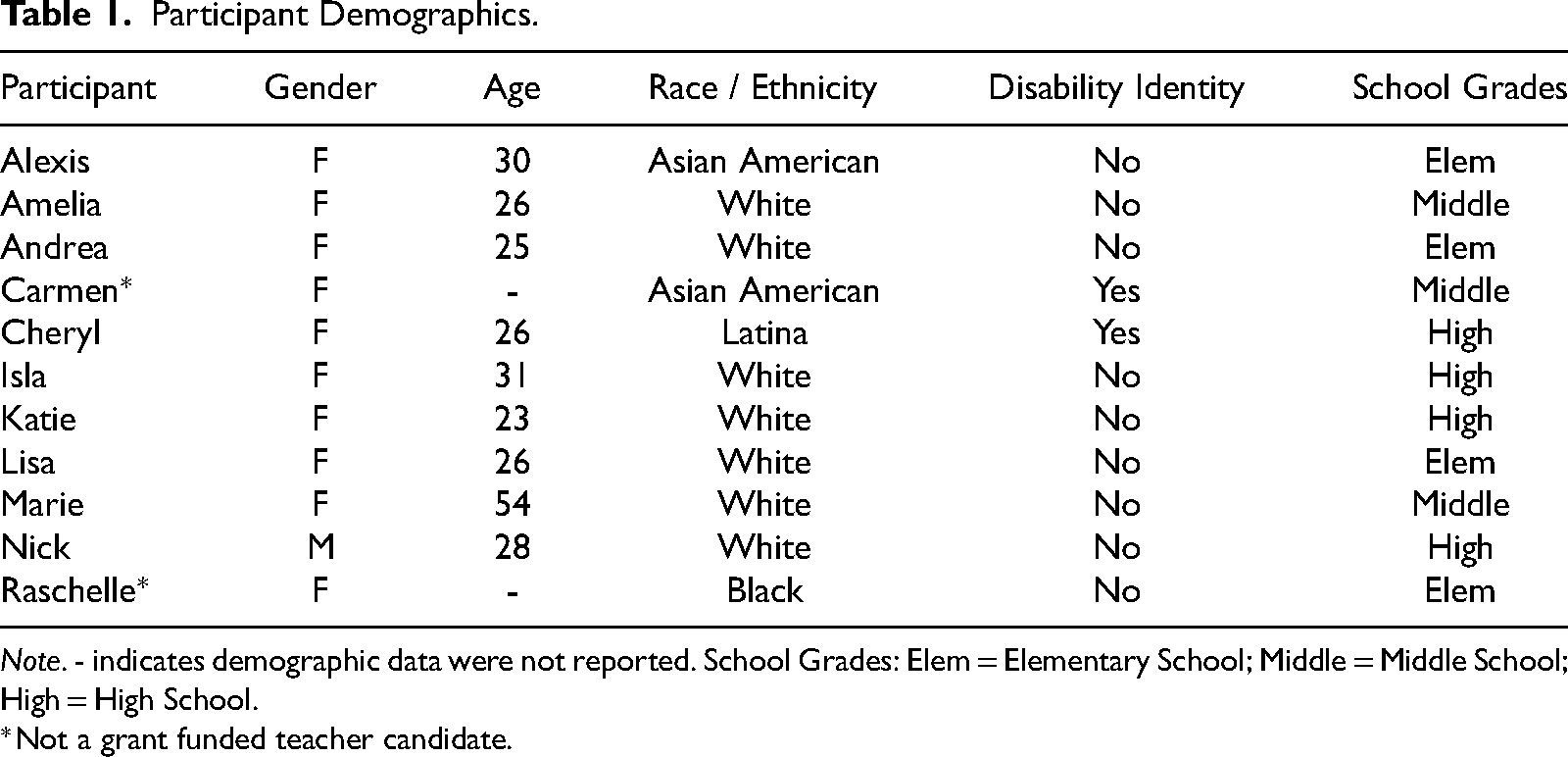
Note. - indicates demographic data were not reported. School Grades: Elem = Elementary School; Middle = Middle School; High = High School.
*Not a grant funded teacher candidate.
The teacher preparation program these teacher candidates were a part of aimed to equip practicing educators with the knowledge, skills, and confidence needed to become catalysts for change for PreK-12 students with complex support needs. The program oriented around a commitment to enacting inclusive practices, challenging ableist assumptions, and emphasizing practical applications of theoretical knowledge in real-world settings. Teacher candidates completed fieldwork experiences each semester of their 2-year program of study, and received coaching and feedback from university faculty and doctoral students to support them in advocating for and implementing high-quality inclusive education within their schools and/or districts. They learned about models of disability and inclusive teaching strategies. They had practicum seminars and hands-on projects (e.g., conducting ecological inventories, rewriting individualized education programs). The preparation program also provided additional professional development through attendance at national conferences and summer institutes, fostering a collaborative and reflexive learning environment.
Researcher Positionalities
The authors of this study are primarily based in the United States. One author is from Italy and is currently located there. Seven of the eight authors identify as cis-gendered White women, and one author identifies as a White man. Three authors identify with disabilities. No one identified with complex support needs. Our ability identities, in conjunction with our other identity markers and our personal and professional experiences and theoretical underpinnings, positioned us well for the research design and process while also being aware of biases and power dynamics. First, all authors are engaged in research, teaching, and service that relates to and advocates for inclusive education and students with complex support needs through an equity and justice lens. Moreover, seven of the eight authors bring varied experiences as public school teachers, including as former general education and special education teachers in inclusive educational environments, as well as self-contained program models. Most are also former teachers of students with complex support needs.
As such, we may have developed rapport with participants during focus groups because we collectively understood at least some of the contexts and experiences the teacher candidates navigated. This shared understanding may have supported connection and communication. Simultaneously, teacher candidates’ awareness of some research team members’ concomitant roles as master's program advisors, course instructors, and fieldwork supervisors may have impacted what and how they shared. In other words, they may have been more willing to openly express their thoughts and experiences during focus group discussions with particular facilitators.
Data Collection
Data collection occurred over eight semesters (Fall 2016–Fall 2020). The process was iterative, wherein valuable insights from previous group discussions influenced subsequent focus group questions and endeavors (e.g., mapping, using vignettes; Bhattacharya, 2017). Moreover, some participants partook in group conversations after graduation, adding to the nuances and longevity of their advocacy and agentic experiences. Data collection comprised a total of 24 focus groups, with each session spanning a duration ranging from 35 to 78 min. Ten out of the 11 participants partook in three to four focus group discussions, while each teacher candidate had the opportunity to engage in a range of two to five focus groups. The initial focus groups (n = 2) were conducted by the university faculty. Then, due to concerns about power differentials between the faculty members and teacher candidates, the responsibility of discussion facilitation shifted. Volunteer doctoral students, many of whom were not familiar with the participants, conducted the remaining focus groups (n = 22).
The semi-structured focus group questions encompassed various aspects, such as inviting participants to share insights about their current school program and their aspirations for enhancing educational experiences inclusively for students with complex support needs. Examples of questions included: What do you think a teacher can do to improve student access and participation in general education (Fall 2016)? What do you think about your ability to help students achieve their goals (Spring 2017)? What have been your experiences advocating for changes in your school (Fall 2017)? What are your unique skills that you contribute to your school (Spring 2018)? Sometimes, inclusive teachers experience tensions between what they learned in teacher preparation and the culture of what is occurring in K-12 schools. In what ways does this connect to your own experience (Fall 2020)? For copies of focus group questions, please contact the first author. A professional transcription service transcribed all audio-recorded focus groups. Then, team members reviewed and cleaned the transcripts prior to analysis.
Data Analysis
After one year of extensive group discussions, repeated readings, and initial coding of the complete corpus, the broader research team divided into two smaller data analysis groups with distinct research questions. The data analysis team representing this paper was comprised of the first, second, and third authors, who used a combination of inductive and deductive analyses to develop a code book (or code scheme). During inductive analysis, the team conducted several iterations of initial coding, wherein they unitized, categorized, and labeled the data (Rodwell, 1998). Categories named the level codes, while labels defined each code. To accomplish this, they employed descriptive coding, in vivo coding, and processing coding (Saldaña, 2013). They also held weekly meetings to deliberate on their observations and insights derived from the data. The initial coding process encompassed a range of code categories, including the following primary codes from the first iteration of the code book: Human Possibilities, Spaces and Locations, and Needing Skills/Experiences.
The blended conceptual framing guided analysis during the deductive phase. As an illustration, the Human Possibilities primary code category was changed to Actions to Address Gatekeepers/Gatekeeping, and multiple subcodes surfaced. Changing the label afforded opportunities to look for ways teacher candidates were disrupting (or not) hegemonic notions of intelligence and ability. During weekly meetings, the team shared their premonitions and raised questions, which helped to identify preliminary patterns and insights. Moreover, discussions were springboards to go back to the data and unearth answers (Erickson, 1986). The team transitioned the code book to a code matrix on Dedoose, a web-based data analysis application, after they had generated seven iterations of the code book across most of the data (16 out of 24 transcripts) with at least two team members coding each transcript.
Subsequently, the team applied the code matrix to the whole corpus. To compare, reorganize, and refocus the leveled codes, the team used axial coding (Rodwell, 1998). As an illustration, the code focused on Gatekeepers/Gatekeeping was expanded to six subcodes. This allowed the team to identify material, conceptual, and human gatekeepers of inclusive education, providing a more nuanced and comprehensive story of teacher candidates’ diverse experiences. They used selective coding to determine if and how codes were amalgamations of or in relation to one another (Rodwell, 1998). The team repeatedly applied the code matrix to the data to search for patterns and identified and refined themes across the corpus via group meetings and analytic memos (Saldaña, 2013). See Table 2 for the code matrix.
Code Matrix.
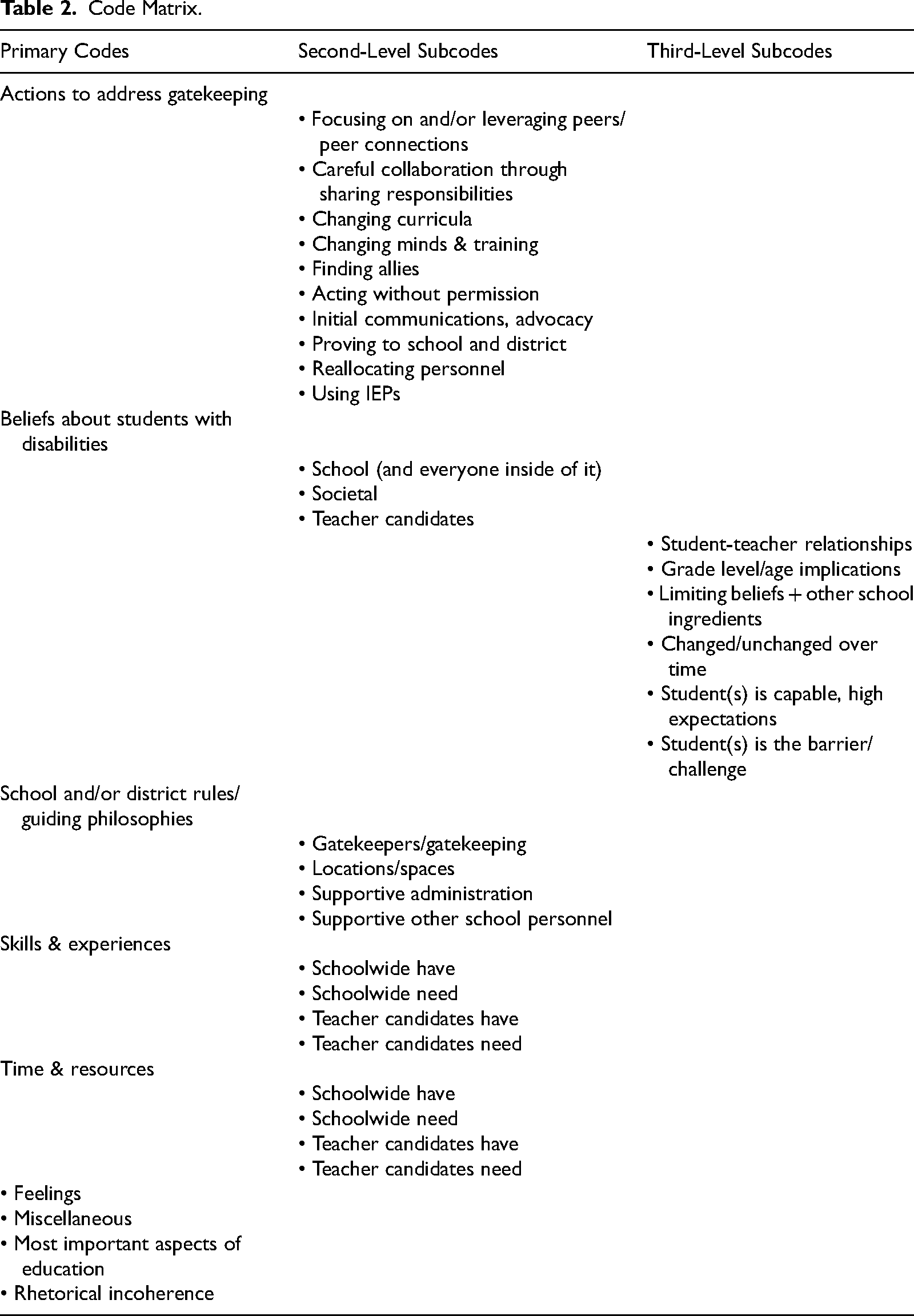
The team leaned on the blended conceptual framing and code matrix to generate themes. Moreover, themes were developed based on careful consideration of how the team thought about the data (Esposito & Evans-Winters, 2022). Themes were generated across codes. For instance, sociospatial implications intersected across primary codes (e.g., school and/or district rules/guiding philosophies, actions to address gatekeeping) and second-level subcodes (i.e., gatekeepers/gatekeeping, locations/spaces). Identifying gatekeeping and mitigating control resonated across primary codes, including but not limited to actions to address gatekeeping, beliefs about students with disabilities, school and/or district rules/guiding philosophies, and subsequent subcodes as well.
Trustworthiness
The team used several strategies to ensure trustworthiness and credibility of the findings. For instance, the team employed investigator triangulation (Brantlinger et al., 2005). The data analysis team consisted of three members (the first three authors) from the broader team. This smaller team met weekly to discuss theoretical frameworks and analytic methods. While in data analysis, this team continued to meet weekly, which allowed them to engage in peer debriefing by reviewing codes, questioning assumptions, and challenging interpretations together (Stahl & King, 2020). They also periodically met with and reported to the larger research team. In addition, the data analysis team engaged in reflexive journaling throughout analysis to foster self-awareness and mitigate bias by reflecting on how their experiences, identity markers, and beliefs might influence interpretations (Lincoln & Guba, 1985). Bringing thoughts and reflections to the team meetings supported shifts in the coding process.
Disconfirming evidence, mapping, and analytic memos were also used to support analysis and trustworthiness. For example, the team intentionally sought disconfirming evidence by examining the data for unexpected subtleties and contradictions (Erickson, 1986). The team sought to go beyond affirming preconceived notions or expected patterns and instead uncovered nuances, inconsistencies, and alternative perspectives. Mapping techniques were employed to visualize relationships between leveled codes (Bhattacharya, 2017). Analytic memos were used to connect emerging themes to the literature (Saldaña, 2013). These approaches afforded insights, upheld credibility and trustworthiness, and supported the team in identifying future areas of research.
Findings
We focus on three themes generated from narrative analysis for the purposes of this paper: (a) signifying spatiality, (b) identifying gatekeeping, and (c) mitigating control. Importantly, the first two themes exemplify the impact spaces and gatekeepers had across schools and districts and how teacher candidates navigated these experiences while making sense of their roles. The third theme operates as a disruptor wherein participants used techniques to address and/or rupture barriers to inclusive education.
Signifying Spatiality
We defined “signifying spatiality” as “Teacher candidates describe how spaces and locations impact teaching and learning.” They used phrases like “separate location,” “corner of the building,” “pushing in,” “pulling out,” and “back of the room” to describe teaching and learning. Raschelle explained, “We both are in self-contained programs, so it's a pretty big barrier to real inclusion … so it's kind of that model, kind of sets you back in that way too.” Like in Raschelle's school, putting all students with complex support needs in the same segregated classroom has been a conceptual and material barrier to inclusive education for years.
Some teacher candidates were so isolated their colleagues were unaware of their existence. Andrea shared,
I would say 90% of the people in the building didn't even know (the classroom) existed. So, that just totally showed me how secluded (the students) were. It's in the middle of the building. How did they not even know? Who did they think the person was?
Andrea's description of her interactions with colleagues illustrated how spatial constraints impacted both her agency and the sense of community for her and her students within the school. Carmen had a similar experience. She shared,
One thing I have noticed is that since the program I'm currently in is so segregated … that affects my ability to really truly be a member of the school culture. I can speak up at staff meetings, but my knowledge is coming from a place where it's just I don't actually know what's really going on in a lot of the school, and that impacts my ability to really contribute meaningfully.
As such, the physical environment influenced interpersonal relationships and professional advocacy, impacting if and how teacher candidates effectively engaged in schoolwide planning and collaboration.
Importantly, these barriers were difficult for some teachers to notice. Isla explained,
I was invited to those meetings, but a lot of times they were, like, ‘Oh, you don't have to be here if you're doing something different in your classroom.’ Being a totally new teacher, I was, like, ‘Oh, okay.’… But looking back now, I realize, I guess what comes to mind is if I had a student who they said couldn't be in that classroom, in the reading classroom, I would hopefully be able to be a part of those collaborative meetings and actually talk to them about what supports I could be there for, what supports they could use to include that student.
The ways teacher candidates’ roles were defined by others also had an influence on teamwork at the classroom level.
Teacher candidates also engaged in spatial sensemaking outside segregated classrooms. Said differently, space was significant regardless of where students with complex support needs were learning. Marie explained,
If (students) are in a general education class, they are put in the back of the room, and I feel like the teachers expect that their paraprofessional is going to sit beside them and that they're going to leave if they start making any noises. It's not inclusive at all.
At Marie's school, students with complex support needs were seen as visitors rather than integral classroom members. Such ideologies and practices significantly impacted Marie's approach to cultivating inclusive education.
Teacher candidates experienced varying levels of segregation, allowing some to focus on general education classroom spaces. Raschelle explained,
I have all of my kids in first grade for an hour in the morning during [general education] literacy centers. They're doing different work because most of them, except for one, aren't really working on decoding necessarily, but just vocabulary and stuff like that. But they're all there, and they kind of … they joined the group, and they do their own independent work and stuff.
At Raschelle's school, youth with complex support needs were sometimes in general education spaces. These spaces and their affordances also mattered for teacher candidates professionally. Lisa explained, “I have personally been in the [general education] classroom more often, which is really nice, so I would like to continue that and be there as much as possible and co-teach.” As a result, Lisa, along with the students on her caseload, had been spending more time in general education classrooms.
Some participants focused on academics within particular spaces, while others focused on social experiences, including extracurricular activities. Cheryl explained,
And so just being able to do those little things, like giving students jobs and having them go to the office and interact with office staff, or take a note to a teacher, or cleaning the cafeteria, just so they're with their other peers and in the general education settings so that they can make friendships and talk to other people. So, they're not just in my classroom alone.
For Cheryl, this sense of belonging extended beyond the classroom coupled with lingering stereotypes that students with complex support needs should be seen running errands and doing tasks (e.g., cleaning).
Teacher candidate discourse revealed the influence of spatial considerations on their actions as well as academic, social, and opportunity aspects for students with complex support needs. Some emphasized the students’ progression along a spectrum of segregation, while others found significance in the social and spatial elements within general education settings, such as the presence or absence of peers, materials, and interactions. The role of space was multifaceted, encompassing efforts to challenge segregation, reposition students and school staff, and focus on the dynamics that emerged once students were no longer in segregated environments.
Identifying Gatekeeping
We defined “identifying gatekeeping” as “A person (e.g., administrator, teacher) or thing (e.g., practice, decision) that impacts access to inclusive education for students with complex support needs.” The most frequently discussed human gatekeepers were district and school administrators, followed by general education teachers. Special education teachers, related services, society, and themselves (i.e., teacher candidates), respectively, were also identified as gatekeepers. For this paper, we focus on administrators and general education teachers.
Teacher candidates pinpointed multiple gatekeepers at the district level. Marie explained, “the culture of special ed
[education] in our whole district is not [that students with complex support needs] are general education students first. … So there's a little contradiction in what they say their philosophy is and what's actually happening.” Despite the district's claim of supporting inclusive education, students with complex support needs were not treated as general education students first, revealing a gap between stated philosophy and actual practice. Carmen articulated the economic realities. She said,
I think the biggest barrier to being able to embed those related services into general education is just that districts are trying to spend as little money as possible … (Related service providers) might have 100-something students on their caseload at five different schools.
When budgets were cut at the state level, district personnel opted to cut special education funding, which impacted if and how inclusive education was enacted.
Various people in power at the district-level reproduced gatekeeping. Katie said,
I had to get that letter of support [from the school district for the master's program], and I had to email it to my coordinator…and she said that she did not see our district going in that direction of inclusion. … To me, it was just like she wasn’t even giving it a shot at all. She wasn’t even supportive of my practicum or anything.
Katie encountered more than one district-level gatekeeper, including the special education coordinator and the director.
Lisa was surprised to find out her principal did not know about inclusive education reform. She said,
And my principal actually said verbatim, “I didn’t realize we do that [teach students with complex support needs in general education classrooms] now.” And it was kind of shocking to see that someone that I looked up to and admired was just … had no idea what we do now. And it really made me look at her in a different light. It was pretty negative.
This lack of awareness and support changed the way Lisa viewed her principal. Moreover, when Lisa had to repeatedly explain why her assignments related to inclusive education, she felt defeated.
Teacher candidates also described how leadership styles supported gatekeeping. Amelia shared,
And I have a principal that's like, “Do whatever you want.” … And he's not asking to be supportive or help change the mindset of the colleagues. … I think [hands-off type leadership] is just as detrimental as being against it because he's not supporting it, so then people don’t really respect his leadership because he's not leading.
For Amelia, a principal who did not lead the school towards inclusive education was as damaging as one who openly opposed it. No movement or a laissez-faire type of leadership approach were both harmful. Andrea described another way leadership styles were gatekeeping. She said,
My principal is physically present for meetings or things like that. But as far as, like, emotionally or mentally, he's not really there. And so, sometimes it's not that I want him to tell me what to do, just maybe ask what is going on like, “What are you guys working on? Or what are your goals for yourself?”
Teacher candidates did not feel seen and heard by administrators who displayed little interest and involvement, ultimately affecting their sense of agency.
Nick had very specific advice for what he needed from administrators. He explained,
So again, I feel like what they were doing was trying to promote independence, but they were doing it by numbers [of students] and not with individual cases [of students]. … I would like to see more of the administration actually come into the rooms and see what is happening in the school instead of looking at it as a number.
Generally, Nick's experiences with his principal were positive. Yet, he wanted to ensure they were contextually aware of each student's experiences.
General education teachers also wielded control over the realization of inclusive education as rightful presence for students with complex support needs; this gatekeeping manifested in various settings, such as meetings, classroom entrances, or within the classroom itself. Alexis explained,
But then in my building, it's been a huge struggle because of teachers with a mindset like “No, that's your students.” So, you have to deal with it. Or you know, “They have an autism diagnosis, so they need to be in an autism program.”
While district and school culture impacted teachers’ mindsets, so did the sociohistorical policies and practices that kept general education and special education separate.
Teacher gatekeeping occurred across multiple content areas. Katie explained, “Especially for some classes, like Spanish, I have a teacher that would not be interested.” Some of Katie's students were bilingual in Spanish, but Katie got a clear message that her students did not “belong in here” as she discussed. Amelia shared,
So, when you talk to those teachers about including your kids in Math and English, which traditionally doesn't happen in any of the middle schools in my district, they really can't wrap their heads around it. Because if they don't fit in the lowest group of learners they have in their class, then it's a “Why would they even be in there,” sort of thing.
The siloed nature of general education and special education, in combination with students with complex support needs being considered unsmart and invisible prevailed resulting in additional layers of gatekeeping at the classroom level.
Most participants were new in their roles, yet they clearly described how ableism manifested through gatekeeping and impacted their agency. Some district-level administrators were obvious adversaries of inclusive education, thus hindering participants’ agentic moves. Some school-level administrators were uninvolved, unavailable, and unaware, which made change extra challenging. Further, general education teachers were the second most frequently discussed gatekeepers. They were also adversarial and rigid.
Mitigating Control
We defined “mitigating control” as “Teacher candidates describe their responses to barriers.” Participants discussed 10 different ways they responded to gatekeepers and gatekeeping. Next, we describe five agentic actions not frequently discussed in extant literature. One way teacher candidates acted against gatekeepers was by proving student worth and achievement with data. For instance, they shared data at the district level. Amelia described how her school was supportive, but the district and their other schools were not. She said,
The amount of evidence that [the district] makes me show them and pictures I take and videos I take to show them that it's working and that I can still be doing it is absurd. … I have data like I have it all, but it's like they're trying to catch me. They’re trying to make sure that doesn't work. … It's awful.
Amelia was frequently asked to provide evidence that students were learning and growing outside the segregated classrooms. The absurdity did not escape her. Isla shared how she would use data when responding to a hypothetical situation. She said, “I would also maybe find a time to go observe that classroom and see how a typical classroom goes so I can make a case for how that student could be involved.” Ecological inventories were another technique teacher candidates learned about in their program. Here, Isla found a way to use data as proof to allow a student into the general education classroom. Others described how they would use data to show there was no academic improvement in segregated settings, and how these spaces and practices were harming students socially. Some felt that data was one way they could clarify their realities and advocate for school personnel to think and act more inclusively.
Another move teacher candidates made was through students’ Individualized Education Programs (IEPs). Lisa explained,
I was in an IEP meeting and we were talking about how many minutes this student should have. And I was really pushing for a more inclusive setting. I said I wanted the student to go up in minutes, start to eat lunch with their peers.
Lisa changed the minutes allotted for general education settings for the student. Nick also used IEPs to act towards change. He explained, “Yeah, one thing I've done this year is … the [support] minutes in the IEP. … So just changing minutes to still support but in the general education instead of life skills [segregated classroom].” Nick did not change the minutes of support but rather the location where the support would take place. Raschelle made more than one change within each IEP. She said,
I guess all my kids that I have done IEPs for … they have better goals on their IEP. … They will eat lunch with their classes instead of like not at their own little table. Just things like that, kind of working their way out.
In addition to minutes, goals were another component of the IEP that could be used to make the school day less segregating. Notably, both Amelia and Isla discussed how the teacher preparation program helped them to write IEPs more effectively and how they used this to influence inclusive education for individual students.
Changing curricula was another tactic participants used to respond to inclusive education gatekeeping. Alexis shared,
So, it's just been really neat to see that they're, you know, they want to be with their peers, and it's been exciting to see that they're learning their grade level content just like everyone else. Instead of, you know, being drilled … so, switching it up and doing the curriculum with the [general] education materials and with the teachers.
Moving away from rote learning was one agentic move Alexis was making. Cheryl also focused some of her agency on curricular changes. She said, “Well, the changes that I've made [include] completely redoing our whole curriculum. … Our curriculum was based on the stereotypical life skills curriculum, where they only learned about time and doing the laundry and all of that.” Incorporating learning experiences that did not focus on daily living skills was important for this teacher's agency. Other participants described their efforts to implement curricular changes, aiming to provide students with complex support needs with what Carmen referred to as “access to knowledge” as opposed to less meaningful activities like task boxes.
Reallocating personnel was another technique teacher candidates engaged in to mitigate controlling factors. Often, paraprofessionals (many times referred to as paras) were the focus of the conversation around personnel. Cheryl explained, “But what we've been working on is the paras being able to take over dealing with behaviors so I can continue teaching since that's supposed to be my job.” For some, reallocating personnel had a direct impact on the teacher candidates’ ability to focus on their primary role, which is teaching. Nick was also working with paraprofessionals to make the general education classroom more inclusive. He said,
Instead of the paras following the students to the group … the paras have groups, and the students will be with their friends, and they'll just transition. … So that's been really, really good for reading and math, to kind of lessen the grasp the para has over [a student].
Nick was finding ways to decrease adult-student interactions and increase student-student interactions. Katie was also concerned with the social aspect of schooling but in the cafeteria. She explained,
They want paras there at lunchtime, and I'm like, these kids will be okay. They know how to get back to class. They know how to get their food. … I don’t know, but they want people there to literally just babysit them.
Katie described how students were infantilized in the cafeteria and how she worked to mitigate negative impacts by rearranging personnel and granting autonomy.
Lastly, teacher candidates leveraged peers, including peer supports and friendships, as they worked towards inclusive education as rightful presence. Marie shared a few examples of how she leaned on or celebrated peer-related experiences and supports. She explained,
I believe that all students belong [in general education classrooms], but I also think that for (teaching and learning) to be most successful, there needs to be relationships that are built first … between my students as well and that would include children with disabilities that are in the classroom and their peers … you have to set up a culture where the relationship is built in order for there to be success on anybody's part.
For Marie, prioritizing relationship-building was a critical foundation. Teacher candidates also discussed how ableism as a systemic form of oppression impacted inclusive education through young people. Alexis shared,
I think it starts with younger kids. I mean, having them see and like experience being included with every child and learning how to communicate with others and learning about differences. So, then they can take those views and beliefs that they have learned from school to carry it on to their families and their parents when they are out in public.
Alexis imagined a cumulative effect that could be absorbed across society when inclusive efforts started with younger children. All students belonged, and classroom membership and interpersonal relationships were necessary for everyone's success.
Teacher candidates navigated the intricate landscape of beliefs, policies, and practices controlling students’ inclusive educational experiences. Given the prevalence of gatekeeping and gatekeepers, they had to be creative in their agentic actions. These actions included showcasing student worth and success by regularly collecting and presenting data. Additionally, participants modified students’ IEPs, changed curricula, leveraged peers, and reorganized school personnel. Teacher candidates took these deliberate steps to create more humanizing and inclusive school experiences for students with complex support needs.
Discussion
The purpose of this study was to examine contextual factors and teacher candidates’ agentic moves when transforming schools towards inclusive education for students with complex support needs. Three themes generated through narrative analysis were discussed: signifying spatiality, identifying gatekeeping, and mitigating control.
Signifying Spatiality
Teacher candidates described how beliefs intersected with space and the physical or built environment to impact (a) inclusive education for students with complex support needs and (b) their agency to cultivate and/or maintain it. They discussed how segregated classrooms and self-contained programs, the most common classroom assignment (or placement) for students with complex support needs (Morningstar et al., 2017), were barriers to inclusive education for the students and their teachers. Teacher candidates also described how spatial realities impacted their own opportunities to network and collaborate to co-teach. These findings align with existing literature that emphasizes how space shapes inclusive education reform and highlights the siloed spatial nature or compartmentalization of general and special education, starting in teacher preparation and extending into school environments (Young, 2011). It also supports scholarship that explores how space shapes teacher candidates’ identities and professional trajectories (e.g., Siuty, 2019). These findings, buttressed by rightful presence and DSE, contribute to the literature by revealing the interplay of ableist ideologies, practices, and processes operating with physical school environments to impact inclusive education and teacher agency. Placing a particular focus on teacher candidates supporting students with complex support needs, this research provides valuable insights into their experiences and challenges.
Teacher candidate discourse regarding space served as an access indicator guiding their conversations. For example, when they had opportunities to co-teach and partner with general education teachers, then their spatial discourse shifted. They interrogated the spaces there, noticing if and how youth with complex support needs were part of the general education classroom community. The degree of consequential membership for certain students hinged on their placement within specific general education classrooms, where they could participate in small group activities, engage in learning centers or stations, and freely move around the school. When teacher candidates shifted their focus away from solely striving to remove students from segregated classrooms, they contemplated the curricula, the importance of relationships and friendships, and their understanding of inclusive education as rightful presence within the broader school context. These findings support the current literature on how the physical or built environment impacts social well-being and play (Jansson et al., 2022; Mouratidis, 2018). Moreover, our blended conceptual framing allowed us to extend the extant literature by exposing how space is often discursively and ideologically constrictive when attempting to enact inclusive education. Teacher candidates cannot think about inclusive education for youth with complex support needs on a deeper level as rightful presence because they must first focus so much on physical space and the ableism built into and reproduced through that space.
Identifying Gatekeeping
Participants described gatekeeping of inclusive education as rightful presence by various school personnel. Notably, not all people at school operated as gatekeepers. However, there were many gatekeepers, and this was salient in the data. The most discussed gatekeepers were district and school administrators, followed by general education teachers. Overall, administrators were vital for effective inclusive education; the sociocultural climate and economic impacts imposed on schools by districts were significant. At the district level, special education directors, coordinators, and consultants were identified as gatekeepers. District administrators who were unaware of inclusive education efforts or made no movement towards them were harmful. Disengaged school administrators were perceived as uncooperative and unsupportive and teacher candidates delineated specific recommendations for improvement. For these administrators, inclusive education as rightful presence did not exist for students with complex support needs. These findings support existing literature focused on principals (Nettleton & Barnett, 2016) as inclusive education gatekeepers. Our blended conceptual framing reinforces how ideological and pedagogical inconsistencies between educator preparation programs and the actual conditions they encounter in schools also serve as gatekeeping mechanisms (Tuli & Oljira, 2020). The findings extend the literature by offering specific insights into how district administrators contributed to and reproduced exclusion.
Teacher candidates also talked about the gatekeeping roles some general education teachers took on (Coleman et al., 2023). Their reluctance to embrace inclusive education manifested in meetings, at the classroom door, and within the classroom itself depending on the teacher and context. Colleagues across content areas could be gatekeepers to inclusive education (Muñoz-Muñoz et al., 2022). Therefore, how these educators operated as gatekeepers to authentic access, opportunity, and progress for students with complex support needs contributes to existing research highlighting the specific impacts of general education teachers.
Mitigating Control
Teacher candidates discussed how they responded to gatekeeping and exclusionary policies and practices. Although many different techniques were uncovered, this paper focused on five that are not commonly discussed in the literature due to our blended framing of rightful presence and DSE: proving with data, using IEPs, changing curricula, reallocating personnel, and leveraging peer supports and friendships. Existing literature has shown instances where teacher candidates enacted their agency by implementing modifications to the curricula (Cong-Lem, 2021). This project contributes to the ongoing research on teacher agency by unveiling additional dimensions. Specifically, these findings highlight how teacher candidates not only utilized student-level data and adjusted student IEPs but also strategically redistributed personnel to counter ableism. They also noted the significance of student friendships and relationships for creating more inclusive educational experiences for youth with complex support needs.
Limitations and Implications for Research
The first limitation of this project speaks to future research. While the larger project collected teacher candidate demographic data, it did not collect student demographic data. As purported by DSE and rightful presence, student demographic data are needed to understand better what teacher candidates are experiencing when working towards inclusive education as rightful presence for youth with complex support needs. Disaggregated demographic data ought to include a range of identity markers (e.g., race/ethnicity, disability label, gender, language, communication preference). Then, future research could determine whether advocacy and agency for inclusive education are more successful for specific demographics of students and families and how these dynamics vary across school districts (White et al., 2020). Such research would speak to how intersecting oppressions (e.g., racism, ableism, linguicism) affect inclusive education efforts.
The second limitation also speaks to future research directions. Future research on teacher agency and inclusive education as rightful presence (or not) for youth with complex support needs ought to include additional participants beyond teachers. Scholars should invite administrators and paraprofessionals to construct a more complete picture of how inclusive education is enacted and how ableism is (not) reproduced. Teachers are not solely responsible for transforming schools. Insights from other school personnel could illuminate the layers of the complex and often unsuccessful phenomenon of inclusive education. Furthermore, students with complex support needs and their families—particularly students and families experiencing multiple intersecting oppressions—should be included in future scholarship (Miller, 2022; Toews et al., 2023). Youth and their families are directly impacted by teachers’ agentic moves and may be more aware of existing beliefs and actions and the impacts on students.
A third limitation and subsequent implication centers on data sources. Focus groups were the primary data source for the larger project and this paper. Additional data sources would further contextualize this multifaceted topic. For example, teacher agency scholarship ought to consider integrating observations, teacher preparation course assignments, samples of teacher candidate work, and/or student work samples with other qualitative (e.g., interviews, focus groups) and quantitative (e.g., data sets, surveys) methods (Leko et al., 2023). Further, data collection should span over time as inclusive education is a nonlinear, ongoing process.
Finally, future research should continue interrogating policies and practices associated with the least restrictive environment (LRE) mandate within IDEA (2004). While LRE was initially meant to provide youth with disabilities access to schooling, it is often used to justify segregating youth with complex support needs (Sauer & Jorgensen, 2016). Moreover, the continuum of services, a consequence of LRE, is fundamentally flawed as it focuses on spaces and places rather than the delivery of special education supports and services in general education classrooms (Kurth et al., 2019b). In this study, these constructs were animated within and through teacher candidates’ (attempted and/or realized) agentic moves. More research is needed to examine how space intersects with power dynamics and oppression to (a) impact current interpretations and misinterpretations of LRE and (b) perpetuate the continuum of placements, particularly for students with complex support needs (Buchner & Köpfer, 2022).
Implications for Teacher Preparation
First, teacher candidates less frequently discussed the impact of society on schools compared to their discussions of individual impacts, leading them to propose more insular solutions. This may indicate that they need more opportunities to critically examine why the educational system operates the way it does within the broader context of an ableist, settler colonial state, particularly for White, nondisabled teacher candidates. In addition to learning how to teach about disability in K-12 classrooms, teacher candidates should have opportunities to understand what ableism is and how it functions in society and especially in schools, which mirror societal norms and structures (Baglieri & Lalvani, 2020). While it is more common for teacher candidates to have conversations on racism, classism, and linguicism in their general education teacher preparation programs (Nusbaum & Steinborn, 2019), it is dangerous to assume they are engaging in similar conversations about ableism when it is so ingrained in every part of society and, therefore, often not detected. All teacher candidates, including those who teach and support students with complex support needs, should have opportunities to contemplate, recognize, and address ableism and its intersections with other forms of oppression.
To advance educational equity and justice, teacher educators and preparation programs must cultivate teacher candidates’ agentic thoughts and practices to disrupt ableist pedagogies that perpetuate the segregation of students with complex support needs, denying them access, opportunity, and success. Teaching and learning are ongoing processes, and, as such, teacher educators should continually examine the context in which teacher candidates work, aiming to uncover points of marginalization that students with complex support needs experience. By identifying contextual factors and tensions, teacher preparation can more authentically generate (a) contextually informed teacher development and (b) mediational spaces for self-reflexive and collaborative practices (Miller et al., 2022). Such preparation supports teacher candidates in shifting beliefs and practices for individual and collective agentic action.
Third, teacher candidates cannot do this alone; efforts towards inclusive education cannot and will not occur in siloes. Rather, progress toward inclusive education as rightful presence requires collaborative justice-oriented efforts. Teacher candidates can operate as boundary crossers and diffusers (Evans, 2012), moving conceptually and materially across school spaces, bridging figurative and literal borders. Thus, special education teacher preparation programs should partner across pertinent groups to mitigate isolation. This entails forming partnerships with general education and administrator preparation programs as well as with community scholars and activists of color who are experts in disability rights and/or disability justice (Brown et al., 2023; Robertson et al., 2017). Inclusive education as rightful presence demands a multi-prong approach to resisting oppression. The lack of such partnerships in education may contribute to the ways in which education itself becomes a system or practice (i.e., gatekeeping mechanism) that unintentionally blocks or restricts students with complex support needs from accessing meaningful learning experiences (Taylor & Sailor, 2023). In other words, without equitable, thoughtful partnership and collaboration, the education system may inadvertently be preventing these students from receiving excellent education.
Conclusion
By providing valuable insights into the complex landscape of inclusive education for students with complex support needs, particularly from the perspectives of teacher candidates, this project accentuates a need for transformative changes in teacher preparation and school systems. The themes of spatiality, gatekeeping, and agency and action that emerged from this study serve as focal considerations for educators, policymakers, and researchers. They highlight the importance of creating physically and ideologically inclusive spaces within schools, addressing gatekeeping practices that perpetuate exclusion, and empowering educators to become change agents. Moving forward, the findings of this study offer implications for the future of educational research and teacher preparation, which together form a roadmap for future policy development. They emphasize the necessity of collecting comprehensive demographic data to gain deeper understandings of the experiences of both students and teacher candidates. Furthermore, they advocate for the inclusion of diverse perspectives, including administrators, paraprofessionals, students, and families, in shaping the future of inclusive education. This study reveals challenges, complexities, and possibilities within inclusive education for students with complex support needs. By actively addressing these challenges, cultivating teacher candidates’ agency, and fostering collaborative efforts the field can collectively work towards a more inclusive, just, and equitable educational landscape for all students, particularly inclusive education as rightful presence for youth with complex support needs.
Footnotes
Declaration of Conflicting Interests
The authors declared no potential conflicts of interest with respect to the research, authorship, and/or publication of this article.
Funding
The authors disclosed receipt of the following financial support for the research, authorship, and/or publication of this article: This work was supported by the Office of Special Education Programs, Office of Special Education and Rehabilitative Services, (grant number #H325K160141).
