







Abstract
The present study explores prophetic influence on the present text of Genesis. It argues that the account of the birth of Jacob (Gen. 25:19–26) is modeled largely on the account of Jeremiah’s call (Jer. 1:1–10). Both accounts follow a pattern of background, conception, and fateful hand. A detailed analysis of two passages (Jer. 1:1–10 and Gen. 25:19–26) indicates a possibility that the writing of Genesis is partly dependent on Jeremiah. No matter how great the difference between the two texts seems, Genesis shows acquaintance with Jeremiah’s prophetic message.
Introduction
Jeremiah’s call (Jeremiah 1:1–10) resembles the birth of Jacob (Genesis 25:19–26) in many aspects. 1 Both accounts follow a pattern of background, conception, and hand. A detailed analysis of two passages (Jer. 1:1–10 and Gen. 25:19–26) indicates a possibility that the writing of Genesis is partly dependent on Jeremiah, or vice versa. Narrowing the scope of research, the present paper intends to argue that the account of the birth of Jacob (Gen. 25:19–26) is modeled largely on the account of Jeremiah’s call (Jer. 1:1–10). In other words, it opens a possibility that Genesis shows acquaintance with Jeremiah’s prophetic message.
The idea that the Genesis author(s) 2 was/were familiar with the Jeremiah text may sound strange, as the time setting in the book of Genesis is much earlier than the time of the prophet Jeremiah. In order to write about a certain historical time, however, authors do not necessarily need to live in that period. As long as the author had sources about what happened in the past, he or she could write a historiography a long time afterwards. There is always a possibility that a biblical text can refer to a certain historical period without itself being written in that period. Considering a possibility that the first edition of Genesis could have been updated or revised in later times until it turned into the final form of the text, it would not be surprising that part of Genesis writing could be related to a time when the prophets existed.
There is scholarly assumption that Genesis was written (or at least based) in a historical context long before the prophets existed and therefore the prophetic literature cannot precede Genesis. In the Jewish tradition, Genesis, as part of Torah, is considered written by the great prophet Moses. Traditionally, scholars who prefer to read Genesis etiologically take monarchic times as its possible historical context. For instance, narrowing down the scope to the Jacob narrative (Gen. 25:19–36:43), John Bartlett has taken the period of David as its historical context. 3 Based on the lifestyle and ethnic and socio-political picture in the narrative, Benjamin Mazar has suggested the end of the period of Judges and the beginning of Monarchy as corresponding to its historical context. 4 However, Israel Finkelstein has regarded the Jacob narrative as reflecting late monarchic times. 5
On the other hand, recent biblical scholarship tends to take a later period, such as the exilic or post-exilic period as a possible historical or social context of the Jacob narrative. For example, scholars such as E. Theodore Mullen and Naomi Steinberg have assumed that the Jacob narrative was produced in post-exilic times. 6 Although this group of scholars was not particularly interested in prophetic influence on the book of Genesis, connecting the Jacob narrative with Jeremiah would not be surprising for them.
Scholars such as Hans H. Schmid, John van Seters, and Thomas L. Brodie proposed the possibility that the Pentateuch may have used the prophetic writings. For instance, Schmid insists that the call of Moses follows the similar literary pattern as Isaiah 6, Jeremiah 1, and Ezekiel 1:1–3:17. 7 Similarly, John van Seters insists that Genesis 2–3 resembles Ezek. 28:2–10 and Yahwist transformed the elements of myth from Ezekiel oracles for his own purposes. 8 Van Seters also argues that ‘Moses is made to resemble Jeremiah’ when he laments in Exod. 5:22–23. 9 Thomas L. Brodie, in Genesis as Dialogue, suggested Ezekiel, Isaiah, and Jeremiah as major components of Genesis writing. 10
The purpose of this paper is to foster the discussion made by scholars such as Van Seters and Brodie who consider the book of Genesis as built from extant sources rather than unknown and nonexistent sources—J, E, D, and P. 11 As a test case for measuring prophetic influence on the present text of Genesis, the present paper will outline the similarities between Jer. 1:1–10 and Gen. 25:16–29, provide detailed analysis, and finally explain the implications of their textual connections.
Initial Comparison of the Two Texts
In Jer. 1:1–10, God has consecrated Jeremiah before he was born and appointed Jeremiah a prophet to the nations. Jeremiah objects to God’s call initially due to his lack of confidence, but God reassures Jeremiah and promises His presence wherever Jeremiah goes. Then, God stretches out His hand and touches Jeremiah’s mouth as a sign that God has put His words in Jeremiah’s mouth.
Gen. 25:19–26 tells us that Isaac was forty when he got married to Rebekah and she was barren like Isaac’s mother Sarah. After Isaac’s prayer to God, Rebekah became pregnant but the struggle of her children in her womb led her to inquire of God. God gives her an ambiguous oracle (Gen. 25:23) indicating that two nations are in her womb and that one will serve the other. Afterwards, the twins are born and the first, who came forth red and hairy, is named Esau, and his brother, holding on to Esau’s heel, is called Jacob. Isaac was sixty years when Esau and Jacob were born.
The two seemingly unrelated accounts resemble each other in many aspects, and it is worthwhile to consider their relationship carefully. Although verbatim repetitions between the two accounts are not numerous, there exist similar words, themes, and actions of the characters in these accounts, which will be discussed in the following detailed analysis of the texts. Initial comparison of the two texts shows that their structure is similar. Both Jer. 1:1–10 and Gen. 25:19–26 can be outlined similarly:
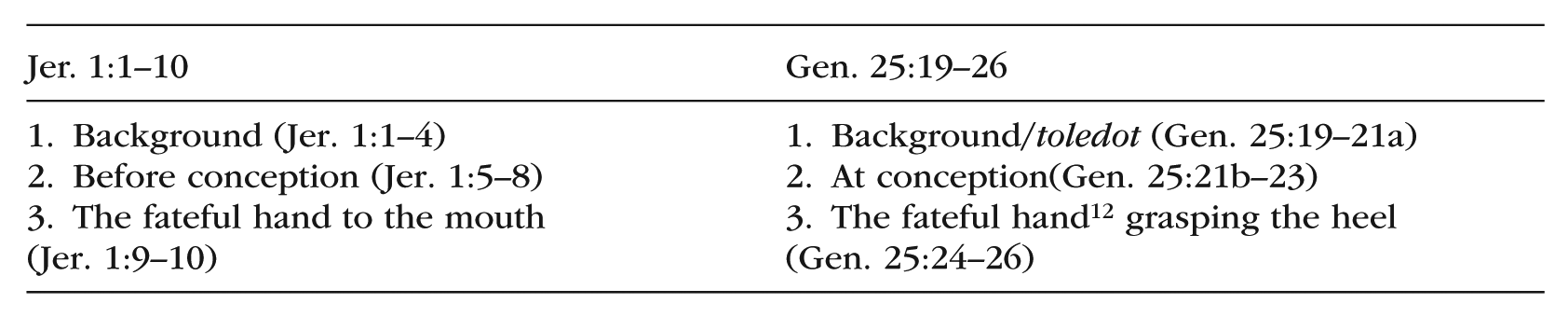
The basic structure for the account of Jeremiah’s call (Jer. 1:1–10) is very similar to the story of the birth of Jacob (Gen. 25:19–26). Both texts follow a framework of ‘Background—Conception—Hand’. These texts begin by describing the family background. In both the call of Jeremiah and the birth of Jacob, conception is closely related to their pre-birth destiny. God has appointed Jeremiah as a prophet to the nation before he is born (before conception). Jacob is also pre-destined to represent a nation when he is in Rebekah’s womb (at conception). The word ‘hand’ signifies the fateful future of both Jeremiah and Jacob. God stretches out His hand, touches Jeremiah’s mouth, and put His words into Jeremiah’s mouth. This symbolizes Jeremiah as the messenger of God’s words. Jacob’s hand holding onto the heel of Esau also symbolizes Jacob’s ongoing rivalry and struggle with his brother Esau. As briefly outlined above, the storytelling of both Jer. 1:1–10 and Gen. 25:19–36 follows the ‘background-conception-hand’ framework.
Detailed Analysis
A more detailed analysis of Jer. 1:1–10 and Gen. 25:19–26 indicates the similarities of the two texts clearly.
1. Background(toledot)—Jer. 1:1–4 & Gen. 25:19–21a
First of all, both Jer. 1:1–10 and Gen. 25:19–26 begin by describing the family background of Jeremiah and Isaac. Jer. 1:1–3 and Gen. 25:19–21a give detailed information about their background. The book of Jeremiah states that Jeremiah is from a priestly family and he is the son of Hilkiah. He is from Anathoth in the land of Benjamin (Jer. 1:1). Employing the toledot(תוֹלְדוֹת) formula—which occurs 11 times 13 in the book of Genesis—the Genesis author introduces Isaac’s sons, namely Esau and Jacob. Both texts also indicate time and location. While the Jeremiah text clearly indicates the broad historical setting of Jeremiah’s time (e.g., in the days of Josiah, Jehoiakim, Zedekiah) and location (Judah), the Genesis text only gives information about Isaac’s age when he got married to Rebekah, and about Rebekah’s barrenness after marriage. Interestingly, the Genesis author emphasizes here that Rebekah and her family are from an Aramean background (Paddan-aram). According to Gen. 25:20, Isaac was 40 years old when he got married to Rebekah. Isaac prayed to God because Rebekah was barren, and God answered Isaac’s prayer. However, it was after twenty years (cf. Gen. 25:20 and 25:26) 14 that she was able to become pregnant and give birth.
In both accounts, the theme of ‘divine intervention’ or ‘divine confrontation’ is present. The expression ‘the word from (to) the
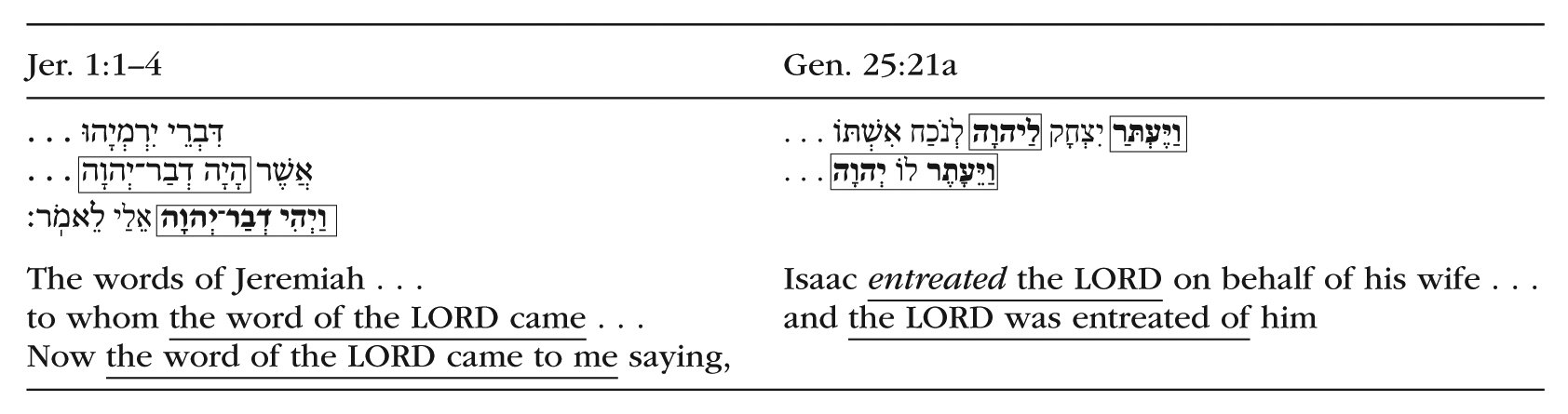
For Jeremiah, the word of the
2. Before/At Conception—Jer. 1:5–8 & Gen. 25:21b–23
After introducing the family background, both Jer. 1:5–8 and Gen. 25:21b–23 move to describe the pre-birth of Jeremiah and Jacob. The conceptions (or pre-birth) of Jeremiah and Jacob are strikingly similar to each other:
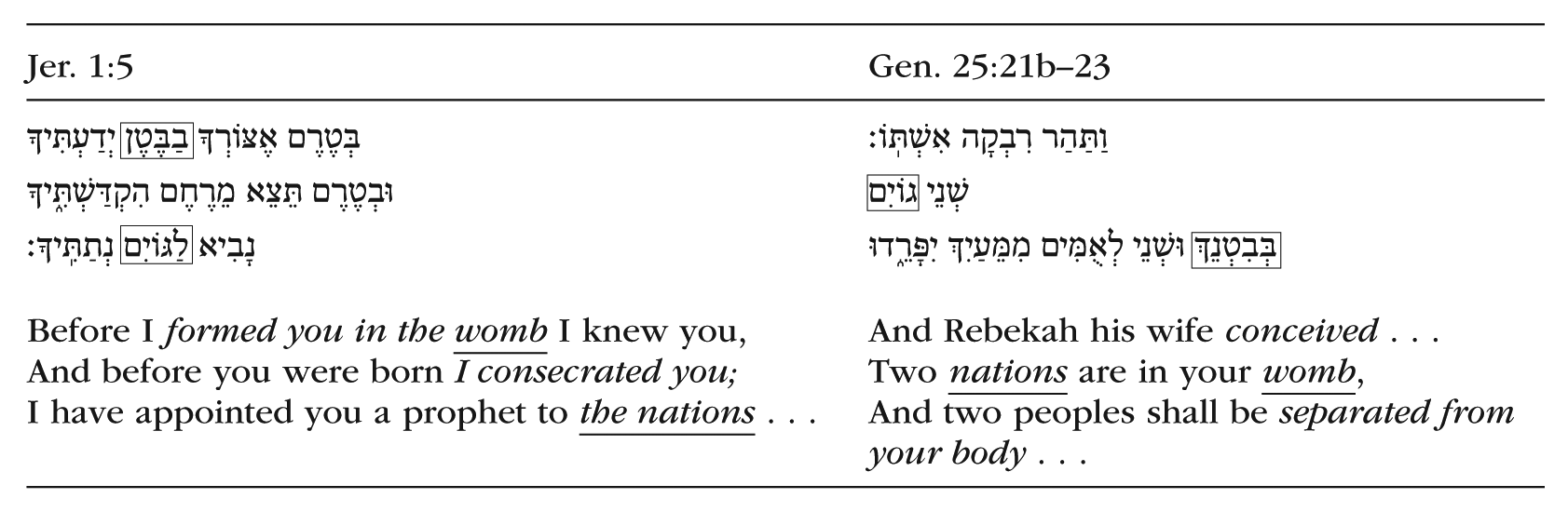
The words ‘womb’(בֶּטֶן) and ‘nations’(גּוֹיִם) are present in both texts, and they are the key words in describing the birth and destiny of both Jeremiah and Jacob. Jacob in Genesis is characterized to resemble Jeremiah. God knew both Jeremiah and Jacob before they were born. Before God formed Jeremiah in the womb (Jer. 1:5), God knew Jeremiah and his relationship to the nations – he is a prophet to the nations. Similarly, according to the divine oracle in Gen. 25:23, God knew of the two nations, and of the relationship of the one nation (Jacob) to the other (Esau)—one nation serving the other. Just as Jeremiah represents God’s people as a prophet, Jacob here represents a nation—Israel according to the later plot development (cf. Gen. 32:28, 32). The theme of separation is also present in both accounts. The people that Jacob represents will be separated from the other people, and Jeremiah was set apart from the people in Judah by God consecrating him.
Both texts also describe the struggle of life and God’s reassurance in this struggle. God’s call causes Jeremiah’s anguish. Similarly, Rebekah’s anguish is caused by the struggle of her babies in the womb. Both Jeremiah and Rebekah are perplexed in their difficult situation. Jeremiah says, ‘Alas, Lord God! Behold, I do not know how to speak, because I am a youth (Jer. 1:6).’ Similarly, Rebekah says, ‘If it is so, why then am I this way?’ (Gen. 25:22) However, God reassures both Jeremiah and Rebekah in their difficult times. God gives His words concerning the respective situations that Jeremiah and Rebekah are encountering. In Jeremiah’s case, God commands Jeremiah to follow His direction. God says that Jeremiah shall go everywhere God sends him. For Rebekah, God gives an ambiguous oracle. The direction given to Rebekah is not clear as much as the direction given to Jeremiah. While Rebekah inquired of her babies in the womb, the oracle given by God mainly announces nations and people. However, God is still in the midst of the struggles of both Jeremiah and Rebekah. God reassures them. Thus, the characterization of Jeremiah is similar to that of Rebekah in terms of their anguish caused by the struggle and receiving God’s reassurance. The characterization of God in both texts is consistent. God is the one who reassures Jeremiah and Rebekah.
3. The Fateful Hand—Jer. 1:9–10 & Gen. 25:24–26
Finally, both Jer. 1:9–10 and Gen. 25:24–26 use יָד as a crucial word to symbolize the destiny of Jeremiah and Jacob:
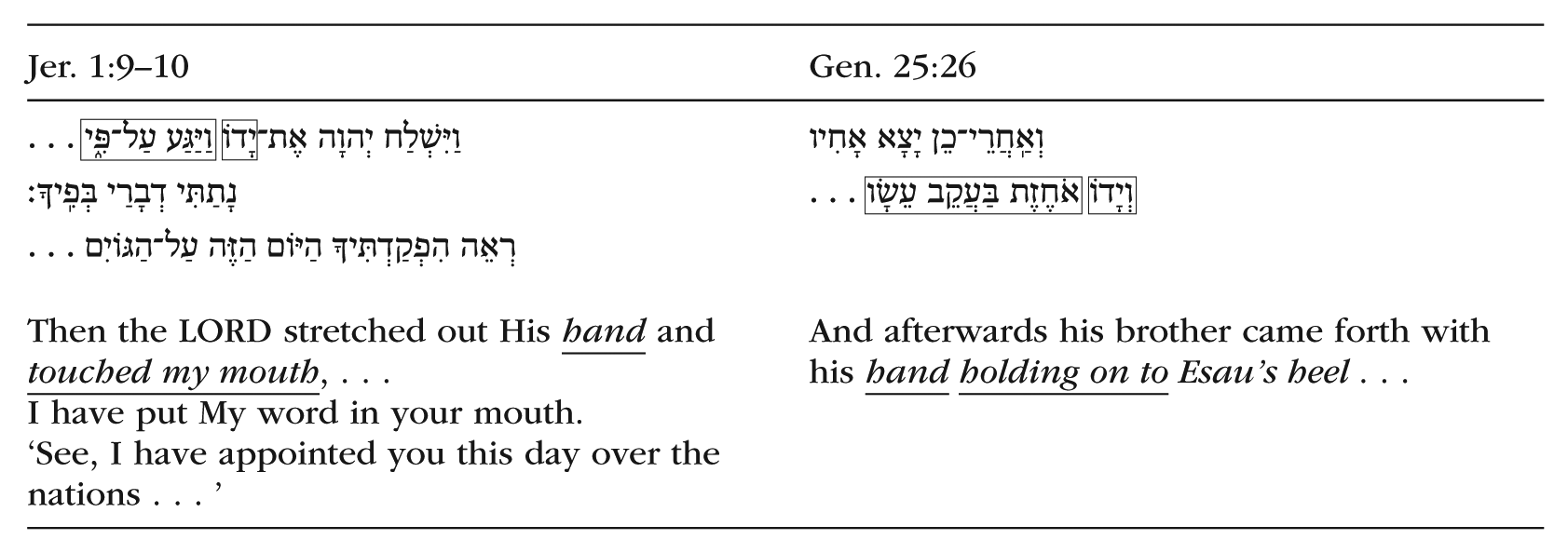
In Jer. 1:9, the hand of God touches Jeremiah’s mouth which will prophesy to the nations powerfully, while in Gen. 25: 26 Jacob’s hand grasps the heel of Esau, the other nation. These actions symbolize both Jeremiah’s and Jacob’s destiny (or role) in the texts. God’s hand touching Jeremiah’s mouth signifies that Jeremiah is the messenger of God’s words. God touches Jeremiah’s mouth with His hand and puts His Word in Jeremiah’s mouth. Jacob’s hand holding on to Esau’s heel implies that Jacob’s struggle with Esau in the womb did not end yet and will continue outside the womb. Thus, in both accounts, the hand symbolizes the fates of both Jeremiah and Jacob and in both cases involves the nations.
Implications of Textual Connections
As shown by the textual analysis of Jer. 1:1–10 and Gen. 25:19–26, there are correspondences of the similar words, themes, characterization and structure between the two texts. For both Jeremiah and Jacob, God had special plans for them before they were born. Just as God has appointed Jeremiah as a representative to the nations, God also gives an oracle that Jacob will represent a nation (Israel, according to the later plot development in the Jacob narrative). There is a struggle of life in both accounts, and God is the one who reassures in the struggle. The way of using the word ‘hand’ in both texts shows the symbolic roles of both Jeremiah and Jacob – Jeremiah as the messenger of God, and Jacob as one who will compete and struggle with his brother.
The framework ‘Background—Conception—Hand’ is also applicable to both texts. When three elements occur in two documents in the same order, this similarity needs explanation. If two people independently arrange the numbers 1 to 3 at random, the chance that they will arrange the numbers in the same order is one in thirty-six. Therefore, the similarity of structure between Jer. 1:1–10 and Gen. 25:19–26 is more like the result of one text’s using the other text rather than happening coincidentally. As both Jer. 1:1–10 and Gen. 25:19–26 forms the beginning of the book of Jeremiah and of the Jacob narrative (Gen. 25:19–36:43) in Genesis, the plausibility of one text’s influence on the other is greater.
Then, the question is which text is likely to use the other. From a traditional perspective, concluding that Jeremiah used Genesis would be more plausible. After all, Jacob is the founding father of Israel, and the story of Jacob describes the ancient time long before the prophet Jeremiah was even born yet. The book of Jeremiah generally draws on the past events such as exodus (Jer. 11:4) and wilderness experience (Jer. 2:2). By referring to the names such as Abraham, Isaac, and Jacob (cf. Jer. 33:26), the book of Jeremiah shows acquaintance of these names in the past. However, it is still noteworthy that Jeremiah’s knowledge of the patriarchs or events around the patriarchs is very limited. Although Jeremiah refers to Jacob frequently (cf. Jer. 2:4; 5:20, 10:16, 25; 30:18; 31:7, 11; 46:28), he does not refer to any story of Jacob in detail. Jeremiah simply uses the term ‘Jacob’ to represent corporate Israel. He never shows any awareness of how Jacob comes to receive a new name Israel at Jabbok (cf. Gen. 32:10–32). Within the book of Jeremiah, there is no allusion to the storyline of the Jacob narrative. Narrowing down the scope to Jer. 1:1–10 and Gen. 25:19–26, there is no indication that Jeremiah was aware of Isaac’s family background, Rebekah’s barrenness or Jacob’s birth. Therefore, it is difficult to conclude that the Genesis text significantly affected the Jeremiah text.
On the other hand, it is equally difficult to identify the influence of Jer. 1:1–10 upon Gen. 25:19–26. If the Genesis text claims to draw upon the Jeremiah text, it would be easier to identify the direction of literary dependence. However, Genesis never claims to draw upon Jeremiah. Furthermore, the book of Genesis should not claim its dependence on any source, because Genesis is the book about the origin of the universe, humanities, and Israel in the land of Canaan. The book itself presupposes the beginning of the biblical texts. Referring to any biblical texts or events in later history is clearly against the purpose of Genesis. Even if the book of Genesis reached its final form later than the book of Jeremiah, the Genesis author must have been aware that the time setting of Genesis account should precede any other biblical writings. In spite of this inevitable reality of the Genesis writing, however, there are several clues that Genesis went through the process of re-writing in a later period. For instance, the Genesis author repeatedly uses the expression ‘to (until) this day’ (עַד הַיּוֹם הַזֶּֽה) 17 (cf. Gen. 19:37–38; 22:14; 26:33; 32:32; 35:20), and presupposes a later period as its time setting. The ‘to this day’ formula means a gaze reflecting on what happened in the past from the author’s time period which is obviously later than the Genesis events.
A careful reading of Jeremiah’s call with Jacob’s birth strengthens a possibility that the Genesis author has adapted Jer. 1:1–10 for the writing of Gen. 25:19–26. First of all, Genesis borrows the characterization of Jeremiah’s conception with the words such as ‘womb’ and ‘nations’, to portray that the conception of Jacob resembles Jeremiah’s. Within the Bible, the description of the birth of characters using the words ‘womb’ and ‘nations’ occur only in Jeremiah 1 and Genesis 25. Genesis also adapts the idea of God’s plan for Jeremiah before his conception into the account of Jacob’s birth. Just as Jeremiah is predestined to be a prophet to the nations before his birth, the Genesis author deliberately describes Jacob as the one who is predestined to represent a nation. 18 As God’s speech in Jer. 1:5 is more explanatory and descriptive than the ambiguous oracle in Gen. 25:23, 19 Jer. 1:5 is likely to be a source for Gen. 25:23. One may propose the counter argument that the ambiguous oracle in Gen. 25:23 could be equally possible to be a source for Jer. 1:5. I do not entirely exclude this possibility, but the chances are more likely that authors tend to transform simple and clear statements into complex and ambiguous statements rather than the other way around.
Secondly, to symbolize Jacob’s ongoing struggle with Esau after his birth, the Genesis author deliberately adopts the scene in Jer. 1:9 where God’s ‘hand’ touches Jeremiah’s mouth, and he transforms it into Jacob’s hand holding on to Esau’s heel in Gen. 25:26. The argument that Gen. 25:26 used Jer. 1:9 is more likely than the opposite case, because Jacob’s hand holding on to Esau’s heel is a more figurative speech than God’s hand touching Jeremiah’s mouth. It is generally easier to make a figurative speech more figurative than the other way. Both ‘God’s hand touching Jeremiah’s mouth’ and ‘Jacob’s hand holding on to Esau’s heel’ are used in a figurative sense, but the action of a newborn baby’s holding on to his twin brother’s heel is more figurative and it would not be considered realistic at all for most readers. The expression ‘holding on to one’s heel’ does not describe a fact. It is rather closer to a metaphor, which implies that Jacob in Gen. 25:26 will obstruct Esau’s future. 20
As discussed above, the two components of ‘conception’ and ‘fateful hand’ in Jer. 1:1–10 are adapted to Gen. 25:19–26. The ‘background’ component in both Jer. 1:1–4 and Gen. 25:19–21a also shows the dependence of Genesis on Jeremiah, but the significance of the former two components is even greater than the background component in terms of demonstrating the way of using Jer. 1:1–10 for the composition of Gen. 25:19–26. The ‘background’ component is present in a number of biblical texts, but the usage of the words ‘womb’ and ‘nations’ to describe the conception of characters and the other usage of symbolizing one’s destiny with the word ‘hand’ is very peculiar. Apart from Jer. 1:10 and Gen. 25:19–26, it occurs nowhere else in the entire Bible. In prophetic literature, touching a prophet’s mouth as a sign for God’s call is present in Isaiah (cf. Isa. 6:7) 21 and Ezekiel (cf. Ezek. 3:2–3), 22 but it is not common except the prophetic literature. Therefore, the presence of the similar literary expression in Gen. 25:19 indicates the Genesis author’s awareness of the prophetic literature, especially the account of Jeremiah’s call and the sign for his call.
Conclusion
One may provide more detailed analysis of these texts, yet what has been given here is already sufficient to draw a straightforward conclusion. When the Genesis author was composing Gen. 25:19–26, the author used the story of Jeremiah’s call as one component. There are also many differences between Jer. 1:1–10 and Gen. 25:19–26. Several connections suggested in this paper may be considered weak by some readers, particularly when they are read out of context.
Yet there is evidence that suggests a literary link between the two texts. The accumulation of this evidence strengthens the case that Jer. 1:1–10 is one of the possible components drawn upon in the writing of Gen. 25:19–26. Several factors confirm this possibility, not only the structural pattern of background—conception—hand, but also the similarities of words, themes, and specific actions to describe the birth and destiny of both Jacob and Jeremiah. No matter how difference between the two texts seems great, it is generally understandable as the prophetic literature was adapted into a narrative form. Reworking the Genesis text with the Jeremiah text still left traces of literary dependence.
Footnotes
1
The call of Jeremiah is often compared with the call of Moses. For example, William L. Holladay insists that Jeremiah’s self-understanding is shaped by biblical figures of Moses and Samuel. See William L. Holladay, ‘The Background of Jeremiah’s Self-Understanding: Moses, Samuel, and Psalm 22’, JBL 83 (1964): 153–64. The similarities between the call of Jeremiah and the birth of Jacob in the beginning of their stories, however, had not drawn much scholarly attention.
2
As traditional Genesis scholarship assumes multiple authorship of the book of Genesis, I indicated both singular and plural forms.
3
John R. Bartlett, ‘The Brotherhood of Edom’, JSOT 4 (1977): 16–21.
4
Benjamin Mazar, ‘The Historical Background of the Book of Genesis’, JNES 28 (1969): 76–7.
5
6
See E. Theodore Mullen, Jr., Ethnic Myths and Pentateuchal Foundations: A New Approach to the Formation of the Pentateuch (Atlanta, GA: Scholars Press, 1997), 9–10, 69; Naomi Steinberg, Kinship and Marriage in Genesis: A Household Economics Perspective (Minneapolis, MN: Fortress, 1993), 143–4; R. Christopher Heard, Dynamics of Diselection: Ambiguity in Genesis 12–36 and Ethnic Boundaries in Post-Exilic Judah (Atlanta, GA: Society of Biblical Literature, 2001), 8–22; Danna N. Fewell, ‘Imagination, Method, and Murder: Un/Framing the Face of Post-Exilic Israel’, in Timothy K. Beal and David M. Gunn (eds), Reading Bibles, Writing Bodies: Identity and the Book (London: Routledge,  ), 132–52.
7
8
John van Seters, Prologue to History: The Yahwist as Historian in Genesis (Louisville, KY: Westminster John Knox Press, 1992), 122. Similarly, John Ha also insists that Genesis 15 shows a broad familiarity with the prophetic literature. Cf. John Ha, Genesis 15: A Theological Compendium of Pentateuchal History, BZAW 181 (Berlin: De Gruyter, ), 215–16.
9
John van Seters, The Life of Moses: The Yahwist as Historian in Exodus-Numbers (Louisville, KY: Westminster John Knox Press, ), 75. Van Seters observes many specific links between the books of Genesis/Exodus and prophetic writings, and he points out that areas of Genesis and Exodus such as the Eden account and the plague narrative are dependent upon the prophetic tradition. See van Seters, Prologue to History, 231–5, 238–41; van Seters, The Life of Moses, 147–8.
10
11
Other books in the Pentateuch are also considered built from extant sources. For example, William Holladay insists that Deut. 28:49, 51–52 is dependent on Jer. 5:15, 17, portions of Jeremiah’s poetry. Cf. William Holladay, Jeremiah 2: A Commentary on the Book of the Prophet Jeremiah, Chapters 26–52, Hermeneia (Philadelphia, PA: Fortress Press, ), 62.
12
While the fateful hand in Jer. 1:9–10 is divine, the fateful hand in Gen. 25:24–26 is human. Nevertheless, Jacob’s conception and birth depend on Isaac entreating the
13
See Gen. 2:4 (the heavens and the earth); 5:1 (Adam); 6:9 (Noah); 10:1 (the sons of Noah); 11:10 (Shem); 11:27 (Terah); 25:12 (Ishmael); 25:19 (Isaac); 36:1 (Esau); 36:9 (Esau); 37:2 (Jacob).
14
When Isaac got married to Rebekah, he was forty years old (Gen. 25:20). Isaac was sixty years old when Rebekah delivered Esau and Jacob (Gen. 25:26).
15
16
There is a wordplay in Gen. 25:21 (the active and passive of the same verb עתר). Niphal Imperfect of עתר can be interpreted as ‘was entreated of.’ Jeremiah’s characteristic phrase ‘word of the
17
For further discussion of ‘until this day’ formula, see B. S Childs, ‘A Study of the Formula, “Until This Day”’, JBL 82 (1963): 272–92; Jeffrey C. Geoghegan, ‘“Until this day” and the Postexilic Redaction of the Deuteronomistic History’, JBL 122 (2003): 201–27.
18
According to the book of Genesis, the name Jacob represents the nation Israel (Gen. 32:28; 35:10).
19
Let us compare the two passages:
Jer. 1:5: ‘Before I formed you in the womb I knew you, And before you were born I consecrated you; I have appointed you a prophet to the nations.’
Gen. 25:23: ‘Two nations are in your womb; And two peoples shall be separated from your body; And one people shall be stronger than the other; And the older shall serve the younger.’
20
Although the English phrase ‘holding on to one’s heel’ is not commonly used to imply ‘obstructing someone’, this expression often means obstructing someone in Korean culture and its usage is similar to Jacob’s hand holding on to Esau’s heel in Gen. 25:26.
21
According to Isa. 6:7, one of the seraphs holds a live coal from the altar with a pair of tongs and touches Isaiah’s mouth with it.
22
According to Ezek. 3:2–3, Ezekiel opens his mouth and God causes Ezekiel to eat the scroll, which is similar to a typical scene of the divine touch to a prophet’s mouth.