







Abstract
Hagar and Ishmael in the biblical narrative are often ignored by biblical interpreters because they are usually understood as minor characters within the story. However, reading Gen. 21:8–21 and Gen. 22:1–19 in light of each other shows that Hagar and Ishmael are heroic characters, not secondary figures. As the book of Genesis carefully selects the words to draw out the parallels between Gen. 21:8–21 and Gen. 22:1–9, narrative linkage between these accounts encourages readers to understand the two accounts together rather than as separate unrelated accounts. The narrative linkage between Gen. 21:8–21 and Gen. 22:1–19 clearly indicates that Hagar and Abraham are narratively bound together as parents who have to see the life-threatening trial of their sons. The book of Genesis portrays Hagar and Ishmael’s suffering in the wilderness as equally significant as Abraham and Isaac’s suffering on the mount of Moriah.
Introduction
The story of Abraham is one of the most well-known stories in the Bible. The number of studies of this narrative now makes it difficult for any individual either to read or simply list all of them. 2 Especially, Genesis 22 is at the center of Christian interpretations. Compared to the story of Abraham’s binding of Isaac on Mount Moriah in Gen. 22:1–19, however, the story of Hagar and Ishmael who are expelled from Abraham’s family in Gen. 21:8–21 has drawn little attention from scholars. Although scholars have given enormous attention to Genesis 22, called the Akedah in rabbinic tradition, most of them have not interpreted Genesis 22 in relation to the previous chapter, Genesis 21. A majority of scholars, including Gerhard von Rad, E. A. Speiser, Dixon Sutherland, simply assume that the narrative roles of Hagar and Ishmael within the Abraham narrative are not significant. 3 Dixon Sutherland’s view is typical. He regards the role of Ishmael in the Abraham narrative simply as an obstacle to God’s promise of offspring. 4 Christopher Heard comments, ‘Many Christian interpreters leave the impression that they wish Ishmael had never been born.’ 5 It is common for readers to overlook the narrative significance of minor or subordinate characters, because the narrator does not tell us much about these characters. However, Hagar and Ishmael are neither secondary nor peripheral characters. They are significant and heroic figures who share narrative motifs and type-scene with Abraham and Isaac.
There is a narrative connectedness between Hagar-Ishmael in Gen. 21:8–21 and Abraham-Isaac in Gen. 22:1–19. For example, both Isaac and Ishmael share a life-threatening experience in their lives. Both are miraculously saved from the danger of death. The angel of God appears in both accounts. As parents, both Abraham and Hagar are present at the life-threatening incident for their respective sons. Given that Hagar and Ishmael share narrative motifs and type-scene with Abraham and Isaac, should these narratives not be interpreted in terms of these connectedness?
This study will read Gen. 21:8–21 and Gen. 22:1–19 in light of each other—in a dialogical way. As the texts of Genesis carefully select the words to draw out the parallels between Gen. 21:8–21 and Gen. 22:1–19, narrative linkage between these accounts encourages readers to understand these two stories together rather than as separate unrelated stories. Scholars such as Gordon J. Wenham, Curt Leviant, Phyllis Trible, and Robert Alter have noted narrative linkage between Genesis 21 and 22, 6 but they have not discussed in detail the specific question that the present study raises: how do the parallels between Gen. 21:8–21 and Gen. 22:1–19 affect readers in understanding these stories in terms of the narrative portrait of Hagar and Ishmael?
The purpose of this study is not only to investigate the parallel elements between Gen. 21:8–21 and Gen. 22:1–19 but also to explain the significance of this narrative linkage in narrative context. The narrative linkage between Gen. 21:8–21 and Gen. 22:1–19 encourages readers to view Hagar and Ishmael in Genesis 21 as heroic characters and their story as a prominent story of God’s blessings like Gen. 22:1–19. God’s promises and blessings are not only for Abraham (thus Isaac and Sarah) but also for Hagar and Ishmael. From a narratological perspective, Hagar and Abraham are closely related to each other as parents who have to see the life-threatening trial of their sons. 7 The narrative linkage also shows that both Isaac and Ishmael are narratively bound together as treasured sons of Abraham who have to go through the life-threatening ordeal. To explain this further, this study will discuss the rationale for reading Gen. 21:8–21 and Gen. 22:1–19 as a dialogue briefly and then read these accounts in a dialogical way.
Rationale for Reading Gen. 21:8–21 and Gen. 22:1–19 as a Dialogue
From a rhetorical and narrative-critical perspective, the story of Hagar and Ishmael in Gen. 21:8–21 and the story of Abraham and Isaac in Gen. 22:1–19 are good examples of parallel accounts that can be interpreted in light of each other. Gen. 21:8–21 and Gen. 22:1–19 are closely linked together in their narrative context. The book of Genesis deliberately links Gen. 21:8–21 and Gen. 22:1–19 so that readers would read these accounts in light of each other. As these accounts share the same concern, one account therefore should not be interpreted in isolation from the other account.
The significance of the parallel accounts can be compared to how a human body functions better as pairs. Many parts of the human body such as legs, hands, and eyes come in pairs, and they work better as pairs in terms of balancing each other. 8 Thomas L. Brodie insists that Genesis is like the human body and that this book is binary: ‘many of its structures involve balance between pairs (of text).’ 9 He insists upon the diptych structure 10 between Genesis 22 and 23 in terms of Abraham facing the near death of his son and the death of his wife, 11 but the parallel between Genesis 22 and 23 is not strong. From a rhetorical and narrative-critical analysis of the texts, Gen. 21:8–21 and Gen. 22:1–19 are such parallel accounts that need to be interpreted in light of each other. The parallel between the two accounts brings balance in interpreting both accounts. By making the two accounts parallel to each other, the book of Genesis makes each story interact with the other story. In the study of narratology, scholars such as Robert Alter and Robert P. Gordon call this technique narrative analogy. Robert P. Gordon defines the narrative analogy as follows:
Narrative analogy is a technique whereby episodes which may be basically unrelated are made to resonate with each other through the reprise in one of words or ideas which belong in the first instance to the other. In this way it is possible to draw comparisons or contrasts between one character or situation and another, or between the response of the same character in different sets of circumstances. Sometimes a relatively minor event may assume unsuspected significance by association with one of greater moment, while still more complex goings-on are also possible through the use of this technique of writing. 12
Similarly, Robert Alter and Peter D. Miscall regard narrative analogy as a feature of Hebrew narrative ‘through which one part of the text provides oblique commentary on another.’ 13 As Gordon and Alter define narrative analogy, Gen. 21:8–21 and Gen. 22:1–19 are such stories where the Genesis author(s) 14 used the technique of narrative analogy to link these two stories. Gen. 21:8–21 and Gen. 22:1–19 are not unrelated stories—one is a story of God’s blessings on Abraham and Isaac and the other a story of God’s cursing Hagar and Ishmael. Because of their narrative connection, readers cannot easily avoid considering their relationship. It would be difficult for them to understand either one of the texts in isolation from the other.
The idea that the book of Genesis is composed in a dialogical form is not new. For example, Claus Westermann observed pairings in the two primordial accounts of sin—the sin in the garden (Gen. 2:25–3:25) and the killing of Abel (Gen. 4:1–16) in his commentary on the book of Genesis. 15 Alan J. Hauser demonstrates the linguistic and thematic links between Genesis 2–3 and Genesis 4:1–16. 16 In the case of Genesis 18–19, the complementarity of these two chapters has been observed by several scholars including R. I. Letellier, Victor P. Hamilton, and Robert Alter. 17 From a broader perspective, Peter D. Miscall insists that Jacob and Joseph stories are analogous in their plot structure. 18 There are still other works which demonstrate narrative linkage of two accounts within the book of Genesis. All these works are significant because they demonstrate there are strong elements of narrative connectedness within the book of Genesis. 19
The book of Genesis has the dialogical aspect, and reading Gen. 21:8–21 and Gen. 22:1–19 should be dialogical. After readers finish reading (or listening to) Gen. 22:1–19, the parallels could lead them to think of what they have read in Gen. 21:8–21 and reconsider Gen. 21:8–21 in light of Gen. 22:1–19. Given that the book of Genesis composed two stories in such a way, reading these accounts in a dialogical way can help readers to make sense of them.
Reading Gen. 21:8–21 and Gen. 22:1–19 as a Dialogue
Now the present study will present an example of reading Gen. 21:8–21 and Gen. 22:1–19 in a dialogical way, based on the parallels between the two accounts. This study will also present the significance of some of these parallels within the larger Abraham narrative. The textual interest in these parallel near-death accounts is not only with Isaac and Ishmael as Abraham’s treasured sons but also with Abraham and Hagar as the recipients of God’s promise and blessings through their offspring.
Now let us look at the first example. Even before the parallel accounts of Gen. 21:8–21 and Gen. 22:1–19, the textual interest for Abraham’s two sons Isaac and Ishmael begins from the use of similar expressions to describe their births. The book of Genesis is interested in both Isaac and Ishmael, not just Isaac. 20 In both accounts, Abraham as a father names both Isaac and Ishmael. Although the angel of God commanded Hagar to name her son ‘Ishmael’ in Gen. 16:11, it is Abraham who names him Ishmael (cf. Gen. 16:15). Readers can infer from Abraham naming his son Ishmael, that he must have heard how the angel of God had directed Hagar to name her son in the wilderness of Shur (Gen. 16:11).
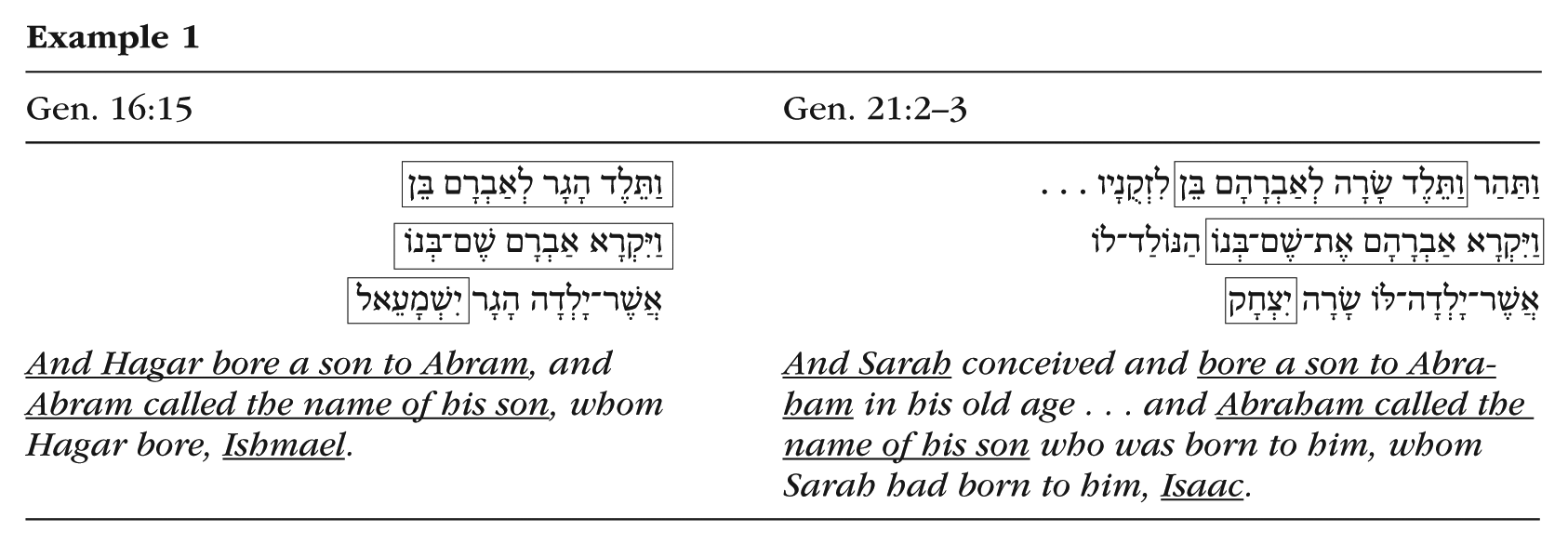
Look at the second example now. The fateful days of Isaac and Ishmael in both accounts begin by portraying Abraham as rising up early in the morning. 21 In both accounts, the narrator uses the identical phrase. Although Abraham could drive out Hagar and Ishmael right after Sarah has demanded it, he waits until the next morning. Consequently, both accounts portray Abraham being present from the early morning on both days that he victimizes Isaac and Ishmael.

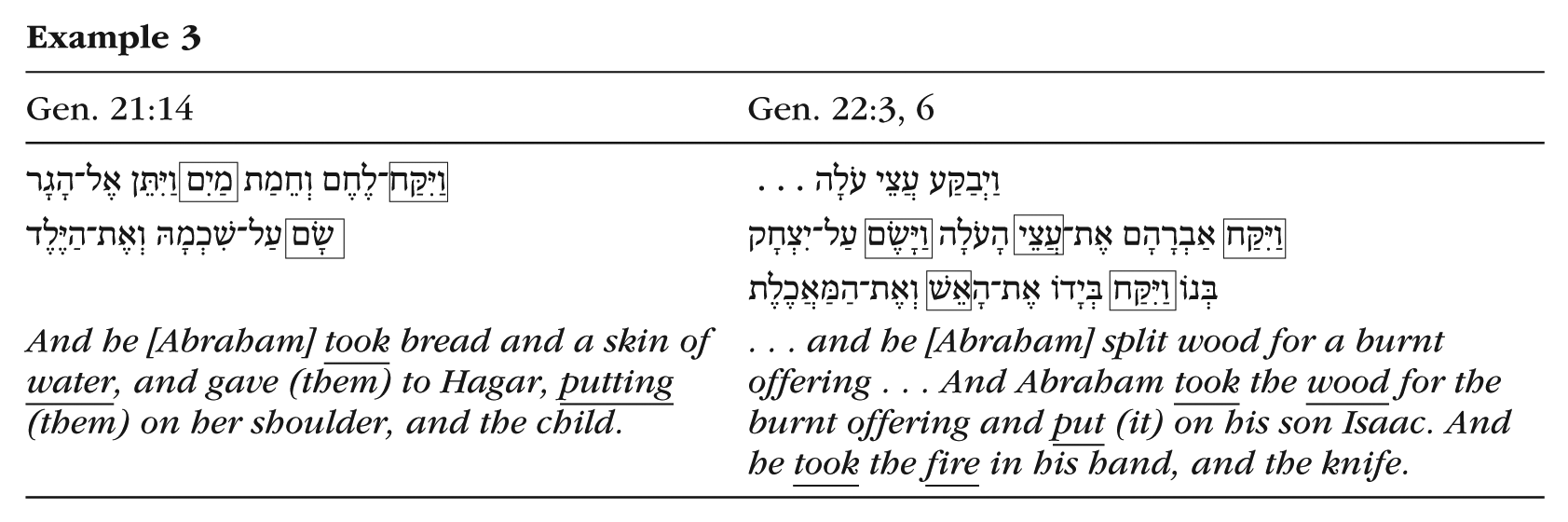
Let us see the third example. On the fateful days of both sons, the narrator portrays Abraham as the one who prepares for the journey and brings the supplies needed for that journey. He puts these supplies upon each son. 22 The Hebrew verbs לָקַח (to take) and שׂים (to put) are used in both accounts. In Gen. 21:8–21, Abraham takes (the Hebrew verb לָקַח) the bread and the water and gives them to Hagar, putting ( the Hebrew verb שׂים) them on her shoulder and Ishmael (Gen. 21:14). In Gen. 22:1–19, Abraham splits the wood for a burnt offering (Gen. 22:3) and during the journey he takes (the Hebrew verb לָקַח) the wood and puts (the Hebrew verb שׂים) it on his son Isaac (Gen. 22:6). 23 While the lack of the water threatens Ishmael’s life in Gen. 21:8–21, the wood and the fire are the elements that can potentially threaten Isaac’s life in Gen. 22:1–19. 24 It is ironical that Abraham, who takes a donkey for his journey to Moriah (Gen. 22:3), does not give such a donkey to Hagar and Ishmael. He just gives the bread and the water that are essential for their life—nothing more.
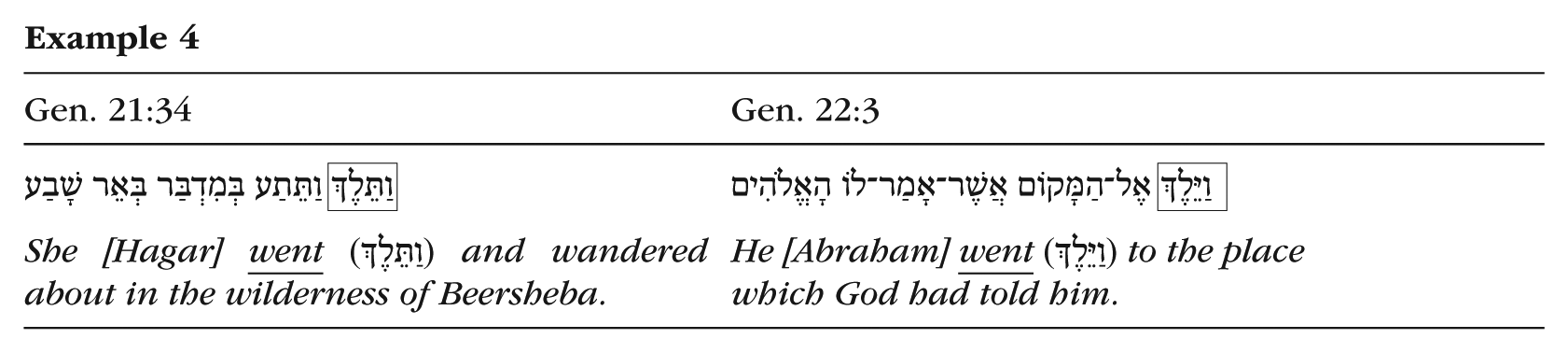
In the fourth example, the narrator describes Abraham and Hagar’s participation in the near-death experience of their sons as parents. Both Abraham and Hagar go (the Hebrew verb הָלַ) to the place where Isaac and Ishmael, respectively, may die, and the Hebrew verb הָלְַ is used in both stories. Abraham goes to that place with Isaac, while Hagar goes to the place with Ishmael. As Abraham and Hagar accompany their sons as parents and as both of them may see the death of their sons there, these stories become more heart-breaking for readers:
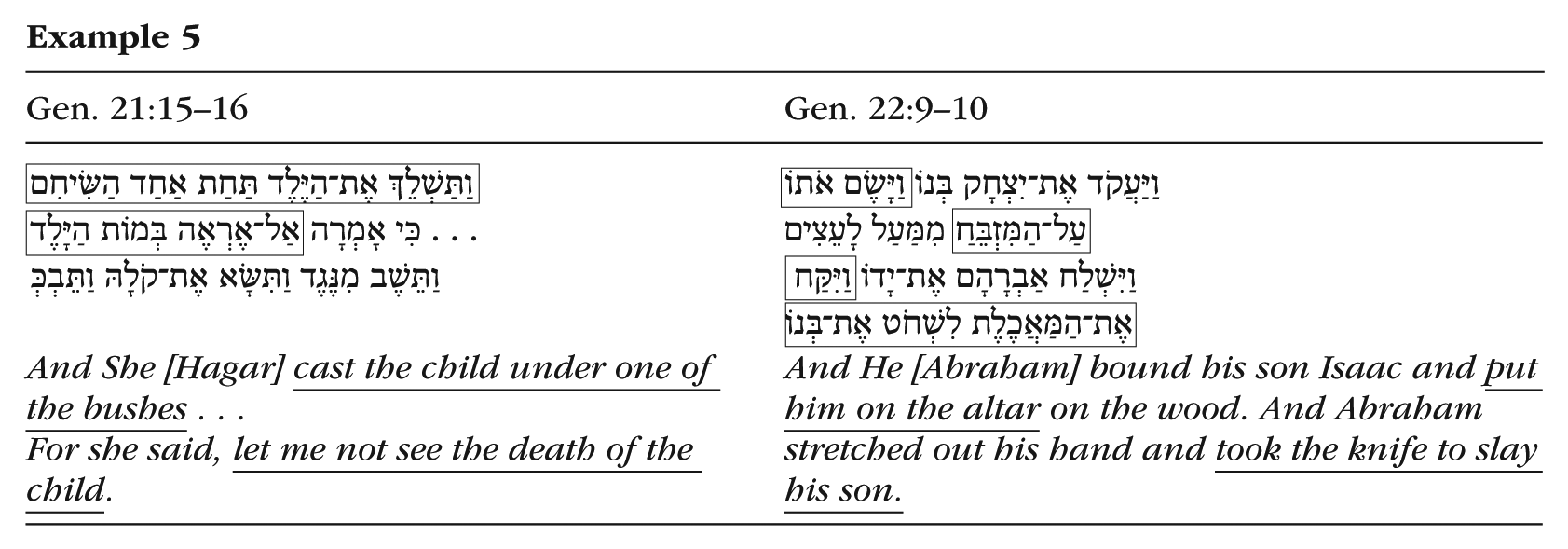
Let us look at example number 5. In both stories, the narrator describes Abraham and Hagar’s encounter with the imminent death of their sons. Both Abraham and Hagar put their sons in places where they may die—Isaac on the altar and Ishmael under one of the bushes in the wilderness. Hagar plays the role of a desperate mother who cannot see her son dying, but Abraham plays a role as a victimizer who must kill his son according to God’s command.
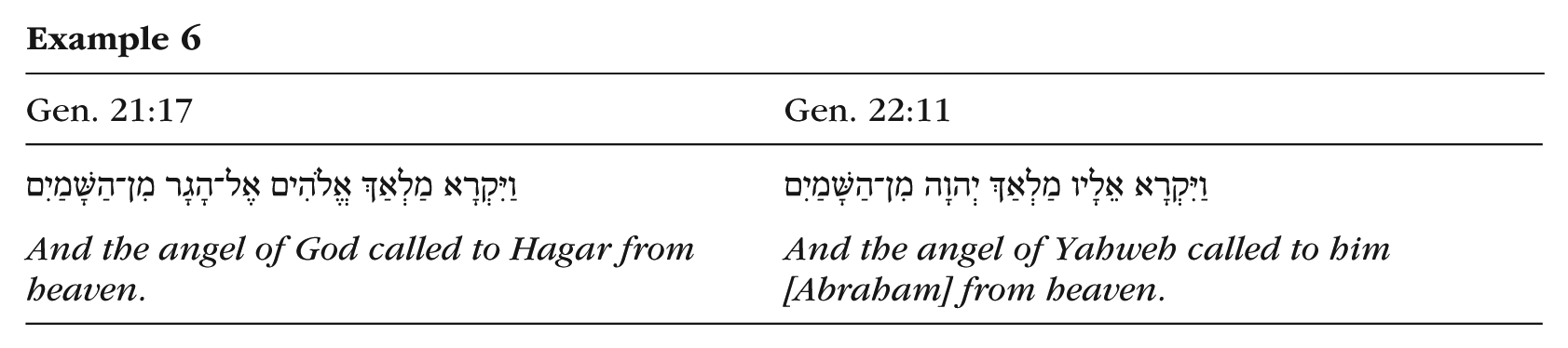
Let us look at the sixth example. Right before the imminent death of both Isaac and Ishmael, the angel of God calls both Abraham and Hagar. 25 The timing for the intervention is identical and highlights suspense in both accounts. 26 Except the names of God, the narrator uses identical phrase in both scenes. At this point, readers who have read Gen. 21:8–21 may expect that the life-threatening ordeal of Isaac, like that of Ishmael, will be finished.
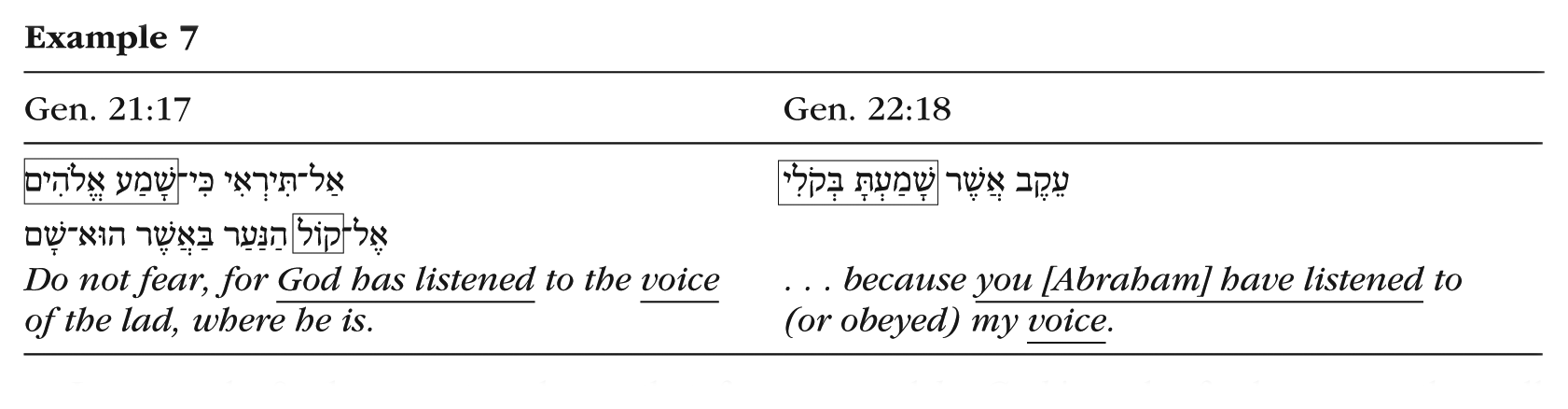
In the seventh example, after the appearance of the angel of God, both accounts show interest in who is listening and how it is related with saving the lives of both Isaac and Ishmael. In the near-death experience of Isaac, Abraham has listened to (or obeyed) God’s voice and as a result has saved Isaac. In the near-death experience of Ishmael, it is God who listens to the voice of Ishmael and as a result Ishmael is saved.
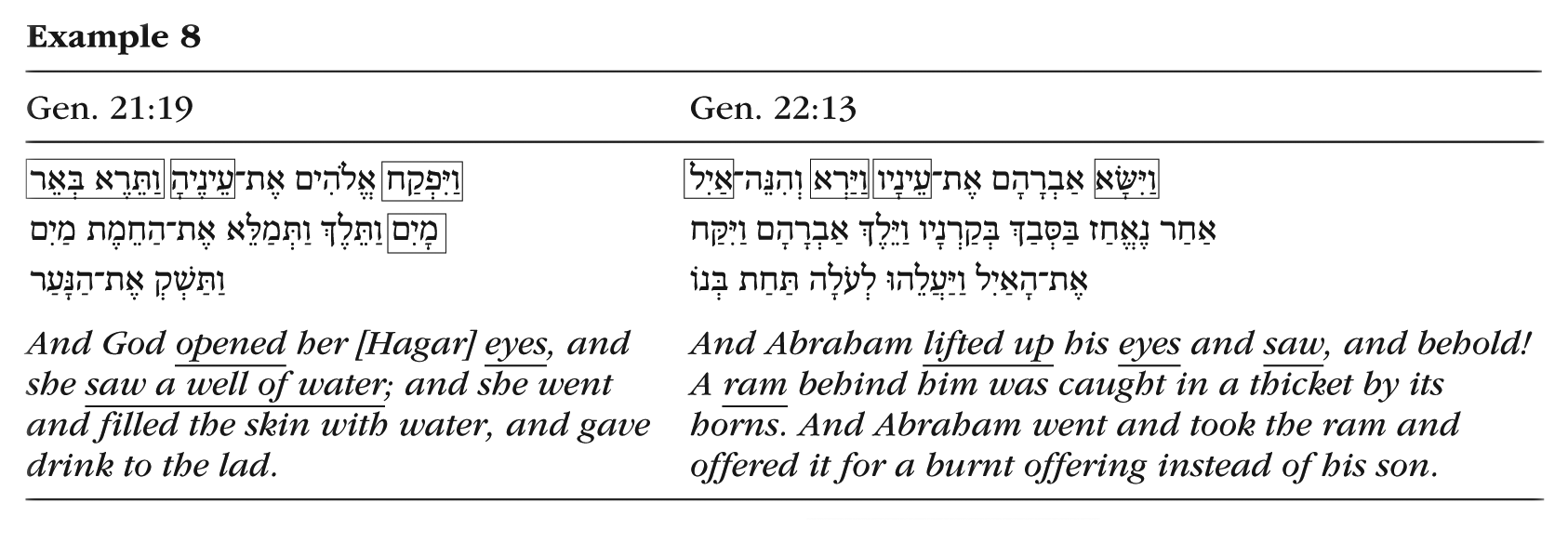
In example 8, the narrator shows that for both Abraham and Hagar seeing is related to the salvation of their sons. By seeing the ram, Abraham comes to offer the ram as a burnt offering instead of his son. Hagar sees the well of water and it saves Ishmael from death by dehydration. However, there is a difference between Hagar and Abraham. Hagar’s eyes are opened by God in order for her to see the well which will save her son Ishmael, but Abraham sees by himself the ram entangled in the thicket which will be sacrificed instead of his son Isaac. 27 Although the narrator portrays both Hagar and Abraham as seeing, Abraham plays a more active role than Hagar in seeing the elements for the salvation of his son.
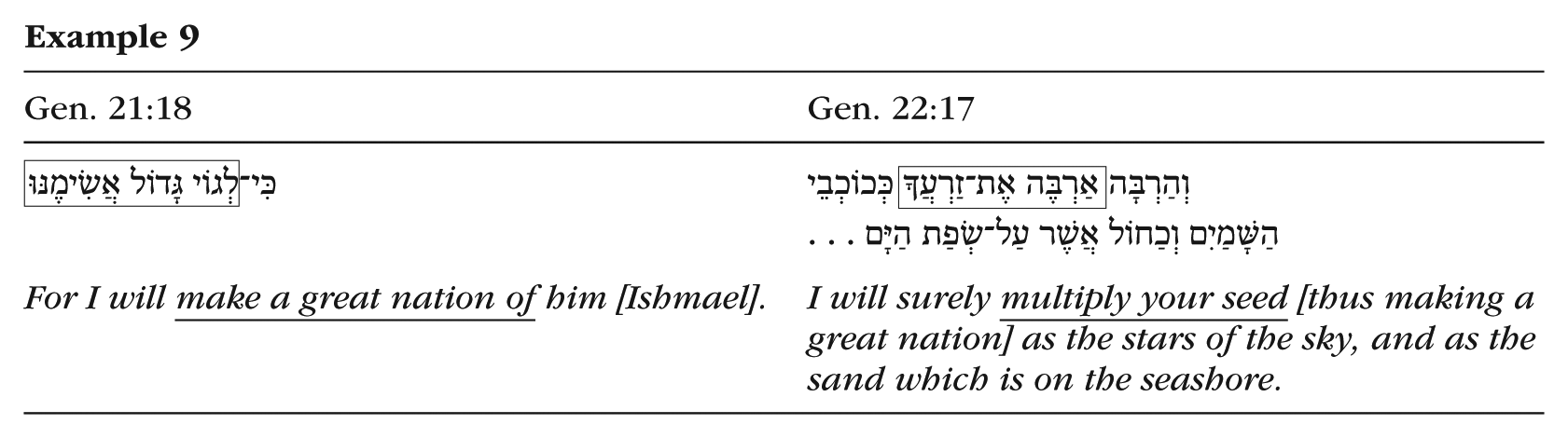
Now look at example 9. After both Isaac and Ishmael become safe from the threat of death, the angel in both accounts delivers God’s promise of a great nation to the parents. 28 In both accounts, the narrator equally portrays Ishmael in relation to Isaac, Hagar in relation to Abraham. All of them are equally portrayed in terms of their receiving God’s promise of becoming a great nation.
In the example 10, after surviving the life-threatening ordeal, both Isaac and Ishmael settle down. The Hebrew verb יָשַׁב is used in both accounts. As Curt Leviant points out, there is a double irony in this parallel. Ishmael nearly died of thirst in the wilderness, but he settled in the wilderness of Paran. Abraham, who sent Hagar and Ishmael to the wilderess of Beersheba and made them nearly die, settles in that town, presumably with Isaac. 29
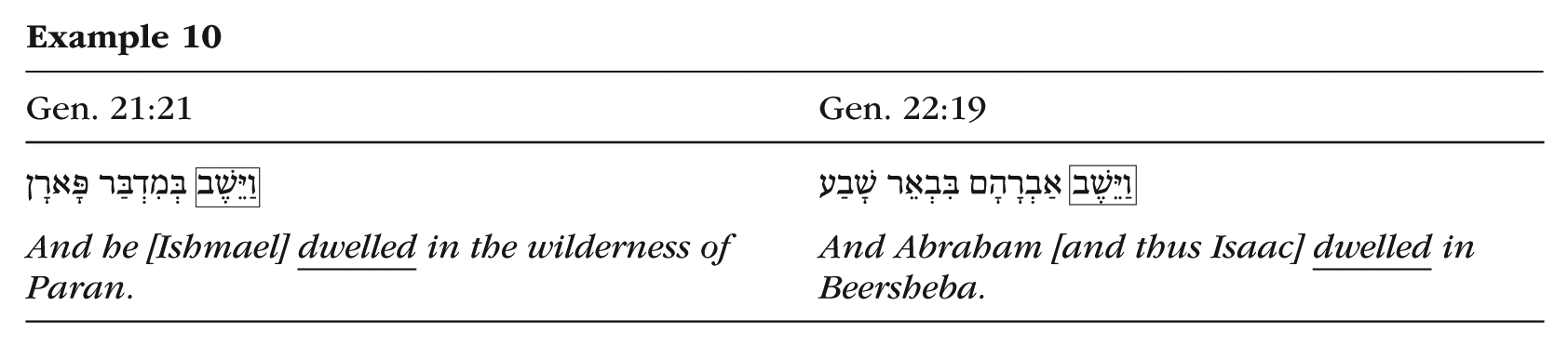
As Isaac and Ishmael have not settled down in the same location, within the larger Abraham narrative it becomes more ironic that both Isaac and Ishmael meet together to bury Abraham their father (cf. Gen. 25:9–10). If Hagar and Ishmael had been completely driven out from the house of Abraham, how could Ishmael meet Isaac to bury Abraham? In the Islamic tradition, Abraham is described to keep coming to visit his son Ishmael. 30 Therefore, Gen. 25:9 strongly indicates that Abraham and Isaac have remained in contact with Hagar and Ishmael even long after Sarah’s request to drive them out. After Sarah has died, Abraham takes Keturah as a wife (Gen. 25:1). According to rabbinic tradition, Keturah is regarded as Hagar. The narrator does not explain how Ishmael comes to join Isaac to bury Abraham even after he was expelled, but at least it is clear that the book of Genesis is interested in portraying Ishmael as close to his father Abraham.
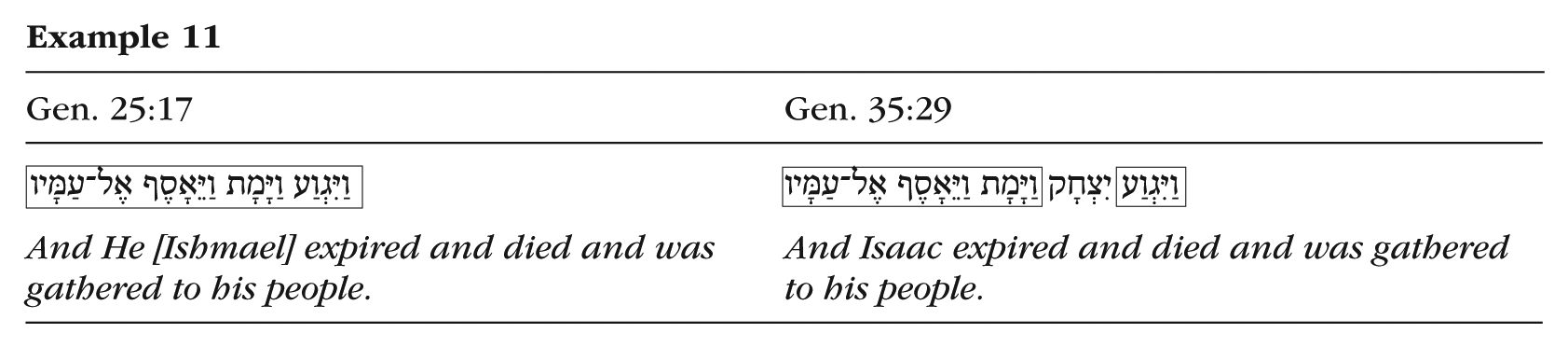
Finally, look at the example 11. Even after the parallel accounts of Gen. 21:8–21 and Gen. 22:1–19, the textual interest for Abraham’s two sons Isaac and Ishmael continues by the use of similar expressions in describing their death scene. The narrator describes the peaceful death of both Ishmael and Isaac with an identical expression. 31
Concluding Remarks
As this dialogical reading has shown, striking narrative connectedness exists between Ishmael and Isaac, and between Hagar and Abraham. This narrative linkage is not coincidental. It is evident that the texts of Genesis intentionally portray Hagar and Ishmael’s suffering in the wilderness as equally heroic and significant as Abraham and Isaac’s suffering on the mountain of Moriah. As Yvonne Sherwood points out, the stories of Hagar and Ishmael may be problematic for Israel’s identity and yet their stories are preserved. 32 God’s promise and blessings given to Hagar and Ishmael are also as significant as God’s promise and blessings for Abraham and Isaac. Through many parallels between Gen. 21:8–21 and Gen. 22:1–19, the narrator also portrays Abraham not only as the father of Isaac but also as the father of Ishmael. One may think that only Gen. 22:1–19 is the only story of God testing Abraham, but the parallels between Gen. 21:8–21 and Gen. 22:1–19 show that both are stories of God testing Abraham by commanding that he sacrifice his two treasured sons.
No matter how different Hagar and Ishmael may seem from Abraham and Isaac, the narrative linkage between Gen. 21:8–21 and Gen. 22:1–19 shows that Hagar and Abraham are narratively bound together as parents who have to see the life-threatening trial of their sons. It also shows that Isaac and Ishmael are narratively bound together as treasured sons of Abraham who have to go through the life-threatening ordeal that is caused by Abraham obeying God’s commands. God’s promise and blessings are not only for Abraham, Isaac and Sarah who are chosen by God. Although Hagar and Ishmael as Egyptians and Ishmaelites stand outside God’s covenant with Abraham and his descendants (cf. Genesis 17), the book of Genesis is comfortable in showing that God even responds to these people and blesses them as much as He blesses Abraham and his descendants through Isaac. In the perspective of God, they are all treasured people. God’s promises and blessings are therefore not only for the Israelites but also for non-Israelites.
Footnotes
1
The present study is reworked and developed from the author’s master’s thesis. It was initially presented at SBL Annual Meeting (20 November 2005, Philadelphia, PA), updated with recent studies on Abraham narrative, and repurposed for publication. Cf. Il-Seung Chung, Ironies in Abraham’s Family: A Study of Narrative Linkage Between Gen. 21:8–21 and Gen. 22:1–19 (Toronto, ON: Tyndale Seminary, 2004).
2
Every year, a number of exegetical studies on Gen. 22:1–19 come out with new perspectives. If one searches the Elenchus of Biblica, one of the bibliographic resources for biblical and theological studies, one will find at least 20 journal articles about the exegetical study of Genesis 22 coming up every year. Judging from the titles, however, scholarly works have tended to focus on Gen. 22:1–19 itself rather than Gen. 22:1–19 in connection with Genesis 21.
3
4
Sutherland, ‘The Organization of the Abraham Promise Narrative’, 340.
5
6
For further discussion, see Gordon J. Wenham, Genesis 16–50, WBC 2 (Dallas, TX: Word Books,  ), 99–100; Curt Leviant, ‘Parallel Lives: The Trials and Traumas of Isaac and Ishmael’, BRev 15 (1999): 20–25, 47; Phyllis Trible, ‘The Other Woman: A Literary and Theological Study of the Hagar Narratives’, in J. T. Butler, Edgar W. Conrad, and Ben C. Ollenburger (eds.), Understanding the Word: Essays in Honour of Bernhard W. Anderson, JSOTSup 37 (Sheffield: JSOT, 1985), 221–46, on 245. n. 73; Robert Alter, The Art of Biblical Narrative (New York: Basic Books, 1981), 182–3; Terence E. Fretheim, ‘The Book of Genesis. Introduction, Commentary, and Reflection’, in D. L. Peterson (ed.), vol. 1, The New Interpreter’s Bible, 321–674, on 489; Larry L. Lyke, ‘Where Does the Boy Belong? Compositional Strategy in Genesis 21:14’, CBQ 56 (1994): 637–48.
7
8
9
Brodie, Genesis as Dialogue, 12.
10
Paintings which have two parts or panels can be called ‘diptychs’. Thomas L. Brodie uses the term ‘diptychs’ to refer to the parallel accounts within the book of Genesis.
11
Brodie points out that each story signifies that Abraham has to face ‘a form of death’ within his own family. When Abraham tries to kill Isaac and offer him as a burnt offering, death comes close, but in the case of Sarah death actually strikes. For this reason, he insists that Genesis 23 is an intensification of Genesis 22. Thomas L. Brodie, ‘Genesis as Dialogue: Genesis’ Twenty-six Diptychs as a Key to Narrative Unity and Meaning’ in A. Wenin (ed.), Studies in the Book of Genesis: Literature, Redaction and History, BETL CLV (Leuven: Leuven University Press, ), 304–5. For further discussion of this parallel structure, see Brodie, Genesis as Dialogue, 265–77.
12
Robert P. Gordon, ‘Simplicity of the Highest Cunning: Narrative Art in the Old Testament’, The Scottish Bulletin of Evangelical Theology 6 (1988): 76. cf. Robert Alter, ‘Composite Artistry’, in The Art of Biblical Narrative (New York: Basic Books, ), 131–54.
13
Robert Alter, ‘A Literary Approach to The Bible’, Commentary 60 (1975): 73. Cited in Peter D. Miscall, ‘The Jacob and Joseph Stories as Analogies’, JSOT 6 (): 29.
14
Both singular and plural forms are indicated as traditional Genesis scholarship assumes multiple authorship of the book of Genesis.
15
16
17
See R. I. Letellier, Day in Mamre, Night in Sodom: Abraham and Lot in Genesis 18 and 19 (New York: BIS, 1995), 39–42; Victor P. Hamilton, The Book of Genesis: Chapters 18–50, NICOT (Grand Rapids, MI: Eerdmans, 1995), 30; Robert Alter, ‘Sodom as Nexus: The Web of Design in Biblical Narrative’, Tikkun 1 (): 30–8.
18
Miscall, ‘The Jacob and Joseph Stories as Analogies’, 31–2.
19
For further discussion in the studies of parallel accounts in the book of Genesis, see Thomas L. Brodie, Genesis as Dialogue. This is a Genesis commentary which demonstrates this trend of parallel studies within the book of Genesis. In this book, Brodie embraces the works of other scholars who observe parallel accounts within the book of Genesis. He also insists that the entire book of Genesis consists of twenty-six parallel accounts in its structure.
20
Leviant, ‘Parallel Lives’, 22.
21
22
By analysing these descriptions, S. Nikaido insists that Ishmael’s journey into the wilderness is parallel to Isaac’s faithful climb to Mount Moriah. Nikaido, ‘Hagar and Ishmael as Literary Figures’, 225. Cf. Wenham, Genesis 16–50, 99.
23
Nikaido, ‘Hagar and Ishmael as Literary Figures’, 224; Leviant, ‘Parallel Lives’, 22.
24
Leviant, ‘Parallel Lives’, 22.
25
Wenham, Genesis 16–50, 99.
26
Nikaido, ‘Hagar and Ishmael as Literary Figures’, 222.
27
28
Wenham, Genesis 16–50, 100.
29
Leviant, ‘Parallel Lives’, 47.
31
Leviant, ‘Parallel Lives’, 47.