







Abstract
This study examines 2 Samuel 11:2–4, David’s encounter with Bathsheba. The text is studied through the theoretical lens of hegemonic masculinity. It argues that David’s actions epitomize toxic patriarchal power: voyeurism, sexual coercion, and abuse of authority. The study aims to analyse 2 Samuel 11:2–4 and apply its exegetical findings particularly towards emancipation of women from violence and oppression. It discusses the concept of hegemonic masculinity. In doing so it takes into consideration the socio-cultural context of 2 Samuel 11:2–4. In the contemporary dispensation, it is observed that hegemonic masculinity has led to the bastardization of women rights in some cultural settings in Africa. Women live their lives to adhere to long lasting cultures that favour only men in most cases. It is revealed that gender oppression and violence has not completely ended as can be seen in patriarchal societies in Africa. Women are faced with the challenges of complying with men’s will and satisfaction. Such has made peasant women, dependants and illiterates vulnerable. The study urges contemporary communities to confront gender based violence and male chauvinism in order to curb women suppression, especially in Africa. Proper application of the findings of this exegesis would aid in controlling hegemonic masculinity and emphasising the value of humanity.
Introduction
2 Samuel 11:2–4 is a narrative that reflects men’s use of power and influence over women and other classes. King David sees Bathsheba bathing, summons her, and sleeps with her despite knowing she is married to Uriah. Power dynamics are apparently demonstrated in the text. David’s royal authority highlights gendered oppression. 1 This passage reflects Bronze Age Near Eastern kingship norms where rulers exercised jus primae noctis (right of the first night) but subverts them through its critical narrative framing. 2
Hegemonic masculinity is not a new practice in human existence. It is a traditional practice both in the Old Testament and in contemporary society. This is shown in David’s gaze that assumes ownership of Bathsheba’s body. 3 David later orders Uriah’s murder (2 Sam. 11:15), extending dominance. Bathsheba is reduced to a pawn in David’s power play. David’s actions mirror modern “consent violations”. A culturally idealized form of masculinity legitimizing male dominance over women/other men through institutional power has continued to exist. 4
Traditional readings often minimize David’s culpability, framing this as “private sin” versus systemic abuse. Traditional exegesis often romanticizes David’s adultery (e.g., “a moment of weakness”), ignoring the abuse of power central to the text. 5 This perpetuates harmful norms. Traditional commentaries often romanticize David’s adultery while erasing Bathsheba’s victimhood. 6
Hegemonic readings of this text have historically reinforced. Few studies apply hegemonic masculinity theory to 2 Samuel 11:2–4, leaving its critique of patriarchal power underdeveloped. This study asks: How does reading 2 Samuel 11:2–4 through hegemonic masculinity expose the text as a critique of toxic power, and what implications does this hold for modern communities? The researchers intend to address the issue of hegemonic masculinity prevalent in contemporary dispensation especially in Africa. This issue can be addressed by studying 2 Samuel 11:2–4 and applying the exegetical findings in a suitable context.
The research methodology adopted in this study is narrative method also called narrative criticism. Narrative method analyzes biblical texts as literary stories, focusing on plot, characters, setting, and rhetorical techniques to reveal theological meaning. The core elements of narrative method are plot, character, setting, dialogue and narrator’s voice. 7 This method is used to analyzes the storytelling techniques that expose David’s hegemonic masculinity. Further, hegemonic masculinity theory is employed in this study. This theory posits that patriarchal power is sustained through institutional control (such as kingship like David’s kingship), subordination of women (such as Bathsheba’s objectification) and marginalization of other men (such as Uriah’s elimination, 2 Sam. 11:15). 8 Hegemonic Masculinity Theory provides a critical lens for analyzing power dynamics in 2 Samuel 11:2–4, where King David uses royal privilege for voyeurism (v.2), summons Bathsheba via institutional power (v.4) and engages in sexual exploitation without consent. 9
Conceptual Framework: Understanding Hegemonic Masculinity
Hegemonic masculinity is a sociological concept describing how male dominance over women is perpetuated in society. It refers to the practices and ideology that legitimize men’s dominant position in society and justifies the subordination of women and marginalized groups of men. The term “hegemonic” comes from Antonio Gramsci’s concept of cultural hegemony, where a dominant group maintains power through cultural and ideological consent, not coercion. It is a socio-cultural practice that legitimizes men’s dominant position and justifies the subordination of the common male population, women, and other marginalized ways of being a man. Hegemonic masculinity is a key theory in research about men and masculinities, including in human geography. 10
However, early definitions were criticized as a fixed character-type, excluding the complexity of different forms of masculinity. Some argue that the concept is heteronormative, ignores positive aspects of masculinity, or is too ambiguous. Reformulations include a more complex model of gender hierarchy, recognition of the geography of masculinities, a more specific treatment of embodiment, and a stronger emphasis on the dynamics of hegemonic masculinity. The concept of hegemonic masculinity arises from critical studies on men (CSM). These studies have in turn been informed by many different theoretical influences and traditions, including patriarchy theory, Marxism, socialist feminism, practice theory (of inter alia Sartre and Bourdieu), and social constructionism More specifically hegemonic masculinity and masculinities theory more generally can be located in the conceptual ground between the critique of sex role theory, and the critique of monolithic versions of patriarchy. 11
Hegemonic masculinity cannot be discussed without making special reference to Connell’s theory of hegemonic masculinity. In this theory, it is argued that masculinity is inherently relational, existing only in contrast to femininity. 12 This relation is not “a confrontation between homogenous, undifferentiated blocs” of men and women, but between multiple masculinities and femininities. 13 Recognizing the plurality of masculinities is “only a first step,” and the more important task is to “examine the relations between them.” 14
The major aspects of Hegemonic Masculinity
The key aspects of hegemonic masculinity include the following:
Social Construction: Masculinity is not a fixed trait but a social construct shaped by cultural and historical contexts.
Hierarchy: Hegemonic masculinity exists within a hierarchy of masculinities influenced by factors like race, class, geography, and sexual orientation. Non-conforming expressions are often viewed less favorably.
Dynamic and Fluid: Expressions of masculinity evolve over time, suggesting potential pathways for more inclusive forms of male identity.
Legitimization of Patriarchy: Hegemonic masculinity embodies the accepted answer to the legitimacy of patriarchy, guaranteeing the dominant position of men and the subordination of women.
Multiple Masculinities: Recognizes multiple masculinities that vary across time, society, culture, and the individual.
Not Universal: Only a minority of men may possess all the characteristics of hegemonic masculinity to the ideal degree.
Hegemony Through Consent: Dominance is attained through relative consensus rather than force.
Intersectionality: Hegemonic masculinity intersects with other social categories like race, class, and sexuality.
Characteristics of Hegemonic Masculinity
Traits such as strength, aggression, competitiveness, and emotional control are valued as the ideal form of masculinity.
It involves physical strength and aggression, emotional stoicism, competitiveness, heterosexuality, and authority over others.
It is the normative ideology that to be a man is to be dominant in society and that the subordination of women is required to maintain such power.
Hegemonic masculinity prizes emotional suppression, aggression, competitiveness, and power.
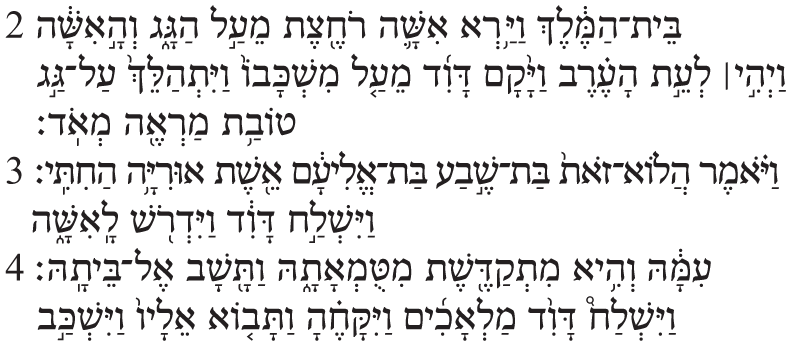
Hebrew Text of 2 Samuel 11:2–4
Historical Context of 2 Samuel 11:2–4
This passage occurs during King David’s reign (c. 1010-970 BCE). The narrative opens with David remaining in Jerusalem while his army besieges Rabbah (Ammonite capital). This was unusual—kings normally led battles (2 Sam. 11:1). David’s absence foreshadows his moral failure. 15 David has consolidated power, defeating the Philistines and uniting Israel/Judah. His position enables abuse of power. The Ammonite war (2 Sam 10) provides context here. Bathsheba’s husband Uriah was a Hittite mercenary in David's army, reflecting Israel's multi-ethnic military. 16
The socio-cultural background of 2 Samuel 11:2–4 indicates that at the time of David’s reign, kings had absolute authority. The command of monarchs seems unquestionable. This gives a clue as to why summoning Bathsheba by David through an emissary was an unrefusable command. In addition, gender and sexuality in society was then based on cultural practice. The tradition promoted women’s vulnerability. Bathsheba was bathing ritually (after menstruation; Lev. 15:19–28), making her “clean” for conception. A critical survey of the action of David in the narrative underscores his voyeuristic culpability and lack of sexual control. Adultery was a severe offense under Mosaic Law (death penalty; Lev. 20:10), but kings often evaded consequences. 17
Close Reading of 2 Samuel 11:2–4
Lust of the eyes for a Woman vv. 2–3
The beginning part of verse 2 implies that David was in a relaxed mood. The Hebrew sentence in v 2a 
 is best translated as “It happened, towards evening time, David stood from upon his couch and walked on the roof of the king’s house”. The second part in verse 2b
  is better translated as “he saw a woman bathing, from the roof; the woman was very pleasing in appearance.” The Hebrew context of this passage denotes that the woman that David saw was attractive to him, hence he became aroused David’s position “on the roof” (v.2) signifies his elevated power, while Bathsheba bathes below in vulnerability.
18
The vertical distance underscores social hierarchy. It is contended that David’s relaxation in his house at that period shows neglect of his business. When he should have been abroad with his army in the field, fighting the battles of the Lord, he devolved the care upon others, and he himself tarried still at Jerusalem.
19
The Hebrew verb
is better translated as “he saw a woman bathing, from the roof; the woman was very pleasing in appearance.” The Hebrew context of this passage denotes that the woman that David saw was attractive to him, hence he became aroused David’s position “on the roof” (v.2) signifies his elevated power, while Bathsheba bathes below in vulnerability.
18
The vertical distance underscores social hierarchy. It is contended that David’s relaxation in his house at that period shows neglect of his business. When he should have been abroad with his army in the field, fighting the battles of the Lord, he devolved the care upon others, and he himself tarried still at Jerusalem.
19
The Hebrew verb  “he saw” implies intentional gazing, intensified by “very beautiful”. David reduces Bathsheba to an aesthetic object.
20
Moreover, The Hebrews often rose at daybreak, and always took a nap during the heat of the day. Afterwards they lounged in the cool of the evening on their flat-roofed terraces. It is probable that David had ascended to enjoy the open-air refreshment earlier than usual.
21
“he saw” implies intentional gazing, intensified by “very beautiful”. David reduces Bathsheba to an aesthetic object.
20
Moreover, The Hebrews often rose at daybreak, and always took a nap during the heat of the day. Afterwards they lounged in the cool of the evening on their flat-roofed terraces. It is probable that David had ascended to enjoy the open-air refreshment earlier than usual.
21
It has been further argued that one may not fault David for perhaps seeking the cooler breezes of the late afternoon, but Bathsheba, knowing the proximity of her courtyard to the palace, probably harboured ulterior designs toward the king. Yet David’s submission to her charms is inexcusable, for the deliberate steps he followed to bring her to the palace required more than enough time for him to resist the initial, impulsive temptation 22 In addition, some schools of thought have tried to cast Bathsheba as a temptress. But the text affirms the innocence of Bathsheba. It is noted that David as king should have been at war. Bathsheba was bathing after David was in bed. Bathsheba was in her own courtyard and could only be seen from the palace roof. David took the initiative to find out who she was. David sent for her. As a woman alone she had no way to reject the demands of a king, who in the ancient Near East had the power of life and death. In essence Bathsheba was forced to come to David’s bed, in what was essentially rape. 23 David’s invitation to Bathsheba was not only on the occasion of seeing her bathing but based on the information he had heard about her physical beauty. Bathsheba seems to have been a celebrated beauty, whose renown had already reached the ears of David from reports carried by women from “harem to harem”. 24
Use of Power and Authority v. 4
The Hebrew verbs  “sent” and
  “took” appear twice (vv.3–4). The repetition stresses David’s commanding authority.
25
On the other hand, Bathsheba’s actions are narrated passively: David’s messengers went to fetch her as she came, and he lay with her. The use of these words in the narrative is accompanied by no dialogue or consent.
26
It speaks volumes of Bathsheba’s exploitation, violation and subjugation by David, the king. Bathsheba’s voicelessness condemns David’s predation. The text implies coercion, as a soldier’s wife could not refuse the king.
27
In the parenthetical “she was purifying herself after her period”, the use of the Hebrew word
“took” appear twice (vv.3–4). The repetition stresses David’s commanding authority.
25
On the other hand, Bathsheba’s actions are narrated passively: David’s messengers went to fetch her as she came, and he lay with her. The use of these words in the narrative is accompanied by no dialogue or consent.
26
It speaks volumes of Bathsheba’s exploitation, violation and subjugation by David, the king. Bathsheba’s voicelessness condemns David’s predation. The text implies coercion, as a soldier’s wife could not refuse the king.
27
In the parenthetical “she was purifying herself after her period”, the use of the Hebrew word  “uncleanness” heightens the sense of ritual uncleanness and violation. David exploits her ritual obedience (Lev 15:19–28) for sexual access. Her purity becomes the means of desecration.
28
David’s actions invert Deuteronomic law that prohibits multiplying wives. His “taking” articulated in the Hebrew word
“uncleanness” heightens the sense of ritual uncleanness and violation. David exploits her ritual obedience (Lev 15:19–28) for sexual access. Her purity becomes the means of desecration.
28
David’s actions invert Deuteronomic law that prohibits multiplying wives. His “taking” articulated in the Hebrew word  echoes Samuel’s warning about royal exploitation (1 Sam 8:11–18).
29
echoes Samuel’s warning about royal exploitation (1 Sam 8:11–18).
29
The despotic kings of the East, when they take a fancy for a woman, send an officer to the house where she lives, who announces it to be the royal pleasure she should remove to the palace. An apartment is then assigned to her and if she is made queen, the monarch orders the announcement to be made that he has made choice of her to be queen. Many instances in history show the ease and despatch with which such secondary marriages are contracted, and a new beauty added to the royal seraglio. But David had to make a promise, or rather an express stipulation to Bathsheba before she complied with the royal will 30 The reference to Bathsheba’s bathing refers to a ritual of cleansing after the completion of the seven days of impurity following her menstrual cycle (see Lev 15:19–24). It also establishes that she was within the most likely time for conception when she had sexual intercourse with David (10–14 days after commencement of menstruation). This also meant that it was impossible for Uriah to be the father of her child. 31
There is ongoing debate about whether Bathsheba could have meaningfully consented to the encounter, given David’s power as king. Some argue that the power imbalance makes the encounter a form of sexual assault. Some scholars caution against transplanting 21st-century standards and ideas into a text written in the context of ancient Israel. They argue that the understanding of rape and consent may have differed significantly at that time.
Dialectics on 2 Samuel 11:2–4 vis-à-vis Hegemonic Masculinity
An exploration of the text of 2 Samuel 11:2–4 through the optics of hegemonic masculinity accentuates David’s culpability of voyeurism. In the narrative, the reader is informed that when David sees Bathsheba bathing, he immediately desires her. This exemplifies the male gaze, where women are viewed as objects of male sexual desire. Hegemonic masculinity describes culturally idealized male dominance expressed through territorial control (space/body), heteronormative conquest and institutionalized entitlement. 32 In patriarchal society such as ancient Israelite society and in some African cultural settings, men are culturally allowed to exercise dominion over women in certain issues including in matters relating to sex. In such culturally based societies, women are not meant to say no when their male counterparts, especially those in the corridors of power or those who have some level of authority over them, want sexual encounters with them.
Abuse of power and authority remains one of the major discoveries of the exegesis of the text. David’s rooftop position symbolizes surveillance power over subjects. As king, David possesses significant power and acts with a sense of entitlement. He sends for Bathsheba without considering her desires or the fact that she is a married woman. This demonstrates an abuse of power inherent in hegemonic masculinity.
The narrative indicates adultery and a lack of restraint. David’s actions demonstrate disregard for the sanctity of marriage. This aligns with a view of masculinity that prioritizes male sexual gratification, even at the expense of others. The verb  “lay with” implies transactional sex, obscuring coercion. Bathsheba’s ritual purification (omitted here but in v.4 MT) is exploited for sexual access. David embodies toxic masculinity, beauty triggers possession, not mutuality.
33
In some African settings, men can be selfish in matters of sexual relationship. Women can be used by men to satisfy their sexual urges. Irrespective of socially and legally accepted marriage, some men in contemporary society engage in extra-marital affairs outside their marriages. Men are often view as promiscuous, looking to satisfy their urge using any available opportunity.
“lay with” implies transactional sex, obscuring coercion. Bathsheba’s ritual purification (omitted here but in v.4 MT) is exploited for sexual access. David embodies toxic masculinity, beauty triggers possession, not mutuality.
33
In some African settings, men can be selfish in matters of sexual relationship. Women can be used by men to satisfy their sexual urges. Irrespective of socially and legally accepted marriage, some men in contemporary society engage in extra-marital affairs outside their marriages. Men are often view as promiscuous, looking to satisfy their urge using any available opportunity.
Silence and a lack of agency for women is seen as an obvious occurrence in the narrative. The text offers limited insight into Bathsheba’s thoughts or feelings. She is primarily presented as an object of David’s desire and a pawn in his power games. This silence reinforces the marginalization of women’s voices in patriarchal narratives. This aspect of women subjugation is prevalent in patriarchal societies including those in Africa. Women including legally married wives are often seen as objects of sexual satisfaction. Women can even be culturally regarded as chattel in some typical traditional settings.
Recommendations
Theologians should integrate discussions of gender and masculinity in theological curricula to encourage critical engagement with biblical texts and their implications for contemporary issues of gender and power.
Leaders should develop programmes that emphasize ethical leadership among men in faith communities, highlighting the importance of accountability, integrity, and respect in positions of authority.
Government and leaders of community should create safe spaces for discussions on masculinity and its impact on relationships and community dynamics, allowing individuals to share experiences and perspectives on gender norms.
Support should be given to initiatives that address issues of sexual violence and abuse of power, promoting a culture that challenges hegemonic masculinity and advocates for justice and healing.
Men should be encouraged to model positive expressions of masculinity that prioritize emotional intelligence, empathy, and mutual respect, contributing to healthier relationships and communities.
Conclusion
The analysis of 2 Samuel 11:2–4 through the lens of hegemonic masculinity reveals the complex interplay of power, gender, and morality in the narrative of David and Bathsheba. David’s actions exemplify the traits associated with hegemonic masculinity, such as dominance, entitlement, and sexual conquest. The text illustrates how these traits can lead to moral failures and devastating consequences, not only for the individuals involved but also for the broader community. David’s abuse of power and the subsequent fallout highlight the dangers of a patriarchal system that valorizes masculine authority without accountability.
This passage serves as a critical reflection on the implications of hegemonic masculinity in contemporary contexts, prompting readers to consider how similar dynamics of power and gender continue to manifest in modern society. This narrative invites us to challenge these norms and seek a more equitable understanding of masculinity that values respect, consent, and moral responsibility.
Footnotes

1
J. Cheryl Exum. Plotted, Shot, and Painted: Cultural Representations of Biblical Women. (Sheffield Academic Press, 1996). Pp 1–304.
2
Robert Alter. The David Story: A Translation with Commentary. Pp 1–253 (W.W. Norton, 1999).
3
Susanne Scholz. Sacred Witness: Rape in the Hebrew Bible. Pp 1–264 (Fortress Press, 2010).
4
Raewyn W. Connell. Masculinities. Pp 1–352 (University of California Press, 1995).
5
Phyllis A. Bird. Missing Persons and Mistaken Identities: Women and the Israelite Cult. Pp 1–288 (Fortress Press, 1997).
6
Susanne Scholz. Sacred Witness: Rape in the Hebrew Bible. Pp 1–264 (Fortress Press, 2010).
7
Robert Alter. The Art of Biblical Narrative. Pp 1-253 (Basic Books, 1981).
8
James W. Messerschmidt. Hegemonic Masculinity: Formulation, Reformulation, and Amplification. Pp 1-168 (Rowman & Littlefield, 2018).
9
Raewyn W. Connell. Masculinities. Pp 1–352 (University of California Press, 1995).
10
Peter Hopkins and Andreas Giazitzoglu. “Hegemonic masculinity: new spaces, practices, and relations” Progress in Human Geography, Vol. 49(1) pp 84–98 (2025).
11
Jeff Hearn, Sofia Aboim and Richard Howson. “Hegemonic Masculinity.” Blackwell Encyclopedia of Sociology Reference Online, Second Edition. No page numbers (Wiley-Blackwell, Oxford, 2016).
12
R.W Connell. Masculinities. pp. 1–352 (Berkeley: University of California Press, 2005).
13
Tim Carrigan, Bob Connell and John Lee. “Toward a New Sociology of Masculinity.” Theory and Society 14(5): pp 551–604. (1985).
14
R.W Connell. Masculinities. Pp 1-352 (Berkeley: University of California Press, 2005).
15
Kyle P. McCarter. II Samuel: A New Translation with Introduction and Commentary. pp. 1-553 (Anchor Bible, 1984).
16
Baruch Halpern. David’s Secret Demons: Messiah, Murderer, Traitor, King. Pp 1-512 (Eerdmans, 2001).
17
Tikya Frymer-Kensky. Reading the Women of the Bible. Pp 1-446 (Schocken, 2002).
18
Jan P. Fokkelman. Narrative Art and Poetry in the Books of Samuel, Vol. 1. Pp 1-700 (Assen: Van Gorcum, 1981).
19
Matthew Henry. Matthew Henry’s Commentary on the Whole Bible: Complete and Unabridged in One Volume. Pp1-2, 100 (Peabody: Hendrickson, 1996).
20
Robert Alter. The David Story: A Translation with Commentary of 1 and 2 Samuel. Pp 1-253 (New York: W.W. Norton, 1999).
21
Robert Jamieson., A.R Fausset and David Brown. A Commentary, Critical and Explanatory, on the Old and New Testaments. pp. 1–400 (Oak Harbor, WA: Logos Research Systems, Inc., 1997).
22
John F. Walvoord and Roy B. Zuck. The Bible Knowledge Commentary : An Exposition of the Scriptures. Pp 1-1,568 (Wheaton, IL: Victor Books, 1985).
23
Larry Richards. The Bible Reader’s Companion. Pp 1-1,008 (Wheaton, Ill: Victor Books, 1991).
24
Robert Jamieson., A.R Fausset and David Brown. A Commentary, Critical and Explanatory, on the Old and New Testaments. pp. 1–400 (Oak Harbor, WA: Logos Research Systems, Inc., 1997).
25
Robert Polzin. David and the Deuteronomist. Pp 1-246 (Bloomington: Indiana University Press, 1993).
26
Susanne Scholz. Sacred Witness: Rape in the Hebrew Bible. Pp 1-264 (Minneapolis: Fortress Press, 2021).
27
Wilda C. Gafney. Womanist Midrash. Pp 1-280 (Louisville: Westminster John Knox, 2017) p. 154.
28
Kyle P. McCarter. II Samuel: A New Translation with Introduction and Commentary. Anchor Yale Bible. pp. 1-553 (New York: Doubleday, 1984).
29
Walter Brueggemann. First and Second Samuel. Pp 1-402 (Louisville: Westminster John Knox, 1990).
30
Robert Jamieson., A.R Fausset and David Brown. A Commentary, Critical and Explanatory, on the Old and New Testaments. pp. 1–400 (Oak Harbor, WA: Logos Research Systems, Inc., 1997).
31
Victor Harold Matthews; Mark W. Chavalas and John H. Walton. The IVP Bible Background Commentary: Old Testament. electronic ed. Pp 1-832 (Downers Grove, IL: InterVarsity Press, 2000).
32
Raewyn W. Connell and James W. Messerschmidt. “Hegemonic Masculinity: Rethinking the Concept.” Gender & Society 19(6): pp. 829-859. 2005.
33
Juliana L. Claassens. Mourner, Mother, Midwife: Reimagining God's Delivering Presence. Pp 1-224 (Louisville: Westminster John Knox, 2012).