







Abstract
Satan’s fall to earth is described at the end of the Inferno in a way that has led many readers, including eminent scholars from the 14th century to the present, to believe Dante imagined Satan’s impact as having brought about not only the mountain of purgatory but also the pit of hell itself. However, this reading is indefensible because it is supported by neither the bible nor medieval theology, because it is contradicted by the inscription over the Gate of Hell, because the formation of an eternal realm by any agency other than God himself was held to be impossible, and, most importantly, because careful analysis of the relevant passage in the poem itself clearly excludes the interpretation.
Keywords
As Dante and Virgil reach the center of the earth and finish climbing down Satan’s shaggy flank, they emerge on the “picciola spera” (Inf. 34.116) 1 which forms the reverse side of Judecca, part of the pit at the bottom of hell. At this point in the Commedia, Virgil describes Lucifer’s fall in one of the poem’s most magnificent passages of imaginative invention. In Dante’s conception, as Satan plummeted to earth, the lands of the southern hemisphere rushed to the north. In addition, material within the center of the earth, in a similar revulsion from the source of all evil, was ejected into the southern hemisphere to form the mountain of purgatory, the void being left by Satan’s impact forming the cavern of hell. Thus, by a very satisfying irony, Satan’s act of rebellion resulted in the formation not only of a pathway by which erring humanity could hope to re-ascend to God, but also of the dungeon in which the devil and all his followers were to be forever punished.
Or, at least, this was what I told my classes for the first several years I taught the Inferno, until one day a student made the obvious objection that the inscription on the Gate of Hell says God, not Satan, made hell. After a hasty re-examination of the passage, I was able explain, by a narrowly literal interpretation, that what the inscription says is that God made the gate, but not necessarily all of hell.
Having escaped this immediate difficulty, however, I decided to research the student’s question further.
The view that Dante imagined Satan forming hell is supported by a long tradition. Only 17 years after Dante’s death, a note by the author of L’Ottimo Commento asserted that the earth fleeing from Satan “lasciasse lo inferno voto” (Torri, 1827–1829). 2 The reading soon received Boccaccio’s imprimatur in his lectures on the poem in 1373–1375. Although ill health prevented him from reaching Canto XXXIV, Boccaccio’s remark on the gate of hell makes the point: God hurled Satan down to the center of the earth, where he “la sua prigione fece.” That the whole of hell is implied by “prigione” is made clear by Boccaccio’s subsequent comment that this place would “finalmente esser prigione di tutti quegli li quali contro alla sua deità perassero” (Boccaccio, 1965: note on Inferno 3.4–6). 3
The view remained popular through the 20th century, until in 1986 Carla Forti made a concerted objection to it in her “Nascità dell’Inferno o nascità del Purgatorio: Nota sulla caduta del Lucifero dantesco” (Forti, 1986). In this study, Forti enumerates the many modern Italian commentators who assert that Dante presents hell being formed by Satan’s fall, among them authors of articles in the authoritative Enciclopedia dantesca (Istituto della Enciclopedia Italiana, 1970–1978) 4 as well as in such widely distributed reference works as the Storia della letteratura italiana (Sapegno, 1990). 5 She goes on to focus on the theological problems the misinterpretation entails, arguing that the idea that Satan made hell is contradicted by the inscription over its gate, and pointing out that the eternity of hell affirmed by the gate’s inscription rules out anything but creation directly by God. 6
Because Forti’s article focused on complex theological arguments whose validity can be (with difficulty) contested, her refutation of the traditional interpretation was unheeded—especially by American Dantisti—and the idea that Dante imagined Satan excavating hell through his fall has persisted in the writings of some of the most eminent specialists of recent years, among them Remo Ceserani (1998), Lino Pertile (2007), Teodolinda Barolini (2010), Molly G Morrison and Richard Lansing (2010), and Giuseppe Mazzotta (2014).
7
The reading has also found its way into a recently published handbook of medieval literature.
8
On the other hand, equally respected 20th century scholars have explicitly rejected the idea, including GA Scartazzini and G Vandelli, Charles Singleton, Daniele Mattalia, Mark Musa, and Allen Mandelbaum. In fact, editor-commentators in the 20th and 21st centuries, with their eyes fixed on the text, exclude the possibility of Satan’s fall forming the pit of hell by a proportion of 10 to one.
9
As early as the beginning of the 20th century, Hermann Oelsner expressed frustration at the popularity of the misreading: This passage has generally been taken to establish a connection between the cone of the Mount of Purgatory and the funnel of Hell. It is obvious, however, that Hell was in existence ready to receive Satan, and that the “loco vòto” of v. 125 and the “tomba” of v. 128 refer not to Hell, but to the cavern into which the nether bulk of Satan is thrust. (Oelsner, 1900)
Scholars who assert that Dante imagined Satan’s fall as forming hell do not defend their interpretations, but then neither do those who reject this interpretation of the event described by Virgil in Infeno XXXIV. As Forti points out, even Bruno Nardi’s (1959, 1990) detailed discussions of the canto do not address the question directly: “la sua attenzione è focalizzata su altri problemi” (Forti, 1986: 241, fn. 2).
Although the hypothesis that Dante presents Satan bringing about the formation of hell by his impact on the earth has been attractive to scholars both medieval and contemporary, the view has at least three serious problems.
The first is that this conception of the origin of hell is found nowhere in early Christian or medieval thought and is in fact contradicted by passages of both the Old and New Testaments. In Isaiah 14:9 we are told concerning Lucifer’s fall that “Infernus subter conturbatus est in occursum adventus tui,” implying that hell was in existence when it was disturbed by his arrival, 10 and in the Parable of the Sheep and Goats, Jesus says that the cursed shall depart into everlasting fire, “qui paratus est diabolo, et angelis eius” (Matt. 25:41). Augustine was probably thinking of this verse when he wrote concerning Satan and the fallen angels that “Scripture, which deceives no man, says that God spared them not, and that they were condemned beforehand by Him, and cast into prisons of darkness in hell” (Augustine, 1886: 21.23). 11 As the “widely diffused” Glossa Ordinaria also explains, in an interlinear note over the Gospel phrase “paratus est,” hell was “preordained from the establishment of the world” (“preordinatus a constitutione mundi”). 12 An additional biblical text asserts “Deus angelis peccantibus non pepercit, sed rudentibus inferni detractos in tartarum tradidit cruciandos, in judícium reservari” (2 Peter 2:4), clearly implying that the fallen angels were passively “drawn down” (“detractos”) into a hell which was already in existence. Perhaps because of the explicitness of this scriptural testimony, none of the many Patristic and later medieval discussions of hell find it necessary to explicitly treat how hell came into being: it was assumed to have been created by God at the time he created the earth in his foreknowledge that some of the angels would rebel; it was prepared beforehand in order to receive them. Hell may have been disturbed by Satan’s fall (Isaiah, “conturbatus est”), but it was not thought to have been formed by that event. 13
Of course, Dante’s poetic imagination does not always conform to the teachings of the church—his unorthodox assignment of the virtuous pagans to limbo and his proactive condemnation to Ptolomea of sinners who are still alive on earth are only two examples. But there is a second major problem with the view that Satan’s fall formed hell—what seems to be Dante’s own explicit statement to the contrary in the inscription over its gate: Giustizia mosse il mio alto fattore: fecemi la divina podestate, la somma sapienza e ‘l primo amore. Dinanzi a me non fuor cose create se non etterne, e io etterno duro. (Inf. 3.4–8)
Whatever the gate may be thought to say becomes moot, however, given Virgil’s unequivocal assertion at the beginning of the poem that hell is a “loco etterno” created for the ancient spirits in their pain (Inf. 1.114). As will now be discussed, a seemingly insuperable problem for the idea that Satan formed hell arises from this (and perhaps the gate’s) assertion that hell is eternal.
“Creation” in Dante’s understanding included “first creation”—creation ex nihilo—which could only be accomplished by God, as well as creation through the forces of nature by action of the angelic intelligences. Could Satan’s forming of hell through his fall be seen as a kind of mediated creation, that God foreordained hell only in the sense that he foresaw it, and that he used Satan’s fall as the instrument, the material agent for its formation? Pertile (2001) seems to be hinting at this. But established doctrine, followed by Dante, held that things that are eternal could only be brought about by God’s first creation (“Ciò che da lei sanza mezzo distilla/non ha poi fine, perché non si move / la sua imprenta quand’ella sigilla,” Par. 7.70–72), 17 and by the later middle ages almost all theologians agreed that hell was to last forever. 18 Of course, Dante did imagine Satan’s fall as the instrumental agent in forming an important part of the world: the mountain of purgatory. But, as a result of a form of creation that was not directly the work of God, purgatory would not last forever. 19 Patrick Boyde, one of the most reliable guides to Dante’s philosophical and theological thought, explains that Dante intended the creation of hell to be understood as having occurred “sanze mezzo.” However, he still seems to want to salvage the misreading of Canto XXXIV by somewhat cryptically remarking in another context that Dante “tells us that Hell was made by God, and that it assumed its definitive shape at the time when Lucifer and the rebel angels fell from Heaven” (Boyde, 1981: 288, 69).
Whatever one may think of the two objections discussed in the preceding paragraphs to the interpretation that Dante imagined Satan’s fall forming hell— which are argued at length in Forti’s article—the view faces a final and, in my opinion, insuperable problem that Forti mentions but does not treat in detail.
20
This problem is simply the passage itself in which Virgil describes the results of the impact of Satan on the earth: Da questa parte cadde giù dal cielo; e la terra, che pria di qua si sporse, per paura di lui fé del mar velo, e venne a l’emisperio nostro; e forse per fuggir lui lasciò qui loco vòto quella ch’appar di qua, e sù ricorse. (Inf. 34.121–126)
It seems to me that Dante could hardly be more explicit in defining the situation of the poets at the time of Virgil’s description. First, the pilgrim emphasizes his mistake in assuming that he and Virgil are still in hell by reporting his confusion as they pass the center of gravity at Satan’s hip and Virgil turns head to foot: “sì che ‘n inferno i’ credea tornar anche” (81). “Inferno”—the place to which Dante-pilgrim mistakenly thinks he is returning—and the place to which Dante is actually now going are clearly identified as two different locations. Then Dante-pilgrim goes on to describe the new setting in which he finds himself: Non era camminata di palagio là ‘v’ eravam, ma natural burella ch’avea mal suolo e di lume disagio. (Inf. 34.97–99)
Thus Dante provides the reader with no fewer than three indications that the location of the poets is outside of hell before he utters the phrase “loco vòto” that the common misreading of the passage identifies with the cone of hell itself. Is it plausible that Dante would report his mistake in thinking that he was “going back to hell” if a few lines later the “here” of the “loco vòto” were again to refer to hell? Are the locations which Dante-pilgrim describes as “là ‘v’ eravam” and the “qui” of Virgil’s “loco vòto” two different places? Is it probable that the poet would confusingly change the meaning of his pilgrim’s “where we were” and Virgil’s “here” within a few dozen lines at a time in which the poets are not described as moving? After Virgil’s clarification for Dante that they are now in the southern hemisphere, on a little sphere or circular space 21 opposite the pit of hell, could a reference to “qui” only eight lines later, plausibly refer to hell as a whole? Finally, the commentators agree that the word burella (used nowhere else in the poem) means something like “cellar” or “subterranean vault” (Singleton). Would this word be appropriately applied to the vastness of the whole of hell, one circle of which is imagined to be 22 miles in circumference (Inf. 29.9)?
When Virgil describes the “loco vòto” caused by Satan, the place he refers to as “qui” cannot be the whole of hell, but only the smaller cavity immediately surrounding Satan’s lower body and legs in which the poets are standing (see Figure 1). As the journey continues, Dante-pilgrim describes the most remote location of this “burella” (now called a “tomba,” the tomb of Satan), where there is a passageway that leads upwards to the shore of purgatory: Luogo è lã giù da Belzebù remoto tanto quanto la tomba si distende, che non per vista, ma per suono è noto d’un ruscelletto che quivi discende per la buca d’un sasso, ch’elli ha roso, col corso ch’elli avvolge, e poco pende. (Inf. 34.127–132) Dante and Virgil in the “loco voto” caused by Satan’s impact on earth, standing on the “picciola spera” that forms the other face of Judecca.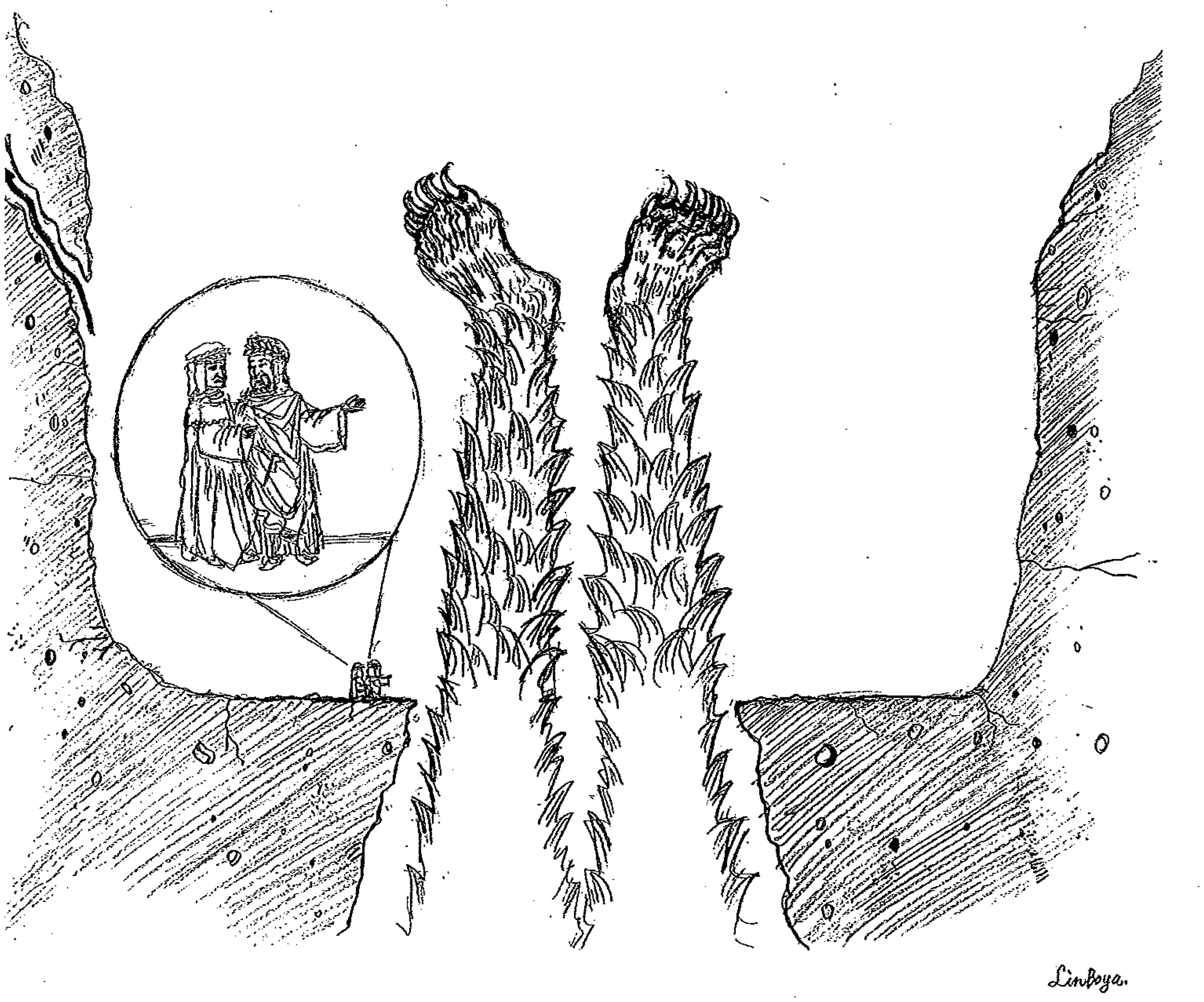
As pointed out at the beginning of this article, the perennial appeal of the view that Dante imagined Satan’s fall forming hell is the satisfying relationship it establishes between the devil’s rebellion and his punishment, the same irony famously expressed by Adam’s exclamation in Paradise Lost: “That all this good of evil shall produce;/And evil turn to good; more wonderful” (12:470–471). Of course, the irony of Satan’s fall creating “good” remains powerfully expressed in Dante’s audacious conception of the origin of purgatory. But, as I hope the evidence presented here has demonstrated, a reading of Inferno XXXIV which ascribes the formation of hell to Satan’s fall is one which teachers and scholars of Dante will in future need to forego. 22