







Abstract
American artist and architect Paul Laffoley (1935–2015) had a life-long fascination with Dante. Not only did he refer to Dante and the Commedia throughout his writings and paintings, but he created a large-scale triptych illustrating the poem, as well as sketched out plans for a full-immersion Dante study center on a planetoid orbiting the Sun, complete with a to-scale replica of the medieval Earth, Mount Purgatory, the material heavens, and the Empyrean through which a “Dante Candidate” could re-enact the Pilgrim’s journey. Laffoley’s work is often placed by art critics within the visionary tradition and Laffoley himself embraced that label, even as he deconstructed the term in his writing. Among the many visionary artists, poets, and philosophers Laffoley studied, Dante was central. He was, for Laffoley, a model seeker of knowledge, a seer beyond the illusions of everyday life. The essay that follows offers a brief biography of Laffoley and his works; an overview of his two main Dante projects (The Divine Comedy triptych [1972–1975] and The Dantesphere [1978]); and initial considerations on how Dante’s works and thought fit into Laffoley’s larger epistemological project.
On November 16, 2015, nearly 700 years after Dante’s death, the planet Earth lost another extraordinary human being: the visionary artist, Paul Laffoley (Cambridge, MA, 1935 – Boston, MA, 2015) (see Figure 1). I would like to think Laffoley, like Dante, is now able to experience the beauties and ineffable paradoxes of the universe—and beyond—that his works so often imagined, and imaged, in such detail. Dante’s Commedia was one of Laffoley’s most beloved and revisited texts, inspiring references to Dante throughout his visual art and written work, a massive triptych of paintings, and a plan for a site in which the Pilgrim’s entire journey would be re-enacted inside a pentakis dodecahedral planetoid orbiting the sun.
Paul Laffoley in his studio in South Boston, January 2015. Photo by Elyse Benenson.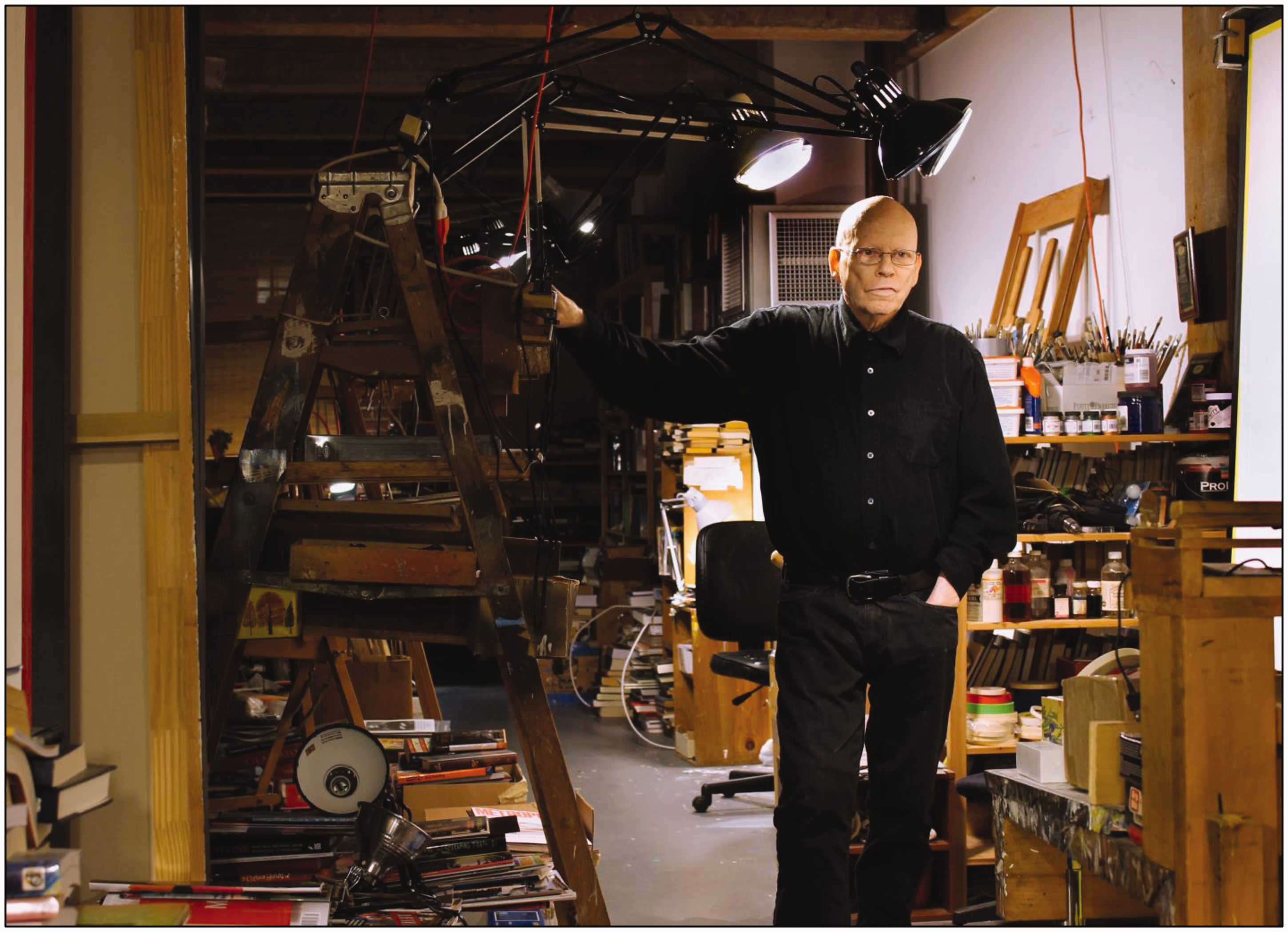
Laffoley’s work bursts with symbols, symmetry, systems, lists, charts, topological forms ranging from Alexander Horns to fractals, mathematical proportions (e.g., phi), the musical octave, pop culture references, and most strikingly, words and more words. His paintings and writing reference everything from yoga to yugas, UFOs to utopias, absinthe to aleatory evolution. Laffoley proposes living buildings, time machines, renewable energy transportation, portals to other dimensions and times. He sings of the cycles of history and hints at ways to create better worlds and futures. In including so much knowledge from sources the world over—ancient and modern—in offering so many new visions of life in this universe, Laffoley created an encyclopedic, visual cathedral reminiscent of Dante’s poetic one. As Dante wrote in Paradiso 1, “Surge ai mortali per diverse foci / la lucerna del mondo” [The lantern of the world rises to mortals by various paths] (1.37–38).
Laffoley often said that he read the Commedia eighteen times: fifteen times in English and three times in Italian (Laffoley, 1986b: 69). As someone who had the great fortune of knowing him, I have no doubt this claim was true. Laffoley was a brilliant, erudite, encyclopedic, and tireless reader with a photographic memory. His home/studio was crammed with books from ceiling to floor, wall to wall. Douglas Walla of Kent Fine Art—Laffoley’s agent since 1987 and the person who boxed up the artist’s things after he passed away—estimates that Laffoley had over 10,000 books and seventy-two boxes of writing (Walla, 2020). Laffoley was eccentric, yes, but always consistent in his eccentricities, and “coherent” in his propositions and practices (Bracewell, 2013: 46), one of these being carefully noting how many times he (or someone he was studying) did something. Times and time are central to his work, as can be seen in his numerous writings on the concept of time and the notion of history, and in his meticulous calculations of actions and events, such as the amount of time Dante Pilgrim spent in each step of his journey (Laffoley, 1978: 22–23).
Whether meeting with Laffoley in person, attending his public lectures, watching an interview, or reading his autobiographical writing, one would hear “the stories.” 1 He never varied his tellings, regardless of his audience. Many of the experiences he recounted were highly peculiar, full of synchronicities, hard to believe, and even challenging to comprehend. Did he really experience an alien encounter? What did he mean by psychotronic? What, and when, is the Bauharoque? What is an eloptic nohmagraphon? Add to all this the fact that his stories (like his artwork) brim with multiple languages, extensive philosophical and esoteric terminology and symbolism, and a wonderful sense of humor. No listener or reader or viewer could be faulted for wondering if he invented some of his experiences. Yet, as Jean-Pierre Larroque concluded in his 2011 documentary on Laffoley, “even if you don’t believe what Paul Laffoley says, it’s important to believe in Paul Laffoley. His work drives our civilization another inch forward” (2011). Laffoley did occasionally forget a detail or two, and he did enjoy playing with language (or rather, languages) and delivering one-liners to make people laugh, but he never changed the content of his stories. I should note, however, that among Laffoley’s consistently repeated stories was a claim to have been born in 1940, five years later than his actual birth date. Perhaps, like some other artists and public figures, he wanted to seem younger (and thus even more accomplished) in order to fare better in award and fellowship competitions. Or perhaps, as I will propose later in this essay, he had a more interesting motive for saying he was born in 1940.
Laffoley’s unusualness begins at his very beginning. He was an only child (or so he thought), born into a moderately affluent family. His father’s career as a respected vice president of a bank (Cambridge Trust) sustained the family’s Boston Brahmin veneer, while more privately Paul G. Laffoley, Sr. maintained a life as a trance medium, refused to believe in gravity, was friends with the Harvard parapsychology researcher Leonard T. Troland, and introduced his son to copious paranormal notions. 2 At six months old, Laffoley reported, he uttered the word “Constantinople”; he then went silent until age four (Laffoley, 1988b). He was, later in life, diagnosed with a mild form of Asperger’s, and he said that he learned after his father died that he had had an elder brother who died of “extreme autism” before Laffoley was born (Laffoley, 1999a: 27). He underwent a second phase of silence—an extended state of catatonia that he says he self-induced to experience being like a zombie (1999a: 27)—in his early twenties, followed by eight electroshock treatments. In an interview, he told me he thought he might be an “encephalated schizophrenic” or “encapsulated psychotic” 3 (Laffoley, 2006, 2008a), and laughed after he said that. He was likely joking with me. Neither schizophrenia nor psychosis ever manifested in his life: he never acted erratically, nor was he tormented by voices or visions; and he never showed anything but kindness and generosity to all who knew him. What is more, he did not drink or take drugs, even during his harrowing experience at Woodstock in 1969, where a number of his paintings were exhibited without his permission and he had to fight to get them back (his telling is worth a read, and he mentions Dante at its opening 4 ). Yes, in later life, he would make a number of curious claims: that he had had a few encounters with an alien named Quazgaa Klaatu (a little suspicious, or intentionally funny, given that “Klaatu” is the name of the alien in his favorite science fiction film, The Day the Earth Stood Still [1959] 5 ); that there was an alien laboratory in his brain (see his painting The Thanaton: The Messenger of the Cosmic Task [1996] 6 ). He also had a lion’s paw “foot” made for fancy events to replace his prosthetic leg (his right leg had been amputated after a fall that happened the night before his Portaling show opened at Kent Fine Art in NYC in 2001 7 ). But even so, his mind was astonishingly clear, his talent immense, and the number of people who adored him exceptionally large. As poet John Yau recently said, “Paul was a dervish who could maintain long flights of fancy without ever falling into the abyss of madness. It was a delight and daunting to listen to him extoll” (Yau, 2020). Even Laffoley himself said it was hard to believe many of the things that he experienced and the information that he received—a comment that will sound quite familiar to readers of Dante, and to others who study writers who have encountered phenomena beyond our world and understanding. He noted in his reflections on his 1978 painting The Living Klein Bottle House of Time that there might, one day, be a device that could help him, and us, make sense of such curious experiences and mind-boggling data: the “Agnosticon.” It would allow its user, when faced with unfamiliar or incomprehensible information, “to engineer their doubt or faith processes… in order to believe or disbelieve any proposition instantly” (Laffoley, 2016: 162). 8
Laffoley majored in classics and art history at Brown University—taking courses also in philosophy, and graduating in 1958, not in 1962, as he sometimes stated, and various publications have echoed.
9
He liked to tell the story that he did not actually finish his senior thesis on Lucretius until 1985, when he submitted it in the form of a detailed painting visualizing De rerum natura, and for which he received and A- (the minus for lateness).
10
After college, he went to the Harvard School of Design (HSD) for a degree in architecture. He spoke fondly of working as an assistant to the Italian sculptor Mirko Basaldella, and of his interactions with his HSD cohort. He was, however, asked to leave HSD after a year, told that he was being “grand juried out” of the program for his tendency to get “over involved” in his work (Laffoley, 2002b) and for “conceptual deviance” (Laffoley, 2008a), as when he designed what he called “living” buildings. At the encouragement of his mother, who herself had wished to become an architect, he then began architecture school at MIT in the 1964–1965 academic year, was again kicked out, and then in 1967 tried one more time, unsuccessfully, at the Boston Architecture Center. Laffoley did finally receive his architect’s license in 1990, albeit too late for his mother to celebrate this accomplishment with him, as she had died in 1984. A number of his drawings and paintings show his building projects, some of which are based in four-dimensional Klein bottle arrangements (see Figure 2) and Goethe’s notion of Urpflanze, the primordial origin of plant life (see Laffoley’s painting, Das Urpflanze Haus, 1984) as well as architecture created through grafted vegetation, ginkgo biloba trees, pine trees, and katsu plants, in particular (Laffoley, 2000, 2002b).
The Living Klein Bottle House of Time (1978).
After being dismissed from HSD, Laffoley spent the early 1960s in New York City, assisting artists, including his idol, the visionary architect Frederick Kiesler (in an apprenticeship that ended abruptly [see Henderson, 2016: 35]); and Andy Warhol, who asked him to watch TV test patterns at his Firehouse Studio in the wee hours of the morning to see if there were anything that could be used in a film. It is possible that these images inspired Laffoley to begin creating paintings with a form that would become one of his trademarks: the mandala. Laffoley had been introduced to mandalas in his youth by his mathematics tutor, who was from India, but it is not until 1963 that we see these particular patterns in Laffoley’s work (see, for example, True Liberation, Figure 3).
11
As his style developed, mandalas often merged with diagrams, and he used both formats for conveying symbolic information in a non-linear and ‘simultaneous’ way. Warhol’s pop art aesthetic also made an impact on the young Laffoley, although he would use consumerist imagery and “kitsch” for a starkly different purpose than Warhol. For Laffoley, as we will see below, kitsch functioned as a gateway-trigger to open the mind to complex metaphysical notions and experiences.
True Liberation (1963).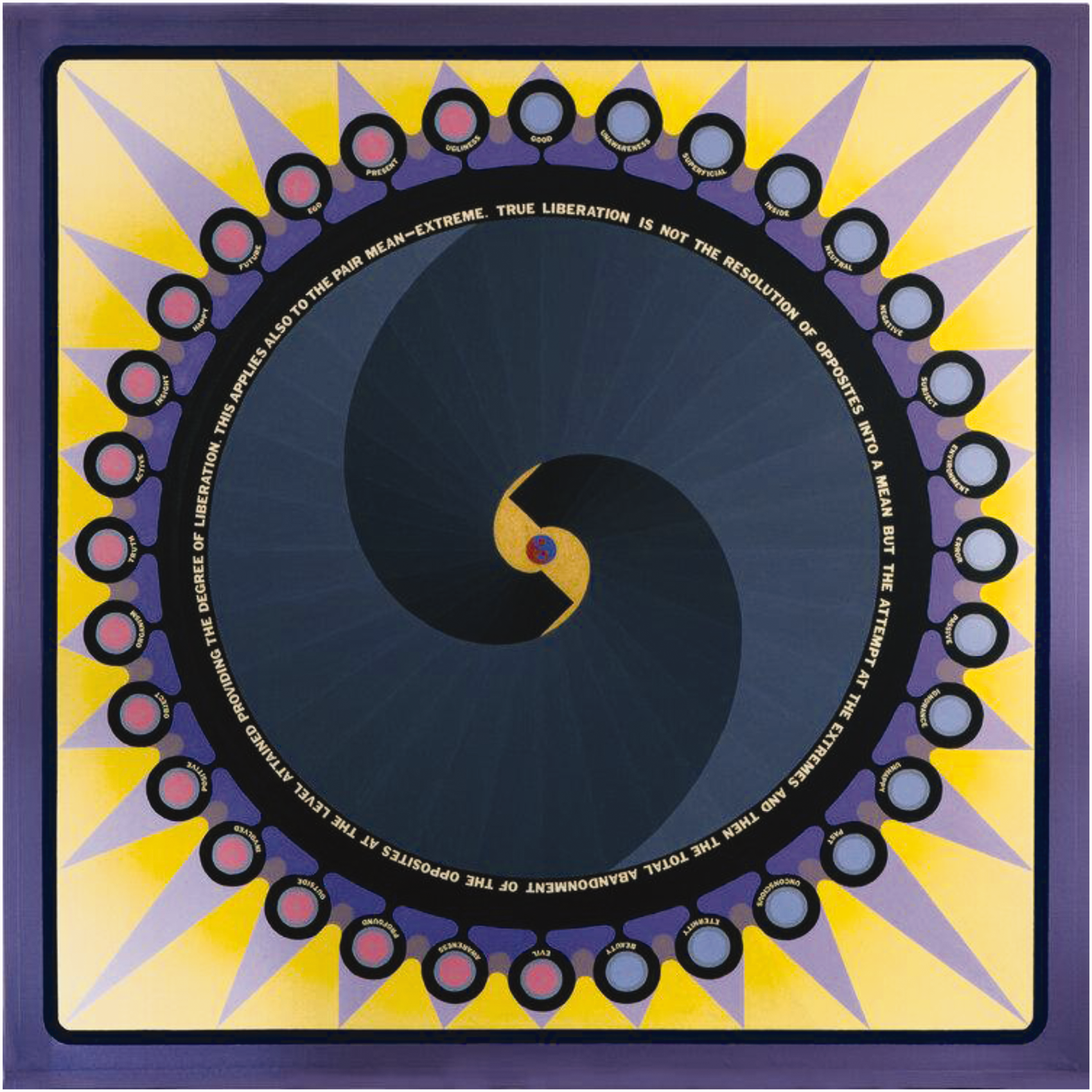
After working for Warhol, Laffoley spent eighteen months between 1962 and 1963 assisting Minoru Yamasaki, the lead architect of the World Trade Center. Yet again, he was dismissed from his position. This time, it was for making an unsolicited suggestion: adding pedestrian bridges between the towers at five-story intervals to offer businesses a way to spread out their staff horizontally, and to increase the stability of what would then be the highest towers in the world. Hauntingly, in 1962, before moving to New York City and thus before working on the World Trade Center, he painted a work entitled The City Can Change Your Life that seems to foresee September 11 (see Figure 4). The painting shows an airplane crashing into Manhattan in three panels, but in reverse: the panel on the left depicts a crashed plane (accompanied by a skull and crossbones); the middle one, an approaching plane (accompanied by a heart and arrow, which Laffoley describes as a broken heart); and the one on the right, shows a plane high up in the air (accompanied by a clock that reads 9:03—the precise time that United Airlines Flight 175 would, years later, crash into the South Tower of the World Trade Center). Curiously, the viewer’s eyes need to track from right to left to reconstruct the story of the crash.
12
The City Can Change Your Life (1962).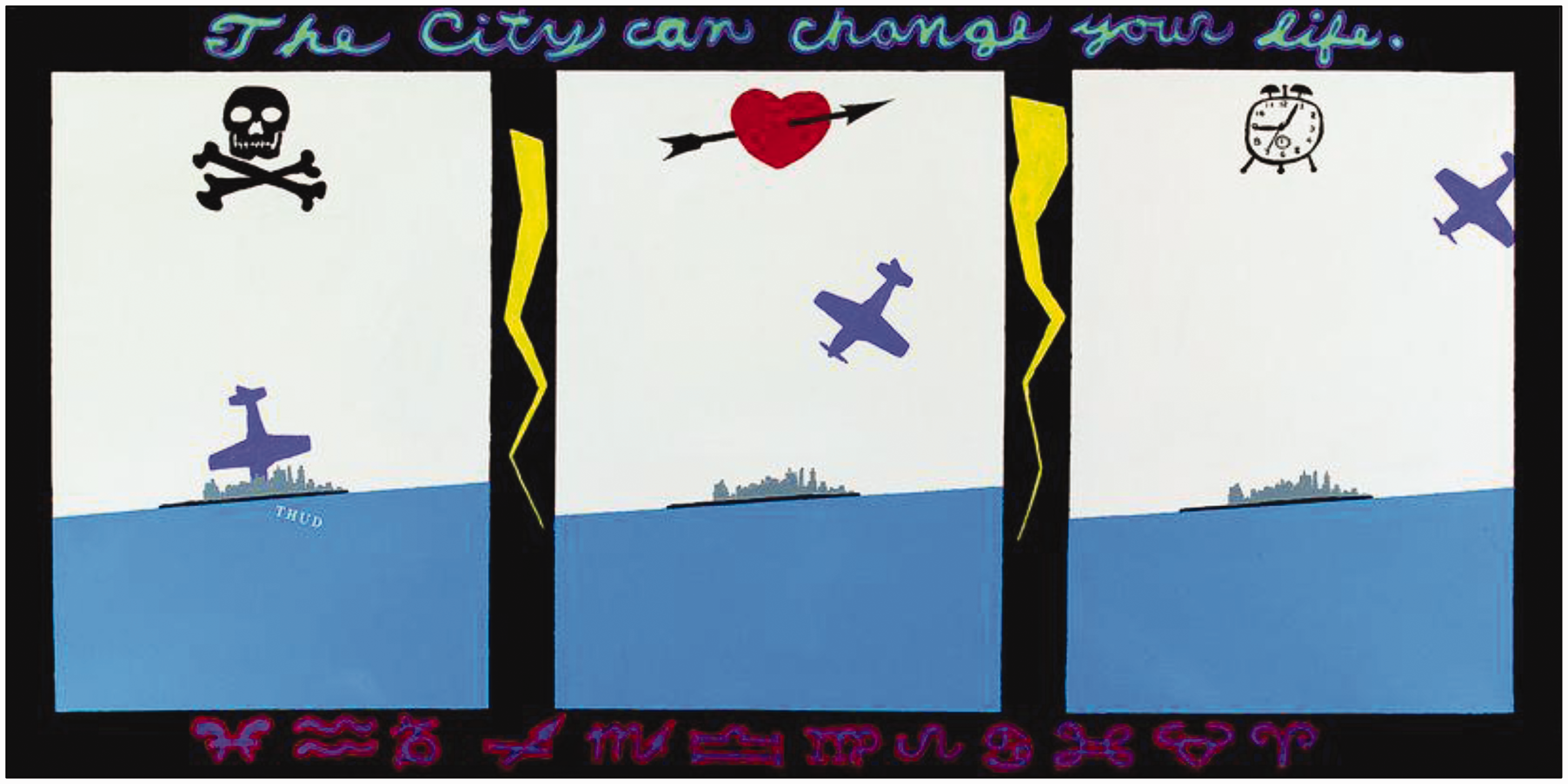
Laffoley did not claim to be psychic or to know the future. While he studied astrology and was fascinated by ideas of remote viewing, ESP, tarot reading, astral travel, and lucid dreaming, and while he did theorize about what the future might look like, he never claimed to know for sure what it would be. He did admit, though, that throughout his life he caught brief glimpses of events or images from what seemed to be the past or the future, as if these were happening in his present. He believed anyone could receive these glimpses, and that anyone could peer into the workings of the universe. He also believed time travel was possible, sketching and painting numerous mechanisms for its realization (see, for example, his Levogyre [1976] and Geochronmechane: The Time Machine from Earth [1990]). And he authored a fascinating theory of the cycles of history that builds on Vico’s corsi e ricorsi and Joachim of Fiore’s three ages, with terminology and tools that range from the history of philosophy and art, to pop culture and science fiction (see, for example, Laffoley, 1989a: 89–102).
Four decades after being involved with the construction of the World Trade Center and painting The City Can Change Your Life, Laffoley would return to the Twin Towers in his work. This time, he created a painting he titled Gaudeamus Igitur (2001) (see Figure 5), which celebrates the tall hotel Antoni Gaudí had proposed for lower Manhattan in 1908 and had intended as an actual center for world trade (see Laffoley, 2016: 234). In 2003, Laffoley hand-submitted his interpretation of Gaudí’s hotel design as his entry for the Ground Zero site competition. In 2004, I happened across a Rizzoli coffee table book called Imagining Ground Zero: Official and Unofficial Proposals for the World Trade Center Site (Stephens, Luna and Broadhurst, 2004) and saw that Laffoley’s proposal was included. I showed it to him and he was miffed that he had not been alerted to the publication. He was pleased, though, that his proposal was featured as the final image in the collection, just before the index, and he had had the last word.
13
Gaudeamus Igitur (2001).
In 1963, upon the death of his father, Laffoley returned to Boston, and after a few moves, found a small studio space downtown—a large utility closet in a building on Bromfield street—where he would live and work for close to forty years. It was here that, in 1971, he founded the Boston Visionary Cell, “a non-profit art association encouraging art and architecture of the visionary genre” (Laffoley, 2002b), which was officially incorporated in the State of Massachusetts. 14 In 1966 he began exhibiting his work regularly in solo and group shows. He had gallery representation in Boston, New York, and on the West Coast, and in 1988, he began working with Douglas Walla of Kent Fine Art in New York City (then in the West Village and later in Chelsea). Walla continues to serve as the manager of Laffoley’s estate, artwork, and intellectual property, and was one of Laffoley’s dearest and most trusted friends.
Later in life, as a recognized artist, Laffoley would win awards—the Boston Institute of Contemporary Art’s Englehard Award (1985–1986), the Pollock-Krasner Foundation Grant (2002), and the Guggenheim Fellowship (2009). He created over 200 paintings, about 500 drawings, 100 architectural drawings, and a few sculpture/models. In the 2000s, his works would be shown not just nationally, but internationally, including in London, Paris, Berlin, and São Paolo. Was he still a “fringe” artist, outside the art world establishment? Yes and no. He was never interested in actually being “in” it, although he liked winning competitions and fellowships if they came with monetary awards that would help support his art. If anything, he continued to the end to embrace the personas of “kook,” as Donna Kossy defined the term in her magazine, Kook, and in a superb interview with Laffoley in 1990, 15 and “geezer”—that is, an opinionated, peculiar, often controversial artist who is a senior citizen, but identifies as young (Laffoley, 2008e and the painting The Five Principles of Geezer Art [2003]). Yet, as art critic William Grimes wrote in his obituary for Laffoley in The New York Times, while Laffoley was considered by many one of the world’s “most distinctive and cerebral of outside artists,” he might in fact have been “the ultimate insider” (Grimes, 2015). What Grimes meant by “insider” is ambiguous, but perhaps he was predicting Laffoley’s future star status in the art world.
Had Laffoley read Grimes’ comment, he might have quipped that he was, in fact, the “ultimate inside” artist, given that he did very little of anything other than work in his studio, read, watch movies, eat out at a few nearby restaurants, and attend openings of his shows. He often thought it was funny that people thought of him as an “outsider,” as “he never went outside!” (Walla, 2016: 9). He lived primarily inside the mind/spirit, and he armchair traveled to outer space, other dimensions, and other times; that said, Laffoley might challenge me to prove he “only” armchair traveled, as astro-traveling and other experiences he underwent had seemed quite real to him.
In the final decade of his life, now living and working in a 2000-square-foot artist’s studio in a renovated warehouse building in the Fort Point district of South Boston, Laffoley was doted on by adoring assistants from Boston’s art schools, and visited often by devoted friends and starry-eyed fans (myself included). His paintings were now selling for hundreds of thousands of dollars. Yet as cultural critic Michael Bracewell wrote, and I would agree, even with Laffoley’s success, even with his widely accepted status as a “visionary artist,” he never “positioned himself as a guru, iconoclast or countercultural hero” (Bracewell, 2013: 47). “Visionary art,” Laffoley wrote, “is not art for art’s sake or art for some religious sake, but an end in itself” (Dugan, 1971: 6). His extensive writing on what the concept of “visionary art” means is worth reading for its insights into his complex theories on its distinction from other kinds of art. His theory is unexpectedly complex for a term we so use so loosely to describe people who seem to see outside of their own time. Laffoley-as-visionary, as one learns from his writing and artwork, is not Laffoley-as-solipsism, without guides or inspirations. He literally filled his works with the names of people to whom he felt indebted: “homages,” as he called them. Among his most cited homages—to list just a few (and, yes, to observe that they are all white men, which is worth further discussion) in alphabetical order—are Aquinas, Baudelaire, Bergson, Blake, Boullés, Bragdon, Coleridge, Descartes, Duchamp, Escher, B. Fuller, Gaudí, Goethe, Hegel, Heraclitus, Huxley, Jarry, Joachim of Fiore, Jung, Kiesler, Leibniz, Lovecraft, Lucretius, Lull, Mandelbrot, Nietzche, Ouspensky, Parmenides, Plato, Plotinus, Poe, Pythagoras, R. Steiner, Teilhard de Chardin, Tesla, R. Thom, Verne, Vico, Wells, and … Dante. Laffoley’s homage to Dante can be found in paintings such as The Aquarian Age (1967), The Renovatio Mundi (1977), Die Erde Blume (1994), The Thanaton (1988), and Pickman’s Mephitic Models (2004) (see, for example, Figure 6), as well as throughout his journals and published writing. And, of course, there is Laffoley’s massive 1972–1975 triptych, The Divine Comedy, and the 1978 Dantesphere project, both of which I will address in the following pages.
The Renovatio Mundi (1977) and detail from bottom.
Laffoley’s wide and deep erudition—in Western philosophical thought and the literary canon, in esoteric writings from across the globe and time, in world religions, in science and technology, in mathematics, in the history of art, in architectural theory, in historiography, in pop culture, and in psychology—has always been recognized, but scholars have only recently begun to study the grounding of his work in these multiple areas of intellectual inquiry. In 2016, the University of Chicago Press published a catalogue raisonné of his works: The Essential Paul Laffoley: Works from the Boston Visionary Cell. This hefty tome contains excellent reproductions of over ninety of the artist’s works (mostly paintings), with each work accompanied by Laffoley’s glosses, which he called “thought-forms.” Laffoley would have categorized these as “mental matter” or the “energy of the mind,” and their style is similar to a kind of writing described by Theosophists Annie Besant and C.W. Leadbeater, to whom he attributes the coining of the term “thought-form.” Four essays precede the plates and their accompanying thought-forms, including one by me, on The Divine Comedy triptych (Saiber, 2016); I would refer readers interested in Laffoley’s sources for his triptych to that essay.
The Divine Comedy triptych (1972–1975)
Laffoley’s extraordinary triptych (see Figure 7a, b, c) brings Dante’s journey into a remarkably comprehensive and vivid illus-translation. Laffoley is the only artist, as far as I know, to have depicted in a single piece all one hundred cantos as well as the topography of Hell, Purgatory, and Paradise.
16
The three paintings bear Laffoley’s trademark style, combining architectonic precision, mind-boggling detail, immense erudition, diagrammatics, symmetry, and—most of all—words. Just as Laffoley called Dante’s poem a “verbal cathedral” (Laffoley, 2008a), we could call Laffoley’s triptych a painted poem. The triptych is, without question, Laffoley’s most verbose work of visual art. He painted numerous pieces inspired by poetry, such as the aforementioned Lucretius’s De rerum natura (1985) and Edward Lear’s “The Owl and the Pussy-cat” (Owl, Death, Pussycat [2003]), but none of these comes close to the quantity of logos filling the Dante triptych. The three panels are as dense and detailed as Dante’s journey itself. As Laffoley told me, it would have been wrong for the paintings to leave anything out—what would he omit, how could he choose? (Laffoley, 2008a). If what Yau wrote of Laffoley is correct—that a visionary is a very rare someone searching “to establish links between the microcosm and the macrocosm, who, once he finds them can shed the strictures of temporal time and recover the eternal”—then Laffoley indeed joins Dante in rarified air (Yau, 1986: 88).
The Divine Comedy triptych (1972-1975). Above, Inferno panel. Purgatorio panel. Paradiso panel.


Each panel of the triptych is a 6′ × 6′ [1.83 × 1.83 meters] canvas with oil and acrylic paints, ink, and press-on vinyl letters. Laffoley told me he would have liked each panel to be 50′ × 50′ [15.24 × 15.24 meters] (Laffoley, 2008a); although in some of his writing he says his ideal was for each panel to be 20′ × 20′ [6.1 × 6.1 meters]. Each panel depicts one of Dante’s three realms (Hell, Purgatory, and Paradise) in a mandalic structure, and each contains the topography of the respective realm at the center, surrounded by what look like filmstrips or movie stills, as Laffoley described them (2008a). These units, which I like to think of as canto-cells—thirty-four surrounding the topographical diagram of Inferno, and thirty-three surrounding the topographies of Purgatory and Paradise, respectively—contain summaries, action figures, diagrams, and even the amount of time treated in each canto. Walla recently found Laffoley’s notecard-drafts for each canto-cell, an example of which I include here, next to its completed painted version (see Figures 8 a, b). Each canto-cell is quite small (a few inches square) [under 10 cm square], and the cartoon-like drawings are done freehand. The detail within each cell, the complex topography at the center of each panel, and the ornaments and phrases scattered throughout the panels, require close viewing and much time on the part of the viewer. The Divine Comedy triptych is hardly the Commedia in shorthand. For the topography of the pit of Hell and Mount Purgatory, Laffoley followed a variety of sources ranging from early Renaissance diagrams through contemporary drawings. For Paradise, on the other hand, the structure is completely his own. I refer readers to my earlier essay on Dante and Laffoley (Saiber, 2016) for more information on these elements, although much more work is needed to elucidate their full range of meaning.
(a) Notecard for Inferno 5 (1972-75). (b) Canto cell for Inferno 5.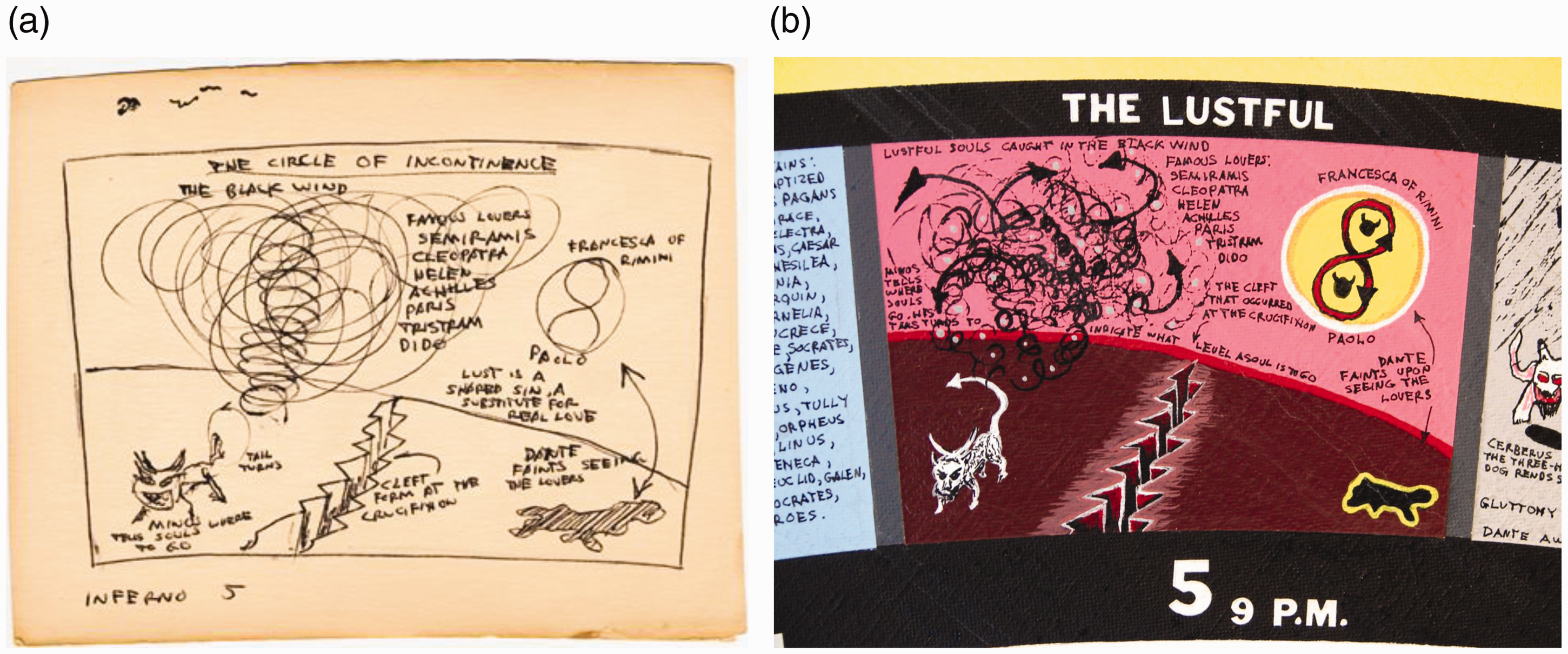
While Laffoley is impressively faithful to the facts, figures, and actions of Dante’s text in the canto-cells and in the organization of the three realms (see Saiber, 2016), he also inserts phrases here and there throughout the panels (especially the Inferno) that are not from Dante’s poem or other writing, but are, rather, “extrapolations” (Laffoley, 2008a). He explained to me that these phrases are neither adaptations nor interpretations, but ideas he saw as present in Dante’s poem that he wove together with concepts of his own. One of the most striking is the phrase in white letters below Lucifer’s dangling feet: “Satan as self-defeating kitsch” (see Figure 9). Kitsch—a central concept in Laffoley’s thought—is a kind of “barrier” between a “realm of pure visionary imagination as opposed to typical scholarship as a method of knowledge” (Laffoley, 2002a). It is also, he explained, a kind of veil that surrounds the true meanings of symbols and protects inner revelation, or true knowledge (Laffoley, 1999a). Kitsch, for Laffoley, is like a distorted lens through which we view the world, leading us to perceive things as changing when they are really remaining the same; or as known and understood, when in fact they are not. In the Inferno panel, Satan dwells in kitsch because he is “abstracted from real life” (Laffoley, 2008a). He is “self-defeating” because he “keeps flapping his wings… and keeps progress down” (Laffoley, 2008a). Kitsch, Laffoley continues, laden with clichés and norms, is what keeps us from really and truly seeing what is new, as well as what is real and true, even if that reality and truth is right in front of us (Laffoley, 2008a). While the Paradiso panel seems to be kitsch-free, Laffoley did insert kitsch into the Purgatorio, in the form of puffy pink clouds (see Figure 10). Unlike Satan and the damned, who are stuck in their vision of themselves and the world, the penitents in Purgatory must fight the inclination to stay stuck in the viewpoints and habits that kept them from living a “free” life. In the Christian context, that would mean a life following Christian morals; Laffoley instead conceptualized the Pilgrim’s, and our, progression as toward “awareness.”
Detail from the Purgatorio panel. Detail from the Inferno panel.

Moving outward to the ornamentation surrounding the canto-cells of all three panels, we see symmetrical, mandalic patterns. The frame of the Inferno panel looks like a night sky filled with stars, overlaid by fluorescent red, orange, and yellow flames in the style of “race car paint jobs” (Laffoley, 2008a).
17
These flames evoke testosterone, a sense of toughness and evil, and, as Laffoley noted, a desire to seem scary (Laffoley, 2008a). There is humor in the Inferno panel, as there is in the other two panels, a few examples being where Laffoley depicts Dante with bloodshot eyes (see Figure 11), or falling out of a canto-cell frame (see the canto-cell for Paradiso 20). Laffoley liked to say that Dante called his poem The Comedy not only because it has a “happy ending,” but because it contained humor (Laffoley, 2008a). As mentioned earlier, Laffoley loved double meanings in creating verbal and visual puns, although his humor was never sarcastic or ironic. As artist Jean Marie Wasilik wrote in her essay for the 1999 Austin exhibition catalogue, “… when humor appears in his work it has the quality of a grin of recognition” (Wasilik, 1999: 14).
18
Detail from the Paradiso panel, canto-cell 25.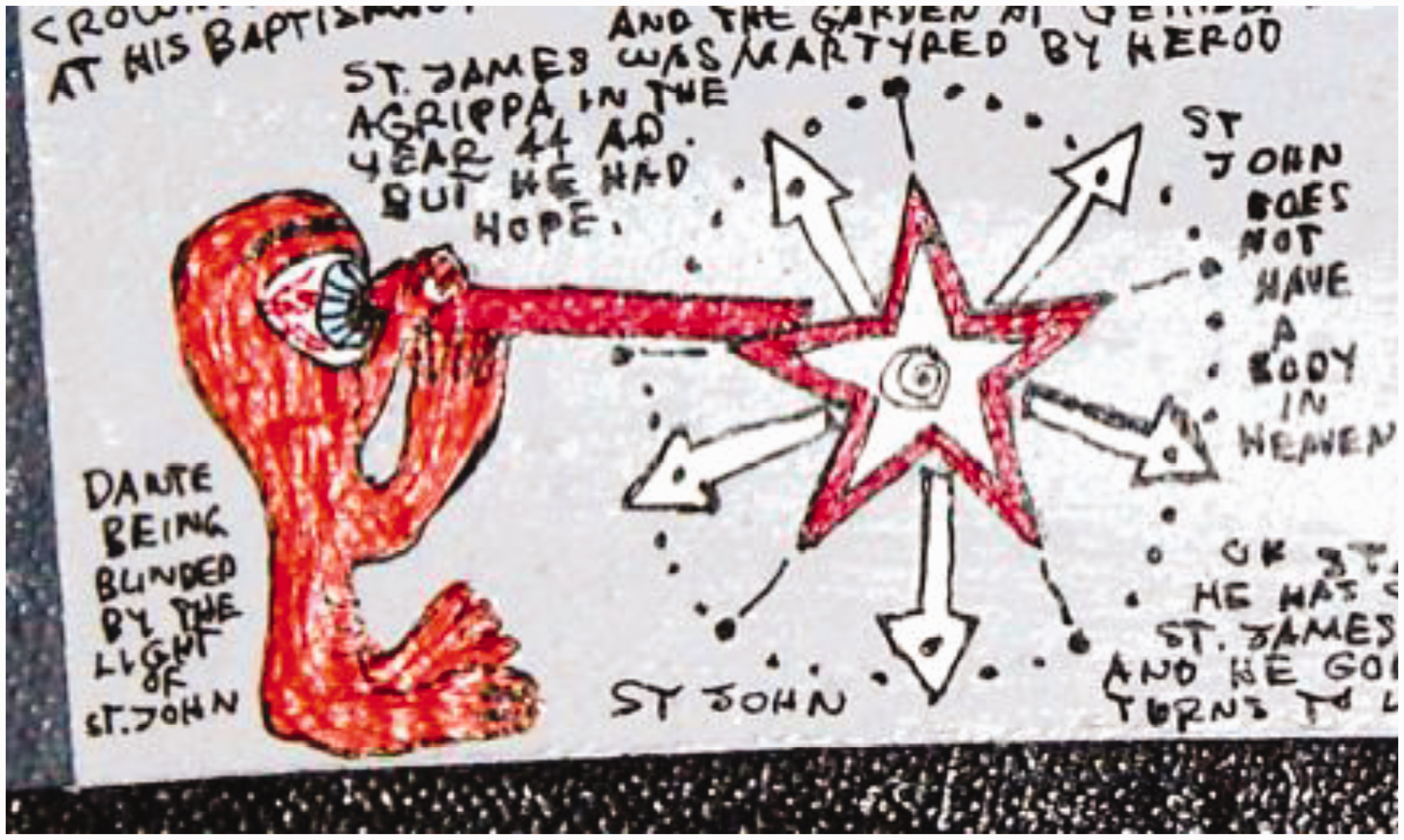
The frames of the Purgatorio panel are much busier than those of either the Inferno or Paradiso panels. Mount Purgatory is, of course, a busy place, with souls trying to complete their penance as quickly as possible. The most eye-catching elements in this panel are four boxes, one in each of the panel’s corners (see Figure 12 a, b, c, d). Each box contains Laffoley’s copy of the famous illuminations of the Evangelists in the Book of Kells (Fol. 27v). The prominent images of the Evangelists, together with the imagery of panel as a whole, indicate a bridge between the earthly and the Divine, a mediation between the human/natural and the Divine. The swirling, kaleidoscopic designs populating the spaces between the Evangelists and the canto-cells are filled with shapes that have three and four sides, recalling the Divine Trinity, and the human and the earthly indicated by the number four.
Details from the Purgatorio panel frame corners.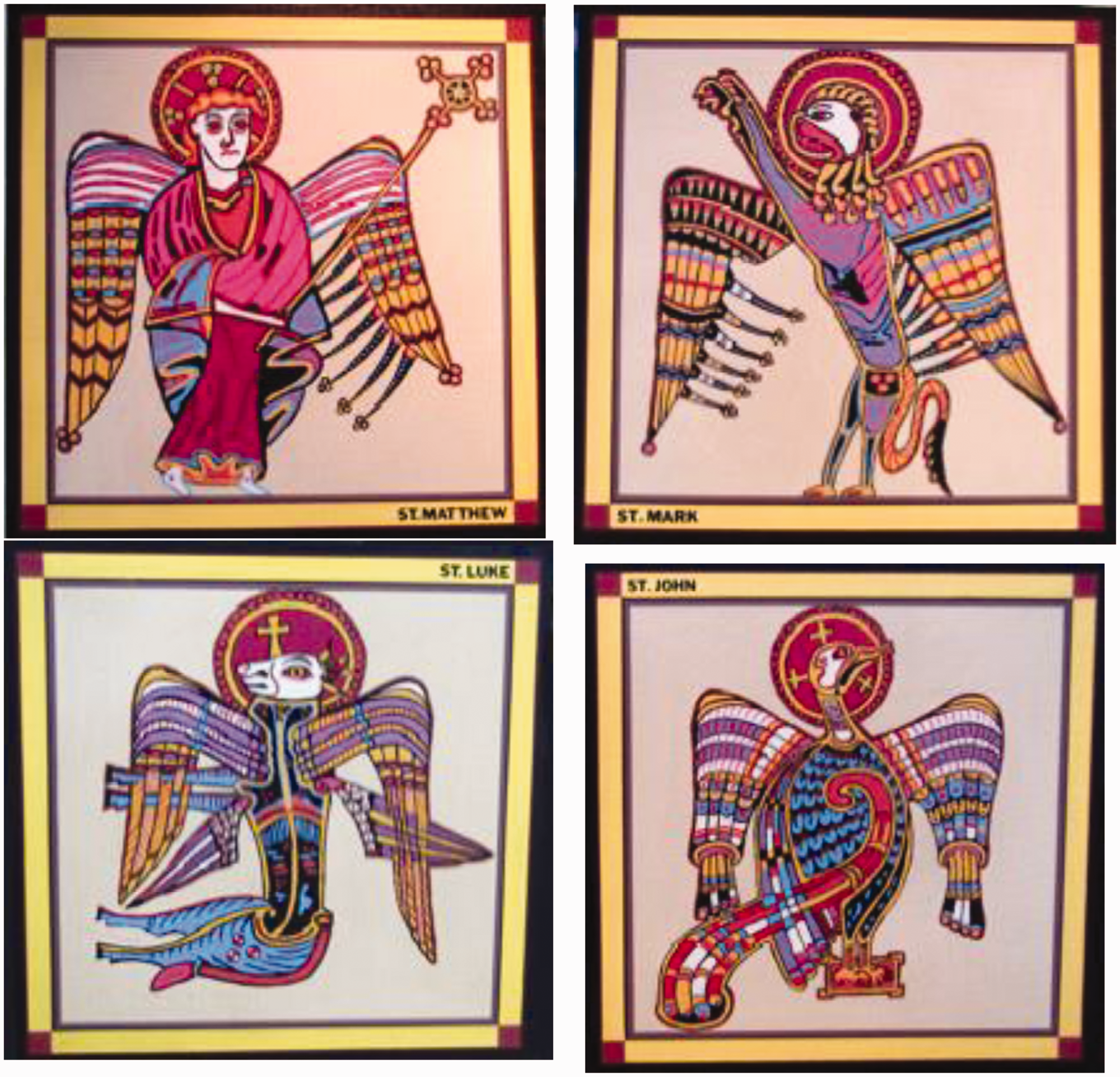
The Paradiso panel frame, like Inferno’s, has flames that seem like light rays, although these gold, white, and yellow beams have little to do with car culture. 19 They explode straight out from the canto-cells and echo the Sacred Rose, which Laffoley depicts just below the canto-cells with sixty-four white outer petals (and sixty-four yellow inner petals), each divided into seven or eight zones, depending whether you count the grey petals, which may be there to indicate dimension. The zones are separated by colored lines, but these colors do not match up precisely with the colors of the spheres below; this seems to be a rare moment in which Laffoley missed an opportunity to layer in additional meaning.
Breaking the outer frame at the top of each panel’s canto-cell circle we see what I would call title-cells (see Figure 13 a, b, c). Each title-cell holds two portraits: one of Dante (always on the left) and the other, one of his guides. On the Inferno panel, the portrait of Dante evokes the work by Giovanni del Ponte: the poet is wearing his well-known red hat and not crowned with the laurel wreath.
20
Laffoley is perhaps indicating that Dante has yet to merit it. In the Purgatorio panel, the Dante portrait resembles that by Domenico di Michelino (here, with laurel crown);
21
and on the Paradiso panel Dante, with laurel crown and book in hand, looks like that painted by Luca Signorelli.
22
In the three portraits Dante is represented as the Poet, not the Pilgrim, and in none of them is he represented as sleeping, and thereby dreaming this journey, although Dante may have, according to Laffoley, “lucidly” dreamed it, or experienced some sort of time travel (Laffoley, 2008a).
Details from top of each panel.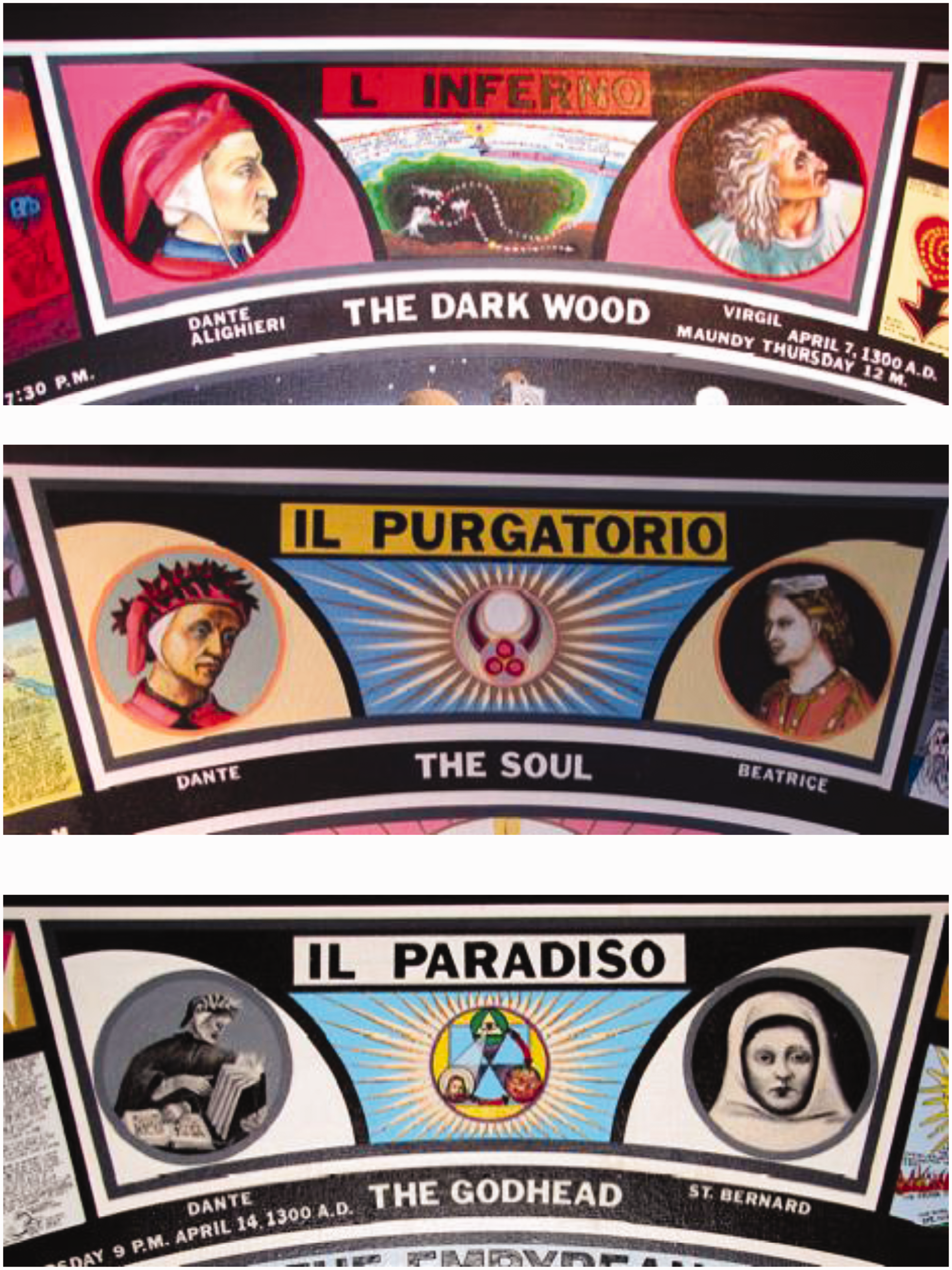
For his guides (also wide awake) Laffoley draws on similar antecedents. In the Inferno panel, Virgil is wild-haired and looking like a mad prognosticator, clearly inspired by Luca Signorelli’s early sixteenth-century depiction of Virgil in the Cappella di San Brizio in Orvieto. In the Purgatorio panel, Beatrice resembles the elegant female figure in Giotto’s fresco “The Meeting at the Golden Gate” (1304–1306) in the Scrovegni Chapel in Padua. And on the Paradiso panel, Saint Bernard of Clairvaux looks both traditionally Cistercian in his white garment with head covered, and quite feminine, resembling Mary, to whom he is famously devoted. I am still working to identify what image Laffoley used as a model for this painting of Saint Bernard, or, alternatively, evidence that in this case he chose to work without one.
The portraits of Dante and his guides in the title-cells are accompanied by vignettes, each vignette with a caption below it. The Inferno’s title-cell image is a mini-overview of the journey as far as Mount Purgatory and the fiery sphere around the Earth. It is captioned “The Dark Wood” (see Figure 13a). The Purgatorio title-cell contains a circular shape, encompassing two adjacent circles that look like an infinity sign, the upper circle being completely white, and the lower one containing three more circles arranged in a pyramid shape, with what look like two horns emanating from them (see Figure 13b). The whole image is radiating pale yellow and gold rays (a solar pattern Laffoley uses often in his paintings), echoing the frame of the Paradiso panel. The caption reads “The Soul.” Laffoley explains that this figure represents a four-dimensional sphere—a hypersphere turning in on itself—and functions as a portent of things to come (Laffoley, 2008a). As the Inferno title-cell looked ahead to Purgatorio, the Purgatorio title-cell looks ahead to Paradiso. The Paradiso title-cell, captioned “The Godhead,” links all three realms through bright rays of light (which are present in the other two title-cells) (see Figure 13c). Paradiso’s title-cell also contains a circle surrounding a square upon which hover three small circles. Within these three small circles are a pyramid with an eye (top), Jesus (bottom left), and fire (bottom right): representing Father, Son, and Holy Spirit, as well as the three afterlife realms. The three are linked by cones that join their points at the center of the square. Laffoley is clearly recalling the image of the geometer who attempts to square the circle.
There is a lot more to say about the visual qualities of the triptych. I will mention just a few things here about one element: the panels’ color palettes. The Inferno panel’s thirty-four canto-cells are imbued with strong colors, primarily from the red, yellow, and orange family, although blue, green, and a few purples make an appearance. The Purgatorio panel’s canto-cells are dominated by shades of grey representing the stone of the mountain, with blues and purples, a few yellows and some pink. Paradiso’s canto-cells have a pastel palette, with colors corresponding to their associated celestial realm. Paradiso canto-cells 2, 3, and 4, for example, all take place in the sphere of the Moon, which Laffoley chose to designate with a pale green, as can be seen in the Sphere of the Moon in his diagram of the heavens. Laffoley’s depiction of the heavenly spheres, I should note, are both Material and Angelic simultaneously. He does not show one set of concentric circles for the Material Realm and one for the Angelic Circles in the Empyrean.
The modern viewer of the triptych may have expected to see the colors in the Paradise panel arranged in a rainbow, light-spectrum order, but Laffoley explained to me that the colors he used for the Material/Angelic spheres, and their corresponding canto-cells, are from “astrology analogs” and a kind of color symbolism that the medieval mind would have recognized (Laffoley, 2008c). In fact, Laffoley uses these same colors for the planets in Alchemy: The Telenomic Process of the Universe (1973), which he painted while working on the triptych. In his thought-form to Color Breathing (1983) Laffoley cites from Goethe’s Zur Farbenlehre: “Colors are the actions and sufferings of light as a result of its meeting with darkness” (Laffoley, 1999b, plate 21; italics, Laffoley’s). He extends this notion to the idea that the purest of colors are those which are found in non-albedo light, which he believes exists in lucid dreaming. Although viewers are not dreaming when they look at his paintings, there is no doubt that his colors, and his arrangement of those colors on canvases, are powerful and provocative. Even the changing colors of Dante and Virgil’s robes, as well as the changing colors of Dante and his guides’ skin, trigger us to be aware of the Pilgrim’s evolution on the journey. Looking at a Laffoley may be as close as many of us can come to lucid dreaming.
Linked to Laffoley’s choice of colors is his choice of corresponding numbers. His artwork and writing are filled with digits, especially those of particular symbolic or aesthetic significance such as π and Dimensionality: The Manifestation of Fate (1992).
Hard-to-miss numbers sit boldly under each canto-cell, indicating a time of the day or night. Laffoley calculated the Pilgrim’s timetable on his journey through a process of interpolation that was quite elaborate, but, he admitted, was also one of his favorite parts of this project (Laffoley, 2008c). He decided to do these calculations precisely because he “read that no one should be so literal with The Divine Comedy” (Laffoley, 2008c). He also includes these time calculations in his proposal for the Dantesphere, which I will discuss in the last part of this essay.
Laffoley’s work often engages the cycles of time. It is not by chance that the three Divine Comedy panels have their main action arranged in a circular form. As a student of Joachim of Fiore, Vico, and Nietzsche, Laffoley believed in the circular, “eternal recurrence of events and fate” (Laffoley, 1999b, plate 13). The painting Temporality: The Great Within of the Universe (1974), which Laffoley completed contemporaneously with or just before beginning the Paradiso panel, is one of his pieces most focused on questions surrounding the metaphysical nature of time. Two others are Mellonchron (1985) and Geochronmechane: The Time Machine from the Earth (1990), which represent time differently—neither as a line nor a circle, but as a Horned Sphere. 23 In his world scheme, three stages of cultural history cycle and recycle: “continuity”; “separation”; and “contact.” 24 The Middle Ages, in this scheme, is one of “continuity,” that is, a time in which people identified with the things they described and depicted. The Renaissance that followed was a time of “separation” in which, Laffoley theorized, people detached themselves mentally from the objects of their contemplation and discussion. The Enlightenment through the last century has been a time of “contact” in which people “retrofitted” themselves forward and backward in time, giving rise to movements like the Proto-Baroque, Neo-Classicism, and Postmodernism (Laffoley, 2008d).
The turn of the twenty-first century—our now—is what Laffoley would call the “Bauharoque.” It is a period that fuses the aesthetics of Bauhaus, which wanted to “unify the arts under architecture with the aim of creating utopia,” with the Baroque, “whose goal was to transform life into theater” (Laffoley, 1989a: 93). The Bauharoque, succinctly, is “utopian theater or theater of utopia” (Laffoley, 1989a: 93). It begins, Laffoley says, in response to the cynicism of Postmodernism and “will provide the world with a century of the most exciting challenges and solutions the human race has ever known” (Laffoley, 1999b, plates 25 and 26).
Laffoley’s hero Kiesler thought of history “as an endless sequence of technological changes, and art as a thematic continuity which could be extended and expanded upon by both viewer and artist” (Yau, 1986: 84). In an interview with UFO-enthusiast Brad Steiger, Laffoley spoke of the individual’s relationship to the world and his or her unique and “authentic projection of meaning upon the flow of events” (Steiger, 1976: 241). He also noted how time and “the totality of events” cannot be seen by the eye, and thus must be imagined internally and from an a-historical perspective, the perspective that would be engaged in “the mystical experience, fantasy, dreams, visions, voices, response to mythic structures, etc.” (Steiger, 1976: 241). In Laffoley’s paradigm, Dante’s journey—whether it was a mystical experience, imagined journey, dream, or lucid dream—certainly qualifies as a kind of “meta-history,” and Dante as a Kieslerian artist of continuity.
The more abstract the image, as those in Paradise ultimately are, the more words Laffoley used. The final canto-cell of Laffoley’s The Divine Comedy is, in fact, nearly all words (see Figure 15). The comic book elements are jettisoned, the architectural precision is cast aside, the esoteric symbolism is left unused. The way Laffoley depicts Dante’s encounter with God is through painted words. God seems to exist in the space between word and image, between two thoughts, between the lines. As Dante himself is speechless and unable to recall totally or recount accurately what he saw and felt in front of God, Laffoley is imageless. In the end, as in the beginning, was the word.
The final canto of Paradiso.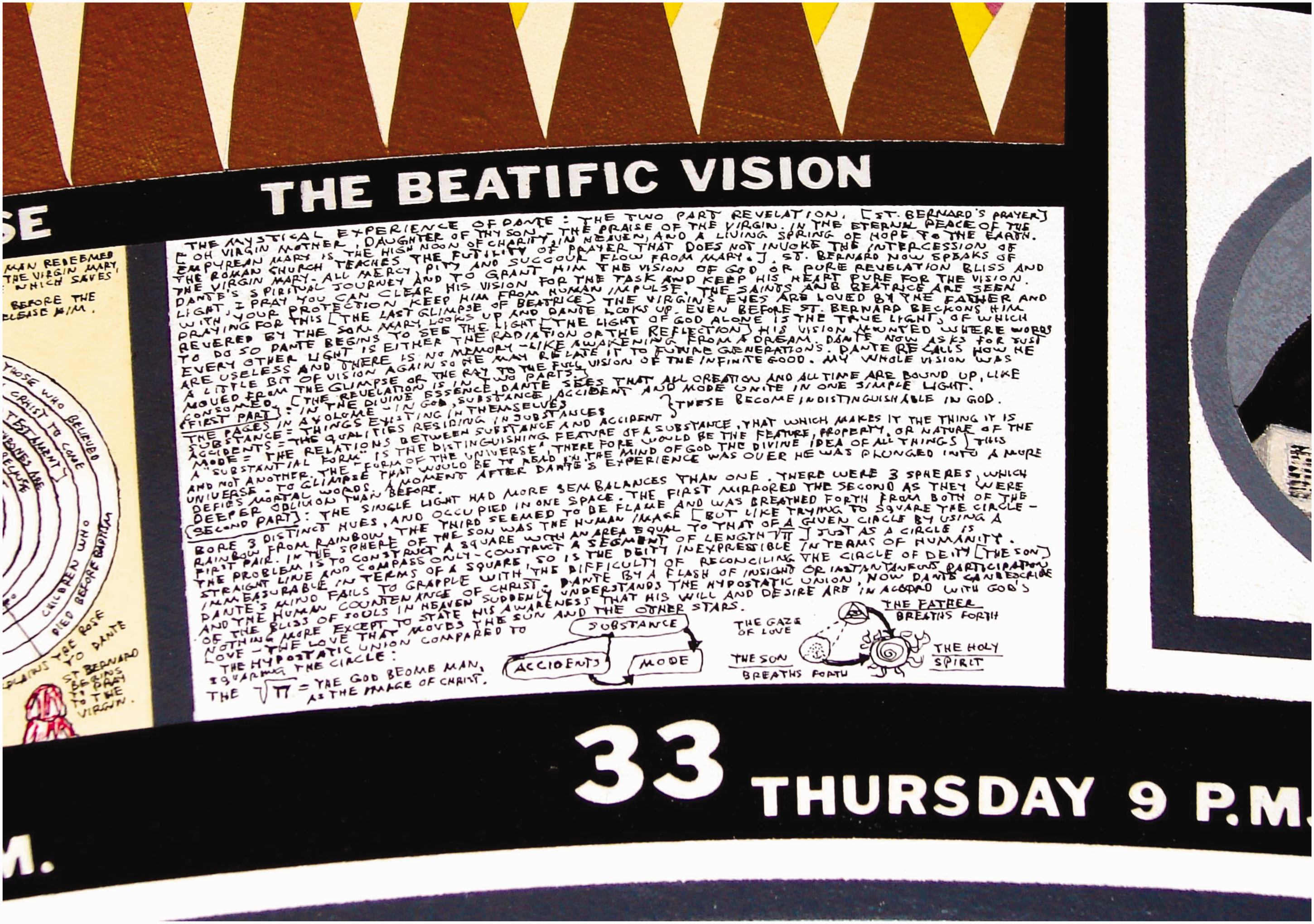
The Divine Comedy triptych has been on display only a few times: immediately upon completion in 1975 at The Harvard Divinity School, sponsored—Laffoley told me—by the Dante Society of America and the Dante Alighieri Society of Massachusetts (Laffoley, 2008a); also in 1975 at the now defunct Manteca Gallery in Boston; and at the Austin Museum of Art in 1999. The triptych was featured in Sulfur Magazine (Laffoley, 1986b) and purchased in 1987 by Ruth and Marvin Sackner of Miami, Florida, founders of the extraordinary Archive of Concrete and Visual Poetry. For many years, out of the thousands of works they had collected (over 75,000 items), the Sackners featured only a handful in their private home in Miami: Laffoley’s triptych was one (or should I say “three”) of those pieces. 25
In an interview, as elsewhere, Laffoley said he began the project in 1972, “when he was almost thirty-three: the age of Christ at his crucifixion and almost of Dante at the narrative time of his journey (1300)” (Laffoley, 2008a). However, while going through Laffoley’s papers after his death, we learned that Laffoley was born in 1935, 26 not in 1940 as he had claimed. That would mean he was almost thirty-eight when he began the triptych. Laffoley does not mention an identification with Christ’s age at the time of the Crucifixion or Dante’s age at the beginning of the journey in his 1978 Dantesphere project, which will be discussed shortly, nor does he do so in his 1986 essay “Reflections Upon Having Illustrated The Divine Comedy of Dante Alighieri” (Laffoley, 1986a), which was written prior to the nearly identical 1986 publication “Three Statements from The Divine Comedy Illustration” in Sulfur magazine (Laffoley, 1986b). Yau, however, mentions the 1940 date of birth in a 1986 essay that follows Laffoley’s “Three Statements” in the same issue of Sulfur, and Walla reports that when they met in 1987, Laffoley told him he was born in 1940. Thus by the mid-1980s Laffoley was claiming this as the year of his birth.
In trying to uncover when, and especially why, Laffoley began claiming to have been born in 1940, I found a 1971 article whose author, Kieran Dugan, says he met Laffoley, “a young (then twenty-nine) Boston painter,” in 1969 (Dugan, 1971: 2). Laffoley was, it seems, claiming a “1940 birth” as early as 1969. Laffoley’s art career began in Boston in the early 1960s. 27 Perhaps that was when he chose to change his birthyear? But why? Perhaps because he lost a few years between graduating college in 1958 and beginning at HSD in 1962 to what he described as catatonia, or a self-induced zombie-experience (Laffoley, 1999a: 27). 28 If he told people he graduated Brown in 1962 instead of 1958, he could effectively erase those lost years. Yet he never hesitated in his writing or conversations to talk about his “lost years,” so why hide them with a birthdate change? A possible answer is that he may have decided on the birthdate change shortly after his important lucid dream in 1961, which he often said changed his life. He recounted how, in this dream, he saw a few sculptures in a gallery that appeared as “bodies of light” so brilliant (in both senses of the word) that he felt himself become the knowledge they were seeking (Laffoley, 1989a: 15–19). The sculptures, he said, were the knowers, and he was the knowledge they wished to obtain. He feared he would be decimated by the sculptures’ desire for knowledge (that is, their desire for knowledge of him) and that should they keep studying him, he would cease to exist. He said it was like Dante “entering the realm of death without Virgil as his guide” (1989a: 19). This lucid dream, or portal, or singularity, or death experience, as he variously called it, jump-started his painting career. He explained that he was now going to work with knowledge and knowing, and questions related to revelation; and he would need a guide, as Dante did. It seems, then, that he saw a connection between this life-changing dream and Dante’s visio (or fictio, as the case may be)—which Laffoley believed was not a “near death” experience for Dante, but a mystical revelation (1989a: 17–19). In connecting himself to the Pilgrim, he may have begun to think that he, too, was (or should be) midway on the journey of his life, although Dante Poet was not midway in the journey of his life around 1300, but had only about twenty more years to live.
It turns out that Laffoley’s age when he began the paintings in 1972 was thirty-seven or thirty-eight: midway on the journey of his life, which ended when he was 80 (not 56, like Dante). Laffoley’s change of birth year is a fascinating issue. If he chose 1940 in the early 1960s, after his revelation dream to align himself with Dante Pilgrim’s 35 years, that choice would parallel Dante Poet’s many uses of numeric, linguistic, and spatial patterns in the retelling of his own life and his divine journey. Laffoley, like Dante, not only looked for and found patterns “within seemingly-random sequences of personal events,” but “pushed their implications to the furthest limits his imagination [allowed] him to go” (Yau, 1986: 86).
It took Laffoley about three years to complete the three panels—one per year, he said. From his 1986 essay on illustrating the Comedy, he shows how committed he was to “translating” the poem into rigorous imagery. “For illustration to become art,” he wrote, “the artist must program the task on a subject that is already literature, or a subject that is capable of being translated into literature” (Laffoley, 1986a). He also spoke about how illustrating the Commedia was “a personal bottleneck” in his life, a challenge that he had “to get through,” and a sort of “ad hoc initiation process for a Western visionary artist” (Laffoley in Florence, Hutchins, 1995: Disc 1.1). People told him not to bother undertaking such a huge endeavor: it would be too hard and take too long (Laffoley in Florence, 1995: Disc 1.1). He admitted that he feared the project might cause a swift end to his life, as he knew that many artists who illustrated the Commedia did so toward the end of their lives (Laffoley in Florence. Hutchins, 1995: Disc 1.1). But he often did exactly the opposite of what people told him to do (or not to do). That he even took some pride in these moments can be seen, for example, in how quickly he petitioned to be Kiesler’s assistant after his uncle, an architect whose advice Laffoley always followed in “the inverse,” told him never to waste his time around the likes of Kiesler (Laffoley, 1988b: 2). He likewise acted directly against his uncle’s advice that he should ignore the De Stijl and Bauhaus movements (Larroque, 2011).
Laffoley said that in making these three paintings he wanted to understand Dante’s unique sense of purpose and path, and not just see him as “everyman” (Laffoley, 2008a). He also, more cryptically, aimed to show Dante’s discovery and celebration of “the horror and joy of being dead,” much as, he said, Socrates did when he described the Myth of Er to Glaucon in Plato’s Republic (Laffoley, 2008a). “For Dante [and the medieval world],” Laffoley wrote in his journal: the mortal, inhabited world could communicate with the spiritual and divine world by means of death, the mantic arts, demonic possession and divine inspiration or revelation. For the modern existential person, the kitsch world of pop culture and the inauthentic can communicate with the authentic world of creative response to nature by means of clichés transformed by the subconscious into symbol and back again. (Laffoley, 1986a)
Much of Laffoley’s work, in fact, is an attempt to connect life with death (and what “death” means to Laffoley is a topic I will not engage here), the present with the past and the future, and the authentic with the inauthentic (the “kitsch”) through a complex hierarchical semiotics (see, for example, his 1980 “Toward a Definition of a Symbol” and his 1989 “Symbolism” [Laffoley, 1989c]). He wrote that “the secret to life lies not in life… but in death” (Laffoley, note to Thanaton: The Messenger of the Cosmic Task [1996] in Laffoley, 1999a, plate 24). And in order to portray this relationship, and to properly illustrate Dante’s journey, Laffoley wanted his three paintings to contain “the entire body of information that comprises the poem” (Laffoley, 2008b). The triptych is, then, meant to be seen both chronologically, as stages of a journey, and simultaneously, with all three realms happening synchronically and life and death experienced concurrently. Many of his paintings, in fact, echo these principles.
Laffoley’s theory of illustration for this piece was to “return to the Weltanschauungen of Dante, and use that ambiance as a point of departure” (2008a). Dante’s experience, although supposedly unfolding over the course of a little over one week’s time, was one of total immersion, and Laffoley wanted to represent that for us as viewers. His later project, The Dantesphere (1978) would take this idea many steps further.
The Dantesphere (1978)
When Laffoley finished the triptych in 1975 he felt something was “a little wrong”; something was “inadequate about what [he] had done” (Laffoley in Florence. Hutchins, 1995: Disc 2.4). He attributed this feeling to his choice of medium: he had tried to illustrate the Commedia using painting alone. While he was happy with the way the triptych presented Dante’s journey and the poem in a less linear and static fashion than prior attempts to depict the Commedia, he wanted to expand what art could do to convey Dante’s visionary experience (Laffoley in Florence. Hutchins, 1995: Disc 1.1). He wanted his new illustration to be more akin to an actual cathedral (not just “like” a cathedral packed with information). He often spoke of how medieval education was based in cathedral schools, and how important the physical spaces of Gothic churches were to educators and learners of the time. He also believed that people in the Middle Ages, many of whom could not read or did not have access to books, had a much more attuned sense of hearing, and gave primacy to that sense, over the sense of sight (Laffoley in Florence. Hutchins, 1995: Disc 1.3). He thus began to plan a full-sensory-immersion illustration of the Commedia, and a more “concrete” and “literal,” if you will, experience of Dante’s journey.
Written and sketched in 1978, the Dantesphere is what Laffoley calls his “second proposal for the illustration of The Divine Comedy of Dante Alighieri” (Laffoley, 1978) (see Figure 16). On the Dantesphere’s title page we see that his dedicatees are multiple: not just Dante, but also Étienne-Louis Boullée, the eighteenth-century French architect known for neoclassical design and for a number of buildings considered “visionary,” a critics’ catch-all term for building proposals that are clearly impossible to build (at least at the time of publication). The Dantesphere offers an intricate plan for a structure that’s quite difficult to imagine: an artificial solar satellite (a planetoid) that hosts within it a “life-sized” version of Hell, Purgatory, and Paradise; and on its surface, the medieval Mediterranean world, including the hemispheres of aqua et terra, and sixty (yes, 60) early fourteenth-century Florences. The Dantesphere, we learn, is a floating school/museum/performance/vision-quest realm in which visitors are either participants in, or witnesses to, Dante’s journey in “real time.” Laffoley said that the Dantesphere was, in part, an expression of his frustration that he had not been able to make The Divine Comedy triptych as large as he had wanted (Laffoley, 2008b).
The title page of The Dantesphere (1978).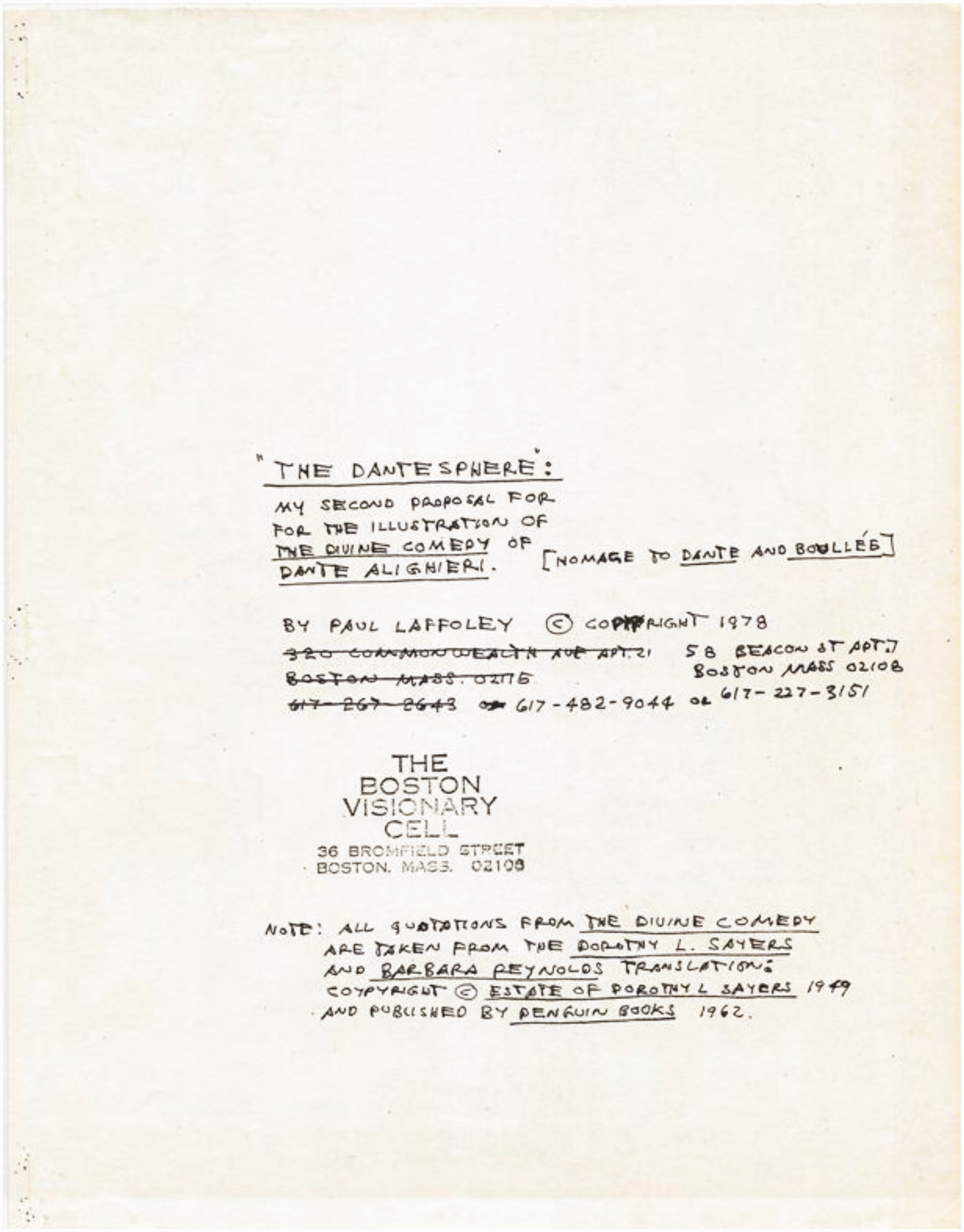
In his notes on the Dantesphere, Laffoley gives homage to a number of other visionary creators (and creations) besides Dante and Boullée: the twentieth-century architect Paolo Soleri and his utopic community of Arcosanti (Arizona); the physicist Freeman Dyson and his theoretical outer-space habitats; the science fiction writer Arthur C. Clarke’s imagined cylindrical starship; the work of engineer and futurist Dandridge Cole; physicist Gerard O’Neil famed for his hypothesized space colony “O’Neil cylinder”; scientist, astronaut, near-death experiencer, and eco-retreat founder Brian T. O’Leary; and space architect (and early Nazi) Werner Von Braun. Laffoley also recalls his own 1968 painting I, Robur Master of the World (see Figure 17)—a piece that imagines an earth-moon link-up via living structures and echoes, in its title, a Jules Verne adventure. Laffoley says he dedicated that painting to Boullée, even though Boullée does not appear in the painting’s homage list, but rather Verne, Poe, Wells, Marcuse, and Le Comte de St. Germain (Laffoley, 1978: 2).
I, Robur, Master of the World (1968).
I should mention that while Laffoley was impatient with then-current (1970s) architectural and scientific progress (too slow for his taste), as well as humanity’s snail-paced spiritual evolution, his art and writing do not, for the most part, explore questions related to class, race, ethnicity, or politics. Thus he could cite Von Braun alongside anti-fascists such as Arthur C. Clarke, and Leni Riefenstahl alongside the Jewish Kiesler (see “The Five Principles of Geezer Art,” 2008) without any explanations. World religions, gender, and sexuality, are, on the other hand, present in Laffoley’s thematics. 29 His deep interest in religious symbolism is immediately apparent in his work, as are gender and sexuality binaries, like the many other binaries he frequently depicted (see, for example, the previously cited Dimensionality, Figure 14): life-death, light-dark, past-future, alpha-omega, inside-outside, hyle-eidos, entropy-order, potential-kinetic, and so on. That said, it is important to recognize that Laffoley’s binaries lie along a spectrum; they are not polarities in the either/or sense. While his work up to his death in 2015 did not explore emerging discourses around non-binary gender identity and queerness, he likely would have embraced such realities without a blink, seeing these fluidities as an evolution toward a more fully integrated individual person, and a more integrated species within the universe. His fascination with robots and aliens, while not directly in conversation with recent theories of the cyborg, posthuman, and transhuman, indicates a mind that saw homo sapiens as just a point/moment along that same evolutionary spectrum that leads far beyond this planet. Diagnosed with Asperger’s and experiencing a physical disability later in life (his prosthetic leg), Laffoley was keenly aware of being differently-abled. What is absent in Laffoley’s work —discussions of race, class, ethnicity, politics, disability, difference—is indeed as worthy of further exploration as what is present.
But back to the Dantesphere. The project is, in many ways, a celebration of the imagination and an expression of the artist’s frustration with the lack of imagination he saw in the architecture around him. Laffoley often said “the imagination is all we have. It is behind everything we do or think” (epigraph to The Essential Paul Laffoley, 2016). Since 2000, Laffoley wrote, we have been living in what he called the age of the Bauharoque (see Figure 18)—a mix of “the heroic modernism” of Bauhaus and the “exalted theatricality” of the high Baroque (Laffoley, 1989a: 92). I will not enter here into his theories of time, art, and history—which show up throughout his paintings—but we should note his recognition that it is only hundreds of years in the future, in the period Laffoley labels the “Modieval” (or sometimes the “New Middle Ages”), that the world would be ready and able to create the Dantesphere (Laffoley, 1989a: 95). Much of Laffoley’s theory of history takes its cues from Joachim of Fiore’s writing (see Figure 6, The Renovatio Mundi painting of 1977), and he states often how important Joachim was to Dante. He believed that even though Dante’s poem is thought to have summed up “the history of the western world” [in Dante’s time], the Commedia was really “just a preparation for new [visionary] understanding” like that of Joachim, the person Laffoley believed to be “responsible for Dante’s journey” (Laffoley in Florence. Hutchins, 1995: Disc 1.2). Quite a claim, and one that deserves a good deal more investigation to fully understand.
The Context of the Bauharoque (1978).
The Dantesphere proposal exists in twenty-three handwritten pages. The first thirteen pages are an introduction and narrative summary of the project. The final ten pages are filled with diagrams, design parameters and calculations, a few photocopied images, and some annotations. On page 14 (see Figure 19), where the diagrams start, Laffoley outlines the planetoid’s proposed size and shape, its location in our galaxy, a cross-section of the planetoid as whole, a radial view (from the planet’s center to the protective features surrounding its outer atmosphere), and steps in the formation of a pentakis dodecahedron (a dodecahedron with a pentagonal pyramid attached to each of its twelve faces, creating sixty faces), which is to be the shape of the planetoid. Laffoley does not mention Galileo’s 1588 Due lezioni all'Accademia fiorentina circa la figura, sito e grandezza dell'Inferno di Dante in his proposal (or elsewhere, as far as I know), but he would likely have loved reading and critiquing it. When I interviewed him in 2008, he said that he had not explored the full history of earlier attempts to map Dante’s afterlife, but would have liked to do so.
From the Dantesphere, p. 14.
On page 16, Laffoley sketched the Mediterranean Sea above taped-in images: a photocopy of a drawing showing Dante’s house and an aerial photo of the Ponte Vecchio. On page 17 and following, he similarly added photocopies of Dorothy Sayers’ diagrams from her and Barbara Reynolds’ 1949–1962 translation of the Commedia. On page 18, he included bits from his own depiction of the afterlife from his triptych, such as his rendering of Mount Purgatory, complete with the little clouds below the Gate of St. Peter. Page 19 also shows more Sayers-Reynolds diagrams of the Earth and the underworld and offers a few notes about the interior for the replica of Earth. On pages 20 and 21, Laffoley lists the characters from the Commedia that need to be included in the simulation of the three realms, followed by an outline of the medieval cosmos. The final two pages of the proposal, pages 22 and 23, provide a to-do list for Dante Candidates (Dante Pilgrim stand-ins for the re-enactment of the journey), the time sequence for the journey, and the means by which the Candidate returns to the surface of the Dantesphere.
The diameter of the Dantesphere, Laffoley proposes in this formal description, should be approximately 60,000 miles 30 (although elsewhere he said 64,000), “about 15,000 miles less than that of Saturn” (Laffoley, 1978: 3). 31 Its mass would be quite a bit less than that of Earth, as the Dantesphere is hollow, although far from empty. Its orbit would be the same as that of the asteroid Ceres, which is between Mars and Jupiter. Laffoley had a number of reasons for selecting this location. In brief (he offered more detail and rationale than I will give here) it would be “28” in Bode’s planetary orbital series (albeit the eighteenth-century Titius-Bode theory of solar system formation has since been deemed inaccurate), and 28 (as 2+8) adds up to 10, which he notes symbolizes the wheel of fortune (p. 4), and “a completed cycle in which there is an unfolding unity” (Laffoley, 1986b: 71). Putting the planetoid there would not disrupt the “gyroscopic balance” of the solar system, as Laffoley believed mining operations were being planned for the asteroid belt, and so the Dantesphere could be easily built from nearby materials. And in a moment of Laffoley-style humor, which combines gleeful optimism with nuts-and-bolts pragmatism, he notes that a nearby workforce would also be at hand to help out with building the Dantesphere.
To maintain an Earth-like atmosphere, the exterior (surface) of the Dantesphere would be surrounded by a geodesic sphere ten miles out, comprised of “living tissue genetically programmed to withstand particle and radiation bombardment, while allowing through it types of radiation which are necessary to sustain human life” (Laffoley, 1978: 5). He explains how the sphere would facilitate the appearance of day and night, and how this geodesic tissue would be connected to the surface of the earth via ten-mile-high pylons and rockets. (Buckminster Fuller’s geodesic architecture was of great interest to Laffoley, as can be seen here and throughout his work.)
The surface, or “ground level,” would be the “preparatory area” for the Dante Candidates, also called Patrons. It would sport sixty “Earth-area” subdivisions (those are the sixty Florences), one on each face of the pentakis dodecahedral planetoid; the Candidates would train in these Earth-areas. Each Candidate would arrive on the surface of the Dantesphere at age thirty-three and train for two years. In that time, he or she would be required to memorize the poem (Laffoley does not specify if in the original Italian, or in translation)—especially all of Dante Pilgrim’s lines—and study medieval philosophy and theology at Florentine universities and cathedral schools. Candidates would also learn some “memorabilia,” as Laffoley writes, such as Boccaccio’s telling of the story that Dante’s son Jacopo dreamed about where his father placed Paradiso’s final cantos. Laffoley points out that this preparation functions as “the notes, glossary, and appendices” do for a reader of the poem itself (Laffoley, 1978: 5), and in one of my favorite moments in the Dantesphere document, he mentions that “moot points of scholasticism would be discussed on street corners, as it was done at the time of Dante” (Laffoley, 1978: 5).
When the candidate turns thirty-five, he or she would then depart alone into the interior of the planetoid to re-enact Dante Pilgrim’s journey. In brief, and without listing all of Laffoley’s specific dimensions, the interior of the planetoid would consist of a stationary, geocentric “medieval Earth” (complete with Northern hemisphere primarily of land, Southern primarily of water, and Lucifer frozen in its center), Mount Purgatory in the Southern hemisphere at the antipode to Jerusalem, the Sphere of Air, the Celestial Spheres, and the Empyrean. The spaces separating each realm extend to the thousands of miles, and moving between them requires complex means of transport and life support, not to mention many workers and a great deal of equipment, which Laffoley amusingly takes the time to note is stored in the “hollow” medieval Earth (1978: 19, see also his painting The Hollow Earth [1968]).
Following exactly in the Pilgrim’s footsteps, the Candidate would start the trek at midnight on Maundy Thursday and end on the following Thursday at 9 p.m. Laffoley carefully accounted for how to track Earth-time on this planetoid in the orbit of Ceres—I will just say that it involves rockets, induced sleep, and electronic awakenings (Laffoley, 1978: 7). He also went into detail about how Lucifer ended up lodged inside the Earth (and started a “building program” once there) (Laffoley, 2008a), and how the land that had occupied the Southern hemisphere fled to avoid touching Satan and thereby created the “tube-like channel” of Lethe and Mount Purgatory (there is also a tube that carries the Lethean waters from Hell to Earthly Paradise, although no mention of the Old Man of Crete’s tears). He added a particular touch to a theory, not fully accepted in Dante scholarship, on the creation of Purgatory: “… God feared the inertia of the soil evacuation would exhaust the Earth entirely. Thus, God caused an opening to occur at the North Pole. This hole became the entrance to the cavern of the inferno in the midst of ‘dark woods’” (Laffoley, 1978: 7–8).
Once inside the Dantesphere, the Candidate would encounter on his or her journey sophisticated, multi-sensorial (not just visual) holographic renderings of the Commedia’s characters—the souls, guardians, devils, angels, and more that populated Dante’s afterlife—as he or she traversed thousands of miles from the Entrance to Hell to the medieval Earth center, up Mount Purgatory to Earthly Paradise (the inverse, he writes, of Eden) (1978: 7), traveling through the Celestial Spheres of the Ptolemaic cosmos (he details this astronomy on p. 10), and into the spaceless-timeless Empyrean. The medieval Earth would be held in place by electro-magnetic fields. The holograms would be more advanced than those we have today, able to offer an image visible at a full 360o (1978: 9). Their technology would be based on “psychotronic equipment” and include sonar and haptic (touch) simulators, as well as simulators for taste, smell, temperature, and other kinesthetic sensations (1978: 9). Laffoley offers as an example that the Candidate should, like the Pilgrim, experience the heat of the Wall of Fire on the cornice of the Lustful in Purgatory, also without being harmed (1978: 9).
A new Candidate would enter Hell each week, the sixty Candidates-in-training carefully staggered so that each enters the journey alone. Laffoley mentions that spectators would be invited to watch the journey on the planetoid’s surface, and would be required to arrive at least a month beforehand to study the poem. He does not mention where they would go to watch the Candidates traveling inside the planetoid. Perhaps on a screen while sitting in one of the sixty ‘Florences’? Not only are all people invited to witness the journeys, but Laffoley extends the invitation to life forms from other galaxies, expecting them to be part of our future reality. The proposal does not mention whether aliens can take on the mantle of being a Candidate, but knowing Laffoley, I would assume he would be delighted if they did, though he would worry about how to accommodate their physiologies within this human-centered space, atmosphere, and experience.
In his discussion of the medieval, heliocentric cosmos, Laffoley comments that Dante knew his Ptolemy well, but “did not believe in a localized, temporal and material heaven, as is often ascribed to an ideational matrix of ‘the Middle Ages’” (1978: 10). He explains this by analyzing Beatrice’s exposition in Par. 4 that while the souls seem to the Pilgrim to be inhabiting a given celestial sphere (the Platonic idea of a soul returning to its “star,” as Dante knew from the Timaeus), what he is seeing are actually only projections for “the sake of human understanding” (1978: 11). The souls’ actual being is outside of time and space in the Empyrean (a “transcendent state,” as he calls it) (1978: 11). He then jokes about how the holographic projection of souls, especially in Paradise, “is useful only up to a point. This point is the infinitely small light encircled by nine rings” (1978: 11), that is, God.
As Laffoley moves into the final pages of the Dantesphere’s introductory narrative (1978: 12–13), he turns to the proposal’s most complex ideas. Here, Laffoley offers his big-picture thoughts on the nature of the Pilgrim’s journey to God and the Poet’s act of “transcribing” this journey. He concludes that Dante the Poet was not describing a mystical vision experience that one could experience while embodied, but rather an epistemic one that merely hints at what actually happens after death. The nature of death, and the continuity between life and death, are major themes in Laffoley’s thought. He often discussed the differences between near-death experiences and a realm in which we are alive but without our bodies. He thought that Dante’s journey was akin to the latter (and humorously noted that Dante “was doing reportage” for us) (Laffoley, 2008a).
Laffoley then offers his theory of “meta-energy,” paralleling it to the concept of revelation, and presenting meta-energy as transcending the speed of light (the concept of which he discusses extensively elsewhere in his work on time travel). Meta-energy is a fundamental concept for Laffoley. It is not an energy based on “electromagnetic, gravitational, weak or strong nuclear forces,” he explains, “but energy based on the belief that it is psychic in nature and only instrumentally in material or substantial form” (1978: 13). In some of his writing he associates meta-energy with “death,” or a spatial fifth dimension, or a location that makes you feel like you are in the presence of something that is more alive than life itself. Painted in 1981, just three years after the Dantesphere, Laffoley’s The Orgone Motor (see Figure 20) distinguishes the thought-based meta-energy (singularities, portals, dimensions, lucid dreaming) from the energy Wilhelm Reich detailed as a biological, sexual energy.
The Orgone Motor (1981).
In the final paragraph of the proposal’s narrative section, Laffoley writes (quoting Reynolds’ translation of Par. 33, 88–90): “I believe someday it will be possible to present the model of the experience [that is, Dante’s experience]: substance, accident, and mode unite fused, so to speak, together, in such wise that this I tell of is one simple light” (1978: 13).
Laffoley in Florence (1995), courtesy of Dana Hutchins.
I should here say a few words about Laffoley’s connection to religion and spirituality. Most of his paintings and writings are filled with religious symbolism, metaphysical doctrine, and esoterism from both Western and Eastern traditions. While Laffoley considered himself a Roman Catholic, he was not actively observant, nor adherent to any particular faith. As a “visionary”—and he spent his whole career working under that label, wrote extensively in his notebooks about what it meant, and operated his Boston Visionary Cell for almost fifty years—he repeatedly stated that visionaries are not connected to any religious group (Laffoley, 2008a). He did not even consider himself “spiritual,” but neither would he have called himself an atheist or agnostic. He was just “Paul,” or at least mostly Paul. Like Dante Pilgrim in Paradiso, much of the information he received (in Laffoley’s case, in dreams, from nanobots in his brain, from a few alien encounters, and from other “revelation” sources) was so obscure and hard to understand that he could barely remember and understand it all, and could only do his best when trying to paint or write about it. He was quick to say something to the effect of, “Why me? I am not Aeneas, I am not Paul… wait I am Paul… I am not Dante!” He often believed other people would be “better prepared than he was to receive” that information (see the thought-form to Thanaton III), and he often described his paintings as “smarter than he” (Laffoley, 2008a). Again, like Dante, he thought, “forse di retro a me con miglior voci / si pregherà perché Cirra risponda” (Par. 1.35–36).
Coda
It was once said of Laffoley that “it is much easier to kiss the tires of a moving bus than write an article about Paul Laffoley’s ideas on art and the cosmos” (Dugan, 1971: 2). What I have offered in this essay is merely a snapshot of one rotation—part of the Dante one—on the many wheels of Laffoley’s bus. In the early 2000s, when I first started corresponding with Laffoley and visiting him in his Boston studio, he asked me to promise that one day I would write a book about his work on Dante. I readily agreed. My 2016 essay on his Divine Comedy triptych was a first step in that direction, and this essay makes a second. It is my own “second proposal” for the illustration of Laffoley’s illustration of The Divine Comedy. A book will be, at any rate, easier to deliver on than Laffoley’s other request. In 2008 he sent me an email wishing me a good trip to Florence, “the best place in Italy,” (see Fig. 21) where I would spend the upcoming year. I can imagine the glee on his face as he wrote the following: Also, please send me a piece of Dante’s house. You have to obtain it at high noon on my birthday (August 14) from the outside of the walls of the house. The piece I had obtained in the 80s became lost when I moved. You should wait until the police show up to park in front of the House. Then with your jack knife pop out a small hunk into a small clear plastic bag (just like you see them do on Law and Order). If you are questioned, you can claim (in Italian, of course) that you work for the government of Florence and you are part of a team that is trying to determine just how long it would take (in terms of number of tourists and years) before all the major monuments in town would be removed to other parts of the world—duty free. The reason I want you to do this I believe Dante owes me big time for what I have done for him, and I promise to do a painting of his house and incorporate the piece into the painting.
Laffoley likely did not think Dante owed him a thing; he just wanted a piece of the “Dante House,” and he wanted to make me laugh. What he truly wanted vis-à-vis Dante, he described in his Dantesphere proposal: I believe when our new world view exists, every man and every woman again will be able to read Dante’s Divine Comedy with comprehension and empathy recognizing a kindred spirit. I have illustrated The Divine Comedy for just such a future audience. (p. 7)