







Abstract
Rossini is often historicized by placing him in the context of the Restoration period (1815–1848). This article uses a historical methodology to examine that assumption in order to propose new insights into Rossini, his music, and his place in Italian history, culture, and opera. Rossini's experience shows how one of the great cultural icons of the Ottocento navigated the vicissitudes of one of Italy's most tumultuous centuries. The history is in dialogue with musicological research, especially by analyzing what listeners heard in his music. His music evoked strong binaries, the opposition of German and Italian music, which is sometimes identified with teleological history, here the tendency to manipulate the musical past for some more present purpose, for example, forcing Rossini into a nationalist narrative. Noting its dangers, this study expands the context in terms of time, by considering Rossini's entire career subject to historical categories, not only the Restoration but also the Risorgimento, the French Second Empire, and especially the often-overlooked Bologna period, and Rossini's relationship to politics. It also enlarges the sources consulted to include some of his minor works, for example his Messa di Gloria (1820), Cantata in onore del Sommo Pontefice Pio Nono (1847), and Hymn à Napoleon III (1867). Finally, the study also examines how Rossini developed his own historical consciousness amid his alienation from both the 19th-century and Italian opera in particular.
Introduction
Gioachino Rossini was born on February 29, 1792; he died in Paris on November 13, 1868; and he was disinterred and reburied in Florence's Basilica of Santa Croce, Italy's Pantheon, on May 3, 1887. It is tempting to explore the historical significance of each of these dates, for they connect Rossini to many of the revolutionary events of the 19th century. Two months after his birth, Austria and Prussia declared war on France, transforming the “French” revolution into a pan-European one. One of its effects came two years after Rossini's death when France's ruler, Napoleon III, was defeated by a Prussian army. That war led to German unification and two world wars. Most intriguing, a newly united Italy reclaimed Rossini's body, and commemorated it with an ostentatious tomb alongside Italy’s greatest historical figures, Dante, Michelangelo, Machiavelli, Galileo, Alfieri, and many more, the only musician so honored. Bellini was buried in his native Catania, Donizetti in Bergamo, but Rossini was “nationalized” in Santa Croce, by an Italian nation that he never really embraced, one of many Rossinian ironies. Many other composers were forgotten as styles changed. Vivaldi died in obscure poverty in Vienna, but Rossini, who had abandoned the stage 58 years earlier, had become more lauded over time.
The problem with historicizing Rossini is history. Pursuing the significance of those dates is to seek out the historical forces they represent, risking overwhelming the examination of Rossini, the man and his music. At the same time, they cannot be ignored. Rossini studies have been the preserve of musicologists and they have been able to sidestep this historical problem. Two recent attempts to apply historical concepts to Rossini's music have produced mixed results. The first is Rossini and Post-Napoleonic Europe by Warren Roberts, a historian who used Rossini's librettos to explore his engagement with contemporary history. Cenerentola, for example, is seen as a satire on the princely court, while more broadly Rossini critiques war, patriotism, and oppression. His Rossini is a satirist who subverts Restoration politics and religion (Roberts, 2015: 83–88, 200). This approach is problematic, for Rossini lacked a historical consciousness, though he had an acute aesthetic one. Another study, Music in the Present Tense by Emmanuele Senici, a musicologist, is an impressive, rich text, with greatly expanded sources including literary, philosophical, even psychological ones. Senici ties Rossini intimately to history through the Italian Restoration. Rossini's music was in perfect sync with the years from Napoleon's defeat to the Revolutions of 1830, offering solace to traumatized Italians who needed to shield themselves from the modernity created by the Revolution.
1
Rossini left the stage at the very moment that Italians left the Restoration, embracing the Romanticism of Donizetti and Bellini.
2
While insightful, Senici ends his study with Semiramide (1823), Rossini's last Italian opera, though he lived another 45 years, some of them remarkably creative. Such a narrow historical perspective creates problems for Senici when he attempts to explain broader issues such as the modern Rossini revival and produces sentences like the following that conclude his study: These works allow us for a moment to immerse ourselves in a temporal dimension coming to us from the past but in which the past does not exist, in which indeed the concept of tenses is absent, and yet we are fully aware that this past-less dimension is located in the past, and a distant one at that. (Senici, 2019: 281)
This is surely a musicological not a historical judgement for the past really does exist, the notion of “past-lessness” is highly dubious, and while the past is always distant, history exists to render it as accessible as possible. In the end, both authors’ studies are not quite so historical after all, for a lack of historical breadth through which they lose sight of Rossini himself, as if he ceased to exist after Guillaume Tell, or mistaking aesthetics for politics. 3 He becomes subsumed by the revolutions of his time, either as victim or furtive participant.
There was a historical Rossini, very elusive for several reasons, and this study attempts to understand him as such as he changed over time or refused to do so. The challenges involved are a series of balances, between the century's historical forces and Rossini's response to them, between Rossini as individual artist and the role he played in defining italianità, between the perception of Rossini as a national cultural hero and his own self-perceived pusillanimity. All this requires tolerating considerable ambiguity thanks to Rossini's penchant for hiding his thoughts and beliefs in humorous deflection. Rossini was unable to comprehend fully the changes that his generation experienced. He was indeed a reactionary, but much more profoundly aesthetically than politically. That is still another necessary balance.
Some theoretical considerations
Musicologists have long associated Gioachino Rossini's operatic career (1810–1829) with the Restoration, the period spanning 1815–1830/1848, in what seems a perfect chronological fit. The judgement of Abbate and Parker might stand for this relationship: These political upheavals ushered in a period commonly called the “Restoration,” which is usually seen as a misguided (or at least unsuccessful) attempt to quash the threat of renewed revolution by reinstating the eighteenth-century status quo … there is no doubt both for us and for audiences of the time, that the operatic Restoration period was inescapably characterized by Rossini. (Abbate and Parker, 2012: 188–189)
But “characterize” is rather vague and chronology is not always predictive, nor does it efface the challenges of relating music to history in a meaningful way. As a result, a number of disciplinary, theoretical, and methodological issues need to be addressed. A skeletal but valid definition of the Restoration will clarify the point: It was a movement to restore the status quo ante of 1789 and it failed. The Old Regime was finished. If Rossini's career represents some sort of musical version of this then these two characteristics should be reflected in his music; it should be backward-looking to say the styles of Giovanni Paisiello (1740–1816) or Domenico Cimarosa (1749–1801), and a failure as such. But in both cases the opposite is true; Rossini's music was perceived as new and modern, criticized by conservatives as loud, repetitive, and “German,” and he was the most popular composer of his time. On the surface at least, Rossini's career seems the very opposite of the Restoration. Other historical terms such as “modernity” and “post-Napoleonic” present challenges of their own, as does “Risorgimento,” one too important to ignore. The more crucial question is the relationship between these historical constructs, which are always in large part temporal, and musicological investigation, which always seems in large part stylistic. The two disciplines seem to operate in different spheres, the first in a relatively closed system with its own language, theory, aesthetics, and the like, the other more open to broader political, social, and economic influences, but without deep access to the music itself.
To complicate things further, the first half of the 19th century not only lurched between revolution and reaction; it also produced a series of “isms,” big systems of thought, political and economic—liberalism, capitalism, socialism, positivism, and above all nationalism—that dominated thinking and which functioned as mechanisms of order and classification in an otherwise disorderly century. Then there is the problem of sources. Rossini revealed little about either his political or aesthetic views until after his retirement from opera and often through humorous anecdotes whose meanings were not always clear. He expressed even less a historical perspective and then only at the end of his life. Then there are two aspects of Rossini's compositional style that render his music difficult to use as a historical source: his lack of imitation, the close connection between music and text, and his self-borrowings. So, analyzing Elizabetta's cavatina “Quant’ è grato all’alma mia” in act one of Elizabetta regina d’Inghilterra, Mary Ann Smart notes that “overall the relationship between text and music is distant, the thirty-second note scale turns and fragments are distributed according to structural rather than semantic logic.” Considering that he included in the cabaletta a phrase written for the castrato Velluti in Aureliano in Palmira (1813) and used again in Rosina's cavatina “Una voce poco fa” in the Barber (1816), this is a musical source difficult to align either with the text or with the context of its premier in Naples in 1815 (Smart, 2018: 75–81). Finally, the trajectory of Rossini's career presents still another challenge, he wrote an immense amount of music in one genre from 1810 to 1829, little music from 1830 to 1856, and ultimately considerably more music from 1857 to 1868 but in very different musical and cultural contexts.
These historical, musicological, and personal factors render applying historical analysis to Rossini and his music difficult. As early as 1864, the Milanese music critic Filippo Filippi published an essay, “The Past, the Present, the Future, Rossini, Verdi, Wagner, Critical-Biographical Hints.” Thanks to Wagner, the notion of “music of the future” was in the air and the clever concept behind the essay was that the three otherwise distinctive composers shared a legacy of moving the past into the future. Rossini was being historicized. But by 1864 performances of Rossini's operas had already been largely reduced to the Barber and occasional revivals of Otello and Guillaume Tell. The essay was a tribute to Rossini but also an epitaph (Filippi, 1864: 14–28). This was Rossini as bridge between the 18th-century masters Paisiello and Cimarosa and Verdi, a useful explanation of his historical value and an example of what Alex Körner calls the “straight-jacket of national teleologies,” the tendency to “manipulate the musical past into a prefabricated present” (Körner, 2020: 402–419, especially 403 and 413). It is not that the “straight-jacket” is wrong so much as limiting; Rossini is reduced to a means, to explain Wagner and Verdi in contemporary opera. This is the limitation of musicological stylistic analysis, exaggerated by the rapidity of stylistic change in the 19th century. It is remarkable that Rossini's music was perceived as radical in the 1810s and old-fashioned by the late 1830s, in the guise of the romanticism of Meyerbeer and Donizetti. An alternative historical approach to mitigate the effect of national teleologies is to widen both time and sources, to consider Rossini's musical career in broad enough terms and over sufficient time within the periodization of his three distinct creative contexts. This balancing requires a consideration of his less-studied post-operatic works and Rossini's role not only in 19th-century operatic history but also within the thicker history of his time and his perception of self within it (Walton, 2003: 131). 4
Divided by the Apennines, with few navigable rivers, the Italian peninsula was politically divided, with an economy that had declined from its glory days in the Middle Ages and was overwhelmingly rural and agricultural. Much of the land was owned by the Church and absentee landlords who were largely exempt from taxes, the burden thereupon shifting to the peasantry. The opera industry was a microcosm of Italian society, notoriously hierarchical, and the privileges of the house boxes and fees were jealously guarded (Roselli, 1984: 40–46). In this environment, compositional facility was often a matter of economic survival and Rossini claimed that he left the Bolognese music Liceo at age 18 to support his parents. In many ways, his career was determined as much by cold economics as by lofty aesthetics (Joerg, 1992: 77). 5
The origins of the French Revolution are traceable to the Enlightenment, and one of Italy's great minds was Ludovico Antonio Muratori (1672–1750), a priest and librarian/archivist of the Duke of Modena. He produced a vast amount of scholarship on the Italian Middle Ages published in 28 volumes of the Rerum Italicarum Scriptores (1723–1751). Muratori helped to create a common Italian historical narrative which he extended to the Italian language in his Della perfetta poesia italiana. The Italian language originated in the corrupted speech of the Roman vulgars which was still further ruined by the barbarian invaders: So, little by little the common people of this beautiful Province, in addition to adopting many foreign words, the Latins themselves altering their own language, changing the endings of the words, shortening them, lengthening them, and corrupting them. In sum, a new language was formed … (Muratori, 1706: Book 1 chap. 3: 7–8)
6
There is nothing more essential to cultural identity than a common language, but Tuscan Italian was limited to the educated elite. In the early 19th century, the concept of italianità was still a “cultural nationalism,” a Muratorian sense of a shared cultural, historical, linguistic but not political heritage. Old divisions remained, and politics and music did not always align. So, backward Naples was the most progressive operatically, having eliminated recitativo secco, and hosting Rossini's venture into the romantic with Scott's Lady of the Lake (La donna del Lago, 1819), while progressive Milan retained the old tradition (Bianca e Falliero, 1819) (Rossini, 1992: 254–255). 7 When he first arrived in Naples, Rossini was suspect as a “northerner” in a city immensely proud of the Neapolitan school that had produced so many masters. Niccolò Zingarelli, director of the Royal Naples Conservatory, forbade his students to study Rossini's scores (Weinstock, 1968: 47). Meanwhile, when Rossini wrote to his mother in the wake of the debut of his Mosé in Egitto (1818) and referred to the Neapolitans as “Mangia Maccheroni” (Macaroni-Eaters), he was recognizing them as a people apart with their own peculiar mores (Rossini, 1992: 199). 8
The listeners of early Rossini heard music that was new and exciting, and they tried to understand it in the context of a Restoration period that ended a quarter century of war and revolution. Their perceptions can supply some of the best evidence for understanding the historical significance of Rossini and his music, especially as it relates to the Restoration. These were not ordinary members of the audience but elite, perceptive listeners. The modern art of listening had begun around 1750 and was a skill that had to be learned, assuming that the listeners had the obligation to come to terms with what they were hearing (Thurau and Ziemer, 2019: 8–9). Their “listening” corresponds to the three phases in Rossini's productive life which are also distinct historical sub-periods in Italian history: 1) listeners during Rossini's active years as opera composer (Restoration); 2) listeners during Rossini's “silent years” (Risorgimento); and 3) listeners in Paris: Rossini's place in the history of opera (Second Empire).
Listeners during Rossini's active years as opera composer (Restoration)
Seeking the source of “political music” associated with Verdi, Mary Ann Smart found its origin in an attack on the dismal state of Italian literary production by Madame de Staël. The attack stimulated a lively debate on Romanticism, centered in Milan, and reflected in the two most prominent artistic personalities of the day, the choreographer Salvatore Viganò and Rossini. Contrary to expectations, it was Viganò and not Rossini who became the center of the Italian defense. Reviews of Rossini premieres focused on the principal singers while Viganò's ballerinas attracted little attention. “Writ large, the subtraction of the voice from Viganò's spectacles also enabled modes of criticism that slipped free of the moralistic aesthetics that governed contemporary Italian writing about music” (Smart, 2018: 32–33).
There are three things here that provide a useful starting point for understanding our listeners and through them Rossini and his music. The first is singing, beautiful singing. When listeners experienced Rossini, they heard the singers. It is doubtful that Rossini would have been surprised by this or displeased, for he did his best to accommodate the strength of each singer by providing a devilishly difficult vocal line to spectacular effect. And this leads to the second point, that Rossini's music in its intense fioritura and robust orchestration tended to overwhelm the word. There was no doubt that in Rossini the word served the music and did so to invoke pleasure. Finally, ballet did not carry with it the immense cultural burden of opera, at the center of Italian cultural dominance, steeped in tradition, and resistant to change.
A second filter that permeated listeners’ perception of Rossini's music was a German-Italian nexus, a basis for producing national teleologies. 9 Stendhal's famous biography of Rossini essentially begins with a chapter titled “Of Certain Differences between German and Italian Music.” It frames the entire book. At the end of the chapter, he concludes that the “only reality in music is the state of mind which it induces in the listener” (Stendhal, 1970: 18). For Stendhal, this can only be understood as a national predisposition; German and Italian states of mind determined what was heard. On March 24, 1820, Rossini premiered a Messa di Gloria in Naples. The Neapolitans loved it, but a German listener heard with different ears. The commentary of Carl von Militz appeared in a German edition of Stendhal's biography. No music evoked a more bifurcated reaction than Rossini's. Parts of the Mass were written in full operatic style; indeed, part of the Gloria found its way in the overture into Le siège de Corinthe. According to Philp Gossett, the “thematic material is never developed, but simply repeated so that the strength of the composition lies entirely in the appeal of its themes,” while Radiciotti uses the verb “intedescarsi” (to Germanize) to describe the accusations of some of Rossini's critics (Gossett, 1968: 331–334; Radiciotti, 1927–1929: 3:91). This was “German” music of sorts and Militz recognized it as such but within the inappropriateness of the Gloria “which the Neapolitans applauded as if in a theatre.” Meanwhile, the reviewer in the Giornale delle due Sicilie singled out the beautiful melodies while Militz, the avatar of German music, heard music that while “German,” was stolen and stitched together “as in a salami, and excessively self-borrowed.” This was “faux-German” music not really developed à la Beethoven, merely orchestrated; and all unabashedly operatic, that is “Italian.” This clash of national cultures was part of the special language of early 19th-century nationalism, and it produced national listeners (Sorba, 2014: 53–67; Jacobshagen, 2018: 381). 10
Stendhal's comments on Zelmira are immersed in the German-Italian binary, “But these two giants of music have proceeded in opposite directions, for while Mozart would probably, had he lived, have grown completely Italian, Rossini may well, by the end of his career, have become more German than Beethoven himself” (Stendhal, 1970: 394–395).
11
A year earlier, he wrote an article on Rossini that was published in The Paris Monthly Review, reprinted and translated into Italian (Stendahl, 1822: 440–447). There, Stendhal noted the extreme rapidity of Rossini's music, enchanting and frank, but without permanent impression. “Rossini's operas, composed mostly of concert arias, require little attention; the ear is amused, and the soul too rarely takes part in it” (Righetti-Giorgi, 1823: 53).
12
Such comments motivated Geltrude Righetti-Giorgi, the first Rosina and Cenerentola and friend of the composer, to fire off a reply also couched in the Mozart-Rossini debate. She understood it as an attack not merely on Rossini but on Italian music itself and replied: I am of the opinion that the public will like Rossini's works more and more than those of Mozart. In those of Rossini you can always find the Italian song … There is no work by Rossini in which this truly Italian taste, and which is spreading in other nations, does not excel … The Italians desire an expressive music that sweetly seeks their hearts. (Righetti-Giorgi, 1823: 55–57) [emphases mine]
For Righetti-Giorgi, Rossini's music, that is Italian music, is expressive, sweet, and of the heart. She is still convinced of the dominance of “Italian taste” spreading to other nations, but another listener understood better the decline of Italian music and the rise of a new German music.
Giuseppe Carpani (1751–1825) was the most astute listener of Rossini and the first to historicize his music in the contrasting contexts of German and Italian music. As early as 1804, he lamented the decadence of “true music” (decadimento della vera musica) (Carpani, 1824: 19): I am talking about one thousand eight hundred twelve. The great singers had left the stage, who with the mastery of their singing knew how to emphasize even mediocre compositions … Cherubini and Spontini had become French, and were lost to Italian music. Among the young writers of merit were Pavesi, Farinelli, Generali, Coccia, Nicolini, and a few others. These fed our hopes; but, to tell the truth, they were not enough for our theatrical needs. Not that they lacked talent; but, drenched early in the vaunted cantilena of Piccini, Paesielli [sic], Cimarosa, Bertoni, and already like their masters, they did not know how to detach themselves from them, and by means of new melodies awaken the attention of the public. (Carpani, 1924: 137)
13
It was Rossini who with Tancredi and L’Italiana in Algeri rescued Italian opera from its decline with his new style, a “novel system of melody,” and through great singers who were the center of attention. Carpani analyzed all this at length, within the German-Italian dualism of the day. The purpose of music is to please and its most essential element is cantilena. Harmony can enhance melody but by itself it is not capable of giving pleasure (Carpani, 1824: 69). Having lived in Vienna for some time and written a biography of Haydn, he had a particularly deep sense of the contentious relationship between German and Italian music. Frustrated by the popularity of Italian music, German composers tried to establish erudition over melody. They all turned their souls to the devotion of harmony: Two genres of music emerged onto the field and contend for victory: the ancient and regular Italian, based on song and all melody; the Romantic German, poor in cantilena and rich in harmony, full, erudite, capriciously deaf to well-trained ears, and a slave in chains from every word to word. (Carpani, 1824: 72–73)
14
Another listener, Giacomo Leopardi, who was even more pessimistic than Carpani, developed an authentic theory of listening. Well known for criticizing the decadence of contemporary Italian culture in his Discourse on the Present State of the Mores of Italians (1824), he contended that Italy lacked the basis for a true exchange of ideas, especially the novel, the principal means for dealing with modernity. Instead, Italians were dedicated to three venues, the passeggio or evening stroll, church rituals, and theater (spettacoli). The problem for Leopardi is that the last, the spectacle, is essentially a passive, herd-like activity and of course the most essential spectacle was opera (Leopardi, 1906: 345).
Given these thoughts, it is somewhat surprising that Leopardi went to the opera, but he wrote to his brother Carlo after attending a performance of Rossini's La Donna del Lago in Rome in February 1823: I congratulate you on the feelings and tears that Rossini's music caused you, but you are wrong to believe that we do not have anything like this. We have at the [Teatro] Argentina La Donna del Lago, where music is performed by astonishing voices and is a wonderful thing, and I could still cry, if the gift of tears had not been suspended for me, since I realize that I have not even lost it at all. (Leopardi, 1860: 214–216)
15
Once again, the listener of Rossini's music hears the singers’ voices and it is possible that this listening experience led to Leopardi's thoughts on melody written in his Zibaldone a few months later in August 1823: What constitutes melody in music, that is, the successive harmony of tones, or rather, harmony in the successive sequence of tones, is, like any other form of harmony or congruence, determined by habituation, or by arbitrary laws, may be shown by the fact that musical melodies do not delight the unknowledgeable unless the succession, the successive arrangement, of tones in them is such that our ears become used to them, that is, that such melodies are either entirely popular, in that the people, in hearing the opening sequence, is able to guess the middle, the end, and the entire development, or resemble the popular or have some popular part or one which resembles the popular. Nor is the popular in musical melody anything other than a succession of tones to which the ears of the people, or the listeners generally have in some way become accustomed. The music of Rossini is universally appreciated for no other reason than because his melodies are either entirely popular, and lifted, so to speak, from the mouths of the people; or resemble those successions of tones which the people are generally familiar with and have become accustomed to, i.e., popular ones, more than those of other composers do, or have more popular parts… (Leopardi, 2013: 1317)
Rossini's music is not only popular but modern, that is, more melodious and breaks the rules of classical composition (Leopardi, 2013: 1321). 16
Leopardi transcends the cruder binary of German and Italian music, replacing it with a new dualism of the popular and the knowledgeable, a rejection of Enlightenment elitism for a folk-romanticism (Leopardi, 2013: 1318). Leopardi like Rossini is a transitional figure. He still thinks in essentially cultural categories but with a new emphasis on the popular, a nod to an incipient nationalism. But any notion of Rossini as a romantic, nationalist composer is greatly compromised by the last listener, Clemens von Metternich.
No one is more strongly associated with the Restoration than Metternich, the archenemy of the French Revolution and Italian unification. Today, his legacy is viewed more positively, less as a political reactionary and more as a practitioner of a traditional Habsburg grand strategy to survive its geography in the middle of Europe surrounded by potential enemies, and which required a series of buffer states in Italy and Germany (Mitchell, 2018). Austria's traditional enemy was France, whose invasion could proceed along two routes, the Rhine/Danube or the Po through Lombardy and Venetia, and Chancellor Metternich was determined to keep France out of Italy (Laven, 1997: 3–33). He was also an astute listener of music.
Thanks to its strategic importance, Metternich spent a good deal of time in Italy, where he was acquainted with Rossini's music from around 1815–1816. He noted in his memoirs hearing several of Rossini's operas, and invited him to compose two cantatas for the Congress of Verona, the Santa alleanza and Il vero omaggio. His greatest exposure to Rossini's music, though, was from March to July 1822 when Rossini was in Vienna with Barbaja's Neapolitan troop and a frequent guest at Metternich's palace. His listening focused on Rossini's orchestra but especially the singing, and most of all the vocal prowess of the tenor Giovanni David: April 8. [1822] – What a good episode in my life is the establishment of the Italian opera here; it has at last succeeded, and I have gained a real and great victory. I have been present at a rehearsal of “Zelmira.” Everything in it is good: the music and the singers, and David is the first singer of his kind. He unites everything: a beautiful tenor voice with a depth and a compass that gives on the one hand the very idea and essence of manhood, and on the other has nothing of it. He takes, without effort, the upper C with the natural voice, and goes down with ease. His method is unrivalled, and his execution perfect; in a word, he leaves nothing to be desired; and there are few things in this world on which I could venture to pronounce such a judgment … At the head of all is Rossini himself, with an orchestra and chorus which astonish everyone. It may be supposed what delight this gives to a melomaniac like me. There are moments when the sunbeams penetrate the darkness of my prison, and so I feel most thoroughly. (Metternich, 1881: 3: 575–576)
If Italian opera brought light into Metternich's life, he found German opera aesthetically unpleasing and politically suspect. Nobody refutes national musical teleologies better than Metternich. The perennial dispute pitting German against Italian music had spread to Austria and for him bad politics and bad taste went hand in hand. July 27. [1822] – This evening I was for the first time at the German opera. But a German voice is quite pitiable in comparison with an Italian. People don’t open their mouths, and seem to think the nose is also an organ of the human voice. It is remarkable that a wrong spirit and bad taste always go together; thus we see that all malcontents have a horror of Italian music. In Germany people are always quarreling about whether German or Italian music is to be preferred. Our country joins in the fray. (Metternich, 1881: 3: 587–588)
Like the Italian listeners, Metternich hears singing, the spectacular voice of David, and like his fellow German, Militz, an astonishing orchestra. Metternich still thinks in the aesthetic terms of Carpani and he does not connect Rossini's music to politics; that is the mistake of the radicals. Politics extended to (German) music distorts the ear and creates bad taste. Despite his criticism, though, Metternich himself connects politics to the nasal warblings of German music, bad music correlates with malicious politics, but Rossini's music, Italian music, delights and consoles. It is outside of politics (and so is Italian statehood) (Nicastro, 1979: 199–210). Despite their varied backgrounds, all the listeners heard the same things in Italian music—melody, song, voice, cantilena, expressive and pleasurable—and conceived them in contradistinction to German music. Italians expressed great pride in their musical heritage, but it was not yet politicized as it was in Germany.
The Restoration was more than the reestablishment of the status quo; it was a threshold that reviewed the past with new eyes in the light of revolutionary change, a last glimpse of a bygone day, beautiful but destined to fade away. Rossini's music is indeed correlated with the Restoration; it embraced and embodied this special time, a moment of harmony between past and future that was especially transitory. The Rossini listener heard Italian music in a way that is difficult for us to understand, we being so much the product of the 19th-century nation-state. For them, it was national music but without the state and somewhat contradictory. Natural music. Giovanni David sings “with a natural voice,” accessible to the unknowledgeable through Rossinian melodies but performable only by the most highly trained singers whose avatar was the castrati, hardly natural at all. Regular in form, the solita forma, yet interrupted, stretched, but neither broken nor utterly new, classical (Beghelli, 2004: 85–103).
17
Perceived by outsiders as hedonistic, Italians and their music were aestheticized; they wrote beautiful music and sang brilliantly, but they were unable to create a (modern) unified state. Balzac captured this image of an aestheticized, de-politicized Italian culture in his novel Massimila Doni, and a decadent Venice: In the evening the lovers went to the theatre. This is the way of Italian life: love in the morning; music in the evening; the night for sleep. How far preferable is this existence to that of a country where every one expends his lungs and strength in politics, without contributing any more, single-minded, to the progress of affairs than a grain of sand can make a cloud of dust. Liberty, in those strange lands, consists in the right to squabble over public concerns, to take care of oneself, to waste time in patriotic undertakings each more futile than the last, inasmuch as they all weaken that noble, holy self-concern which is the parent of all great human achievement. At Venice, on the contrary, love and its myriad ties, the sweet business of real happiness, fills up all the time. (De Balzac, 2005: 39)
Rossini and Metternich shared an authentic friendship in part based on a commonly held separation of the political from the aesthetic.
If Italian music was secure, perhaps trapped, in its history, German operatic music, also nationless, was far less assured. Its proponents defined it in opposition to Italian music: harmony not melody, learned not popular, spiritual not pleasurable, music closely connected to word, yet its relative lack of history gave it greater freedom to redefine itself in the hands of Beethoven and Wagner. These forces would accelerate over the rest of the 19th century. Like the Restoration, Rossini's music was liminal, a momentary entrée from one world to another (Applegate, 2012: 329–349, especially 334).
Listeners during Rossini's “silent years” (Risorgimento)
After the premiere of Guillaume Tell, Rossini returned to Italy awaiting the next libretto. It never arrived. There are many explanations for why he ceased composing at the height of his fame. Some say that he was exhausted having written 39 operas in 19 years. Others that he sensed a new romanticism in the music of Donizetti, Bellini, and Meyerbeer, a direction he refused to follow. Health problems became more serious. For certain, he stopped composing for the Paris Opéra because it invalidated his contract, and his lifetime pension was cancelled in the wake of the 1830 revolution. History hitherto his friend was beginning to turn against him as the Restoration began to unravel. For five years, he pursued legal remedies and finally won restitution of his pension. In 1831, he accepted a commission from a Spanish priest to compose a Stabat mater (Madrid premiere, 1833), completing only about half of the movements and enlisting Giovanni Tadolini to write the rest. 18 The following year, he wrote the cantata Giovanna d’Arco and dedicated it to Olympe Péllesier, his future wife. Around the same time, he wrote a collection of salon music called Les soirées musicales (published 1835). And then: mostly silence.
The 1830s changed nearly everything for Rossini. The period from 1830 to 1855 was the least musically productive in his life and the most politically engaged. But this engagement was not the product of his own will so much as history imposing itself on him during a period of increasingly bitter division. The time of national music without a state was ending. Rossini had returned to Bologna legally separated from Isabella Colbran and romantically connected to Olympe Pélessier who joined him in the city but living at a separate address. But this was not the same old city in which he had grown up. Bologna was the second city of the Papal States. In 1789, the church owned 19 per cent of the land, nobles 55 per cent, and the middle class 18 per cent. In 1804, the respective figures were 4 per cent, 50 per cent, and 34 per cent. The Revolution had attacked the Church's wealth and strengthened the Third Estate in Bologna, the class most supportive of Italian unification (Beales and Biagini, 2014: 25). Bologna had become a center of nationalistic activity and he was becoming two Rossinis, an iconic cultural figure lauded by the powerful while increasingly despised in his hometown.
The first writer to detect these historical shifts was Giuseppe Mazzini. He heard Rossini's music in terms similar to his earlier contemporaries, first his melodies, “One might describe his melodies as sculptured in alto relievo, and fancy that they arose in the imagination of their author beneath the sun of a Neapolitan summer at noonday.” Published in 1836, Mazzini's Philosophy of Music had the benefit of hindsight while continuing the process of historicizing Rossini's music that Carpani had begun. He too saw Rossini as the man who saved music and he continued to perceive the usual binary of Italian and German music, though Mazzini typically spiritualized Italian music as individualistic, reflecting man without God while German music was corporate, reflecting “social thought,” God without man (Mazzini, 1862: 4: 99–100, Mazzini, 1891: 29). But for Mazzini, Rossini only initiated a process developed by Donizetti and then Meyerbeer; he “did not create, he restored” (Rossini non creò, restaurò) (Mazzini, 1862: 4: 97, Mazzini, 1891: 26). Mazzini detected that the times were changing, and they would bewilder Rossini. No longer a liminal figure, Rossini was in the process of being fixed in an evolving time and it was outpacing him.
A good place to begin assessing Rossini's Bologna years is with the reminiscence of Marco Minghetti (1818–1886), Bolognese economist, political moderate, and fifth prime minister of Italy. He offered a perceptive and fair assessment of Rossini as a man soured on his own times, wealthy, and skeptical. The fact is that the Paris revolution had not only troubled him, depriving him of part of the profits he had in the théâtre italien, but also annoyed him, and having already put substantial assets aside, he had returned to Bologna, where he sat enthroned among friends, and he was listened to like an oracle. But his skeptical nature won him little goodwill from the crowd. And he affected even more skepticism than he really had, and he affected nonchalance about every culture, while on the contrary his acute intelligence was endowed with many learned ideas, and whatever the matter he was talking about, he always sent flashes of light. (Minghetti, 1888: 56–57)
19
The personality traits identified by Minghetti were to define Rossini's silent years.
The Cronaca di Bologna was a chronicle/diary written by Enrico Bottrigari, a notary (b. 1811), covering the years 1845 to 1859. It reveals how the Risorgimento changed listening to Rossini's music. Metternich's aestheticization of Italian music was no longer tenable. Bottrigari notes how the Papal States were barbarously governed (barbaramente governa), with constant threats from roving bands of bandits acting out of desperate poverty, while he had a keen ear for music (Bottrigari, 1960: 1: 2, 11). He found that Donizetti's L’Elisir d’amore possessed “very pleasing melodies” (soavissime melodie) but with an overture written in “German style” (composta sulla maniera dello stile tedesco). Audiences were still listening for beautiful melodies and imagining music in the old binaries. On Verdi's I Due Foscari he opined that “he does not yet have the spark of genius, he lacks deliberation [pensieri] and melody; his music is more often than not unnecessarily deafening in the instrumental part.” He liked I Lombardi all Prima Crociata better for its passionate phrases and moments of dramatic effect but not as much as the “beautiful and dear music of Bellini!” (Bottrigari, 1960: 1: 42). 20 He admired Rossini, recalling the Bolognese premiere of his Stabat mater, how “Everyone remembers how that first performance met the universal admiration of Bolognese and the many foreigners who came to hear that new work by the genius from Pesaro” (Bottrigari, 1960: 1: 17–18). 21
If the 1830s brought substantial change to Rossini's life, 1848, the year of revolution, destroyed his relationship with Bologna. Bottrigari records his excitement at Pius IX's election and his subsequent disillusion. His account of the Rossinis bolting from Bologna on April 28, 1848 marks the transformation of Rossini into a despised reactionary. A collection had been taken up to support resistance to the Austrians, with the town's newspaper publishing the donators’ names: At this time a sum had been reached that exceeded 1000 scudi … I will include among these, for the sake of truth, Count Ottavio Malvezzi, very rich in fortune, and that egoist par excellence, Maestro Rossini, also rich, but very unpopular. Both gave 500 scudi, each out of fear of the worst; Rossini added two Horses, one of which died shortly after the offering and the other that landed behind him. Rossini is disliked by the liberals for the vituperative behavior he holds toward Italian emigrants since 1831 in Paris. Back in Italy, his musical fame and the stupendous work of the Stabat Mater that he composed and had performed in Bologna made him accepted by the city and he was rehabilitated by the liberals themselves. But the lack of care he paid to the Musical Liceo, entrusted to his direction, his cynical character, and the aversion he bore to any patriotic and generous idea made him so hated that insulted and mocked by the people he followed his fear and the insinuations of that contemptible woman that he took for his second wife, and fled with her to Arezzo. (Bottrigari, 1960: 1: 329–330)
22
Much of Minghetti's description is confirmed, the connection between Rossini's conservatism and the Parisian revolution of 1830, his cynical character, and his alienation from the people. The one assertion that does not ring true is the accusation of neglect of the Liceo to which Rossini seemed genuinely dedicated. Yet these harsh criticisms do not compromise his continued admiration for Rossini's music, at least most of the time. But the association of Rossini's music with italianità was beginning to crack under political radicalization. A few years earlier, Bottrigari attended a performance of Rossini's sacred choirs La Fede, La Speranza, La Carità, preferring the last for its melodic effect (l’effetto melodico). But he couldn’t resist adding: The author directed its performance at the Piano, which produced great pleasure among the numerous envoys. The last Chorus surpasses the others for the melodic effect; which brought no little surprise, each one knowing how Charity has never found a place in the heart of the famous Master! (Bottrigari, 1960: 1: 19–20)
23
The news of Rossini's parsimony led a crowd to come to his villa where some yelled insults that he was a rich reactionary. In sincere fear and perhaps egged on by his wife, they fled to Florence the next morning. This led a Barnabite priest, Ugo Bassi, to come to Rossini's rescue. Bassi became a national hero when he subsequently joined Garibaldi in Rome, and was captured and executed by the Austrians. He preached forgiveness and organized a rally at Rossini's home praising him, pleading with him to return to Bologna. This was a key moment in the relationship between Rossini and the Risorgimento. In Zanolini's account, Bassi connected Rossini's music to national liberation, saying “that the author of Guglielmo Tell could not be anything but an advocate of freedom and independence; that he alone brought a signal victory over the Austrians, forcing them to recognize the superiority of the Italian musical genius” (Zanolini, 1875: 113). 24 Still immersed in the binary of Italian and German music, Bassi weaponized Rossini's last great opera as a victory over Austrian oppression. Rather than melody, though, he heard politics, and a victory that was entirely a cultural one embedded in a sense of Italian cultural superiority reminiscent of Righetti-Giorgi and readily conceded by the archenemy, Metternich. Bassi was in transition to his own nationalist teleology, as was Vincenzo Gioberti (1801–1852). No one argued more persuasively for political unification based on Italian cultural genius than Gioberti.
Gioberti's On the Moral and Civil Primacy of the Italian Race (Del primato morale e civile degli italiani) was published in 1843 at almost the perfect moment. It straddled the liberal divide between moderates and radicals, advocating national unity within a traditional cultural nationalism based on the intrinsic moral superiority of Italian culture. He reconciled Catholicism to national unity, proposed a confederation of current rulers under the leadership of the pope, and like Muratori evoked the glory of the Middle Ages, a neo-Guelfism that recalled the expulsion of German emperors from Italy 600 years earlier.
Bottrigari's diary is filled with hope for change clearly linked to Gioberti's vision. All that was needed was a willing pope and that came with the election of Giovanni Maria Mastai Ferretti (1792–1878). Elected on June 16, 1846 as Pius IX, he achieved great renown just a few weeks later on July 18 when he amnestied political prisoners. This act made him the most popular leader in Italy. Bottrigari was ecstatic, “Drawing good wishes from the first acts of the Sovereign clemency, they say that through the election of Mastai to the pontificate, the greatest and most peaceful of revolutions will miraculously take place!” (Bottrigari, 1960: 1: 86). 25 However, it was not long before violent revolution hit Rome, forcing the pope to flee and to repudiate any liberalism he may have possessed.
On June 10, 1846, Rossini signed a petition addressed to the papal Camerlengo asking the cardinals in conclave to choose a pope open to reform. He was one of 2000 who signed (Bottrigari, 1960: 1: 63; Weinstock, 1968: 237). With so many petitioners, it is difficult to determine if Rossini was a convinced Giobertian neo-Guelf or simply going along with the crowd. But quickly he was drawn into support of Pius when he was invited to compose a cantata for the new papal hero. The Roman historian Giuseppe Spada wrote to Rossini on July 23, 1846, calling him “a man of genius and of progress” and inviting him to write a cantata in honor of Pius IX (Fabri-Scarpellini, 1847: 5). Rossini begged off citing ill health and that he was “musically mute,” but said that if Count Giovanni Marchetti would send him something he could put together a brief chorus (Fabri-Scarpellini, 1847: 6). Instead, on October 25 Rossini sent word that a five-part grand cantata was complete, not a new work but a musical compilation (compilazione musicale), together with very precise directions for singers, orchestra, and military band. What happened seems to have been the interjection of Alessandro Torlonia, papal banker and one of the richest men in Italy. Rossini had written Matilde di Shabran in 1821 for his father, Giovanni, who owned the Teatro Apollo in Rome, and the son had continued his father's support for opera in Rome. Torlonia wanted something grander, and Rossini obliged.
The spectacular performance with a chorus of 200, underwritten by Torlonia, took place in the Great Hall of the Senatorial Palace on the Campidoglio, the Capitoline hill of ancient Rome, on New Year's Day, 1847 (Spada, 1868: 175–176). 26 Rossini drew his music from four operas. If the music was old, the words were new and highly politicized. It begins with a chorus of pardoned prisoners; those Pius had amnestied. The characters are neo-Guelf metaphorical figures, “Amor publico” (Public Love), “Speranza” (Hope), “Corifeo” (Chorus Leader), and “Genio Cristiano” (Christian Genius—a Giobertian concept). Count Giovanni Marchetti's poetry is stilted and obscure by even the usual literary conventions of the day (Rossini, 1997). Pius is addressed as both spiritual and secular ruler, High Priest and King (Gran Sacerdote e Regnator). The pontiff is true, powerful, and steadfast (vero, possente, e fermo) in the face of revolutionary opponents, “sad sowers of doubt and fear” (I tristi seminator di dubbio e paura). Medieval, universal claims of papal authority are asserted, “No, Rome will no longer/ enjoy a feared rule/ it will hold a better scepter/ over all the world” (No, non godrà più Roma/ di formidato impero/ ella del mondo intero/ scettro miglior terrà).
In some ways, the Cantata in onore del Sommo Pontefice Pio Nono is one of Rossini's most important works and certainly one of his most political. Expertly arranged, its orchestration modified, with new recitative and vocal lines; it was at the very least a considerable feat of expert musical organization. It was also an accomplishment that was “historical through and through,” a transformation of his operatic music into something political; a cantata, archaic and Baroque, that also met the contemporary moment of national fervor in its own antiquated way (Rossini, 1996, 1997). 27 A Rossinian historical awakening, more attuned to his present day but only so far. Still a liminal figure, he was a man and artist betwixt past and present.
Exploring Rossini's music during the “silent years” raises the question of musical style which takes us back to musicology. It is impossible to gauge the contemporary style of the Pius IX's cantata, for it was old music compiled to new text, but there is another work of Rossini's “silent years” written just months after the papal celebration, a Tantum ergo first performed on November 28, 1847 to celebrate the restoration of the church of San Francesco of the Conventual Franciscans in Bologna. Bottrigari's comments are typically insightful: On the last day of the function, a Tantum ergo by Rossini was performed. It was a new work whose instrumental part made a great effect, but its conception particularly found in the second part was not praiseworthy because it was a little trivial and not suitable to the religious style.
28
While the medieval plainchant setting of Saint Thomas Aquinas’ text runs for less than two minutes, Rossini produced a piece for two tenors and bass that runs for nearly 10, scored for a large orchestra. If the Pio IX cantata refashioned opera into a political manifesto, the Tantum ergo transformed plainchant into opera. A double aria, an andante and an allegro, the first was lyrical and imitative, the second extroverted with highly animated orchestral writing. While Thomas's text evokes solemn devotion to the Eucharist, Rossini's allegro is really an operatic cabaletta. After a false ending and reintroduction of the andante, the piece concludes with a brilliant and exciting coda. The “Amen” is sung in unison in the style of an operatic trio. The overall effect is exciting without any effort for the music to reflect a close meaning of the text. Bottrigari notes the inappropriate nature of Rossini's setting, dramatic, instantly identifiable, with immediate scintillating (orchestral) effect on the listener, but music that does not closely reflect the text. This is Rossini returned to a past time.
The compositions of the “silent years” were few in number but diverse in style, yet Rossini was still Rossini. His music continued to be instantly recognizable by those natural melodies described by Leopardi and the robust orchestrations noted by Bottrigari. The Tantum ergo could have been written 30 years earlier alongside the Messa di Gloria, also accused of being an egregiously unreligious setting of a sacred text. Having ventured warily into the Risorgimento, Rossini retreated to the Middle Ages with his Stabat mater and Tantum ergo. 29 Was the papal cantata a revolutionary gesture of national consciousness, an act of allegiance to his sovereign, or simply a favor to a prominent banker? Perhaps all three. Rossini was a man alienated from his own time yet unable to escape it, despite physically fleeing from revolution a little more than a year after its premiere. The Revolution of 1848 also impacted Rossini's listeners. The identification of Rossini's music with italianità continued but the perception of Italianness was changing over the 1830s and 1840s, different for Bottrigari than for Carpani and Righetti-Giorgi, more politicized, more middle class, and in a new public sphere. For the most part, Bottrigari was still able to separate the music from politics when he listened to Rossini's melodies but sometimes that was impossible. Ultimately, the music of the “silent years” does not project a clear message. It included a traditional religious work of genius, another centered on the most conservative strain of the Risorgimento, a third written in the operatic style he had abandoned decades earlier, and a few others that presaged works to come, anticipating the spirit of the later century. In their disorder, the works reflected the times, wars of national liberation against Austria led by a reactionary house of Savoy and the emergence of new leaders such as Garibaldi and Cavour. Like most of his fellow Italians, Rossini was buffeted by these developments and he affected a skepticism that masked his own lack of comprehension, but some of his music revealed an emerging ability to adapt to newer times. The “silent years,” the least productive musically, were the crucible through which Rossini began to come to terms with his age. Recovering from debilitating physical and perhaps psychological illnesses in the later years of his life, Rossini's music and its place in opera history were being clarified both in Rossini's own mind and in the perception of his listeners. That clarifying agent was history and the music he created in Paris was the most historically conscious that he ever composed.
Rossini and history (a little more theory)
The years in Florence (1848–1855) were the worst for Rossini. He suffered significant physical symptoms of urethritis, gonorrhea, and diarrhea possibly connected to the psychological ones of severe depression, even suicidal thoughts. Writing to his friend Domenico Donzelli that “I do not speak to you of my future projects since in the times in which we live it is necessary to take one day at a time” (Mazzatinti and Manis, 1902: 180), 30 Rossini was connecting his own malady to the illness of his time, perhaps a sign of an emerging historical consciousness. The move to Paris was an act of desperation that seemed to pay off. By 1857, he was well enough to begin 10 years of creativity in the form of his Péchés de Vieillesse and his Petite Messe Solennelle. He also thought quite a lot about the future, or at least about the music of the future. This third and final phase of Rossini's productive life played out in the Second Empire France of Napoleon III (r. Emperor 1852–1870). Gioachino Rossini came back to life as his physical and psychological symptoms faded but maybe also because liminal Rossini found a home in that most liminal of regimes, one-part hereditary monarchy, one-part popular government, and one-part modernizing imperialist state, a halfway house between Bourbon Restorationism and the Third Republic. If Rossini fled in horror from revolutionary Bologna, in Paris he found a home, a refuge, and the stability he needed to create. Significantly, he recovered outside of the Italian state.
Paris was the center of the musical world, the fulcrum of tradition and innovation. It was the perfect place for Rossini to process the revolutionary world into which he was born. Beyond the dualism of Italian and Germanic music was the “music of the future,” a popular idea that occupied Rossini in his last years. Wagner called on Rossini in Paris in March 1860. His Music of the Future (La musique de l’avenir) was published in French later that year, but the term and Wagner's ideas had been in circulation for a decade. Meanwhile, Rossini had subscribed to the Bach-Gesellschaft. Liminal Rossini was publicly perceived as from a bygone era, an image he himself cultivated, while in private he simultaneously explored music's future, a pattern he began to develop during the “silent years.” Of all the commentators on Rossini and his music, one of the most perceptive was the same Filippo Filippi met earlier, the music critic of La Perseveranza in Milan. His analysis of the Petite Messe Solennelle (1863), Rossini's last great composition, clarifies the essence of his late style: Rossini, in his Petite Messe, wanted to prove that he could succeed in all genres, in all styles that he knew, first of all his own, and also the others if he wanted to. So, I have no hesitation in saying that the Petite Messe begins with the music of the past, then the present, and also a small amount of the future (dell’avvenire). (Filippi, 1876: 129).
31
The Christe eleison was in the style of Palestrina, the Credo showed the influence of Cherubini, the prélude religieux, Scarlatti, and the fugue at the end of the Credo, Bach. This was Rossini exploring the history of Western sacred music and his place in it. 32 His most incisive judgment of the past, present, and future was written in notes not words in three piano pieces, written about this same time, the Spécimen de l'Ancien Régime, Spécimen de mon temps, and Spécimen de l'avenir, the first an evocation of a more elegant past and the last a parody of Lisztian romanticism. 33
If Righetti-Giorgi was a listener-performer, a co-creator of the Barber and Cenerentola, and if Filippi as critic was able to assess Rossini's music over half a century, the passage of another generation was required before Rossini's place could be fully historicized. Girolamo Gasparella, in his study of the same Filippi, saw the critic's quest for a true music-drama achieved by Wagner but presaged by Italian composers, and thereby presented a comprehensive history of 19th-century Italian opera: The epic struggle, which conferred on him [Filippi] the greatest notoriety, and which marks his greatest triumph of criticism, however, was the one fought for Wagner. Already Rossini with Guglielmo Tell first and with Otello had shown that lyrical art could not continue to be a slave to the virtuosity of the singer, and that it had to change direction to be a true interpreter of serious, noble, and profound feelings; and the initiated evolution, understood by Bellini and Donizetti, found a great continuator in Verdi, each work of whose marked a step forward in the ever more intimate union of drama and music. (Gasparella, 1901: 21)
34
Writing on the cusp of the 20th century, in the year that both Verdi and prime minister Francesco Crispi died, Gasparella constructed a history of 19th-century Italian opera as the gradual convergence of music and drama. Under the Left, particularly during the premierships of Crispi, Italy was in close touch with her Mazzinian heritage and Gasparella's account of 19th-century opera aligns nicely with Mazzinian notions of the Risorgimento, the nation-state, and opera. If the early listeners of Rossini's music heard something revolutionary, Gasparella constructs something continuous, with Rossini its progenitor, Italianità triumphant. It is also a Risorgimento myth, the story of the union of music and drama that mirrors the inevitability of political unification, that appropriates the Restoration period into the Risorgimento, national teleological music par excellence. If Rossini was freed from the angst of revolutionary Bologna by his move to Paris, Gasparella remains trapped in a maelstrom of forces that beg explanation. The best he can do is devise an un-Rossinian Rossini, one who epitomized the intimate union of drama and music Italian-style, but who regularly flouted any such concept. One who he claims liberated Italian opera from the foibles of the virtuoso opera singer but whose music was perceived as the very opposite in the Milan of Viganò. 35 Gasparella tried to preserve and extend Mazzini's dream of a new kind of European music, a fusion of Italian and German, led by the “Italian mission in Europe.” But German music intervened, not the bizarre German music dismissed by Carpani but one so much more powerful, Wagnerian music-drama that became the hermeneutic describing 19th-century Italian opera.
The binary of Italian and German music was pervasive, especially in the first half of the century, but the dualism does not appear to be equitable. Beethoven seems to be at the center of changing, mostly negative, perceptions.
36
Not only did he tell Rossini to give us more Barbers, that Italians don’t have enough science to deal with true drama, nor could they acquire it in Italy, but he also criticized Mozart for writing frivolous Italian operas (Michotte, 1968: 44–45).
37
Balzac had a retort to all this placed in the mouth of his heroine Massimilla Doni, enraptured by the opening chords of Mosé: Dear Rossini! you have done well to throw this bone to gnaw to the Tedeschi, who declared we had no harmony, no science! Now you will hear the ominous melody the maestro has engrafted on to this profound harmonic composition, worthy to compare with the most elaborate structures of the Germans, but never fatiguing or tiresome. (De Balzac, 2005: 71)
Germans had a clearer understanding of the “true” nature of Italian music as they saw it because they used it as a mechanism to define German music, generally in the form of thesis-antithesis. Meanwhile, Italians seem to have had a much vaguer sense of German music. They saw music as Italian and when something peculiar occurred it was dubbed “German,” e.g. Bottrigari hearing German music in the overture to Donizetti's L’Elisir d’Amore.
Alex Körner contends: that history, as a construction of the mind, takes the vast territory of the musical past and reorganizes it according to political or ideological preferences. In doing so, historians and musicologists apply teleological principles that recognize in the nation-state the inevitable outcome of a narrowly defined progression towards political modernity. (Körner, 2020: 403, 413)
The allure of teleological history is in its simplification of complex historical phenomena. It acts as a shortcut but also as a short circuit, by placing composers and their music in tight historical categories, in the 19th century particularly national ones. This is useful but distorting, for Rossini's relationship to the music of Haydn and Mozart was more complex than the German-Italian binary allows and Filippi's and Gasparella's claims (as well as Leopardi's) that Rossini's music was “modern,” was another short circuit of a more intricate reality. That reality entailed the creation of a modern Italian state and the decline of a transnational aristocracy personified by Metternich, and which had patronized Italian opera. Moreover, if music is not fully contextualized it threatens to reduce its history to mere changes in taste and style. If this happens then opera exists outside of history. These issues were more difficult for Italians, who had a long tradition of dominating European music (opera) without an Italian state. It was in its essence non-political, cosmopolitan music. Therefore, attempts to “nationalize” Italian music developed late, not until after unification and, for Gasparella at least, at the turn of the 20th century. This is also why the concept of national music aligned with a state was so foreign to Rossini and helps to explain why Rossini thrived in Bonapartist Paris, where he produced not only Italian music but French music as well.
Conclusion: Rossini's place in the history of opera, listeners in Paris (Le Second Empire)
Upon Rossini's death, Richard Wagner wrote a peculiar tribute to him. He related that in his famous meeting in Paris Rossini confided in him that had he been born in Germany things would have been better. He had facility and things had turned out well enough but the Italy in which he was born was no longer one that aspired to higher aims. In his youth, he had to serve this base form of opera just to survive and when he achieved greater security it was too late for him to change (Michotte, 1968: 48–49). Rossini's plea for understanding was interpreted by Wagner as a sort of “modesty” that led him to judge Rossini as the “first truly great and reverable man I had yet encountered in the art world.” Wagner went on to say that when he wrote The Music of the Future, he was guided by Rossini's confession to judge harshly the state of modern Italian operatic music. Ultimately, Rossini could not be considered an art hero, not for a lack of natural gifts or artistic conscience but because “his public and environment … made it difficult for a man like him to raise himself above his age” (Wagner, 1895: 4: 269–274). Wagner was on to something; it was the time and place (Restoration Italy) that robbed Rossini of what he could have been. Both composers seemed to share a common historical perspective of the decline of Italian opera, but they did so from that old duality, from very different cultural assumptions.
In his remarkable reminiscence, Wagner managed to establish a serious historical method to evaluate Rossini combined with his own prejudicial nationalism and a venomous attack on Italian operatic culture. But neither Wagner's nor Gasparella's historicisms are adequate for the task because despite having the exact opposite opinion about the development of 19th-century Italian opera, both are handicapped by nationalist teleologies (Ragusa, 1972: 298).
38
It is necessary to return to the early listeners of Rossini's music who heard in it singing, melody, cantilena, and bel canto, which were the hallmarks of Italian music and a source of pride. But this pride conflicted with political reality, a disunited, powerless, poor, backward Italy, dominated by Austria. This contradiction fostered shame, in Leopardi's words: If we are to reawaken and recover the spirit of the nation, our first move must not be an excessive pride and appreciation of what we have, but shame. And this must push us towards complete change and to renew everything. Without this we will never do anything. To commemorate our past glories is an encouragement to virtue, but to lie and fake a present glory encourages acedia and makes us satisfied to remain in the very contemptible present condition. (Leopardi, 1900: 2: 228)
This (historical) dissonance and its shame manifested itself in a self-othering with explicit negative comparisons with other nations that produced a national character profile of indolence, extreme individuality, and self-indulgence that was used by Italians themselves to explain Italian national failure and inferiority toward other Europeans (Patriarca, 2010). 39
Like many of his generation, Rossini suffered the perceived inadequacies of Italian culture and expressed them through self-abnegating attitudes toward German music. He had a distinct habit of praising German music to German musicians, to Wagner, Naumann, Hiller, Moscheles, and Hanslick, while spoofing the traditions and state of Italian music. This was more than good manners; it emanated from a sense of inferiority about himself and Italian music. Beethoven instilled the idea when he met Rossini, and Wagner brought it to its logical conclusion in his Opera and Drama (1852), where he was considerably less charitable than in his Remembrance. It is not accidental that like all of Rossini's listeners Wagner focused on melody which he inverted from Italy's glory to its bane. According to Wagner, Rossini put all form aside, and relied on “narcotizing Melody,” forgetting the words for “risky runs and melodic entrechats.” Rossini's other sin was giving the public what it wanted, city by city. If there had been an allegiance to true “Folk,” Rossini would have been revolutionary, but instead he served the “Folk-scum” that made him nothing more than a reactionary. Wagner's final accusation was political, that Rossini's music aligned with Metternich's politics and that he represented not only the debasement of opera but the worst sort of political tyranny (Wagner, 1895: 2: 43–46).
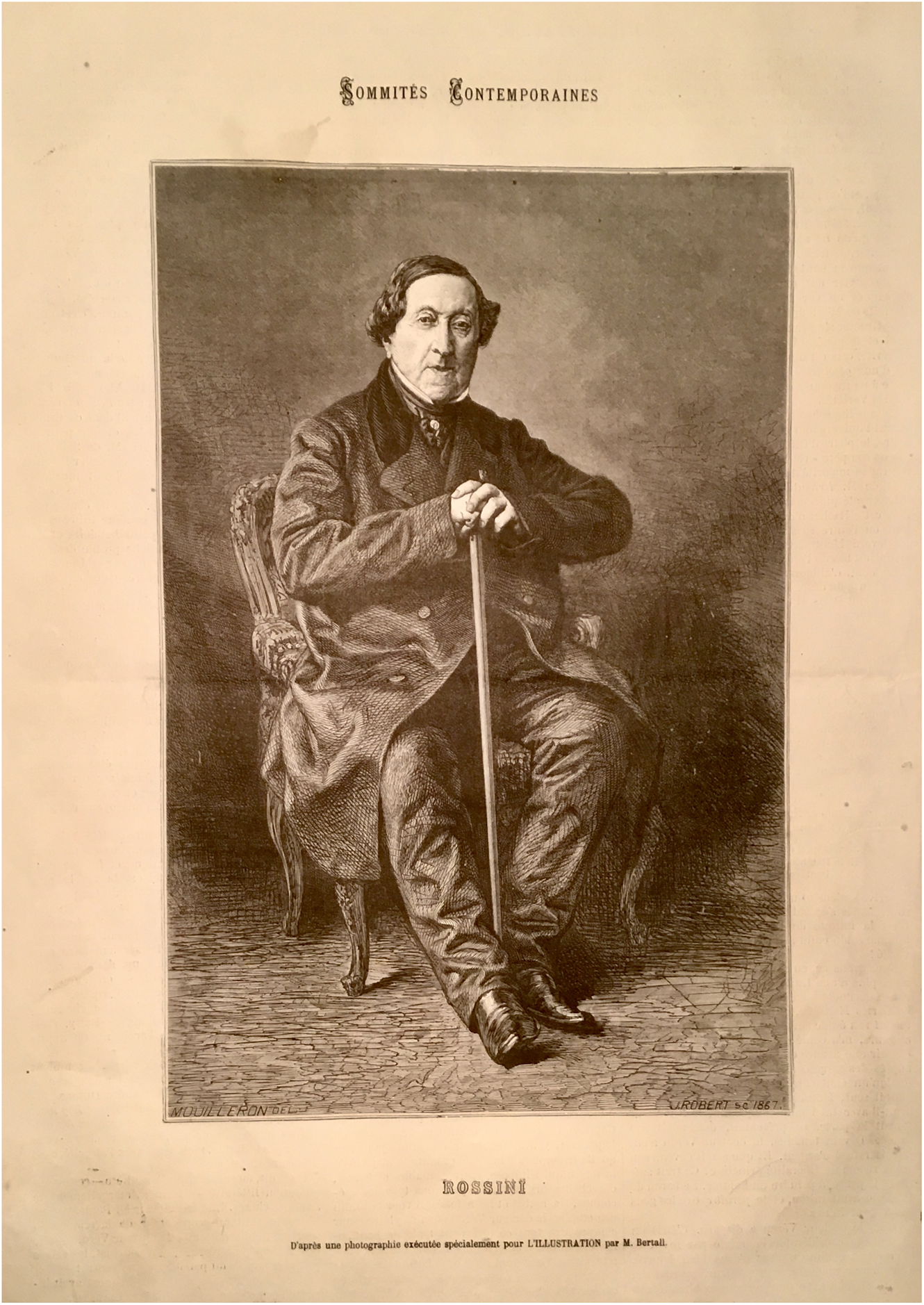 Sommité Contemporaines (1867).
Two historical forces obliged Rossini to develop a more acute sense of the past, either to defend himself or to provide himself with a plausible self-narrative. The first was the unification of Italy in 1861, and the second was the decline in aesthetic prestige of Italian opera in the wake of Germanic symphonism. For late Rossini, the glory of Italian music personified by the castrati was no more, and singing, the most crucial aspect of Italian music, had declined. In his much-quoted letter to Giovanni Pacini, Rossini asserted that music is based only on the ideal and feeling and “cannot avoid the influence of the time in which we live. Today the ideal and feeling are exclusively turned toward steam, robbery, and barricades …” (Mazzatinti and Manis, 1902: 295). 40 Here, Rossini exhibited a keenly precise if negative historical judgment of his times, but when he said to Wagner “For my part, I belonged to my time,” it was to embrace not the time in which he lived but rather the age of Mozart and Cimarosa into which he was born. And when he wrote to Filippi four years later, he placed himself in an even broader musical-historical context extending back to Palestrina. These two different historical contexts, one external (to music), an age of steam and barricades, the other internal, the history of Italian opera, shared a common trajectory of decline. It was a 19th century not of progress but of violence, the death of bel canto, and the decline of Italian music. 41 According to Michotte's account at Beau-Séjour, “Maestro,” we demanded, “do you really believe that bel canto is irretrievably lost?” “Absolutely,” he answered sharply” (Michotte, 1968: 108). Rossini was constructing a history of his time, in terms of musical decline and social chaos.
Rossini's definitive statement on his relationship with politics was made to Ferdinand Hiller in response to fabricated accusations that he had conspired with the Austrians: I never got involved in politics in any way. I was a musician and it never occurred to me that I wanted to be something else, although I took a lively part in what was happening in the world and especially in the fate of my homeland. (Joerg, 1992: 123)
Typically, his account was a mixture of truth, some creative recollection, and a healthy amount of dissimulation, for his “lively part” in the fate of Italy was mostly imposed on him in a most unpleasant way. One of the most self-revealing of Rossinian anecdotes was when: Once, one of his intimate friends, knowing well his political opinions and temperament, asked him jokingly how in his conservatism, he was able to find writing Guillaume Tell with its heroic tone. “I confess,” he responded, “that while I was composing that opera, I felt in me something that excited me; I believe that on the contrary, if a revolution broke out, I would have grabbed a rifle … but unloaded.”
42
(Radiciotti, 1929: 134)
This is Rossini in all of his humorous and skeptical self, passive protester, admitting to the effect his art had on him, but not quite enough to allow him to take violent action, sporting a gun without ammunition amid a revolution, a man in the middle when the middle was a dangerous place in such a divided century. 43
Amidst a series of concepts referring to time (and therefore to history), Rossini wrote that an aria performed in his home was: that music of the so-called Future !!! With regard to this topic so much in vogue and so unfairly discussed, I can tell you that when I read certain swear words such as Progress, Decadence, Future, Past, Present, Convention etc., I experience a certain anti-peristaltic movement in my stomach that I feel all the pains of the world to repress. (Mazzatinti and Manis, 1902: 330)
Rejecting these “parolacce,” one part of Rossini's historical response was to go back to a more pristine, simpler past and an archaic style within the Italian tradition of cantilena, perhaps inspired by the Cecilian movement (Rattalino, 1977; Riva, 2013: 97 n. 3). In contrast to German intellectual bombast, Rossini defined Italian music as “simple melody and variety of rhythm.” If only contemporary composers would follow this rule, and “our ancient holy fathers, Marcello, Palestrina, Pergolese [sic],” their fame would be assured (Mazzatinti and Manis, 1902: 330).
44
And so the archaic nature of the Messe, cultivating a learned eclecticism as if he were making up for that lost study he had confided to Wagner. Verdi was less charitable in his response to the Messe: Lately, Rossini has made progress and studied!!! Auf! Studied what? For me I would wish him to unlearn music, and write another Barber … I, who have completely trusted in Rossini's name for the last things written by him, now if he has studied, I am beginning to doubt. (Verdi, 1931: 38)
45
Verdi too embraced Beethoven's idea of an untaught, natural Italian musicality confining Rossini back to 1816. But Rossini refused to be locked in; he was exploring all sorts of music creatively in his piano and vocal music. 46 On December 22, 1861, his Le chant des Titans was performed at the Opéra. Both the public and a reviewer were astonished with music that seemed so un-Rossinian (Weinstock, 1968: 312–314). He still had the ability to amaze, but his operatic idiom changed little.
One of Rossini's last compositions was a Hymne à Napoléon III et à son Vaillant Peuple for the Universal Exposition of Art and Industry in 1867 in Paris, set to a quirky text by Emilien Pacini for a “pontiff,” priests, soldiers, and camp followers, a mixture of the sacred and patriotic typical of the Second Empire (Rossini, 1968: vi). The pontiff's prayer is not sacred music but one of Rossini's “operatic prayers” followed by a jaunty tune sung by the camp followers. The reaction of one listener, M Savigny, music critic for the periodical L’illustration, heard Rossini's music in terms remarkably similar to the listeners of a half century earlier. First, the melody of the Pontiff: “We do not believe that there is, in the most beautiful pieces of Moise, a musical phrase higher, broader, more powerful than that of the pontiff” (Nous ne croyons pas qu’il y ait, dans les plus beaux morceaux de Moise, une phrase plus élevée, plus large, plus puissante que celle du pontife); “The phrase following the final invocation has a tremendous effect” (La phrase qui suit l’invocation finale est d’un effet prodigieux) (Savigny, 1867: 14). In response to letters of praise, Rossini wrote of his “poor poem which I wrote to be sung in my garden at Passy, before my family, and not on such solemnity. What do you want? I was asked and I could not refuse,” it came from “on high” 47 (Mazzatinti and Manis, 1902: 309–310). All this is immediately recognizable: the unforgettable melodies, the music's effect, the requests from “on high” that can’t be refused, the irony of a hymn to be performed in his “garden,” a score that required a large orchestra, military band, and cannons! He had reached back to his old popular style; Rossini was still Rossini.
And so, we have a Rossini who could amaze with such un-Rossinian music and at the same time remind listeners of Moise written exactly 40 years earlier. Rossini's late music seems a mélange of styles, part baroque, part romantic, part neo-classical, and part Rossini still being Rossini. This is pluri-dimensional Rossini and its explanation lies in many factors, musically in different genres and the growing separation of operatic and symphonic music. But the more important explanation is in the distinction between public and private. Almost all his Paris music was unpublished, written for himself alone, a means of self-expression, the hallmark of 19th-century music. So says Richard Crocker: “If we were to articulate the primary concept of nineteenth-century music as received from that century itself, it would (I think) be that music is self-expression …” (Crocker, 1977: 182; Cormac, 2020: 61–66). We finally may have an answer to the question of the relationship between Rossini's music and the politics of the day, particularly the Restoration. He accepted commissions from “on high,” whether from Metternich, Pius IX, or Napoleon III, committing to them musically more than politically. This is “Old Regime” Rossini, still working within patron–client relationships, in Baroque cantata forms, and in his old operatic style long abandoned. Le chant des Titans was the exception, written for private use that he allowed to be publicly performed as a fundraiser and then immediately withdrawn. Rossini's private music was “revolutionary,” but multi-directional, pointing forward and back, an aesthetic that was a complex zibaldone (mish mash), to use a Leopardian term, exploratory, eclectic, difficult to categorize and usually detached. Rossini wrote his “revolutionary” music for himself or for a few intimates. Public music was different; it had an audience to please and he gave it what it expected (Steffan, 2018). 48 This is perhaps the best explanation for Rossini's retirement, that he sensed that he was no longer capable or willing to produce music that pleased the new audience of the emerging bourgeoisie. Throughout his life, he expressed admiration for the music of Haydn and Mozart, yet ultimately his music did not imitate theirs. This perplexed his German listeners, especially Peter Lichtenthal, the Milan correspondent for the Allgemeine musikalische Zeitung, who prodded Rossini to emulate Haydn and Mozart, to which Rossini replied “temo il pubblico italiano” (I fear the Italian public) (Jacobshagen, 2018: 384 n 10). 49 There is not only a liminal Rossini but a bifurcated one, a public and a private one, a traditionalist and a progressive one, a man outside and inside his own time, and this may be the key to understanding the transfer of Rossini's body to Florence as an Italian national hero. He was popular, he gave the public what it wanted, and once Italy was unified memory of his politics faded. In his wit and love of good food, he engendered countless anecdotes, authentic and not, and embodied one aspect of an Italian national character—the buongustaio. As the savior of Italian opera during dark days of the Restoration, he had protected the Italian national art—opera. As one of the most popular cultural figures in Paris, he proved that Italians and their culture could command respect.
Ultimately, we have in Rossini a man who resists history's attempt to rationalize the past, who pays tribute to the “holy fathers” of Italian music while simultaneously lampooning the foibles of Italian opera, even questioning the ability of Italy to train serious composers. How much does Rossini personify an Ottocento Italian national culture? He certainly lived and thought outside of not only the Risorgimento narrative but also that of the idea of 19th-century progress. There is something ambivalent and skeptical in Rossini that captures the attitude of many not quite “made” Italians, evoking D’Azeglio's famous dictum of an Italy made and now the need to make Italians. Rossini rejected most of the vast changes that occurred during his life, in both art and politics, and it came in the form of a series of paradoxes. He disdained politics but continued to write in praise of political leaders, because what else could he do? He wrote short, intimate, and often innovative chamber music and a grandiose celebration of Napoleon III, with bells, tambourines, and cannons in his most popular style. He proclaimed his love of German composers but declined to follow them. He feared the public, yet he commanded the public's adulation for most of his life and he did not fear failures; he had his fair share of those, and he shrugged them off, or at least he pretended to. It may have been that the opera, public music, was business, his livelihood, something he could not put at risk by writing for himself alone. He praised the past, condemned the present, and pondered the future. In that, he was of the long 19th century, a period marked by cycles of rapid change (revolution) and retrenchment (reaction) that he explored in his Specimen piano pieces. He balanced all these paradoxes with a wink and a nod, disguising his seriousness of purpose. In the end, the picture of a man amid a violent revolution grabbing his unloaded gun might be the most accurate image of a complicated creative genius who tried to saunter through a history more volatile and discordant than he could bear. A composer of the 19th century, and not; a man of his times, yet profoundly alienated from them.
Footnotes
Acknowledgements
Many thanks to Erich Lippman, Jessica M. Abbazio, and Brian Luckner for their valuable assistance in preparing this article.