







Abstract
This article analyses the current condition of teaching Italian abroad and the ways in which second-language programmes can engage learners and meet their educational goals. While we are aware of the need for systematic action amongst various actors to ensure the future of Italian-language teaching, we choose to focus on the concept of Experiential Learning (EL). EL is a didactic action (i.e. a linguistic policy) which can be directly implemented into university courses or programmes and represents an innovative method of teaching Italian as a second language. Research on the theme of EL was conducted on Italian L2 courses at the University of Toronto Mississauga and involved instructors and students from various departments. These results lay the foundation for the creation of concrete educational policies, consistent with international literature on the action-oriented approach (CEFR, ACTFL), and for the ‘power of feasibility’ of individual classes (and individual teachers) of L2.
Keywords
Introduction
This article is part of a research space based on educational linguistics (Bowen, 2018; Bowen and Penneforte, 2017; De Mauro, 2018; Panico and Sbrocchi, 2000; Piccardo and North, 2019) and educational-linguistic policy (Spolsky, 2004, 2009, 2021). Contributions from Casini and Bancheri (forthcoming) and Danesi (2020, 2021) have already focused on the link between teaching processes and language policies, not limiting their considerations to a top-down approach, whereby institutional levels of academic management lend support to second-language teaching, but also consider a bottom-up approach, whereby the power and discretion remain with the individual teacher who directs and manages the immediate expendability of the language course.
We do not wish to uphold the misconception that the two forms of language policy (top-down and bottom-up) are not in fact linked: institutional support, often in the form of economic support, encourages or determines choices made in the classroom and by extension, directly impacts bottom-up educational policies. We believe that the former is only marginally addressable, as institutions must be convinced by reflection and analytical research to devote attention and importance to the issues of language teaching, however the latter, those in the classroom, fall within the direct power and responsibility of the teacher. This means that the teacher – in their teaching autonomy, in the choices they make, in the structuring of a course with certain contents rather than others, using certain didactic methods and models rather than others, opening their teaching to innovation and civil society, rather than flattening it on the textbook – is creating an educational policy, no less important than the institutional one (but connected to it) and certainly with a much greater direct grip on the ‘educational life’ of students.
We are aware that educational action, alone, can do little within a group of issues that pertain to multiple levels of social life, but we are equally aware of the fact that as cultural operators—teachers and professors who work in the university and in the school—education is in our ‘direct power’ (while the remaining plans are not directly modifiable), and at the very least, we must exercise this ‘educational power’ to implement change (for the better).
Teaching Italian L2 in North America: The state of the art
Between the end of 2021 and the beginning of 2022, in no more than a few months apart, numerous works have been published that address the issues at the base of any process of educational and political-educational intervention surrounding the condition of the Italian language abroad. Providing a straightforward answer is difficult, due to both the topic itself and the numerous pieces of data involved. Casini and Bancheri (forthcoming) have considered how even the numbers (i.e. the number of courses offered in schools and universities, the number of enrolments, the number of courses in relation to levels, etc.), which by nature should be as objective as possible, assume characters of vagueness, especially when these numbers are declaimed by institutions and politics. However, the quantitative data, while failing to justify the status quo, or in suggesting strategies for change (but at times making suggestions in this sense), manages to paint at least a tendential picture of a research context, within which it is then necessary to provide a qualitative reflection. In this contribution, we do not carry out a qualitative analysis on the current state of the Italian language in the world, for which we refer to more general contributions including Coccia et al. (2021), Casini and Bancheri (2022a) and Fimognari (2022). 1
More specifically, Fimognari (2022) focuses on the relationship between language-education-economy to uncover the degree of expendability of Italian in the local business sector. The research emphasizes the connection between economics and education, considering how the language skills developed through the curriculum can be linked to the economy and more specifically, the language skills requested by the job market. Thus, considering the expendability of Italian in the Canadian job market can help language departments expand their course offerings and attract those students who wish to use their language skills in a non-academic context. Moreover, Fimognari argues that economics has a considerable influence on education given the growing pressure (both from students and institutions) to make the language skills acquired at university useful in the labour market.
From MLA to AP courses: Data analysis
Among the quantitative data that depicts a difficult context for the humanities and for the teaching of Italian as a second language, we find the latest reports from the Modern Language Association (MLA, 2019) which we consider together with the analysis proposed by Looney et al. (2021).
The MLA data covers enrolment numbers for non-English language courses and programmes in the United States. While this data is limited to the American context, it is indicative of a general trend linked to North America as a whole. The latest report available is from 2016 and the next report will be published in spring 2023. Already in 2016, the data indicated that student enrolments and the number of courses in Italian programmes had suffered an overall decrease of 20.1% compared to the previous 2013 report. This decrease was greater than that of all other major foreign languages taught in the United States. To these pessimistic results, we add a further element of concern: in 2013, the ratio of basic to advanced courses was 11:1, more than double that of other European languages. This means that for every student enrolled in an advanced Italian course, there were 11 in the introductory course (in other words, only one in 11 students continued their study of Italian after the first-year course). This report suggests that there is a significant problem in defining upper-year language training, as students do not seem to be attracted to the advanced courses. However, it is those advanced courses that give students the linguistic autonomy in different communicative registers, including daily and sectorial contexts.
The lack of interest shown towards the Italian language at the school level is not a novel issue: Maiellaro (2016) recalled this phenomenon in the United States educational context that was characterized by pragmatism. That is, the North American society, perhaps more so than the European one, considers education as an investment of effort, energy, and money, and therefore the students want to see a positive future outcome in the job market of the skills gained in school and university. The lack of interest in Italian was linked to the lack of such a ‘future vision’ which prevented students from making educational investments in learning Italian. 2
This aspect is also highlighted by the small number of enrolments in Italian AP courses.
The Advanced Placement (AP) programme allows students in secondary school to pursue college and university courses (which are approved by the College Board 3 ). These courses are at an introductory university level and are available in a variety of subject areas (i.e. Arts, English – language and literature, History and Social Sciences, Maths and Computer Sciences, Natural Sciences, and World Languages and Culture, among which, Italian). The exams are at the difficulty level of first-year university courses, and Ontario universities will award university-level credits for earning high scores on these exams. Some of the multiple factors that determine whether an AP course is offered are linked to student demand for such a course, as well as the student's previous knowledge and academic preparation which must be enough to ensure their success in the course and in realistically passing the final exam. Further, the teachers need to be willing, and competent enough, to teach a course which is almost at a university level. Please refer to Casini (forthcoming) for an analysis of AP courses and exams in Italian. Here we use the quantitative implications that AP enrolments provide: 4 from 1956 to 2021 we witness an exponential growth of high schools, colleges and universities that offer and recognize AP courses in North America. We also notice a similar growth in the number of students interested in AP courses. In 1955–1956, 104 secondary schools offered AP courses with a total of 1229 students compared to the over 22,000 schools offering AP courses in 2021 with over 2.5 million enrolled students.
In terms of more current statistics, in 2020 and 2021 there were general declines in the number of AP course registrations. There is no doubt that the Covid-19 pandemic and online teaching and learning have played an important role in determining such a decline. 5 However, in the face of a general decline in the number of students attending AP courses, Italian appears to suffer much more than other courses. If we consider languages alone, enrolment in the Italian language and culture AP course in 2021 totalled 2102 with a decrease of 17% compared to 2020. Japanese exceeds Italian by approximately 100 registrations (2204) with a decrease of 15% compared to 2020. The AP German course had 4315 enrolments in 2021 (a decrease of 12% compared to 2020) and the AP Latin course is chosen by 4889 students with a 16% decrease compared to 2020.
In terms of results (i.e. passing the course and the examination to obtain the credits transferable to a university degree), Italian students demonstrate advanced skills. According to the College Board, passing the exam (and obtaining university credits, at least in Ontario, which we consider as a paradigmatic case) requires a minimum score of 4/5 or 5/5. In 2021, 44% of students passed the AP Italian course, compared to 37% of German students and 27% of Latin students. 6 This topic is certainly of interest and will be compared to the course syllabus and the exam description by Casini (forthcoming). However, what we want to highlight in this context is that the small number of registrations in Italian courses is linked to a lack of planning in the definition of an educational path. Choosing an AP course in the fourth year of high school means mortgaging with plausible certainty a future academic path on the same topic as the AP course. Italian shows a lack of planning and attractiveness starting in secondary school. The lack of attractiveness stems from reasons we will soon consider (Casini and Bancheri, 2022a; Coccia et al., 2021; De Mauro et al., 2002) and that continue into the post-secondary context.
Before the publication of the MLA 2023 report, according to the MLA's sample survey of enrolments in the fall of 2020, the total number of enrolments (undergraduate and graduate) in languages other than English decreased by 15.4% between 2016 and 2020. Due to the pandemic, the MLA postponed its full language enrolment census to 2021. The MLA conducted a sample survey of language enrolments during the autumn of 2020 7 in order to understand the current stance during the first year of the pandemic. A total of 1309 institutions were included in the sample survey compared to the 2547 institutions included in the previous census.
This 15.4% decline was the largest decrease in enrolments recorded since the beginning of the census. From 1995 to 2009 (when language enrolments peaked at 1,673,566), language enrolments had been steadily increasing, but they have been declining since 2009.
Spanish and French remain the two most studied languages, with a decrease of 15.2% and 22.4% respectively between 2016 and 2020. German declined even more drastically by 32.2% and Italian by 24.4%, with a total number of enrolments of 26,116 in 2020 (8433 fewer than in 2016).
Other data for Italian L2 in the global world
Research by Coccia et al. (2021) does not exclusively consider the enrolment data of Italian courses but presents a qualitative and quantitative analysis of the motivations and general expendability of Italian-language competence in the labour market. It also emphasizes the coexistence of old and new problems for Italian abroad. It is necessary to create a new interpretative paradigm of the phenomenon, one which can overcome (but not eliminate) the Italian language of artistic and literary culture binomial, and which highlights new functions of language in response to the needs of the people in the global world.
The reflections brought forth by Coccia et al. (2021) refer to the model proposed in Italiano 2000 (De Mauro et al., 2002) and to the global language market which considers the relationship between languages not in terms of formal structures (such as morphology, syntax and phonetics) but in terms of semiotic identity, whereby languages are symbolic systems that relate to the cultural, ethical, political, economic and sociological issues of a country. This model also appears in Storia linguistica dell’Italia unita (De Mauro, 1963), which seems perfectly consistent with the facts of Italian abroad. In this perspective, relations between languages are marked, not neutral. That is, the choices that individuals or social groups make about language (for example, deciding which language to use, which language to learn or which language courses to create) are linked to the pragmatic function of that language, not on a communicative level but on a social level, and in terms of its expendability in the contemporary context. In Italiano 2020, Italian is at a disadvantage compared to other languages with which it ‘competes’ because of its decreasing attractiveness in the global language market. Amongst the causes of this low attractiveness is the lack of structured and prolonged action, and the lack of economic investment in the cultural industry, also in terms of human capital. Moreover, also confirmed by Casini and Bancheri (2019) in the North American context, Italiano 2020 underlines the lack of a common strategy, that is, of a network between different actors – from local actors to institutional actors (the educational system), from the local economic production system, to the international one linked with Italy, up to the community and migratory dimension –operating, each in its own sector, for the welfare (and development) of Italian in the world. A sort of self-referentialism emerges, and once again, a model of action (or non-action) that is based on the concept of Italian language of culture, different from the perspective of Campa (2019), but rather in a simplistic and traditional (and at times banal) sense, which considers the intrinsic cultural link between language and high intellectuality, as if it were sufficient to promote a language in the contemporary global world.
In the Canadian context, and in particular in Toronto, Casini and Bancheri (2022a) carried out a comparative research project between Italian, Spanish, Portuguese and German to determine which amongst these languages exercises the greatest social-economic-educational ‘power’. Specifically, they studied whether younger generations abroad (of both Italian origin and not) are attracted to the Italian language.
The research results, even those exclusively from the Greater Toronto Area (GTA) (although a limited context, it is pragmatic for Ontario and Canada), highlight the generally limited power of Italian compared to other foreign languages; a power manifested particularly in the areas of heritage and new identity, values linked to the visibility of language in the urban context and the values of tourism, taste and good taste. Furthermore, Italian is particularly weak in terms of economic development.
In a study on the link between the Italian language-education-economy in the GTA, Fimognari (2022) designed and conducted a comparative analysis of business and management courses offered though the University of Toronto language departments (specifically Italian, Spanish, Portuguese and German) and considered both the skills acquired through these courses and the skills requested by future employers. The goal of the research was to propose an innovative educational policy to increase the marketability of Italian abroad. After analysing syllabi from business courses offered in the aforementioned languages, the research found that all courses employ an action-oriented approach to language learning with a curriculum that clearly highlights the link between language-culture-economics. Most importantly, however, the research found that Italian is the only language department which does not offer business courses due to more practical administrative challenges (i.e. lack of qualified faculty, and uncertainty over student demand). Moreover, Fimognari argues that part of the reason why no Italian business course has yet been created is due to the traditional reputation of Italian as a language of culture – students approach the study of Italian, not for its economy or business model, but for its art, history, literature and heritage. Essentially, in order to increase the vitality of the Italian language, it would be beneficial to include Italian for business courses within language programmes to guarantee that students acquire theoretical and linguistic knowledge as well as a sectorial register that will increase their chances of finding employment in an Italian-speaking environment. Fimognari (2022) concluded that economics has a considerable influence on education given the growing pressure (both from students and institutions) to make the language skills acquired at university useful in the labour market.
The link between economics and education is not surprising: the power that a language manifests in terms of functionality and expendability in those areas deemed more functional to social development and more useful in everyday life (that is, those of work and economic productivity [research took place in 2022]) is directly connected to a (sometimes monetary) investment required to study that language and to attend courses and programmes locally and abroad. Knowledge of the German language seems to ‘pay more’, ensuring greater advantages of functionality, expendability and use in the medium to long term. Italian, on the other hand, symbolizes a bond (at times more theoretical than actual) with the ethnic community in Ontario and serves a generic function of attractiveness according to a traditional canon whereby Italian is a ‘liked language’, a ‘beautiful language’. In general, the framework provided by linguistic research is a framework of general suffering, in which the maintenance or construction of the power of a language needs specific support actions, notably political-educational actions.
Action-oriented approach (CEFR) and experiential learning
Amongst the theoretical elements that distinguish the CEFR (Common European Framework of Reference for Languages) (Council of Europe, 2020) from its 2002 version, we find the action-oriented approach. According to this approach, language students are social agents and language is their primary (and not the only) communicative/interactive tool: The CEFR's action-oriented approach represents a shift away from syllabuses based on a linear progression through language structures, or a pre-determined set of notions and functions, towards syllabuses based on needs analysis, oriented towards real-life tasks and constructed around purposefully selected notions and functions. […] The idea is to design curricula and courses based on real-world communicative needs, organized around real-life tasks and accompanied by ‘can do’ descriptors that communicate aims to learners. (Council of Europe, 2020: 26)
According to the action-oriented approach, the goal of the lesson is no longer to teach grammatical and lexical structures, but centres around the completion of a task, e.g. a presentation, a poster or a role-playing exercise: Action-oriented tasks give users/learners the opportunity to engage in action – to come up with a well-defined outcome, to create an artefact: a visible product. It is during the process of developing the product that the learners mediate and (pluri)language i.e. exploit different linguistic and semiotic resources to communicate and (co)construct meaning, and so, acquire new language. (Piccardo and North, 2019: 278)
One of the characteristics that defines the approach is the social aspect that distinguishes learning, because most of the tasks are carried out in a group: Users and learners of a language primarily as ‘social agents’, i.e. members of society who have tasks (not exclusively language-related) to accomplish in a given set of circumstances, in a specific environment and within a particular field of action. While acts of speech occur within language activities, these activities form part of a wider social context, which alone is able to give them their full meaning. We speak of ‘tasks’ in so far as the actions are performed by one or more individuals strategically, using their own specific competences to achieve a given result. The action-based approach therefore also takes into account the cognitive, emotional, and volitional resources and the full range of abilities specific to and applied by the individual as a social agent. (Council of Europe, 2001: 9)
The social actor is at the centre of the didactic action (Piccardo and Galante, 2017); the student is autonomous in their learning because the approach provides more space for creativity and multilingualism in the construction and co-construction of meaning along with the other members of the group. This promotes learning experiences within the class, unlike the task-based teaching approach in which the tasks focus on learning that becomes the goal of teaching, which usually occurs when one must pass a certification exam for citizenship or to enrol in university. However, in the action-oriented approach, tasks are focused on social life and the student must be able to communicate in real-life contexts in the target language (Delibas and Günday, 2016).
In this way: being real-life oriented, action-oriented tasks tend to be open to linguistic and cultural diversity, thus, the AoA encourages learners to be naturally curious about diversity and to consider it as an ordinary characteristic of human nature and everyday life and language. (Piccardo and North, 2019: 84)
Instead of imitating real-life situations, the action-oriented approach leads students towards real-life, linguistic-communicative experiences:
8
The learner acts in a society, be it the class or outside (the barriers between the two are increasingly blurred). Action is what characterizes learning in the same way as it characterizes our everyday life in society; The class is an authentic social milieu where different individuals act together; Acting together is what we are increasingly doing when we are involved in projects. […] By being called to act in an authentic social milieu such as the classroom, to pursue authentic goals and produce authentic materials, individuals are automatically very far away from the neutral, unidentified ‘learners’ that characterized CLT [communicative language teaching]. (Piccardo and North, 2019: 245–246)
Experiential learning (EL) (or rather, its educational systematization) is a new teaching principle that greatly supports the experiential component of the learning process (amongst the extensive literature on this topic, refer to Billett, 2009; Bowen, 2018; Bowen and Penneforte, 2017; Jackson, 2015; Rowe and Zegwaard, 2017; Smith and Worsfold, 2015). The following fact seems non-accidental: if today, EL is a fundamental element of quality teaching, languages seem to have understood its connection before other disciplines, considering the functional dimension of learning, as is known from the theoretical basis of the CEFR placed in the action-oriented approach.
In the North American university context, EL is an integrated element in the teaching of many hard sciences such as mathematics, medicine, engineering and chemistry. It seems to be suffering in the humanities and linguistic disciplines, which have not yet discovered the potential of this teaching practice. Having an EL component in a course means that the course leaves the classroom (both metaphorically and concretely) and enters the social and economic-productive territory in which the teacher lives, consumes and teaches and in which the student lives, consumes and learns. There are no more or less adequate courses to integrate components of EL, but there are activities within courses on literature, history, semiotics, theoretical linguistics, etc. that can include an EL component. This inevitably reflects on the instructor's qualities and skills: the teacher can choose to follow a traditional lesson and perhaps be a good teacher, limiting themselves to a role in a small field of action. Or they can choose to be a good teacher/politician for the academic discipline because they are able to fully deal with the subject matter and with how the content taught can branch out of academia. The dialogue between different institutions is at stake, and they are all involved in the process of cultural, economic and social development of a territory, a province and a nation. EL is a form of teaching that brings students into the community, helping them to both connect what they learned in class to the real world and transform inert knowledge into used knowledge. Eyler (2009) highlights that EL can lead to ‘more powerful’ academic learning and more responsible training environments that produce more engaged citizens that are more involved in social and world dynamics. This increases the chances of students being able to use the critical knowledge and skills acquired over years of training for the rest of their life. Lettieri (forthcoming) uses Eyler's (2009) words to define EL as good practice within the L2 learning process: according to Eyler (2009: 24) ‘experiential education, which takes students into the community, helps students both to bridge classroom study and life in the world and to transform inert knowledge into knowledge-in-use’. Eyler (2009: 31) explains that ‘experiential education can lead to more powerful academic learning’ and a more empowering school environment, producing ‘more engaged citizens’ and ‘increas[ing] the likelihood that students will be able to use throughout their lives the knowledge, critical abilities, and habits of mind acquired in their studies’.
Recalling the concepts of action-oriented approach and EL in the context of a linguistic policy reflection is not superfluous, as the idea of action in the process of learning and teaching languages, that has profound philosophical implications in the construction of meaning (Wittgenstein, 1953), is connected to the idea of experience (learning). Experience (any kind of experience) is possible through action, an action that directs the learning process which is linked to experience through action. Therefore, to speak of EL means to speak of action and so EL has its own theoretical foundation in the pragma-linguistic, action-oriented approach of the CEFR (Vedovelli, 2010).
The link between EL and the action-oriented approach in the theoretical paradigm of the CEFR is unfortunately only implicit. In our opinion, this demonstrates how languages, although able to intuit this connection, have not yet been able to formalize the component of action and experience. In other words, action determines experience and experience determines action. The expression ‘experiential learning’ is missing from the European document (Council of Europe, 2020) we refer to, and similar results are also found in the ACTFL guidelines (ACTFL, 2015) (see Casini, 2019a for an overview of the differences between the CEFR and ACTFL guidelines). Table 1 shows the number of times each word appears in the CEFR.
The reference to the CEFR's lexicon is, in our opinion, confirmation of how central the idea of social experience is for international language policies, whereby the social experience is also to be implemented through the language-learning plan. At the same time, however, the model for which good, formalized language learning in the classroom passes through experience is still in its early stages. We are aware that the CEFR is not a handbook of foreign language didactics, and that its users are not only students and teachers, even though they are undoubtedly its main readers/users. Therefore, the widespread reference to the concept of experience cannot fail to be theoretically and formally accepted as a good and innovative teaching practice in the language classroom.
Experiential learning: A case study at the University of Toronto Mississauga (UTM)
In 2008, the Association of American Colleges and Universities (AACU) (2008) defined a list of high-impact educational practices that North American universities are using to create quality management and educational plans. Among these we find the Diversity / Global Learning indicator which recalls the need to make education a global and international experience, while the second indicator predicts that internships are another common form of EL. Through an internship, students get work experience in a formal setting while being mentored by professionals in their field of interest, usually tied to their future career. Community engagement refers to the collaboration between the educational institution and the local, regional, national or global community for the reciprocal exchange of knowledge and resources. EL is, in fact, a common denominator for these high-impact practices and is an essential component of community engagement that enriches the learning experience through community engagement. Moreover, since 2017, UTM has been working to make EL one of the goals of its Mission and Academic Plan (Office of the Vice Principal and Dean, 2017).
Considering UTM's educational policy, we must consider EL as an integral part of the learning process in which to confront the issues of the expendability of acquired skills and the acquisition of new skills in the field. If we direct the focus towards the students, we ask ourselves what the students’ learning expectations are, whether they are consistent with the educational offerings and whether a language course or programme can realistically implement EL activities to satisfy their expectations.
The qualitative research involves 20 third- or fourth-year students (some of whom are recent graduates) of the UTM Italian programme in 2022. The students had completed at least three third- or fourth-year Italian courses and had achieved an average grade of at least A-. 9
Similar questions were then submitted to faculty and staff who coordinate the EL 10 programme at UTM, and to those who work in the Department of Language Studies, UTM.
From a student's perspective
The students answered the following questions:
What does EL mean? What would you expect or what would you like to gain from an EL project within a university course? Does EL add any extra value to a foreign language course? Do you think EL activities are important in developing linguistic competence? Why or why not? Imagine you are an educator; would you implement EL activities into your course? Why or why not? What skills should the professor have in order to appropriately carry out EL activities in class? If you have not already mentioned it, what sort of EL activity would you like to participate in? Do you have any additional comments regarding EL?
The questions can be divided into three macro-blocks: questions 1, 2 and 3 are centred around the meaning of the teaching practice. These questions consider the students’ opinions (1), and whether the prospects of adding an EL element to courses could be a positive and functional addition to the development of skills (2, 3).
Questions 4, 5 and 6 place the undergraduate student in the perspective of the teacher. It should be noted that many of the students enrolled in the Language Studies department have completed courses in the Language Teaching and Learning and Teaching Methodologies programmes and have had some form of teaching experience in private schools. These questions allow the student to create a more articulated response than the previous ones since they can combine the two perspectives (of both teacher and student).
Question 7 is open-ended and gathers further insights on EL. The answers are interesting, not so much on a quantitative level (since all the students have proven to know the meaning of EL and appreciate its value within a language course), but on a qualitative level: 11
Question 1: I_03: EL is a teaching method that provides experience; it is a teaching/learning path in which students must take a part of their learning into their own hands, making a life or work experience.
I_07: EL is a didactic activity that involves students and is based on experience, that is, it applies what is studied to real life and brings real life into the world of learning at school.
I_12: This expression refers to a method of learning obtained through the practical application of the subject in question. Learning the content of a course is gained from field experience.
I_19: EL means not learning in a classroom but learning in a more practical environment and it allows students to learn a life skill outside of the classroom. Examples of EL activities that could be beneficial to a language course or programme are field trips, study abroad experiences, organizing a theatrical production, culinary workshops, making anything creative (such as art, music, film) and visiting art galleries or museums.
Questions 2 and 3: I_04: Be able to give clear and precise instructions on how to carry out EL projects inside or outside the class.
I_05: If a course had an EL component, it should still be something achievable in the given timeframe. This means that the instructions and assignments must be given in advance so that students have a clear indication of what to do and how to do it. I think that EL projects should be different, just as the methods of classroom learning are sometimes different.
I_06: Without doing an EL activity, language learners will not be fully aware of their cultural and language skills. It is very important that language classes offer a learning experience where learners have contact with the real world.
I_07: Through an EL activity, students are forced to use their language skills in real-life situations and will thus be able to improve their language through these experiences. For example, by participating in internships, students will be using the language learned in the classroom to communicate in a professional context and will possibly notice some gaps in their linguistic knowledge (especially in terms of sectorial vocabulary). Consequently, their mentor will help them acquire the appropriate linguistic register and lexicon and the student will pick up on many previously overlooked linguistic nuances.
I_08: I think it is extremely important to add an EL activity aimed at achieving linguistic competence. Practising the language means giving students a pragmatic perspective closer to the linguistic reality that is a fundamental aspect to understand the relationship between society and the language itself.
I_09: I believe that the teacher, to do EL activities in the classroom, must have already taught the material and have good experience with the subject matter; therefore, the teacher must have skills related to the EL activity.
I_10: I expect an EL project to take me out of the classroom and let me interact with professionals and people from the community to practise the language skills learned in the classroom.
I_10: The teacher must have experience and competence in EL projects. Moreover, they must have good contacts with the community in order to organize the activities. For example, if you do a business activity, the teacher must have contacts in that sector in order to organize and promote the activities.
I_11: The instructor should have good communication and interpersonal skills to maintain a good relationship between them and their students and between them and the community in which the EL activity is to take place. Moreover, instructors should have a clear plan and schedule of what days and times are required to commit to the EL activity and to accurately communicate them to the students so as to not overwhelm them with too many commitments outside academia.
I_12: I would like an EL project to give me many opportunities for interaction and collaboration between people within the context in which we live.
I_14: I think it's very important to take the class out of the classroom and away from the books and do something more experiential. Theory is always important, but it is even more important to apply theory to real life in contexts where students can have contact with the target language.
I_15: The teacher must have a flexible teaching ability and a linguistic and cultural curiosity to do EL activities in the classroom.
I_16: The teacher should have grit and show passion for the subject within which to do EL. In addition, I believe that the teacher should make sure that the class does not feel uncomfortable and thus grant a certain degree of freedom of expression as students desire, wherever possible. Even the use of objects or tools that help the imagination or ‘challenge’ certain traditional ideas would be an interesting and engaging way to carry out an EL activity.
I_17: I expect to have direct practical experience aimed at learning or deepening the theoretical part learned during the lessons.
I_18: In an EL activity I would like to go on field trips and attend workshops related to the field I wish to enter upon graduation. These types of opportunities would allow me to gain new perspectives on my field of study and to personally witness how what I am studying relates to my community. Through workshops, I can go into more detail on a particular topic and practise language in a new environment.
I_20: An EL activity should contain some form of placement and co-op opportunity. For someone who has no prior working experience, co-op placements are important for giving many students the chance to determine whether a particular career is right for them. Moreover, it allows them to learn more about themselves as a learner and about specific areas of improvement of a particular skill.
The answers provided, especially for question 3, should be seriously considered. Here, the student was invited to reflect on EL and on the value that these activities bring to a course, yet they immediately shifted the perspective onto the teacher, touching upon one of the next questions. The informants believe that EL activities are important and feasible, provided that the teacher has diversified skills that can support this. The students highlight the need for skills that go beyond the linguistic field, to build on skills in business, community and tourism, or even linguistics, sociolinguistics and translation, depending on the activities being promoted. In this sense, the references to teacher competencies in the Dieci Tesi Giscel (a document created in Italy for the educational management of Italian plurilingualism; https://giscel.it) are very current. In fact, in 1975, they spoke of a renewed language education which saw a leap in the quality and quantity of teachers’ skills (Casini, 2019a, 2022; Casini and Bancheri, 2022b, forthcoming; De Mauro, 2018).
Another element found in many answers is the request to implement community engagement. UTM Italian students understand the particular position that Italian holds in Toronto and ask that teaching activities be oriented towards a greater integration between academia and the community. Students want to study and learn Italian not only because their skills can be used in an international context and in Italy, but because these skills are available to the Italian linguistic community present in the territory. This community recalls identity issues, but also work issues, because the Italian community is also made up of companies and businesses that outline an economic profile of Italian in Toronto (Casini, 2018a, 2018b). Developing EL projects within the community also means providing students with job opportunities at the end of their course of study. Also, in terms of the need to converge EL in community engagement, the competences of the teacher and their teaching strategies (beyond the traditional ones) also play an important role (Balboni, 2015; Vedovelli, 2010).
A third aspect pointed out by students, and which in our opinion is of great interest, is the idea that EL should lead to ‘freer’ communication. In what sense ‘freer’? What does freedom mean in language teaching? The concept of freedom is not in itself a semiotic or linguistic category, but it closely recalls the concept of creativity, opposing it (or rather placing it side by side) to norm and regularity. The student has understood that sometimes in-class teaching is very attentive to the formal structure of the language (grammar, morphology and syntax) but not as attentive to the use of the language, and seems to favour correctness over functionality. De Mauro (1980, 2018) and Casini (2019b, 2020, 2022; Casini and Bancheri, 2021) have highlighted the potential creative value of grammar, indicating the need for teaching to consider the creative uses of language and how these can, when used in context, address the functionality of the language differently than through a grammatical textbook.
Considering their answers, the students seem to intuit the dichotomy between use and form and believe that form must be prioritized in an in-class study and that use must be prioritized in social life (i.e. during EL).
In Casini (2022), we considered the formal presuppositions that could make grammar creative, and how these assumptions are associated with the principles of plurality and semiotic adequacy of the language in the context of use. At the same time, however, we focused on the fact that the teacher needs more advanced skills to recognize this plurality of possibilities and to give the student a solid anchor to choose the best communicative solutions to adopt amongst a wide range of possibilities (they are called the best not because they are better, but because they are more adequate).
Moreover, students seem to be aware that EL is an integral part of a course, and therefore, like any other component of a course, activities must be clear and achievable within a pre-defined timeframe in order to be successfully integrated within a course.
Questions 4, 5 and 6: I_1: As a teacher I would like to do a lot of EL because theory does not always correspond to practice.
I_2: If possible, yes. I have always believed teaching that brings students into a learning environment is the most fruitful.
I_3: EL activities have a great value for cultural and sociolinguistic skills that in many language courses are never actually taken into account. Priority is given to teaching a course according to a curriculum that is not always adequate, and little value is given to other aspects of the language. It is not necessary to always use textbooks because students do not like to learn in a traditional way. They want to learn a language in a ‘useful’ way that reflects the current linguistic and cultural situation.
I_4: As a teacher, I would undoubtedly give priority to EL in order to introduce students to the live use of the language. In my opinion an EL activity is an opportunity for students to apply what they learned in real situations. In addition, adding a practical component to the course means making the course itself more enjoyable and intriguing.
I_5: I am a teacher now and I would like to implement activities and experiences where students create and express themselves through vocabulary, art projects, verbal games and activities. This would allow them to use the language in real social situations and build their confidence in using the language in different social environments. Through these activities, students get the opportunity to encounter native or heritage speakers, which increases their cultural and linguistic awareness in contexts outside of what is covered in a traditional language course such as business and politics.
I_7: I would like to open the doors to the world of business and politics, publishing and translation. I would like to talk and work with people outside the academic context (that is, not professors) to discover the real use of the language. It would be ideal for a language course to do EL and Global Learning and have to deal directly with the country in which the language is spoken.
I_9: Any activity aimed at developing proficiency in the language is EL. Dialogues between colleagues, discussions on current topics with non-professionals, watching and analysing a film, creating a poetry and/or prose workshop, writing theatre pieces, visiting places that reflect the notions learned in class, interviews, music, fashion, cooking. Innovative ways of teaching the language make the process more attractive and intriguing. Keeping students’ attention is the most important/difficult part as students need to feel encouraged and entertained.
I_10: In the field of languages especially in America and the UK we think that it is not necessary (or at least it is quite useless) to learn other languages, because with English we can already speak with everyone. This is not true. In the lesson we saw that some research shows just the opposite; often, if we want to do business with small Italian fashion, gastronomy or tourism companies, then we can not only work with English, but in these environments we need to work with Italian. We learned that the Italian language is useful in order to work in these areas of excellence, and we do EL to be able to use the language in these situations.
I_15: When planning this year's Italian Christmas concert at my heritage language school, I decided to have students learn how to sew ornaments for the Christmas tree. The process of learning how to sew was conducted entirely in Italian, and students learned the vocabulary related to this popular activity. Sewing is a fun and creative activity which is different from what the students are accustomed to. The students worked in groups, which I believe is one of the best ways for students to solve problems and create artwork as a team.
I_16: EL is important for those students wishing to enter the business world because, contrary to popular belief (especially in English-speaking countries), English is not the only useful language for international business relations. English may be dominant in communication amongst larger companies, but if we want to do business with smaller companies, Italian is the more dominant language and may sometimes be the only language used. Therefore, learning to use Italian in these particular contexts would be very useful.
The answers to the second block of questions are still implicitly tied to the figure of the teacher. They highlight the importance of EL in rendering a course attractive and its importance in fostering a relationship between teaching and real life. However, apart from a few cases, students do not seem to provide concrete insights into what type of EL activity should be included in a language course or what type of activity they would personally like to experience.
Only I_07 and I_09 have explicitly linked the concept of EL to a semantic and cultural field (politics and economics), but also a working field (publishing and translation). I_09 mentions all the courses that have had an EL element (theatre, culinary and fashion courses) and suggests that these elements could provide inspiration for EL since the interactions occur with people outside academia. The students’ vague answers indicate their openness to innovation in teaching, but they seem unable to provide concrete proposals for EL activities and wait for the teacher and their professional training to provide concrete ideas and plans for activities.
Fimognari (2022) has already written about the link between language-economy-education in the Toronto GTA context, but it is interesting to recall the responses of I_10 and I_16. This feature was recalled by Casini and Bancheri (2022b) beginning with a European and North American investigation about monolingualism as a disease and multilingualism as its cure, especially in the workforce. The economic income that the lack of linguistic competence in languages other than English has determined since the 1970s is significant. However, the same value (perhaps accentuated) is still present in urban areas such as Toronto, which is still strongly tied to migration in which the young generations want to rediscover a part of Italy. Perhaps the less glamorous and more local aspect of Italian economics requires the communication to be in Italian and needs to be able to combine linguistic competence and economic and working needs.
In this sense, students seem to have understood the link between Italian and EL in the economic and cultural context of Ontario. This aspect is also referred to in the answers to the last question (7) which, although only provided by a few respondents, highlights this limitation on the part of the students’ proposals. I_01: I don’t have much experience with EL and maybe the same goes for many other students.
I_19: Since EL is a new learning tool used in language classrooms and departments, I have very limited first-hand experience with these sorts of activities. As EL becomes more popular and mainstream, I will be able to form a better opinion on my likes and dislikes in terms of the types of activities that are more interesting and effective in language learning, and course management strategies.
From a teacher's perspective
As already highlighted in the students’ responses, the role of the teacher is an integral part of not only the regular teaching process, but also all the activities related to it, including EL. The teacher and their skills determine the activities outside of the classroom, and therefore a complete reflection on EL that wants to frame its full scope in L2 courses must also include an academic structure consisting of teachers and staff working in this area.
At UTM, this structure is represented by the Experiential Education Unit (EEU) in the Dean's Office. 12 The EEU supports EL learning opportunities such as academic internships, practicum placements, domestic and international community engagements, project-based research opportunities and field courses.
UTM offers EL opportunities that enrich graduate and undergraduate programmes, giving back to the community and society and thereby improving community–campus relationships and enhancing the reputation of the university as a whole. Students learn important professional skills such as autonomy, resilience and adaptability through EL.
UTM has been offering EL for over a decade and has contributed to the improvement and innovation in students’ learning. The EEU's short-term goal is to expand on the number of EL opportunities and types of activities offered to students. They also wish to add paid work-integrated opportunities for undergraduates and to expand on the WIL programme at the graduate level. Pilot projects are currently underway to help support this goal. Essentially, their objective is to provide students with EL opportunities that will expand their potential beyond the classroom and make what they learn in class more useful in their future career.
EEU is constantly looking for ways to improve and build upon existing EL programmes across various academic units at UTM. Support and resources are offered to both students and faculty involved in for-credit EL opportunities and to departments with EL components in their courses. The EEU also strives to maintain long-lasting connections with employers and community partners that offer these valuable experiences to students.
The following paragraphs are divided into questions and are followed by a summary of the answers provided during the interview.
Question 1: What types of activities are important for EL?
Examples of EL activities would be client-based projects such as internships and working with local business across various industries buying and selling. They could also participate in other opportunities in which they work in the community on research and exchange knowledge and information, applying theoretical knowledge from the classroom in a real-world setting, building on communication skills and adding experiences to their resume. Students at UTM can work in a variety of industries such as translation, politics, cultural heritage preservation, writing, gastronomy and international internships, among others, through collaborations that have been realized over the years. In terms of Language Studies, in Toronto we have access to local diaspora and immigrant communities, allowing language students to find positions working in finance, healthcare, gastronomy, education, entertainment and journalism thanks to their communication skills in other languages. An example of an EL activity in Italian Studies is a teaching placement in which they work for 100 h with a teacher mentor and learn how to teach, eventually getting the chance to teach a class. Furthermore, students enrolled in culinary and fashion courses experience frequent guest speakers and guided virtual tours of fashion museums as well as live cooking demonstrations. More recently, researchers in education have been experimenting with Virtual Reality (VR) in which students use the VR headsets and apply their (language) learning in a virtual space. Similarly, Artificial Intelligence (AI) spaces are used to help students communicate in the target language with a robot. This is optimal for individual self-study.
Question 2: What are the challenges of implementing EL activities?
When it comes to embedding EL activities into a university course, it is often particularly challenging to find placements and activities that interest and complement every student. A common roadblock is students who show disinterest in a certain activity or who have disabilities that make it difficult or impossible to physically get to the placement. In terms of technology, trying to implement new instruments such as VR and AI into the classroom requires heavy dependency on IT and other technologically adept students. Moreover, for many students to participate in EL actives, they must first overcome potential financial and sociocultural barriers, and institutions must work for equal representation and provide bursaries to financially support students. Therefore, at the university level and in terms of EL programming, it is essential to provide teachers with the necessary support. This is an educational policy action that, at least in North America, starts at the university level and is then distributed to the programme and courses.
Question 3: How can the Italian department implement EL activities?
The UTM language department has always done an excellent job in emphasizing EL and has incorporated EL activities such as interviews with members of the community, internships and other field and work experiences. For example, through the Italian play, students practise language with their peers in a more direct way instead of just learning through the traditional lectures and textbooks. Students must think on their feet and apply their language skills in a simulated work environment. There are many other activities that can be implemented by the Italian department, such as: (I) a course on Italian business in which students learn the vocabulary and structure of Italian bureaucracy. This could lead them to approach companies that do business with Italy and that have a cultural and economic interest in Italy. (II) A writing course that will allow students to improve on their professional/advanced Italian writing skills and explore the range of written language variety in diaphasic, diamesic and diatopic terms. (III) A course on Italian Canadian literature will allows students to identify some of the characteristics of the reproduction of the Italian Canadian identity. This is to be compared in Canada with the members of the community, in Italy with members of return migration and with the different migration profiles of contemporary Italy. (IV) A course on Italian Language Teaching and Learning is one of those courses in which the EL resources are most exploited. Where applicable, Italian classes could incorporate teaching placements in which students get to teach in public school Italian classes. Students create lesson materials from the theory they learned in class, and they then experiment these methods in front of their peers (who act as students) or in real public schools. Through different teaching methods, student teachers can experiment with the specific skills to be developed, and they can identify which, among the glottodidactic methods, is the most functional for the achievement of various teaching objectives (from linguistic-communicative to the passing of an exam etc.).
Question 4: What are some of the skills required by the professor to implement EL activities in the classroom?
Firstly, the faculty member needs to have a good understanding of how the proposed activity is EL in nature and they need to know how the students will be applying their learning in a real-world setting. They need to think of the desired outcomes of the course and the skills they want the students to acquire through the activity. In turn, the activity needs to be intentionally designed and related to the learning goals of the course. The members of the faculty also need to be excellent communicators, highly organized and aware of the resources that are required. Internships are very resource-intensive, whereas a research project or community-engaged learning opportunity is not as resource-intensive. The university helps the faculty organize the EL activity and ensure that they have the right resources to succeed. They also need to be sure that they are cultivating strong relationships and connections with community partners. Moreover, faculty members need to know if they have the adequate resources to sustain the activity in the long run. Lastly, in more practical terms, the faculty member wishing to implement EL needs to have been at the university for at least five years – long enough to understand the department's culture.
Question 5: Does EL add extra value to university education? In terms of language courses, do you think EL activities are important in developing linguistic competence? Why or why not?
Yes, EL does add a lot of value to the university experience in general. In terms of languages, it is proven that they cannot be mastered only through textbooks. Students must be put in real social situations in which they can use and improve on the language skills picked up in the classroom. EL activities fulfil the goals of the CEFR, allowing for exchanges of language and the use of the language within the sociocultural context. The main question is: how can we use EL to simulate the sociocultural environment in which the language is used? Since language is learned through context, students need to be immersed in those contexts. Global classroom opportunities allow students to be placed in environments that they are not familiar with, but in which they can pick up on the signifiers that would allow language use to emerge. Students begin to improvise and use their own language tools to construct meaning. Moreover, by placing students directly in the social context, they realize that what they are learning is useful and that it directly applies to the real world. Finally, EL gives students the autonomy to take initiative over their own learning and in doing so, reinforces the content. For example, in an EL environment, the student gets feedback on a conversation in the target language either informally (directly from their interlocutor), or formally (by noting their linguistic development and reflecting on how it is changing, where they went wrong and how to improve).
The analysis of the EEU's responses reveals two elements on which, in the context of an educational policy for languages and for Italian L2, attention should be paid: (A) the skills required of the teacher and (B) the support of the academic structure. Both are part of a bottom-up language policy model on which North American and European universities must focus their efforts and question themselves to better overcome the challenges of the future. In Vedovelli and Casini (2016) and Casini (2019a, 2020), starting from perspectives not directly linked to EL, we considered the actuality and relevance of the Tesi Giscel with international and European language policies. Today, considering the concept of EL and the research carried out, we reiterate once again the relevance of the Tesi Giscel that moved within Italy's multilingual context (Italian/dialect and, more recently, Italian/other languages). The document was based on two pillars: (I) the quality of the teacher's skills, and (II) the communicative functionality of the languages to be taught and learned (Loiero and Lugarini, 2019). We believe that these two priorities can be incorporated into the EL process, and into the transformation that EL can bring to the didactic and educational process.
Conclusion
What Is the Language of Power? is the title of a book published in 2022 on the state of health of the Italian language in Toronto, Ontario. The title is deliberately provocative but has allowed us to reflect on the power of languages (Casini and Bancheri, 2022a). We reconsider that question and ask ourselves what power languages can hold in the field of education.
Unlike other disciplines, languages can and should serve as archetypes for other disciplines in embracing the potential of experiential education. If EL is today in North America a goal of academia and a foundational element of quality teaching, languages seem to have arrived earlier than other disciplines at the functional dimension of learning.
According to Spolsky (2004, 2009), every language policy is defined by a series of actions/decisions that influence the linguistic structures of a territory. For a more immediate, bottom-up linguistic-educational policy that involves teachers and administrators of educational systems in Italy and abroad, being aware of these results implies becoming aware of how each person involved – in their own role – is directly responsible for both the course taught and the programme. More generally, they are also involved in the ‘state of health’ of the language. This is a form of responsibility for teaching, which we do not believe is in contrast with the need for networking as indicated by Casini and Bancheri (2019) and Coccia et al. (2021). Every single teacher plays an integral role in the development of language that leads them to make certain choices and perform certain actions. Among these actions, we find those perspectives of EL that are the most visible, tangible, effective and, ultimately, the educational manifestation of the power of languages.
Number of times each term and expression appear in the CEFR.
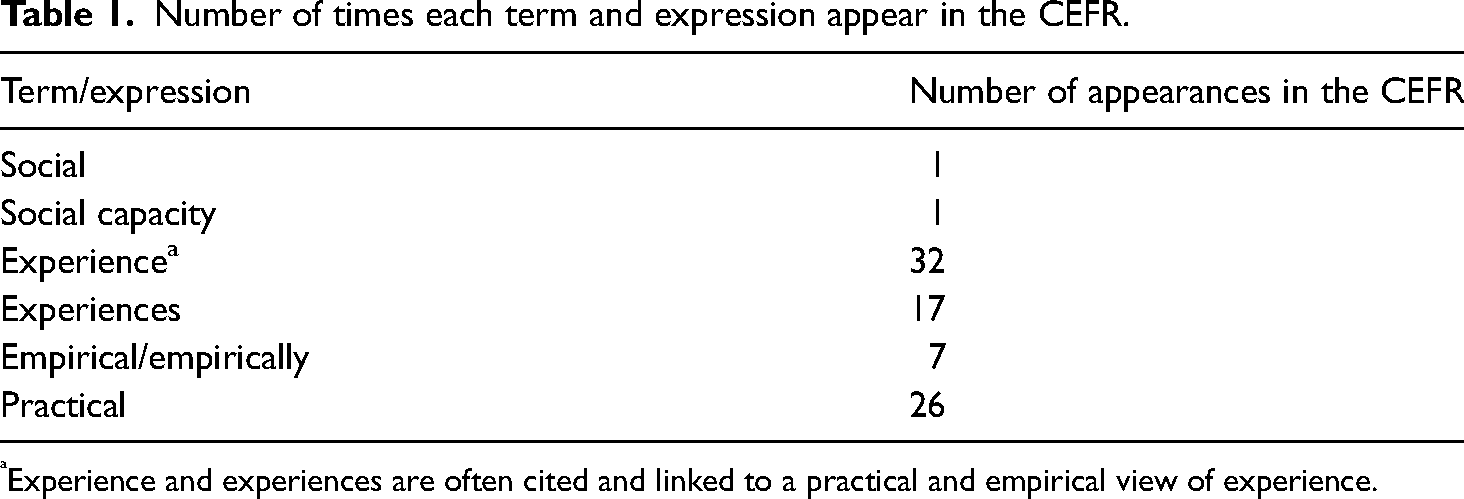
Experience and experiences are often cited and linked to a practical and empirical view of experience.