







Abstract
The problem of culturally, linguistically, and economically diverse (CLED) student underrepresentation in gifted programs demonstrates a need to examine systemic processes, including the building of systemic capacity at the district and school levels where policies for gifted programs are formed and implemented. To examine the effects of this process on one diverse district’s gifted identification and services, we conducted 10 focus group interviews with 61 participants including gifted coordinators, teacher leaders, and gifted facilitators in the middle of a district initiative aimed at improving equitable identification and services in its gifted program. Data were analyzed using the six-phase approach of Thematic Analysis, which included (1) familiarization, (2) coding, (3) searching for themes, (4) reviewing themes, (5) defining and naming themes, and then (6) writing our report. Three overarching themes emerged from the in-depth analysis: (1) building systemic capacity, (2) shifting conceptions of giftedness, and (3) equitable identification practices and inclusive programming. Findings indicated the importance of systemic capacity building in teachers for improved CLED student identification into gifted programs and services. Essentially, building systemic capacity and shifting conceptions of giftedness share a reciprocal relationship in leading to more equitable gifted identification practices and inclusive programming. Moreover, implementing flexible and nuanced policy that takes into consideration school climate and culture is critical to building systemic capacity while working toward goals of equity. Recommendations are provided for researchers and practitioners based on these major findings.
Keywords
Public schools grow increasingly diverse with immigration trends contributing substantially to this growth. In 2016, nearly 14% or 43.7 million people living in America were foreign-born (Radford & Budiman, 2018); and, according to demographic projections based on the 2010 U.S. census, more than half of American children will come from racially and ethnically diverse populations in 2020 (Colby & Ortman, 2015). Despite this growth, and the recognition from the federal government that “outstanding talents” (p. 3) are present in culturally, linguistically, and economically diverse (CLED) students (United States Department of Education, 1993), their representation in gifted programs lags far behind comparable rates for White students, dominant language speakers, and students from middle to high-income families (Card & Giuliano, 2016; Ford, 2014; Hamilton et al., 2018; Siegle et al., 2016).
This problem of CLED student underrepresentation indicates a need to reexamine leadership and systemic processes, including the building of systemic capacity at the district level where policies for gifted programs often are constructed and implemented. Systemic capacity refers to the ability of all parts of an organization to function harmoniously toward a fixed goal and the conditions under which this ability takes shape (Floden et al., 1995; Stringer, 2009). Systemic change requires capacity building and a network of communication that facilitates knowledge and skills for the initiative (Datnow, 2012). Rorrer et al. (2008) argued that the district is a critical actor in systemic reform efforts to promote equity through policy reform. Other scholars have argued that building capacity systemically is a complex undertaking (Stoll, 2009) that can be influenced by personal, interpersonal, and organizational processes (Mitchell & Sackney, 2011) and that is multifaceted to incorporate internal and external supports that include policy makers (Fullan, 2006). A recent systematic review revealed the need for more empirical studies examining educational leaders and their roles in implementing and enforcing policies for improved CLED gifted identification and services (Mun, Ezzani, et al., 2020). Similarly, Plucker et al. (2017) argued for the importance of examining educational policy and its implementation for systemic reform in gifted education. However, issues related to policy implementation have “received only sporadic attention” (Plucker et al., 2017, p. 210) despite its potential for large-scale change.
Study Purpose
The purpose of this study was to explore perspectives of district GT coordinators and teacher leaders in a diverse school district in the second year of a 5-year district initiative aimed at improving equitable identification and services in its gifted program. The following research questions guided this study:
How does a district build systemic capacity in teacher and district leaders to identify CLED students in gifted education?
What do teachers and district leaders perceive as giftedness in students?
How has district-led training influenced these beliefs, if at all, and with what implications?
We first discuss the literature supporting the importance of leadership and building systemic capacity to reform CLED identification and services in gifted education. Next, we present our conceptual framework of systemic capacity and the methods by which we sought to answer our questions, followed by findings and a discussion of implications for administrators, teachers, and researchers.
Leadership for Systemic Change in Gifted and Talented (GT) Education
Systemic change involves policies, structures, and practices. Systemic implies that for a district to effect change it must work with all schools within the district. A lack of such cohesion has been connected to the long-standing disparities in advanced academic representation and educational performance of CLED students (Goings & Ford, 2018; Peters et al., 2014; Plucker & Peters, 2016). Cultural deficit views, racism, differential access to resources, biased standardized assessments, use of rigid cutoff scores, and a lack of culturally relevant professional development have been noted as potential contributors to low representation of CLED populations in gifted programs (Ezzani & Brooks, 2019; Ford, 2014; Lockhart & Mun, 2020; Mun, 2016; Mun, Hemmler, et al., 2020; Siegle et al., 2016; Valencia, 2012). System leaders are urged to implement culturally relevant policies and practices to build systemic capacity and produce equitable reform (Horsford et al., 2011).
A synthesis of the literature on building systemic capacity for program improvement reveals several critical elements. Systemic reform efforts should be grounded in policy and data-driven decision-making practices (Ezzani, 2015; Honig et al., 2014; Park & Datnow, 2009) and incorporate professional learning opportunities that promote reflection and collaboration (Fullan, 2002). Moreover, building and sustaining systemic capacity requires program coherence achieved through a shared vision among stakeholders (Bennett et al., 2014; King & Bouchard, 2011; Newman et al., 2000; Stoll, 2009). While research exists on the use of reform efforts to build district capacity in teaching and learning, the scholarship is negligible regarding systemic reforms on increasing equity in gifted programming through leveraging policy. A major barrier toward enacting equity policy for gifted CLED students is how giftedness is conceptualized.
Conceptions of Giftedness
There is no universally accepted definition of giftedness (Dai & Chen, 2013), which contributes to complicating the gifted identification process (Mun, 2016). A central concern with the IQ-based conception of giftedness is that its core philosophy often seems at odds with identification practices meant to promote inclusion. However, the prevalence of IQ and cognitive-based tests as leading indicators for gifted programs in the United States, suggests that the view of giftedness as inextricable from inherent ability continues to undergird modern conceptions of giftedness (Borland, 2009; Pfeiffer 2015). This presents confusion for educators, who often have been instructed to incorporate culture-fair identification practices and expand their notions of giftedness to include a host of affective and achievement-based characteristics while placing less reliance on IQ.
Contemporary notions of equity and excellence encourage highly contextual strategies, such as need-based interventions, increased access to wider pools of eligible children, and identification practices based on available services that develop domain-specific talent (Feldhusen, 1995; Peters & Engerrand, 2016; Subotnik et al., 2011). Therefore, district-grounded initiatives aimed at building capacity for program reform may require flexible, nuanced policies that consider school culture and climate (Bennett et al., 2014; King & Bouchard, 2011; Stringer, 2009). However, implementing and sustaining context-bound policy necessitates commitment from all stakeholders at the school level, which is no small task. According to the principles of systemic capacity building, school stakeholders must adopt a shared vision and establish a common language in developing and assessing program goals. This may be challenging at schools where teachers hold inconsistent conceptions of giftedness.
Disparities in Access and Achievement in Gifted Programming
Achievement gaps persist despite some gains toward parity in the representation of CLED students in gifted programming (Plucker & Peters, 2018). Scholars argue that successful programs strategically place student diversity at the forefront and directly challenge traditional curricular models that ignore student differences (Ford & Trotman, 2001; Olszewski-Kubilius & Thomson, 2010). Improvements for CLED students in gifted education stem largely from efforts to include culturally responsive pedagogy, teacher professional development on the needs of diverse gifted students, and the implementation of culture-fair identification techniques (Olszewski-Kubilius & Thomson, 2010). For example, a movement toward universal consideration could mitigate biases in using nomination (Lakin, 2016; Peters et al., 2019) and widen the pool of entry. Overall, progress toward equity for CLED students can largely be attributed to a sustained focus on intentionally inclusive practice and its impact on student success.
The notion that diversity of student experience and cultural background can and should be leveraged as a driver for student success aligns with the emphasis on the context-specific considerations necessary for building systemic capacity. As the needs of diverse gifted students continue to take priority in gifted education, it is critical to explore how the beliefs of stakeholders affect student success. It is vital to explore how the principles of systemic capacity building can federate school stakeholders in achieving equity and excellence in gifted programming.
Conceptual Framework: Building Systemic Capacity in Gifted Education
Systemic capacity refers to the ability of all parts of an organization to function in harmony toward a fixed goal (Floden et al., 1995; Stringer, 2009). In educational contexts, systemic capacity has been used interchangeably with terms like readiness and school improvement (Stoll, 2009; Stringer, 2009) to describe the effort to meet individual, collective, and systemic needs in “ways that sustain equilibrium while moving towards improvement” (Stringer, 2009, p. 153). Thus, we have conceptualized systemic capacity as how instructional leaders build capacity for systemic district reform efforts (i.e., changing institutional processes and beliefs in the school system) to address inequities within school districts.
Through the lens of building systemic capacity, we explored how a district engaged in building capacity in district leaders and educators for systemic reform to provide a more equitable gifted program. Systemic district reform efforts have been found primarily to provide instructional leadership, reorient the organization, establish policy coherence, and maintain an equity focus (Rorrer et al., 2008). Using a systemic perspective, we can evaluate how districts build capacity in educators and district leaders to engage in inclusive gifted identification practices and development of talent (Ziegler & Stoeger, 2017). Within gifted education, we argue the issue of increasing equity should be central to systemic district reform as a means of providing equitable opportunities for CLED students in gifted programs.
Instructional leadership as a systemic reform effort encompasses a coordination of efforts through communication, planning, and collaboration (Björk, 1993). Effective instructional leadership also requires progress monitoring of goals “to improve instruction, increase data accessibility, transparency and accountability” (Rorrer et al., 2008, p. 318). Systemic instructional leadership for gifted education would include curriculum planning and delivery, teaching strategies and identification processes, and classroom and school organization guided by facilitators at the district and school levels (Watters & Diezmann, 2008). Efforts toward capacity building district-wide require leaders to take a systemic focus to reorient the district.
Reorienting the organization necessitates refinement and alignment of district structures and processes (Cawelti, 2001; Desimone et al., 2002) and a change in district culture that aligns with the systemic reform effort, meaning reevaluating the core values of the district (McLaughlin, 1992). Scholars suggest that this requires leaders to build capacity within their educational system (Fuller & Johnson, 2004; Massell, 2000; Spillane & Thompson, 1997) based on the newly established core values and attendant goals. If districts are serious about engaging in systemic reform efforts, it is vital to build the capacity of their institutional actors (e.g., teachers, principals, coordinators) to achieve reform within the district.
Establishing policy coherence is a means to systemic reform that consists of two secondary characteristics: mediating federal, state, and local policy (Honig & Hatch, 2004; Massell, 2000; Peters et al., 2019) and aligning resources (Desimone et al., 2002; Spillane & Thompson, 1997; Wenglinsky, 1997). Rorrer et al. (2008) argued that alignment is not simply achieved through implementation but by shaping policies into district initiatives with goals and strategies. Policy coherence is a first step toward changing perceptions about inclusion in gifted education.
Last, an essential district role in systemic reform is to maintain an equity focus. School districts are urged first to acknowledge past inequities within the system and culture (Skrla et al., 2000; Skrla & Scheurich, 2001; Togneri & Anderson, 2003), and then to foreground equity in data and transparent practices (Cawelti, 2001; Rorrer, 2006). A focus on equity has become prominent in reform efforts; yet, studies by Skrla et al. (2000) and Togneri and Anderson (2003) argued that vulnerability on the part of districts to acknowledge poor performance is a critical step toward successfully disrupting inequities. A systemic focus on equity could speak to the injustices of excluding CLED students from gifted education and empower educators to engage in the professional development and research that shines a light on the explicit and implicit constraints within the system (Lo & Porath, 2017).
Method
We conducted 10 in-person focus group interviews and collected a variety of documents from the district office and eight schools as part of this qualitative investigation. In qualitative inquiry, researchers are interested in how people ascribe meaning to their experiences, describe phenomena, and identify patterns (Merriam, 2016). Focus groups helped us comprehend the thoughts, feelings, and opinions of leaders and teachers (Krueger & Casey, 2015) and were “useful for . . . understanding community dynamics and eliciting feedback on sensitive issues” (p. 232). In this study, focus groups helped us understand normative beliefs, particularly surrounding teachers’ and GT coordinators’ conceptualizations of giftedness of students from historically underserved backgrounds, and how teacher leaders perceive capacity building within their school system.
Participants
Sixty-one informants participated in this study. Data were drawn from 10 district and school level focus groups with district GT coordinators, teachers, and GT facilitators. We first conducted a focus group interview with two district GT coordinators to better understand the context of the gifted program. The other district-level focus groups consisted of five to seven GT facilitators. School level focus groups were composed of 54 teachers and GT facilitators from four elementary schools, two middle schools, and two high schools.
This data set was part of a larger study that involved 119 participants (district leaders, principals, teachers, GT facilitators, and parents) within a large school district in the Southwest Central region of the United States (Ezzani et al., in press). Data collected included interviews, focus group discussions, observations, field notes, and district documents.
District Context
Within the 2014-2015 school year, Cypress School District (pseudonym) conducted a self-imposed audit (district document) of their GT program to evaluate how well the program delivered services to its students. The evaluation provided a layered look at how well the system set valid goals for the GT program, concentrated its resources to accomplish those directions, and improved student performance over time. The audit revealed that
White students represented 48% of the district student population, yet represented 54% of the GT population
Hispanic and African American students represented 38% of the district student population, but only 22% of the GT population
Asian students represented 13% of the district student population and 23% of the GT population
Recommendations of the 2014-2015 audit included the formation of a task force of staff, parents, students, and community members charged with reviewing the audit findings and recommendations and developing a plan for system-wide GT services. Audit recommendations also included a program plan that specified the vision, mission, and goals in alignment with the district’s strategic plan (district document) and the state plan for the education of GT students. The state plan is a document meant to provide guidance for districts in following state requirements and recommendations for identifying and serving GT students. The state uses the following definition to describe GT students: A child or youth who performs at or shows the potential for performing at a remarkably high level of accomplishment when compared to others of the same age, experience, or environment and who: (1) exhibits high performance capability in an intellectual, creative, or artistic area; (2) possesses an unusual capacity for leadership; or (3) excels in a specific academic field.
To aid districts in meeting the state requirement that each district adopt its own policy for identifying and serving GT students, the state plan articulates minimum program requirements for state compliance. In addition to the minimum standards, the state plan also provides guidance in adopting recommended or exemplary performance standards.
A 30-member task force worked over the 2015-2016 school year to establish six goals for a 5-year GT plan focused on: (1) staffing/leadership; (2) multifaceted programming and differentiated curriculum; (3) a systematic identification process inclusive of diverse populations; (4) design and implementation of a comprehensive GT professional development model that provides systemic accountability; (5) individualized GT service planning addressing socioemotional and educational needs determined by student, staff, and family input and collective data; and (6) family and community members engagement in GT education. The goals were intended to be defensible, equitable, pluralistic, comprehensive, pragmatic, and designed in ways to advocate for students.
Data collection began in the second year of a district-wide initiative. During the time of the study, this district served 52,995 students. The following tables provide context for student demographics and delineate the roles and responsibilities of teachers and their years of service in the district (see Tables 1, 2, and 3).
District Demographic Information.
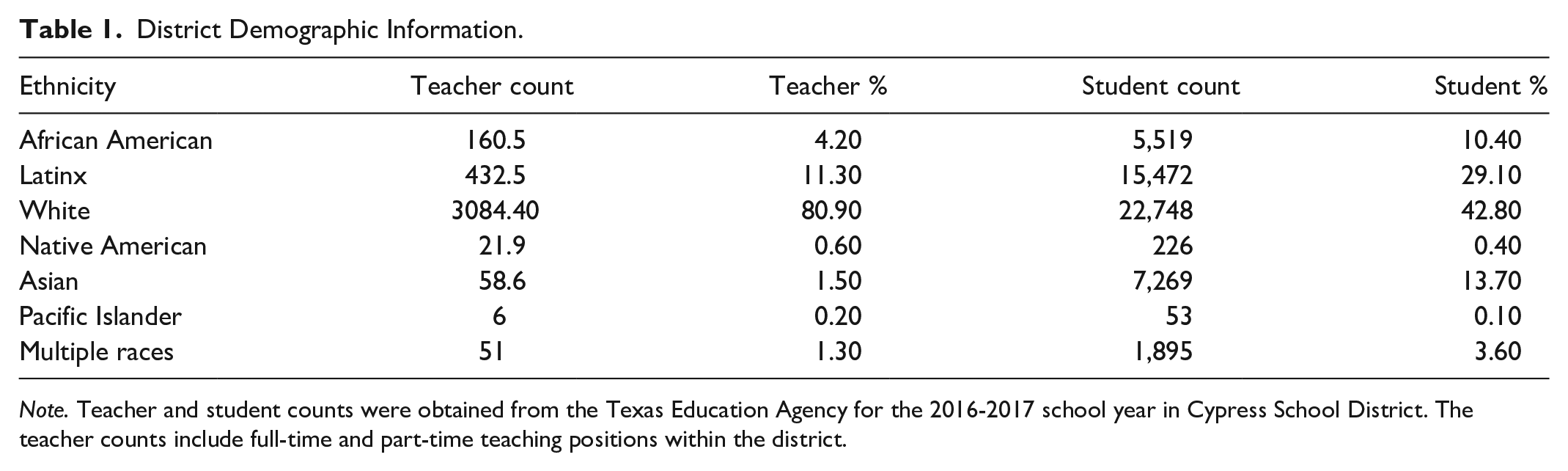
Note. Teacher and student counts were obtained from the Texas Education Agency for the 2016-2017 school year in Cypress School District. The teacher counts include full-time and part-time teaching positions within the district.
Roles and Responsibilities of Elementary Focus Group Participants.
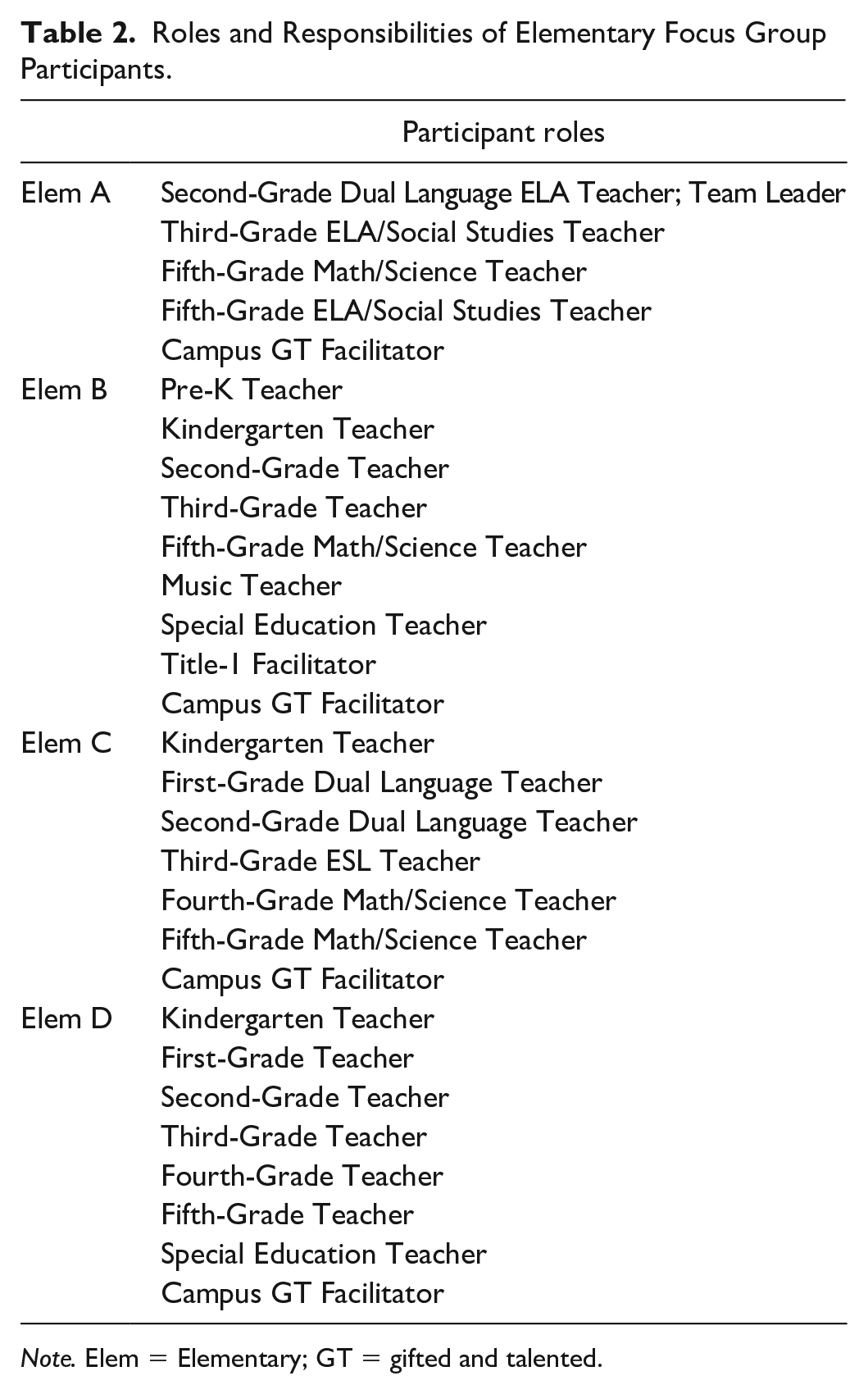
Note. Elem = Elementary; GT = gifted and talented.
Roles and Responsibilities of Secondary Focus Group Participants.
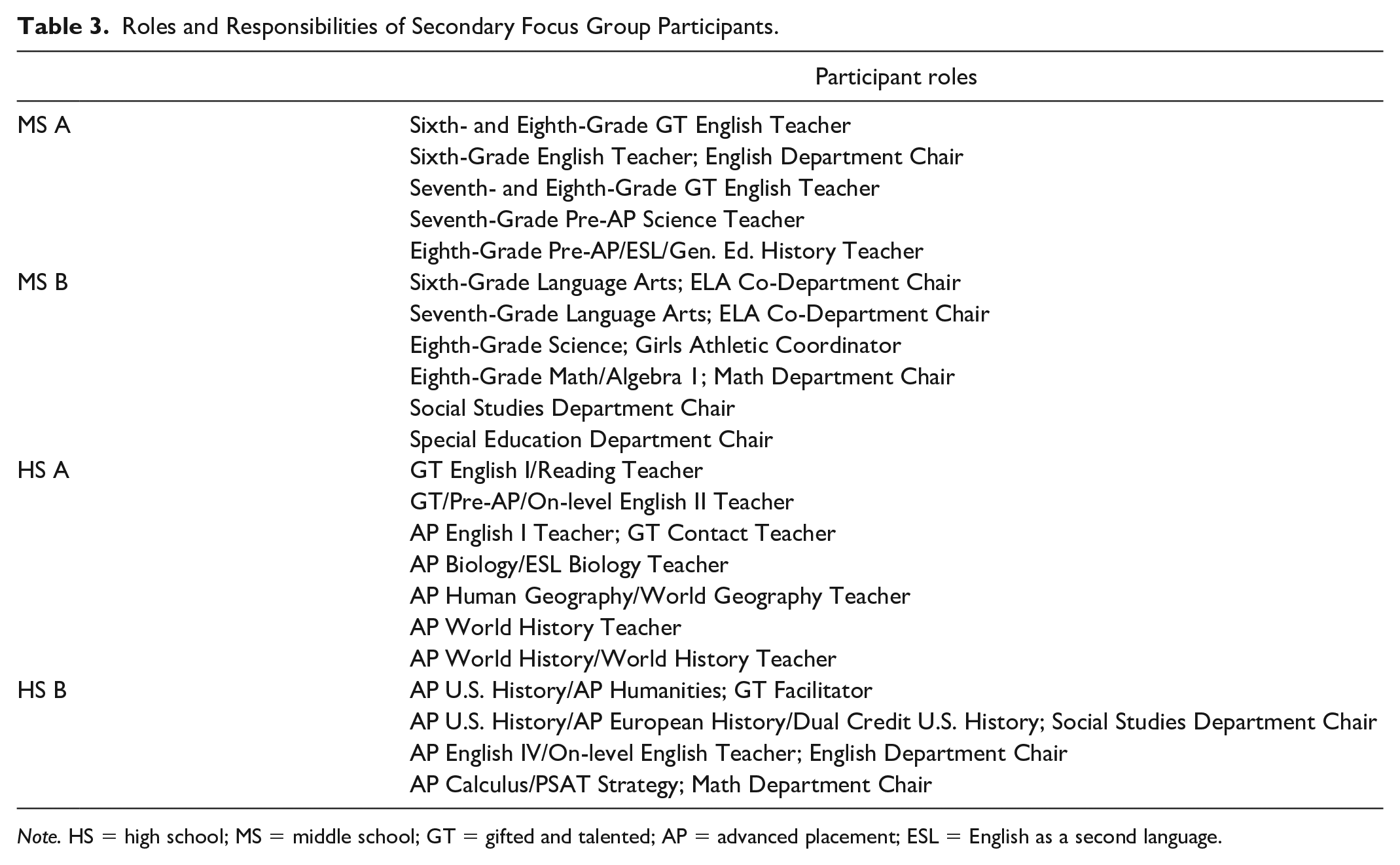
Note. HS = high school; MS = middle school; GT = gifted and talented; AP = advanced placement; ESL = English as a second language.
Data Collection Procedures
We considered this study as a partnership with the Cypress School District. Prior to the selection of the district, preliminary data revealed Cypress to be a model district that developed and then leveraged an equity policy to operationalize a set of practices well supported by research. During the planning process, we consulted with district leaders to attain a general understanding of local initiatives and to narrow down our campus/school selection. When describing the school sites, participants, and the data collected, we used the words campus and school interchangeably. Further purposive sampling was shaped by schools with diverse student populations, engaged to implement the equity policy. All were rated as having exemplary GT programs and designated Title I. 1 District and school visits were conducted by members of our research team in groups of two to four. At least one university faculty member from the research team was in attendance for each visit. Interviews and focus groups were semistructured, lasted approximately an hour, were audiotaped with permission, and were transcribed by a professional third-party service. To address credibility, dependability, and transferability, faculty met with the research team who coded the transcripts to provide a contextual background and act as another theoretical audit (i.e., in addition to literature) when interpreting the data, and assisted with interrater reliability throughout the coding process (Shenton, 2004). Focus group data were collected over a 6-month period, with multiple site visits to the district and schools, and member checks with the district GT coordinators spanned 2 years. This recursive process clarified perspectives and established alignment across policy documents and district reports.
Research Team Background
We acknowledge that “analysis is constructed at the intersection of the data and the researcher’s theoretical assumptions, disciplinary knowledge, research skills, and experience” (Clarke et al., 2015, p. 231). Thus, reflexivity or “the process of reflecting critically on the self as researcher, the ‘human as instrument’” is important (Lincoln & Guba, 2000, p. 183). We reflected on our subjective experiences and knowledge at multiple points during the study.
All research team members, two faculty members and eight doctoral students, were affiliated with the College of Education at a large university in the Southwest Central region of the United States at the time of their participation. Each faculty member predominantly identifies as a mixed methods or qualitative researcher with expertise in culturally responsive leadership, district reform efforts, and advocacy for historically marginalized students in gifted education. The doctoral students have interests in equity and excellence initiatives, second language learning, and applied methodology. The majority of our team members identify as scholars of color and/or were raised in low-socioeconomic backgrounds. Collectively the team has ample experience teaching traditionally underserved students.
Trustworthiness
Guba (1981) used the term trustworthiness to indicate a rigorous, dependable, and credible study with results that may be transferable to other contexts. Multiple strategies were employed to increase the trustworthiness of our study including development of familiarity with the organization’s culture through recurrent dialogue with the district, encouragement of honest feedback with participants, research team debriefing following each site visit, data triangulation, and maintenance of an audit trail (Guba, 1981; Merriam, 2016; Shenton, 2004). Our team utilized overlapping methods (i.e., interviews, focus groups, observation protocol), and engaged in reflective appraisal throughout various stages of the research process to enhance our dependability (Shenton, 2004).
Data were triangulated across multiple sources (e.g. focus groups across district and schools, variety of informant roles), methods (e.g. focus groups, observations, and documents), theories (leadership and gifted education), diversity of researchers interacting with the data, and data types (e.g., transcripts, field notes, district documentation). During focus groups, researchers asked the participants to explain their responses and asked follow-up questions in the moment for clarity. Additionally, the team met with the lead district GT coordinator for member checking. She reviewed and confirmed a summary of major understandings from her focus group interview. Throughout the observations and focus group interviews, field notes were taken with particular attention to nonverbal cues within the interview (e.g., body language). Within the coding process, we utilized negotiated agreement (i.e., code definitions and codes) to achieve consensual agreement during group discussions and increase the credibility of findings. Our team utilized an iterative process to identify key findings, compared our results to identify patterns, and made sure to reflect on alternative interpretations (i.e., negative cases and outliers) in reference to positive views of the implementation of their equity policy, to encourage more trustworthiness of our findings (i.e., confirmability and credibility).
Data Analysis
We used an experiential approach to thematic analysis that utilized “critical realist ontology and contextual epistemology” (Clarke et al., 2015, p. 226) to understand experiences and practices that reflect the perceived reality of this district. We followed a six-phase approach to coding and developing themes, which included familiarization, coding, searching for themes, reviewing themes, defining and naming themes, and then writing our report (Braun & Clarke, 2006; Clarke et al., 2015). This approach required researchers to spend ample time getting to know the data. Each member of the coding team read the transcripts thoroughly to gain an understanding of the focus group perspectives and context before the coding process began.
We used an iterative process of questioning and analytic note taking during our initial reading and met periodically to discuss. Through those discussions, we decided on an a priori coding structure based on our conceptual framework of systemic capacity building for district reform and guided by our research questions. However, we also allowed for emergent codes within our coding process. The coding team used simultaneous and pattern coding that included conceptual, descriptive, and structural coding schemes based on both our conceptual framework and the language used within our research and focus group questions (see Table 4; Clarke et al., 2015; Saldaña, 2016).
Research Questions, Interview Protocol Stem, and Probing Questions.
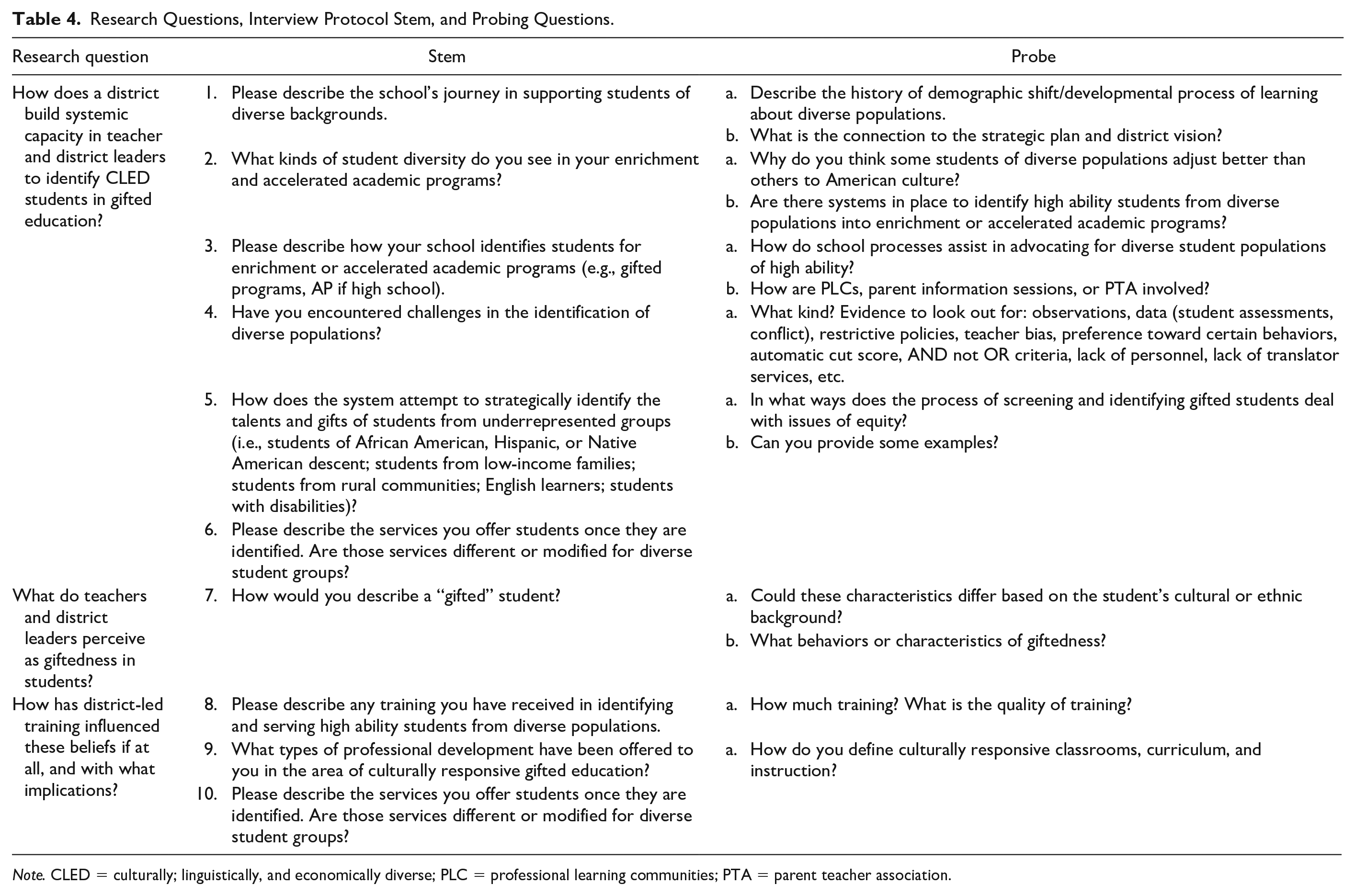
Note. CLED = culturally; linguistically, and economically diverse; PLC = professional learning communities; PTA = parent teacher association.
Table 4 depicts the stem and probing questions used in the participant focus groups and their alignment with our overarching research questions. Since questions were asked pertaining to giftedness, cultural proficiency training, district initiatives for identification, and services, structural coding schemes allowed us to apply a “content-based or conceptual phrase to a segment of data that relates to a specific research question” (Saldaña, 2016, p. 98) via Atlas.ti 8. While utilizing these a priori codes, if team members noticed additional codes, we allowed open coding and discussed those emergent codes at our biweekly research meetings for future inclusion.
Three members of the research team coded the data based on their familiarity with GT education, curriculum and instruction, and experience as public school teachers. One coded elementary, one coded secondary, and the third lead member coded both to help bridge the connection between elementary and secondary codes. During the biweekly meetings, coding team members merged independent codes to a master coding file and clarified discrepancies (i.e., other codes generated, naming structures) through discussion to improve the dependability of our codes. Team members also triangulated findings within and across elementary and secondary focus groups, district GT coordinator focus groups, field notes, and district documents (e.g., campus demographic calculations, policy documents) to help reduce investigator bias and confront subjectivities. Throughout our meetings, we questioned and clarified understanding of codes for inclusion or exclusion. Instead of quantifying our agreement, we utilized this recursive process to reconcile our disagreements and clarified misunderstandings before the lead coder merged codes to existing coding structures. Additionally, these meetings allowed us to engage in reflective commentary on how we coded the transcripts, how our coding analyses related to our conceptual framework, and what we found in observations of the identification committee (i.e., applying the observation protocol for the identification committee), the field notes, and the district documentation.
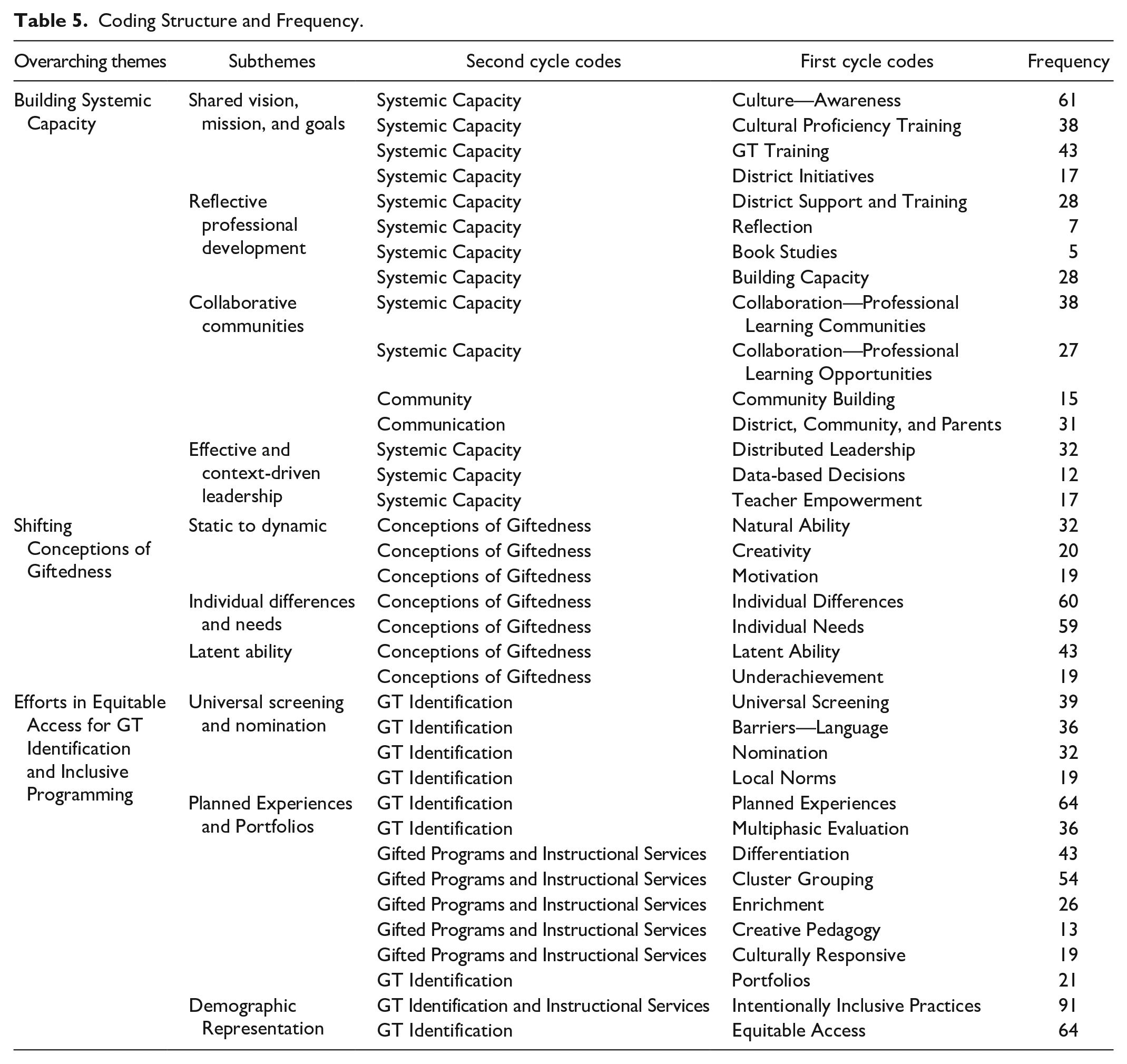
These meetings helped us develop a codebook with agreed on definitions, code structure negotiation, and schemes. Initially, we developed structural codes based on our research questions and then used subcoding to assist in further indexing and categorizing for deeper conceptualization. Our first round of analysis utilized this structural coding scheme and described the attributes and processes that the participants experienced. From this first round, commonalities in participant feedback led to the development of identified codes. A second round of coding utilized pattern and focused coding to derive broader, more conceptual coding schemes (e.g., systemic capacity, conceptions of giftedness: latent or masked ability) to categorize themes yielded from the first round of coding (Saldaña, 2016). This simultaneous process required coders to discuss individual understandings of the data, which added additional complexity and richer perspectives. After completion of coding, the coders discussed the frequency of subthemes derived from focused coding and how they related to broader categories, which were our eventual overarching themes. The coding team had in-depth discussions with each other and with the larger research team to ascertain negotiated agreement on the final codes and eventual themes for inclusion in this article (Biesta, 1998; Mead, 1922). Negotiated agreement occurs when “researchers code a transcript, compare codings, and then discuss their disagreements in an effort to reconcile them and arrive at a final version” (Campbell et al., 2013, p. 305) to resolve discrepancies. Throughout this iterative process we determined how we should merge existing coding structures (i.e., codes and subcodes) into our final themes and subthemes. Table 5 represents the outcome of this process and depicts the frequency of each first-cycle code as well as the broader themes and overall coding structure that resulted from the second cycle of coding and discussions among the coding team.
Coding Structure and Frequency.
Findings
Three overarching themes emerged from the analysis, (1) building systemic capacity, (2) shifting conceptions of giftedness, and (3) equitable identification practices and inclusive programming. Essentially, building systemic capacity and shifting conceptions of giftedness share a reciprocal relationship in leading to more equitable gifted identification practices and inclusive programming.
Building Systemic Capacity
Administrators, teachers, and other key stakeholders needed a unified focus in executing a shared vision, mission, and goals to improve the system. In this case, district leaders recognized the need for alignment to best identify and serve their CLED gifted student population. This required teachers to take part in reflective professional development and develop collaborative communities in order to sustain efforts for reform. Program change was facilitated by effective leadership that considered the sociocultural climate of each school to implement campus-specific changes. These district-level changes were the starting point to influence conceptions of giftedness, as well as the gifted identification and programming for the district.
Shared Vision, Mission, and Goals
Building capacity for systemic improvement requires unifying stakeholders in a shared endeavor. In this district, reform was driven by critical evaluation of the district’s gifted program and the subsequent observation that CLED students were not being equitably represented or served. Changes to the state plan for gifted education in 2009 emphasized placement for services rather than programming. This new language offered flexibility in program options and in district interpretations of who could be served in gifted education and how. Two district GT coordinators, supported by curriculum and instruction district leaders, led the initiative system-wide. They offered programmatic support to all campus GT facilitators and provided feedback to the curriculum administrator, with one responsible for elementary and the other secondary. The secondary coordinator was new to the district; however, the elementary coordinator had served 15 years as teacher, instructional specialist and presently as the district GT coordinator for elementary education. They shared that identification rate disparities of CLED students served as a tipping point in instigating full-scale program change. The elementary GT coordinator said, We only identified students who were really good at everything; we believed strongly in cutoff scores no matter your cultural background or linguistic diversity. . . . The 2009 revision of the State plan specifically said students would no longer qualify for our program, they would qualify for gifted services; that was really the impetus that helped us start conversations about the places that just didn’t feel right and didn’t reflect the diversity of our district in our program. (Focus group interview, February 24, 2017)
Transitioning from a traditional model of gifted education that emphasized rigid cutoff scores and consistent high achievement to an inclusive model that emphasized the nurturance of academic potential necessitated comprehensive program reform bolstered by a systems perspective. The elementary GT coordinator continued, It’s really a multifaceted approach and just training, learning, looking at our demographics and coming up with a system that advocates on both ends for those students. . . . So we really tried to look at systems and procedures and training conversation pieces to put a puzzle together and help all. (Focus group interview, February 24, 2017)
Establishing a program vision that would better serve a wider range of students required district administrators to gather critical feedback from teachers and campus leaders. These collective efforts contributed to program changes that would be shaped by district-wide cultural proficiency training and broadening stakeholder conceptions of how gifted behaviors can manifest in CLED students. This shared vision and the energy to achieve it were largely evident across the elementary focus group. A shared language in describing efforts toward inclusivity was evident in statements that included words like unified, trailblazers, and advocacy. Sustaining momentum while working toward program change also meant providing teachers and leaders with varied, continuous opportunities for reflective professional development and creating networks of support and collaboration.
Reflective Professional Development
District and campus leadership provided culturally proficient professional learning opportunities to better serve CLED students. These opportunities helped educators reflect on their biases and realize the moral imperative to support CLED students. These concepts were interwoven with GT professional development, as evidenced within their plans for elementary and secondary educators. Six-hour professional development by district staff ensured systemic consistency and accountability. The goal of learning a culturally responsive curriculum was to help bring “awareness that there are different behaviors that manifest themselves in different groups that are indicators of giftedness” (Focus group interview, February 24, 2017). The elementary district GT coordinator conveyed, They’re not problems; they’re indicators of giftedness. That awareness and open mind to interpretation of behaviors is where I see that beginning, and so in professional development we [emphasize] . . . the nature and needs of a gifted student. (Focus group interview, February 24, 2017)
Professional development was held at the district and campus level, to target specific demographics that varied by campus. Teachers reviewed district and campus demographic data, including single family households, gender ratios, and teacher demographics in comparison to student demographics. A special education inclusion teacher discussed how these conversations cannot be void of socioeconomic status (SES), and other teacher participants voiced the need to remember SES within diverse populations. Through the cultural proficiency training, teachers were asked to reflect on their own culture and biases, and how these were related to the student populations they serve at each campus. An elementary GT facilitator (P4) articulated, . . . they had us reflect on our own culture . . . we talked about our name, where it comes from, its significance, how we grew up. Then in the GT department we talked about cultural proficiency and how we serve our campuses. (Focus group interview, April 10, 2017)
Teachers described how the process of self-reflection helped them to better understand the diverse needs and backgrounds of their students. Although there were generally positive anecdotes by most teachers, facilitators, and coordinators on the implementation of the cultural proficiency training, several secondary teachers felt this was another “fad” or phase of training and were unsure of actual long-term change. One secondary GT teacher shared her perception of the cultural proficiency training, “I think the intent is wonderful . . . but the delivery lacks. I’m all about collaboration, but it’s the same lesson that I’ve gotten for the last 5 years and I don’t know that it’s going to change” (Focus group interview, May 15, 2017).
Despite some teachers feeling uncertain of change, or perceiving a lack of depth or differentiation in the training, the majority of teachers felt that the increased awareness and reflection on their biases and culture were helpful in identification and implementation of differentiated instruction through their collaborative communities.
Collaborative Communities
Collaborative communities reinforce program cohesion, alignment with the district vision, and the changing needs of the campuses. Intentional collaborative opportunities for teachers were necessary for implementation and accountability within campus grade levels and individual subject-specific departments. Professional learning communities (PLC) and other committees, such as Response to Intervention (RTI), provided alignment of district and campus initiatives to improve student outcomes. Teachers’ weekly PLC focused on process skills, objectives, language standards, and particular topics to plan for student learning (district document). These meetings were designed to promote a collaborative organizational culture through recurring cycles of collective inquiry to achieve better results for students. One high school teacher discussed the benefits of collaboration, “ . . . in PLC you know the topic . . . ‘How did you do it?’ and somebody [says], ‘I never thought of that, let’s give it a shot’” (Focus group interview, March 28, 2017).
Many teachers described an intentionality and openness during PLC and RTI to try new ways of approaching students “ . . . to enrich them, help them, and diversify how they learn . . . ” (Focus group interview, April 10, 2017). Cypress required GT teachers to differentiate their lessons and implement depth and complexity icons to encourage higher level thinking (e.g., synthesis, evaluation; District documentation). At one school, with more than two thirds of the students designated as historically marginalized and more than half economically disadvantaged, the principal provided school wide professional development on the use of depth and complexity icons. Observation revealed the icons in the PLC room and teachers described usage in classrooms. On a larger scale, all elementary school teachers collaborated with GT facilitators during PLCs to plan for activities that incorporated critical and creative thinking (i.e., planned experiences). Similarly, RTI committees in this district are designed to “think about students that are struggling and who need advancement as well” (Focus group interview, April 10, 2017). This district recognized that students needed “more challenges so it may not be formal GT identification yet, but they’re needing advanced services” (Focus group interview, April 10, 2017).
Both RTI and PLCs serve as systemic structures to engage teachers in collaborative learning processes that align the vision, mission, and goals of equity within the district. These structures allowed for program change and sustainability of continuous efforts toward growth and improvement, and helped ensure reform implementation and accountability among teachers and leaders.
Effective and Context-Driven Leadership
Effectively driving program change through capacity building calls for leaders who recognize the strengths of their teachers and students, provide opportunities for growth, and mobilize and allocate adequate resources. Gifted teachers and facilitators across many of the elementary focus groups indicated they felt free to try new things that might work best to serve diverse students in new ways, as exemplified by these statements: . . . our district has supported us a lot. . . . Our principal pulled strings to have people come, [which] costs a lot of money. . . she’s been able to get the extra funding from the district. (Focus group interview, March 30, 2017) The district did a good job of making sure that we know what we need to do for the kids [on our campus] and give them what they need. (Focus group interview, April 10, 2017)
Campus-specific efforts at achieving program improvement were evident in both focus group commentary and in discussions of school policies. However, positive mentions of context-driven policy that reflect individual student needs and campus demographics were inconsistent across the district focus groups and were more apparent at the elementary level. Secondary school focus group participants were far more critical of the options available for gifted students. They noted that available programs like Advanced Placement were not enough to meet student needs and that additional academic options were needed. Despite efforts to improve secondary identification practices through a new universal screening process in sixth grade, focus group data revealed that efforts to enhance secondary services were lacking.
Shifting Conceptions of Giftedness
For many teachers, the willingness to work toward program change meant adopting new perspectives of giftedness. We noticed a reciprocal effect of the district aiming to build systemic capacity and shifting conceptions of giftedness. Stakeholders participated in both district-led and campus-specific professional development (e.g., gifted education, PLCs, culturally responsive practices) that promoted shifting from static to dynamic conceptions of giftedness, encouraged teachers to consider the individual differences and needs of the students on their respective campuses, and illuminated the need to consider how barriers may conceal latent ability.
Static to Dynamic
Cypress’ district professional development propagated a broadened sense of giftedness that required a shift from static to dynamic conceptions of giftedness. Cypress’ identification policy described their process as pluralistic, meaning “the broadest defensible definition of gifted/talented should be used,” and comprehensive, intended to identify as many students with potential as possible. The elementary district GT coordinator shared, The traditional training produced traditional results, so teachers thought a GT student was . . . the traditionally stereotypical GT student—that informed their practice and informed the referrals. Now, with different training, I see more diversity; we still want more. (Focus group interview, February 24, 2017)
Teachers in the focus group consistently mentioned how “there’s no one definition for a GT kid and that’s important to remember about them” (Focus group interview, March 21, 2017). Some teachers referred to more natural or innate ability using language such as smart, process information quickly, naturally show inquiry, and ability to problem-solve. At times they would refer to gifted students as high achievers, stereotypically GT, or inherently more creative. The GT coordinator discussed how professional development and classroom experiences helped teachers understand giftedness and how it could look different based on diverse backgrounds. With the policy change, students qualified for services rather than programs. This shifted how teachers could identify students and “opened up a whole new world of opportunity of practice and thinking” (Focus group interview, February 24, 2017). When teachers were asked about how giftedness may be presented based on cultural or ethnic background, elementary and secondary educators described gifted students as strong communicators, out-of-the box thinkers, showing leadership, having enhanced language abilities even when English was not their first language, and domain-specific needs (e.g., math, science, language arts). An elementary teacher said, I don’t think one size fits all in the definition of gifted, but generally speaking, most of them have accelerated learning . . . their sense of humor, how they play on language, if they have two languages, and those kind of things . . . is what I see. (Focus group interview, April 10, 2017)
Overall, teachers described a broadened conception of giftedness and their role in encouraging and developing students to cater to individual learning needs.
Individual Differences and Needs
Teachers described individual differences in ability, aptitude, or creativity that schools should address. Cultural proficiency training emphasized the importance of understanding student backgrounds to build relationships and develop appropriate pedagogy. One elementary teacher said, I think understanding where they’re coming from and using their experiences to boost teaching. So, I know something they’re familiar with and that’s my starting point to teach the unfamiliar—knowing the cultural differences and just being aware. (Focus group interview, April 10, 2017)
Teachers were trained to scaffold and differentiate the needs of gifted students and build portfolios for them through adaptive curriculum and programming. Another elementary teacher described how her school differentiated learning and that it did not matter if they were “high-achieving or wherever on the spectrum . . . we’re able to meet them where they are and give them exactly what they need” (Focus Group Interview, April 10, 2017). This elementary school adopted GT individual educational plans for each student. Although specific to this particular school, other teacher leaders across the district reiterated how they catered to the individual needs of students and sought out hidden potential.
Latent Ability
In examining the individual needs of students, teachers sought to either overlook or help students remove barriers to gifted identification. Barriers included English language acquisition; problematic, resistant, or non-compliant behaviors; limited access to educational resources at home; and other experiential challenges compounded by low SES. Teachers described latent ability, or ability that has been hidden or masked by perceived behavioral, experiential, and/or linguistic barriers. Some participants described perceived hardships faced by students from low-SES backgrounds as obstacles to demonstrating potential, as exemplified by this statement: “Sometimes that hard background kind of masks their abilities. So, we’ve been working really hard to help them overcome that” (Focus group interview, March 7, 2017).
Other focus group participants suggested that looking past potential barriers works to clarify and enhance conceptions of giftedness to include students whose behaviors may not align with traditional expectations: A GT kid can be a kid that’s in a behavioral intervention class . . . like number two said, they don’t fit the norm of what we’ve been told is a GT kid. . . . So, there’s a lot of misconceptions about GT kids that have come to light in the last few years. (Focus group interview, March 7, 2017)
For this teacher, “what we’ve been told” is a nod to conventional beliefs regarding giftedness that formerly guided identification practices. Recent shifts in thinking encourage teachers and leaders to recognize potential barriers to gifted identification and to actively engage in helping students work past them.
A lot of times because they’re not performing like we think a GT learner should . . . they fall through the cracks . . . and with the language barrier holding them back, I think they know that we’ll see that same potential in them and help them succeed. (Focus group interview, March 21, 2017)
For these participants, acknowledging that latent ability may be obscured by either student characteristics and behaviors, or by teacher expectations, necessitates efforts to uncover it and facilitate its development. Teachers from multiple campuses discussed implementing strategies aimed at eliciting and developing abilities in students who demonstrated high academic potential. Several elementary focus group participants indicated that this strategy was beneficial for underserved students.
It’s like a self-fulfilling prophecy, get in GT so you become GT . . . because they’ve never had this experience; they’ve never had this chance before, and now they’re given the chance and they take it and run with it. (Focus group interview, April 10, 2017)
These sentiments reinforce the notion that future successes may be more challenging to predict in students whose indicators of academic potential may be overshadowed by hardship or whose behaviors do not align with traditional understandings of giftedness. Allowing trial participation in the district’s gifted program is one strategy in the larger effort to be more inclusive and equitable.
Efforts in Equitable Access for GT Identification and Inclusive Programming
Building systemic capacity and shifting conceptions of giftedness started with an overhaul of the nomination process and identification criteria. This included the implementation of universal screening, planned experiences and portfolios, and equitable representation. The policy reform, influenced by the state and district-level, required the district to alter their system to build the capacity in their faculty and administration to have more dynamic views of giftedness in order to implement changes to their gifted identification and program options. Throughout the gifted identification process, there were multiple pathways to entry into gifted programs. The district changed their gifted identification process and implemented multiple time points for universal screening, lowered cut scores, provided teacher training to reduce bias in nomination, included alternative pathways for identification (e.g., portfolios, planned experiences), and reflected on equitable demographic representation at the campus level.
Universal Screening and Nomination
This district utilized a modified two-phase system of entry into their gifted program where students are first universally screened in the spring semester of kindergarten before initiating formal evaluation. As part of their district initiative to increase equitable identification and services, they aimed to build a system to advocate for underrepresented student groups through the identification process. The elementary GT coordinator conveyed, The way we identify now is through a systematic screening and then we look for candidates who would be ready for formal testing. (Focus Group Interview, February 24, 2017)
Part of advocating for underrepresented groups meant mitigating the effects of teacher bias during the GT nomination process. In addition to cultural proficiency and GT professional development, Cypress sought to increase equitable identification by expanding who could recommend students to include parents, teachers, and students. Students could be considered for identification through universal screening at multiple time points OR through teacher, parent, or student referrals. Students who were screened and nominated would then go to the campus committee for recommendations for formal testing. The elementary GT coordinator stated, The campus committee makes the recommendations and that’s important because obviously they know the students much better than we do. However, we need a system of checks and balances. So, campus committee recommendations then come to a district committee where they’re screened. (Focus group interview, February 24, 2017)
These “checks and balances” are used in part to assist in a more equitable referral process. However, Cypress does not rely solely on nomination and instead uses multiple assessments so all students may be considered (i.e., planned experiences, online nonverbal assessment, and sixth grade universal screening). Students are universally screened in kindergarten and again in the fall semester of third grade using a nonverbal ability test. Students with potential are then formally tested using the CogAT-OLSAT for ability, Stanford and ITBS 2 for achievement, and a nonverbal cognitive ability test (i.e., Naglieri Nonverbal Ability Test (NNAT-2). Nonverbal tests (e.g., NNAT, Ravens, nonverbal section of CogAT) are used for English language learners, nonreaders, and culturally diverse students. The district leadership believes that the NNAT-2 is considered “as neutral as you can be to come through and get some of that potential, that ability” (Focus Group Interview, May 22, 2017). A relatively new phenomenon for this district was to begin universal administration of the NNAT in sixth grade. The secondary GT coordinator described that their first attempt yielded “about fifty students that have now been identified that [I] truly don’t know would have identified before—because the screener took the place of a nomination” (Focus Group Interview, February 24, 2017). Although they shifted to include a universal screening process at the secondary level, referrals for GT identification predominantly came from the elementary level.
Local norms
Campus-based focus groups discussed utilization of local norms in their screening process for participation in the gifted program. This district lowered cutoff scores by using local norms based on campus demographics to allow more students to be considered (District documentation; Focus Group Interview, February 24, 2017). One facilitator described how the most common way CLED students are not included is because of cutoff scores, so before looking at the scores, they included other data (e.g., teacher nominations and portfolios) and encouraged conversations about the whole child. They said, “It’s not our job to say, ‘We can’t serve you because you don’t speak English very well.’ It’s our job to say, ‘Hey you’ve got something going on upstairs, how can we serve you?’” (Observation protocol, April 12, 2017). One elementary focus group reported using national norms in setting identification criteria, indicating district support for varied identification policies across campuses. Focus group participants described using local norms to determine which students rise to the top when compared with other students from the same school who are of “like age, ability, and background” (Focus group interview, April 10, 2017). In doing so, they have created a program in which one school’s GT program may not appear to match another’s due to demographic differences across campuses. One participant described the use of their campus specific local norms: “Our version of GT is what our norm is because our GT is going to look a little different from somebody else’s GT, but that doesn’t make us less GT” (Focus group interview, April 10, 2017).
Although participants discussed the mixed use of both local and national norms across campuses within their screening process, there was less discussion on the specifics of how they utilized local norm-based identification within each campus. It was apparent that many teachers were not aware of how the norming process was facilitated, but they held positive views on the use of local norms to encourage more equitable representation. A GT facilitator at the elementary level mentioned how both ability and achievement tests were used, and “we do a screener in Kindergarten and Third Grade to see what our top five to ten percent is on the nonverbal ability test and even in our GT testing . . . [they] locally norm the top five to ten percent” (Focus group interview, April 10, 2017). At an observation of the district identification committee, we observed comparisons of students to the “campus context” and “peer level groups,” however committee members did not explicitly state their quantitative criteria for that campus (Observation protocol, April 12, 2017). They did discuss using both qualitative data (e.g., teacher and parental surveys, portfolios) and quantitative data (e.g., ability and achievement tests), when making final placement decisions. Additional follow-up on how they engage in norming practices in identification (i.e., how did cut scores differ by campus) and how they objectively review portfolios is needed; this lack of understanding may contribute to differential implementation at each campus.
Planned Experiences and Portfolios
Part of their systematic screening is to place students on a performance watchlist from K-2 if they are close to the cutoff, which includes participation in planned experiences to build a portfolio as an alternative pathway for identification. In third grade, portfolios are assessed by the committee for formal testing. Since all students participate in these planned experiences, students not on the watchlist are also open to being nominated. The district GT coordinator described these experiences as opportunities for student potential to surface that may otherwise go unnoticed. Planned observations begin in kindergarten and continue for 3 years, during which time students are clustered according to perceived ability and monitored via the creation and maintenance of individual student portfolios. At each campus, the lead GT teacher or GT facilitator plans lessons intended to evoke creative problem solving in students and observes them in action using the Kingore Observation Inventory. Each planned experience culminates in a committee meeting between teachers and the campus GT facilitator to discuss their observations of student performance and resulting outcomes. Planned experiences are used not only to reveal students who should be nominated for formal testing but also to guide clustering and enrichment decisions, and to monitor progress before formal testing is considered.
We look for who surfaces to the top to enter the formal realm . . . then we have principals willing to automatically cluster students in classes before they’re formally identified so we can provide that environment for them. (Focus group interview, Feb 24, 2017)
The district’s implementation of universal screening, planned experiences, and portfolio monitoring indicated intentionality in considering traditionally underrepresented students for their gifted program. The districts’ formal evaluation committee considered the child’s background (e.g., English learner status, participation in special programs, low SES, ethnicity; Observation Protocol, April 12, 2017) and offered full or provisional placement in gifted services if the district’s formal evaluation committee felt they would benefit from services (e.g., makerspaces, genius hour, robotics). Provisional placement was based on the child’s background and if they showed superior ability (e.g., verbal, math) in at least one area. Although planned experiences were only available in elementary, the district committee decided to continue use of portfolios throughout elementary and secondary in order to monitor students who showed potential (i.e., close to cutoffs, provisional placements).
Demographic Representation
In Cypress, district leaders empower campus leaders to implement individualized and context-driven identification policies. This is evident in the encouragement of equitable demographic representation across the district, and in the documentation used within their campus professional development to reflect on their gifted populations. The district audit of gifted identification practices found that current enrollment by ethnicity was not proportional with district enrollment (e.g., district documents, observation protocols, field notes). Each campus was expected to look at the total demographic population as well as who was identified for gifted services to determine the proportionality of demographics at each campus. This analysis relied on campuses calculating their representation index (RI). The RI represents the percentage of how specific groups of students are represented in their gifted population (comparable to the total student population). This is computed by “the percentage of students identified as gifted who come from a given demographic group as well as the percentage of students in an overall population from that same group” (Peters et al., 2019, p. 3). On reflection, teachers found how their individual campus demographics varied and leaders encouraged each campus to adopt practices to improve proportionate representation of their gifted student populations (i.e., 1.0 means proportional representation). For example, in 2015-2016, district documents revealed that there was a large proportion of Latinx students within the district. Latinx students had a RI of .62; this means that Latinx students were represented just over half as frequently in the gifted population as compared to their total population in the district. More disproportionate was that of Black students (RI = .39), whereby less than half of Black students were represented in the gifted population compared with the total population of Black students in the district. Conversely, Asian students in the district had a RI of 1.76, meaning that there was a higher percentage of Asian students (24.05%) represented in gifted programs, than Asian students represented in the total student population (13.87%). Representation indices across campuses of Asian, White, Native American, Multiple Races, and Pacific Islanders over 1.0 were indicative of high representation in gifted programs comparable to their total population at the campus. For example, at Elementary C, White students had an RI of 6.06, reflecting White students being 8% of the total population of students but 50% of the total gifted student population at that campus.
On closer examination of their representation indices across campuses, there was inconsistent overrepresentation by Asian, White, Native American, and Multiple Races, but Latinx, Black, and Pacific Islander student populations remained underrepresented. Although there were higher representation indices for Latinx students on some campuses these lacked consistency. A continuity among the campuses was that Black students were less than proportionately represented in gifted programs comparable to the total population of Black students. At the district level, Black, Latinx, and Pacific Islanders were underrepresented within gifted programs compared with their total population in this district. Overall, the representation indices by district and campus indicated that disproportionality was an issue that needs to be further addressed (see Table 6).
GT Student Representation Index by Ethnicity/Race.
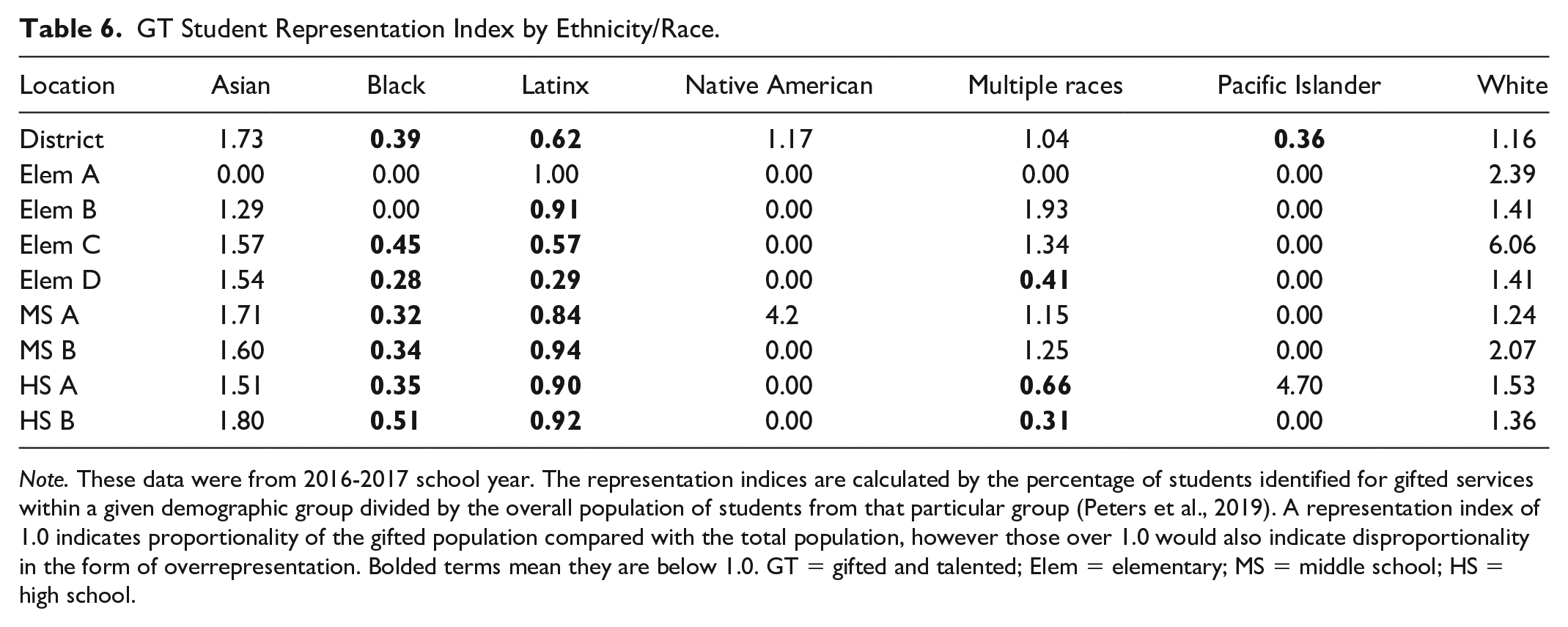
Note. These data were from 2016-2017 school year. The representation indices are calculated by the percentage of students identified for gifted services within a given demographic group divided by the overall population of students from that particular group (Peters et al., 2019). A representation index of 1.0 indicates proportionality of the gifted population compared with the total population, however those over 1.0 would also indicate disproportionality in the form of overrepresentation. Bolded terms mean they are below 1.0. GT = gifted and talented; Elem = elementary; MS = middle school; HS = high school.
Discussion
We investigated a district’s efforts to build systemic capacity in district and teacher leaders for improved CLED student identification in gifted education, and how district-led reform may have influenced how they conceive of giftedness in their students. Building systemic capacity requires a network of stakeholders to have a deep understanding of the reform effort and a dynamic approach of how to get there (McBee et al., 2012; Plucker et al., 2017). As evidenced in this study and argued by Rorrer et al. (2008), the district was a critical actor in systemic reform efforts to disrupt inequities in gifted education. The findings also reaffirm the sway of educational policy and systemic reform (Plucker et al., 2017), the influence of the personal, interpersonal, and organizational processes (Mitchell & Sackney, 2011), and internal and external supports (Fullan, 2006) to change gifted programming.
Leadership and policy in gifted education at the federal and state levels provide an important frame for what can happen at the system and school levels. In this case, district leaders leveraged the state’s gifted education plan that defines exemplary programming. The Cypress School District used the state’s definition to craft an equity policy, shaping, and impacting efforts in equitable access for GT identification and inclusive programming. District leaders (i.e., GT coordinators) used a systemic approach to elevate teacher commitment by designating GT facilitators (teacher leaders) at each campus, affirming that they can take responsibility for their professional learning and the learning of others. The findings indicate that capacity building through teacher leadership is a powerful strategy to advance collaborative practices in schools and heighten teacher responsibility to commit to equitable practices (Fullan, 2006; Rorrer et al., 2008). Moreover, implementing flexible and nuanced policy that takes into consideration school climate and culture is critical to building systemic capacity while working toward goals of equity (Bennett et al., 2014; King & Bouchard, 2011; Stringer, 2009).
The district leaders implemented a coherent array of reforms with the goal that students in the GT program reflect the diverse populations of the district. This required a shift in both conceptions of giftedness and in identification practices, including evaluating demographic representation and use of local norms in determining criteria for gifted identification (Peters et al., 2019). The district further opened their criteria through using an OR option (Lakin, 2018), meaning that students were universally screened before consideration for formal evaluation or they could be referred by teachers, parents, or students. Not only that, if students were close to the cut off at their campus, they would be placed on a watchlist, cluster grouped, and participate in planned experiences to build a portfolio for campus consideration. In doing so, this district utilized multiple alternative pathways for gifted identification and even offered provisional placement with the aim to be more equitable for CLED students.
Based on our findings, we developed a visual model that captured the dynamics of the Cypress School District and its systemic reform efforts toward equity for historically underserved students in gifted education (see Figure 1). This model depicts how in Cypress School District, systemic capacity (i.e., shared vision, reflective professional development, collaborative communities, context-dependent leadership) directly influenced broadened conceptions of giftedness (i.e., dynamic, individual differences and needs, latent ability), and a broadened conception of giftedness helped to reinforce the why behind building systemic capacity. Both systemic capacity and conceptions of giftedness aimed to improve gifted identification processes and programs for CLED students aligned with inclusive gifted programming. There were various entry paths throughout the gifted identification process. Students could be considered for gifted identification through universal screening that occurred at multiple time points OR through teacher, parent, or student referrals. Decision flow can be observed through whether the campus and formal district evaluations decided Yes or No through this process. If students were close to the cutoff for formal evaluation, they were either placed on a watchlist for planned experiences or offered provisional placement in gifted services. Both options required maintenance of a portfolio. These efforts were all informed and influenced by their specified equity policy, state guidelines for GT, as well as federal and local contexts relative to the district.
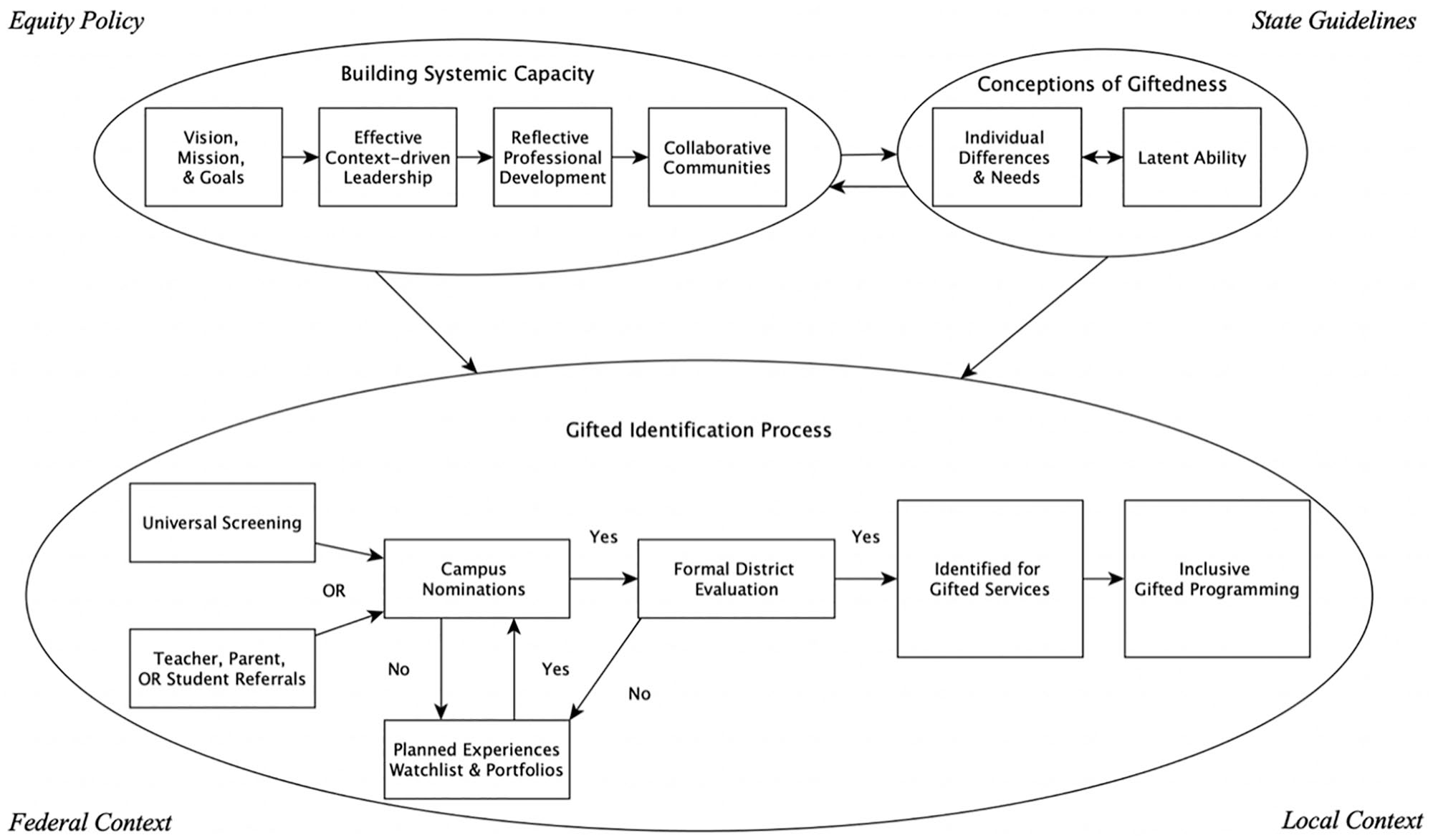
Model of building systemic capacity for gifted identification and services in Cypress district.
Overall, our findings argue for critical system evaluation (e.g., audit), which takes into consideration the enactment of an equity policy that aligns with the system’s purpose, goals, and practices (Bennett et al., 2014; King & Bouchard, 2011; Newman et al., 2000; Stoll, 2009); a strategic plan developed and inclusive of all stakeholders; and development and implementation of a 5-year plan driven by a district-shaped equity policy advocating for historically marginalized student populations. Though the majority of focus group participants indicated feeling better equipped to recognize potential in underrepresented groups, the district’s representation indices suggest that gaps in representation remained in Year 1 of the implementation effort. We know that the change process is complex, and Fullan (2006) contended that the change process for district turnaround was 8 years. The district’s systemic reform initiative highlights how efforts to change practices in nomination and identification are possible with the intent of mitigating disproportionality. The increased representation of CLED students at the middle school level brought on by the adoption of universal screening in sixth grade, elucidates how the possibility of universal consideration may assist in removing this barrier (Peters et al., 2019).
The district’s efforts to more equitably identify CLED students for gifted services were prompted in part by recommendations in the state plan to identify students for services rather than programming. Our knowledge of the district’s available services was limited to those discussed in the focus groups. At the elementary level, some schools described using pull-out sessions, while others described offering push-in enrichment activities using depth and complexity icons, or creative pedagogy. Additionally, the district GT coordinator mentioned that acceleration had recently been made available at the elementary level. At the secondary levels, pre-AP and AP offerings were described. It was clear that the district policy affords some context-driven flexibility in the services provided to students once identified, but further research examining the extent to which newly adopted identification procedures align with available services would benefit our understanding of the district’s overall efforts.
At this district, effective leadership and policy at the federal, state, and district levels undergird systemic efforts toward reform. Reform, however, requires district leaders to critically evaluate their structures and processes, and the educators within it to openly acknowledge existing inequities (Togneri & Anderson, 2003). We found that building systemic capacity and shifting conceptions of giftedness share a reciprocal relationship to more equitable identification practices and inclusive programming. The ways in which district and teacher leaders conceive of giftedness matter for improved CLED student identification into gifted programs and services. Additionally, building systemic capacity through reflective professional development has been used to challenge and change traditional conceptions toward a multidimensional understanding of giftedness. These findings have important consequences for the broader domain of gifted education, as most policies and practices reinforce more static conceptions of giftedness (i.e., the gifted child model and its IQ-based conception of giftedness (Borland, 2009; Dai & Chen, 2013).
Factors that typify systemic capacity development also support challenging and changing conceptions of giftedness, such as district and school trainings, PLC and RTI discussions, culture change, and leadership initiatives. All have been used to change conceptions of giftedness in faculty and staff across the district with the aim to make identification and services more equitable. Specifically, building systemic capacity in elementary school teachers led some of our participants to actively seek potential and nominate students traditionally overlooked for gifted services. Teachers also shared their passion about broadening services to their students and helping to make their curriculum reflective of the populations they serve. These scenarios are more likely when district GT coordinators serve and are entrenched in the district’s curriculum teams. Last, while many of the participants spoke highly of the professional development and its effects in changing conceptions of giftedness in CLED populations, there is still much work to be done to implement lasting changes in identification and services for students.
Limitations
Schools were selected based on relevance to our research questions and in consultation with Cypress School District. It is possible that the district GT coordinators may have recommended schools for participation based on predetermined factors (e.g., positive relationships with school leaders). However, the coordinators did not attend the school focus groups in order to not influence participant responses. We only conducted member checks with the main district elementary coordinator due to loss of contact and participant attrition within the school district, which we recognize as a limitation in this study. However, we made best efforts to clarify and probe for understanding of participant responses within the context of the focus groups, with one team member facilitating the focus groups and the other team member(s) taking detailed field notes to provide additional data.
Recommendations for Future Research
We recommend further research to expand on the findings from this study:
Conduct a district quantitative, longitudinal study to analyze actual shifts in student demographics of who is identified for gifted services over time.
Examine shifting conceptions of giftedness before and after ongoing professional development to assess for changes in beliefs and classroom practices.
Evaluate district-led professional development in cultural proficiency and gifted education to understand its effects on principals and teachers.
Consider inclusion of student, parent, or principal voices to triangulate teacher and district leader responses as they were not present within this study.
This study did not focus on the direct alignment between identification and services. Future research should investigate the alignment of methods of identification and the type of program or service provided.
Recommendations for Practitioners
There has been movement in this district to align with trends that promote inclusivity in gifted education for CLED students. Lessons learned from this district are as follows:
Enact data-informed leadership practices at the district and school levels and take ownership of systemic inequities in gifted education that disadvantage CLED populations.
Create an equity policy aligned with federal and state recommendations to recognize outstanding talent in CLED students and aim to close the gap in their identification.
Enact universal consideration of students at multiple time points (elementary and secondary) and use alternative pathways to identification that aim to mitigate bias in the process (e.g., watchlists, portfolios).
Provide district-wide professional development in cultural proficiency that is systemic and comprehensive, such as embedded discussions in weekly PLCs to mitigate bias and inequities through reflective practices.
Conclusion
In conclusion, our findings indicate that building systemic capacity in stakeholders is an important component to change inequitable policies and practices in gifted education. Substantial systemic reform efforts in gifted education require district leaders to adopt equity-focused policies that align with goals for their gifted programs. Building capacity in coordinators and educators is required to increase cultural competence and focus on the strengths of students. These efforts can help shift coordinators’ and educators’ perceptions from more static to dynamic conceptions of giftedness. Additionally, our results indicate that districts need to establish structures and processes to provide multiple pathways for entry in gifted programs. No system will be perfect, but efforts to change inequitable practices in gifted education will require a concerted effort to change our existing educational systems to meet the needs of CLED students and support their success in gifted programs. Reorienting the organization and people within it necessitates the implementation of structures and processes that invite and extend on challenging conversations focused on race, ethnicity, and language as it relates to gifted education. Finally, sustaining equity in gifted education for students who are CLED requires educators to act with moral purpose and shed their traditional assumptions about giftedness to upend long-held beliefs that have contributed to oppressive practices.
Footnotes
Declaration of Conflicting Interests
The author(s) declared no potential conflicts of interest with respect to the research, authorship, and/or publication of this article.
Funding
The author(s) received no financial support for the research, authorship, and/or publication of this article.
Open Science Disclosure Statement
The data analyzed in this study are available on request from the authors for purposes of reproducing the results, with the exception of transcripts that include data that might compromise confidentiality. The focus group and interview protocols used in the article are available on request from the authors for purposes of reproducing the results or replicating the study. There were no previously created materials used in this research.
