







Abstract

Peters (2021) presented an analysis of disproportionate representation of demographic groups in gifted education programs. He views disproportionate representation as a consequence of inequalities that originate outside of gifted education and says that narrowly focusing on gifted education practices will be inadequate for remedying the inequities in the field. Peters’ analysis has four levels of increasing generality: local gifted education practices, proximal causes, distal causes, and theoretical causes. Unfortunately, Peters’ argument grows increasingly shaky as its generality increases.
Gifted Identification Procedures
Peters (2021) is correct when advocating for universal consideration, frontloading, eliminating parent and teacher nominations, and using building-level norms. These techniques improve access to gifted programs for children from traditionally underrepresented groups. There is no place in 21st-century gifted education for selection procedures that give preferential consideration to any student or ignore the local context.
Proximal Causes
Peters (2021) is also correct that a major proximal cause of disproportionate representation in gifted programs is gaps in educational performance and/or preparedness. Table 1 shows the academic achievement gaps between White and Black students on the National Assessment of Educational Progress. However, the percentages of Black (4.3%) and White (7.7%) students labeled as gifted (De Brey et al., 2021, Table 204.90) are consistent with a mean score difference of d = .291. In other words, gifted disproportionality is actually less than what would be expected if students were selected for gifted programs solely on the basis of exceeding a uniform cutoff on an academic achievement test. This means that disproportionalities across racial groups can mostly be explained by achievement score gaps, and these gaps are likely the main proximal cause of the disproportionate representation of gifted programs.
Mean Black/White Gaps (Cohen’s d) in Reading, Mathematics, and Science NAEP Scores.
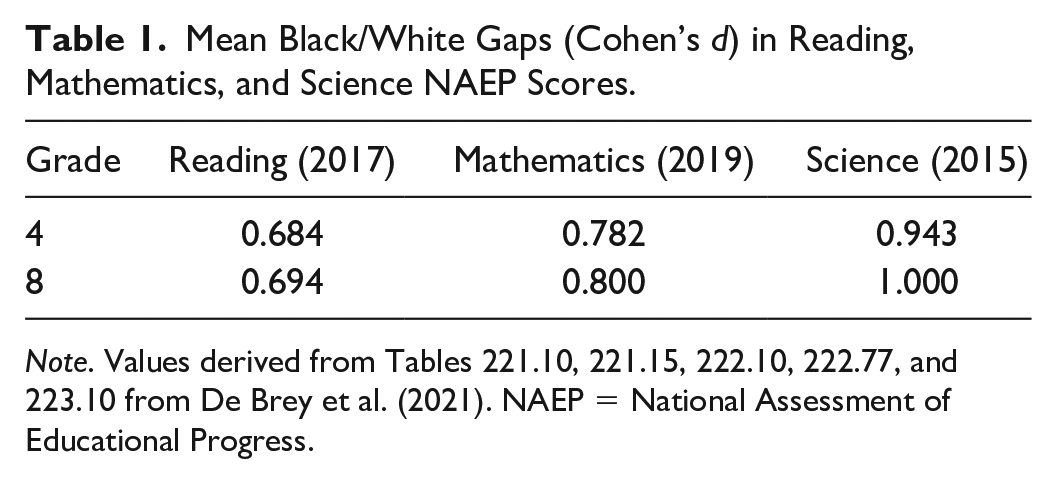
Note. Values derived from Tables 221.10, 221.15, 222.10, 222.77, and 223.10 from De Brey et al. (2021). NAEP = National Assessment of Educational Progress.
Distal Causes
If the achievement gap is a principal cause of disproportionality in gifted programs, the logical question of the cause of the achievement gap arises. This is where Peters (2021) is on empirically shaky ground because all his proposed causes are too weak to explain the large differences in achievement shown in Table 1. There is not sufficient space in this commentary to address all the distal causes Peters suggests, but I will discuss the main ones.
Peters (2021) suggests poverty as a cause for lower achievement for low-income students, which is a common viewpoint. However, the evidence does not support this as a powerful contributor to the achievement gap. Giving randomly selected families money does not increase scholastic performance (Cesarini et al., 2016), nor does randomly providing vouchers for low-income families to move to wealthier neighborhoods (Sanbonmatsu et al., 2006)—results that preclude a causal influence of poverty on achievement gaps.
Moreover, socioeconomic differences in the United States are too small to cause large achievement gaps. Although gross income inequality is high, after taxes and wealth transfers to low-income households, American income inequality has a Gini coefficient of only .35 (Gramm & Early, 2021). And most poor American households are not places of great deprivation. Most enjoy many of the amenities found in middle-class homes (including air conditioning, cable/satellite TV, and a personal vehicle); only the most prosperous country in history would call them poor (Frisby, 2013).
Similarly, it is unlikely that differences in preschool experiences are a distal cause of the achievement gap. Two government-sponsored randomized control trials showed that the benefits of preschool are gone by the beginning of first grade (see Warne, 2020, chapter 15, for a discussion). Thus, it is unlikely that increased access to preschool will reduce the achievement gap or improve gifted identification rates.
Some of Peters’ (this issue) proposed distal causes affect too few people to be the cause of the large achievement gaps in Table 1. For example, even Peters admits that almost all American mothers obtain prenatal care. Likewise, lead poisoning is rare in the United States. Among children ages 1 to 5 years, only 4.0% of African Americans, 1.9% of Whites, and 1.1% of Mexican American children have blood lead levels of ≥5 μg/dL (Centers for Disease Control and Prevention, 2016). Modern blood lead levels are so low that lowering them further may not produce noticeable improvements in cognitive abilities (Kaufman, 2009).
Theoretical Explanations
At the theoretical level, Peters (2021) blames “societal inequality and systemic, institutionalized racism” (p. 2) for both distal and proximal causes of disproportionalities in gifted programs. This explanation is underdeveloped for several reasons. First, Peters operationalizes societal inequality and institutional racism as discrepancies in outcomes across groups—and then uses these same inequalities as evidence that societal inequality and institutional racism exist. This circular reasoning is unfalsifiable. Second, Peters’ theoretical explanation is, at best, a label for group differences. But as nondiscriminatory variables explain these discrepancies, Peters’ theory risks becoming a secular “god-of-the-gaps” explanation and will grow increasingly irrelevant as the unexplained variance in outcomes is reduced.
Third, attributing discrepancies to institutional racism and inequality also ignores the known genetic influence on life outcomes. Socioeconomic status is partially influenced by genes, and some of these genes also explain variance in educational achievement (Krapohl & Plomin, 2016). Any explanation for societal inequalities that does not include genetic differences is incomplete. Finally, every measure of overt racism in the United States has decreased in the past 50 years. If racism is an explanation for persistent societal inequalities—including in education—then its impacts must grow stronger as overt racism is reduced in society. If this is true, racism is like homeopathy for the social sciences—as it is diluted, it grows in its influence.
Conclusion
Many of Peters’ (this issue) proposals for social change are laudable (e.g., improving health care access, diversifying the teacher workforce), but it may not be realistic to expect these changes to close the achievement gap and produce gifted programs that reflect the demographics of the general student population. I agree with his proposed changes to gifted identification procedures, which can disadvantage currently underrepresented students. I also agree that the achievement gap is a major proximal cause of the gifted identification gap. But Peters’ distal causes are not sufficiently powerful to create the achievement gap, and his theoretical explanation is underdeveloped and insufficient.
Footnotes
Declaration of Conflicting Interests
The author declared no potential conflicts of interest with respect to the research, authorship, and/or publication of this article.
Funding
The author received no financial support for the research, authorship, and/or publication of this article.
Open Science Disclosure Statements
This commentary is not data based and as such there are no data, protocols, code, or newly created materials to share.
