







Abstract
Culturally responsive instruction is recommended to mitigate disparities in the retention of racially and ethnically diverse students in gifted programs. However, the endorsement of colorblind racial ideology is associated with lower multicultural teaching competency and the adoption of deficit perspectives of students of color. The present study examined the relationship between colorblind racial ideology and multicultural teaching competency among a sample of 2,323 Texas teachers who report providing instruction for students identified as gifted and talented in either general or gifted-specific settings. Multiple regression analysis found that racial colorblindness, sex, and multicultural teaching knowledge predicted the self-reported implementation of culturally responsive instruction when teaching gifted students, while gifted-specific training and school diversity had no effects. Implications relate to the necessity of addressing teachers’ racial beliefs and ensuring that gifted-specific professional development equips teachers with the knowledge and skills necessary for meeting the needs of diverse gifted students.
Keywords
In the field of gifted education, scholars and practitioners recognize the problem of systemic disparities in identifying and serving racially and ethnically diverse students in schools across the nation (Ford, 2021; Grissom & Redding, 2016; Hamilton et al., 2018; Hodges et al., 2018; Mun et al., 2021; Siegle et al., 2016). The implementation of culturally responsive instruction has been widely supported in theoretical literature as a promising means to address this problem through more equitable recruitment and retention of racially and ethnically diverse gifted students (Collins, 2018; Ford, 2021; Ford & Trotman, 2001; Mun et al., 2020; Olszewski-Kubilius & Thomson, 2010). However, colorblind racial ideology (CBRI) poses a threat to educators’ adoption of multicultural perspectives and the efficacy with which teachers implement culturally responsive instruction (Alvarez & Milner, 2018; Aragón et al., 2017; Battey et al., 2021; Burden et al., 2015; Cadenas et al., 2020; Garcia et al., 2020; Spanierman et al., 2011).
CBRI represents the mentality that a person’s racial or ethnic background should not and does not impact their opportunities or achievements (Neville et al., 2000, 2013). At first glance, this perspective seems to support egalitarian principles, but this implication is deceptive and lends to CBRI’s “broad and insidious appeal” (Babbitt et al., 2016, p. 53). Rather, scholars contend that the widespread endorsement of CBRI actually sustains systemic racial disparities (Bonilla-Silva, 2016; Neville et al., 2000, 2013). Individuals who endorse CBRI are more likely to attribute negative outcomes experienced by individuals from traditionally minoritized groups to cultural or individual deficiencies, rather than to systemic or structural inequality (Neville et al., 2013). Among educators, these beliefs manifest in the adoption of deficit perspectives of students of color and low expectations of student ability and achievement (Battey et al., 2021; Cobb, 2017; Flores & Gunzenhauser, 2019; Lewis, 2001; Liou et al., 2019; Parsons et al., 2018; Stoll, 2014; Welton et al., 2015). Moreover, higher CBRI has been associated with lower multicultural teaching competency and a decreased likelihood to implement culturally responsive teaching practices (Alvarez & Milner, 2018; Aragon et al., 2017; Battey et al., 2021; Burden et al., 2015; Cadenas et al., 2020; Garcia et al., 2020; Spanierman et al., 2011). Consequently, CBRI may negatively impact the equitable allocation of resources and opportunities to learn for racially and ethnically diverse gifted students (Milner, 2012). To date, there have been no empirical investigations conducted within the field of gifted education that examine the relationship between CBRI among educators and the implementation of culturally responsive pedagogy when teaching racially and ethnically diverse gifted students. The present study addresses gaps in the extant literature by examining the relationship between CBRI and multicultural teaching competency among educators of gifted students in the state of Texas.
Review of Literature
Culturally Responsive Pedagogy
Implementing culturally responsive pedagogy in K–12 schools may help recruit and retain racially and ethnically diverse students in gifted programs (Ford, 2015; Lockhart & Mun, 2020). Gay (2002) defined culturally responsive teaching as, “using the cultural characteristics, experiences, and perspectives of ethnically diverse students as conduits for teaching them more effectively” (p. 106). Gay (2002) went on to suggest that the potential benefits of culturally responsive instruction include fostering student motivation, engagement, interest, and ultimately achievement. Empirical examinations largely support these assertions (Aronson & Laughter, 2016; Byrd, 2016; Dee & Penner, 2017). However, to effectively implement culturally responsive instruction, educators must first be culturally competent; this requires the self-examination of one’s worldviews and biases and the development of knowledge regarding the diverse cultural backgrounds of the students one serves (Spanierman et al., 2011).
Spanierman et al. (2011) define multicultural teaching competency as:
an iterative process in which teachers continuously (a) explore their attitudes and beliefs about multicultural issues, (b) increase their understanding of specific populations, and (c) examine the impact this awareness and knowledge has on what and how they teach as well as how they interact with students and their families. (p. 444)
To measure this construct, Spanierman et al. (2011) developed the Multicultural Teaching Competency Scale (MTCS), which measures both multicultural teaching knowledge and skill. Multicultural teaching knowledge (MTK) is defined as “knowledge of culturally responsive pedagogy and instructional strategies related to diverse populations, major sociohistorical and current sociopolitical realities, and cultural dynamics . . . that may affect between- and within-group differences” (Spanierman et al., 2011, p. 445). Spanierman et al. (2011) delineate multicultural teaching skill (MTS) from MTK by describing it as:
teachers’ ability to (a) actively select, develop, implement, and evaluate strategies that facilitate the academic achievement and personal development of all students; (b) select and implement culturally sensitive behavioral management strategies and interventions; and (c) participate in ongoing review and evaluation of school policies, procedures, and practices with regard to cultural responsiveness. (p.445)
Ford and Moore (2004) suggested that educators of gifted students must demonstrate cultural competence to create culturally responsive gifted classrooms. Educators who demonstrate such competence are those who cultivate positive student–teacher relationships; ensure that their instructional styles are “culturally compatible” (Ford & Moore, 2004, p. 39) with the diverse cultures represented in their classrooms; and select multicultural curricular content, materials, and activities.
Colorblind Racial Ideology
One barrier to the development of multicultural teaching competency and the implementation of culturally responsive instruction is CBRI. The American Psychological Association (APA, Task Force on Preventing Discrimination and Promoting Diversity, 2012) defines CBRI as the belief that “individuals’ group membership or physical appearance is not and should not be influential in how we perceive, evaluate, make decisions about, or formulate public policy toward them” (p. 9). Although this ideology may seem well-intentioned, CBRI sustains an inequitable status quo through its denial of both the existence and the consequences of systemic racism. Ultimately, the endorsement of CBRI supports and defends unjust social systems “while maintaining a perspective that provides the cover of innocence” (APA, Task Force on Preventing Discrimination and Promoting Diversity, 2012, p. 4). As with deficit thinking, individuals who adopt colorblind attitudes are more likely to attribute negative outcomes for people of color to cultural or individual deficiencies, rather than to systemic inequality. Neville et al.’s (2013) framework describes CBRI as “an ultramodern form of racism” (p. 455) that consists of two domains: color-evasion, which involves denying cultural differences in favor of emphasizing sameness; and power-evasion, which involves denying racism by emphasizing that everyone has the same opportunities. According to Neville et al. (2013), these dimensions manifest in four types of CBRI: the denial or minimization of race, the denial of blatant racism, unawareness of institutional racism, and the unawareness of White privilege.
Similar to Neville et al.’s (2013) framework of CBRI, Bonilla-Silva (2016) describes racial colorblindness as a form of racism typified by the dismissal of discrimination and its enduring effects on people of color. Bonilla-Silva (2016) asserts that power structures rely on ideology to “produce and reinforce the status quo” and describes CBRI as a “powerful ideology [that] has emerged to defend the contemporary racial order” (p. 53–54). Although he refers to CBRI as “colorblind racism,” Bonilla-Silva (2016) draws a distinction between CBRI and more explicit forms of racism, describing colorblind racism as a subtle means of justifying racial inequality. Bonilla-Silva’s (2016) framework provides an explanation for how racial colorblindness is constructed by establishing four frames, or “paths for interpreting information”: (a) abstract liberalism, which describes the adoption of ideas associated with political and economic liberalism as a means to ignore oppression; (b) naturalization, which describes the reasoning used “to explain away racial phenomena as natural occurrences”; (c) cultural racism, which relies on culturally based arguments to justify the social standing of people of color; and (d) minimization of racism, which describes the belief that discrimination is no longer a central factor in life outcomes for people of color (p. 74–77). Both Neville et al. (2000, 2013) and Bonilla-Silva (2016) explain racial colorblindness as an ideology that maintains dominant social hierarchies by dismissing systemic racial inequities.
Colorblind Racial Ideology Among Educators
Previous research suggests that men typically report higher levels of CBRI than women and that individuals who are White report higher levels of CBRI than those who are not (Garcia et al., 2020; Mekawi et al., 2017; Neville et al., 2000; Yi et al., 2020). Despite a greater endorsement of CBRI among White individuals, there is wide variability of colorblind racial attitudes within historically minoritized groups (Neville et al., 2000; Yi et al., 2020). The prevalence of CBRI among educators is unclear, but there is some literature to suggest that this ideology may be less pervasive among educators than non-educators (Garcia et al., 2020). However, studies exploring the racial beliefs of pre-K–12 teachers suggest that a considerable number maintain colorblind racial attitudes (Cobb, 2017; Flores & Gunzenhauser, 2019; Lewis, 2001; Liou et al., 2019; Parsons et al., 2018; Stoll, 2014; Welton et al., 2015). This may be attributable to CBRI’s relationship with whiteness and the disproportionately White teaching workforce in the United States (National Center for Education Statistics, 2022). In a nationally representative survey of teachers, Quinn (2017) found that nearly 30% believed that income inequality persists for Black people in America because they lack the “motivation or willpower to pull themselves out of poverty” (p. 409). Similarly, Rochmes et al. (2017) found that about 30% of the educators in their study reported the belief that teachers are very limited in their abilities to affect student achievement because of the influence of family background. Aside from beliefs regarding the achievements and outcomes of people of color, the endorsement of CBRI has been associated with decreased empathy (Mekawi et al., 2017; Muller & Miles, 2017; Patterson et al., 2018; Yi et al., 2020), lower agreeableness and perspective-taking (Mekawi et al., 2017; Muller & Miles, 2017), a greater endorsement of social-dominance orientation (Spanierman et al., 2011), the disapproval of social policies meant to address race-based inequities (Neville et al., 2013; Oh et al., 2010; Sperling & Kuhn, 2016; Stoll, 2014; Yi & Todd, 2021), and the decreased likelihood of taking action to address prejudice (Yi et al., 2020).
CBRI and Gifted Education
In the gifted education literature, racial colorblindness has been associated with fostering deficit thinking that poses barriers to the equitable identification and implementation of culturally responsive pedagogy (Ford, 2014; Ford et al., 2011; Ford & King, 2014; Wright et al., 2017). Within the context of gifted education, Ford (2010) described colorblindness as occurring “when educators/individuals intentionally or unintentionally suppress the importance of and role of culture in learning, curriculum, instruction, assessment, and expectations” (p. 32). Despite a lack of research on CBRI within gifted-specific contexts, studies of racial colorblindness among educators in general education settings affirm Ford’s (2010) assertion. For example, Battey et al. (2021) found that among preservice teachers, higher levels of racial colorblindness predicted more negative evaluations of Black students’ mathematical thinking. The authors found that when comparing the mathematical thinking of White and Black students who displayed similar levels of accuracy in their responses, CBRI did not seem to influence teachers’ assessments of the correctness of Black students’ explanations; instead, it influenced teachers’ assessments of Black students’ ability and competence (Battey et al., 2021).
Other studies examining the relationship between colorblind racial attitudes and deficit perspectives suggest that racial colorblindness in teachers is associated with stereotypic beliefs that relate race/ethnicity with achievement expectations (Liou et al., 2019), assumptions that students of color come from cultures that do not value education (Flores & Gunzenhauser, 2019; Welton et al., 2015), beliefs that parents of minoritized students are unloving or uninvolved (Welton et al., 2015), and depictions of local communities of color as entrenched in crime, poverty, and immorality (Mellom et al., 2018). Although racial colorblindness has been named as a barrier to equitable instruction for culturally diverse students in the field of gifted education, there has been no empirical work to date examining this relationship.
The Inverse Relationship Between CBRI and Culturally Responsive Pedagogy
Increased racial colorblindness in teachers has been associated with lower multicultural teaching competency (Burden et al., 2015; Garcia et al., 2020; Spanierman et al., 2011), decreased likelihood to incorporate culturally inclusive pedagogical strategies (Aragón et al., 2017), and psychological inflexibility when confronting one’s own stigmatizing beliefs regarding race (DeCuir-Gunby et al., 2020). Although Spanierman et al. (2011) found higher CBRI to predict lower levels of multicultural teaching knowledge and skill, other studies suggest that teachers’ knowledge of multicultural teaching practices may be less affected by CBRI than their implementation of such practices. For example, in their study of physical education teachers, Burden et al. (2015) found that although CBRI shared no association with educators’ perceptions of their own multicultural teaching knowledge, higher CBRI predicted lower implementation of multicultural practices.
Similarly, in a study of teachers in Germany, Hachfeld et al. (2015) examined the relationship between CBRI, multicultural competency, and teachers’ willingness to implement culturally responsive instruction when teaching immigrants from culturally diverse backgrounds. Citing Germany’s large, and ever-increasing, populations of immigrant students who are Muslim or from Eastern European countries, the authors wished to determine whether the endorsement of either multicultural ideology or CBRI predicted a greater likelihood of implementing culturally responsive instruction. Hachfeld et al. (2015) found that CBRI was not related to teachers’ self-efficacy beliefs regarding the instruction of students who are immigrants from culturally diverse backgrounds. Rather, higher CBRI predicted decreased “willingness to adapt their teaching to a culturally diverse student body. . .the more strongly participants endorsed colorblind beliefs the less they reported being willing to adapt their teaching to the specific needs of immigrant students and culturally diverse classes” (p. 51). In a study conducted in the United States regarding culturally responsive instruction with students who are immigrants from culturally diverse backgrounds, Cadenas et al. (2020) found similar results, in that CBRI did not predict teachers’ perceived self-efficacy regarding the implementation of culturally responsive instruction with students who are immigrants. Instead, CBRI negatively predicted participants’ outcome expectations of culturally responsive instruction. Educators with high CBRI were not less aware of culturally responsive practices, but they did have lower expectations of the extent to which culturally responsive practices would improve student outcomes (Cadenas et al., 2020). These findings reinforce the notion that when educators endorse CBRI, they are less likely to see the benefit of culturally responsive practices and are consequently less likely to implement them, even when they feel confident in their own abilities to do so.
Training and Preparation
Insufficient teacher training on both culturally responsive pedagogy and the needs of gifted students has been cited as a contributor to the adoption of deficit perspectives (Ford, 2014; Ford et al., 2011; Ford & King, 2014). In the 2015 report on the State of the States in Gifted Education, the National Association for Gifted Children (NAGC) noted that only five states require general education teachers to complete gifted-specific training. The most recent report indicates that only three states require that coursework specific to gifted education be included in teacher preparation programs (Rinn et al., 2020). Because professional development on the needs and qualities of gifted learners (and likely those of culturally diverse gifted learners) is typically only provided for teachers of students already identified as gifted, those charged with making nomination decisions are unlikely to have received any gifted-specific training at all. This is one of the reasons why Ezzani et al. (2021) assert that training culturally responsive teachers is necessary to “make visible biases that affect decision making” (p. 112) and to advance systemic equity in improving identification and services for culturally, linguistically, and economically diverse students in gifted programs.
As it stands, few teacher licensure programs require or offer any gifted-specific coursework (NAGC & Council of State Directors of Programs for the Gifted, 2015). In the state of Texas, teachers who provide instruction that is considered to be a service provided by a district’s gifted and talented education program (e.g., a gifted sheltered classroom, an Advanced Placement course, etc.) are required to complete an initial 30 hr of training regarding the nature and needs of gifted and talented students, assessing student needs, and curriculum and instruction for gifted students (Texas Education Agency [TEA], 2019). However, students identified as gifted and talented are regularly served in general education settings by teachers who are not required to receive this training. Although the state outlines a framework of required topics for gifted-specific instruction, multicultural or culturally responsive instruction is not one of them. Furthermore, the Texas State Plan for the Education of Gifted and Talented Students makes no mention of culturally responsive or multicultural practices (TEA, 2019). What is included in gifted-specific training is left open to the discretion of individual districts, which means that some districts may opt to include a focus on culturally responsive pedagogy while others may not. However, a statewide initiative to better prepare teachers for meeting the needs of students of color has been outlined in the TEA’s state equity plan (Texas Education Agency [TEA], 2015). In it, the TEA (2015) notes “structural, economic, political, social, and educational factors that influence access to excellent teachers” for students of color in Texas public schools (p. 21) and indicates insufficient training and support for teachers as a root cause of equity gaps in the state. To address these disparities, the TEA (2015) pledged to assist Texas school districts in developing local equity plans and facilitating targeted professional development for teachers. Whether the initiatives outlined in the TEA’s (2015) equity plan have effectively informed gifted-specific training and professional development for Texas teachers remains to be seen, underscoring the critical need for research that examines the extent to which training specific to gifted education adequately prepares teachers to implement culturally responsive instruction.
The Present Study
CBRI has the power to shape teacher expectations and may work against culturally responsive practices in gifted education. Despite a wealth of available literature regarding the negative influences of CBRI on instructional practices in general education, there are no empirical explorations of CBRI’s influence on the instructional practices of teachers of gifted students. This prompts the question, does CBRI in teachers of gifted students impact their use of culturally responsive teaching strategies? The present study examines the relationships between CBRI, professional learning in gifted and talented education, multicultural teaching knowledge, and the self-reported implementation of culturally responsive instruction. Because previous research has associated racial beliefs with both gender and race (Neville et al., 2013), these demographic characteristics of teachers were also included in the analysis.
Research Questions
The following research questions guided the present study:
Hypotheses
In response to the first research question, the authors hypothesized that teachers who report greater endorsement of CBRI, as indicated by higher scores on The Color-Blind Racial Attitudes Scale (CoBRAS), will report a lower implementation of culturally responsive teaching practices than those with lower CBRI, as indicated by lower scores on the multicultural teaching skill subscale of the MTCS. In addition, the authors hypothesized that teachers who are male would report higher CBRI and lower culturally responsive instruction than those who are female.
The second question examines the relationship between CBRI and the two constructs measured by the combined MTCS. Because the subscales (knowledge and skill) were developed to measure one overarching construct (competency), the authors presumed that multicultural teaching knowledge will positively predict multicultural teaching skills. However, the authors hypothesized that CBRI will moderate this relationship, in that greater endorsement of colorblindness will weaken the relationship between participants’ knowledge of multicultural instruction and their reported implementation of multicultural practices.
For the third research question, the authors hypothesized that participants who have completed the state’s 30-hr gifted-specific professional learning series would report greater implementation of culturally responsive teaching practices than those who have not completed the training, as indicated by higher scores on the multicultural teaching skill subscale of the MTCS.
The fourth research question assesses the relationship between self-reported culturally responsive instruction and the racial and ethnic diversity of a school’s student population. The authors hypothesized that larger proportions of students of color enrolled in a given school would predict higher rates of self-reported culturally responsive teaching practices, as indicated by higher scores on the multicultural teaching skill subscale of the MTCS.
Method
Sample
The sample included 2,323 teachers from across 516 independent school districts within the state of Texas who provide instruction, either in general education or in gifted-specific settings, for students who have been identified as gifted and talented. The decision to focus on educators in the state of Texas was influenced by the considerable racial and ethnic diversity of its student population as well as its relatively large proportion of students who are served in gifted and talented programs. As of the 2020–2021 school year, Texas public schools served more than 5.25 million students, and only 26.5% of these students were White (TEA, 2021). Furthermore, of the more than five million students enrolled in the state, around 8% were formally identified as gifted and talented (n = 443,849; TEA, 2021). Despite the diverse student population in the state, more than half of the state’s teachers are White. In the 2021–2022 school year, 56.6% of teachers in Texas were White, 28.8% were Hispanic or Latin/o/a/x, 11.1% were Black or African American, 2% were Asian or Pacific Islander, 1.2 % were two or more races or ethnicities, and 0.3% were American Indian or Alaska Native (TEA, 2022). Owing to these unique demographics, a better understanding of the interplay between racial ideologies and multicultural teaching competencies of Texas teachers will lend insight into how gifted students who are racially and ethnically diverse may be better served.
Participants were recruited using a contact list of currently employed teachers (as of the 2021–2022 school year) obtained from the TEA via public information request. Teachers for whom email addresses were available in the TEA-provided contact list (n = 371,519) received a unique survey link generated by the Qualtrics survey platform. The use of unique links allowed the researcher to embed demographic variables as well as those pertaining to teachers’ schools and districts, that were provided in TEA’s contact list. Embedded variables made available by the TEA included sex, race and ethnicity, years of teaching experience, region, district, and school. Respondents included 2,323 teachers employed in 516 independent school districts across the state, representing about 43% of the state’s 1,207 districts. For the purpose of providing educational services, the state is divided into 20 geographic regions, each of which houses an education service center (ESC). Depending on the region, an ESC might serve as few as 19 to as many as 118 independent districts. Compared with regions in more rural areas, regions in major metropolitan areas generally serve larger numbers of districts that employ larger numbers of teachers (see Table 1).
Regional Distributions of Texas Teachers and Study Participants.
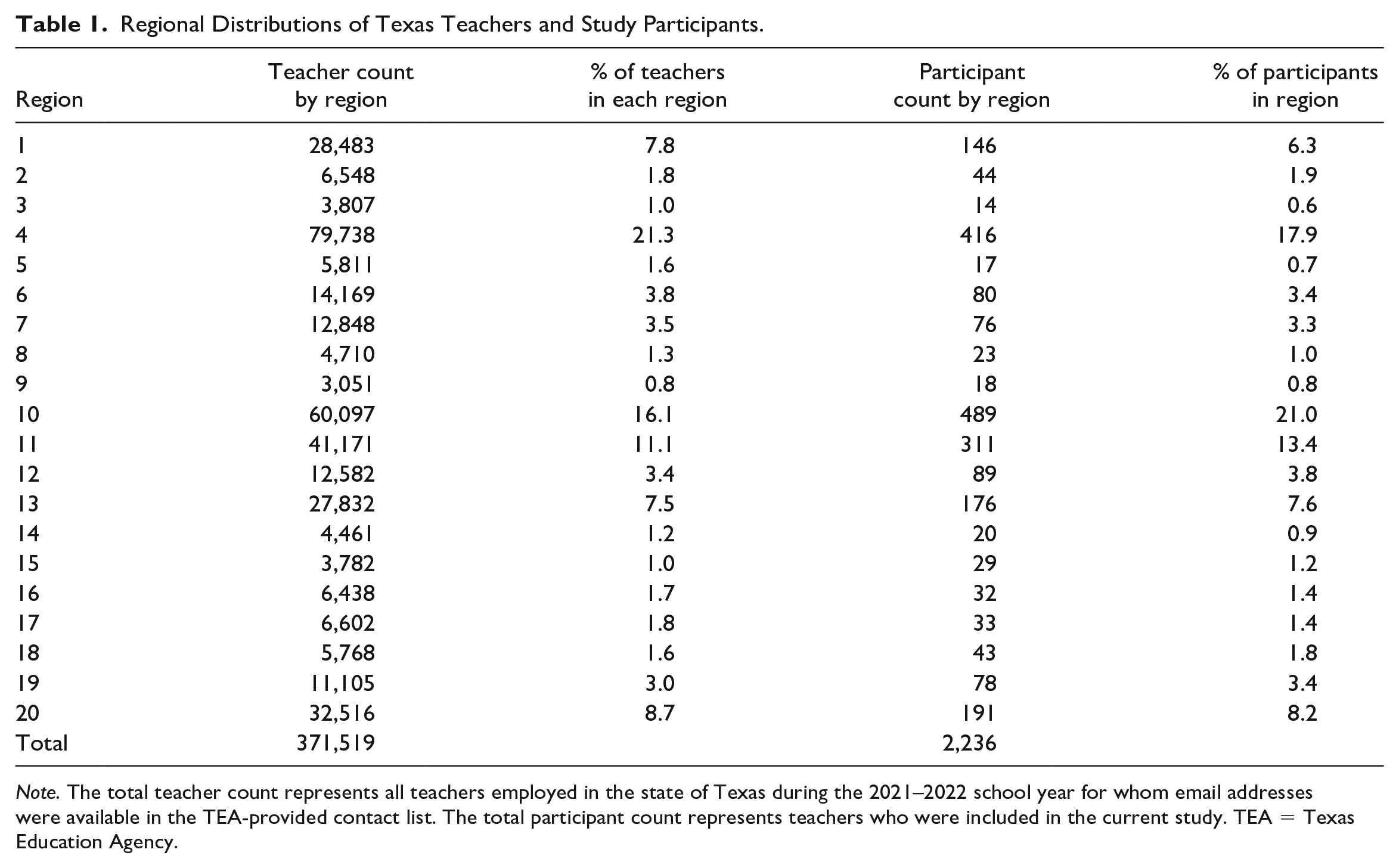
Note. The total teacher count represents all teachers employed in the state of Texas during the 2021–2022 school year for whom email addresses were available in the TEA-provided contact list. The total participant count represents teachers who were included in the current study. TEA = Texas Education Agency.
The average years of teaching experience across the sample was 13.7 (SD = 9.42). Female participants accounted for about 70.4% of the sample (n = 1,636), and male participants 29.6% (n = 687; see Table 2). The racial and ethnic composition of the sample was similar to that of the population of Texas teachers and was as follows: Asian or Pacific Islander (n = 33, 1.38%), Black or African American (n = 188, 8.09%), Hispanic/Latin/o/a/x (n = 448, 19.29%), Two or more racial or ethnic groups (n = 32, 1.38%), and American Indian or Alaska Native (n = 8, 0.3%). White participants comprised the majority of the sample (n = 1,615, 69.52%). Despite the use of unique links with embedded data, the survey was configured to be completely anonymous and did not collect any personally identifiable information. Student enrollment data for the 2021–2022 school year was collected from the Public Education Information Management System (PEIMS), available on TEA’s website. This data was merged using campus and district IDs to evaluate the proportion of students of color enrolled in each teacher’s school campus and district. PEIMS reports mask student enrollment figures when specific populations are below variable thresholds, to protect students’ identities. For schools and districts with masked enrollment data, unmasked enrollment data for the 2020–2021 school year was gathered from the National Center for Education Statistics Elementary/Secondary Information System web application.
Descriptive Statistics for Teacher Demographic Characteristics and Study Variables.
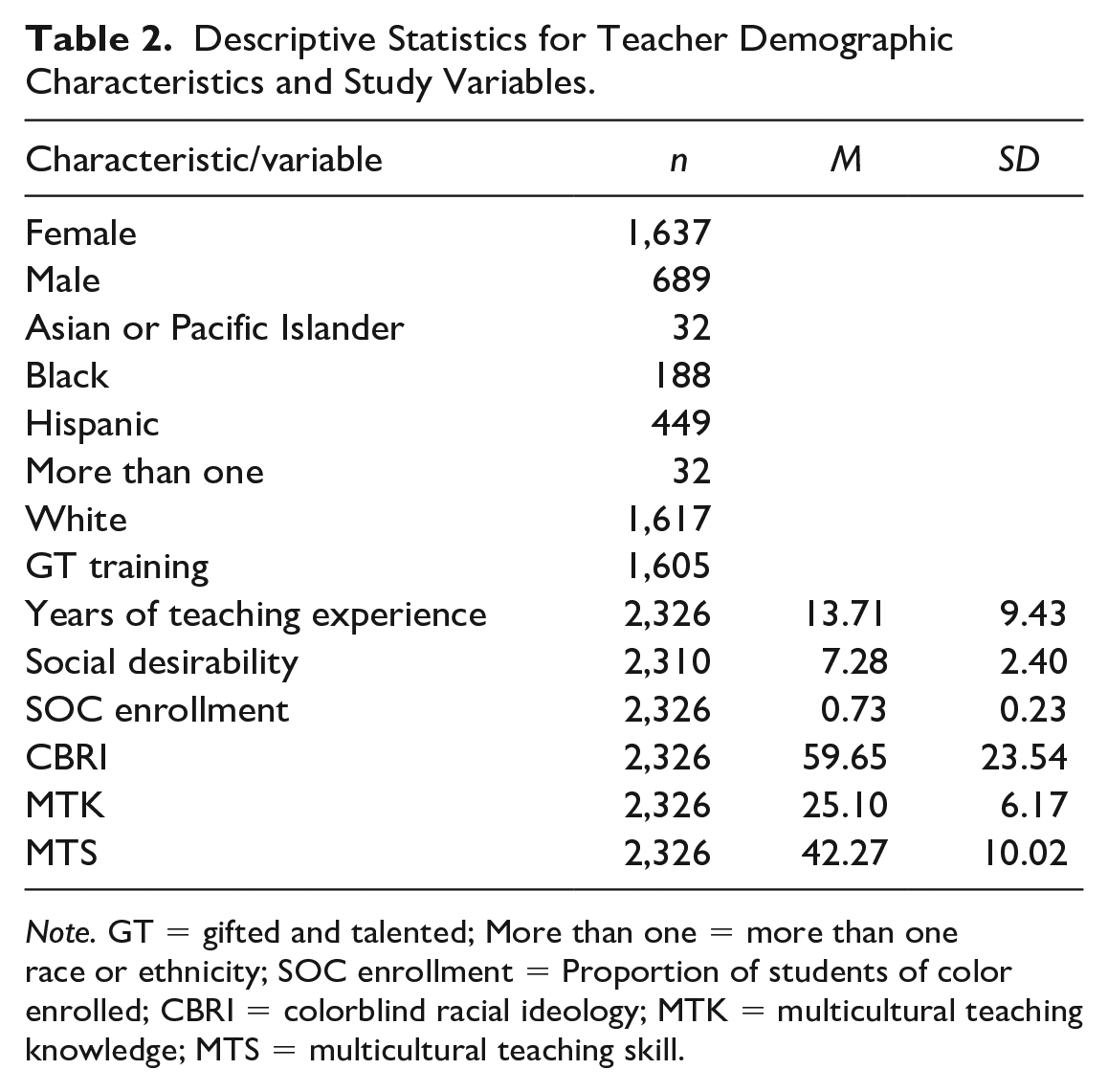
Note. GT = gifted and talented; More than one = more than one race or ethnicity; SOC enrollment = Proportion of students of color enrolled; CBRI = colorblind racial ideology; MTK = multicultural teaching knowledge; MTS = multicultural teaching skill.
Upon agreeing to participate in the study, respondents were asked if they regularly provide instruction to students who have been identified as gifted and talented; those who indicated that they do not were not included in the present study. Retained participants were then directed to answer survey questions regarding colorblind racial attitudes, multicultural teaching competency, and participation in training related to the provision of gifted and talented instructional services. Because the present study relies on self-reported data, and because the implementation of culturally responsive instruction may be considered a socially desirable behavior among educators, the researchers felt it necessary to control for socially desirable response bias. To address this, a shortened version of the Marlowe–Crowne Social Desirability Scale (MCSDS) was also included.
Instruments
Colorblind Racial Attitudes Scale
Racial colorblindness of participants was assessed using the CoBRAS instrument. Neville and colleagues (2000) constructed the CoBRAS to assess the cognitive dimensions of racial colorblindness: unawareness of racial privilege, unawareness of institutional discrimination, and denial of blatant racism. An analysis of the scale’s overall reliability yielded α =.86. Sample items include: “White people in the U.S. have certain advantages because of the color of their skin” and “Social problems in the U.S. are rare, isolated situations” (p. 63). The final instrument, which was used in the present study, consists of 20 items on which participants rate their agreement on a 6-point Likert-type scale from 1 (strongly disagree) to 6 (strongly agree). Total scores are summed, with higher scores indicating greater endorsement of CBRI. The full CoBRAS scale had a Cronbach’s alpha coefficient of .95, indicating excellent reliability.
Multicultural Teaching Competency Scale
Teachers’ multicultural teaching competency was assessed through the Multicultural Teaching Competency Scale (MCTS). The MCTS (Spanierman et al., 2011) is a 16-item instrument that evaluates two domains of multicultural teaching competency: multicultural teaching knowledge and multicultural teaching skill. Scale development and validation involved three interrelated studies using data collected from 506 preservice and inservice teachers (Spanierman et al., 2011). Initial analysis suggested a two-factor solution: multicultural teaching skill (M = 4.36, SD = .73, α = .80) accounted for 32.89% of the variance, and multicultural teaching knowledge (M = 4.80, SD = 1.01, α = .78) accounted for 8.76%. Factor 1 includes 10 items assessing teachers’ inclusion of multicultural teaching practices, and Factor 2 includes six items assessing teachers’ perceived knowledge of multicultural teaching practices. Across validation studies, the Pearson r between the two factors ranged from .56 to .66.
In addition, Spanierman et al. (2011) examined group differences through the use of multivariate analysis of variance, which suggested that teachers with more hours of training in multicultural instruction demonstrated higher scores on both factors. In a third study, the authors used a subsample of the preceding study (n = 99) to obtain additional validity estimates. Participants completed surveys examining social-dominance orientation, teachers’ multicultural awareness, the CoBRAS, and a measure of social desirability. The authors found that higher MTCS scores positively correlate with scores on the teachers’ multicultural awareness scale (r = .51, p < .01) and negatively with the CoBRAS (r = −.44, p < .01). Spanierman et al. (2011) found that MTCS scores were not associated with social desirability. The resulting version of the MTCS is a 16-item Likert-type scale that asks participants to rate each item from 1 (strongly disagree) to 6 (strongly agree). Total scores are summed, with higher scores indicating increased multicultural teaching competency.
A central goal of the present study was to examine the relationship between knowledge of culturally responsive instruction and the implementation of culturally responsive practices when teaching students who are gifted and talented. To ensure that teachers’ responses are specific to the instruction of gifted learners, the MTCS was prefaced with the phrase, “When teaching students who are gifted and talented . . .” Rather than evaluating participant scores from the full scale, the present study analyzes scores from the MTCS’ two subscales (i.e., multicultural teaching knowledge and multicultural teaching skill) individually. The multicultural teaching knowledge subscale (MTK-S) was used to assess knowledge of culturally responsive instruction; it consists of six items that evaluate teachers’ knowledge using phrases like, “I have a clear understanding of culturally responsive pedagogy,” and “I am knowledgeable about particular teaching strategies that affirm the racial and ethnic identities of all students” (Spanierman et al., 2011, p. 449). In the present study, an analysis of the MTK-S subscale’s reliability generated a Cronbach’s α coefficient of .84, indicating good reliability.
The multicultural teaching skill subscale (MTS-S) consists of 10 items that include phrases like, “My curricula integrate topics and events from racial and ethnic minority populations,” and “I integrate the cultural values and lifestyles of racial and ethnic minority groups into my teaching” (Spanierman et al., 2011, p. 449). It should be noted that despite Spanierman et al.’s (2011) use of the word “ability” to describe multicultural teaching skill, the MTS-S does not measure teachers’ perceived ability to implement culturally responsive instruction; rather, it measures teachers’ self-reported implementation of culturally responsive pedagogy and instructional strategies. Two of the MTS-S items were modified in light of the COVID-19 pandemic and related safety protocols and procedures that have affected school activities and events. The item that originally read, “I plan many activities to celebrate diverse cultural practices in my classroom” was changed to “I plan many instructional activities to celebrate diverse cultural practices in my classroom” (Spanierman et al., 2011, p. 449). In addition, the item that originally read, “I plan school events to increase students’ knowledge about cultural experiences of various racial and ethnic groups” was modified to read, “I plan instructional activities to increase students’ knowledge about cultural experiences of various racial and ethnic groups” (Spanierman et al., 2011, p. 449). Reliability analysis of the MTS-S in the present study had a Cronbach’s α coefficient of .87, indicating good reliability.
Marlowe-Crowne Social Desirability Scale-Short Form
To account for social desirability response bias when measuring self-reported multicultural teaching skill, a shortened version of the MCSDS (Ballard, 1992) was included in the present study. The original MCSDS is a 33-item inventory intended to assess the need for social approval (Crowne & Marlowe, 1960). The use of a shortened social desirability scale may be appropriate and provide a “useful alternative” (Ballard, 1992. p. 1155) when implementation of a full scale is not possible (Loo & Loewen, 2004). In the present study, a shortened scale was used to mitigate the response burden caused by a lengthy survey and minimize the occurrence of missing data attributed to participants exiting the survey before completion. Loo and Loewen (2004) tested the validity and reliability of a number of shortened scales and suggested that Ballard’s (1992) 11-item scale is an optimal choice as an alternative to the full scale. Ballard’s shortened version uses select items from the original scale; sample items include, “I sometimes feel resentful when I don’t get my way,” and “No matter who I’m talking to, I’m always a good listener” (Crowne & Marlowe, 1960, p. 351). Items are scored based on participants’ answers of either true or false and some items are reverse-coded. Higher scores indicate an increased propensity to answer questions in a socially desirable way. Loo and Loewen (2004) found that the shortened instrument yielded a coefficient of a = .69, which is indicative of questionable reliability. In the present study, the scale yielded an α coefficient of .68, similar to that of Loo and Loewen. Fisher and Katz (2000) note that when measuring some constructs, a certain degree of social desirability should be expected, particularly when the construct represents a social value or belief system that is considered to be encouraged or preferred. To lessen the potential effect of social desirability bias, Fisher and Katz (2000) encourage researchers to take additional steps beyond the implementation of social desirability scales, like increasing the anonymity of participant responses and incorporating regression analyses.
Analyses
All regression analyses were conducted using IBM’s SPSS 28. Missing data were minimal, representing only 0.7% of responses on variables associated with the social desirability scale, and attributed to participants who chose to exit the survey before completion. Because a missing value analysis indicated that the data were missing completely at random (p = .219; Little, 1988), expectation maximization was used to impute missing values (Enders, 2010).
Predictor Variables
Sex
Participant sex is a dummy coded variable using embedded data included in the TEA contact list, where 0 = Female and 1 = Male.
Race and Ethnicity
Participant race and ethnicity were also embedded using the TEA contact list. Instead of dummy coding, the authors utilized effect coding to create four race and ethnicity-related variables: Asian or Pacific Islander, Black or African American, Hispanic/Latin/o/a/x, and More than one race or ethnicity (where 1= the indicated race or ethnicity, −1 = White, and 0 = All Others). Dummy coding typically positions White participants as a reference group by which all other groups are compared, as the constant is equal to the reference group’s mean. In contrast, effect coding allows for each group to be compared to all other groups, as the constant is equal to the unweighted grand mean (Mayhew & Simonoff, 2015). When examining race, effect coding is recommended as a more equitable alternative to dummy coding, as it does not “essentialize one group’s experiences over another’s” (Mayhew & Simonoff, 2015, p. 595).
Enrollment of Students of Color
TEA enrollment data categorizes student race and ethnicity using the following descriptors: American Indian or Alaska Native, Asian, Black or African American, Hispanic/Latino, Native Hawaiian/Other Pacific, Two or more races, and White. Student of color enrollment represents the proportion of enrolled students who are from racially and ethnically diverse backgrounds (i.e., students who are not White) on each teacher’s school campus. The student enrollment variable was created by dividing the number of White students enrolled by the number of total students enrolled for each campus and then subtracting this number from 1. Values range from 0 to 1, where 0 is indicative of a student population that is all White, and 1 is indicative of a population that is entirely composed of students of color (M = 0.73, SD = 0.23).
CBRI
Scores from the full CoBRAS scale were used to represent CBRI; observed scores range from 20 to 120 (M = 59.59, SD = 23.49), and higher scores indicate greater endorsement of racial colorblindness (see Table 2).
Gifted and Talented Training
Training was operationalized as a dichotomous variable (no = 0, yes = 1) that represents whether a teacher has completed training specific to the education of gifted and talented students. In the state of Texas, only educators who provide instruction as part of the services provided by a school or district’s gifted and talented program are required to complete 30 hr of gifted-specific training. This training must include the following areas: the nature and needs of gifted students, identification and assessments, social and emotional needs, creativity and instructional strategies, and differentiated curriculum (TEA, 2019). However, teachers without this training often provide instruction to students identified as gifted and talented in general education settings. In the current sample, 69% of participants indicate having completed the training (n = 1,604).
Multicultural Teaching Knowledge
Multicultural teaching knowledge (MTK) was operationalized as a continuous variable representing participant scores on the MTK-S of the MCTS. The observations for MTK had an average of 25.09 (SD = 6.17, Min = 6.00, Max = 36.00).
Social Desirability
Social desirability was operationalized as a continuous variable that represented scores from Ballard’s (1992) 11-item shortened version of the MCSDS. Observed scores ranged from 0 to 11 (M = 7.27, SD = 2.40).
Outcome Variable
The implementation of culturally responsive practices when teaching gifted students was operationalized as a continuous variable that represents participant scores on the MTS-S of the MCTS. Observed scores for MTS had an average of 42.30 (SD = 9.99, Min = 10.00, Max = 60.00).
Assumptions
Prior to conducting the regression, assumptions regarding normality, autocorrelations, collinearity, and homoscedasticity were checked via the inspection of scatterplots and the p-p plot (see Figure 1) (Keith, 2015). Assumptions regarding the normality of residuals, autocorrelations, and collinearity were met. Homoscedasticity was evaluated by plotting the residuals against the predicted values (Bates et al., 2015; Osborne & Waters, 2002). The assumption of homoscedasticity is met if the points appear randomly distributed with a mean of zero and no apparent curvature. Figure 2 presents a scatterplot of predicted values and model residuals; in it, a slight funneling effect is apparent at the right of the distribution. This suggests a violation of the assumption of homoscedasticity. Subsequently, the authors chose to conduct regression analyses using heteroskedasticity-robust standard errors (Hayes & Cai, 2007).
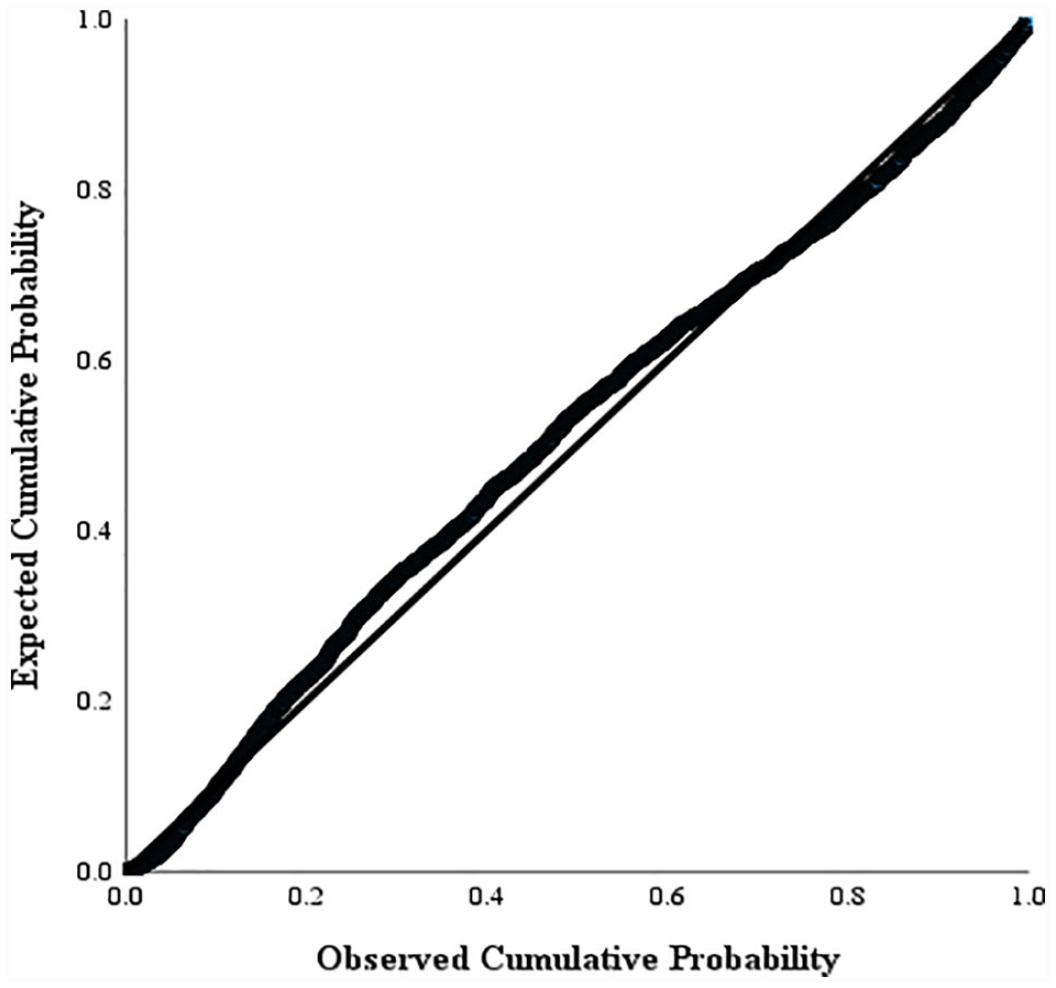
Normal P–P Plot of Standardized Residuals.
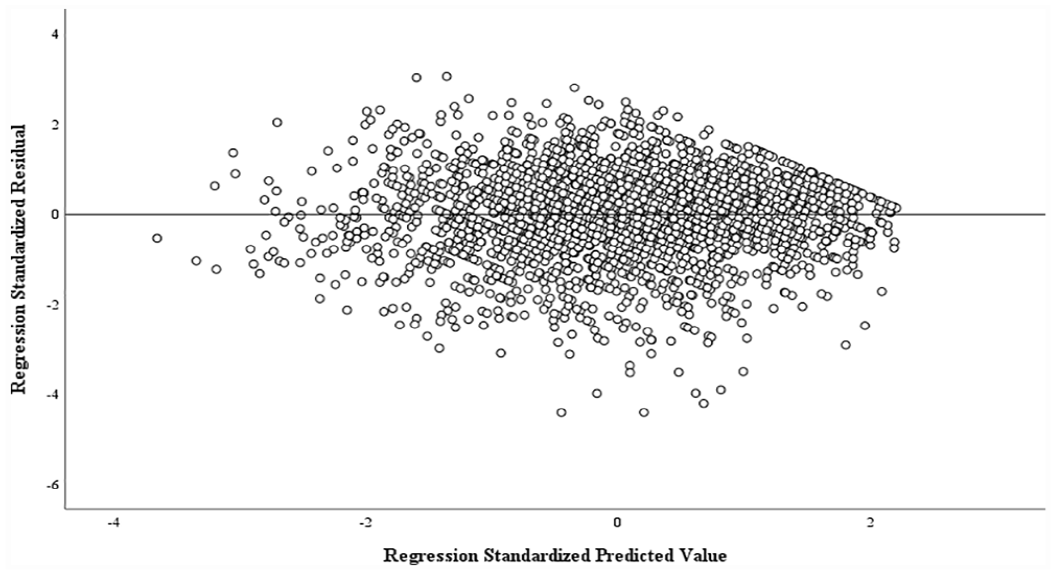
Scatterplot of Standardized Residuals.
Outliers
An analysis of squared Mahalanobis distances indicated that three multivariate outliers (p < .001) had significant influence on the results of the model. In addition, an analysis of studentized residuals (Pituch & Stevens, 2015) indicated the presence of additional outliers (n = 12). However, no outliers were removed.
Results
After descriptive statistics and bivariate correlations were obtained and examined, multicultural teaching skill with gifted students (MTS) was regressed on participant race/ethnicity, sex, CBRI, gifted-specific training, social desirability scores, student of color enrollment, and MTK (see Tables 2 and 3). An interaction term testing a moderation effect between CBRI and multicultural teaching knowledge in predicting multicultural teaching skill was added to the model. To aid in the interpretation of potential interaction effects, both CBRI and MTK scores were mean-centered before being entered into the model.
Bivariate Correlations Among Study Variables.
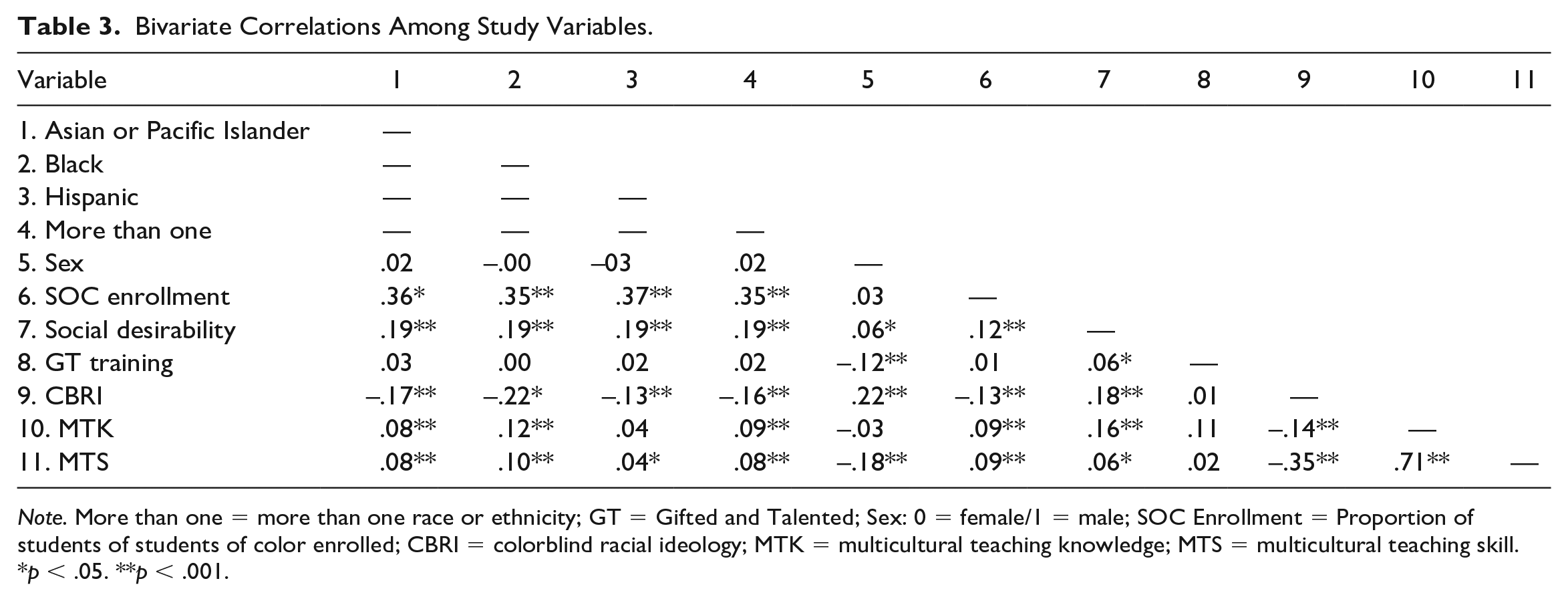
Note. More than one = more than one race or ethnicity; GT = Gifted and Talented; Sex: 0 = female/1 = male; SOC Enrollment = Proportion of students of students of color enrolled; CBRI = colorblind racial ideology; MTK = multicultural teaching knowledge; MTS = multicultural teaching skill.
p < .05. **p < .001.
Results focus on both standardized weights and squared structure coefficients (see Table 4). Structure coefficients are bivariate correlations between each predictor variable and the synthetic variable (Ŷ) that indicate the percentage of variance that can be explained by each predictor in a model (Henson, 2002, 2006). In this way, structure coefficients provide a clearer sense of the independent contribution of each predictor to the overall effect. Structure coefficients can be obtained using the following formula: rs = r Y–X /R. Squaring the resulting values yields the percentage of variance in the outcome variable that each predictor can explain (rs2).
Multiple Regression of Self-Reported Implementation of Culturally Responsive Teaching Practices.
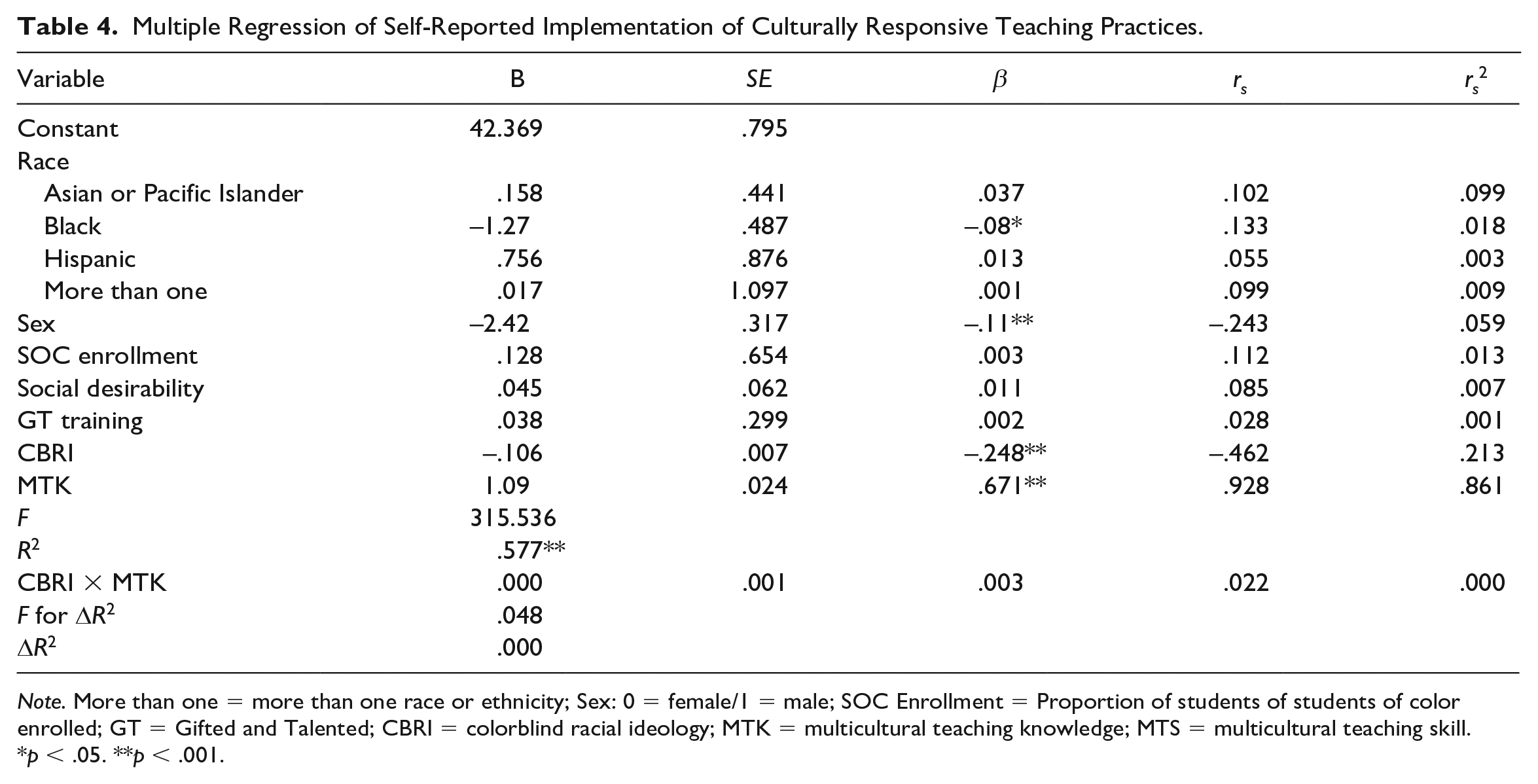
Note. More than one = more than one race or ethnicity; Sex: 0 = female/1 = male; SOC Enrollment = Proportion of students of students of color enrolled; GT = Gifted and Talented; CBRI = colorblind racial ideology; MTK = multicultural teaching knowledge; MTS = multicultural teaching skill.
p < .05. **p < .001.
The results of the linear regression model were significant, F(10, 2315) = 315.536, p < .001, R2 = .577, indicating that approximately 57.7% of the variance in self-reported implementation of culturally responsive instruction is explainable by the predictors. The interaction term was not significant. Sex, the Black racial variable, CBRI, and MTK scores were all significant predictors of MTS. Completion of training specific to gifted and talented education, school diversity, and social desirability were not significant predictors of MTS. Sex significantly predicted MTS, (β = −.11, rs2 = .059, p < .001). This indicates that males report lower implementation of culturally responsive practices, and that sex accounts for about 6% of the variance in the self-reported implementation of culturally responsive instruction. The Black racial variable significantly predicted MTS, (β = −.08, rs2 = .018, p = .014), suggesting that Black participants report lower implementation of culturally responsive practices than others, and that this variable accounts for about 2% of the variance in the self-reported implementation of culturally responsive instruction. CBRI significantly predicted MTS, (β = −.248, rs2 = .213, p < .001). This indicates that individuals who reported greater endorsement of CBRI reported lower implementation of culturally responsive practices and that CBRI accounts for about 21% of the variance in the self-reported implementation of culturally responsive instruction. Scores on the MTK significantly predicted MTS, (β = .671, rs2 = .861, p < .001). This indicates that increased multicultural teaching knowledge predicts higher scores on the MTS and about 86% of the variance in teachers’ self-reported implementation of culturally responsive instruction when teaching gifted students. As noted, the interaction term between CoBRAS scores and MTK scores did not have significant effect on the overall model, suggesting that CBRI does not moderate the effect of multicultural teaching knowledge in predicting the self-reported implementation of culturally responsive instructional practices with gifted students.
Subsequent Moderation Analysis
The negative effect of the Black racial variable on MTS was surprising, especially given the variable’s positive correlation with MTS and MTK (see Table 3). The inclusion of the additional predictors in the regression model appeared to alter this relationship. Because CBRI is typically more prevalent among individuals who are White and less so among people who are Black, a moderation analysis was conducted to examine a potential interaction between CoBRAS and the Black racial variable. An additional interaction analysis was conducted in SPSS and plotted using the Hayes PROCESS macro. In keeping with the necessity of employing robust parameter estimates, a heteroscedasticity consistent standard error and covariance matrix estimator was used. The interaction between CoBRAS and the Black racial variable was statistically significant and contributed a small effect (ΔR2 = .002, p <.001). Table 5 displays findings from the overall model after including the subsequent moderation analysis.
Multiple Regression of Self-Reported Implementation of Culturally Responsive Teaching Practices With Secondary Moderation Analysis.
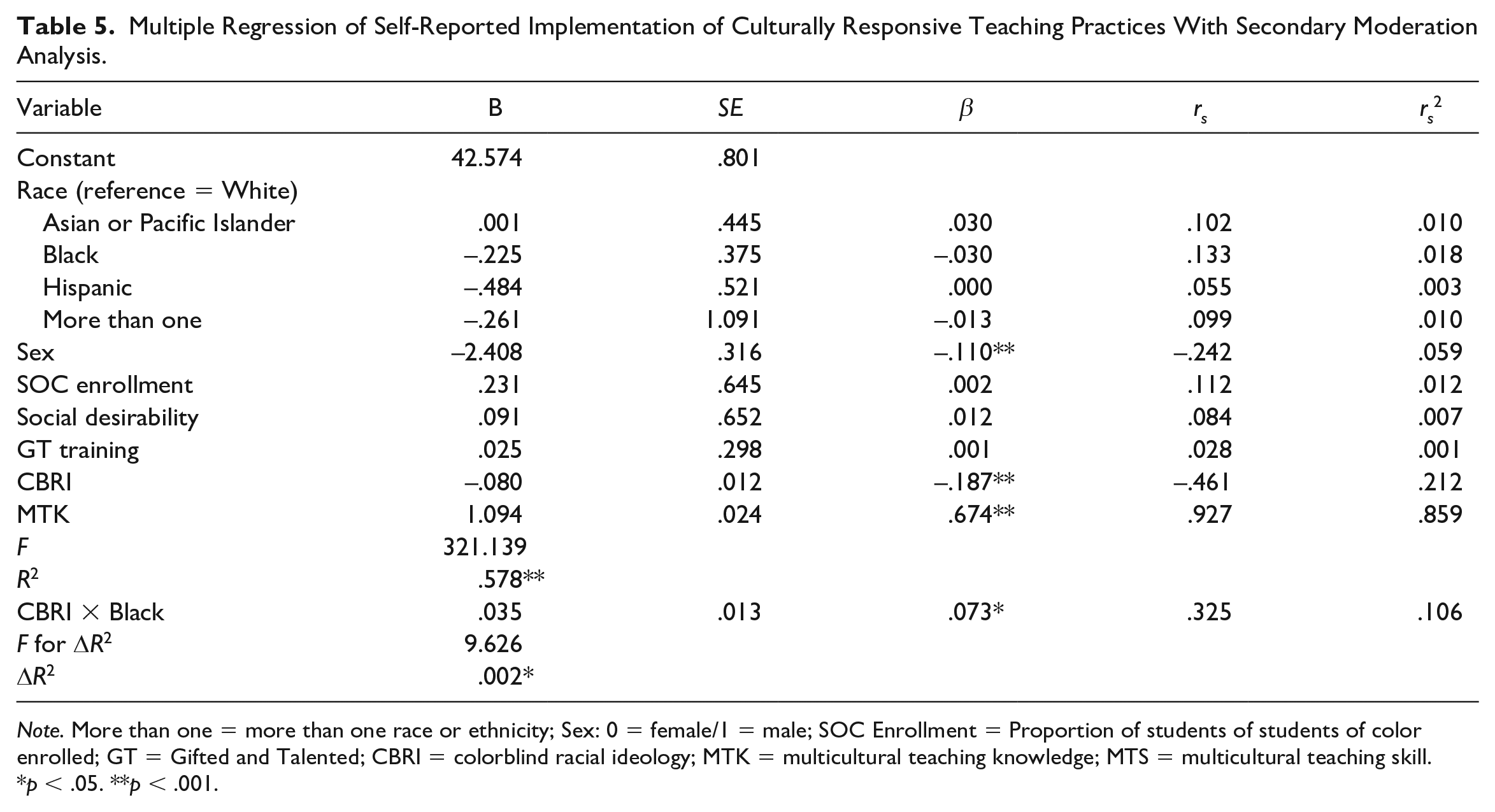
Note. More than one = more than one race or ethnicity; Sex: 0 = female/1 = male; SOC Enrollment = Proportion of students of students of color enrolled; GT = Gifted and Talented; CBRI = colorblind racial ideology; MTK = multicultural teaching knowledge; MTS = multicultural teaching skill.
p < .05. **p < .001.
The interaction added very little variance to the overall regression model (.2%), but when the interaction was included, the Black racial variable was no longer a significant predictor of self-reported implementation of culturally responsive instruction when teaching gifted students. An analysis of simple slopes indicates that CBRI did not significantly predict MTS among teachers who were Black but did for teachers who were White (B = −.113, p < .001) and for those in the All Others group (B = −.094, p < .001). Figure 3 depicts the moderation effect of race on the relationship between CBRI and MTS. It illustrates that as CBRI increases, the reported implementation of culturally responsive teaching practices with gifted students (i.e., MTS) decreases for teachers in both the White and the All Others groups. However, at high levels of CBRI, White teachers report lower implementation of culturally responsive practices when teaching gifted students than others.
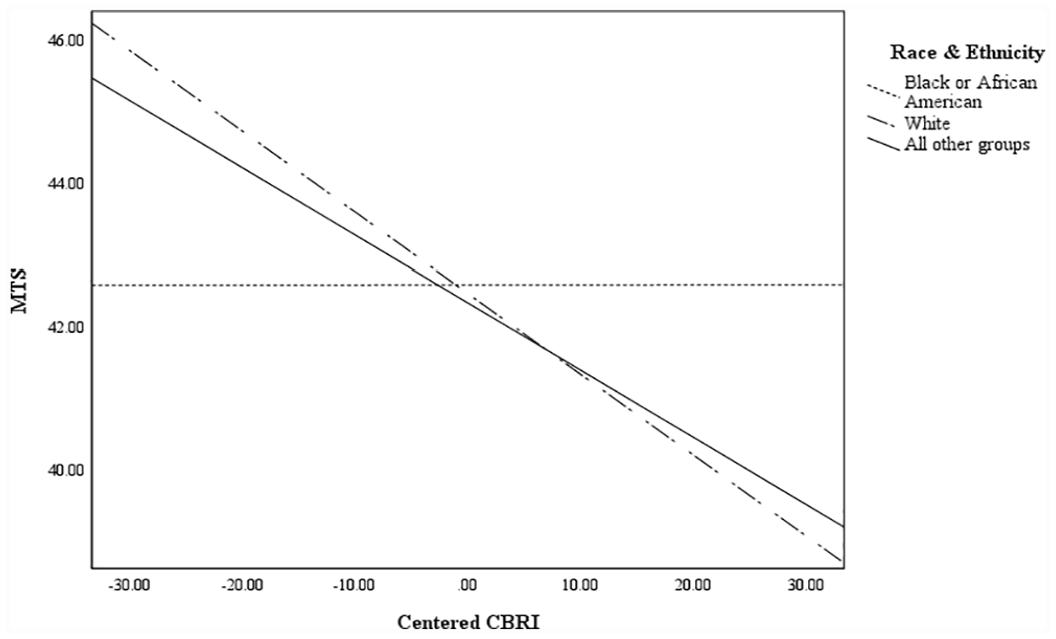
Interaction of Race and Ethnicity and Colorblind Racial Ideology in Predicting Multicultural Teaching Skill.
Additional Analysis
To examine the potentially confounding effects of clustering, the authors employed hierarchical linear modeling, using HLM 8. In the present study, the data had a nested structure, in that data were collected from teachers who were grouped, or clustered, within districts (n = 516). District-level data were available for all participants except for one, (n = 2,325). Dividing the number of Level-1 units (n = 2,325) by the number of Level-2 units (n = 516) yielded an average cluster size of 4.5, which is lower than the recommended minimum average cluster size of at least 10 (given a cluster size of at least 100; Clarke & Wheaton, 2007). With a large Level-1 sample size, as was the case in the present study, average cluster size has little effect on the estimation of fixed effects, or the impact of Level-1 predictors. However, low average cluster size limits the power for testing random slopes, or the between-cluster variances, of the effects of Level-1 predictors (Snijders Tom, 2005). In other words, low average cluster size limits the power of testing the effects of district-level predictors on teacher-level variables. Model testing proceeded with these limitations acknowledged.
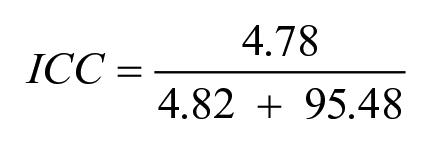
Model testing included an unconstrained, or null, model to determine the proportion of variance in MTS that can be explained by the clustering structure. The district mean of MTS was 41.95 (see Table 6), and the variance component suggested that significant variation in MTS existed between districts. Running a null model allowed for the determination of the intraclass correlation coefficient (ICC). The ICC typically ranges from .10 to .20 when examining school effects and can be used to determine whether HLM is an appropriate method of analysis, as it “indicates the degree of non-independence in the data” (McCoach, 2010, p. 134). In this case, an analysis of the unconstrained model yielded an ICC of .048. The ICC was calculated using the equation below:


Results From the Unconstrained Model.
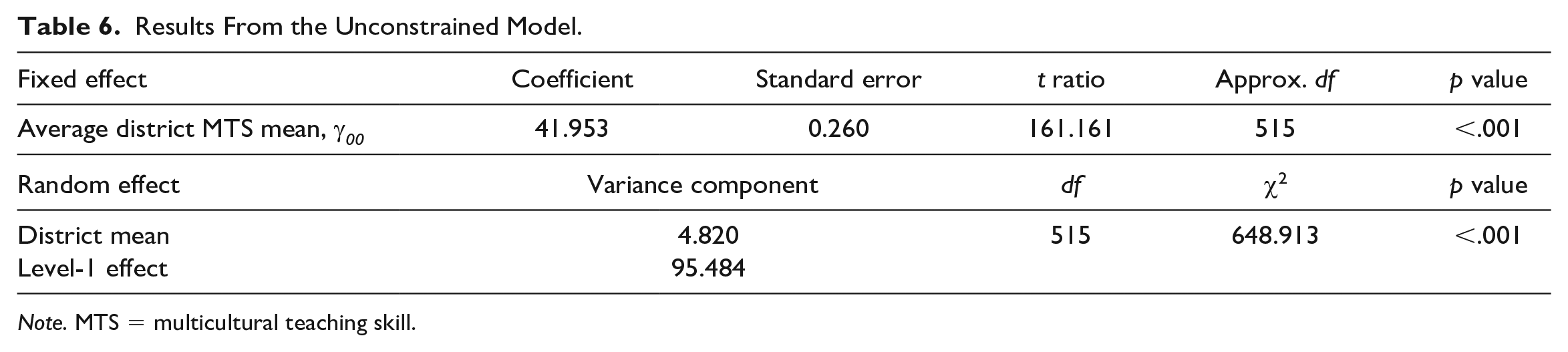
Note. MTS = multicultural teaching skill.
This suggests that about 5% of the variance in teachers’ self-reported implementation of culturally responsive practices was between districts, while 95% was within districts. The low ICC in this case was an indicator that multilevel modeling may not be appropriate given the current data structure. For further clarification, the ICC was used to calculate the design effect, deff = 1+, average cluster size −1) * ICC), which indicates whether a multilevel design is more or less efficient than single-level analysis (Snijders Tom, 2005). A widely held rule of thumb is that a design effect smaller than two suggests that the use of single-level analysis is appropriate and unlikely to lead to biased results (Maas & Hox, 2005). Lai and Kwok (2015) argued that this rule should not be applied when researchers have an average cluster size of less than 10; however, in such cases, the authors recommend using single-level analyses, and ignoring the clustering effect, if the design effect is as small as 1.1. Because the design effect in the present study was 1.168, the authors determined that the use of single-level analysis is appropriate and chose not to continue with model testing.
Discussion
The present study examined the relationships between CBRI, multicultural teaching knowledge, gifted-specific training, sex, race and ethnicity, and the self-reported implementation of culturally responsive instruction among teachers of students who have been identified as gifted and talented. Using multiple regression analysis, results indicated that CBRI, sex, and multicultural teaching knowledge were all significant predictors of the self-reported implementation of culturally responsive instruction with gifted students. Conversely, completion of gifted-specific training and school-level enrollment of students of color were not significant predictors of the outcome variable. Although the hypothesized interaction between CBRI and multicultural teaching knowledge was not found to be significant, an additional moderation analysis revealed a moderation effect of race on CBRI when predicting self-reported culturally responsive instruction. The degree of no-independence of the data that can be attributed to a clustering effect at the district level was examined with additional analyses using hierarchical linear modeling, which revealed a small grouping effect. The extent to which current findings address the study’s research questions is addressed in greater detail below.
The Relationship Between Teacher Attitudes, Attributes, and Culturally Responsive Practices
The first research question examines the relationship between culturally responsive practices with and teachers’ demographic characteristics, multicultural teaching knowledge, and CBRI. In the present study, sex was found to negatively predict MTS, in that males reported lower implementation of culturally responsive teaching practices with gifted students. This departs from past research indicating no significant relationship between sex and multicultural teaching competency (Spanierman et al., 2011) but aligns with existing research suggesting that men generally report greater endorsement of CBRI than women (Garcia et al., 2020; Neville et al., 2013, 2014; Poteat & Spanierman, 2012).
Regarding teacher race and ethnicity, only the Black racial variable significantly predicted MTS in the initial model. However, after including the interaction term between CBRI and the Black racial variable in the second regression model, this relationship was no longer significant. Our results suggest that race moderates the effect of CBRI in predicting culturally responsive instruction and that the relationship between the two constructs is strongest among White teachers. This aligns somewhat with previous findings of a moderating effect of race on the relationship between CBRI and culturally responsive instruction. Cadenas et al. (2020) found that the effect of CBRI on teachers’ culturally responsive self-efficacy when teaching students who are immigrants was moderated by race. However, unlike the present study, Cadenas et al. (2020) found that this effect was only significant for Asian and Asian American teachers.
In the present study, the second moderation analysis also suggests that at very low levels of CBRI, White teachers report a greater implementation of culturally responsive practices when teaching gifted students than do others. These findings are similar to those found in Chao’s (2013) examination of multicultural practices among school counselors. Chao (2013) found that when White school counselors had low CBRI, they demonstrated higher multicultural counseling competency than did counselors from diverse racial and ethnic backgrounds. Chao (2013) suggests that this could be attributed to current trends in professional development aimed specifically at addressing the practices and beliefs of White school counselors. Similar logic may explain the current findings, in that professional development surrounding culturally responsive instruction may be targeted to teachers who are White.
Unsurprisingly, multicultural teaching knowledge was the strongest predictor of multicultural teaching skills in the present study. Ultimately, teachers with greater knowledge of culturally responsive instruction report greater implementation of culturally responsive practices when teaching gifted students. However, CBRI was also found to be a significant predictor in the model, aligning with previous findings that teachers who endorse racial colorblindness demonstrate less multicultural teaching competency and are less likely to implement culturally responsive instruction (Aragón et al., 2017; Burden et al., 2015; Garcia et al., 2020; Spanierman et al., 2011). Our findings underscore the notion that a teacher’s capacity and willingness to implement culturally responsive instruction are not only dependent on their knowledge of culturally responsive pedagogy but are also subject to their beliefs about race.
The Effect of Colorblind Racial Ideology on the Relationship Between Multicultural Teaching Knowledge and Skill
The second research question sought to determine whether CBRI has a moderating effect on multicultural teaching knowledge in predicting self-reported implementation of culturally responsive practices. The correlation between CBRI and culturally responsive practices was considerably stronger than that between CBRI and multicultural teaching knowledge which aligns with previous findings suggesting that teachers who endorse CBRI may be less likely to implement culturally responsive instruction, even if they are knowledgeable in this area (Burden et al., 2015; Cadenas et al., 2020; Hachfeld et al., 2015). However, the interaction term was insignificant, suggesting that CBRI does not moderate the relationship between multicultural teaching knowledge and implementation. This was somewhat surprising, especially in light of Comstock et al.’s (2023) study, in which the authors found that teachers’ beliefs regarding culturally responsive teaching moderate the relationship between their feelings of culturally responsive self-efficacy and the extent to which they implement culturally responsive practices. Specifically, Comstock et al. (2023) found that endorsing pedagogical beliefs that both emphasize sameness over cultural difference and embrace a colorblind approach to teaching, weakens the relationship between culturally responsive self-efficacy and the implementation of culturally responsive practices.
The Relationship Between Gifted-Specific Professional Learning and the Implementation of Culturally Responsive Instruction
The third research question was posed to determine whether there is a relationship between the completion of professional learning related to gifted and talented education and the self-reported implementation of culturally responsive instruction among teachers of gifted and talented students in the state of Texas. In the current sample, nearly 70% of participants reported having completed the required training (n = 1,604). Regardless, participation in gifted-specific training was not a significant predictor of self-reported culturally responsive instruction. Moreover, participation in gifted-specific training did not significantly correlate with multicultural teaching knowledge, which suggests that Texas teachers who have completed the required gifted-specific training are no more or less knowledgeable about culturally responsive instruction than those who have not. These findings suggest that the required training for Texas teachers who provide instruction as part of a gifted program’s service model may not be sufficient in equipping teachers with the knowledge and skills necessary to implement culturally responsive instruction when teaching gifted students from diverse racial and ethnic backgrounds.
The Influence of School Diversity on Teachers’ Implementation of Culturally Responsive Practices
The fourth and final question takes into account the potentially confounding influence of the demographic composition of a school’s student population on teachers’ self-reported implementation of culturally responsive instruction. The inclusion of the student enrollment variable controls for the racial and ethnic composition of the student population in each teacher’s school. Despite our hypothesis that teachers in schools with larger proportions of students of color would report a greater implementation of culturally responsive practices, the proportion of enrolled students of color was not a significant predictor in either regression model. This suggests that the relationship between CBRI, multicultural teaching knowledge, and teachers’ self-reported implementation of culturally responsive instruction is unaffected by the racial and ethnic diversity of a school’s student population.
Implications for Practice
Implications of the present study emphasize the importance of gifted-specific professional development that (a) fosters multicultural competency and (b) encourages teachers to evaluate the extent to which their beliefs about race influence their instructional practices. Gifted-specific training that incorporates principles of culturally competent instruction has been recommended for making gifted programs more equitable (Mun et al., 2020; Wright et al., 2017). Moreover, the NAGC includes the development and use of “curriculum that is responsive and relevant to diversity” in its Pre-K–12 gifted programming standards (p. 10) and emphasizes the necessity of state education agencies to provide educators with professional learning that fosters the development of culturally responsive learning environments. The present study underscores the importance of these standards, as its findings indicate that when teachers are knowledgeable about multicultural teaching practices, they are more likely to engage in culturally responsive instruction when teaching students who are gifted and talented. Research on enhancing multicultural teaching competency in teachers suggests that targeted professional development increases both knowledge and implementation of culturally responsive practices (Spanierman et al., 2011). However, in the current sample, completion of the training required to provide gifted instructional services was largely insufficient in developing teachers’ capacity to implement culturally responsive instruction. Unlike many other states, the state of Texas does have established training requirements for in-service teachers who provide gifted education services. However, what is included in gifted-specific training varies widely across districts, as there is no standard curriculum, training provider, or training platform, and determinations of whether a program’s content and materials meet the state’s broad criteria can be made at the district level. It is critical that the criteria used to outline the required gifted-specific training in the state of Texas be more clearly articulated to include an emphasis on multicultural competency and to better align with the language established in NAGC’s (2019) gifted programming standards.
In addition, the present study emphasizes the need for the provision of professional development that encourages teachers to confront their own racial beliefs that may undermine the goals of equitable instruction. Our findings indicate that the endorsement of CBRI is a threat to the use of culturally responsive practices when teaching gifted students, and support research suggesting that teachers’ racial beliefs impact their expectations of students and subsequently their instructional choices. When teachers endorse CBRI, they are more inclined to view race as a conflict-laden topic and are consequently more likely to engage in instructional practices that are antithetical to culturally responsive pedagogy, such as color-evasion through the minimization of diversity in favor of emphasizing sameness and power-evasion through the denial of systemic racial inequity (Alvarez & Milner, 2018; Flores & Gunzenhauser, 2019; Lewis, 2001; Neville et al., 2013; Welton et al., 2015). Ultimately, teachers who are higher in CBRI are less likely to practice culturally responsive instruction, but they are also more likely to engage in deficit thinking and set and maintain lower expectations for students from diverse backgrounds (Battey et al., 2021; Cobb, 2017; Flores & Gunzenhauser, 2019; Lewis, 2001; Liou et al., 2019; Parsons et al., 2018; Stoll, 2014; Welton et al., 2015). This may be particularly detrimental for gifted students of color, as the endorsement of CBRI may result in teachers perceiving no benefit to implementing culturally responsive practices, even if they have knowledge of such practices. The NAGC’s (2019) programming standards related to professional development include the imperative that educators “recognize their biases, develop philosophies responsive to diversity, commit themselves to removing barriers, and create inclusive learning environments that meet the educational interests, strengths, and needs of diverse students with gifts and talents” (p. 17). In fact, research suggests that CBRI can be countered with greater exposure to diversity-related experiences (Neville et al., 2014; Patterson et al., 2018), participating in intergroup dialogues that encourage perspective-taking (Muller & Miles, 2017), and exposure to experiences of racism (Patterson & Domenech Rodríguez, 2019; Soble et al., 2011). Importantly, exposure to diversity-related issues may not be sufficient in shifting racial ideologies if preexisting biases go unchecked (Peters et al., 2016). Instead, professional development aimed at challenging harmful racial beliefs should center color-consciousness, self-reflection, and the importance of diversity (Liou et al., 2019; Thompson, 2014; Ullucci & Battey, 2011). Just as the effort to enhance cultural competence among teachers requires the self-examinations of one’s views and biases, so does the effort to combat CBRI and reject deficit mindsets.
Limitations
Limitations in the present study relate to both the method of data collection and to the overall social context in which the study was conducted. First, random sampling was not used in this study, which may have introduced sampling bias and decreased generalizability. Also, self-reported data is prone to response bias, and this may be especially true when evaluating culturally responsive teaching practices (Debnam et al., 2015). To mitigate the effect of socially desirable response bias in the present study, the authors ensured complete anonymity during data collection and analysis and controlled for social desirability using regression analyses (Fisher & Katz, 2000). Ultimately, social desirability was not found to predict self-reported culturally responsive instructional practices; however, the measure used had questionable reliability. Furthermore, social desirability does not account for the potential over-estimation of one’s culturally responsive teaching practices. In addition, use of a shortened form of the MCSDS may have been a limitation as compared with using the full scale (Ballard, 1992; Fischer & Fick, 1993).
An additional limitation of the present study relates to the overarching social context in which the study was conducted. Although Texas was chosen as an area of focus because of its increasing student diversity, the state has recently enacted legislation that limits the way instruction pertaining to race and racism can be conducted in public schools. House Bill 3979 relates primarily to the social studies curriculum (Texas Legislature Online, 2021) and was enacted as part of a nationwide effort to limit the influence of critical race theory on instruction in schools. Despite the fact that multicultural (or culturally responsive) instruction and critical race theory are separate constructs, it is possible that they have been conflated by some educators. Teachers who are unaware of their conceptual differences may opt not to implement culturally responsive instruction for fear of violating the guidelines established in House Bill 3979, and the present study does not account for this possibility. Future research should be conducted in states that have enacted similar legislation and should include additional components that examine the extent to which teachers’ instructional practices have shifted as a result.
Perhaps the most considerable limitation in the present study is the inability to examine the effects of district- and school-level clustering on teacher-level predictors. Although the null model revealed a small level of non-independence of the data, the low design effect suggests that a single-level analysis was appropriate (Lai & Kwok, 2015; Maas & Hox, 2005). In future research that examines these constructs among teachers, steps should be taken to ensure more balanced data collection to better account for clustering effects. Further research should be conducted that more thoroughly examines the school- and district-level predictors of culturally responsive instruction with gifted students. Doing so could allow for the identification of specific schools and districts in which average cultural responsiveness is high, and of specific training programs or climate-related attributes that contribute to this outcome.
Finally, when considering future examinations of these constructs, additional consideration should include re-framing the language used to describe colorblind racial ideology or CBRI. As researchers in the social sciences endeavor to use more inclusive language and to evaluate the extent to which research practices engender and perpetuate deficit-based frameworks, they should seek to find alternative descriptors of constructs with potentially problematic names. In this case, racial colorblindness may be perceived as an ableist term, as it “equates blindness with ignorance” (Annamma et al., 2017, p. 154). Although the present study does not attempt to re-articulate language used in the prevailing frameworks of CBRI, future work should include a reexamination of this construct with a specific focus on revising problematic terminology.
Footnotes
Declaration of Conflicting Interests
The author(s) declared no potential conflicts of interest with respect to the research, authorship, and/or publication of this article.
Funding
The author(s) received no financial support for the research, authorship, and/or publication of this article.
Open Science Disclosure Statement
The data analyzed in this study are not available for purposes of reproducing the results. The code or protocol used to generate the findings reported in the article is not available for the purposes of reproducing the results or replicating the study. The newly created, unique materials used to conduct the research are not available for the purposes of reproducing the results or replicating the procedure.

This journal operates a double-anonymized peer-review process. Due to a technical error, this article was initially reviewed using the double-anonymized process and subsequent reviews were conducted through a single-anonymized peer-review process. All authors and reviewers were made aware of the error and agreed to proceed with the peer-review process with the identity of the authors known to the reviewers. No reviewers reported conflicts of interest.