







Abstract
The purpose of this qualitative, phenomenological study was to investigate the experiences and perspectives of parents of highly and profoundly gifted children in developmental and cultural contexts. A purposive sample was selected from parents who are members of networks and organizations serving highly and profoundly gifted students. We conducted semi-structured interviews with 11 parents. Data were analyzed using the six-step approach of thematic analysis and revealed eight overarching themes including (a) self-efficacy within sociocultural contexts; (b) feelings of confidence; (c) role in fulfilling children’s needs; (d) decisions and actions related to children’s giftedness; (e) development of the parent/child dyads; (f) sense of belonging within the larger community; (g) impact of Covid-19 pandemic on their child’s gifted education; and (h) resources needed to facilitate children’s social-emotional and academic needs. Implications inform educators, counselors, and communities of the lived experiences of parents and their need for a sense of support and belonging.
Parenthood inherently presents challenges and requires self-development to remain responsive to the constantly changing developmental stages of children. A potential lag between parental and child development may be even more pronounced in the parenting of highly and profoundly gifted (HG/PG) children whose development is atypical and asynchronous (Chellapan & Margrain, 2013; Lubinski et al., 2001). Parents of HG/PG gifted students may find themselves needing to advocate for the social-emotional, psychosocial, and academic needs of their HG/PG child, and this may be confounded by disparities between definitions of giftedness within sociocultural contexts (Huff et al., 2005; Sternberg, 2007). Parenting styles and practices may be a response or adaptation to the presence of high or profound giftedness and/or cultural expectations and values of parents (Moritz Rudasill et al., 2013). In other words, parents may behave differently in the context of high or profound giftedness (Huey et al., 2013; Morawska & Sanders, 2009; Porath, 2007), and feelings of isolation may emerge from an inability to connect with other parents (Porter, 2005; Saranli, 2017).
Purpose Statement and Research Questions
While the past and current research has focused on social-emotional and academic needs of gifted learners, the experiences and perspectives of parents of HG/PG children have largely been overlooked or minimally researched (Jolly & Matthews, 2012; Karpinski et al., 2018). In a longitudinal study of gifted children (n = 56) across the gifted spectrum, Ruff (2021) found that parental personalities and perspectives are significant factors in explaining differences in outcomes. Considering developmental contexts and that both parents and children experience developmental phases of learning and growth, the interaction of developmental trajectories of parents and gifted children suggests a need for specific strategies, competencies, and support (Morawska & Sanders, 2008, 2009). Parenting evolves and is dynamic due to the developing nature of children (Jolly & Matthews, 2012; Morawska & Sanders, 2009). In general, there is a lack of empirical studies related to parenting experience in the context of development, culture, and high and profound giftedness (see Jolly & Matthews, 2012). Glimpses into the lived experiences and needs of parents with HG/PG children can sometimes be found within research on the children (e.g., Karpinski et al., 2018; Schultz, 2018; Shavinina, 1999). Therefore, the current study seeks to bring awareness to the personal experiences of parents and to gain an in-depth understanding of these experiences. These experiences can provide insights and lead to informed training for researchers, educators, counselors, and pediatricians to address the needs of families of HG/PG children in developmental and sociocultural contexts.
Research Questions
To gain an in-depth understanding of the lived experiences of parents of HG/PG children, the following research questions were developed to guide this study:
Operationalization of HG/PG
For the purpose of this study, the definition of giftedness stated in Marland’s (1972) Report was used as most states draw upon this report as the basis of their own definitions (Rinn et al., 2022). The Marland definition is as follows:
Gifted and talented children are those identified by professionally qualified persons who by virtue of outstanding abilities are capable of high performance. These are children who require differentiated educational programs and services beyond those normally provided by the regular school program in order to realize their contribution to self and society. Children capable of high performance included those with demonstrated achievement in any of the following areas:
General intellectual ability
Specific academic ability
Creative or productive thinking
Leadership ability
Visual and performing arts
Psychomotor ability (p. 2)
In the context of this definition, this study focused on those who are intellectually gifted, specifically the HG/PG as they are the most likely to be impacted by asynchronous development (Alsop, 2003; Silverman, 1997). Thus, for the present purpose, the definition used throughout this study is one associated with high IQ as determined by a score of 145 to 159 (highly gifted) or above 160 (profoundly gifted) on a full-scale IQ test such as the Wechsler Intelligence Scale for Children (WISC-V) and/or falling within the 95th percentile on a nationally standardized test such as ACT/SAT in which sixth- through ninth-grade students participate in above-grade-level testing (see Lubinski, 2016; Makel et al., 2016; see also Mate, 2009).
Parenting Gifted Children
Research on parenting gifted children suggests that unique challenges may occur including difficulty finding a good academic fit and addressing social and emotional needs related to giftedness (Guthrie, 2019; Morawska & Sanders, 2009; Renati et al., 2017). Parenting in general presents challenges for several reasons, and parents draw upon extended family, educational partners, and the community to support them in raising their children (Koshy et al., 2013). Parenting gifted children requires parents to take on roles other than parenting which may include advocate and/or educator to meet the needs of their gifted child (Auerbach, 2007; Hertzog & Bennett, 2004). Parenting self-efficacy (parents’ beliefs about the ability to parent effectively) influences parenting decisions and actions (Ardelt & Eccles, 2001). Efficacy in parenting may impact parents’ ability to meet the needs of their gifted children (Morawska & Sanders, 2009). The impact of parents’ perceptions, attitudes, and understanding of giftedness on gifted children has been examined previously (Matthews et al., 2014); however, limited research exists regarding the influence of giftedness, specifically, high and profound giftedness, on parenting (Kuczynski et al., 2016; Morawska & Sanders, 2009).
In a systematic literature review, Papadopoulos (2021) only found 16 studies that addressed “parenting G/T children” and “needs of G/T children” (p. 4). Among those studies, the author noted that the findings were consistent and posited that parents of gifted children faced unique parenting challenges related to their child(ren)’s giftedness. Some findings related to parenting gifted children include the following: parental stress due to developmental issues (e.g., asynchronous development); mismatch of parents’ intellectual abilities compared with their children’s superior intellectual abilities; parents’ feelings of unpreparedness for the unique academic and social-emotional needs of their children; lack of support from others; difficulty discerning parenting role; lack of resources to address the needs of their gifted children; and parents’ attitudes and understanding of giftedness. Specifically, Papadopoulos (2021) stated, “when combined with the unique characteristics of gifted children, such as asynchronous development, increased sensitivity, and a tendency toward negative perfectionism, parenting gifted children becomes considerably more difficult” (p. 1). Wellisch (2021) explored the narratives of mothers seeking early school entrance for their gifted preschool children and found that the parents’ social issues were directly related to parenting gifted children including challenges with finding a good academic fit related to their gifted children’s social-emotional or behavioral issues. Koshy et al. (2017) also found that some parents of gifted children experienced feelings of isolation. Similarly, in a study of homeschooling parents of gifted children, Jolly et al. (2013) found that parents experienced feelings of isolation partially attributed to their children’s giftedness.
Feelings of Confidence and Competence in Parenting Abilities
Ardelt and Eccles (2001) posited that parents are more likely to help develop their children’s academic talents if they have confidence that their involvement will have a positive effect. While self-efficacy refers to one’s ability to have agency to act at will to elicit desired outcomes, parental self-efficacy refers to the degree (high to low) to which parents feel confident and competent in their parenting skills and ability to parent effectively (Ardelt & Eccles, 2001; Jones & Prinz, 2005; Ohan et al., 2000). Efficacy is related to sociocultural and social cognitive theories that attribute influences on development and efficacy to the environment (Bandura, 1977, 1982; Vygotsky, 1978).
Support Within Parenting and Educational Communities
In a qualitative study, Morawska and Sanders (2009) examined the responses of 409 parents regarding their experiences to find effective parenting interventions for parents of gifted children. Parenting and parent coping were described by parents as needing help with “bright kids who don’t act their age,” lack of confidence in their parenting skills, and dealing with the opinions/judgment of others (p. 168). In a qualitative study, Saranli (2017) examined perceptions of the need for support, coping strategies, and self-development among four affluent parents of gifted children in Turkey. It was found that parents expressed feelings of isolation in the context of parenting their gifted children which confirmed earlier information on this topic (see Porter, 2005).
In addition, there is empirical evidence of strong associations between parental involvement and the education attainment and achievement outcome of their children in both gifted and non-gifted literature (Benner et al., 2016; Garn et al., 2012; Toper et al., 2010). Researchers have also found that parental involvement and parents’ ability to address their child’s needs holistically by attending to both present educational needs and future career goals are instrumental to reducing achievement gaps (Hertzog & Bennett, 2004; Kerr & Sodano, 2003; Olszewski-Kubilius et al., 2004; Subotnik et al., 2012). Benner et al. (2016) examined the immediate and long-term effects of parents’ school-based involvement and parents’ educational expectations on high school students’ academic outcomes using socioeconomic status and prior achievement as moderators. Support within educational communities is necessary as these findings suggest that parents have an important role in identifying their students’ giftedness and should be considered a viable resource, especially in the context of low socioeconomic status (Garn et al., 2012; McBee et al., 2012; Peters & Engerrand, 2016).
Parenting in the Context of Culture
Sociocultural contexts in combination with high intelligence can represent another layer of complexity to parenting HG/PG children (Levy & Plucker, 2003; Mun & Hertzog, 2019; Sternberg, 2007). Parents who are culturally diverse face feelings of their own inadequacy and are impacted by the quality of home-school communication (Tan, 2019). This inadequacy may be a direct result of parents’ own level of education or barriers to their involvement, such as limited resources due to constraints associated with time and finances (Zhang et al., 2020).
Parenting in the Context of High and Profound Giftedness
Research since the time of Terman’s (1925) longitudinal study of high-ability individuals has focused on the life trajectories and productive outcomes of gifted individuals (Lubinski, 2016). Research has also considered parents’ influence on the social, emotional, and academic outcomes of gifted individuals (Hertzog & Bennett, 2004). Hollingworth (1942) found that among participants with an IQ of 180 or greater, 33% of fathers and 42% of mothers were college-educated. Gross (2004) discussed the role of parenting, family, and birth order among 60 participants all of whom had IQs of 160 or higher, and found that parents valued academic achievement and chose active, rather than passive, activities to foster learning in their children.
In a study of 38 families with children whose IQs ranged from 170 to 190, Silverman and Kearney (1989) found that parents faced unique challenges associated with their child’s high and profound giftedness. For example, finding academic fit, lack of societal support, constraints of time and finances, and “facing the possibility of an early empty nest because of extreme acceleration of the children” were found to be some unique challenges with which parents of HG/PG children may have to contend (p. 47). In addition, among parents of gifted children, Renati et al. (2023) noted unique parenting challenges in the following areas: developmental, emotional, behavioral, educational, and social.
Parenting in the Context of Asynchronous Development
In HG/PG children, asynchronous or uneven rates of development, may be experienced (Silverman, 1997). Parents’ development refers to self-awareness, responsibility, competence, and perspective-taking during adulthood, and is influenced by becoming a parent and interactions with their children (Kuczynski et al., 2016). Asynchronous development refers to experiencing uneven rates of physical, cognitive, and social-emotional development and is described as being “out-of-sync” (Silverman, 1997). Greater disparity between cognitive and social-emotional development results in greater dyssynchrony (Hollingworth, 1926, 1942; Morawska & Sanders, 2009; Terrassier, 1985). Parental experiences and perspectives may need to be considered in this context (Cross & Cross, 2015; Peterson, 2009, 2014; Rinn, 2020).
Theoretical Framework
For both groups, parents and children, development occurs dynamically and differently. Bronfenbrenner’s Family Ecological Theory emphasizes the interactions between family and external influences, such as community and culture, and provides a framework through which to view the relationships of parents with their HG/PG children (Bronfenbrenner, 2005). For example, using a systems theory in the context of parenting HG/PG children shows the influences on parents’ interactions at each level—the micro-, meso-, exo-, macro-, and chrono-systems (Bronfenbrenner, 2001; Velez-Agosto et al., 2017). This Family Systems Theory asserts that all family members comprise a single unit in which each member is influenced by the emotions of its individual members (Saranli, 2017).
Method
Qualitative Descriptive Design
The research design is a phenomenological, qualitative study using thematic analysis to explore the lived experiences and perspectives of parents of HG/PG children (Braun & Clarke, 2006; Creswell & Poth, 2018; Nowell et al., 2017). The descriptive and exploratory nature of the research design allowed the phenomenon to be understood through the lens of participants (Willis et al., 2016). This approach required flexibility and openness to respond, interpret, and communicate by seeking to understand the phenomenon (Vagel, 2014).
Recruitment
Purposive sampling was used to provide a close fit between the research context and participant insights into the phenomenon of parenting HG/PG children. Following IRB approval, emails were sent to members of associations/organizations for parents of gifted children to recruit participants.
Participants
Participants included parents of both school-aged and early adulthood HG/PG children. To ensure confidentiality, participants were assigned a pseudonym. Nationally standardized test scores (e.g., IQ tests) and psychological or other third-party evaluations (e.g., psychological evaluation), as reported by parents, served as indicators of high and profound giftedness.
Participant Demographics
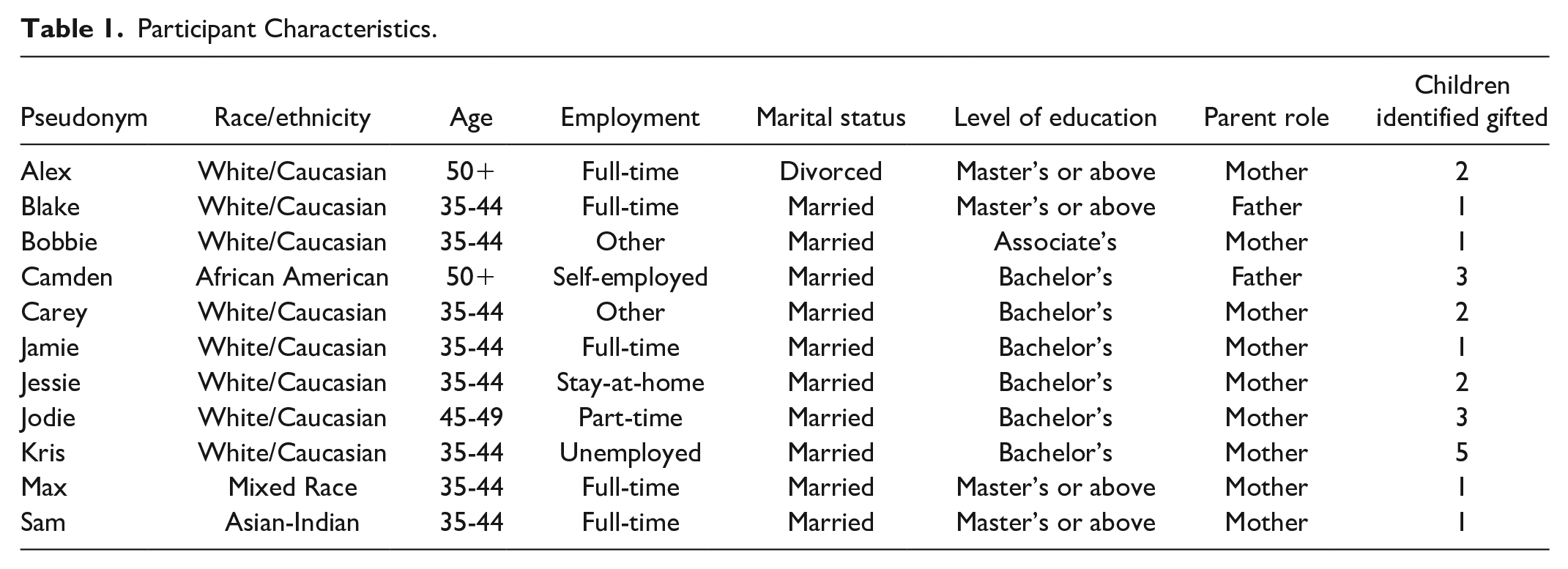
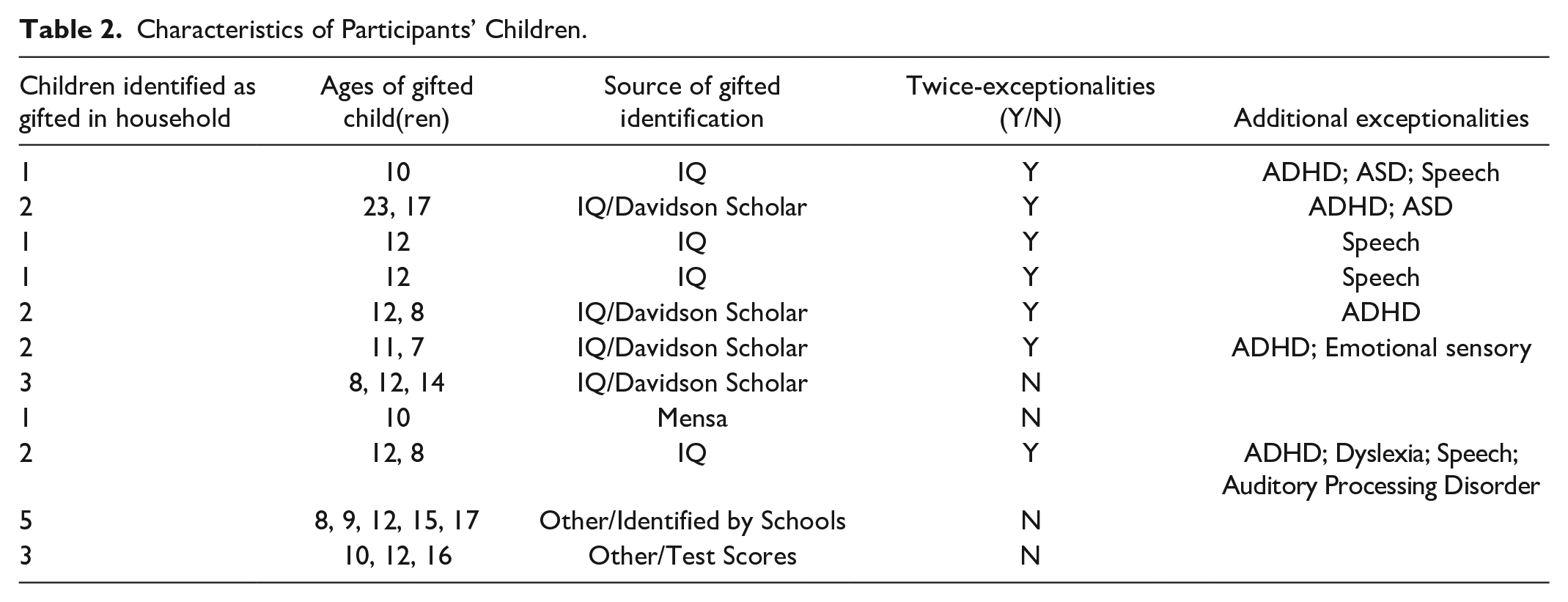
Demographic information is shown in Table 1. Eleven parents participated in the study (n = 11). Two participants, parents of the same child, opted to interview together. Characteristics of participants’ children identified as gifted are shown in Table 2.
Participant Characteristics.
Characteristics of Participants’ Children.
Research Procedures, Instruments, and Data Collection
Before participating in an interview, each participant completed an online survey with demographic questions and the Parenting Sense of Competency Scale (PSOC; Gibauhd-Walsten & Wanderson, 1978; Ohan et al., 2000). The PSOC scale is a 17-item questionnaire using a 6-point Likert-type scale ranging from “strongly disagree” to “strongly agree” to measure parenting self-esteem based on two factors—satisfaction and competency—with nine of the items reverse scored. The internal consistency of the PSOC is reported as .75 and .76 for satisfaction and efficacy, respectively (Johnston & Mash, 1989). This form was used to guide conversations during the semi-structured interviews. For example, parents’ responses on the form were useful for asking individualized questions specifically related to the response (e.g., can you tell me more about your response to the following question: “Even though being a parent could be rewarding, I am frustrated now while my child is at his or her current age”).
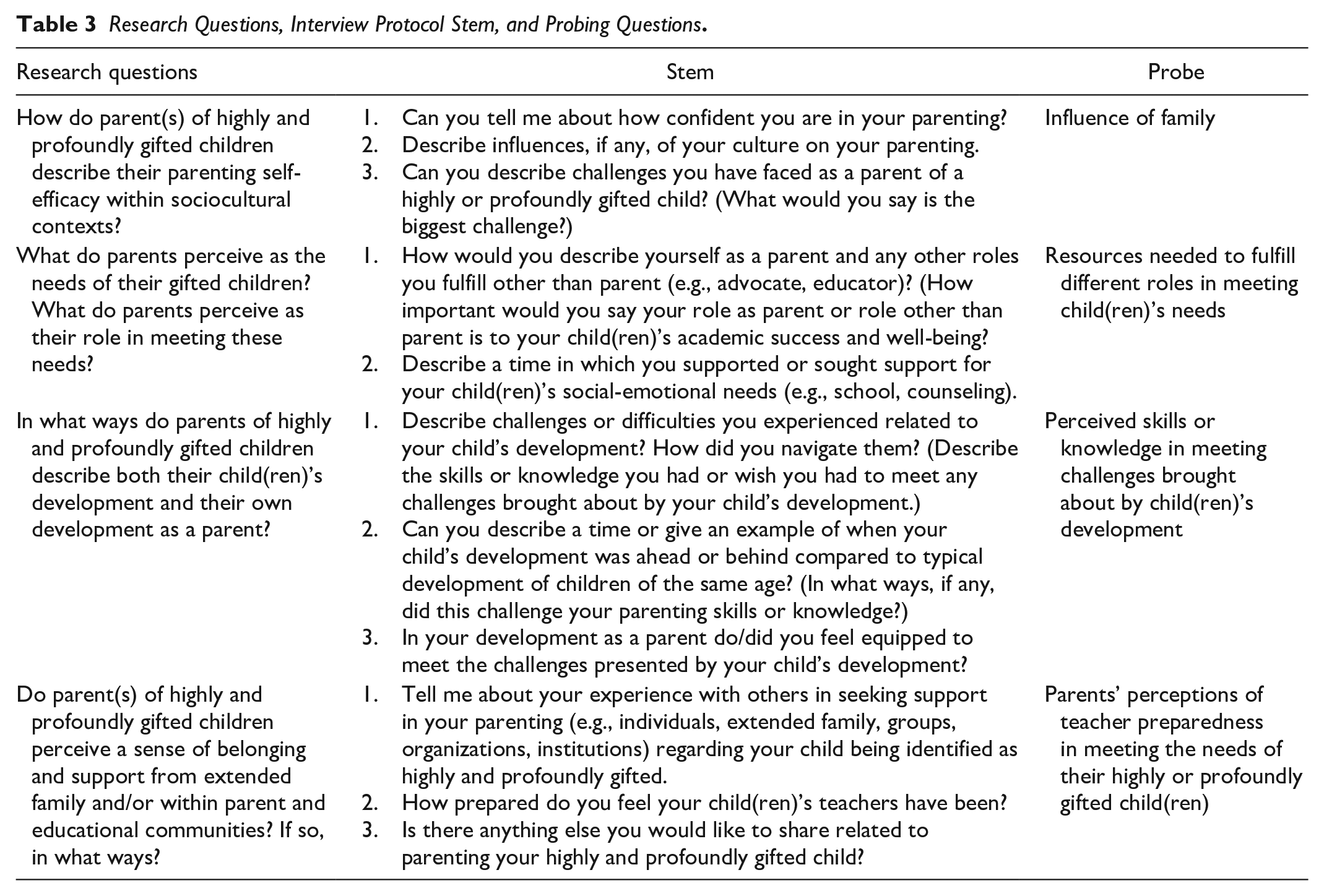
Participants were then scheduled for online interviews using a semi-structured interview protocol. The questions were open-ended allowing participants to share their experiences and perspectives as parents of HG/PG children specifically related to (a) a sense of belonging and support; (b) confidence and competence related to parenting decisions, attitudes, and behaviors, (c) roles fulfilled by parent; and (d) influences on parenting competence and confidence. Follow-up questions were used to probe as needed to gain additional insight following participants’ initial responses. Table 3 contains research questions and probes.
Research Questions, Interview Protocol Stem, and Probing Questions.
At the beginning of the interview session, following McNamara’s (2009) principles, participants were provided with the purpose of the interview, the expected length of the interview, and an opportunity to ask questions. Interviews ranged from 60 to 90 min and were recorded and transcribed via Zoom. Interview transcripts were derived from automated transcription recordings using Zoom and manually corrected for errors. After interviews were anonymized, a copy of the interview transcript was sent to participants for member checking and for the opportunity to add any additional details they would like to include (Candela, 2019; Turner, 2010).
Data Analysis
A six-phase thematic analysis method was used as outlined by Braun and Clarke (2006), which includes the following: (a) familiarization with data corpus, (b) code generation, (c) theme development, (d) theme revision, (e) theme organization, and (f) reporting. Open coding was also used to allow for emergent codes as guided by theoretical and conceptual understandings related to the research focus (Braun & Clarke, 2006; Saldaña, 2016). A first and second round of coding occurred to capture initial codes and conceptual codes, respectively (Freeman, 2017; Saldaña, 2016). Once each coder finished applying codes independently, the coders met to discuss and finalize codes. Any discrepancies were resolved through an iterative process of discussion to achieve interrater agreement.
Following close examination, the data were organized for common themes. A code matrix was then created to visually represent the codes and categories used in the analysis (Kuckartz, 2014). A qualitative analysis software program, Dedoose, was used for data management, coding, and analysis (Dedoose, 2022).
Demographic information, participant profiles, and emergent themes were analyzed to understand the lived experiences and perspectives of participants regarding parenting HP/PG children (Braun & Clarke, 2006). Participant demographics and information regarding parents’ sense of competency in their parenting ability were initially collected from the online survey to triangulate the data, to familiarize participants to the study’s aim, and to better understand the parenting experiences (Creswell & Poth, 2018). Optional open-ended questions included opportunities for parents to provide information regarding their children’s ages if none of the provided options fit. Finally, quotes used from transcripts were edited to remove any filler, unnecessary, or repeated words in a series to help with ease of understanding (Bucholtz, 2007).
Researcher Background
In qualitative research, subjectivity can be a factor based on the topic and interactions between participants and the researcher (Clarke et al., 2015; Merriam & Tisdell, 2016). In this case, the authors are familiar with parenting in this context. The authors have worked with students who are gifted and/or their parents. In addition, all the authors have participated in and conducted qualitative and quantitative research and brought this knowledge and experience to the current study. Two of the authors are faculty members in gifted education. One of the authors is a postdoctoral researcher in gifted education. One of the authors is an advanced doctoral student. All of the authors are parents, including the parents of twice exceptional and/or HG/PG children.
Trustworthiness
To ensure the rigor and trustworthiness of this qualitative study, we used the following criteria as a guide: credibility, dependability, confirmability, and transferability (Guba, 1981; Noble & Smith, 2015; Nowell et al., 2017). To practice reflexivity, a journal of thoughts, reflections, and decision-making processes was kept through the data collection and analysis. As the researchers in this study have personally experienced aspects of the phenomenon under investigation, reflexivity was practiced throughout this investigation to address prior assumptions that may have been present (Roulston, 2010).
In addition, debriefing, member checking, and triangulation of data were used to maintain appropriate research rigor (Noble & Smith, 2015). Specifically, we examined PSOC survey responses, interview responses, and information regarding gifted identification. We also incorporated evidence (e.g., excerpts and quotes) from the interviews to support a priori and emergent themes as appropriate (Tracy, 2010).
The use of member checking (i.e., participant validation) in qualitative research was used to maintain the credibility of participants’ recorded responses (Candela, 2019). In addition, survey responses from the PSOC were scored to corroborate qualitative data from participants’ open-ended responses to interview questions (Braun et al., 2020). This additional step helped to increase the overall trustworthiness of the findings (Shenton, 2004). The two coders also participated in an interrater reliability test conducted using Dedoose tools to ensure interrater reliability and increase trustworthiness. To discern agreement between the two coders, Cohen’s κ was calculated and found to be within McHugh’s (2012) suggested Cohen’s κ of > .81 and within the accepted range of .61 to 80. The results of the interrater reliability test indicated a mid to high level of agreement between the coders with a Cohen’s κ value of .70.
Findings
Semi-structured interviews with 11 parents resulted in eight overarching themes including the following: (a) parenting self-efficacy within sociocultural contexts; (b) parenting sense of confidence and competence; (c) parents’ roles in meeting the needs of their HG/PG children (e.g., advocacy, educator, curator, researcher); (d) parents’ decisions and actions related to their children’s giftedness including frustrations, challenges, feelings of guilt, and parents’ own experience being identified gifted; (e) parent and child development; (f) sense of belonging and support from communities; (g) impact of COVID-19 pandemic on their child’s gifted education; and (h) resources needed to facilitate their children’s social-emotional and academic needs. The findings noted in this study are presented in the order of the research questions.
Descriptive Findings
Scores on the PSOC can range from 17 to 119. The higher scores correspond to a greater sense of competency. We used the guidelines for the instrument to gather information regarding parenting sense of competence. Responses to the PSOC items were used to guide conversations during the semi-structured interviews by providing participants an opportunity to share additional information based on their survey responses. The use of the survey in this qualitative study helped to garner rich data (Braun et al., 2020). Participants’ scores in the current study ranged from 53 to 84, with a mean of 67.90 (SD = 10.76) which is slightly below average. Specifically, six participants scored below the group mean, and five participants scored above the mean. Within the sample, all participants (n = 11) reported being a parent of at least one gifted child.
Thematic Findings
A list of themes and subthemes is shown in Table 4. Some themes were directly related to the research questions and other themes emerged during the interviews. The codes and descriptions are included to provide further insight into the themes and to provide context based on the frequency of participants’ responses related to the research questions.
Overarching Themes, Codes, Code Description Examples.
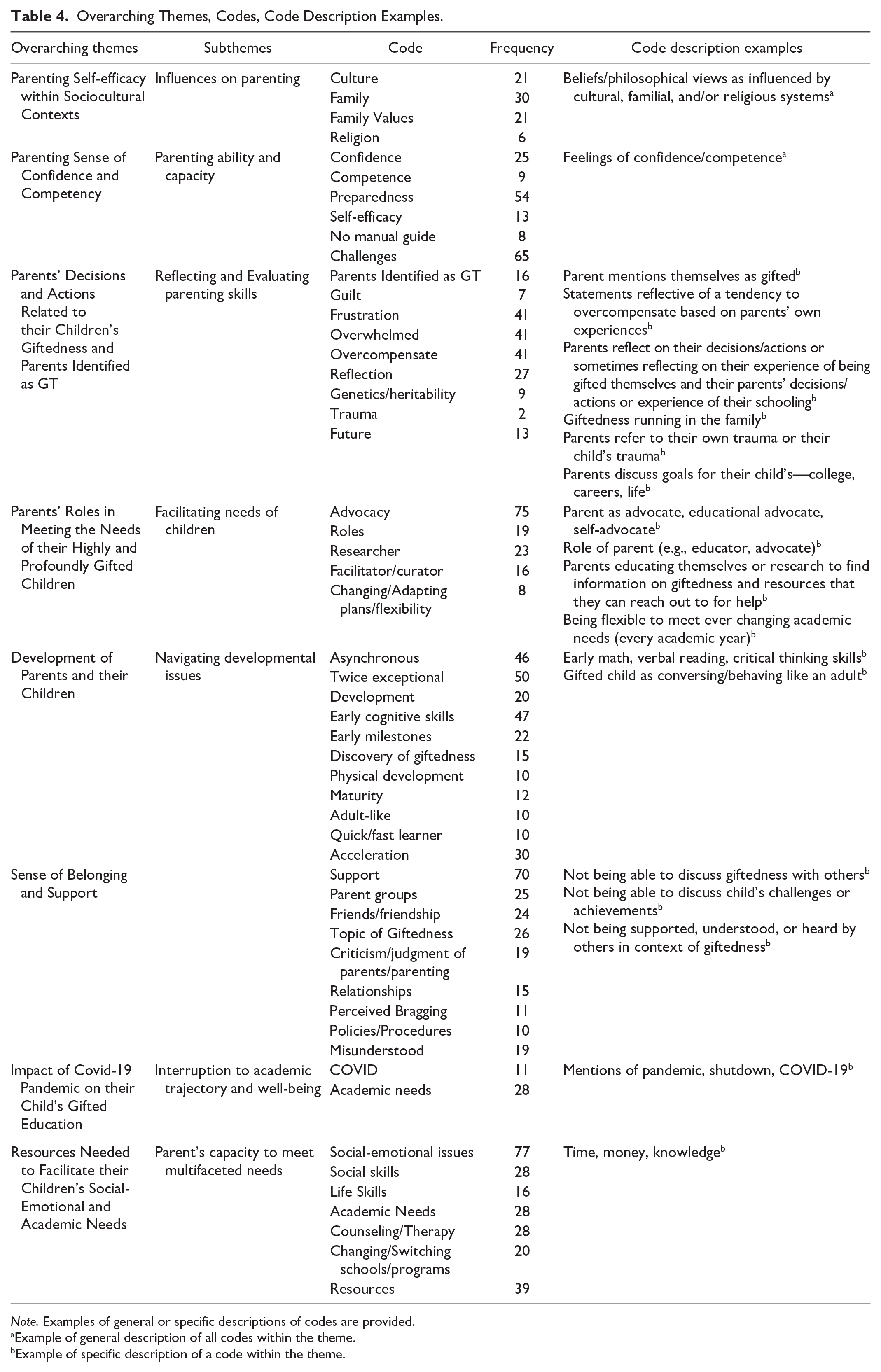
Note. Examples of general or specific descriptions of codes are provided.
Example of general description of all codes within the theme.
Example of specific description of a code within the theme.
Parenting Self-Efficacy Within Sociocultural Contexts
In describing culture, 10 participants referred to their societal culture and/or their family culture. Participants referred to race/ethnicity, geographic location, and/or religion when discussing the influence of culture. When discussing family culture, participants referred to their family of origin (e.g., immediate family members such as one’s parents, siblings, etc.) and its influence on their parenting. This included family values that influenced their parenting decisions and actions. Sam, a mother of a profoundly gifted child, described the influence of racial/ethnic culture on educational values stating, “I and my husband are Indian, we are born and raised in India, so typically, education is the most important thing when you’re in school, so I think we do value education a lot” (Individual Interview, September 6, 2022).
Three participants mentioned not having culture due to belonging to the majority culture in the United States. Alex, a parent of two highly gifted children, stated, “I feel like I’m in the category, dominant culture which is kind of a non-culture” (Individual Interview, August 22, 2022). Another participant noted the influence of being raised in a particular geographical location noting, “I grew up in a small town in the Midwest, and there weren’t a lot of opportunities where I grew up” (Individual Interview, September 22, 2022). Jodie, a parent of a profoundly gifted child, noted the influence of religion in parenting stating, “We’re Christian so, that certainly guides some of our parenting” (Individual Interview, September 1, 2022). Ten participants also referenced how they were parented while growing up as being an influence on their parenting. One participant noted that her dad was “authoritarian” (Individual Interview, August 31, 2022). Another participant mentioned how being a part of the majority culture influenced their values that guided parenting stating, “I think as with any sort of standard issue White American, we have great support from an educational perspective in terms of education is valued culturally by White Americans” (Individual Interview, August 20, 2022).
Parenting Sense of Confidence and Competence
Parents of HG/PG children described their parenting self-efficacy as being challenged due to navigating issues specifically related to parenting a gifted child. Parents perceived their feelings of competence and confidence as enhancing or inhibiting their parenting decisions in the context of their child’s giftedness. Parents who felt confident expressed doing the best they could while parents who felt less confident expressed being unsure if they were doing what they should be doing and doubts about whether or not their parenting was good enough.
Two participants described their parenting or personal philosophy. This was mentioned as a guiding principle that helped them in their parenting decisions. Jamie described her personal philosophy when advocating educationally for the needs of her gifted child stating, “As far as school goes, it’s up to me, I gotta do it all, so, it’s kind of just been my philosophy where I don’t mind asking the hard questions because if I don’t do it, nobody else is” (Individual Interview, August 17, 2022). Kris stated the following:
I try [to] teach them to be respectful and kind, and follow the rules, but it doesn’t mean you have to do it because it’s a rule. There’s a choice. That’s my personal philosophy, there’s pretty much always a choice. (Individual Interview, September 22, 2022)
All of the participants indicated having mixed feelings about confidence in their parenting. Four participants mentioned being surprised if anyone could answer that they are confident in their parenting. Four participants mentioned feeling confident that they are doing their best based on what they know. For example, Blake, a married father of a gifted child, described having confidence in the following way:
I believe that when we look at what we’re doing to do what’s best for him, I don’t think our confidence level is there based upon are we making the right decisions. What are the right decisions? Where, what guidance do we have? And there’s very little guidance out there to parent some gifted kids. (Individual Interview, August 25, 2022)
Blake also described how others seemed to perceive what it means to parent a child who is highly or profoundly gifted sharing the following:
I think a lot of people look at it and say, oh, you’re very lucky to have such a smart kid that you don’t have to worry about. . .It’s the other end of the spectrum. There’s just as many problems and issues that we have to deal with on this side that the challenge is that we don’t know if we’re doing it right. We don’t know what the guidance is. (Individual Interview, August 25, 2022)
When discussing the challenges of knowing when and how much to push HG/PG children, Carey stated the following:
Trying to figure out how am I going to pay for college if she has to start college at twelve, especially getting her in the right academic setting. It’s impossible sometimes to know if you’re doing it right, because you don’t want to push too hard. Well, for God’s sake, she’s in calculus. How can that not be pushing too hard? (Individual Interview, August 31, 2022)
Five participants mentioned having no manual or guidebook to help parents of HG/PG children. Specifically, Carey stated, “Any thinking parent knows, you have no clue, but particularly this, there’s no manual” (Individual Interview, August 31, 2022).
Parents’ Roles in Meeting the Needs of their Highly and Profoundly Gifted Children
Parents perceived their gifted children’s needs as multifaceted and their roles in meeting those needs as integral to the success of their children in those respective areas. The roles parents felt they fulfilled included educator, advocate, facilitator, curator, counselor, and tutor. Participants described being their children’s educators when facing difficulty in finding a good educational match. Two participants mentioned leaving their employment to facilitate their children’s academic needs. While some parents noted that their occupation was in education or an education-related field, other parents mentioned not being an educator and the unanticipated challenges they encountered while fulfilling the role of educator. For example, Alex stated the following about stepping into the role of educator, “So, I was her educator. The first year, I was her only educator which was absolutely terrible. [It was] so much better when I had classes for her to take because I’m not a teacher” (Individual Interview, August 22, 2022). When asked about fulfilling roles beyond parenting, Jodie stated the following:
Oh, definitely parent, advocate, and educator, all of them. I’ve been an educator, but I don’t teach certain subjects. I don’t know math or chemistry at the level he was at. In that case it was more my job to find the resources needed so that he could learn at his level with a challenge and high quality. I [was] a facilitator kind of person at that point, or a researcher, looking for where and when and who, that kind of thing. (Individual Interview, September 1, 2022)
Jodie went on to describe the many “steps” of facilitating HG/PG children’s academic needs concluding that “it’s a job that somebody’s got to figure out. . .you can’t just open the door to the regular down the street public school and be like, that’s gonna work. All of a sudden you become a lot more” (Individual Interview, September 1, 2022).
Participants mentioned the time and knowledge required of them to be able to successfully advocate. Three participants described their experience in bringing information from gifted literature and research articles to teachers and schools only to discover it was not well-received. Blake stated the following:
So, it doesn’t happen, you know, like these books tell you to do certain things when you do them, nobody cares. I think that’s when we stopped bringing the books, I mean, I hate to be like that. (Individual Interview, August 25, 2022)
Another participant described attempts to share gifted information with teachers during their child’s elementary years but noted that they stopped sharing information as their child got into higher grade levels. Jessie stated the following about advocating for gifted children, “when you’re working with public schools and the districts and you’re trying to advocate for gifted kids, it’s like advocating for beautiful people” (Individual Interview, August 30, 2022).
In addition, Jodie alluded to the amount of time spent looking for resources to address the changing needs of HG/PG children stating, “so, so many hours” (Individual Interview, September 1, 2022).
Eight participants described having to research information on their own regarding giftedness to educate themselves about what it means to be gifted. Parents made the following statements about personal research and self-education to meet the needs of their HG/PG children, “we are just trying to keep ourselves educated for what we need to do with him” (Individual Interview, August 25, 2022) or “having these kinds of kids is not that common, so, we just try to educate people” (Individual Interview, September 6, 2022). Max, a mother of a profoundly gifted child, expressed that having a background in education and development was helpful but was not enough to feel completely prepared for the knowledge needed in knowing how to parent HG/PG children stating:
I live in a little bit of a world that deals with child development and education. I knew enough to learn how to figure [it] out, but I think that he has thrown us for more of a loop than we anticipated. (Individual Interview, August 25, 2022)
Seven participants referred to themselves as needing to be the facilitator or curator of their children’s education and meeting their children’s present and future needs. For example, Kris said:
Now today, right now, I feel relatively confident in understanding. . .what to look for and where to advocate for my kids and where to push them, how they think about the world. What happens after school? High school? I think about this, what kind of challenges might they face? (Individual Interview, September 22, 2022)
Another parent stated concerns about the future saying, “What are we going to do? And you think about that the entire time in your mind. How are we going to get there?” (Individual Interview, September 1, 2022).
Parents mentioned that they felt the roles they fulfilled were “very” important to ensuring their children’s academic, social-emotional, and psychosocial needs were met but that fulfilling the roles beyond parenting “does not always come naturally” (Individual Interview, August 25, 2022). Max stated the following regarding the role of meeting her son’s academic needs:
I feel like my role is more organizer of resources for him, so, the GT tutor, the different things he’s participated in that we thought would be fun or challenging for him, tried to present those opportunities, making sure he has books on his Kindle to read that are somewhat appropriate, that kind of thing. (Individual Interview, August 25, 2022)
One of the challenges parents mentioned in meeting their children’s needs included the variety of, and sometimes changing, interests of their children and trying to facilitate those interests.
Four participants specifically mentioned that their ultimate goal for their children was for them to be kind, happy individuals. While five participants mentioned goals related to their children having life skills to be able to “function in the world” and being a “functioning adult.” For example, Jessie stated, “But one of the things that gives me confidence is, I’m raising gifted people who are going to be able to survive and thrive in a world where they are exceptionally gifted, and the rest of the world is not” (Individual Interview, August 30, 2022).
Parenting Decisions and Actions
When asked about parenting decisions, seven participants reflected on their decisions and actions and things they wish they had known or had done differently. Jessie, a parent of two profoundly gifted children, commented, “I guess that some days that I wish I had realized sooner that they were different” (Individual Interview, August 30, 2022). Alex discussed feelings of regret and not being ready for challenges related to parenting HG/PG children stating, “I’m never ready, that’s the problem. The problem is, I’m never ready for the challenges that [are] in front of me” (Individual Interview, August 22, 2022).
Feelings of Guilt
Four participants referred to feelings of guilt or remorse regarding their parenting decisions and actions in the context of their children’s high and profound giftedness. For example, when speaking of challenges related to school, Kris remarked, “I feel really guilty because I didn’t understand the scope of how it was until closer to the end of the year” and “I wish as parent I had paid more attention to those sorts of things” (September 22, 2022). Similarly, Alex stated, “With my daughter you know, I have a lot of regrets that are like 20/20, I wish I had known sooner; I wish I had understood what gifted learning styles were; I wish I had understood Autism more” (Individual Interview, August 22, 2022). Bobbie mentioned the guilt regarding challenges related to twice-exceptionalities stating, “I wish I had known sooner the struggles [she] was having with reading” (Individual Interview, September 21, 2022). Another parent discussed feelings of guilt saying, “It’s a challenge, it really is. It’s frustrating. It gives you a lot of guilt feelings a lot of the times” (Individual Interview, September 6, 2022). Carey described the feelings of not doing enough compared to other parent group members stating the following:
But the last couple of years, I almost really felt guilty about not getting him involved in different things, because I just felt like it was overwhelming to see what other parents are into; their kids are doing these languages, these homeschools, all the different types of things. (Individual Interview, September 6, 2022)
Challenges and Frustrations
Nine parents mentioned frustrations, either their own or their children’s, regarding issues related to giftedness. Frustrations included inflexible school policies and procedures that were prohibitive to students’ identification, services, and/or participation in gifted programming; communication with teachers, schools, and/or administrators that indicated limited understanding of students’ academic needs and/or an unwillingness to facilitate specific academic needs related to students’ giftedness; feelings of being misunderstood or dismissed when trying to advocate; and lack of support. Carey mentioned frustration with their child’s school following changes in schooling due to the pandemic stating, “I’m frustrated because I feel like they’re just looking at his test scores, and they’re not taking into account his specific emotional distress last year, combined with seeing his work. Also, he didn’t have an advocate” (Individual Interview, August 31, 2022).
Testing was referred to numerous times during the interviews in the context of challenging experiences. Nine parents referred to testing (e.g., IQ tests and creativity tests), often mentioning their child/children being tested multiple times for placement in a school, a gifted program, or a specific class. Parents expressed frustration about the challenge of changing schools with the new school not accepting gifted identification criteria from their child’s previous school. The re-testing was described as exhausting, expensive, and redundant.
Parents Identified as Gifted and Talented
Seven parents mentioned their own experience of being identified as gifted during K–12 as they reflected on its influence on parenting their own highly or profoundly gifted child. In addition, six parents mentioned giftedness being in the family either through themselves or relatives. Parents reflected on being identified as gifted when they were in school. One parent relayed her decision to never allow her children to be accelerated in school due to her own negative experience with being accelerated and the bullying that occurred as a result stating, “Definitely my experience with grade skipping has influence my strong aversion to doing it for mine” (Individual Interview, August 31, 2022). Participants reflected on how their own parents responded to their gifted identification and how little was known or at least explained about what it meant to be gifted at the time they were identified.
Development of Parents and Their Children
Six participants noted their own developmental trajectory as parents reflecting on things they wish they had known or done differently. Some participants shared their own experiences from childhood and how they were parented. Alex specifically noted, “I wish I had spent a little more time being family-focused, what are the needs of the family other than what it means to the kid” (Individual Interview, August 22, 2022). Another parent reflected on how they’ve changed as a parent noting, “I mean with five kids, there’s a lot going on, but I guess it’s–your kids get good grades, and they’re fine, and it’s so much more than that” (Individual Interview, September 22, 2022).
When asked about the development of their children, participants mentioned noticing early alertness at birth. For example, Carey, a married mother of two profoundly gifted children, described development of one of the children in the following way:
She was always advanced in everything. She was alert from birth. She was lifting her head very early, [she] lifted her head the day she was born. . .I remember the nurses remarked about how alert she was, even right after birth. (Individual Interview, August 31, 2022)
In addition, Carey remarked on other early milestones before the two children were identified as gifted stating the following:
I just thought my kids were weird. I had no idea that was that unusual. She walked super early. I think she took her first steps at eight and a half months, and I didn’t know that that could be related. She talked early, she didn’t read as early as a lot of PG kids, actually, but she memorized books very early. (Individual Interview, August 31, 2022)
Other parents also referred to noticing early milestones including Alex who said this about her gifted child, “As soon as she started talking, that’s when we knew she was [gifted]. I guess I would have just called her precocious or something like that before we knew she was gifted, and everybody commented on it” (Individual Interview, August 22, 2022).
Participants discussed the point at which they discovered their children’s giftedness. The early development was sometimes mentioned in conjunction with a developmental delay such as speech or verbal delay. Six participants described their child as having more than one exceptionality. For example, Jamie mentioned that her son was advanced in math when entering kindergarten, but he did not know the alphabet. Another participant mentioned her daughter’s early physical milestones (e.g., early walking and fine motor skills) and delayed speech. In several instances, parents described searching for answers only to discover twice-exceptionalities existed, such as speech delays, dyslexia, and/or ADHD in conjunction with high or profound giftedness. Alex stated the following regarding the challenge of distinguishing giftedness with other exceptionalities:
We had to re-evaluate at age six looking for weaknesses and challenges and her profile, and they came back again with highly gifted but a lot of potential issues that they were like, we can’t really tell what they are—maybe she’s on the spectrum, maybe she has ADHD, maybe she has all these things. She’s just so complicated, we can’t figure her out. Then at nine she was diagnosed with autism. (Individual Interview, August 22, 2022)
Carey mentioned her child being given a “working label” of twice exceptional and exceptionally gifted (Individual Interview, August 31, 2022). The parent was waiting to hear more nuanced results from the neuropsychologist and described her child as an “enigma” to professionals who were trying to identify and disentangle giftedness with other exceptionalities. Bobbie mentioned her twice-exceptional child as being described as “unique” by psychologists, doctors, and teachers (Individual Interview, September 21, 2022).
Parents also described their HG/PG children as experiencing asynchronous development. Parents noted the ways in which asynchronous or uneven rates of development impacted their parenting or brought about challenges at home and/or in the classroom. For example, Jamie stated, “he’s just bored, like, it’s not that he’s bothersome, and I think teachers didn’t understand it” (Individual Interview, August 17, 2022). When asked about parenting challenges related to development, Bobbie said, “I think the biggest thing for me with my daughter was the asynchronous development and seeing how fast her motor skills were going while how far behind her verbal skills were” (Individual Interview, September 21, 2022).
Four participants mentioned having adult conversations with their young children noting that intellectual ability was sometimes misaligned with the appropriateness of the subject matter of the issues being discussed. This included conversations about societal issues perceived by their children. For example, Jamie, a married mother of a profoundly gifted child, described the challenge of not knowing how to answer her child stating, “there’s the adult answer, and there’s the ten-year-old answer, and I go somewhere in between, and we’re just like how appropriate is this for him because he’ll ask more questions if it’s not up to par” (Individual Interview, August 17, 2022).
Participants mentioned having to Google answers to their HG/PG children’s questions. Jamie said, “like, he asked us questions that we have to Google, he is very much outside the box, it’s like an adult child” (Individual Interview, August 17, 2022).
Parents mentioned dealing with maturity/immaturity of their children and the challenges brought about by this including their children preferring being in company and conversation with adults rather than their peers. Max, a married mother of three, mentioned how their child, who is identified as profoundly gifted, set the temperament of their home while referencing the intensity that could be experienced.
Participants discussed social challenges of their children that challenged their parenting skills. While discussing the impact of acceleration on these challenges, one participant stated, “So, there were social challenges, but once we had the grade acceleration, much of those went away for both kids” (Individual Interview, August 30, 2022).
Five participants also discussed their concerns over their HG/PG children coming up against an academic challenge for the first time after being accustomed to things coming easy to them. For example, Kris, a parent of five children identified as HG/PG, described the experience of one child avoiding school work because of facing something that was academically difficult for the first time stating, “we found out when he was failing because he just wouldn’t do the work because it was hard, and so instead of addressing it, he just ignored it because up until that point everything had been easy for him” (Individual Interview, September 22, 2022). Carey described the concern of preparing HG/PG children for encountering challenges for the first time stating, “then you have things like if they’re not used to having to try, but then the first time they have to try, that’s a big deal” (Individual Interview, August 31, 2022). Another parent faced challenges regarding the pace and interest of schoolwork and shared following statement:
The things that will take other kids a lot of time to study for, he gets it down pretty quickly as long as he likes the subject. But if he doesn’t like it, it’s not gonna happen. It’s really, really hard to make him realize, okay, you need to study for all the subjects. (Individual Interview, September 6, 2022)
All of the participants expressed concerns related to social-emotional issues or social skills. Concerns were raised over social interactions, finding like-minded peers, being able to have a childhood, and learning to deal with conflict resolution. For example, Max described a heightened sense of injustice that resulted in intense “meltdowns” (Individual Interview, August 25, 2022). Another participant noted that her profoundly gifted child was not “socially mature enough to handle [some things]” (Individual Interview, August 17, 2022). Two participants described how their children struggled during group work and worked better independently. Alex shared the following description:
So, academically, again, totally fine, socially and emotionally, really a lot of problems, how to manage the anxieties and stresses of not even doing her homework or something like that or just making sure she fed herself well. It is still challenging me because socially [and] emotionally, she is very atypical. (Individual Interview, August 22, 2022)
Sense of Belonging and Support
Parents perceived finding belonging and support among extended family, friends, and other parents as difficult. Seven parents described their relationships and interactions with family, friends, other parents, groups, teachers, and schools. Six participants specifically expressed the need to be listened to, believed, understood, and supported and needing a safe space to talk about their children. Participants described feelings of loneliness, being lonely, and not being able to talk about their HG/PG children with others, even within the gifted community or among other parents of gifted children. Participants also described seeking help from other parents of gifted children, gifted organizations, and Facebook groups. They described their attempts to get help or advice and the difficulties they had in finding a safe place to talk about their children or relate to others who did not have the same parenting challenges experienced by parents of HG/PG children. When discussing feelings of loneliness, Jessie stated that “it’s so much more isolating, because then you’re in a community of peers who really should understand” (Individual Interview, August 30, 2022). Jessie also shared the following regarding loneliness experienced when trying to connect with other parents of gifted children:
So, just the hardest thing is definitely the loneliness and compounding the loneliness is even in a group in which I should find solidarity as a mother of exceptionally gifted children, I don’t, except for very few people, so it’s like a niche of a niche. (Individual Interview, August 30, 2022)
Max, a mother of a profoundly gifted elementary student, referred to having difficulty finding a community of people who can relate to parenting HG/PG children. This mother stated that “it’s kind of a lonely group. We don’t know of a great community that we could talk to about it” (Individual Interview, August 25, 2022).
Family and Friends
When speaking about the support of friends, some participants discussed the challenges they faced maintaining friendships and not having the support of friends, and in some cases, losing friends due to their children’s giftedness. Jessie described the following challenges of feeling isolated and misunderstood:
So, challenges, it’s just the loneliness, the isolation, advocating when you’re advocating for somebody who nobody wants to give anything to, because they think they have the world, and they don’t understand that there’s challenges that come with that. (Individual Interview, August 30, 2022)
Kris said, “I’ve told my husband that we have each other when we talk about these things, but there’s no one else that we know of who could relate” (Individual Interview, September 22, 2022).
Another participant, Carey, also mentioned the challenges of bringing up giftedness to other people saying, “People have this attitude either an elitist attitude from people who are not gifted or ironically, I can’t even talk about it with other gifted families unless they’re PG because it becomes a competition” (Individual Interview, August 31, 2022). Not being able to talk about their children or their children’s accomplishments was seen as another way parents felt alienated from others. For example, Jessie said:
I just want to say again how isolating it is, how you have these kids that are incredible humans, and you’re so excited by them and [want] to share their accomplishments in the same way that somebody would share their kid winning a first-place medal in a swimming race, or a football trophy, or a debate tournament. (Individual Interview, August 30, 2022)
Parenting and Educational Communities
Participants described finding others who could relate to their experiences. For example, Jodie said, “One challenge early on, was finding parents who are going through the same things” (Individual Interview, September 1, 2022).
Participants described the challenges of finding a fit or support even within the gifted community. While parents discussed how helpful it was to have a place to connect, they also brought up the challenges even within these communities designated specifically for families of gifted children. Parents described feeling judged, criticized, or misunderstood both inside and outside the gifted community. For example, Jessie made the following statement:
But in the gifted community, and probably a lot of people that you talk to, and especially in the highly and exceptionally gifted community. Everyone’s first answer for anything that goes wrong is you should be homeschooling your kid, and that is not an option for my family. I am the breadwinner. (Individual Interview, August 30, 2022)
Nine participants mentioned not being able to talk about their HG/PG children to other people. Specifically, participants mentioned that talking about their children was interpreted as bragging by those who did not understand their child’s giftedness or were unwilling to acknowledge it. For example, Sam stated the following:
I don’t know if it is a taboo thing, but sometimes, when you have a gifted kid, it’s almost like when you’re trying to talk to other people who don’t have kids like that, it comes out as you’re like bragging, which you’re not really bragging, you know. There are certain things that you want to say about your kids, but it kind of becomes awkward because they’re like, oh, yeah, yeah, you know. I mean, they don’t want to discuss [it] further. (Individual Interview, September 6, 2022)
Carey, a parent of two profoundly gifted children, stated it this way, “So, you learn really quick when you have a [profoundly gifted] PG family, you can only really talk about it with another PG family” (Individual Interview, August 31, 2022).
Eight participants referenced feeling judged or criticized by others for their parenting decisions or actions. Criticisms came from extended family, other parents, and school personnel. Parents described having to request and at times demand meetings at their child’s school and the challenges of “proving” that their child had specific academic needs to be met. Alex described the challenges faced at the school level stating:
The administration I felt like treated me like I was a helicopter parent, like I wanted my kid to be special like I wanted her to be able to take a college class when she was in first grade, like I was whining because I wanted her to get age-appropriate material. I just wanted her to stop being kicked out of class, and I was really not supported. (Individual Interview, August 22, 2022)
Teachers
Attitudes toward teachers were mixed with some participants describing difficulties in getting support from teachers while others described attentive, supportive teachers who offered solutions in helping parents. Carey stated, “I think educators need to understand that giftedness does not just mean on their exam, that it can show up looking like [other] things” (Individual Interview, August 31, 2022). Ten parents described a mix of experiences with their children’s teachers. For example, Blake, a married parent of a profoundly gifted child, described feeling lucky to find that some teachers were good but also noted that while teachers often recognized their son’s giftedness, there was not necessarily anything beyond the recognition. Blake said:
We got lucky; we’ve had probably about half of his teachers I feel like are prepared. His kindergarten teacher was fantastic. Some of his pre-k teachers I thought were really good and understood it, recognized [giftedness] early on. First and second grade, they feel like they’re breaking this incredible news to you, and how lucky you are, “we have some really good news for you, we’ve got his test scores back, and they’re really good.” Yes, great, so, what do we do with that information? And that’s sort of where it stopped. (Individual Interview, August 25, 2022)
Similarly, Camden, a parent of three gifted children, mentioned a lack of preparation among some of his children’s gifted teachers stating, “we didn’t even know who the gifted teacher was, we weren’t invited in” and contrasted that with one of the children’s first gifted teachers who was very prepared and helped students “get on the right path” and “challenged them” (Individual Interview, November 1, 2022).
Schools
Seven participants described challenges in finding a good academic fit for their children. For example, Blake said, “it’s like there is no perfect solution” (Individual Interview, August 25, 2022). One commonality among many of the participants is the realization they had about staying flexible and open to change to meet their child’s needs. This involved school meetings, testing, changing schools, or being willing to be at their child’s school regularly to stay in communication with the school on how to best meet the ongoing, and ever-changing academic needs of their children. Parents discussed grade-skipping, acceleration, and specialized programs for gifted students. Regarding finding a good academic fit, Jodie stated, “understand that the school isn’t built for them at all, and just dropping them in and hoping the school’s going to do their thing, is not going to happen” (Individual Interview, September 1, 2022). Carey mentioned making several attempts to work with a specific school or program to make it work only to disappointingly discover that it is not a long-term fit. Bobbie noted that “every year is different” and discussed the different experiences. For example, a school or teacher may have been great for one grade but not for the next, or grade skipping was not an option at one school, or a program/curriculum was not providing the appropriate challenge.
School Administration
Participants shared their experiences with navigating school systems. One participant mentioned the challenges of retesting due to schools having different criteria and eligibility for their gifted programs. Five parents mentioned their children having to work alone while at school because the school could not provide the curriculum or academic programs needed by their children. This resulted in children sitting alone set apart from other students. Parents expressed the tension between facilitating the appropriate academic rigor for their HG/PG children and concerns over their social-emotional well-being.
Impact of COVID-19 Pandemic
Four participants noted the impact of the pandemic on their children’s education. In some cases, parents referred to “COVID” as having a negative impact regarding social-emotional issues while other parents mentioned how the change in the educational format worked to their children’s advantage regarding pacing, grade-skipping, and acceleration. For example, Sam referred to concerns over making sure her son stays connected with others. Specifically, Sam referred to efforts made to ensure their profoundly gifted son had opportunities for social engagement and described how the pandemic made this particularly challenging stating that “Things are kind of slow because of the COVID, but now they are picking back up again, so whatever we can, we just want him to feel like he belongs to a group” (Individual Interview, September 6, 2022). COVID-19 was also mentioned as impacting both the academic and the social-emotional well-being of students. Camden, a parent of three gifted children, specifically mentioned social-emotional concerns stating, “It was during COVID where I felt like there was a need for some kind of emotional support for all the kids” (Individual Interview, November 1, 2022). Kris, a parent of five children identified as HG/PG, described children moving from one grade to another during the pandemic and how this impacted her highly and profoundly gifted son:
He was in fourth grade, then COVID hit his fifth-grade year. So, that was a weird year. But his fourth-grade year was really great, because the pacing was really great. I don’t think they spent an overly long time on a subject, and in the regular classroom they spend so long on the subject to make sure all of the kids can get there. (Individual Interview, September 22, 2022)
Bobbie mentioned taking advantage of grade-skipping during the pandemic stating:
We knew with the pandemic, everybody was going to take a six-month jump back in content, we need[ed] to go ahead and get her in second grade. We’re glad we did, because going into second grade she wasn’t even at the bottom of the group given the whole stay at home business. (Individual Interview, September 21, 2022)
Carey described the challenges in working with teachers and schools and keeping her children on pace during the pandemic and shared the following regarding her children’s giftedness and the changes in her children’s educational experience brought about by the pandemic:
Everything is unusual with them. So, that’s why advocacy is constant. Last year, she essentially learned no math. It was a weird year with COVID. We were remote, homeschooled the year before, and she had a teacher that didn’t seem to grasp it—that these kids went home at spring break in third grade, and didn’t come back because of COVID, and then a full year of remote schooling, which is horrible—made it better than others but obviously a problem. (Individual Interview, August 31, 2022)
Another participant mentioned getting laid off during the recent worldwide pandemic and how this ended up being a good fit for their two highly and profoundly gifted children due to the challenges presented by online learning. This was on several fronts including speech therapy, occupational therapy, counseling, testing, academic programs, tutoring, mentoring, and curriculum.
Resources
Participants mentioned the resources needed, including the amount of knowledge, time, and money, to facilitate the academic and social-emotional needs of their children. Resources were needed to find the right educational fit or to facilitate a needed change. Five participants noted the need to be flexible and willing to change plans and the need to remain open-minded to continuously meet the needs of their HG/PG children. For example, Jodie stated the following about the need to adapt to the changing academic needs of HG/PG children:
For each year, we kind of look at it and say, okay, this is what’s going to work here. I’ve never been like because something works today means it’s going to work next year. We’ll keep assessing. I think everybody goes through that as a parent when their kids are little. First couple of years you’re like oh, I’ve got it figured out and your schedule is good to go, and then they change, they grow, and now they don’t have the nap or whatever, and it’s kind of the same, except it’s educationally more. . .but as soon as you think you have it figured out, needs change. (Individual Interview, September 1, 2022)
Five participants specifically expressed feeling lucky or blessed to have the resources to be able to facilitate their children’s needs including finding academic programs outside of school, counseling, speech or occupational therapy, enrichment or extracurricular activities, selecting a school that is tuition-based, and even relocating to meet their children’s needs if necessary. These participants also noted that they are aware that not everyone has the resources to do one or any of the items listed. In that regard, these parents described feeling fortunate to have that flexibility in meeting their children’s needs.
Discussion
The purpose of this qualitative study was to explore parents’ perspectives and lived experiences in parenting HG/PG children in sociocultural and developmental contexts. The findings of the current study indicated that parents of HG/PG children experience feelings of isolation related to not being able to share their experiences with others without the risk of judgment or criticism of their parenting actions and decisions. The findings also indicated that parents of HG/PG children face unique challenges that they felt ill-equipped to handle, noting that there was no guidebook, manual, or reliable resources to help them navigate their parenting journey. In addition, the findings indicated a need for support for parents in educational settings as well as parenting groups. Resources to facilitate the needs of HG/PG and twice-exceptional children were also found to be limited and/or inaccessible due to parents’ constraints of time, money, location, education, and/or capacity (e.g., work schedule and parenting multiple children). Challenges noted by parents include the need for support, early signs of giftedness recognized by parents, finding resources, parents’ own experiences of being identified as gifted, need for belonging, and roles in meeting the needs of their HG/PG children. Table 5 contains detailed discussion and conclusion information regarding the findings.
Discussion and Conclusion.
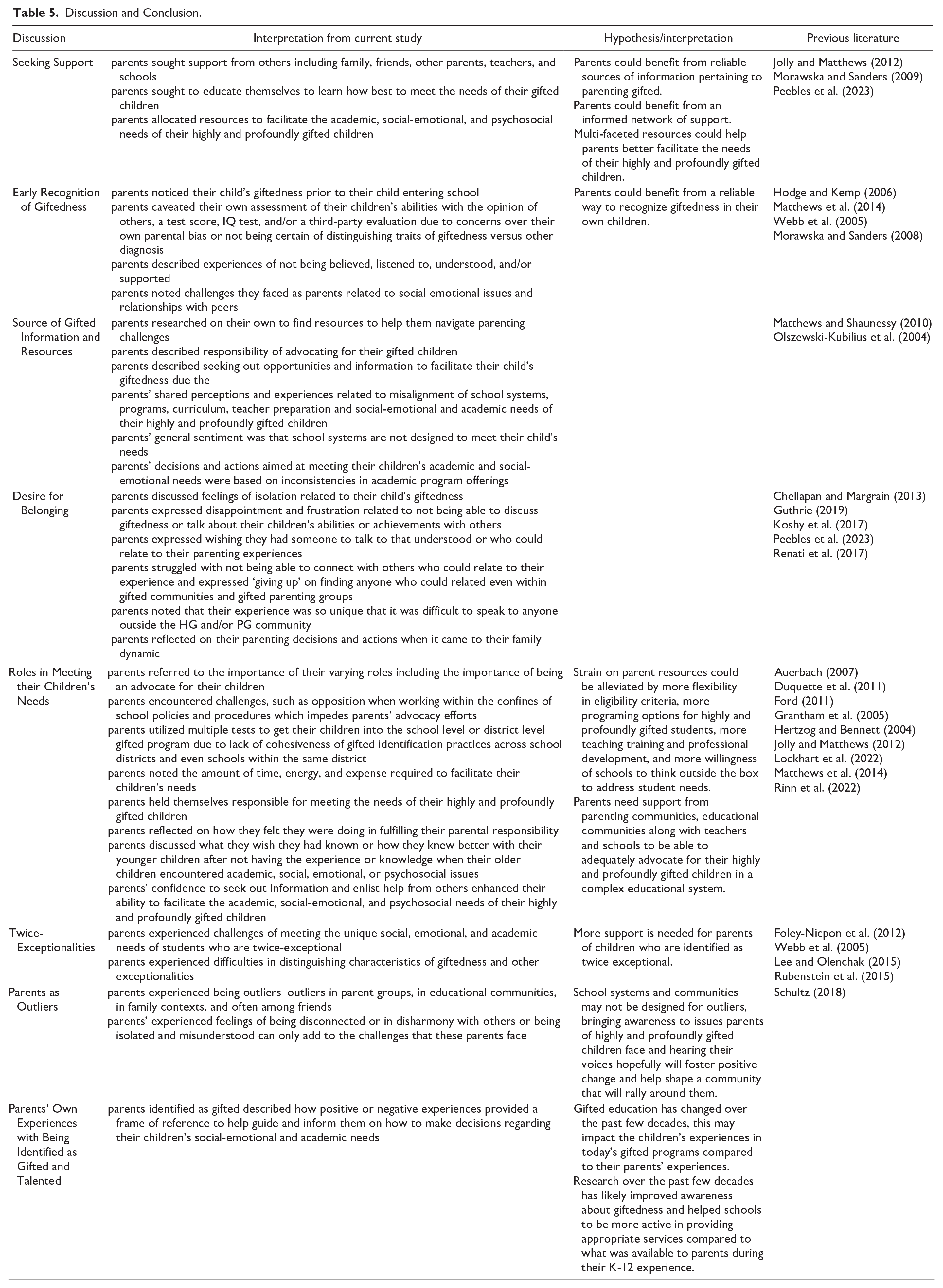
Previous literature noted limited research on parenting gifted children (Jolly & Matthews, 2012; Morawska & Sanders, 2009; Peebles et al., 2023). Our findings provided insights into the parenting trajectory of parents of HG/PG children including parents’ efforts to seek support from family, friends, other parents, teachers, and schools; educate themselves to learn how to meet the needs of their gifted children; and allocate resources to facilitate multifaceted needs of their HG/PG children. Consistent with previous studies, several participants noticed their child’s giftedness before their child entered school but sought affirmation partly due to concerns over parental bias or uncertainty around distinguishing traits of giftedness versus other diagnosis (e.g., ADHD; Hodge & Kemp, 2006; Matthews et al., 2014; Webb et al., 2005).
Limitations
There were several limitations in the study. First, while participants were purposively selected based on meeting specific characteristic criteria and based on their survey responses, participation was also based on participants’ willingness to participate. Second, there was limited diversity with predominantly educated, white, and married participants. There were also disproportionately more mothers than fathers; however, participants often spoke regarding the experiences of both parents. In addition, seven participants stated their children were twice exceptional, making the results primarily limited to that population. Although, this was an emergent theme and not the original focus of our study. Finally, one participant was the parent of a young adult thus responses were based on reflections of parenting during K–12.
Implications
The findings provide valuable insights for parents and professionals who live and work with HG/PG students. These findings can foster improvements in home-school communication and educational experiences of HG/PG students including twice-exceptional students by offering appropriately challenging and meaningful learning opportunities while also tending to social-emotional needs via a curriculum focused on affective development. Finally, health care systems can train pediatricians and counselors to provide support and education for parents with HG/PG and twice-exceptional children who face unique experiences related to developmental and social-emotional issues.
Future Directions
During the interviews, parents spent much of the time discussing their children’s experiences. Future studies should focus on parents’ perceptions of their children’s experiences related to being identified as HG/PG. Future research should examine parenting stress related to parenting HG/PG children, including those with more than one exceptionality. Considering the challenges presented by the current design of educational systems noted by the participants, future research should focus on implementable changes that could foster a more inclusive approach to the academic and social-emotional support needed among parents who must self-educate, research, and advocate on behalf of their children with little to no support from a systemic perspective. In addition, parents spoke of fulfilling roles beyond parenting that they had not anticipated or did not feel prepared to do. Future research should focus on ways schools can partner with parents of HG/PG children to alleviate some of the strain on parenting duties associated with parenting in this unique context.
Future research should also focus on family dynamics (e.g., marital status of parents and number of siblings in the household) as possible influences on parenting decisions and actions of parents of HG/PG children. In the current study, all participants had more than one child with a mix of children identified as gifted and not identified as gifted. Participants in this study referenced the interactions of siblings. Considering the shifts in parenting required when parenting multiple children with varying levels of abilities along with differentiated academic and social-emotional needs, a closer examination may provide insight into additional challenges for parents of HG/PG children with multiple children. A more diverse group of both mothers and fathers, or other types of parents, may provide additional insights into the influence of the parental role held. Positionality and expectations of parents may vary widely and depend on concepts regarding gender roles within a given regional or cultural setting.
Conclusion
The majority of parents of HG/PG children in this study mentioned not having consistent, reliable support from schools, families, and/or educational and parenting communities. Their children being identified as HG/PG has made everything they encounter somewhat of a challenge. This includes identifying other exceptionalities that are masked or illuminated by being HG/PG. It also includes challenges with school systems not designed for children identified as highly and profoundly gifted.
These findings suggest that parents are struggling to connect with others who have a shared experience and can offer advice and guidance on how to navigate their parenting journey and the unique challenges faced by parents of HG/PG children. Unique challenges include developmental challenges related to asynchronous development; communication with teachers and schools; advocacy; finding local resources to facilitate their child’s academic needs; garnering support from a community of family, friends, and other parents with who they can safely discuss their child’s abilities, struggles, and achievements.
The feelings of isolation described by participants are concerning and suggest that parents of HG/PG children lack a sense of community. Parents in this study described not being able to talk about their children, being misunderstood, not being listened to, or knowing where to find reliable information that would be readily received by others. These findings will hopefully bring awareness to the challenges faced by parents of HG/PG children including parents of HG/PG children who are twice exceptional. Awareness will hopefully lead to addressing those needs and developing a system of support that will offer parents a place to reflect and dialog about the challenges they face, thus equipping parents to better facilitate the academic, social, emotional, and psychosocial needs of their children.
Supplemental Material
sj-docx-1-gcq-10.1177_00169862241254840 – Supplemental material for Perspectives of Parents of Highly and Profoundly Gifted Children Regarding Competence, Belonging, and Support Within a Sociocultural Context
Supplemental material, sj-docx-1-gcq-10.1177_00169862241254840 for Perspectives of Parents of Highly and Profoundly Gifted Children Regarding Competence, Belonging, and Support Within a Sociocultural Context by Rebecca M. Johnson, Anne N. Rinn, Rachel U. Mun and Glorry Yeung in Gifted Child Quarterly
Footnotes
Authors’ Note
This article is based on the dissertation completed by the first author. The first author is now at Purdue University in West Lafayette, IN as a postdoctoral scholar.
Declaration of Conflicting Interests
The author(s) declared no potential conflicts of interest with respect to the research, authorship, and/or publication of this article.
Funding
The author(s) received no financial support for the research, authorship, and/or publication of this article.
Open Science Disclosure Statement
The data analyzed in this study are not available for purposes of reproducing the results. The code or protocol used to generate the findings reported in the article are not available for purposes of reproducing the results or replicating the study. The newly created, unique materials used to conduct the research are not available for the purposes of reproducing the results or replicating the procedure.

Author Biographies
References
Supplementary Material
Please find the following supplemental material available below.
For Open Access articles published under a Creative Commons License, all supplemental material carries the same license as the article it is associated with.
For non-Open Access articles published, all supplemental material carries a non-exclusive license, and permission requests for re-use of supplemental material or any part of supplemental material shall be sent directly to the copyright owner as specified in the copyright notice associated with the article.
