







Abstract
Grades play a critical role in both quantifying students’ academic accomplishments and identifying gifted students. Most previous studies measure average grades across subjects or use questionnaires to ask students’ likelihood of getting good grades. However, numerical grades are unable to explain how students’ perceptions of their grades and its relation to pressure. Gifted students may view grades differently and value them greater than students in regular high schools, warranting further research. We utilized semi-structured interviews with Chinese (n = 18) and Korean (n = 4) immigrant gifted adolescents. An inductive thematic analysis revealed three main themes: contextual pressures, perceived meaning of grades, and reactions to pressures. Findings reveal that the combined pressures of parental expectations, peer comparisons, and self-imposed pressure heighten these students’ experience of stress in these pressure-cooker environments. We highlight how culture-specific stressors, such as the model minority stereotype and parental expectations, play a significant role in students’ perceptions and internalization of academic pressures and the resulting effects on their self-efficacy.
Plain Language Summary
Grades play a critical role in both quantifying students’ academic accomplishments and identifying gifted students. Most previous studies measure average grades across subjects or use questionnaires to ask students’ likelihood of getting good grades. However, numerical grades are unable to explain students’ perceptions of their grades and its relation to pressure. Gifted students may view grades differently and value them greater than students in regular high schools, warranting further research. We conducted semi-structured interviews with Chinese (n = 18) and Korean (n = 4) immigrant gifted adolescents. An analysis revealed three main themes: contextual pressures, perceived meaning of grades, and reactions to pressures. The combined pressures of parental expectations, peer comparisons, and self-imposed pressure heighten these students’ experience of stress in these pressure-cooker environments. We highlight how culture-specific stressors, such as the model minority stereotype and parental expectations, play a significant role in students’ perceptions and internalization of academic pressures and the resulting effects on their self-efficacy.
Introduction
“Academically gifted students” refers to students who demonstrate superior academic performance compared to their peers (Chen et al., 2018; Worrell et al., 2019). Gifted students are often in accelerated or enrichment classes within regular high schools (Kim, 2016); however, there is a subgroup of gifted students who test into specialized schools consisting solely of equally high-achieving individuals. Although problems have been identified with gifted students not being challenged enough in regular schools, gifted students who transfer to specialized high schools may be over-challenged and at risk of increased stress and anxiety from the new peer comparison group (Fletcher & Speirs Neumeister, 2012).
High school adolescents are in a crucial developmental time in their lives (Eccles & Roeser, 2011) and spend a large portion of their daily lives within the school context, where they can experience different types of pressures. Gifted high school students have greater expectations and pressure to succeed than their counterparts in regular high schools (Noor, 2023). A previous study highlighted grades as a primary source of students’ stress (Neumeister, 2004); however, it did not explore how grades became a source of stress for gifted students. Gifted students may perceive good grades on a different standard than students in regular schools since many gifted students have been found to have perfectionism tendencies and higher pressure in the school environment (Grugan et al., 2021).
Grades and Self-Efficacy
Grades play a critical role in both quantifying students’ academic achievements and identifying gifted students (Worrell et al., 2019). Most previous studies measure average grades across subjects or use questionnaires to ask about students’ likelihood of getting good grades (e.g., Yuan et al., 2016). Although high school grade point average (GPA) has been historically used as a predictor of academic success in college (Noble & Sawyer, 2002), there are questions of how accurate these grades are comparatively across different high school standards (Westrick et al., 2015). Despite these arguments, high school students continue to believe that high school GPA is an important determining factor in college admission (Galla et al., 2019).
While previous research has examined numerical grades of gifted students (e.g., Chamberlin et al., 2023), few studies have explored how students perceive the grades that they receive. Gifted students often face unspoken social comparisons with their peers in gifted schools to get into prestigious Ivy League schools (Meyer et al., 2021), often considered their natural next step after gifted high schools. The competitive nature of gifted programs, combined with high external and internal expectations to attend top universities, may cause students to view grades as more than just feedback on their current academic performance but rather as a reflection of their intelligence and academic capabilities (Bernecker & Job, 2019). Minor fluctuations in their grades may be viewed as personal failures rather than normal academic variations since gifted students are used to being at the top of the class. Instead, gifted students may perceive fluctuations in their grades as an indication that they are incapable of excelling academically, undermining their self-efficacy—their belief in their abilities to succeed in certain situations (Waddington, 2023). This hyper-fixation on grades may result in heightened perfectionism, anxiety, or depression as students equate grades to successes and failures.
Perfectionism, a characteristic commonly found within the gifted population, is the disposition to strive for perfection and set exceedingly high expectations for oneself (Stoeber et al., 2020). Perfectionism can manifest in healthy or unhealthy ways, with the former associated with high self-esteem and the latter linked to avoidance and anxiety (Grugan et al., 2021). The constant need to be perfect can trigger persistent self-pressure and negative emotions. Gifted students often struggle with the idea of receiving scores less than what they consider “perfect” (Noor, 2023), especially when they have performance goal orientations. Having performance goals refers to their focus on meeting norms and expectations by getting the “best” grades (Huang, 2012). Focusing only on the outcomes may breed negative self-efficacy when failing to achieve the desired grades. Self-efficacy refers to how confident individuals feel about their ability to succeed in various tasks (e.g., grades). This performance goal orientation seen in many gifted students is comparable to having a fixed mindset. According to the Mindset Theory, having a fixed mindset is the belief that one’s abilities and talents, such as intelligence, are unchangeable (Dweck & Leggett, 1988). Individuals with a fixed mindset, as opposed to those with a growth mindset (characterized by a passion for learning and investing effort into self-improvement), are often more vulnerable to being disheartened by perceived failure.
In addition, adolescents’ self-efficacy is a predictor of their grades (Weiser & Riggio, 2010), and, in turn, self-efficacy has been found to be influenced by their academic performance (Dixson et al., 2016). Although studies have explored how academic performance, often measured in grades, can impact students’ academic self-efficacy and well-being (McBride et al., 2021), previous studies have not explored the perception of grades and its potential moderating effect on the relation between grades and academic self-efficacy. Moreover, few studies have investigated the relation between the perception of grades and how students react to pressure related to grades (Chamberlin et al., 2023). Understanding these unique pressures that gifted students face is crucial to developing healthier educational environments and systems in gifted schools.
Multiple Layers of Pressure
Gifted students are often either placed in accelerated or enrichment classes within regular high school or moved to specialized high schools. While students who remain in regular high schools within special programs are still surrounded by students of varying abilities, those enrolled in specialized high schools are exclusively surrounded by academically gifted peers who passed qualifying admissions exams (Worrell et al., 2019). Research suggests that when students are surrounded by others of equivalent ability levels, they may experience well-being challenges due to heightened competition and pressure (Durak et al., 2022). This homogeneous environment may contribute to lower self-perception among gifted students in specialized high schools (Marsh, 1987).
When students relocate to a more competitive school environment, it may especially impact their views on grades and may lead to increased pressure. For example, academically gifted students may be accustomed to attaining “perfect grades” (i.e., 100s) in regular schools (Desmet et al., 2020), but after relocation, they face increased competition from peers of equal or better academic ability, structured academic programs, and more rigorous coursework. Thus, students may struggle to maintain their high grades in the new school and may begin to experience lower grades; they may feel pressured to maintain their history of good grades and not being able to do so may lead to poor academic self-efficacy (Blaas, 2014) and feelings of relative underachievement (Ritchotte et al., 2014).
Emphasis on academic performance is especially pronounced among Asian immigrant adolescents, who often face external pressures from society (e.g., model minority myth) to meet exceedingly high academic expectations (Lee & Zhou, 2015). The model minority myth perpetuates that Asian immigrants are universally successful compared to other ethnic minorities (e.g., Black, Latino; Yi & Todd, 2021). Although it is often misconstrued as a positive stereotype, this myth has damaging implications for Asian Americans by pressuring them to fit these expectations, often at the expense of their mental health and cultural identity (Shih et al., 2019; Walton & Truong, 2023). Asian Americans are often overlooked in research on gifted students, largely due to the perception that they are overrepresented in gifted programs (Yoon & Gentry, 2009). However, such overrepresentation does not ensure positive outcomes for this population. In fact, empirical findings consistently indicate that Asian American youth with high academic achievement are at high risk of experiencing compromised psychological adjustment, such as heightened internalizing problems (Choi et al., 2021; Qin, 2008).
Although Asian American students are often perceived as “doing well” educationally, the failure to uphold the model minority stereotype by receiving grades that are perceived to be less than “perfect” may lead to feelings of inadequacy and academic burnout (Gupta et al., 2011), which in turn may negatively affect their academic self-efficacy and well-being. As a result, many Asian immigrant adolescents internalize the norms and pressures of the achievement paradox, feeling like they are underachieving, contributing to higher rates of poor mental health (Austin & Chorpita, 2004; Qin, 2008).
Alongside societal pressures, Asian immigrant parents often have high expectations for their children as they hold the belief that the primary means of achieving success and upward mobility in the United States is by getting good grades and attending prestigious universities, such as Ivy League schools (Dhingra, 2018; Glick & White, 2003; Mun & Hertzog, 2019). Many Asian immigrant families migrate in pursuit of achieving the “American Dream” through educational success (Dondero & Humphries, 2016) by having a “success frame” mindset. This mindset is characterized by the determination to succeed in a new country through earning all As, going to elite schools (i.e., Ivy League universities), and working as a doctor, lawyer, scientist, or engineer (Mun & Hertzog, 2019; Zhou & Lee, 2017). Chinese and Vietnamese children with a success frame mindset were found to view good grades as “A is for Average, and B is an Asian Fail” (Lee & Zhou, 2014, p. 45). Asian immigrant parents instill in their children this success frame mindset through their educational expectations, emphasizing the importance of achieving good grades and gaining admission to Ivy League schools as the only perceived pathway to upward mobility (Gao, 2021; Lee & Zhou, 2014).
Asian parents are often influenced by Confucianism, which entitles parents to a training role that guides their children to be academically successful (Chao, 1994). Parents endorsing the training role often have high expectations of their children, which may serve as pressure (Liu et al., 2025). This may foster an environment where children feel that their intrinsic value is conditional on their academic achievement, potentially negatively impacting their self-efficacy when they are unable to meet their parents’ expectations (Kao & Hébert, 2006; Weiser & Riggio, 2010). When Asian immigrant children are unable to fulfill parental demands for academic excellence, they may experience a sense of inadequacy and failure, which can undermine their self-efficacy and negatively impact their overall well-being (Lee & Zhou, 2014).
Parents’ expectations of students’ grades have been found to influence students’ own perception of a good grade among college students (e.g., Neumeister, 2004); however, more studies are needed to investigate this experience in high school gifted students. The constant need to maintain perfect grades, coupled with family expectations, may lead to increased perfectionism to avoid failing to meet their parents’ expectations. Thus, many students who aspire to gain admission into competitive universities (i.e., Ivy Leagues) and meet parental expectations may strive to maintain good grades to reach this goal. However, when pressure comes from societal misconceptions, school environment, and parental expectations, this combined pressure to succeed may be overwhelming for Asian American students and negatively impact their well-being (e.g., self-efficacy).
Self-efficacy can be influenced by a variety of contextual factors (Mistry et al., 2016). For example, Asian immigrant families often uphold cultural values and beliefs rooted in their pre-migration contexts, which may be manifested in parents’ expectations and involvement in education and influence children’s aspirations and self-efficacy (Mun & Yeung, 2022; Yamamoto et al., 2022). Meanwhile, post-migration contexts, such as the social structures and school contexts in the United States, may also play a critical role in defining success and social relationships for these youths (Mistry et al., 2016). However, despite the potential influences of these multifaceted contexts on Asian American gifted students, the way in which these youths interpret and navigate these contexts remains under-investigated. To address this gap, this study centers on a specific setting of a specialized school for gifted students to examine Asian American gifted students’ perceptions of their academic and psychological experiences.
Theoretical Frameworks
Our study is mainly guided by the self-determination theory (SDT; Deci & Ryan, 1985; Ryan & Deci, 2000), a comprehensive framework for understanding students’ motivation. SDT emphasizes the importance of fulfilling three basic needs—autonomy (i.e., sense of control over one’s actions and choices), competence (i.e., feeling of effectiveness and mastery in one’s activities), and relatedness (i.e., sense of connection and belonging with others)—for optimal motivation and well-being. When autonomy, competence, and relatedness are nurtured, students are more inclined to feel intrinsic motivation (e.g., learning for enjoyment; Larson & Rusk, 2011). Conversely, external pressures and heightened expectations can lead to extrinsic motivation (e.g., learning for external rewards or validation; Guay et al., 2010). Consequently, the kind of motivation students cultivate can impact their overall engagement and well-being. Those who are intrinsically motivated often find joy in learning and show greater perseverance when faced with challenges, while students primarily motivated by external validation may suffer from increased anxiety, burnout, and diminished academic self-efficacy (Phillips & Lindsay, 2006). Excessive dependence on external validation (i.e., grades) can result in maladaptive perfectionism, where students fear failure and strive for perfect grades (Fletcher & Speirs Neumeister, 2012).
In the context of gifted schools, structured academic programs and high expectations may restrict autonomy, while rigorous coursework and peer comparisons can influence students’ sense of competence and relatedness. Students may experience diminished autonomy and less control in gifted school environments due to structured programs that leave few opportunities for self-directed learning (Yang, 2016). In addition, students transitioning from a regular school to a gifted school may experience increased pressure. The big-fish-little-pond effect on self-concept (BFLPE; Marsh, 1987) further explains how autonomy can be constrained during this transition. This theory is illustrated by differentiating between the two distinct school environments experienced by gifted students, where the “fish” symbolizes the students, and the “ponds” represent the relative achievement levels of their peers within the broader school setting. Gifted students are “big fish” in regular school but become “little fish” in a “big pond” when transitioning to high-achieving schools with equally capable peers, experiencing greater competition and external pressure. As their academic standing shifts relative to their peers in the new school environment, they may feel less in control over their academic success, reducing their autonomy. This shift can also create additional pressure in other microsystems (i.e., the immediate environments that a person interacts with, such as family, school, and peers) and mesosystems (i.e., the interconnection between these settings), which may have critical influences on adolescent development (Bronfenbrenner, 1979).
While rigorous gifted programs aim to foster high levels of achievement, they may also contribute to a decrease in perceived competence and self-efficacy as students compare their success with that of their peers (Dai et al., 1998). Social cognitive theory (SCT; Bandura, 1977) highlights how various contextual pressures influence gifted students’ self-efficacy. This decrease in self-efficacy, combined with the challenges presented by the new academic and social environment, creates a complex and multifaceted landscape for gifted students as they navigate their learning experiences in a new school setting. When transitioning into an environment where they are no longer among the top performers, they may question their abilities and experience a decline in perceived competition and self-efficacy.
Transitioning to a high-achieving peer group may present both opportunities and challenges for developing social connections and a sense of belonging. Being surrounded by intellectually similar peers may foster a sense of camaraderie, a shared understanding of their experiences, and a sense of belonging (Striley, 2014). On the other hand, increased competition and pressure may create challenges in maintaining supportive friendships, particularly if students perceive their peers primarily as academic competitors rather than collaborative partners who can succeed together (Helsper et al., 2025). If competition overrides connection, social comparison may emerge, potentially diminishing motivation and increasing stress.
The Present Study
To sum up, although there have been previous studies on gifted students’ overt levels of pressure, there has been a lack of focus on gifted high schoolers’ perception of the pressure they experience and their corresponding reactions. Moreover, Asian American gifted students are often overlooked in previous research. To fill these gaps in existing research, this study focused on gifted East Asian American high schoolers attending a specialized high school, aiming to explore these adolescents’ experiences with grades and their intersection with how they conceptualize pressures. More specifically, the current study investigated how academically gifted East Asian American students (a) experience contextual pressures, (b) uniquely define good and bad grades, and (c) conceptualize and react to pressure.
Methods
Participants and Procedures
The current study drew on interview data from a larger study on the academic and psychosocial experiences of academically gifted students. The data were originally collected as part of a larger study conducted by the last author in 2006 to understand the psychosocial development of high-achieving Asian American students in a school for gifted students in a northeastern metropolis. The school was one of three public high schools run by the city’s Board of Education to serve the needs of academically gifted students. This school was chosen because of the large number of Asian Americans in the student population. The entire cohort of ninth graders was invited to participate (N = 825). Written parental consent was obtained from students who completed the questionnaire designed for the study. The principal investigator presented the study to parents of the freshmen cohort in attendance at the parent association meeting (about 100). The study was also explained to the students at the beginning of an English class, and parental consent forms were distributed to students who showed interest in participating.
The sample consisted of students from one of three public high schools specialized for academically gifted students in a northeastern metropolis. Students were admitted to this high school upon passing the Specialized High School Admission Test (Krane, 2001); less than 5% passed the test and were admitted into this highly competitive school. The school consisted of 63% Asian American, predominantly Chinese and Korean Americans, who comprised the sample in the present study. Asian American parents in the area frequently mentioned that it was this school that they all wanted to send their children to, which may explain the high saturation of Asian Americans, and was thus selected for the larger study. Pseudonyms were used to maintain the confidentiality of the students and the school. Participants for this study (n = 22) were selected from the larger sample of ninth graders who completed surveys (N = 825) and follow-up in-depth interviews (n = 29) to better understand students’ experiences in this unique school environment. Five interviews with European students were excluded. Two interviews with Asian participants were excluded due to their short length.
Our study drew on semi-structured interview data collected from 22 gifted students from Chinese (n = 18) and Korean (n = 4) immigrant families. Participants were primarily female students (n = 14; 64%). The interviews were audio-recorded and transcribed verbatim in English. The semi-structured interviews focused on parent-child relationships, Asian stereotypes, the school environment, student experiences in school, and mental health. Interviews lasted between 1 and 2 hr, with an average of 1 hr and 20 min, and were conducted by the last author and a trained graduate research assistant. The recorded interviews were transcribed verbatim by undergraduate students using a transcription machine with a foot pedal. Example interview questions relevant to the current study were as follows: What has been your general experience attending Summer Lake High School? How is this experience as an Asian student? What triggers your stress, and why? Where is the most pressure in this school? How do you feel when you get a bad grade?
Data Analysis
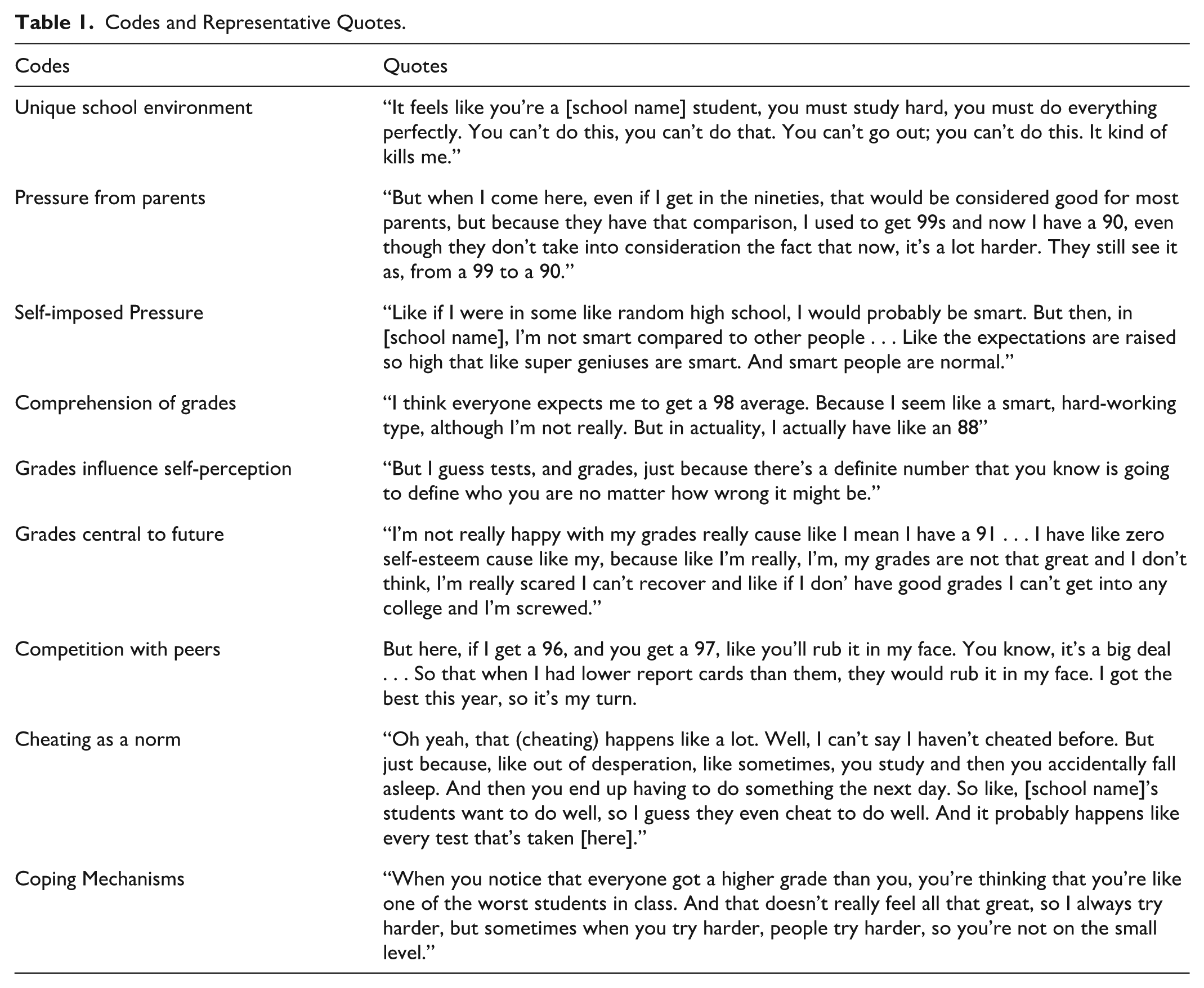
An inductive semantic analytic approach for thematic analysis was utilized (Braun & Clarke, 2006). Our analysis process exemplified the bottom-up approach, as our coding process started with data-driven open coding. The first author familiarized herself with the data and generated initial codes on the most frequently mentioned characteristics of students’ general experiences during the interviews. Based on these initial codes, it emerged that grades hold a uniquely high position in the lives of these academically gifted students. Then, the first and last authors developed a preliminary codebook based on the initial coding process to organize key concepts and the initial interpretation of themes and subthemes. After discussion with all authors, a more focused codebook was created by removing irrelevant codes and condensing relevant themes related to grades. A second round of coding by the first three authors was conducted using the finalized codebook on all the transcribed interviews. The coders met and discussed the various themes, subthemes, and emergent codes, and grouped the various codes into main themes that the interviews depicted. For example, “comprehension of good and bad grades,” “grades define who I am,” and “grades are central to the future” were grouped under the larger main theme of “meaning of grades.” To ensure the reliability of our coding process and interrater reliability, regular meetings were held among the coders to discuss and resolve any discrepancies in codes and themes (MacPhail et al., 2016). Finalized codes and representative interview quotes are included in Table 1.
Codes and Representative Quotes.
Researcher Positionality
As a fellow Korean immigrant student, the first author understood and was aware of the academic pressure that Korean youth often receive from their families and community due to the Confucian emphasis on education rooted in their Korean heritage culture (Huang & Gove, 2015). However, she did not attend an academically gifted high school and did not share the experiences of these students or the difficulties of learning in a pressure-cooker environment (Feld & Shusterman, 2015). As a researcher, she drew from her personal experiences with familial and social pressure to succeed to create a foundation for investigating how these academically gifted Asian Americans have unique perceptions of grades and their reactions to pressure.
The second and third authors are international students from China. The second author started her academic journey in the United States in her senior year of high school, whereas the third author started in graduate school. The last author came to the U.S. from China in her mid-20s to attend graduate school. Unlike the participants in this study, they did not attend specialized high schools that only admit high-achieving students. However, all authors come from an East Asian cultural background where high achievement through hard work is valued (Hau & Salili, 1991). Although the researchers are cultural insiders, we acknowledge that we did not share the same experiences as the participants and may have potential bias as outsiders to gifted students’ experiences. Throughout the research process, we continuously reflected on our own potential biases and actively minimized them by meeting frequently to discuss all codes and analyses to ensure proper representation of the students.
Results
Students at this school experienced pressures from the school environment, parents, and internalized self-pressure that were all normalized in this pressure-cooker environment (Feld & Shusterman, 2015). Across these areas of pressure, students named two root causes: grades and college. In terms of grades, unlike the generally accepted grade of 70s being passing in the U.S. education system, these students perceived anything below 90s as a “bad” grade, potentially decreasing their chances at desired colleges. Students also named college as one of the reasons why they felt that receiving bad grades was perceived as so detrimental, since it prevented them from standing out positively among other applicants. After receiving grades perceived as “bad” (i.e., below 90s), students had various reactions, including self-reflection practices and, in some cases, even cheating.
Contextual Pressures
Unique School Environment and Pressure From Peers
Students reported feeling pressure on their academic performance from various sources, including the public, the school, their parents, and themselves (n = 19; 83%). Many students reported perceiving public expectations of being Summer Lake students as being smart. Since most students admitted to this school were top students, the school had a reputation for being high-achieving, particularly in math and science. Students mentioned receiving comments from the public, such as “Oh, you’re in Summer Lake High School? You’re really smart, and your grades must be really good,” or “Oh, he’s from Summer Lake High School, he should know this.” Many students also expressed that in maintaining the public image of Summer Lake High School, they felt pressured and forced to work hard to fit the public image of their school. For example, Danny said, “It feels like you’re a Summer Lake student, you must study hard, you must do everything perfectly. You can’t do this. You can’t do that. You can’t go out . . . It kind of kills me.”
One student explained that these expectations of being smart in math and science also arise from the traditional stereotypes of associating Asians with being good at these subjects. Emily believed that the predominant Asian population in this school conveys to others the belief that all students in this school are smart: It comes from maybe just the population of the school. It’s a math and science school. Most of the students are Asian and . . . I know this school used to be like an all-boys school. And right now, it’s still like that: “people who are Asian.” It’s dominated by one type of people, so I guess that’s where the stereotype came. Half of the school is known for its academics, and they do well in like math competitions. You know, so I guess that’s how they related Asians to school.
Teachers were also one of the primary sources of pressure for the students. Most students talked about the expectations from teachers. John reported, “Teachers are like, ‘Oh, it’s Summer Lake, you guys are smart,’ then they’re going to set all these ridiculously high standards that realistically couldn’t be met.” As a result, students reported that they “have to self-study,” teaching themselves the material.
Peers were another primary source of pressure for these academically gifted students. Students reported that being surrounded by equally gifted students led to students putting pressure on themselves. Lori stated: Everyone is just so much smarter than me. I was used to being like able to do everything right away in school and not have to study or anything . . . I think [the pressure is] from the other students, seeing them [and] how they do, which makes me get worried about how I’m doing in comparison to them.
When students constantly compare their academic performance with their peers, they felt pressured to continue improving their performance.
Despite all the pressure from public comments and their peers, some students also reported feeling a sense of belonging in this environment because they were not the only “nerd” in school. For example, Grace expressed: I come to Summer Lake High School, and I was like, “Everyone’s nerdy. That’s great” and I felt like I really found myself in Summer Lake. And I could be someone else other than that smart kid because everyone here is really smart.
The pressures from society and peers affected how these academically gifted Asian students experienced their daily schooling experience at this specialized high school. Despite being pressured by stereotypes, societal expectations, and comparisons to their peers, they still seem to form a sense of community when surrounded by other like-minded individuals.
Pressure From Parents
Many students reported pressure from their parents’ expectations to achieve good grades, which were accompanied by their parents’ aspirations for them to attend a prestigious college (e.g., Ivy League) and secure a desirable job (e.g., doctor, lawyer; n = 17; 74%). With these expectations, as many students reported, their parents repeatedly talked about grades and schoolwork at home and pushed them to participate in activities that they were not interested in. For many, their parents constantly emphasized the priority of their schoolwork for high schoolers and discouraged social and other extracurricular activities. A failing grade sometimes brought consequences. Nathan described: She gets really angry at a failing grade. So, I just bring myself back up and then everything is fine . . . I don’t know what I’m afraid of, but whenever I get a bad grade, I just feel so bad about it. And I wouldn’t tell my mom sometimes. If she finds out, she just yells at me, and asks me why I did that. And that I should take off my work [extracurricular activities] and everything. The only downside to that is that I won’t be able to do things that I usually do. I won’t be able to watch TV, she’ll be like, “you should be studying. You just failed your test or whatever.”
Some students also reported that their parents were unaware of the competitive environment at this school or the differing standards compared to other schools, which further exacerbated parental pressure. For example, Eric described that his parents still evaluated his grades using the standards of his previous school: But when I come here, even if I get in the 90s, that would be considered good for most parents, but because they have that comparison, I used to get 99s and now I have a 90, even though they don’t take into consideration, the fact that now, it’s a lot harder. They still see it as, from a 99 to a 90. So, they think I should still be able to get high 90s.
Many students implied that their parents’ expectations were connected to their immigrant and minority mentalities. Justin shared, “I guess their expectations . . . coming from a minority family, or coming from an immigrant family, they really see everything as merit-based—if you work hard, then you can achieve.” Danny paraphrased the desires of his parents, “She doesn’t want you to fail in life. She wants you to succeed. And walk forward, not backwards.” According to the students’ reports, with such a mentality, some parents appeared to be paranoid about anything that may hinder their children’s success. Sara shared, I guess a lot of Chinese parents, because they’re immigrants so they’re really, really paranoid about things like “I want my kids to do really well in life. And become really successful.” So, they don’t want anything to bring their kids down.
The immigrant mentalities also involved a sense of oneness in the family. Annie shared, “I’ve talked about this with my mother before, and she’s always like that’s why you have to make sure that you establish yourself here so that your family gets to have the benefits, like legacy, things like that.” The intergenerational continuation of family legacies was also suggested by Jane, who stated, “I know a lot of immigrants or first generations, so it’s that your parents work so hard, that you also have to strive to do better than they have.” Students recognized their parents’ immigrant mindset and cultural values as the reason for the pressure they felt to get good grades and succeed.
Self-Imposed Pressure
More than half of the interviewed students reported that they placed a lot of pressure on themselves (n = 12; 52%). Several students stated that although their parents tried to alleviate their stress and did not push them hard, they could sense their parents’ desire for them to do well. For example, John said: Both my mom and dad are having kind of this sad like tone, “It’s okay, it doesn’t really matter. Just try your best.” It’s always this, “try your best” kind of tone. They don’t really push me to do anything. Not really pushing me anymore or giving me expectations, but there’s always this kind of hope that maybe you will be better than your sister.
Eddie described the process in which he internalized external expectations as his own standards for achievement: I guess it’s (the pressure) more from myself. Like no one actually explicitly tells you, “You have to do better.” It’s usually implied, about how, if you want to do better, if you want to achieve more. So, you end up striving for more. You work harder, and you pressure yourself to do better.
Several students expressed that they pressured themselves to get into college. John said with worry, “My grades are not that great, and I’m really scared I can’t recover, and if I don’t have good grades, I can’t get into any college, and I’m screwed.” Some also hoped that they could be pushed harder. For example, John later described in his interview, “I feel at times kind of sad because I feel like I should be pushed, like someone is supposed to push me. Because I’m so used to them encouraging me to do this or do that.”
Our study revealed that some gifted students placed more pressure on themselves than their parents to maintain the grades they had always received and to achieve success. In some cases, when parents did not exert any pressure on the student, the gifted adolescent put pressure on themselves to counteract the lack of support from their family.
Perceived Meanings of Grades
Our findings indicated that the adolescents in our study had different standards for what qualifies as a “good” grade. Participants reported that they made meaning of good and bad grades in a unique way. Students named two root causes of the pressure they experienced: grades and college.
Comprehension of Good and Bad Grades
Grades are at the core of students’ education and school experience. Depending on the school context, students have unique perceptions of what is considered a good and bad grade (n = 13; 59%). Although grades themselves are numerical representations of students’ academic performance, students perceived certain grades as “good” or “bad.” Due to the nature of this specialized school environment, students held a higher standard for what constitutes a “good” grade and “bad” grade. Unlike the universally accepted grade of 70s being passing, or “acceptable” in the U.S. educational system (Kinder & Knecht, 2011), these adolescents perceived anything below 90s as a “bad” grade and conceptualized higher expectations for a grade to be considered “good.”
Multiple students mentioned that both students and their parents expected them only to get grades in the 90s. Lauren said in her interview, “Everyone expects me to get a 98 average. Because I seem like a smart, hard-working type, although I’m not really. But I have an 88.” Another student stated that their definition of a good grade is based on their parents’ expectations. Regarding his parents’ expectations, Albert said, “That’s pretty much it because they see a 9 in front of everything; they’re like, ‘Okay, you’re good.’” Some students have internalized their parents’ grade expectations as their own standards. Jill stated: I think as long as I get grades that both me and my parents are fine with . . . I think at the very least a 90, probably, I mean even if I get a 90 and if my parents see, they’ll probably be like, “Oh, you know you can do better.” And I’m like, “I know I can do better.” I think probably a 95, if I had to place in the average.
When asked what a good grade is, Nathan responded, “Above a 90. About a 93. Because my transcript averages about a 93 right now, so I don’t want to get lower than that.” Not only are grades comprehended differently, but there is an additional level of pressure on those who do attain the desired “good” grades to maintain them. Sara talked about her classmate who expressed this additional pressure: There’s this kid that sits behind me in math class, he got an 86 on the last test, and he’s like, “there goes my 99 average.” He got like a 104 on the last few tests [with extra credit], and so he’s like, “Oh my god, I got an 86.”
Although some are able to achieve their standards of a good grade, they have the pressure to maintain those grades with every test and assignment they complete.
“Grades Define Who I Am”
Even though grades are meant to represent academic performance, students in pressure-cooker school environments may view their grades as a reflection of themselves (n = 13; 59%). These students were hyper-fixated on every grade, equating the grade percentages received with their self-concept. Grace stated, “But I guess tests and grades, just because there’s a definite number that you know is going to define who you are no matter how wrong it might be.” Other students have expressed that grades are the central stressor in their lives. Eddie said: Besides grades, which make up a large majority of the worry. It would just be like everything I worry about revolves around the grades, and how you get high enough, and how you won’t get into college, what others will think of you. What will they perceive you as, as a good person or an extremely smart person? And you also worry about how other people think of you, what friends you make. And then you start thinking about whether you’ve been social enough, if you’ve been with people, and it can really affect who you are.
Grades act not only as a stressor but also as the most important aspect of their entire lives. Peter stated about his peers, “Maybe it’s something they put onto themselves. Like they have to get a high grade, like it’s their life. And if they don’t do that, they’re worthless.” John reflected on the impact of the stress of grades on his own mental health. He said: Like I have really low self-esteem for myself because it’s like all this grade stuff, and then like, I don’t know, sometimes I get really depressed because I feel like I can’t keep up, I can’t like recover from a bad grade I had and then it’s like, you just like feel so bad because like, especially like after when my parents lecture me or whatever, and like you just feel so bad.
John made the explicit connection between the pressure to achieve good grades and his experience of having low self-esteem and depression. When he perceived that he could not “recover from a bad grade,” it elicited negative feelings that ruminated into low self-esteem and feelings of depression. Other adolescents echoed this sentiment indirectly by sharing symptoms such as constant worry, sadness, and being upset. Among all the participants who discussed grades, grades were named as a significant stressor in their lives and had an overall negative impact on how they perceived themselves.
Grades are Essential to Their Future
Many adolescents perceived their grades as central to their future and college success (n = 14; 64%). GPA is the numeric representation of students’ academic accomplishments. Within the U.S. education system, GPA is one of the main factors that colleges take into consideration when evaluating college applications. Among these academically gifted high school students, they perceived that each subpar grade they received would be detrimental to their GPA and their future, particularly negatively impacting their chances of getting into desired colleges. Eric said, If I get a bad grade, they’ll [my parents will] both be angry. But my dad will probably give me a long speech about it like, “you’re not going to get into a good college if you keep this up.”
In Eric’s case, he was not only concerned about getting into his desired college, but he also felt that he must get good grades so that his dad would not be upset. He had internalized the message from his dad that bad grades would ruin his chances of getting into a good college. John felt the need to get even higher grades to be considered good enough due to his desire to stand out among his peers. He stated: Compared to everyone else around Summer Lake High School, I guess if you don’t have a 96, then it’s not that great of a grade. Because like 91, everybody has a 91, if you have a 96, then colleges will see what you have, that would like to stand out from everybody else and they’ll accept you. I don’t know, a 91 average is like really bad.
Students like John view any grades that will not help them stand out from their peers as a “bad grade” and, therefore, a hindrance to their future success. As mentioned previously, these academically gifted students felt that grades were reflective of themselves. One student specifically stated that even though they acknowledge that it is not a positive perspective, it can be a source of motivation. Sara stated: Obviously you shouldn’t define someone by their grade, but you know when you go to college, they’ll see that number, and immediately judge you. At least initially. And so, yeah, it’s not the greatest thing, but that motivates me to get good grades.
Although students recognized that defining oneself with a numerical value can be problematic, students perceived it to be unavoidable and as motivation to get good grades for college.
Reactions to Pressure
Another theme that emerged was students’ strong reactions to grades that were perceived as “bad.” They worked hard to surpass their peers and sometimes even cheated to get good grades. In addition, they utilized different coping mechanisms to deal with academic stress and maintain their emotional wellness.
Competition Among Peers
More than half of the participants (n = 13, 59%) indicated that they felt intense competition with peers. For example, some students were not willing to help peers with homework because they did not want others to get higher grades. In addition, they perceived one point as a big difference, and they must work harder to get ahead next time. As Eric commented: But here, if I get a 96 and you get a 97, like you’ll rub it in my face. You know, it’s a big deal . . . So that when I had lower report cards than them, they would rub it in my face. I got the best this year, so it’s my turn.
Similarly, John mentioned: Since you’re at Summer Lake High School, you definitely know there’s not going to be anybody that’s actually going to help you with homework unless you’re really good friends with them and they trust you and so forth.
Furthermore, peer relationships seem to become more complicated due to competition. Although these students do not have ill wishes toward their peers, they are more focused on their own success than on that of their peers. Eddie pointed out: Even though he’s your friend or something, you don’t want him to be an underachiever, but you want him to just do equally well. But you always have that sense of self-preservation, where you always want to do better to get into the Ivy Leagues.
Even though they do not wish failure on their friends, adolescents feel that they should do just a little bit better so that they have a better chance of getting into good schools. These adolescents navigate a nuanced relationship where they do not wish harm on their friends, but at the same time, want to be slightly better than them as a means of self-preservation to succeed in gaining admission to Ivy League schools.
Cheating as a Norm
Besides making a greater effort, students sometimes felt desperate and turned to cheating to achieve good grades. The majority of the participants (n = 15, 58%) mentioned that cheating was the norm at school; they either had cheated themselves or knew somebody who had cheated. As Nathan commented, “I’m pretty sure every student at Summer Lake High School has cheated at least once.” He also explained why students had to cheat: I can’t say I haven’t cheated before. But just because, like out of desperation, like sometimes, you study and then you accidentally fall asleep. And then you end up having to do something the next day. So, Summer Lake High School students want to do well, so I guess they even cheat to do well. And it probably happens like every test that’s taken [here].
Nathan also commented on how his perception of cheating has changed since freshman year: In freshman year, I looked down upon it (cheating). I saw my friends doing it, and I was like, “Why are you cheating?” But then, now, I see why. Because with like sports and everything, there’s just so little time, and you want to do all these other things. So eventually, if you can’t get all the information, you have to cheat.
Many participants perceived cheating as a necessary act. In other words, good grades were so important to these students that they were willing to take high risks to achieve high grades, even if they might face serious consequences for cheating. Other students noted that it was the pressure from their parents that pushed them to cheat to succeed. Danny shared: There was once or twice that I did cheat. Because it was absolutely, my parents were going to like screw me over if I didn’t do well. So it was just like, “ah just this once, like once or twice.” Just for the grade, once or twice, I’ll have to do it for it.
The fear of getting in trouble with his parents made Danny feel anxious and pressured to cheat “just this once” to get the grade he needed, so that he would not face consequences from his parents. These adolescents felt that cheating was a means to maintain their good grades, whether that pressure came from the normalcy of cheating in school or from their parents to keep their grades high.
Coping Mechanisms
Our participants (n = 19, 86%) reported various ways to cope with the enormous pressure and stress associated with receiving low grades. Many of them mentioned that they enjoyed activities such as reading, listening to music, or playing sports to relax. In addition, they self-reflected and tried to change their mindsets to cope with stress. For example, Jill commented: Well, when I first see it, I’ll be all, “Oh my God, I got an N [equivalent to a grade between 65–74%]” and I’d be all upset and I’d be like, “What did I do? What did I do? What did I do?” But eventually I’d just go along with, like, I suppose my new philosophy. I just don’t, don’t worry about it as much. I think to myself, “Well, instead of worrying about it and getting nowhere and getting upset over nothing, why don’t you just like take this into, take this into account in the future? Why don’t you just think to yourself, ‘Oh, I remember that time I got an N. I’d better work harder this time?’” So yeah, try not to, like, think on too much and I just, I guess try to learn from it.
Similarly, Emily also learned to refocus her mind and accept that life has many different possibilities: I don’t think you should focus only on, you know, your grades because ultimately that’s not going to decide your future. I mean truly, you might not go to an Ivy League university because you didn’t do well in school. But a lot of people, they go to an average college, and they still succeed in life and become really well-known.
While many of these students shared positive and adaptive coping mechanisms to manage pressures and stressors, some students alluded to mental health symptoms, such as depression and anxiety. Jill shared: I would always worry about those stupid mistakes, and I would worry and I’d beat myself up over them. So I guess like I just like followed it up until like eventually it just exploded, and I realized that this wasn’t getting me anywhere, that this was like why I was always upset and depressed and, well, not really depressed, but sad all the time.
Jill articulated what many of the students in this school described feeling because of the pressure to get good grades. She felt that she would constantly think and dwell on her “stupid mistakes” that she perceived as the reason for her bad grades. This led to Jill feeling sad all the time and even momentarily equating it with depression.
Overall, these findings highlight how gifted East Asian high schoolers possess a unique understanding of the distinction between good and bad grades. Although they seem to define good grades on a higher scale, they were also under pressure to receive good grades from society, parents, and peers. Generally, some students reflected on their negative grades and developed positive coping mechanisms for receiving bad grades, while others experienced mental health symptoms.
Discussion
Gifted high schools are inherently competitive due to their selective admissions process, rigorous course materials, and high expectations to succeed. While these specialized schools are intended to foster a space for gifted students to excel academically, research suggests that these competitive environments can contribute to heightened stress, perfectionistic tendencies, and negative self-efficacy among students (Adelson, 2007; Chan, 2007). Our findings highlight how collective pressures from parental expectations, peer comparisons, and self-imposed pressure intensify these students’ stress in these pressure-cooker environments, which can have detrimental effects on students’ mental health and self-efficacy. There is a large body of research on gifted students’ experiences in high-achieving schools and their subsequently poor effect on their mental health and overall well-being (e.g., Luthar et al., 2020; Mun & Hertzog, 2019). For example, Mun and Hertzog’s (2019) study of Asian American women who entered college early found that perceptions of high parental expectations and their own internalized expectations may have contributed to stress, feelings of failure, and depression for some. However, previous studies have not yet investigated the role of gifted students’ perceptions of grades in relation to Asian cultural values. Our findings highlight how an intense focus on external validation from grades contributes to the stress experienced in this pressure-cooker school context. The interplay of Asian cultural values, immigrant mindset, peer comparisons, and parental pressures all play a significant role in shaping these students’ experiences.
Our findings are situated within the context of Ryan and Deci’s (2000) self-determination theory (SDT), where extrinsic and intrinsic motivations are differential drives to behave in certain ways. The SDT emphasizes fulfilling three main components: autonomy, competence, and relatedness. Our study suggests that the multiple layers of pressure from these gifted students’ lives can constrict students’ autonomy, undermine their sense of competence, and damage their relatedness. We extend this framework by incorporating culture-based stressors (e.g., model minority myth, parental expectations) relevant to Asian American gifted students to understand how these stressors shape students’ understanding and internalization of academic pressures and their subsequent impact on their self-efficacy. Our findings suggest that intrinsic and extrinsic motivations are deeply intertwined for Asian American gifted students; the drive for academic excellence is both self-imposed and reinforced by external pressures, making it difficult for intrinsic motivation to function as a buffer against stress. Most students in this study found that the school emphasized external motivation through the multi-layer pressure from family, peers, and society. These students experience motivation as a dual force that amplifies rather than alleviates academic pressure centered around good and bad grades. This intense focus on grades, whether perceived as good or bad, serves as a critical external motivation that influences their well-being and illicit behaviors (i.e., cheating) and the use of coping mechanisms. In this context, as negative extrinsic motivation, bad grades emerged as a central factor that adversely impacted these students’ behaviors and self-efficacy. Thus, our findings suggest that for gifted Asian Americans in this study, their extrinsic motivation is seemingly overwhelming, making it difficult to separate their personal drive from external expectations.
This intense focus on grades is shaped by multiple sources of pressure from different influential proximal relationships, including peers in school and parents. There is inherently more pressure in specialized schools designed to challenge academically gifted students (Sewell & Goings, 2020). When surrounded by equally gifted peers, Asian American students in our study felt that the school environment fostered a space where the pressure to get good grades was more prevalent, which was further reinforced by this school’s policies, such as meeting specific high grades to be able to participate in certain activities (e.g., school field trips). Moreover, there is increased pressure on gifted students in specialized schools to continue their education at the most prestigious colleges (i.e., Ivy League; Suldo et al., 2008). In fact, recent studies have discussed that the increased achievement pressures that high-achieving schools create put gifted students at greater risk for poorer mental health (Fang et al., 2018; Luthar et al., 2020). In these highly competitive school environments, the relentless pressure to succeed may lead students to internalize feelings of failure to meet expectations as a reflection of their self-worth and academic ability (i.e., self-efficacy; Luthar et al., 2020). Moreover, when surrounded by other gifted students, students in this study constantly compared themselves with their peers’ grades, negatively impacting their well-being and relatedness (Fang et al., 2018). Within this highly competitive academic context, bad grades represent more than a simple numerical value; they represent a loss in different ways with peers, parents, and themselves.
A bad grade causes worry about losing face with their peers and feelings of falling behind in the competition with their peers in the study. Keeping face is an important cultural value for Asian Americans to uphold for the family (Chen et al., 2018); however, for academically gifted Asian Americans, it may be extended to keeping face for their school and in front of their peers. Rather than viewing cheating as maladaptive, these gifted students viewed it as a necessary means of survival within a pressure-cooker school. It has been speculated that gifted students may not seek help from parents or teachers about any academic concerns or issues to maintain the positive social image of their high-achieving school (Peterson, 2018). Grades reflect social comparisons against their peers’ performances (Zhou & Lee, 2017). This may be explained by some gifted students having performance goal orientation, where students are focused primarily on the grades they receive and comparing their performance against their peers’ rather than learning and understanding the content (Little, 2012). Competition with peers is also consistent with a recently proposed conceptual model where gifted students focus on their success in comparison with their peers, termed as a “survival of the fittest” mentality, which has been found to be associated with anxiety and heightened stress (Luthar et al., 2020). Continuing to compare with peers suggests that there are long-term negative impacts of attending a high-achieving school (Göllner et al., 2018), which was evident in the students in our study.
Beyond the pressures from peers and the larger school context, parental expectations play a crucial role in shaping students’ experiences of pressure. For Asian American students, a bad grade is a loss of being able to continue to meet their parents’ academic expectations. Asian parents traditionally hold high educational expectations for their children (Tan & Yates, 2011), which is exacerbated when gifted students enter academically gifted high schools. Sending gifted students to specialized schools has gained popularity, particularly among Asian immigrant families who hope their children will attend the best universities (Lee & Zhou, 2015). Asian immigrant parents sometimes have an incomplete understanding of the U.S. higher education system due to their immigrant status, often focusing solely on going to Ivy League universities as the only pathway to upper mobility, known as the “success frame” (Lee & Zhou, 2014; Mun & Hertzog, 2019). However, this singular focus often takes a heavy toll on students’ mental health and undermines their autonomy, especially when combined with the pressure to do well in specialized high schools to increase their chances of admission (Mun & Hertzog, 2019). In this particular specialized high school for gifted students, as our data suggests, Asian American students face multi-layered pressures from their school, parents, and peers.
In this new school environment, parents in this study are no longer expecting their children to simply bring home good grades, but expect them to maintain the same level of good grades that they have received thus far. Problematically, parents’ consistently high educational expectations no longer align with adolescents’ actual schooling outcomes. For example, adolescents may begin receiving comparatively lower grades (i.e., “bad” grades) than what they consistently received (i.e., “good” grades) at their former school. Compared to their previous school context, students felt pressured to study harder to obtain the same high grades as before, which contributed to heightened stress. Mun and Hertzog (2019) argue that constantly expecting straight A’s is a problematic expectation of wanting perfectionism from their children. Asian American parents’ high educational expectations may have a greater impact than gifted adolescents’ self-pressure to succeed, since it is more normalized for Asian parents to compare their children with their peers to encourage proper behavior (Fung, 1999; Fung et al., 2023). Moreover, when parents attempt to transmit the immigrant mindset and push their children to achieve the “American Dream” by encouraging them to pursue elite colleges (i.e., Ivy Leagues), it becomes another source of pressure for gifted adolescents to endure.
Although grades are often treated as an objective measure of ability, research suggests that it is influenced by various factors, including teacher biases, grading policies, and school curriculum (Brookhart et al., 2016; Guskey & Brookhart, 2019). On a macro level, the pressures students face in specialized schools reflect deeper systemic issues within the American education system. These schools, designed to challenge high-achieving students, often prioritize measurable outcomes such as grades, standardized test scores, and prestigious college admissions, driven by societal beliefs in meritocracy—a system that assumes success is based on individual ability and effort (Unz, 2012). This reliance on grades fosters a performance-oriented environment where opportunities for scholarships, internships, and future career pathways are closely tied to the grades students receive. However, this intense focus on academic achievement can overshadow other critical aspects of development, such as creativity, critical thinking, and well-being.
When some of these students were unable to maintain their perfect grades (i.e., 100s), they felt a sense of failure. Since these students were at the top of their class before transferring to this school, this was their first exposure to academic “failure.” When gifted students encounter relative failure for the first time, they tend to be harsher toward themselves, which may negatively influence their self-esteem (Ramos et al., 2023). For these students, a perceived bad grade is more than just an academic setback; it is a direct challenge to their academic self-efficacy and failure to meet parental expectations. Our findings suggest that when these academically gifted Asian immigrant adolescents experience failure (i.e., receiving “bad” grades), it plays a central role in their self-efficacy. When considering cultural values, our study suggests that external pressure can overshadow intrinsic motivation to get good grades and meet parental and school expectations.
When gifted students, who were top achievers at their previous schools, begin to struggle in a pressure-cooker environment, it can trigger different reactions to the pressure. Some students internalize self-pressures and bad grades, manifesting into negative feelings and low academic self-efficacy, which could potentially lead to poor mental health (Mun & Hertzog, 2019; Park et al., 2024). In contrast, others used positive coping strategies to turn the pressure into motivation to succeed. When gifted adolescents internalize pressure, their frustration and dissatisfaction when unable to accomplish a “perfect” score (Desmet et al., 2020) are often driven by a lack of self-efficacy, a key determinant in their sense of underachievement (Siegle et al., 2017). As their motivation and self-efficacy are diminished, gifted students frequently experience perceived underachievement, particularly when receiving “bad grades” (Desmet et al., 2020). When gifted students felt that they were underachieving, they compared and competed with their peers (Desmet et al., 2020; Noor, 2023), which may be an internalization of their parents’ constant comparisons of their adolescents with their peers (Fung et al., 2023).
Our findings indicate that many students resort to cheating to cope with the overwhelming pressure to succeed in this school, which reflects the high level of pressure that these students endure. In this context, cheating is not simply a matter of individual ethics (Murdock & Anderman, 2006), but a reflection of systemic dysfunction. It should not be viewed in isolation but rather as a symptom of broader structural issues, such as intense academic pressure, prioritization of external achievement over genuine learning, and a curriculum that places excessive demands and unrealistic expectations on students.
Although cheating is a maladaptive coping strategy, these gifted students view it as a necessary method to succeed, reflecting their desperate attempts to keep up with both the internal and external pressures. Research suggests that when students feel success is unattainable, they use maladaptive coping strategies, such as cheating, as a means of survival and to avoid failure (McCabe et al., 2012). Moreover, when students feel a strong sense of belonging within their school community, they are more likely to view cheating as normative behavior (Anderman, 2007). When students view cheating as acceptable behavior, it risks instilling a belief that integrity is secondary to academic success, a lesson that can negatively impact them far beyond the classroom. Rather than seeing cheating as a necessary evil, we should treat it as a red flag that signals to educators that the educational system is making it difficult for these students to attain academic success with integrity. Addressing this issue of normalized cheating demands systematic reforms in gifted schools and a cultural shift in how we define academic success.
Implications
Our findings suggest that academic pressure negatively impacts gifted Asian American students’ self-efficacy and mental health, highlighting the need to make some changes in existing gifted school contexts. Our findings can be utilized for the development of programs for gifted students upon entry to specialized schools. For example, first-year programs can be offered to all incoming students to teach the necessary skills for this unique group of students to succeed in the new school environment. According to our findings, academically gifted students would benefit from learning how to handle their first encounters with academic challenges and failures. The first-year program could teach positive coping mechanisms for dealing with failure and help students learn how to collectively create a positive learning environment. Further, although gifted students place great importance on grades for academic success, it is crucial to inform students that grades are one of many ways to measure academic success. Grades given by teachers are inherently subjective, as the grading standards vary across different schools (Brookhart et al., 2016; Guskey & Brookhart, 2019). Our findings also indicate that it would be helpful to have information sessions for parents addressing the shift in the environmental context, including grading policies that may be different from students’ previous schools and their potentially negative impact on their students’ well-being.
While it is important to understand how academic stress manifests in students’ lives, it is equally vital to scrutinize the role of broader systematic structure and curriculum design in contributing to this stress. While much of the pressure that students named stemmed from family, peer, and school contexts, it is equally important to question how school policies and curriculum design contributed to a high-pressure environment. For example, highly competitive gifted high schools could consider strategies to de-emphasize grades in student evaluation. Changes to the school environment, evaluation policy, and expectations may ease some of the pressure students feel to achieve a specific grade, alleviating some of the negative impact that grades have on their self-efficacy (Lopez & Lent, 1992) and shifting the focus from achieving a certain level of “good grades” to promoting genuine learning. Moreover, this de-emphasis on achieving high grades will un-normalize cheating as a necessary means to succeed. As educators, it is important to question what opportunities are missed in cultivating healthy development in students when there is a narrow focus on numerical grades, limiting opportunities for fostering a genuine love of learning, creativity, critical thinking, and other lifelong learning skills (Vaghela & Parsana, 2024). By de-emphasizing numerical grades and encouraging other important skills, we can foster a shift in gifted students to broaden their definition of success beyond the grades they receive.
Limitations and Future Directions
Although this study offers nuanced insights into academically gifted Asian American high school students’ experiences with grades and pressures, we acknowledge several limitations of the present study. First, this study only unveils the experiences of Korean and Chinese American academically gifted high school students attending this type of school and cannot be generalized to other Asian groups (e.g., South Asian), to other gifted students from different cultural backgrounds, or to gifted students attending other types of high schools. In addition, due to the limited sample size, the full diversity of Korean and Chinese American students was not fully represented. Therefore, future research should recruit a more diverse and larger sample of other Asian American subgroups to understand similarities and differences across different cultural contexts. It would also be helpful for future research to explore the experiences of students attending this type of high school who do not identify as Asian American to see if there are similarities in gifted students despite cultural differences. Second, our data reveals only students’ perspectives and does not provide insight into parents’ and teachers’ perspectives. Future research should compare parents’, students’, and teachers’ perspectives on the centrality of grades on pressure to get a more holistic understanding of Asian American gifted high schoolers’ experiences. Future research can follow up with gifted high schoolers in college to investigate if a similar mindset exists. This is particularly crucial for college students attending Ivy League schools, which are designed comparably to gifted high schools. Further information from this future research will better inform intervention efforts to improve programs for gifted students at different levels. Finally, it would also be very helpful to examine the benefits and drawbacks of gifted schools for children and adolescents. Are gifted schools serving our high-achieving students well? Is the curriculum putting too much pressure on students? Do the outcomes, both academic and psychosocial, align with the original intentions behind the establishment of these gifted education programs? What are some adjustments that can be made to balance academic rigor with student well-being?
Footnotes

Ethical Considerations
Ethical approval for this study was obtained from the Michigan State University Internal Review Board (IRB) (approval no. 06-703) on November 4, 2006.
Funding
The authors disclosed receipt of the following financial support for the research, authorship, and/or publication of this article: The authors received financial support from William T. Grant Foundation.
Declaration of Conflicting Interests
The authors declared no potential conflicts of interest with respect to the research, authorship, and/or publication of this article.
Open Practices
The data analyzed in this study are not available for purposes of reproducing the results. The code or protocol used to generate the findings reported in the article are not available for purposes of reproducing the results or replicating the study. There are no other newly created, unique materials used to conduct the research.
Artificial Intelligence Use
The authors confirm that no generative AI tools were used in the development of this article.